
Workday just announced another AI recruiting agent. Your organization already has Workday, your recruiters have sourcing tools, and somewhere in procurement, someone is inevitably going to ask why you need anything else.
It's a fair question.
Enterprise talent acquisition teams have spent years investing in technology designed to make hiring more efficient. Applicant tracking systems, candidate relationship management platforms, sourcing tools, assessment solutions and interview scheduling software have become familiar parts of the recruiting operation.
Now we're adding AI recruiting agents to the conversation.
And with every new announcement comes another round of questions. What does this agent actually do? Does it replace something we already own? Will it work with our existing recruiting systems? And perhaps most importantly, does it solve a problem we haven't already paid someone else to solve?
Those are the questions enterprise recruiting leaders should be asking.
Because adding another AI agent to your technology stack is not a strategy. Understanding what each agent contributes might be.
For organizations using Workday, that conversation is becoming particularly interesting. Workday is expanding its AI recruiting capabilities, while products such as Talent Autopilot are approaching candidate discovery and engagement from a different data foundation.
The question isn't necessarily which product replaces the other.
It's whether your recruiting technology can help you find the people you already know about and the people you've never encountered.
Does Workday Already Have an AI Recruiting Agent?
Yes. And it's worth understanding what Workday offers before evaluating another AI recruiting solution.
Workday has introduced multiple AI capabilities for talent acquisition, including its Recruiting Agent powered by HiredScore and its newer Talent Acquisition Agent.
These are related offerings, but they should not be confused.
Workday's Recruiting Agent, powered by HiredScore AI, helps recruiting teams evaluate applicants, rediscover candidates from existing talent pools and improve hiring workflows.
It can surface past applicants, CRM leads and internal employees who may be relevant to open positions. It also supports candidate grading, recruiter notifications and hiring manager collaboration.
That is meaningful functionality, particularly for large organizations managing substantial applicant volumes.
In October 2026, Workday also announced its Talent Acquisition Agent, expanding its agentic approach to hiring.
The newer agent, which Workday introduced in early access, is designed to support activities including internal and external sourcing, screening, candidate communication, requisition monitoring and interview scheduling.
This matters because it would be inaccurate to suggest that Workday only manages applicants or that its AI capabilities stop at the ATS.
Workday is clearly investing in a more comprehensive recruiting experience.
But that doesn't mean every enterprise recruiting problem has been solved.
Your ATS Knows a Lot About Your Candidates. What About Everyone Else?
Consider the amount of candidate information sitting inside a large enterprise's recruiting systems.
Thousands of applicants. Years of hiring activity. People who made it to final interviews but weren't selected. Candidates who expressed interest in the company but never found the right opportunity.
There is enormous potential value in that information.
A candidate who wasn't right for a position two years ago might be an excellent fit today. An employee in one business unit may have experience that translates into an opening elsewhere. A former applicant may have developed new skills since their last interaction with the organization.
AI-powered rediscovery can help recruiting teams make better use of those relationships and records.
That is an important problem to solve.
But there's another question.
What about the person who never applied?
The engineer working for a competitor. The operations leader whose experience spans three industries. The sales executive whose career progression makes them an excellent fit, even though their current title would never appear in a recruiter's search.
They may not exist in your ATS or CRM. They may never have visited your careers page. And they may not appear in the familiar searches your recruiting team runs every week.
Finding those people requires looking beyond the information an organization has already collected.
It requires external talent discovery.
Workday's newer Talent Acquisition Agent includes external sourcing capabilities, so the distinction is not simply internal versus external recruiting.
The more useful question is what external professional data each solution can access, how it identifies relevant candidates and whether it helps recruiters discover people their existing tools consistently overlook.
What Is the Difference Between Workday Recruiting AI and Talent Autopilot?
Workday's recruiting AI capabilities and Talent Autopilot address some of the same recruiting challenges, but they approach those challenges from different starting points.
Workday's recruiting AI portfolio is closely connected to enterprise hiring operations. Its capabilities span applicant evaluation, candidate rediscovery, hiring manager collaboration, scheduling and broader recruiting workflows.
Talent Autopilot is an AI recruiting agent from ZoomInfo Talent Solutions, built around candidate discovery and engagement using ZoomInfo's verified professional data and company intelligence.
Rather than requiring recruiters to anticipate every relevant job title, company or keyword, Talent Autopilot can interpret a hiring objective and reason across professional backgrounds to help identify candidates traditional searches might miss.
It also supports recruiter-approved personalized outreach, connecting discovery with the next step in the recruiting process.
The distinction is not that one product uses AI and the other doesn't. Both do.
It is how each product approaches the recruiting problem, the information available to it and the work it is designed to perform.
For an enterprise buyer, the evaluation should focus on three questions.
First, what candidate information does the technology have access to?
Second, how does it determine which people are relevant to a hiring objective?
And third, what can recruiters actually do with those candidates once they are discovered?
Those answers are more useful than comparing two feature lists filled with nearly identical promises about automation and efficiency.
Why External Talent Data Matters for Enterprise Recruiting
Enterprise organizations have a particular challenge when it comes to candidate discovery.
They hire across business units, locations, industries and specialized functions. A sourcing strategy that works for a high-volume customer service position may be entirely inappropriate for an executive-level technical role.
And the people most relevant to those positions are not necessarily looking for jobs.
They may be employed, successful and completely absent from the organization's existing candidate database.
This is where external professional data becomes important.
Aptitude Research's 2026 report, The Confidence Gap: Why Verified Data Is the Foundation of Modern Recruiting, found that 61% of respondents believed at least a quarter of the records in their ATS or talent database were out of date.
The same research found that 90% considered independent data verification necessary to trust an autonomous recruiting agent.
Those findings raise an important question for enterprise technology buyers.
If AI is going to perform more of the recruiting work, how much confidence do we have in the information it uses?
An agent may be able to identify a promising candidate from existing records. But if the employment history is outdated, the contact information is incorrect or important professional experience is missing, the resulting recommendation may be less useful than it appears.
External talent data can help expand discovery beyond existing records. Verified professional information can also provide additional context for understanding candidates and supporting outreach.
That doesn't eliminate the value of an ATS or the information an enterprise has already collected.
It creates an opportunity to complement that information with a broader view of the talent market.
And that is where Talent Autopilot has a different story to tell.
Can Talent Autopilot Work Alongside Workday?
Talent Autopilot is not an applicant tracking system, and organizations do not need to approach it as a replacement for Workday.
The products serve different roles in the recruiting technology environment.
Workday supports the organization's established hiring processes, candidate records and recruiting operations. Talent Autopilot focuses on discovering and engaging qualified candidates using ZoomInfo's professional data foundation.
Talent Autopilot includes ATS connectivity capabilities, duplicate awareness and candidate export functionality. However, direct compatibility with any particular ATS, including Workday, depends on the supported connection and configuration.
Enterprise buyers should confirm the current Workday connection options with ZoomInfo before making assumptions about native integration, data synchronization or supported workflows.
Saying that two products can serve complementary purposes is not the same as saying they have a verified, native integration.
For enterprise teams, the practical evaluation should include how candidates move between systems, how duplicate records are handled, which information can be transferred and what administrative or security requirements apply.
Those are important implementation questions.
But they shouldn't distract from the larger business question: Does adding an external AI recruiting agent help your team discover and engage candidates it would otherwise struggle to find?
Do Enterprise Recruiting Teams Need More Than One AI Agent?
Possibly. But the answer should depend on the problem, not the number of agents available.
A large organization may already have technology that helps recruiters screen applicants, identify past candidates and coordinate hiring manager decisions.
If those capabilities are working well, adding another product to perform exactly the same tasks may create unnecessary complexity.
On the other hand, the same organization may still struggle to find qualified people outside its existing applicant and candidate pools.
Its recruiters may spend hours constructing searches, reviewing familiar profiles and trying to identify relevant experience that doesn't fit neatly into traditional job titles.
Those are different challenges.
The case for an additional AI recruiting agent becomes stronger when it contributes something the existing technology does not adequately provide.
That could mean access to a different professional data foundation, a new approach to candidate discovery or a more connected path from sourcing to engagement.
It could also mean helping recruiters find candidates whose backgrounds would otherwise be difficult to identify.
The objective should not be to accumulate AI agents.
It should be to understand which work each one performs and whether that work improves recruiting outcomes.
How Talent Autopilot Fits Into an Enterprise Recruiting Strategy
Talent Autopilot is designed to help recruiters discover, evaluate and engage qualified candidates without relying exclusively on traditional title and keyword searches.
Recruiters begin by describing who they need.
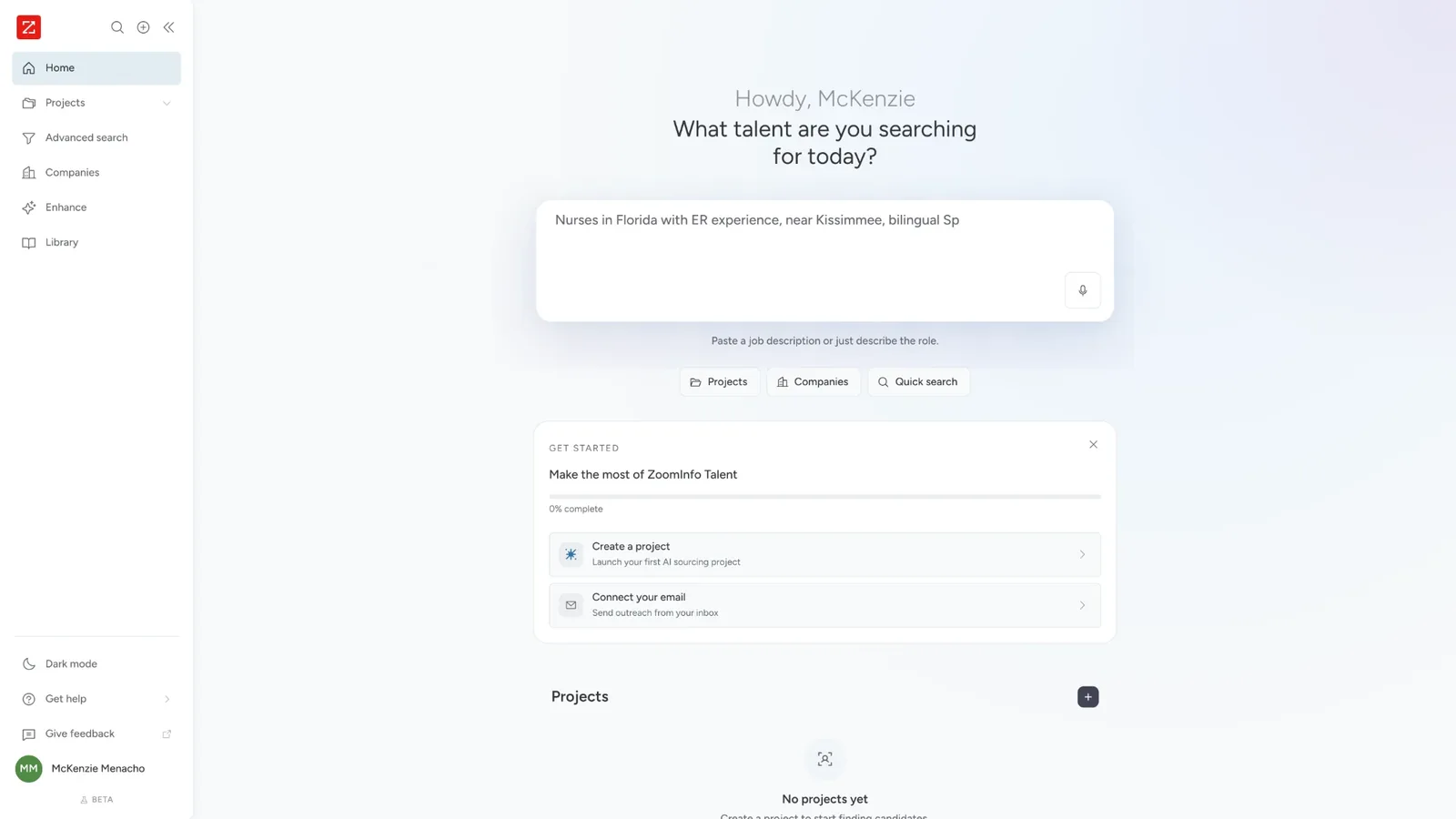
The agent interprets the hiring objective and reasons across professional information, including skills, career history and company intelligence, to help identify people who may be relevant.
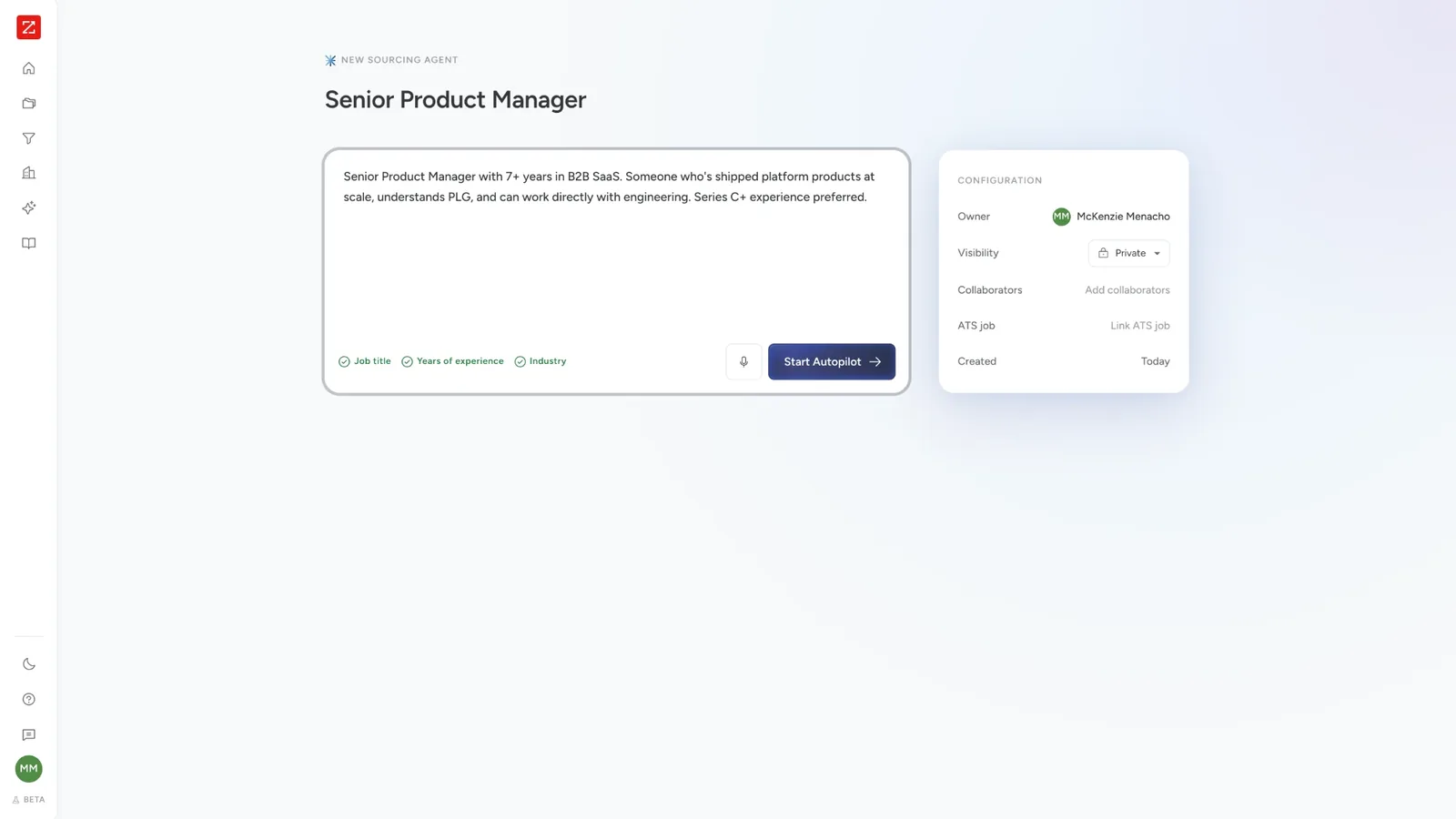
Recruiters can review those candidates, refine the hiring objective and determine who warrants further consideration.
Once outreach is approved, Talent Autopilot supports personalized email engagement through connected Gmail or Outlook accounts. It also provides engagement tracking and candidate response classification.
The recruiter remains in control of outreach approval and candidate decisions.
For an enterprise team, the opportunity is to improve candidate discovery without treating the organization's existing recruiting infrastructure as obsolete.
Workday can continue to support the hiring processes the organization depends on. Talent Autopilot can be evaluated for the additional value it brings to external discovery and engagement.
Whether that combination makes sense depends on the enterprise's sourcing challenges, existing capabilities and technical requirements.
And that's exactly how a technology investment should be evaluated.
Five Questions Enterprise Buyers Should Ask Before Adding an AI Recruiting Agent
If you're evaluating AI recruiting technology alongside Workday, I would start with five questions.
1. Are we finding the same candidates repeatedly?
If your recruiters are consistently returning to familiar talent pools, you may need a different approach to discovery rather than another way to search the same information.
2. What data is powering the agent?
Ask where the professional information comes from, how it is maintained and what verification processes support its accuracy.
3. Does the agent help us discover people beyond obvious titles and keywords?
For difficult or specialized positions, the ability to recognize relevant experience across different career paths can be more valuable than producing another list of exact-title matches.
4. How does the technology fit into our existing recruiting environment?
Understand supported ATS connections, candidate export, duplicate handling, access controls and the practical work required to adopt the product. Don't assume that an advertised integration covers every workflow.
5. How will we know whether it's working?
Measure candidate relevance, recruiter effort, interested responses and progression into meaningful hiring conversations. A faster search is useful, but it isn't the same as a better recruiting outcome.
These questions help distinguish a genuinely useful addition to the recruiting stack from another product that simply promises to do more with AI.
The Next Enterprise Recruiting Investment Should Fill a Gap
Enterprise recruiting leaders have no shortage of technology choices.
Workday's continued investment in AI recruiting is a meaningful development. Its capabilities for candidate evaluation, rediscovery, workflow orchestration and external sourcing deserve serious consideration.
So does the question of whether an organization needs additional technology.
But I wouldn't start that conversation by asking how many AI agents the enterprise already owns.
I'd start with the roles recruiters still struggle to fill.
Which candidates are they unable to find? Where does the existing talent pool fall short? How much time do recruiters spend searching for people who never appear in their usual results? And how often does a promising discovery turn into a meaningful conversation?
Those answers reveal where the opportunity exists.
Sometimes the best candidate is already in your ATS, waiting to be rediscovered.
Sometimes that person has never heard of your company.
A thoughtful enterprise recruiting strategy should account for both.
That's why Talent Autopilot belongs in the conversation for organizations evaluating how to extend their candidate discovery capabilities alongside Workday.
Not because every enterprise needs another AI agent.
Because the next great hire may be someone your current recruiting technology hasn't helped you find yet.
Frequently Asked Questions About Workday and Talent Autopilot
Does Workday have an AI recruiting agent?
Yes. Workday offers a Recruiting Agent powered by HiredScore AI, with capabilities including candidate screening, talent rediscovery and recruiting workflow support. Workday also announced a newer Talent Acquisition Agent in October 2026, designed to support sourcing, screening, candidate communication, scheduling and other hiring activities.
What is the difference between Workday Recruiting Agent and Talent Autopilot?
Workday's Recruiting Agent, powered by HiredScore, focuses on capabilities including applicant evaluation, rediscovery of existing talent and recruiting workflow efficiency. Talent Autopilot focuses on AI-powered candidate discovery and engagement using ZoomInfo's verified professional data. Workday's newer Talent Acquisition Agent also supports external sourcing, so organizations should compare specific capabilities rather than assume the products have no overlap.
Does Talent Autopilot integrate with Workday?
Talent Autopilot supports ATS connectivity capabilities, duplicate awareness and candidate export. A native Workday integration and its specific supported workflows depend on the current connection options and configuration. Enterprise buyers should contact ZoomInfo to verify current Workday compatibility before making assumptions.
Do I need to replace Workday to use Talent Autopilot?
No. Talent Autopilot is not an ATS replacement. It is designed for AI-powered candidate discovery and engagement. Organizations can evaluate it as a complementary recruiting solution while retaining Workday for their established hiring operations, subject to technical compatibility and workflow requirements.
Can Workday source candidates outside its ATS?
Yes. Workday's newer Talent Acquisition Agent includes external sourcing capabilities, and HiredScore supports sourcing from certain external talent sources. The availability and scope of these capabilities depend on the Workday products, connections and configurations an organization uses.
Why would an enterprise use Talent Autopilot alongside Workday?
An enterprise might evaluate Talent Autopilot to expand external candidate discovery, identify relevant professionals beyond traditional title and keyword searches, and support personalized engagement using ZoomInfo's professional data. The value depends on the organization's existing Workday capabilities and remaining sourcing needs.
Does Talent Autopilot replace LinkedIn Recruiter?
Talent Autopilot offers an alternative approach to candidate sourcing by using AI agents and ZoomInfo's professional data to help discover candidates beyond conventional search criteria. Whether it replaces or complements LinkedIn Recruiter depends on the organization's sourcing strategy, existing investments and recruiting requirements.
How does Talent Autopilot help with enterprise candidate sourcing?
Talent Autopilot interprets hiring objectives and reasons across skills, career history and company intelligence to help recruiters identify qualified candidates. It also supports candidate review, refinement, recruiter-approved personalized outreach and engagement tracking.
Where can I learn more about Talent Autopilot?
Visit Talent Autopilot to explore ZoomInfo Talent Solutions' AI recruiting agent for candidate discovery and engagement.
