
Choosing between ActiveCampaign and Zoho comes down to a question most comparison articles skip: are you a marketer who needs a CRM, or a sales team that needs marketing automation?
These five questions will get you closer to the right answer:
Is your primary challenge building marketing campaigns, or managing a sales pipeline?
Do you want one vendor for your entire business stack, or a specialized tool for marketing execution?
How important is email and messaging automation versus CRM customization and process enforcement?
What does your team look like: a small marketing team running campaigns, or a sales organization with reps, territories, and deal pipelines?
How confident are you in the quality of your B2B contact data, and how do you identify which accounts are ready to buy?
In short, here's what we recommend:
ActiveCampaign is the right choice for marketers who need automation without enterprise complexity. Its visual automation builder handles branching, behavioral triggers, and cross-channel orchestration across email, SMS, and WhatsApp from one platform. The Active Intelligence AI layer builds full campaigns from plain-language prompts. But its built-in CRM is lightweight next to dedicated sales tools, pricing climbs as your contact list grows, and advanced features carry a real learning curve.
Zoho is built for teams that need a CRM first and marketing automation second. Zoho CRM covers sales pipelines, territory management, CPQ, and forecasting, all backed by Zia AI for predictive scoring and autonomous sales agents. The broader Zoho ecosystem spans 55+ integrated applications covering finance, HR, support, and analytics under one roof. The trade-off: setup demands significant configuration time, the interface can feel dense, and marketing automation doesn't match a dedicated platform like ActiveCampaign.
Both platforms handle what happens after you have a prospect's attention. Neither solves the problem that comes before: knowing who to target, whether they're in-market, and having verified contact data that doesn't bounce. That's the gap where most B2B campaigns quietly fail.
ZoomInfo is a B2B data and GTM intelligence platform that provides the data layer both ActiveCampaign and Zoho depend on but don't include. With 500M contacts, 100M companies, 135M+ verified phone numbers, and 200M+ verified business email addresses, ZoomInfo gives your marketing automation and CRM a foundation of accurate, current B2B data. Its GTM Context Graph combines this data with your CRM records, conversation transcripts, and behavioral signals to reveal not just who your buyers are, but when they're ready to buy and why. That intelligence flows into your existing tools through native CRM integrations, APIs, and MCP, so whichever platform you choose, the data powering it is verified and complete.
If feeding your CRM and marketing automation with verified B2B data and real-time buyer intent sounds like the missing piece, see how ZoomInfo works.
ActiveCampaign vs. Zoho vs. ZoomInfo at a glance
ActiveCampaign | Zoho | ZoomInfo | |
|---|---|---|---|
Core strength | Marketing automation and email | CRM and business suite | B2B data intelligence and GTM signals |
AI capability | Active Intelligence (campaign building, predictive sending) | Zia (lead scoring, agentic AI, forecasting) | GTM Context Graph (buyer intent, account intelligence) |
CRM depth | Lightweight, marketing-companion CRM | Full sales force automation with CPQ and territories | Not a CRM; enriches any CRM with B2B data |
Marketing automation | Visual builder, cross-channel | Cadences and journey orchestration | Audience building, signal-triggered plays |
Channels | Email, SMS, WhatsApp | Email, phone, SMS, WhatsApp, live chat, social | Display ads, email, connected TV |
Free plan | No (14-day trial) | Yes (up to 3 users) | Yes (ZoomInfo Lite, permanent) |
Starting price | $15/month (1,000 contacts) | $14/user/month | Custom-quoted |
Integrations | 1,000+ apps | 1,100+ apps | 120+ native, plus API and MCP for any tool |
Best for | Marketers running campaigns | Sales teams managing pipelines | Powering either platform with verified data |
Marketing automation vs. CRM: different starting points
ActiveCampaign and Zoho approach the same buyer from opposite directions. Understanding which direction matches yours is the fastest way to a decision.
ActiveCampaign started as an email marketing tool in 2003 and evolved into what it now calls an autonomous marketing platform. Every feature (the automation builder, the CRM, the AI layer) serves marketers. The CRM exists so marketers can track deals their campaigns generated. The AI exists to build and optimize campaigns faster. The platform thinks in campaigns, sequences, and subscriber journeys.
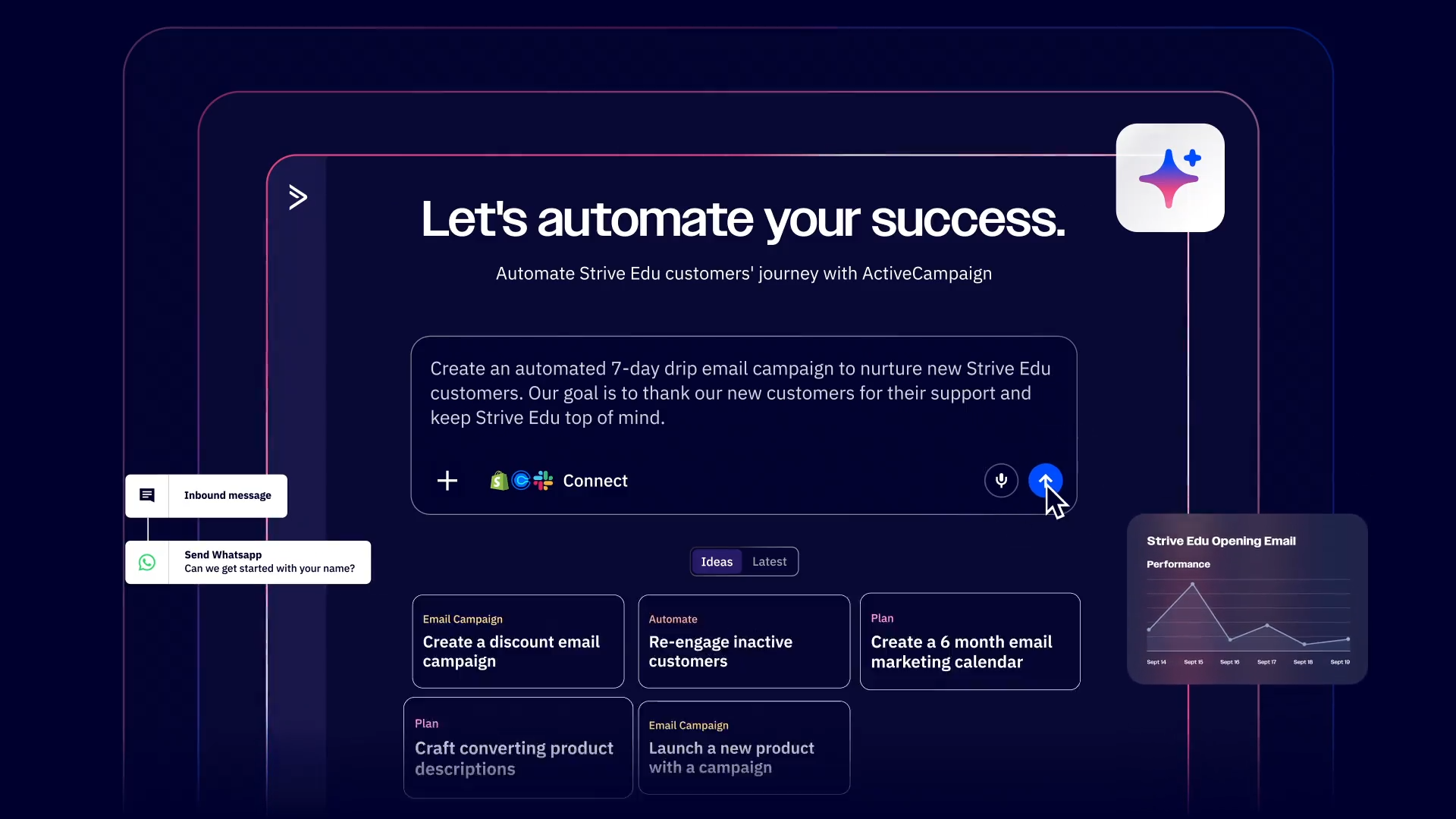
Source: ActiveCampaign
Zoho launched Zoho CRM in 2005 as an affordable Salesforce alternative and expanded into a suite of 55+ applications. Everything orbits the CRM. Marketing automation exists to generate and nurture leads for the sales pipeline. AI exists to help reps close deals faster. The platform thinks in contacts, deals, territories, and revenue forecasts.
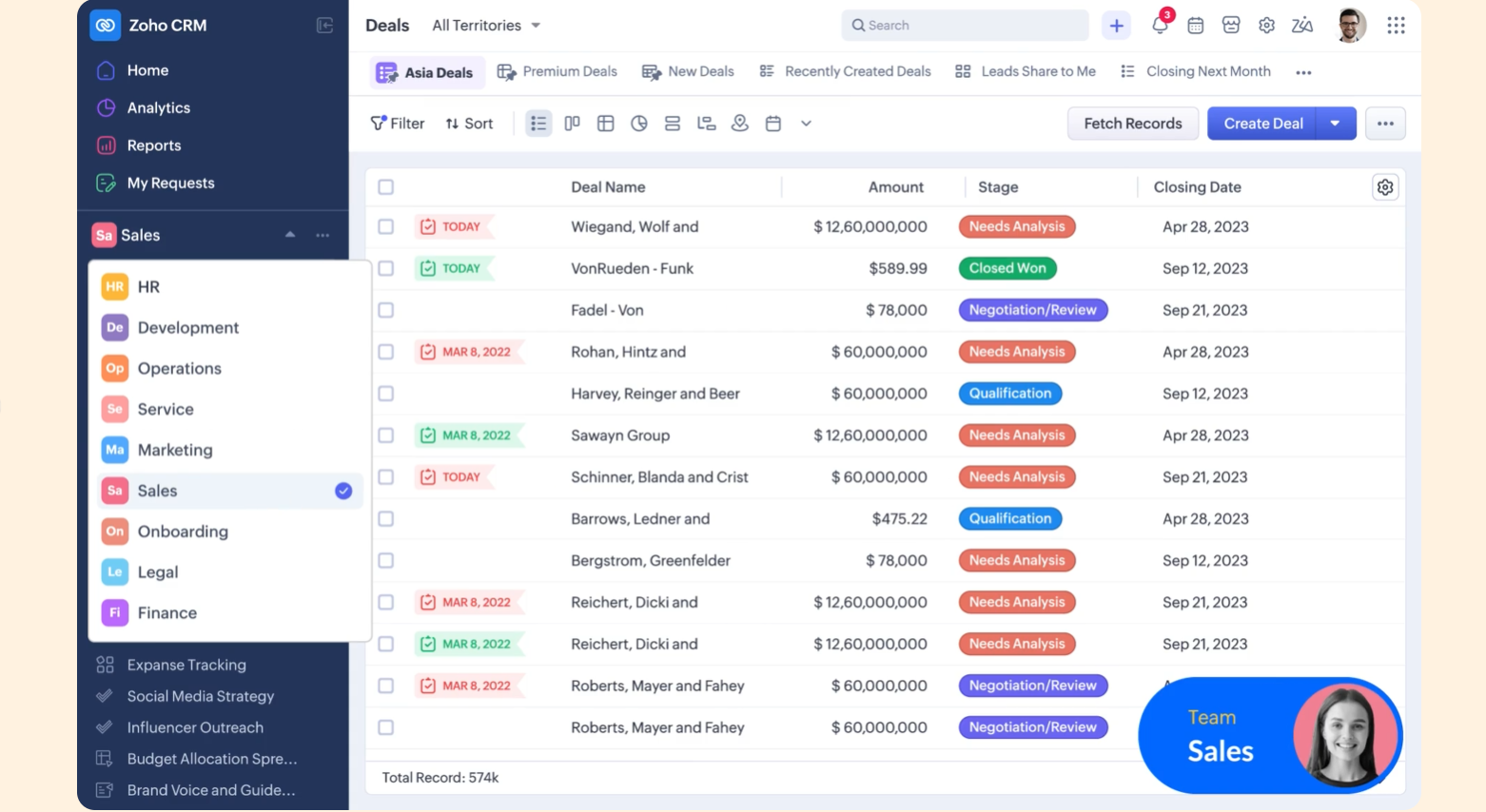
Source: Zoho CRM
For a three-person marketing team running email campaigns, landing pages, and SMS sequences, ActiveCampaign will feel natural from day one. For a sales organization with reps, territories, deal pipelines, and quoting workflows, Zoho will make more sense immediately.
The trouble starts when teams need both, which most B2B companies eventually do.
ActiveCampaign leads on automation depth
ActiveCampaign's visual automation builder is the core of the platform, and it shows. The builder supports unlimited automation actions on Plus plans and above, with branching logic that routes contacts based on real-time behavior, engagement signals, and custom field values. A subscriber who clicks a pricing link gets a different follow-up than one who reads a case study. A lead who opens three emails but never replies gets moved to a phone outreach sequence. The logic can go as deep as you need.
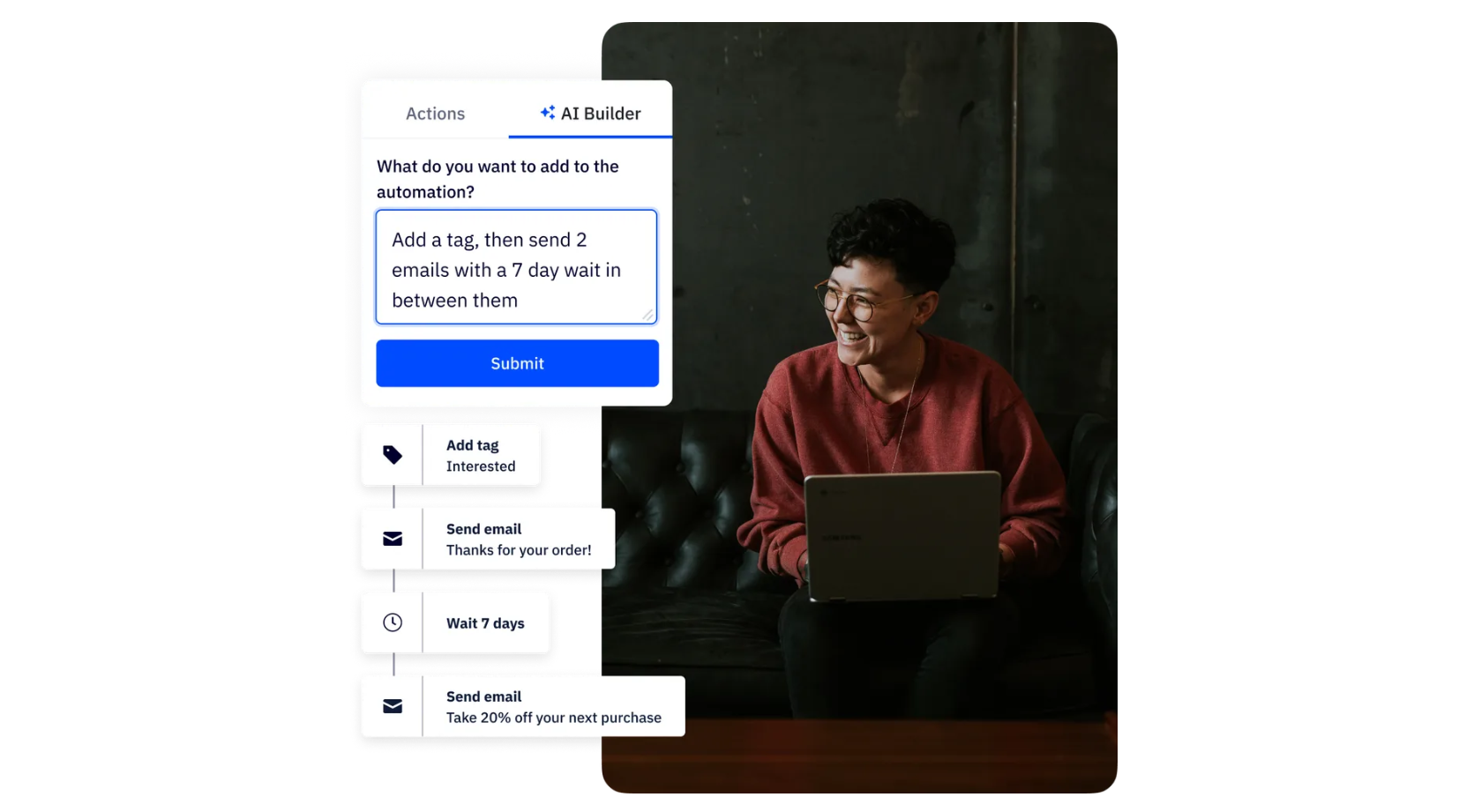
Source: ActiveCampaign
The AI layer, Active Intelligence, takes this further. Describe a marketing goal in plain language, and AI agents build the campaign: subject lines, content, images, audience segments, and send timing. Predictive Sending studies each contact's engagement history and delivers emails when that person is most likely to open, rather than blasting the whole list at once.
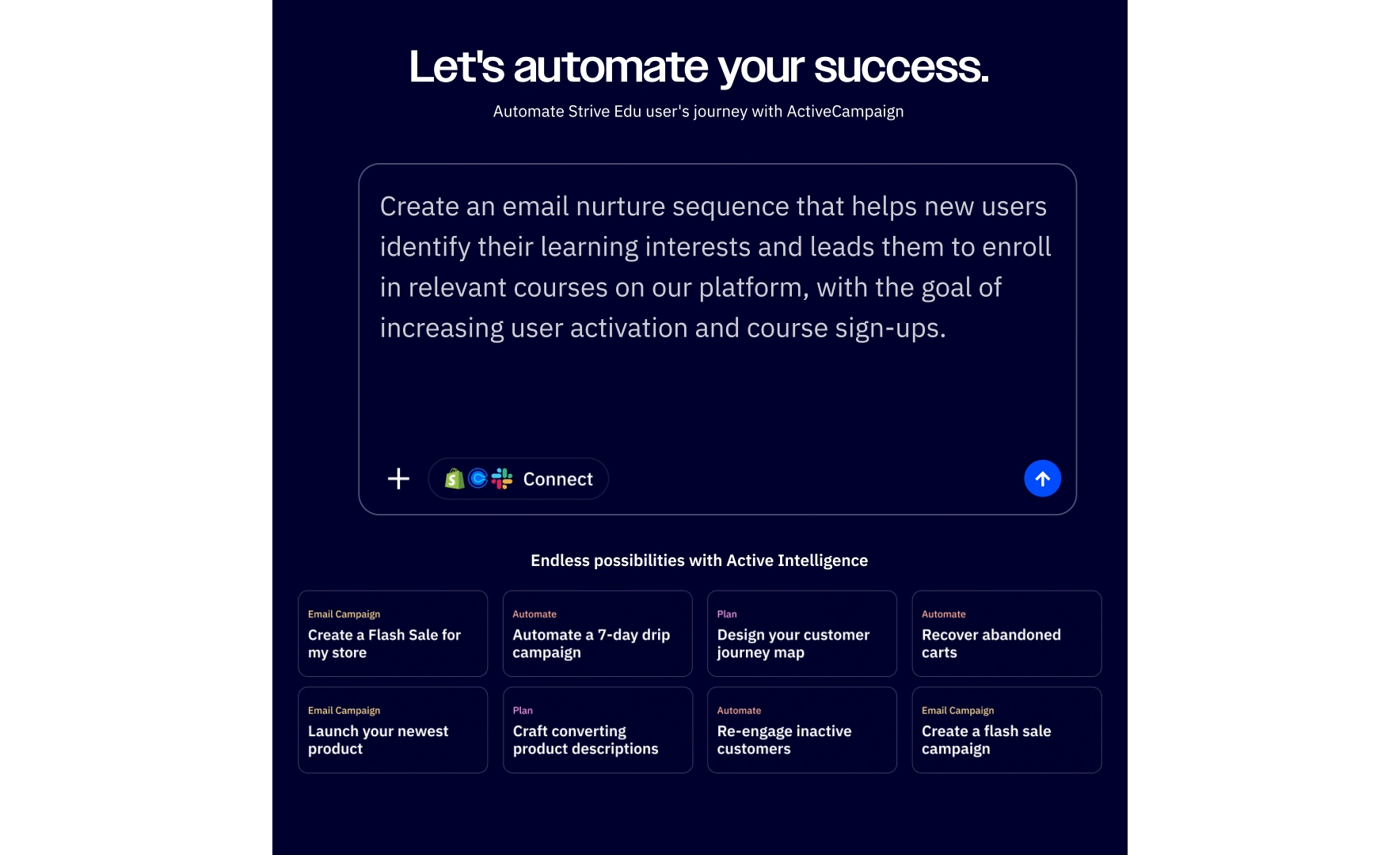
Source: ActiveCampaign
Cross-channel coordination is native. The same automation that triggers an email can follow up with SMS or WhatsApp, all from one builder using shared contact data. ActiveCampaign became a Meta Business Partner for WhatsApp access, and the Hilos acquisition in 2025 added a no-code Flows builder for automated WhatsApp conversations.
Where ActiveCampaign's automation hits its ceiling: the built-in CRM. It handles basic deal pipelines, lead scoring, and one-to-one sales emails, but it lacks territory management, CPQ, sales forecasting with committed vs. best-case categories, and the process enforcement tools that sales-driven organizations need. The CRM is a companion to marketing, not a standalone sales platform.
Zoho wins on CRM depth and ecosystem breadth
Zoho CRM is a full sales force automation platform with capabilities ActiveCampaign doesn't attempt.
Multiple sales pipelines let teams run distinct deal processes for different product lines or geographies within one CRM instance. Blueprint enforces sales process compliance: reps cannot advance a deal to the next stage until they've completed required criteria, logged specific activities, and filled required fields. Territory management handles rule-based account assignment with analytics at the regional, team, and individual level. CPQ lets reps configure product bundles, apply pricing rules, and generate quotes directly from a deal record.
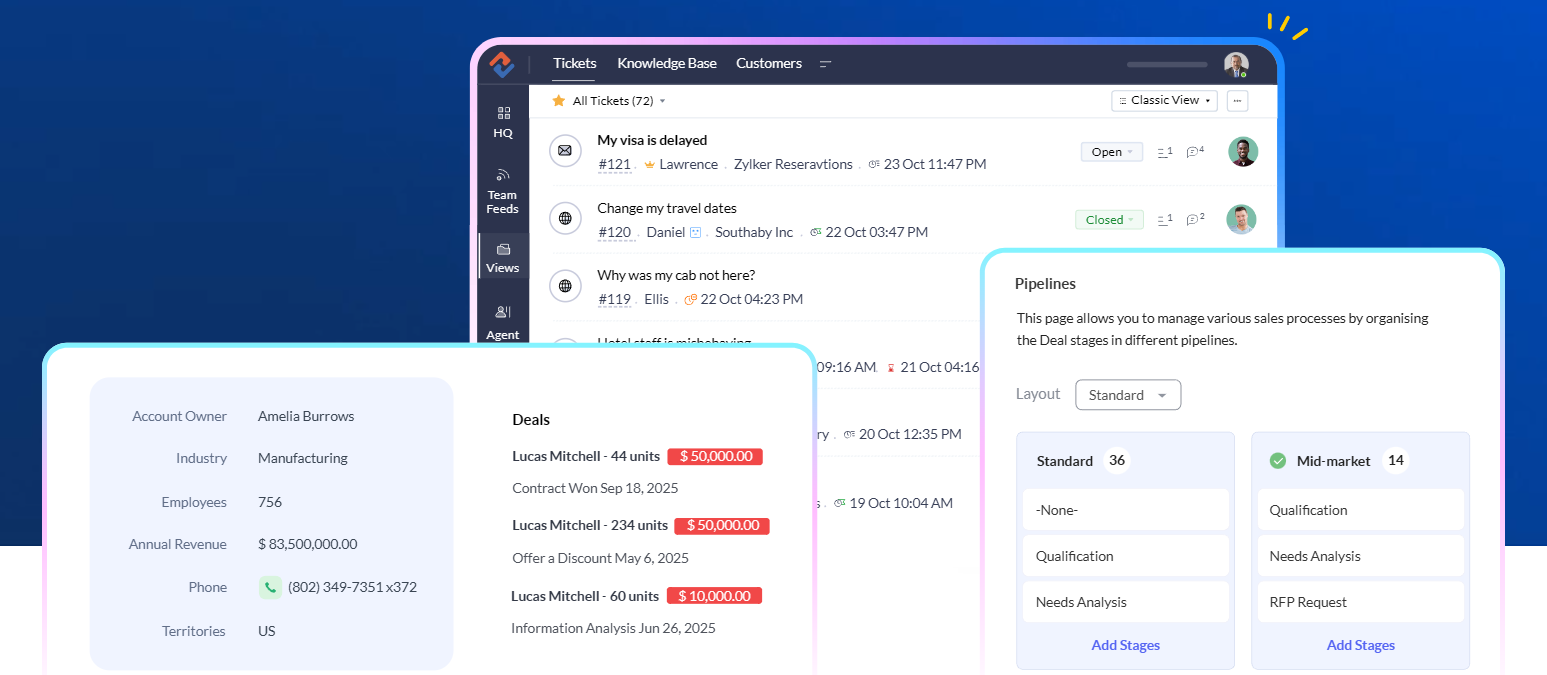
Source: Zoho CRM
The AI layer, Zia, covers three tiers: predictive intelligence (lead scoring, churn prediction, AI forecasting), generative AI (module creation, workflow creation, and report generation from natural language), and agentic AI with autonomous agents that handle multi-step sales tasks. Zia also does something ActiveCampaign's AI doesn't: it monitors audit logs to spot repetitive manual actions and suggests automating them.
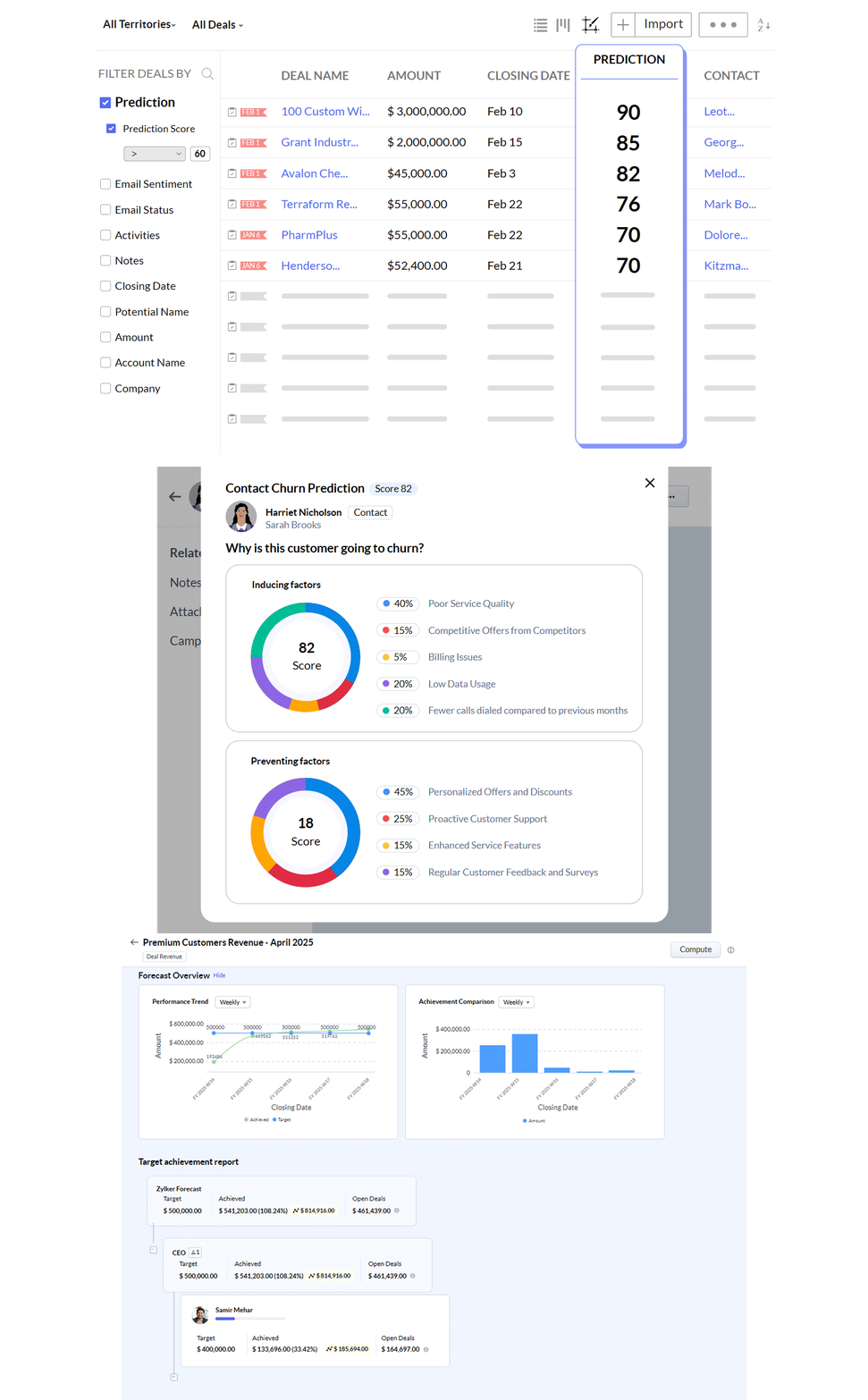
Source: Zoho CRM
Then there's the ecosystem. Zoho CRM connects natively with 40+ first-party applications: finance (Zoho Books), support (Zoho Desk), project management (Zoho Projects), analytics (Zoho Analytics), and more. Zoho One bundles 50+ apps at a flat per-employee rate. For businesses willing to go all-in on one vendor, the integration between apps runs deeper than anything achievable through third-party connectors.
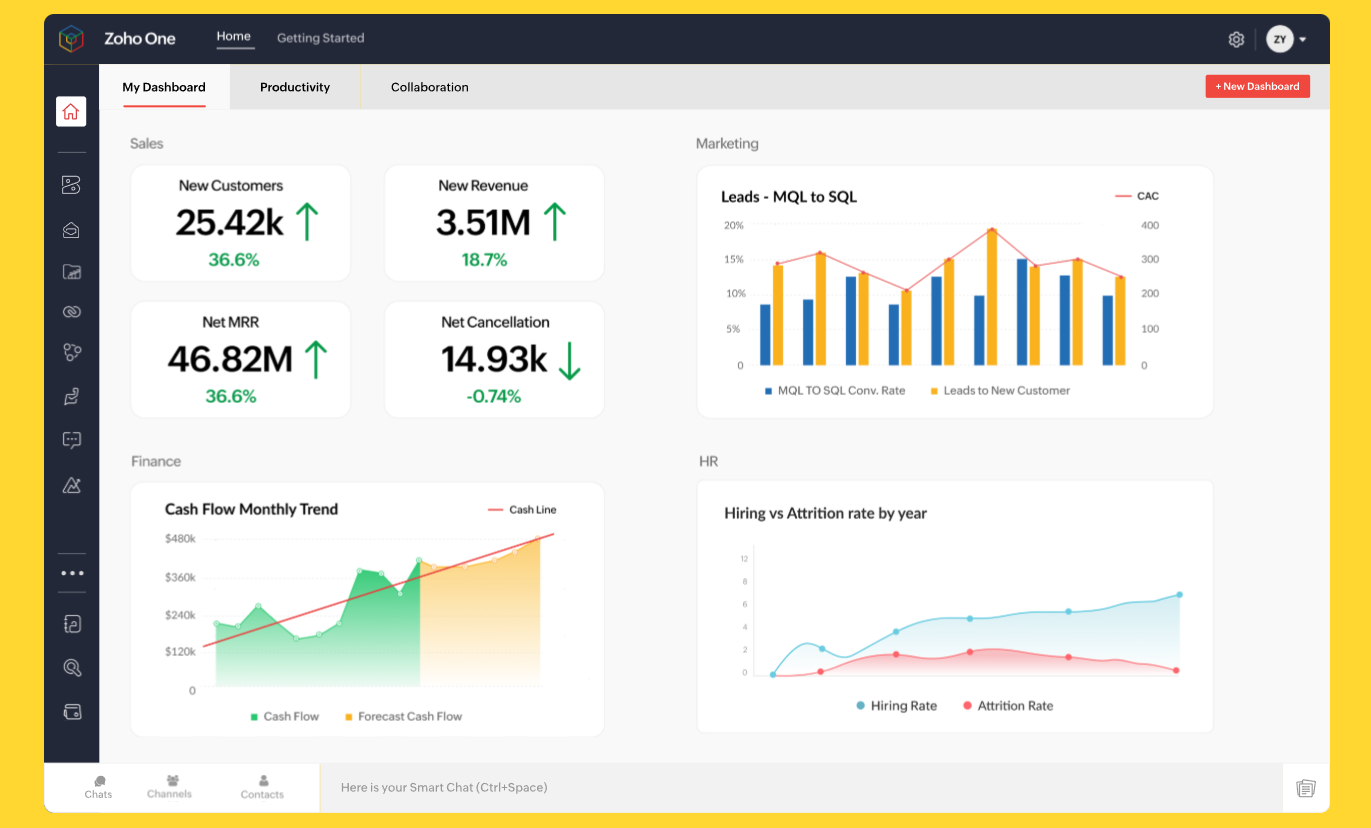
Source: Zoho CRM
Where Zoho's breadth creates friction: setup requires real configuration time rather than immediate out-of-the-box use. The volume of features can overwhelm new users, and the marketing automation capabilities, while solid, don't match ActiveCampaign's specialization. Cadences handle multichannel follow-up sequences, and CommandCenter enables journey orchestration at the Enterprise tier, but neither reaches the granularity of ActiveCampaign's visual automation builder.
AI comparison: Active Intelligence vs. Zia
Both platforms have moved beyond basic AI features into territory that changes how teams work. The implementations reflect each platform's core identity.
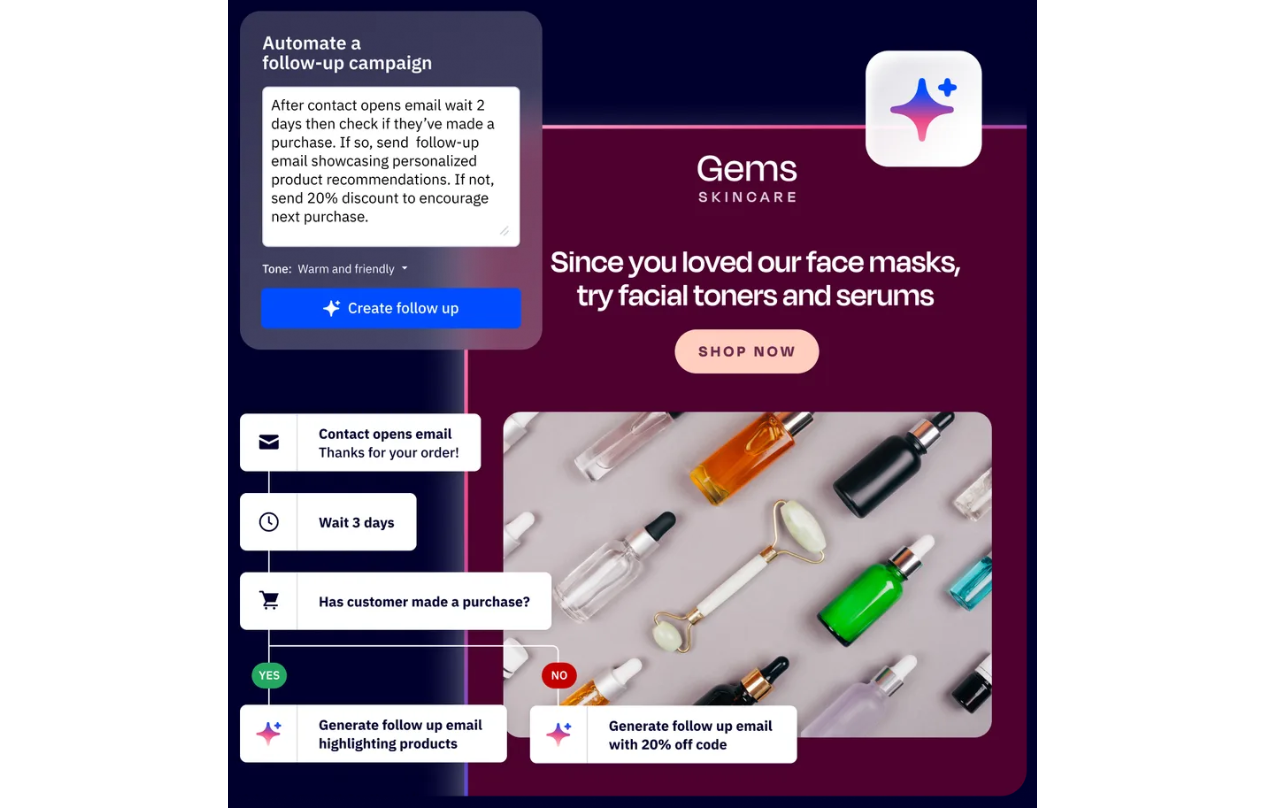
ActiveCampaign's Active Intelligence thinks like a marketer. The AI Campaign Builder generates complete email campaigns from a single prompt: subject lines, content, images, and layouts. AI-Suggested Segments analyze audience data to surface high-value groups marketers might miss. The AI Brand Kit imports brand assets from a website URL. The system cuts campaign creation from hours to minutes.
Source: ActiveCampaign
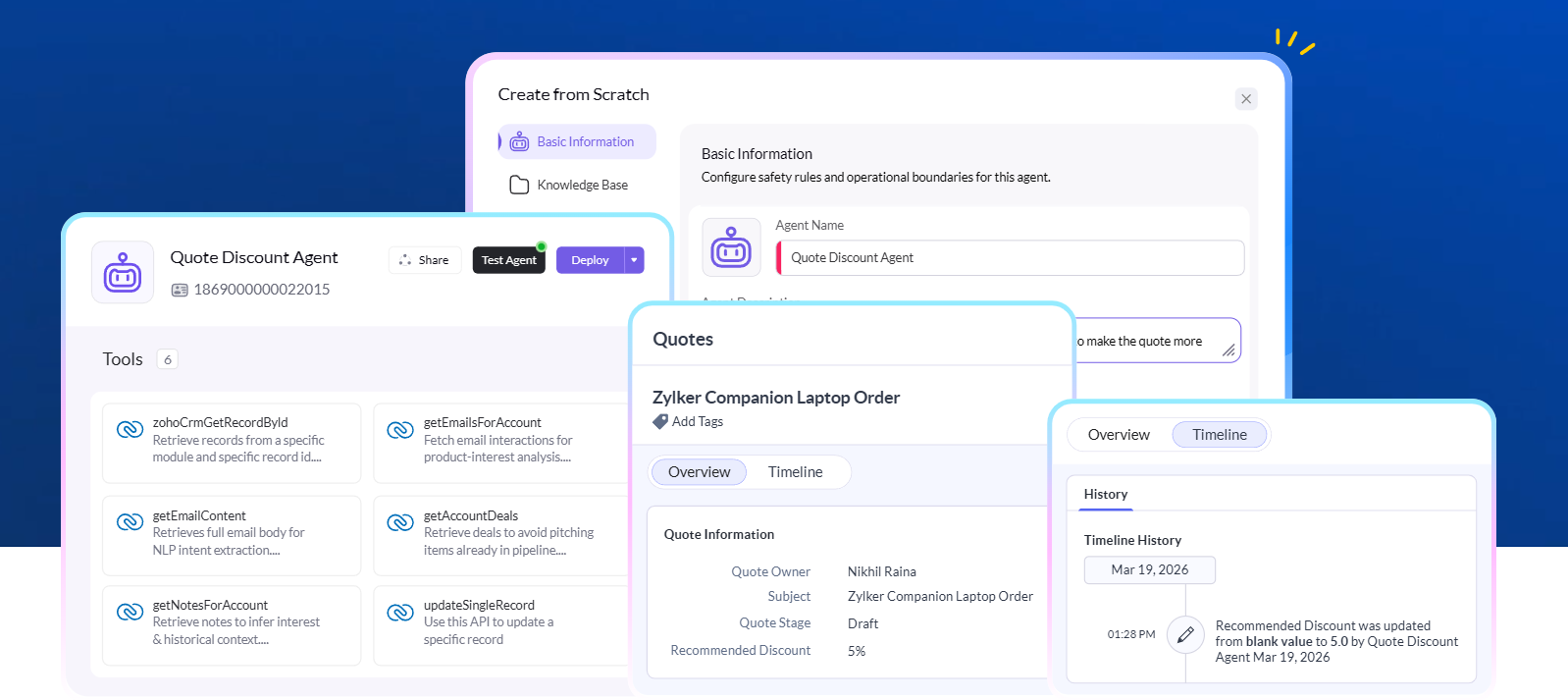
Zoho's Zia thinks like a sales operator. Zia scores rank prospects by conversion likelihood. Churn prediction identifies at-risk accounts. Call transcription converts call audio to text and extracts sentiment, intent, and emotion. Email intelligence classifies incoming messages by sentiment and flags competitor mentions. The Zia Agent Studio offers 100+ pre-built agents integrated with 60+ applications, and QuickML lets Ultimate-tier users build custom ML models on CRM data without a data science team.
Source: Zoho CRM
ActiveCampaign's AI excels at creating and optimizing marketing content and campaigns. Zoho's AI excels at analyzing sales conversations, scoring leads, and discovering automation opportunities. Both are strong in their domains; neither fully covers the other's.
What neither AI can do: tell you which companies outside your existing database are researching solutions like yours right now. That requires a different kind of intelligence entirely.
The data gap both platforms share
ActiveCampaign and Zoho are execution platforms. They handle what happens after a contact enters your system: nurturing, scoring, routing, engaging, and closing. But both depend entirely on the data you feed them.
ActiveCampaign's automation builder can design the most sophisticated branching sequence in the world. If the email addresses it sends to are outdated, the sequence never fires. Zoho's Zia can predict which deals will close with impressive accuracy. If the contact records behind those deals are incomplete (missing direct dials, wrong titles, stale company data), reps waste time chasing ghosts.
This is the structural gap in both platforms. They automate actions on existing data. They don't generate new intelligence about who to target, which accounts are in-market, or how to reach decision-makers with verified contact information.
ZoomInfo exists to fill that gap. The platform provides 500M contacts, 100M companies, 135M+ verified phone numbers, 120M direct-dial phone numbers, and 200M+ verified business email addresses. This data runs through a multi-source verification pipeline backed by 300+ human researchers and achieves up to 95% accuracy on first-party data.
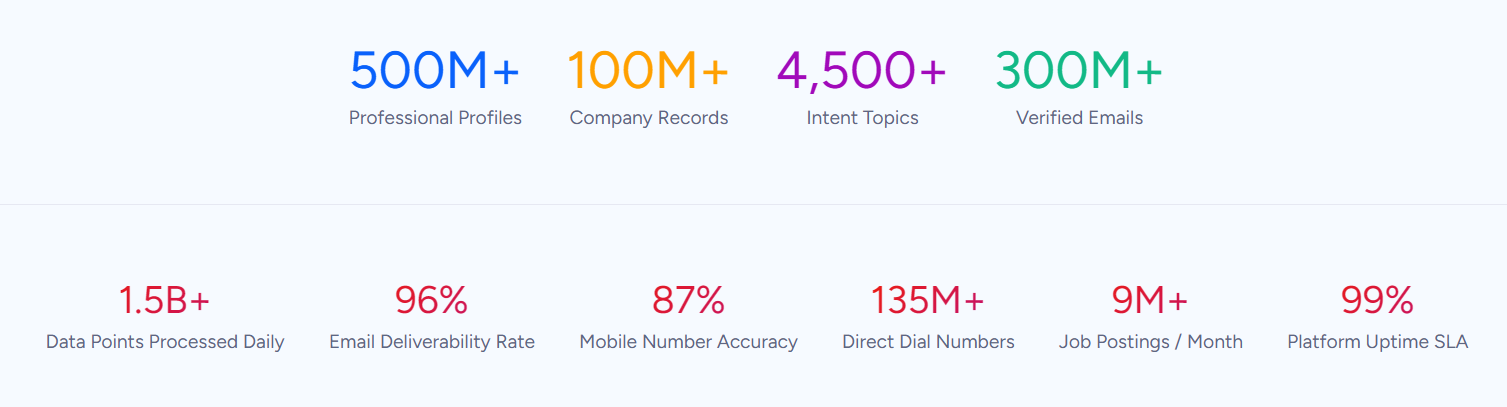
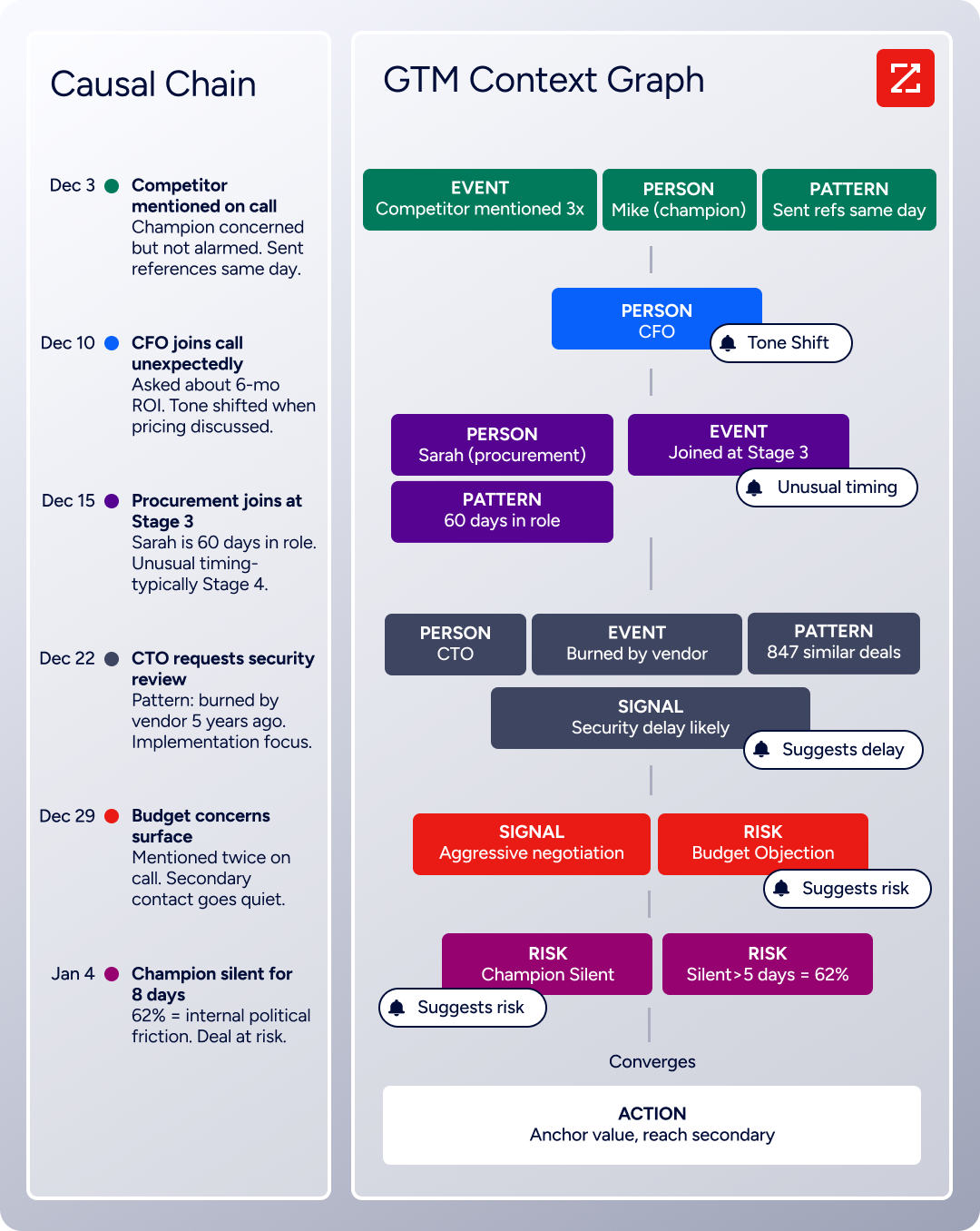
But raw data is only the starting layer. ZoomInfo's GTM Context Graph processes 1.5B+ data points daily, combining ZoomInfo's B2B data with your CRM records, conversation transcripts, and behavioral signals. The result: an intelligence layer that captures not just what happened in a deal, but why it happened. Your CRM records that a deal moved to Stage 3. The GTM Context Graph understands that it moved because the CFO joined the last call and asked about six-month ROI, which matches the pattern behind closed-won deals in your segment.
Buyer Intent data tracks signals from 210 million IP-to-Organization pairings and 6 trillion+ new keyword-to-device pairings sourced monthly, showing which companies are researching solutions in your category. WebSights resolves anonymous website traffic to companies and identifies buying team members with direct contact information.
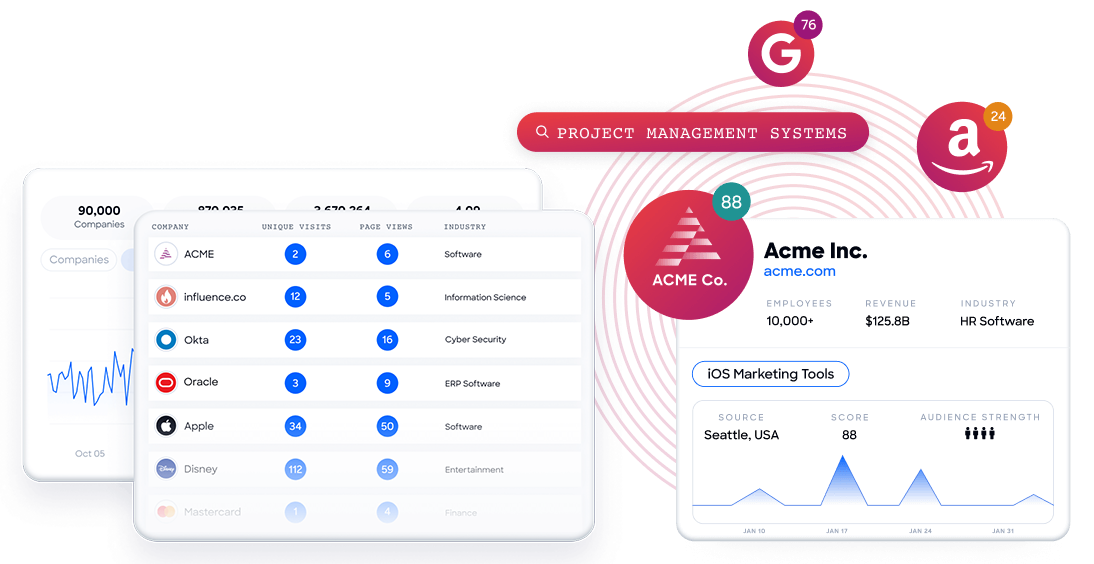
Whether you run ActiveCampaign or Zoho, ZoomInfo answers the questions they can't: Who should I be targeting? Are they ready to buy? And how do I reach them?
"That combination of our internal CRM data, external signals, and AI that's given all that context has helped us craft very specific account- and persona-based messages. And people have responded to them right away." (Toby Carrington, Chief Business Officer, Seismic)
Pricing models reflect different business models
The three platforms price around different units, which tells you who they're built for.
ActiveCampaign charges based on contact count. All plans bill annually by default. The Starter plan begins at $15/month for 1,000 contacts and scales from there; at 10,000 contacts, Starter costs $149/month. Plus, Professional, and Enterprise tiers unlock progressively more features: unlimited automation actions, predictive sending, conditional content, and revenue attribution. Enterprise pricing is custom. The Starter plan caps automations at 5 actions per workflow, which may push growing teams to upgrade quickly. There's a 14-day free trial (no credit card required) and a 30-day money-back guarantee for first-time subscribers, but no permanent free plan.
Zoho CRM charges per user, per month. Annual billing: Standard at $14/user/month, Professional at $23, Enterprise at $40, Ultimate at $52. A permanent free plan supports up to 3 users with basic CRM features. The 15-day free trial gives full Enterprise access, no credit card required. Month-to-month billing is available with no annual lock-in. Compared to Salesforce Enterprise at $165/user/month, the savings are 38-76%. Hidden costs to watch: paid support tiers for priority or dedicated support, Jumpstart implementation at $200/hour (minimum $2,000), and additional data storage at roughly $20/month per GB.
ZoomInfo uses custom-quoted, consumption-based pricing with no publicly listed prices. Costs scale around seats, data credits, and feature access. ZoomInfo Lite is a permanent free tier with access to ZoomInfo's B2B database, 10 monthly export credits, and basic search tools. A 7-day free trial provides broader access. The premium pricing reflects what ZoomInfo provides: verified B2B data at scale, buyer intent signals, and GTM intelligence that neither ActiveCampaign nor Zoho includes at any price tier.
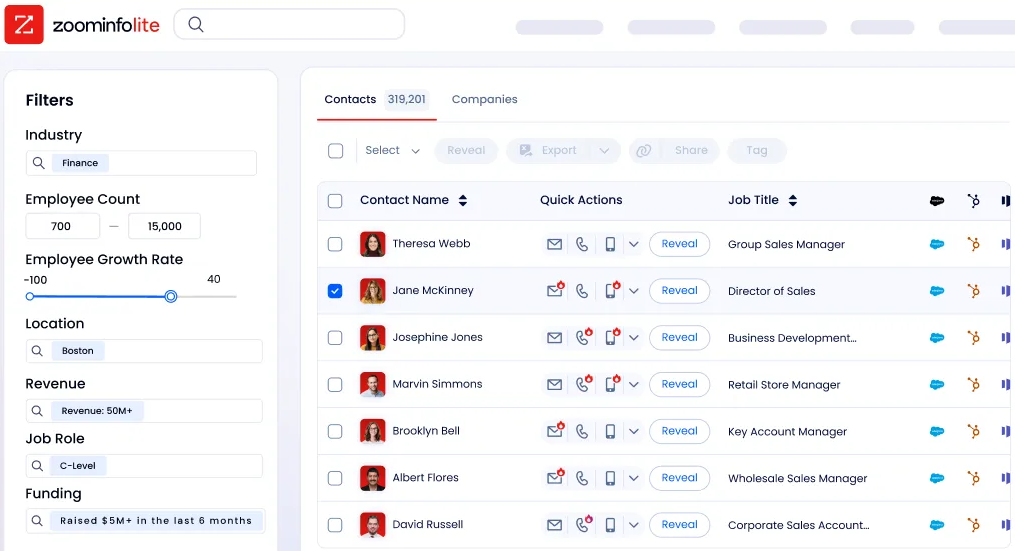
The practical comparison: a 10-person team with 10,000 contacts would pay roughly $149/month for ActiveCampaign Starter or $140/month for Zoho CRM Standard. These are separate spending categories from ZoomInfo, which is a data investment that feeds either platform.
Integration ecosystems and how ZoomInfo connects to both
ActiveCampaign offers 1,000+ app integrations spanning CRM, ecommerce, forms, advertising, and developer tools. Key connectors include Shopify, Salesforce, WordPress, and Zapier. The REST API covers contacts, deals, campaigns, and automations, with App Studio for building custom integrations. ActiveCampaign also offers MCP connectors for Claude and ChatGPT, opening the platform to external AI workflows.
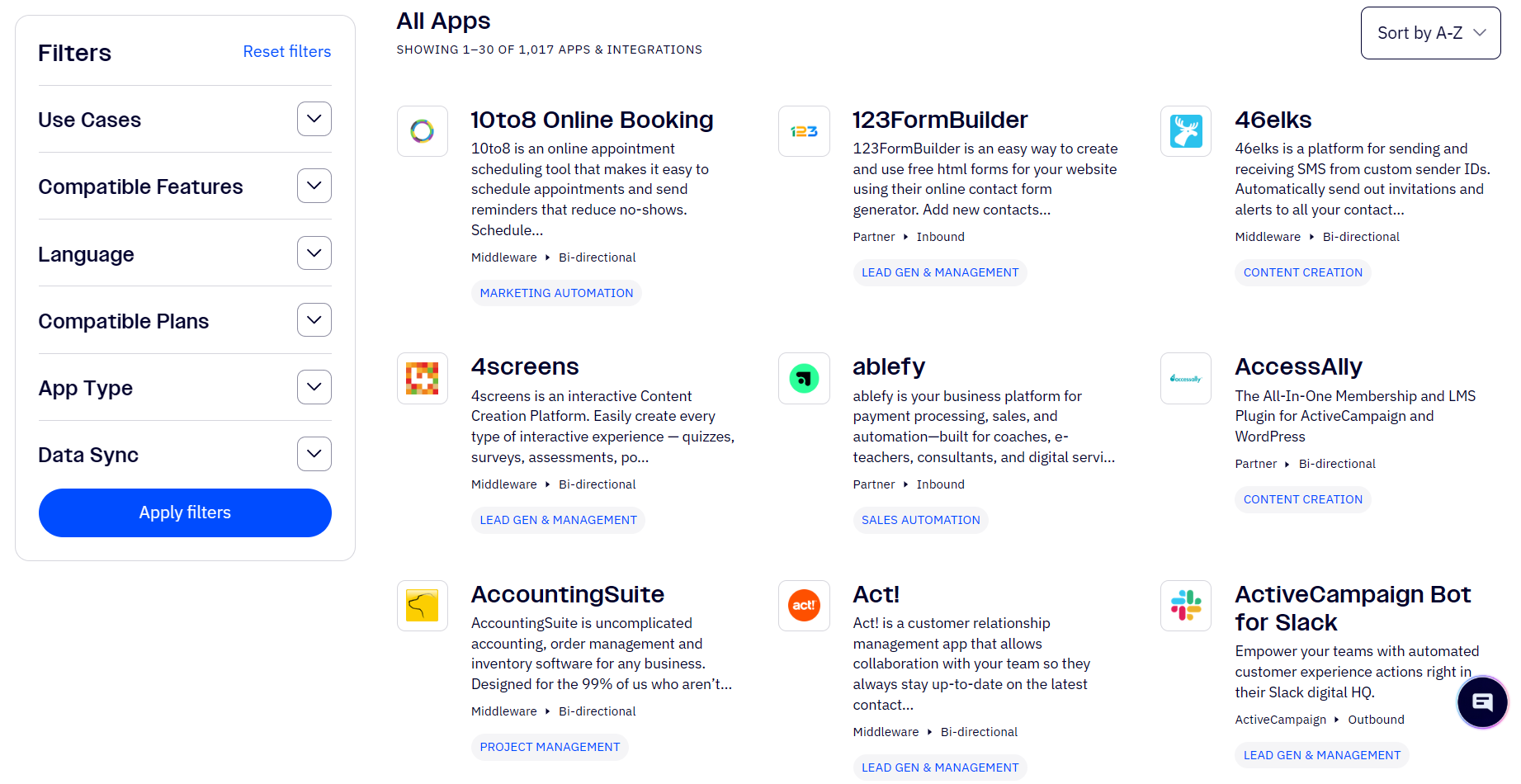
Source: ActiveCampaign
Zoho CRM offers 1,100+ integrations through the Zoho Marketplace, plus native connections to 40+ Zoho apps. The developer platform provides REST and GraphQL APIs, serverless Deluge functions, and a Widget SDK. Zoho Flow handles cross-app workflow automation. Zoho also supports MCP for AI agent access across 950+ Zoho and third-party services.
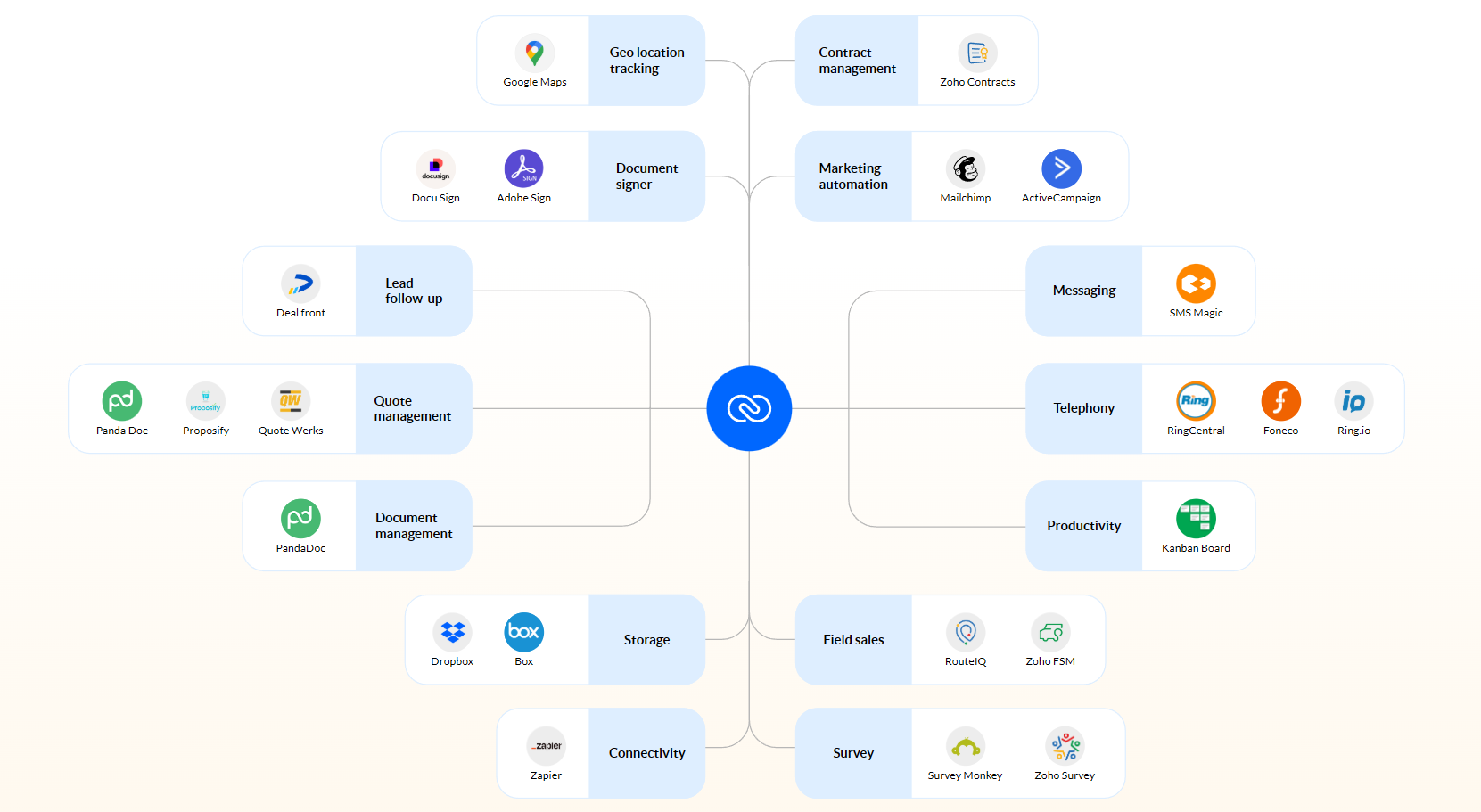
Source: Zoho CRM
ZoomInfo connects to both ecosystems. Its Marketing plans include native integration with Zoho alongside Salesforce, HubSpot, Marketo, and Dynamics. For ActiveCampaign, ZoomInfo data flows through its Enterprise API and iPaaS connectors. The ZoomInfo MCP server exposes ZoomInfo's B2B data and intelligence to any MCP-compatible tool, and API access is included in all relevant plans. The same data and GTM Context Graph available in ZoomInfo's own GTM Workspace and GTM Studio flows into any CRM, marketing automation, or custom application without loss.
"ZoomInfo is our one source of truth for account data, and even more so for contact data. There's no other provider in the market that provides you with that level of detail." (Thor Sanderson, Senior Manager of Sales Technology Enablement, Smartsheet)
Security and compliance comparison
All three platforms take data protection seriously, though certifications and approaches differ.
ActiveCampaign supports GDPR, CCPA, and LGPD compliance with published Data Processing Addenda. HIPAA support and SSO are available on Enterprise plans. SOC 2 certification was not confirmed in available public sources.
Zoho holds ISO 27001, ISO 27701, SOC 2 Type 2, and HIPAA certifications. The company operates its own data centers with 18 locations globally, biometric access, and AES-256 encryption. Zoho's privacy stance is explicit: no advertising-based revenue, no data selling, no third-party trackers.
ZoomInfo maintains ISO 27001, ISO 27701, SOC 2 Type II, TRUSTe GDPR, and TRUSTe CCPA certifications, all renewed annually. ZoomInfo is a registered data broker in California and Vermont, with compliance built into the data layer itself.
For regulated industries, Zoho's self-hosted infrastructure and ZoomInfo's certification stack both provide strong foundations. ActiveCampaign covers the basics but may need Enterprise-tier upgrades for healthcare or financial services compliance.
ActiveCampaign vs. Zoho vs. ZoomInfo: Which should you choose?
The choice between ActiveCampaign and Zoho depends on where your team spends most of its time. ZoomInfo is the data layer that makes either choice work harder.
Choose ActiveCampaign if:
Marketing automation is your primary need
You want email, SMS, and WhatsApp campaign orchestration
Your team is small and marketing-led
You need AI that builds and optimizes campaigns from plain-language prompts
A lightweight CRM for tracking marketing-generated deals is sufficient
Choose Zoho if:
You need a full CRM with sales pipelines, territories, and forecasting
Your team includes sales reps who need process enforcement and deal management
You want one vendor covering CRM, finance, HR, and support
AI-powered lead scoring, call intelligence, and sales coaching matter to your workflow
Budget matters and you want enterprise features at mid-market pricing
Add ZoomInfo to either platform if:
You need verified B2B contact data that reaches decision-makers
You want to know which accounts are researching solutions in your category
Your campaigns and outreach suffer from stale, incomplete, or inaccurate data
You're ready to move from guessing who to target to knowing, backed by buyer intent signals and the GTM Context Graph
You want the same intelligence available in your CRM, your marketing tools, and any AI agent through API and MCP
Explore ZoomInfo with a permanent free Lite account or a 7-day trial.
ActiveCampaign and Zoho each solve real problems for real teams. ActiveCampaign turns one marketer into a campaign machine. Zoho turns a growing sales team into an organized revenue operation. But the campaigns and pipelines both platforms run are only as good as the data behind them. ZoomInfo provides the B2B data foundation, the buying signals, and the contextual intelligence that turns good marketing automation and good CRM into predictable revenue growth.
Your tool choice determines how you execute. Your data determines whether that execution connects with the right people at the right time.
ActiveCampaign vs. Zoho vs. ZoomInfo FAQ
What is the fundamental difference between ActiveCampaign, Zoho, and ZoomInfo?
ActiveCampaign is a marketing automation platform with a built-in CRM, focused on email, SMS, and WhatsApp campaign orchestration with visual automation. Zoho is a CRM-first business suite with 55+ integrated applications, offering sales force automation, territory management, CPQ, and marketing capabilities. ZoomInfo is a B2B data intelligence platform that provides verified contact data, company intelligence, and buyer intent signals to power either platform's outreach and pipeline.
Which is cheaper: ActiveCampaign or Zoho?
Zoho is cheaper for most teams. Its CRM starts at $14/user/month with a permanent free plan for up to 3 users. ActiveCampaign starts at $15/month for 1,000 contacts on its Starter plan, but costs climb with contact volume: 10,000 contacts costs $149/month on Starter alone. For a 10-person team, Zoho CRM Standard costs about $140/month total while ActiveCampaign's cost depends entirely on list size.
Do I need ZoomInfo if I already use ActiveCampaign or Zoho?
ZoomInfo addresses a gap that neither platform fills. ActiveCampaign and Zoho automate actions on contacts already in your system, but they don't provide B2B contact databases, buyer intent signals, or verified direct-dial phone numbers. ZoomInfo's 500M contacts and 200M+ verified business emails give your campaigns and pipelines a foundation of accurate, current data. Its buyer intent data shows which companies are researching your category before they fill out a form.
Which platform has better AI capabilities?
Each excels in its own domain. ActiveCampaign's Active Intelligence builds marketing campaigns from prompts and optimizes send times per subscriber. Zoho's Zia scores leads, predicts churn, transcribes calls, and suggests workflow automation opportunities. ZoomInfo's GTM Context Graph processes 1.5B+ data points daily to reveal why deals move or stall and which accounts match your proven win patterns. The AI capabilities are complementary rather than competitive.
Can ZoomInfo integrate with both ActiveCampaign and Zoho?
Yes. ZoomInfo's Marketing plans include native integration with Zoho alongside Salesforce, HubSpot, and others. For ActiveCampaign, ZoomInfo data flows through its Enterprise API and iPaaS connectors. The ZoomInfo MCP server connects to any MCP-compatible tool, and API access is included in all relevant ZoomInfo plans.
Which platform is easier to set up and learn?
ActiveCampaign's basic features are accessible quickly, though mastering advanced automation takes time. Zoho requires the most upfront configuration: its depth of features means significant setup before delivering value, particularly for Blueprint process design and Canvas UI customization. ZoomInfo is the simplest to adopt: ZoomInfo Lite offers a permanent free tier with immediate access to B2B search, and the broader platform deploys in weeks rather than months.
Which platform handles marketing automation better: ActiveCampaign or Zoho?
ActiveCampaign is the stronger marketing automation platform. Its visual automation builder supports unlimited actions with complex branching, behavioral triggers, and cross-channel orchestration across email, SMS, and WhatsApp. Zoho offers Cadences for multichannel follow-up and CommandCenter for journey orchestration, but these are supplements to a CRM-first platform rather than core specializations. For teams whose primary job is running marketing campaigns, ActiveCampaign is the more capable choice.
What kind of data does ZoomInfo provide that ActiveCampaign and Zoho don't?
ZoomInfo provides B2B identity data (verified email addresses, direct-dial phone numbers, job titles), company intelligence (firmographics, org charts, technographics across 30,000+ technologies), and buying signals (buyer intent from 210 million IP-to-Organization pairings, website visitor identification, job-change alerts, funding events). Neither ActiveCampaign nor Zoho includes a B2B contact database, buyer intent monitoring, or anonymous website visitor identification at the company or contact level.
