
Adobe Experience Platform is one of the largest enterprise customer data platforms, providing a shared data foundation for real-time customer profiles, cross-channel journey orchestration, and personalization.
But many organizations discover that AEP's enterprise-only pricing, six-to-eighteen-month implementation timelines, and Adobe ecosystem dependency create real barriers. Profile-volume pricing rises as data grows, XDM schema design demands dedicated engineering resources, and Gartner's 2025 CDP Magic Quadrant reclassified AEP from Leader to Visionary, a sign that specialized alternatives are outperforming it on standalone CDP criteria.
That's where this guide comes in. Whether you're looking to:
Power B2B go-to-market execution with intelligence data and prospecting
Unify customer data within your Salesforce ecosystem without a parallel platform
Orchestrate vendor-neutral, real-time data routing across a multi-vendor martech stack
Stand up a customer data pipeline in days with transparent, self-serve pricing
Collect and activate mobile-first behavioral event data with schema enforcement at the source
Activate warehouse data for marketing without duplicating it into a proprietary store
Own your data infrastructure with an open-source CDP and deployment flexibility
We'll explore Adobe Experience Platform alternatives that excel in each area.
This isn't about finding a "better" platform than AEP. It's about finding the right fit for your data architecture, team structure, and budget. Some organizations will complement AEP with these tools; others will replace it entirely.
The Best Adobe Experience Platform Alternatives |
|---|
Best Alternative for B2B Go-to-Market Intelligence and Prospecting We chose ZoomInfo because it delivers the B2B data foundation and GTM intelligence that AEP's consumer-focused architecture was never designed to provide. |
Best Alternative for Enterprise Teams Already Running Salesforce We chose Salesforce Data 360 because it unifies Sales Cloud, Service Cloud, and Marketing Cloud data into a single profile without the ETL overhead and schema migration that AEP demands from Salesforce-heavy organizations. |
Best Alternative for Vendor-Neutral Real-Time Data Orchestration We chose Tealium because its 1,300+ pre-built integrations and consent enforcement at the point of data collection make it a leading vendor-neutral CDP for regulated industries and multi-vendor martech stacks. |
Best Alternative for Accessible, Self-Serve Customer Data Infrastructure We chose Twilio Segment because its permanent free tier, published pricing, and 700+ destination integrations let teams validate a CDP approach in days rather than the months AEP requires before a single event is tracked. |
Best Alternative for Mobile-First Consumer Brands We chose mParticle because its native mobile SDKs, schema enforcement at collection, and included Cortex AI predictive audiences make it built for organizations where the mobile app is the primary customer touchpoint. |
Best Alternative for Warehouse-Native Activation Without Data Duplication We chose Hightouch because it delivers CDP capabilities on top of existing Snowflake, Databricks, or BigQuery environments, eliminating the profile-volume pricing and data migration that AEP requires. |
Best Alternative for Engineering-Led Data Ownership We chose RudderStack because its open-source core, customer VPC deployment, and warehouse-native architecture give data engineering teams full control over their customer data pipeline without vendor lock-in. |
What is Adobe Experience Platform?
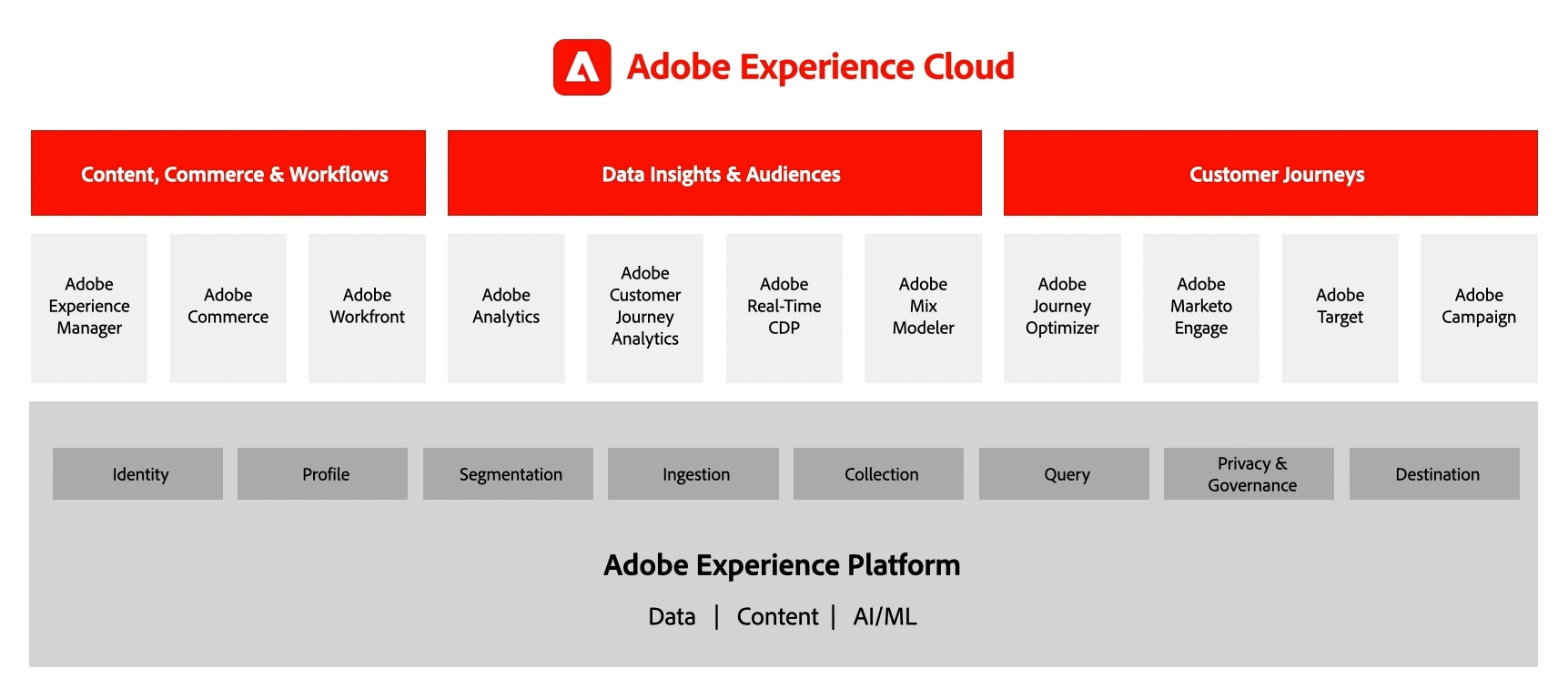
Source: Adobe
Adobe Experience Platform (AEP) is a cloud-native data platform that sits beneath Adobe's enterprise product suite. It centralizes customer data from any system and applies machine learning to deliver personalized experiences. Its key features include:
Real-Time Customer Profile that merges data from online, offline, CRM, and third-party sources into a single, continuously updated view of each customer
Identity Service with a deterministic identity graph resolving anonymous and known identifiers across devices and channels
Segmentation Service supporting streaming, batch, and edge audience evaluation with a visual Segment Builder
500+ destination connectors for activating audience data across advertising, email, CRM, and cloud storage platforms
Data governance framework (DULE) that enforces usage restrictions at the schema field level, propagating compliance labels through every downstream activation
AI capabilities via Adobe Sensei, including Customer AI for churn and propensity scoring, and Agent Orchestrator for autonomous marketing workflows
AEP powers applications like Real-Time CDP, Adobe Journey Optimizer, and Customer Journey Analytics. When data from any channel enters the platform, it's normalized against the Experience Data Model (XDM), resolved to a unified profile, and made available for segmentation and activation across Adobe's ecosystem.
That shared data layer is AEP's core value. But its enterprise-only pricing (billed per 1,000 profiles with no published rate card), long implementation timelines that routinely require certified SI partners, and the ecosystem commitment needed to extract full value mean many organizations need more specialized tools for parts of their data strategy. That's what we'll explore next.
Looking for B2B intelligence to power your go-to-market strategy? ZoomInfo's GTM Context Graph unifies 500M contacts, 100M companies, and 1.5B+ daily data points into insights your sales and marketing teams can use today. Learn more about ZoomInfo.
How We Curated Our List of Adobe Experience Platform Alternatives
After evaluating AEP and researching the CDP market, we found that AEP's broad approach to customer experience creates gaps for organizations with different data architectures, team structures, and go-to-market needs. AEP unifies B2C customer data well for large enterprises already invested in Adobe's ecosystem, but many businesses need more specialized tools for:
Powering B2B go-to-market execution with verified contact data, intent signals, and prospecting
Unifying customer data within an existing Salesforce ecosystem without parallel infrastructure
Orchestrating real-time data flows across a multi-vendor martech stack without ecosystem lock-in
Standing up a data pipeline quickly with transparent, self-serve pricing
Collecting mobile-first behavioral data with schema enforcement before bad events corrupt downstream systems
Activating warehouse data for marketing without duplicating it into a proprietary profile store
Owning the data infrastructure with open-source flexibility and deployment control
Each tool on this list leads in one of these areas. You might use them alongside AEP or as a standalone replacement.
DISCLAIMER: We aren't covering every customer data platform on the market! Our focus is on highlighting the best alternatives that address specific limitations of Adobe Experience Platform for various use cases and team structures. |
|---|
1. ZoomInfo – Best Alternative for B2B Go-to-Market Intelligence and Prospecting
ZoomInfo is an AI GTM platform built on the largest B2B data foundation in the industry. While AEP is architected for B2C customer experience (unifying consumer interactions across channels for personalization), ZoomInfo serves the B2B intelligence layer: identifying who your buyers are, when they're in-market, and what to say to them. Its key features include:
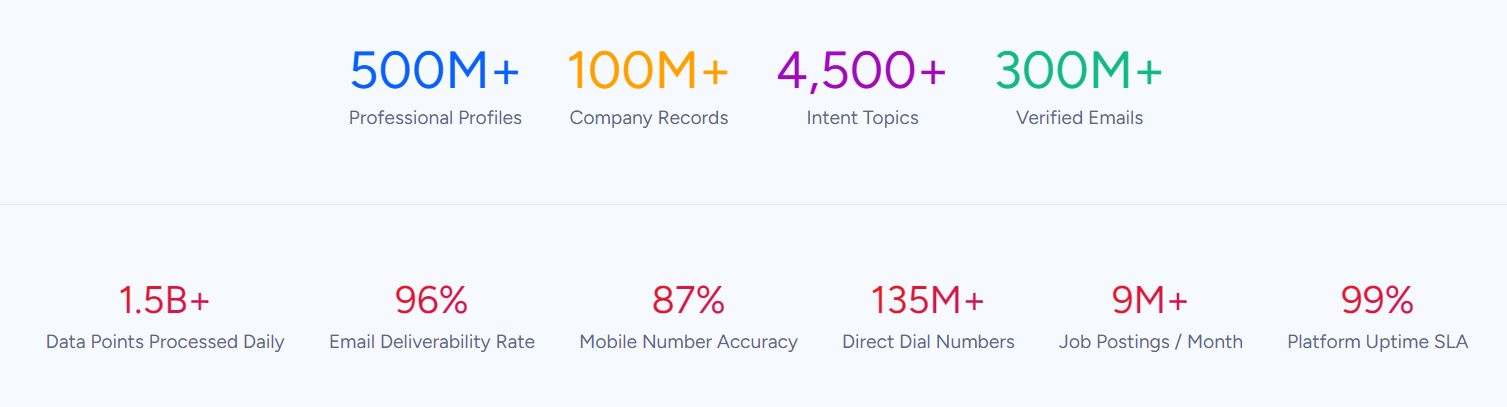
B2B data: 500M contacts, 100M companies, 135M+ verified phone numbers, 120M direct-dial phone numbers, and 200M+ verified business email addresses, verified by 300+ human researchers with up to 95% accuracy on first-party data
Buyer Intent Data: ZoomInfo Intent tracks signals from 210 million IP-to-Organization pairings and 6 trillion+ new keyword-to-device pairings sourced monthly, with Guided Intent identifying topics historically correlated with deal success
GTM Context Graph: An intelligence layer processing 1.5B+ data points daily that fuses ZoomInfo's B2B data with your CRM records, conversation transcripts, and behavioral signals to capture not just what happened in a deal, but why it happened
Universal access: GTM Workspace for sellers, GTM Studio for marketers and RevOps, and APIs and MCP for any custom tool or AI agent
For B2B organizations, ZoomInfo doesn't replace AEP's consumer personalization. It fills the go-to-market intelligence gap that AEP's consumer-focused architecture leaves open: verified contact data for prospecting, intent signals that show when companies are in-market, and execution tools that tell sellers who to contact, when to engage, and what to say.
Why Choose ZoomInfo Over Adobe Experience Platform for B2B Go-to-Market Intelligence
AEP unifies consumer behavioral data for personalization. But for B2B revenue teams, the challenge isn't stitching anonymous website sessions into profiles. It's finding verified decision-makers, knowing when accounts are in-market, and executing coordinated outreach. ZoomInfo addresses these needs directly.
The Largest B2B Data Platform: Verified Contacts, Not Anonymous Profiles
AEP's Real-Time Customer Profile is designed around consumer identity resolution: stitching cookie IDs, device IDs, and CRM records into unified profiles for known and anonymous visitors. For B2B go-to-market teams, the need is different. You need verified contact information for specific decision-makers at target accounts, with direct dials that actually ring and emails that actually land.
ZoomInfo operates the largest B2B data platform, covering three dimensions: identity data (who buyers are and how to reach them), company context (100M companies with org charts, technographics, and other attributes), and signals showing when accounts are in-market. In a Fortune 500 competitive RFP analyzing 25 million contacts across vendors, the independent consultant concluded that "no other competitor came even close."
ZoomInfo in Action: Your marketing team identifies a target account showing intent signals for your product category. Instead of waiting for that account to fill out a web form (AEP's model), ZoomInfo surfaces the entire buying committee with verified direct dials and business emails, the company's technology stack, recent funding or leadership changes, and the specific intent topics they're researching. Your sales team reaches out with informed messaging before the account has even engaged with your website.
ZoomInfo's data advantage is externally validated: Forrester Wave Leader for Intent Data Providers B2B (Q1 2025), Gartner MQ Leader for ABM Platforms for two consecutive years, and 133 No. 1 rankings on G2 Summer 2025.
The GTM Context Graph: Intelligence That Explains Why Deals Move
AEP unifies consumer touchpoints, but its intelligence layer is built around consumer journey orchestration: churn scoring, next-best-offer, and audience segmentation. For B2B, the critical intelligence isn't "which segment does this consumer belong to?" It's "why did this deal accelerate, who's championing it, and what should the rep do next?"
The GTM Context Graph fuses ZoomInfo's B2B data with your CRM records, Chorus conversation intelligence, email interactions, and behavioral signals into a single intelligence layer. As ZoomInfo CPO Dominik Facher explains: "The CRM recorded the state change. It has no record of why it happened." The GTM Context Graph captures that context, powering AI that understands deal dynamics rather than just recording them.
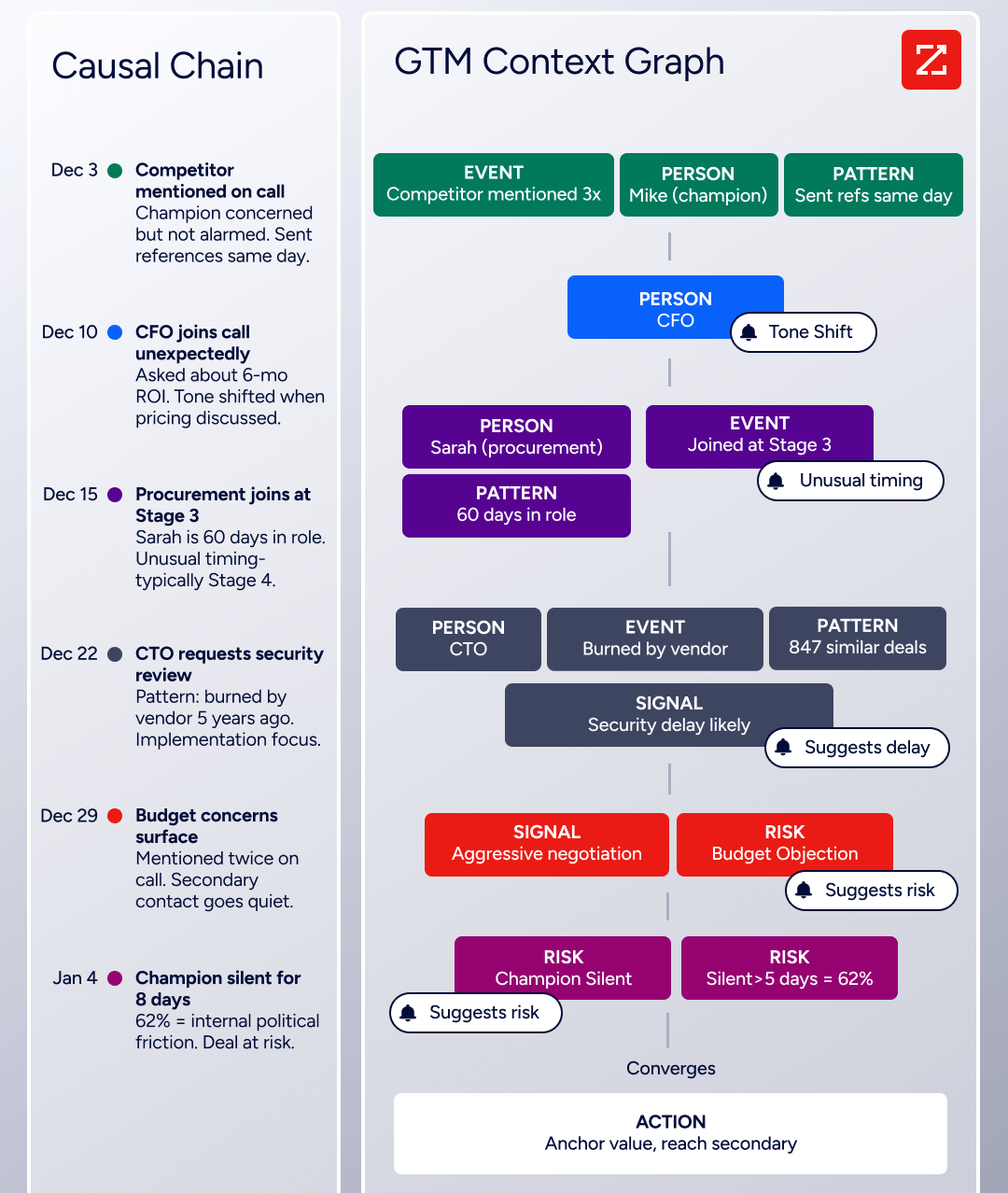
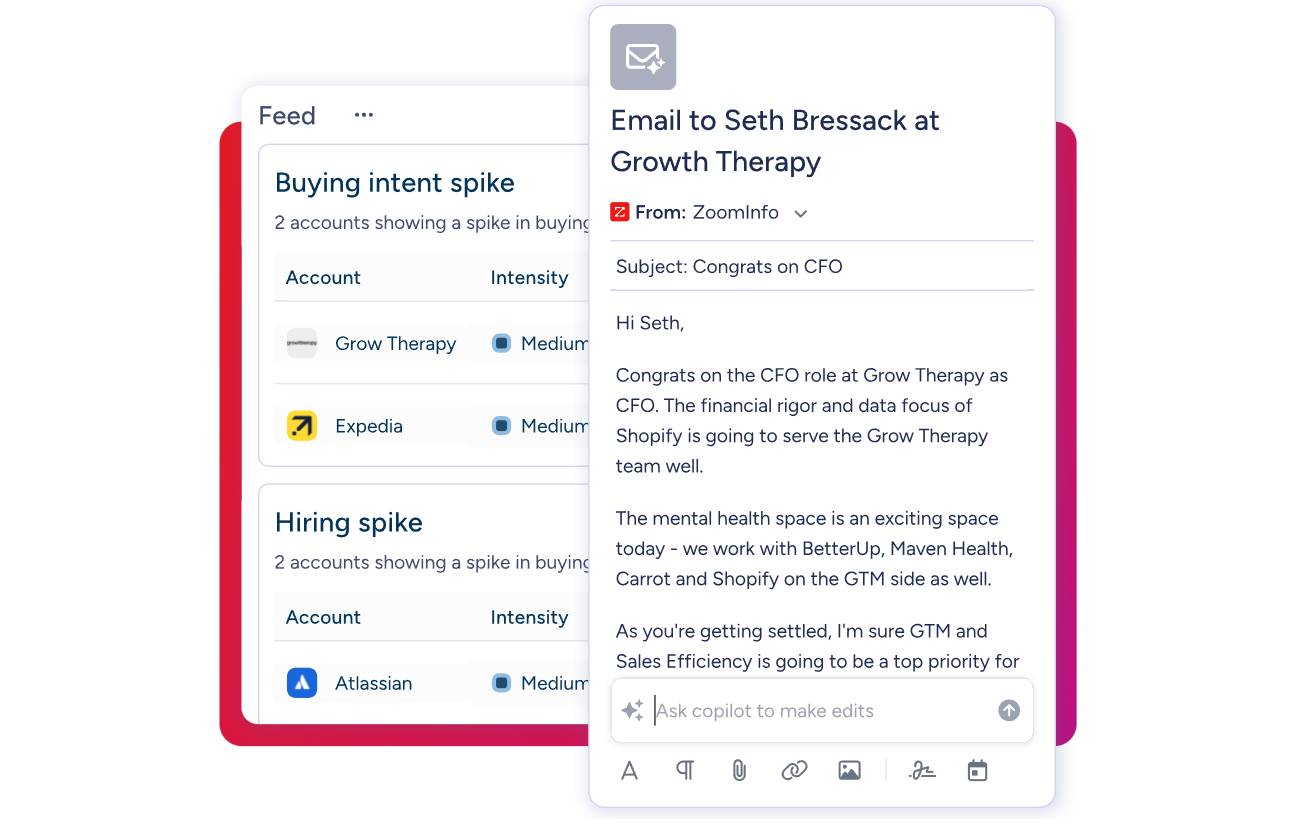
ZoomInfo in Action: A seller opens GTM Workspace to find that an account's CFO joined the last call and asked about six-month ROI. The GTM Context Graph recognizes this pattern from thousands of similar deals: executive sponsorship entering at this stage, combined with ROI-focused questions, predicts acceleration. The AI drafts a follow-up email addressing the specific concern, while third-party signals show the company is hiring three new VPs and researching your competitor. All of this surfaces in one workspace.
Seismic attributed 39% of active pipeline to opportunities identified or influenced by ZoomInfo signals, and their sales team became 54% more productive.
Universal Access: Your Intelligence, Any Tool, Any Workflow
AEP delivers its value primarily through Adobe's own application suite. ZoomInfo takes the opposite approach: the same data and intelligence are accessible through native products for sellers and marketers, and through APIs and MCP for any custom tool, AI agent, or partner platform. API access is included in all relevant plans.
GTM Studio gives marketers and RevOps teams a canvas for designing and activating GTM plays in natural language, cutting expansion plays from 3 weeks to 30 minutes. The ZoomInfo MCP server connects AI models to ZoomInfo's B2B data, with no custom coding beyond one-time server configuration.
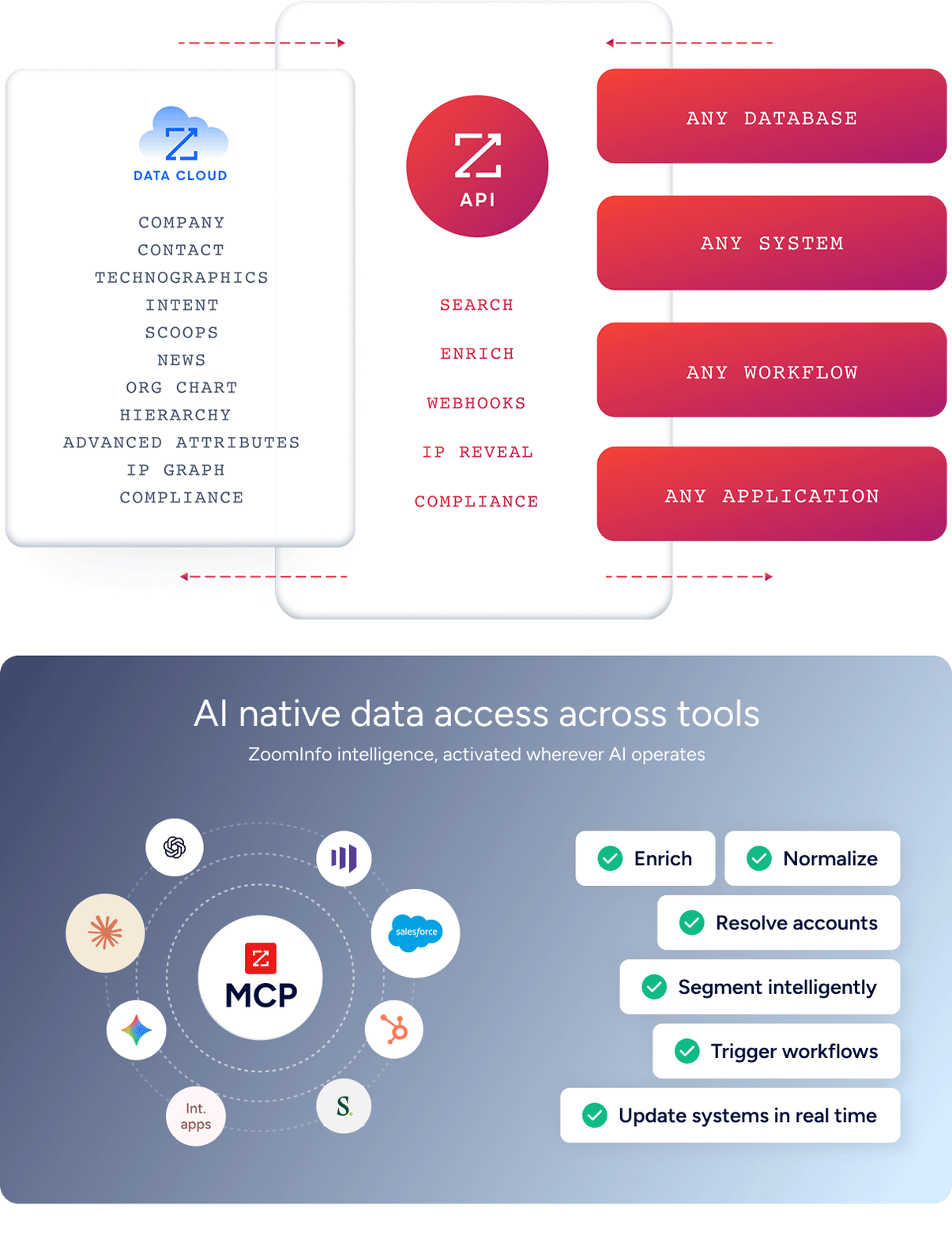
ZoomInfo in Action: A RevOps engineer at a financial services firm builds an internal AI agent using ZoomInfo's MCP server, powering account research and prospecting inside their proprietary workflow tool. As CEO Henry Schuck said: "That's a surface area we would never see before." The same intelligence powering ZoomInfo's native products now fuels a custom agent.
BDO Canada cut time spent on internal data dashboard updates by 87% using ZoomInfo's API.
NOTE: We also evaluated Apollo.io and Cognism. Apollo.io offers a more accessible price point for smaller teams, while Cognism excels in European mobile number coverage. ZoomInfo's data scale (500M contacts, 135M+ verified phone numbers), the GTM Context Graph, and access via APIs and MCP make it the strongest option for enterprise B2B go-to-market execution.
ZoomInfo Pricing
ZoomInfo uses a custom-quoted, consumption-based pricing model with no public prices. Pricing scales based on usage, number of users, monthly credit volume, features, company size, and contract length.
ZoomInfo offers three product lines:
Sales plans (Professional, Advanced, Enterprise) for prospecting, intent signals, and AI-powered outreach
Marketing plans (Marketing Demand, ABM Lite, ABM Enterprise) for audience targeting, display advertising, and account-based marketing
Chorus (conversation intelligence) and Chat (data-powered website chat) as standalone products
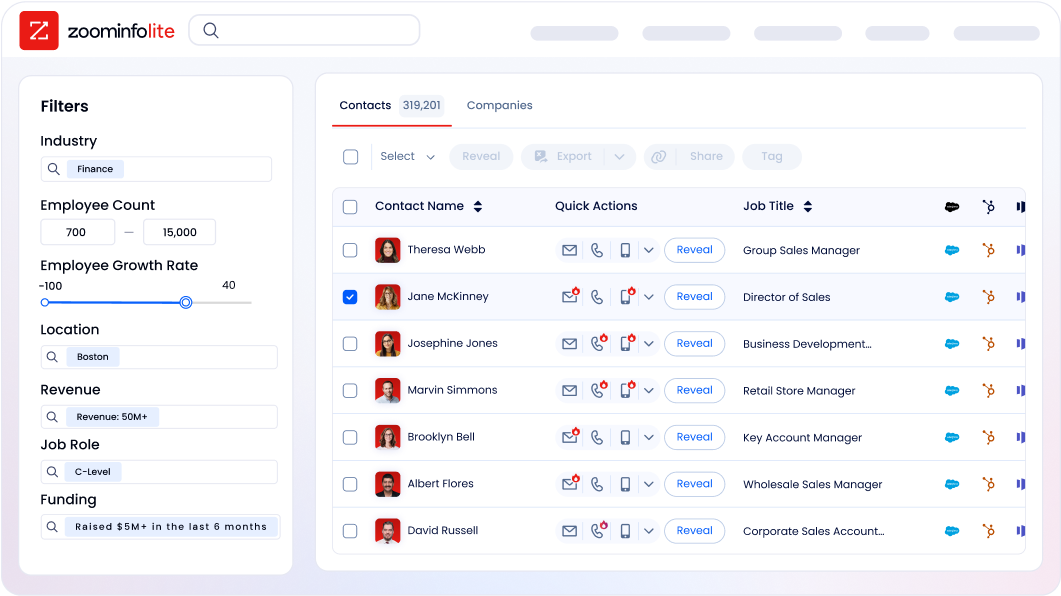
ZoomInfo Lite is a permanent free tier (no credit card, no time limits) that includes access to ZoomInfo's B2B database with 10 monthly export credits, individual and company searches, the Chrome extension, and WebSights Lite. ZoomInfo also offers a 7-day free trial with access to core platform features.
Who Should Use ZoomInfo?
Choose ZoomInfo if:
You run B2B sales and marketing operations and need verified contact data, direct dials, and business emails to prospect and engage decision-makers at target accounts, rather than stitching anonymous consumer sessions into profiles.
Your go-to-market strategy depends on identifying in-market accounts before they engage with your brand, using intent signals to prioritize and personalize outreach.
You want to power custom AI agents, internal tools, or partner platforms with B2B intelligence via APIs and MCP, without being locked into one vendor's application layer.
Want to see your B2B market clearly? ZoomInfo gives your sales and marketing teams verified data, intent signals, and intelligence to find, win, and grow customers. Get started with a free trial.
2. Salesforce Data 360 – Best Alternative for Enterprise Teams Already Running Salesforce
Source: Salesforce
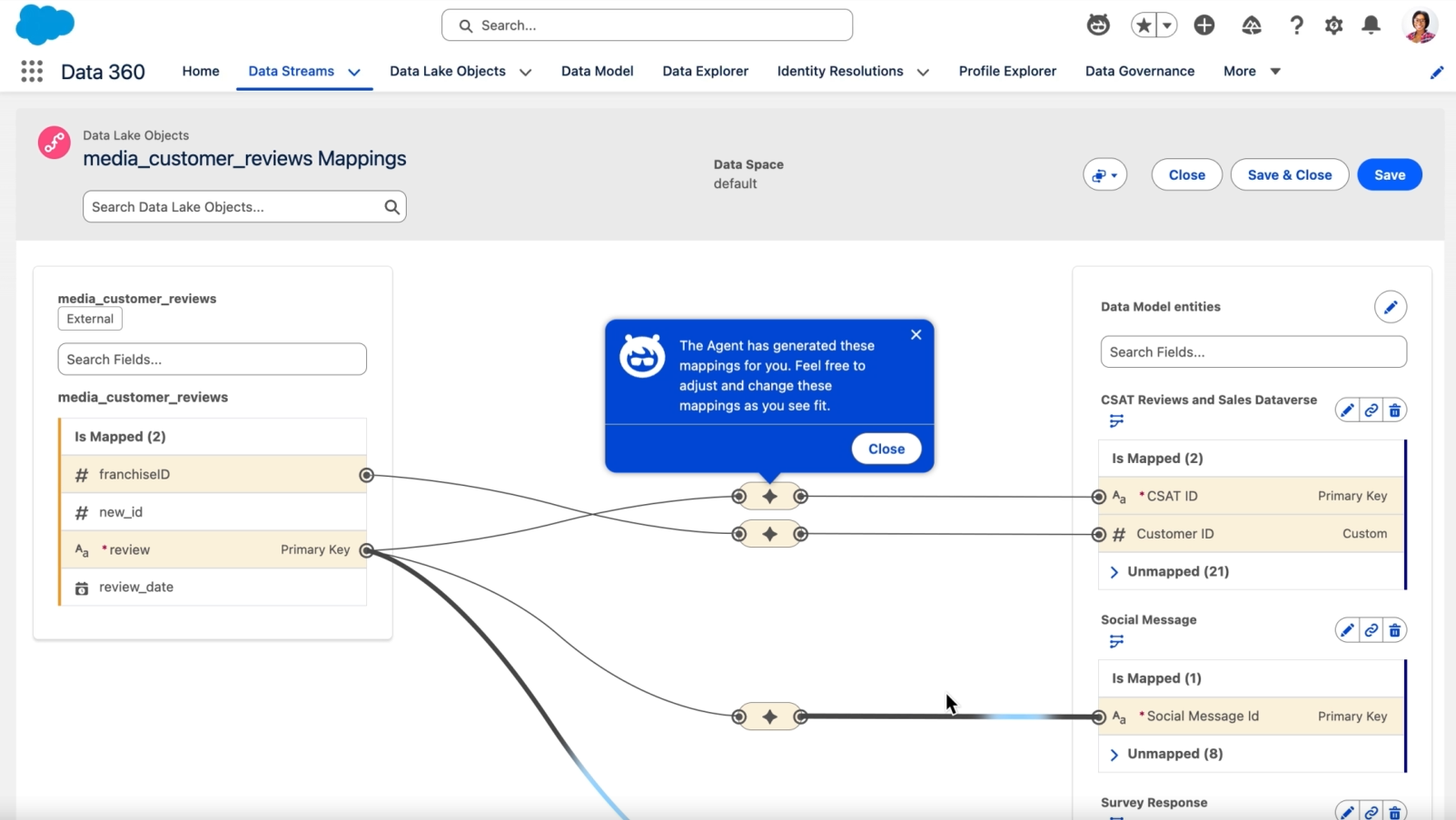
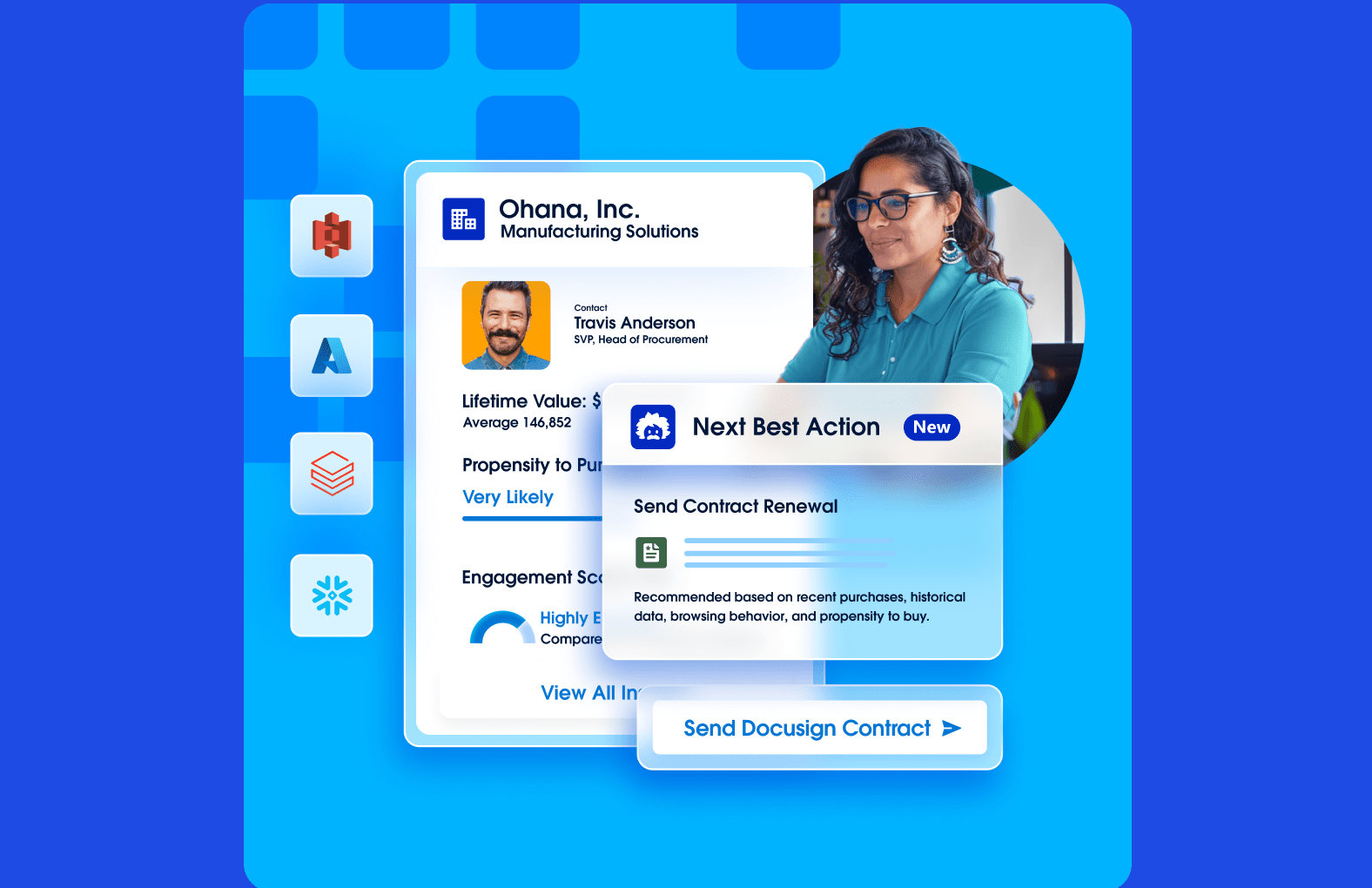
Salesforce Data 360 is an enterprise CDP built into the Salesforce platform. It unifies customer data from Sales Cloud, Service Cloud, Marketing Cloud, and Commerce Cloud into a single, AI-ready profile without ETL work. For organizations already deep in Salesforce, it eliminates the multi-SI implementation project that AEP typically demands. Its key capabilities include:
Native, zero-ETL unification of Sales Cloud, Service Cloud, Marketing Cloud, and Commerce Cloud data into a single Customer 360 profile
Zero-copy data federation with Snowflake, Databricks, Google BigQuery, AWS, and IBM, keeping data in place without profile-volume pricing escalation
Agentforce AI agents for sales, service, marketing, and commerce running on the unified data layer
Gartner Magic Quadrant Leader for CDPs for the third consecutive year, ranked highest in Ability to Execute
Why Choose Salesforce Data 360 Over Adobe Experience Platform?
Native Salesforce Ecosystem Unification AEP treats Salesforce CRM, Marketing Cloud, and Commerce Cloud as external sources requiring connector configuration, schema mapping, and ongoing pipeline maintenance. Salesforce Data 360 eliminates this: data from all Salesforce Clouds merges into a unified Customer 360 profile without any extraction, transformation, or loading.
Zero-Copy Data Federation Avoids Profile-Volume Pricing AEP's costs scale as organizations bring more data into its profile store. Data 360 federates queries directly against external warehouse data without physically ingesting records. In FY2026, Salesforce processed 53 trillion records via Zero Copy, a 310% year-over-year increase.
Agentforce AI Is Native, Not a Separate SKU AEP's Agent Orchestrator is a separately purchasable SKU on top of an already high base cost. Salesforce Data 360 is the native data foundation for Agentforce, and the two are architecturally inseparable. All top 10 Q4 FY2026 Agentforce deals included Data 360, and combined Agentforce and Data 360 ARR exceeded $2.9 billion.
Source: Salesforce
For a direct head-to-head look at how Adobe Experience Platform and Salesforce compare as enterprise data platforms, see our Adobe Experience Platform vs Salesforce breakdown.
NOTE: We also evaluated Treasure Data and Microsoft Dynamics 365 Customer Insights for this enterprise CDP category. Treasure Data excels at large-scale behavioral data processing for consumer brands, and Dynamics 365 Customer Insights integrates tightly with Microsoft's productivity stack. Salesforce Data 360 has the largest enterprise CDP installed base (nearly half of the Fortune 100 are active customers), the tightest native CRM integration, and the most developed AI execution layer in the category.
Salesforce Data 360 Pricing
Salesforce Data 360 uses two parallel pricing models:
Flex Credits: $500 per 100,000 Flex Credits, consumed across platform actions like unstructured data processing, data queries, and real-time pipelines. Flex Credits are interchangeable with Agentforce.
Profiles (flat-rate): $240 per 1,000 profiles per year (standard) or $420 per 1,000 profiles per year (Enterprise Profiles with Data Masking and Ad Audience add-ons).
Data 360 Starter: $60,000/year, including 10M Flex Credits, 5 TB storage, and 100 internal users.
Batch data ingestion and zero-copy integrations are included at no additional cost in all tiers.
Who Should Use Salesforce Data 360?
Choose Salesforce Data 360 if:
Your organization already runs multiple Salesforce Clouds and wants to unify customer data across them without introducing a parallel data platform or ETL pipelines.
You have significant data volume in Snowflake, Databricks, or Google BigQuery that you want to activate without physically ingesting it into a separate store or triggering profile-volume pricing.
You are evaluating Agentforce for autonomous AI workflows and need the data foundation it requires, since Data 360 and Agentforce are architecturally coupled.
3. Tealium – Best Alternative for Vendor-Neutral Real-Time Data Orchestration
Source: Tealium
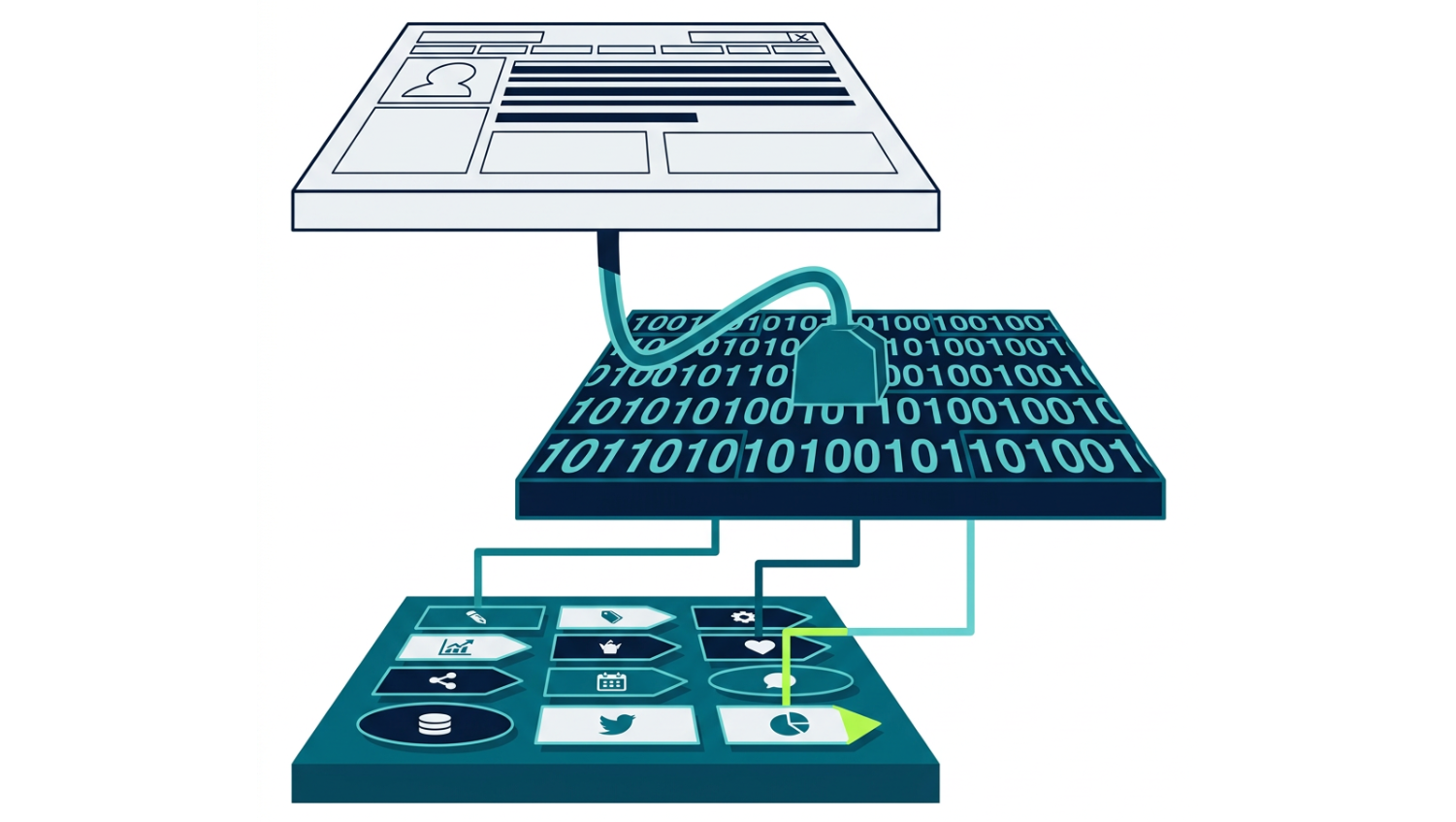
Tealium is a Customer Data Orchestration Platform built on vendor neutrality as a founding principle: collect, unify, and route customer data to whatever tools a team already uses, with no ecosystem allegiance required. Its key capabilities include:
1,300+ pre-built integrations spanning ad platforms, CRMs, data warehouses, AI services, and analytics tools
Real-time in-session visitor profile updates via AudienceStream CDP, with documented trigger-to-activation latency of under 300ms
Consent enforced at the point of data collection, not retroactively at the activation layer
Two consecutive Gartner MQ Leader placements (2024 and 2025)
Why Choose Tealium Over Adobe Experience Platform?
1,300+ Integrations Without Ecosystem Commitment AEP's activation strength is concentrated in the Adobe Experience Cloud, and Gartner's 2025 CDP Magic Quadrant noted that purchasing Adobe's CDP "may also require" an investment in Journey Optimizer. Tealium inverts this: 1,300+ pre-built connectors span advertising platforms, CRM systems, AI services (AWS Bedrock, Vertex AI, OpenAI), analytics platforms, and cloud data warehouses, all unlocked without adopting additional Tealium modules. G2 reviewers consistently cite integration breadth and vendor neutrality as standout benefits.
Real-Time In-Session Profile Updates AEP's standard audience evaluation runs on batch schedules that can lag by hours. Tealium's AudienceStream CDP ingests events, evaluates enrichment rules, stitches identity, and recomputes audience membership in a single pipeline pass, with trigger-to-activation latency of under 300ms.
Consent at Collection, Not at Activation AEP's DULE framework enforces governance at the activation layer: data reaches AEP's data lake before governance intervenes. Tealium enforces consent at the point of data collection. Tags requiring consent are blocked from loading if consent is absent. Data that shouldn't be collected never gets collected. Tealium holds HIPAA BAA, SOC 2 Type II, ISO 27701, and ISO 27018 certifications without add-on SKUs.
Source: Tealium
NOTE: We also evaluated BlueConic and Treasure Data for this category. BlueConic excels at profile-driven personalization for media and publishing teams, and Treasure Data is built for large-scale enterprise data unification. Tealium offers the best balance of real-time processing, connector breadth, and built-in compliance infrastructure, backed by consecutive Gartner Magic Quadrant Leader recognition.
Tealium Pricing
Tealium does not publish pricing on its website. All agreements are custom enterprise contracts through direct sales. The platform is modular: customers license Data Collection (iQ Tag Management), CDP (AudienceStream), Enrichment & Orchestration (EventStream), and Data Cloud Activation components separately or together. Three support tiers are available: Basic (included), Enhanced (paid, with response SLAs), and Premium (paid, with a dedicated Technical Account Manager).
Who Should Use Tealium?
Choose Tealium if:
Your martech stack spans multiple vendors and you need a data orchestration layer that routes customer context across all of them without committing to a single software ecosystem.
You operate in a regulated industry (financial services, healthcare, insurance) where consent must be enforced at the point of data collection, not filtered retroactively at activation, and where HIPAA BAA and ISO 27701 certifications are procurement requirements.
Your highest-value use cases depend on in-session behavioral signals, where batch-cycle audience evaluation introduces delays that cost conversions.
4. Twilio Segment – Best Alternative for Accessible, Self-Serve Customer Data Infrastructure
Source: Twilio
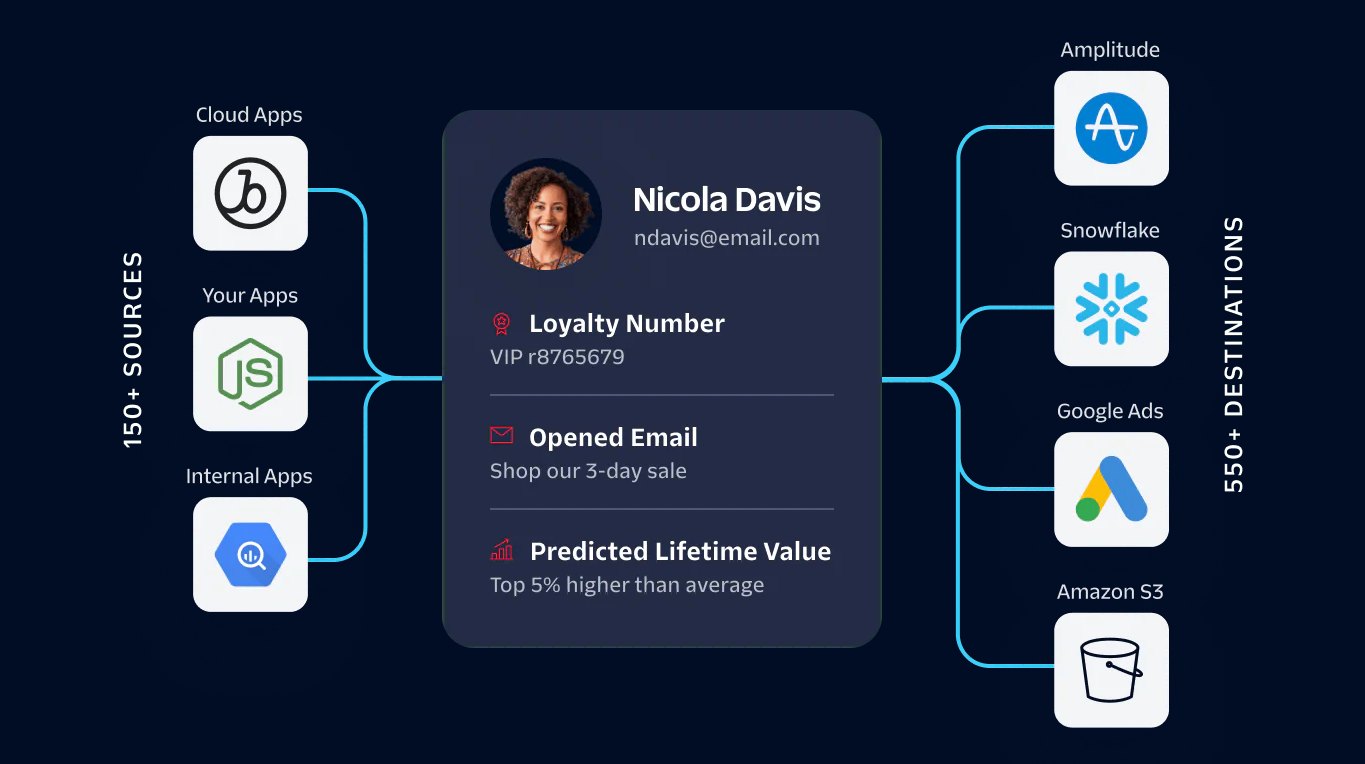
Twilio Segment is a developer-first customer data platform that collects behavioral event data across web, mobile, and server-side touchpoints, unifies it into persistent customer profiles, and routes it to downstream tools through a pre-built integration catalog. Its key capabilities include:
Connections: A single SDK that collects events once and fans them out to 700+ destination integrations
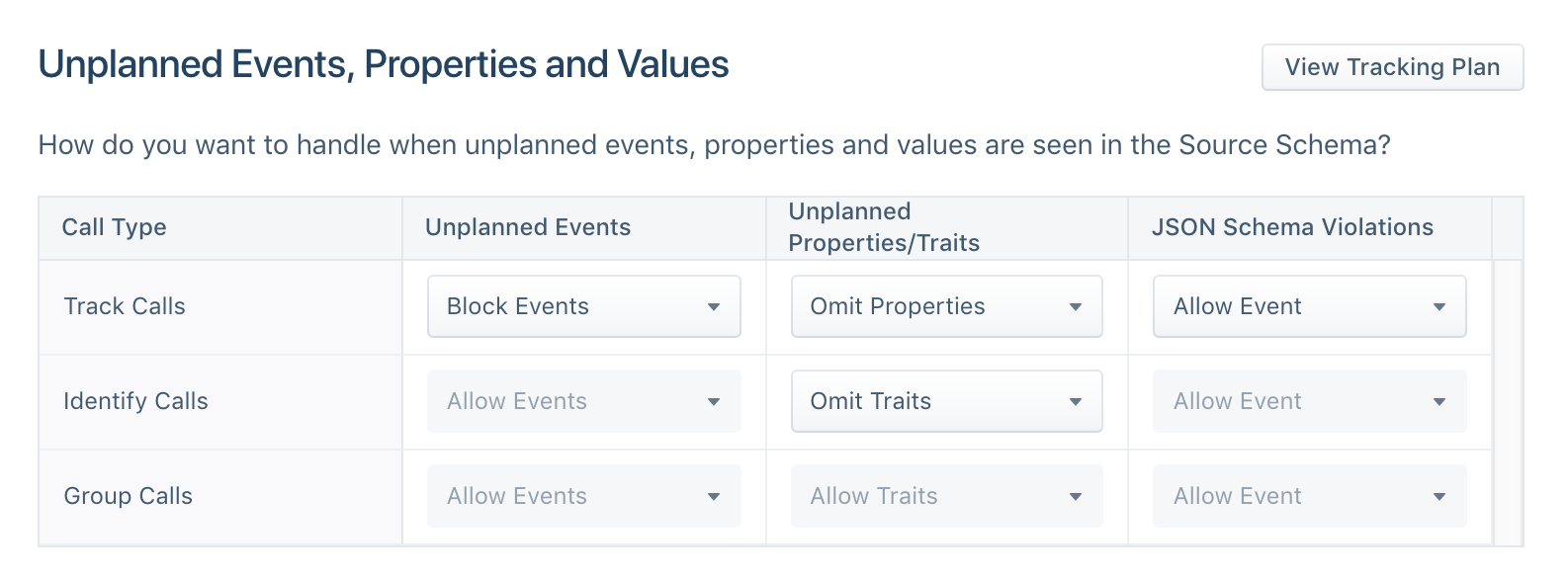
Protocols: Schema enforcement at the point of collection, blocking malformed events before they corrupt downstream tools
Unify: Deterministic identity resolution stitching anonymous sessions and cross-device events into unified profiles
Permanent free tier: Up to 1,000 monthly tracked users at no cost with no credit card required, and a self-serve Team plan starting at $120/month
Why Choose Twilio Segment Over Adobe Experience Platform?
Transparent Pricing and a Permanent Free Tier AEP has no free plan, no self-serve signup, and no published pricing. Segment's permanent Free tier supports 1,000 monthly tracked users, 2 sources, and 1 warehouse destination, indefinitely. The Team plan scales to 10,000 MTUs at $120/month with published overage rates. A team can validate their event tracking approach, connect their warehouse, and test destination integrations the same week they create an account.
700+ Integrations That Eliminate Per-Tool Instrumentation Engineering teams implement Segment's SDK once, covering web (Analytics.js), mobile (iOS/Swift, Android/Kotlin), and server-side (Node, Python, Ruby, Go, Java), and Segment fans event data out to every downstream tool simultaneously. Destination Actions give teams field-level control over what data each action sends and when. Reverse ETL closes the loop: computed data from the warehouse flows back into operational tools on a detected-change basis.
Protocols Enforces Data Quality at the Source AEP's ingestion layer includes partial-ingestion error thresholds, but malformed events can enter the pipeline and surface as corrupted profiles. Segment Protocols validates incoming events against an approved schema at the point of collection. Schema Controls block or quarantine malformed events before they reach any destination.
Source: Twilio
NOTE: We also evaluated Klaviyo and Hull for this accessibility-focused CDP category. Klaviyo excels at email and SMS activation for direct-to-consumer e-commerce brands, but Twilio Segment is the only option with a genuine permanent free plan, the broadest destination catalog at the entry level, and a developer SDK ecosystem mature enough to serve as production infrastructure.
Twilio Segment Pricing
Segment uses a usage-based model anchored to Monthly Tracked Users (MTUs):
Free ($0/month, permanent): 1,000 MTUs, 2 sources, 1 warehouse destination, 500K Reverse ETL records/month, 550+ destinations. No credit card required.
Team ($120/month): 10,000 MTUs, unlimited sources, 1M Reverse ETL records/month, public API access. Overage at $10-$12 per 1,000 additional MTUs.
Business (custom pricing): Unlimited MTUs and warehouse destinations, Protocols included, HIPAA eligibility, SSO/SCIM, advanced roles.
Who Should Use Twilio Segment?
Choose Twilio Segment if:
Your team has at least one data engineer who can own SDK instrumentation and you need a functioning CDP within days, not months.
You operate a multi-tool martech stack with five or more analytics, marketing, and CRM tools, and your current approach requires separate instrumentation for each.
You need a permanent entry point for a CDP without committing to a six-figure enterprise contract before proving business value internally.
5. mParticle – Best Alternative for Mobile-First Consumer Brands
Source: mParticle
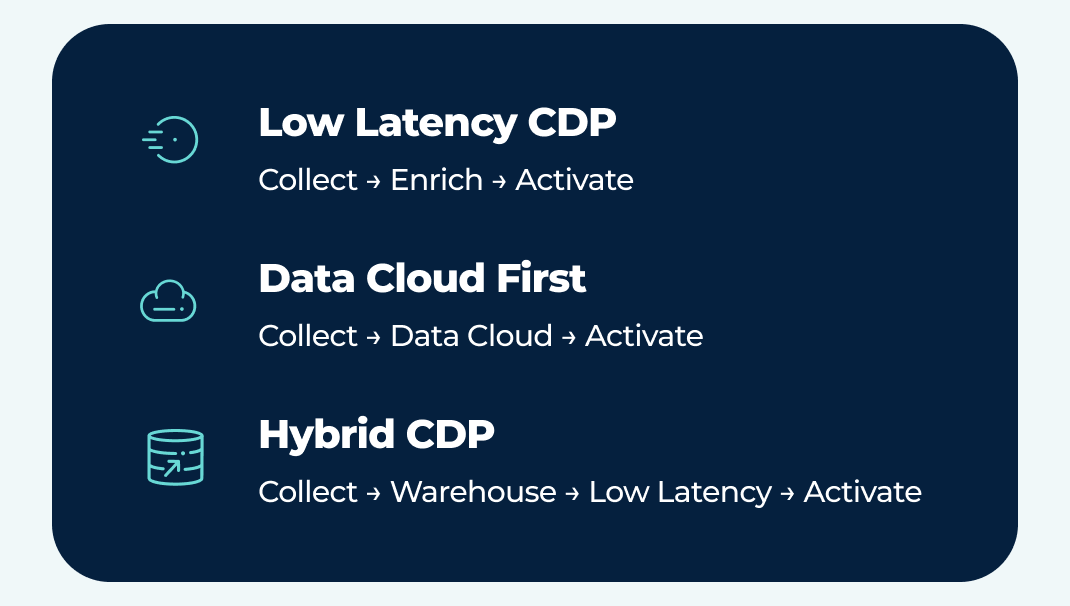
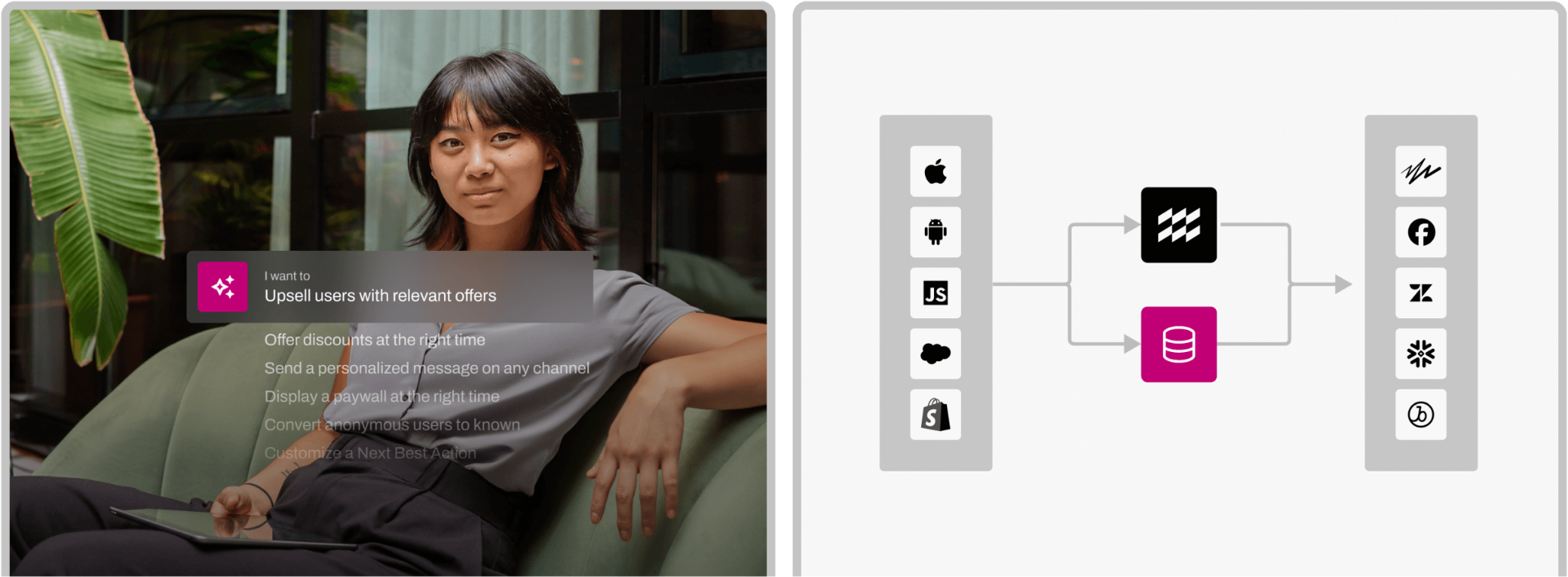
mParticle is a hybrid CDP that combines real-time event streaming with warehouse-native composable activation, built for multi-channel B2C brands where mobile is the primary customer touchpoint. Founded in 2013 to route event data from native mobile apps, mParticle's architecture handles mobile constraints that web-first platforms treat as afterthoughts. Its key capabilities include:
Native SDK collection for iOS, Android, React Native, Flutter, and Roku with offline event queuing and session management
Data Planning for schema enforcement at the point of event collection
IDSync with five distinct identity strategies that engineering teams can tune to match their business model
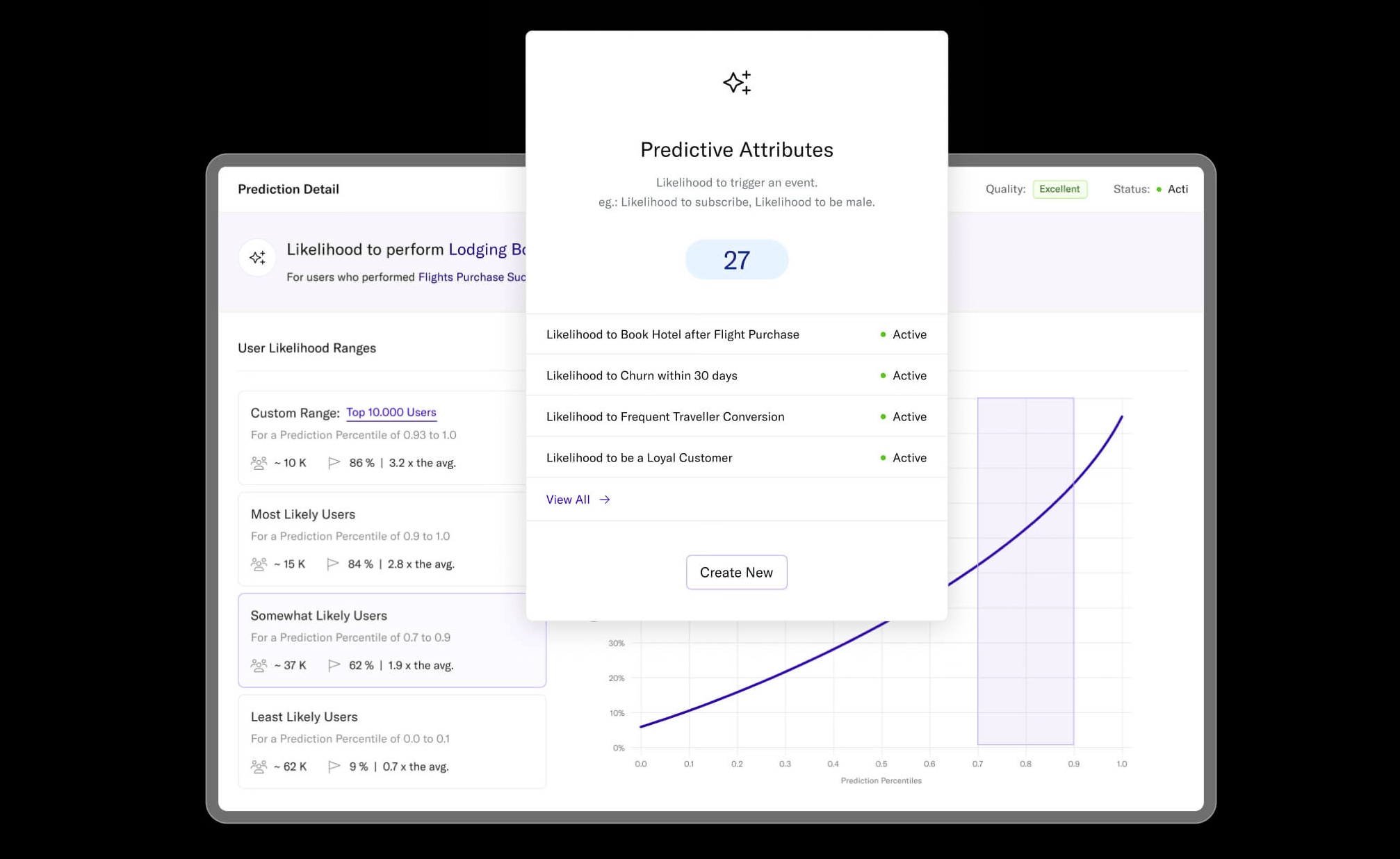
Cortex AI for predictive audiences, included in the standard platform, not a separate SKU
Why Choose mParticle Over Adobe Experience Platform?
Mobile-Native Data Collection AEP's primary collection mechanism is the Web SDK, with mobile SDKs added as coverage extensions. mParticle's native SDKs for iOS, Android, React Native, Flutter, and Roku are engineered for mobile constraints: offline event queuing, iOS AppTrackingTransparency handling, battery and network optimization, and session management behaviors that differ from browser sessions.
Data Planning Validates Events Before They Reach Profiles AEP's Data Prep reshapes data after submission. mParticle's Data Planning validates incoming events against an approved schema at the point of collection. A malformed event from a new SDK release is blocked at the gate, logged, and alerted on before it can corrupt downstream systems.
Cortex AI Predictive Audiences Are Included AEP's Customer AI is a purchasable add-on billed per million insights. mParticle's Cortex AI engine is included in the standard subscription, giving teams predictive audience capabilities without a separate data science resource or additional ML platform SKU.
Source: mParticle
NOTE: We also evaluated Amplitude and CleverTap for this mobile-first category. Amplitude excels at product analytics and experimentation for product-led growth teams, and CleverTap offers strong mobile engagement campaign execution. mParticle is the strongest mobile-native CDP for organizations that need collection quality, identity resolution, and predictive activation governed from a single platform.
mParticle Pricing
mParticle operates on a credits-based pricing model with no public rate card and no self-serve signup. Customers make an upfront contractual credit commitment. All platform features (including Cortex predictive audiences, warehouse sync, and composable audiences) are accessible on any credit plan with no feature-gated tiers. There is no free plan. New customers must request a quote or demo.
Who Should Use mParticle?
Choose mParticle if:
Your primary customer touchpoint is a native mobile app and you need data collection infrastructure engineered for mobile constraints.
Your engineering team cannot tolerate downstream data quality contamination from schema-drifting events and needs violations caught at the point of collection.
You want predictive audience capabilities included in your CDP contract without a separate data science resource or additional ML platform SKU.
6. Hightouch – Best Alternative for Warehouse-Native Activation Without Data Duplication
Source: Hightouch
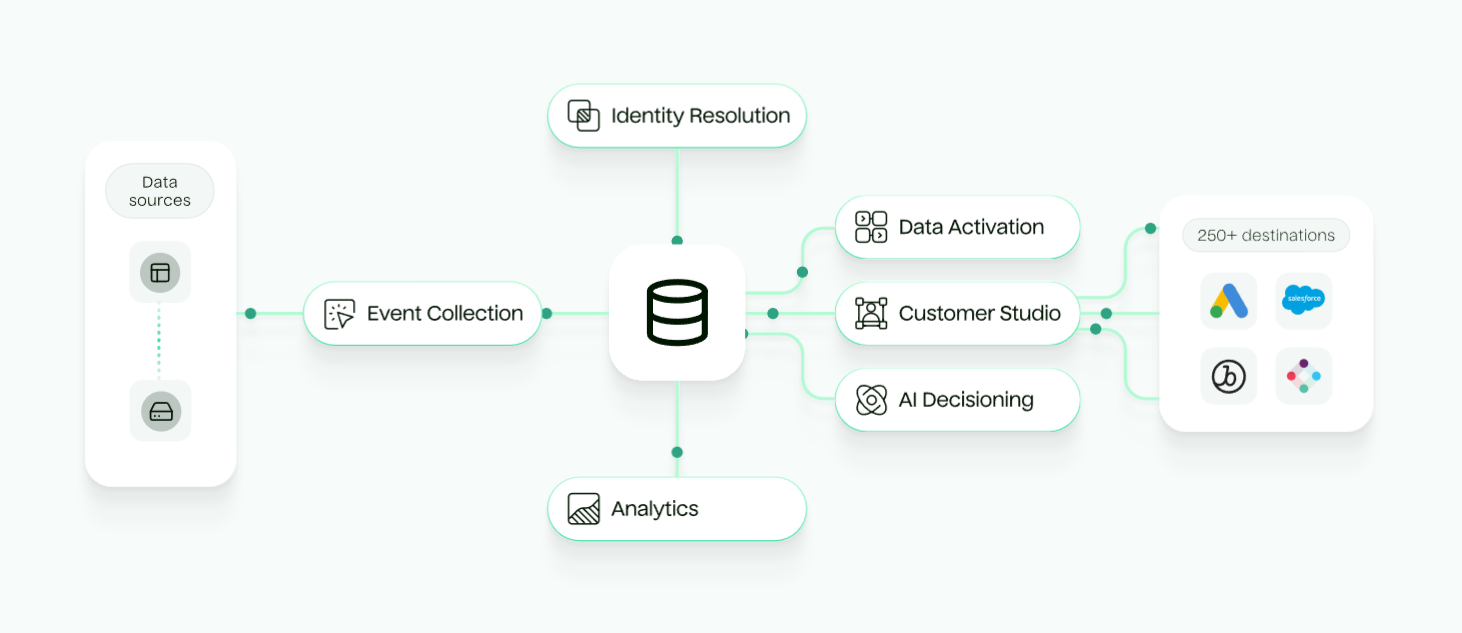
Hightouch is a warehouse-native Composable CDP that delivers customer data platform functionality on top of an organization's existing Snowflake, Databricks, BigQuery, or Redshift environment, without ingesting data into a proprietary profile store. Its key capabilities include:
Warehouse-native architecture: Operates on top of the customer's existing cloud data warehouse with no data duplication
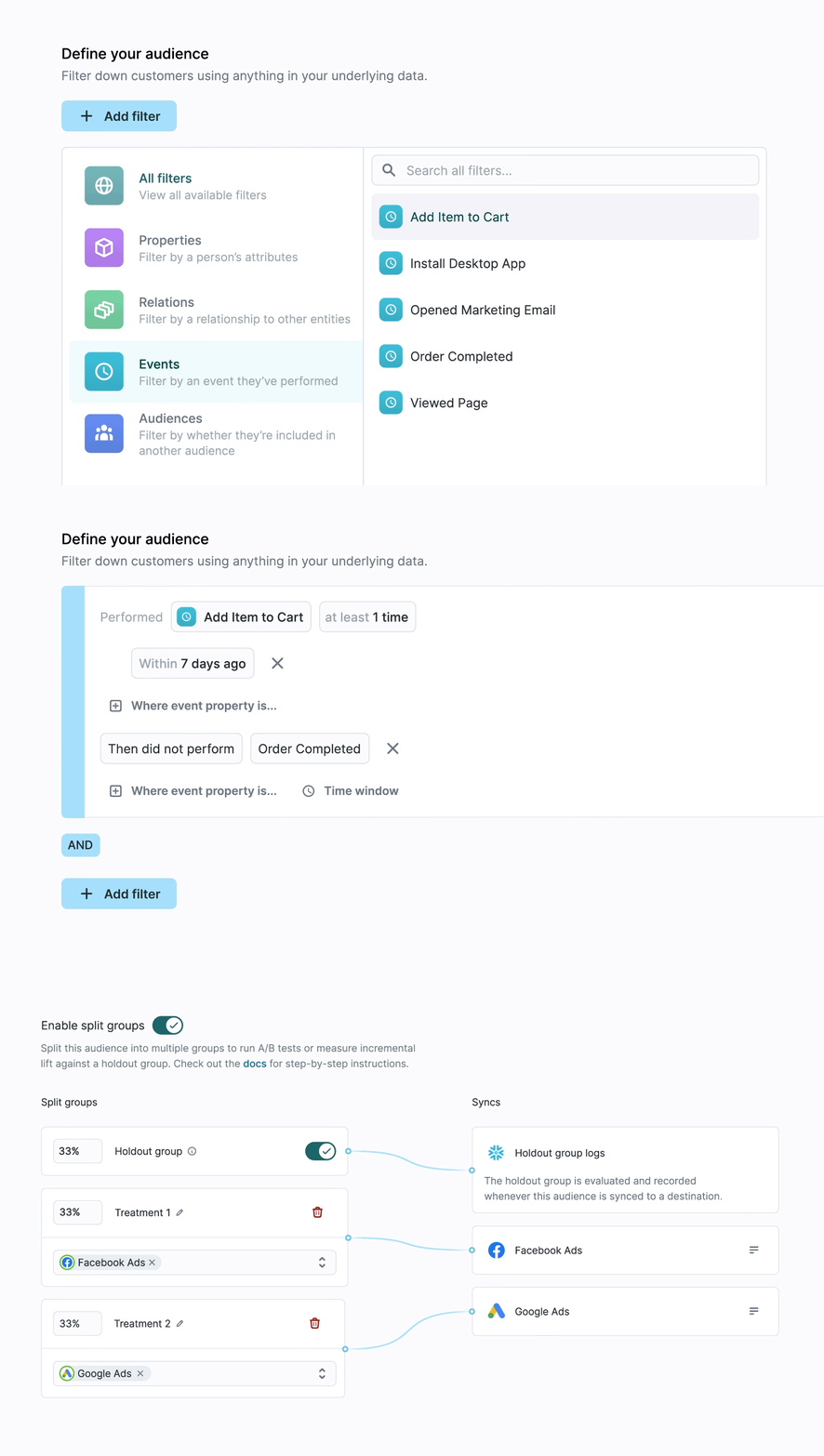
Reverse ETL to 250+ destinations: Any SQL query result from the warehouse syncs automatically to CRM, ad platforms, and marketing tools via managed connectors
Customer Studio: Visual, no-code audience builder for marketing teams to build and activate audiences directly from warehouse tables
AI Decisioning: Reinforcement learning engine that replaces rule-based campaign logic with autonomous 1:1 optimization
Gartner Magic Quadrant Leader designation in January 2026
Why Choose Hightouch Over Adobe Experience Platform?
No Data Duplication: The Warehouse Stays the Single Source of Truth AEP requires data to be ingested into its proprietary Real-Time Customer Profile store, creating a second copy that drives up profile-volume pricing and introduces synchronization lag. Hightouch connects directly to the existing warehouse: Hightouch never stores a single byte of customer data. The platform has processed over 7.3 trillion records at 99.99% global uptime.
Implementation in Days, Not Months AEP's implementation routinely runs six to eighteen months. Hightouch reads directly from the customer's existing warehouse where data is already modeled, so teams with existing data models can go live within days.
Marketer Self-Service Without Schema Engineering AEP's Segment Builder operates downstream of XDM schema design: any new data attribute requires an engineering change before it surfaces in the audience builder. Customer Studio reads from the warehouse directly, so any data already modeled there is immediately available for audience building without schema work.
Source: Hightouch
NOTE: We also evaluated Census and Simon Data for this warehouse-native category. Census is a credible Reverse ETL option focused on data syncing, and Simon Data brings a mature CDP approach for e-commerce marketers. Hightouch offers the broadest product range, spanning Reverse ETL, Composable CDP, AI Decisioning, and Agentic Marketing in a single platform.
Hightouch Pricing
Hightouch uses a usage-based, modular pricing structure with no MTU caps and no per-seat charges on paid plans:
Free Tier: Permanently free with up to 2 active syncs, all 250+ destination types, unlimited seats, and hourly sync frequency.
Business Tier: Quote-based. Modular: purchase only the components needed (Reverse ETL, Customer Studio, Identity Resolution, Real-time Personalization). Usage-based pricing anchored to active syncs.
AI Decisioning: Quote-based. Purchasable independently without a Composable CDP subscription.
Who Should Use Hightouch?
Choose Hightouch if:
Your team already runs Snowflake, Databricks, BigQuery, or Redshift and has customer data modeled in the warehouse that you want to activate without migration or schema re-design.
Your marketing team is blocked waiting on data engineering to build audience queries or map new attributes into a CDP schema.
You need fast time-to-first-value: if AEP's six-to-eighteen-month implementation is incompatible with your roadmap or budget.
7. RudderStack – Best Alternative for Engineering-Led Data Ownership Without Vendor Lock-In
Source: RudderStack
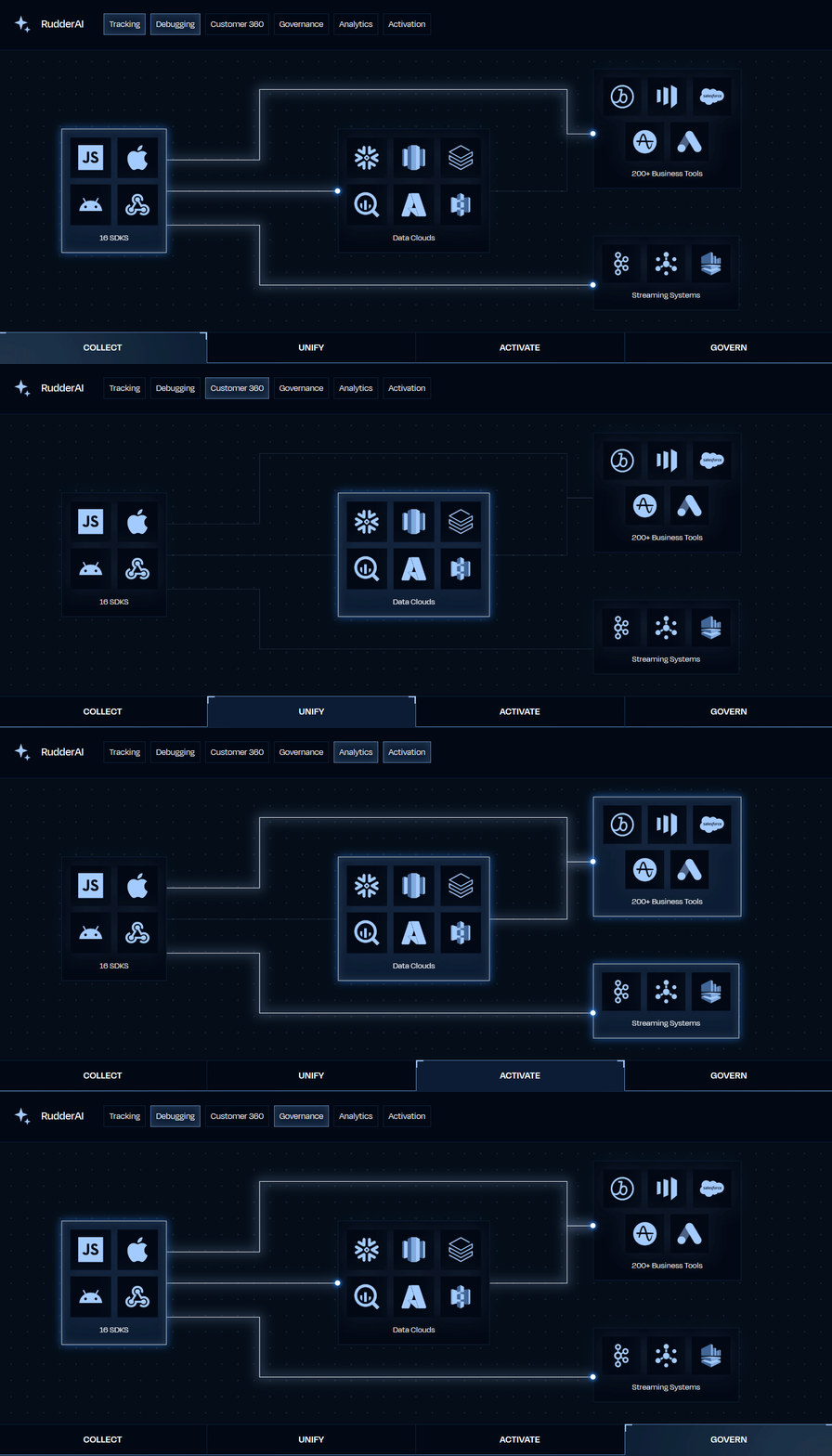
RudderStack is a warehouse-native customer data infrastructure platform that gives data engineering teams event collection, identity resolution, and audience activation without storing any customer data in vendor infrastructure. Its server is open-source under AGPL-3.0 and can be deployed on any cloud or on-premises environment. Its key capabilities include:
Real-time event collection via 16+ SDK sources (JavaScript, iOS, Android, Flutter, React Native, Node.js, Python, Go)
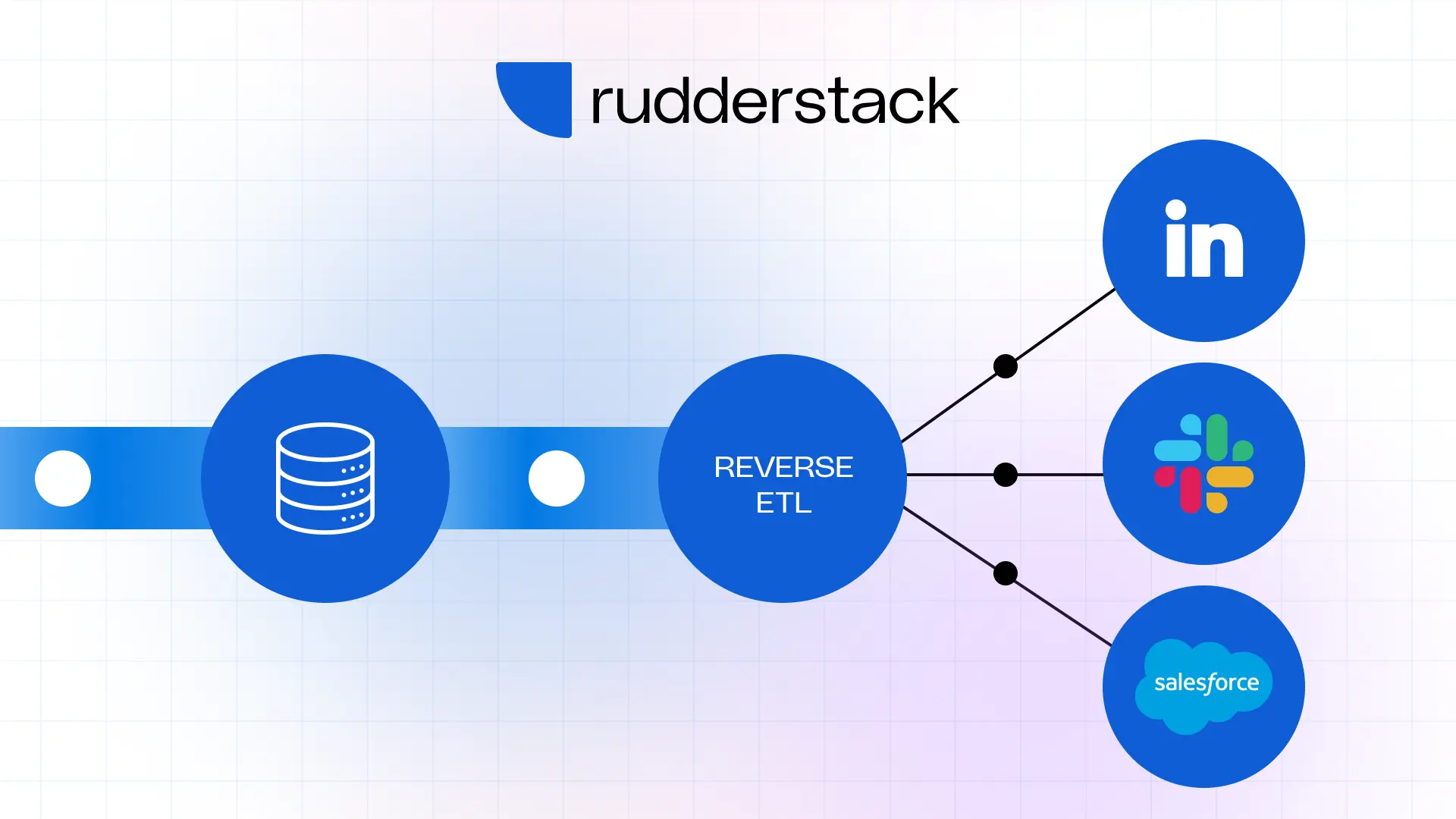
Reverse ETL for activating warehouse data to 200+ downstream destinations, included in all plans
In-pipeline JavaScript and Python Transformations for real-time enrichment, PII masking, and event filtering
Permanently free cloud plan supporting 250,000 monthly events
Three deployment modes: SaaS, customer VPC, and fully self-hosted
Why Choose RudderStack Over Adobe Experience Platform?
Open-Source Core Eliminates Vendor Lock-In AEP is a closed, proprietary system where the pipeline, identity graph logic, and governance framework all live in Adobe's cloud under Adobe's licensing terms. RudderStack's rudder-server is open-source on GitHub under AGPL-3.0. Data engineering teams can inspect the codebase, modify it, and run it on their own infrastructure at no licensing cost. RudderStack delivered 3.3 trillion events for over 4,000 organizations in 2025.
Permanently Free Cloud Plan With Full Feature Access AEP has no free tier and no self-serve trial. RudderStack offers a permanently free cloud plan supporting 250,000 monthly events, 200+ cloud destination integrations, and Reverse ETL with up to 10 connections, with no credit card required.
Warehouse-Native Reverse ETL Is Included on All Plans AEP's SQL-based transformation and write-back capability (Data Distiller) is a separately licensed add-on. RudderStack includes Reverse ETL on all plans, including the free tier, so teams get warehouse-native activation from day one without an add-on purchase.
Source: RudderStack
NOTE: We also evaluated Segment's free tier and Apache Kafka for this category. Segment offers a free tier but is not open-source, does not include Reverse ETL at every tier, and lacks deployment flexibility beyond Twilio's managed cloud. Apache Kafka handles event streaming well but requires separate tooling for identity resolution and destination management. RudderStack is the only CDP that combines a true open-source core, a free cloud plan, and warehouse-native Reverse ETL.
RudderStack Pricing
Free ($0/month, permanent): 250,000 monthly events, 200+ cloud destinations, Reverse ETL (10 connections), community Slack support. Warehouse sync time: 3 hours.
Starter ($220/month): 1 million monthly events, unlimited tracking plans, email support, 99.95% uptime SLA. Warehouse sync time: 1 hour.
Growth (custom pricing): Custom event volume, unlimited Transformations and Reverse ETL connections, dedicated support. Warehouse sync time: 30 minutes.
Enterprise (custom pricing): Python Transformations, Profiles access, HIPAA compliance (with BAA), SSO, customer VPC deployment. Warehouse sync time: 5 minutes.
Who Should Use RudderStack?
Choose RudderStack if:
Your organization has a data warehouse in production and wants a CDP that treats it as the system of record rather than duplicating data into a proprietary vendor layer.
Your team includes data engineers who can operate a code-based, API-first platform and you want the option to self-host the data plane entirely.
Cost predictability and data ownership are primary concerns and you want warehouse-native event streaming without profile-volume pricing that escalates with data breadth.
The Final Verdict
Adobe Experience Platform works well as an enterprise data platform for large organizations with deep Adobe ecosystem investments, but different data architectures, team structures, and go-to-market needs call for more specialized solutions. Here are the best alternatives:
ZoomInfo for B2B go-to-market intelligence, verified contact data, intent signals, and AI-powered prospecting
Salesforce Data 360 for enterprise teams already running multiple Salesforce Clouds who need native, zero-ETL data unification
Tealium for vendor-neutral, real-time data orchestration across multi-vendor martech stacks with compliance built into the collection layer
Twilio Segment for teams that need a data pipeline in days with transparent pricing and a permanent free tier
mParticle for mobile-first consumer brands that need native mobile SDKs, schema enforcement at collection, and included predictive audiences
Hightouch for warehouse-native activation that eliminates data duplication and profile-volume pricing
RudderStack for engineering-led organizations that want open-source data ownership with deployment flexibility
The right choice depends on where your data lives today, how your team operates, and what capabilities you need most. Many organizations combine these tools to build their ideal data stack.
Want to power your B2B go-to-market with verified intelligence? ZoomInfo gives your team data on 500M+ contacts, insights from the GTM Context Graph, and access through any tool via APIs and MCP. Start your free trial.
Adobe Experience Platform Alternatives FAQ
Why do organizations look for Adobe Experience Platform alternatives?
The most common reasons are AEP's enterprise-only pricing (billed per 1,000 profiles with no published rate card), implementation timelines that routinely run six to eighteen months with certified SI partners, and Adobe ecosystem dependency that Gartner flagged as a constraint on flexibility. Organizations with B2B go-to-market needs, limited budgets, or existing data warehouse investments often find specialized platforms deliver faster time-to-value.
What is the best Adobe Experience Platform alternative for B2B companies?
ZoomInfo is built for B2B go-to-market execution with 500M contacts, 135M+ verified phone numbers, and 200M+ verified business email addresses. While AEP is designed for B2C consumer experience, ZoomInfo provides the B2B intelligence layer for identifying decision-makers, detecting buyer intent, and executing coordinated sales and marketing outreach.
Is there a free alternative to Adobe Experience Platform?
Several alternatives offer free tiers that AEP does not. Twilio Segment's permanent free plan supports 1,000 monthly tracked users with 550+ destination integrations. RudderStack's free plan supports 250,000 monthly events with Reverse ETL included. Hightouch offers a free tier with 2 active syncs to 250+ destinations. ZoomInfo Lite provides permanent free access to its B2B database with 10 monthly export credits.
Which Adobe Experience Platform alternative is best for teams already using Salesforce?
Salesforce Data 360 is the strongest choice for organizations running multiple Salesforce Clouds. It unifies Sales Cloud, Service Cloud, Marketing Cloud, and Commerce Cloud data into a single profile without ETL work, and its zero-copy data federation connects to external warehouses without profile-volume pricing escalation. It has been a Gartner Magic Quadrant Leader for CDPs for three consecutive years.
How does Adobe Experience Platform compare to warehouse-native CDPs like Hightouch?
AEP requires data to be ingested into its proprietary Real-Time Customer Profile store, which drives profile-volume pricing and introduces synchronization overhead. Warehouse-native CDPs like Hightouch and RudderStack operate directly on top of existing Snowflake, Databricks, or BigQuery environments without duplicating data. This eliminates a major cost driver and means marketing teams work from the same data version as the rest of the organization.
Which alternative is best for mobile-first consumer brands?
mParticle is built for mobile-first organizations with native SDKs for iOS, Android, React Native, Flutter, and Roku that handle mobile-specific constraints like offline event queuing, AppTrackingTransparency compliance, and session management. Its Cortex AI predictive audiences are included in the standard subscription without a separate data science team or add-on SKU.
Can these alternatives integrate with Adobe Experience Platform?
Several of these platforms work alongside AEP rather than replacing it. Tealium's 1,300+ integrations include Adobe ecosystem connectors. Twilio Segment and Hightouch can route data to AEP as a destination. ZoomInfo's B2B intelligence can complement AEP's consumer data with verified contact and company information for B2B use cases. Whether to complement or replace AEP depends on your data architecture and use cases.
Which alternative offers the fastest implementation?
Hightouch and RudderStack offer the fastest paths to value for teams with existing data warehouses, with some customers going live in under a week. Twilio Segment's self-serve model lets teams connect sources and destinations within hours. By contrast, AEP's enterprise implementations typically require six to eighteen months and involvement from certified SI partners like Accenture or Deloitte Digital.
