
Comparing Agile CRM and SugarCRM is like comparing a studio apartment to a manufacturing plant. Both provide shelter, but for different lives.
Agile CRM was built for startups and micro-businesses that need CRM, marketing automation, and a help desk in one affordable package. SugarCRM was built for mid-market B2B companies (particularly in manufacturing, wholesale, and distribution) that need their CRM to speak the same language as their ERP system.
Before you pick one, answer these five questions:
Do you have fewer than 15 salespeople, or more?
Is your sales process transactional (short cycles, high volume) or relationship-driven (long cycles, complex accounts)?
Do you need your CRM connected to an ERP system?
Is your budget under $50/user/month, or can you invest more for better intelligence?
Do you need a system that tracks what already happened, or one that tells you what to do next?
In short, here's what we recommend:
Agile CRM fits small teams that want sales, marketing, and customer service automation in a single platform without paying enterprise prices. Its free plan covers up to 10 users, and paid tiers start at $8.99/user/month. You get contact management, a visual deal pipeline, email campaigns, lead scoring, and a built-in help desk. The trade-offs are real: an interface that hasn't had a visual update in years, slow loading times, and inconsistent customer support.
SugarCRM (now rebranding as SugarAI) serves mid-market B2B companies that need a CRM connected to their operations. With 180+ ERP integrations and Sugar sales-i analyzing order history to surface cross-sell, upsell, and churn-risk signals, it's the only major CRM that treats ERP data as a primary intelligence source. SugarCRM has been named a Leader in Nucleus Research's SFA Value Matrix for six consecutive years. The barrier to entry is steep: a 15-user minimum at $59/user/month means your minimum commitment is $885/month before anyone logs in.
Both platforms solve the CRM problem from the inside: they organize what your team already knows about its customers. But neither solves the upstream problem, whether your pipeline is full of the right deals in the first place. For that, you need a platform that starts with intelligence.
ZoomInfo is an AI GTM platform built on the largest B2B data foundation in the industry: 500M contacts, 100M companies, 135M+ verified phone numbers, and 200M+ verified business email addresses. That data fuels ZoomInfo's GTM Context Graph, which processes 1.5B+ data points daily by combining your CRM records, conversation transcripts, and behavioral signals with ZoomInfo's third-party intelligence, revealing not just what happened in a deal but why. Your team accesses that intelligence through GTM Workspace (for sellers), GTM Studio (for marketers and RevOps), or APIs and MCP in any front-end, including CRMs like SugarCRM.
If you want to see how intelligence changes selling, explore ZoomInfo with a free trial.
Agile CRM vs. SugarCRM vs. ZoomInfo at a glance
Agile CRM | SugarCRM | ZoomInfo | |
|---|---|---|---|
Built for | Small businesses, 1-50 employees | Mid-market B2B (manufacturing, wholesale, distribution) | Enterprise and upper mid-market GTM teams |
Core approach | All-in-one CRM + marketing + help desk | ERP-connected selling platform | AI-powered GTM intelligence + execution |
Contact database | Up to 1,000 (free) to unlimited | Depends on deployment | 500M contacts, 100M companies |
ERP integration | None | 180+ ERP integrations | Integrates with CRMs that connect to ERPs |
AI capabilities | None | AI lead prioritization, guided workflows, sentiment analysis | GTM Context Graph, AI agents, intent data, conversation intelligence |
Analyst recognition | None | Nucleus Research Leader (6 consecutive years), IDC MarketScape Leader | Gartner MQ Leader (ABM), Forrester Wave Leader (Intent Data), G2: 133 No. 1 rankings |
Deployment | Cloud only | Cloud and on-premises | Cloud |
Starting price | Free (up to 10 users); $8.99/user/month paid | $59/user/month (15-user minimum) | Custom-quoted; free tier available (ZoomInfo Lite) |
Free plan | Yes (10 users, 1,000 contacts) | No (7-day trial only) | Yes (ZoomInfo Lite, permanent) |
Minimum commitment | $0 | $885/month (15 users) | Custom |
These CRMs serve fundamentally different businesses
Agile CRM and SugarCRM look similar on feature checklists. Both offer contact management, deal pipelines, email campaigns, and support ticketing. In practice, they serve different markets.
75.4% of Agile CRM's customers have 1-10 employees. The typical user is a founder or small sales manager who was tracking leads in a spreadsheet last month. They need something affordable that consolidates CRM, email marketing, and support tickets into one login. Agile CRM delivers that for $0 to $47.99/user/month.
SugarCRM's audience differs in nearly every dimension. Its customers are B2B companies in manufacturing, wholesale, and distribution with 50 to 1,000+ employees, complex product catalogs, long buying cycles, and ERP systems that hold the real story of customer purchasing behavior.
The 15-user minimum isn't an oversight. It's a design choice.
SugarCRM doesn't want solo operators or three-person startups. It wants mid-market B2B companies whose sales process depends on knowing what customers bought last quarter, which product lines they've stopped ordering, and when a reorder is overdue. That intelligence comes from ERP data, and SugarCRM is the only major CRM that treats it as a core input.
Sales intelligence: passive records vs. active guidance
The deepest difference between these platforms is what they do with data once it's in the system.
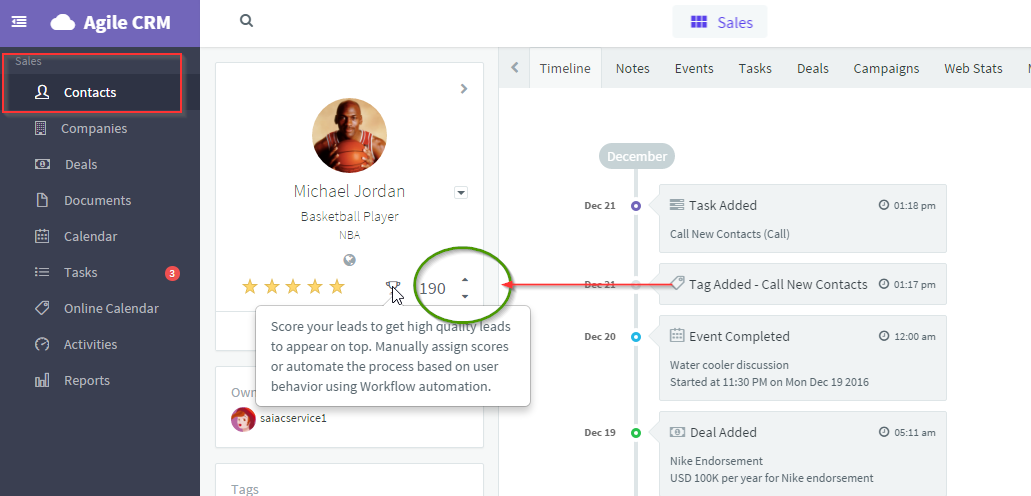
Agile CRM gives you a 360-degree contact view that pulls together contact details, email history, website activity, call logs, and deal status on a single page. You can track deals through a drag-and-drop Kanban pipeline and use lead scoring to prioritize contacts based on email engagement and web behavior. It's a system of record that tells you what happened.
Source: Agile CRM
SugarCRM goes further.
Sugar Sell guides sellers toward what to do next. When a rep logs in, the platform shows which accounts and opportunities matter most right now, ranking them by risk signals, engagement gaps, and expansion opportunities.
Sugar sales-i analyzes ERP order data to surface buying patterns and whitespace opportunities inside the CRM, without requiring separate BI tools. Before a meeting, reps get a context view combining company summaries, recent news, past interactions, and contact history. For manufacturers managing hundreds of accounts with recurring purchase cycles, this turns the CRM from a filing cabinet into a coaching tool.
ZoomInfo operates at a different level.
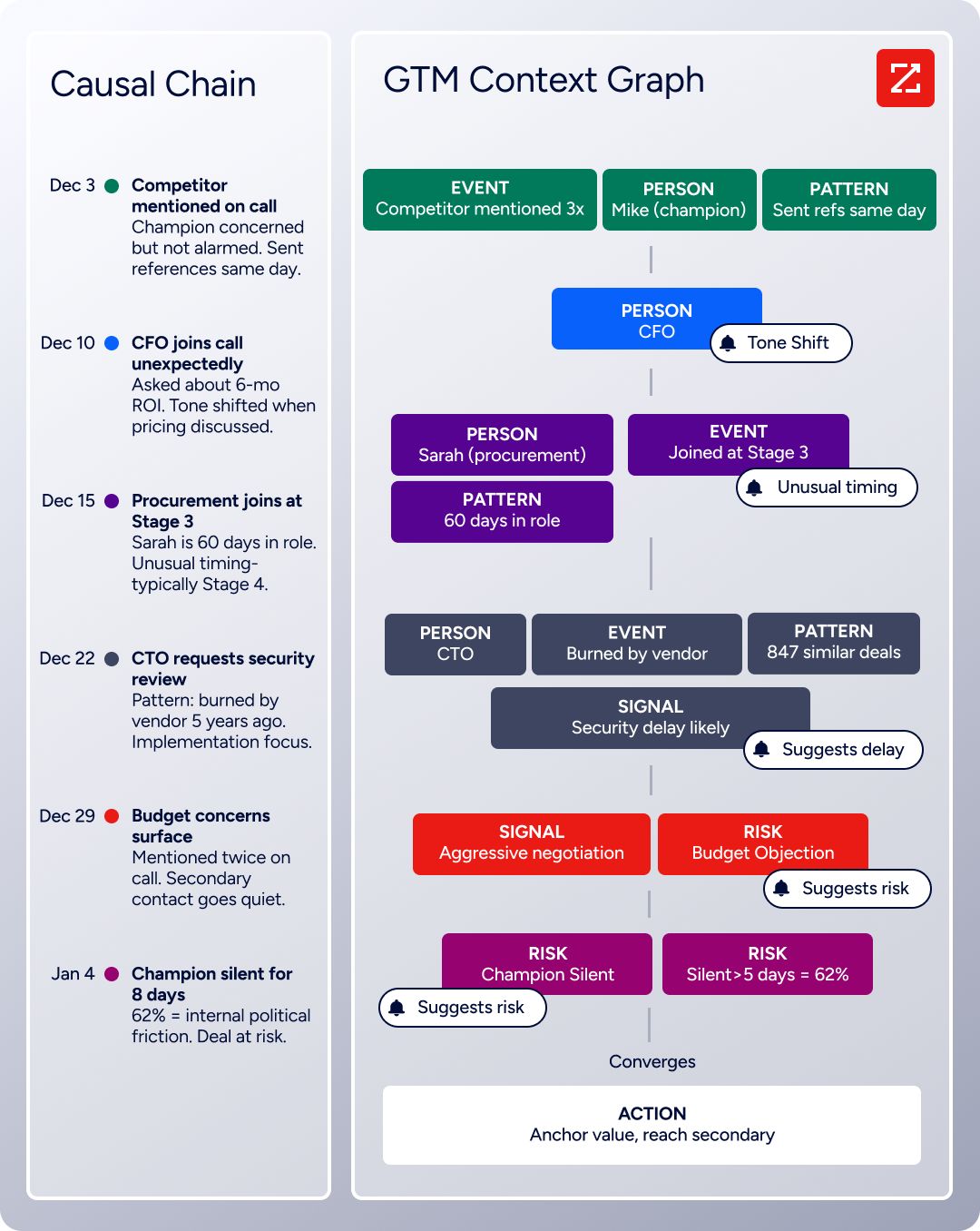
While Agile CRM and SugarCRM organize internal data (what your team has logged), ZoomInfo's GTM Context Graph combines your internal CRM data with external intelligence: 500M contacts, buyer intent signals from 210 million IP-to-Organization pairings, conversation transcripts, and behavioral data.
The result is an intelligence layer that captures not just what happened in a deal, but why it happened. A CRM records that a deal moved to Stage 3. ZoomInfo can identify that executive sponsorship entering at this stage, combined with intent signals showing the company researching your competitor, matches the pattern behind closed-won deals in your segment.
In GTM Workspace, sellers see prioritized accounts with AI-drafted outreach that already addresses the specific concern identified as the deal-moving moment. No toggling between systems, no manual research.
Source: ZoomInfo
Seismic's sales team attributed 39% of active pipeline to opportunities identified or influenced by ZoomInfo signals and boosted productivity by 54%. (Seismic)
Marketing automation at different scales
Marketing automation is where Agile CRM outperforms its price point, and where SugarCRM takes a different approach.
Agile CRM includes marketing automation at all paid tiers, not locked behind a premium plan.
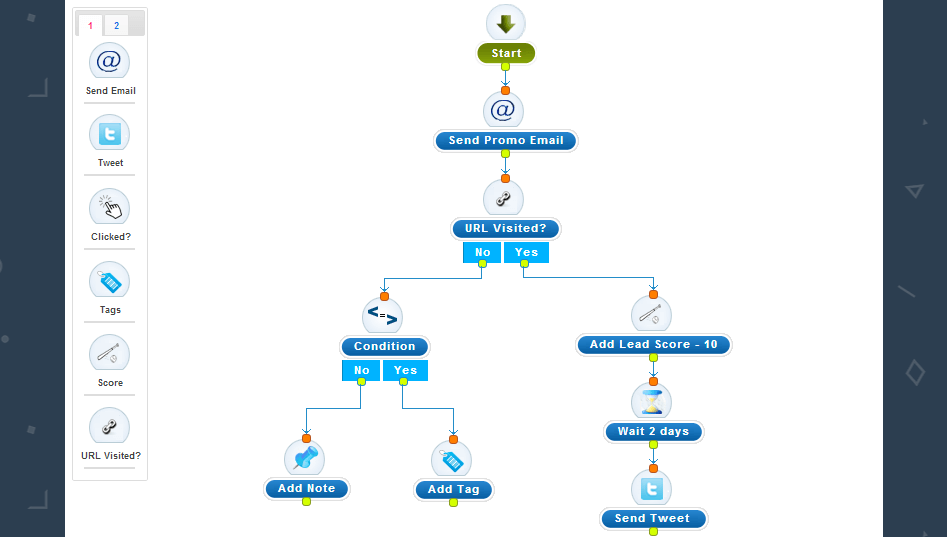
The visual campaign builder lets you sequence email sends, time delays, condition checks, SMS messages, and social posts. You can build drip campaigns triggered by contact behavior, deploy web forms and landing pages to capture leads, and run multichannel campaigns combining email, SMS, and social in a single sequence.
For a platform starting at $8.99/user/month, this breadth is unusual. The caveat: some users report marketing automation inconsistencies, and email deliverability concerns recur in reviews.
Source: Agile CRM
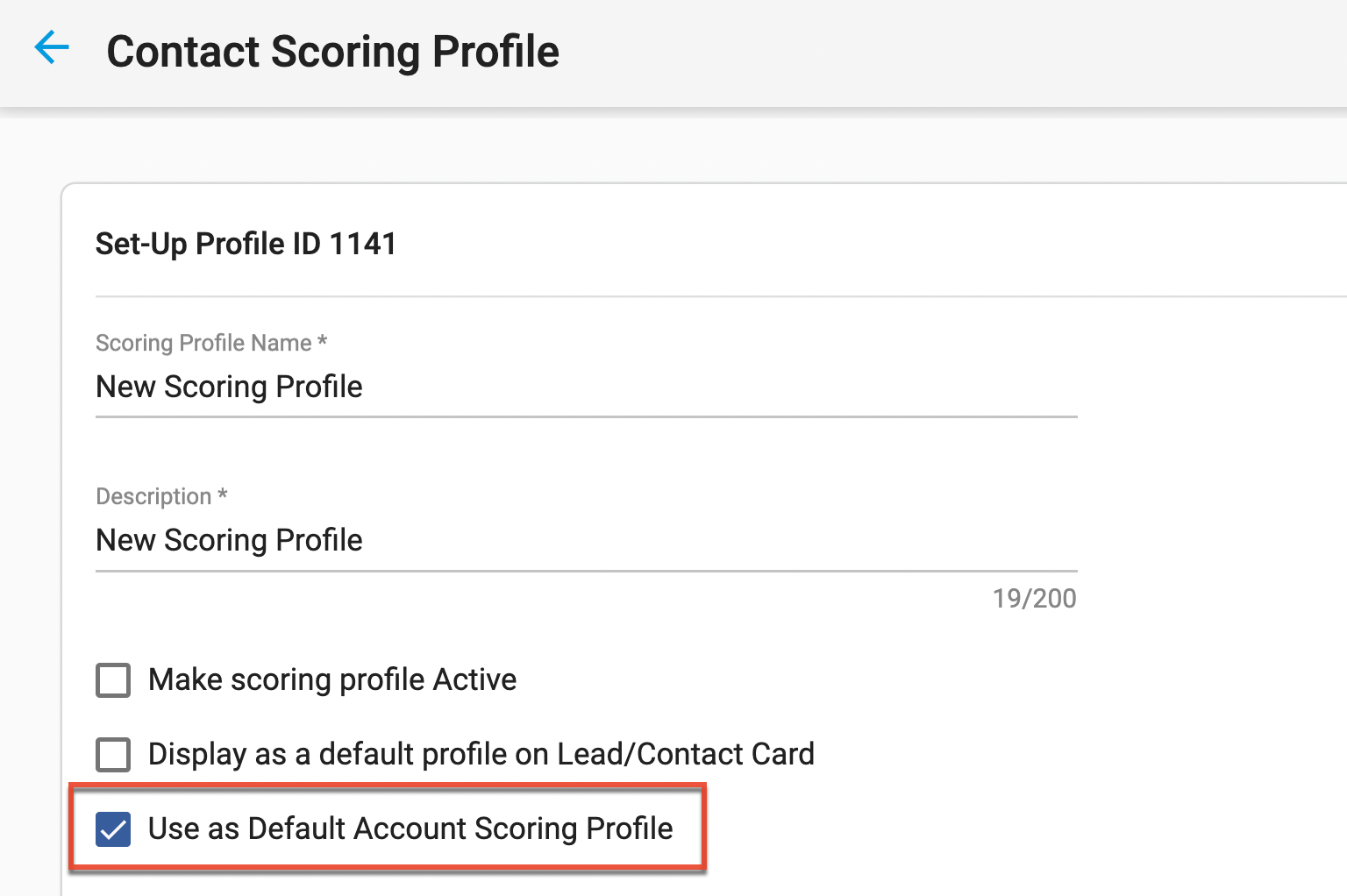
SugarCRM separates marketing into its own product.
Sugar Market is a dedicated marketing automation platform with a visual nurture builder, lead scoring with account-based scoring at all tiers, Advanced Analytics powered by Looker, and a Listeners module that triggers marketing actions based on CRM field changes. The Buyer's Journey View gives sales reps a timeline of every marketing interaction a prospect has had, visible inside Sugar Sell.
It's more capable than Agile CRM's built-in automation, but it's a separately priced product with contact-volume-based pricing that requires a sales quote.
Source: SugarCRM
ZoomInfo approaches marketing from the data side.
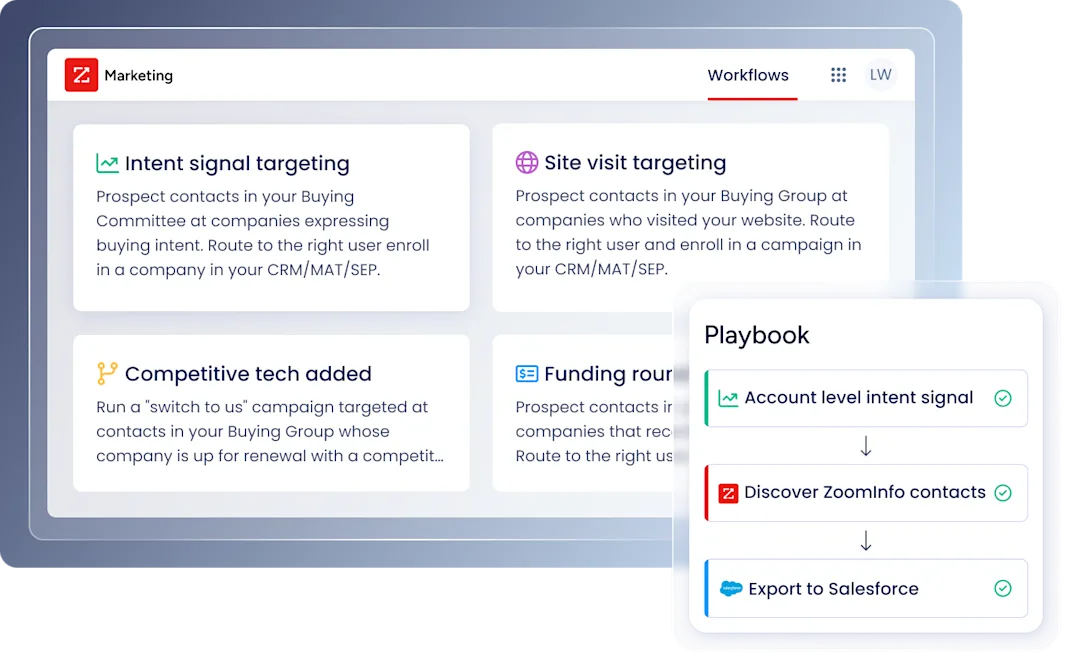
ZoomInfo Marketing layers intent signals across accounts to identify buyer readiness, then routes those accounts into campaigns across display ads (via a native demand-side platform), email sequences, and SDR workflows. FormComplete reduces web forms to a single field by auto-appending the rest from ZoomInfo's database.
In GTM Studio, marketers describe audiences in natural language and launch multi-channel plays targeting accounts that match proven win patterns, without engineering tickets.
Source: ZoomInfo
Impartner saw a 45% increase in website engagement and saved 15 hours through automation after adopting ZoomInfo's platform. (Impartner)
Pricing reflects different worlds
The pricing structures tell you exactly who each platform was built for.
Agile CRM is the most accessible.
The free plan supports up to 10 users with 1,000 contacts, no credit card required. Paid plans scale from $8.99/user/month (Starter) to $47.99/user/month (Enterprise) on annual billing. A five-person team on the Regular plan pays roughly $150/month for 50,000 contacts with full marketing automation.
Additional costs come from Twilio integration for telephony (separate per-minute charges) and SMS gateway fees via Plivo or Twilio. Note: some reviews mention billing surprises and difficult cancellation experiences, so read the fine print before committing to annual billing.
SugarCRM starts higher and climbs steeply.
Sugar Sell Standard is $59/user/month, Advanced is $85/user/month, and Premier is $135/user/month, all billed annually with a 15-user minimum. That means your floor is $10,620/year to get started. Key AI features (lead prioritization, Revenue Intelligence, generative AI, sentiment analysis) are not included in the Advanced tier; you need Premier or a separate purchase.
Sugar Market and Sugar Serve pricing aren't published, adding friction for buyers trying to model total cost. SugarCRM claims users can lower TCO by up to 32% compared to Salesforce for similar functionality, and the no-code configuration model reduces developer dependency.
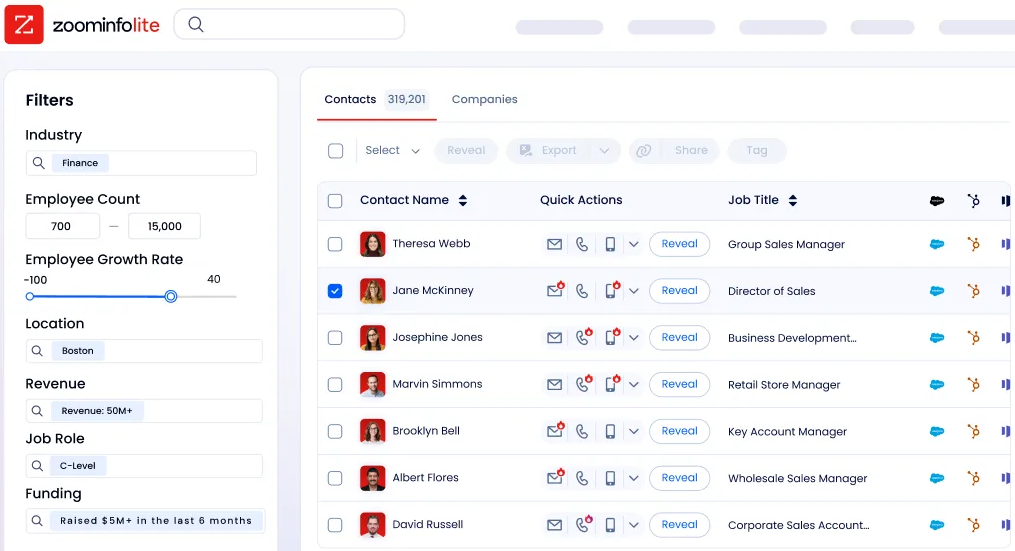
ZoomInfo uses consumption-based pricing with no published dollar amounts. Costs scale around enterprise license agreements, data access volume, API consumption, and AI activity.
ZoomInfo Lite is a permanent free tier (not a trial) with access to the B2B database, 10 monthly export credits, and basic prospecting tools. A 7-day free trial is also available. The investment is premium, but the ROI case is documented: Snowflake achieved 200% higher conversion rates on top-scoring accounts, and Seismic saved 11.5 hours per week per seller.
Source: ZoomInfo
The data gap nobody talks about
Here's the problem most CRM comparisons ignore: a CRM is only as good as the data inside it. And most CRM data is incomplete, outdated, or missing.
Agile CRM stores whatever your team enters. You can track website visitor behavior via a JavaScript snippet and pull social profile data from LinkedIn and Twitter, but the contact database is entirely self-built. If your reps don't log a contact, it doesn't exist. If a prospect changes jobs, the record goes stale until someone updates it.
SugarCRM has a real advantage here through its ERP connection. Sugar sales-i ingests historical and ongoing transactional data from connected ERP systems, giving reps access to purchase history, buying patterns, and seasonal trends they'd never find in a traditional CRM.
But this intelligence covers only existing customers with ERP transaction history. For net-new prospecting, SugarCRM still depends on manual data entry or third-party enrichment.
ZoomInfo starts with the data.
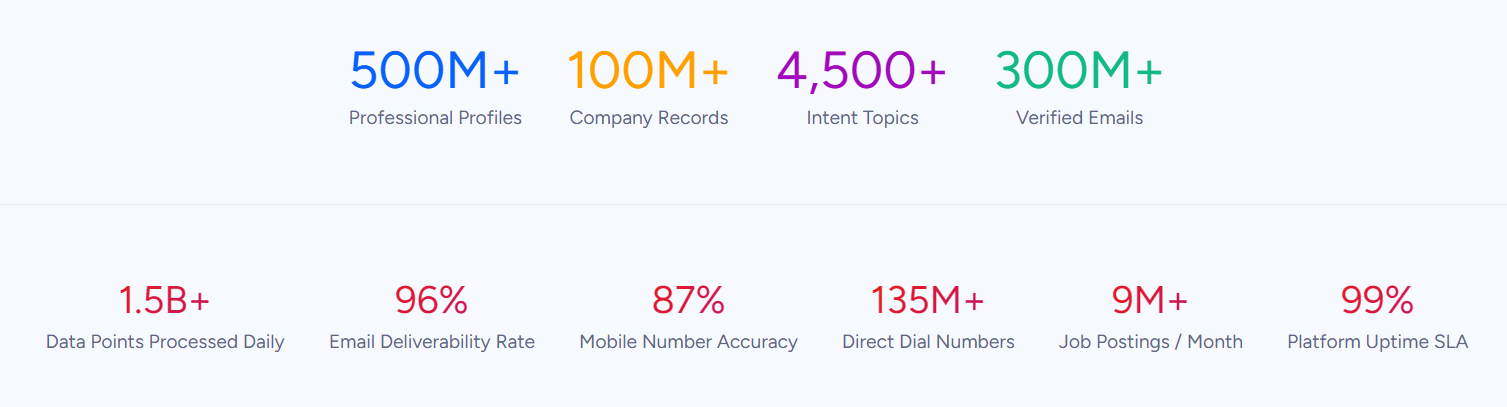
Its platform covers 500M contacts and 100M companies, verified through a multi-source pipeline backed by 300+ human researchers with up to 95% accuracy on first-party data. Beyond static profiles, ZoomInfo tracks buyer intent signals, technographic data across 30,000+ technologies at 30+ million companies, org charts with direct dials, and job-change alerts.
Source: ZoomInfo
In a Fortune 500 competitive RFP analyzing 25 million contacts across vendors, the independent consultant concluded that "no other competitor came even close."
This data gap compounds. Incomplete CRM records produce incomplete pipeline visibility, which produces inaccurate forecasts, which produces missed revenue. ZoomInfo closes the gap at the source.
"ZoomInfo gives us the information we need to execute. We don't have to go through and spend our time digging. It's already there, so we can be three steps ahead." — William Kenimer, Vice President of Revenue Operations (Vensure)
Integrations and ecosystem maturity
The integration story reveals each platform's ambitions and limits.
Agile CRM offers over 60 integrations through its plugins page, covering essentials like Gmail, Stripe, Shopify, WooCommerce, QuickBooks, and WordPress.
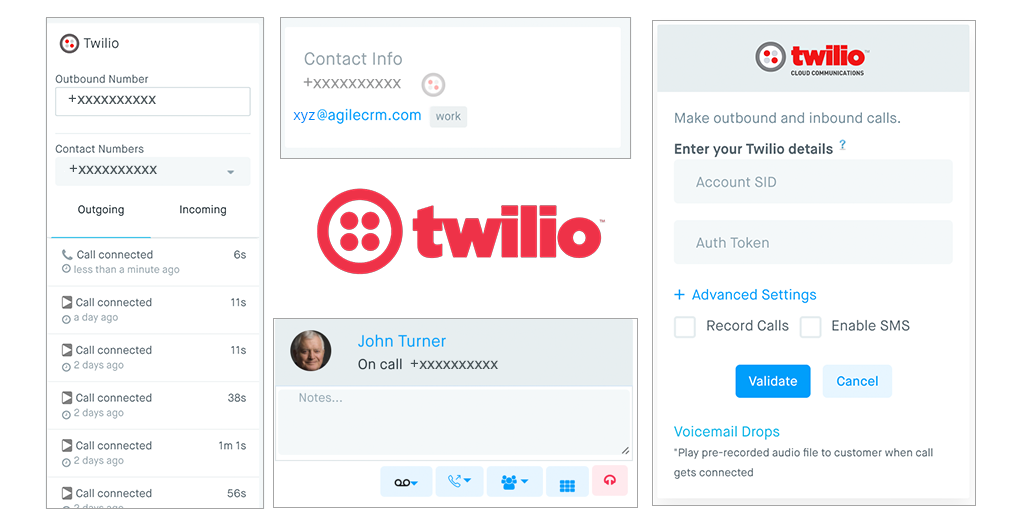
Twilio handles telephony, and Zapier extends connectivity to thousands of additional apps. The REST API is documented on GitHub with SDKs for multiple languages including Java, Python, PHP, .NET, Node.js, and Ruby. The ecosystem works for small businesses, but the integrations are narrower than what mid-market companies typically need.
Source: Agile CRM
SugarCRM centers its integration story on ERP.
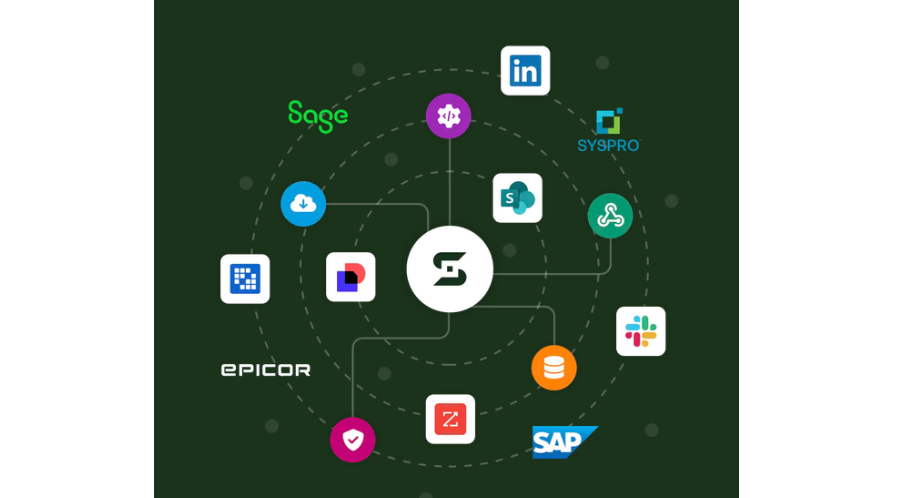
The 180+ ERP integrations include connectors for SAP, Oracle, Epicor, Syspro, Sage, and NetSuite, many provided by specialists like Magic xpi, Commercient SYNC, and Faye through the SugarAI Marketplace. A new Sugar for Syspro integration connects manufacturers' shop floor data with the sales CRM out of the box.
The REST API is well-documented and versioned (v10 through v11.25), with OAuth 2.0 authentication and an official Postman Collection. The marketplace also covers telephony, marketing, project management, and AI tools. Outside the ERP world, however, some reviewers note that SugarCRM doesn't integrate natively with many modern SaaS tools, and manual data transfers are sometimes required.
Source: Sugar AI
ZoomInfo takes an open approach.
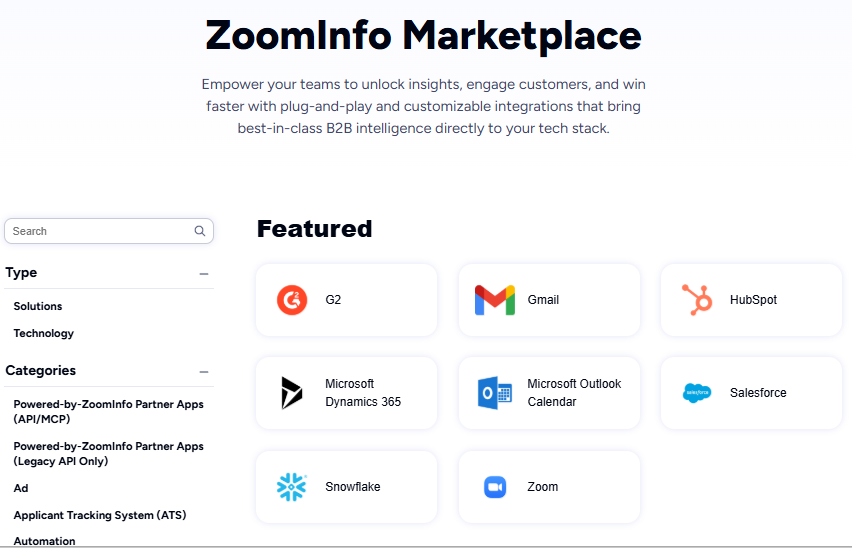
The App Marketplace lists 172+ integration partners spanning CRM (Salesforce, HubSpot, Microsoft Dynamics), cloud data platforms (AWS, Snowflake, Databricks, Google Cloud), marketing automation, sales engagement, and communications. ZoomInfo's Enterprise API provides programmatic access to its full data and intelligence layer, and the MCP server connects AI models directly to ZoomInfo's data as a native tool.
API access is included in all relevant plans, and ZoomInfo integrates directly with SugarCRM through its marketplace, meaning teams using Sugar Sell can enrich their CRM with ZoomInfo's data without switching platforms.
Source: ZoomInfo
"The plug-and-play aspect of the API means I can integrate it very easily into any process and get information at a moment's notice," said Jerry Wilson, Senior Marketing Intelligence Analyst at BDO Canada, who saw an 87% reduction in time spent on data dashboard updates. (BDO Canada)
Agile CRM vs. SugarCRM vs. ZoomInfo: Which should you choose?
The right platform depends on the size of your team, the complexity of your sales process, and whether you need a system that tracks your pipeline or one that fills it.
Choose Agile CRM if:
You have fewer than 15 salespeople
Your budget is under $50/user/month
You need CRM, email marketing, and help desk in one affordable tool
Your sales cycle is short and transactional
You're moving off spreadsheets for the first time
You can work around a dated interface and occasional performance issues
Choose SugarCRM if:
You're a mid-market B2B company in manufacturing, wholesale, or distribution
You need your CRM connected to an ERP system
Your sales reps manage large account bases with recurring purchase cycles
Cross-sell and upsell intelligence from order history is critical to your revenue
You need both cloud and on-premises deployment options
You can commit to 15+ users and $885+/month
Choose ZoomInfo if:
Your pipeline depends on finding and engaging prospects before competitors do
You need verified contact data, direct dials, and buyer intent signals at scale
You want AI that tells sellers who to contact, when to engage, and what to say
You need intelligence that works inside your existing CRM or through ZoomInfo's own products
Data quality and coverage are the foundation of your GTM strategy
You want a platform that grows more valuable as it learns from every deal
See how ZoomInfo's intelligence changes the equation with a free trial.
Agile CRM and SugarCRM are both capable CRMs for their respective audiences. But neither solves the intelligence problem. A CRM records what your team already knows.
ZoomInfo reveals what your team hasn't discovered yet: which accounts are researching solutions, who the decision-makers are, what they care about, and when they're ready to buy. For teams that want to move from tracking deals to creating them, that difference is the one that matters.
Agile CRM vs. SugarCRM vs. ZoomInfo FAQ
What is the fundamental difference between Agile CRM, SugarCRM, and ZoomInfo?
Agile CRM is an all-in-one CRM for small businesses that need sales, marketing automation, and help desk in a single affordable platform.
SugarCRM is a selling platform built for mid-market B2B companies (particularly in manufacturing, wholesale, and distribution) that need ERP integration to surface buying patterns and customer intelligence.
ZoomInfo is an AI GTM platform that starts with the largest B2B database in the industry and delivers intelligence through its own products and any third-party tool via APIs and MCP.
Which platform is cheapest to get started with?
Agile CRM is the most affordable, with a free plan supporting up to 10 users and 1,000 contacts, and paid plans starting at $8.99/user/month. ZoomInfo offers ZoomInfo Lite as a permanent free tier with 10 monthly export credits. SugarCRM has no free plan and requires a 15-user minimum at $59/user/month, making $885/month the floor for any team.
Can ZoomInfo work alongside Agile CRM or SugarCRM?
ZoomInfo integrates with SugarCRM through its marketplace, letting teams enrich Sugar Sell records with ZoomInfo's verified contact data, intent signals, and company intelligence. For Agile CRM, ZoomInfo data can connect through Zapier or the REST API. ZoomInfo is designed to power any CRM with intelligence, not to replace CRM functionality.
Which platform has the best AI capabilities?
ZoomInfo leads by a wide margin. Its GTM Context Graph processes 1.5 billion data points daily and provides AI account prioritization, outreach generation, and deal intelligence through GTM Workspace. SugarCRM offers AI lead prioritization, guided workflows, and sentiment analysis, though its core AI features require the Premier tier at $135/user/month or separate purchase. Agile CRM does not currently offer AI features.
Who is SugarCRM's ERP integration designed for?
SugarCRM's 180+ ERP integrations and Sugar sales-i module serve B2B companies in manufacturing, wholesale, and distribution that run their operations through ERP systems like SAP, Oracle, Epicor, or Syspro. The sales-i module analyzes ERP order data to surface cross-sell gaps, reorder windows, and churn risks. Companies without an ERP system won't benefit from this differentiator.
How does data quality compare across the three platforms?
Agile CRM and SugarCRM both depend on data your team enters manually or imports. SugarCRM has an advantage through its ERP connection, which provides transactional purchase data for existing customers.
ZoomInfo maintains a verified database of 500M contacts and 100M companies, backed by 300+ human researchers and up to 95% accuracy on first-party data. In a Fortune 500 competitive evaluation of 25 million contacts across vendors, an independent consultant concluded that no other competitor came close to ZoomInfo's coverage.
Is Agile CRM reliable enough for a growing business?
Agile CRM works well for basic CRM and simple marketing automation, but users report limits as they scale. Recurring complaints include slow loading times, marketing automation workflows that sometimes fail or behave inconsistently, email deliverability concerns, and support quality that varies by plan tier.
Teams that outgrow these limits typically move to mid-market platforms like SugarCRM or add intelligence tools like ZoomInfo.
Does SugarCRM offer on-premises deployment?
Yes. SugarCRM is one of the few modern CRM vendors that supports both cloud (SugarCloud, hosted on AWS) and on-premises deployment via Sugar Enterprise. On-premises starts at $85/user/month with a 10-user minimum.
This matters for regulated industries and companies with data sovereignty requirements, though on-premises customers bear their own hosting, server, and IT maintenance costs.
