

Alta entered the market in 2025 with a clear thesis: sales teams spend too much time on tasks that AI agents could handle. Its three agents (Katie for outbound, Luna for orchestration, Alex for inbound) promise to automate prospecting, qualification, and follow-up around the clock. For teams that want to hand execution to AI and focus on closing, the pitch is compelling.
To write this Alta review, we've analyzed the platform extensively. We believe it's the ideal choice if:
You want AI agents that handle outbound prospecting and inbound qualification without human involvement
You need multi-channel outreach across email, LinkedIn, and SMS from a single platform
You prefer an agent-first approach where AI executes your sales playbook 24/7
You value hands-on onboarding and dedicated customer support
Your team has a well-defined ICP and sales playbook ready for AI to follow
However, Alta might not be the best choice if:
You need verified B2B data as the foundation of your GTM strategy
You require intelligence that captures why deals move, not just automated outreach
You want a platform that spans sales, marketing, operations, and conversation intelligence
You need data access through APIs and AI-native protocols for custom tools
You're looking for analyst validation and a proven track record at scale
In this case, you should consider ZoomInfo: an AI GTM platform built on B2B data covering 500M contacts and 100M companies, an intelligence layer that captures not just what happened in your deals but why, and access that delivers that intelligence through native front-ends for sellers and marketers or through APIs and MCP into any tool your team already uses.
We've included a detailed look at ZoomInfo at the end of this Alta review, as the stronger choice for teams that need the full GTM stack rather than a focused AI agent layer. If you're ready to explore ZoomInfo, you can start with a free trial here.
What is Alta?
Alta is an AI-powered sales automation platform founded in 2023 by Stav Levi-Neumark (CEO), Tom Hoffen (CTO), and Mor Shabtai (COO).
The founding team's experience at Monday.com shaped the product: Levi-Neumark was one of Monday.com's first employees, where she built a BI tool called "BigBrain" that became central to business decisions and helped the company grow past a billion dollars in annual revenue. That experience, combined with demand from companies reaching out for their own version of BigBrain, led the team to build Alta.
The company launched out of stealth on March 4, 2025, announcing a $7 million seed round led by Entree Capital and Target Global. Its advisory board includes Gavin Patterson, former President and CRO at Salesforce, and Yoram Teitz, Partner at General Atlantic.
Alta is headquartered in Tel Aviv with an additional office in New York. Current customers include Snowflake, Monday.com, PayPal, Deel, and 11labs.
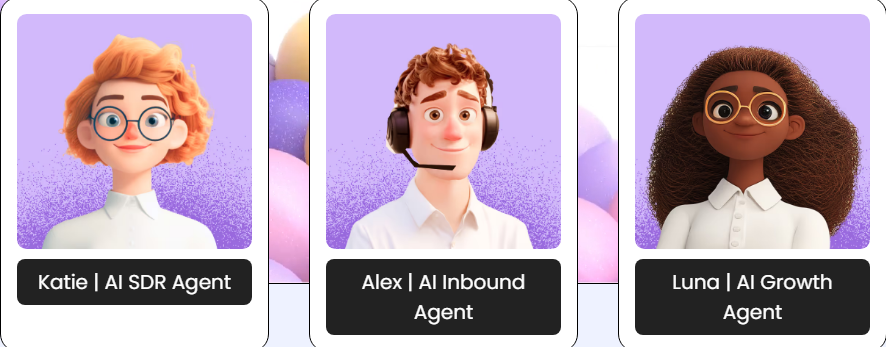
The platform centers on three AI agents: Katie (AI SDR Agent) for outbound prospecting, Luna (AI Growth Agent) for GTM orchestration and intelligence, and Alex (AI Inbound Agent) for real-time lead qualification. Alta positions these not as automation tools but as digital teammates that analyze data, prioritize opportunities, and execute on them. The company emphasizes that its agents are transparent about being AI, which it says builds trust with prospects.
Source: Alta
Alta Pros & Cons
Pros | Cons |
|---|---|
- Clean, intuitive interface praised by users | - Learning curve for structuring campaigns effectively |
- Multi-channel outreach across email, LinkedIn, and SMS | - Limited workflow customization compared to Clay or Zapier-based tools |
- Hands-on customer support and dedicated CSMs | - Integration ecosystem still maturing beyond core CRMs |
- AI agents that run 24/7 without human intervention | - No published pricing; custom quotes only |
- Personalization using 50+ data sources | - Phone outreach lacks full telephony features |
- G2 High Performer recognition across multiple categories | - Non-cancellable, non-refundable contracts |
- SOC 2 Type II and ISO 27001 certified | - Product still maturing as a newer entrant |
Alta Review: How It Works & Key Features
Katie (AI SDR Agent): Autonomous outbound prospecting across email, LinkedIn, and SMS.
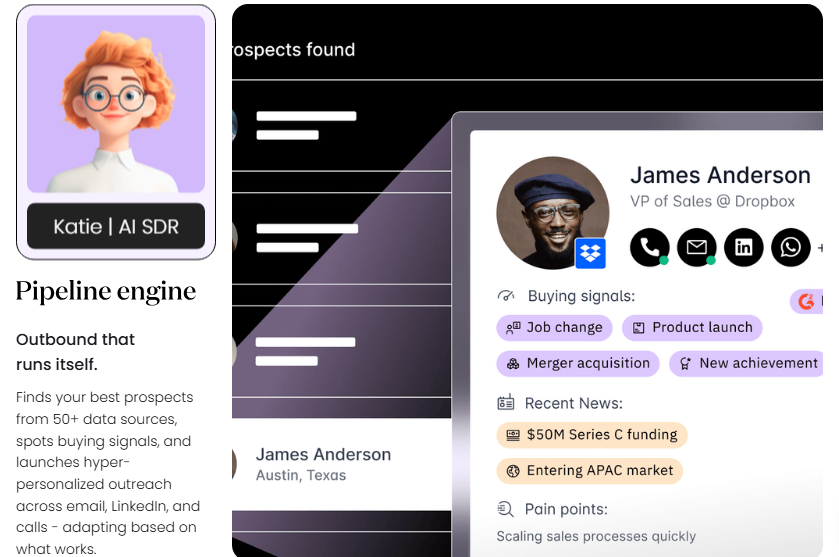
Katie is Alta's AI SDR Agent, designed to replace the manual work of a traditional sales development rep. She runs around the clock, always follows up, and uses data to find the best prospects and personalize each interaction.
Katie operates through a four-phase workflow.
First, she analyzes your CRM and 50+ data sources to identify your Ideal Customer Profile and high-value prospects, monitoring hiring trends, funding events, and tech stack adoption. Users can define their ICP through company and contact filters or use Katie's chat interface to type natural language requests like "Add job titles related to Marketing."
Second, Katie generates pitch content by pulling selling points, pain points, and value propositions from your website URL. Third, she sends follow-up messages through email, LinkedIn, and text with personalization controls including five slider adjustments for formality, persuasion, urgency, personalization, and word count. Once launched, Katie runs on autopilot by default, adding qualified prospects based on ICP fit.
Source: Alta
One notable feature is AI Enrichment variables that pull real-time information from the web (a company's CTO name, recent funding, or competitors) and insert them into messages. Users can choose from six outreach style templates including Value-Laden, Social Selling, and Direct Action.
Luna (AI Growth Agent): The intelligence layer that connects data to action.
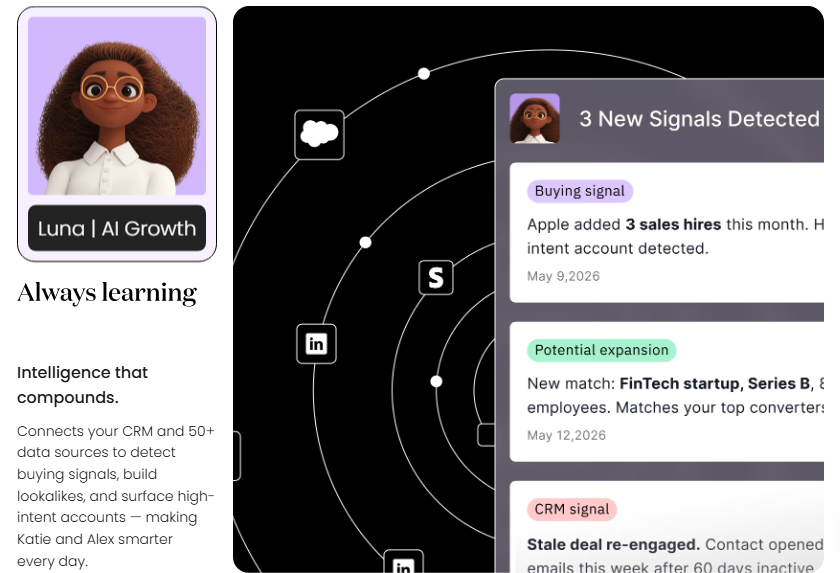
Luna is Alta's AI Growth Agent, the system behind Katie and Alex. While Katie executes outreach and Alex handles inbound, Luna analyzes GTM data, detects patterns, and optimizes sales and marketing performance.
Luna syncs with your CRM, enrichment tools, and 50+ data sources to find lookalikes, buying signals, and best-fit accounts. She analyzes CRM activity, intent data, job postings, news, and engagement patterns to identify when prospects are ready to buy, then triggers outreach from Katie and Alex.
The optimization is continuous: Luna runs A/B tests, spots patterns, and adjusts messaging, timing, and targeting with each interaction. What works for one prospect improves targeting for the next thousand.
Rather than adding another dashboard, Luna delivers insights to Slack, email, or Teams where you already work: which campaigns to scale, which segments to pause, and where to focus.
Source: Alta
Alex (AI Inbound Agent): Instant lead qualification across every channel.
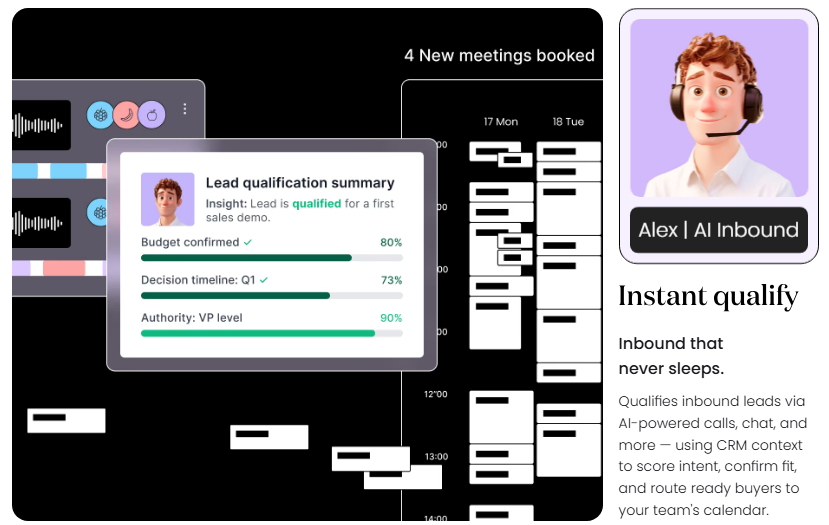
Alex is Alta's AI Inbound Agent, designed to respond to and qualify inbound leads the moment they arrive. The problem Alex solves is response speed: leads that get replies within the first 30 minutes are 21x more likely to respond positively.
Alex handles inbound on voice, chat, email, SMS, WhatsApp, and LinkedIn, qualifying and converting leads 24/7 in 20+ languages. Setup follows four steps: choose your use case, set qualification criteria and share your playbook, sync with CRM, calendar, and tech stack, and let Alex analyze conversations to improve over time.
Source: Alta
Beyond qualification, Alex handles event and webinar follow-up, meeting scheduling (including checking HubSpot calendar availability and booking directly during calls), account expansion outreach, and competitive intelligence gathering. The agent knows when to escalate to the human team, handling complex conversations while recognizing when human judgment is needed.
Integrations and Security: Connections to major CRMs and enterprise-grade compliance.
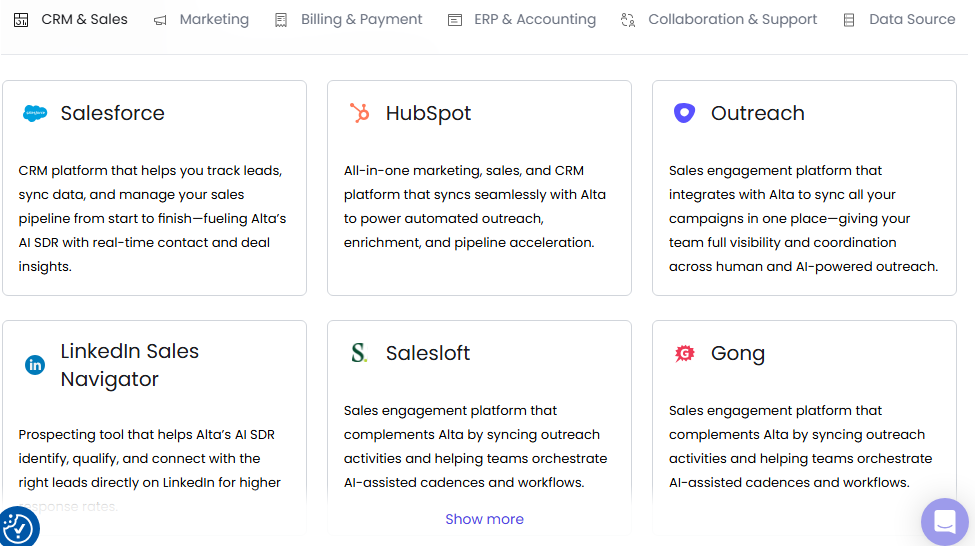
Alta integrates with 50+ tools across CRMs, sales engagement, marketing, data, and collaboration.
Native CRM integrations include Salesforce, HubSpot, and Pipedrive with bidirectional sync and configurable deduplication rules. Sales engagement connections cover Outreach, Salesloft, Gong, and Chorus. Collaboration tools include Slack, monday.com, and Jira.
Source: Alta
On security, Alta holds SOC 2 Type II certification and ISO/IEC 27001:2022 certification. Data protection covers GDPR, CCPA/CPRA, and HIPAA. Encryption uses TLS 1.2+ in transit and AES-256 at rest. Infrastructure runs on AWS Managed Services with multi-AZ deployment. Customer data is never used to train shared AI models.
Where Alta Falls Short
Alta delivers on AI-driven outreach, but several limitations surface for teams with broader GTM needs. These reflect a platform built for agent-driven outreach, not go-to-market intelligence.
No Proprietary Data Foundation: Alta draws from 50+ external data sources and customer CRM data, but it does not own or maintain a proprietary B2B database. The quality of Katie's outreach and Luna's intelligence depends on the data fed into the system. Teams without strong existing data may find the agents working with incomplete or unverified contact information, which hurts deliverability and response rates.
Narrow Product Scope: Alta focuses on AI agent execution for sales. It does not offer conversation intelligence, website visitor identification, marketing automation, ABM, or data operations tools. Teams that need data, intelligence, and execution working together across sales and marketing must assemble multiple vendors alongside Alta.
Opaque Pricing and Rigid Contracts: Alta uses a custom quote-based pricing model with no published prices. The Terms of Service state that all payments are non-refundable and non-cancellable, with auto-renewal unless you give 60 days' notice.
The company advertises transparent pricing with no hidden fees, but the Terms reference overage fees charged in arrears and separate charges for professional services, making total cost hard to predict before signing.
Limited Workflow Customization: Unlike Clay or Zapier-based platforms, Alta doesn't offer drag-and-drop workflows or customizable automations. Teams that need specific automation logic beyond Alta's pre-configured agent workflows may find the platform restrictive.
Early-Stage Product Maturity: As a newer entrant, some features are still maturing. The company launched publicly in March 2025 with $7 million in seed funding. Its G2 recognition and customer roster are encouraging, but the platform's track record is measured in months, not years. Access to multiple agents and deeper analytics may only be available on custom-priced plans.
These limitations are natural for a focused, early-stage platform. But they leave a gap for teams that need verified data, intelligence, and multi-functional GTM capabilities from a single provider.
Top Alta Alternative for Comprehensive GTM: ZoomInfo
ZoomInfo addresses Alta's gaps by approaching the GTM problem from the opposite direction. Where Alta starts with AI agents and relies on external data, ZoomInfo starts with its own B2B data and builds intelligence and execution on top of it.
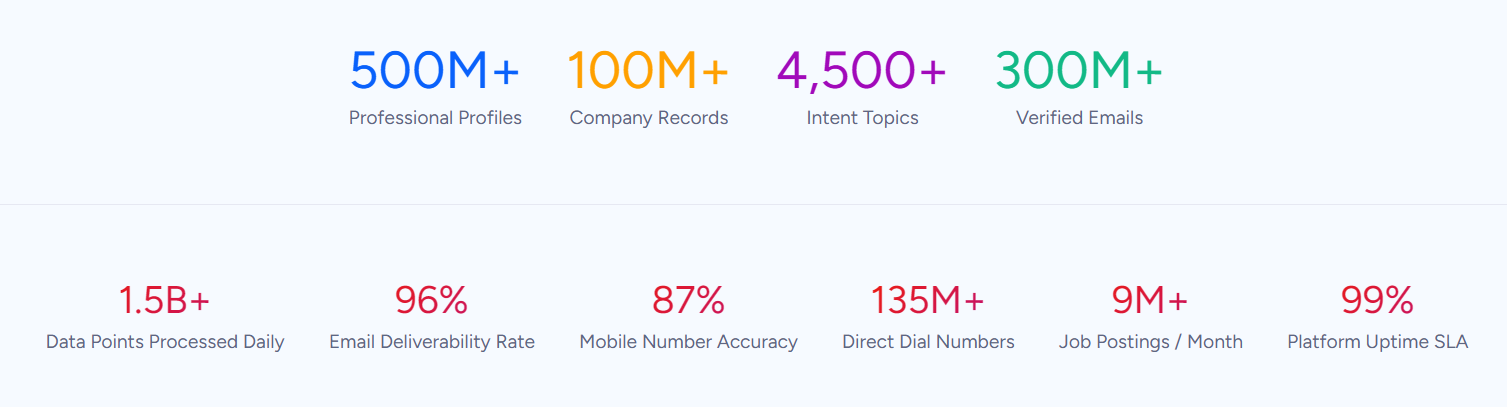
ZoomInfo is an AI GTM platform built on three pillars: a data foundation (500M contacts, 100M companies, 135M+ verified phone numbers, and 200M+ verified business email addresses), the GTM Context Graph (an intelligence layer that fuses this data with your CRM records, conversation transcripts, and behavioral signals to reveal not just what happened in your deals but why), and access through GTM Workspace for sellers, GTM Studio for marketers and RevOps, or APIs and MCP in any front-end.
ZoomInfo is a public company (NASDAQ: GTM) serving 35,000+ companies worldwide, including Adobe, Snowflake, PayPal, and Thomson Reuters. It has been named a Gartner Magic Quadrant Leader for ABM Platforms for two consecutive years and a Forrester Wave Leader for Intent Data Providers.
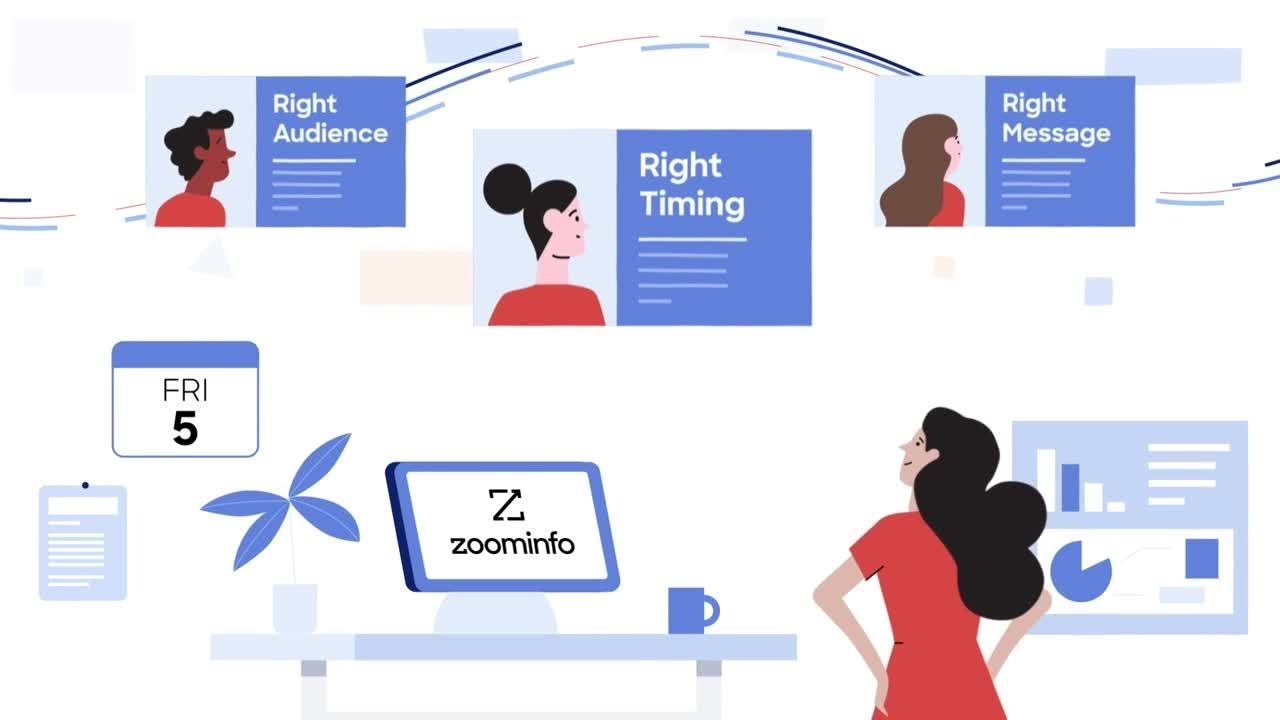
The Most Comprehensive B2B Data: ZoomInfo's data spans 500M contacts and 100M companies, verified at scale.
Alta relies on external data sources and customer CRM data. ZoomInfo owns the data layer.
The platform covers three dimensions: identity data (who buyers are and how to reach them), company context (attributes, org charts, technographics across 30,000+ technologies), and dynamic signals (intent data, website visitor tracking, and buying activity).
This data flows through a verification pipeline backed by 300+ human researchers and multi-layered ML processing, reaching up to 95% accuracy on first-party data. The accuracy claim is externally validated: in a Fortune 500 competitive RFP analyzing 25 million contacts across vendors, the independent consultant concluded that "no other competitor came even close."
Source: ZoomInfo
For sales reps, this means direct dials that ring and emails that land. For RevOps teams, enrichment workflows don't require stitching together multiple vendors for a complete account picture.
ZoomInfo Intent tracks signals from 210 million IP-to-Organization pairings and 6 trillion+ new keyword-to-device pairings sourced monthly. Guided Intent, exclusive to ZoomInfo, identifies topics historically correlated with deal success rather than requiring manual topic selection.
"ZoomInfo gives us the information we need to execute. We don't have to spend our time digging. It's already there, so we can be three steps ahead." (Vensure case study)
The GTM Context Graph: Intelligence that captures why deals move, not just that they moved.
Alta's Luna agent analyzes data and surfaces recommendations, but it operates on whatever data customers provide.
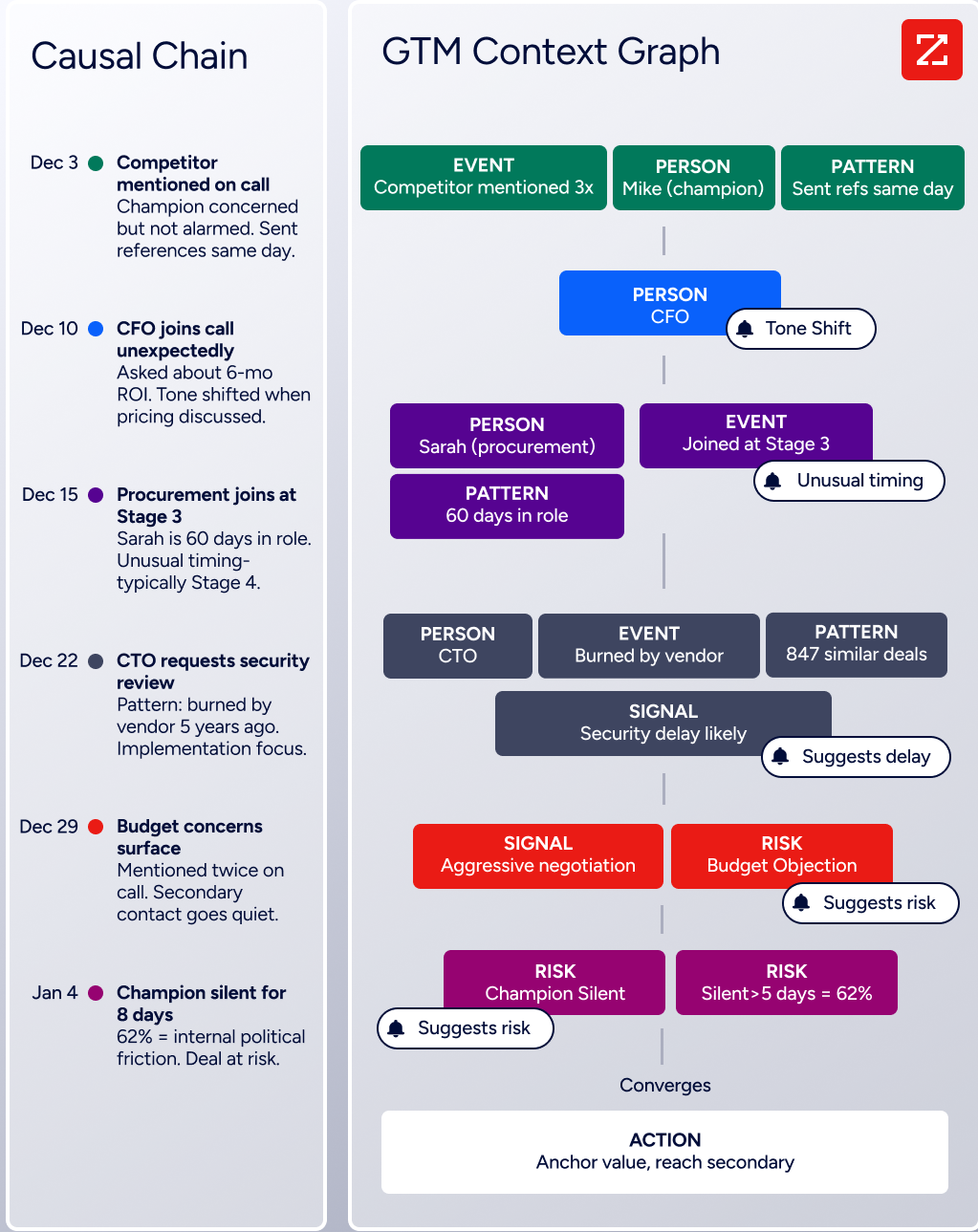
ZoomInfo's GTM Context Graph goes further by fusing ZoomInfo's B2B data with a customer's CRM records, conversation intelligence from Chorus, email interactions, and behavioral signals into a single intelligence layer that processes 1.5B+ data points daily.
The distinction matters.
A CRM records that a deal moved from Stage 3 to Stage 4. Conversation intelligence transcribes what the VP of Finance said on the last call. Intent platforms log a research spike. The GTM Context Graph reasons across all three to capture why the deal moved, then connects that reasoning to actions. As ZoomInfo's CPO Dominik Facher writes: "The CRM recorded the state change. It has no record of why it happened."
Source: ZoomInfo
This intelligence exists because ZoomInfo has spent 20 years building data unification infrastructure and acquired tools like Chorus to capture and extract meaning from every interaction. A startup building AI agents on top of third-party data cannot replicate this.
Seismic attributed 39% of active pipeline to ZoomInfo-influenced opportunities and reported 54% productivity gains: "That combination of our internal CRM data, external signals, and AI that's given all that context has helped us craft very specific account- and persona-based messages." (Seismic case study)
Universal Access: Use ZoomInfo's intelligence in any tool, any workflow, any AI agent.
Alta requires teams to work inside its platform. ZoomInfo delivers its intelligence through three channels, so teams choose where they work without losing access to the same data.
GTM Workspace gives sellers a single screen where AI agents handle account research, draft outreach, monitor signals, and update CRM, all powered by the GTM Context Graph. The Action Feed streams in-market buyers with pre-drafted actions on every signal: G2 comparisons, funding events, executive hires.
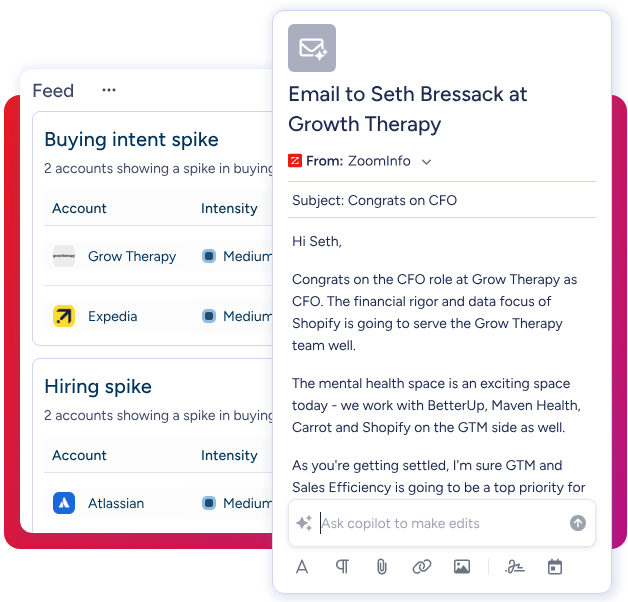
Source: ZoomInfo
GTM Studio gives marketers and RevOps an AI-powered canvas where audience definition, campaign orchestration, and pipeline measurement happen in natural language. Expansion plays that used to take 3 weeks now launch in 30 minutes.
For teams that build beyond ZoomInfo's own products, APIs and MCP expose the same intelligence to any custom agent, internal tool, or partner platform. The MCP server currently supports Claude and ChatGPT, with additional tools noted as coming soon. API access is included in all relevant plans.
All three channels draw from one GTM Context Graph. Where you work never limits the intelligence available.
"The plug-and-play aspect of the API means I can integrate it into any process and get information at a moment's notice," achieving an 87% reduction in time spent on data dashboard updates. (BDO Canada case study)
Pricing and Access: A permanent free tier and transparent credit system.
ZoomInfo offers ZoomInfo Lite, a permanent free tier with access to the B2B database, 10 monthly export credits, individual and company searches, the ReachOut Chrome Extension, WebSights Lite, HubSpot integration, and built-in email sending. No credit card, no annual commitment, no time limit. A separate 7-day free trial provides access to paid features.
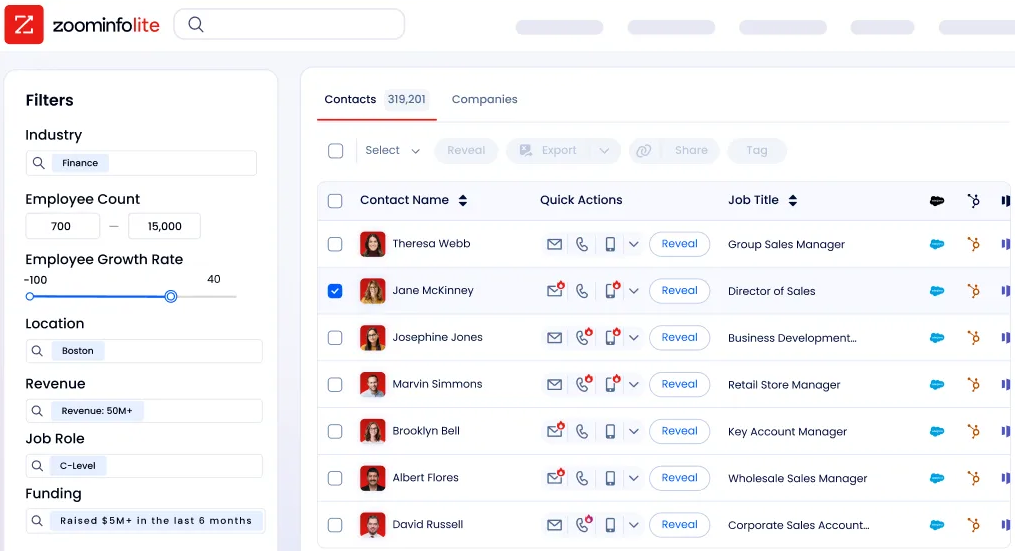
Source: ZoomInfo
Paid plans follow a custom-quoted, seat-and-credit model across Sales (Professional, Advanced, Enterprise), Marketing (Marketing Demand, ABM Lite, ABM Enterprise), and standalone products like Chorus and Chat. Credits are consumed only when exporting data; searching and viewing within ZoomInfo is free.
Note: ZoomInfo is transitioning toward a consumption-based pricing model.
Alta or ZoomInfo: Comparison Summary
Aspect | Alta | ZoomInfo |
|---|---|---|
Core approach | AI agent execution layer | AI GTM platform |
Proprietary data | None; relies on 50+ external sources | 500M contacts, 100M companies, 135M+ verified phones, 200M+ verified email addresses |
Intelligence layer | Luna (pattern detection, campaign optimization) | GTM Context Graph (1.5B+ data points daily, CRM + conversations + signals) |
Outbound execution | Katie AI SDR (email, LinkedIn, SMS) | GTM Workspace AI agents + Salesloft partnership |
Inbound handling | Alex AI agent (voice, chat, email, SMS, WhatsApp) | Website Chat with visitor identification + FormComplete |
Conversation intelligence | Not included | Chorus (14 patents, call/meeting/email analysis) |
Marketing & ABM | Not included | Native DSP, ABM orchestration, audience management |
Data operations | Not included | Multi-vendor enrichment, deduplication, routing |
API / AI agent access | Webhook and API for calls | Enterprise API, MCP server, Cloud Data Cubes |
Free plan | No public free plan; pilot available | ZoomInfo Lite (permanent, no credit card) |
Pricing transparency | Custom quotes only | Custom quotes; credit system documented |
Contract terms | Non-cancellable, quarterly billing, 60-day renewal notice | Annual contracts; multi-year discounts |
Analyst recognition | G2 High Performer (AI Sales Agents) | Gartner Leader (ABM), Forrester Leader (Intent), G2 133 No. 1 rankings |
Company stage | Seed ($7M raised, founded 2023) | Public (NASDAQ: GTM, $1.25B annual revenue) |
Customers | Snowflake, Monday.com, PayPal, Deel | Adobe, Snowflake, PayPal, Thomson Reuters, 35,000+ total |
Final Verdict
The choice between Alta and ZoomInfo depends on what your GTM strategy requires today and where it's heading.
Choose Alta if you have a well-defined ICP, a proven sales playbook, and reliable data sources already in place.
Alta's AI agents can take that foundation and execute outbound prospecting and inbound qualification on their own, 24/7, without adding SDR headcount. The platform works best for teams that want to hand execution to AI and focus their people on relationship-building and closing. If your primary need is scaling outreach volume and speed with minimal manual effort, Alta delivers.
Choose ZoomInfo if you need the full picture: verified data, contextual intelligence, and execution across sales, marketing, and operations.
ZoomInfo's value starts with the data layer. Direct dials that ring, emails that land, intent signals that reveal when accounts are in-market. The GTM Context Graph turns that data into intelligence that explains why deals move or stall, and three access channels (GTM Workspace, GTM Studio, APIs/MCP) put that intelligence into every team and every tool without lock-in.
For organizations that want one platform to power their entire go-to-market motion, ZoomInfo provides what a focused agent platform cannot.
The distinction is structural. Alta is an execution layer that performs well when fed good data and clear playbooks. ZoomInfo is the data and intelligence foundation that makes every downstream action (whether inside its own products or any third-party tool) more accurate, more contextual, and more likely to convert.
Get started with ZoomInfo here.
Alta FAQ
What is Alta and what does it do?
Alta is an AI-powered sales automation platform with three AI agents: Katie for outbound prospecting, Luna for GTM orchestration and intelligence, and Alex for inbound lead qualification.
These agents automate prospect research, personalized outreach across email, LinkedIn, and SMS, meeting scheduling, and campaign optimization. Alta targets B2B revenue teams that want to scale pipeline generation without proportionally scaling headcount.
How much does Alta cost?
Alta does not publish pricing. Costs depend on team size, usage volume, and channels used (email, LinkedIn, or calls). The company offers custom quotes delivered in hours rather than days. Contracts are billed quarterly by default with auto-renewal unless 60 days' notice is given. All payments are non-refundable and non-cancellable under Alta's Terms of Service.
ZoomInfo offers a permanent free tier (ZoomInfo Lite) with no credit card required, plus a 7-day free trial of paid features.
Does Alta have a free plan or free trial?
Alta does not advertise a free plan or self-service trial. The company may offer evaluation periods (pilots) with a default duration of 90 days, but these are provided at Alta's discretion and intended for internal evaluation only, not production use.
ZoomInfo provides ZoomInfo Lite as a permanent free tier with access to the B2B database, 10 monthly export credits, Chrome extension, and HubSpot integration, with no time limits.
Does Alta have its own contact database?
No. Alta does not maintain a proprietary B2B contact database. The platform relies on 50+ external data sources and customer CRM data to fuel its AI agents. This means the quality of Alta's outreach depends on the quality of data those sources provide.
ZoomInfo owns and maintains a B2B data platform with 500M contacts, 100M companies, and 135M+ verified phone numbers, verified through a pipeline backed by 300+ human researchers.
What integrations does Alta support?
Alta integrates with 50+ tools across CRMs (Salesforce, HubSpot, Pipedrive), sales engagement platforms (Outreach, Salesloft, Gong, Chorus), marketing platforms (Mailchimp, Marketo, Google Ads, LinkedIn Ads), data sources (ZoomInfo, Snowflake, Google Sheets), and collaboration tools (Slack, monday.com, Jira). The platform also supports webhook URLs and API access for programmatic use.
ZoomInfo offers 120+ marketplace integrations, Cloud Partner data ingestion (AWS, Google Cloud, Snowflake, Databricks), and MCP server access for AI agents.
Is Alta secure and compliant?
Yes. Alta holds SOC 2 Type II and ISO 27001:2022 certifications, with compliance covering GDPR, CCPA/CPRA, and HIPAA. Data is encrypted with TLS 1.2+ in transit and AES-256 at rest, running on AWS Managed Services. The platform includes role-based access control, SAML 2.0 and OAuth SSO, and immutable audit logs. Customer data is never used to train shared AI models.
ZoomInfo maintains a comparable certification stack (ISO 27001, ISO 27701, SOC 2 Type II, TRUSTe GDPR and CCPA validations) and is a registered data broker in California and Vermont.
How does Alta compare to ZoomInfo for outbound sales?
Alta's approach is agent-first: Katie handles prospecting, outreach, and follow-up autonomously across multiple channels. ZoomInfo takes a data-and-intelligence-first approach: its GTM Workspace provides AI-powered execution for sellers, but the outreach is grounded in a verified B2B database and an intelligence layer that captures why deals move.
For teams that already have strong data and need execution, Alta may suffice. For teams that need accurate data, contextual intelligence, and execution in one platform, ZoomInfo covers the full workflow from signal detection to closed deal.
Who are Alta's typical customers?
Alta's customer base includes B2B technology companies and SaaS businesses such as Snowflake, Monday.com, PayPal, Deel, and 11labs. The platform targets mid-market to enterprise revenue teams with defined sales processes and outbound motions. Alta suits teams that want to augment or replace SDR headcount with AI agents.
ZoomInfo serves 35,000+ companies worldwide, including enterprise customers like Adobe, Snowflake, PayPal, Thomson Reuters, and Databricks, across sales, marketing, and revenue operations.
Researching Alta? These comparisons and alternatives help you decide:
