
If you're searching for amoCRM, you should know it rebranded to Kommo in October 2022. The product is the same. The name changed when the platform shifted to a messenger-first CRM.
Choosing between Kommo and Zoho CRM comes down to how your team sells:
Do your deals happen in WhatsApp and Instagram DMs, or through email, phone, and structured multi-step processes?
Do you need a CRM simple enough to use in minutes, or one customizable enough to model complex sales workflows?
Is your team small and fast-moving, or large enough to need territory management, process enforcement, and forecasting?
How important is verified B2B prospecting data and buyer intent signals for filling your pipeline?
Do you want month-to-month contract flexibility, or are you comfortable committing for six months?
In short, here's what we recommend:
Kommo is built for businesses that sell through messaging apps. Its unified inbox pulls WhatsApp, Instagram, TikTok, Telegram, and Facebook Messenger conversations into one CRM pipeline, so reps manage all conversations from a single screen. The AI agent handles inquiries, qualifies leads, and processes payments 24/7 without human help.
At $15/user/month, Kommo is affordable and quick to deploy for teams that sell through chat. The trade-off: limited reporting, basic customization, a six-month minimum commitment, and an architecture not designed for complex, multi-stage B2B sales processes.
Zoho CRM is a CRM platform that scales from startup to mid-market enterprise. With Canvas Design Studio for custom interfaces, Blueprint for enforced sales processes, and Zia AI for predictive scoring, forecasting, and autonomous AI agents, Zoho CRM offers depth Kommo doesn't attempt.
Pricing starts at $14/user/month with month-to-month billing and a permanent free plan for up to 3 users. The trade-off: advanced features require configuration time, support quality is inconsistent, and the most useful capabilities (Zia AI, territory management, journey orchestration) sit behind Enterprise-tier pricing.
Both platforms manage your pipeline once leads arrive. Neither solves the upstream problem: finding the right prospects, knowing when they're ready to buy, and reaching the decision-makers.
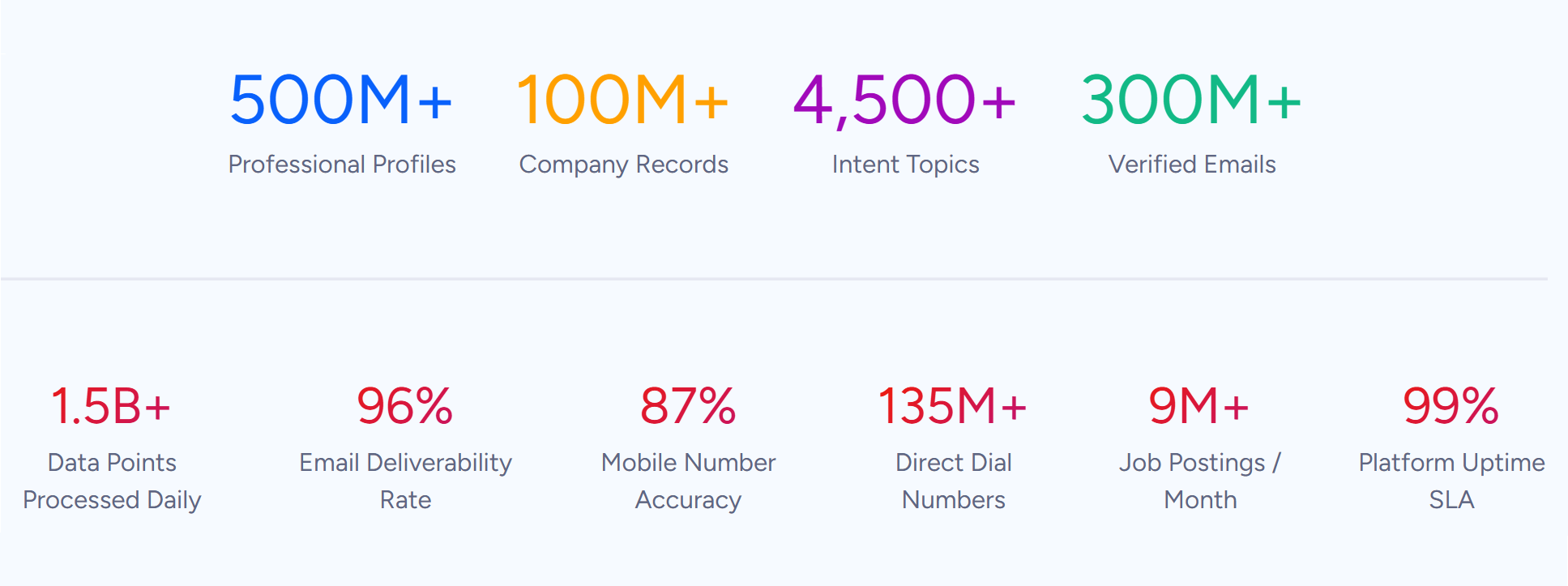
ZoomInfo is a B2B data and go-to-market platform that gives sales teams intelligence no CRM provides on its own. Its database covers 500M contacts, 100M companies, 135M+ verified phone numbers, and 200M+ verified business emails, so reps can identify buyers and reach them directly.
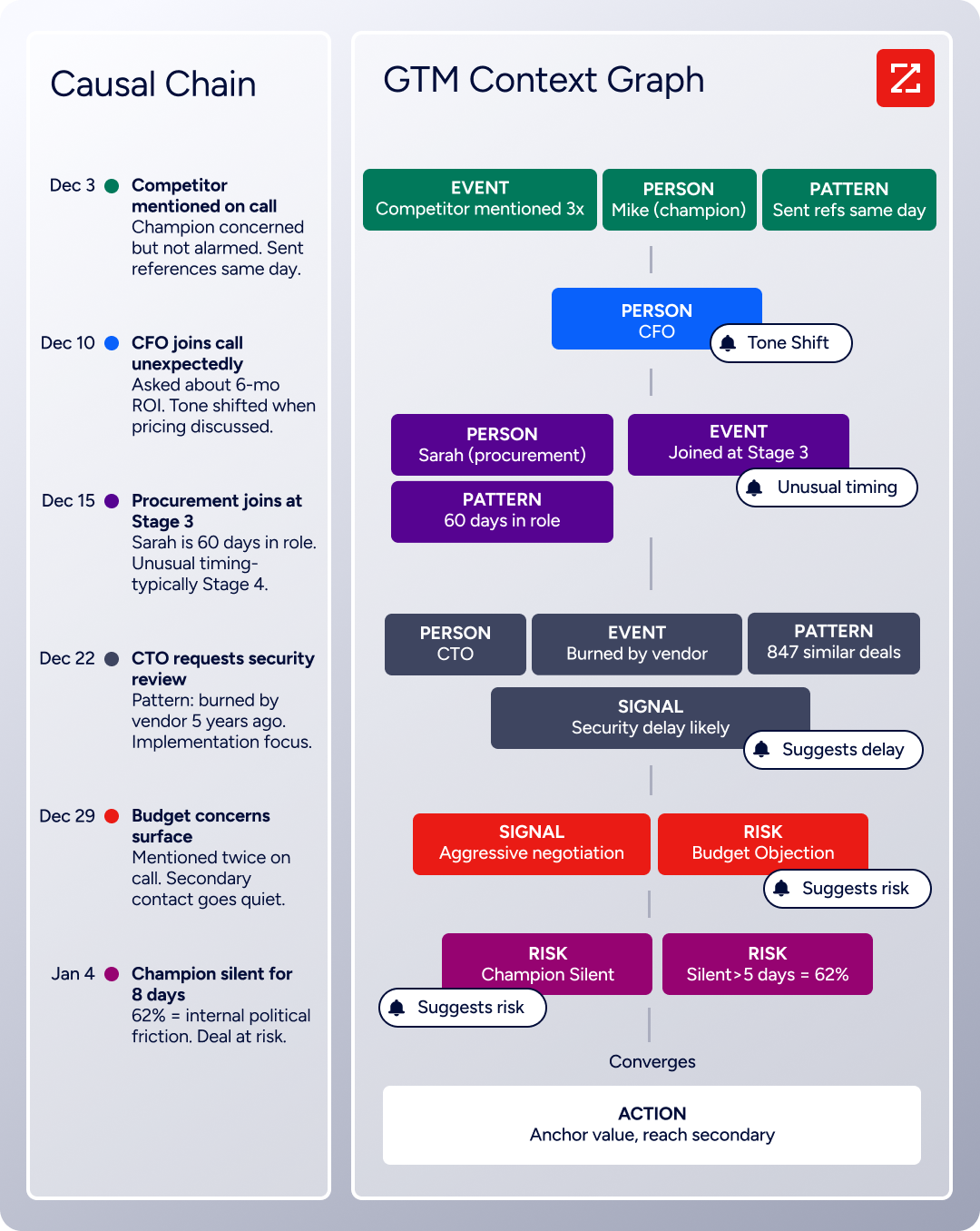
The GTM Context Graph (processing 1.5B+ data points daily) combines this data with your CRM records and behavioral signals to show which accounts are in-market and why deals move. Sales teams use GTM Workspace for AI-driven prospecting, while marketers and RevOps use GTM Studio to build and run campaigns.
For teams on Kommo or Zoho CRM, ZoomInfo fills the data gap between a reactive pipeline and a proactive one.
If verified B2B data and buyer intelligence sound like the missing piece in your sales workflow, see how ZoomInfo works with a free trial.
Kommo vs. Zoho CRM vs. ZoomInfo at a glance
Kommo (amoCRM) | Zoho CRM | ZoomInfo | |
|---|---|---|---|
Core focus | Messenger-based sales CRM | Customizable CRM | B2B data and go-to-market platform |
AI capabilities | AI agent for messenger conversations | Zia: scoring, forecasting, autonomous agents | GTM Context Graph, AI outreach and intent signals |
Channels | WhatsApp, Instagram, TikTok, Telegram, email | Email, phone, WhatsApp, social, SMS, LINE | Works with any channel |
Customization | Limited pipeline and field options | Canvas, Blueprint, up to 500 custom modules | Integrates with your CRM |
Reporting | Basic; AI Analyst on Pro tier | 40+ reports, cohort analysis, anomaly detection | Pipeline analytics and intent dashboards |
Integrations | |||
B2B contact database | None | None | 500M contacts, 200M+ verified emails |
Free option | 14-day trial only | Free plan for up to 3 users | ZoomInfo Lite (permanent, no time limit) |
Starting price | $15/user/month (6-month minimum) | ~$14/user/month (monthly billing available) | Free tier (Lite); paid plans custom-quoted |
Contract flexibility | 6-month minimum | Month-to-month available | Annual contracts standard |
Best for | SMBs selling via WhatsApp/Instagram | SMB to mid-market with process-driven sales | B2B teams needing prospecting data and buyer signals |
Messenger-first vs. multi-channel: the fundamental split
Kommo and Zoho CRM are built for different sales motions.
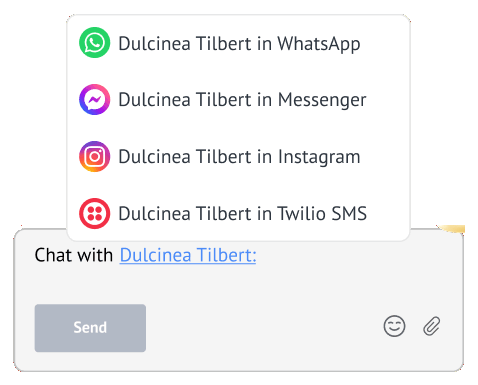
Kommo assumes your sales happen in chat. The entire product (pipeline, inbox, automation, AI) is organized around conversation threads on WhatsApp, Instagram, TikTok, and Telegram. When a prospect sends a WhatsApp message, it lands in a unified inbox linked to a deal card in the pipeline.
Source: Kommo
The rep replies from the same interface. The AI agent can handle the conversation on its own. The deal closes inside the chat thread, sometimes with a Stripe payment link sent mid-conversation.
This model works for businesses where sales are conversational and mobile-first: e-commerce stores fielding Instagram DMs, real estate agents managing buyer inquiries on WhatsApp, service businesses booking appointments through Telegram. Kommo calls this Messenger-Based Sales (MBS) and positions itself as "The world's first conversational CRM".
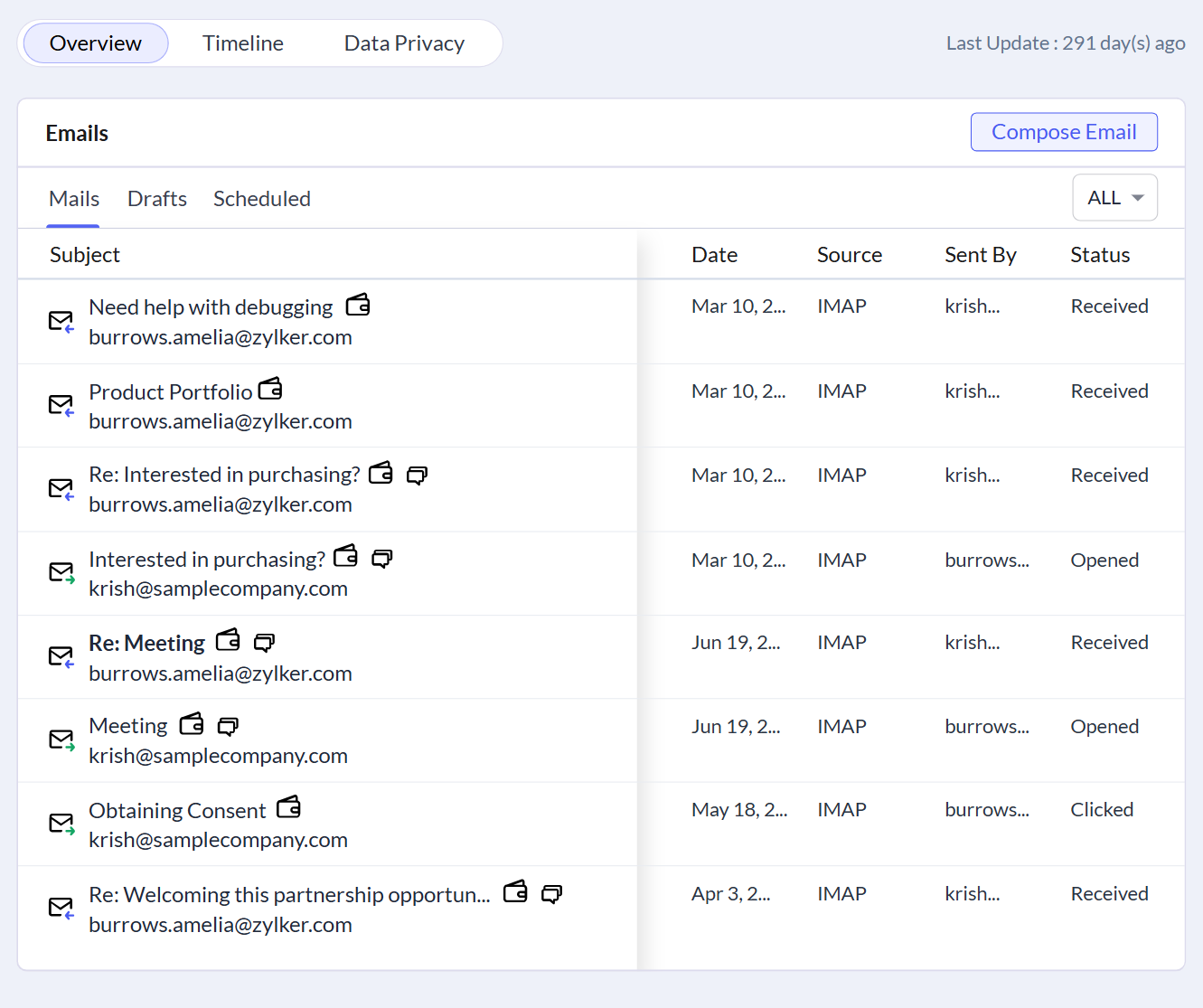
Zoho CRM makes no assumption about where sales happen. It covers email, phone, WhatsApp, SMS, social media (Facebook and X), LINE for Business, and live chat, all logged against CRM records. But the architecture isn't organized around any single channel. It's organized around structured processes: lead capture rules, pipeline stage enforcement, territory assignment, approval chains, and forecasting hierarchies.
Source: Zoho CRM
This distinction shapes everything downstream. Kommo is fast to set up and intuitive for messenger-heavy teams, but rigid when your sales process doesn't fit the chat-first model. Zoho CRM requires more configuration upfront but adapts to nearly any sales workflow, from transactional to consultative to enterprise.
Kommo leads in conversational sales, Zoho leads in process enforcement
Each platform has a clear advantage in its design territory.
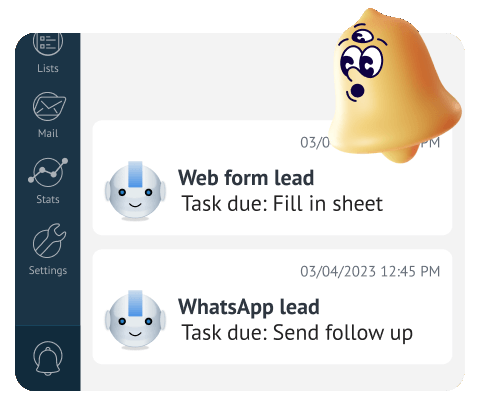
Kommo's conversational strengths. The Salesbot is a no-code chatbot builder included on all plans, with unlimited bots. It qualifies leads, collects contact information, sends follow-ups, and moves deals through pipeline stages automatically.
Source: Kommo
The AI agent goes further: it greets customers, recommends products, processes payments, and hands off to a human when it hits its limits. Kommo reports 85% of issues resolved without human help and a 65% increase in customer retention among AI agent users.
The Instagram integration goes further than most. Kommo converts comments to DMs, auto-replies to story mentions, and triggers keyword-based bot responses, moving beyond message forwarding into lead generation from public engagement. As a Meta Official Partner, Kommo has full WhatsApp Business Platform API access, including Flows, Carousels, and Click-to-WhatsApp ad attribution.
Zoho CRM's process strengths. Blueprint is the standout. It maps your sales process as a visual flowchart with enforced transitions: reps cannot advance a deal unless they've completed required fields, finished tasks, or obtained approvals. Built-in stagnation alerts flag deals stuck too long at any stage. G2 users call out Blueprint as effective at keeping reps on process and reducing human error.
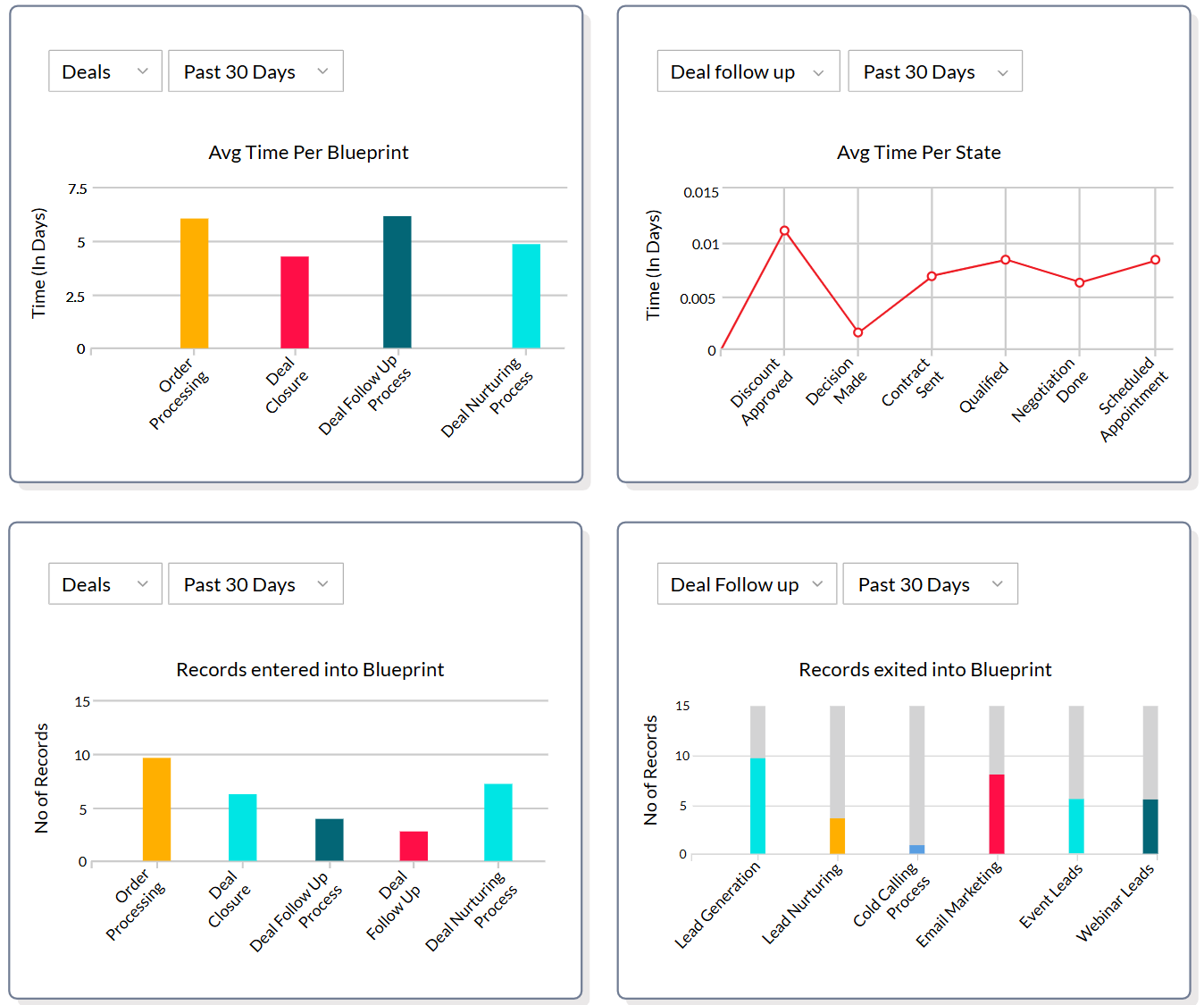
Source: Zoho CRM
Cadences add structured multi-channel follow-up sequences (email, phone, task, WhatsApp) that branch based on customer behavior. CommandCenter provides journey orchestration with PathFinder, which visualizes how customers move through your funnel before you design the ideal path.
The gap between them: Kommo's automation excels at messenger conversations but can't enforce multi-step sales processes. Zoho CRM enforces complex processes across channels but doesn't match Kommo's strength in chat-native selling.
AI approaches: chat agents vs. CRM intelligence
Both platforms invest in AI, but their capabilities target different problems.
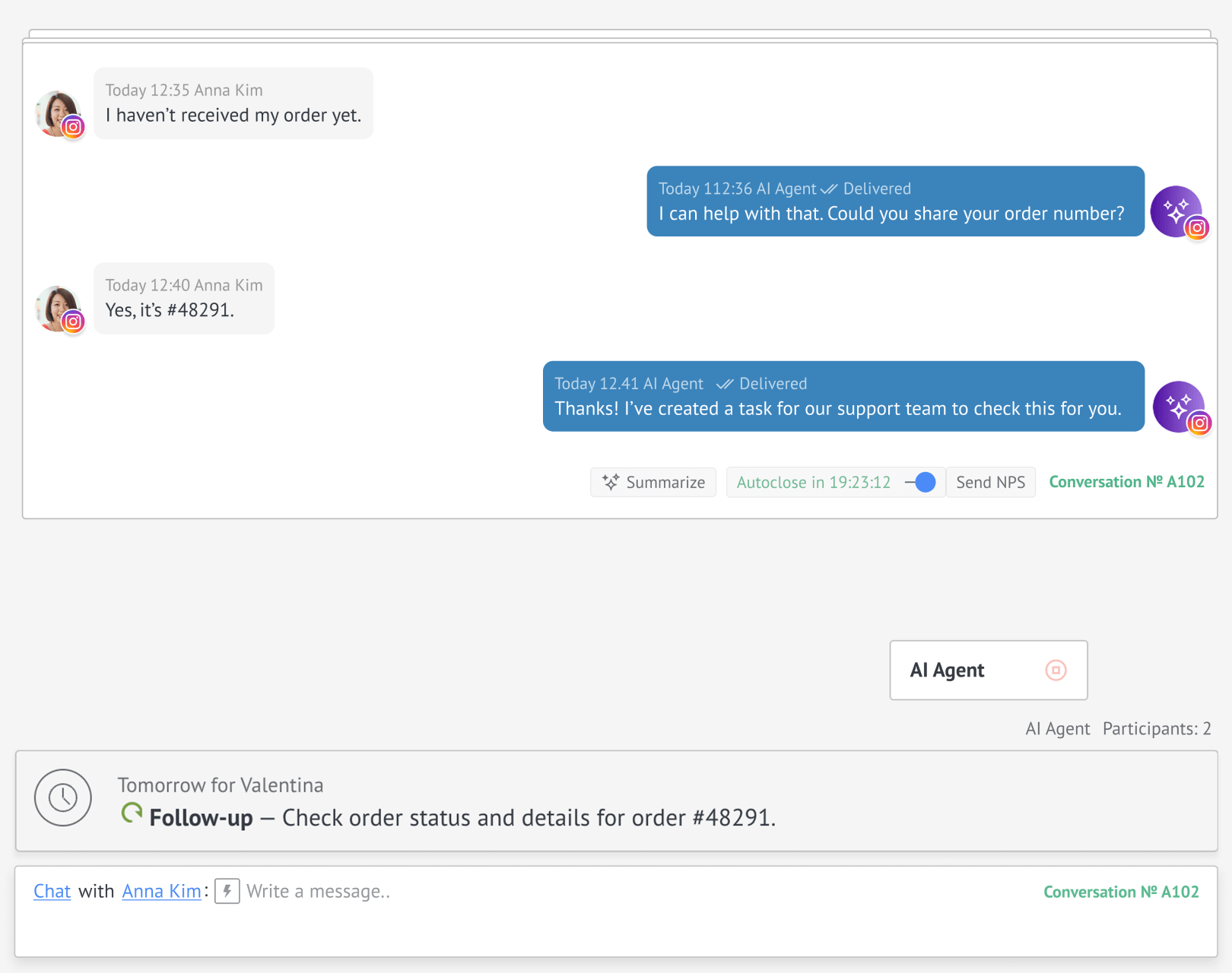
Kommo AI is built for the messenger channel. The AI agent operates inside WhatsApp, Instagram, and TikTok conversations, handling the buyer journey from FAQ to purchase.
Source: Kommo
It connects to e-commerce stores (Shopify, WooCommerce, Nuvemshop/Tiendanube, and Lazada), pulling product data so it can recommend items and quote prices accurately. Response time averages 3 to 8 seconds, and it detects the customer's language automatically.
AI credits are allocated per seat: 750/month on Base, 1,250 on Advanced, 2,250 on Pro, with no rollover. When credits run out, you buy additional packages. The Copilot provides conversation summaries, reply suggestions, and a writing assistant on all plans.
Zoho CRM's Zia covers broader ground. Predictive lead scoring, churn prediction, deal win probability, best time and channel to contact, email sentiment analysis, call transcription with emotion detection, and anomaly detection for sales forecasts are all built in.
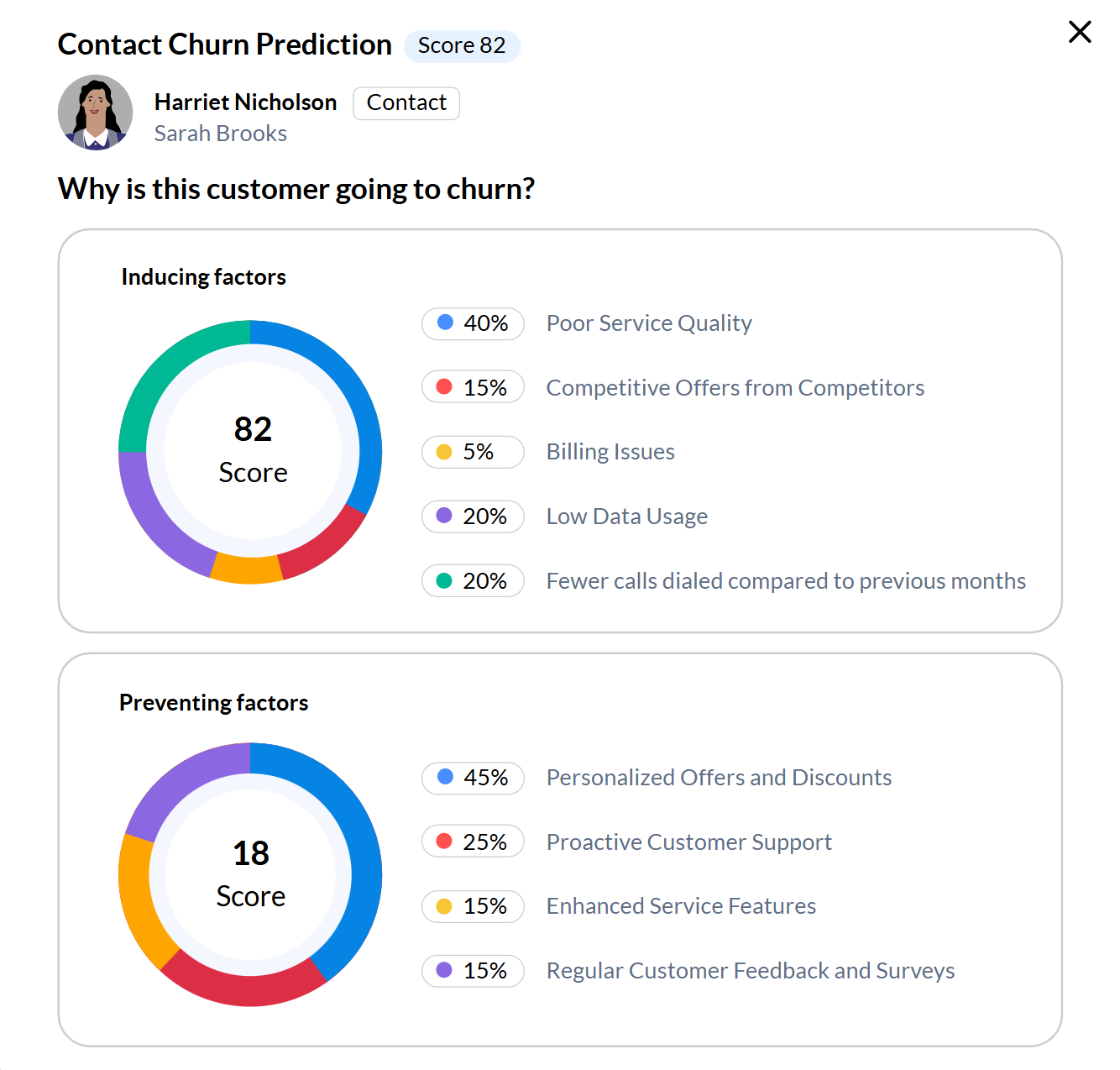
Source: Zoho CRM
The Zia Agents Store offers seven pre-built agents (SDR, sales coach, deal analyzer, quote generator, follow-up scheduler, revenue growth specialist, and deal closure reminder) that work as autonomous employees within the CRM. Agent Studio lets you create custom agents from natural language descriptions without code.
Beyond selling, Zia handles CRM configuration: describe a module or workflow in plain language, and Zia builds it, including fields, triggers, and actions.
The practical difference is scope. Kommo's AI replaces a human in the chat thread. Zia replaces manual work across the entire CRM: scoring, routing, forecasting, coaching, and system administration. If your sales live in messenger, Kommo's AI delivers immediate value. If your sales span multiple channels and need forecasting and process intelligence, Zia's breadth matters more.
Customization reveals who each platform was built for
Zoho CRM's customization is a tier above Kommo's.
Canvas Design Studio lets administrators redesign record views with full control over layout, colors, typography, and images, all without code. Different views can be assigned to different users via Canvas Rules (up to 100 rules per module). The Ultimate plan supports 500 custom modules.
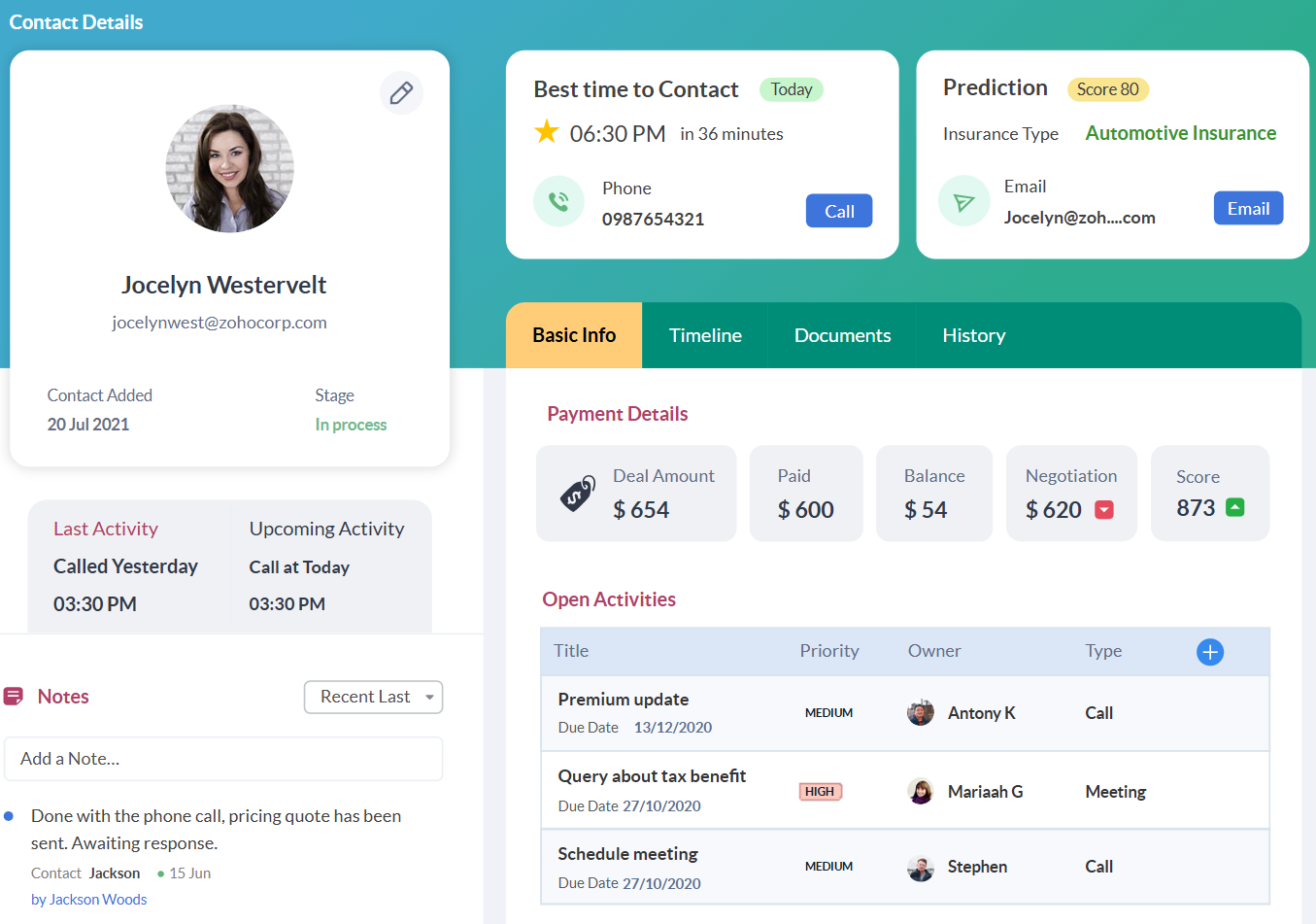
Source: Zoho CRM
Wizards break long data-entry forms into guided step-by-step flows. For developers, Client Scripts, custom Deluge functions, and a Sandbox environment allow customization without risking production data.
Kommo's customization is intentionally simpler. You get up to 50 custom pipelines (100 on Enterprise), 100 to 400 custom fields depending on plan, and configurable pipeline triggers. Five pre-built pipeline templates cover common business types. But Capterra reviewers consistently flag constraints on customizing pipeline stages as a recurring frustration for teams with non-standard workflows.
This isn't a failure on Kommo's part. It's a design choice. Kommo optimizes for speed: connect your WhatsApp and start selling in minutes. Zoho CRM optimizes for flexibility: model any sales process, then enforce it at scale. The right choice depends on whether your process fits Kommo's model or needs Zoho's range.
The data gap both CRMs share, and how ZoomInfo fills it
Kommo's pipeline fills from inbound messenger conversations, web forms, and ad clicks. Zoho CRM captures leads through web forms, social media, live chat, and manual entry. Both platforms rely on prospects coming to you.
For B2B sales teams, this creates a structural problem. You need to know which companies match your ideal customer profile, who the decision-makers are, how to reach them directly, and whether they're researching solutions like yours. CRMs don't answer those questions. They record what happens after you've already found someone to talk to.
ZoomInfo operates upstream of any CRM. Its database covers 500M contacts, 100M companies, 135M+ verified phone numbers, 120M direct dials, and 200M+ verified business email addresses. A team of 300+ human researchers maintains this data with up to 95% accuracy on first-party records.
Source: ZoomInfo
In a Fortune 500 competitive RFP analyzing 25 million contacts across vendors, an independent consultant concluded that "no other competitor came even close."
The GTM Context Graph turns this data into intelligence. It processes 1.5B+ data points daily, combining ZoomInfo's third-party data with your CRM records, conversation transcripts, and behavioral signals to show not just what happened in a deal, but why. Pattern-matching across thousands of deals lets the AI identify which signal combinations predict wins in your market.\
Source: ZoomInfo
For teams using Kommo or Zoho CRM, ZoomInfo fills three gaps:
Prospecting data. Instead of waiting for inbound leads, reps search ZoomInfo's database by industry, headcount, technology stack, job title, and 300+ company attributes. Saved searches trigger alerts when new matches appear. One-click export pushes contacts into a CRM.
Buyer intent signals. ZoomInfo Intent identifies which companies are researching topics relevant to your product, drawing from 210 million IP-to-Organization pairings and 6 trillion+ new keyword-to-device pairings sourced monthly. Guided Intent, exclusive to ZoomInfo, surfaces topics historically correlated with closed-won deals instead of requiring manual topic selection.

Source: ZoomInfo
CRM enrichment. ZoomInfo keeps CRM records current with verified contact details, company attribute updates, and job-change alerts. This matters for both platforms: Kommo's per-seat lead caps (2,500 to 10,000 depending on plan) mean every lead slot should count, and Zoho CRM's scoring and forecasting are only as accurate as the underlying data.
"ZoomInfo gives us the information we need to execute. We don't have to go through and spend our time digging. It's already there, so we can be three steps ahead." (Vensure)
ZoomInfo integrates with both ecosystems. Its App Marketplace includes native connectors for Zoho CRM, and API and MCP access let teams feed ZoomInfo intelligence into any tool, including custom workflows built around Kommo's API.
Source: ZoomInfo
Pricing comparison
Kommo uses per-seat pricing with a six-month minimum commitment. No monthly billing option exists.
Plan | Price (per user/month) | Active Leads/Seat | AI Credits/Seat/Month |
|---|---|---|---|
Base | 2,500 | 750 | |
Advanced | $25 | 5,000 | 1,250 |
Pro | $45 | 10,000 | 2,250 |
Enterprise | Custom | Custom | Custom |
A three-person team on Base pays $270 upfront for six months. Additional costs include WhatsApp Conversation Credits (passed through from Meta's pricing), extra AI credit packages when monthly allocations run out, and paid marketplace integrations. Kommo offers a 14-day free trial with no credit card required but no permanent free plan. The company notes it has not raised prices in over 8 years.
Zoho CRM uses per-seat pricing with month-to-month or annual billing. Annual billing saves up to 34%.
Zoho CRM's paid tiers (Standard through Ultimate) start at $14/user/month on annual billing. The free plan supports up to 3 users permanently with core lead, contact, and deal management. Key feature gates: Blueprint requires Professional, Zia AI and territory management require Enterprise, and QuickML custom AI model building is Ultimate-only.
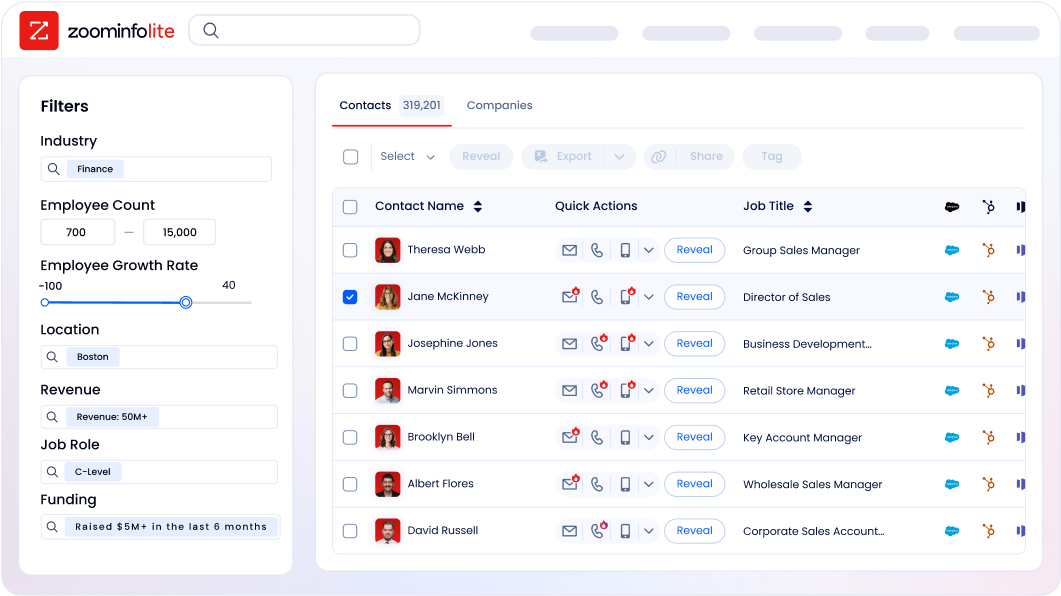
ZoomInfo uses consumption-based pricing with no publicly listed dollar amounts. Costs scale with seats, monthly credit volume, features, and contract length. Annual contracts are standard. ZoomInfo Lite provides permanent free access with 10 monthly export credits, and a 7-day free trial is available for paid features.
Source: ZoomInfo
ZoomInfo is priced as an intelligence investment, not a CRM subscription. The return centers on pipeline quality: verified contacts who pick up the phone, emails that land in inboxes, and intent signals that tell you which accounts to prioritize before your competitors reach them.
"It's not just the data itself. It's more about the right data at the right time to help us reach out with the right message across that full buyer journey." (Redwood Logistics)
Kommo vs. Zoho CRM vs. ZoomInfo: Which should you choose?
The right choice depends on how your team sells and what's missing from your current setup.
Choose Kommo if:
Your sales happen primarily through WhatsApp, Instagram, or other messaging apps
You need an AI agent that handles customer conversations around the clock
Your team is small and needs to start quickly without complex configuration
Your sales process is straightforward: conversation to deal to close
You operate in markets where messenger commerce dominates (Latin America, Southeast Asia)
Choose Zoho CRM if:
You need a customizable CRM that scales from startup to mid-market enterprise
Process enforcement, territory management, and forecasting are central to your operations
You want month-to-month contract flexibility and transparent pricing
Your sales span multiple channels (email, phone, social, messaging)
You value a broad ecosystem of integrated business applications (60+ Zoho tools)
Add ZoomInfo to either CRM if:
You need verified B2B contact data to fill your pipeline with qualified prospects
Buyer intent signals would help your team prioritize who to contact and when
You want AI that understands deal context, not just CRM field values
Your outreach depends on direct dials and verified emails that connect
You're building a data-driven go-to-market operation across sales, marketing, and RevOps
See ZoomInfo in action with a free trial, or start with ZoomInfo Lite at no cost.
Kommo and Zoho CRM both handle what happens after a prospect enters your pipeline. Kommo does it through chat. Zoho CRM does it through structured, customizable processes. ZoomInfo handles what comes before: finding the right accounts, reading their buying signals, and delivering verified contact data into whatever CRM your team uses. The strongest B2B sales operations combine both layers.
"ZoomInfo's not just a contact data company anymore. They've built a full system of execution. GTM Intelligence actually works the list, writes the outreach, triggers the play, and helps drive predictable growth." (Levanta)
Kommo (amoCRM) vs. Zoho CRM vs. ZoomInfo FAQ
Is amoCRM the same as Kommo?
Yes. amoCRM rebranded to Kommo in October 2022. The product, team, and pricing remain the same. The name changed when the platform shifted from a traditional CRM to a messenger-based sales tool for WhatsApp, Instagram, and other messaging channels.
Which CRM is better for small teams just getting started?
Kommo is faster to set up if your sales happen through messaging apps. Most teams are productive within hours. Zoho CRM offers a permanent free plan for up to 3 users and a broader feature set for teams that need lead and deal management without messenger features. Zoho CRM's customization takes more time to configure but pays off as your process matures.
Can Kommo handle email and phone-based sales?
Kommo supports email and phone integrations, but it was designed around messenger conversations. Email and phone are secondary channels in the interface. If your team sells primarily through email sequences and cold calls, Zoho CRM's omnichannel architecture with built-in telephony, email intelligence, and structured cadences is a stronger fit.
How does Zoho CRM's Blueprint compare to Kommo's automation?
Blueprint enforces a defined sales process: reps cannot skip steps, required fields must be completed, and approvals must be obtained before a deal advances. Kommo's automation is built around messenger workflows. Its Salesbot handles lead qualification and follow-up in chat, and pipeline triggers automate stage progression.
Blueprint governs the entire sales process across channels; Kommo's automation governs the conversation.
Do either Kommo or Zoho CRM include B2B prospecting data?
Neither platform includes a B2B contact database. Both rely on inbound leads, manual data entry, or third-party integrations for prospecting data. ZoomInfo fills this gap with 500M contacts, 200M+ verified business email addresses, and 135M+ verified phone numbers, plus buyer intent signals that identify which companies are researching relevant topics.
Does ZoomInfo integrate with Kommo and Zoho CRM?
ZoomInfo integrates natively with Zoho CRM through its App Marketplace. For Kommo, ZoomInfo data connects through API access or automation bridges like Zapier. ZoomInfo's MCP server also lets AI agents pull ZoomInfo intelligence into any compatible tool or workflow.
Which platform has the strongest AI capabilities?
Each platform's AI serves a different purpose. Kommo's AI agent manages messenger conversations autonomously, including product recommendations, payment processing, and appointment booking. Zoho CRM's Zia provides predictive lead scoring, churn prediction, deal analysis, call transcription, and autonomous AI agents that operate as digital employees within the CRM.
ZoomInfo's GTM Context Graph powers account intelligence, buyer intent signals, and outreach recommendations built on 500M contacts and 1.5B + daily data points.
What are the contract and pricing differences between all three?
Kommo requires a six-month minimum commitment starting at $15/user/month with no monthly billing option. Zoho CRM offers month-to-month contracts starting at approximately $14/user/month on annual billing, plus a permanent free plan for up to 3 users. ZoomInfo uses custom-quoted annual contracts with consumption-based pricing; ZoomInfo Lite provides permanent free access with 10 monthly export credits.
