

Amperity has built its reputation on a single, difficult problem: stitching together fragmented customer records from dozens of systems into one accurate profile. For enterprise consumer brands drowning in siloed data (loyalty programs that don't talk to e-commerce, POS records disconnected from email engagement, CRM entries duplicated across acquisitions), Amperity's AI-powered identity resolution offers a way out. The platform has served more than 400 brands, including Alaska Airlines, Wyndham Hotels, and DICK'S Sporting Goods.
To write this Amperity review, we analyzed the platform extensively. We believe it's the right choice if:
You're an enterprise consumer brand with customer data scattered across dozens of systems
Identity resolution (accurately merging duplicate and fragmented records) is your primary data challenge
You operate in retail, travel/hospitality, or financial services with high transaction volumes
You already use Databricks or Snowflake and want a CDP that works natively with your data lakehouse
You have dedicated data engineering resources to manage implementation and configuration
However, Amperity might not be the best choice if:
You're a mid-market or SMB company without dedicated data engineering staff
Your customer data is simple and lives in one or two systems
You need a self-serve platform with quick onboarding and no sales cycle
You want publicly available pricing before engaging with a sales team
Your primary need is B2B prospecting and sales intelligence rather than consumer data unification
For enterprise organizations that also have B2B go-to-market needs (corporate sales, business partnerships, pipeline generation), ZoomInfo serves an entirely separate function: an AI GTM platform built on large-scale B2B data (500M contacts, 100M companies, 135M+ verified phone numbers, and 200M+ verified business email addresses), with a GTM Context Graph that helps sales, marketing, and RevOps teams find and grow business customers.
We've included a brief overview of ZoomInfo at the end of this Amperity review for organizations whose go-to-market strategy extends beyond consumer data. If you'd like to explore ZoomInfo's B2B intelligence capabilities, you can start with a free trial here.
What is Amperity?
Amperity is an AI-powered Customer Data Cloud founded in 2016 by Derek Slager and Kabir Shahani in Seattle, Washington. The founders previously co-founded Blue Dot, Inc. (later acquired by IMS Health) and shared a thesis that brands collected massive amounts of customer data but lacked the infrastructure to create real value from it. The specific problem: custom-code and rules-based methods for unifying customer data were broken. They couldn't handle the messiness of how real people interact with brands. Name changes, multiple email addresses, evolving behaviors. The founders' solution was to treat that messiness as a design constraint, building a machine learning-based identity resolution approach grounded in academic research published at SIGMOD 2020.
The company has raised approximately $187M across five funding rounds, reaching unicorn status in its 2021 Series D round led by HighSage Ventures. In November 2024, Tony Alika Owens replaced co-founder Shahani as CEO, bringing over 20 years of enterprise software leadership from Salesforce, Oracle, and LivePerson.
Today, Amperity serves brands including Alaska Airlines, DICK'S Sporting Goods, Wyndham Hotels & Resorts, Virgin Atlantic, Brooks Running, and BECU. The platform runs on a data lakehouse architecture with native Databricks and Snowflake zero-copy data sharing, 200+ pre-built connectors, and SOC 2, GDPR, HIPAA, and CCPA compliance certifications.
The target buyer is the enterprise technologist: CDOs, data engineering leads, and marketing technologists at consumer brands. The platform is organized around five product areas: Customer Data Foundation (ingestion), Identity Resolution (Stitch), Customer 360 (unified profiles), Audience Hub (activation), and AmpAI (embedded generative AI).
Amperity Pros & Cons
Pros | Cons |
|---|---|
- Patented AI identity resolution with published academic backing | - No self-serve trial or free plan for the core platform |
- Lakehouse-native architecture (Databricks, Snowflake, BigQuery) | - Consumption-based pricing with no published rates |
- 200+ pre-built source and destination connectors | - Requires dedicated data engineering resources |
- Three simultaneous identity graphs (Growth, Trust, Opportunity) | - Enterprise-only with no SMB or mid-market pathway |
- SOC 2, HIPAA, GDPR, CCPA, and ISO 27001 certifications | - Premium connector surcharges for major ad platforms |
- Predictive CLV, churn, and product affinity models built in | - B2C-focused with no B2B or account-based marketing capabilities |
- Natural language AI assistants across segments, journeys, and queries | - AI agent capabilities still in private beta |
Amperity Review: How It Works & Key Features
Identity Resolution (Stitch): Amperity's patented engine finds hidden connections across messy, fragmented customer data.
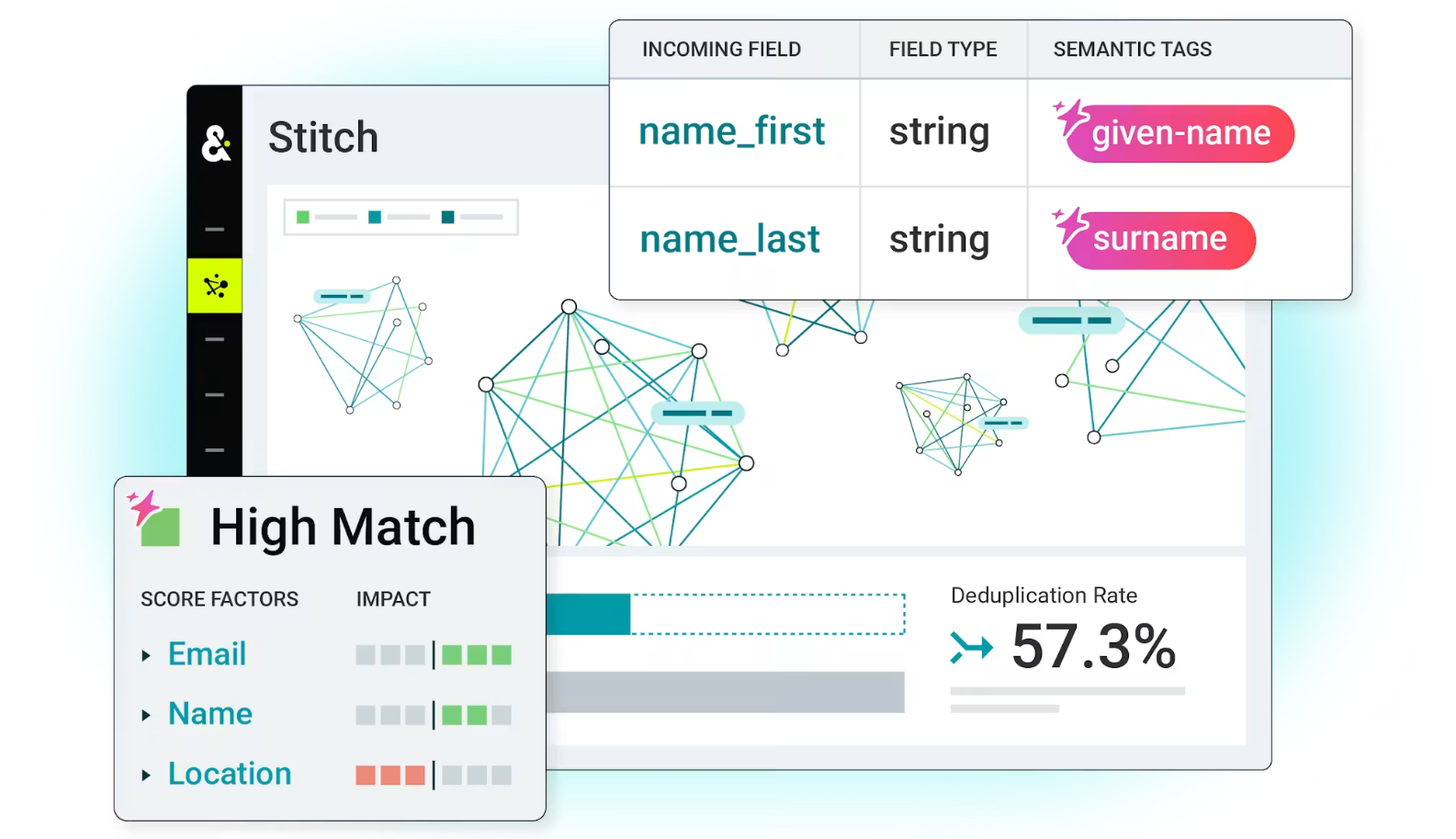
Stitch is the core of Amperity's platform: a patented identity resolution engine that assigns every unique individual a persistent identifier called the Amperity ID. The problem it solves is straightforward. The same customer appears as "Jane Smith" in one system, "J. Smith" in another, and "jane.smith@gmail.com" in a third. Manual SQL matching breaks constantly, and deterministic rule-based tools miss 40%+ of matches.
Stitch resolves this through a seven-stage pipeline. First, semantic tags standardize PII across all source tables regardless of naming conventions. The engine then preprocesses values (normalizing addresses, reformatting phone numbers, lowercasing emails), combines all tagged tables, and runs a blocking strategy to narrow the candidate space for comparison. Every record pair within a block receives a pairwise comparison score across five match categories, from Exact (5) to Non-match (0), evaluating name similarity, email patterns, physical addresses, phone numbers, and birthdates. A hierarchical comparison step then examines clusters for internal conflicts (like a married couple sharing PII) and splits over-merged groups.
Source: Amperity
The result is an Amperity ID built for stability: when new data arrives, Stitch identifies whether it belongs to an existing cluster rather than creating a new one. This matters for downstream systems that use the ID as a join key, since instability would cascade into broken joins and stale audiences.
What distinguishes Stitch is the three-graph architecture. The Growth Graph uses probabilistic matching for broader reach. The Trust Graph uses deterministic matching for higher precision. The Opportunity Graph measures the gap between the two. This lets teams choose their accuracy-versus-reach tradeoff per use case (stricter matching for loyalty communications, broader matching for advertising audiences) without rebuilding the identity layer each time.
Customer Data Foundation: Schema-free ingestion that connects every source without forcing data reformatting.
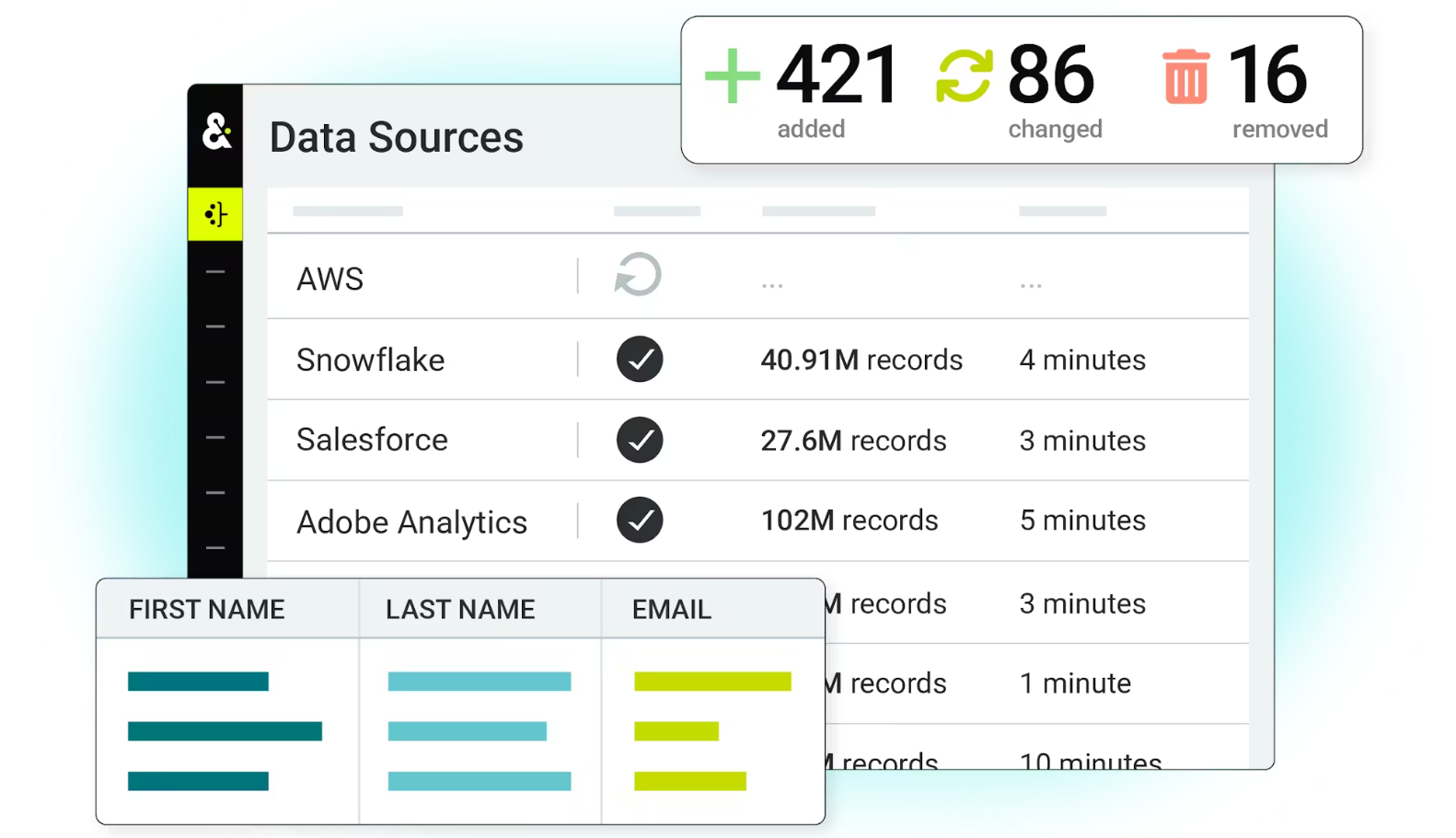
The Customer Data Foundation is Amperity's ingestion and data preparation layer. Enterprise brands accumulate customer data across CRMs, e-commerce platforms, loyalty programs, email tools, and point-of-sale systems, each with its own schema and naming conventions. The typical approach requires custom ETL pipelines that are expensive, slow, and fragile. Amperity takes the opposite approach: accept raw data in any format and transform it in place.
Source: Amperity
The foundation uses a semantic tagging system to apply common understanding across data sources. A column named "CUST_FNAME" in one system and "first_name" in another both receive the same tag. As the documentation states: "An important benefit of semantic tagging is that it allows raw data to be provided directly to Amperity. This avoids a traditional and more expensive extract, transform, and load (ETL) operations."
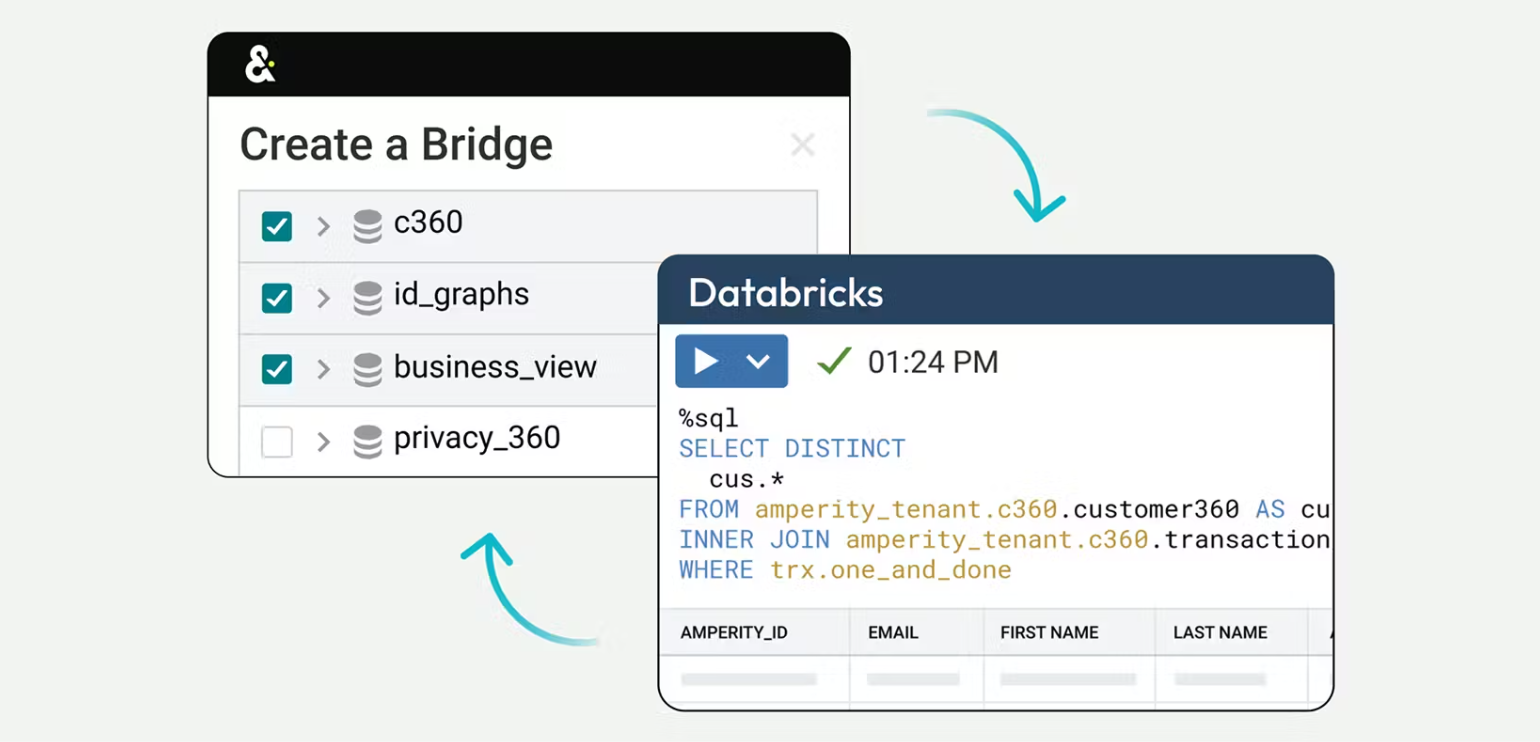
Data flows through pre-built source connectors covering platforms like Adobe Analytics, Braze, HubSpot, Klaviyo, Salesforce, Snowflake, Square, Toast, Zendesk, and more. Connections are also available via SFTP, Azure Blob Storage, Google Cloud Storage, Amazon Kinesis Data Firehose, or the Streaming API for real-time data. For brands using a data lakehouse, Amperity Bridge enables zero-copy data sharing with Databricks (via Delta Sharing), Snowflake (via Secure Data Sharing), and Google BigQuery. Data never leaves the lakehouse; Amperity reads from and writes to the shared catalog directly.
Source: Amperity
Customer 360: Unified profiles with 200+ out-of-the-box attributes and predictive models.
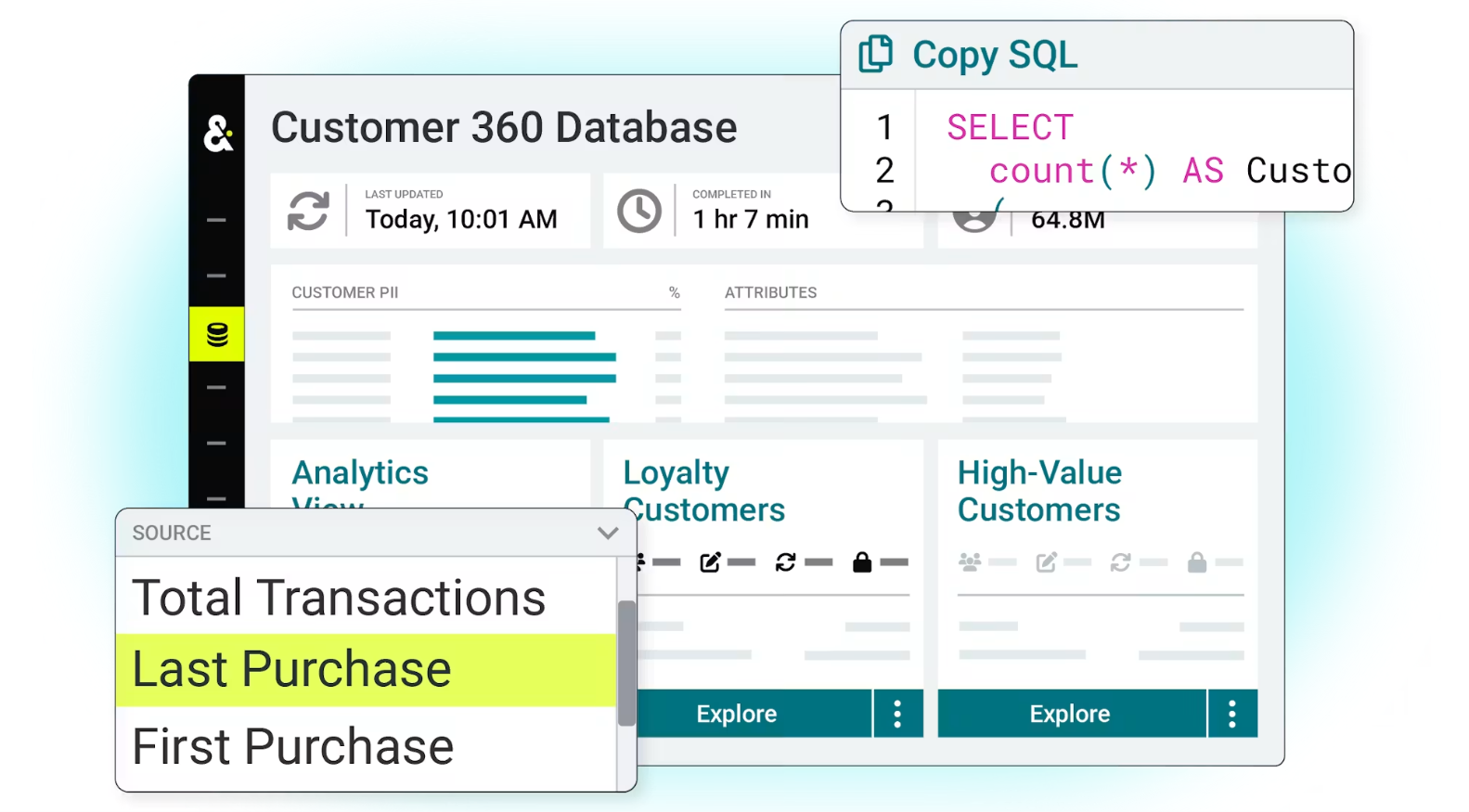
The Customer 360 layer produces a unified profile for every customer by connecting Stitch output with transactional data, behavioral signals, and predictive analytics. Each row represents a single person, anchored by the Amperity ID.
The profile includes 200+ out-of-the-box attributes covering cross-system data (e-commerce, POS, and loyalty combined per person), RFM scoring calculated against the last 12 months of transactions, and time-period rollups for 30-day, 3-month, 6-month, 12-month, and lifetime windows. The Customer Attributes table adds contactability flags, opt-in status, lifecycle classification, and customer type indicators (employee, reseller, test account, gift giver).
Source: Amperity
Amperity layers four predictive models natively: Predicted CLV, churn propensity (using each customer's purchase history rather than hard-coded RFM rules), product affinity (for any product taxonomy with 20 to 2,000 unique values), and event propensity (likelihood of specific events like loyalty signups or repeat bookings). These models produce structured output, including audience size tiers (top 1%, 1-5%, and so on) that marketing teams can use directly in campaign targeting without data science intervention.
Both SQL-based analysis and a visual segment editor access the same resolved data. Operators use Spark SQL for programmatic control, while non-technical users explore profiles through the visual interface. There is no limit to the number of databases that can be configured from the same identity layer: filtered views by brand, QA environments, passthrough databases for raw data consumers, and custom databases for experimentation.
Audience Hub: No-code segmentation and activation across 200+ destinations.
Audience Hub is the activation layer, sitting on top of the unified profiles. It solves two common bottlenecks: marketing teams waiting on technical staff to extract audiences, and the need to rebuild the same audience logic in each downstream platform separately.
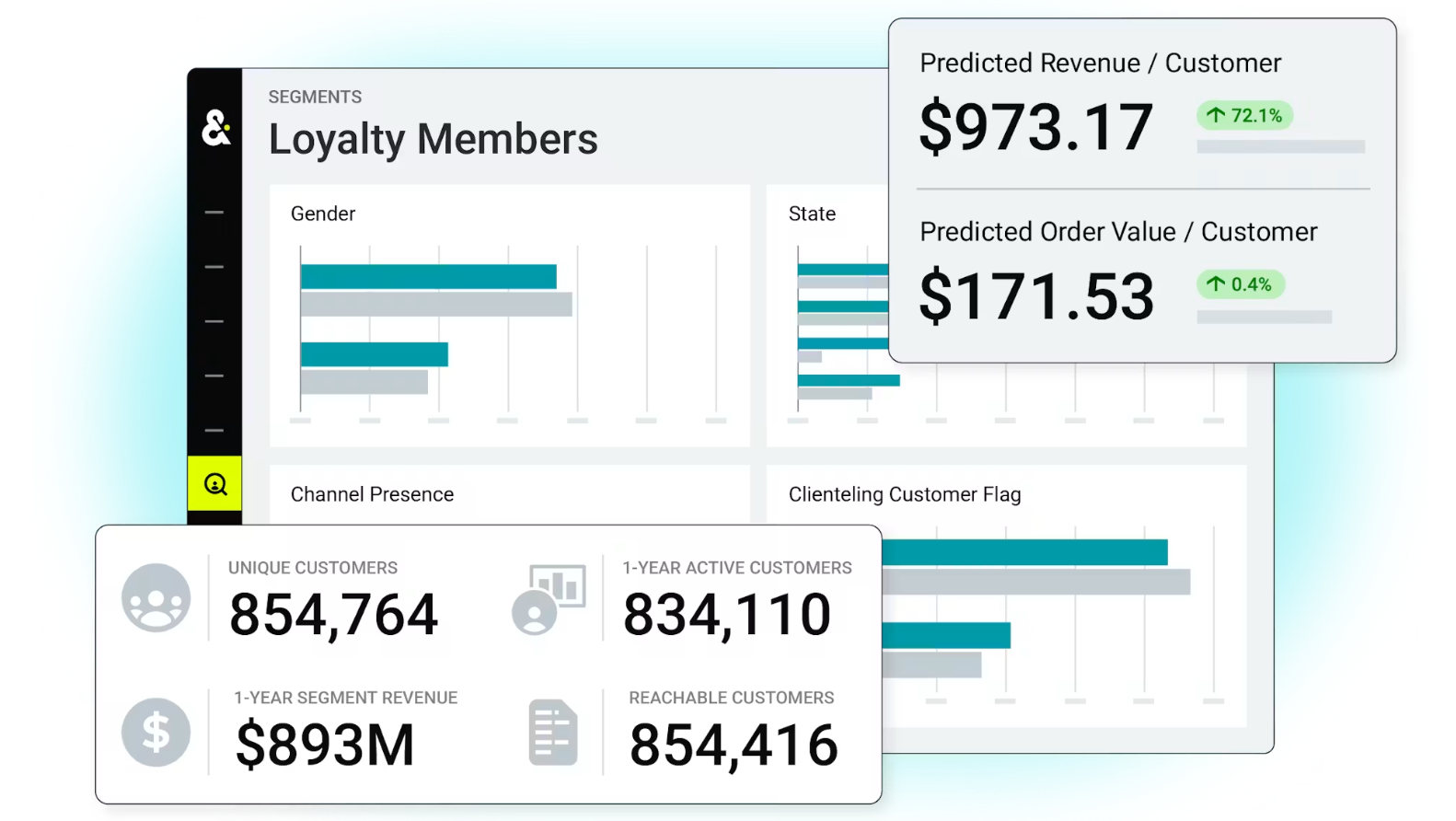
Source: Amperity
The Segment Editor is a no-code drag-and-drop builder where marketers select attributes from the Customer 360, purchase behavior filters, or custom SQL-backed tables. As attributes are added, segment insights update in real time to show customer count, prior-year revenue contribution, active customer count, and reachability via email, phone, Facebook, or physical address. The Segments AI assistant lets users describe audiences in natural language.
For scheduled batch campaigns, the Campaigns builder takes a segment as its starting audience, lets users create sub-audiences (treatment groups) filtered by additional criteria, assigns each sub-audience to one or more destinations, and schedules delivery as one-time or recurring sends. For behavior-triggered flows, the Journeys canvas is a visual workflow builder with activate, delay, conditional split, and percent split nodes, including people-based measurement for holdout groups.
The platform connects to 200+ destinations including Meta Ads, Google Ads, TikTok, Pinterest, The Trade Desk, Amazon Ads, Braze, Klaviyo, HubSpot, Salesforce Marketing Cloud, ActiveCampaign, and cloud storage endpoints. Built-in Conversion APIs send event and online/offline conversion data back to ad networks for ROAS optimization. Profile APIs enable real-time website and in-app personalization.
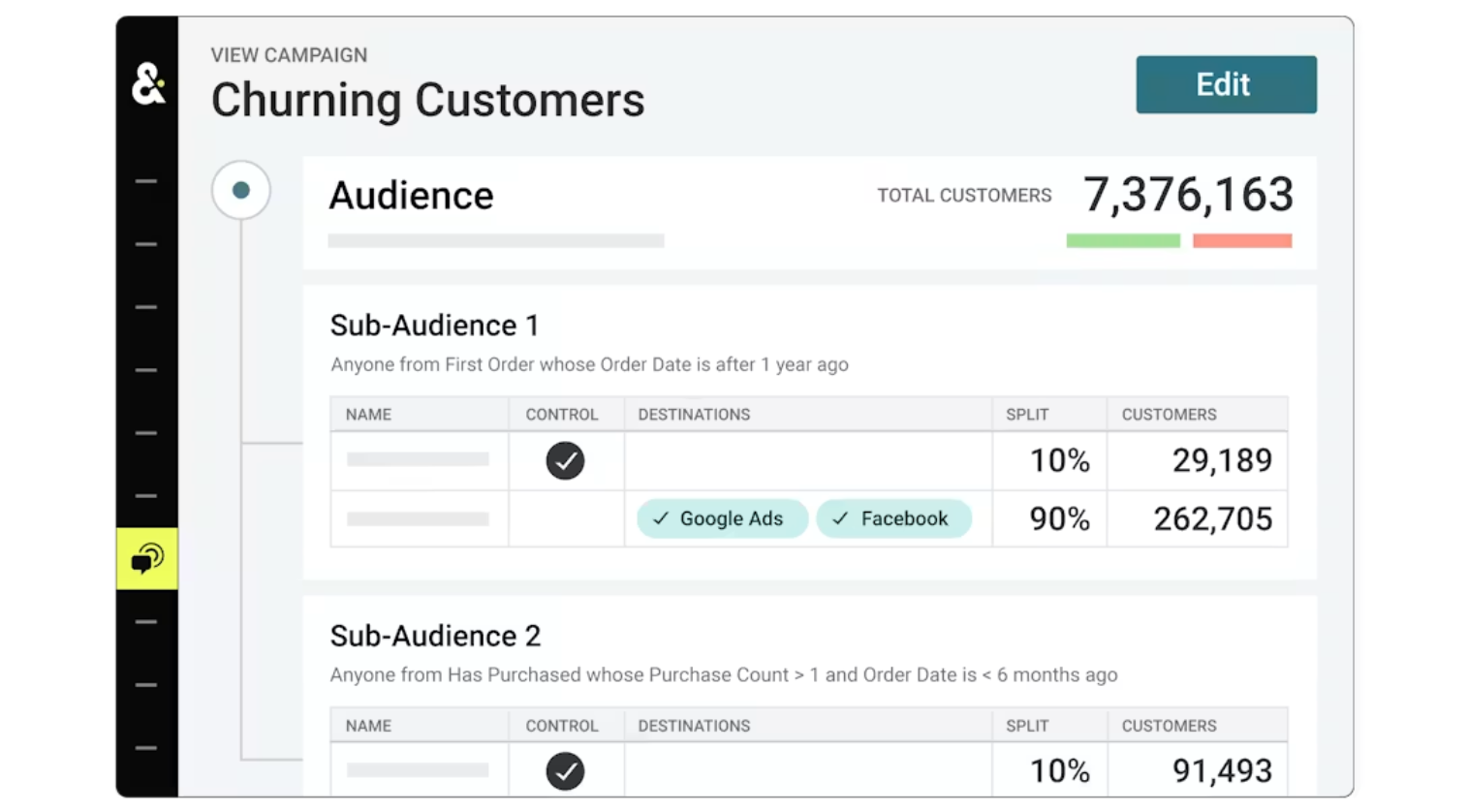
Source: Amperity
AmpAI: Embedded generative AI that turns questions into segments, journeys, and queries.
AmpAI is Amperity's AI layer, built on the Azure OpenAI Service. It appears as five tools: a Customer Data Assistant for conversational starting points, a Segments AI Assistant for generating segments from natural language, a Journeys AI Assistant for creating multi-touch journeys, a Queries AI Assistant for writing and debugging SQL, and a Consumption AI Assistant for investigating usage patterns.
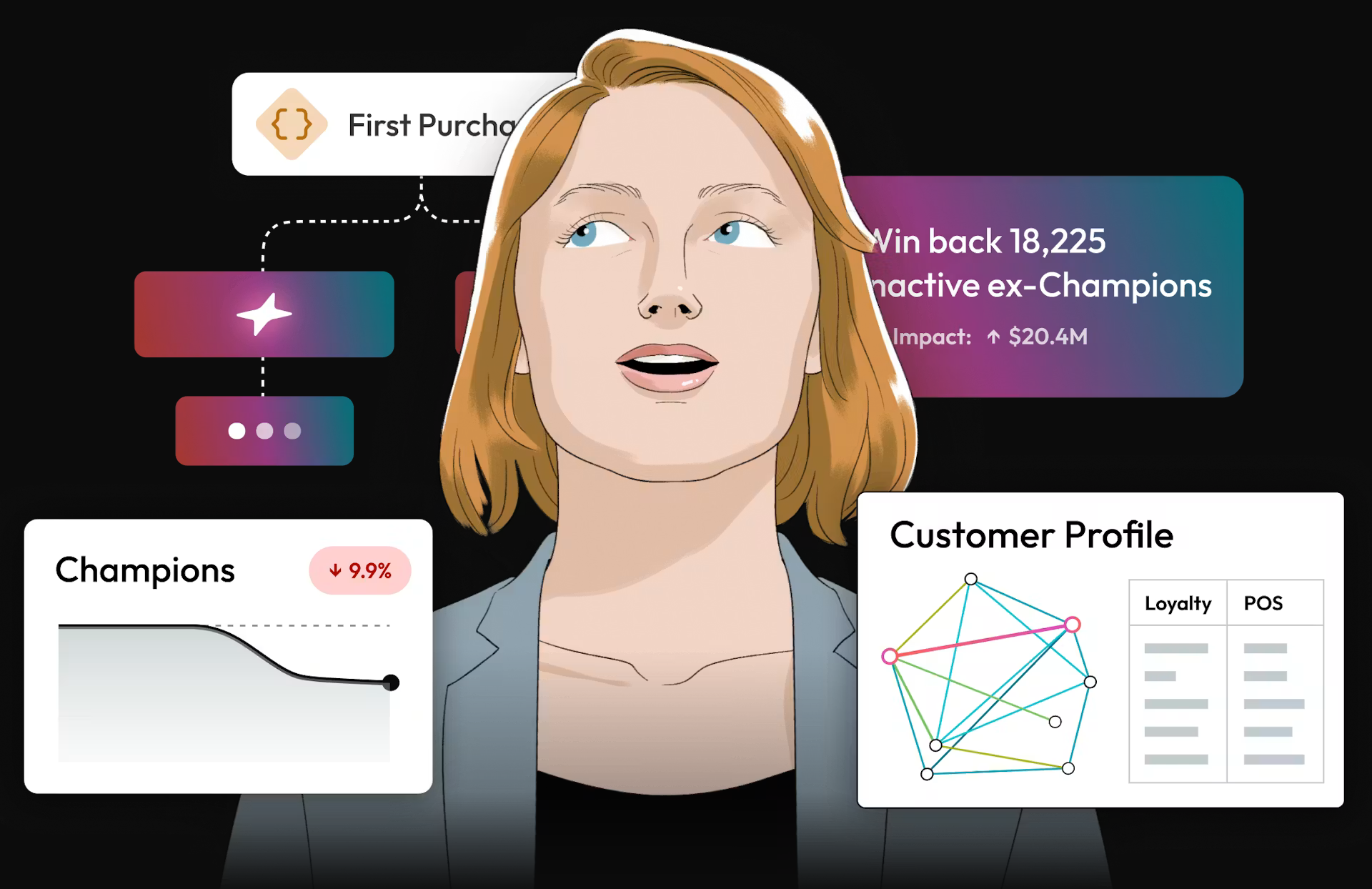
Source: Amperity
What separates AmpAI from generic AI assistants is that it uses tenant-specific information, including schema metadata, field descriptions, and usage patterns. A custom prompting capability lets operators encode business logic and terminology so the AI applies brand-specific definitions consistently.
Separately, Chuck is a command-line AI agent for data engineers working in Databricks. It uses Amperity's identity resolution models (trained on data from 400+ enterprise brands) and lets engineers express data tasks in natural language through their terminal. Chuck offers a free tier that includes the Databricks-native CLI, Unity Catalog integration, PII detection, semantic tagging, and identity graph capabilities, available without a sales engagement.
At Amplify 2026 (May 2026), Amperity announced four new capabilities: real-time site personalization and journey abandonment recovery, Recommended Actions that surface next-best opportunities automatically, an enhanced Customer Data Assistant, and an Amperity MCP Server that connects identity-resolved customer context to enterprise AI tools like Microsoft Copilot, Claude, and ChatGPT. Autonomous AI agents that monitor campaign performance and adapt in real time are coming in private beta.
Pricing: Consumption-based model with no published rates.
Amperity uses a consumption-based pricing model built around a proprietary unit called "Amps." Activities that consume Amps include processing customer records, building segments, running campaigns, and activating insights. Consumption is measured across two dimensions: Amps (compute) and Storage (TB), tracked and billed separately.
Two editions are available, both with identical platform access:
Standard Edition: The full platform including data foundation, identity resolution, Customer 360, predictive modeling, segments, journeys, campaigns, orchestrations, and Profile API. Support runs 6am–6pm PT, Monday through Friday.
Enterprise Edition: Same platform access plus 24/7 support, priority response SLAs, priority ticket reviews, and private instructor-led training.
Amperity claims "no add-ons and no hidden fees", though several cost variables exist. Premium connectors for advertising platforms (Meta Ads, Google Ads, TikTok, The Trade Desk, Pinterest, Snapchat, and others) carry an additional flat fee of 25,000 Amps per connector per month. Compute resource sizing, adjustable from XS to XXL, directly affects the rate at which Amps are consumed per hour. Predictive modeling can consume Amps heavily, especially on model training days.
No public pricing numbers are disclosed. All pricing requires a sales engagement. Up to 10% of unused Amps can roll over to the next contract term. There is no self-serve free trial for the core platform. The Chuck free tier is the only self-serve option.
Where Amperity Falls Short
Amperity excels at enterprise-scale identity resolution for consumer brands, but several limitations surface during evaluation. These reflect a platform built for a specific buyer and use case.
Enterprise-Only Accessibility: There is no self-serve trial, no freemium tier, and no SMB pathway for the core platform. Every engagement starts with a sales conversation. For organizations without dedicated data engineering resources, the platform may exceed what they can realistically operate. The Operators Guide requires familiarity with Presto SQL and Spark SQL for deep configuration.
Opaque Pricing: The Amps consumption model offers flexibility but also unpredictability. Rapidly growing customer bases or high-frequency activation can drive unexpected cost increases. Only 10% of unused Amps roll over to the next contract term. Premium connector surcharges for major advertising platforms add another variable. Without public pricing, organizations cannot evaluate total cost of ownership before engaging sales. Gartner's 2026 Magic Quadrant for CDPs cited "uncertainty from consumption-based pricing shift" as a concern.
Vertical Concentration: Amperity's customer evidence clusters in retail, travel/hospitality, airlines, and financial services. B2B organizations, healthcare providers, and manufacturers will find no pre-built data models, industry-specific templates, or documented use cases for their verticals.
No B2B Capabilities: Amperity is built for consumer data. There are no account-based marketing features, no B2B contact databases, no intent signal tracking for business buyers, and no prospecting tools. Enterprise organizations with both B2C and B2B operations need a separate platform for business-to-business go-to-market.
Emerging AI Capabilities: The most compelling features announced at Amplify 2026 (autonomous AI agents, real-time site personalization, and the MCP Server) are either in private beta or newly launched. Customers evaluating Amperity for these capabilities are assessing a roadmap alongside proven production features.
Implementation Timeline: The platform's value scales with the quality and breadth of data fed into it. Alaska Airlines' partnership started in 2017, and the case study evidence suggests ROI compounds over years of iterative optimization. While rapid wins like Virgin Atlantic's four-day profile unification are documented, organizations should plan for a longer value realization cycle with the full platform.
These limitations follow naturally from building a specialized enterprise CDP. But they leave a clear gap: organizations that also need B2B go-to-market intelligence (finding business prospects, tracking buyer intent, generating pipeline) need a different class of tool.
For Your B2B Go-to-Market Needs: ZoomInfo
Amperity solves the consumer data problem. But enterprise organizations rarely operate in a single dimension. The same hotel chain using Amperity to personalize guest experiences also has a corporate sales team selling group bookings to businesses. The airline unifying passenger data also needs to prospect travel management companies. The retailer merging in-store and online behavior also maintains wholesale partnerships.
For these B2B go-to-market needs, ZoomInfo is an AI GTM platform built on a large-scale data foundation: 500M contacts, 100M companies, 135M+ verified phone numbers, and 200M+ verified business email addresses. Its GTM Context Graph processes 1.5B+ data points daily, unifying this data with your CRM records, conversation transcripts, and behavioral signals to reveal the full context of your accounts. That context shows not just what happened, but why, and which actions to take next. Your team can drive sales from the GTM Workspace, run plays from GTM Studio, or power their own tools through the API and MCP.
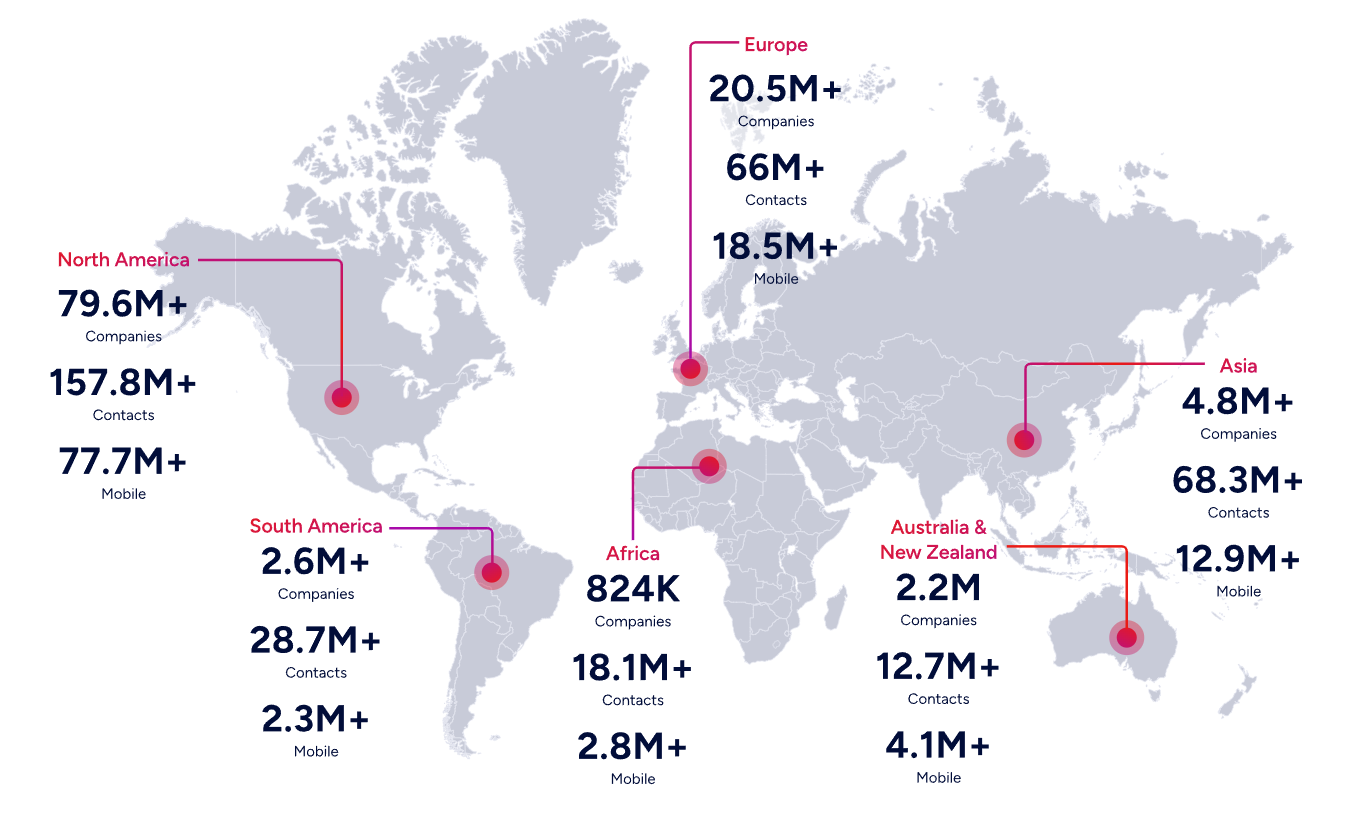
Comprehensive B2B Data: ZoomInfo provides verified business contacts, company intelligence, and buyer intent signals at scale.
Where Amperity ingests and resolves your existing customer data, ZoomInfo provides the B2B data itself: verified contacts with direct dials and business emails, company attributes, org charts, technographic profiles across 30,000+ technologies, and real-time buying intent signals. A multi-source pipeline backed by 300+ human researchers maintains the data, which reaches up to 95% accuracy on first-party records.
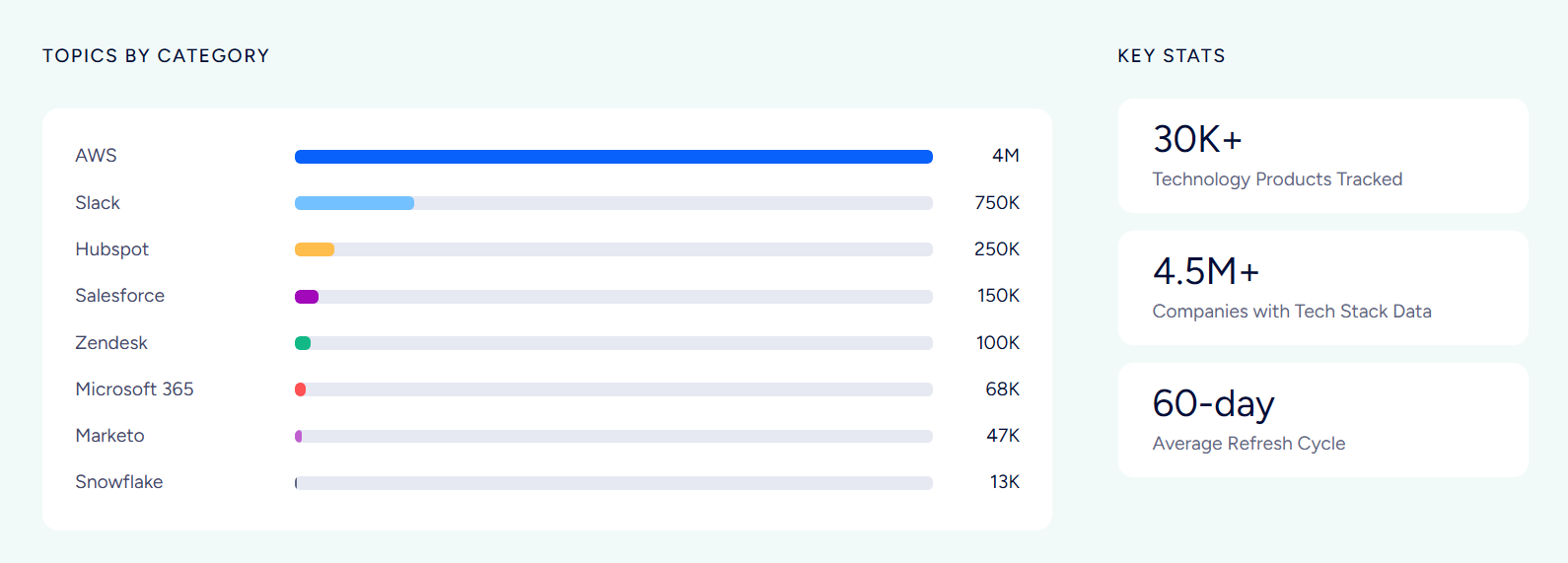
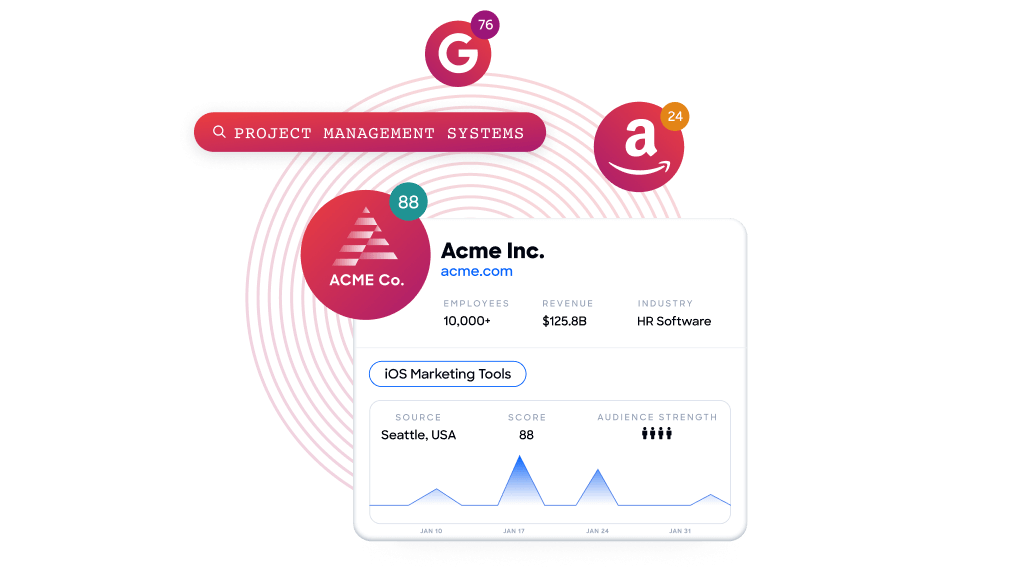
Buyer Intent data tracks signals from 210 million IP-to-Organization pairings and 6 trillion+ new keyword-to-device pairings sourced monthly. Guided Intent, exclusive to ZoomInfo, identifies topics historically correlated with deal success rather than requiring manual topic selection. WebSights resolves anonymous website traffic to companies, including buying team identification and direct contact information.
In a Fortune 500 competitive RFP analyzing 25 million contacts across vendors, an independent consultant concluded that "no other competitor came even close." ZoomInfo is a Leader in the Gartner Magic Quadrant for ABM Platforms for the second consecutive year and earned 133 No. 1 rankings on G2 across Sales Intelligence, Buyer Intent, and Data Quality categories.
SpringDB used ZoomInfo's enriched data for precise client targeting, achieving 2x–3x increases in campaign conversions and a 300% increase in database usability. (SpringDB)
GTM Context Graph and AI Execution: An intelligence layer that captures not just what happened in a deal, but why.
ZoomInfo's GTM Context Graph unifies its B2B data with a customer's own CRM records, conversation intelligence from Chorus (call recording and analysis), and behavioral signals into a single graph that captures the reasoning behind deal progression. A CRM records that a deal moved stages; the Context Graph captures that the CFO joined the last call and asked about six-month ROI, which is what actually moved the deal forward.
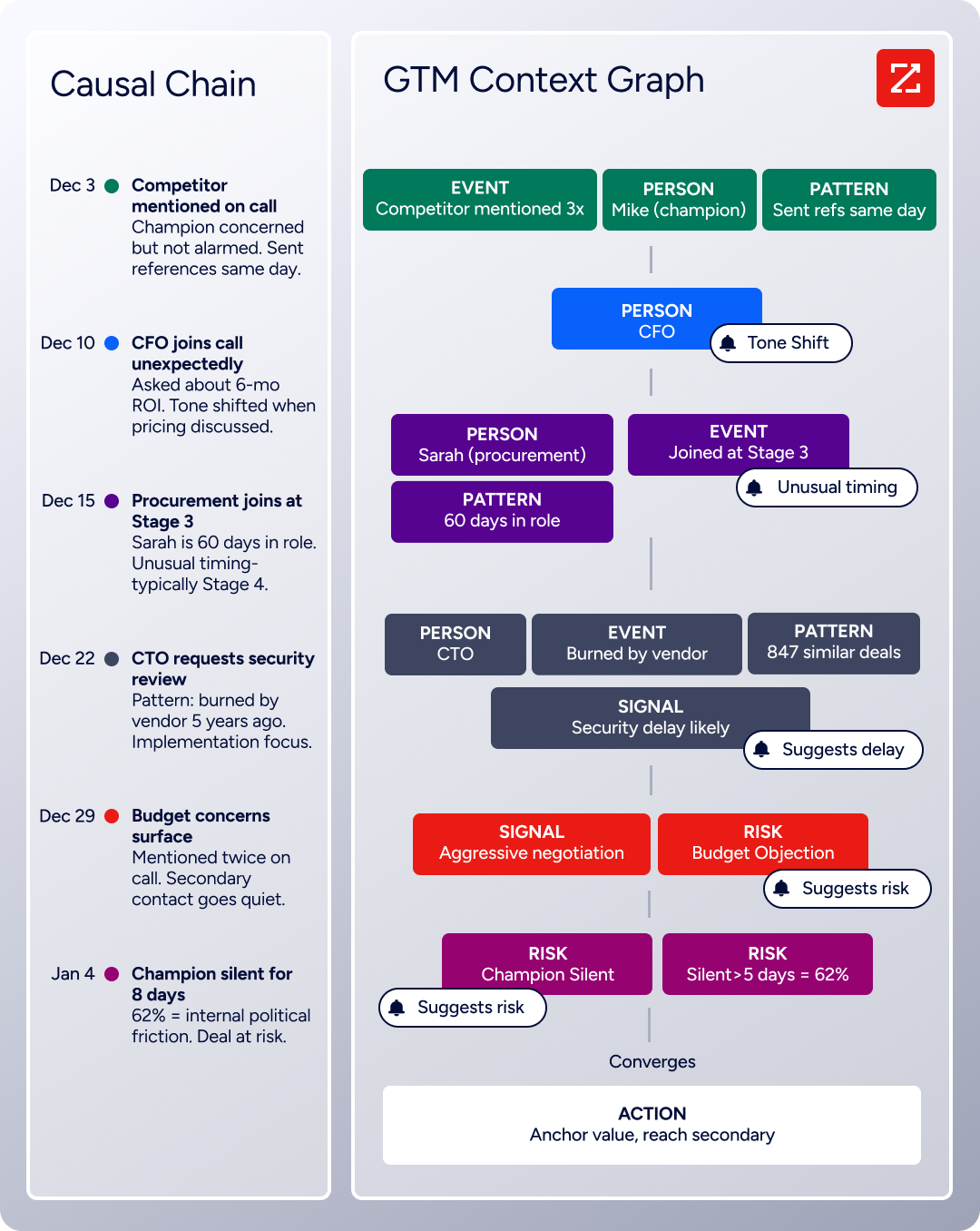
That intelligence flows through three channels. GTM Workspace gives sellers one place where prioritized accounts, AI-drafted outreach, and deal execution converge. GTM Studio gives marketers and RevOps teams a builder where they define audiences, orchestrate campaigns, and measure pipeline in natural language. APIs and MCP expose the same intelligence to any custom agent, internal tool, or partner platform. All three draw from one Context Graph: the same data and reasoning, available wherever decisions get made.
Seismic's sales team attributed 39% of active pipeline to opportunities identified or influenced by ZoomInfo signals, boosted productivity by 54%, and saved 11.5 hours per week. (Seismic)
Accessible Entry Points: ZoomInfo offers a permanent free tier and transparent trial options.
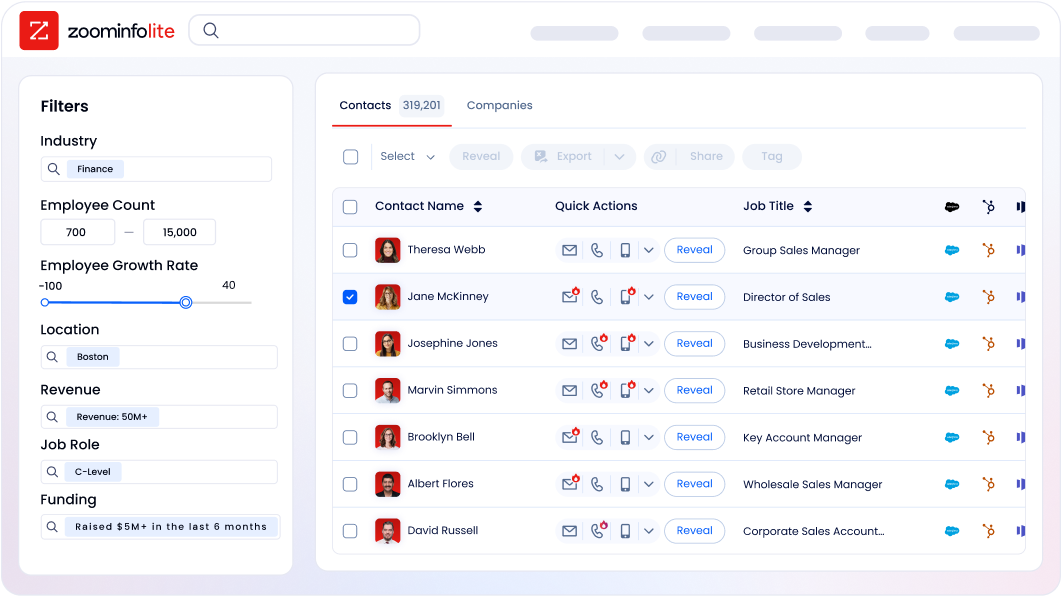
Unlike Amperity's sales-only path, ZoomInfo provides multiple ways to evaluate the platform before committing. ZoomInfo Lite is a permanent free tier (not a trial) offering access to the B2B database, 10 monthly export credits, advanced search filters, a Chrome extension, WebSights Lite (up to 10 website visitor reveals per day), and HubSpot integration. A separate 7-day free trial provides broader access to core features including intent signals and email outreach, with no credit card required.
Paid plans use consumption-based pricing, with separate tiers for Sales (Professional, Advanced, Enterprise), Marketing (Marketing Demand, ABM Lite, ABM Enterprise), and additional products like Chorus and Chat. API access is included in all relevant plans, and the MCP server is available through partners including Anthropic Claude.
Amperity and ZoomInfo: At a Glance
Aspect | Amperity | ZoomInfo |
|---|---|---|
Primary Focus | B2C customer data unification and activation | B2B go-to-market intelligence and execution |
Data Source | Ingests and resolves your existing customer data | Provides 500M contacts, 100M companies, and intent signals |
Core Capability | AI identity resolution across fragmented records | B2B prospecting, buyer intent, and sales intelligence |
Target Buyer | CDOs, data engineers, marketing technologists | Sales, marketing, RevOps, and GTM engineers |
Industries | Retail, travel/hospitality, financial services | B2B SaaS, financial services, professional services |
AI Capabilities | AmpAI assistants, predictive CLV/churn models | GTM Context Graph, AI agents, conversation intelligence |
Data Architecture | Lakehouse-native (Databricks, Snowflake, BigQuery) | Proprietary B2B data + CRM integration |
Free Access | Chuck free tier (Databricks only) | ZoomInfo Lite (permanent) + 7-day trial |
Pricing Model | Consumption-based (Amps), no published rates | Consumption-based pricing, custom-quoted |
Compliance | SOC 2, HIPAA, GDPR, CCPA, ISO 27001 | ISO 27001, ISO 27701, SOC 2 Type II, GDPR, CCPA |
Final Verdict
Amperity and ZoomInfo serve different functions. The question isn't which to choose, but whether you need one, the other, or both.
Choose Amperity if your primary challenge is unifying fragmented consumer customer data into accurate, actionable profiles. It's built for enterprise brands in retail, travel, hospitality, and financial services with customer records scattered across dozens of systems and no consistent identifier. The patented identity resolution, lakehouse-native architecture, and predictive analytics make it the strongest option for organizations whose competitive advantage depends on knowing exactly who their customers are across every touchpoint. Expect an enterprise sales process and implementation measured in weeks to months, but the documented results (3x deduplication improvements, 35% media cost reductions, measurable loyalty conversion lifts) demonstrate the platform's value at scale.
Choose ZoomInfo if your organization needs B2B go-to-market intelligence: finding business prospects, tracking buyer intent, and accelerating pipeline. Whether you're a dedicated B2B company or an enterprise with both consumer and business operations, ZoomInfo provides the verified contacts, company data, and AI execution tools that sales and marketing teams need. The GTM Context Graph turns raw data into deal-level reasoning, and the platform's three channels (GTM Workspace for sellers, GTM Studio for marketers and RevOps, APIs and MCP for any tool) deliver that intelligence wherever decisions get made.
Get started with ZoomInfo here.
For enterprise organizations operating across both B2C and B2B, Amperity and ZoomInfo address non-overlapping needs. Amperity makes your consumer data accurate and actionable. ZoomInfo makes your B2B go-to-market informed and efficient. Together, they cover the full spectrum of customer intelligence.
Amperity FAQ
What is Amperity used for?
Amperity is a Customer Data Cloud used primarily by enterprise consumer brands to unify customer data from dozens of disconnected systems into a single, accurate profile per person. Its core capability is AI-powered identity resolution, which merges duplicate and fragmented records that rules-based approaches miss. Common use cases include building unified customer profiles, creating marketing audiences without SQL, optimizing paid media spend through better targeting, driving loyalty program enrollment, and calculating customer lifetime value across channels.
How much does Amperity cost?
Amperity does not publish pricing. The platform uses a consumption-based model built around a proprietary unit called "Amps," which measures usage across data processing, segmentation, campaigns, and activation. Two editions (Standard and Enterprise) provide identical platform access, differing only in support coverage and training. Premium connectors for major ad platforms carry additional surcharges of 25,000 Amps per connector per month. All pricing requires a sales engagement, and the rollover provisions and overage mechanics suggest annual or multi-year contract structures.
Does Amperity offer a free trial?
There is no publicly advertised free trial for the core Amperity platform. The only self-serve free option is Chuck, a command-line AI agent for data engineers working in Databricks, which includes identity resolution, PII detection, and semantic tagging capabilities. For the full Customer Data Cloud, all paths go through a sales engagement. ZoomInfo, by comparison, offers both a permanent free tier (ZoomInfo Lite) and a 7-day free trial with no credit card required.
What industries does Amperity serve?
Amperity's strongest fit is with large consumer enterprises in retail, travel and hospitality, airlines, financial services, restaurants, and sports and entertainment. Named customers include Alaska Airlines, Wyndham Hotels, DICK'S Sporting Goods, Brooks Running, Virgin Atlantic, BECU, and the Seattle Seahawks. The platform is not designed for B2B organizations and has no documented use cases for healthcare providers, manufacturers, or verticals outside its core focus.
How does Amperity's identity resolution work?
Amperity's Stitch engine uses a seven-stage pipeline combining deterministic and probabilistic matching simultaneously. It applies semantic tags to standardize data across sources, narrows comparison candidates through blocking strategies, then runs pairwise comparisons scoring each record pair from Exact (5) to Non-match (0) across name, email, address, phone, and birthdate dimensions. Three identity graphs run in parallel: Growth (probabilistic, broader reach), Trust (deterministic, higher precision), and Opportunity (measuring the gap between the two). The technology is backed by five patents and published academic research at SIGMOD 2020.
Does Amperity integrate with Databricks and Snowflake?
Yes. Amperity Bridge enables zero-copy data sharing with Databricks (via Delta Sharing), Snowflake (via Secure Data Sharing), and Google BigQuery. Data stays in the customer's own lakehouse rather than being copied to Amperity's storage. This architecture reduces data movement costs and keeps the data warehouse as the single source of truth. Alaska Airlines uses this architecture to support 105 data feeds across 27 destinations.
Can non-technical users build audiences in Amperity?
Yes. The Segment Editor is a no-code drag-and-drop builder where marketers choose attributes from the Customer 360, purchase behavior filters, or uploaded files without writing SQL. Segment insights update in real time to show customer count, revenue contribution, and channel reachability. An AI assistant also lets users describe audiences in natural language. However, platform configuration, data pipeline management, and advanced customization still require technical expertise including SQL familiarity.
How does Amperity compare to ZoomInfo?
Amperity and ZoomInfo solve different problems for different audiences. Amperity is a B2C Customer Data Cloud that unifies existing consumer data from fragmented systems using AI identity resolution, serving retail, hospitality, and financial services brands. ZoomInfo is an AI GTM platform that provides verified business contacts, company data, buyer intent signals, and AI execution tools for B2B organizations. They do not compete. Enterprise organizations with both consumer and business operations may benefit from both platforms for their respective functions.
Researching Amperity? These comparisons and alternatives help you decide:
