
Choosing between Amperity and Salesforce for your customer data strategy comes down to a few questions:
Do you need a platform that resolves fragmented customer identities, or do you want CDP capabilities inside a broader CRM and marketing ecosystem?
Is your main challenge unifying data about customers you already have, or finding and engaging new buyers you don't know yet?
Are you a consumer brand that needs to merge in-store, online, and loyalty data into one profile, or an enterprise running both B2C and B2B?
Do you have the data engineering resources to implement an enterprise CDP, or do you need something that works within your existing Salesforce environment?
Is your bottleneck identity resolution accuracy, or getting unified data into the hands of the teams who need it?
In short, here's what we recommend:
Amperity is the leading pure-play CDP for consumer brands that need to solve identity resolution at scale. Its patented Stitch engine uses up to 45 AI models to unify fragmented customer records across dozens of siloed systems, and its lakehouse-native architecture keeps your data in Databricks or Snowflake without copying it to a vendor silo. But Amperity requires a data engineering team, has no self-serve tier, and handles only consumer data. B2B organizations won't find account-based capabilities here.
Salesforce offers CDP capabilities through Data Cloud, the data layer beneath the world's largest CRM ecosystem. Named a Gartner Magic Quadrant Leader for Customer Data Platforms with the highest scores in both Execution and Vision, Data Cloud connects directly to Sales Cloud, Service Cloud, Marketing Cloud, and Commerce Cloud, so unified customer profiles immediately power every customer-facing workflow. For organizations already on Salesforce, Data Cloud closes the integration gap between your CDP and your CRM. The tradeoff: Salesforce's breadth makes pricing complex, and getting full value from Data Cloud requires investment across multiple Salesforce products.
Both platforms unify data about customers you already know. But for B2B organizations (or any company whose sales team needs to find new buyers) there's an intelligence layer neither platform provides.
ZoomInfo is an AI-powered GTM platform built on a B2B data foundation of 500M contacts, 100M companies, 135M+ verified phone numbers, and 200M+ verified business email addresses. Where Amperity and Salesforce Data Cloud unify data from your internal systems, ZoomInfo provides the external intelligence sales and marketing teams need to identify, reach, and win new business. Its GTM Context Graph processes 1.5B+ data points daily, fusing ZoomInfo's B2B data with your CRM records, conversation transcripts, and behavioral signals to show the full context of your accounts: not just what happened, but why it happened, and what to do next. Teams access this intelligence through GTM Workspace for sellers, GTM Studio for marketers and RevOps, or APIs and MCP in any front-end.
If your go-to-market strategy depends on finding and engaging B2B buyers, see how ZoomInfo's data and intelligence can power your pipeline.
Amperity vs. Salesforce vs. ZoomInfo at a glance
Amperity | Salesforce (Data Cloud) | ZoomInfo | |
|---|---|---|---|
Primary function | Consumer identity resolution and CDP | CRM ecosystem with embedded CDP | B2B intelligence and GTM execution |
Core data | Your first-party customer data, unified | Your first-party data + CRM records | 500M contacts, 100M companies + your CRM data |
Identity resolution | Patented AI (up to 45 models) | Built-in identity matching | B2B entity resolution across 100M+ companies |
Data architecture | Lakehouse-native (Databricks, Snowflake) | Zero-copy (Snowflake, BigQuery, Databricks) | API/MCP-first, cloud data cubes (AWS, Snowflake, Databricks) |
Activation channels | 200+ destination connectors | Native to Sales, Service, Marketing, Commerce Clouds | GTM Workspace, GTM Studio, 172+ integrations |
AI capabilities | AmpAI (segment creation, journey building) | Agentforce (autonomous agents across CRM) | GTM Context Graph, AI agents for prospecting and outreach |
Pricing model | Consumption-based (Amps), no public pricing | Multi-cloud licensing + consumption credits | Consumption-based pricing, custom-quoted |
Free tier | None (Chuck free tier for Databricks only) | Free CRM (2 users) + Salesforce Foundations | ZoomInfo Lite (permanent free) + 7-day trial |
Best for | Consumer brands with fragmented data | Organizations wanting CDP + CRM + full platform | B2B sales, marketing, and RevOps teams |
The fundamental divide: unifying your data vs. providing new intelligence
Amperity and Salesforce Data Cloud solve the same core problem from different angles: making sense of the customer data your organization already collects. ZoomInfo solves a different problem entirely.
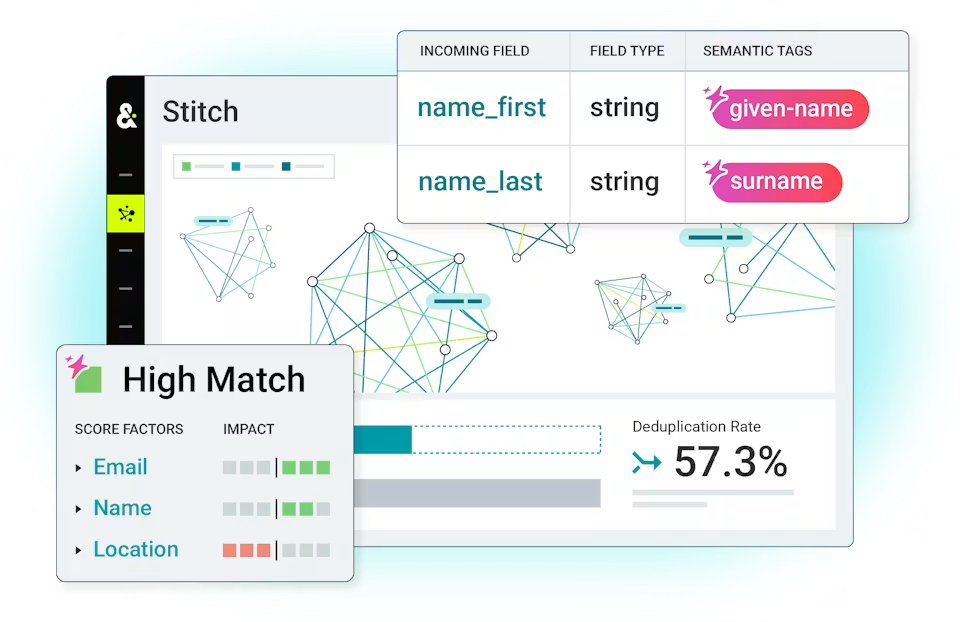
Amperity starts from the assumption that your customer data is fragmented across dozens of systems with inconsistent formats, duplicated records, and no reliable way to connect them. A customer who bought in-store, signed up for loyalty online, and called support has three separate records in three separate systems.
Source: Amperity
Amperity finds hidden connections in online and offline PII data and builds a unified identity graph from those fragments. The output: a deduplicated, single customer profile your marketing and analytics teams can use.
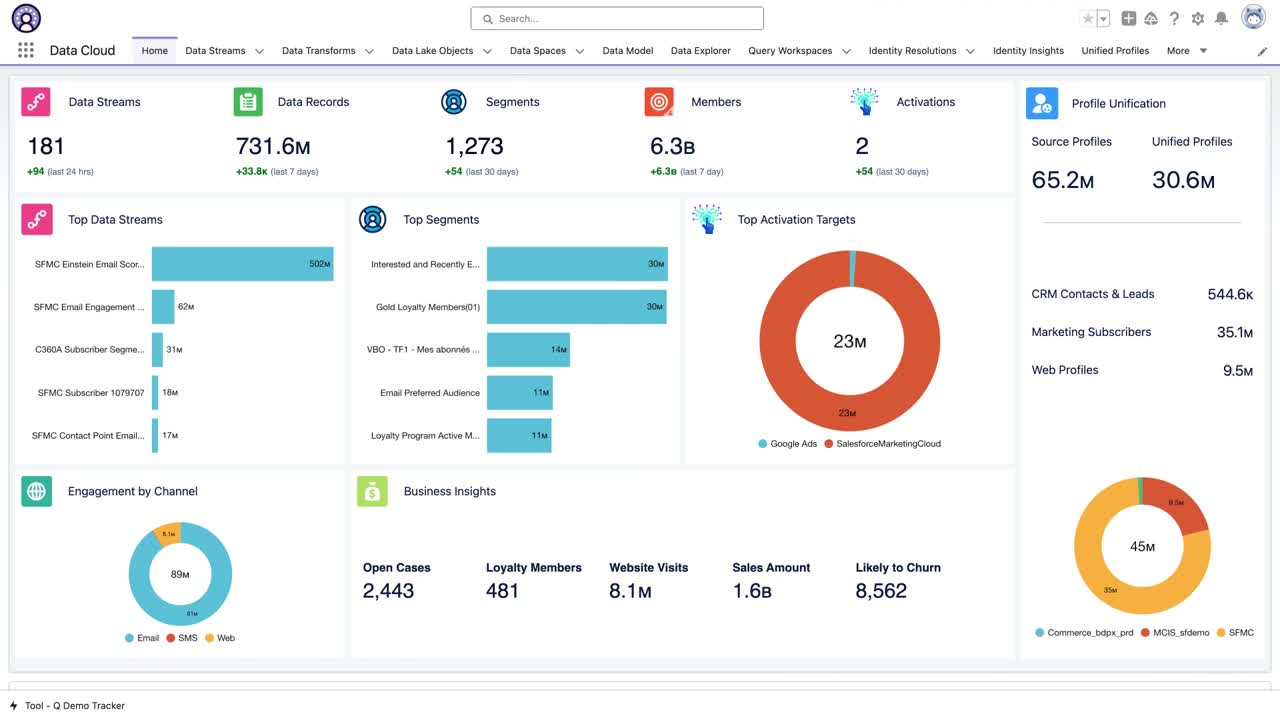
Salesforce Data Cloud solves the same fragmentation problem from inside the Salesforce ecosystem. It pulls fragmented data into one complete view of the business by ingesting data from Salesforce clouds, databases, and third-party apps through 200+ pre-built connectors.
Source: Salesforce
The advantage: once Data Cloud unifies the data, it immediately powers Agentforce agents, Marketing Cloud journeys, Sales Cloud pipelines, and Service Cloud cases without additional integration work.
ZoomInfo doesn't unify your internal customer data. It provides external intelligence your systems don't have: who works at which company, how to reach them, what technologies they use, and whether they're researching solutions like yours.
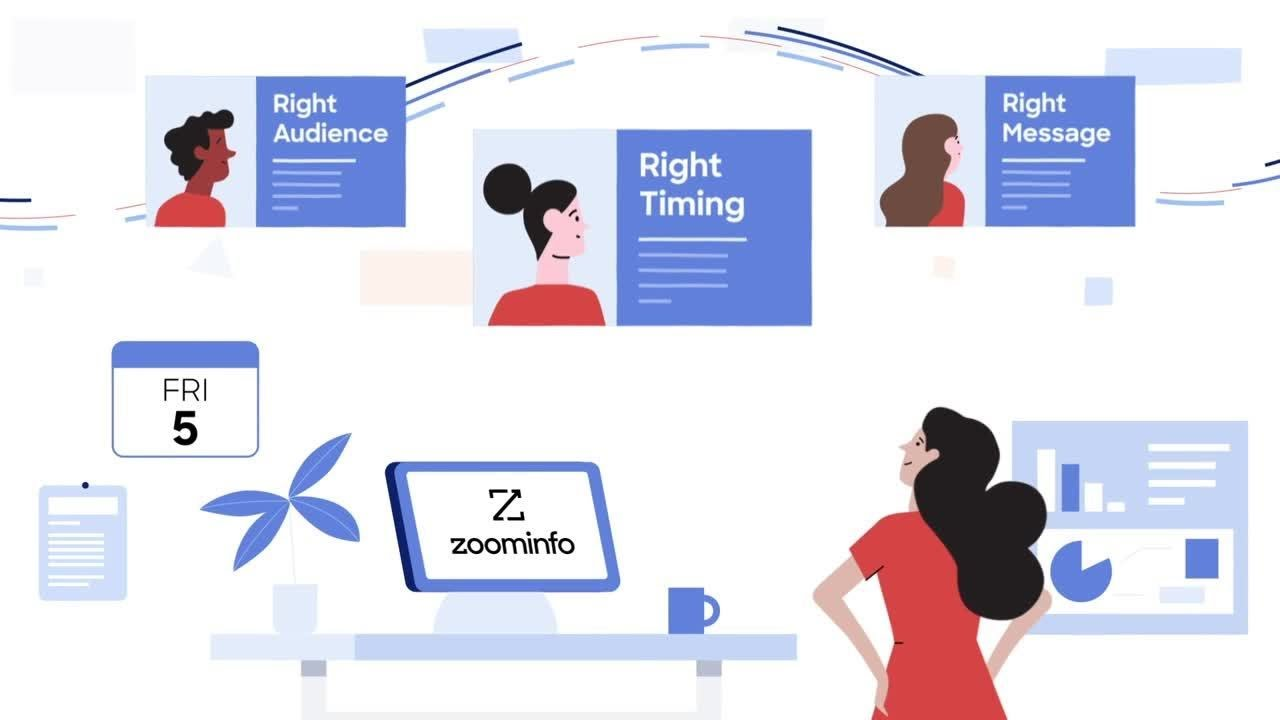
For B2B go-to-market teams, this external intelligence is often more valuable than internal data unification, because it answers the question internal data can't: who should we be talking to next?
Amperity owns consumer identity resolution
If your core challenge is turning messy consumer data into accurate, unified profiles, Amperity has built the most technically differentiated solution on the market.
Amperity's Stitch identity engine runs deterministic and probabilistic matching simultaneously across every connected data source. Where rules-based systems require exact matches (same email, same phone number), Stitch finds connections that human analysts and simpler tools miss.
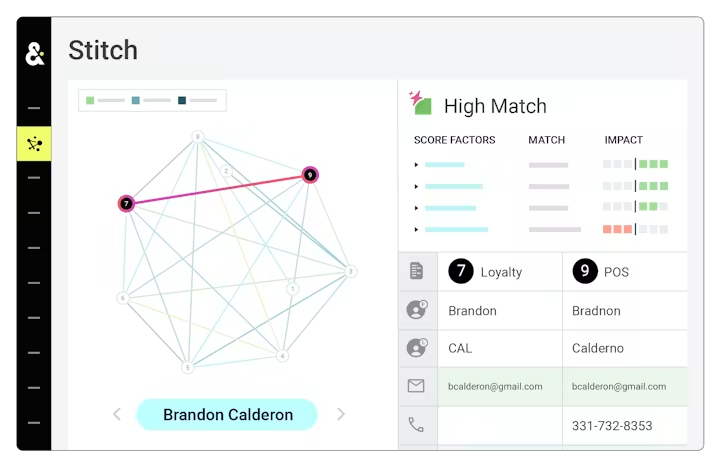
Source: Amperity
The technology holds five patents and peer-reviewed research published at SIGMOD 2020. Its three simultaneous identity graphs (Growth, Trust, and Opportunity) let teams choose their accuracy-vs.-reach tradeoff for different use cases.
The Growth Graph uses probabilistic matching for broad coverage. The Trust Graph restricts to deterministic matches for compliance-sensitive use cases. The Opportunity Graph measures the gap between the two, quantifying how many additional customers you could reach by loosening match criteria.
The catch: this level of identity resolution requires enterprise-scale investment. Amperity has no self-serve tier, no public pricing, and requires a sales conversation to begin. Organizations without data engineering capacity will face a steep onboarding curve.
And because Amperity handles only consumer data, B2B companies won't find account-based marketing, org chart intelligence, or buyer intent signals here. Amperity holds a Niche Player position in the Gartner Magic Quadrant for CDPs in 2026, with Gartner citing identity resolution as a strength while noting concerns around net revenue retention and management turnover.
Salesforce wins on ecosystem breadth
Salesforce's data platform advantage isn't technical superiority in identity resolution. It's that every unified customer profile connects immediately to every tool your teams already use.
Data Cloud ingested 112 trillion records in FY26, up 114% year-over-year. That scale reflects a structural advantage: when your CDP lives inside the same platform as your CRM, marketing automation, commerce engine, and service desk, data flows without integration work.
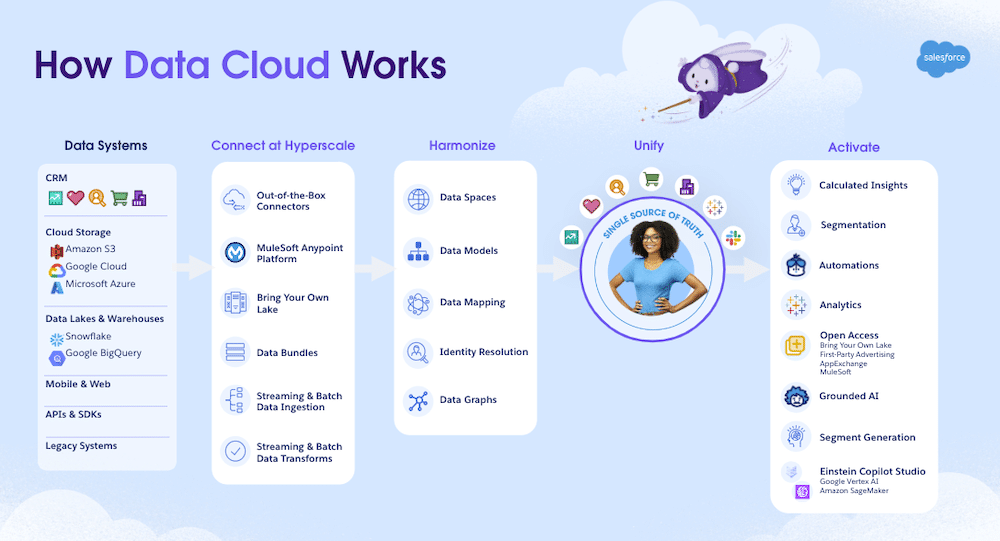
Source: Salesforce
A customer profile unified in Data Cloud can trigger a Marketing Cloud journey, surface inside a Sales Cloud pipeline view, or inform an Agentforce service agent resolving a support case.
Agentforce takes this further. Rather than just storing unified profiles, Salesforce deploys AI agents that act on them.
For organizations already invested in Salesforce, Data Cloud eliminates a real pain point: the integration gap between a standalone CDP and the systems that use the data. Nearly half the Fortune 100 are active Data Cloud customers.
But this breadth costs money. Salesforce acknowledged its pricing "needed to be easier to understand, more predictable, and more flexible" in a September 2025 pricing update. Data Cloud alone costs $500 per 100,000 credits plus $23/month per TB of storage. Add Sales Cloud Enterprise at $175/user/month, Marketing Cloud starting at $1,500/org/month, and a Premier Success Plan at 30% of net license fees, and total costs climb fast.
And while Data Cloud's identity resolution works, it doesn't match Amperity's depth for the hardest consumer identity problems: Amperity's patented probabilistic matching with up to 45 concurrent AI models was designed specifically for that challenge.
The B2B intelligence gap both platforms leave open
Both Amperity and Salesforce Data Cloud work with data your organization already collects: purchase histories, loyalty records, website interactions, support tickets. They answer the question: "What do we know about our existing customers?"
For B2B go-to-market teams, the more pressing question is: "Who should we be selling to, and when are they ready to buy?"
That's a different data problem. Your CRM doesn't know about the VP of Engineering who just joined a target account. Your CDP can't tell you which companies are researching your category. Your marketing automation platform doesn't have direct-dial phone numbers for the buying committee.
ZoomInfo provides this external intelligence at a scale neither Amperity nor Salesforce matches. The platform covers 500M contacts and 100M companies, verified through a multi-source pipeline backed by 300+ human researchers with up to 95% accuracy on first-party data.
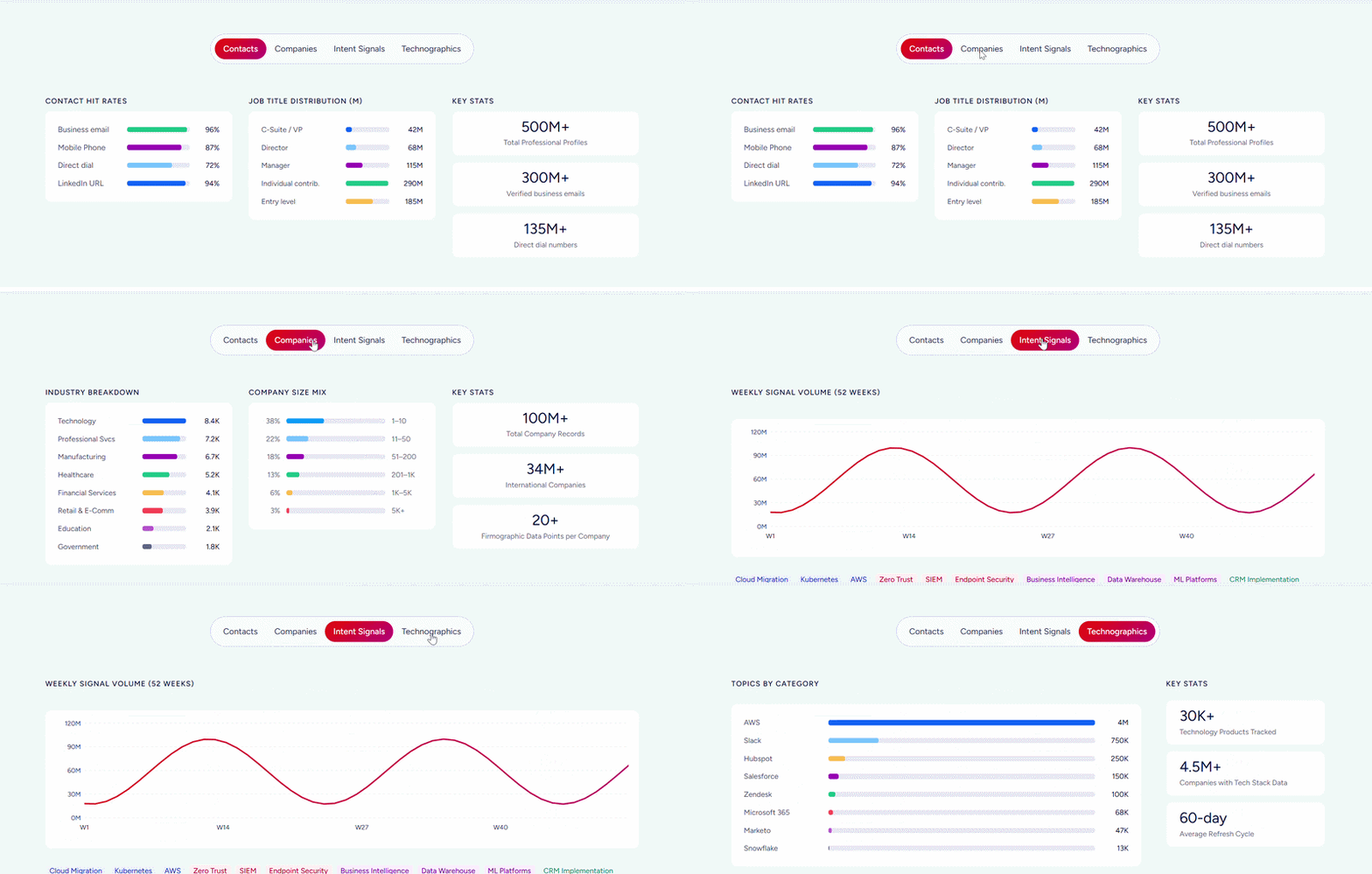
In a Fortune 500 competitive RFP analyzing 25 million contacts across vendors, an independent consultant concluded that "no other competitor came even close."
But raw data isn't what separates ZoomInfo from a static contact database. The GTM Context Graph processes 1.5B+ data points daily, fusing ZoomInfo's B2B data with a customer's own CRM records, conversation intelligence, email interactions, and behavioral signals.
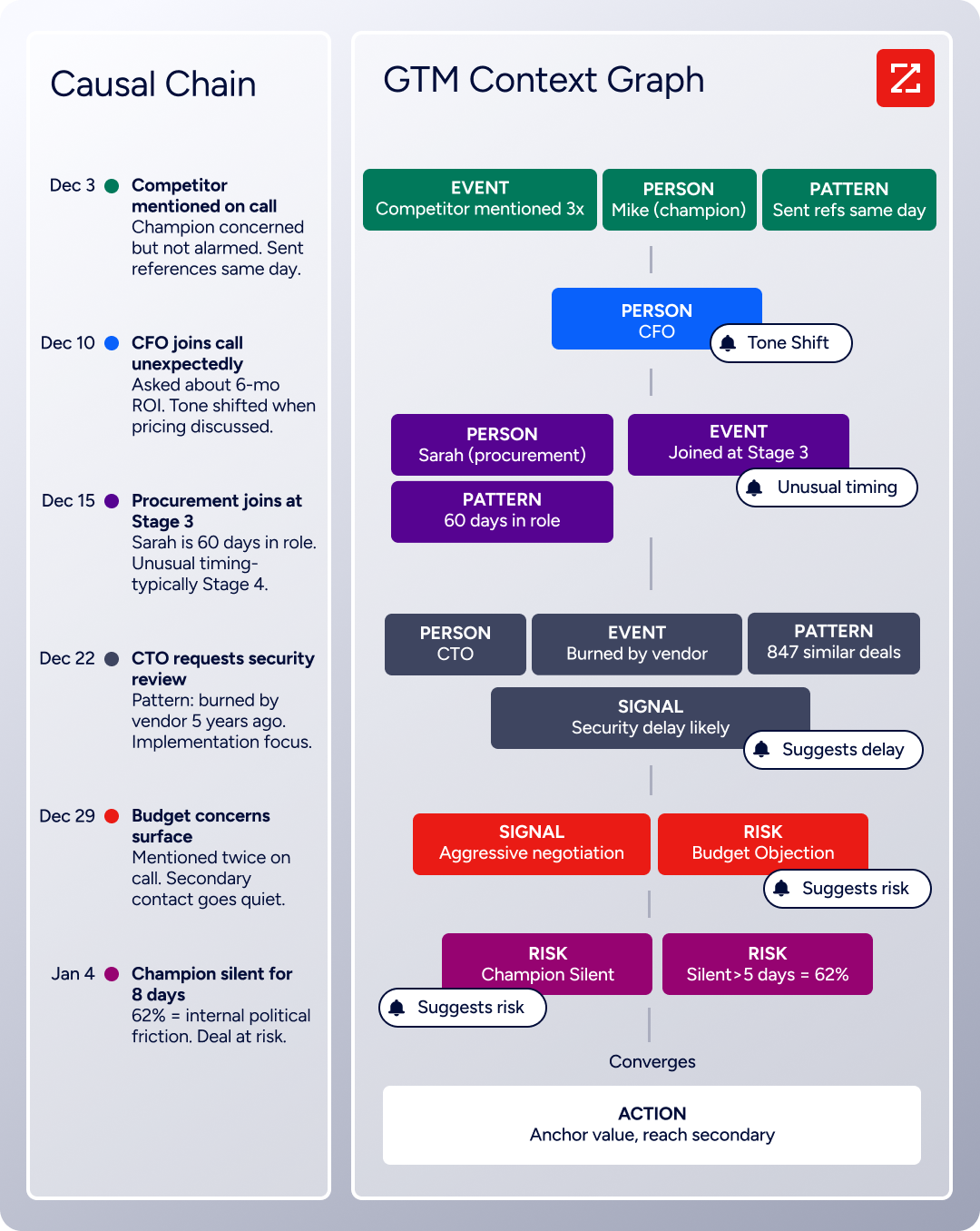
Where a CRM records that a deal moved from Stage 3 to Stage 4, the GTM Context Graph captures why: the CFO joined the last call and asked about six-month ROI, or the VP went quiet for eight days because of an internal budget battle. As ZoomInfo's Chief Product Officer Dominik Facher writes: "The CRM recorded the state change. It has no record of why it happened."
This intelligence flows into every access point. Sellers use GTM Workspace for AI-powered account research and outreach. Marketers and RevOps use GTM Studio to build and launch GTM plays in natural language. For teams building beyond ZoomInfo's own products, APIs and MCP expose the same intelligence to any custom agent or third-party platform.
Seismic's sales team attributed 39% of active pipeline to opportunities identified or influenced by ZoomInfo signals, with a 54% productivity gain and 11.5 hours saved per week per seller. (Seismic)
For a closer look at how Salesforce and ZoomInfo compare on B2B intelligence and GTM execution specifically, see our Salesforce vs. ZoomInfo comparison.
Data architecture comparison
How each platform handles data storage and movement reveals different design priorities.
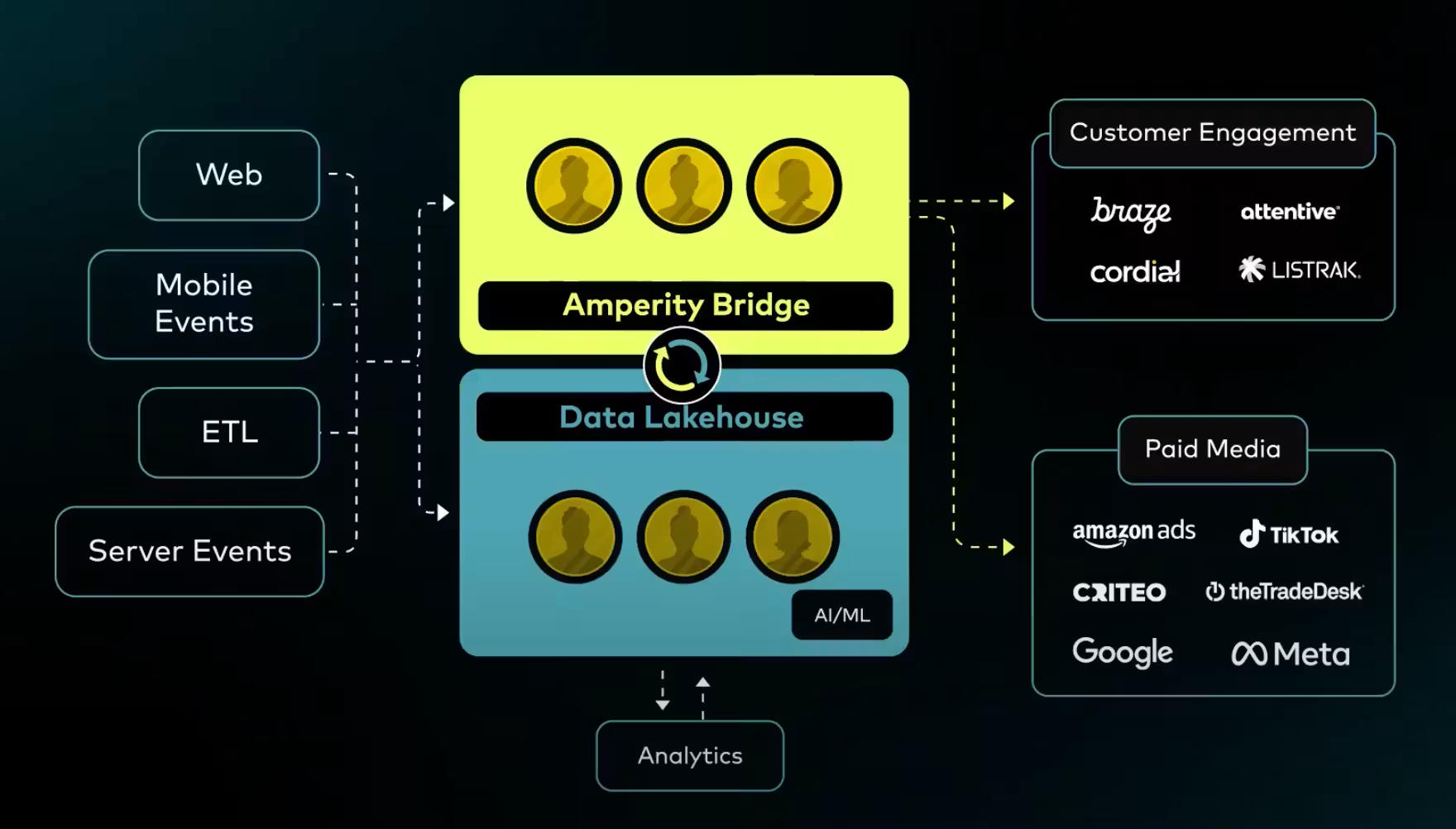
Amperity built a lakehouse-native architecture with Amperity Bridge, enabling zero-copy data sharing with Databricks (via Delta Sharing), Snowflake (via Secure Data Sharing), and Google BigQuery. Data never leaves your existing infrastructure: Amperity reads from and writes to your lakehouse catalog directly.
Source: Amperity
The platform accepts raw data in any schema through its semantic tagging system, transforming data in place rather than requiring pre-processing. This ELT approach avoids the bottleneck where data teams spend weeks normalizing schemas before a CDP can begin.
Salesforce Data Cloud takes a similar zero-copy approach, connecting directly to live data in Snowflake, Databricks, BigQuery, and AWS without ETL or data duplication. Ingesting data from other Salesforce clouds is free (zero credits), which removes friction for organizations already on the platform.
Vector search indexes for RAG-based AI grounding position Data Cloud as the data layer for Agentforce agents, not just a CDP.
ZoomInfo delivers its data through three mechanisms. The Enterprise API provides programmatic access with a search-then-enrich pattern, where searches are free and enrichment consumes credits.
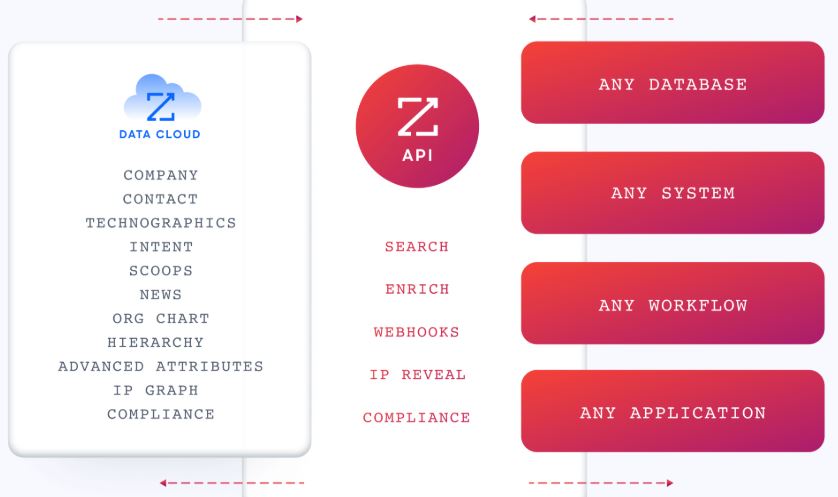
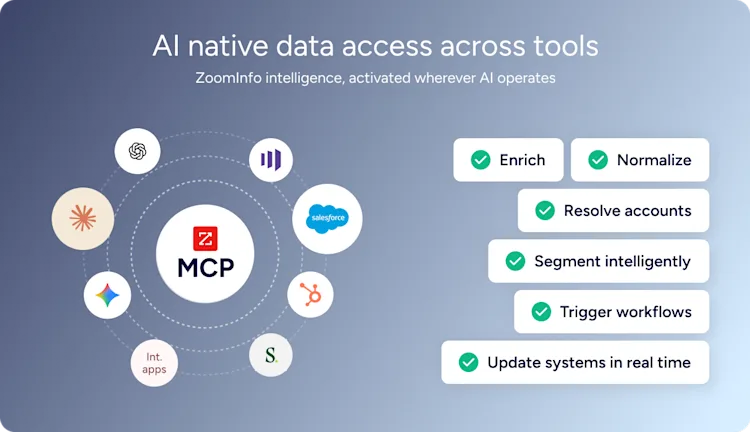
Cloud Data Cubes push ZoomInfo data directly into AWS, Snowflake, Google Cloud, and Databricks for analysis alongside first-party data. The MCP server makes ZoomInfo data accessible to any AI assistant (Claude, ChatGPT, or custom-built agents) through natural language queries.
BDO Canada achieved an 87% reduction in time spent on data dashboard updates using the ZoomInfo API. (BDO Canada)
AI capabilities reflect different missions
All three platforms have invested heavily in AI, but their implementations serve different goals.
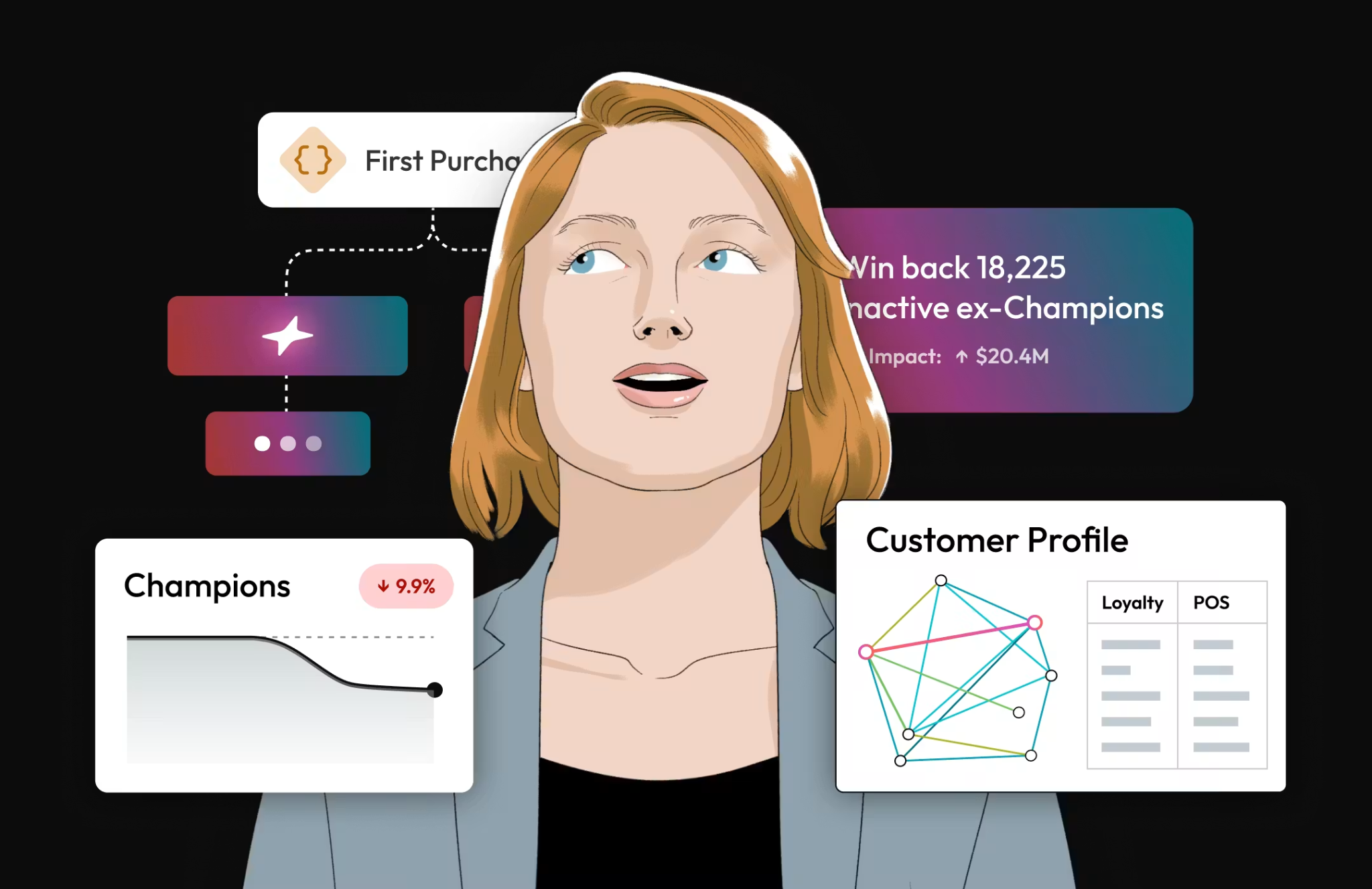
Amperity's AmpAI is built on the Azure OpenAI Service and designed to make the Customer 360 accessible to non-technical users. Marketers describe audiences in natural language, and the AI generates the segment without SQL.
Source: Amperity
The AI assistants are embedded in the segment editor, journey canvas, and query editor, not accessed through a separate interface. Chuck, Amperity's Databricks AI agent, extends this to data engineers, letting them run identity resolution and PII standardization through natural-language commands at the terminal.
Amperity also runs four native predictive models: predicted CLV, churn propensity, product affinity, and event propensity. These models feed into the same resolved profile that powers segmentation and activation, so marketing teams can target customers by predicted lifetime value or churn risk without involving data science.
Salesforce's Agentforce operates at a different scale. Powered by the proprietary Atlas Reasoning Engine, Agentforce deploys autonomous AI agents across sales, service, marketing, and commerce. These aren't copilots that need constant prompting: they perceive, plan, and execute on their own.
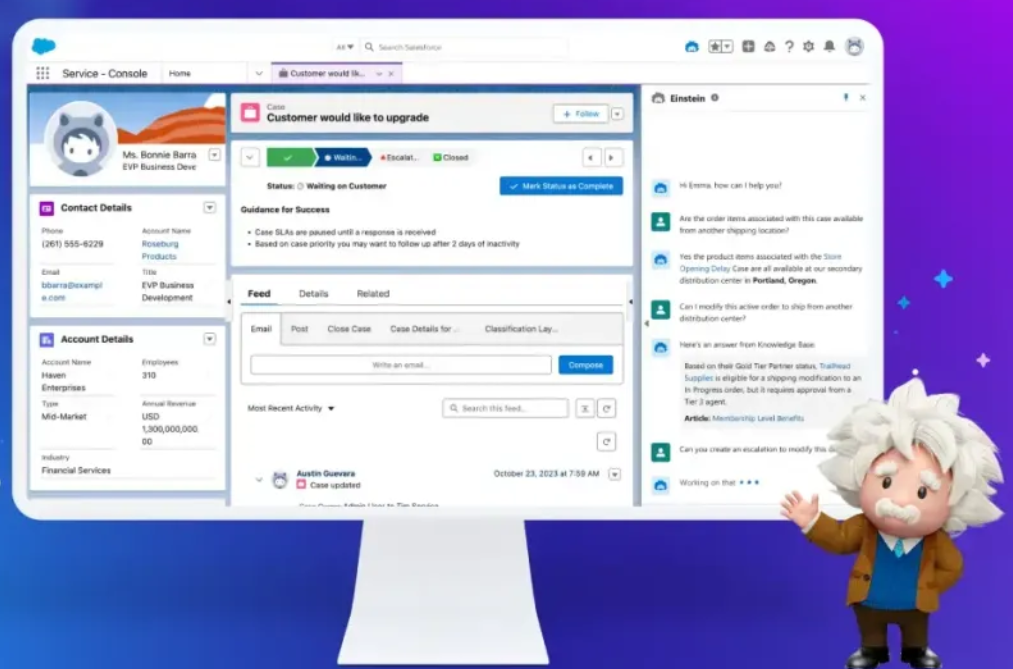
Source: Salesforce
Pre-built agents cover service, SDR, sales coaching, personal shopping, campaigns, employee support, and more. The Einstein Trust Layer provides zero data retention with LLM partners, PII masking, and toxicity detection, which matters for regulated industries.
ZoomInfo's AI is built for B2B go-to-market execution. The agents inside GTM Workspace, built on Anthropic's Claude, answer three questions for every rep: who to contact, when to engage, and what to say.
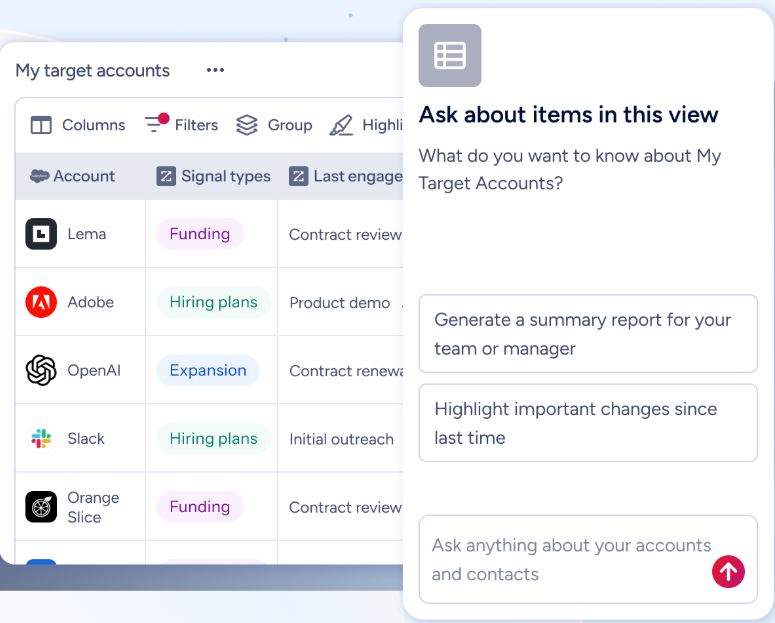
They draw on the GTM Context Graph, combining external B2B intelligence with internal CRM and conversation data to generate outreach that addresses specific deal dynamics.
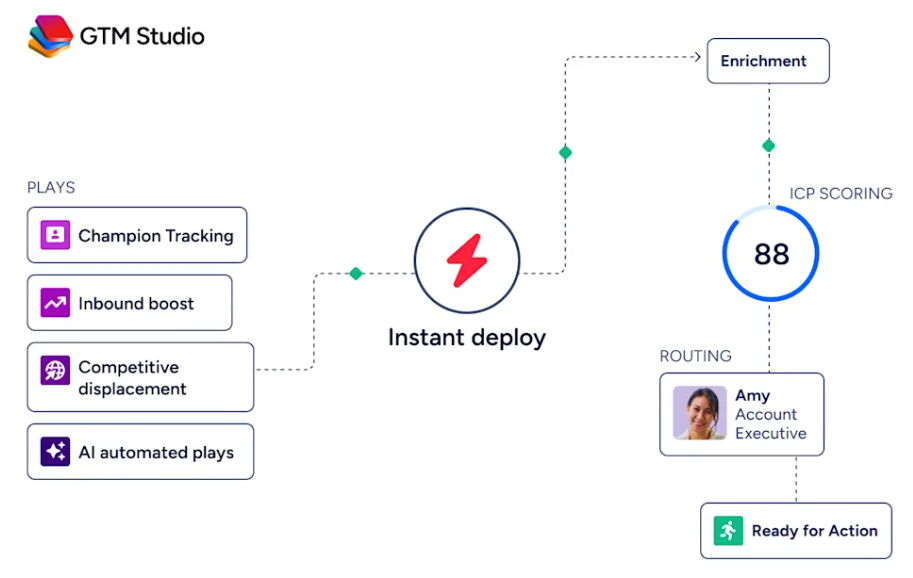
GTM Studio takes AI further for marketers and RevOps: describe an audience in natural language, and the platform builds, enriches, and activates a multi-channel play. Expansion plays that used to take 3 weeks now launch in 30 minutes.
Pricing reflects different buying decisions
The three platforms price around different value units, making direct comparison difficult. But understanding the models matters.
Amperity uses a consumption-based model built around a proprietary unit called "Amps", measuring usage across processing, segmentation, campaigns, and activation. Both Standard and Enterprise editions offer identical platform capabilities; the only difference is support coverage (Standard: 6am-6pm PT weekdays; Enterprise: 24/7 with priority SLAs).
Amperity claims "no add-ons and no hidden fees", though premium connectors for major ad platforms carry an additional 25,000 Amps per connector per month, and predictive modeling can drive high consumption on training days. No public pricing is available. All paths go through a sales conversation.
Salesforce pricing spans multiple products. Data Cloud costs $500 per 100,000 credits plus $23/month per TB storage. But Data Cloud doesn't operate in isolation. Sales Cloud Enterprise is $175/user/month. Marketing Cloud starts at $1,500/org/month.
Agentforce consumption runs $500 per 100,000 Flex Credits (each action costs 20 credits, or $0.10/action). Premier Support adds 30% to net license fees. Over 70% of implementations are partner-led, adding professional services costs on top of license fees.
ZoomInfo uses consumption-based pricing with custom-quoted plans and no published dollar amounts. Costs scale around seats (user access), credits (data exports), and AI activity.
The permanent free tier, ZoomInfo Lite, includes access to the B2B database with 10 monthly export credits, individual and company search, the Chrome extension, and HubSpot integration, with no credit card or time limit. A separate 7-day free trial provides access to full platform features.
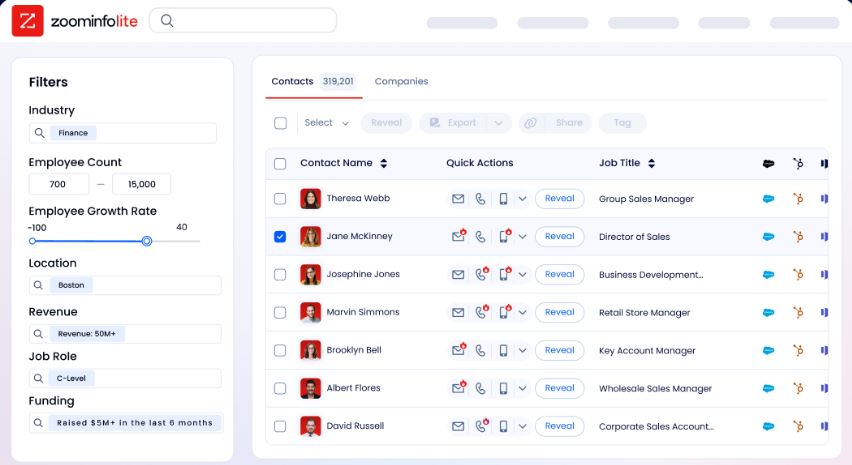
These aren't competing line items in the same budget. Amperity and Salesforce Data Cloud are CDP investments, typically owned by marketing or data teams. ZoomInfo is a GTM intelligence investment, typically owned by sales and marketing leadership. Many organizations run all three.
Integration and ecosystem comparison
Amperity provides 200+ destination connectors for activating unified profiles across paid media platforms (Meta Ads, Google Ads, TikTok, The Trade Desk), email tools (Braze, Klaviyo, HubSpot, Salesforce Marketing Cloud), and cloud storage/BI destinations.
Its Bridge architecture enables zero-copy sharing with Databricks, Snowflake, and BigQuery. Source connectors cover Adobe Analytics, Amazon S3, Google Analytics, Salesforce Sales Cloud, Salesforce Commerce Cloud, and Zendesk.
The integration focus is marketing activation channels and data infrastructure rather than sales or service tools.
Salesforce has the largest enterprise ecosystem in software. AppExchange hosts 9,000+ partner apps with 14+ million installs, and 91% of customers use at least one AppExchange app. MuleSoft serves as Salesforce's native integration platform with hundreds of pre-built connectors for enterprise systems. Native integrations include Google Workspace and Microsoft Outlook and Teams.
The AgentExchange marketplace launched with 200+ partners for Agentforce components, including Google Cloud, Docusign, Box, and Workday.
ZoomInfo's Marketplace lists 172+ integrations across CRM, marketing automation, sales engagement, data warehouses, and communications platforms. Featured integrations include Salesforce, HubSpot, Microsoft Dynamics 365, and Snowflake.
The MCP server extends ZoomInfo data to AI assistants like Claude and ChatGPT.
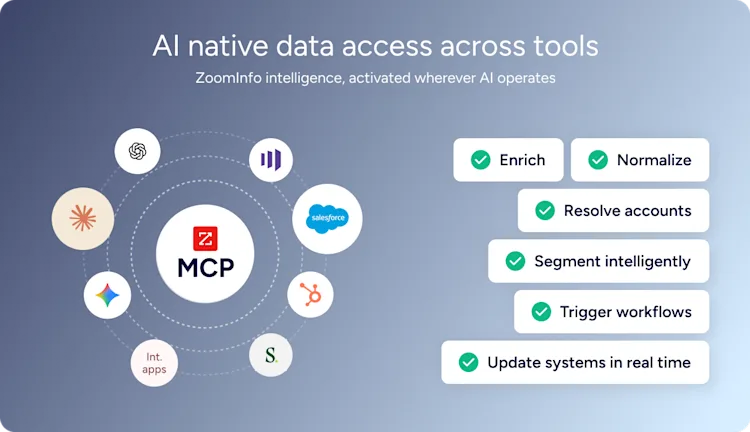
Cloud Data Cubes push data directly into AWS, Google Cloud, Snowflake, and Databricks.
ZoomInfo integrates directly with Salesforce as both a data source and enrichment layer. Organizations running Salesforce CRM can pipe ZoomInfo's B2B intelligence into their Salesforce records, where it also becomes available to Data Cloud. The three platforms don't just coexist; they compound.
ZoomInfo enriches the CRM data that Data Cloud unifies, and that unified data powers Agentforce agents with deeper context.
Snowflake uses ZoomInfo for at least one-third of the most critical data features in their Account Propensity Scoring model, feeding over 70 firmographic and technographic data fields. Accounts monitored using ZoomInfo-powered scores showed 90% higher opportunity open rates and 2x higher customer conversion rates. (Snowflake)
Amperity vs. Salesforce vs. ZoomInfo: Which should you choose?
The choice depends on which data problem is most urgent for your organization.
Choose Amperity if:
You're a consumer brand with fragmented customer data across dozens of systems
Identity resolution accuracy is your primary concern, and you need to deduplicate millions of records reliably
You have a data engineering team that can implement and maintain an enterprise CDP
You're already invested in Databricks or Snowflake and want your CDP to work natively with your lakehouse
Marketing activation (loyalty, paid media, personalization) is where unified data needs to go first
Choose Salesforce (Data Cloud) if:
You're already running on Salesforce and want CDP capabilities inside your existing ecosystem
You need unified customer profiles to power sales, service, marketing, and commerce simultaneously
Deploying AI agents (Agentforce) across customer touchpoints is part of your strategy
You want the broadest enterprise integration ecosystem available
You prefer a single vendor for CRM, CDP, analytics, and collaboration
Choose ZoomInfo if:
Your organization has a B2B sales or marketing motion that depends on finding new buyers
You need verified contact data, company intelligence, and buyer intent signals your internal systems don't have
Enriching CRM data with external B2B intelligence would improve prospecting, pipeline generation, and account targeting
You want AI-powered GTM execution (from AI-drafted outreach to signal-triggered plays) grounded in B2B data
You want to power your own tools and AI agents with B2B intelligence via APIs and MCP
See how ZoomInfo's GTM Context Graph can power your pipeline with a free trial.
These three platforms don't compete for the same budget line. Amperity unifies your consumer data. Salesforce connects that unified data to every customer-facing workflow. ZoomInfo provides the external B2B intelligence neither platform generates on its own. For organizations with both consumer and B2B operations, the strongest data strategy often involves more than one.
Amperity vs. Salesforce vs. ZoomInfo FAQ
What is the fundamental difference between Amperity, Salesforce Data Cloud, and ZoomInfo?
Amperity is a pure-play customer data platform focused on resolving fragmented consumer identities across siloed systems using patented AI-powered matching. Salesforce Data Cloud is a CDP inside the broader Salesforce CRM ecosystem, unifying customer data to power sales, service, marketing, and commerce workflows natively.
ZoomInfo is a B2B intelligence platform that provides external data (500M contacts, 100M companies, buyer intent signals, and verified phone numbers) that neither Amperity nor Salesforce generates internally.
Which platform has the strongest identity resolution?
Amperity leads in consumer identity resolution. Its Stitch engine uses up to 45 AI models with five patents covering probabilistic matching, transitive stitching, and stable ID maintenance. Dick's Sporting Goods reported Amperity deduplicated 3x more records than their own internal process. Salesforce Data Cloud includes identity resolution but is not built for the hardest consumer identity matching problems.
ZoomInfo focuses on B2B entity resolution, matching companies and contacts across 100M+ company profiles rather than resolving consumer identities.
Can these platforms work together?
Yes. ZoomInfo integrates directly with Salesforce as a data enrichment source, feeding verified B2B contacts, company attributes, and intent signals into Salesforce CRM records. Those enriched records can then flow into Salesforce Data Cloud. Amperity also connects to Salesforce Sales Cloud and Salesforce Marketing Cloud as both a source and destination.
Organizations with both B2C and B2B operations sometimes run all three: Amperity for consumer identity, Salesforce as the operational hub, and ZoomInfo for B2B intelligence.
How does pricing compare across the three platforms?
None of the three publishes fully transparent pricing. Amperity uses consumption-based "Amps" with no public figures, requiring a sales conversation. Salesforce Data Cloud costs $500 per 100,000 credits plus $23/month per TB storage, but total cost depends on which Salesforce clouds and support plans you add.
ZoomInfo uses consumption-based pricing with custom-quoted plans, though it offers a permanent free tier (ZoomInfo Lite) with 10 monthly export credits and a 7-day free trial of the full platform.
Which platform is best for a B2B company?
ZoomInfo is built for B2B go-to-market teams. Its database covers 500M contacts and 100M companies with verified phone numbers, business email addresses, buyer intent signals, and technographics.
Amperity does not support B2B use cases or account-based marketing. Salesforce serves B2B organizations through Sales Cloud and Marketing Cloud (Account Engagement), but its Data Cloud CDP capabilities focus on customer profile unification rather than external B2B intelligence and prospecting data.
Which platform has the strongest AI capabilities?
Each platform's AI serves a different purpose. Amperity's AmpAI helps marketers create segments and journeys in natural language, with four native predictive models for CLV, churn, product affinity, and event propensity. Salesforce's Agentforce deploys autonomous AI agents across the full CRM stack, reaching $800M ARR and processing 2.4 billion Agentic Work Units.
ZoomInfo's AI agents in GTM Workspace and GTM Studio are built for B2B prospecting and outreach, powered by the GTM Context Graph that captures why deals move or stall. The strongest AI depends on whether your priority is understanding existing customers, automating customer-facing workflows, or finding and engaging new buyers.
Do any of these platforms offer a free tier?
ZoomInfo offers the most accessible free entry point with ZoomInfo Lite, a permanent free tier (no credit card, no time limit) including database access, 10 monthly export credits, search filters, Chrome extension, and HubSpot integration.
Salesforce offers a free CRM for up to 2 users and Salesforce Foundations (including 200K Flex Credits and 250K Data Cloud credits) for existing customers. Amperity has no free tier for its core platform; the only free option is Chuck, a command-line AI agent for Databricks users.
What compliance certifications does each platform hold?
All three maintain enterprise-grade compliance. Amperity holds SOC 2, ISO 27001, HIPAA, GDPR, CCPA, and Australian Privacy Principles certifications. Salesforce holds ISO 27001/27017/27018, SOC 1/2/3, FedRAMP (Government Cloud), and HITRUST certifications, plus the Einstein Trust Layer for AI-specific governance.
ZoomInfo holds ISO 27001, ISO 27701, SOC 2 Type II, TRUSTe GDPR, and TRUSTe CCPA certifications, all renewed annually, and is a registered data broker in California and Vermont.
Comparing Amperity and Salesforce? These related breakdowns go deeper:
