
The question behind every B2B data API evaluation: does the surface cover enough ground, at enough depth and scale, to justify building your pipeline on it?
Apollo's REST API covers its sales intelligence and engagement platform: enrichment, prospect search, CRM records, sequences, deals, tasks, conversations, and analytics. Apollo publishes developer docs, a downloadable OpenAPI specification, and includes API access on all plans, including the free tier.
For a platform that started as a contact database and grew into a go-to-market suite, the API surface is wider than most competitors.
But breadth and depth for a developer's build are different questions.
The Apollo API is likely the right choice if:
You need programmatic access to a 270M+ contaapct and 70M company database for enrichment, search, and prospecting workflows.
You want to manage sequences, contacts, accounts, and deals through a single REST surface without stitching together multiple vendor APIs.
You are building a pipeline where free-tier API access lets you prototype before committing budget.
You need both people enrichment and organization enrichment on the same platform, with bulk endpoints for each.
You want an MCP server for AI-agent workflows alongside the REST API.
However, it might not be the right fit if:
You need OAuth 2.0 with PKCE, scoped tokens, and credential rotation for a multi-tenant integration. Apollo's OAuth flow is limited to technology partners, not general API consumers.
You need published, specific rate-limit numbers to design your pipeline's throughput. Apollo's rate-limit page does not document exact figures.
You need official SDKs. Apollo publishes none and leaves client generation to the developer.
You need traditional push-based webhooks. Apollo's webhook model is polling-based, not event-driven.
You need intelligence beyond contact and company data: org charts, corporate hierarchies, technographics, or AI-powered account research at the API layer.
Your volume requires higher rate limits, but your budget does not support a Custom plan.
In this case, consider ZoomInfo's API: a REST suite covering search, enrichment, AI intelligence (account summaries, lookalike expansion, buying-committee recommendations), and audience management across 500M contacts and 100M companies, with OAuth 2.0 authentication, published tiered rate limits up to 35 req/sec, and an MCP server for AI-agent workflows.
This article reviews both: the Apollo API in technical depth first, then ZoomInfo's API where your build needs broader data, more intelligence, or enterprise auth.
Check this out: If you want an in-depth direct comparison between ZoomInfo and Apollo.
Apollo API at a Glance
Attribute | Detail |
|---|---|
API type | REST over HTTPS, JSON request/response |
Authentication | API key (direct access) or OAuth 2.0 authorization code grant (partner integrations) |
Base URL | https://app.apollo.io/api/v1/ |
Rate limits | Vary by endpoint and plan; exact figures not publicly documented |
SDKs | None official; OpenAPI spec available for client generation |
Webhooks | Polling-based (Poll Webhook Result endpoint); no push-based webhook subscriptions |
MCP server | Apollo MCP at https://mcp.apollo.io/mcp |
CLI | Apollo CLI for command-line workflows |
Documentation | docs.apollo.io (ReadMe-hosted, interactive reference) |
Pricing / access | Available on all plans including free; credits consumed on enrichment endpoints |
Apollo API: What Works Well & What to Plan Around
What works well | What to plan around |
|---|---|
API access on all plans including free tier (no enterprise gate) | No official SDKs: you build and maintain the HTTP layer yourself |
Wide endpoint surface: enrichment, search, CRM, sequences, deals, tasks, conversations | Rate-limit specifics not published: exact req/sec and req/min figures are undocumented |
OpenAPI spec downloadable for client generation and Postman import | OAuth 2.0 reserved for technology partners, not general API consumers |
MCP server and CLI available alongside the REST API | No push-based webhooks: only a polling endpoint for async results |
Search endpoints (People API Search) do not consume credits | Enrichment and search pagination consume credits, and credits do not roll over |
Both people and organization enrichment support bulk operations | Phone number reveals cost 8 credits each (vs. 1 credit for email), which adds up at scale |
Apollo API: Authentication & Getting Started
API access starts with any Apollo account, including the free Starter plan.
You create keys in the Apollo dashboard at Settings > Integrations > API Keys, or through the developer portal. Only admins or users with the appropriate permission profile can create API keys.
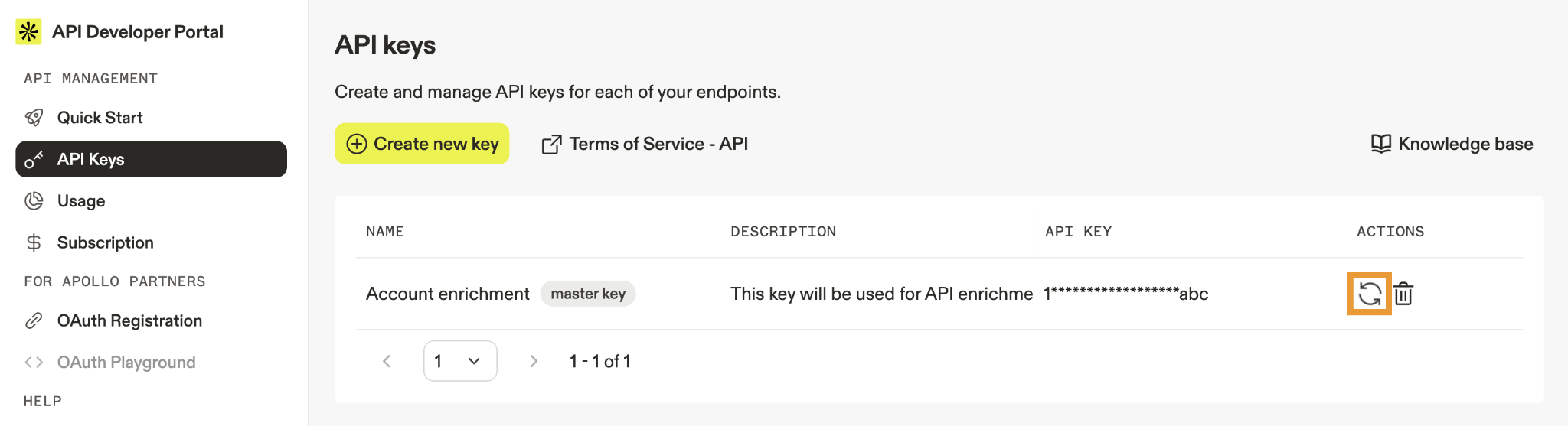
Source: Apollo
Apollo supports two authentication methods:
API key is the standard path for direct, account-level access. The key authenticates every request, passed in the request body or headers. A workspace can hold multiple API keys, each tracked with its own usage statistics through a dedicated developer dashboard.
OAuth 2.0 authorization code grant is available for technology partner integrations that need to act on behalf of mutual users. The flow requires app registration with Apollo to receive a client ID and client secret.
The authorization endpoint is https://app.apollo.io/#/oauth/authorize; the token endpoint is POST https://app.apollo.io/api/v1/oauth/token. Access tokens expire after 30 days (2,592,000 seconds), and Apollo issues refresh tokens alongside them. You can register up to 4 redirect URLs per OAuth app.
A basic authenticated request:
curl -X POST "https://app.apollo.io/api/v1/people/match" \
-H "Content-Type: application/json" \
-H "X-Api-Key: YOUR_API_KEY" \
-d '{"email": "test@example.com"}'
Worth noting: the OAuth flow is not a general-purpose developer feature. Apollo designed it for partner integrations that need delegated access to mutual customers' accounts. If you are building an internal or single-tenant application, API key authentication is the intended path.
Apollo API: Core Endpoints & Capabilities
The API is organized by a resource group, all returning and accepting JSON. The endpoint catalogue spans data enrichment, prospect discovery, CRM record management, sales engagement, deal tracking, and analytics. The API reference documents each endpoint with example requests and responses.
Enrichment
The primary credit-consuming surface. Enrichment endpoints return verified contact and company data from Apollo's database of 270M+ contacts and 70M companies.
People Enrichment (POST): match a person by email, LinkedIn URL, or other identifiers and return their profile (verified email, phone, title, company, employment history).
Bulk People Enrichment (POST): enrich multiple people in a single call.
Organization Enrichment (GET): return a company's profile (industry, revenue, employee count, technographics, funding data).
Bulk Organization Enrichment: enrich multiple companies at once.
Credit consumption depends on the data returned. An email address costs 1 credit per reveal, a phone number costs 8 credits, and data enrichment ranges from 1 to 8 credits per record depending on the fields returned.
What you would build with this: a CRM enrichment pipeline that takes a list of email addresses, bulk-enriches them against Apollo's database, and writes verified contact details and firmographic data back to your system.
People & Organization Search
Search endpoints let you discover prospects and companies without knowing their identifiers upfront.
People API Search (POST): search Apollo's contact database using filters (title, company, location, industry). This endpoint does not consume credits.
Get Complete Person Info (GET): retrieve the full profile for a specific person. Credits apply.
Organization Search (POST): search companies by firmographic attributes. Credits consumed per page of results.
Organization Job Postings (GET): retrieve active job listings for a company. Credits consumed per page.
Get Complete Organization Info (GET): full company profile. Credits per record.
News Articles Search: search news related to companies.
The cost-effective workflow is search-then-enrich: filter freely with search (free on People API Search), then spend credits only on the records worth enriching.
What you would build with this: an ICP-matching service that searches for companies matching your firmographic criteria, filters to decision-makers at those companies, and enriches only the qualified matches.
Contacts & Accounts (CRM)
Full CRUD operations on Apollo's internal CRM records.
Contacts:
Create (POST), Update (PATCH), Bulk Create (POST), bulk update, search, view, update stage/owner, list stages. No credits consumed.
Accounts:
Create (POST), Update (PATCH), Bulk Create (POST), bulk update, search, view, update owner, list stages. No credits consumed.
What you would build with this: a bidirectional sync between your external CRM (Salesforce, HubSpot) and Apollo, keeping contact records, account assignments, and stage progressions consistent across systems.
Sequences (Sales Engagement)
Programmatic control over Apollo's multichannel outreach sequences.
Create (POST), Update (PUT), Search (POST), add contacts to a sequence, update contact status within a sequence, activate, deactivate, and archive. All free.
What you would build with this: an automated enrollment engine that adds qualified leads to targeted sequences based on intent signals or deal stage changes, without touching the Apollo dashboard.
Deals & Tasks
Tasks: Create (POST), Bulk Create (POST), Search (POST). All free.
Calls & Conversations
Calls: Create Call Records (POST), Search (GET), Update (PUT). All free.
Conversations: Search (POST), Get Info (GET, credits if AI insights present), Export (POST, credits per record with AI insights).
One-Off Email
Create Draft (POST), Send Now (POST), Check Send Status (POST). All free.
Analytics & Users
Query Analytics Report (POST). Free.
Get Current User Profile (GET), Get List of Users (GET). Free.
View API Usage Stats and Rate Limits (POST). Free.
Supporting Resources
The API also covers Email Accounts (list connected accounts), Lists, Custom Fields, Notes, and API Key management.
Pagination applies across search and enrichment endpoints; paginating through results multiplies credit consumption on credit-bearing endpoints.
Apollo API: Webhooks & Events
Apollo does not offer push-based webhooks where the platform POSTs events to a developer-registered URL.
The API includes a Poll Webhook Result (GET) endpoint, a polling mechanism where developers call it to retrieve results of asynchronous operations.
The developer docs contain no event subscription system, no webhook payload documentation, and no event type catalogue. For developers who want to build event-driven workflows (trigger an action when a contact replies, a sequence completes, or a deal stage changes), this is a gap. Event-driven integrations require polling the relevant endpoints on a schedule, which adds latency and engineering overhead.
Apollo's platform generates signals developers would naturally want to react to in real time: sequence completions, email replies, deal stage transitions, contact status changes. Without push notifications, you must build your own polling layer and accept the delay.
Apollo API: SDKs, Docs & Rate Limits
SDKs & Libraries
Apollo does not publish official SDKs in any language.
The developer docs suggest downloading the OpenAPI specification and using it to generate a client SDK or importing it into Postman or Insomnia. SDK generation falls entirely on the developer.
Two first-party tools sit alongside the REST API:
The Apollo CLI provides command-line access to Apollo workflows.
The Apollo MCP server at https://mcp.apollo.io/mcp exposes Apollo's data as native tools for MCP-compatible AI assistants, using OAuth 2.0 over Streamable HTTP (no API key required for MCP connections).

Source: Apollo
Without official SDKs, you own the auth layer, request serialization, error handling, rate-limit backoff, and pagination logic. The OpenAPI spec lets you auto-generate a client, but a generated client is not a maintained SDK with documented edge cases and versioned releases.
Documentation & Developer Experience
Apollo's developer documentation lives at docs.apollo.io, built on ReadMe. The structure:
Get Started: API overview, key creation, key testing, OAuth 2.0 partner flow, API pricing and credit consumption
Tutorials: step-by-step walkthroughs (Find People, Enrich People Data, Retrieve Mobile Phone Numbers, Waterfall Enrichment, Convert Enriched People to Contacts, Retrieve LinkedIn Profiles)
API Reference: per-endpoint documentation with example requests and responses
MCP & CLI docs: separate sections for the MCP server and Apollo CLI
The developer portal provides an OAuth playground for testing authorization flows. A developer dashboard tracks API key usage and credit consumption per user or per team.
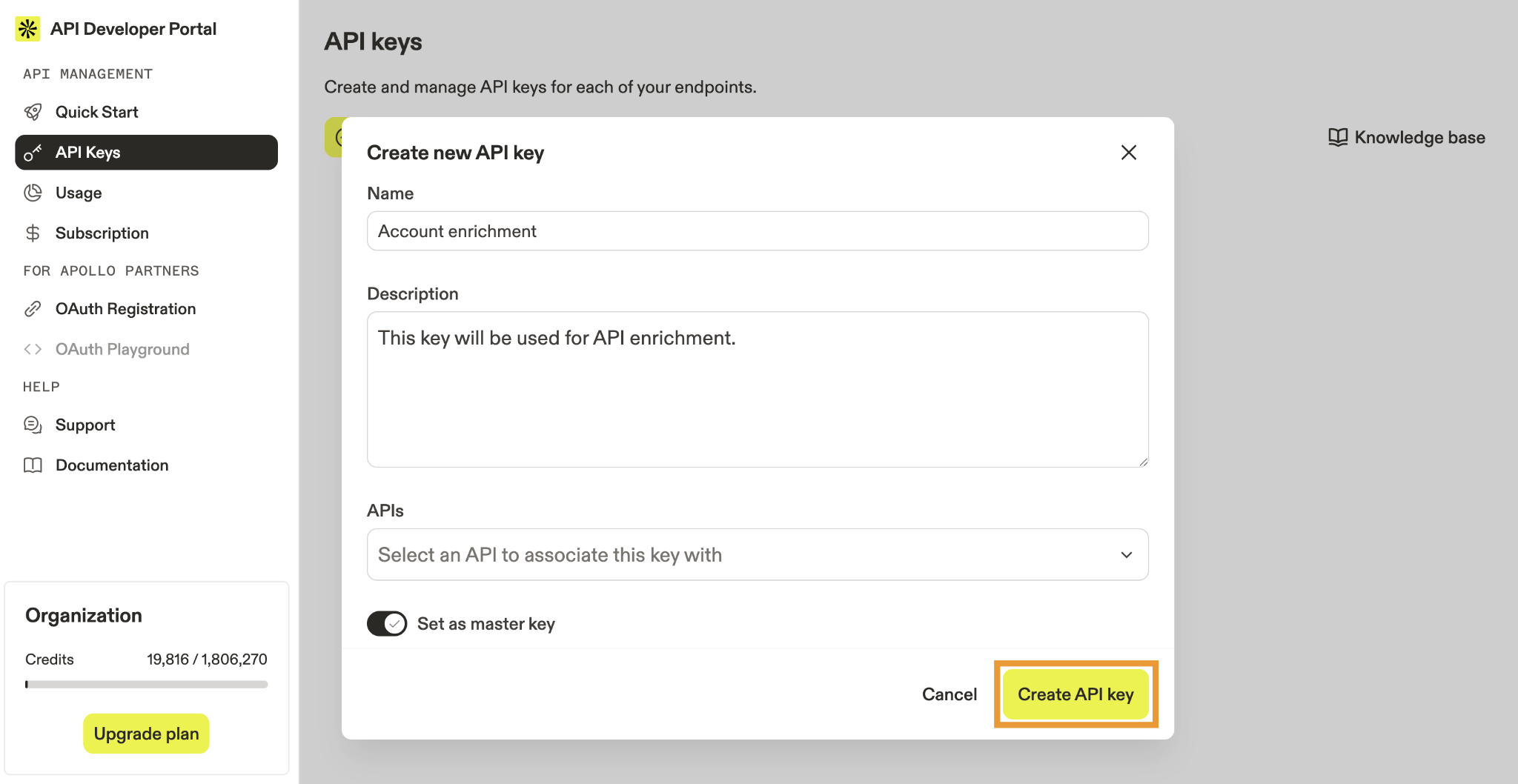
Source: Apollo
Apollo publishes an llms.txt index for AI development tools. Developer support is available through the Knowledge Base, the Apollo Community, and chat support on paid plans.
One gap: no public API changelog exists in the developer docs. When the API surface changes, you discover it by testing or reading community posts, not by scanning a version history.
Rate Limits & Constraints
Apollo's rate limits vary by endpoint and by plan. The API returns a 429 Too Many Requests response when you exceed a limit.
The Rate Limits reference page does not publish specific numbers (requests per second, per minute, or per hour). What the docs provide:
Developers can view current rate limits in-app under Settings > Integrations > API Usage.
The View API Usage Stats and Rate Limits endpoint returns current limits programmatically.
Apollo recommends reducing request volume, waiting for the limit window to reset, or upgrading to a higher plan.
For a developer designing a pipeline, unpublished rate limits are a real constraint. You cannot plan your throughput, batching strategy, or retry logic against a documented ceiling. You can discover your limits through the usage endpoint, but that is runtime discovery, not a design-time guarantee.
Apollo API Pricing & Access Costs
All Apollo plans include API access, making the API available from the free tier upward. Plans differ primarily in credit allowances and which endpoints consume credits.
Plan | Price (annual, per seat/month) | Credits (annual) |
|---|---|---|
Free (Starter) | 900/year, granted monthly | |
Basic | $49 | 30,000/year, granted upfront |
Professional | $79 | 48,000/year, granted upfront |
Organization | $119 (min 3 seats) | 72,000/year, granted upfront |
Credit costs for API-accessed data:
Email address: 1 credit per reveal
Phone number: 8 credits per reveal
Data enrichment: 1 to 8 credits per record (depending on fields)
AI research: 1 credit per run
Endpoints that create, update, list, or manage records (contacts, accounts, deals, sequences, tasks) consume no credits. Credits are charged only when qualifying data is returned by enrichment, organization search, news search, or AI-insight endpoints.
For a developer sizing costs: on the Basic plan ($49/month annual), 30,000 credits per year translates to roughly 30,000 email reveals or about 3,750 phone number reveals. At Professional ($79/month), you get 48,000 credits. Credits are a shared pool across the team, do not roll over, and are non-refundable.
One licensing constraint: using Apollo data to power external products, share data with customers, or resell it is not permitted under standard plans. A separate Data Reseller agreement is required. The Apollo MCP server carries no additional cost; the same plan credits and limits apply.
Where the Apollo API Falls Short
These are the practical limits a developer should plan around when building on this API. Several reflect scope decisions as the API evolved from a sales platform into a developer surface.
Rate limits are not published. The rate-limit reference page exists but documents no specific numbers. You cannot design your pipeline's throughput, batching, or retry logic against a documented ceiling. You can query your limits at runtime through the usage endpoint, but that is discovery, not a spec.
For teams evaluating multiple APIs before committing, this is a gap: you cannot compare Apollo's throughput against a competitor's published tiers.
No push-based webhooks. The API provides a polling endpoint for async results, but no event subscription system where Apollo POSTs to your URL on contact replies, sequence completions, or deal stage changes. Developers who need event-driven architectures must build and maintain their own polling layer.
No official SDKs. Every integration is raw HTTP or an auto-generated client from the OpenAPI spec. For production systems with dozens of endpoint calls, retry logic, and pagination handling, you are building the client library that most established APIs would provide.
OAuth 2.0 is partner-only. Apollo designed the OAuth flow for technology partners building integrations for mutual customers, not for general API consumers. If you are building a multi-tenant SaaS product that connects to many Apollo accounts, each customer must share an API key manually rather than authenticating through a delegated flow.
Credit consumption on pagination. Paginating through search results on credit-bearing endpoints multiplies your credit spend. A search that returns 500 results across 5 pages consumes credits on each page, not just the initial request. This makes large-scale prospecting queries expensive unless you tighten your filters.
Phone numbers are expensive at scale. At 8 credits per phone number reveal (vs. 1 credit for email), a pipeline that enriches both email and phone for every contact burns through credits fast. On the Basic plan with 30,000 annual credits, enriching 3,000 contacts with both email and phone would consume 27,000 credits (90% of your annual allowance).
No intelligence endpoints. The API covers enrichment and search but does not expose AI-powered account research, lookalike expansion, buying-committee recommendations, or contact recommendations. These capabilities exist in Apollo's UI (AI features, lead scoring), but the API does not offer them as programmable endpoints.
ZoomInfo API: The Data and Intelligence Layer Beyond Sales Engagement
Apollo's API gives you programmatic access to a B2B contact database and sales engagement features: enrichment, search, sequences, deals, and CRM management.
ZoomInfo is an AI GTM platform whose API provides comprehensive data, broader intelligence, and enterprise-grade access controls: verified direct dials, org charts, corporate hierarchies, technographics, buyer intent, AI-powered account research, and buying-committee recommendations, all through an OAuth 2.0 surface with published rate limits.
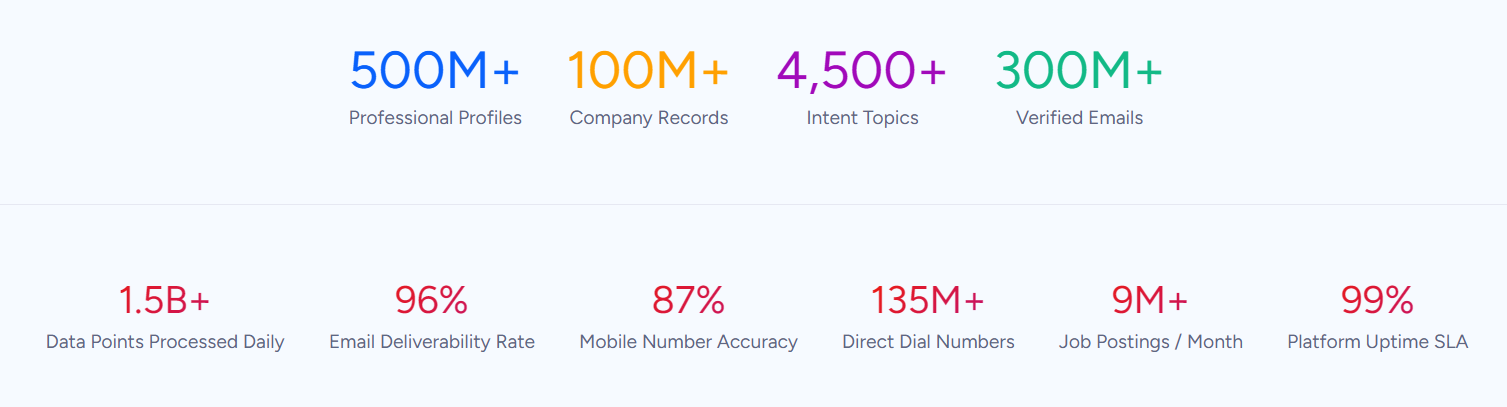
Upstream of the API sits the GTM Context Graph, an intelligence layer that processes 1.5B+ data points daily by combining ZoomInfo's B2B data with your first-party data (the same layer that powers the AI endpoints a developer calls through the REST surface).
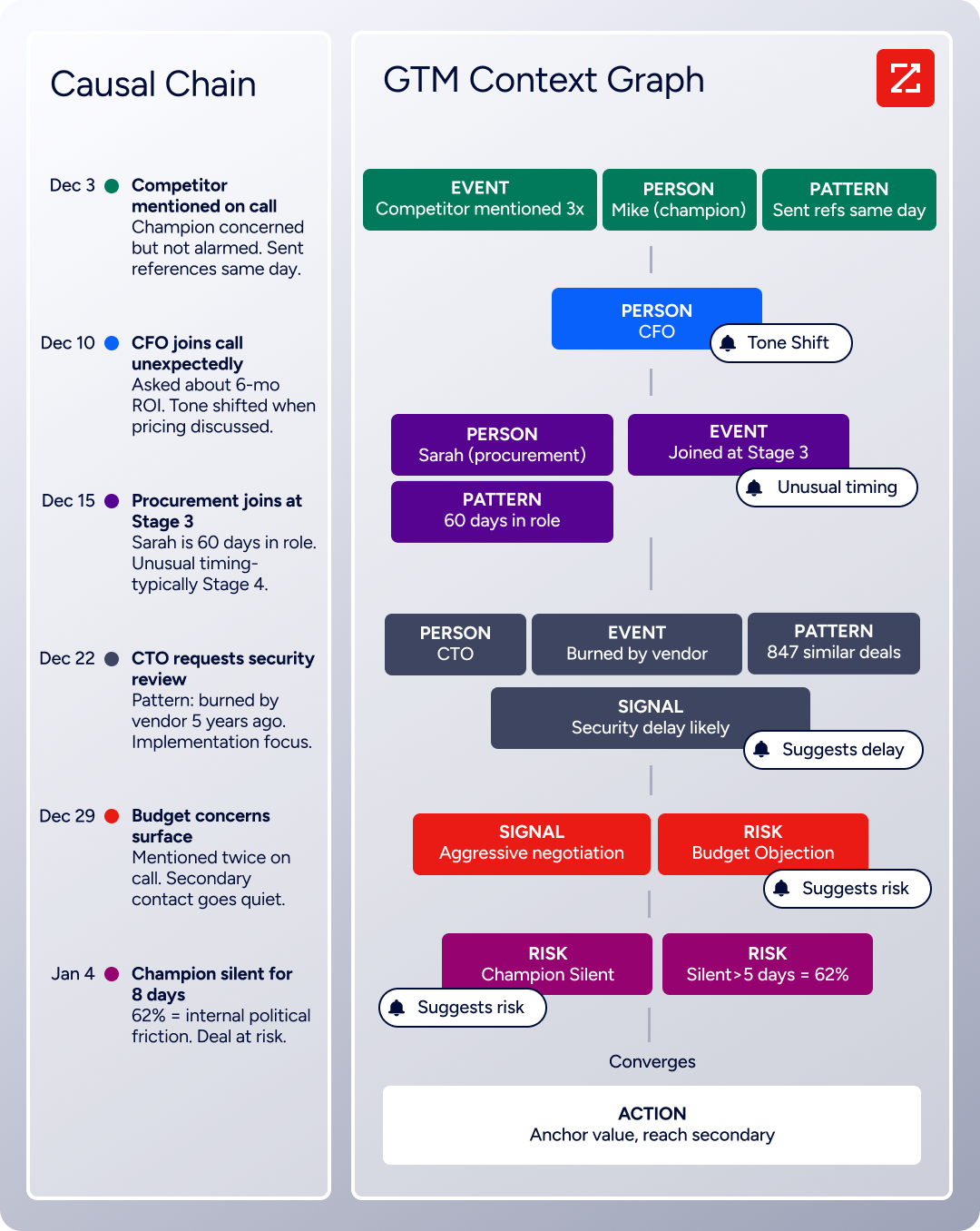
The two APIs overlap on contact and company enrichment but diverge on depth, intelligence, and developer experience.
What the API Covers
ZoomInfo's Enterprise API is a REST suite served from https://api.zoominfo.com/gtm, organized into four areas documented in the interactive API reference:
Data API (Search & Enrich): Search endpoints cover Contacts, Companies, Intent, News, and Scoops, returning matched records without consuming credits. Enrich endpoints return the full payload: business emails, direct dials, employment history, corporate hierarchy, org charts, technographics, and hashtag signals, up to 25 records per call.
The underlying dataset spans 500M contacts, 100M companies, 135M+ verified phone numbers, and 200M+ verified business email addresses.
AI Intelligence API: Account Summary returns structured account intelligence with a free-form Q&A endpoint. Find Similar Companies performs lookalike expansion. Contact Recommendations returns AI-ranked buying-committee suggestions by motion (prospecting, deal acceleration, renewals). These are the intelligence endpoints Apollo's API does not offer.
Marketing API: CRUD endpoints for programmatic audience management.
Platform API (Engagements, Beta): Bidirectional engagement data via the Engagements API.
What you would build with this: a pipeline that searches for companies matching your ICP (free), enriches the matches with full profiles including org charts and technographics (1 credit per new record), then uses the AI Intelligence API to identify the buying committee and generate an account brief before handing off to your outreach system.
Authentication & Access
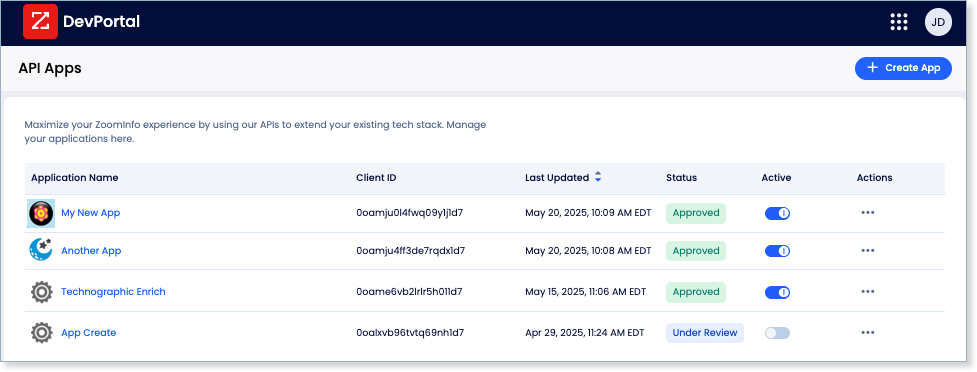
ZoomInfo uses OAuth 2.0 with PKCE via Okta, supporting three flows: Authorization Code with PKCE (web applications), Client Credentials (server-to-server), and Refresh Token.
Access tokens are 24-hour Bearer tokens with rotating refresh tokens. You register applications through the ZoomInfo Developer Portal.
This is a different authentication model from Apollo's. OAuth 2.0 with PKCE supports delegated access, credential rotation, and scoped permissions out of the box. For multi-tenant integrations, enterprise security requirements, or builds where credential hygiene matters, ZoomInfo's auth model provides what Apollo's API key approach does not.
Rate Limits, Credits & Webhooks
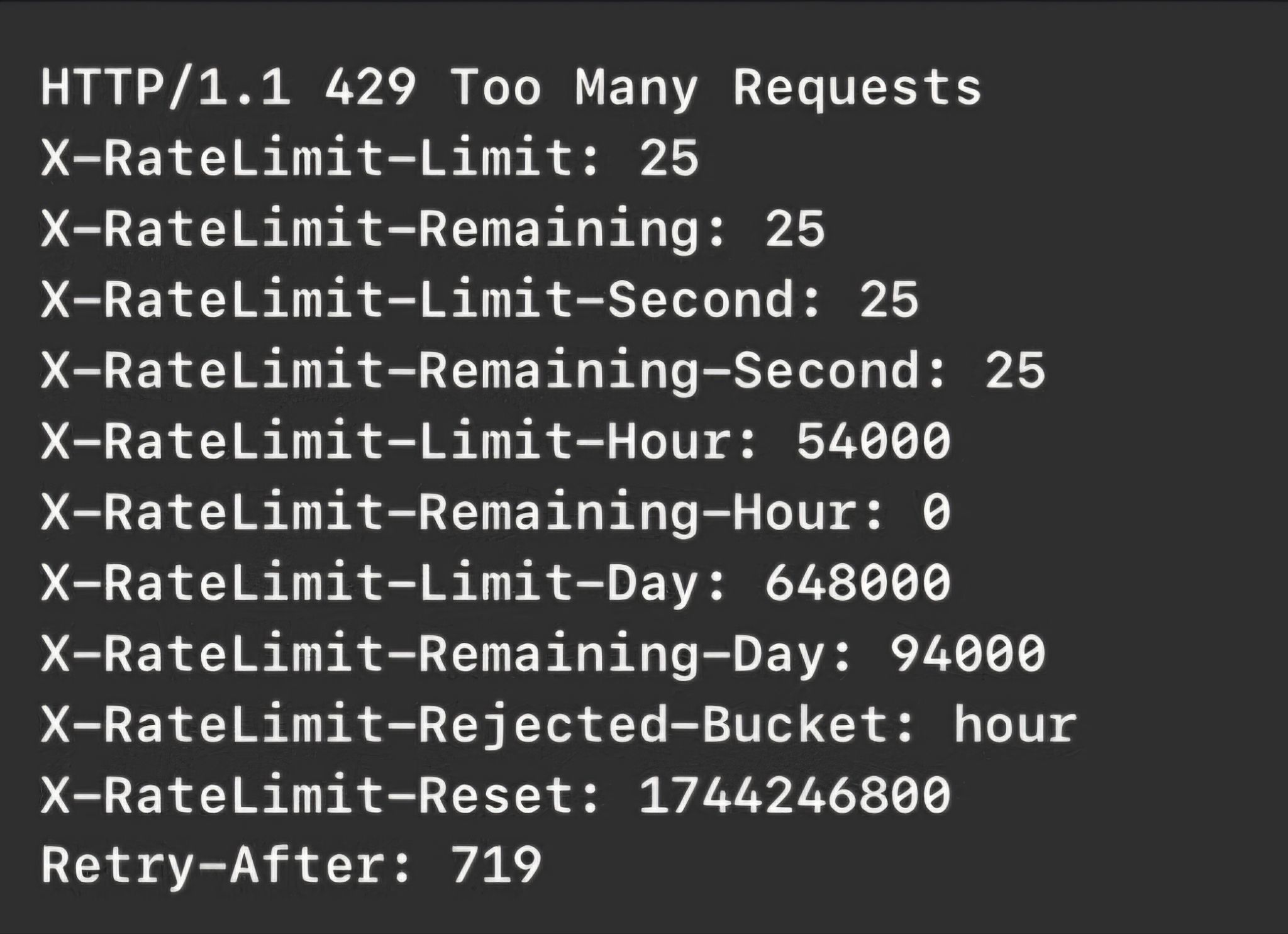
ZoomInfo publishes rate limits by tier: Builder (5 req/sec), Standard (25 req/sec), and Scaling (35 req/sec), with per-hour and per-day sliding-window limits enforced simultaneously.
Source: ZoomInfo
Every response includes quota headers with remaining capacity, and 429 responses include a Retry-After header with exact backoff timing. A developer can design throughput against documented ceilings rather than discovering limits at runtime.
Credits follow a rolling 12-month window: enriching a record for the first time consumes one credit; re-enriching the same record within the year is free. Search and lookup operations are free.
Webhooks are available via the Agents API, covering bulk enrichment completions, record changes, credit thresholds, and new GTM signals. Retry behavior and throttling are configurable per event type.
MCP & Developer Experience
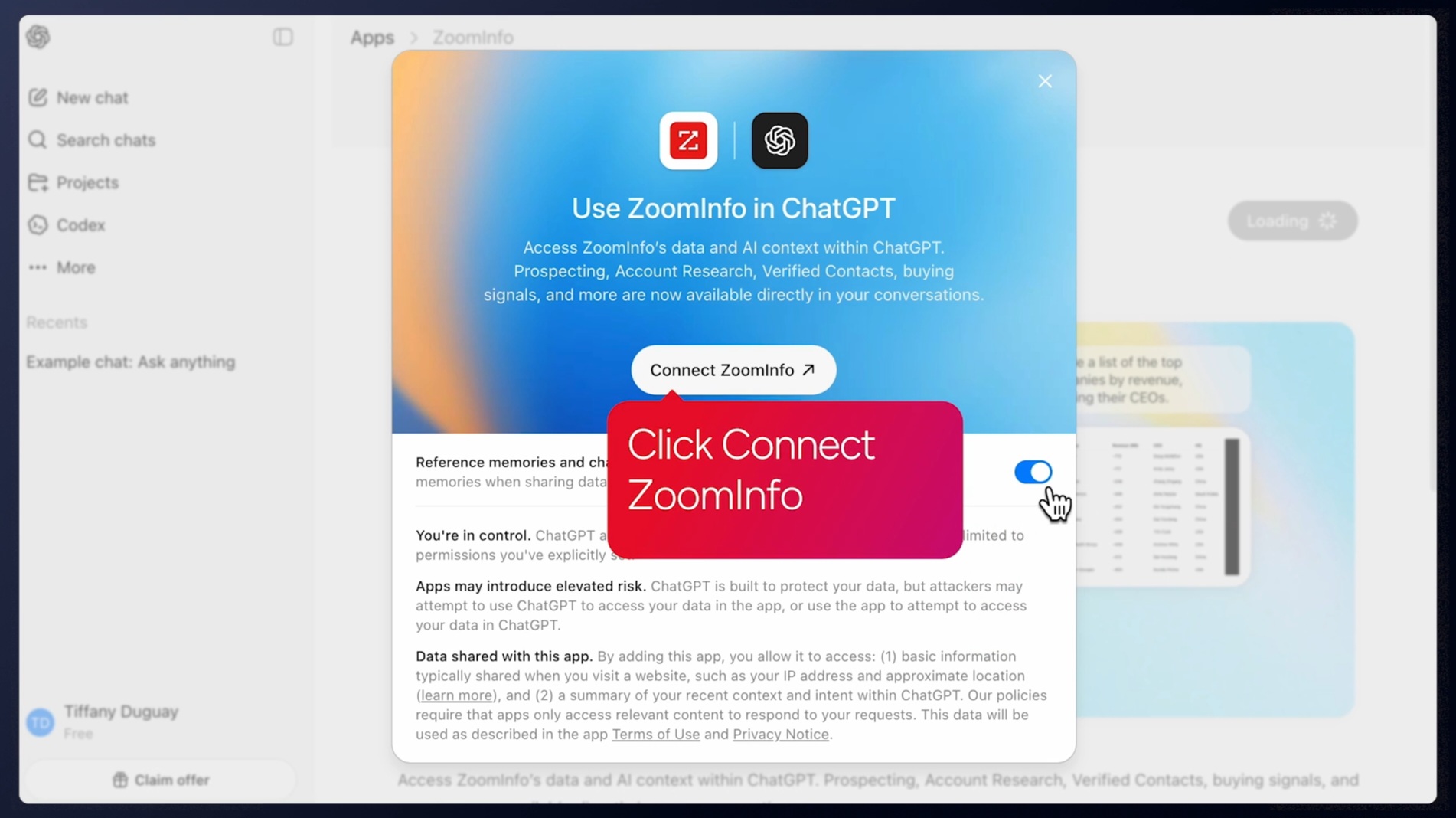
ZoomInfo's MCP server at https://mcp.zoominfo.com/mcp exposes search, enrich, and account research as native tools for MCP-compatible assistants, currently supporting Claude and ChatGPT. A separate Docs MCP server enables AI-assisted code generation against the API spec.
`
Source: ZoomInfo
ZoomInfo does not publish official SDKs either, so both platforms require direct HTTP integration. Documentation lives at docs.zoominfo.com with an interactive API reference, OAuth recipes in five languages, and an llms.txt index for AI development tools. Pricing is custom-quoted; ZoomInfo has added API access to all relevant plans.
BDO Canada reported an 87% reduction in time spent updating internal data dashboards using the ZoomInfo API, with one analyst describing the integration as plug-and-play across any process. (ZoomInfo)
Apollo API vs. ZoomInfo API
Dimension | Apollo API | ZoomInfo API |
|---|---|---|
API type | REST, JSON | REST, JSON:API format |
Authentication | API key (general use); OAuth 2.0 authorization code (partner-only) | OAuth 2.0 with PKCE (three flows: Auth Code, Client Credentials, Refresh Token) |
Contact database | 270M+ contacts, 70M companies | 500M contacts, 100M companies, 135M+ verified phone numbers, 200M+ verified business emails |
Core scope | Enrichment, search, CRM, sequences, deals, tasks, conversations, analytics | Search, enrichment, AI intelligence, intent, org charts, technographics, audience management |
AI endpoints | Not available at the API layer | Account Summary, Find Similar Companies, Contact Recommendations |
Webhooks | Polling-based (Poll Webhook Result) | Agent Teams-based push webhooks (enrichment jobs, signal alerts, credit thresholds) |
SDKs | None (OpenAPI spec for generation) | None (recipes in Shell, Node, Ruby, PHP, Python) |
Rate limits | Vary by plan; exact figures not published | 5-35 req/sec by tier, with per-hour and per-day sliding windows, all published |
MCP server | Available at mcp.apollo.io | Available at mcp.zoominfo.com (Claude, ChatGPT) |
Compliance API | Not available | Data privacy and opt-out management endpoints |
Credit model | 1 credit/email, 8 credits/phone; credits do not roll over | 1 credit per new record enriched; re-enrichment within 12 months is free |
Pricing model | Transparent: $0 to $119/seat/month with published credit allowances | Custom-quoted, consumption-based |
Best for | Developers building enrichment and sales engagement pipelines who want free-tier access and transparent pricing | Developers building intelligence-first pipelines who need deeper data, AI endpoints, enterprise auth, and published rate limits |
Final Verdict
Apollo's API gives developers programmatic access to a 270M+ contact database, sales engagement features, and CRM management, all available from the free tier with transparent pricing.
The OpenAPI spec, MCP server, and CLI round out a developer toolkit that is more accessible than most competitors. Its limits are real but are limits of depth and developer infrastructure (no published rate limits, no push webhooks, no SDKs, partner-only OAuth), not of the underlying data.
Choose the Apollo API if you are building enrichment and sales engagement workflows where transparent pricing, free-tier prototyping, and a wide endpoint surface matter more than enterprise auth or AI intelligence endpoints. The $0 entry point and the search-then-enrich pattern (search is free, enrich consumes credits) make it a cost-effective starting point for contact and company data pipelines.
Choose the ZoomInfo API if your build needs the intelligence layer upstream of engagement: more detailed data (500M contacts, org charts, technographics, 135M+ verified phone numbers), AI-powered account research and buying-committee recommendations, published rate limits you can design against, OAuth 2.0 with PKCE for enterprise integrations, and push-based webhooks for event-driven workflows.
Explore the ZoomInfo Enterprise API or start with the developer docs to see the endpoint surface directly.
A developer who needs neither API should consider that Apollo's strength is breadth across the sales workflow (data plus engagement), while ZoomInfo's strength is depth across the data and intelligence layer. If your pipeline requires both engagement automation and B2B intelligence, the two APIs are complementary layers rather than interchangeable surfaces.
FAQ
Is the Apollo API free?
API access is available on all Apollo plans, including the free Starter plan. The free tier provides 900 credits per year (granted monthly at 75 credits/month). Enrichment endpoints consume credits when they return qualifying data: 1 credit per email reveal, 8 credits per phone number, and 1 to 8 credits per enrichment record depending on fields.
Endpoints that create, update, or manage records (contacts, accounts, deals, sequences) are free on all plans. Paid plans start at $49/seat/month (annual) with 30,000 credits per year.
Does Apollo have a GraphQL API?
No. Apollo exposes a REST API (v1) over HTTPS with JSON request and response bodies. There is no GraphQL endpoint. If you need GraphQL, you would need to build a wrapper layer on top of the REST API or use the downloadable OpenAPI specification to generate a compatible client.
What is the Apollo API rate limit?
Apollo's rate limits vary by endpoint and plan, but the exact figures (requests per second, per minute, per hour) are not published in the developer documentation.
The API returns a 429 Too Many Requests response when you exceed a limit. You can view current limits in the Apollo dashboard under Settings > Integrations > API Usage, or query them programmatically via the View API Usage Stats and Rate Limits endpoint. Apollo recommends reducing request volume, waiting for the limit window to reset, or upgrading to a higher plan.
Are there official Apollo SDKs?
No. Apollo does not publish official SDKs in any language. The developer documentation provides an OpenAPI specification you can download to auto-generate a client SDK or import into tools like Postman and Insomnia. Apollo offers an Apollo CLI for command-line workflows and an Apollo MCP server for AI-agent integrations, but neither is a traditional language SDK.
Does the Apollo API support webhooks?
Not in the traditional sense. Apollo's API includes a Poll Webhook Result endpoint (GET), a polling mechanism for retrieving results of asynchronous operations.
There is no push-based webhook system where Apollo POSTs events to a developer-registered URL when contacts reply, sequences complete, or deal stages change. Developers building event-driven integrations need to poll relevant endpoints on a schedule.
What does ZoomInfo's API add to an Apollo build?
ZoomInfo's API adds the data depth and intelligence layer that Apollo's API does not cover. Where Apollo provides enrichment from a 270M+ contact database, ZoomInfo draws from 500M contacts, 100M companies, and 135M+ verified phone numbers, with org charts, corporate hierarchies, and technographics in the enrichment payload.
ZoomInfo's AI Intelligence API adds AI-powered account research, lookalike company expansion, and buying-committee recommendations (endpoints Apollo does not expose).
ZoomInfo also provides OAuth 2.0 with PKCE for enterprise integrations, published rate limits (5 to 35 req/sec by tier), push-based webhooks via the Agents API, and a Compliance API for data privacy management. The two APIs use different authentication models and pricing structures, so plan the integration layer accordingly.
