
Ashby is one of the fastest-growing recruiting platforms, serving 4,000+ customers including Snowflake, Ramp, Notion, Shopify, and Zapier. It combines ATS, scheduling, CRM, sourcing, and analytics into a single data layer, giving talent teams one system of record for the full hiring lifecycle.
But a recruiting platform only captures what happens inside it.
Ashby tracks applications, interview feedback, pipeline stages, and offer approvals. On its own, it cannot synchronize headcount plans from your HRIS, surface pipeline updates in the channels where your team coordinates, transcribe and score interview conversations against your competency rubric, or extend hiring events into the IT provisioning and payroll systems that need to act the moment a candidate is marked hired.
The right integrations close those gaps. They connect your ATS to the tools that own adjacent data, automate the handoffs that slow time-to-hire, and push recruiting outcomes into downstream operations without manual work.
This guide covers the strongest integration for each of the jobs Ashby users most commonly need done:
Synchronize headcount plans and new hire records with your HRIS
Surface pipeline activity and enable in-context recruiting actions in your team workspace
Source passive candidates and keep outreach pipelines synchronized with your talent network
Capture, transcribe, and score interviews against your competency rubric
Dispatch consistent technical skills assessments and receive scored results in the candidate record
Run post-offer background screening with compliance documentation in one place
Automate recruiting workflow handoffs across your broader HR and operations stack
Each section walks through how the integration connects with Ashby, what data flows between the platforms, pricing, and who benefits most.
Best Ashby Integrations at a Glance | |
|---|---|
Best Ashby Integration for Enterprise HRIS Synchronization Connects Ashby to your HRIS through a native bidirectional API that syncs job requisitions, headcount openings, compensation data, and new hire records every 20 minutes, eliminating the manual handoffs between recruiting and HR that delay onboarding. | |
Best Ashby Integration for Real-Time Pipeline Collaboration and In-Context Recruiting Actions Delivers pipeline notifications, offer approvals, and interview coordination into Slack channels, with an AI assistant that lets recruiters search candidates, advance applicants, and draft outreach without leaving the conversation. | |
Best Ashby Integration for Passive Candidate Sourcing and Pipeline Coordination Connects Ashby's sourcing to LinkedIn's 1B+ member network through native outreach features and workflow automation connectors that keep sourcing and ATS pipelines aligned. | |
Best Ashby Integration for Interview Intelligence and Scorecard Automation Joins Ashby-scheduled interviews automatically, transcribes conversations, and pre-fills structured feedback forms with competency-mapped evidence anchored to candidate quotes, closing the gap between a live call and a completed scorecard. | |
Best Ashby Integration for Consistent Technical Skills Assessment Dispatches science-backed coding assessments from Ashby's interview plan stages and pushes scored results back to the candidate timeline via webhooks, giving engineering teams comparable evaluation data across every candidate in the pipeline. | |
Best Ashby Integration for Post-Offer Background Screening. Initiates background checks from the Ashby candidate profile, manages FCRA-compliant consent collection and adverse action workflows, and syncs screening status and completed reports back to the hiring record in real time. | |
Best Ashby Integration for No-Code Recruiting Workflow Automation Routes Ashby hiring events to 8,000+ connected applications, letting recruiting and HR ops teams automate post-hire handoffs to IT provisioning, payroll, onboarding platforms, and internal communications without engineering support. |
What Is Ashby?
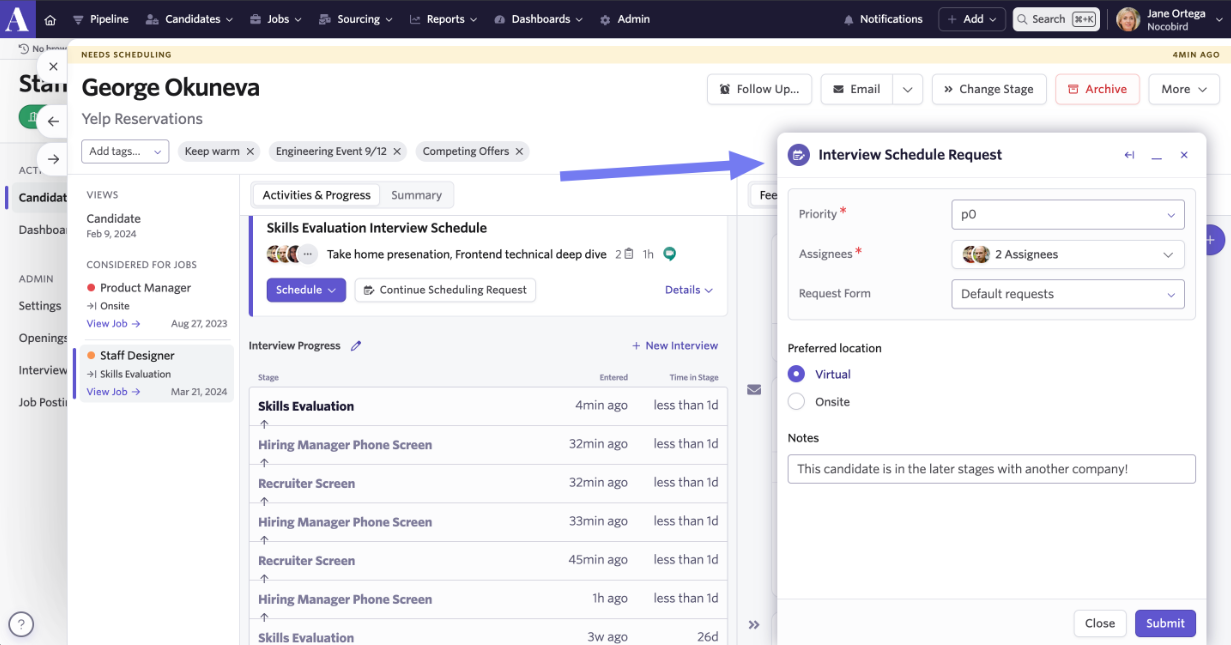
Ashby is a recruiting platform that combines ATS, scheduling, CRM, sourcing, and analytics into a single system for talent teams from startups through enterprises.
Source: Ashby
The company positions itself as "What an ATS should be", built for recruiting teams who have outgrown lightweight tools and need structured hiring, automation, and analytics drawing from the same data layer. Ashby serves 4,000+ customers including Shopify, Snowflake, Ramp, Notion, Vanta, and Zapier, and has raised approximately $114.5M across five rounds with 135% year-over-year revenue growth.
Ashby's integration ecosystem is a strength.
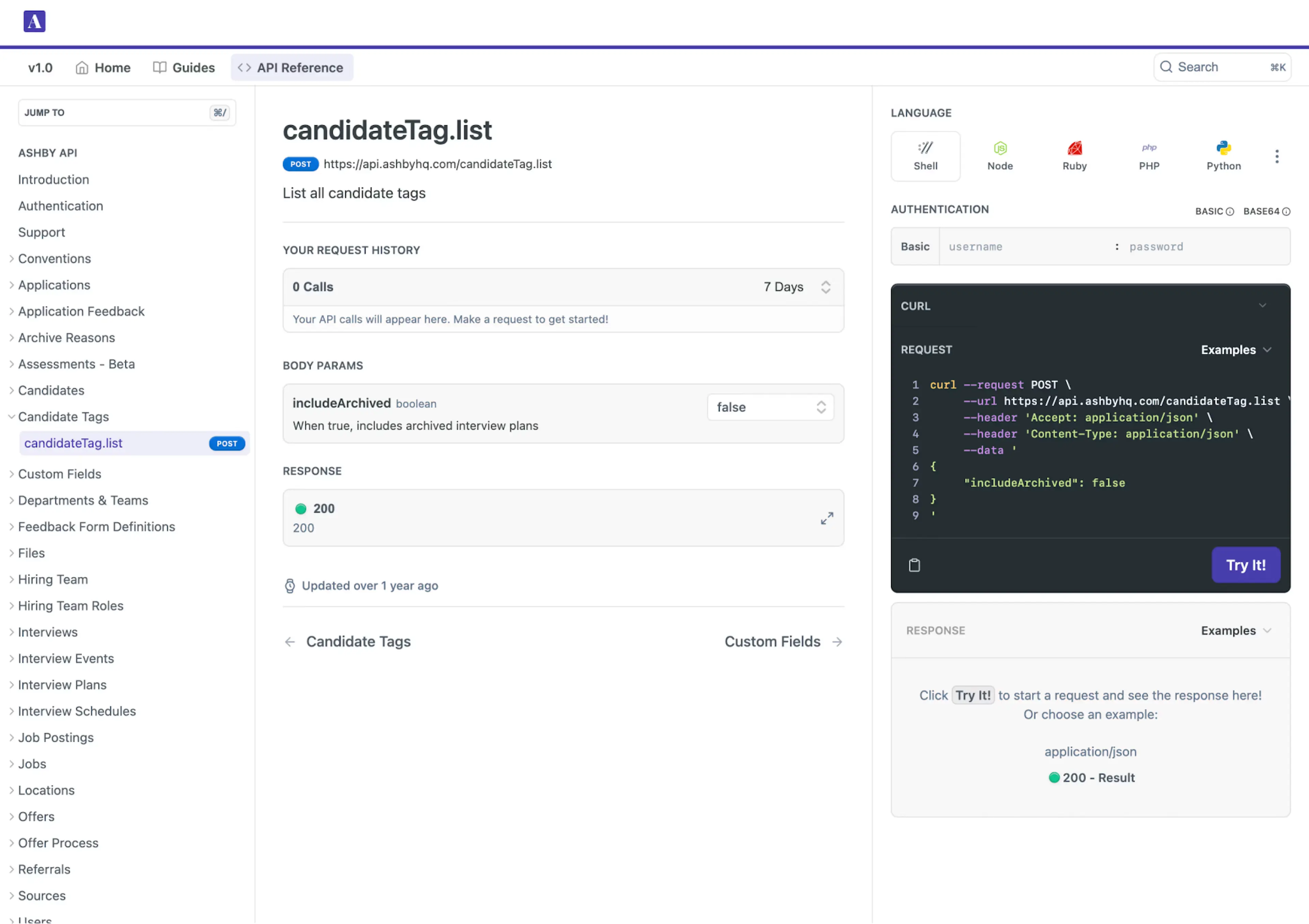
The Ashby integrations directory lists 250+ out-of-the-box integrations spanning HRIS platforms, assessment tools, communication apps, job boards, sourcing extensions, e-signature providers, video interviewing platforms, and workflow automation connectors. On the technical side, Ashby offers a REST-adjacent RPC-style API with endpoints covering candidates, jobs, applications, interviews, offers, and organization data, plus a webhook system for event-driven automation.
Source: Ashby
Ashby also publishes a machine-readable llms.txt index with all endpoints in OpenAPI format, and has announced an upcoming MCP server (Model Context Protocol) to let external AI tools and agents interact with Ashby data.
Integration categories include:
HRIS and platform: Workday, BambooHR, Rippling, and other core HR systems for headcount and new hire sync
Team communication: Slack, Microsoft Teams for pipeline notifications and in-context actions
Sourcing and talent networks: LinkedIn outreach features, Chrome extension for LinkedIn and GitHub
Interview intelligence: Metaview, native AI Notetaker for transcription and scorecard automation
Skills assessment: CodeSignal, HackerRank, and other technical evaluation platforms
Background screening: Checkr, Sterling for post-offer compliance workflows
Workflow automation: Zapier, Make for cross-system orchestration without code
Here are the seven integrations we selected as the best options across the categories that matter most to recruiting operations teams.
1. Workday: Best Ashby Integration for Enterprise HRIS Synchronization
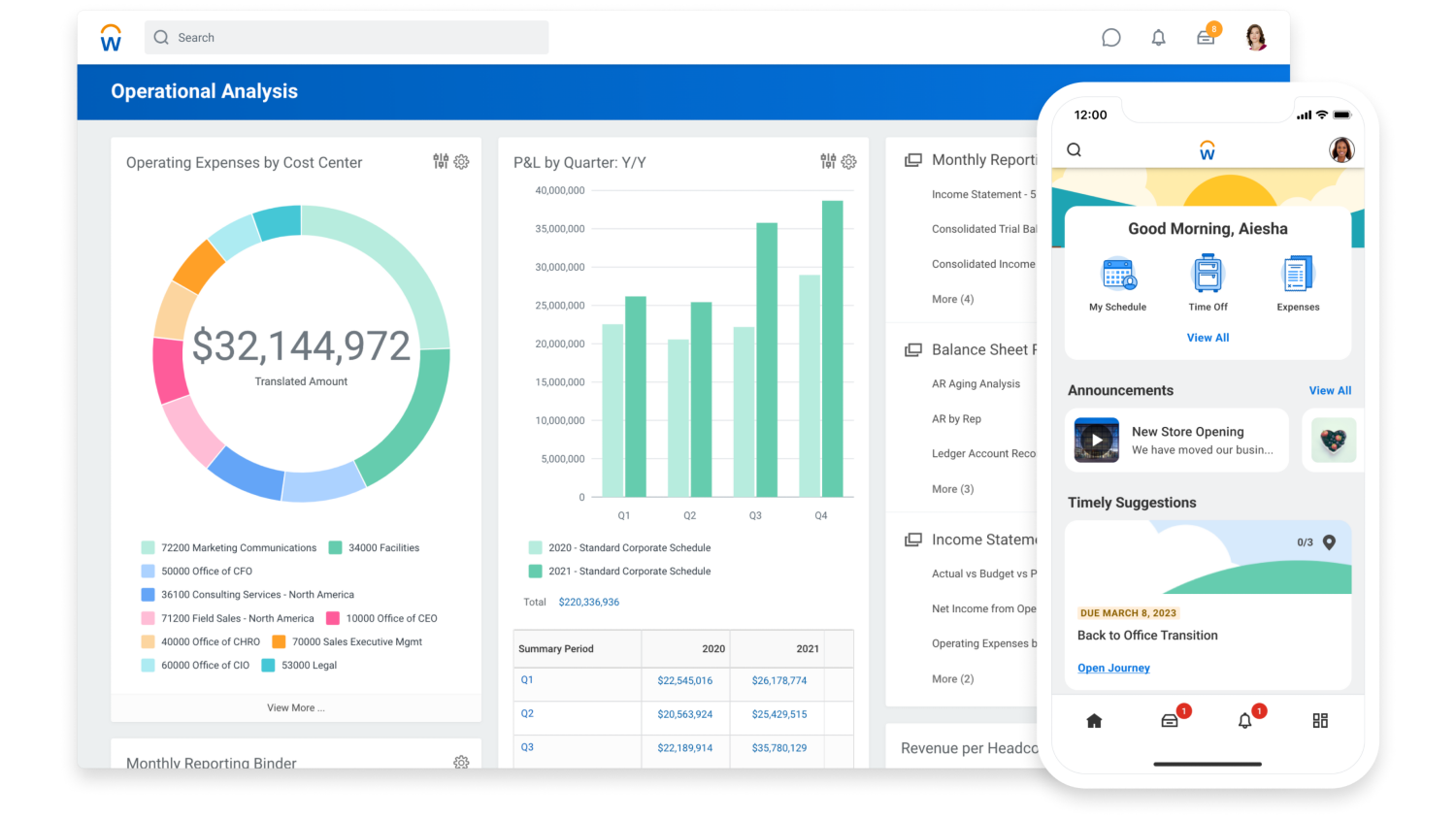
Workday is an enterprise cloud platform for HR, Finance, and IT that integrates with Ashby through a native bidirectional API integration to keep headcount plans, job requisitions, new hire records, and compensation data synchronized between your HRIS and ATS. The sync runs every 20 minutes without manual exports or consultant overhead.
Source: Workday
Key integration capabilities include:
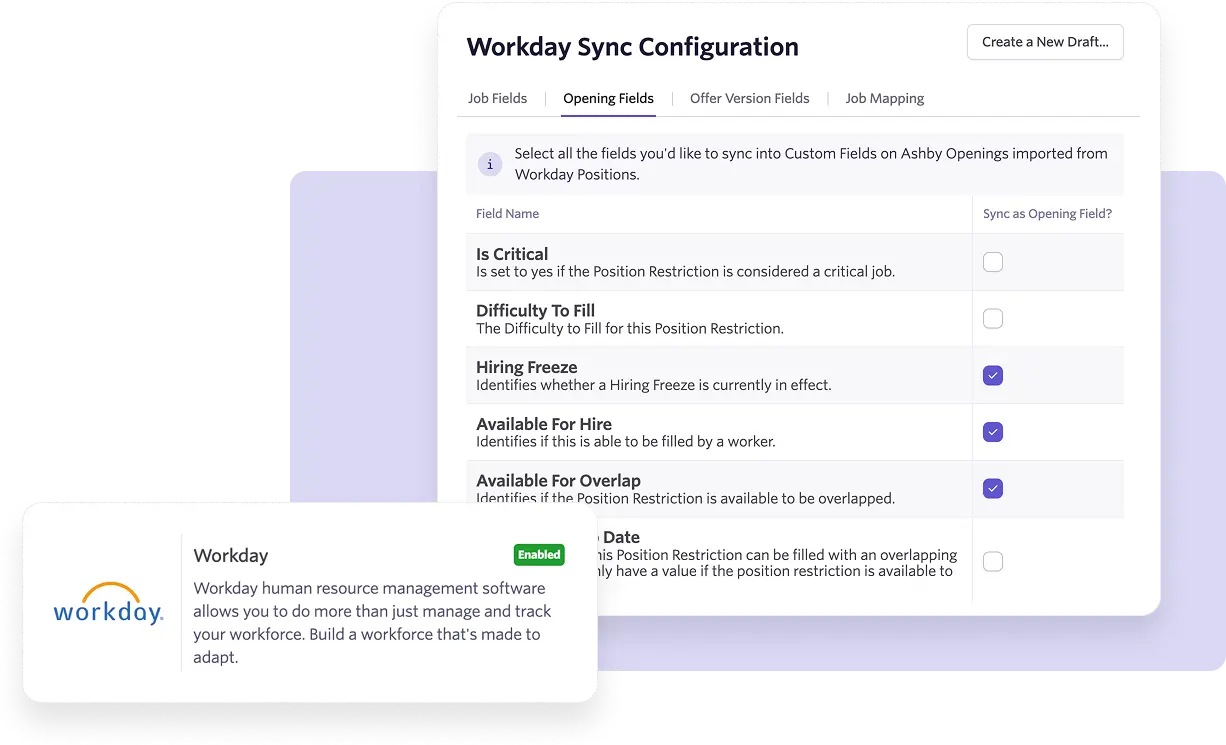
Workday job requisitions flow into Ashby as active jobs while Workday positions flow in as openings, maintaining a single source of truth for headcount tracking
When a candidate is marked hired in Ashby, their record pushes to Workday automatically, eliminating manual handoffs that delay onboarding
Offer details created in Ashby pre-fill from Workday compensation data and sync bidirectionally so payroll and HR see the same figures
Field-level mapping lets teams configure which data points sync and in which direction, preventing unintended overwrites
Live sync error monitoring surfaces conflicts in real time inside Ashby's admin panel
How Workday Integrates with Ashby
Source: Ashby
Ashby and Workday connect through a native bidirectional API integration that Ashby maintains as a featured HRIS partnership. Unlike iPaaS-dependent connections that route data through a middleware layer, this is a direct API-to-API link between the two platforms, exclusive to Ashby's Enterprise plan.
The sync cycle runs every 20 minutes without manual triggers. Configuration requires admin permissions on both sides: Workday Integration System User credentials with scoped security domain permissions, and Ashby admin access to configure field mappings.
1. Bidirectional Job Requisition and Opening Sync.
A hiring manager's approved Workday requisition becomes an Ashby job automatically. Workday positions flow into Ashby as openings, Ashby's primary headcount tracking object, which carries an approval workflow and enables time-to-fill reporting at the individual headcount level. When requisition status changes in Workday (approved, on-hold, cancelled), those states propagate into Ashby, preventing recruiters from sourcing for roles put on hold in the HRIS.
2. Automatic New Hire Record Push to Workday.
When a recruiter marks a candidate hired in Ashby, the platform pushes the new hire record into Workday automatically. Onboarding setup in Workday (payroll configuration, benefits enrollment, IT provisioning) cannot begin until the new hire record exists in the HRIS.
The integration removes the manual handoff that often adds hours or days between offer acceptance and Day 1 readiness. For organizations running Workday Payroll, payroll configuration starts when the hire is confirmed, not when an HR coordinator finishes manual data entry.
3. Compensation and Offer Data Synchronization.
When a recruiter initiates an offer in Ashby for a role that originated as a Workday requisition, approved compensation data (salary bands, bonus structures, equity ranges) pre-fills the relevant Ashby offer fields. After the offer is approved in Ashby, those figures sync back to Workday so payroll and HR see the agreed compensation without a separate data entry step. The compensation in the recruiting workflow matches the HRIS record with a documented sync trail.
4. Field Mapping and Data Ownership.
Field-level controls let teams configure which data points sync and in which direction. Workday remains the system of record for HRIS-native fields (employment type, cost center, supervisory organization), while Ashby owns recruiting-specific fields (candidate source, interview feedback, pipeline stage history). Different business units with different Workday supervisory organizations can map to different Ashby departments without middleware.
5. Live Sync Error Monitoring.
Sync errors between two enterprise systems are inevitable. The integration surfaces them in real time inside Ashby's admin panel, giving recruiting ops visibility into which records failed to sync, what the error was, and what corrective action is needed. Catching errors at the source, rather than discovering them when a new hire reports for work without system access, is where this monitoring layer earns its keep.
Workday Pricing
Workday does not publish pricing on its website. All pricing for Workday HCM is negotiated through Workday's enterprise sales team. Workday targets mid-size organizations (500-3,500 employees) through its Workday GO pre-configured package and scales to the largest global enterprises. The Gartner Magic Quadrant for Cloud HCM Suites positions Workday for 1,000+ employee enterprises.
On the Ashby side, the Workday integration requires Ashby's Enterprise plan (1,000+ employees, pricing on request). Teams on Foundations or Plus cannot access this integration without upgrading.
Who Should Use the Workday Integration?
Enterprise recruiting operations teams (typically 1,000+ employees) already running Workday as their HRIS that need to eliminate duplicated job setup and manual new hire notification steps between the two systems
Organizations where payroll and benefits enrollment depend on timely HRIS record creation and the manual handoff between recruiting and HR is adding days between offer acceptance and Day 1 readiness
Teams using Ashby's openings management for headcount tracking that need those openings synchronized with approved Workday requisitions automatically, without manual reconciliation after each planning cycle
2. Slack: Best Ashby Integration for Real-Time Pipeline Collaboration and In-Context Recruiting Actions
Slack is a team communication platform that integrates with Ashby to deliver recruiting pipeline activity into the channels where hiring teams already spend their day. Instead of logging into the ATS to take routine pipeline actions, approve offers, or check candidate status, the integration brings those capabilities into Slack.
Source: Slack
Key integration capabilities include:
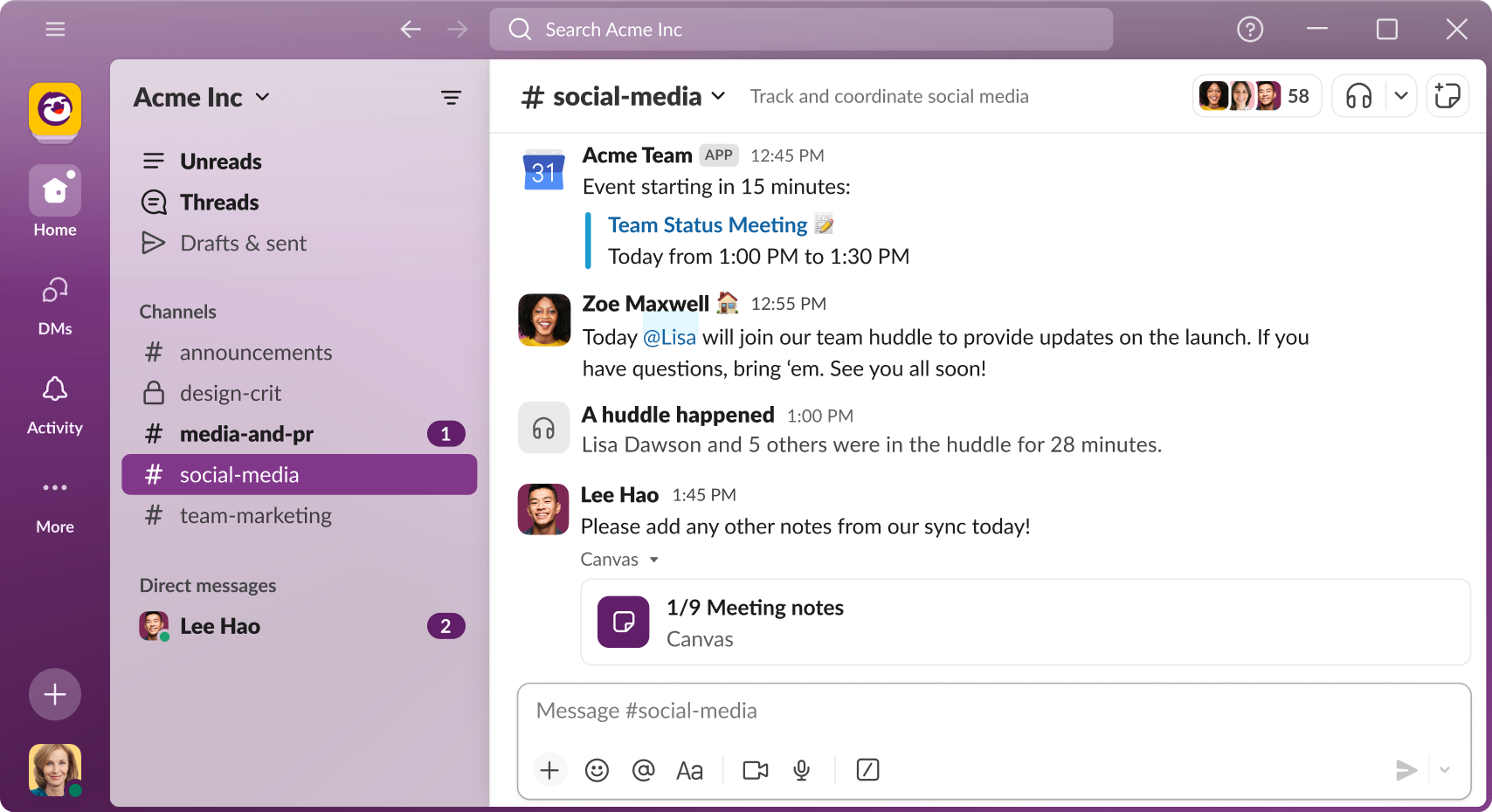
Real-time notifications when candidates move stages, receive offers, or trigger hiring milestones, delivered to designated channels or direct messages
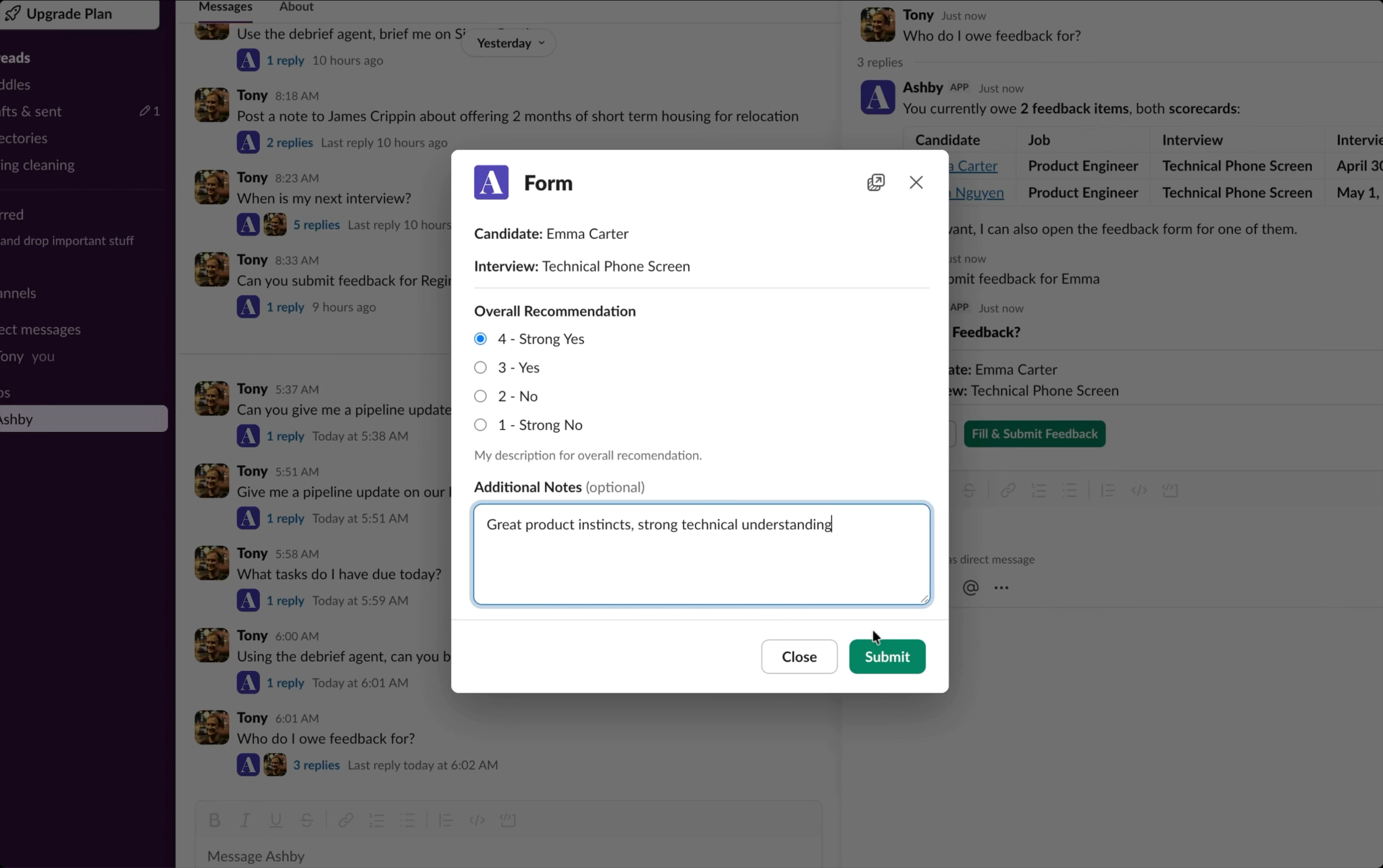
In-Slack offer approval and interview feedback submission without opening Ashby
Automatic creation of a private Slack channel for each interview loop, consolidating interviewer coordination in one searchable thread
The Ashby AI assistant running inside Slack, letting recruiters search candidates, advance applicants, and draft outreach using plain-language commands
How Slack Integrates with Ashby
Source: Ashby
The Ashby-Slack integration is a first-party connection available through the Slack Marketplace, included across all Ashby plan tiers (Foundations, Plus, and Enterprise). Setup runs through the Ashby admin panel via Slack's standard OAuth flow. No API keys or custom webhook configuration are required for the core integration.
The integration runs bidirectionally: Ashby pushes pipeline event data into Slack as notifications and channel actions, and Slack users initiate actions back into Ashby through the Ashby Assistant. All Assistant actions require explicit user confirmation before execution, keeping a human in the loop consistent with Ashby's agentic AI design philosophy.
1. Real-Time Stage-Change and Candidate Notifications.
When a candidate advances through an interview stage, receives an offer, or triggers a hiring milestone inside Ashby, the integration pushes a notification to a designated Slack channel. The full hiring team (engineers, hiring managers, executives) stays current on candidate status without needing Ashby access.
For recruiting operations teams, Ashby's analytics alerts extend this further: Slack notifications fire when SLA conditions are breached (interviewer feedback pending beyond a configured threshold), and scheduled dashboard delivery posts recruiting metrics summaries to channels automatically.
2. In-Slack Offer Approvals and Interview Feedback.
Hiring managers receive offer approval requests and feedback prompts in Slack and can respond without navigating to Ashby. Combined with Ashby's feedback blinding (which prevents interviewers from seeing peer feedback until they submit their own), the Slack prompt removes login friction while preserving structured evaluation integrity.
3. Automatic Private Interview Channel Creation.
When an interview loop is scheduled in Ashby, the integration creates a private Slack channel for that interview and adds all assigned interviewers. This consolidates scheduling confirmations, interviewer reminders, and debrief discussion in one thread tied to the specific candidate and role.
4. Ashby Assistant in Slack.
The Ashby AI assistant runs inside Slack, giving recruiters a conversational interface to their pipeline. Recruiters can search for candidates, advance or archive applicants, draft and send candidate emails, and update pipeline records using plain-language commands. Because the assistant pulls from Ashby's data layer spanning resumes, emails, notes, feedback, and interview history, its answers reflect the full candidate record.
Slack Pricing
Slack uses per-seat pricing:
Pro: $7.25/user/month billed annually (unlimited message history, unlimited app integrations, 24/7 support)
Business+: $15.00/user/month billed annually (SAML SSO, SCIM, full AI suite including Slackbot and channel summaries)
Enterprise+: Custom pricing (multi-workspace management, DLP, HIPAA compliance)
The Ashby integration works on all paid tiers. Slack's free plan limits app integrations to 10 and message history to 90 days, which constrains teams running several Slack apps.
Who Should Use the Slack Integration?
Hiring managers and interviewers who work primarily in Slack and where requiring a separate ATS login to approve offers or submit feedback introduces delays that extend time-to-offer
Recruiting coordinators managing high-volume interview loops across multiple roles who need automatically created, interviewer-specific channels for scheduling and debrief coordination
Teams already using Ashby Analytics alerts that want SLA breach notifications and scheduled dashboard deliveries routed to the Slack channels where stakeholders can act on them
3. LinkedIn Recruiter: Best Ashby Integration for Passive Candidate Sourcing and Pipeline Coordination
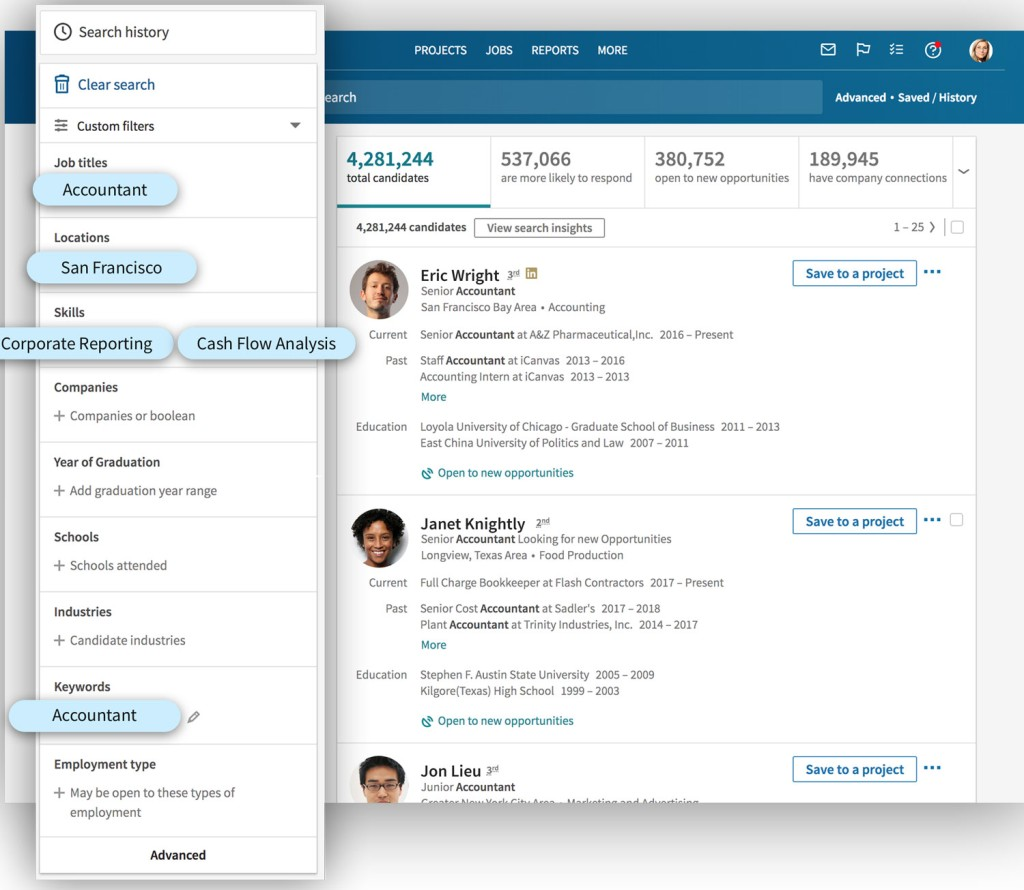
LinkedIn Recruiter is a talent acquisition platform providing access to over 1 billion members that works alongside Ashby to connect the world's largest professional network with your structured hiring pipeline. The two platforms do not share a direct native API integration, but Ashby provides built-in LinkedIn outreach features and teams can connect them through workflow automation tools like Zapier, Workato, or Relay.app.
Source: LinkedIn Recruiter
Key integration capabilities include:
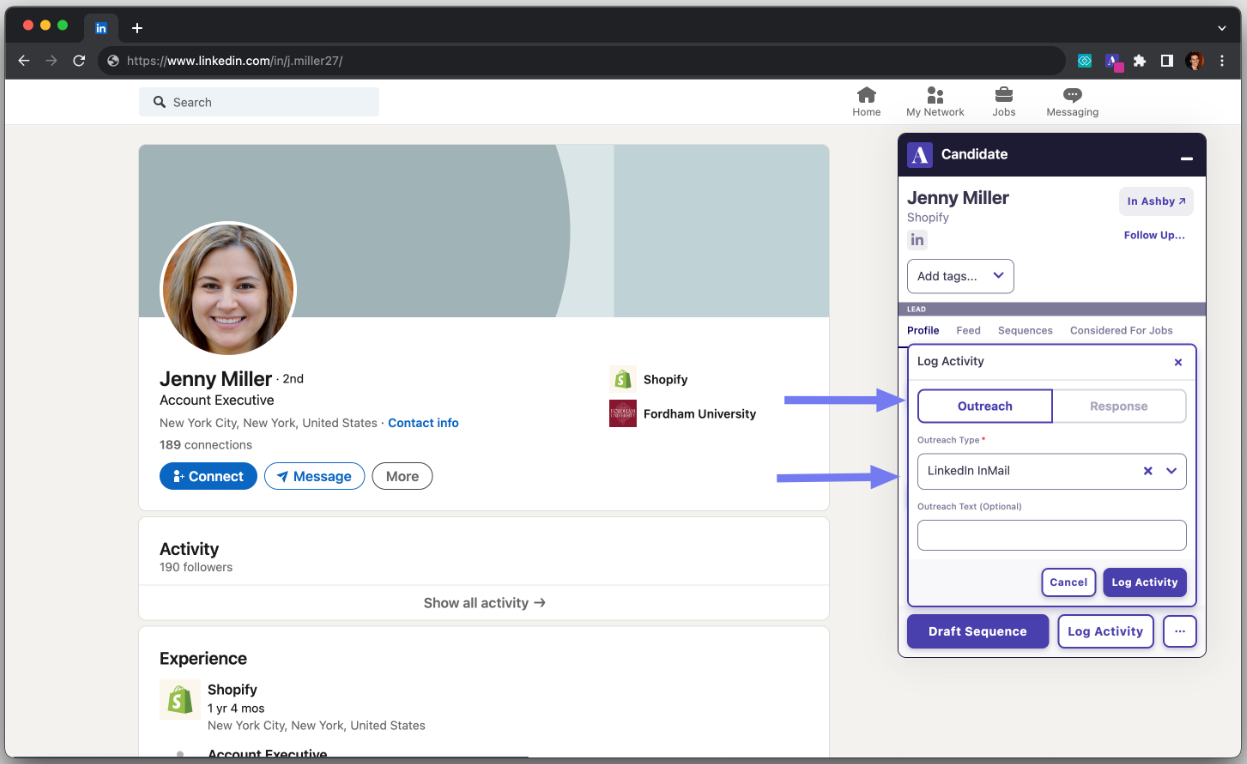
Ashby's native LinkedIn outreach actions that log InMails and connection requests as candidate touchpoints within the ATS
Ashby's Chrome Extension for sourcing from LinkedIn profiles with one-click candidate creation and duplicate detection
Multi-channel outreach sequences in Ashby that interleave email, LinkedIn InMail, and LinkedIn connection request stages in a single cadence
Workflow automation connectors (via Zapier or similar) that can synchronize candidate data and status between the two platforms
How LinkedIn Recruiter Integrates with Ashby
Source: Ashby
Ashby connects to LinkedIn through two surfaces: native sourcing features built into Ashby, and third-party workflow automation platforms that bridge the two systems for teams needing deeper synchronization.
The native surface is Ashby's Chrome Extension and outreach sequence system. The extension lets recruiters source from LinkedIn, LinkedIn Recruiter, LinkedIn Recruiter Lite, Sales Navigator, and GitHub. While viewing a candidate's LinkedIn profile, the extension checks whether that person already exists in Ashby, preventing duplicate records. Candidates are added via pasted LinkedIn URL, PDF download, or manual entry, with bulk CSV import from LinkedIn Recruiter supporting up to 25 candidates per export.
1. Native LinkedIn Outreach Actions in Ashby Sequences.
Ashby's multi-channel sequences support LinkedIn InMail prompts and LinkedIn connection request stages alongside email, all managed from a single template editor. When a LinkedIn outreach action fires within a sequence, it logs that touchpoint on the candidate's Ashby record as a tracked activity. Recruiters manage all sourcing outreach (email and LinkedIn) from one pipeline view rather than toggling between platforms.
2. Chrome Extension Sourcing with Duplicate Detection.
The Ashby Chrome Extension adds candidates from LinkedIn profiles into Ashby with a single click. Before creating a new record, the extension checks whether the candidate already exists in the system, matching on LinkedIn profile identity. A built-in data enrichment feature finds personal email addresses for sourced candidates within the extension, and recruiters can enroll candidates into outreach sequences from the extension interface.
3. AI Personalization for LinkedIn Outreach.
Ashby's AI personalization tokens generate context-aware copy using the candidate's resume and linked job description. These tokens work inside LinkedIn outreach stages within sequences, producing personalized InMail copy at scale. Ashby reports approximately 46% higher response rates from sequences using these AI tokens compared to standard templates.
4. Workflow Automation for Status Synchronization.
For teams needing bidirectional status updates between LinkedIn Recruiter and Ashby, Zapier's Ashby-LinkedIn connector and similar automation platforms enable custom sync workflows. These connections let stage changes in Ashby trigger actions on the LinkedIn side, and LinkedIn events update Ashby records, keeping both platforms current without manual reconciliation.
LinkedIn Recruiter Pricing
LinkedIn Recruiter uses quote-based, per-seat subscription pricing for its enterprise tiers:
Recruiter Lite: $170/month per seat (monthly) or approximately $140/month (annual); 30 InMail credits per seat per month; access limited to 1st, 2nd, and 3rd-degree connections
Recruiter Corporate: Quote-based pricing; 150 InMail credits per seat per month; full LinkedIn network access (1B+ members); annual contract
Hiring Assistant: Available as a separate paid add-on on Recruiter Corporate for AI-assisted candidate evaluation
On the Ashby side, the Chrome Extension and native LinkedIn outreach features are included on all plans (Foundations at $400/month for up to 100 employees, Plus and Enterprise at custom pricing).
Who Should Use the LinkedIn Recruiter Integration?
Teams sourcing passive candidates on LinkedIn regularly who want to manage the full outreach lifecycle (InMail sequences, connection requests, and email follow-ups) from within Ashby's pipeline view
Recruiters copying profile data manually between LinkedIn and their ATS who want the Chrome Extension's one-click sourcing with automatic duplicate detection
Organizations running multi-channel outreach sequences that need LinkedIn touchpoints tracked alongside email activity on the same candidate record for consistent reporting
4. Metaview: Best Ashby Integration for Interview Intelligence and Scorecard Automation
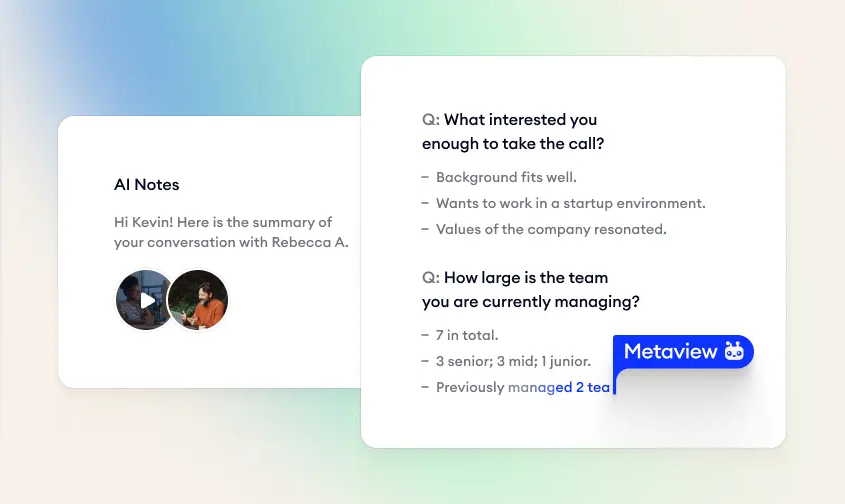
Metaview is a recruiting platform that integrates with Ashby through a native integration to capture, transcribe, and convert interview conversations into structured scorecard data automatically. The integration eliminates the manual note-taking step between a live candidate call and a completed Ashby feedback form.
Source: Metaview
Key integration capabilities include:
Automatic interview detection and bot join via Ashby's calendar and scheduling data, requiring zero per-interview configuration
AI-generated notes mapped to Ashby's competency rubric, pre-filling feedback form fields with evidence anchored to candidate quotes
Bidirectional profile linking between Metaview interviews and Ashby candidate records
Browser extension-based scorecard autofill that surfaces inside Ashby's web UI
How Metaview Integrates with Ashby
Source: Ashby
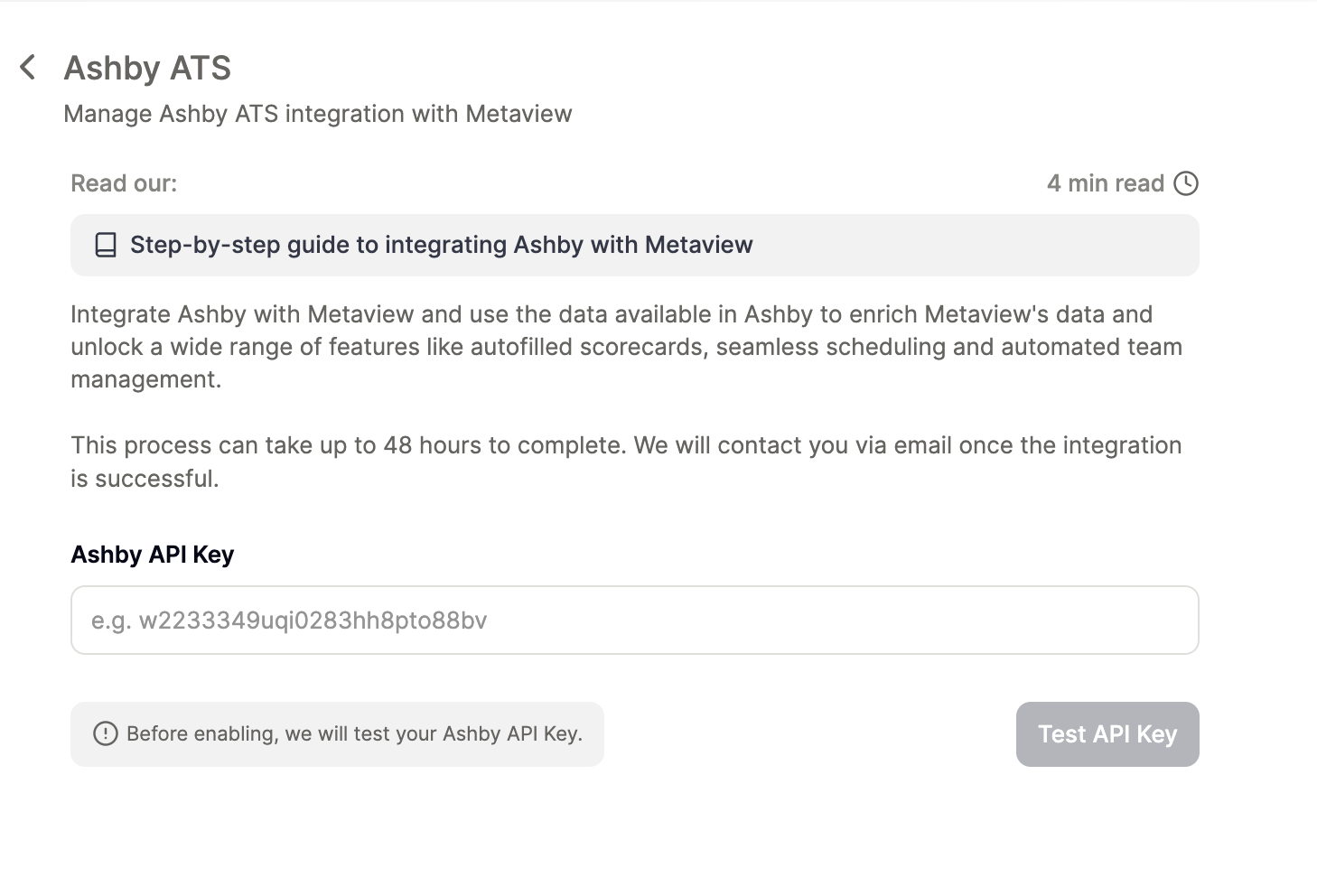
Metaview and Ashby connect through a native ATS integration listed in both Ashby's integration directory and Metaview's integrations page. The connection is a validated, maintained first-party integration, not a community-built connector.
1. Automatic Interview Join via Ashby Scheduling.
Metaview detects interviews scheduled through Ashby and joins the call automatically as a bot participant, recording and transcribing the full conversation without anyone clicking a button.
When an interview is booked via Ashby's scheduling module and a calendar invite is generated, Metaview reads that invite, confirms a supported video conference link (Google Meet, Zoom, Microsoft Teams, or Webex), and queues the bot to join at the scheduled time. Every Ashby-scheduled interview becomes a documented, searchable conversation by default.
2. AI-Generated Feedback Form Pre-Fill Mapped to Ashby's Competency Rubric.
Once a call ends, Metaview's AI reads the full transcript and generates structured notes calibrated to the evaluation rubric configured in Ashby for that interview stage. Rather than producing a generic meeting summary, the AI maps what the candidate said to each scored dimension in the feedback form, pre-populating every structured field with a suggested answer anchored to a direct quote from the transcript.
The template system includes interview-specific formats (Technical Debrief, Team Debrief, System Design Interview, Recruiter Screen) and supports custom templates with per-section AI instructions.
3. Bidirectional Profile Links and Browser Extension Scorecard Autofill.
Each interview captured in Metaview links directly to the candidate's Ashby profile, and each Ashby candidate record surfaces the associated Metaview interview history. Metaview's Chrome and Edge browser extension provides scorecard autofill within the browser while an interviewer works inside Ashby's web interface, so interviewers can complete feedback forms without switching tabs.
Metaview Pricing
Metaview prices the AI Notetaker module (the core of the Ashby integration) separately from its other agents:
AI Notetaker Free: $0/month per user (25 calls per user per month, subject to a 60-credit team cap; 14-day conversation history access)
AI Notetaker Pro: $60/month per user (unlimited calls, full conversation history, no credit caps)
AI Notetaker Enterprise: Custom pricing (custom volume and configuration, typically for 50+ interviewer seat deployments)
Cost scales with the number of interviewers who record and submit feedback, not just recruiter headcount. A 5-recruiter team running 50 interviews per week with 3 interviewers per loop would need about 15 seats.
Who Should Use the Metaview Integration?
Teams running structured, competency-based interview loops in Ashby that see inconsistent or late scorecard completion: Metaview's default-on recording and AI pre-fill raises the floor on feedback quality without requiring interviewers to change their behavior
Hiring managers who are attentive in interviews but poor at detailed note-taking afterward: the quote-anchored, rubric-mapped pre-fill converts their attention into high-quality ATS data
Organizations conducting ten or more interviews per week where tracking which calls were documented and which scorecards were submitted requires manual follow-up
5. CodeSignal: Best Ashby Integration for Consistent Technical Skills Assessment
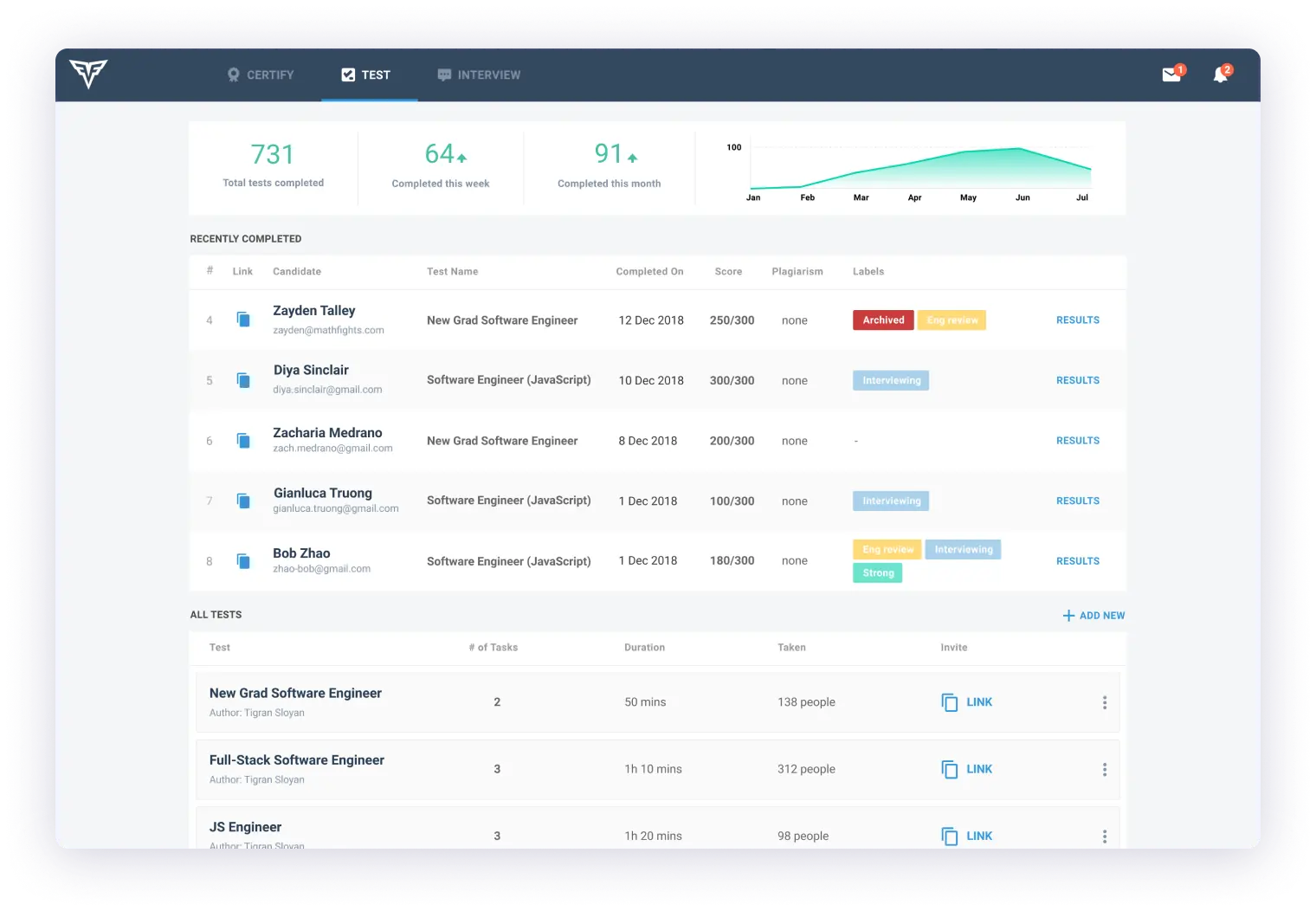
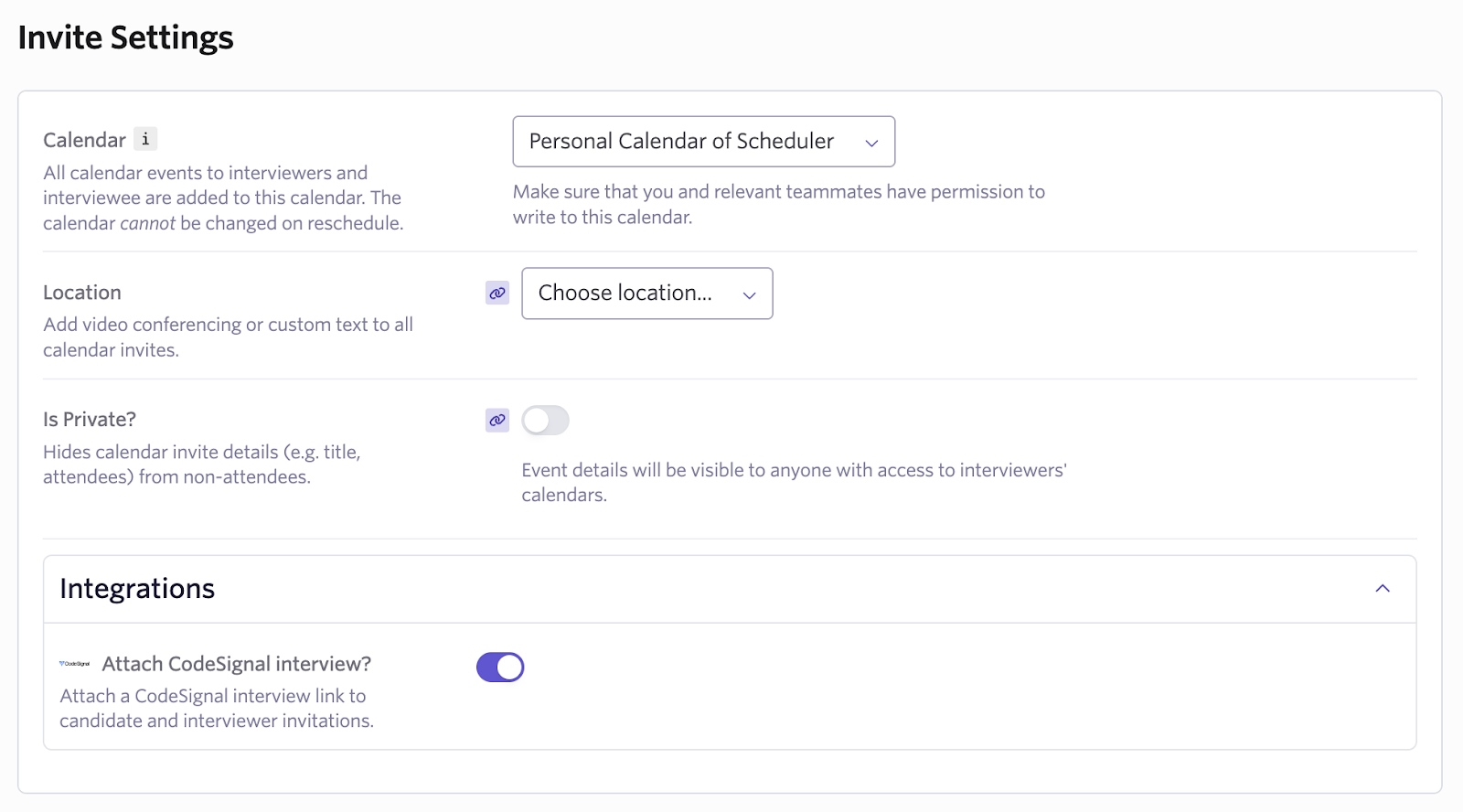
CodeSignal is a skills platform that integrates with Ashby through API keys and webhooks to let engineering hiring teams dispatch technical assessments from a candidate's Ashby record and receive scored results back on the same activity timeline.
Source: Software Advice
Key integration capabilities include:
Assessment invitations triggered from within the Ashby candidate profile, with candidate details pre-populated from the ATS record
Webhook-based result delivery that pushes CodeSignal scores into the candidate's Ashby activity timeline
A consistent, science-backed scoring framework (the Coding Score) validated by industrial-organizational psychologists through approximately 2,800 research hours per role
Anti-cheating infrastructure including a Suspicion Score, dynamic question rotation, and AI proctoring, with integrity flags appearing alongside scores in Ashby
Support for 35+ programming languages and 70+ technical role templates
How CodeSignal Integrates with Ashby
Source: CodeSignal
The integration is native and bidirectional: CodeSignal appears in Ashby's integration directory, and Ashby appears on CodeSignal's integrations page. Setup requires an API key from the CodeSignal Admin panel and webhook endpoint configuration with HMAC-SHA256 signature verification. No third-party middleware is required.
1. Assessment Dispatch from the Ashby Candidate Profile.
Recruiters trigger a CodeSignal assessment invitation from a candidate's Ashby record. Ashby's automated activities system lets teams configure assessment dispatch as a stage-triggered action on any interview plan: when a candidate enters a "Technical Screen" stage, Ashby can automatically initiate a CodeSignal invitation with candidate details pre-populated. The assessment invitation includes CodeSignal's standard AI proctoring and identity verification from the moment it leaves Ashby.
2. Webhook-Based Result Sync to the Ashby Activity Timeline.
When a candidate completes an assessment, CodeSignal's webhook system fires a result event carrying the score, competency breakdown, and integrity flags from the Suspicion Score to the candidate's Ashby activity timeline. The engineering hiring manager and recruiter both see the CodeSignal result alongside the resume, interview feedback, and scheduling history. CodeSignal's webhook retry logic uses exponential backoff with up to 25 consecutive attempts, and signature verification via HMAC-SHA256 ensures payload authenticity.
3. Consistent Scoring Across All Candidates.
Every assessment result that arrives in Ashby was generated by the same CodeSignal Skills Evaluation Framework. The Coding Score (a standardized 300-850 rating) provides a single, comparable number for every candidate, regardless of which interviewer evaluated them or when the assessment was taken. Ashby provides structural consistency in the interview process; CodeSignal provides measurement consistency in the assessment layer.
Hiring managers comparing finalists in Ashby's pipeline know both scores were produced under identical conditions. CodeSignal holds 4.5 stars on G2 from 1,405 reviews, rating 8.4/10 for integrations.
CodeSignal Pricing
CodeSignal uses a credit-based subscription model where one credit is consumed each time a candidate starts an assessment:
Build: $79/month billed annually (60 credits per year, 2,000+ questions, basic API access, AI proctoring)
Grow: $479/month billed annually (420 credits per year, ATS integrations including the native Ashby connection with webhook-based sync, overage credits at $20 each)
Pro/Enterprise: Custom pricing (advanced API and webhooks, SSO/SCIM, custom assessment authoring, dedicated CSM)
The Grow plan is the entry point for teams wanting the full bidirectional Ashby integration with webhook result sync.
Who Should Use the CodeSignal Integration?
Engineering hiring teams spending significant time on first-round technical screens that want to automate assessment dispatch from within Ashby's interview plan stages
Organizations needing comparable technical scores across all candidates rather than variable interview notes from different engineers, with side-by-side candidate comparisons available in the Ashby candidate record
Teams hiring for software engineering, data science, or ML roles where a science-backed, standardized assessment is a defensible and legally auditable screening step
6. Checkr: Best Ashby Integration for Post-Offer Background Screening
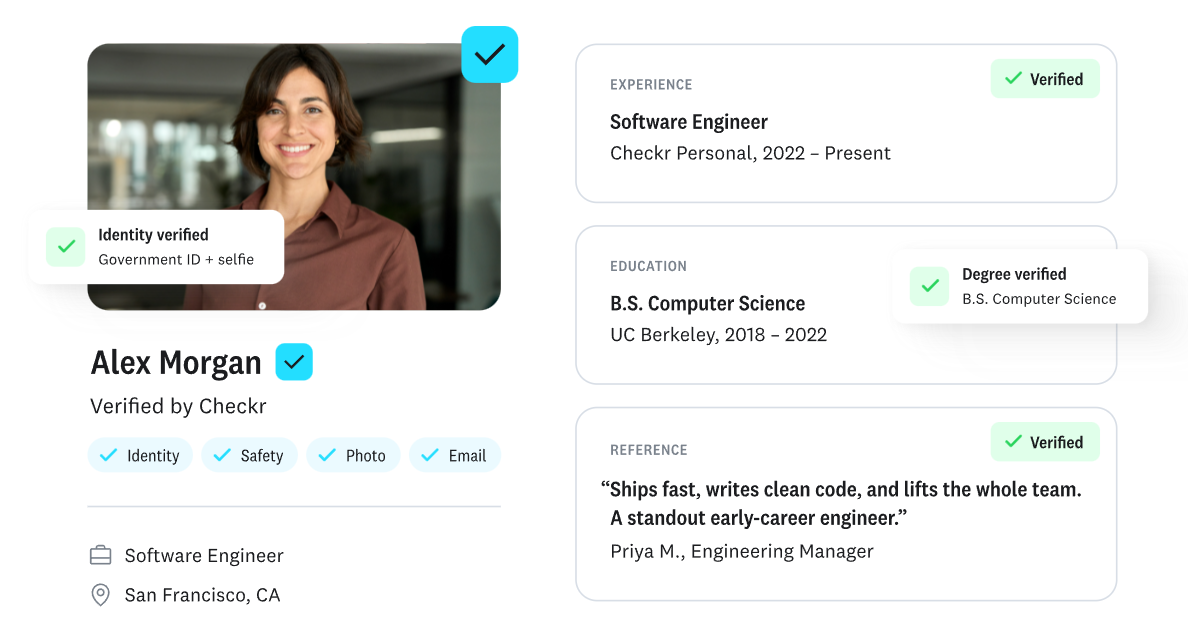
Checkr is a background screening platform that integrates with Ashby as an official native partner to consolidate post-offer compliance work inside the candidate record. Recruiting teams initiate screenings, track check status, and retain completed compliance documentation without leaving the ATS.
Source: Checkr
Key integration capabilities include:
One-click background check initiation from the candidate's Ashby profile, with Checkr managing FCRA-required consent collection and candidate communications automatically
Real-time status updates pushed from Checkr back into Ashby as each screening stage progresses
Completed screening reports stored within the Ashby candidate profile alongside offer letters and interview scorecards
Automated adverse action workflow management (pre-adverse action notices, mandatory waiting periods, post-adverse action notices) tied to the candidate's Ashby record
How Checkr Integrates with Ashby
Source: Checkr
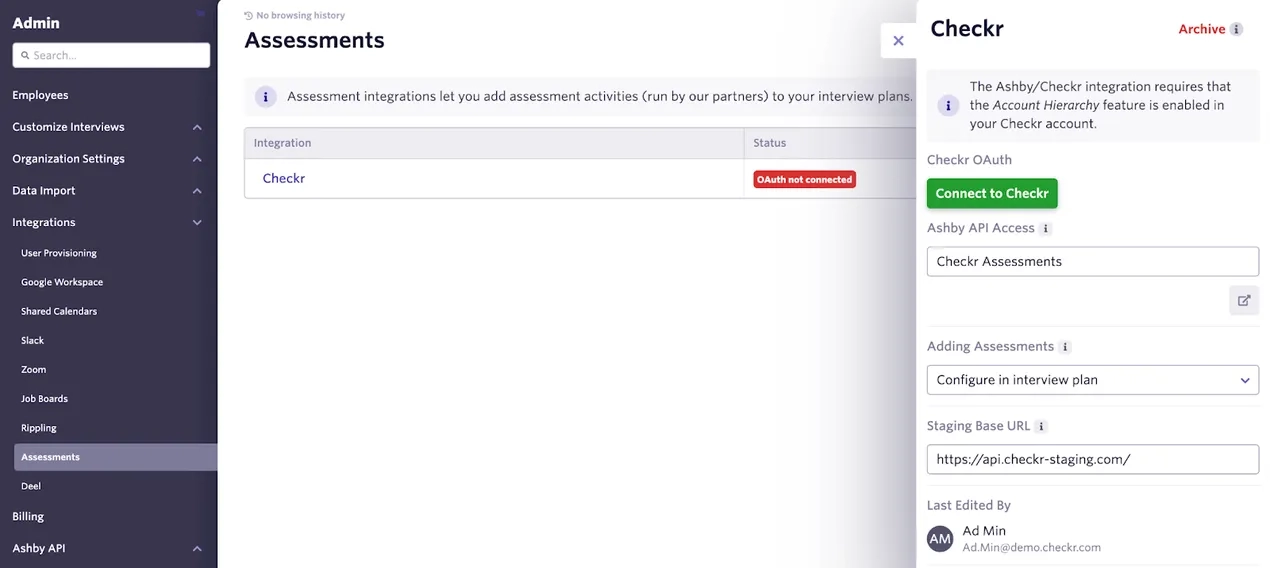
Checkr connects to Ashby through an official native partner integration listed in Ashby's integration directory. Ashby sends candidate data to initialize the screening order, and Checkr returns status updates and completed reports back to the Ashby candidate record.
1. One-Click Screening Initiation from the Candidate Profile.
When a recruiter is ready to trigger a background check (typically after a conditional offer is accepted), the Checkr integration surfaces as an action within the candidate's Ashby profile. The recruiter selects the appropriate Checkr package and initiates with a single click.
Checkr handles all candidate-facing workflows: sending invitations, routing candidates through Checkr's mobile-optimized portal for FCRA consent and PII collection, and managing subsequent communications. The integration routes consent through Checkr's infrastructure, which serves 120,000+ business customers with FCRA-trained candidate support.
2. Real-Time Status Synced to the Ashby Record.
Each progression point generates a status update pushed to the candidate's Ashby record: invitation sent, consent received, check in progress, check complete, report ready. Coordinators tracking post-offer timelines see current screening status alongside offer details in the same view. Checkr reports 89% of criminal checks completing within one hour, and its Report ETA feature generates dynamic completion estimates from processing patterns across 35 million+ annual checks.
3. Compliance Documentation Co-Located with the Hiring Record.
Completed screening reports and compliance artifacts deposit into the candidate's Ashby profile. The full hiring record (resume, scorecards, offer letter, background report) lives in one place. Checkr's compliance engine filters non-reportable records (outside legal look-back periods or excluded by ban-the-box laws) before the report surfaces in Ashby. When a reportable record appears, Checkr's Assess adjudication tools and adverse action workflow manage jurisdiction-specific waiting periods (7-30 days) automatically.
Checkr Pricing
Checkr uses a pay-per-report, usage-based model with no monthly seat fees, no contracts required, and no minimum order volume:
Basic: $29.99/report (SSN trace, sex offender registry, global watchlist, national criminal search)
Essential: $54.99/report (adds unlimited county criminal search; most popular tier for technology company hiring)
Complete: $89.99/report (adds state and federal criminal searches)
Enterprise: Contact sales (custom packages, volume pricing, automated adjudication)
Common add-ons: employment verification at $12.50-$50/check, education verification at $12.50-$25/check, identity verification at $4.99/check, and Assess Standard automated adjudication at $2.49/report. Government and third-party data access fees pass through at cost (state court fees range from $0-$95).
Who Should Use the Checkr Integration?
Teams running post-offer background screening as a defined stage in Ashby's interview plan that need to initiate checks without leaving the ATS workflow
Organizations hiring at a pace where FCRA compliance errors represent real legal exposure: Checkr's automated consent collection, non-reportable record suppression, and adverse action workflow management reduce compliance risk at volume
Coordinators currently managing screening status in a separate vendor portal who want check progress visible inside the Ashby candidate record without switching between systems
7. Zapier: Best Ashby Integration for No-Code Recruiting Workflow Automation
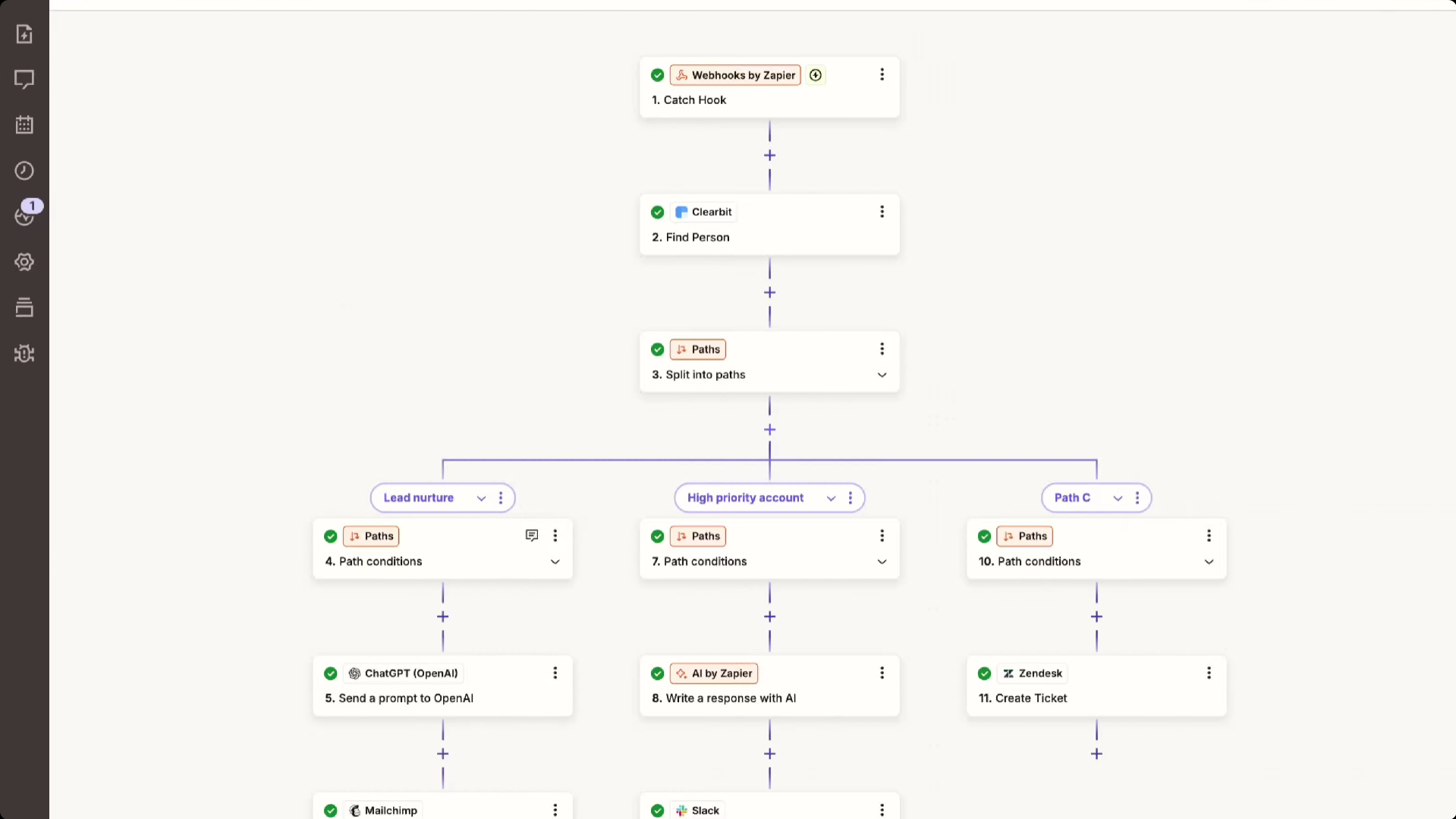
Zapier is a workflow automation platform that integrates with Ashby through a native connector to extend hiring pipeline events into automated actions across 8,000+ connected applications. It lets recruiting and HR operations teams build custom handoffs between Ashby and their broader tool stack without engineering support.
Source: Zapier
Key integration capabilities include:
Stage-change triggers that activate downstream workflows when candidates reach Offer Accepted or Hired in Ashby
New job opening broadcasts across internal channels, CMS careers pages, and sourcing teams
Payroll and HR system record creation on hire, pushing new hire data from Ashby into platforms like ADP, Gusto, or Rippling
Multi-step automation with conditional logic and data transformation connecting Ashby to tools it has no native integration with
How Zapier Integrates with Ashby
Source: Ashby
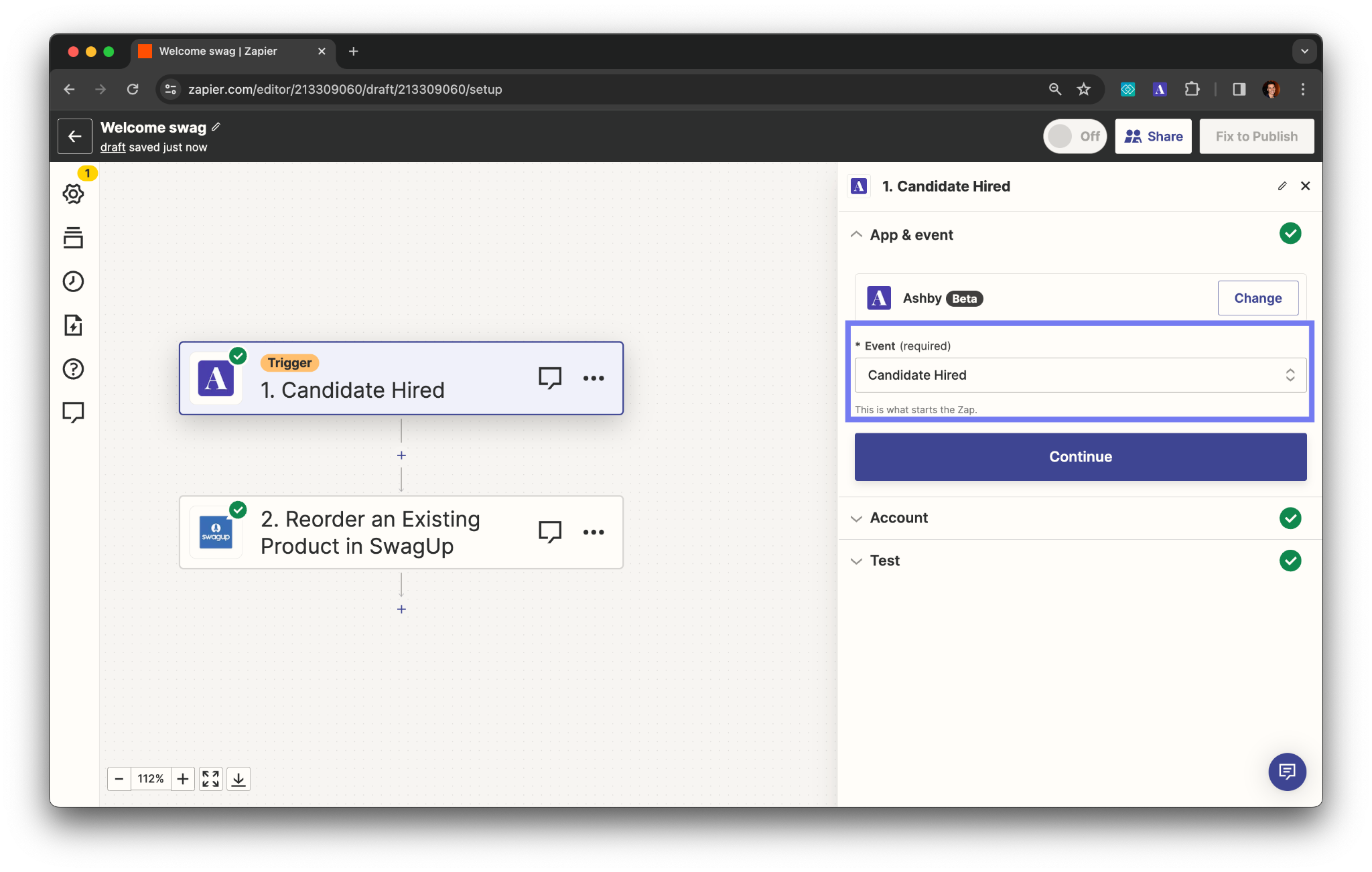
Zapier connects to Ashby through its native integration, listed in Ashby's integrations directory under "External Workflows." Setup follows Zapier's standard OAuth flow with no API key management required. Ashby functions as both a trigger source (candidate stage changes, new applications, job postings) and an action target (creating or updating records). Ashby's webhook system supports real-time event delivery, so Zapier receives Ashby events instantly rather than on a polling delay.
1. Stage-Change Triggers for Post-Hire Operations.
When Ashby marks a candidate as Hired, Zapier detects the stage change and fires a configurable sequence of actions: creating an IT provisioning task in Asana or ClickUp, sending a welcome email, triggering a swag shipment, notifying the hiring manager in Slack, and creating a pre-filled new employee record in a connected HR system.
Ashby's native automated activities handle recruiting-side transitions (scheduling links, questionnaires); Zapier extends those trigger points into the broader operations ecosystem. Zapier Paths branch different candidate types (full-time vs. contractor, different departments) to different downstream workflows from the same trigger.
2. New Job Opening Broadcasts.
When a new job is published in Ashby, Zapier broadcasts to internal channels and external systems simultaneously: a formatted Slack message to the recruiting channel, a push to a Webflow CMS collection for the company careers page, a planning document in Notion, and an email to the sourcing team lead. Teams maintaining custom CMS-based careers sites (rather than Ashby's hosted job board) use this pattern to keep their site current without manual publishing.
3. Payroll and HR System Sync.
Ashby's native integrations cover Workday, but payroll platforms like ADP Workforce Now, Gusto, and Rippling fall outside Ashby's native integration set. Zapier bridges this gap: a Zap triggered by the Hired stage maps candidate data (name, email, start date, department, compensation from the offer record) to the payroll platform's new employee record fields. When start date, compensation, and department data flows from Ashby into payroll via Zapier, no one has to retype it.
Zapier Pricing
Zapier uses task-based pricing where each successful action step consumes one task (Filters, Paths, and Formatter steps do not consume tasks):
Free: $0/month (100 tasks/month, 2-step Zaps only, 15-minute polling; not suitable for multi-step Ashby workflows)
Professional: Starts at $19.99/month billed annually for 750 tasks (multi-step Zaps with up to 100 steps, webhook-based instant triggers, Paths and conditional logic)
Team: Starts at $69/month billed annually for 2,000 tasks (shared workspaces for up to 25 users, SAML SSO)
Enterprise: Custom pricing (unlimited users, SCIM provisioning, advanced admin controls)
A typical post-hire Zap (Slack notification + Notion page + payroll record + Asana task + welcome email) consumes 5 tasks per hire. At 50 hires per month, that's 250 tasks, well within the Professional tier.
Who Should Use the Zapier Integration?
Teams where post-hire handoffs to IT, payroll, or HR operations require manual steps because those tools have no native Ashby connection
Organizations maintaining custom CMS-based careers sites that need to stay in sync with Ashby job postings without manual publishing
Recruiting or HR ops teams without engineering resources that need cross-system automation spanning tools outside Ashby's native integration catalog
Also Worth Considering: ZoomInfo
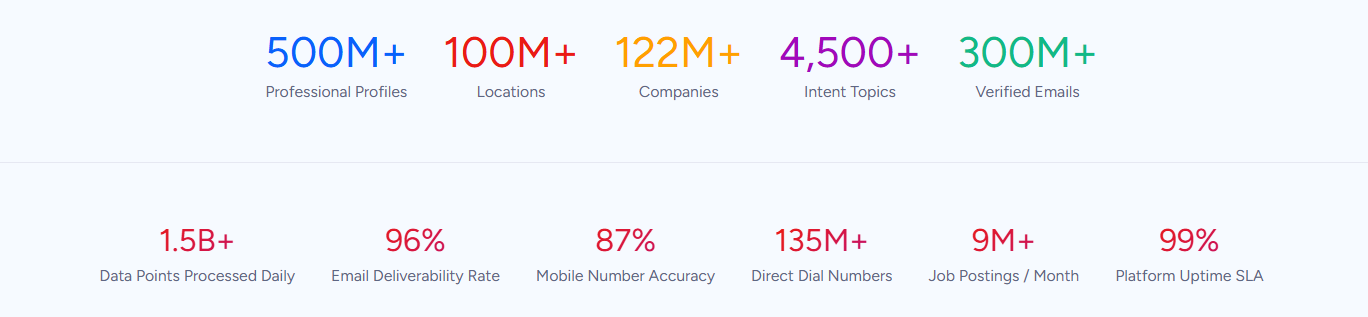
ZoomInfo is a GTM platform built on a B2B data foundation of 500M contacts, 100M companies, 135M+ verified phone numbers, and 200M+ verified business email addresses. ZoomInfo does not have a direct integration with Ashby, but the two platforms serve overlapping audiences in ways that make ZoomInfo relevant to teams building their recruiting operations stack.
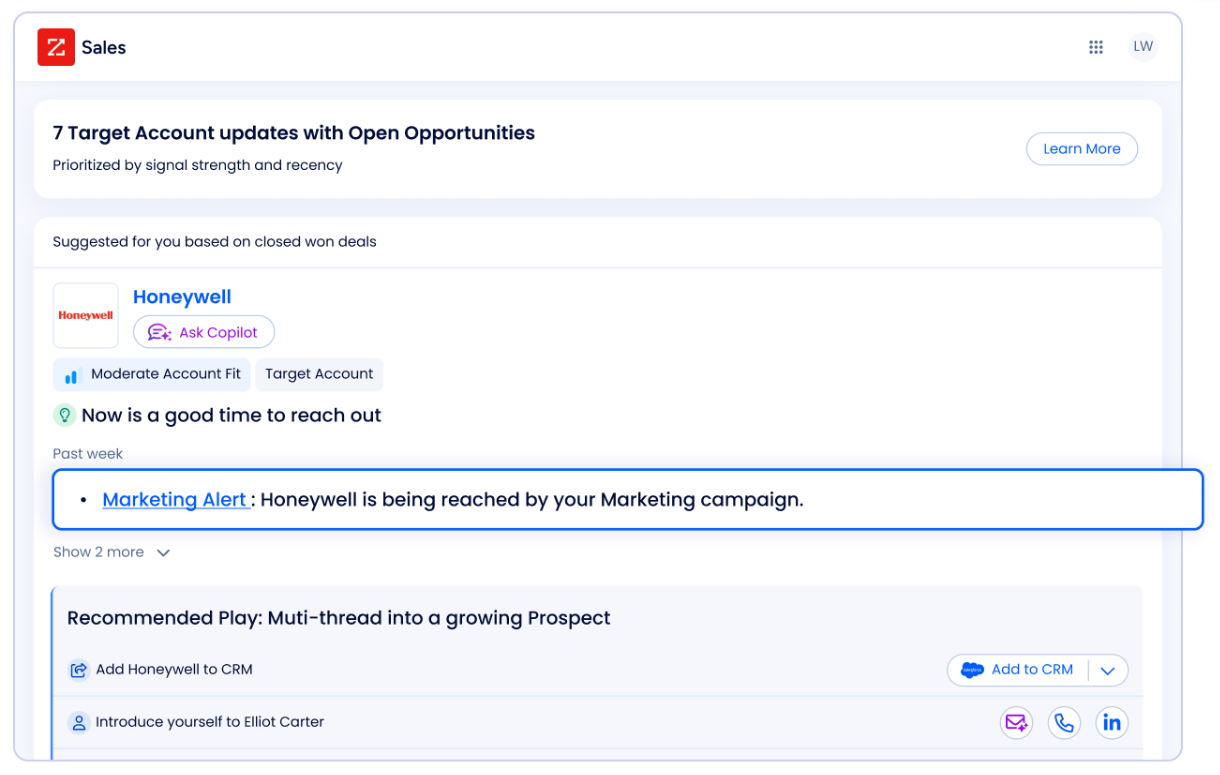
Ashby users are typically technology companies and high-growth startups with ambitious hiring goals. These same organizations run go-to-market teams that depend on accurate B2B data, buyer intent signals, and technographic intelligence to build pipeline. ZoomInfo serves that need: its data and intelligence layer powers prospecting, enrichment, and GTM execution for 35,000+ companies worldwide.
For recruiting teams, ZoomInfo's data can inform hiring decisions at a strategic level. Understanding which companies in your target market are growing headcount, investing in specific technologies, or showing buying signals for your category helps talent teams anticipate where future hiring needs will emerge. RevOps and recruiting operations leaders at Ashby-powered companies often use ZoomInfo alongside their ATS: ZoomInfo powers the go-to-market work that drives headcount demand, while Ashby manages the structured hiring process that fills those roles.
Teams needing to connect the two platforms can do so through Ashby's Zapier integration as a middleware layer, enabling custom workflows between ZoomInfo's data and Ashby's candidate pipeline.
Seismic's sales team attributed 39% of active pipeline to opportunities identified or influenced by ZoomInfo signals, reporting 54% productivity gains and saving 11.5 hours per week per seller. (Seismic Case Study)
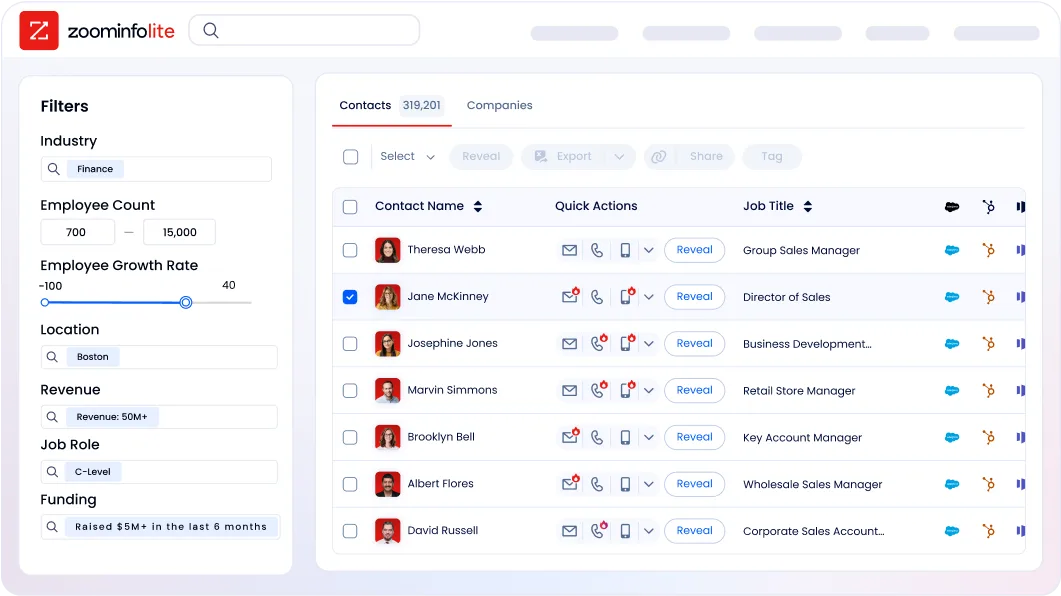
ZoomInfo uses a consumption-based pricing model with custom quotes. ZoomInfo Lite is a permanent free tier (no credit card, no time limit) with 10 monthly export credits, searches, and CRM integrations.
Final Verdict
The best Ashby integrations extend your recruiting platform into the systems where adjacent work happens:
Workday: bidirectional HRIS sync that keeps headcount plans, compensation, and new hire records flowing between enterprise HR and recruiting
Slack: real-time pipeline visibility with in-context offer approvals, feedback submission, and an AI assistant that brings ATS actions to your team workspace
LinkedIn Recruiter: passive candidate sourcing with native outreach tracking, Chrome Extension sourcing, and multi-channel sequences managed from one pipeline
Metaview: automatic interview transcription with rubric-aware AI that pre-fills Ashby feedback forms with evidence anchored to candidate quotes
CodeSignal: consistent, science-backed technical assessment scores delivered to the candidate timeline via webhooks
Checkr: one-click post-offer background screening with automated FCRA compliance and real-time status updates in the candidate record
Zapier: no-code automation routing Ashby hiring events into 8,000+ apps for post-hire operations handoffs
These integrations compound: you might run Workday for HRIS sync, Slack for collaboration, Metaview for interview intelligence, and Zapier for operations handoffs on the same Ashby instance, each closing a different gap in the hiring lifecycle.
If your go-to-market team is scaling alongside your recruiting function, consider how your revenue data connects to your hiring strategy. ZoomInfo powers GTM execution for 35,000+ companies with verified B2B data, buyer intent signals, and intelligence, and its free Lite tier lets your team explore the data quality before committing to a subscription.
Frequently Asked Questions
How many integrations does Ashby support?
Ashby's integrations directory includes 250+ out-of-the-box integrations spanning HRIS platforms, assessment tools, communication apps, job boards, sourcing extensions, e-signature providers, video interviewing platforms, and workflow automation connectors. Beyond pre-built integrations, Ashby's REST API with endpoints covering candidates, jobs, applications, interviews, and offers enables custom integrations with any system that can make HTTP requests. The webhook system supports event-driven connections for real-time automation.
Do Ashby integrations work on all plans?
Most integrations are included on all Ashby plans, including the Foundations tier ($400/month for up to 100 employees). The major exceptions are the Workday integration (exclusive to the Enterprise plan for 1,000+ employee organizations) and some HRIS-specific connectors. Slack, Zapier, Metaview, CodeSignal, Checkr, and the Chrome Extension for LinkedIn sourcing are available across Foundations, Plus, and Enterprise. Check each integration's documentation for tier-specific feature availability.
How does Ashby handle data sync with third-party integrations?
Ashby supports both polling-based and event-driven sync depending on the integration. Native integrations like Workday use scheduled API sync cycles (every 20 minutes). The webhook system delivers real-time event notifications with exponential backoff retry logic (up to 10 attempts) and signature verification for payload authenticity. For integrations connected via Zapier, Ashby supports instant webhook-based triggers rather than polling delays.
Can I connect Ashby to tools that are not in the integrations directory?
Yes. Ashby's API covers the full recruiting data model (candidates, jobs, applications, interviews, offers, organization data) and supports custom integrations with any system that can make HTTP requests. For no-code solutions, Zapier connects Ashby to 8,000+ applications with triggers, actions, and searches. Ashby's upcoming MCP server will also let external AI tools and agents interact with Ashby data.
Does Ashby have an AI notetaker, and how does it compare to Metaview?
Ashby offers a native AI Notetaker add-on available on all plans that records, transcribes, and summarizes interviews with AI-assisted feedback form autofill. It has the advantage of full platform integration with no additional vendor. Metaview provides more rubric-aware AI with dedicated recruiting-specific templates (Technical Debrief, Recruiter Screen, System Design Interview) and more customization options. Teams wanting the simplest setup should evaluate Ashby's native notetaker; teams needing richer, rubric-anchored output across high-volume structured hiring should evaluate Metaview.
Is Ashby secure enough for enterprise deployments?
Ashby is SOC 2 Type 2 certified with annual audits. All data is hosted on AWS with TLS 1.2/1.3 encryption in transit and AES-256 at rest. Authentication flows through Google Workspace, Microsoft 365, SAML SSO, or OIDC (no password authentication). SCIM directory sync is available on Plus and Enterprise plans. Ashby provides configurable GDPR and CCPA compliance workflows and a Trust Center for security documentation access.
What is the best way to power your go-to-market team alongside Ashby's recruiting operations?
Growing companies need both a recruiting engine and a revenue engine working together. While Ashby handles structured hiring from sourcing through offer, ZoomInfo powers the go-to-market work that drives headcount demand. ZoomInfo's data foundation spans 500M contacts, 100M companies, 135M+ verified phone numbers, and 200M+ verified business email addresses, along with buyer intent signals and technographic intelligence, giving your sales and marketing teams the data they need to fill pipeline. Its GTM Context Graph processes 1.5B+ data points daily to reveal not just which accounts are in-market, but why deals move. Teams access this intelligence through GTM Workspace for sellers, GTM Studio for marketers and RevOps, or APIs and MCP in any tool. ZoomInfo Lite offers a permanent free tier to evaluate the platform before committing.
