
Avoma is a meeting intelligence platform that automates note-taking, coaches sales reps, and forecasts revenue from your team's conversations. For small and mid-sized revenue teams buried in manual CRM updates and scattered call notes, the pitch is clear: one tool that records every meeting, writes the summary, scores the call, and flags at-risk deals.
To write this Avoma review, we analyzed the platform in detail. We believe it fits well if:
You need automated meeting transcription, notes, and CRM data entry in one tool
You want conversation intelligence and coaching without enterprise pricing
Your team is under 100 people and needs a cheaper alternative to Gong
You value cross-functional meeting visibility across sales, CS, and product teams
You want a built-in scheduler and lead router alongside your meeting assistant
However, Avoma might not be the best choice if:
You need B2B prospecting data alongside conversation intelligence
You want intent signals, technographics, and buyer behavior data to prioritize accounts
Your team requires a single platform spanning data, outreach, and deal execution
You need conversation intelligence connected to a verified contact database
Reliability and transcription accuracy are non-negotiable for your workflow
In this case, consider ZoomInfo: an AI go-to-market platform that combines B2B data with conversation intelligence, revenue intelligence, and AI-powered execution. Where Avoma focuses on what happens during and after meetings, ZoomInfo covers the full go-to-market cycle, from identifying accounts and contacts, to engaging them with AI-drafted outreach, to analyzing every conversation through Chorus, to forecasting pipeline with signals that go beyond call data alone.
We've included a detailed look at ZoomInfo later in this Avoma review, for teams that need conversation intelligence as part of a broader go-to-market strategy rather than a standalone tool. If you're ready to explore a full-platform approach, start with ZoomInfo's free trial.
What is Avoma?
Avoma (short for "A Very Organized Meeting Assistant") is a conversation intelligence and AI meeting assistant platform founded in late 2017 in Palo Alto, California.
Co-founders Aditya Kothadiya (CEO), Devendra Laulkar (CTO), and Albert Lai (AI Head) built it on a simple premise: meetings generate valuable information, but most of it gets lost because people must choose between listening and taking notes.
The platform has raised $15M in funding ($3M Seed led by K9 Ventures, $12M Series A led by Headline) with backing from HubSpot Ventures and the Zoom Apps Fund. It now serves over 1,000 organizations across software, financial services, healthcare, and professional services.
Avoma is organized around four products: an AI Meeting Assistant for recording, transcription, and note-taking; a Scheduler & Lead Router for booking and qualifying meetings; Conversation Intelligence for coaching and call analysis; and Revenue Intelligence for deal tracking and forecasting.
The platform targets sales, customer success, marketing, and product teams, positioning itself as a cross-functional tool rather than a sales-only solution.
Avoma Pros & Cons
Pros | Cons |
|---|---|
- Automated note-taking with custom AI templates | - Reliability concerns: recorder join failures and mid-call drops |
- Cross-functional use beyond sales teams | - Transcription accuracy reportedly around 80% vs. 95%+ modern standard |
- Transparent, published pricing with no platform fees | - Revenue Intelligence features require paid add-ons |
- Free scheduler with unlimited scheduling pages | - Limited CRM integration depth per user reviews |
- AI coaching with live answer cards during calls | - Maximum 100 paid seats on the Organization plan |
- 14-day free trial with no credit card required | - No B2B prospecting data or intent signals |
- Supports 50+ languages for transcription | - Small company (~60 employees) with limited support resources |
Avoma Review: How it Works & Key Features
AI Meeting Assistant: Avoma automates note-taking, transcription, and CRM updates across every meeting.
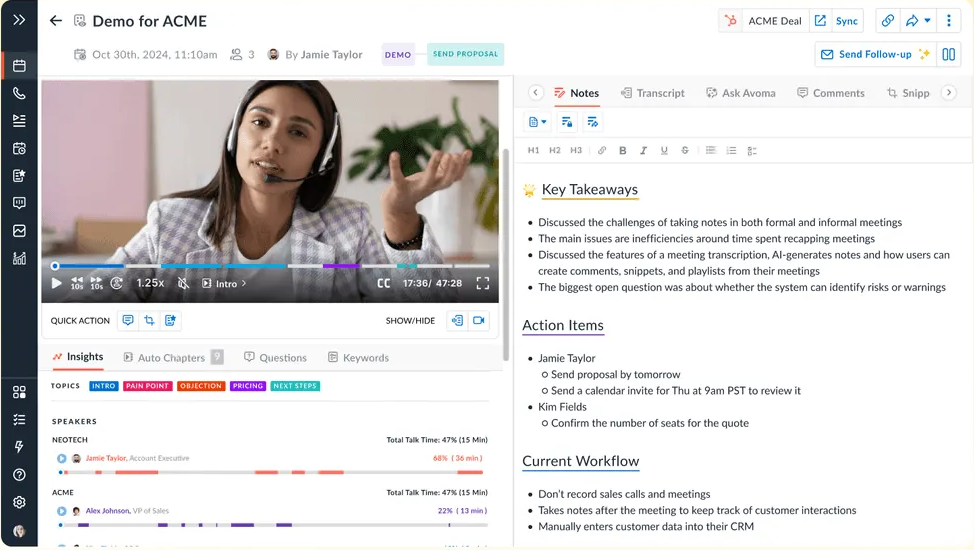
Avoma's AI Meeting Assistant handles the administrative work that eats time before, during, and after meetings. The system records video meetings, generates real-time transcripts in over 60 languages, and produces one-page bulleted summaries organized by categories like Pain Points, Next Steps, and Business Need.
Source: Avoma
The template system adds useful depth.
Avoma includes 90+ note templates across 11 collections covering Sales, Customer Success, Product, and more. Templates map to specific meeting types, so a discovery call gets a different note structure than a QBR. During meetings, users click contextual bookmarks (Pain Points, Feedback, etc.) that time-stamp and organize information under relevant topics in real time.
After the meeting, Avoma syncs notes to the connected CRM by recognizing contact, company, and deal information from attendee details. It also generates follow-up email drafts that recap the conversation and outline next steps.
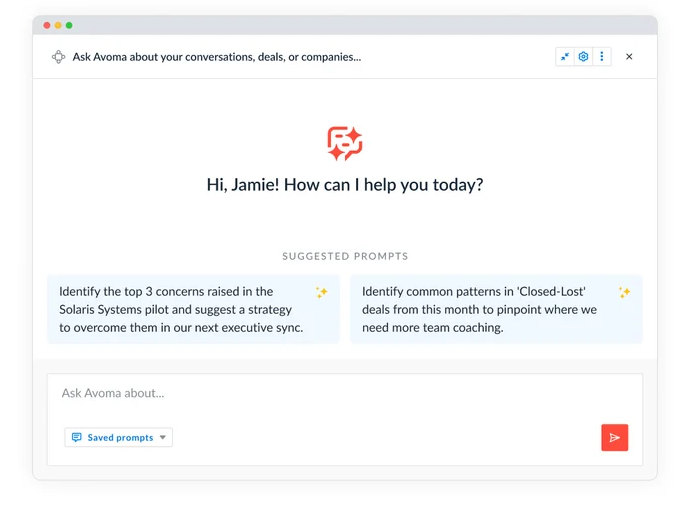
The "Ask Avoma" AI Copilot adds a search layer across all this data. Reps can ask questions about account history without digging through recordings or CRM records, and the system retrieves answers from meetings, emails, and deals.
Source: Avoma
Scheduler & Lead Router: Avoma offers free scheduling with optional lead routing.
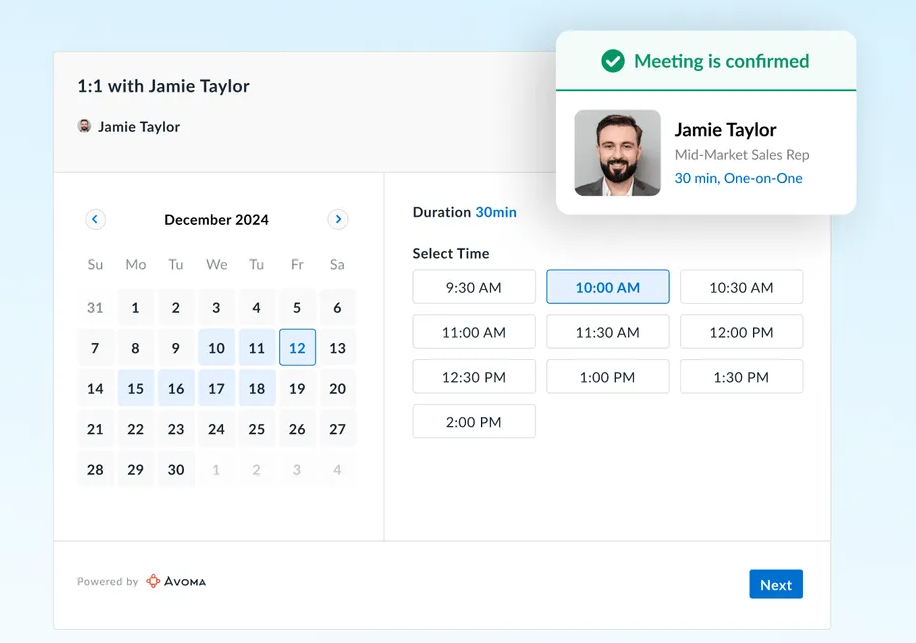
The Scheduler provides unlimited scheduling pages for 1:1, group, and round-robin meetings at no cost.
Users set availability windows, buffer times, minimum scheduling notice, and future booking limits. The round-robin system supports equal or weighted distribution across team members, with handling for cancellations and no-shows.
Source: Avoma
The Lead Router add-on ($19/user/month) connects to HubSpot or Marketo forms to qualify and route inbound leads.
When a prospect submits a form, the router evaluates responses against configured rules and performs CRM ownership checks to match the prospect's email or domain to existing Contact, Account, or Deal records. This ensures existing customers see their assigned rep's calendar instead of entering a generic round-robin.
For outbound teams, the Outbound Handoff Router lets SDRs book meetings with the right AE during live prospect calls, skipping the delay of scheduling follow-ups afterward.
Managed page templates give admins control over organizational standards. They can lock specific sections (event info, scheduling preferences) while leaving others open for customization, then bulk-assign templates to team members.
Conversation Intelligence: Avoma scores calls and provides real-time coaching during live conversations.
Avoma's Conversation Intelligence adds coaching and analytics on top of the base meeting assistant.
The AI Coaching Assistant scores calls against predefined criteria, with three default scorecard templates for SDR prospecting, sales demos, and customer success calls. Each question is evaluated on a 5-point scale with timestamped evidence from the transcript, so coaches can jump to the relevant moment.
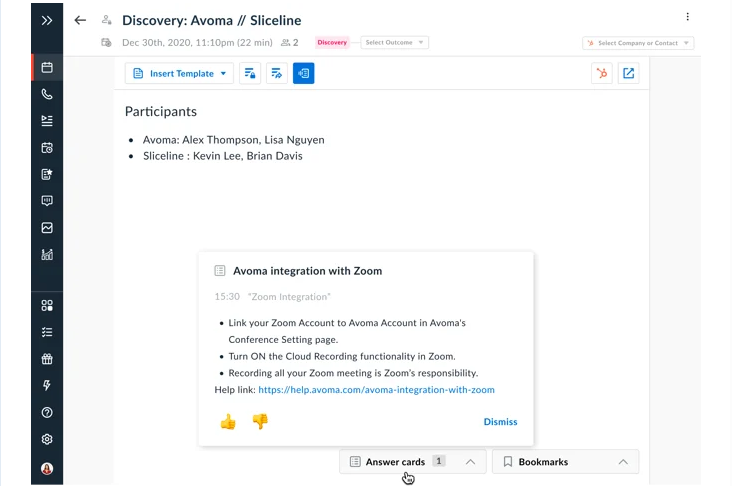
The Live Answer Assistant shifts Avoma from reactive to proactive coaching.
During calls, the system monitors the conversation and displays Answer Cards with pre-configured talking points when it detects trigger phrases. If a prospect raises an objection, the relevant guidance appears for 20 seconds, visible only to the rep. Admins define these cards by creating example phrases and keywords for each scenario.
Source: Avoma
Analytics cover talk time percentages, filler word usage, monologue duration, and question counts, with visual indicators showing whether calls fall within benchmarks like the 40-60% talk time recommendation. Custom Smart Trackers use semantic matching to monitor keywords and topics across conversations, catching variations and synonyms rather than requiring exact matches.
This add-on costs $29/seat/month (annual) or $35/month (monthly) and requires a Conversation Intelligence subscription.
Revenue Intelligence: Avoma tracks deal health and forecasts pipeline using conversation data.
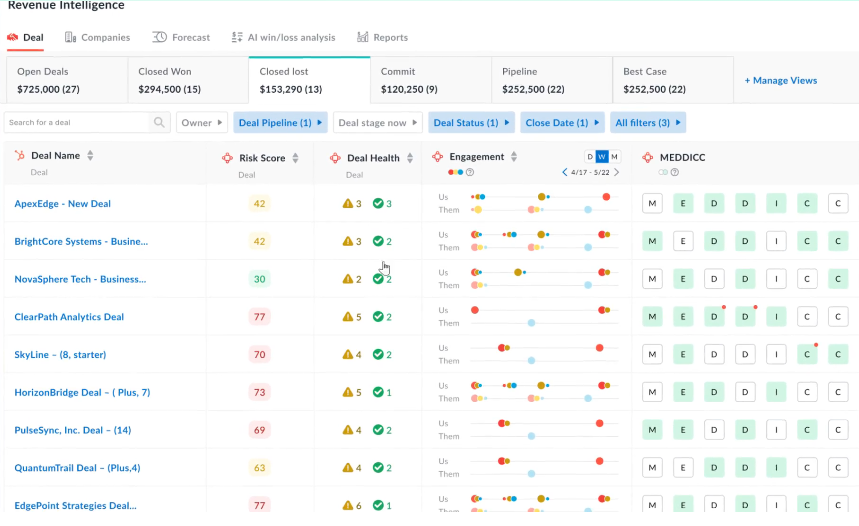
The Revenue Intelligence add-on layers pipeline management and forecasting on top of Avoma's conversation data. Instead of relying on CRM stage fields and rep estimates, the system analyzes buyer interactions and pipeline activity to assess where deals actually stand.
Source: Avoma
The AI tracks sales methodologies (BANT, MEDDICC, SPICED) by extracting qualification signals from conversations. A Methodology Qualification column in the deal dashboard shows which framework criteria have been covered, with evidence linked to specific meeting moments. The Live Methodology Mentor guides reps in real time, detecting topics as they come up and prompting on what still needs to be addressed.
Deal risk alerts surface issues like stalled momentum, missing next steps, weak sentiment, and low buyer engagement. These can be delivered via Slack or email with configurable triggers.
The Forecast Tool organizes deals into Pipeline, Best Case, Commit, and Closed categories, with reps submitting individual forecasts and managers rolling up team views. The system keeps forecast submission history for comparing past predictions to actual outcomes.
AI win-loss analysis generates explanations when deals close, highlighting factors like needs identification, solution fit, or integration gaps, supported by evidence from actual interactions. A 12-month trend chart helps identify patterns across quarters.
This add-on also costs $29/seat/month (annual) or $35/month (monthly) and requires a connected CRM (Salesforce or HubSpot, with Zoho and Pipedrive coming soon).
Pricing: Avoma uses transparent per-seat pricing with optional add-ons.
Avoma's pricing distinguishes between paid Recorder Seats and unlimited free view-only collaborators. All paid users must be on the same base plan.
Startup Plan ($19/user/month annual, $29 monthly): Up to 25 paid seats. Includes unlimited 1:1 scheduling, automatic video recording, unlimited transcription, AI summary notes, "Ask Avoma" per meeting, AI email follow-ups, auto CRM sync, and dialer integration.
Organization Plan ($29/user/month annual, $39 monthly): Up to 100 paid seats. Adds custom AI topics and templates, group and round-robin scheduling, limited Conversation Intelligence, smart playlists, translation, custom email templates, org-level policies, API access, and a Customer Success Manager.
Enterprise Plan ($39/user/month annual only): Minimum 10 paid seats. Adds a designated Success Manager, concierge onboarding, quarterly business reviews, unlimited usage intelligence, team-specific access controls, SSO (SAML/OIDC), data retention policies, and HIPAA compliance.
Add-ons (per seat, on top of base plan):
Conversation Intelligence: $29/month (annual) or $35/month
Revenue Intelligence: $29/month (annual) or $35/month
Lead Router: $19/month (annual) or $25/month
A team of 10 on the Organization plan with both Conversation and Revenue Intelligence add-ons would pay $82/user/month annually ($820/month total), or $109/user/month on monthly billing.
Avoma offers a 14-day free trial of the Organization plan with all add-ons enabled, no credit card required.
Where Avoma Falls Short
Avoma delivers real value for meeting-heavy teams on a budget, but several limitations surface with sustained use. These reflect a platform built for meeting intelligence, not full go-to-market execution.
Reliability Concerns: According to aggregated user reviews, 73% of users cite reliability as their top concern: recorders joining calls 5-15 minutes late in 48% of cases, dropping mid-call in 31%, and failing to join in 27%. Avoma has acknowledged these issues and says recent updates helped, but for teams that need every call recorded, this track record raises concern.
Transcription Accuracy: Reviews put transcription accuracy at roughly 80%, compared to the 95%+ modern platforms achieve, with particular trouble handling non-native English speakers and technical terminology. Since every downstream feature (AI notes, coaching scores, deal risk alerts) depends on accurate transcription, errors here cascade through the entire platform.
No Prospecting Data or Intent Signals: Avoma tells you what happened in meetings but offers no data about who to meet with. There's no contact database, no intent signals showing which accounts are researching solutions, no technographic data revealing what tools prospects use. Teams still need separate tools to identify and prioritize accounts before Avoma adds value.
Add-On Pricing Complexity: The $19-29/user base price looks attractive, but the features most teams need (call scoring, deal risk alerts, forecasting) sit behind $29/seat add-ons. A rep who needs both Conversation and Revenue Intelligence on the Organization plan pays $82/user/month annually. The gap between the advertised starting price and the practical cost catches buyers off guard.
Scale Limitations: The Organization plan caps at 100 paid seats, and the Enterprise plan requires a minimum of 10. With roughly 60 employees and $15M in estimated revenue, Avoma is a small company in a competitive market against well-funded incumbents. For organizations that need long-term vendor stability and deep enterprise support, this profile carries risk.
Limited CRM Integration Depth: Multiple Capterra reviews cite "limited CRM integration" as a recurring friction point. Avoma connects to Salesforce, HubSpot, and several other CRMs, but the depth of two-way sync and field mapping doesn't match what larger platforms offer.
These limitations aren't failures. They're the natural result of a small team building a meeting-focused platform on Series A funding.
But they leave a clear gap for teams that want conversation intelligence connected to prospecting data, intent signals, and full-cycle go-to-market execution.
Top Avoma Alternative: ZoomInfo
ZoomInfo is an AI go-to-market platform that lets sales reps walk into every call knowing why a deal is moving, who's championing it, and what's likely to happen next.
Marketers can describe audiences in plain language and launch plays against accounts that match proven win patterns, without an engineering ticket. Leaders can spot deal risk before it shows up in CRM stage fields. That depth comes from the GTM Context Graph, an intelligence layer that processes 1.5B+ data points daily.
It's built on ZoomInfo's B2B dataset: 500M contacts, 100M companies, 135M+ verified phone numbers, and 200M+ verified business emails, unified with your CRM records, conversation transcripts, and behavioral signals. Teams access this intelligence through the GTM Workspace for sellers, GTM Studio for marketers and RevOps, or APIs and MCP in any front-end.
Conversation Intelligence with Chorus: ZoomInfo captures and analyzes every customer interaction, connected to its B2B dataset.
Chorus, ZoomInfo's conversation intelligence engine, records, transcribes, and analyzes sales calls, meetings, and emails. It covers the same ground as Avoma's Conversation Intelligence: talk ratios, sentiment analysis, objection detection, coaching scorecards, and deal intelligence. The difference is what it connects to.
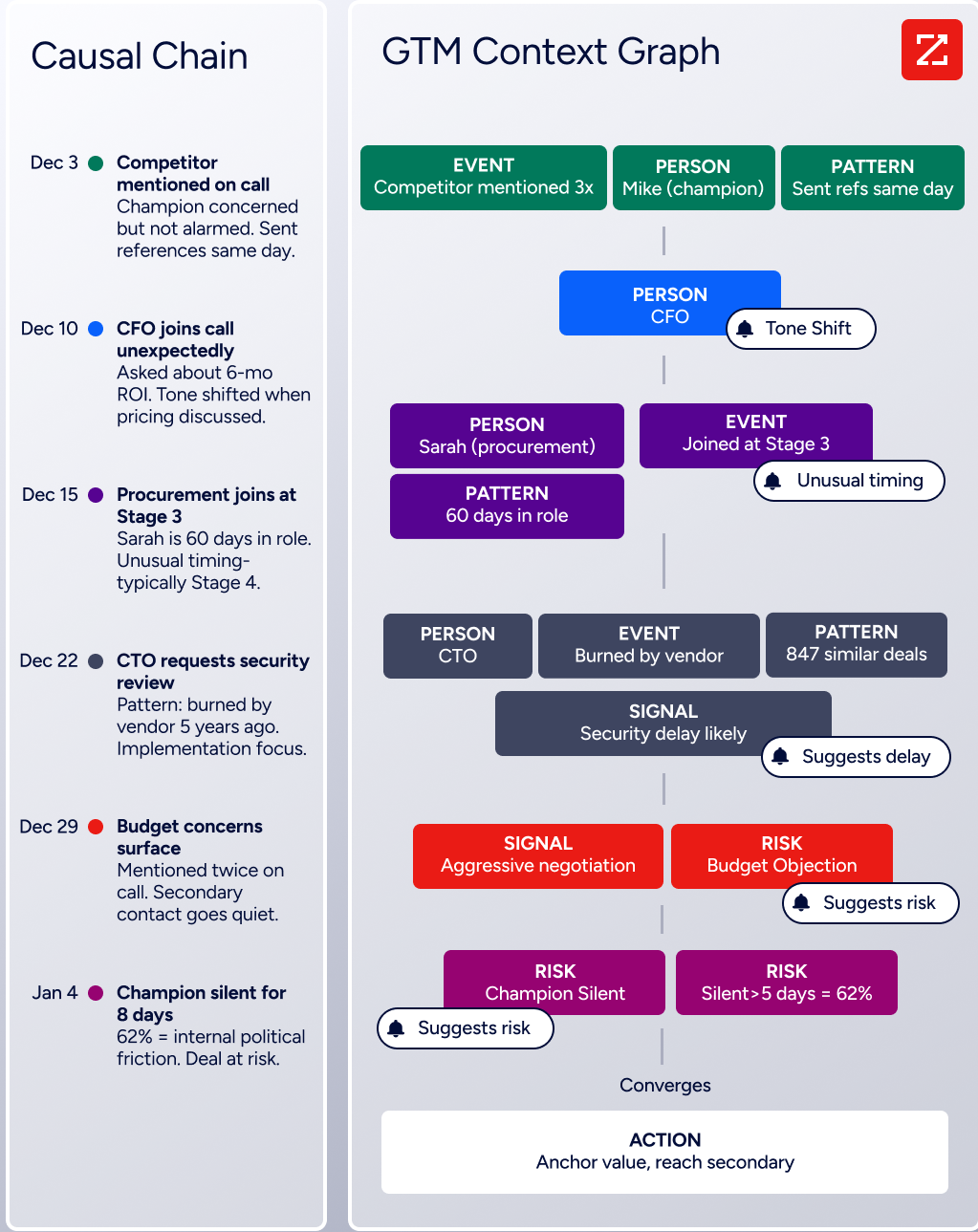
Where Avoma's insights stay within meetings, Chorus feeds into ZoomInfo's GTM Context Graph, which combines conversation data with third-party intelligence (intent signals, org chart changes, funding events, hiring patterns) and CRM data.
A rep reviewing a call sees not just what was said but ZoomInfo's full profile for every participant (direct dials, email addresses, company details, and buying signals) without switching to a separate system.
Source: ZoomInfo
This Connected Intelligence approach means coaching happens in the context of account reality, not in isolation. A stalling deal isn't just a conversation problem; it might correlate with an org change, a competitor evaluation, or a budget cycle that only external signals would reveal.
Seismic's sales team attributed 39% of active pipeline to opportunities identified or influenced by ZoomInfo signals and boosted productivity by 54%. (Seismic case study)
B2B Data and Intent Signals: ZoomInfo provides the prospecting intelligence that Avoma lacks.
Avoma starts working once a meeting is booked. ZoomInfo starts working before anyone knows your prospect exists.
The platform's Contact & Company Search spans 300+ company attributes with 120M direct-dial phone numbers and 200M+ verified business email addresses, verified by 300+ human researchers at up to 95% accuracy on first-party data.
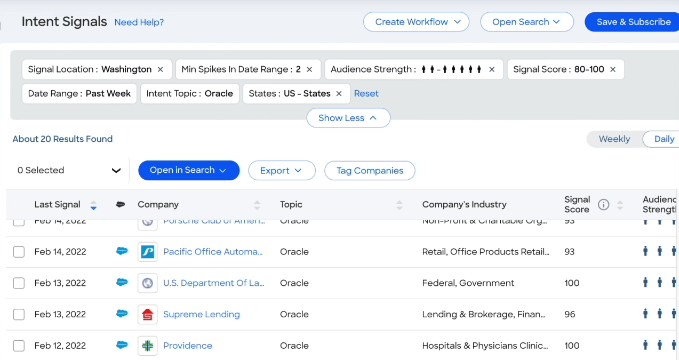
Buyer Intent data tracks signals from 210 million IP-to-Organization pairings and 6 trillion+ new keyword-to-device pairings sourced monthly, identifying companies researching solutions before they reach out. Guided Intent, exclusive to ZoomInfo, identifies topics historically correlated with your deal success rather than requiring manual topic selection.
Source: ZoomInfo
The data quality is externally validated.
In a Fortune 500 competitive RFP analyzing 25 million contacts across vendors, an independent consultant concluded that "no other competitor came even close." ZoomInfo holds 133 No. 1 rankings on G2 and was named a Forrester Wave Leader for Intent Data Providers and a Gartner MQ Leader for ABM Platforms for two consecutive years.
SpringDB saw 2x-3x increases in campaign conversions, a 300% increase in database usability, and 30-50% uplift in average deal size after enriching their data with ZoomInfo. (SpringDB case study)
GTM Workspace and GTM Studio: ZoomInfo gives sellers and marketers dedicated workspaces powered by the same intelligence.
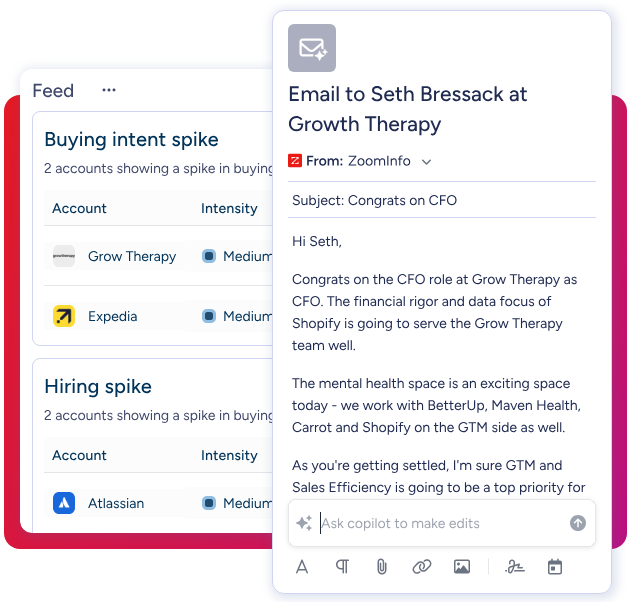
ZoomInfo’s GTM Workspace is an AI-powered workspace for sellers that consolidates their book of business, buying signals, account research, and AI-drafted outreach in one place.
Instead of toggling between a CRM, a prospecting tool, a meeting assistant, and an email platform, reps see prioritized accounts with pre-drafted actions on every signal: G2 comparisons, funding events, executive hires. AI agents (built on Anthropic's Claude) handle account research, CRM updates, and outreach drafting.
Source: ZoomInfo
GTM Studio serves marketers, RevOps, and GTM engineers with an AI-powered orchestration canvas. Teams describe audiences in natural language, enrich with first- and third-party data, define triggers, and activate multi-channel plays (email, calls, ads, direct mail) without engineering support. Expansion plays that took 3 weeks now launch in 30 minutes.
For teams building beyond ZoomInfo's own products, APIs and MCP expose the same intelligence to any custom agent, internal tool, or partner platform. API access is included in all relevant plans.
"ZoomInfo is our one source of truth for account data, and even more so for contact data. There's no other provider in the market that provides you with that level of detail." - Thor Sanderson, Senior Manager of Sales Technology Enablement, Smartsheet (Smartsheet case study)
Pricing: ZoomInfo uses custom consumption-based pricing with a permanent free tier.
ZoomInfo uses consumption-based pricing where costs scale around data access, API consumption, AI activity, and number of users. Pricing is custom-quoted (no published dollar amounts for paid tiers), reflecting its enterprise focus and deployment variability.
The platform is organized into Sales, Marketing, and standalone product lines (Chorus, Chat), each with tiered feature sets (Professional, Advanced, Enterprise for Sales; Marketing Demand, ABM Lite, ABM Enterprise for Marketing).
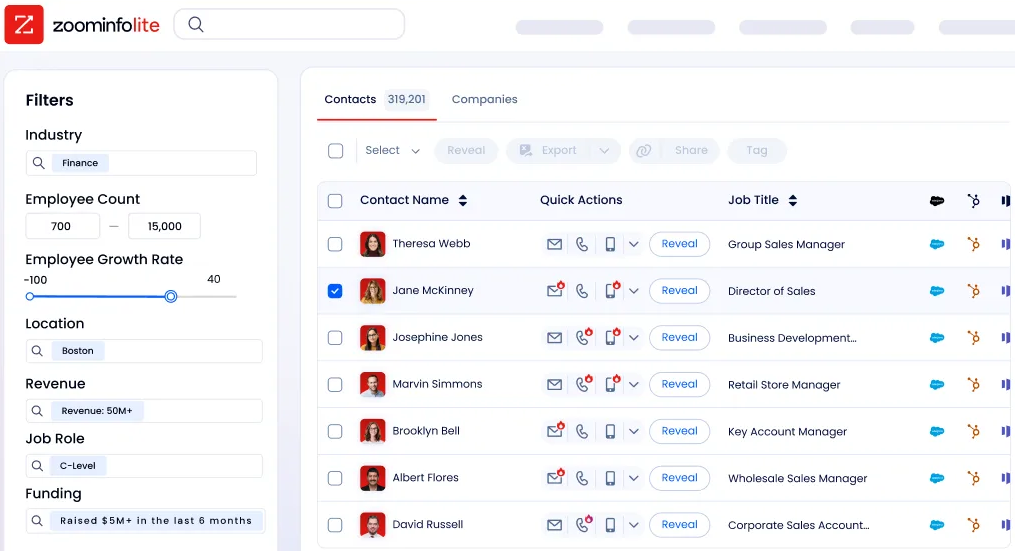
ZoomInfo Lite is a permanent free tier (not a trial) that includes access to ZoomInfo's B2B database, 10 monthly export credits, individual and company searches, the ReachOut Chrome Extension, WebSights Lite (up to 10 website visitor reveals per day), built-in email sending, and HubSpot integration. No credit card or time limit.
A separate 7-day free trial provides broader access to core platform features, also with no credit card required.
Source: ZoomInfo
Avoma or ZoomInfo: Comparison Summary
Avoma | ZoomInfo | |
|---|---|---|
Primary focus | Meeting intelligence and conversation analytics | Full go-to-market: data, intelligence, and execution |
B2B contact database | None | 500M contacts, 120M direct dials, 200M+ verified emails |
Buyer intent signals | None | 210M IP-to-Org pairings, 6T+ keyword signals monthly |
Conversation intelligence | Built-in with coaching and scoring | Chorus: recording, analysis, connected to B2B data |
Meeting transcription | Real-time in 50+ languages | Through Chorus integration |
AI meeting notes | Custom templates, 90+ pre-built | Through Chorus with CRM sync |
Revenue intelligence | Deal risk, forecasting, win-loss analysis (add-on) | Pipeline analytics powered by conversation + intent + CRM data |
Scheduler | Free unlimited scheduling + paid lead router | Not a standalone feature |
Target user | SMB revenue teams (under 200 employees) | Enterprise and upper mid-market GTM teams |
CRM integrations | Salesforce, HubSpot, Pipedrive, Zoho, Copper | Salesforce, HubSpot, Microsoft Dynamics + 120 marketplace integrations |
Published pricing | Yes ($19-39/user/month base + add-ons) | Consumption-based (custom-quoted); ZoomInfo Lite free tier available |
Free trial | 14 days, no credit card | 7 days, no credit card + permanent Lite tier |
Analyst recognition | G2 badges in AI Sales Assistant and Meeting categories | Gartner MQ Leader (ABM), Forrester Wave Leader (Intent Data), 133 No. 1 G2 rankings |
Company scale | ~60 employees, $15M estimated revenue | Public (NASDAQ: GTM), $1.25B revenue, 35,000+ customers |
Final Verdict
The choice between Avoma and ZoomInfo depends on where your team's biggest gap sits: meeting productivity or full-cycle go-to-market execution.
Choose Avoma if your team already knows who to talk to and the bottleneck is what happens during and after those conversations.
For small-to-mid-sized revenue teams that need automated note-taking, call coaching, and basic revenue analytics without enterprise pricing, Avoma delivers real value. Its cross-functional approach (serving CS, marketing, and product alongside sales), published pricing, and free scheduler make it practical for budget-conscious organizations that want more from every meeting.
Choose ZoomInfo if your challenge extends beyond meeting intelligence to the full go-to-market motion: finding the right accounts, reaching verified decision-makers, detecting buying intent before competitors do, and executing with AI that understands why deals move.
ZoomInfo's B2B data, the GTM Context Graph, and conversation intelligence through Chorus mean your team isn't just recording better meetings; they're having the right meetings with the right people at the right time, with full context on every interaction.
Get started with ZoomInfo here.
Avoma solves the meeting problem. ZoomInfo solves the go-to-market problem, and meetings are one part of it.
Avoma FAQ
What is Avoma used for?
Avoma is a conversation intelligence and AI meeting assistant platform that automates note-taking, transcription, and CRM data entry. It also provides call scoring, sales coaching, meeting scheduling, lead routing, and revenue forecasting. The platform targets sales, customer success, marketing, and product teams that rely heavily on meetings.
How much does Avoma cost?
Avoma's base plans range from $19 to $39 per user per month with annual billing. The Startup plan ($19/user) covers recording, transcription, AI notes, and basic scheduling. The Organization plan ($29/user) adds custom templates, round-robin scheduling, and limited analytics. Conversation Intelligence and Revenue Intelligence are separate add-ons at $29/seat each. A team of 10 on the Organization plan with both add-ons pays $820/month annually.
Does Avoma have a free plan?
Avoma does not have a permanent free plan. It offers a 14-day free trial of the Organization plan with all add-ons enabled, no credit card required. After the trial, accounts revert to a Viewer role that can access past recordings and notes but cannot record new meetings.
ZoomInfo offers a permanent free tier (ZoomInfo Lite) with B2B data access, 10 monthly export credits, and website visitor tracking.
How reliable is Avoma's meeting recording?
Reliability has been a concern in user reviews. Aggregated feedback shows recorders joining calls late, dropping mid-call, or failing to join entirely. Avoma has acknowledged these issues in its G2 review analysis and says recent updates improved bot timing. Prospective buyers should test current performance during the 14-day trial.
Does Avoma integrate with CRM systems?
Avoma offers native integrations with Salesforce, HubSpot, Pipedrive, Copper, Zoho, and Zendesk Sell. The platform can sync meeting notes, update CRM fields, and create tasks from action items. Some users report that CRM integration depth is limited compared to larger platforms. Certain integrations require admin-level configuration.
How does Avoma compare to Gong?
Avoma positions itself as a cheaper alternative to Gong, offering conversation intelligence at $29/seat/month versus Gong's reported pricing starting above $100/user/month with platform fees. Avoma claims over 200 former Gong customers have switched.
However, Gong provides deeper sales behavior analytics and more advanced coaching. For teams wanting conversation intelligence connected to B2B data and intent signals, ZoomInfo with Chorus covers both conversation analysis and the full GTM data layer.
For a detailed side-by-side breakdown of Avoma and Gong, see our Avoma vs Gong comparison.
Does Avoma support languages other than English?
Yes. Avoma supports real-time transcription in over 50 languages and can translate transcriptions and notes into over 60 languages. This makes it usable for global teams. However, user reviews note that transcription accuracy drops with non-native English speakers and technical terminology.
What security certifications does Avoma have?
Avoma is SOC 2 Type II certified, GDPR compliant, EU-US DPF compliant, HIPAA compliant (Enterprise plan), and CPRA compliant. The platform runs on Amazon Web Services in the United States, with all data encrypted at rest and in transit. Avoma commits to not using customer data to train AI models and conducts third-party penetration testing at least annually.
