
Every quarter starts the same way: you open your CRM, pull a list, and start dialing. Half the numbers ring to voicemail for someone who left the company a year ago. A third of your emails bounce before lunch. By Wednesday, you are troubleshooting the data instead of selling.
The gap between the contact data you have and the contact data you need is where pipeline goes to die. B2B email list providers exist to close the gap, but the category ranges from static CSV brokers to full-platform intelligence engines, and picking the wrong one costs more than a subscription fee.
This guide evaluates the best B2B email list providers for 2026 across data quality, verification methodology, compliance infrastructure, integration depth, and sales enablement capabilities. The goal is to help you find the right data partner for your specific go-to-market motion, not just the largest database.
If you need the short answer: ZoomInfo leads for revenue teams that need verified data at scale. Let's get into the full list.
1. ZoomInfo
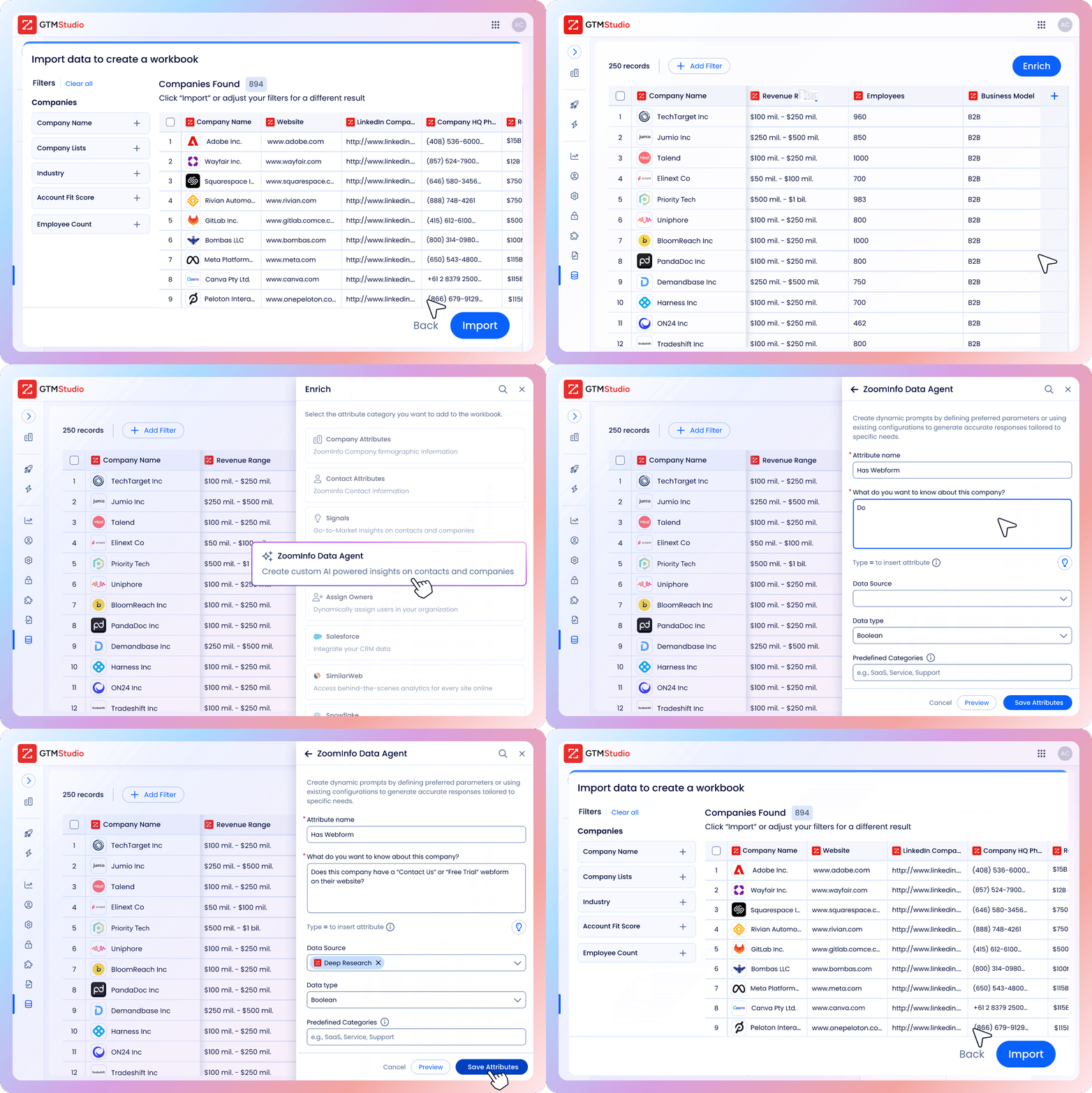
ZoomInfo is an all-in-one AI GTM Platform with more than 500 million verified contacts and 100 million companies powering go-to-market teams worldwide. ZoomInfo Sales combines verified business email data with company intelligence, technographics, and real-time intent data signals, giving revenue teams a unified data foundation for building accurate B2B email lists and identifying in-market buyers.
At the center of the platform is the GTM Context Graph, an intelligence layer that processes 1.5B+ data points daily, fusing B2B data with CRM records, conversation intelligence, and behavioral signals to reason about why accounts are in-market, not just what they look like. Sales teams don't just get email addresses. They get organizational charts showing decision-maker hierarchies, intent signals indicating which accounts are actively researching relevant solutions, and real-time alerts when trigger events like funding rounds, executive changes, or technology adoptions occur.
Through GTM Workspace, teams can move from prospect research to outreach in a single environment without switching between tools. GTM Workspace includes native AI agents that surface account insights, recommend contacts, and automate prospecting tasks, allowing sellers to prioritize the best opportunities rather than spending time on manual research. ZoomInfo data can also be accessed outside the platform through APIs and MCP (Model Context Protocol), allowing teams and AI agents to pull verified contact and company intelligence directly into other tools and workflows.
Named a Leader in the Gartner Magic Quadrant for ABM Platforms (2024, 2025) and a Leader in the Forrester Wave for Intent Data Providers B2B (Q1 2025, highest scores across 8 criteria). ZoomInfo maintains enterprise-grade compliance including GDPR, CCPA, SOC 2 Type II, ISO 27001, and ISO 27701 certification.
ZoomInfo Customer Outcomes:
Brown & Brown Insurance (pipeline acceleration): Booked meetings by 208% after combining intent data with verified contacts to focus outreach on in-market accounts.
CreditXpert (prospecting efficiency): Improved prospecting outcomes by using ZoomInfo's verified data to reach decision-makers faster. See the CreditXpert case study for details.
Outreach (connect rates): Increased connect rate 7x within weeks of switching to ZoomInfo's verified direct dials.
Redwood Logistics (cost and time savings): Cut CPC by 99% and saved 25 hours per week by replacing manual research with ZoomInfo's enrichment workflows.
Key Features
Use ZoomInfo in three core ways: Headless through GTM.AI, in the ZoomInfo UI, or via integration partners
Largest email database: 500M+ verified B2B contacts and 100M+ companies with continuous data refreshes to build up-to-date B2B mailing lists
Time your email well: Buyer intent signals and account-level insights that identify accounts actively researching solutions
Cultivate your list: Advanced segmentation using firmographic, technographic, and intent-based filters
Enrich your systems: Native CRM and sales engagement integrations with Salesforce, HubSpot, Outreach, and Salesloft
Leverage email addresses anywhere: API and MCP access for universal data delivery across tools and AI agents
Pricing
Free to start with consumption credits based on usage. Enterprise teams can scale into custom plans based on team size and data volume.
Pros
Largest verified B2B database (500M+ contacts, 120M+ direct dials, 200M+ verified business emails)
GTM Context Graph reasoning layer that fuses CRM, intent, conversation, and behavioral data
Native integrations with Salesforce, HubSpot, Outreach, and Salesloft with bidirectional sync
Enterprise compliance infrastructure (SOC 2 Type II, ISO 27001, ISO 27701, GDPR, CCPA)
Cons
Full platform value requires onboarding investment
Custom pricing requires a sales conversation
Request a demo to see how ZoomInfo fits your team's prospecting workflow.
2. Cognism
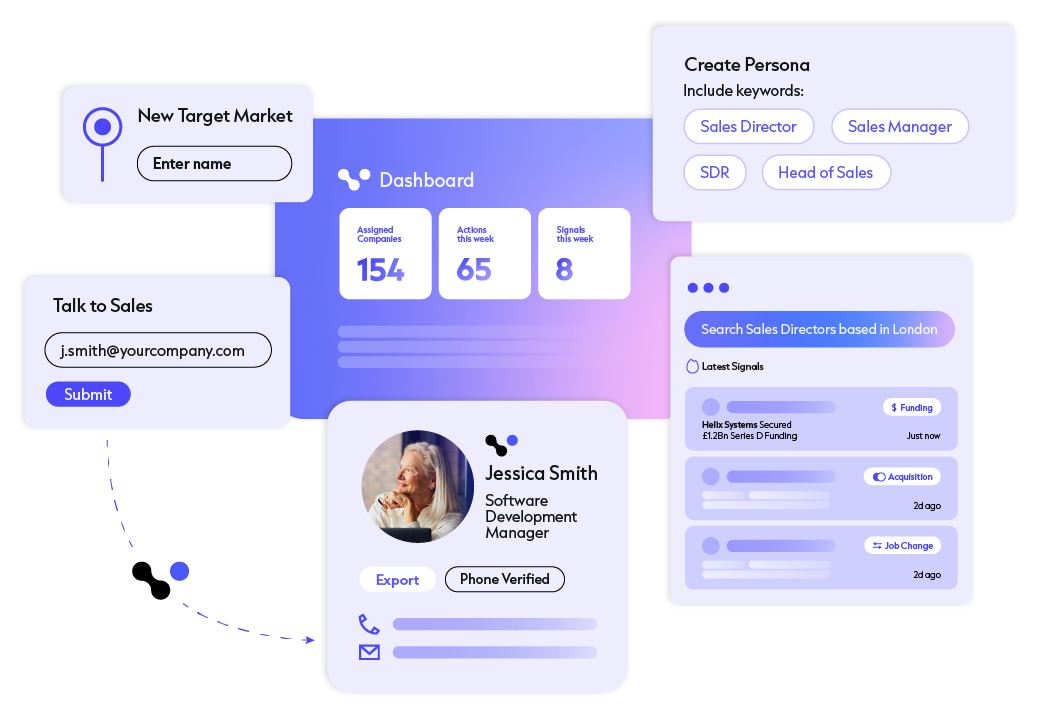
Cognism provides B2B contact data with international coverage and emphasis on compliance with global data privacy regulations. The platform is used by teams selling into EMEA and other non-US markets where data sourcing standards and lawful basis requirements differ significantly from North American norms.
Cognism provides phone-verified contact information for key European markets. The phone verification happens at the individual contact level, a meaningful differentiator in regions where direct-dial business lines are less standardized and mobile verification adds confidence to outreach. Cognism claims 87%+ accuracy on verified records within the Diamond set.
However, the scope is narrower than ZoomInfo's global verified data foundation (135M+ verified phone numbers, 120M+ direct dials, 45M+ international mobile numbers). For compliance teams evaluating email vendor relationships, Cognism provides transparent documentation on data sourcing methods and maintains enterprise-grade security certifications.
The platform integrates with major CRM platforms and sales engagement tools, enabling teams to access contact data within their existing workflows. Sales trigger alerts and intent data integration help teams identify optimal outreach timing.
Key Features
International B2B contact coverage with strong EMEA database depth
Phone-verified data for European markets
GDPR and CCPA-focused compliance framework with transparent data sourcing documentation
CRM and sales engagement integrations with Salesforce, HubSpot, and Outreach
Advanced filtering and prospecting interface
Sales trigger alerts for timing-based outreach
Pricing
Cognism uses quote-based pricing with two tiers (Standard and Pro). Verified data is included in the Pro tier.
Pros
Strong EMEA data coverage with phone-verified mobile numbers
GDPR-first compliance infrastructure with documented lawful basis
Phone verification rigor at the individual contact level
Cons
Smaller dataset scale than ZoomInfo's global verified data foundation
No conversation intelligence capability
No ABM motion or account-based orchestration
Quote-based pricing with no public tiers
How Cognism compares against ZoomInfo
Cognism's verified Data lands hardest with teams selling into EMEA who need phone-verified mobile numbers and GDPR-first compliance documentation.Okay
ZoomInfo's edge is ZoomInfo's global verified data foundation spans 135M+ verified phone numbers and 120M+ direct dials vs. Cognism's narrower EU-focused set, the GTM Context Graph reasoning layer that Cognism does not offer, and conversation intelligence via Chorus, which Cognism lacks entirely.
See the Cognism vs. ZoomInfo comparison for the full head-to-head.
3. Apollo
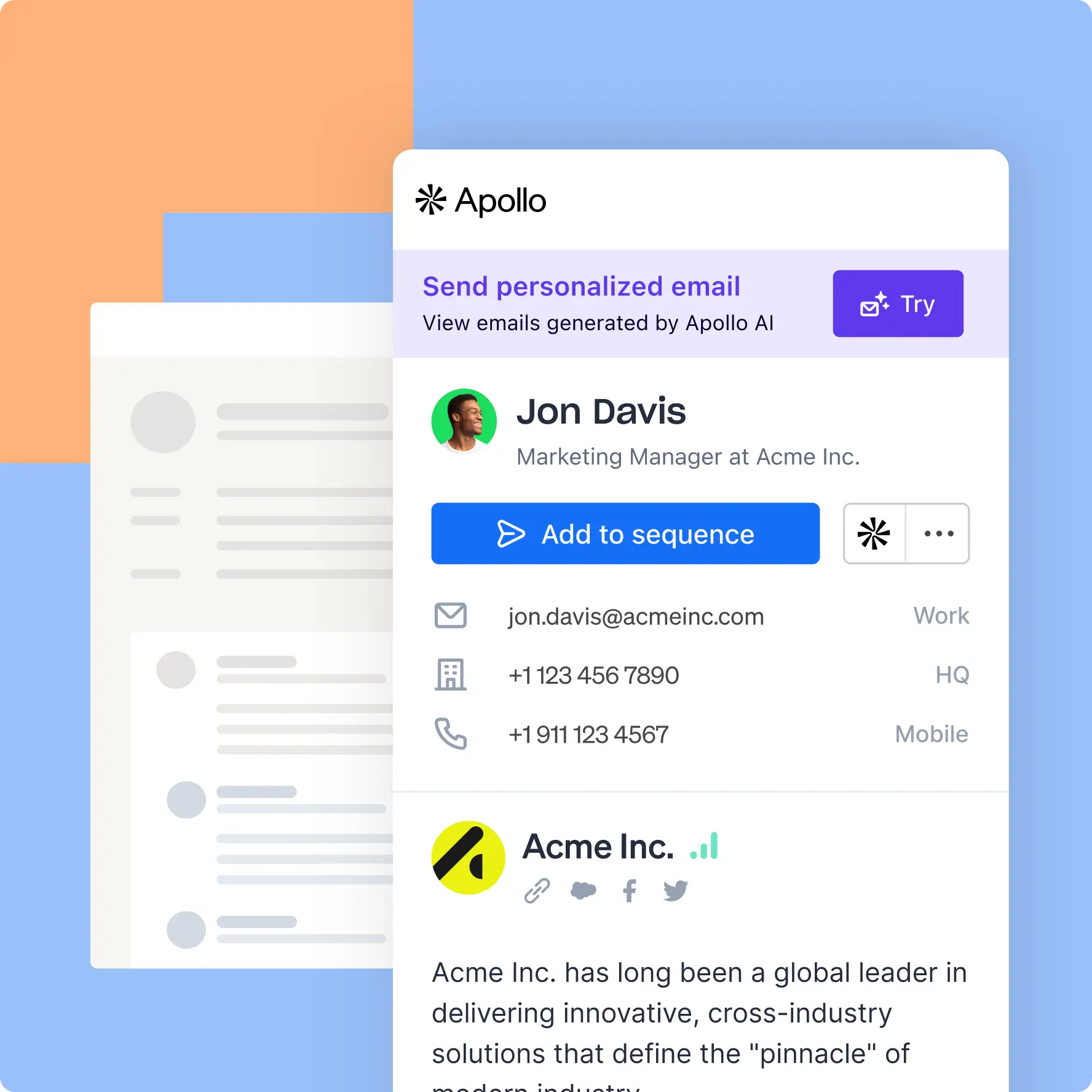
Apollo combines B2B contact data with outbound automation in a single platform. The all-in-one approach appeals to startups and growth teams looking to consolidate prospecting and email outreach without purchasing separate tools for sequencing, analytics, and engagement tracking.
Apollo's AI agents handle prospecting and outreach natively, including AI-drafted personalized emails and conversation summaries from synced calls. The agents have native access to Apollo's contact data without requiring data integration, but they do not reason across CRM, intent, conversation intelligence, and behavioral signals the way ZoomInfo's GTM Context Graph does.
The platform includes built-in email sequencing capabilities, allowing teams to automate multi-touch campaigns without additional software. Apollo offers deliverability tools including DMARC and DKIM configuration support to help teams maintain sender reputation. A free tier provides access to basic contact data and limited monthly credits, making it accessible for individual sellers and small teams evaluating B2B data platforms before committing to paid plans.
Apollo integrates with major CRM platforms and marketing tools, syncing contact data and engagement activity across systems.
Key Features
Large B2B contact database (~230M contacts) with email discovery and enrichment for B2B email marketing lists
AI agents for prospecting, outreach, and AI-drafted personalized emails
Built-in email sequencing and outbound automation for multi-touch campaigns
Deliverability tools including DMARC and DKIM configuration support
CRM and marketing tool integrations with Salesforce, HubSpot, and others
Free tier with basic contact access and limited monthly credits
Chrome extension for prospecting directly from LinkedIn and company websites
Pricing
Apollo offers a free tier with limited credits. Paid plans start at $49/user/month (Basic) with public tiered pricing.
Pros
All-in-one prospecting and sequencing in a single platform
Free tier for individual sellers evaluating the tool
Public per-seat pricing with no sales conversation required
Cons
Data accuracy weaker for EMEA and APAC contacts compared to US coverage
Thinner enterprise proof points than ZoomInfo or Cognism
No GTM Context Graph equivalent for cross-signal reasoning
How Apollo compares against ZoomInfo
Apollo's all-in-one positioning lands hardest with SMB and individual sellers who want public per-seat pricing and an integrated dialer in one tool.
ZoomInfo's edge is enterprise-grade verified-data scale (500M contacts vs. Apollo's ~230M), the GTM Context Graph reasoning layer Apollo's AI agents do not have, and deeper conversation intelligence via Chorus.
See the Apollo vs. ZoomInfo all-in-one platform comparison for the full head-to-head.
4. Lusha
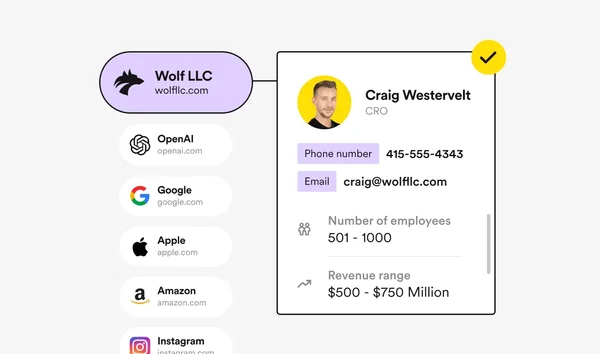
Lusha provides quick access to email addresses and B2B lists through a simple interface and browser extension. The platform is frequently used by individual sales reps for on-the-fly prospecting, particularly via LinkedIn, where speed of contact retrieval matters more than deep account intelligence.
The Chrome extension captures contact information directly from LinkedIn profiles and company websites with a single click. Lusha provides verified email addresses and direct-dial phone numbers for multi-channel outreach. The platform integrates with popular sales and marketing tools, allowing reps to save contacts directly to their database without manual data entry.
Lusha offers a freemium model with limited monthly credits, making it accessible for individual users testing the platform before committing to paid plans. Teams requiring advanced filtering, intent data, organizational intelligence, or enterprise-scale enrichment will find Lusha's capabilities more limited compared to full-platform providers.
Key Features
Chrome extension for LinkedIn prospecting and website contact capture
Verified email addresses and direct-dial phone numbers
Lusha MCP server for AI agent integration
Simple user experience designed for individual contributors
Freemium model with limited monthly credits for testing
Bulk enrichment capabilities for existing contact lists
API access for custom integrations and workflows
Pricing
Lusha offers a free tier. Paid plans start at $37.45/user/month (Starter) with fully public tiered pricing up to $299.95/month (Premium).
Pros
Public tiered pricing with a free tier for testing
MCP server for AI agent integration
Simple UX with minimal onboarding required
Cons
Smaller verified database than ZoomInfo's 500M contacts
Limited workflow orchestration compared to GTM Workspace
No conversation intelligence capability
How Lusha compares against ZoomInfo
Lusha's public tiered pricing and free tier make it the lowest-friction entry point for individual sellers and small teams who need fast LinkedIn prospecting.
ZoomInfo's edge is ZoomInfo's 500M verified contacts vs. Lusha's smaller database with lower verification rigor, ZoomInfo MCP exposes verified data plus GTM Context Graph signals (not just contact lookups), and GTM Workspace workflow orchestration that Lusha's simple search/enrich surface does not match.
See the Lusha vs. ZoomInfo comparison for the full head-to-head.
5. UpLead
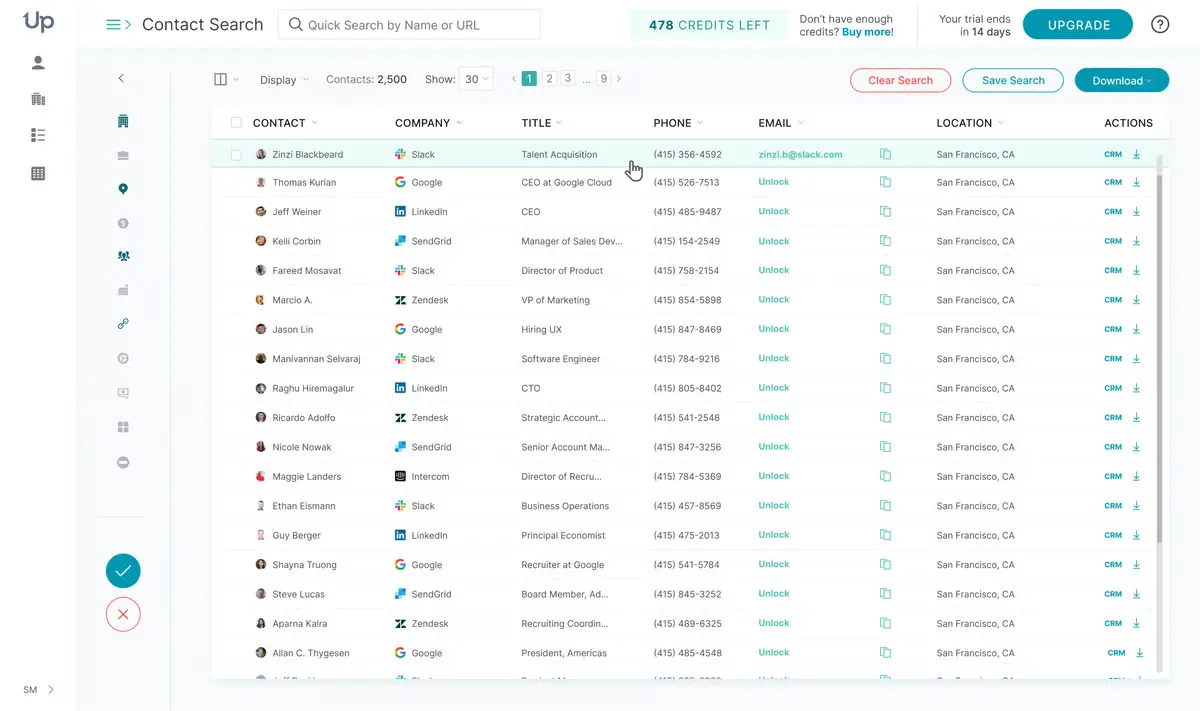
UpLead Prospector focuses on delivering verified B2B contact data with a strong emphasis on accuracy at the point of download. With over 180 million contacts in 200+ countries, the platform validates all emails in real time before a contact is exported, meaning teams only receive addresses that pass verification checks rather than discovering bounce issues after a campaign launches.
UpLead's real-time verification at download is a genuine strength for SMB teams that lack dedicated RevOps resources to run post-download hygiene workflows. UpLead backs this with a 95% data accuracy guarantee, offering credit refunds for any contacts that fail verification, a transparency signal that reflects confidence in their methodology. However, the platform has no GTM Context Graph, no conversation intelligence, and no website visitor tracking.
The platform includes firmographic and technographic filters that enable precise targeting based on company attributes and technology stack. Transparent credit-based pricing with no long-term contracts makes it accessible for teams with variable prospecting volumes. UpLead integrates with major CRM platforms including Salesforce, HubSpot, and Zoho, syncing contact data directly into existing workflows.
Key Features
Real-time email verification before download with a 95% data accuracy guarantee and credit refunds
180M+ contacts in 200+ countries
Firmographic and technographic filters for precise targeting
CRM integrations with Salesforce, HubSpot, and Zoho
Transparent credit-based pricing with no long-term contracts
Technology tracking showing software and tools companies use
Data enrichment for existing contact lists and CRM records
Pricing
UpLead starts at $99/month (Essentials) with public tiered pricing and no annual lock-in on lower tiers.
Pros
Real-time verification at the moment of download
95% accuracy guarantee with credit refunds for failed verifications
Transparent pricing with no long-term contracts
Cons
No GTM Workspace, GTM Studio, or Chorus equivalents
No intent data on lower pricing tiers
Enrichment fields capped at roughly 50 attributes
How UpLead compares against ZoomInfo
UpLead's transparent $99/month starting price and 95% accuracy guarantee with credit refunds make it the strongest value proposition for SMB teams that prioritize verification over platform breadth.
ZoomInfo's edge is ZoomInfo's 500M contacts vs. UpLead's 180M+, GTM Context Graph reasoning across CRM, intent, conversation, and behavioral signals that UpLead does not offer, and website visitor tracking (WebSights) that UpLead's own vs-page concedes it does not match.
Here's a head-to-head UpLead vs. ZoomInfo walkthrough.
6. Lead411
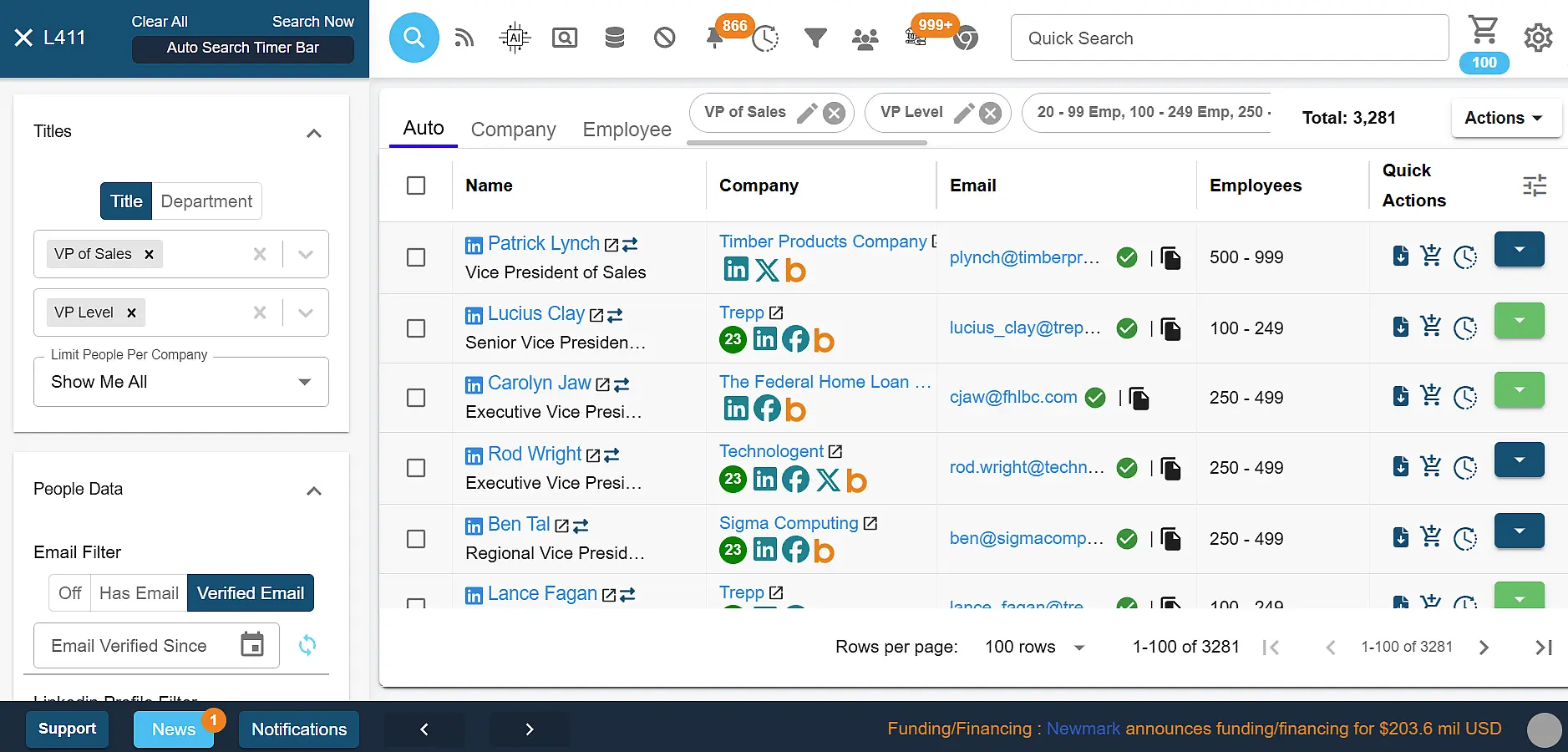
Lead411 pairs contact data, including B2B email leads, with sales triggers and intent indicators. The platform is designed to help outbound teams identify when accounts are more likely to engage, a meaningful shift from demographic-only targeting toward timing-based prospecting.
Lead411 uses triple-verified emails (SMTP, human, and ESP open validation) and claims 450M+ contacts and roughly 20M company profiles. Bombora buyer intent topics are bundled into plans, giving teams timing-based signals without a separate intent data contract. Growth intent triggers include funding announcements, executive changes, company growth indicators, and technology adoption signals.
Lead411 bundles Bombora content intent at a lower price than going direct to Bombora, but has no GTM Workspace, no conversation intelligence, and no MCP server. The platform provides verified email addresses and direct-dial phone numbers for multi-channel outreach. Unlimited email exports on certain plans appeal to high-volume prospecting teams. Lead411 integrates with major CRM systems and sales engagement platforms, syncing contact data and trigger alerts into existing workflows.
Key Features
Triple-verified emails (SMTP + human + ESP open validation)
450M+ contacts and ~20M company profiles
Bombora buyer intent topics bundled in plans
Sales trigger alerts including funding, executive changes, and growth signals
CRM connectivity with Salesforce, HubSpot, and Pipedrive
Unlimited email exports on select pricing plans
Technology tracking and technographic filtering
Pricing
Lead411 uses tiered pricing (Spark/Ignite/Blaze) with unlimited search and export on annual tiers. Per-tier dollar amounts are not publicly listed.
Pros
Triple-verification with 3-month re-verification cycles
Bundled Bombora intent data without a separate contract
Unlimited exports on annual plans
Cons
No GTM Workspace or GTM Studio equivalent
No conversation intelligence capability
Per-tier pricing not publicly transparent
How Lead411 compares against ZoomInfo
Lead411's bundled Bombora intent data and triple-verification with 3-month re-verification cycles appeal to outbound teams that want timing-based prospecting at a lower price point than enterprise platforms.
ZoomInfo's edge is ZoomInfo's 500M contacts vs. Lead411's 450M+, with ZoomInfo's continuous refresh pipeline processing 1.5B+ data points daily, GTM Workspace AI agent layer and GTM Studio that Lead411 does not offer, and conversation intelligence via Chorus, which Lead411 lacks.
7. Snov.io
Snov.io is a prospecting and email discovery platform that also includes verification and lightweight outreach functionality. The platform is commonly used by smaller teams and agencies that need combined discovery and campaign capabilities without the complexity or cost of enterprise-grade platforms.
Snov.io supports both individual contact lookup and bulk domain-based email searches, making it useful for teams working from defined target account lists. The platform includes email verification tools that check deliverability before sending, reducing bounce rates and protecting sender reputation. Email warm-up functionality helps teams gradually build sending reputation for new domains and email accounts, a practical feature for agencies launching outreach from fresh infrastructure.
Drip campaign capabilities allow teams to automate multi-touch sequences without purchasing separate engagement software. Snov.io integrates with CRM platforms and outreach tools, syncing contact data and campaign activity across systems. Campaign tracking monitors open rates, click rates, and reply rates to inform sequence optimization.
Key Features
Email discovery and verification with real-time deliverability checks
Domain-based searches for finding contacts at target companies
Email warm-up functionality for building sender reputation
Drip campaigns and cold email automation
CRM and outreach integrations with major platforms
Campaign tracking tools monitoring engagement metrics
Chrome extension for prospecting from LinkedIn and websites
Pricing
Snov.io offers a free trial with 50 credits. Paid plans start at $30/month (Starter) with public tiered pricing.
Pros
Combined discovery, verification, and outreach in one tool
Email warm-up for new domains and accounts
Affordable entry point for agencies and small teams
Cons
Smaller database than enterprise providers
Limited intent data capabilities
No phone data included
8. Hunter
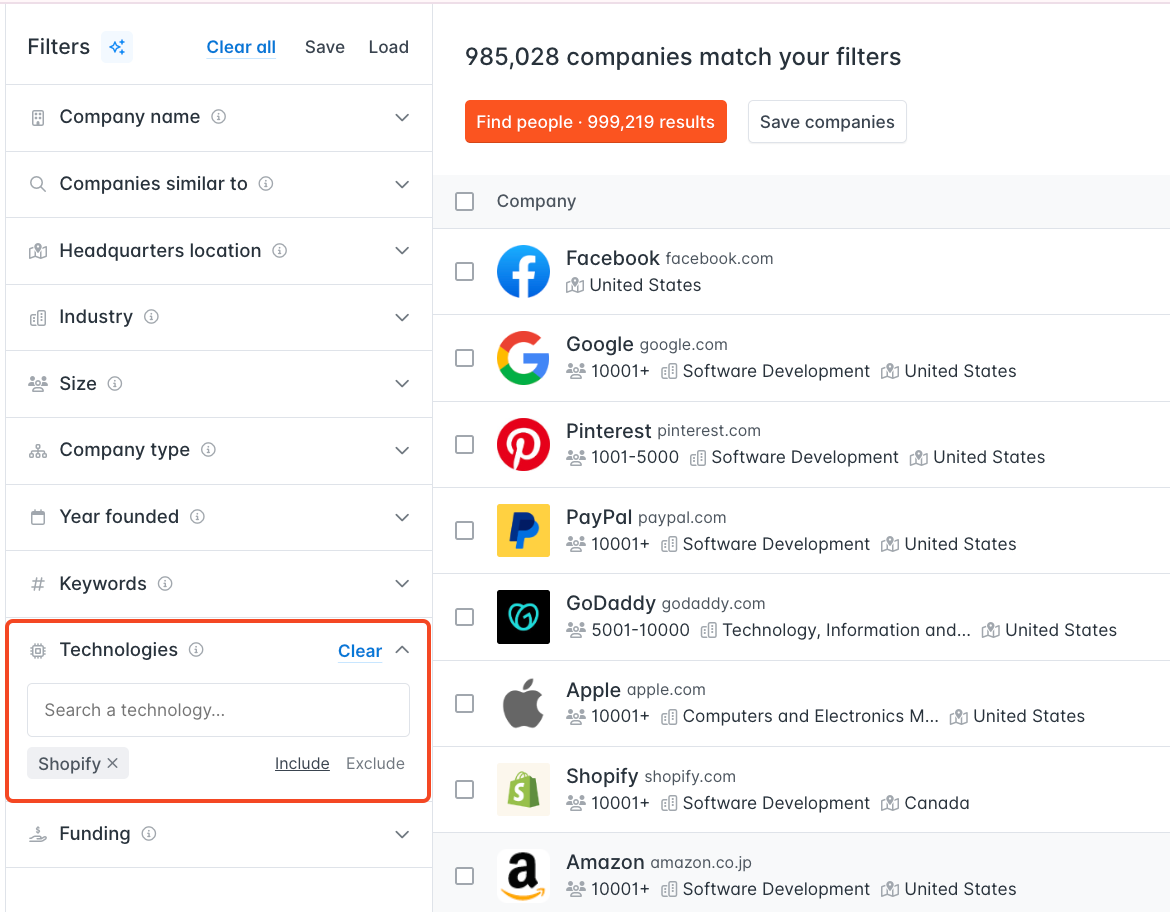
Hunter Email Finder specializes in finding and verifying email addresses associated with specific domains. The platform is widely used for lead generation, PR outreach, and account-based prospecting where teams already know their target companies and need to identify accurate email formats rather than discover new accounts.
Hunter searches a database of 100M+ public professional email addresses, using email pattern recognition to identify likely formats based on known contacts at a company. Each result includes a confidence score indicating the probability that the discovered email is valid, plus public-source attribution and discovery dates for every record. This public-source attribution per email is rare in the category, but the database is email-only (no phone, mobile, or technographic data) and 100M emails vs. ZoomInfo's 200M+ verified business emails.
Bulk verification capabilities allow teams to validate existing contact lists, identifying deliverable addresses and flagging risky or invalid emails before sending campaigns, a useful hygiene step for teams inheriting legacy databases. Hunter offers API access for developers building custom prospecting workflows. Failed lookups do not consume credits, a small but meaningful detail for teams running high-volume searches.
Key Features
Domain-based email discovery with pattern recognition
Auto-verification with confidence scoring
Public-source attribution and discovery dates per email
Bulk verification for validating existing contact lists
API access for custom integrations
Bulk search functionality for multiple domains simultaneously
Browser extension for finding emails on company websites
Pricing
Hunter offers a free tier (25 searches/month). Paid plans start at $34/month (Starter) with public tiered pricing.
Pros
Public-source attribution per email, rare in the category
Free tier available with failed lookups not consuming credits
Simple, focused tool for domain-based email discovery
Cons
Email-only: no phone, mobile, or technographic data
Public-web-scraped rather than enterprise contributor network
100M emails vs. ZoomInfo's 200M+ verified business emails
How Hunter compares against ZoomInfo
Hunter's free tier and public-source attribution per email make it the go-to tool for teams targeting specific companies with defined account lists who need domain-based email discovery.
ZoomInfo's edge is ZoomInfo's 200M+ verified business emails vs. Hunter's 100M+ public-web-scraped emails, ZoomInfo provides phone, mobile, technographic, and intent data that Hunter does not offer at all, and GTM Workspace workflow orchestration that Hunter's point-tool email finder does not match.
9. RocketReach
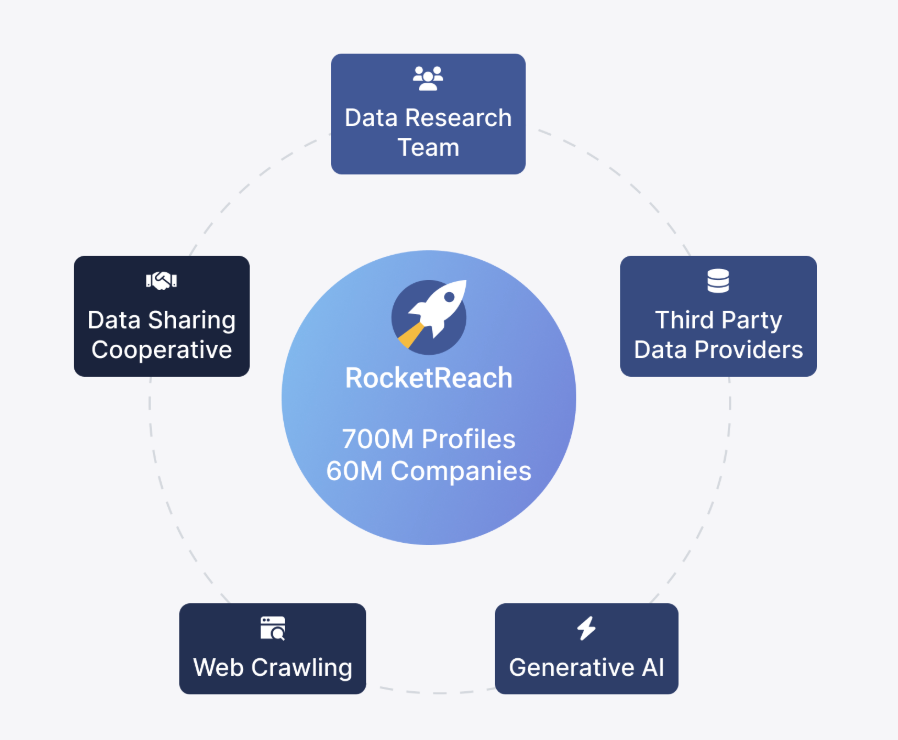
The RocketReach Platform helps users find work emails, phone numbers, and social profiles for professionals across industries. With over 700M+ verified professional profiles and 60M companies, the platform supports prospecting, recruiting, and partnership outreach, making it a practical option for organizations where multiple functions need contact data from a single source.
RocketReach includes native Messages, Sequences, and an AI Email Writer for outbound campaigns, plus B2B Intent Data via Intentsify covering 35K+ topics. The platform provides social profile discovery, linking email and phone data to LinkedIn, Twitter, and other professional networks. This multi-channel view is particularly useful for business development and recruiting use cases where relationship context matters alongside contact information.
RocketReach claims 700M+ contacts and adds native outreach and intent, but has no GTM Context Graph, no Chorus-equivalent conversation intelligence, and no MCP server. Bulk lookup capabilities allow teams to process large contact lists simultaneously. API access supports developers building custom workflows or integrating contact discovery into existing applications.
Key Features
700M+ verified professional profiles plus 60M companies
Native Messages, Sequences, and AI Email Writer
B2B Intent Data via Intentsify (35K+ topics)
Social profile discovery linking to LinkedIn, Twitter, and other networks
CRM and ATS integrations for sales and recruiting workflows
Browser extension for prospecting from LinkedIn and websites
Bulk lookup capabilities and API access
Pricing
RocketReach starts at $25/seat/month (Essentials) with public tiered pricing. Custom plans start at $6K/year.
Pros
Large database spanning sales, recruiting, and partnerships
Bundled outreach with native sequences and AI email writer
Niche depth in healthcare and recruiter verticals
Cons
No GTM Context Graph for cross-signal reasoning
No conversation intelligence equivalent
No MCP server or AI agent marketplace presence
10. D&B Hoovers
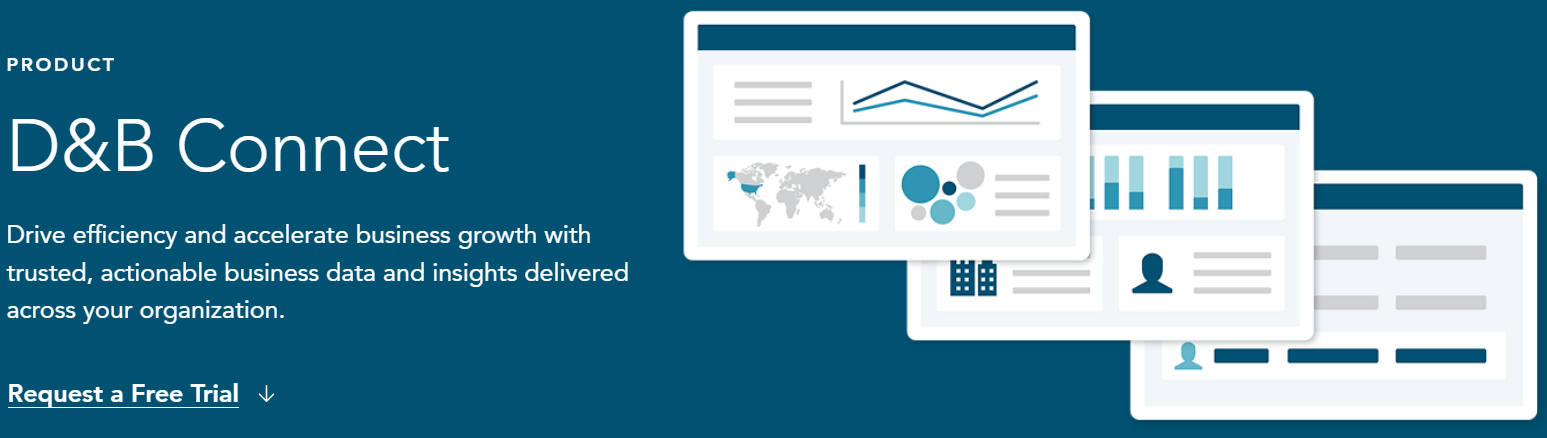
The D&B Hoovers Platform combines extensive company intelligence with executive contact data, drawing on Dun & Bradstreet's nearly 200 years of business information collection. The platform is typically used by enterprise teams focused on account research and strategic prospecting where firmographic depth and business hierarchy data matter as much as individual contact details.
D&B Hoovers provides 330M+ companies and 520M+ contacts, AI-powered Prospect Scoring against ICP criteria, 175+ filters, and the D-U-N-S Number as a unique business identifier. The D-U-N-S Number is particularly valuable for teams that need corporate hierarchy data and government-contracting compliance verification. Global coverage with international business intelligence makes it relevant for enterprise teams with complex, multi-market account strategies.
D&B Hoovers draws on nearly 200 years of business data heritage and the D-U-N-S Number, but multiple Gartner reviewers flag data freshness and accuracy issues, including reports of around 70% data accuracy. The platform has no GTM Workspace, no conversation intelligence, and no MCP server. The platform integrates with major CRM platforms and analytics tools, syncing company intelligence and contact data into existing workflows.
Key Features
330M+ companies and 520M+ contacts with global business coverage
AI-powered Prospect Scoring against ICP criteria
D-U-N-S Number as unique business identifier
175+ filters for advanced search and segmentation
Business intelligence and financial data for account research
Company relationship and ownership information
CRM integrations with enterprise platforms
Vertical add-ons for healthcare and technology
Pricing
D&B Hoovers offers a self-serve SMB tier at $49/month (Essentials) with a first-month-free trial. Enterprise pricing is fully gated.
Pros
Nearly 200 years of data heritage with the D-U-N-S Number
Strong corporate hierarchy and parent-subsidiary data
Vertical add-ons for healthcare and technology verticals
Cons
Gartner-reported ~70% data accuracy raises freshness concerns
No conversation intelligence equivalent to Chorus
No GTM Workspace, GTM Studio, or MCP capabilities
How D&B Hoovers compares against ZoomInfo
D&B Hoovers' nearly 200-year data heritage and the D-U-N-S Number make it the default choice for enterprise teams that need corporate hierarchy data and government-contracting compliance verification.
ZoomInfo's edge is ZoomInfo's verified data accuracy vs. D&B Hoovers' Gartner-reported ~70% accuracy, GTM Context Graph reasoning across CRM, intent, conversation, and behavioral signals that D&B Hoovers does not offer, and conversation intelligence via Chorus, which D&B Hoovers lacks entirely.
Here's a D&B Hoovers vs. ZoomInfo walkthrough.
11. Seamless.AI
Seamless.AI uses AI-driven search to discover contact details in real time. Rather than querying a static database, the platform uses AI to find current contact information at the moment of search, an approach designed to surface more current data for sales reps during active prospecting sessions.
The platform offers browser-based prospecting tools for discovering contacts directly from LinkedIn and company websites. Seamless.AI integrates with CRM platforms, syncing discovered contacts into existing workflows. Real-time data enrichment updates contact records with current information as users access them, rather than relying on periodic batch updates.
Seamless.AI functions well as a supplementary data source alongside primary CRM workflows, particularly for reps who need to quickly enrich individual records during outreach preparation. Teams requiring enterprise-scale list building, deep intent data, or compliance documentation should evaluate whether Seamless.AI's real-time discovery model meets their volume and governance requirements.
Key Features
AI-powered contact discovery with real-time search
Real-time data enrichment updating contact records dynamically
Browser-based prospecting tools for LinkedIn and websites
CRM integrations for syncing contact data
Browser extension for prospecting without leaving workflow
List building capabilities for creating targeted prospect lists
Automated lead discovery based on targeting criteria
Pricing
Seamless.AI offers a free tier with limited credits. Paid plans are not publicly listed; pricing requires a sales conversation.
Pros
Real-time AI search surfaces current contact information
Chrome extension for in-workflow prospecting
Useful as a supplementary enrichment source
Cons
No published pricing or public tiers
Limited intent data capabilities
Compliance documentation unclear compared to enterprise providers
How We Evaluated These Best B2B Email List Providers
We evaluated each email provider against these criteria using hands-on testing, customer interviews, and analysis of G2 reviews from verified users. Evaluation current as of Q2 2026.
Each B2B email list provider in this guide was assessed against a consistent set of criteria that reflect what revenue teams actually need from a B2B data provider. Database size alone is not a reliable quality signal. A smaller, well-verified database consistently outperforms a larger one with high decay rates.
Before committing to any provider, request an ICP-matched sample of 200+ contacts (not a generic demo sample) and run them through an independent verification tool. Providers who refuse to provide targeted samples are a red flag.
Our evaluation framework covers:
Data accuracy and verification methodology: How emails are validated, how frequently records are refreshed, and how catch-all domains and role-based addresses are handled.
Targeting and segmentation depth: Availability of intent, firmographic and technographic filters beyond basic job title and industry.
CRM and sales engagement integrations: Native connectors, sync frequency, and bidirectional data flow with tools like Salesforce, HubSpot, Outreach, and Salesloft.
Compliance infrastructure: GDPR, CCPA, and CAN-SPAM adherence; data sourcing transparency; opt-out and suppression handling.
Intent and signal data: Whether the platform surfaces buying signals, trigger events, and account-level activity, not just static contact records.
Ideal use case fit: Team size, market focus, and workflow complexity each affect which platform delivers the most value.
Results vary by team size, target market, and existing tech stack. Use this guide as a starting framework, then test accuracy against your specific ICP before committing.
What B2B Email List Providers Actually Do
B2B contact data platforms deliver verified business contact information (professional email addresses, direct-dial phone numbers, job titles, and company intelligence) to sales, marketing, and revenue operations teams. Modern providers go well beyond static list exports. They combine continuously refreshed contact data with buyer intent signals, technographic insights, and native CRM integrations.
This enables teams to identify high-potential accounts, prioritize outreach based on real-time buying signals, and execute targeted multi-channel campaigns without relying on lists that decay the moment they are downloaded.
The distinction between a data provider and a data platform matters. A static list purchased once and imported into a CRM begins degrading immediately. A 10,000-contact database loses roughly 2,500 valid records per year without continuous refresh, meaning 208 bad contacts enter your outreach queue every month. A dynamic platform continuously re-validates records, surfaces new contacts, and enriches existing ones as circumstances change.
Catch-all domains accept email to any address format, making them appear valid during verification but frequently resulting in bounces. Providers that do not distinguish catch-all addresses from verified addresses inflate their accuracy metrics. When evaluating any provider's accuracy claims, ask specifically how catch-all domains are classified.
Core capabilities to look for include:
Verified B2B email addresses: Continuously validated contact data that reduces bounce rates and protects sender reputation. Look for providers that distinguish between verified, catch-all, and risky addresses rather than treating all records equally.
Firmographic and technographic data: Company attributes and technology stack information that enable precise targeting and personalization at scale.
CRM and sales engagement integrations: Native connections with CRMs and sales engagement platforms that keep contact data synchronized across your revenue tech stack without manual CSV imports.
Data enrichment and contact validation: Automated hygiene workflows that maintain database accuracy through continuous enrichment without requiring manual effort from RevOps teams.
Compliance with data privacy regulations: GDPR, CCPA, and CAN-SPAM adherence, including lawful basis documentation, suppression list management, and opt-out handling, that protects your business from legal and financial risk.
When integrated properly into a go-to-market stack, these platforms become the data backbone for pipeline generation, not just a source of email addresses.
Why Modern B2B Data Platforms Go Beyond Static Lists
The fundamental limitation of a one-time list purchase is that it captures a single moment in time. Decision-makers change roles, companies get acquired, and technology stacks evolve, all of which affect whether a contact is still relevant, reachable, and in-market.
Modern platforms address this by delivering continuously refreshed data with intent signals and CRM integrations that reflect current buyer behavior.
For SDRs running high-volume sequences, stale data means bounced emails and damaged domain reputation. For AEs preparing discovery calls, it means wasted research time on contacts who left the company months ago.
High-quality, dynamic contact data directly impacts revenue team performance across several dimensions:
Faster buyer access: Reach decision-makers without manual research delays or outdated contact records.
Personalized outreach: Use accurate firmographic and role data to tailor messaging to the right stakeholder at the right moment.
Protected sender reputation: Reduce bounced emails that damage deliverability scores and trigger spam filters.
Automated data hygiene: Maintain CRM accuracy through continuous enrichment and validation rather than periodic manual cleanses.
Are B2B Email Lists Legal? Compliance and Data Sourcing
Accessing a compliant B2B data platform with documented lawful basis is legal. Buying a static list from an unvetted broker carries legal risk because the buyer assumes data sourcing liability with no visibility into how contacts were collected, whether consent was obtained, or whether suppression requests have been honored.
The distinction matters for every team evaluating B2B email list providers.
GDPR lawful basis for B2B prospecting: Under GDPR Article 6(1)(f), legitimate interest can serve as a lawful basis for B2B outreach, but the data controller must document the balancing test and honor opt-out requests promptly. Providers operating in EU markets should supply this documentation on request.
CCPA requirements for California contacts: The California Consumer Privacy Act gives contacts the right to know what data is collected, request deletion, and opt out of sale. Your provider must maintain suppression lists and process deletion requests within the statutory window.
CAN-SPAM compliance for outbound email: Every commercial email must include a physical address, a clear unsubscribe mechanism, and honest subject lines. Your provider's data does not exempt you from these requirements.
What to ask your vendor before purchasing:
Can you document the lawful basis for every contact record in your database?
Do you maintain real-time suppression lists that sync with my CRM?
What certifications do you hold (SOC 2 Type II, ISO 27001, ISO 27701)?
How do you handle GDPR deletion requests, and what is your response time?
Will you provide a compliance attestation letter for my legal team?
ZoomInfo maintains SOC 2 Type II, ISO 27001, ISO 27701, GDPR, and CCPA compliance infrastructure with documented data sourcing methodology. For teams where procurement or legal review is part of the buying process, this documentation reduces vendor risk assessment timelines.
How to Choose the Right B2B Email List Provider
Selecting the right provider means finding a data partner that aligns with your team's specific goals, workflow, target market, and budget. Database size is a starting point, not a decision criterion. A provider with 700 million contacts but poor verification methodology will consistently underperform a smaller, well-maintained database with real-time validation among B2B data providers.
The best platform delivers high-quality B2B data that helps your team hit pipeline targets without wasting time on manual research, bad contacts, or compliance exposure.
Data Accuracy and Verification Methodology
A large list of unverified contacts wastes time and damages your sender reputation. Poor data quality affects deliverability scores, reduces engagement rates, and forces reps to spend hours manually validating contacts before outreach, time that should be spent selling.
When evaluating providers, go beyond headline accuracy claims and ask about methodology. How does the provider handle catch-all domains, where any email address at a company appears valid but many bounce? How are role-based addresses (info@, sales@) classified? What is the average data refresh cadence, and how does the provider measure decay rates across their database?
Evaluate providers based on these accuracy factors:
Look for providers offering accuracy guarantees with credit replacement for contacts that fail verification
Verify how frequently the database is refreshed and how decay is monitored and addressed
Check whether email verification happens in real time before download or as a batch process after export
Understand how catch-all domains and risky addresses are flagged versus verified addresses
Request data samples matching your target account profile and test accuracy against your own ICP before purchasing
Targeting and Segmentation Depth
The ability to build precise target lists determines whether you are reaching decision-makers or wasting outreach on irrelevant contacts. Advanced filtering capabilities using firmographic, technographic, and intent-based criteria enable teams to focus on accounts that genuinely match their ideal customer profile, not just companies in the right industry or size range.
Teams that layer intent signals on top of firmographic filters see meaningfully better engagement rates because they are reaching buyers who are already in-market, not just theoretically a good fit.
Evaluate segmentation capabilities beyond basic job title and industry filters:
Evaluate firmographic filters including company size, revenue, location, and industry
Check for technographic data showing what software and tools companies use
Look for intent signals indicating which accounts are actively researching solutions
Assess whether the platform provides organizational charts and decision-maker hierarchies
Prioritize dynamic data platforms over vendors selling static lists. Static email lists decay rapidly and lack the continuous updates and intelligence that modern revenue teams require.
Integration Depth and CRM Sync Quality
The value of any B2B data provider collapses if the data cannot flow cleanly into your existing workflow. When evaluating integration depth, look beyond "we integrate with Salesforce" and ask specific questions:
Does the integration support bidirectional sync (data flows from the provider to your CRM and back), or is it unidirectional (provider to CRM only)?
What is the sync frequency? Real-time, hourly, or daily batch?
How does the platform handle field mapping? Can you map provider fields to custom CRM fields, or are you locked into a default schema?
How are duplicate records handled? Does the integration merge, skip, or create duplicates when a contact already exists in your CRM?
Bidirectional sync matters because your CRM contains context (deal stage, last activity, owner) that the data provider does not have. Platforms that can read CRM context and adjust enrichment accordingly reduce manual cleanup for RevOps teams.
Email Deliverability and Sender Reputation
Your email bounce rate is the canary in the coal mine for data quality. Most email service providers flag accounts that sustain bounce rates above 2%, and repeated violations can land your domain on blocklists that take weeks to resolve.
The cascade is straightforward: bad data leads to bounced emails, bounced emails damage domain reputation, damaged reputation reduces deliverability across all outreach (not just the bad contacts), and reduced deliverability kills pipeline. For SDRs running high-volume sequences, this is not an abstract risk. It is the difference between 500 emails landing in inboxes and 500 emails landing in spam.
When evaluating providers, ask how they handle catch-all domains, how frequently they re-verify existing records, and whether they offer suppression list integration to automatically exclude known-bad addresses from exports.
Intent Data and Buying Signals
Not all intent data is created equal. When evaluating B2B data providers, distinguish between:
First-party intent (signals from your own website, content, and product usage) vs. third-party intent (signals from external content consumption and research behavior)
Topic-level intent (account is researching "sales engagement") vs. keyword-level intent (account is searching for "Outreach vs. Salesloft pricing")
Account-level signals (the company is showing intent) vs. contact-level signals (a specific person at the company is showing intent)
The difference between these signal types determines whether your outreach is timely and relevant or generic and ignored. Outreach increased their connect rate 7x after switching to ZoomInfo's verified data and signal-based targeting, proof that signal-based targeting outperforms volume-based prospecting.
B2B Email List Provider Comparison Table
Here is how the top B2B email list providers compare across key evaluation dimensions:
Platform | Database Coverage | Key Strength | Best For | Pricing Model | Free Trial |
|---|---|---|---|---|---|
ZoomInfo | 500M+ contacts, 100M+ companies | GTM Context Graph: intent reasoning and organizational intelligence at enterprise scale | Enterprise RevOps teams needing verified data, intent signals, and GTM automation | Free to start with consumption credits based on usage | Yes |
Cognism | Global B2B database with strong EMEA coverage | Phone-verified Diamond Verified Data and GDPR compliance | Teams selling into EMEA markets with strict compliance requirements | Custom/enterprise | No |
Apollo | ~230M contacts | All-in-one prospecting with built-in AI agents and sequencing | Growth-stage teams consolidating prospecting and outreach | Free tier available | Yes |
Lusha | Business contact database | Browser extension and MCP server for fast LinkedIn prospecting | Solo SDRs and small teams needing quick contact retrieval | Credit-based (public) | Yes |
UpLead | 180M+ contacts | Real-time email verification before download with 95% accuracy guarantee | SMB teams prioritizing data accuracy over platform breadth | Subscription (public) | Yes |
Lead411 | 450M+ contacts, ~20M companies | Bundled Bombora intent and triple-verified emails | Outbound teams focused on timing-based prospecting | Custom/enterprise | No |
Snov.io | Email discovery platform | Email discovery with verification, warm-up, and drip campaigns | Agencies and small teams needing combined discovery and outreach | Credit-based (public) | Yes |
Hunter | 100M+ public professional emails | Public-source attribution and domain-based email pattern recognition | Teams targeting specific companies with defined account lists | Credit-based (public) | Yes |
RocketReach | 700M+ professionals | Native outreach sequences and multi-function coverage | Multi-function teams spanning sales, recruiting, and partnerships | Subscription (public) | No |
D&B Hoovers | 330M+ companies, 520M+ contacts | D-U-N-S Number and nearly 200 years of business data heritage | Enterprise teams needing corporate hierarchy and government compliance data | Subscription (public) | Yes |
Seamless.AI | Real-time AI search | AI-powered contact discovery with Chrome extension | Sales reps needing supplementary real-time data enrichment | Custom/enterprise | Yes |
Frequently Asked Questions About B2B Email List Providers
Is buying a B2B email list legal?
Accessing a compliant B2B data platform with documented lawful basis (GDPR Article 6, CCPA) is legal. Buying a static list from an unvetted broker carries legal risk because the buyer assumes data sourcing liability with no visibility into how contacts were collected. Look for vendors with SOC 2 Type II, GDPR, and CCPA compliance documentation before you buy a B2B email list from any source.
What is the most accurate B2B contact database?
Accuracy depends on verification methodology, not database size. ZoomInfo processes 1.5B+ data points daily through continuous refresh and maintains 500M+ verified contacts. Outreach increased their connect rate 7x after switching to ZoomInfo's verified data. Look for B2B email list providers that distinguish between verified, catch-all, and risky addresses and offer accuracy guarantees with credit replacement.
How quickly does B2B contact data decay?
B2B contact data decays at roughly 25% per year due to job changes, company restructuring, and email domain migrations. A 10,000-contact database loses roughly 2,500 valid records per year without continuous enrichment. Dynamic platforms that continuously re-validate records outperform static lists that begin degrading the moment they are downloaded.
What is the difference between a B2B email list and a B2B data platform?
A B2B email list is a static file of contacts that begins decaying immediately after download. A B2B contact data platform continuously refreshes records, surfaces intent signals, integrates with CRMs, and enriches existing data through dynamic data pipelines. The platform model reduces bounce rates, protects sender reputation, and keeps outreach targeting current.
How do I evaluate a B2B email list provider before purchasing?
Request a sample of 200+ contacts matching your exact ICP (not a generic sample) and run them through an independent email verification tool. Evaluate verification methodology, data refresh cadence, catch-all domain handling, CRM integration depth, and compliance documentation. Providers who refuse to provide ICP-matched samples are a red flag. Request a demo from your top candidates and test accuracy against your specific workflow before committing.