
BlueConic has earned its place as a Customer Growth Engine for B2C brands. It combines a real-time customer data platform with AI-driven decisioning (Agent Studio) and interactive data capture (Experiences by Jebbit). For mid-market retail, ecommerce, and CPG brands, it delivers real-time unified profiles, pre-built Growth Plays, and cross-channel activation from a single platform.
But as your data infrastructure matures, your channels expand, or your team's technical skills grow, BlueConic's architecture can create friction. It cannot send messages natively, so every campaign still routes through a separate ESP. Its enterprise-only pricing, with no published rates and no self-serve evaluation path, makes cost modeling difficult before a sales conversation. Its web-first JavaScript tag can miss signals from mobile apps, server-side events, and environments where ad blockers interfere. And its profile schema handles standard B2C behavioral data well but can require heavy transformation when your data model includes product hierarchies, household structures, or warehouse-based ML outputs.
This guide covers platforms that fill those gaps, whether you need to:
Enrich your go-to-market intelligence with B2B data, intent signals, and AI-powered prospecting
Orchestrate enterprise-scale data collection across multi-cloud, multi-region environments with 1,300+ integrations
Consolidate your CDP and ESP into a single platform with native multichannel campaign execution
Combine a customer data platform with native email, SMS, and push delivery at transparent pricing
Instrument developer-first data collection with schema governance and a self-serve free tier
Build a mobile-first data foundation with app SDK coverage and configurable cross-device identity resolution
Activate customer data directly from your existing data warehouse without duplicating it into a separate CDP
This is not about finding a "better" platform than BlueConic. It is about finding the right fit for your data infrastructure, team capabilities, and growth requirements. Some organizations will use these tools alongside BlueConic to fill specific gaps; others will find a more complete match for their needs.
The Best BlueConic Alternatives
Best Alternative for B2B Go-to-Market Intelligence and Data-Driven Prospecting We chose ZoomInfo because it delivers what no B2C-focused CDP can: B2B data covering 500M contacts and 100M companies, intent signals, and AI-powered prospecting through the GTM Context Graph. |
|---|
Best Alternative for Enterprise Multi-Cloud Data Orchestration We chose Tealium because its 1,300+ integrations, server-side event collection, warehouse-native activation, and multi-region data residency cover organizations with mixed martech stacks and strict compliance requirements. |
Best Alternative for B2C Ecommerce Brands Needing Native Multichannel Execution We chose Bloomreach because it fills BlueConic's most cited gap: it combines a CDP with native email, SMS, WhatsApp, and push delivery, plus commerce-specific AI that connects product catalog data directly to recommendations and messaging. |
Best Alternative for Ecommerce Brands Seeking Integrated CDP and Execution at Accessible Pricing We chose Klaviyo because it combines an ecommerce CDP with native email, SMS, push, and WhatsApp execution at transparent, contact-volume-based pricing, including a free tier that BlueConic's enterprise-only model does not offer. |
Best Alternative for Developer-First Data Collection and Accessible Entry Pricing We chose Segment because its API-native architecture, 750+ integrations, schema governance (Protocols), and self-serve free tier give engineering-led teams a way to validate a CDP against production data before committing a budget. |
Best Alternative for Mobile-First Brands Where the App Is the Business We chose mParticle because its native mobile SDKs, configurable identity resolution framework (IDSync), and server-side event streaming architecture are built for brands where mobile apps generate the majority of revenue events. |
Best Alternative for Warehouse-Native CDP Activation We chose Hightouch because it activates customer data directly from Snowflake, Databricks, or BigQuery without duplicating it into a separate CDP, keeping the data warehouse as the single source of truth while giving marketers self-serve audience tools. |
What is BlueConic?
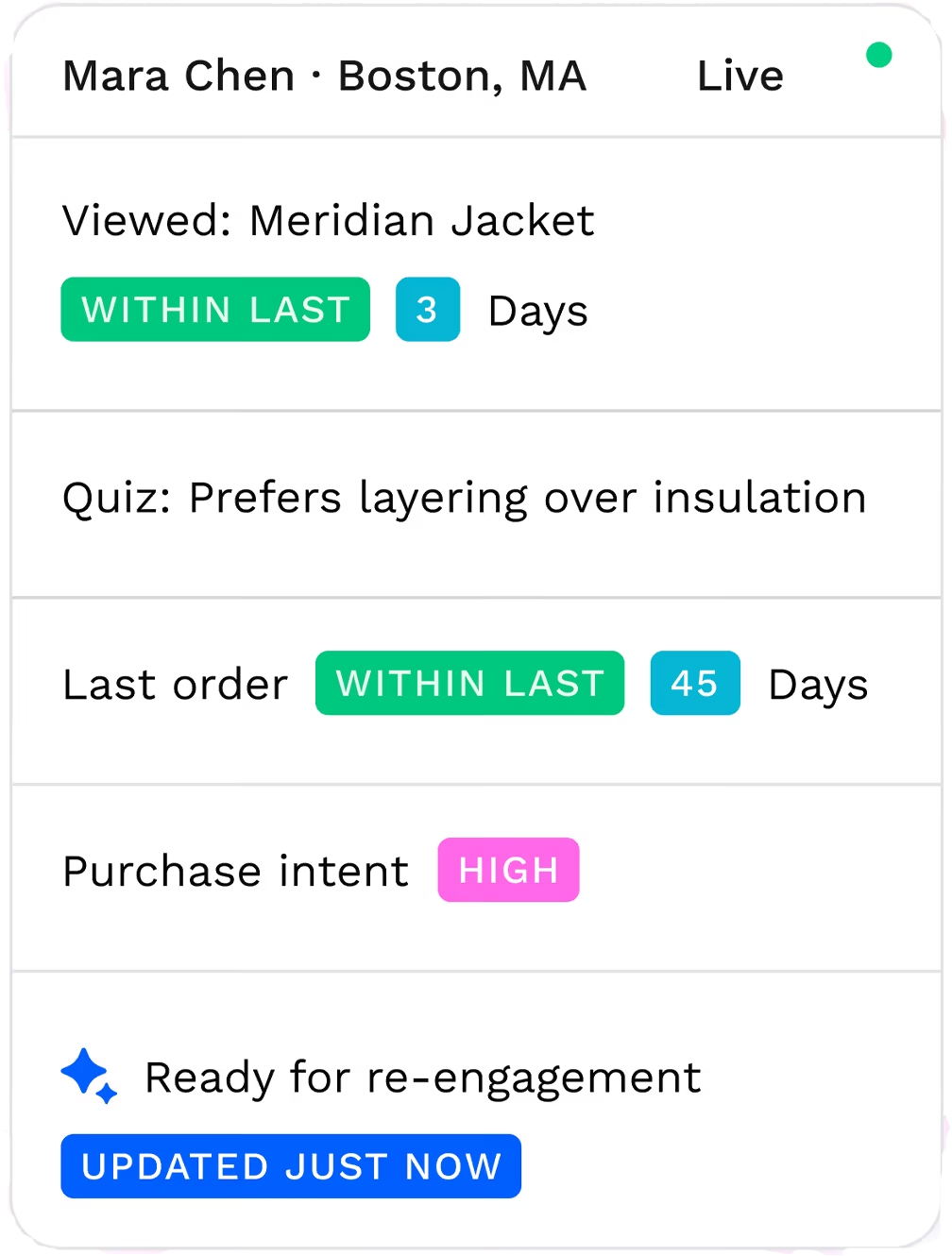
Source: BlueConic
BlueConic is a Customer Growth Engine for B2C brands, built around a real-time customer data platform with AI-driven agents and cross-channel activation. Founded in the Netherlands in 2010 and now headquartered in Boston, BlueConic serves over 500 brands including Express, L'Oreal, Heineken, ASICS, and Unilever.
Its key features include:
Real-time unified customer profiles that update in sub-seconds as behavior happens across channels, including for anonymous visitors
Agent Studio with Build, Decisioning, and Measurement agents that execute, coordinate, and optimize growth strategies across customers and channels
Interactive Experiences by Jebbit for capturing declared (zero-party) data through quizzes, product finders, and preference centers built into the CDP
150+ pre-built integrations across ESPs, ad platforms, CRMs, and data warehouses including Klaviyo, Braze, Meta, Google, Salesforce, and Snowflake
14+ pre-built Growth Plays covering identity building, commerce growth, and retention, with a stated commitment to measurable revenue outcomes within 90 days
AI Workbench with Python notebooks for custom ML models, CLV scoring, churn propensity, and recommendation algorithms
When a customer converts in one channel, BlueConic fires suppression everywhere simultaneously rather than waiting for each channel's own sync schedule. The CDP, interactive data capture, and agent decisioning operate from a single live profile, keeping all connected tools aligned.
However, BlueConic has limitations that lead teams to explore alternatives.
It does not send emails, SMS, or push notifications natively, so every campaign routes through a separate ESP. Its pricing is enterprise-only with no published rates or self-serve evaluation path. Its identity resolution leans on email address as the primary identifier, which leaves profile gaps when customers interact across devices without providing an email. And its web-first JavaScript tag architecture can miss signals in environments affected by ad blockers or iOS privacy restrictions.
That is why we focused on platforms that fill these gaps, whether you need B2B intelligence, enterprise-grade data orchestration, native message delivery, accessible pricing, developer-first tooling, mobile-first architecture, or warehouse-native activation.
Looking for B2B intelligence to power your go-to-market strategy? ZoomInfo combines B2B data covering 500M contacts and 100M companies, the AI-powered GTM Context Graph, and access through APIs, MCP, GTM Workspace, and GTM Studio. Learn more about ZoomInfo.
How We Curated Our List of BlueConic Alternatives
After evaluating BlueConic and researching the customer data platform market, we found that BlueConic's B2C-focused, enterprise-only approach does not work for all organizations, specifically:
B2B go-to-market teams that need contact and company intelligence, buyer intent signals, and AI-powered prospecting rather than consumer profile unification
Global enterprises running mixed martech stacks across multiple clouds and regions that need more than 150 integrations and multi-region data residency
B2C ecommerce brands that want to consolidate their CDP and ESP into a single platform with native multichannel campaign execution
Growth-stage ecommerce brands that need CDP functionality with native message delivery at transparent pricing
Engineering-led teams that want to validate a CDP against production data before committing budget, with schema governance built into the data collection layer
Mobile-first brands where apps generate the majority of revenue events and need native SDK coverage with configurable cross-device identity resolution
Data-warehouse-centric organizations that want to activate customer data directly from Snowflake or Databricks without duplicating it into a separate profile store
Each tool on this list leads in one of these areas. You might use them alongside BlueConic to fill capability gaps, or switch to them entirely depending on your needs.
DISCLAIMER: We aren't covering every single customer data platform on the market! Our focus is on highlighting the best alternatives that address specific BlueConic limitations for various use cases and organizational profiles. The goal is to provide insights into tools that cater to specific business needs. |
|---|
1. ZoomInfo: Best Alternative for B2B Go-to-Market Intelligence and Data-Driven Prospecting
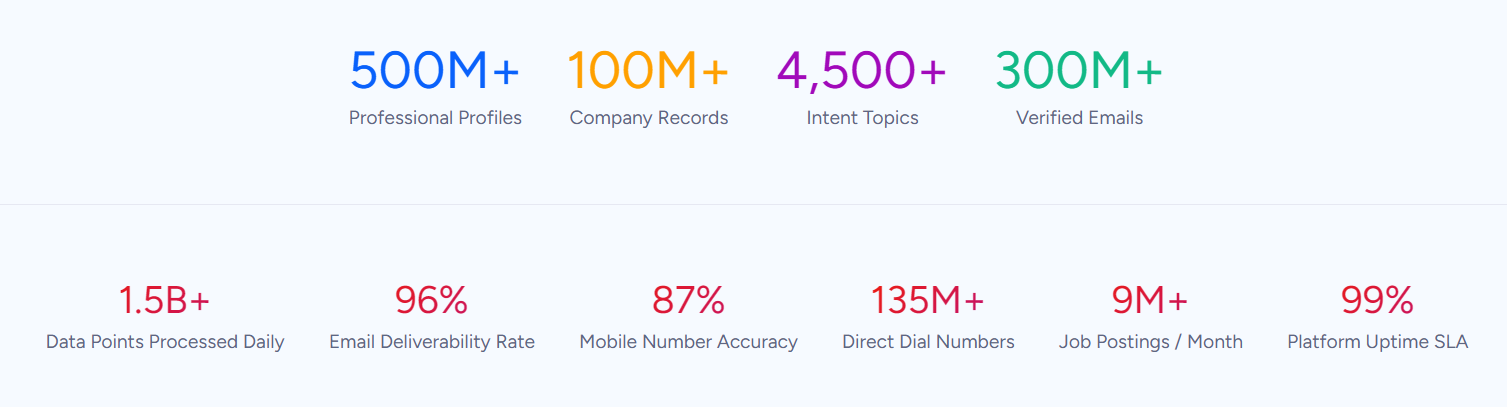
ZoomInfo is an AI-powered GTM platform built on the largest B2B data foundation: 500M contacts, 100M companies, 135M+ verified phone numbers, and 200M+ verified business email addresses. Its key capabilities include:
B2B data platform: 500M contacts, 100M companies, 135M+ verified phone numbers, 120M direct-dial phone numbers, and 200M+ verified business email addresses, verified through a multi-source pipeline backed by 300+ human researchers with up to 95% accuracy on first-party data
GTM Context Graph: An intelligence layer that processes 1.5B+ data points daily, combining ZoomInfo's B2B data with your CRM records, conversation transcripts, and behavioral signals to capture not just what happened in a deal, but why it happened
Buyer Intent Data: ZoomInfo Intent tracks signals from 210 million IP-to-Organization pairings and 6 trillion+ new keyword-to-device pairings sourced monthly, with Guided Intent identifying topics historically correlated with deal success
Universal access: Through GTM Workspace for sellers, GTM Studio for marketers and RevOps, and APIs and MCP for any tool or AI agent
BlueConic is a B2C customer data platform built for consumer brands in retail, ecommerce, and CPG. It has no positioning, tooling, or data coverage for B2B go-to-market motions. ZoomInfo fills an entirely different need: B2B intelligence that powers prospecting, pipeline generation, account-based marketing, and deal execution for sales and marketing teams selling to other businesses.
Why Choose ZoomInfo Over BlueConic for B2B Go-to-Market Intelligence
BlueConic helps B2C brands unify consumer profiles and activate marketing campaigns. ZoomInfo delivers the intelligence that B2B go-to-market teams need to find, prioritize, and engage business buyers. The two platforms serve different audiences and solve different problems.
Comprehensive B2B Data: The Foundation No B2C CDP Can Provide
ZoomInfo operates the largest B2B data platform, spanning three dimensions: identity data (who buyers are, where they work, how to reach them), company context (100M companies with firmographics, org charts, and technographics covering 30,000+ technologies across 200+ categories), and dynamic signals that reveal when accounts are actively in-market.
This advantage has been validated externally: in a Fortune 500 competitive RFP analyzing 25 million contacts across vendors, the independent consultant concluded that "no other competitor came even close."
ZoomInfo has been named a Leader in the Gartner Magic Quadrant for ABM Platforms for two consecutive years (2024 and 2025), a Leader in the Forrester Wave for Intent Data Providers B2B (Q1 2025), and earned 133 No. 1 rankings on G2 in Summer 2025 across Sales Intelligence, Buyer Intent, Data Quality, and Account Data Management categories.
Source: ZoomInfo
BlueConic's data model is built around consumer behavioral profiles. It cannot tell you who sits on a buying committee, what technologies a target company runs, whether an account is actively researching your category, or how to reach a VP of Engineering by direct dial. For any organization with a B2B revenue motion, this is not a gap BlueConic can fill.
ZoomInfo in Action: Your sales team needs to identify companies evaluating customer data platforms, find the VP of Marketing and CTO at each account, understand the company's current tech stack, and reach them with outreach that references their specific buying signals. ZoomInfo surfaces all of this from a single platform: the intent signal that triggered the alert, the verified direct dials and business emails for the buying committee, the company's existing CDP and martech stack, and AI-drafted outreach that addresses the concern driving their evaluation. No B2C-focused CDP can deliver this intelligence because the underlying data layer does not exist in their architecture.
The GTM Context Graph: Intelligence That Understands Why Deals Move
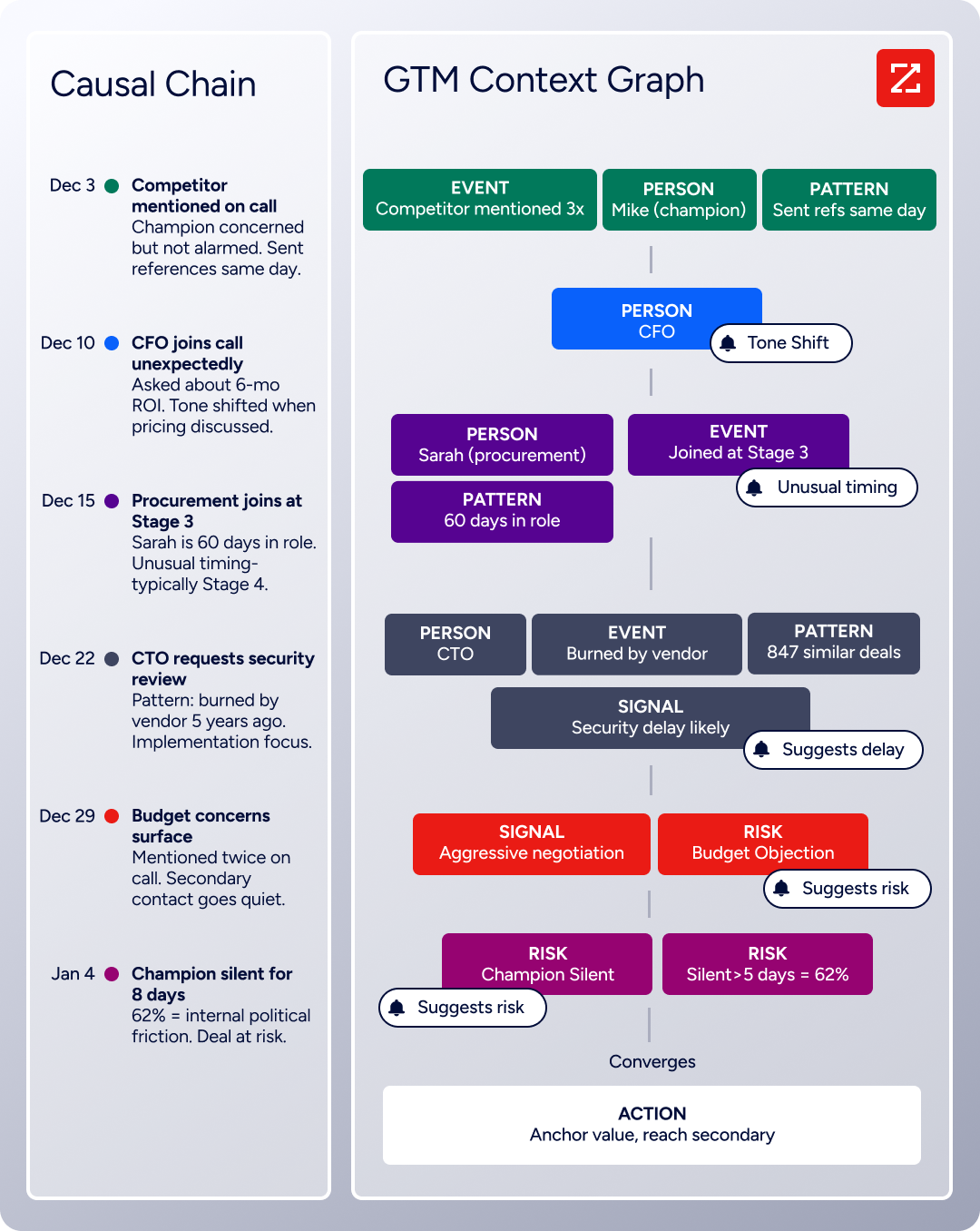
The GTM Context Graph is what transforms ZoomInfo from a data provider into an intelligence platform. It combines ZoomInfo's third-party B2B data with a customer's own CRM records, conversation intelligence from Chorus (ZoomInfo's conversation intelligence engine), email interactions, and behavioral signals into a single intelligence layer.
CRMs record that a deal moved to Stage 3. Conversation intelligence transcribes what the VP of Finance said on the last call. Intent platforms log a spike in research activity. The GTM Context Graph reasons across all three to capture why the deal moved. As ZoomInfo's Chief Product Officer Dominik Facher writes: "The CRM recorded the state change. It has no record of why it happened."
Source: ZoomInfo
This contextual reasoning flows into every downstream action: the follow-up email addresses the specific concern the CFO raised because the system understands why it matters now, the play targets accounts whose signal combinations match your actual win patterns rather than a keyword threshold, and the forecast weights deals by the strength of buying evidence rather than stage labels and rep optimism.
BlueConic's Agent Studio is a decisioning layer for B2C marketing campaigns. ZoomInfo's GTM Context Graph is an intelligence layer for B2B deal execution. Both use AI, but they solve different problems for different audiences.
"ZoomInfo's not just a contact data company anymore. They've built a full system of execution. GTM Intelligence actually works the list, writes the outreach, triggers the play, and helps drive predictable growth." (Ian Brodie, CEO & Co-Founder, Levanta)
Universal Access: Use ZoomInfo's Intelligence in Any Tool
ZoomInfo delivers its intelligence through three surfaces, so the choice of where to work never limits the quality of intelligence available:
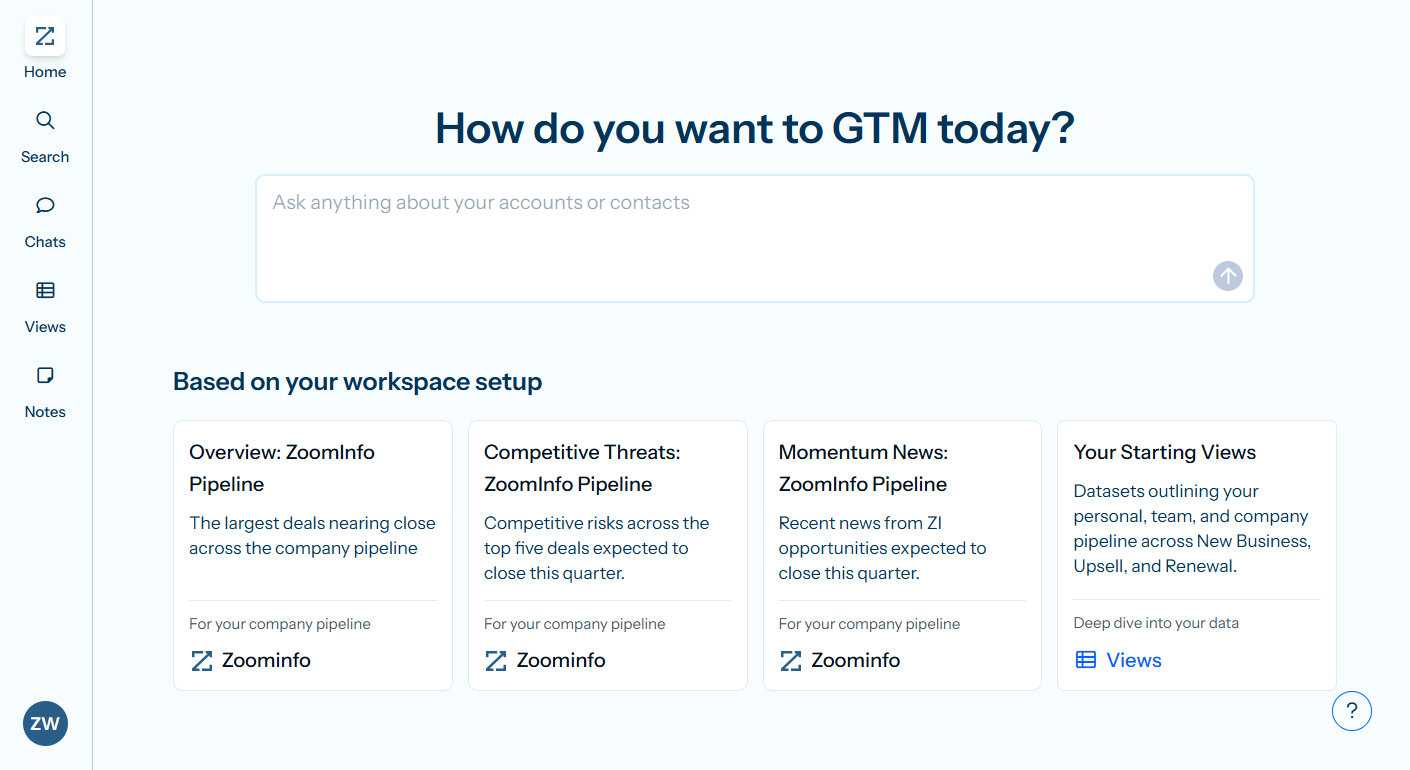
GTM Workspace for sellers: a single workspace where prioritized accounts, AI-drafted outreach, and deal execution converge without toggling between tools. Seismic's sales team boosted productivity by 54% and attributed 39% of pipeline to ZoomInfo signals.
GTM Studio for marketers, RevOps, and GTM engineers: an orchestration canvas where audience definition, campaign orchestration, and pipeline measurement happen in natural language. Expansion plays that used to take 3 weeks now launch in 30 minutes.
APIs and MCP: the same intelligence exposed to any custom agent, internal tool, or partner platform. BDO Canada achieved an 87% reduction in dashboard update time using ZoomInfo's API.
All three surfaces draw from one GTM Context Graph: the same data foundation, the same reasoning, the same continuously learning model. Nothing is degraded or siloed by surface.
"That combination of our internal CRM data, external signals, and AI that's given all that context has helped us craft very specific account- and persona-based messages. And people have responded to them right away." (Toby Carrington, Chief Business Officer, Seismic)
ZoomInfo Pricing
ZoomInfo uses a custom-quoted, consumption-based pricing model with plans organized across Sales, Marketing, and Chorus product lines. Pricing scales based on usage patterns, number of users, monthly credit volume, features, company size, and contract length.
Sales Plans come in three tiers: Professional (contact and company data, CRM integrations, Chrome extension, AI-powered email generation), Advanced (adds intent signals, website visitor tracking, champion tracking, GTM plays), and Enterprise (adds real-time intent, advanced workflows, AI-generated account summaries, dedicated support).
Marketing Plans come in three tiers: Marketing Demand, ABM Lite, and ABM Enterprise, scaling from audience targeting and CRM/MAP integrations up to unlimited Display Network campaigns and AI-powered account scoring.
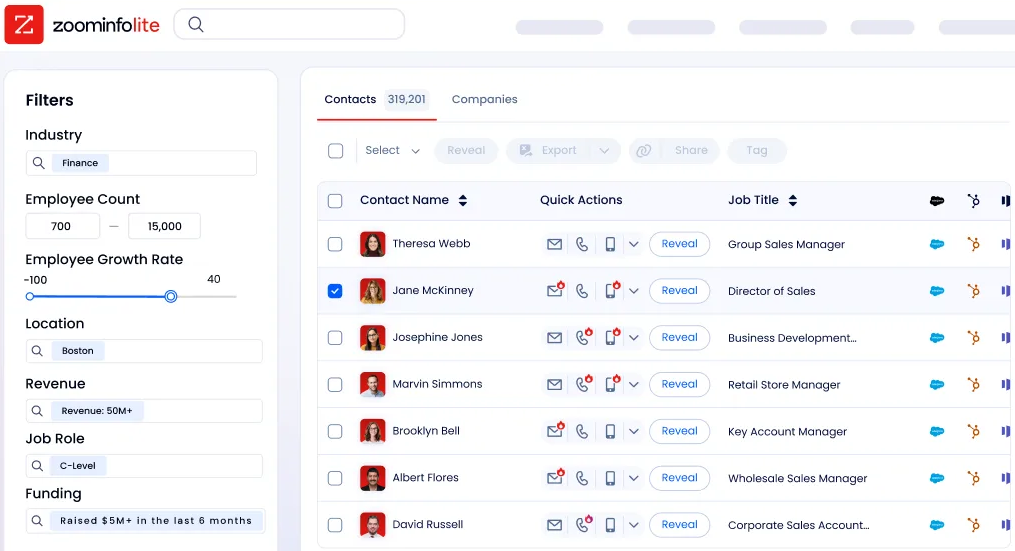
ZoomInfo Lite is a permanent free tier (no credit card, no time limits) providing access to ZoomInfo's B2B database with 10 monthly export credits, individual and company searches, the Chrome extension, and HubSpot integration. A 7-day free trial of the full platform is also available.
API access is included in all relevant plans.
Source: ZoomInfo
Who Should Use ZoomInfo?
Choose ZoomInfo if:
Your organization has a B2B revenue motion and needs contact and company intelligence, buyer intent signals, and AI-powered prospecting to find, prioritize, and engage business buyers (capabilities no B2C-focused CDP like BlueConic delivers).
Your sales and marketing teams need to identify in-market accounts, map buying committees with verified direct dials and business emails, and execute coordinated outreach informed by real-time signals and conversation intelligence.
You want an intelligence layer that works everywhere your teams do: a seller workspace (GTM Workspace), a marketer and RevOps canvas (GTM Studio), or programmatic access (APIs and MCP) in any third-party tool or AI agent.
Looking for the intelligence layer that powers B2B go-to-market success? ZoomInfo combines 500M contacts, 100M companies, the GTM Context Graph, and universal access to help your team find, win, and grow customers. Start your free trial or explore ZoomInfo Lite to see the data for yourself.
2. Tealium: Best Alternative for Enterprise Multi-Cloud Data Orchestration
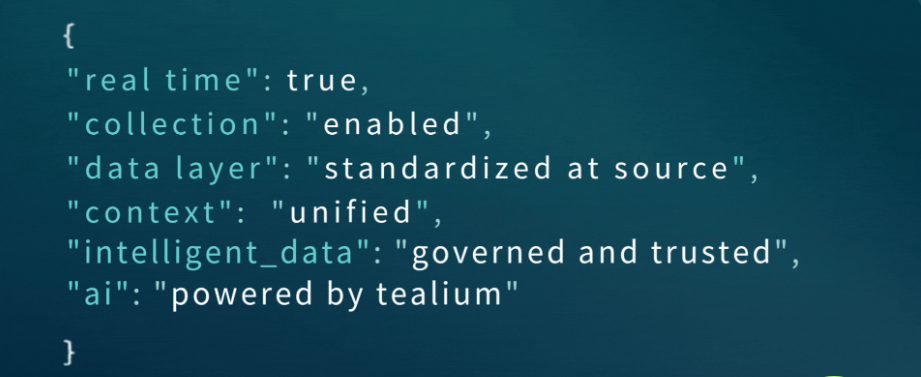
Tealium is a Customer Data Orchestration Platform built for enterprise-scale data collection, identity resolution, audience activation, and warehouse-native orchestration. It is the right BlueConic alternative for organizations whose data infrastructure spans multiple clouds, regions, and legacy systems that a mid-market CDP cannot reach without custom integration work.
Its key capabilities include:
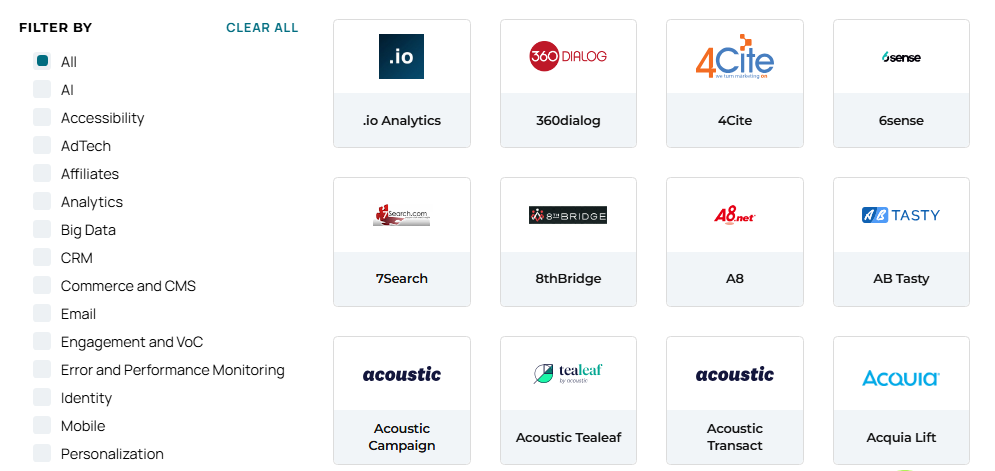
1,300+ pre-built connectors across tag management, server-side event routing, CDPs, advertising platforms, CRMs, data warehouses, and AI services
Server-side event collection via EventStream API Hub, moving data collection out of the browser to eliminate signal loss from ad blockers and iOS restrictions
Warehouse-native audience activation through zero-copy integration with Snowflake, Databricks, BigQuery, and Amazon Redshift
AudienceStream CDP with real-time profile unification and configurable identity resolution
Multi-region data residency including EU and APAC (AWS Singapore)
Why Choose Tealium Over BlueConic for Enterprise Multi-Cloud Data Orchestration
Tealium stands out in the following areas:
Integration Breadth: 1,300+ Connectors vs. 150+
BlueConic's 150+ named integrations cover the major martech categories well. The gap opens when an enterprise's environment includes regional tools, legacy on-premise systems, or specialized industry platforms. BlueConic's fallback for out-of-catalog systems is a generic webhook or CSV connector, which shifts the integration burden onto the customer's engineering team.
Tealium's 1,300+ connector marketplace includes tag templates, server-side connectors, cloud data source connectors for every major warehouse, and conversion API integrations for Google, Meta, TikTok, and The Trade Desk. G2 reviewers call out integration breadth and the ability to operate with any tech stack without lock-in as a key benefit.
Source: Tealium
Server-Side Event Collection for Signal Reliability
BlueConic collects behavioral data through a JavaScript tag placed on website pages. This client-side model is exposed to ad blockers, iOS Intelligent Tracking Prevention, and browser privacy modes.
Tealium's EventStream API Hub moves event collection server-side entirely, processing data in memory and routing events to downstream connectors in real time without the browser as an intermediary. Its Conversion API suite covers Google, Meta, TikTok, and The Trade Desk, transmitting events directly to ad platforms.
For enterprises that depend on precise attribution and accurate audience sizing, the practical difference is measurable in campaign ROI.
Warehouse-Native Activation Without Data Duplication
BlueConic's Snowflake integration gives enterprises a way to connect profiles to an existing warehouse, but the architecture is still CDP-centric: data flows through BlueConic's profile layer, which sits alongside the warehouse.
Tealium's Data Cloud Activation module takes a zero-copy approach, reading audience definitions from Snowflake, BigQuery, Databricks, or Redshift directly without loading a duplicate into Tealium's storage. The Snowflake Audience Discovery App runs as a Snowflake Native App inside the customer's own account, and audiences activate across Tealium's 1,300+ connectors.
Data Residency and Compliance for Multinational Enterprises
BlueConic runs on AWS with hosting region specified per Order Form. For multinational enterprises operating under GDPR, PDPA, and APPI simultaneously, a single-region deployment creates compliance complexity.
Tealium supports multi-region data residency including dedicated EU hosting and an AWS Singapore Region for APAC. Tealium holds HIPAA BAA, SOC 2 Type II, ISO 27701, and ISO 27018 certifications, while BlueConic's Trust Center does not reference ISO 27001 or HIPAA BAA.
NOTE: We also evaluated Adobe Real-Time CDP and Salesforce Data Cloud. Adobe Real-Time CDP offers deep integration with the Adobe Experience Cloud ecosystem but is most compelling for organizations already committed to Adobe's broader suite. Salesforce Data Cloud is strong when the entire GTM motion runs through Salesforce, but its activation paths concentrate within the Salesforce ecosystem. Tealium offers an enterprise CDP with low ecosystem lock-in: its independent company status, 1,300+ connectors spanning every vendor ecosystem, and cloud-agnostic multi-region hosting make it a strong choice for enterprises running mixed stacks.
Tealium Pricing
Tealium does not publish pricing. All engagements are custom enterprise contracts.
The platform is modular: organizations license components independently or in combination from Data Collection (iQ Tag Management), Customer Data Platform (AudienceStream), Enrichment & Orchestration (EventStream), Data Cloud Activation, and Tealium for AI.
Support tiers range from Basic (included with all contracts) to Enhanced (paid add-on with Critical 2-hour response SLAs) to Premium (dedicated Technical Account Manager, Critical 1-hour response SLAs).
Who Should Use Tealium?
Choose Tealium if:
Your organization runs a mixed martech stack across multiple clouds, regional tools, or legacy systems that require more than 150 integrations to cover without custom development.
You have a data engineering team invested in Snowflake, Databricks, or BigQuery and need activation tooling that works on top of that investment rather than duplicating it.
Your enterprise operates in multiple regions with data residency requirements (GDPR, PDPA, HIPAA) that require multi-region hosting rather than a single-region deployment.
Browser-side data collection reliability is a known gap in your stack, and you need server-side event collection to eliminate signal loss from ad blockers and iOS restrictions.
3. Bloomreach: Best Alternative for B2C Ecommerce Brands Needing Native Multichannel Execution
Source: Bloomreach
Bloomreach is an AI personalization platform for commerce that solves BlueConic's most cited structural limitation: it not only unifies customer data, it delivers campaigns across 13+ channels natively, without routing through Klaviyo, Braze, or Salesforce Marketing Cloud.
Its key capabilities include:
Native cross-channel execution across email, SMS, RCS, WhatsApp, web personalization, mobile push, in-app, and paid ads from a single Scenario journey builder
Loomi AI powering search ranking, product recommendations, triggered messaging, and predictive segments from one data foundation
Inventory-aware product recommendations that factor in product availability, margin, and cross-sell opportunity
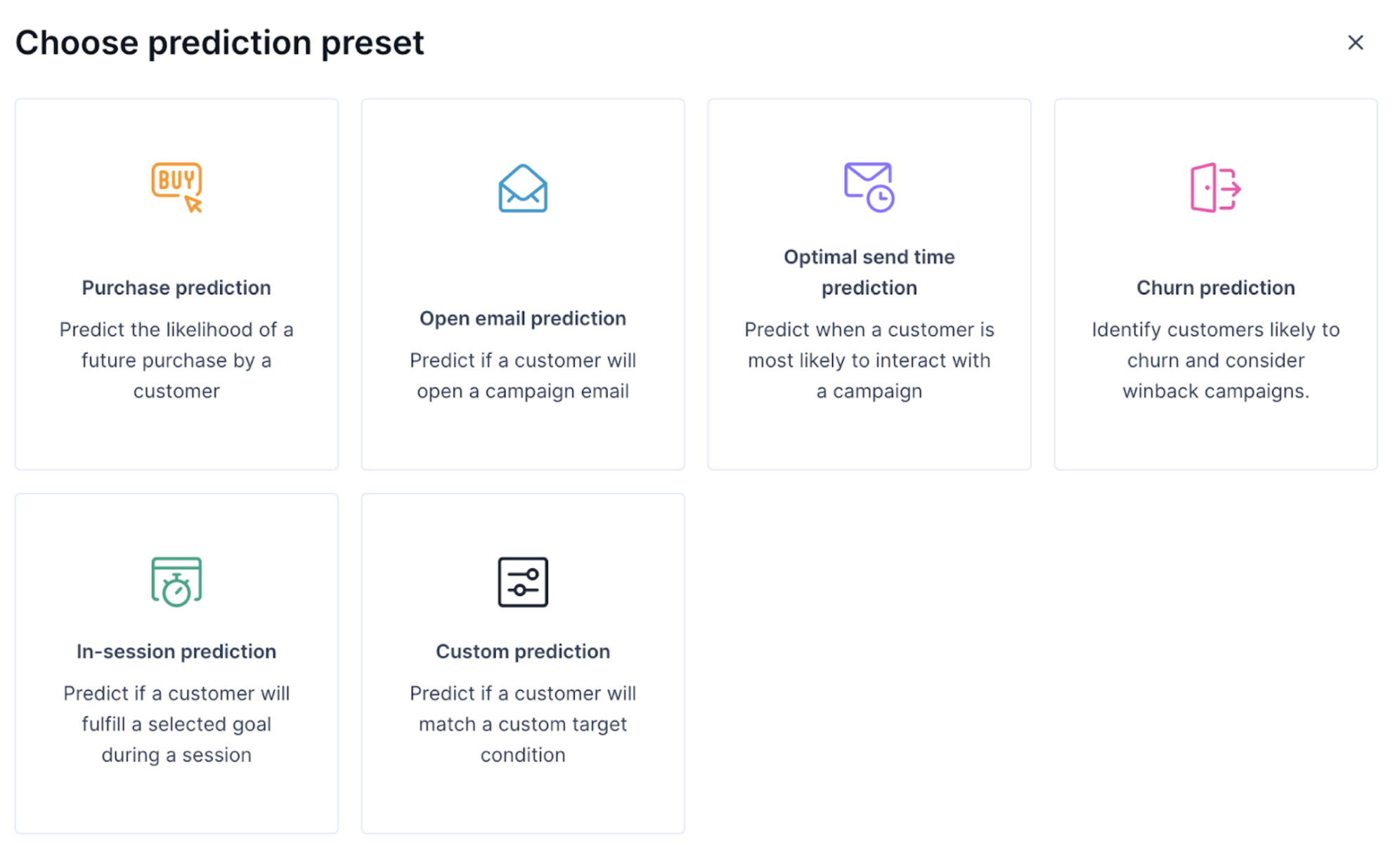
Out-of-the-box ML models for purchase probability, churn risk, optimal send time per recipient, and lifetime value scoring
Autonomous Search & Discovery connecting onsite search behavior directly to offsite messaging
Why Choose Bloomreach Over BlueConic for B2C Ecommerce with Native Multichannel Delivery
Bloomreach stands out in the following areas:
Native Campaign Execution Across 13+ Channels Without External ESPs
BlueConic does not send email, SMS, or push notifications natively. Every campaign requires routing through a separate tool, so even when BlueConic's CDP fires a real-time signal, actual message delivery depends on another platform's sync cycle.
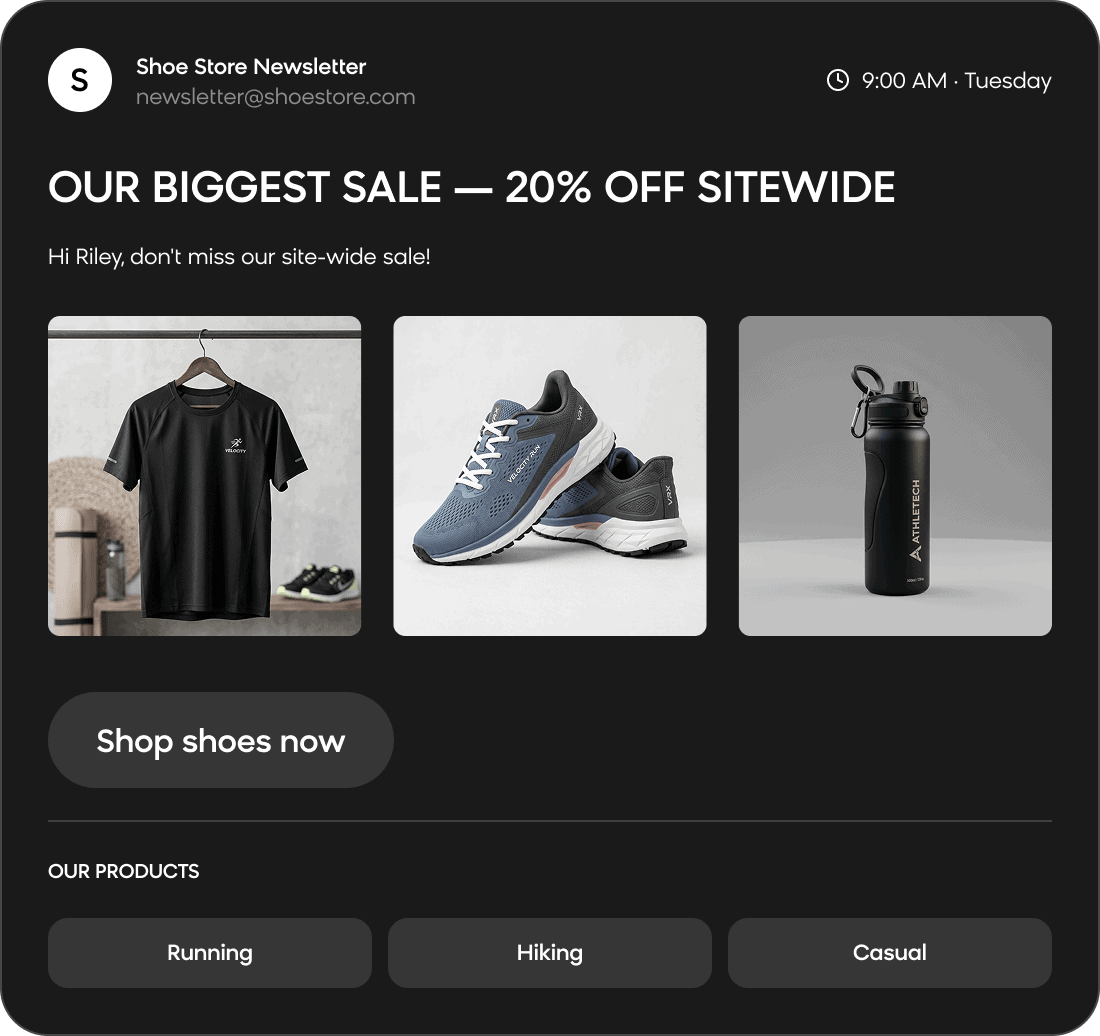
Bloomreach's Marketing Automation product executes across email, SMS/MMS, RCS, WhatsApp, mobile push, in-app messages, web Weblayers, App Inbox, and paid ad audiences from the same journey builder. When a customer abandons a cart, the triggered push notification, the abandoned cart email with personalized product substitutions, and the Meta retargeting suppression all originate from one live data layer with no sync delay.
Commerce-Specific AI That Understands Product Catalogs, Not Just Behavior
BlueConic's AI Workbench is a capable ML environment, but it requires data scientists to build custom propensity models and does not include product catalog intelligence.
Bloomreach ships out-of-the-box predictive model templates for purchase probability, churn risk, optimal send time, and best-channel prediction, all available to marketers without engineering support. Loomi AI's recommendations are inventory-aware: they factor in product availability and margin constraints, so the platform never recommends a product you cannot sell or a discount you should not give.
Source: Bloomreach
Unified CDP, Ecommerce Search, and Recommendations in One Platform
For ecommerce brands running onsite search and offsite campaigns on disconnected data, what a customer searched onsite has no relationship to what email they receive the next day.
Bloomreach's Autonomous Search & Discovery ties product recommendations to search histories and shares the same behavioral model across onsite and offsite activation. Across 250 million searches per day and 1,400+ brands, Bloomreach reports an average RPV lift of 20% or more from its search product alone.
NOTE: We also evaluated Emarsys by SAP and Insider. Emarsys is strong in retail loyalty and omnichannel automation but is most compelling within the SAP ecosystem. Insider delivers strong AI personalization and A/B testing depth, but its CDP layer is thinner than Bloomreach's customer data architecture. Bloomreach offers a combination of CDP, native multichannel execution, and commerce-specific product intelligence well suited for B2C ecommerce brands outgrowing email-only tools.
Bloomreach Pricing
Bloomreach does not publish list prices. All three product lines (Autonomous Marketing, Autonomous Search, and Conversational Shopping) are sold on a custom-quote basis. Pricing is structured around a module fee and a usage fee, with tiers determined by whichever metric is higher: Monthly Unique Visitors or Billable Profiles.
Every plan includes a dedicated Customer Success Manager, standard support with SLAs, onboarding through go-live, and Loomi AI access at no additional charge. The Loomi Marketing Agent add-on starts at $1K/month for existing platform customers. Bloomreach reports a 99% annual renewal rate.
Who Should Use Bloomreach?
Choose Bloomreach if:
You are paying for both a CDP and a separate ESP and want to consolidate both into a single platform with native email, SMS, WhatsApp, and push delivery.
You operate a product catalog where inventory availability, margin, and cross-sell logic should inform recommendations and messaging natively.
Your ecommerce brand runs both onsite search and offsite campaigns and needs both surfaces to read from the same real-time behavioral data.
Your marketing team currently relies on a data scientist to build propensity models, and you need pre-built ML models that marketers can activate directly.
4. Klaviyo: Best Alternative for Ecommerce Brands Seeking Integrated CDP and Execution at Accessible Pricing
Source: Klaviyo
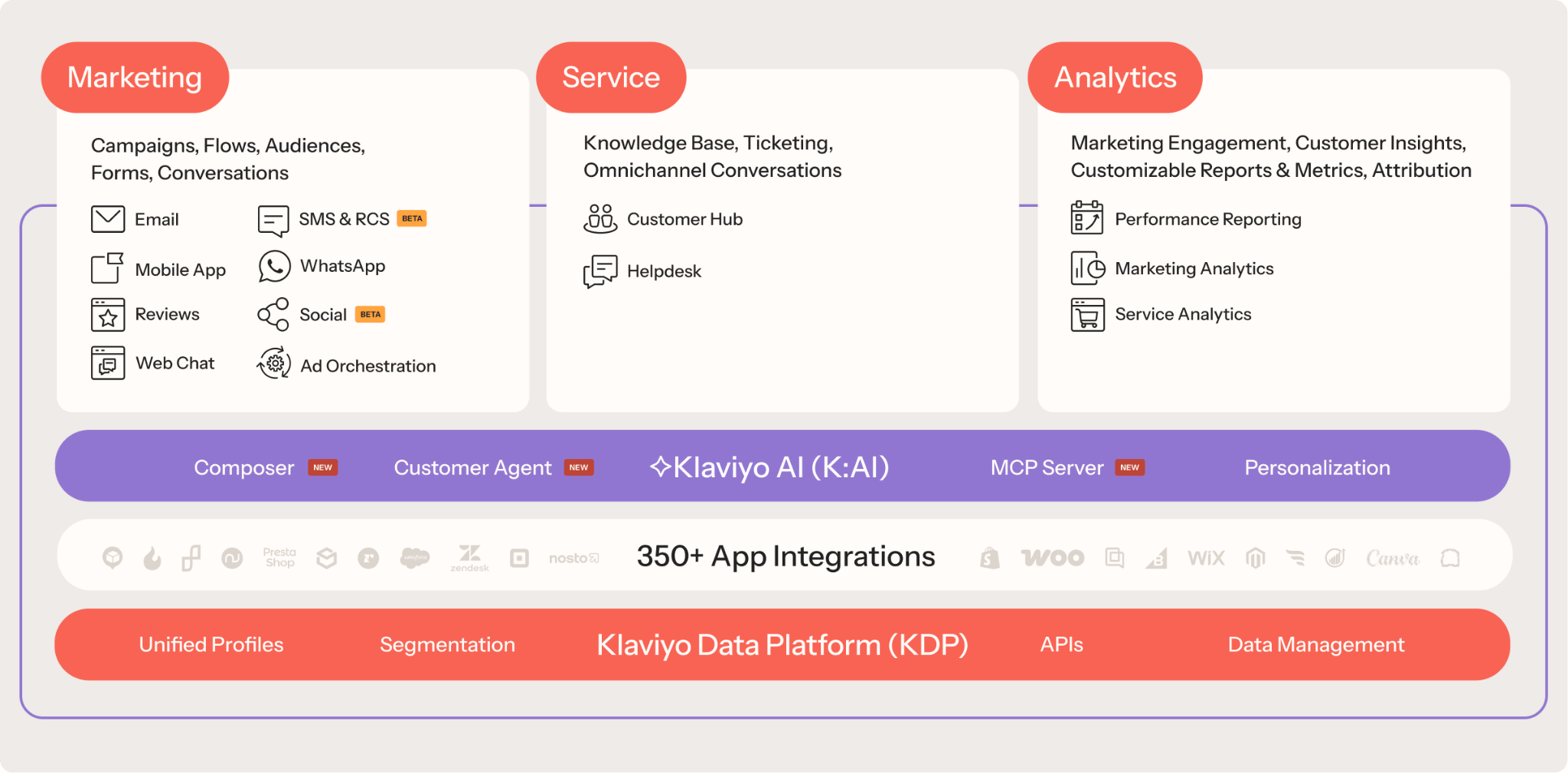
Klaviyo is a B2C CRM and marketing automation platform that combines an ecommerce customer data platform with native email, SMS, push, and WhatsApp execution. It solves two of BlueConic's most significant limitations at once: the lack of native message delivery and the enterprise-only pricing model.
Its key capabilities include:
Native email, SMS/MMS, mobile push, WhatsApp, and RCS for Business delivery from a single flow builder
Klaviyo Data Platform (KDP) with real-time unified profiles, lifetime data retention, and AI-enriched predictive signals
60+ pre-built ecommerce automation flows for abandoned cart, browse abandonment, win-back, back-in-stock, and post-purchase sequences
350+ native integrations including a Shopify strategic partnership with real-time product catalog and cart state sync
Transparent, contact-volume-based pricing with a functional free tier
Klaviyo AI (K:AI) including predictive CLV, churn risk scoring, Channel Affinity routing, and Marketing Agent
Why Choose Klaviyo Over BlueConic for Ecommerce Brands Seeking an Integrated CDP and Execution Layer
Klaviyo stands out in the following areas:
Built-in Message Delivery Eliminates the ESP Dependency
BlueConic positions itself as the decisioning layer, routing audience and suppression signals to external tools for actual message delivery. Every BlueConic customer is, by design, also paying for a separate ESP.
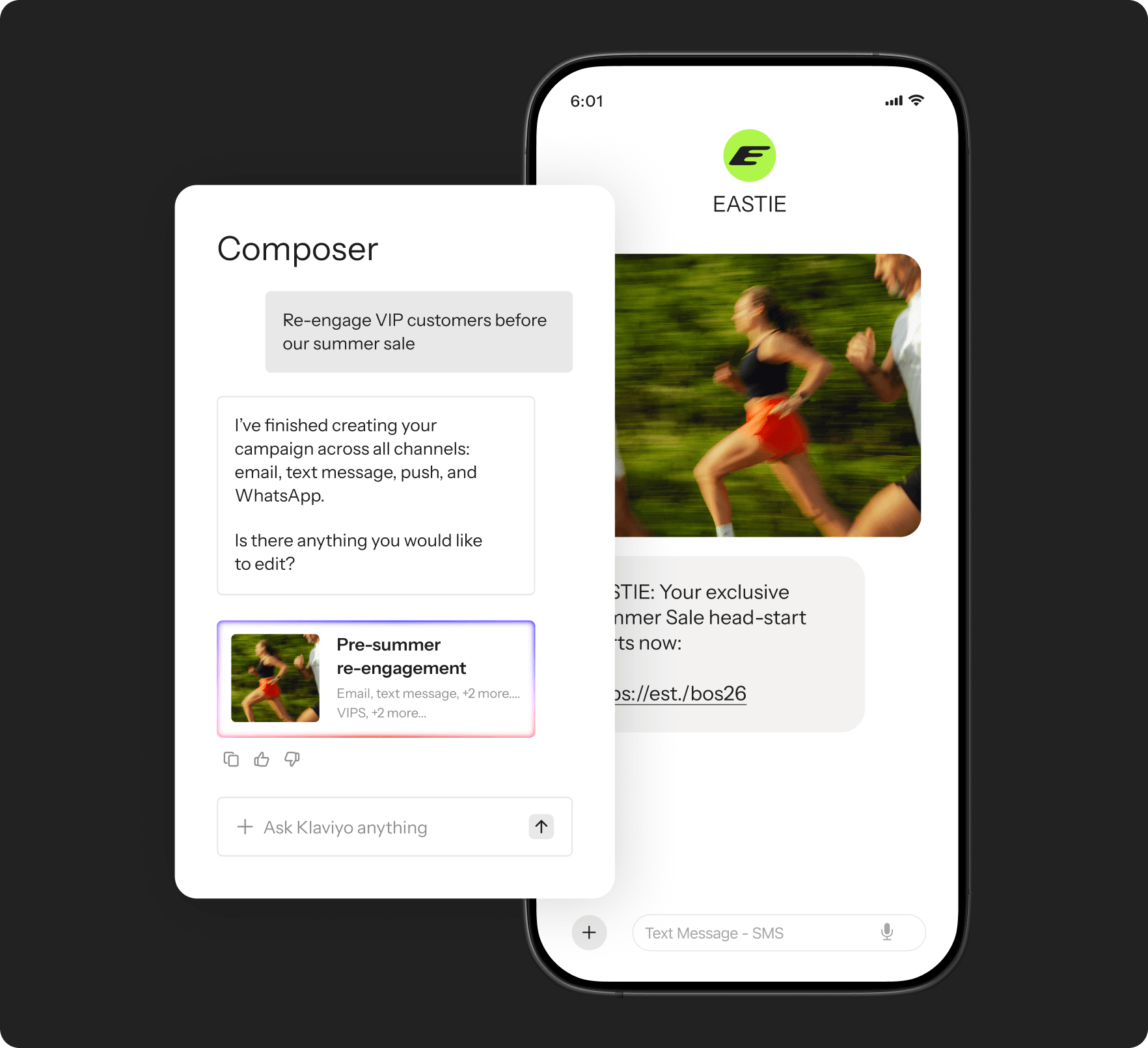
Klaviyo inverts this: the Klaviyo Data Platform and the Klaviyo Marketing execution layer share the same customer profiles, segmentation engine, and flow builder. A segment built on churn risk scores triggers a win-back email automatically within the same platform. An abandoned cart recovery flow fires SMS and email in coordinated sequence from the same automation canvas. There is no export, no sync lag, and no second subscription required.
Transparent, Accessible Pricing vs. Enterprise-Only Commercial Model
BlueConic's pricing page redirects to a sales contact form with no published tiers or costs. Capterra reviewers state directly that "the pricing is very expensive and is focused basically on larger organizations."
Klaviyo publishes its pricing publicly and offers a permanent free plan covering up to 250 active profiles, 500 email sends per month, and 150 mobile message credits per month, with no credit card required. Paid plans scale from 251 profiles upward using a contact-volume-based model. A brand can model its expected costs against list size before ever speaking to a salesperson.
Predictive Analytics Built Into Campaign Execution
BlueConic's AI Workbench supports Python-notebook-based custom ML models, requiring data science resources. Klaviyo's predictive capabilities are embedded directly into the marketing layer.
Predictive CLV, next-order date forecasting, churn risk scoring, and RFM groupings are computed automatically on every profile and surfaced inside the segmentation builder. Channel Affinity AI routes each message through the channel most likely to drive a response. The Marketing Agent scans a brand's website and product catalog, generates campaigns and flows autonomously, and produces weekly campaign recommendations. All K:AI features are included at no additional cost across all paid plans and the free tier.
Source: Klaviyo
NOTE: We also evaluated Omnisend and Mailchimp. Omnisend offers solid email and SMS for ecommerce brands at a competitive price, but its CDP depth is thinner. Mailchimp has broad name recognition and accessible pricing, but its behavioral segmentation is limited compared to Klaviyo's real-time data model. Klaviyo offers a combination of an ecommerce CDP and native omnichannel execution well suited for teams that want to avoid maintaining a separate ESP.
Klaviyo Pricing
Klaviyo uses a contact-volume-based pricing model with no per-seat fees.
Free Plan ($0/month): Up to 250 active profiles, 500 email sends, 150 mobile message credits, access to all 350+ integrations, Marketing Agent, and 50 free Customer Agent AI conversations. No credit card required, no time expiration.
Paid Marketing Plans (Email): Scale from 251 active profiles upward. Pricing calculated via an interactive tool at klaviyo.com/pricing. Full access to drag-and-drop editor, 160+ templates, AI copy generation, segmentation, flows, and analytics.
Email + SMS Plans: Combines email and SMS billing under a unified contact-based pricing structure. Brands using both channels see a 19% increase in GMV growth rate.
Enterprise (Custom Pricing): Dedicated support tiers, Solutions Architect, Deliverability Strategist, and 24/7 live chat support. Enterprise customers include Mattel, TaylorMade, and Glossier.
Who Should Use Klaviyo?
Choose Klaviyo if:
You are running a CDP alongside a separate ESP and want to consolidate both into one platform without losing CDP functionality.
You operate a Shopify-native ecommerce brand and want your CDP, email, SMS, and analytics to share the same customer profiles without cross-system data handoffs.
You need predictive analytics (CLV, churn risk, next-order date, RFM) available to marketing teams without a data scientist, embedded in the same interface where campaigns are built.
BlueConic's enterprise-only commercial model is not viable for your stage, and you need transparent pricing you can model before engaging sales.
5. Twilio Segment: Best Alternative for Developer-First Data Collection and Accessible Entry Pricing
Source: Twilio
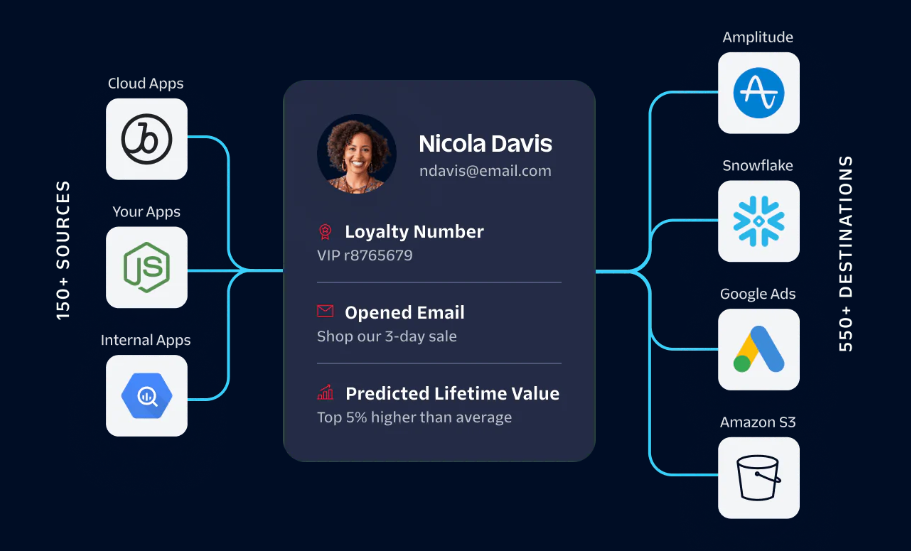
Twilio Segment is a customer data platform built on a developer-first, API-native architecture. It collects behavioral event data across web, mobile, and server-side sources and routes it to 700+ pre-built downstream destinations from a single instrumentation layer.
Its key capabilities include:
Free plan supporting up to 1,000 Monthly Tracked Users with no credit card required, and a self-serve Team plan starting at $120/month
750+ pre-built source and destination integrations spanning analytics, advertising, CRM, email marketing, data warehouses, and enrichment platforms
Protocols: schema enforcement and Tracking Plan governance that validates incoming events before they enter the pipeline
API-first SDK coverage for JavaScript, Python, Ruby, Java, Go, iOS (Swift), and Android (Kotlin)
Bi-directional warehouse integration via Connections (events routed to Snowflake, BigQuery, Redshift, Databricks) and Reverse ETL
Unify: identity resolution stitching anonymous and known events into persistent unified profiles
Why Choose Segment Over BlueConic for Developer-First Data Collection
Segment stands out in the following areas:
A Real, Self-Serve Free Tier and Transparent Entry Pricing
BlueConic's Terms of Service reference a Free Access Subscription, but no public sign-up path exists. Segment's free plan is live and self-serve: $0/month for 1,000 Monthly Tracked Users, two data sources, one warehouse destination, 500,000 Reverse ETL records, and access to the full 700+ integration catalog.
The Team plan starts at $120/month for 10,000 MTUs with a 14-day free trial and published overage pricing. An engineering team can instrument production sources, validate data quality, and connect downstream tools before speaking to a salesperson.
750+ Integrations with a Shared Data Contract
Every integration in Segment's catalog operates against the same Segment Spec, which defines six canonical call types and standardized schemas for common event patterns. A team that instruments their codebase against the Spec once can activate any of the 750+ destinations without rewriting tracking logic.
G2 reviewers describe this as "unifying user data from web, mobile, backend, and CRM into a single stream, consolidating one-time event tracking for all tools without duplicate effort." The Destination Actions framework makes field-level mapping configurable in the UI, and Segment Functions extend coverage with JavaScript running on managed AWS Lambda.
Protocols: Schema Enforcement at the Point of Data Collection
This is a governance capability BlueConic does not offer.
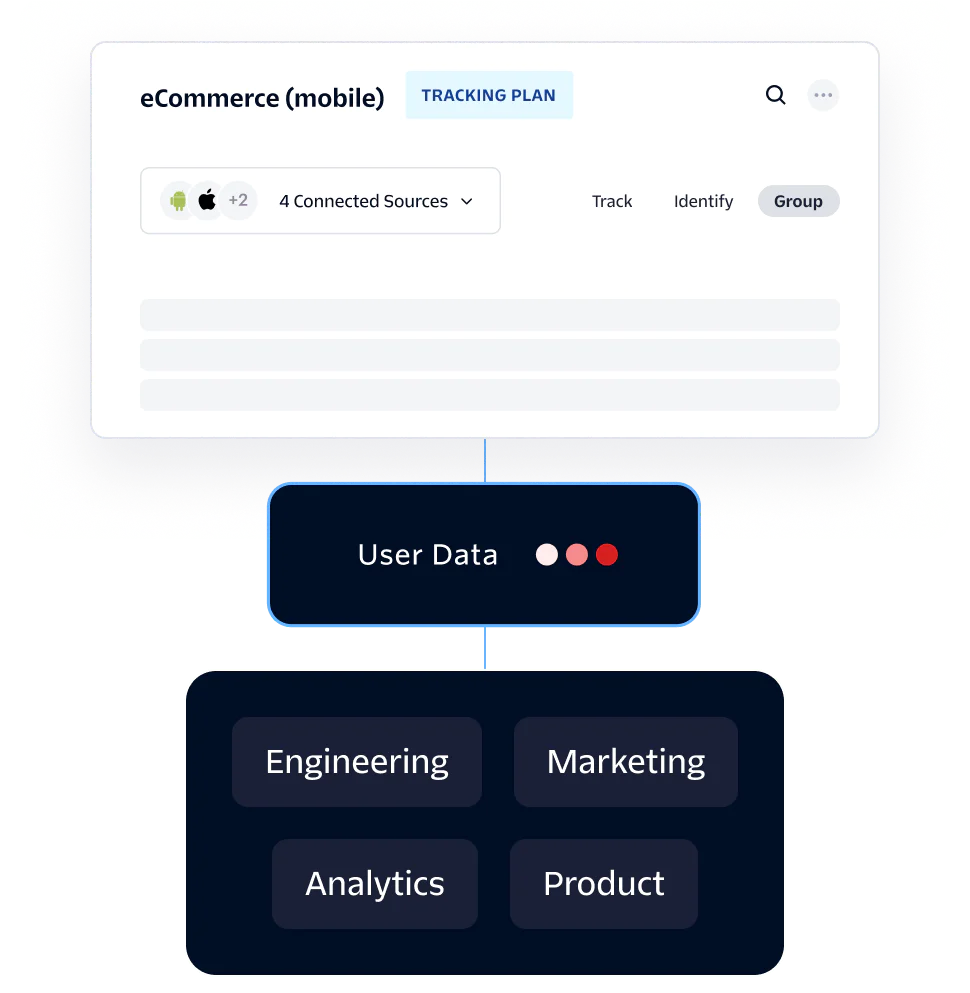
Segment Protocols validates every incoming event against a pre-defined Tracking Plan before it enters the pipeline, catching instrumentation errors at the source. Schema controls can block non-conforming events or route them to quarantine.
If an engineer fires Order_Complete in one source and order_completed in another, BlueConic registers two separate signals requiring manual reconciliation, while Segment catches the mismatch at the point of collection.
Source: Twilio
NOTE: We also evaluated RudderStack and mParticle. RudderStack offers an open-source, self-hostable option with cost savings at scale but requires infrastructure management that adds operational overhead. mParticle provides superior mobile SDK performance and mobile-first architecture (more on that in the next section). Segment offers a balanced entry point for engineering-led teams: a self-serve free tier, the largest pre-built integration catalog in the CDP category, and data governance tooling that most alternatives treat as an afterthought.
If you are weighing Segment against mParticle directly, see our mParticle vs Segment comparison for a detailed look at how the two platforms differ on mobile SDK coverage, identity resolution, and pricing.
Segment Pricing
Free Plan ($0/month): 1,000 MTUs, 2 Sources, 1 Warehouse Destination, 500K Reverse ETL Records, 700+ integrations, 10 seats. No credit card required.
Team Plan (starts at $120/month): 10,000 MTUs, unlimited Sources, 1 Warehouse Destination, 1M Reverse ETL Records, public API access. 14-day free trial. Overage: $10-$12 per 1,000 additional MTUs.
Business Plan (custom pricing): Custom MTU volume, unlimited sources and warehouse destinations, unlimited seats. Includes Protocols, HIPAA eligibility, regional data residency, and dedicated CSM.
Full CDP with Unify + Engage (custom pricing): All Connections features plus identity resolution, audience activation, journey orchestration, AI features, and unlimited seats.
Who Should Use Segment?
Choose Segment if:
Your team has engineering resources comfortable owning data instrumentation through SDKs and APIs rather than marketer-operated tag-based tooling.
You want to evaluate a CDP against production data before committing a budget, using a self-serve free tier and transparent paid plans.
You are building on a modern data stack (Snowflake, BigQuery, Databricks) and want warehouse-native architecture where the CDP complements existing data infrastructure.
You need schema governance at the point of data collection to prevent instrumentation errors from corrupting downstream segmentation and campaigns.
6. mParticle: Best Alternative for Mobile-First Brands Where the App Is the Business

Source: mParticle
mParticle is a hybrid customer data platform that combines real-time event streaming with warehouse-native composable activation. It is the specialist CDP for brands where a mobile app generates the majority of revenue events: gaming, fintech, food delivery, media streaming, and QSR.
Its key capabilities include:
Native mobile SDKs for iOS, Android, React Native, Flutter, Roku, Xbox, and Xamarin, collecting app lifecycle events, in-app behavior, and push token management
IDSync configurable identity framework with five distinct resolution strategies and multiple identifier types including IDFA, IDFV, customer ID, and email
Data Plans for schema enforcement at the point of collection, blocking malformed events before they propagate downstream
Real-time event streaming to 300+ server-side integrations with simultaneous fan-out
Match Boost improving first-party data match rates on Meta, Google, and TikTok by 25-100%
Hybrid CDP architecture on Snowflake AI Data Cloud (launched October 2025)
Why Choose mParticle Over BlueConic for Mobile-First Data Collection
mParticle stands out in the following areas:
Mobile SDK Architecture Built for App-Centric Businesses
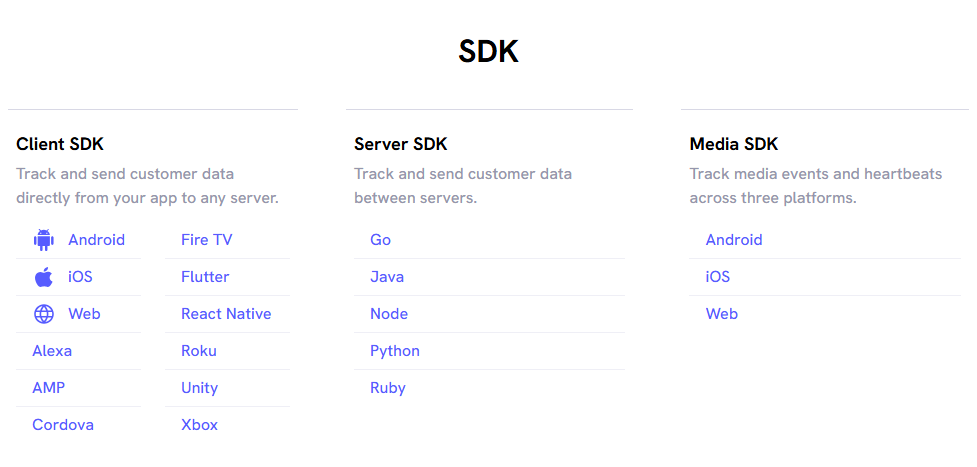
BlueConic's data collection centers on a JavaScript tag placed on web pages, supplemented by generic mobile SDKs. mParticle was founded in 2013 specifically to solve the problem of routing event data from mobile apps. Its native SDKs for iOS, Android, React Native, Flutter, Roku, Xbox, Xamarin, and AMP capture app lifecycle events, in-app purchase events, push token registration, and device-level signals with iOS 14-18 AppTrackingTransparency compatibility.
For gaming studios tracking in-app purchase funnels or fintech apps tracking onboarding completions, mParticle's SDK depth is the architectural advantage.
Source: mParticle
Configurable Identity Resolution Beyond Email Dependence
BlueConic's identity resolution leans on email address as the primary unifying identifier, creating profile fragmentation when the same customer interacts across devices without providing an email.
mParticle's IDSync framework supports multiple identifier types (customer ID, email, IDFA, IDFV, Google Advertising ID, Roku Advertising ID, and custom types) with a configurable identity priority list.
Five distinct resolution strategies, from Profile Conversion to Profile Isolation, let brands choose whether to preserve anonymous journeys or quarantine anonymous data depending on regulatory environment. The Identity Dashboard provides aggregate visibility into identifier coverage, and Identity Logs give per-call traceability.
Data Plans: Schema Enforcement Before Bad Data Propagates
mParticle's Data Plans enforce schema validation at the point of ingestion. A Data Plan specifies expected events, required attributes, and data types. Non-conforming events generate violations, and operators can block them entirely. The Data Planning API lets plans be version-controlled alongside app code, with SDK-level linting tools treating data quality as a software engineering discipline.
Real-Time Server-Side Event Streaming with Simultaneous Fan-Out
All 300+ integrations operate server-side, so data collection and activation happen without client-side performance impact. Every event routes simultaneously to all connected destinations in sub-second time.
NOTE: We also evaluated Treasure Data and Lytics. Treasure Data excels at enterprise analytics depth in regulated industries, but its heavier footprint increases implementation complexity. Lytics brings strong ML-driven audience modeling but has limited mobile SDK depth. mParticle offers mobile-first architecture built for brands where BlueConic's web-first data collection is insufficient.
mParticle Pricing
mParticle operates on a credits-based model with no published rates. Customers make an upfront contractual credit commitment, with all platform features accessible with any credit purchase (no feature-gated tiers).
Billable items include events ingested, real-time audience products, Cortex AI features, extended data retention, and Profile API usage. Enterprise buyers should model total projected event volume carefully, since AI features (Cortex) are metered as active intelligent attributes multiplied by events forwarded.
Who Should Use mParticle?
Choose mParticle if:
Your mobile app generates the majority of customer revenue events, and BlueConic's JavaScript-tag-based data collection cannot capture the app lifecycle events and in-app behavioral signals your activation stack depends on.
Your customers interact across native iOS and Android apps, web, connected TV, and loyalty systems, and you need an identity framework that resolves device advertising IDs, not just email addresses, into unified profiles.
Your engineering team treats data quality as a first-class concern and needs schema enforcement at the point of collection rather than discovering instrumentation errors after they have propagated.
You are in a data-intensive vertical (media, QSR, fintech, retail ecommerce) where real-time behavioral event streaming to 300+ destinations simultaneously is an operational requirement.
7. Hightouch: Best Alternative for Warehouse-Native CDP Activation
Source: Hightouch
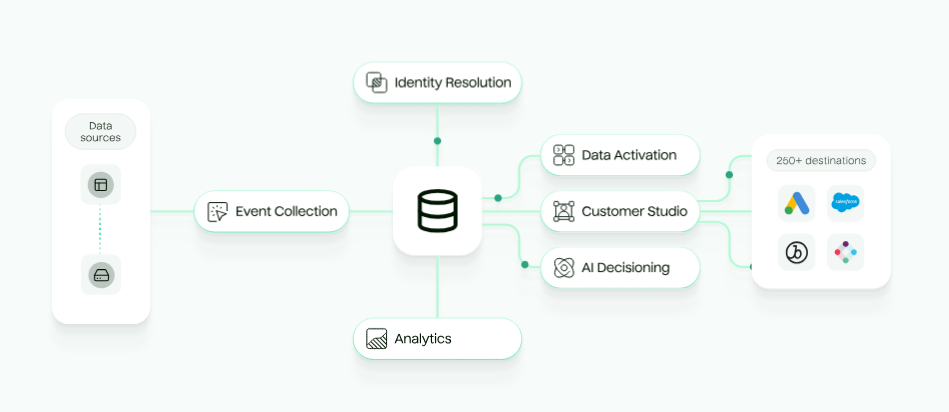
Hightouch is a composable customer data platform that activates customer data directly from an organization's existing data warehouse (Snowflake, Databricks, BigQuery, Redshift, or Azure Synapse) rather than ingesting and re-storing it in a proprietary CDP layer.
Its key capabilities include:
Reverse ETL syncing any SQL query, table, or dbt model directly to 250+ marketing and sales destinations without custom export scripts
Warehouse-native architecture that never copies customer data into Hightouch's own infrastructure
Customer Studio no-code audience builder for marketers to define and activate segments without engineering tickets
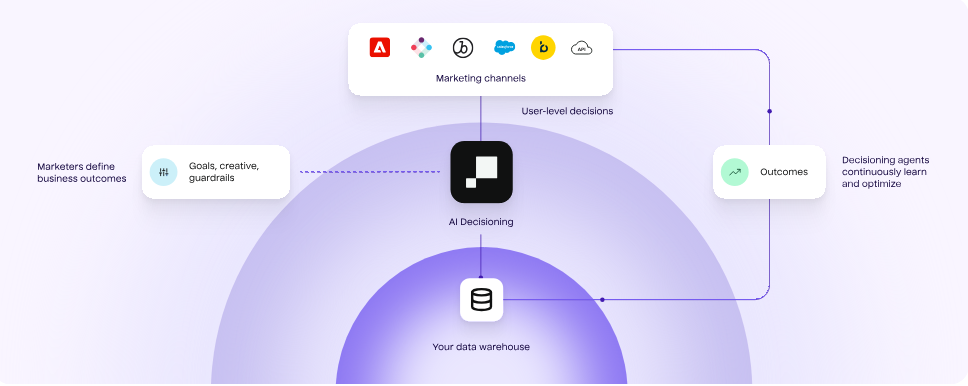
AI Decisioning powered by reinforcement learning (contextual multi-armed bandit) that optimizes message content, channel, send time, and offer per individual
Real-time Personalization API serving responses at p99 under 30 milliseconds at up to 1 million requests per second
Why Choose Hightouch Over BlueConic for Warehouse-Native CDP Activation
Hightouch stands out in the following areas:
Warehouse-Native Architecture Eliminates Data Duplication
BlueConic ingests customer data into its own profile store, so any organization running BlueConic alongside Snowflake or Databricks maintains two competing copies of customer data, each drifting between sync cycles.
Hightouch never stores a single byte of customer data: queries run against the customer's warehouse at execution time, results pass through ephemeral workers, and data reaches destinations without being persisted in Hightouch's infrastructure. For regulated industries, this means the data governance perimeter stays intact around a single system.
AI Decisioning Built on Reinforcement Learning, Not Rule-Based Guardrails
BlueConic's Agent Studio evaluates each customer against live profiles and determines next-best actions within marketer-configured guardrails.
Hightouch's AI Decisioning uses a contextual multi-armed bandit to optimize four decisions simultaneously for each customer: what content to send, in which channel, at what time, and with which offer. Each customer is treated as an individual context vector, and every send is simultaneously a communication and an experiment.
Source: Hightouch
Full Data Flexibility Without Conforming to CDP Schema Constraints
BlueConic's profile model stores data as typed profile properties with up to 250 Timeline events per profile. Organizations with complex data models (multiple product lines, household hierarchies, or B2B account structures) can hit structural ceilings. Hightouch activates whatever is in the warehouse, in whatever shape it takes, at 99.99% global uptime.
NOTE: We also evaluated GrowthLoop and Amperity. GrowthLoop takes a similar warehouse-native approach with solid AI-powered audience tools, but its capability set is narrower and its agentic marketing roadmap is less mature. Amperity delivers strong data unification for multi-brand retail, but its architecture is a more traditional CDP that ingests data into Amperity's infrastructure rather than staying warehouse-native. Hightouch offers a direct answer to BlueConic's data duplication overhead, broad destination coverage (250+ connectors), and advanced AI decisioning for teams whose data already lives in a cloud warehouse.
Hightouch Pricing
Hightouch uses a modular, usage-based pricing model with no MTU caps or per-seat charges on paid plans.
Free Tier: Permanently free with up to 2 active syncs per month, unlimited destinations and seats, hourly sync frequency, 100M operations/month. Self-serve signup at app.hightouch.com/signup.
Business Tier (custom pricing): Usage anchored to active syncs. Modular: purchase only the products needed (Reverse ETL, Customer Studio, Identity Resolution, Real-time Personalization, Match Booster). Includes SOC 2 Type 2, ISO 27001, HIPAA, GDPR compliance. Dedicated CSM and solutions architect.
AI Decisioning (separately purchasable): Usage-based pricing anchored to monthly personalized actions. Does not require a Composable CDP subscription.
Who Should Use Hightouch?
Choose Hightouch if:
Your organization has an established cloud data warehouse on Snowflake, Databricks, BigQuery, or Redshift, and your marketing team cannot access or act on that data without engineering tickets.
You need to activate complex, non-standard data objects (product catalogs, subscription tiers, ML model outputs, household graphs) that would require heavy transformation to fit into a traditional CDP's profile schema.
Your data governance or compliance posture cannot accommodate a second authoritative copy of customer data in a vendor's infrastructure.
You want to move beyond rule-based campaign logic toward a continuously learning AI system that optimizes 1:1 decisions for each customer.
The Final Verdict
BlueConic excels as a real-time customer growth engine for mid-market B2C brands, but different organizations have infrastructure, technical, and commercial requirements that call for specialized solutions. Here are the best alternatives:
ZoomInfo for B2B go-to-market intelligence: data covering 500M contacts and 100M companies, intent signals, and AI-powered prospecting through the GTM Context Graph
Tealium for enterprise multi-cloud data orchestration with 1,300+ integrations, server-side event collection, and multi-region data residency
Bloomreach for B2C ecommerce brands that need native multichannel execution across 13+ channels with commerce-specific AI and product catalog intelligence
Klaviyo for ecommerce brands that want an integrated CDP and execution layer at transparent pricing with a functional free tier
Twilio Segment for engineering-led teams that need developer-first data collection with schema governance and a self-serve free tier
mParticle for mobile-first brands that need native app SDKs, configurable cross-device identity resolution, and server-side event streaming
Hightouch for data-warehouse-centric organizations that want to activate customer data directly from Snowflake or Databricks without duplicating it into a separate CDP
You do not have to choose between BlueConic and these alternatives exclusively. Many organizations use BlueConic alongside specialized tools to build their data and marketing stack. Consider your infrastructure, team capabilities, and growth requirements when deciding which solution fits.
Ready to power your B2B go-to-market strategy? ZoomInfo combines 500M contacts, 100M companies, and the GTM Context Graph to help your team find, win, and grow customers. Start your free trial or explore ZoomInfo Lite to get started.
BlueConic Alternatives FAQ
Why do organizations look for BlueConic alternatives?
BlueConic excels as a real-time CDP for B2C brands, but organizations commonly look elsewhere for several reasons.
It cannot send email, SMS, or push natively, so every campaign requires a separate ESP. Its enterprise-only pricing with no published rates makes cost modeling difficult before a sales conversation. Its web-first JavaScript tag architecture can miss signals from mobile apps and environments affected by ad blockers. And its B2C-only focus means B2B organizations have no use case for the platform.
What is the best overall BlueConic alternative?
There is no single best alternative because BlueConic serves a specific niche (B2C customer data and growth).
ZoomInfo is the top choice for B2B go-to-market intelligence. For B2C brands, Bloomreach is the strongest option for teams that want to consolidate their CDP and ESP, while Klaviyo offers the most accessible pricing with a free tier. Tealium leads for enterprise multi-cloud environments, and Hightouch fits best for warehouse-native activation.
Is there a free alternative to BlueConic?
Yes. Klaviyo offers a permanent free plan covering 250 active profiles with email, SMS credits, and full integration access. Twilio Segment's free plan supports 1,000 Monthly Tracked Users with 700+ integrations. Hightouch offers a permanent free tier with 2 active syncs per month. ZoomInfo Lite provides a permanent free tier with access to the B2B database and 10 monthly export credits. BlueConic references a free access subscription in its terms of service, but no public sign-up path exists.
Which BlueConic alternative is best for ecommerce brands?
For ecommerce brands that want to eliminate the ESP dependency, Bloomreach offers native multichannel execution across 13+ channels with commerce-specific AI. Klaviyo is the strongest option for Shopify-native brands that want accessible pricing with built-in email, SMS, and push delivery.
The choice depends on catalog complexity and budget: Bloomreach's product catalog intelligence is more developed, while Klaviyo's transparent pricing and free tier make it more accessible for growth-stage brands.
How does BlueConic compare to warehouse-native CDPs like Hightouch?
BlueConic builds and maintains its own customer profile store that sits alongside an organization's data warehouse, creating two competing copies of customer data. Hightouch activates data directly from Snowflake, Databricks, BigQuery, or Redshift without copying it into a separate infrastructure layer.
For organizations with mature warehouse investments and strict data governance requirements, Hightouch eliminates the duplication and reconciliation overhead. BlueConic's advantage is its agentic growth layer (Agent Studio) and interactive data capture (Experiences by Jebbit), which Hightouch does not replicate.
Which alternative is best for mobile-first brands?
mParticle is built for brands where mobile apps generate the majority of revenue events. Its native SDKs for iOS, Android, React Native, Flutter, Roku, and Xbox capture app lifecycle events, push token management, and device-level signals.
Its IDSync framework supports multiple identifier types including IDFA, IDFV, and device advertising IDs with five distinct resolution strategies, addressing the profile fragmentation that BlueConic's email-dependent identity resolution creates for cross-device mobile journeys.
Can these alternatives integrate with BlueConic?
Several of these platforms can work alongside BlueConic rather than replacing it.
Tealium has a native BlueConic connector for tag management integration. Segment can route event data to BlueConic as a destination. Hightouch can sync warehouse data to BlueConic's profiles. ZoomInfo serves an entirely different purpose (B2B intelligence) and would complement rather than overlap with BlueConic's B2C functionality.
The right approach depends on whether you need to fill a specific gap or replace the platform entirely.
Which BlueConic alternative has the strongest data governance?
Twilio Segment's Protocols feature provides schema enforcement at the point of data collection, validating every event against a Tracking Plan before it enters the pipeline. mParticle's Data Plans offer similar schema validation with SDK-level linting tools. Tealium provides enterprise-grade compliance with HIPAA BAA, SOC 2 Type II, ISO 27701, and multi-region data residency.
For data governance in the context of warehouse-native activation, Hightouch keeps all data in the customer's own cloud environment, avoiding the compliance exposure of maintaining a second data store.
