
Breadcrumbs built its reputation as a transparent, no-code lead scoring platform that gave B2B SaaS teams something rare: a clear view of which leads were worth pursuing and why. Its co-dynamic scoring model combined firmographic fit with behavioral engagement into a two-dimensional A-D / 1-4 matrix. RevOps and marketing operations teams that needed lead prioritization without a data science team adopted it quickly.
But Breadcrumbs is no longer available as a standalone product. In October 2024, MadKudu acquired Breadcrumbs and began migrating its customers to the MadKudu platform. Less than a year later, HG Insights acquired MadKudu itself. The scoring technology now sits two acquisitions deep inside an enterprise technographics company, and the original breadcrumbs.io pricing page redirects to a demo booking form.
If you're searching for an alternative, you're not alone. Whether you're looking to:
Access B2B data and AI-powered intelligence for smarter account prioritization
Continue PLG-native signal-based scoring on the platform that acquired Breadcrumbs
Deploy enterprise ABM with external intent data and buying stage prediction
Consolidate lead scoring inside your CRM without a separate vendor
Build predictive models across churn, LTV, and conversion without a data science team
Start lead scoring at a price point that works for early-stage teams
Score PLG accounts with real-time intent signals on an actively maintained product
This guide covers solutions for each of those needs. Some teams may use one of these tools to replace Breadcrumbs entirely, while others might combine several into a stack that covers more ground than Breadcrumbs did alone. The goal is finding the right fit for where your business is today and where it's headed.
Let's get into the alternatives.
The Best Breadcrumbs Alternatives
Best Alternative for B2B Data and AI-Powered GTM Intelligence We chose ZoomInfo because it goes beyond lead scoring to provide a large-scale B2B data platform (500M contacts, 100M companies), a GTM Context Graph that captures why deals move, and access through APIs, MCP, and interfaces built for sellers and marketers. |
|---|
Best Alternative for PLG-Native Signal-Based Scoring We chose MadKudu because it is the direct corporate successor to Breadcrumbs, preserving the same scoring architecture and engineering team while adding a wider signal surface and HG Insights' technographic intelligence. |
Best Alternative for Enterprise ABM and Predictive Buying Stage Intelligence We chose 6sense because its trillion-signal external intent engine and AI buying stage classification give enterprise revenue teams visibility into in-market accounts before they self-identify, a gap that first-party-only scoring tools cannot close. |
Best Alternative for CRM-Native Lead Scoring Without an Additional Vendor We chose HubSpot because it offers both manual and AI-powered lead scoring inside the same CRM where contact data, email activity, and pipeline already live, eliminating the sync latency and connector overhead of external scoring tools. |
Best Alternative for ML-Grade Predictive Modeling Across Multiple Use Cases We chose Pecan AI because it delivers machine learning across churn, LTV, conversion, and demand forecasting from a single platform, with no data science team required. |
Best Alternative for Early-Stage Teams on a Budget We chose Outfunnel because it delivers rule-based lead scoring, web visitor tracking, and CRM-to-email sync at a price point that makes sense for small B2B teams with limited lead volumes and no RevOps practitioner. |
Best Alternative for PLG SaaS Teams Needing Real-Time Intent Scoring We chose UserMotion because it carries forward the two-dimensional scoring philosophy Breadcrumbs users valued (ICP fit plus real-time intent) on an actively maintained product with a permanent free tier. |
What is Breadcrumbs?
Source: Breadcrumbs
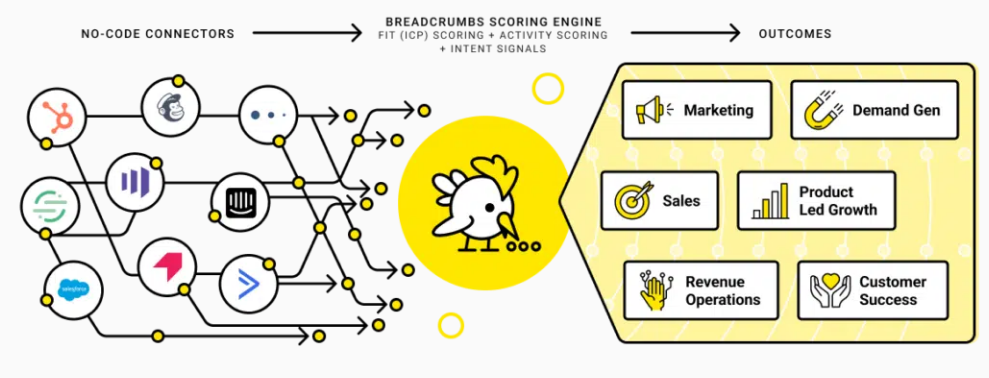
Breadcrumbs was a revenue acceleration platform built around a co-dynamic lead scoring and routing engine that sat between marketing and sales. It promised to make lead scoring (previously an enterprise-budget, data-science-team exercise) available to everyone.
Its key features included:
Co-dynamic scoring model: A two-dimensional A-D (fit) and 1-4 (activity) matrix that scored leads on who they are and what they have done simultaneously, with recency and frequency decay built in
Copilot: An ML-assisted model builder that generated scoring models in minutes without coding
Reveal: An ML-driven ICP discovery tool that surfaced which attributes predicted conversion
Compare: A multivariate testing module that let teams run scoring experiments without disrupting live operations
Explore: A built-in analytics layer for cross-source querying and model comparison
Native integrations: No-code OAuth connectors for HubSpot, Salesforce, Marketo, Mixpanel, Segment, Intercom, Pendo, and more
Breadcrumbs earned praise for its transparent scoring (sellers could see exactly which fit and intent data drove every score), its support for PLG, sales-assisted, and hybrid GTM motions, and documented outcomes like Thinkific's 99.9% SLA reduction and doubled MQL-to-Opportunity rate.
However, the platform had notable limitations.
It required sufficient lead volume to produce statistically meaningful models, depended entirely on first-party CRM data (blind to external buying signals), and produced scores that accumulated in dashboards without automatically triggering seller action.
Most importantly, Breadcrumbs as a standalone product no longer exists. After its October 2024 acquisition by MadKudu and MadKudu's subsequent acquisition by HG Insights in August 2025, teams need to evaluate alternatives that address these gaps while fitting their specific requirements.
Looking for B2B data and AI-powered intelligence to make smarter go-to-market decisions? Explore ZoomInfo to see how its data foundation and GTM Context Graph can sharpen your account prioritization.
How We Curated Our List of Breadcrumbs Alternatives
After researching Breadcrumbs and the lead scoring market, we found that teams leaving the platform have different needs depending on their stage, GTM motion, and technical maturity. Breadcrumbs served the mid-market B2B SaaS scoring niche well, but businesses now need tools that are either more capable or more accessible for:
Accessing verified B2B data as the foundation for account prioritization
Continuing PLG-native scoring on the direct successor platform
Deploying enterprise ABM with external intent data and predictive buying stage classification
Consolidating scoring inside an existing CRM to eliminate external vendor overhead
Building predictive models across multiple business outcomes without a data science team
Starting lead scoring at a price point that works before product-market fit
Scoring PLG accounts with real-time behavioral intent on an actively maintained product
Each tool on this list leads in one of these areas. Depending on your needs, you might adopt a single alternative or combine several into a stack.
DISCLAIMER: We aren't covering every single lead scoring or revenue intelligence tool on the market! Our focus is on highlighting the best alternatives that address Breadcrumbs' limitations for specific use cases and business stages. |
|---|
1. ZoomInfo — Best Alternative for B2B Data and AI-Powered GTM Intelligence

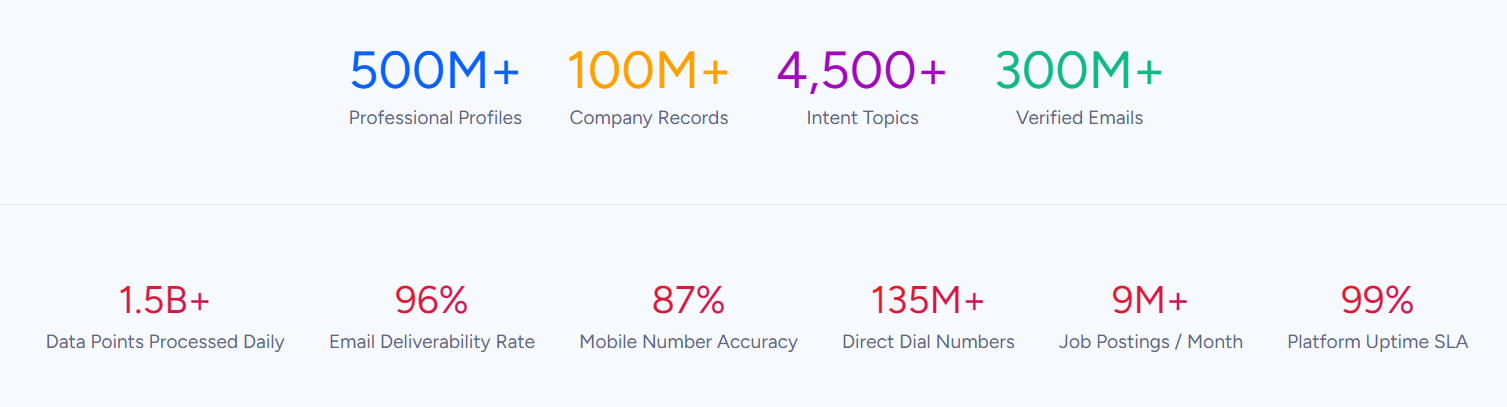
ZoomInfo is an AI GTM platform built on a large B2B data foundation: 500M contacts, 100M companies, 135M+ verified phone numbers, and 200M+ verified business email addresses. By fusing this data with your CRM records, conversation transcripts, and behavioral signals, ZoomInfo's GTM Context Graph (which processes 1.5B+ data points daily) reveals the full context of your accounts.
Its key capabilities include:
B2B data: 500M contacts, 100M companies, 135M+ verified phone numbers, 120M direct-dial phone numbers, and 200M+ verified business email addresses, verified through a multi-source pipeline backed by 300+ human researchers and reaching up to 95% accuracy on first-party data
Buyer Intent Data: ZoomInfo Intent tracks signals from 210 million IP-to-Organization pairings and 6 trillion+ keyword-to-device pairings sourced monthly, with Guided Intent that identifies topics correlated with deal success
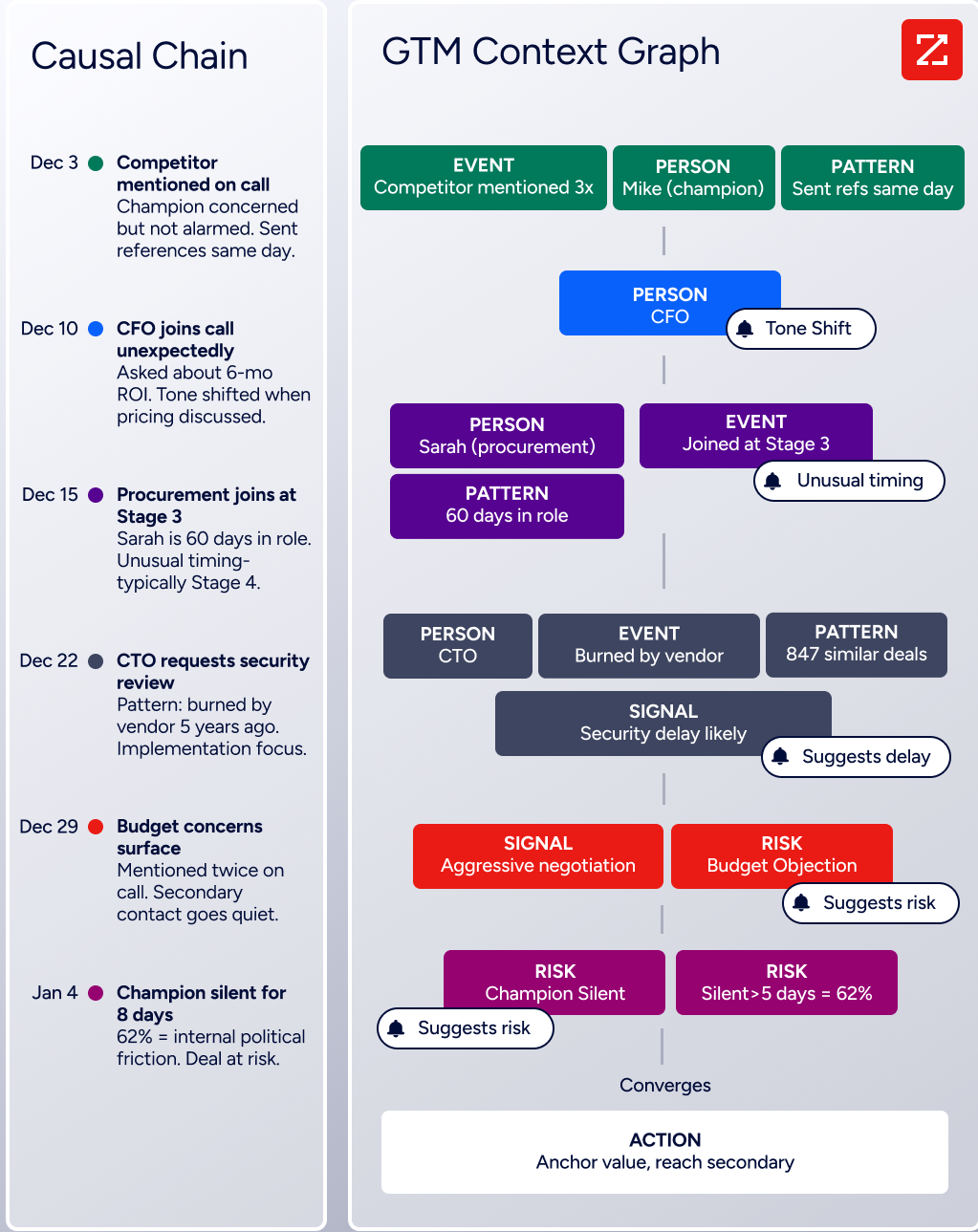
GTM Context Graph: A single intelligence layer that captures not just what happened in a deal, but why it happened, by fusing first-party CRM data with third-party signals
GTM Workspace: An AI-powered workspace for sellers with prioritized account feeds, AI-drafted outreach, and specialized AI agents
GTM Studio: An AI-powered orchestration canvas for marketers, RevOps, and GTM engineers to design, enrich, and activate plays in natural language
Universal access: APIs and MCP expose the same intelligence to any custom agent, internal tool, or partner platform
Where Breadcrumbs scored leads based on whatever data already existed in your CRM, ZoomInfo provides the data itself, the intelligence to interpret it, and the execution layer to act on it. For B2B teams that have outgrown standalone lead scoring and need a platform-level upgrade, ZoomInfo addresses the entire go-to-market workflow.
Why Choose ZoomInfo Over Breadcrumbs for Go-to-Market Intelligence
Breadcrumbs excelled at transparent lead scoring within your existing data. ZoomInfo operates at a different layer of the GTM stack. Here is where it steps up.
B2B Data: Build Your Account Intelligence, Not Just Score It
Breadcrumbs' scoring engine was only as good as the data already in your connected systems. If your CRM had incomplete company records, missing direct dials, or stale contact information, the scoring model inherited every gap.
G2 reviewers noted that onboarding "took longer than expected because we needed to accumulate more data on contact records," and the tool was "not ideal for startups with smaller amounts of leads or contacts."
ZoomInfo eliminates this dependency by providing the data layer itself.
The platform covers three dimensions: identity data (who buyers are and how to reach them), company context (100M companies with company attributes, org charts, and technographics profiling 30,000+ technologies across 200+ categories), and signals that reveal when accounts are actively in-market.
This data is verified at scale: in a Fortune 500 competitive RFP analyzing 25 million contacts across vendors, the independent consultant concluded that "no other competitor came even close."
Source: ZoomInfo
ZoomInfo in Action: Your team is evaluating 200 trial signups from last month and needs to decide which ones to call first. With Breadcrumbs, you could score them on the data they entered in your signup form and whatever product activity your analytics tool captured. With ZoomInfo, you enrich every signup with verified direct dials, company attributes, department org charts, technographic profiles, and intent signals, then prioritize the accounts that match your historical win patterns. The rep doesn't just know who to call; they know the company's tech stack, whether the account is actively researching your category, and who else on the buying committee they should engage.
SpringDB saw 2x-3x increases in campaign conversions across channels, a 300% increase in database usability, and 30-50% uplift in average deal size using ZoomInfo's enriched data platform. (SpringDB Case Study)
GTM Context Graph: Intelligence That Captures Why Deals Move
Breadcrumbs' co-dynamic model scored contacts at a point in time: an A1 (high-fit, high-engagement) was clearly different from a D4 (low-fit, disengaged). That two-dimensional output was useful for prioritizing inbound leads.
But it told you the state of a lead, not the trajectory. It could not capture why a deal accelerated, why a champion went quiet, or what a competitive mention in a call transcript predicted about deal risk.
ZoomInfo's GTM Context Graph addresses this by fusing your CRM records, conversation transcripts from Chorus (ZoomInfo's conversation intelligence engine), email interactions, and product usage signals with ZoomInfo's third-party data into a single intelligence layer.
As CPO Dominik Facher writes: "The CRM recorded the state change. It has no record of why it happened." The GTM Context Graph captures the connections between signals and outcomes: who influences whom, what each action responded to, what thousands of similar deals suggest happens next, and why things slipped.
Source: ZoomInfo
ZoomInfo in Action: A deal has been in Stage 3 for two weeks. In a CRM, that is a stale pipeline record. In ZoomInfo, the GTM Context Graph reveals that the CFO joined the last call, asked about six-month ROI (captured and analyzed by Chorus), and the account is simultaneously researching your competitor on third-party review sites (captured by intent signals). The system recognizes that executive sponsorship entering at this stage, combined with ROI-focused questions, matches the pattern behind closed-won deals in your segment. It drafts a follow-up that addresses the specific ROI concern the CFO raised and surfaces three other accounts showing the same signal combination.
Seismic attributed 39% of active pipeline to opportunities identified or influenced by ZoomInfo signals, with their sales team boosting productivity by 54% and saving 11.5 hours per week per seller. (Seismic Case Study)
Universal Access: Use the Intelligence in Any Tool, Any Workflow
Breadcrumbs offered ten native connectors (HubSpot, Salesforce, Marketo, Segment, Mixpanel, Intercom, Pendo, ActiveCampaign, Mailchimp, and Zingly) and a REST API. Post-acquisition, those connectors are in transition, and the support documentation portal is offline.
ZoomInfo delivers its intelligence through three channels.
GTM Workspace gives sellers a single surface where prioritized accounts, AI-drafted outreach, and deal execution converge. GTM Studio gives marketers and RevOps a builder environment where audience definition, campaign orchestration, and pipeline measurement happen in natural language. And APIs and MCP expose the same intelligence to any custom agent, internal tool, or partner platform.
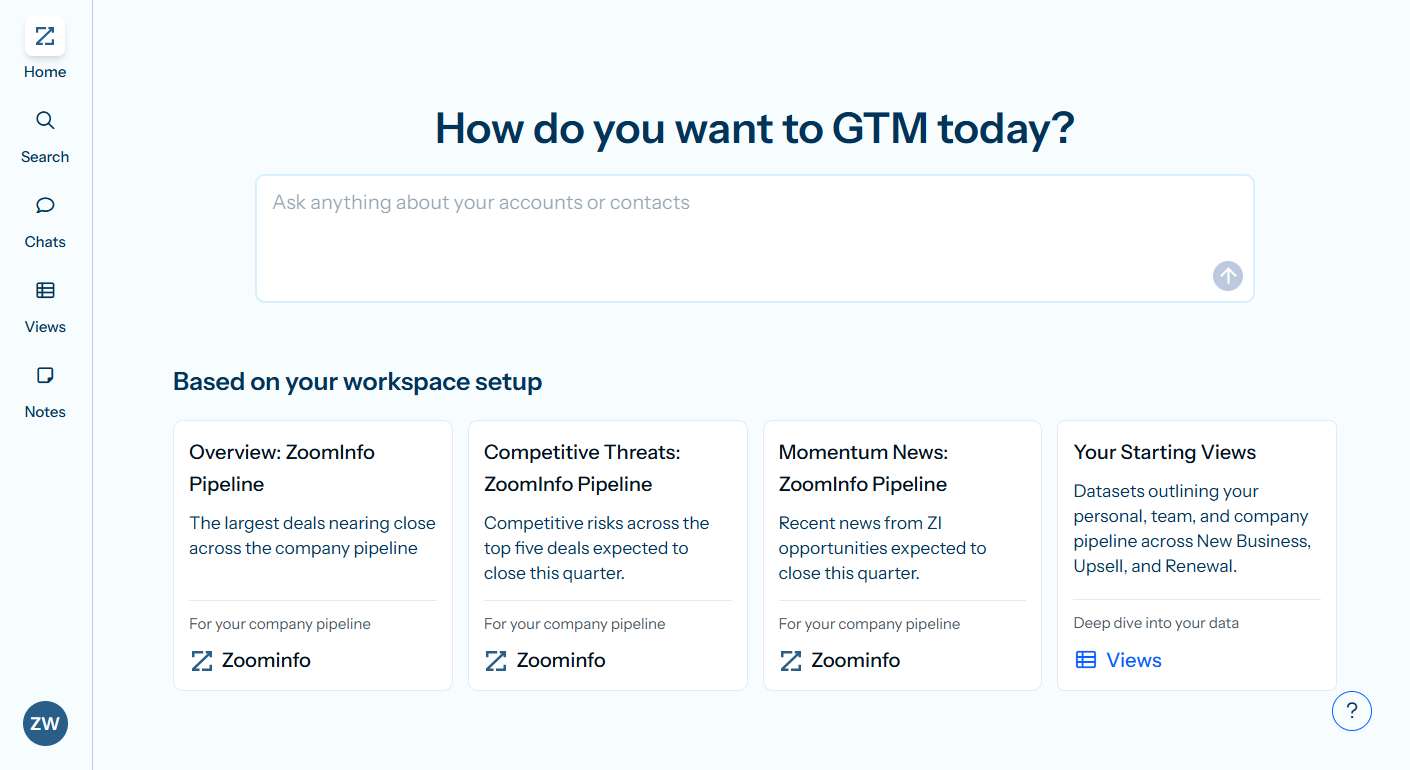
Source: ZoomInfo
The App Marketplace lists 172+ integration partners, including native connectors for Salesforce, HubSpot, Dynamics 365, and cloud platforms like Snowflake, AWS, and Databricks.
ZoomInfo in Action: Your RevOps team describes an audience in plain language inside GTM Studio: "mid-market SaaS companies with 200-1,000 employees, running Salesforce, showing intent signals around your category in the last 30 days." Studio builds the audience, enriches it with verified contacts, and launches a multi-channel play targeting accounts that match your historical win patterns. The accounts flow into GTM Workspace as prioritized entries for your sellers, complete with AI-drafted outreach that addresses each account's specific context. Meanwhile, your engineering team consumes the same data through the API to power an internal lead routing tool. All three channels draw from one GTM Context Graph: the same data, the same reasoning, the same intelligence.
BDO Canada achieved an 87% reduction in time spent on internal data dashboard updates by integrating ZoomInfo's API directly into their systems. (BDO Canada Case Study)
NOTE: We also looked into other B2B data and intelligence platforms. Several offer strong contact databases or intent signals as standalone capabilities. ZoomInfo stands out for combining a large B2B dataset (500M contacts, 100M companies), the GTM Context Graph intelligence layer, and access through APIs, MCP, GTM Workspace, and GTM Studio in a single platform. That combination is validated by Gartner (Leader, ABM Platforms for two consecutive years), Forrester (Leader, Intent Data Providers B2B), and G2 (133 No. 1 rankings).
ZoomInfo Pricing
ZoomInfo uses a consumption-based pricing model with custom quotes for paid tiers. Pricing scales around data access, API consumption, AI activity, number of users, and contract length.
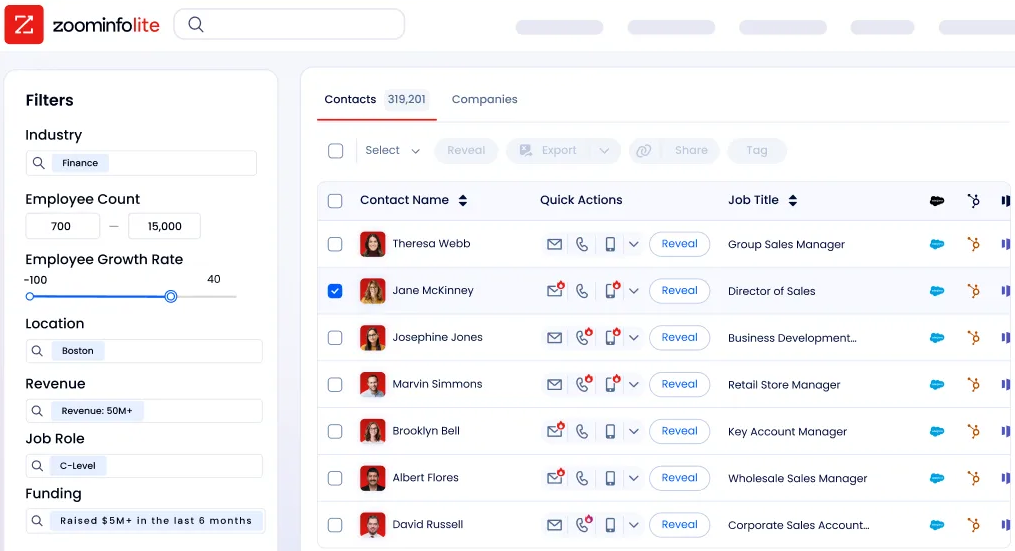
ZoomInfo Lite (Free, Permanent)
Access to ZoomInfo's B2B database with 100M+ verified profiles
10 monthly export credits (25 with Community Edition upgrade)
Individual and company searches, contact information, Chrome extension, mobile app
WebSights Lite (up to 10 website visitor reveals per day)
HubSpot integration included
No credit card, no time limit, no annual commitment
Sales Plans (Custom Quote)
Professional: Contact and company data, CRM integrations, Chrome extension, AI-powered email generation
Advanced: Adds AI-driven account prioritization, Buyer Intent signals, website visitor identification, Champion Tracking, automated outreach workflows
Enterprise: Adds real-time buyer intent, advanced workflows, custom integrations, AI-generated account summaries, dedicated customer service manager
ZoomInfo also offers a 7-day free trial (separate from Lite) with access to core platform features.
Source: ZoomInfo
Who Should Use ZoomInfo?
Choose ZoomInfo if:
Your team has outgrown standalone lead scoring and needs the underlying data foundation, intelligence layer, and execution infrastructure to power go-to-market decisions across prospecting, pipeline management, and account expansion.
You need verified B2B contact and company data to enrich your CRM, fuel your scoring models, and ensure your reps reach the right people with accurate direct dials and emails.
You want AI-powered account prioritization that goes beyond static scores to capture why deals move, who influences decisions, and which accounts match your actual win patterns.
You operate at enterprise or mid-market scale and need privacy compliance infrastructure (ISO 27001, ISO 27701, SOC 2 Type II, TRUSTe GDPR) built into the data layer itself.
You want the flexibility to access intelligence in any tool: through GTM Workspace (for sellers) or GTM Studio (for marketers and RevOps), or programmatically through APIs and MCP in any third-party application.
Ready to move beyond standalone lead scoring? Start with ZoomInfo Lite for free or request a demo to see how B2B data and the GTM Context Graph can power your go-to-market motion.
2. MadKudu (HG Insights) — Best Alternative for PLG-Native Signal-Based Scoring
Source: HG Insights
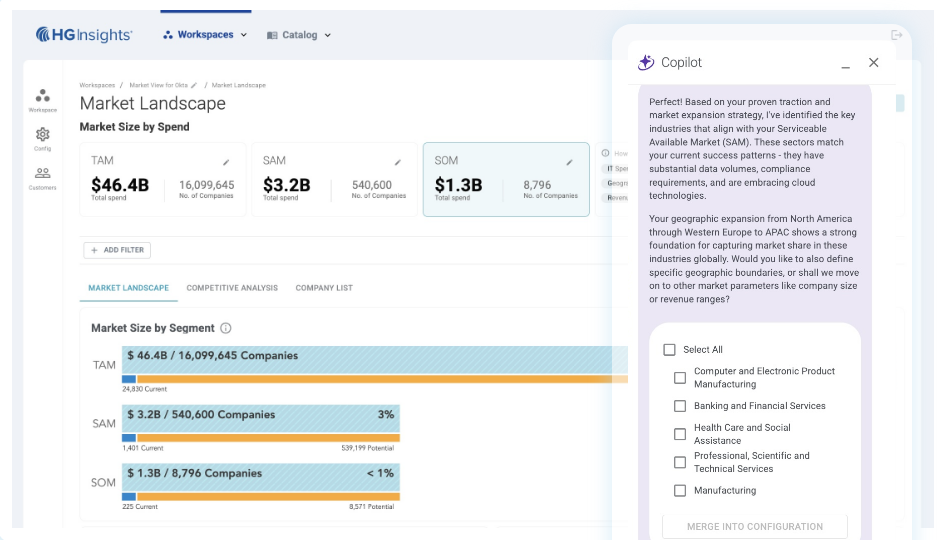
MadKudu, now part of HG Insights, is the direct corporate successor to Breadcrumbs. It acquired Breadcrumbs in October 2024, inheriting the scoring technology, engineering team, and PLG customer base. MadKudu was then acquired by HG Insights in August 2025, gaining HG Insights' technographic intelligence.
Its key capabilities include:
100+ signal types including product usage, firmographic fit, email engagement, buyer intent, funding events, leadership changes, and competitive signals feeding a continuously updating ML model
PLG-specific scoring models blending free-tier product behavior with firmographic ICP data, extending the PLG scoring motion Breadcrumbs pioneered
HG Insights technographic layer detecting 22,000+ technologies across 25M+ companies
Automation Plays that connect high-scoring signals to outreach sequences automatically, closing the gap between scoring and seller action
Native embedding inside Salesforce, Gong, and Outreach via Chrome extension and CRM-native packages
Why Choose MadKudu (HG Insights) Over Breadcrumbs for PLG Signal-Based Scoring
MadKudu stands out in the following areas:
Direct Scoring Continuity With a Wider Signal Surface
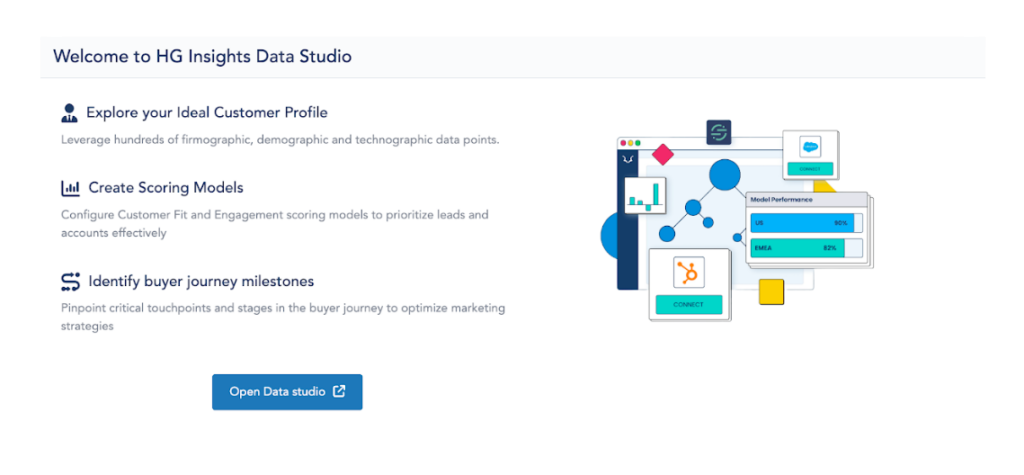
The engineering team that built Breadcrumbs now works at MadKudu. The transparent, two-dimensional scoring philosophy is preserved in MadKudu's Data Studio.
The difference is signal breadth: where Breadcrumbs scored on CRM data, product analytics, and marketing engagement, MadKudu's models also consume buyer intent signals, competitive technology signals, funding event triggers, and (after the HG Insights acquisition) proprietary technographic data covering 22,000+ technology detections across 140+ countries.
Source: HG Insights
Automation Plays Close the Score-to-Action Gap
The most common frustration among Breadcrumbs users was that high scores sat in dashboards without triggering rep activity. MadKudu's Automation Plays close this gap: when a buying signal fires, the system connects it to a recommended playbook and surfaces it to the rep inside Salesforce, Gong, or Outreach. The acquisition announcement positioned the combined platform as a signal-based selling workflow.
HG Insights Technographic Precision
For B2B SaaS companies selling into specific technology environments, HG Insights' multi-source detection techniques surface behind-the-firewall technology usage, including installation location and usage intensity. This enables competitive displacement campaigns targeting accounts at peak readiness, a signal cluster Breadcrumbs could not replicate.
NOTE: We also evaluated Clearbit (now Breeze Intelligence, embedded inside HubSpot) and Toplyne for this archetype. Clearbit excels at firmographic enrichment within the HubSpot ecosystem, and Toplyne is built for in-product PQL identification. MadKudu (HG Insights) offers the most direct continuity from Breadcrumbs: the same scoring architecture, PLG philosophy, and engineering team, now backed by technographic depth and automation infrastructure.
MadKudu (HG Insights) Pricing
MadKudu operates on a consumption-based commercial model administered by HG Insights, with no public pricing and no self-serve entry point.
The standard contract term is two years, with one-year terms available at a premium. The platform is modular: Data Studio, Sales Copilot, and Market Analyzer can be purchased individually. All prospective customers must book a demo before pricing is shared.
Who Should Use MadKudu (HG Insights)?
Choose MadKudu (HG Insights) if:
You are an existing Breadcrumbs customer evaluating where to migrate, and you want the most direct continuation of the scoring architecture and philosophy you already know.
Your team runs a product-led growth motion alongside a sales function, and your primary challenge is identifying which trial users or freemium accounts are conversion-ready.
You need to incorporate technographic intelligence into your account scoring at a level that CRM data alone cannot provide.
Your organization uses Salesforce as its primary CRM; MadKudu's Sales Copilot requires Salesforce and is embedded in that workflow.
3. 6sense — Best Alternative for Enterprise ABM and Predictive Buying Stage Intelligence
Source: 6Sense
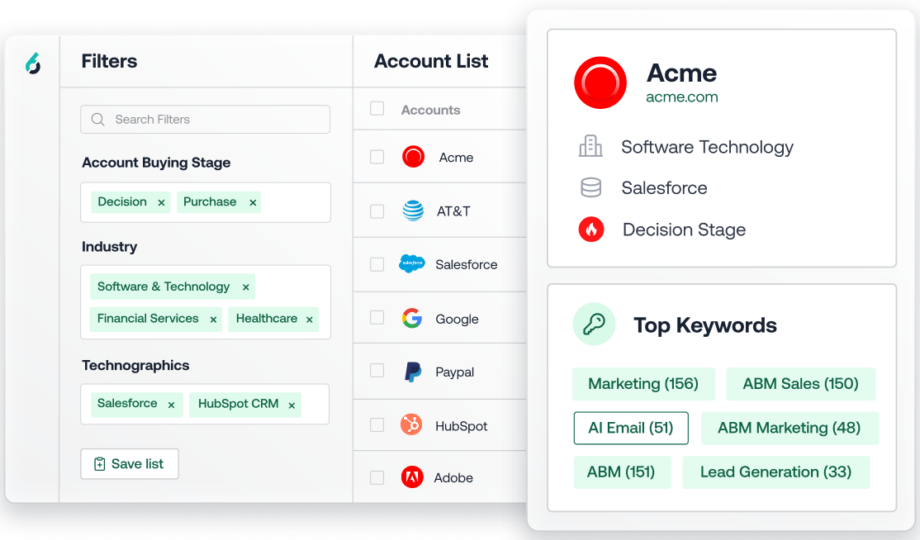
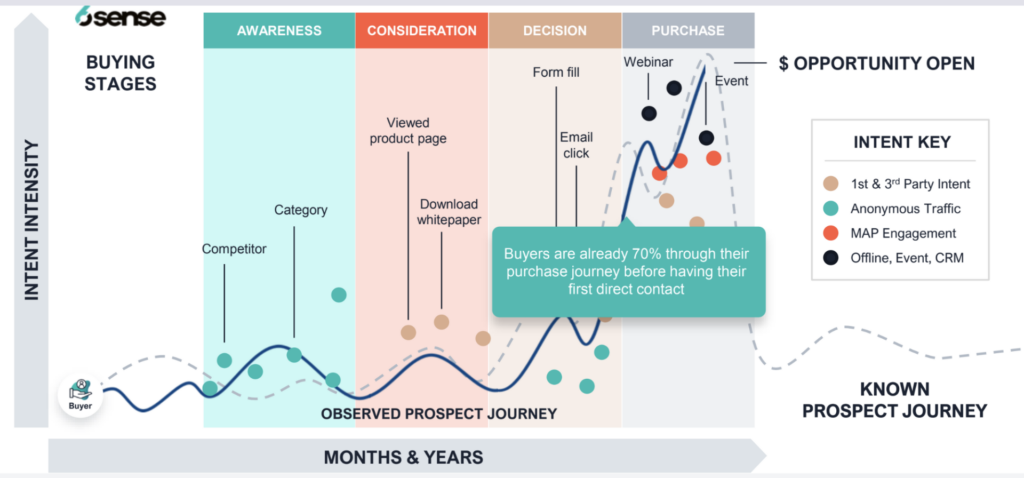
6sense is an enterprise ABM and revenue intelligence platform that replaces CRM-dependent lead scoring with a trillion-signal external intent engine designed to surface in-market accounts before they self-identify. Its foundational premise: only 3% of website visitors identify themselves, leaving 97% of active buyer research invisible to any system that waits for a form fill.
Its key capabilities include:
Signalverse data engine processing 1T+ buying signals daily from B2B content sites, review platforms, and third-party research sources across 40+ languages
AI buying stage classification that places accounts into five stages (Target, Awareness, Consideration, Decision, Purchase) using ML trained on historical conversion patterns
Native DSP via 6sense Accelerate for running display advertising campaigns directly at scored, in-market accounts
RevvyAI conversational command center for configuring signals, building audiences, and launching campaigns through natural language
Why Choose 6sense Over Breadcrumbs for Enterprise ABM?
6sense stands out in the following areas:
External Signal Scale vs. First-Party CRM Scoring
Breadcrumbs drew exclusively from data inside your connected stack, making it blind to companies actively researching your category without visiting your site or entering your CRM.
6sense inverts this through the Signalverse, capturing signals from third-party publishers, review platforms (G2, TrustRadius, Gartner Digital Markets, PeerSpot, TechTarget), and Bombora Company Surge data. Forrester's Q1 2025 Wave awarded 6sense the highest possible scores in accuracy and noise filtering, buying cycle analysis, and insight generation.
Predictive Buying Stage AI vs. Static Scoring
Where Breadcrumbs provided a point-in-time co-dynamic grade, 6sense provides trajectory classification: which accounts are on a path toward creating an opportunity within the next 90 days, based on observed research acceleration. The Temperature model adds a momentum layer, distinguishing between accounts whose research is accelerating versus leveling off.
Source: 6sense
Native Advertising Activation
Breadcrumbs' workflow terminated at the score. 6sense closes the loop with an integrated DSP that runs display campaigns directly at scored accounts, with buying stage as a live targeting dimension. Segment syncs extend audiences to LinkedIn, Meta, Google Ads, and The Trade Desk.
NOTE: We also evaluated Demandbase and Bombora for this archetype. Demandbase offers comparable ABM capabilities, and Bombora provides the underlying intent data layer that many tools consume. 6sense offers the most integrated account intelligence workflow: external signal engine, buying stage AI, native DSP, and sales intelligence in a single platform.
6sense Pricing
6sense operates on a custom-quote pricing model.
A free plan includes 50 credits per month for company and people search, list building, and Chrome Extension access, but does not include intent data, predictive scoring, or CRM integration. Paid plans use a single license model with variants covering credits-only, credits plus predictive scoring, or predictive-only access.
The full ABM platform is priced entirely via sales engagement. Advertising spend is billed separately with a minimum campaign budget of $100.
For a full breakdown of how 6sense's plans and credits are structured, see our 6sense Pricing guide.
Who Should Use 6sense?
Choose 6sense if:
Your team runs a structured ABM program with a defined ICP, clean CRM data, and at least one dedicated RevOps or Marketing Operations resource to manage model configuration.
You need visibility into accounts researching your category in the "dark funnel" before they visit your site or submit a form.
You want advertising, intent scoring, sales intelligence, and workflow orchestration to operate from one platform.
Your sales cycles are long, involve multiple stakeholders, and require sustained account-level engagement.
For a deeper look at 6sense's full platform and capabilities, see our 6sense Review.
4. HubSpot — Best Alternative for CRM-Native Lead Scoring Without an Additional Vendor
Source: HubSpot
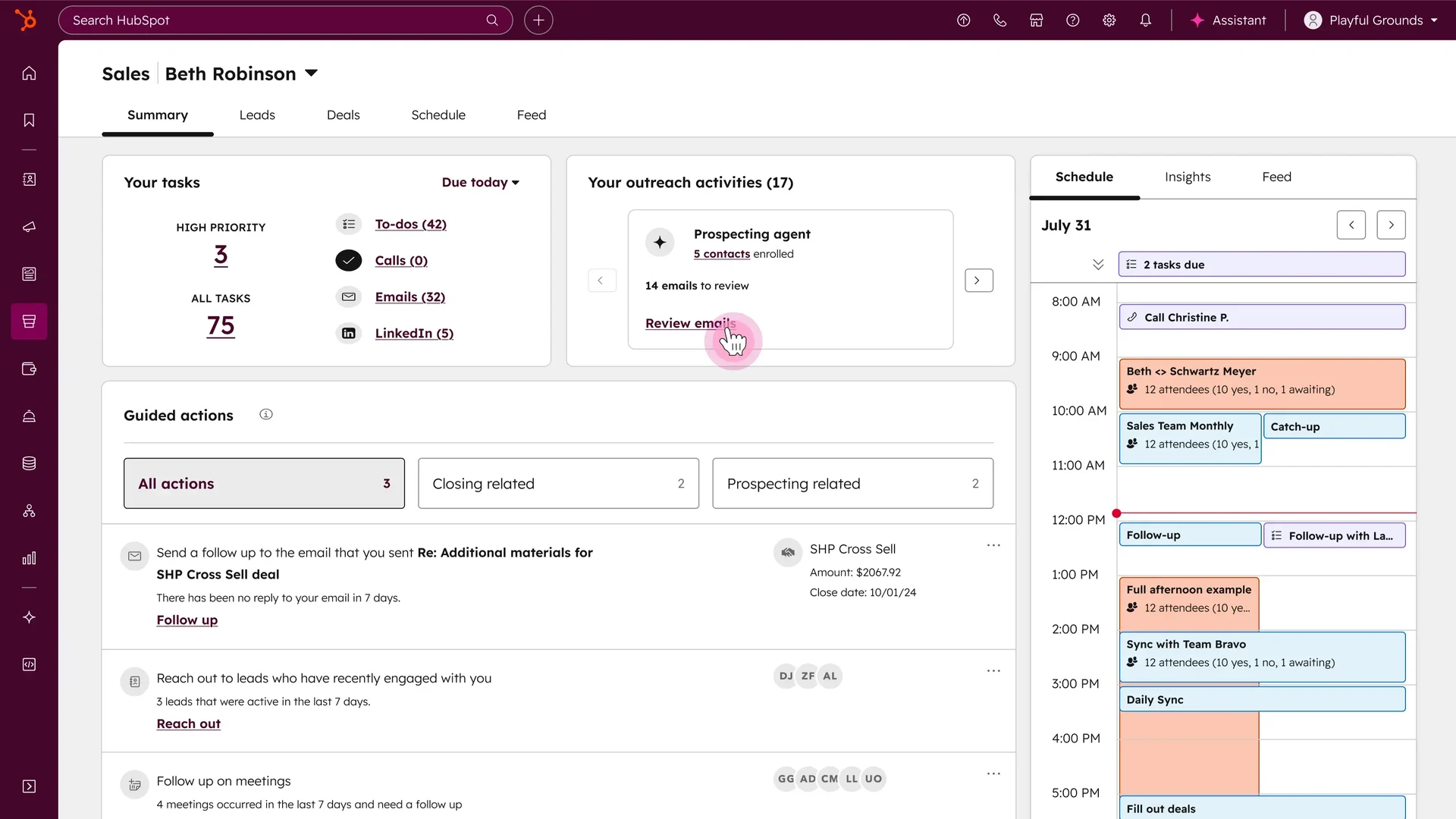
HubSpot is a full CRM and customer platform that offers both manual and AI-powered lead scoring inside the same system where contact data, email activity, and pipeline already live.
Its key capabilities include:
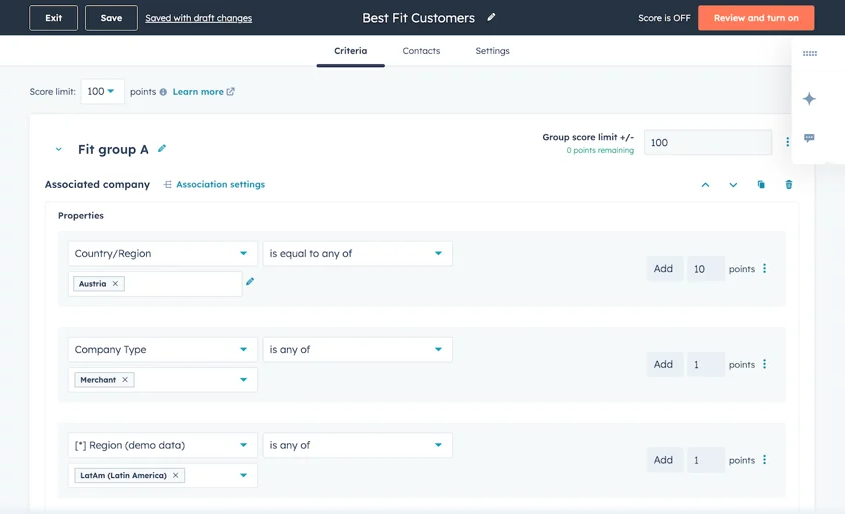
CRM-native manual scoring on the Professional tier, where teams configure rules for demographic fit, company attributes, and behavioral signals directly inside HubSpot
AI predictive lead scoring on the Enterprise tier, analyzing historical conversion data and recommending attribute weights automatically
Unified contact timeline where every score update appears alongside the contact's full CRM history
A permanent free CRM tier accepting unlimited contacts (up to 1 million records), enabling migration before committing to a paid scoring tier
Why Choose HubSpot Over Breadcrumbs for CRM-Native Lead Scoring?
HubSpot stands out in the following areas:
Scoring and CRM Data Share the Same System
Breadcrumbs pulled contact properties from HubSpot or Salesforce via OAuth connectors, computed scores externally, and wrote them back with a 24-hour refresh cycle.
HubSpot's scoring rules execute against contact data that never left the system. Behavioral signals (email opens, link clicks, website page views, meeting bookings) update scores in real time because HubSpot's marketing, sales, and CRM layers share a single data model.
Source: HubSpot
Manual and AI Scoring in the Same Platform
At Sales Hub Professional ($90/seat/month on annual billing), teams get full manual scoring control. At Enterprise ($150/seat/month, annual), HubSpot's predictive scoring layer recommends attribute weights based on historical win data. The progression maps well to how teams mature their scoring programs over time.
Free CRM Reduces Switching Risk
HubSpot's permanent free CRM tier lets teams migrate their contact database at no cost, map engagement workflows, and build historical signal before upgrading to a paid scoring tier. No trial expiration, no credit card required.
NOTE: We also evaluated Freshsales and Keap for the CRM-native lead scoring archetype. Freshsales offers AI-powered scoring inside its CRM, and Keap includes scoring and automation for very small teams. HubSpot offers the most complete native scoring implementation (manual and AI) for businesses that want scoring and CRM in one system, backed by a platform serving 288,706 customers as of year-end 2025.
HubSpot Pricing
Sales Hub Professional: $90/seat/month (annual billing); includes manual lead scoring, sequences, deal pipelines, AI-guided selling, and forecasting. $1,500 one-time onboarding fee required.
Sales Hub Enterprise: $150/seat/month (annual only); adds AI predictive lead scoring, custom objects, advanced permissions, and call transcription. $3,500 one-time onboarding fee required.
Starter Customer Platform: $9/seat/month (annual); bundles Starter editions of Marketing, Sales, Service, Content, and Data Hubs but does not include lead scoring. Useful as a migration staging ground.
Who Should Use HubSpot?
Choose HubSpot if:
Your team already uses HubSpot as its CRM and wants scoring to live where contact data, email engagement, and pipeline activity are already tracked.
You are replacing Breadcrumbs because the MadKudu migration introduced unwanted complexity or pricing changes, and you want a stable, established vendor.
You have fewer than 500 employees and want marketing automation, email marketing, pipeline management, and lead scoring under one subscription.
You want to migrate contacts and evaluate the platform's fit before committing to a paid scoring tier using HubSpot's permanent free CRM.
If you're weighing HubSpot against ZoomInfo, our HubSpot vs ZoomInfo comparison covers how the two platforms differ across CRM, data access, and go-to-market execution.
5. Pecan AI — Best Alternative for ML-Grade Predictive Modeling Across Multiple Use Cases
Source: Pecan AI
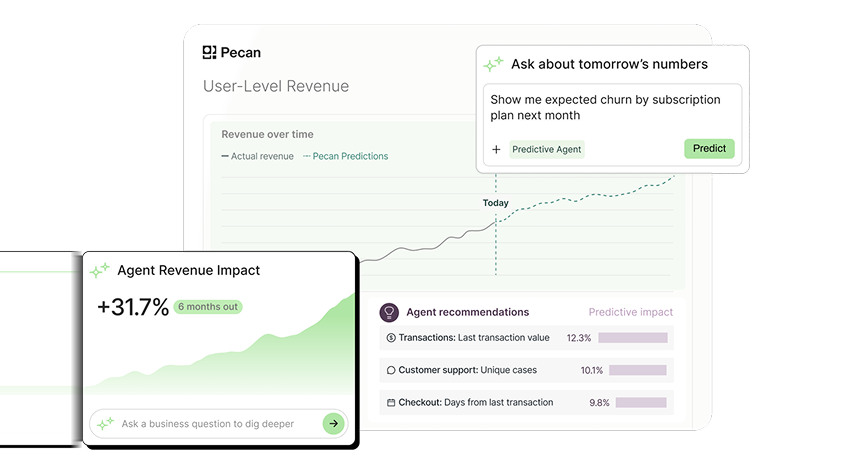
Pecan AI is a predictive AI platform built for data analysts and revenue operations teams who need machine learning accuracy across multiple prediction use cases without hiring a data science team.
Its key capabilities include:
No-code ML model builder via the Predictive AI Agent that handles data prep, feature engineering, algorithm selection, and deployment automatically
Multi-outcome prediction from one infrastructure: churn risk, conversion likelihood, predictive LTV, demand forecasting, upsell propensity, and fraud detection
Warehouse-native architecture connecting directly to Snowflake, BigQuery, and Redshift to train models on full transaction and behavioral history
Automated CRM score write-back pushing predictions to Salesforce and HubSpot on configurable schedules
SOC 2 Type II and ISO 27001 certified security infrastructure
Why Choose Pecan AI Over Breadcrumbs for ML-Grade Predictive Modeling?
Pecan AI stands out in the following areas:
Production ML vs. ML-Assisted Rule Building
Breadcrumbs' Copilot ran a lift-score calculation on CRM properties, surfacing recommended attributes for a human to confirm.
Pecan's Predictive AI Agent runs multi-algorithm optimization across LGBM, CatBoost, LSTM, ARIMA, and Prophet, with Bayesian Optimization for hyperparameter search and SHAP-based feature selection. Teams go from idea to production model in weeks, not quarters.
Multi-Use-Case Prediction Across the Full Customer Lifecycle
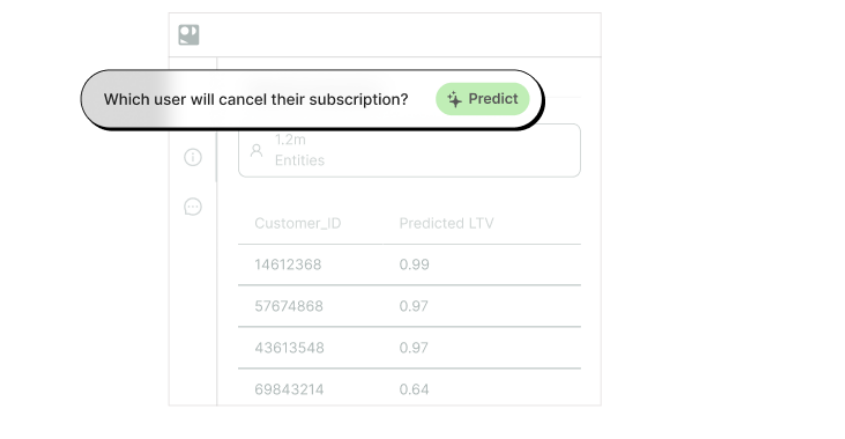
Breadcrumbs was built around the inbound lead-to-opportunity conversion event. Pecan supports prediction across churn risk, demand forecasting, overstock reduction, and campaign response optimization from a single modeling infrastructure.
Source: Pecan AI
Active, Independently Funded Platform
Pecan has raised $116M from investors including Insight Partners, Google Ventures, GGV Capital, and Dell Technologies Capital. It received Gartner Cool Vendor recognition in 2025 and won the 30th Annual Webby Award in AI Experiences & Applications.
NOTE: We also evaluated Toplyne and Correlated for this archetype. Toplyne excels at product-led growth scoring, and Correlated covers PLG-specific account qualification. Pecan AI offers the most technically rigorous predictive ML platform for teams needing breadth across churn, LTV, demand, and conversion prediction without a data scientist.
Pecan AI Pricing
Starter: 2 monthly prediction batches, 500 million rows of storage, Predictive AI Agent included, Salesforce and HubSpot write-back, free trial available (no credit card required)
Team: 10 monthly prediction batches, 2 billion rows of storage, structured onboarding support
Business: custom prediction batches, 5 billion rows, embedded advisory model with weekly expert calls, advanced SSO
Who Should Use Pecan AI?
Choose Pecan AI if:
Your team needs ML-grade prediction across multiple use cases simultaneously (churn, LTV, conversion, demand forecasting) and wants one modeling infrastructure covering all of them.
You have a structured data warehouse (Snowflake, BigQuery, or Redshift) with 12+ months of behavioral or transactional history.
You're running a subscription, DTC, mobile gaming, retail, or service business where customer behavior prediction has direct revenue impact.
You need a predictive platform with active product investment and a formal enterprise security posture, not a tool mid-migration into a third platform.
6. Outfunnel — Best Alternative for Early-Stage Teams on a Budget
Source: Outfunnel
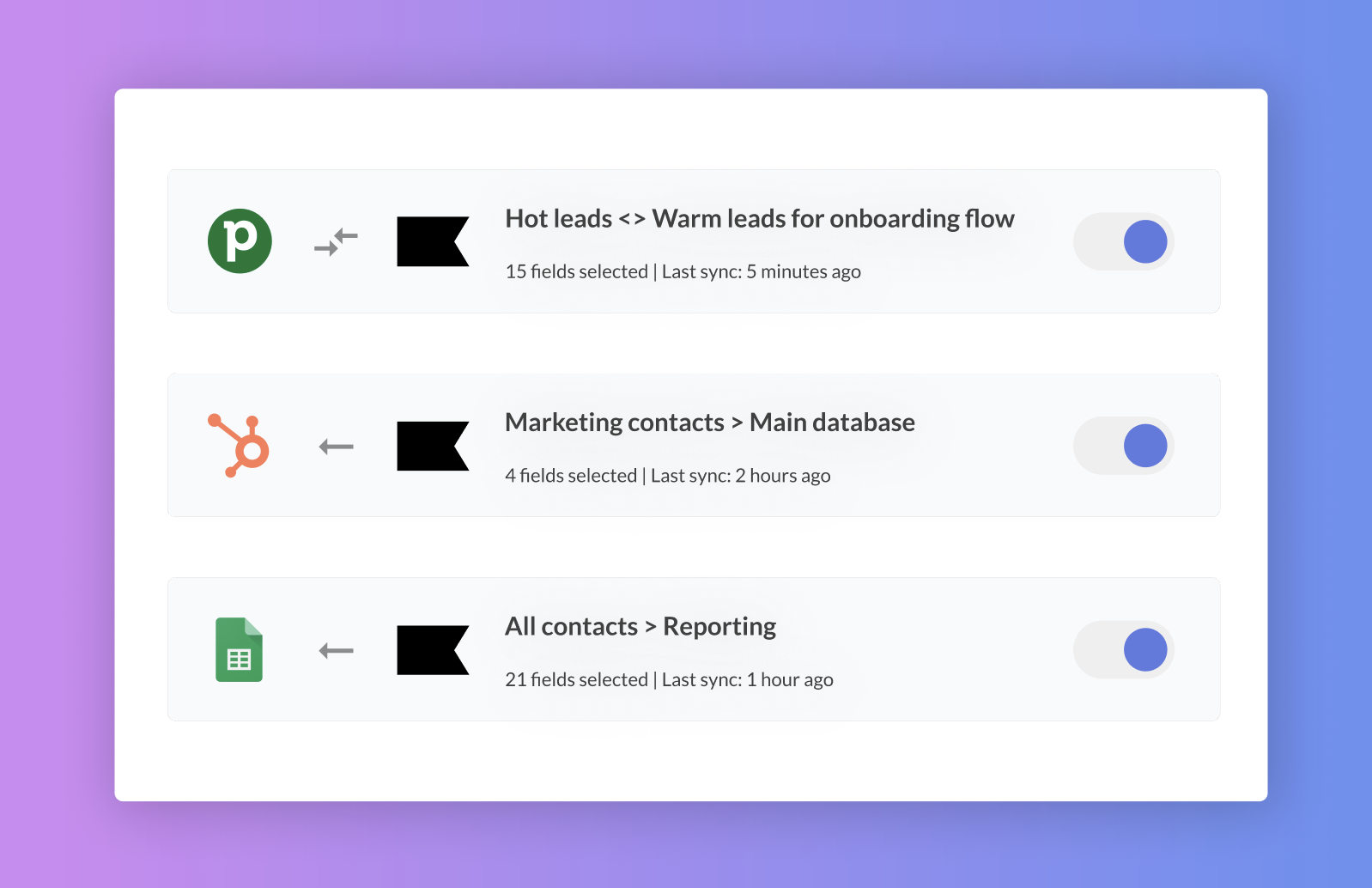
Outfunnel is a sales and marketing integration platform that delivers lead scoring by connecting your CRM to your email tool and website. It gives sales teams a prioritized call list without statistical modeling knowledge or a four-figure monthly budget.
Its key capabilities include:
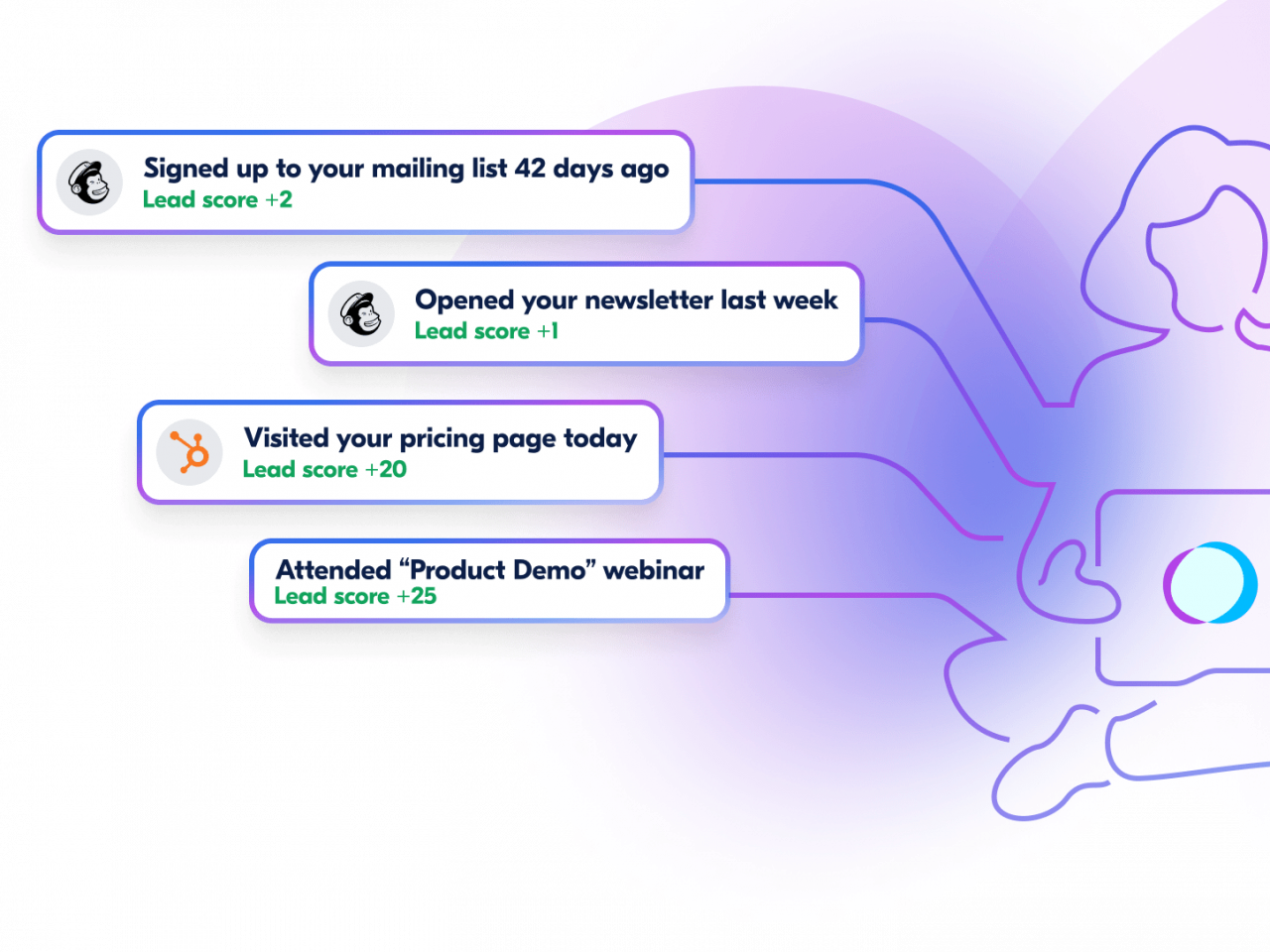
Real-time lead scoring based on email engagement, website visits, and CRM activity, with scores updating in the CRM within approximately one minute
Bidirectional CRM-to-email sync for HubSpot, Pipedrive, Copper, Salesforce, Mailchimp, ActiveCampaign, Brevo, Klaviyo, and additional platforms
Web visitor tracking identifying which CRM contacts are visiting which pages
Score-triggered CRM automation firing native workflow actions when contacts cross score thresholds
Native form routing from LinkedIn Lead Ads, Facebook Lead Ads, Calendly, Gravity Forms, and webhook-enabled tools
14-day free trial with no credit card required and a reported 50% discount for bootstrapped startups and nonprofits
Why Choose Outfunnel Over Breadcrumbs for Early-Stage Lead Prioritization?
Outfunnel stands out in the following areas:
Price Accessibility for Pre-Scale Teams
Breadcrumbs' Pro plan launched at $400/month billed annually. Outfunnel's Professional plan (which includes lead scoring) starts at $99/month for 1,000 active contacts. Outfunnel bills only contacts with engagement events or scores in a given period, not total CRM database size.
No Statistical Complexity or Data Volume Requirements
Breadcrumbs' ML-driven features required sufficient historical conversion data to produce meaningful patterns. Outfunnel's scoring is rule-based: configure which events earn points, set a score expiry window, and scoring is live the same day. G2 reviewers confirm the setup is intuitive and requires minimal technical expertise.
Source: Outfunnel
Active, Stable Product
Outfunnel is independently developed by its founding team, shipped new integrations in Q1 and Q2 2026, and maintains a public changelog. It has earned the #1 Top Rated App on the Pipedrive Marketplace and 4.9/5 on Capterra.
NOTE: We also evaluated HubSpot's free CRM for this archetype. HubSpot offers a capable free contact management layer, but its lead scoring features are locked behind Professional and Enterprise tiers starting at $90/seat/month, well above Outfunnel's pricing. For early-stage B2B teams that want lead scoring without a full CRM platform upgrade, Outfunnel offers the most accessible entry point.
Outfunnel Pricing
Basic Plan: starts at $29/month (100 active contacts); includes contact sync and engagement sync but does NOT include lead scoring or web tracking
Professional Plan: starts at $99/month (1,000 active contacts); includes lead scoring, web visitor tracking, advanced data sync, ecommerce event sync, and call support
Scale Plan: starts at $299/month (15,000+ active contacts, billed annually); adds custom connectors and custom onboarding
Note: Lead scoring is a Professional plan feature. The $29/month Basic plan covers contact sync and engagement sync only.
Who Should Use Outfunnel?
Choose Outfunnel if:
Your team is in the 2-50 employee range, running Pipedrive, HubSpot, or Copper alongside a separate email marketing tool, and currently reconciling contact data manually.
You need lead scoring operational within days, not quarters, with no historical conversion data or statistical expertise required.
Your monthly lead volume is in the hundreds, and Breadcrumbs' $400/month entry or MadKudu's enterprise pricing does not make commercial sense at your current scale.
You are a bootstrapped startup or nonprofit and want to take advantage of Outfunnel's reported 50% discount program.
7. UserMotion — Best Alternative for PLG SaaS Teams Needing Real-Time Intent Scoring
Source: UserMotion
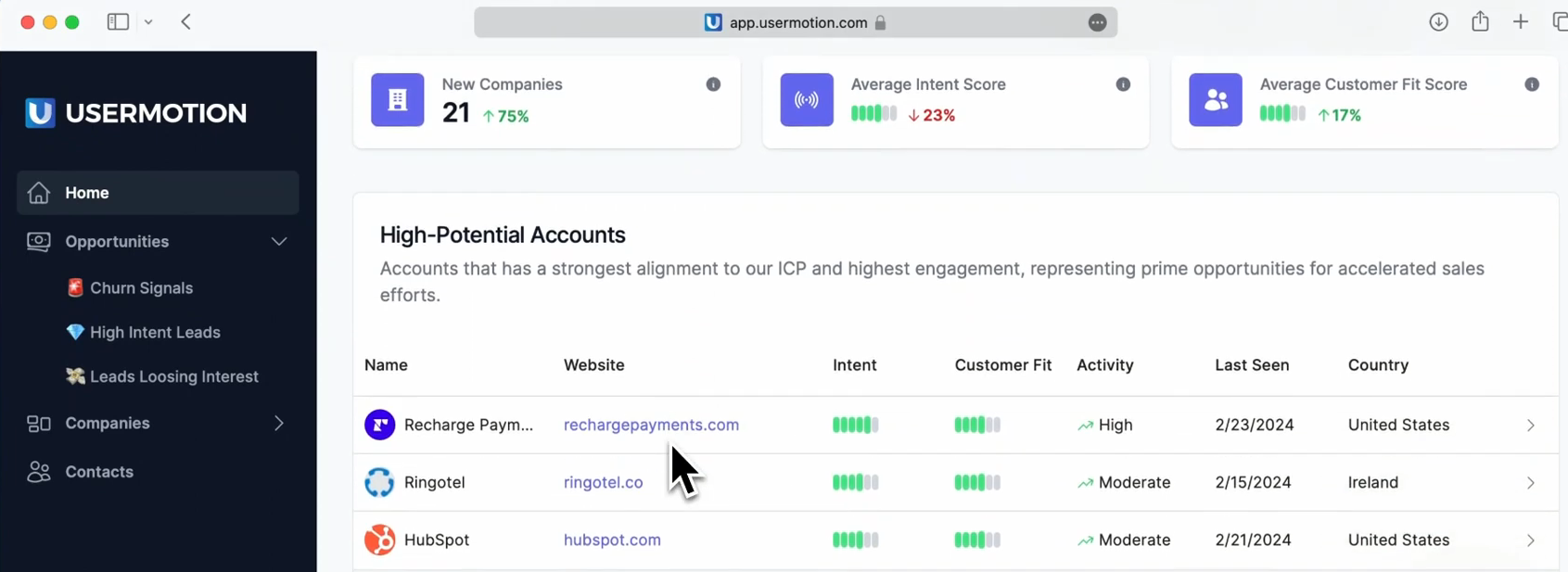
UserMotion is a sales intelligence and predictive lead scoring platform built for B2B SaaS companies running a product-led growth motion. It carries forward the two-dimensional scoring philosophy Breadcrumbs users valued (ICP fit plus behavioral engagement) on an actively maintained product.
Its key capabilities include:
Predictive Lead Scoring with self-learning AI models that combine ICP fit, PQL signals, and 50+ intent signals into a single account score
Customer Health Scoring extending the same intelligence from acquisition to retention and expansion
Real-time revenue alerts delivered to Slack or Discord the moment an account crosses a conversion, expansion, or churn-risk threshold
Signal-based playbooks for Sales, Growth, and Customer Success that prescribe time-bound actions alongside detected signals
A permanent free plan covering up to 1,000 accounts with working ICP scoring, intent scoring, and native integrations
Why Choose UserMotion Over Breadcrumbs for PLG Scoring?
UserMotion stands out in the following areas:
Active Product vs. Sunsetted Platform
UserMotion is actively maintained and independently developed. The pricing page is live, the free tier works, and the product receives ongoing updates. Breadcrumbs' standalone product no longer receives independent investment; its pricing page redirects to MadKudu, and the support documentation is offline.
The Same Two-Dimensional Scoring Philosophy, Still Shipping
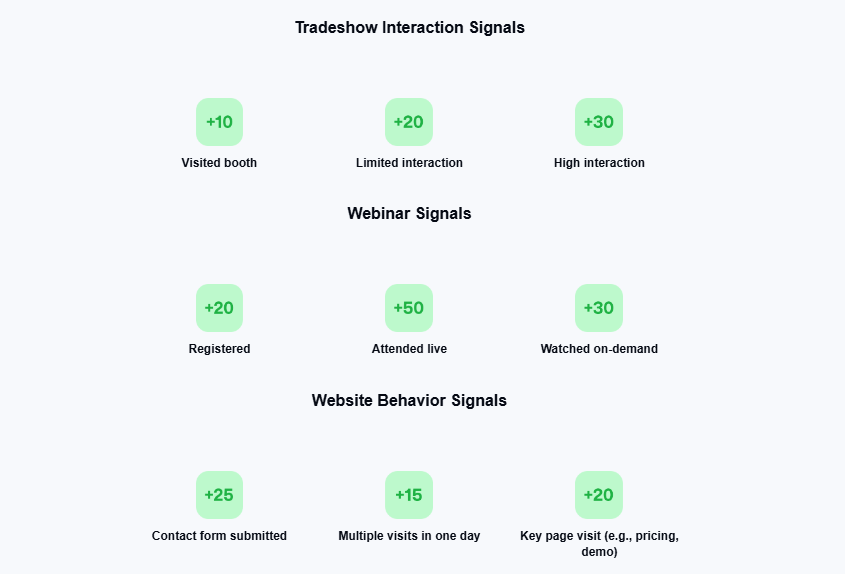
UserMotion combines ICP fit scoring based on firmographic and technographic attributes with intent scoring that tracks 50+ behavioral signals across channels. The intent signal layer applies explicit weighting with decay logic (30 days of inactivity subtracts points), preventing score inflation on stale engagement. The AI model updates continuously without manual reconfiguration.
Source: UserMotion
A Permanent Free Tier That Works
Breadcrumbs' free plan operated in test mode only; scores could not be synced back to connected data sources. UserMotion's permanent free plan covers up to 1,000 accounts with unlimited users, and includes ICP Scoring, Intent Scoring, real-time signals, Best Practice Playbooks, and native integrations with Stripe, Segment, Close, HubSpot, Intercom, and Slack. All of it works in production, not test mode.
NOTE: We also evaluated Factors.ai and Correlated for this archetype. Factors.ai excels at multi-touch attribution and pipeline influence analysis, and Correlated covers PLG-specific signal correlation. UserMotion offers the most direct replacement for the co-dynamic scoring philosophy Breadcrumbs users valued, with a free tier and $199/month entry price that keeps predictive scoring within reach before and after Series A.
UserMotion Pricing
Free: $0/month; up to 1,000 accounts, unlimited users, ICP Scoring, Intent Scoring, real-time signals, native integrations (Stripe, Segment, Close, HubSpot, Intercom, Slack), email support
Starter: $199/month; up to 25,000 accounts, adds Customer 360, Customer Health Scoring, Churn Signals, Upsell and Cross-sell Signals, Automated Workflows, REST API access, chat support. A Startup Program offers 75% off for the first year for qualifying early-stage teams.
Scale: Custom pricing; unlimited accounts, adds Custom Playbooks, Sales Performance Evaluation, Priority support, Dedicated Account Manager, shared Slack channel
Note: UserMotion does not currently offer a native Salesforce integration, which is a hard limitation for Salesforce-first teams.
Who Should Use UserMotion?
Choose UserMotion if:
Your team runs a PLG or PLG-sales hybrid motion, with free trials or freemium tiers generating more signups than your sales team can manually qualify.
You want the two-dimensional scoring philosophy Breadcrumbs users valued (fit plus intent) on a product that is actively maintained and still shipping features.
You need to start scoring before you can afford to pay for it; the permanent free plan covers 1,000 accounts with working scoring and integrations at no cost.
Your CRM stack centers on HubSpot, Close, Intercom, Stripe, or Segment; UserMotion has native connectors for all five.
You want customer health intelligence alongside lead scoring; UserMotion monitors existing accounts for churn risk and expansion signals from $199/month.
The Final Verdict
Breadcrumbs earned its place as a transparent, accessible lead scoring platform. But the product has been absorbed through two acquisitions into HG Insights, and B2B teams need to evaluate alternatives that match their specific needs, GTM motion, and growth stage. Based on our research, here are the best alternatives:
ZoomInfo for B2B data, the GTM Context Graph intelligence layer, and AI-powered go-to-market execution across the full revenue lifecycle
MadKudu (HG Insights) for PLG-native signal-based scoring with direct continuity from Breadcrumbs' architecture and engineering team
6sense for enterprise ABM with external intent data, predictive buying stage classification, and native display advertising
HubSpot for CRM-native lead scoring (manual and AI) without the overhead of an external vendor
Pecan AI for ML-grade predictive modeling across churn, LTV, conversion, and demand forecasting without a data science team
Outfunnel for affordable, rule-based lead scoring and CRM integration for early-stage teams
UserMotion for PLG SaaS teams that need real-time ICP fit plus intent scoring on an actively maintained platform with a free entry point
The right choice depends on what you needed Breadcrumbs for. If you valued the scoring philosophy and PLG focus, MadKudu or UserMotion continue that lineage. If you need the data and intelligence layer that makes any scoring model stronger, ZoomInfo provides the foundation. If you need enterprise ABM, CRM-native simplicity, ML-grade prediction, or budget accessibility, the remaining alternatives each specialize in one of those needs.
Ready to move beyond standalone lead scoring? Explore ZoomInfo to see how its B2B data platform and GTM Context Graph can power smarter account prioritization, AI-driven outreach, and full go-to-market execution. Start with ZoomInfo Lite for free or request a demo to see the full platform in action.
Breadcrumbs Alternatives FAQ
Why are businesses looking for Breadcrumbs alternatives?
The primary reason is that Breadcrumbs is no longer available as a standalone product. MadKudu acquired it in October 2024, and HG Insights acquired MadKudu in August 2025. The breadcrumbs.io pricing page now redirects to a MadKudu demo form, and the support documentation portal is offline.
Beyond the acquisition, Breadcrumbs' limitations included dependency on first-party CRM data (no external intent signals), scores that sat in dashboards without triggering automated seller action, and a minimum data volume requirement that made it difficult for early-stage teams.
What is the most direct replacement for Breadcrumbs?
MadKudu (HG Insights) is the direct corporate successor, with the same engineering team, scoring architecture, and PLG philosophy. Existing Breadcrumbs customers are being migrated to the MadKudu platform.
However, MadKudu now operates on a demo-required enterprise pricing model with no public tiers, a significant shift from Breadcrumbs' self-serve pricing that started at a free plan.
Is there a free alternative to Breadcrumbs for lead scoring?
Yes. UserMotion offers a permanent free plan covering up to 1,000 accounts with working ICP scoring, intent scoring, real-time signals, and native integrations (Stripe, Segment, Close, HubSpot, Intercom, Slack).
Unlike Breadcrumbs' free plan, which operated in test mode and could not sync scores back to data sources, UserMotion's free tier is production-ready. ZoomInfo Lite is also permanently free and provides access to B2B data with 10 monthly export credits and website visitor tracking.
Which Breadcrumbs alternative is best for enterprise teams?
6sense is built for enterprise ABM programs, offering a trillion-signal external intent engine, AI buying stage classification, and a native DSP for account-based advertising. ZoomInfo is the strongest choice for enterprise teams that need B2B data, the GTM Context Graph intelligence layer, and access through APIs, MCP, and interfaces built for sellers and marketers.
Which alternative is best for small teams on a budget?
Outfunnel is the most accessible option for small B2B teams, with lead scoring starting at $99/month on the Professional plan. It uses a rule-based scoring model that requires no historical data or statistical expertise, and offers a reported 50% discount for bootstrapped startups and nonprofits. UserMotion's free tier is another strong option for PLG SaaS teams that need scoring before they can afford to pay for it.
Can I use ZoomInfo alongside another scoring tool?
Yes. ZoomInfo's access model (APIs, MCP, and 172+ marketplace integrations) means its data and intelligence can power any scoring or GTM tool. Teams commonly use ZoomInfo to enrich CRM records that then feed into HubSpot's native scoring, 6sense's ABM models, or other lead prioritization systems. ZoomInfo provides the data foundation; other tools can consume it for their specific use cases.
How does the Breadcrumbs acquisition affect existing customers?
Existing Breadcrumbs customers are being transitioned to the MadKudu platform, now operated under HG Insights. The original Breadcrumbs features (Copilot, Reveal, Compare, Explore) are being absorbed into MadKudu's signal-based selling workflow rather than maintained as standalone capabilities.
Support documentation has migrated to help.madkudu.com, and the developer API is at developers.madkudu.com. Teams that relied on Breadcrumbs' self-serve pricing and transparent per-contact billing should expect a shift toward enterprise, demo-required commercial terms.
Looking beyond Breadcrumbs? Compare the strongest alternatives side by side:
