
Choosing between BuiltWith and Wappalyzer for technology intelligence comes down to five questions:
Do you need historical technology data going back decades, or is current stack detection enough?
Are you building prospect lists by technology usage, or do you also need verified contact data, intent signals, and buying committee mapping?
Is your team willing to pay for granular filtering, or do you need a lighter tool with a lower entry point?
Do you need eCommerce product-level intelligence, or are you focused on SaaS and web technology detection?
Will technographic data alone drive your outreach, or does your go-to-market motion require layering technology signals with contact data, org charts, and buyer intent?
In short, here's what we recommend:
BuiltWith is the choice for teams that live and breathe technographic intelligence. It tracks 113,002+ web technologies across 478 million root domains, with historical data stretching back 41 years to January 1985. If you need to know when a company adopted Shopify, switched from Magento, or started testing a new analytics platform, BuiltWith has no equal. Its eCommerce intelligence (covering 2 billion products across 26 million online stores) makes it valuable for agencies and vendors selling into retail. However, pricing starts at $295/month, the interface takes time to learn, and the data needs manual cleanup at scale.
Wappalyzer offers a simpler entry point for sales and marketing teams that want technology-based prospecting without the complexity. It combines browser extension data from 2.5 million users with proprietary crawlers to deliver current technographic data across 8,028 web technologies. G2 reviewers rate it 9.9 out of 10 for ease of use. But it lacks BuiltWith's historical depth, caps the Pro plan at two technology targets, and its contact data comes with an "as-is" accuracy disclaimer.
Both platforms answer one question well: what technologies does this company use? But for most go-to-market teams, that question is just the starting point. Knowing a prospect runs HubSpot is useful. Knowing their CFO's direct dial, that they're researching your category, and that three similar companies closed deals after showing the same signal pattern is what fills pipeline.
ZoomInfo is a GTM platform built on a large data foundation: 500M contacts, 100M companies, 135M+ verified phone numbers, and 200M+ verified business emails. ZoomInfo tracks 30,000+ technologies across 200+ categories for 30 million+ companies, but technographic data is one input into the GTM Context Graph, an intelligence layer that processes 1.5B+ data points daily by combining ZoomInfo's B2B data with your CRM records, conversation transcripts, and behavioral signals. That intelligence powers execution through GTM Workspace for sellers, GTM Studio for marketers and RevOps, or the Enterprise API and MCP in any front-end. For teams that need more than "find companies using technology X," ZoomInfo turns technographic signals into account intelligence you can act on.
If you need technology data as part of a complete go-to-market platform, see how ZoomInfo works.
BuiltWith vs. Wappalyzer vs. ZoomInfo at a glance
BuiltWith | Wappalyzer | ZoomInfo | |
|---|---|---|---|
Primary focus | Technographic data and market analysis | Technology-based lead generation | AI-powered GTM platform |
Technologies tracked | 113,002+ | 8,028 | 30,000+ across 200+ categories |
Domains indexed | 478M+ root domains | Millions (exact count undisclosed) | 100M companies (30M+ with tech stacks) |
Historical data | 41 years (back to 1985) | Up to 12 months via API | ~90% of pairings updated within 3 months |
Contact data | Names, emails, titles (non-EU/CA) | Emails, phone, social (as-is quality) | 500M contacts, 200M+ verified emails, 135M+ verified phones |
Buyer intent signals | Technology change detection | Website alerts for stack changes | Intent from 210M IP-to-org pairings, 6T+ keyword signals monthly |
CRM integrations | Salesforce, HubSpot, Pardot, Zoho, Dynamics 365, Close.io | Salesforce, HubSpot, Pipedrive | 120+ integrations via App Marketplace |
Free tier | Free individual lookups | 50 lookups/month, 5 alerts | ZoomInfo Lite (permanent free) + 7-day trial |
Starting price | $295/month | $250/month (Pro) | Custom-quoted |
Best for | Technology market research, eCommerce intelligence, competitive analysis | SMB sales teams prospecting by technology stack | Enterprise GTM teams needing data, intent, and execution in one platform |
Technology detection: depth vs. breadth vs. actionability
All three platforms detect website technologies, but they approach the problem from different directions and serve different goals.
BuiltWith has the largest detection infrastructure.
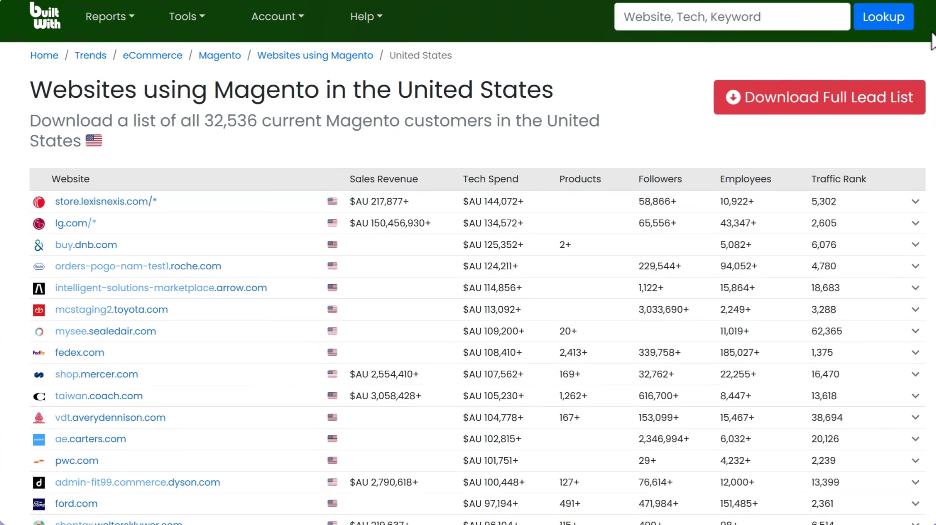
Its crawlers make at least 8.1 billion GET requests per month, indexing 23.8 billion data points across nearly half a billion domains. The platform tracks everything from analytics platforms and CDNs to advertising technologies and AI tools. BuiltWith proved its coverage through a year-long test in which it tracked a secret controlled domain that no competitor ever detected.
Where BuiltWith separates itself is historical data.
Need to know which eCommerce platform a retailer used in 2012? BuiltWith can tell you. Want to track the adoption curve of a JavaScript framework over the past decade? BuiltWith has the trend data. This 41-year historical repository has no match, and it makes the platform essential for market researchers, technology trend analysts, and investment professionals.
Source: BuiltWith
Wappalyzer takes a different approach.
Rather than relying on server-side crawling alone, it combines proprietary crawlers with anonymized signals from its browser extension (installed by over 2.5 million users). This hybrid model can surface technologies that traditional crawlers miss, particularly JavaScript-rendered pages and dynamically loaded tools. Technologies are re-verified monthly, keeping the data current if not as historically deep as BuiltWith.
However, Wappalyzer cannot detect server-side or hidden technologies. Backend infrastructure, internal databases, and ERP systems with no client-side footprint are invisible. G2 reviewers flag this as a real limitation.
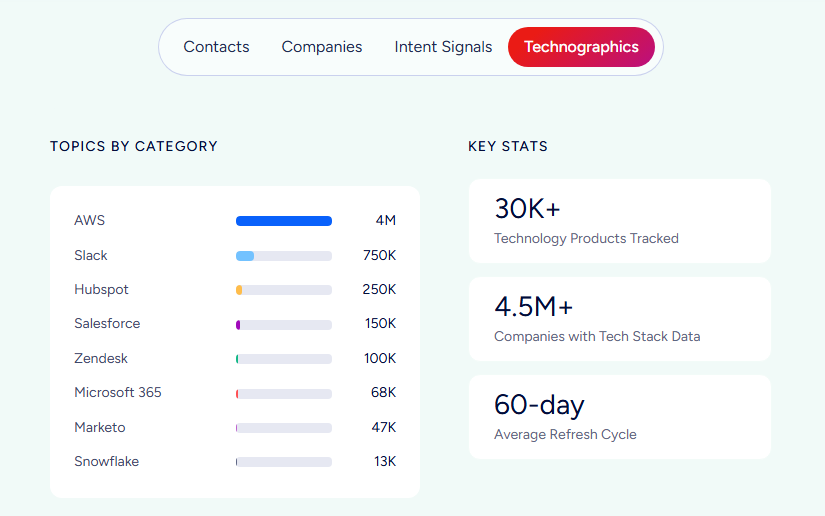
ZoomInfo profiles the tech stacks of 30 million+ companies, tracking 30,000+ technologies across 200+ categories from 20+ source types.
ZoomInfo's technographic data isn't designed to catalog every script tag on every website. It focuses on the technologies that matter for sales conversations: CRMs, marketing automation platforms, cloud infrastructure, security tools, and business applications. Nearly 90% of active pairings are updated within three months.
Source: ZoomInfo
The difference is what happens after detection. BuiltWith and Wappalyzer give you a technology profile. ZoomInfo feeds that profile into the GTM Context Graph, connecting it to verified contacts, org charts, buyer intent, and AI-powered outreach, turning a technographic signal into a complete account strategy.
Lead generation takes different forms on each platform
The way each platform approaches lead generation reveals what it was built for.
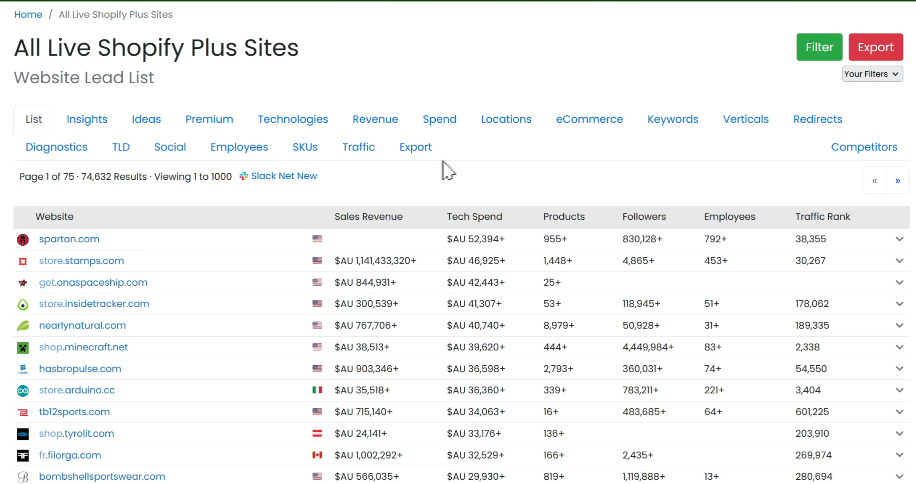
BuiltWith lets you build lists of websites from its database of 113,002+ technologies and 673 million websites, filtering by location (down to city level), traffic ranking, technology spend, vertical, and keywords.
The Actionable Insights feature identifies companies showing buying signals through technology stack changes, platform migrations, and vendor experimentation. For eCommerce prospecting, you can search across 2 billion products to find sites selling specific items.
Source: BuiltWith
The output is data-rich but requires work. G2 reviewers report that BuiltWith data at scale requires manual cleanup, and CRM integrations are not as smooth as they could be.
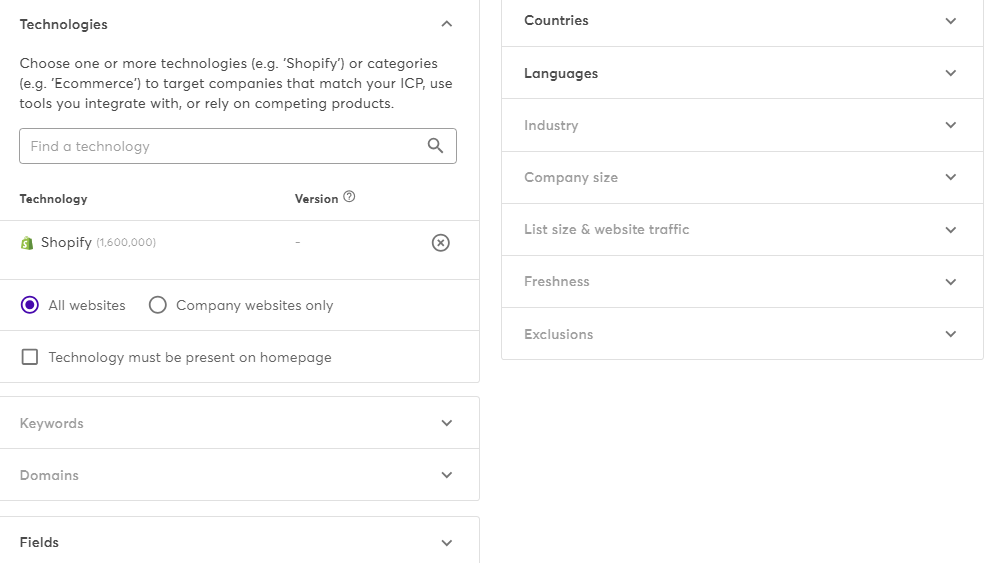
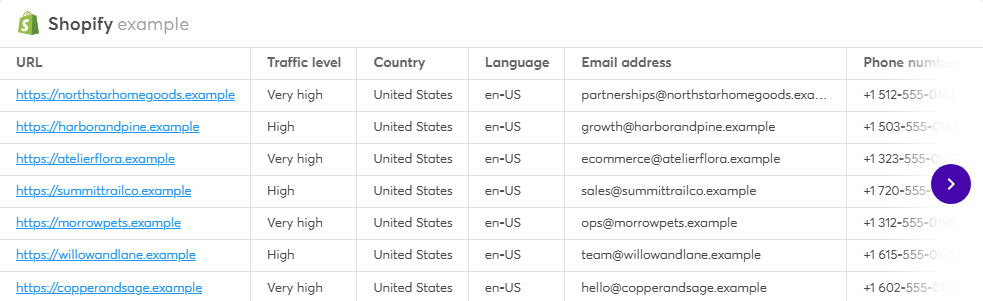
Wappalyzer inverts the typical prospecting model. Instead of starting with a company database and applying filters, you start with a technology. Find all companies running Shopify. Narrow by geography, company size, and traffic. Export with contact details. G2 reviewers rate the workflow 9.9 out of 10 for ease of use.
The limitation is scale and depth.
The Pro plan caps technology targets at two, which constrains multi-ICP prospecting. The Business plan at $450/month doubles the price. And the contact data carries an "as-is" disclaimer rather than an accuracy guarantee, which means you need a verification step before outbound sequences.
Source: Wappalyzer
ZoomInfo treats technographic data as one filter among many.
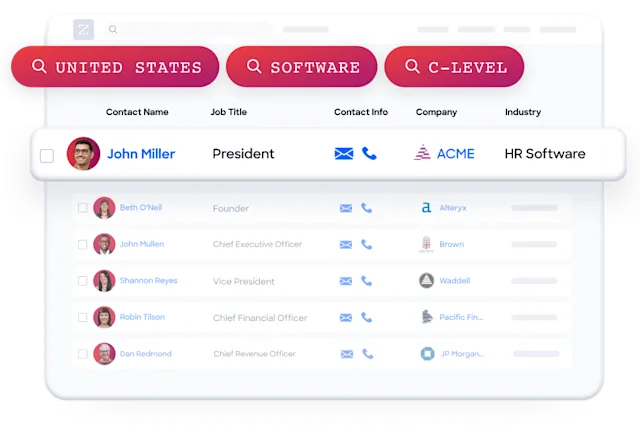
You can search by technology stack, but also by 300+ company attributes, buyer intent signals, website visitor activity, job changes, funding events, and hiring patterns. The results come with verified contact data: 200M+ verified business email addresses and 135M+ verified phone numbers, backed by 300+ human researchers and up to 95% accuracy on first-party data.
Source: ZoomInfo
The difference becomes concrete at the point of outreach. A BuiltWith export gives you a list of domains and some contact details that need cleaning. A Wappalyzer list gives you technology-filtered accounts with unverified emails. A ZoomInfo search gives you the buying committee with direct dials that ring and emails that land.
"ZoomInfo gives us the information we need to execute. It's already there, so we can be three steps ahead." (Vensure)
Contact data quality separates research tools from sales tools
This is the clearest dividing line between the three platforms.
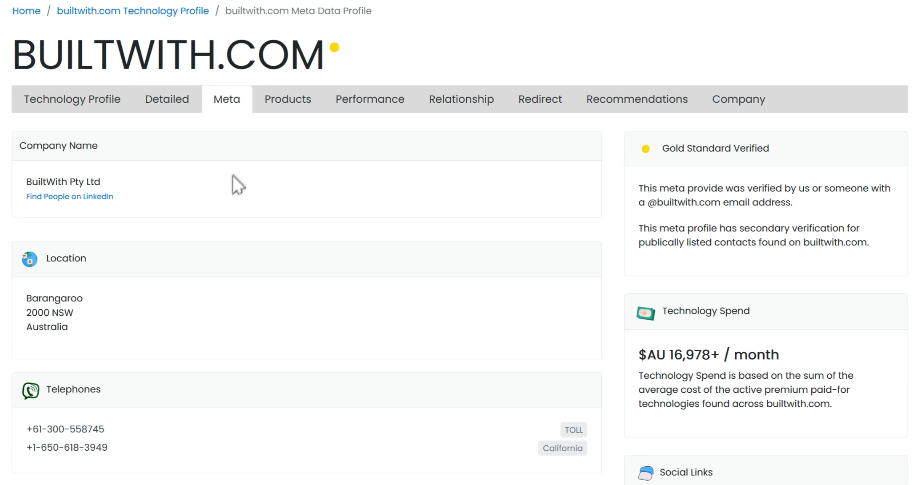
BuiltWith provides contact names, emails, and titles for businesses outside the EU and CA as part of its data exports. It gathers these contacts from publicly listed information on websites. Useful for initial outreach lists, but BuiltWith is a technology data platform, not a contact database. The contact information is supplementary.
Source: BuiltWith
Wappalyzer includes email addresses, phone numbers, and employee names in its exports, with a tiered system: raw emails, verified emails (confirmed reachable), and "safeEmail" (verified, reachable, and assessed as safe-to-send).
This tiering helps, but Wappalyzer explicitly disclaims accuracy on contact fields, so teams using it for outbound still need a verification step.
ZoomInfo was built as a contact data platform from day one.
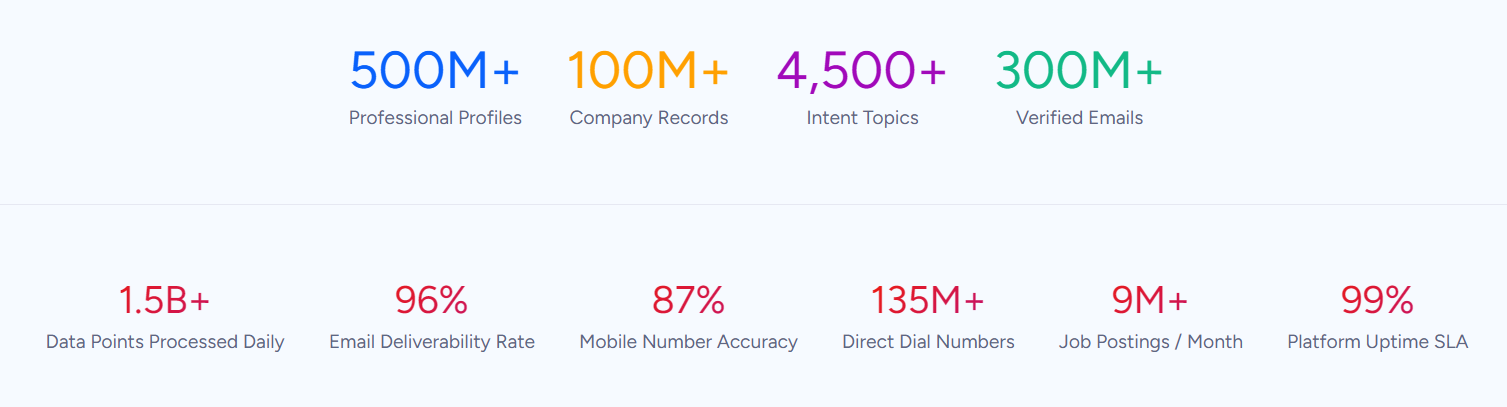
The numbers tell the story: 500M contacts, 135M+ verified phone numbers, 120M direct-dial phone numbers, and 200M+ verified business email addresses. This data flows through a multi-source verification pipeline: automated ML scanning of 28 million site domains daily, a community of 200,000+ ZoomInfo Lite users who share data back, and an in-house Data Training Lab of 300+ human researchers.
In a Fortune 500 competitive RFP analyzing 25 million contacts across vendors, the independent consultant concluded that "no other competitor came even close."
Source: ZoomInfo
For sales teams, the practical impact is clear. A 30% bounce rate doesn't just waste outreach effort; it damages sender reputation and pushes future emails into spam folders. ZoomInfo's verified data eliminates that risk at the source.
SpringDB used ZoomInfo's enriched data to achieve 2x-3x increases in campaign conversions across channels and a 300% increase in database usability. (SpringDB)
Intent and buying signals reveal different levels of intelligence
Knowing what technology a company uses is static information. Knowing when they're about to change it is intelligence you can act on.
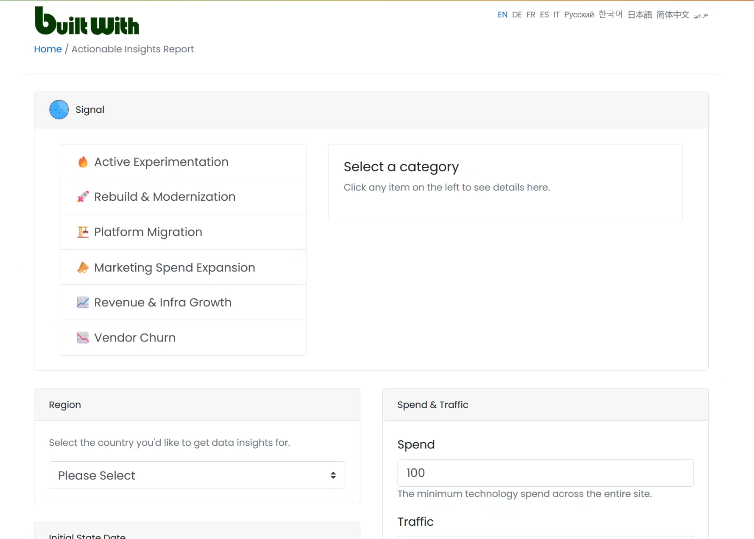
BuiltWith approaches intent through technology change detection. The Actionable Insights feature analyzes real-time stack changes to spot companies testing new tools, migrating platforms, churning vendors, or growing infrastructure.
BuiltWith can also help you find companies affected by outages in their technology stack, opening windows for competitive replacement. These signals are specific to technology adoption and valuable for that use case.
Source: BuiltWith
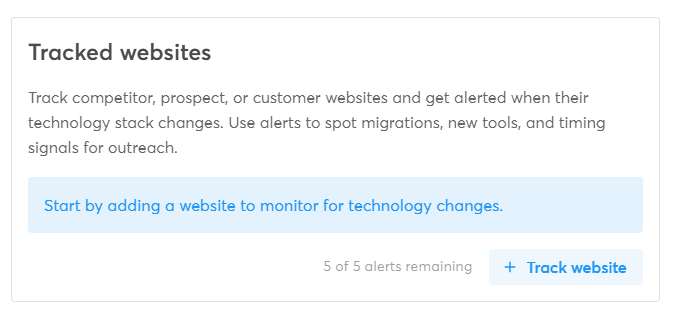
Wappalyzer offers Website Alerts that notify you when tracked websites change their technology stack. You can monitor competitor sites, prospect accounts, and customer properties for installs, removals, and migrations. Free accounts get 5 alerts; paid plans get more. The pitch: react while the change is still fresh.
Source: Wappalyzer
ZoomInfo works at a different level.
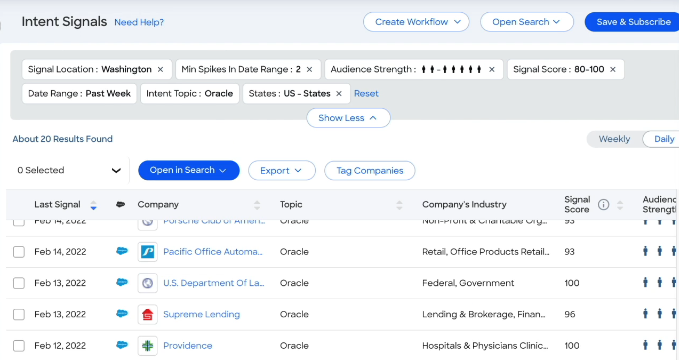
ZoomInfo Intent tracks signals from 210 million IP-to-Organization pairings and 6 trillion+ new keyword-to-device pairings sourced monthly. This captures not just technology stack changes but active research behavior: when a company reads about solutions in your category, visits competitor websites, or consumes content related to your value proposition.
Guided Intent, exclusive to ZoomInfo, identifies topics historically correlated with deal success rather than requiring manual topic selection. Combined with WebSights (which resolves anonymous website traffic to companies and buying team members), these signals flow through the GTM Context Graph to build an intent picture that technology change alerts alone cannot replicate.
Source: ZoomInfo
Seismic attributed 39% of active pipeline to ZoomInfo signals and boosted productivity by 54%: "That combination of our internal CRM data, external signals, and AI has helped us craft very specific account- and persona-based messages." (Seismic)
Pricing structures reflect different markets
The pricing models reveal who each platform serves.
BuiltWith offers three paid tiers: Basic at $295/month (limited to 2 technology reports and 2 keyword searches), Pro at $495/month (unlimited technologies and keywords, 1 login), and Team at $995/month (unlimited logins and API access).
Annual billing saves roughly one month's cost. BuiltWith's free tier covers individual site lookups permanently, but there's no free trial of paid plans because all data is fully exportable. The company recommends signing up for a month, pulling the reports you need, and canceling if the data doesn't justify continued use.
Wappalyzer has a more graduated structure: a permanent free plan (50 lookups/month), Plus at $10/month (200 lookups, browser extension enrichment), Pro at $250/month (5,000 lookups but only 2 technology targets and no API), Business at $450/month (unlimited targets, 20,000 lookups, API access, CRM enrichment), and Enterprise from $850/month.
The jump from Pro to Business is steep but necessary for teams that need more than two technology targets or API access. Note that API credits expire after 60 days, penalizing teams with irregular usage.
ZoomInfo uses custom-quoted pricing with seat-and-credit-based plans.
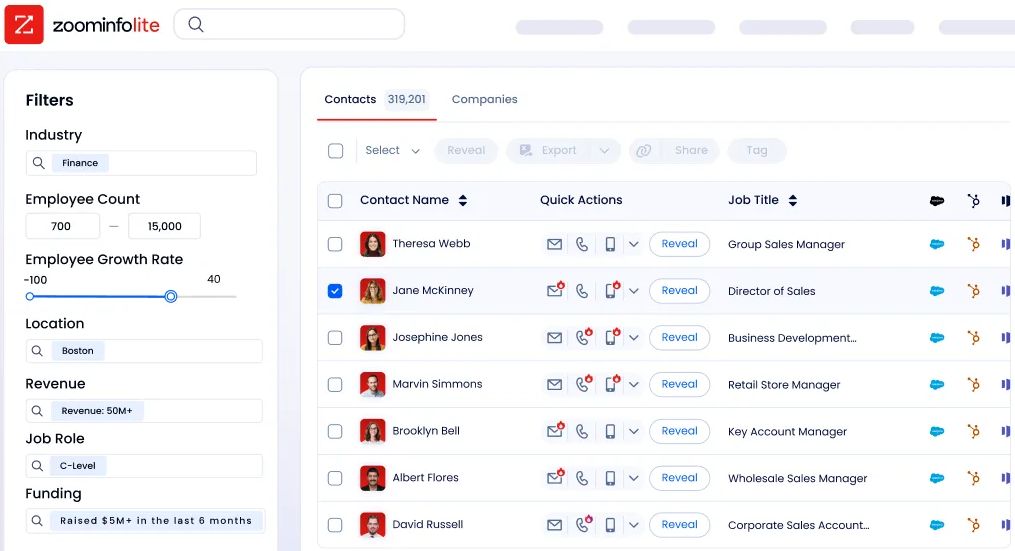
The platform is organized into Sales, Marketing, and Operations product lines, each with tiered plans (Professional, Advanced, Enterprise for Sales; Marketing Demand, ABM Lite, ABM Enterprise for Marketing). ZoomInfo Lite provides permanent free access with 10 monthly export credits and basic search. A 7-day free trial is also available with no credit card required.
Source: ZoomInfo
ZoomInfo's pricing is higher, and that's by design. You're not paying for a technology lookup tool. You're paying for B2B data, buyer intent, conversation intelligence, AI-powered execution, and verified contact data that makes every other signal usable. The ROI math works when you measure pipeline generated rather than cost per lookup.
Note: ZoomInfo is transitioning toward a consumption-based pricing model.
Market analysis and competitive intelligence
For teams focused on technology market research rather than direct sales prospecting, the platforms diverge.
BuiltWith leads here.
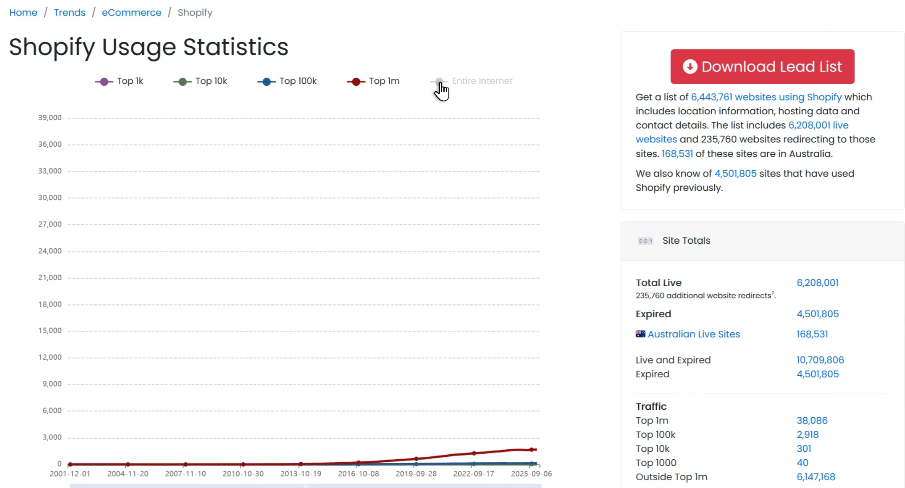
Its Market Analysis platform provides technology adoption trend data across the internet, segmented by top 10K, top 100K, and top 1 million websites. You can track market share movements, competitor wins and losses, and technology adoption curves going back decades.
Source: BuiltWith
This data has earned recognition from large institutions: Winton Capital (one of the world's largest hedge funds) uses BuiltWith for technology benchmarking, while Harvard Business School and MIT Technology Review have cited it in research. The Technology Investor Center provides alternative data feeds for hedge funds and investment firms tracking public company technology spending.
Wappalyzer offers market research capabilities for sizing technology categories and tracking adoption trends, but without the historical depth or institutional-level analysis that BuiltWith provides. It works for quick competitive checks but not for sustained market intelligence.
Source: Wappalyzer
ZoomInfo approaches competitive intelligence differently.
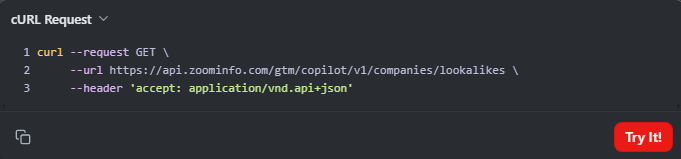
Rather than tracking technology market share across the internet, ZoomInfo focuses on account-level competitive intelligence within your target market. Company Insights and Find Similar Companies help teams identify lookalike accounts and understand competitive dynamics.
For market research, BuiltWith provides broader technology trend coverage. For sales-oriented competitive intelligence, ZoomInfo provides deeper account context.
Source: ZoomInfo
Integrations and API access
How each platform connects to your existing tools determines how much manual work sits between data and action.
BuiltWith integrates with six CRM platforms: HubSpot, Pardot, Zoho, Close.io, Dynamics 365, and Salesforce. It offers a full API with endpoints for domain lookups, relationships, lists, and trends.
Recent additions include MCP support and an AI Agent CLI for automated research workflows. API access requires the Team plan at $995/month. Data is available via Snowflake, Databricks, Redshift, and BigQuery for data warehouse ingestion.
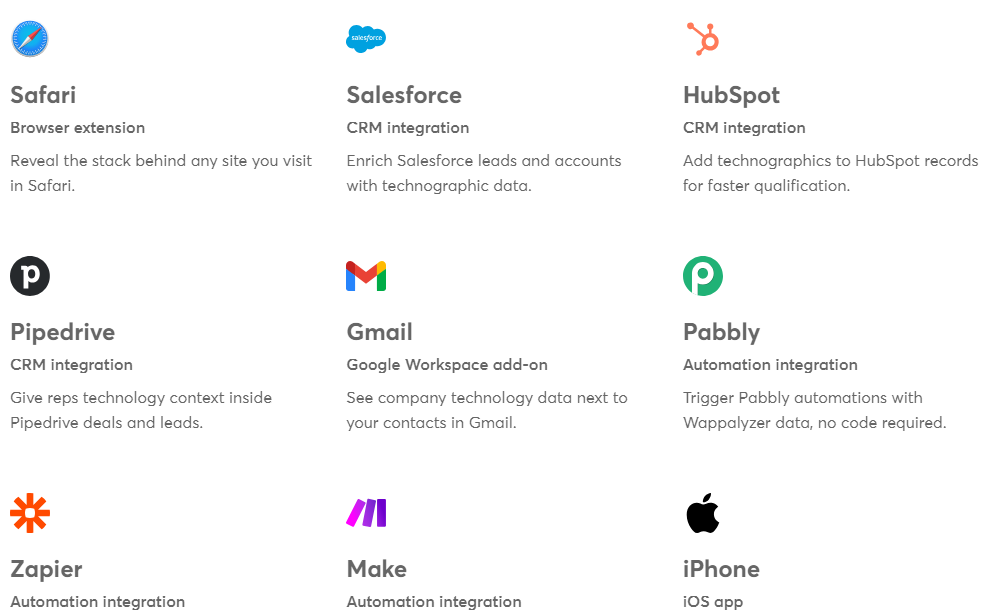
Wappalyzer offers native CRM integrations with Salesforce, HubSpot, and Pipedrive, plus automation connectors through Zapier, Make, and Pabbly. Its REST API is well-documented with an OpenAPI 3.1 spec available for Postman import. A hosted MCP server lets AI agents call Wappalyzer lookups during research workflows. API access requires the Business plan at $450/month.
Source: Wappalyzer
ZoomInfo works at a different scale.
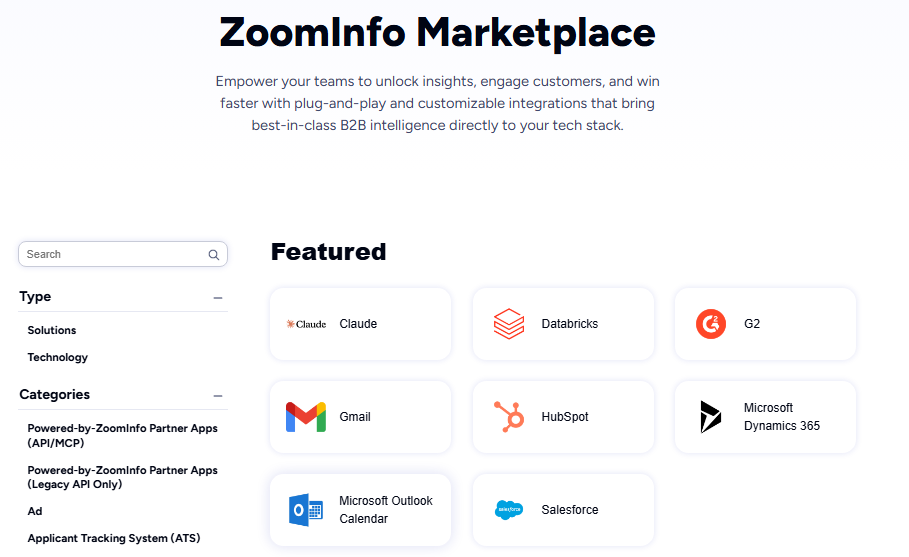
The App Marketplace lists 120+ partner integrations across CRM, marketing automation, sales engagement, revenue intelligence, data warehouse, and communications platforms. The Enterprise API provides programmatic access to ZoomInfo's full data and intelligence layer, organized into Search & Enrich, Copilot AI, Marketing, and Platform endpoint families.
The ZoomInfo MCP server, listed in the Claude directory, connects AI models directly to ZoomInfo's B2B data through natural language. API access is included in all plans, not locked behind a premium tier.
Source: ZoomInfo
BDO Canada cut time spent on data dashboard updates by 87%: "The plug-and-play aspect of the API means I can integrate it very easily into any process and get information at a moment's notice." (BDO Canada)
Security, compliance, and data governance
For enterprise buyers, compliance posture can be a deciding factor.
BuiltWith is GDPR compliant, offers two-factor authentication, SAML2 SSO for Team users, and supports SSO configurations for Google Admin, Microsoft Entra, Okta, and Ping Identity. It maintains a Security Vulnerability Bounty program and provides contact data only outside the EU and CA to comply with privacy regulations.
Source: BuiltWith
Wappalyzer uses HTTPS-only API communication with SHA256 webhook signatures. Its terms are governed by Australian law. To comply with the Spam Act 2003, it does not supply email addresses or phone numbers to users in Australia. No public SOC 2, ISO 27001, or GDPR compliance certifications appear on the Wappalyzer website.
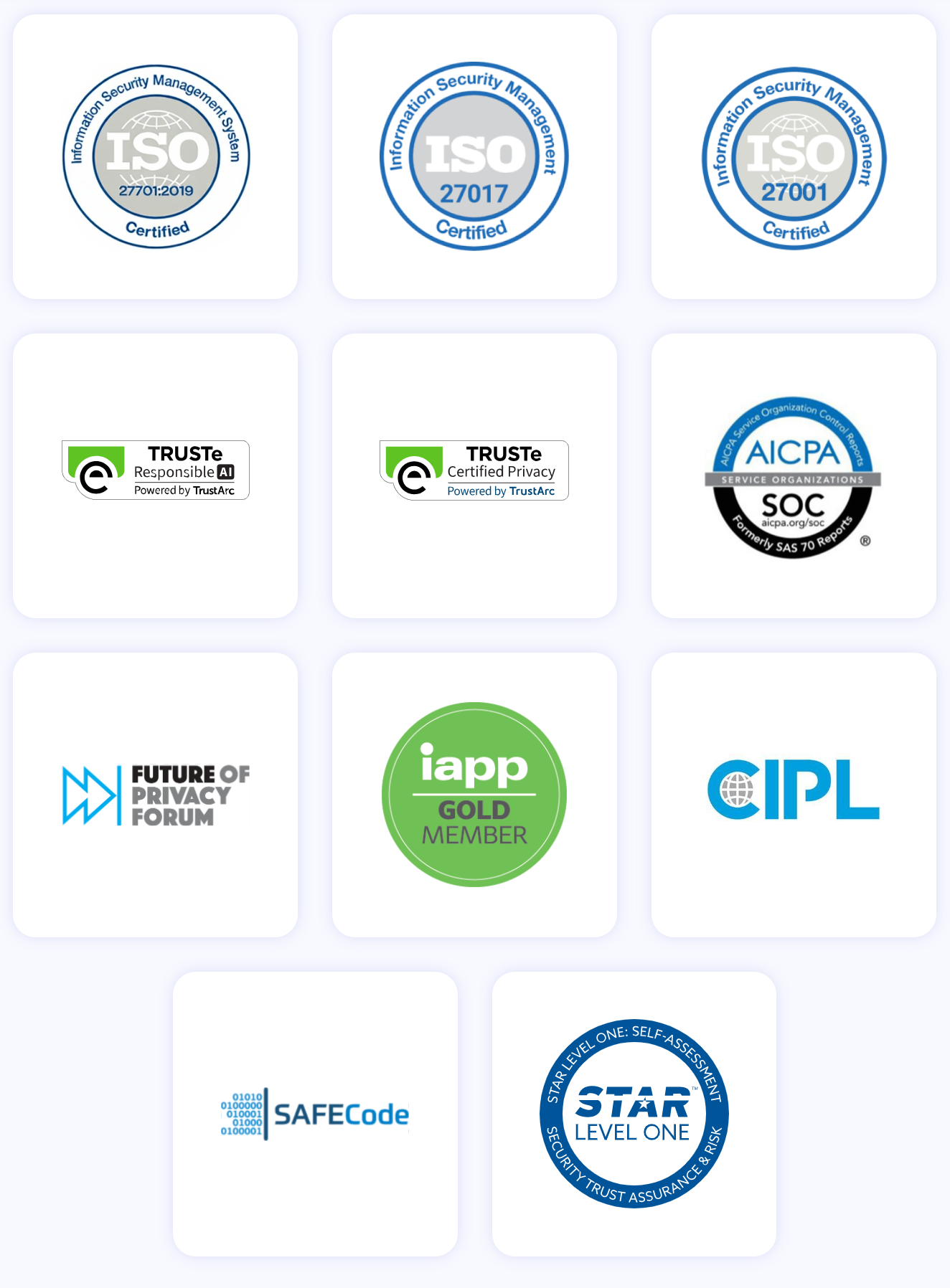
ZoomInfo maintains the widest set of compliance certifications: ISO 27001, ISO 27701, SOC 2 Type II, TRUSTe GDPR, and TRUSTe CCPA, all renewed annually. ZoomInfo is a registered data broker in California and Vermont and maintains a dedicated Trust Center.
For enterprises in regulated industries (financial services, healthcare, government contracting), ZoomInfo's compliance infrastructure is built to pass procurement scrutiny that smaller platforms may not survive.
BuiltWith vs. Wappalyzer vs. ZoomInfo: Which should you choose?
The right tool depends on what you're trying to accomplish with technographic data.
Choose BuiltWith if:
Technology market research and trend analysis are your primary use case
You need historical technology adoption data going back years or decades
You're selling to eCommerce businesses and need product-level intelligence across 26 million online stores
Competitive intelligence around technology market share drives your strategy
You work in investment research or alternative data and need institutional-level technology datasets
Choose Wappalyzer if:
You're a small sales team that prospects primarily by technology stack
Ease of use and low entry cost matter more than data depth
You need a browser extension that instantly shows you what any website runs
Your workflow is simple: find companies using technology X, export list, run outreach
You want a free tier to evaluate data quality before committing
Choose ZoomInfo if:
Your go-to-market motion requires verified contacts, buyer intent, and technographic data working together
You need direct dials and verified emails that reach decision-makers
Buyer intent signals and in-market account identification drive your pipeline strategy
You want AI-powered execution (account research, outreach drafting, deal intelligence) on top of data
Your team needs a single platform rather than stitching together a technology lookup tool, a contact database, an intent provider, and an outreach engine
Start with ZoomInfo Lite for free or request a demo.
BuiltWith and Wappalyzer do one job well: identifying the technologies behind websites. For teams whose workflow revolves around technographic prospecting, either can serve that purpose.
But for go-to-market teams that need technographic signals connected to verified contacts, buyer intent, org charts, and AI-driven execution, ZoomInfo provides the complete picture. The technology stack a company runs tells you what they use. ZoomInfo tells you who to call, when to call them, and what to say when they pick up.
BuiltWith vs. Wappalyzer vs. ZoomInfo FAQ
What is the core difference between BuiltWith, Wappalyzer, and ZoomInfo?
BuiltWith is a technology intelligence platform that tracks 113,002+ web technologies across 478 million domains with historical data going back 41 years, making it strongest for market research and technology trend analysis.
Wappalyzer is a lighter technographic tool tracking 8,028 technologies, focused on sales prospecting through lead lists and browser extension lookups.
ZoomInfo is a GTM platform that includes technographic data as one layer alongside 500M contacts, 100M companies, verified phone numbers and emails, buyer intent signals, conversation intelligence, and AI-powered execution tools, all connected through the GTM Context Graph.
Which platform has the most accurate technology detection?
BuiltWith has the broadest detection, covering 113,002+ technologies with 100% coverage of .com/.net/.org domains. BuiltWith proved its coverage through a year-long test tracking a secret domain that no competitor detected.
Wappalyzer tracks 8,028 technologies and benefits from browser extension signals that can catch dynamically loaded tools, but cannot detect server-side technologies.
ZoomInfo tracks 30,000+ technologies across 200+ categories for 30 million+ companies, with nearly 90% of active pairings updated within three months.
Which platform is best for finding contact information alongside technology data?
ZoomInfo leads in contact data, with 500M contacts, 100M companies, 200M+ verified business email addresses, 135M+ verified phone numbers, and up to 95% accuracy on first-party data.
BuiltWith includes contact names, emails, and titles for businesses outside the EU and CA, but contact data is not its primary product. Wappalyzer provides email addresses and phone numbers but classifies its contact data as "as-is" without accuracy guarantees.
How does pricing compare across the three platforms?
BuiltWith starts at $295/month for the Basic plan (limited to 2 technology reports) and goes up to $995/month for the Team plan with unlimited logins and API access. Wappalyzer starts at $250/month for Pro (capped at 2 technology targets) and $450/month for Business (unlimited targets and API access).
ZoomInfo uses custom-quoted pricing and does not publish prices, though it offers a permanent free tier (ZoomInfo Lite) and a 7-day free trial.
Which platform is best for eCommerce technology intelligence?
BuiltWith has the strongest eCommerce data, tracking over 2,500 eCommerce technologies and 2 billion unique products across 26 million online stores. Users can search by specific products, filter by SKU count and revenue estimates, and build targeted retail prospect lists. Wappalyzer covers eCommerce platforms but without product-level intelligence.
ZoomInfo includes eCommerce technologies in its broader technographic coverage but is not specialized for product-level retail data.
Can I use these platforms together, or are they mutually exclusive?
They serve different purposes and can complement each other.
BuiltWith excels at historical technology research and market analysis. Wappalyzer provides quick, current technology lookups. ZoomInfo provides the verified contact data, buyer intent, and execution layer that turn technographic insights from either platform into outreach you can act on.
Teams focused on technology market research sometimes use BuiltWith for analysis and ZoomInfo for execution.
Which platform offers the best buyer intent data?
ZoomInfo provides the broadest intent intelligence, tracking signals from 210 million IP-to-Organization pairings and 6 trillion+ keyword-to-device pairings sourced monthly. Its Guided Intent feature identifies topics historically correlated with deal success. These signals feed into the GTM Context Graph, which combines them with CRM and first-party data for a complete picture of buyer activity.
BuiltWith's Actionable Insights feature detects intent through technology stack changes and platform migrations. Wappalyzer's Website Alerts notify users of technology changes on monitored sites.
Only ZoomInfo captures research behavior and content consumption as intent signals beyond technology changes.
Which platform has the strongest compliance and security certifications?
ZoomInfo holds the widest compliance stack: ISO 27001, ISO 27701, SOC 2 Type II, TRUSTe GDPR, and TRUSTe CCPA certifications, all renewed annually, plus registration as a data broker in California and Vermont.
BuiltWith is GDPR compliant and offers SAML2 SSO and 2FA but does not publish additional certifications. Wappalyzer does not publicly list SOC 2, ISO 27001, or GDPR compliance certifications.
