

Bullhorn is the global leader in staffing and recruitment software, serving over 10,000 companies with a cloud-based platform that covers the full recruitment lifecycle from candidate sourcing through payroll and billing. With 1,400+ employees across 14 countries and $47 million+ invested in R&D annually, it has become the operational backbone for staffing firms of every size.
But even the best ATS only knows what happens inside it.
Bullhorn tracks candidates, placements, job orders, and client relationships. What it cannot do on its own is verify whether a candidate's phone number still works, source passive talent from a network of 1.3 billion professionals, transcribe and summarize recruiter calls into searchable notes, automate multi-channel redeployment campaigns, run background checks from inside the ATS, connect to the thousands of apps outside its Marketplace, or sync placement data to payroll without manual re-entry.
The right integrations close those gaps. They feed your ATS verified data it can't produce on its own, automate engagement recruiters would otherwise handle manually, put compliance and screening results on candidate records, and connect Bullhorn to the rest of your tech stack so your team works from one complete picture.
This guide covers the strongest integration for each of the jobs Bullhorn users most commonly need done:
Enrich candidate and contact records with verified B2B data, buyer intent signals, and company intelligence
Source passive candidates from the world's largest professional network with full ATS sync
Log every recruiter call automatically and generate AI conversation summaries in the ATS
Automate multi-channel candidate redeployment and pre-screening at scale
Run background checks and adjudication directly from the Bullhorn candidate record
Connect Bullhorn to thousands of apps outside its Marketplace without code
Sync new hires, time entries, and payroll data between Bullhorn and your payroll system
Each section walks through how the integration connects with Bullhorn, what data flows between the platforms, pricing, and who benefits most.
Best Bullhorn Integrations at a Glance | |
|---|---|
Best Bullhorn Integration for B2B Data Enrichment and Contact Intelligence. Enriches Bullhorn candidate and contact records with verified phone numbers, business emails, company attributes, and buyer intent signals, giving recruiters accurate data to act on and the intelligence to prioritize accounts that are actively hiring. | |
Best Bullhorn Integration for Passive Candidate Sourcing. Connects the world's largest professional network to your ATS through Recruiter System Connect, syncing InMails, recruiter notes, candidate submissions, and Easy Apply applications bidirectionally so every sourcing interaction lives in Bullhorn. | |
Best Bullhorn Integration for Automated Call Logging and AI Conversation Records. Eliminates manual call logging with click-to-call from Bullhorn records, automatic post-call note creation, and AI transcriptions and summaries that write back to the ATS as searchable candidate data. | |
Best Bullhorn Integration for Automated Candidate Redeployment and Multi-Channel Engagement. Turns Bullhorn's assignment end dates into automated redeployment campaigns across email, SMS, WhatsApp, and AI chatbot, with pre-screening results and engagement outcomes synced back to candidate records. | |
Best Bullhorn Integration for Background Screening Compliance. Lets staffing teams order, track, and adjudicate background checks directly from the Bullhorn candidate record, with automated adjudication rules and a candidate self-service portal that reduces coordinator workload. | |
Best Bullhorn Integration for No-Code Workflow Automation Across Non-Native Apps. Extends Bullhorn's reach to 8,000+ applications with no-code automation, letting staffing operations teams sync ATS events with tools outside the Bullhorn Marketplace without developer involvement. | |
Best Bullhorn Integration for Payroll and Back-Office Workforce Data Sync. Syncs new hires, terminations, time entries, and employee data between Bullhorn and ADP Workforce Now, eliminating manual re-keying that causes pay delays and compliance risk in staffing back offices. |
What Is Bullhorn?
Source: Bullhorn
Bullhorn is a cloud-based recruitment and staffing platform that serves as the operational core for staffing agencies worldwide, combining applicant tracking, CRM, automation, AI, middle office, and onboarding in a single system of record.
Founded in 1999 in Boston and backed by Stone Point Capital, Insight Partners, and Genstar Capital, Bullhorn claims 80% of enterprise recruitment agencies use its platform. It offers dedicated workflows for professional staffing, healthcare, light industrial, and executive search.
Bullhorn's integration ecosystem is a core strength.
The Bullhorn Marketplace houses 300+ pre-integrated technology partners spanning sourcing, background screening, payroll, job boards, onboarding, analytics, and communication tools.
On the technical side, Bullhorn offers a RESTful API supporting full CRUD operations across all core entities (candidates, jobs, placements, contacts, companies, notes, files), OAuth 2.0 authentication, and a polling-based event subscription system for integration-driven automation.
Open-source SDKs exist for Java and JavaScript, along with a Data Loader for bulk operations.
The integration categories available to Bullhorn users include:
Data enrichment and intelligence: contact databases, company attributes, candidate data verification
Candidate sourcing: LinkedIn Recruiter, job boards, talent networks
Communication and telephony: VoIP platforms, AI call recording, SMS and messaging
Candidate engagement: multi-channel outreach, redeployment automation, chatbots
Background screening and compliance: criminal checks, drug testing, credentialing
Workflow automation: Zapier, no-code connectors, custom webhooks
Payroll and billing: ADP, payroll processors, tax credit compliance
With that ecosystem as context, here are the seven integrations we selected as the best options for extending Bullhorn across the categories that matter most to staffing operations.
1. ZoomInfo: Best Bullhorn Integration for B2B Data Enrichment and Contact Intelligence

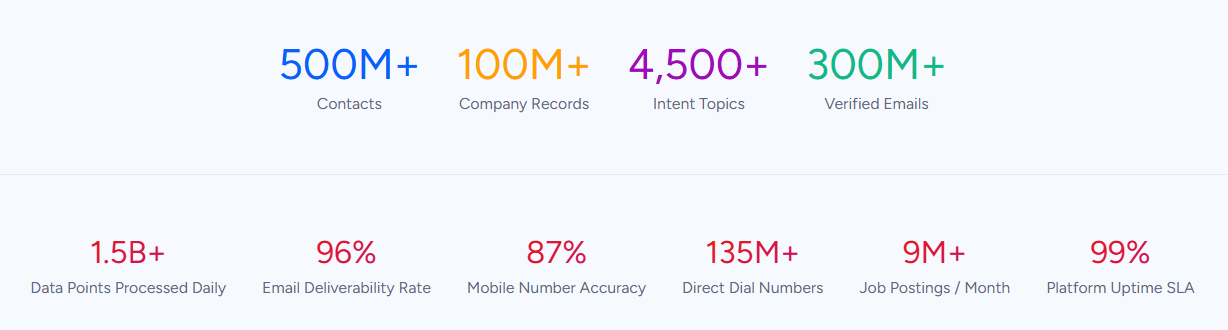
ZoomInfo is a B2B data and go-to-market platform built on a database of 500M contacts, 100M companies, 135M+ verified phone numbers, and 200M+ verified business email addresses.
It integrates with Bullhorn through a native connector in the ZoomInfo App Marketplace, letting staffing teams export verified candidate and contact data directly into Bullhorn with configurable field mappings.
Connecting the two platforms unlocks:
A Bullhorn ATS backed by verified direct dials and business emails, so recruiters spend time calling candidates who actually answer instead of chasing dead numbers
Company intelligence layered onto client and prospect records, including company attributes, technographics, and org charts that inform account development
Buyer intent signals revealing which companies are actively hiring or researching staffing services, so your sales team prioritizes the accounts most likely to convert
Cleaner CRM data through continuous enrichment, reducing the manual research that erodes recruiter productivity
How ZoomInfo Integrates with Bullhorn
ZoomInfo connects to Bullhorn through a native integration available in the ZoomInfo App Marketplace. Account administrators configure field mappings through the ZoomInfo admin panel.
The connector lets users export candidate and contact records from ZoomInfo's database directly into Bullhorn, carrying verified contact data, company details, and professional information into the matching ATS fields.
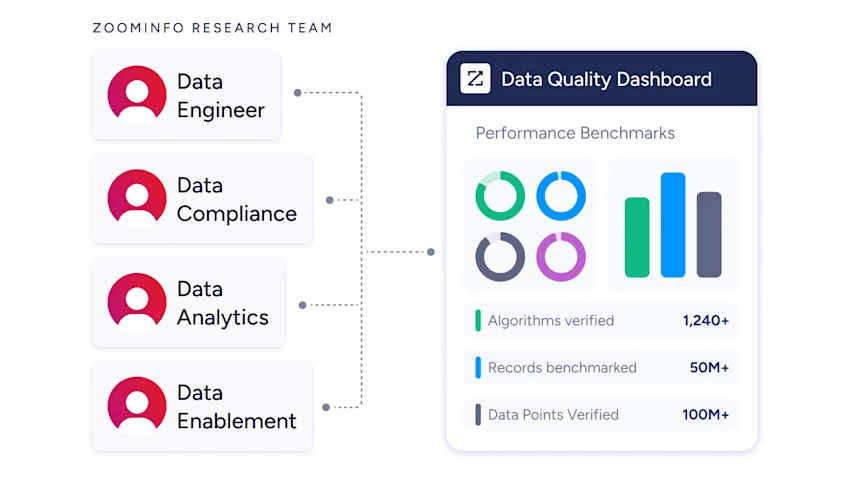
Because ZoomInfo maintains this first-party connector, it requires no middleware and stays current with platform updates on both sides. ZoomInfo's data flows through a verification pipeline backed by 300+ human researchers, reaching up to 95% accuracy on first-party data.
Contact Data Enrichment: Give Recruiters Numbers That Actually Ring
Bullhorn stores the candidate and contact data that recruiters enter or that flows in through resume parsers and job board applications. The problem is that this data degrades quickly: phone numbers disconnect, candidates change jobs, email addresses bounce.
ZoomInfo addresses this with a database of 135M+ verified phone numbers and 200M+ verified business email addresses. Recruiters searching for candidates or building prospect lists in ZoomInfo can export verified contact records directly into Bullhorn in a single action. The data carries current job titles, direct dials, business emails, and company associations.
In a Fortune 500 competitive RFP analyzing 25 million contacts across vendors, the independent consultant concluded that "no other competitor came even close."
ZoomInfo in action: A recruiter working a VP of Finance search in Bullhorn needs direct dials for five decision-makers at a target client. ZoomInfo returns verified phone numbers, current titles, reporting structures, and company attributes.
The recruiter exports all five contacts to Bullhorn in one action, and the ATS records are populated with verified data, not data scraped from a three-year-old LinkedIn profile.
Company Intelligence and Context: Know Your Clients and Prospects
ZoomInfo profiles 100M companies with data including revenue, employee count, industry, headquarters location, and parent-child corporate hierarchy. For staffing agencies using Bullhorn's CRM to manage client relationships and prospect for new business, this intelligence turns account development from guesswork into a data-driven process.
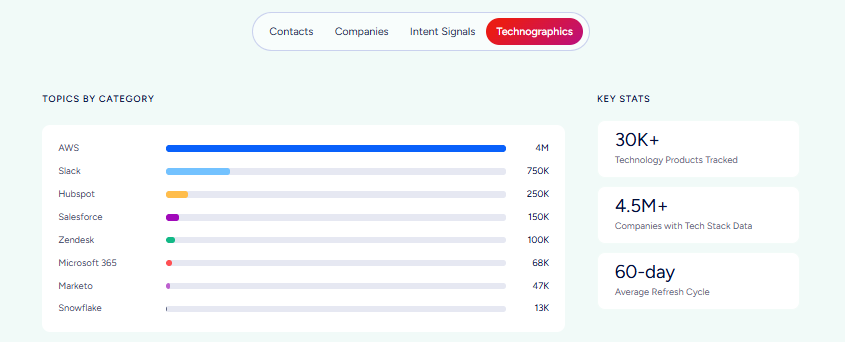
Technographic data covering 30,000+ technologies across 200+ categories adds another layer: a staffing firm specializing in IT placements can identify which target accounts run specific technology stacks, informing both the sales pitch and the candidate matching strategy.
Buyer Intent: Identify Companies Actively Seeking Staffing Services
ZoomInfo's Buyer Intent tracks signals from 210 million IP-to-Organization pairings and 6 trillion+ new keyword-to-device pairings monthly, revealing which companies are actively researching topics relevant to staffing and hiring.
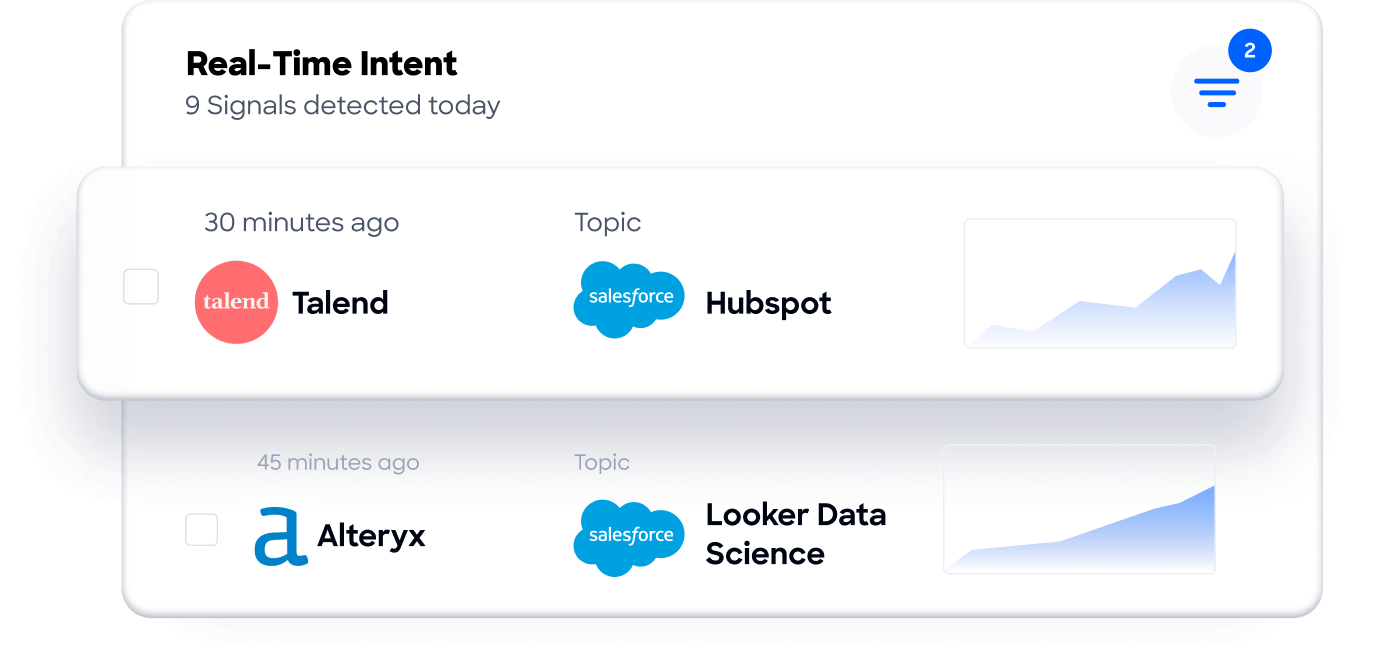
Guided Intent (exclusive to ZoomInfo) identifies the research topics historically correlated with deal success in your business, so signals are calibrated to your actual win patterns rather than generic keyword thresholds.
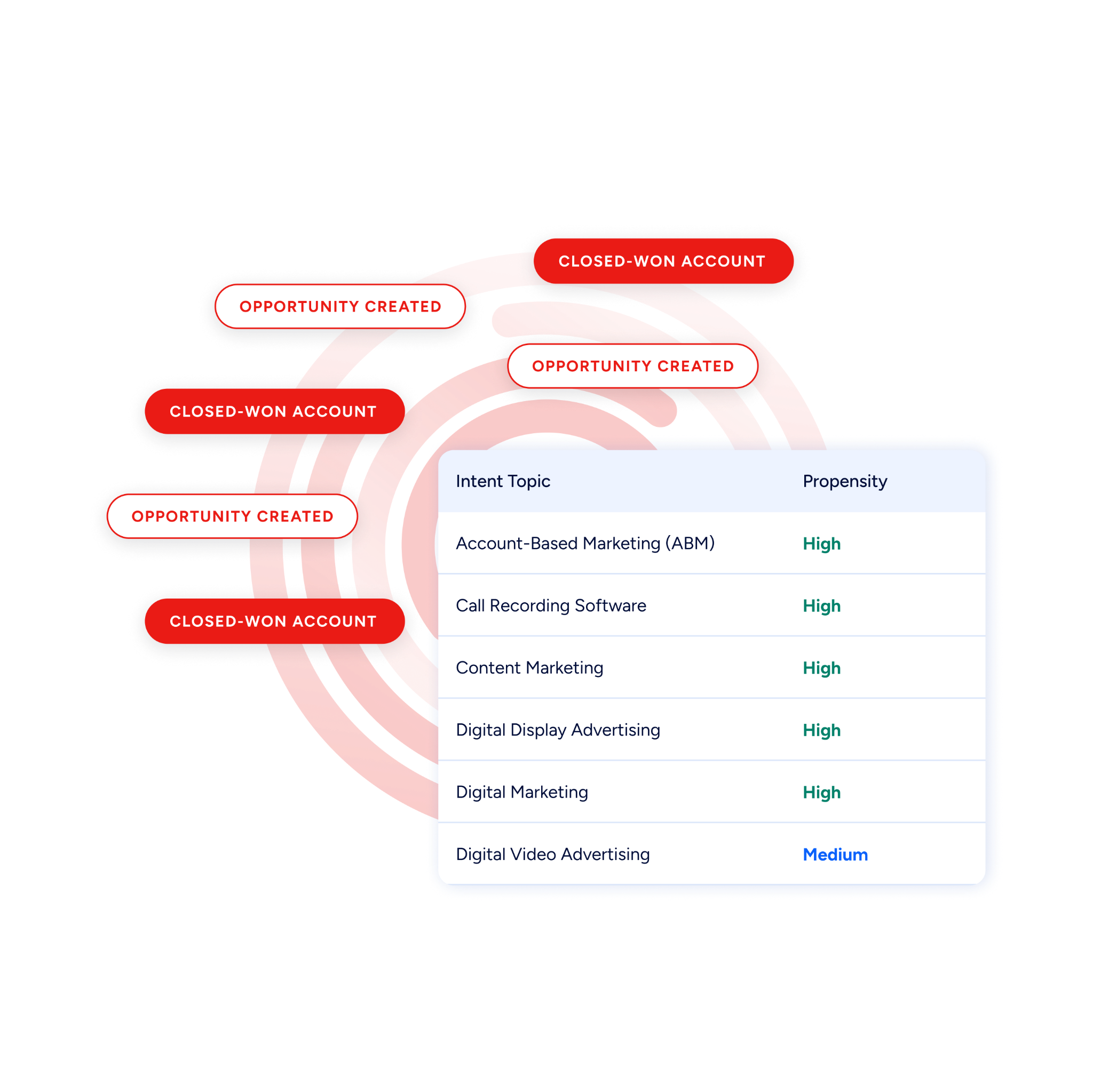
For staffing agency sales teams, this means knowing which prospects are researching "temporary staffing solutions" or "contract-to-hire" before a competitor calls. Those high-intent accounts can be prioritized in Bullhorn's CRM pipeline.
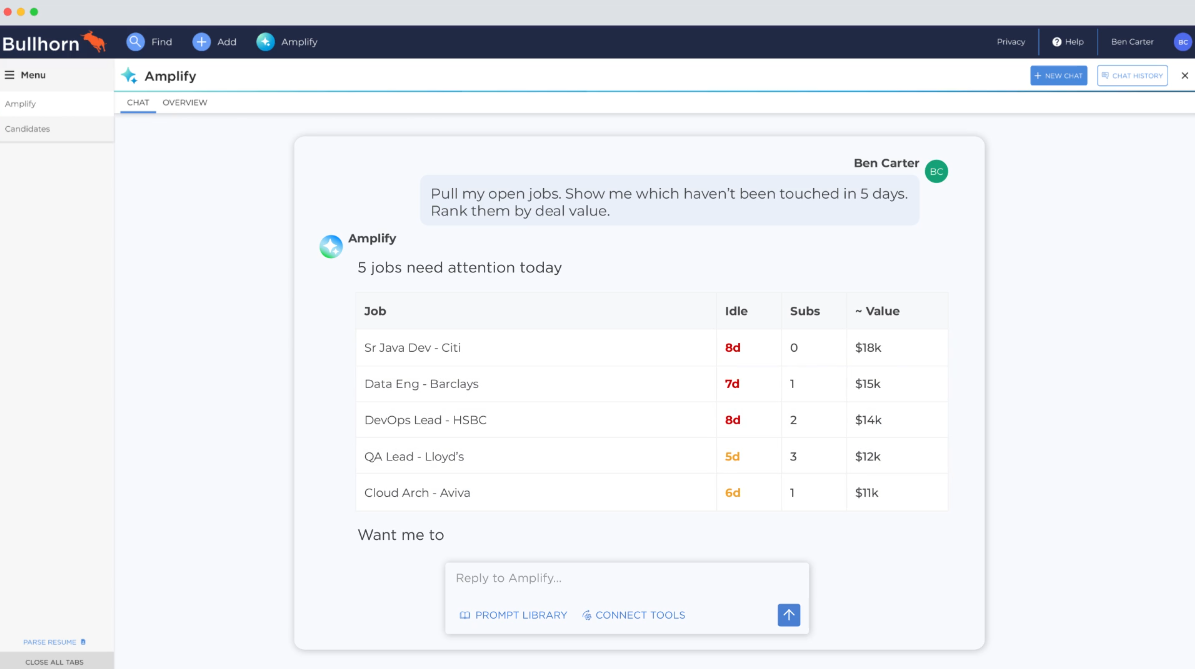
ZoomInfo in action: ZoomInfo detects a mid-market healthcare organization researching "travel nurse staffing agencies" for two consecutive weeks. Your sales team exports the company profile and key contacts to Bullhorn, creates a targeted outreach sequence through Bullhorn Automation, and reaches the decision-maker while the need is active.
Website Visitor Identification and Workflow Automation
ZoomInfo WebSights resolves anonymous website traffic to companies, with automatic traffic filtering that separates genuine company visits from bots. For staffing agencies running websites where potential clients research services, this reveals which companies visit your site and which pages they view.
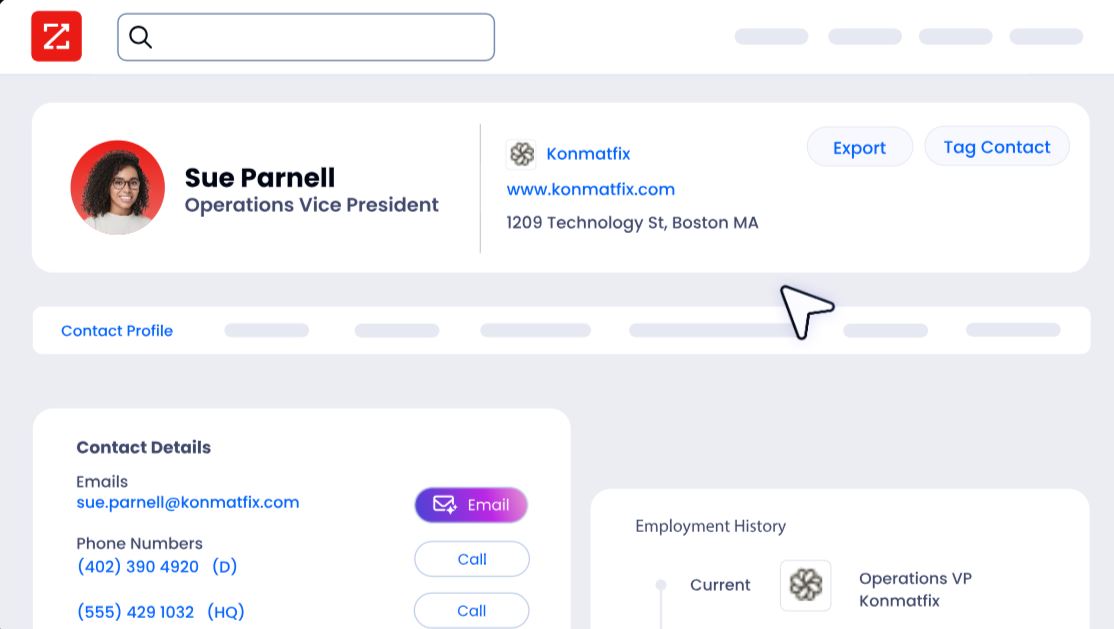
Beyond the Bullhorn connector itself, ZoomInfo's broader intelligence layer is accessible through APIs and MCP, exposing the same data to any tool or AI agent in your stack.
Seismic's sales team attributed 39% of active pipeline to opportunities identified or influenced by ZoomInfo signals, reporting 54% productivity gains and saving 11.5 hours per week per seller. (Seismic Case Study)
ZoomInfo Pricing
ZoomInfo uses a consumption-based pricing model with custom quotes based on usage, users, credit volume, and features.
It is organized into Sales, Marketing, and standalone product lines, each in Professional, Advanced, and Enterprise tiers. The native Bullhorn integration is available through ZoomInfo's connector marketplace, with Advanced tiers adding intent signals and website visitor tracking.
ZoomInfo Lite is a permanent free tier (no credit card, no time limit) with 10 monthly export credits, searches, and the Chrome extension, making it a practical way to evaluate data quality before committing.
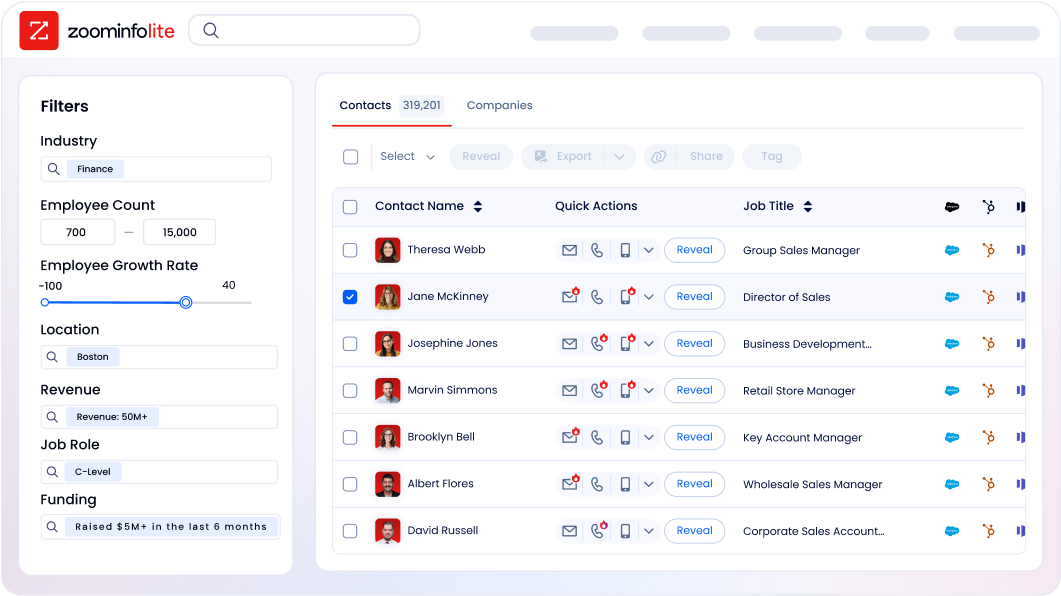
A separate 7-day free trial covers paid features.
Who Should Use the ZoomInfo Integration?
Staffing agency sales teams whose pipeline depends on reaching the right decision-makers: ZoomInfo's verified direct dials and business emails mean your outreach connects instead of bouncing, and intent data tells you which prospects to call first.
Recruiters sourcing passive candidates who need verified contact information beyond what LinkedIn or job board profiles provide, with company intelligence that informs how to position an opportunity.
Revenue operations teams building Bullhorn CRM workflows that need company attribute, technographic, and intent data to power lead scoring, territory planning, and account prioritization instead of static client lists.
2. LinkedIn Recruiter: Best Bullhorn Integration for Passive Candidate Sourcing
Source: Bullhorn
LinkedIn Recruiter is a talent acquisition platform built on a network of over 1.3 billion professionals. It integrates with Bullhorn through Recruiter System Connect (RSC) to create a bidirectional system of record spanning LinkedIn's professional network and your ATS.
The connection makes Bullhorn the canonical record for all LinkedIn sourcing activity: InMails, notes, submissions, and inbound applications.
Key integration capabilities include:
InMail messages and recruiter notes created in LinkedIn Recruiter automatically sync to Bullhorn as Note records against the matching candidate profile
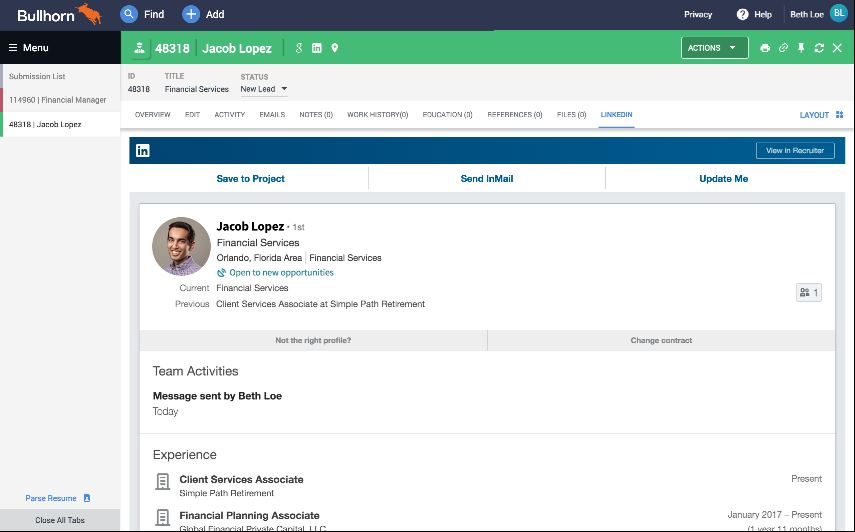
A dedicated LinkedIn Profile tab embedded inside the Bullhorn candidate record displays the full LinkedIn profile, InMail thread, and recruiter notes alongside ATS data
Recruiters can submit candidates to Bullhorn job orders directly from their LinkedIn Recruiter profile in a single action
LinkedIn Easy Apply applications flow into Bullhorn automatically as new structured candidate records with source attribution
How LinkedIn Recruiter Integrates with Bullhorn
Source: LinkedIn
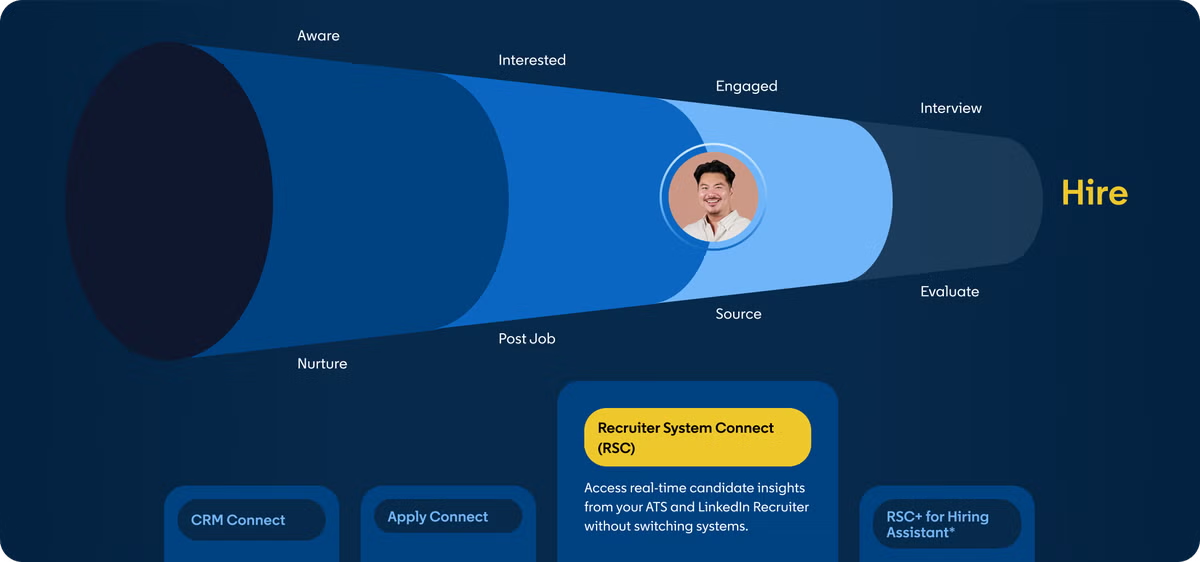
Recruiter System Connect (RSC) is LinkedIn's certified integration framework for ATS platforms, and Bullhorn is a supported RSC partner. RSC is not a generic API connection; it creates a persistent, bidirectional link between LinkedIn Recruiter and Bullhorn at the record level.
Configuration happens through LinkedIn's RSC panel and Bullhorn's admin settings. Activation requires at least one full LinkedIn Recruiter Corporate or RPS+ seat. Bullhorn charges no additional fee for eligible customers.
1. Automatic InMail and Note Sync to Bullhorn.
Every InMail sent from LinkedIn Recruiter and every recruiter note created within LinkedIn automatically appears as a Note record in Bullhorn against the matching candidate profile. This eliminates a persistent data problem in high-volume recruiting: recruiters conduct active outreach on LinkedIn while the ATS accumulates no record of those touchpoints.
In staffing environments where multiple recruiters share candidate pools, this sync makes LinkedIn outreach part of the shared interaction history without any manual logging.
2. LinkedIn Profile Tab Embedded Inside Bullhorn.
RSC adds a dedicated LinkedIn Profile tab directly inside the Bullhorn candidate record, rendering the candidate's full LinkedIn profile alongside the recruiter's InMail thread and notes.
Recruiters reviewing candidates in Bullhorn no longer need a separate browser tab. LinkedIn reports that recruiters save up to 3.5 hours per week by activating RSC, reflecting the combined benefit of the embedded profile view, note sync, and In-ATS Indicator.
3. One-Click Candidate Submission with In-ATS Indicator.
Recruiters can submit candidates from their LinkedIn Recruiter profile directly into Bullhorn job orders in a single action without leaving LinkedIn. The In-ATS Indicator appears on search results and candidate profiles to flag whether a candidate already exists in Bullhorn, preventing duplicate outreach and wasted InMail credits.
For agencies with large existing candidate databases, this is one of the highest-value RSC features: it surfaces the existing ATS relationship at the moment the recruiter considers reaching out.
4. Apply Connect Routes Easy Apply Applications into Bullhorn.
Apply Connect handles inbound applications from candidates who apply via LinkedIn's Easy Apply button on job postings pushed to LinkedIn from Bullhorn. LinkedIn parses profile data into structured Bullhorn candidate fields automatically, with source attributed to the originating LinkedIn job posting for ROI tracking. Inbound applicants arrive in Bullhorn without manual recruiter handling.
5. RSC+ for Hiring Assistant.
An advanced tier called RSC+ for Hiring Assistant unifies all applicants into a single pipeline visible within LinkedIn's Hiring Assistant AI agent, combining ATS resume data with LinkedIn profile data for enriched evaluation. This requires Hiring Assistant as a paid add-on to Recruiter Corporate, or its inclusion via the RPS+ tier.
LinkedIn Recruiter Pricing
LinkedIn Recruiter uses a quote-based annual subscription model for its enterprise tiers:
Recruiter Lite: $170/month (monthly) or approximately $140/month (annual). 30 InMail credits per seat per month. Does NOT support RSC or the Bullhorn integration.
Recruiter Corporate: Quote-based annual contract. 150 InMail credits per seat per month; full network access. Supports RSC with Bullhorn. Hiring Assistant available as a separate add-on.
Recruiter Professional Services (RPS): Quote-based annual contract. 100 InMail credits per seat per month. Supports RSC but does not include Hiring Assistant.
Recruiter Professional Services Plus (RPS+): Quote-based annual contract. 140 InMail credits per seat per month. Includes Hiring Assistant, enabling RSC+ with Bullhorn.
All enterprise tiers are sold via annual contracts that are non-cancelable and non-refundable per LinkedIn's published terms. Bullhorn charges no separate fee for RSC activation for eligible customers.
Who Should Use the LinkedIn Recruiter Integration?
Staffing agencies where LinkedIn is the primary sourcing channel for professional, technical, or knowledge-worker roles and recruiters currently copy InMails and notes into Bullhorn manually: RSC eliminates this double-entry entirely.
Agencies with multiple recruiters sharing candidate pools in Bullhorn where preventing duplicate outreach and avoiding wasted InMail credits is a daily concern: the In-ATS Indicator surfaces existing ATS relationships before the recruiter reaches out.
Firms posting jobs to LinkedIn that want Easy Apply applications flowing into Bullhorn as structured candidate records with source attribution, rather than requiring manual export from LinkedIn's interface.
3. Ringover: Best Bullhorn Integration for Automated Call Logging and AI Conversation Records
Source: Ringover
Ringover is a cloud communication platform that integrates with Bullhorn through a native connector to eliminate manual call logging and turn every recruiter conversation into searchable, structured ATS data. The integration is listed in both Ringover's integrations marketplace and the Bullhorn Marketplace.
Key integration capabilities include:
Click-to-call from any Bullhorn candidate, contact, or lead record without switching tabs
Automatic call logging as notes on matching Bullhorn records, capturing duration, outcome, and timestamp without post-call data entry
Bidirectional sync of candidate, contact, and lead records between Bullhorn and Ringover
AI transcriptions and summaries that write back to Bullhorn as structured notes, making conversation content searchable in the ATS
SMS and WhatsApp message logging on Bullhorn records, creating a unified outreach timeline
How Ringover Integrates with Bullhorn
Source: Ringover
Ringover connects to Bullhorn through a native integration that requires no middleware. Setup involves connecting a Bullhorn account through an API key generated from the Ringover dashboard.
The integration enables bidirectional record sync, click-to-call from ATS records, and automatic post-call logging. The Empower AI add-on (sold separately) is required to unlock AI transcription and summary write-back to Bullhorn.
1. Click-to-Call and Power Dialer from Bullhorn Records.
Recruiters initiate calls by clicking any phone number in the Bullhorn interface. The Power Dialer goes further: recruiters load a list of Bullhorn contacts into a dialer session and work through them sequentially, pushing daily outreach capacity from 40-50 calls to 100+ calls per recruiter per day.
Local presence dialing selects an outbound number with an area code close to each contact's location from a 65+ country number pool, increasing answer rates.
2. Automatic Call Logging and Bidirectional Record Sync.
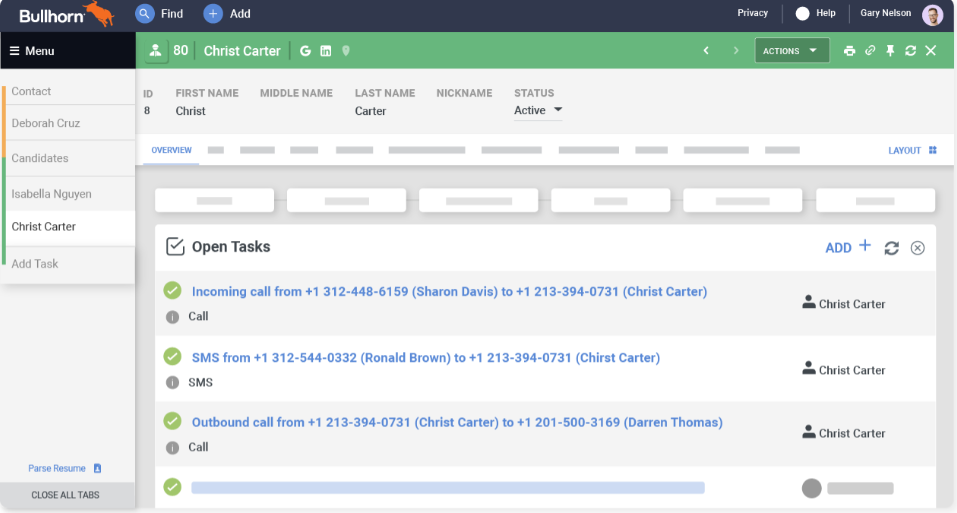
Every call initiated through Ringover from a Bullhorn record logs automatically as a note or task on the matching entity, capturing duration, outcome classification, and timestamp.
The underlying record sync is bidirectional: candidate and contact data flows between Bullhorn and Ringover, so ownership assignments, contact details, and record statuses stay current in both systems without duplicate maintenance.
3. AI Transcriptions and Summaries Written to Bullhorn.
When the Empower AI add-on is active, every call generates an automatic transcription and summary. Transcription AI converts call audio to text across seven languages. Call Summaries AI produces a structured note highlighting key issues, decisions, and next steps, then writes it to the matching Bullhorn record.
Bullhorn's candidate records accumulate a searchable history of conversation content, not just call metadata. A recruiter following up with a candidate placed six months ago can read summaries of every prior conversation from the ATS record.
4. SMS and WhatsApp Message Logging.
SMS and WhatsApp messages sent through Ringover log as communication entries on the Bullhorn candidate or contact record. For teams running multi-channel candidate outreach, Bullhorn records the full sequence without requiring separate logging per channel.
Ringover Pricing
Ringover uses per-seat subscription pricing. The Bullhorn integration is available on the BUSINESS plan and above:
BUSINESS: $47/user/month (annual) or $57/user/month (monthly). Includes all CRM/ATS integrations (100+ connectors, including the native Bullhorn integration), Power Dialer, advanced analytics, local numbers from 65 countries, and manager supervision features.
ADVANCED: Custom pricing. All BUSINESS features plus call campaigns, voicemail drop, and the full integration suite.
Empower AI Add-On: $39/license/month. Required for AI transcriptions, Call Summaries AI, topic detection, and AI summary write-back to Bullhorn. Without this add-on, only call metadata logs to Bullhorn.
Effective cost for the full Bullhorn integration with AI summaries: BUSINESS + Empower at $86/user/month on annual billing.
Who Should Use the Ringover Integration?
Recruiting teams making high call volumes through Bullhorn that lose candidate context between calls because manual logging is inconsistently followed: Ringover's automatic post-call note creation removes the dependency on recruiters remembering to log.
Agencies that want conversation substance in Bullhorn candidate records so any recruiter reviewing a candidate history can read structured AI summaries rather than listening to recordings.
Teams using SMS or WhatsApp for candidate communication that need the full outreach timeline visible alongside call logs in a single ATS record.
4. Sense: Best Bullhorn Integration for Automated Candidate Redeployment and Multi-Channel Engagement
Source: Sense
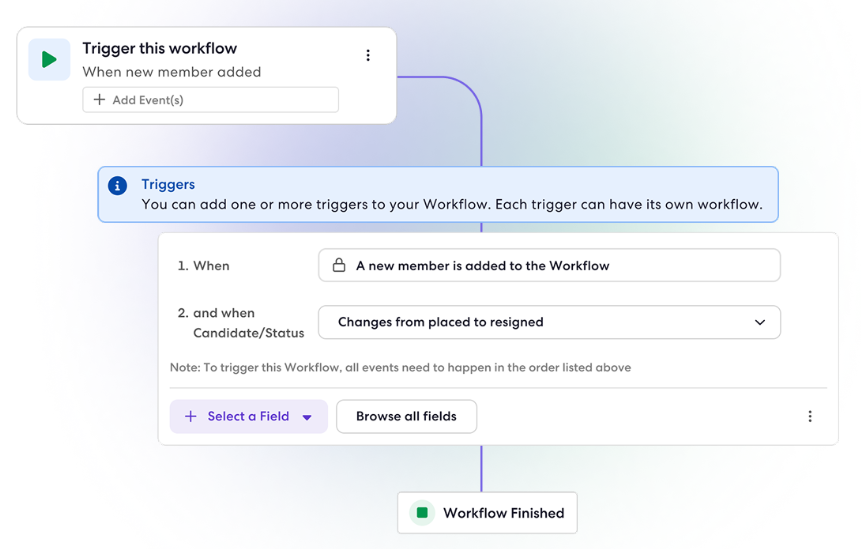
Sense is a talent engagement platform that integrates natively with Bullhorn to turn the ATS from a passive record-keeping system into an active candidate engagement engine.
Sense claims staffing firms can close over 70% of roles using talent already in their ATS, and the Bullhorn integration is the mechanism that makes that possible at scale. The integration is a native, bidirectional connector managed through Sense's implementation team.
Key integration capabilities include:
Automated redeployment campaigns triggered by Bullhorn assignment end dates, launching multi-channel outreach before contractors go cold
A pre-screening chatbot that qualifies inbound candidates against Bullhorn job criteria and writes results back to the ATS
Personalized outreach built from Bullhorn placement history, job preferences, and location data, with engagement outcomes synced back
Candidate NPS surveys triggered by Bullhorn placement events, with scores written to candidate records
How Sense Integrates with Bullhorn
Sense connects to Bullhorn through a native bidirectional integration that authenticates against the Bullhorn REST API and operates as a continuous data pipeline. Bullhorn candidate records, placement data, assignment dates, and contact information flow into Sense, and engagement outcomes write back to matching Bullhorn records in near real-time.
No middleware is required. Sense lists Bullhorn as a primary ATS integration, and the field mapping and trigger logic are built around Bullhorn's data model.
1. Automated Redeployment Campaigns.
Bullhorn stores contractor assignment end dates on every placement record but takes no action on those dates.
Sense reads upcoming end dates continuously and, based on configurable lead times (typically 30, 60, or 90 days before expiration), fires a multi-channel outreach sequence automatically: email introducing new openings, SMS about availability, WhatsApp follow-up, and AI chatbot conversation to capture job preferences.
Sense reports that customers see a 75% increase in redeployment rates and 55% faster hire rates compared to manual processes.
2. Pre-Screening Chatbot with ATS Write-Back.
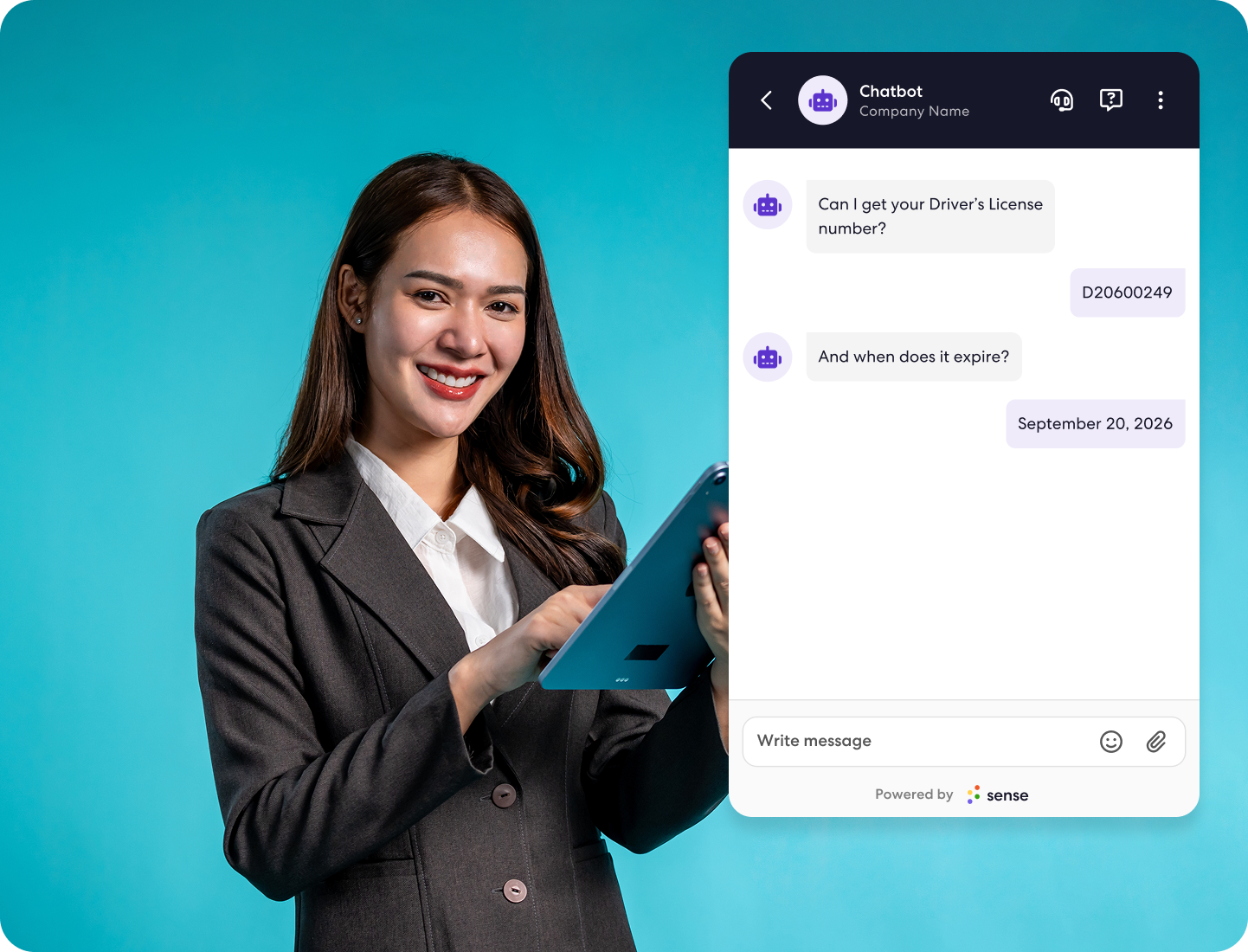
Sense's Pre-Screen Bot runs automated qualification conversations against inbound applicants using criteria from Bullhorn job orders. Candidates who pass receive an interview scheduling link; their qualified status writes back to Bullhorn.
Source: Sense
Disqualified candidates receive a disposition message, and their status is recorded in Bullhorn, so recruiter inboxes surface only candidates who cleared the initial bar. Sense reports that 72% of candidates who interacted with the chatbot believed they were speaking with a human recruiter.
3. Personalized Outreach with Full Engagement Sync.
Job preferences, placement history, skills, and location stored in Bullhorn feed into Sense for message personalization and audience segmentation. Engagement signals (email opens, SMS replies, opt-outs, chatbot interactions) sync back to Bullhorn records as structured activity data.
Opt-outs captured by Sense write to Bullhorn's opt-out fields immediately, preventing duplicate outreach by other team members.
4. Automated Candidate NPS Surveys.
When Bullhorn records a completed placement, Sense triggers a satisfaction survey at a configurable interval. Results write back to the Bullhorn candidate record as notes or structured field values, creating an auditable feedback record managers can use to identify pattern issues.
Sense Pricing
Sense uses a flat monthly platform fee (not per-seat pricing) with plans custom-quoted above published floor prices:
Sense Platform for Staffing Teams: Starting at $2,000/month. Includes Talent CRM, Automation & Workflows, SMS/WhatsApp, Interview Scheduling, Chatbot Screening, Candidate Matching, Analytics, and ATS integration (including Bullhorn). Includes dedicated customer success and implementation managers.
Sense Platform for Enterprise Staffing: Starting at $2,000/month (custom quote). Same feature set, scope negotiated for large operations.
Sense AI Recruiter: Starting at $3,000/month. Adds the full autonomous agent suite: Recruiting Orchestration, Messaging, Scheduling, Screening, Matching, Evaluation, and Onboarding agents.
Standalone modules are available separately: SMS/WhatsApp Messaging at $500/month and Interview Scheduling at $500/month. Sense does not offer a free trial or self-serve signup.
Who Should Use the Sense Integration?
Staffing firms losing contractors between assignments because redeployment outreach happens manually, too late, or not at all: Sense turns Bullhorn's assignment end date fields into the trigger for automated multi-channel campaigns.
Agencies running high-volume job orders in healthcare, light industrial, or logistics where inbound applicant volume exceeds the team's capacity to pre-screen manually: Sense's chatbot qualifies against Bullhorn job criteria and writes results back directly.
Firms at or above the $2,000/month spend threshold that can capture ROI from automation at scale, with per-placement margin savings from redeployment and reduced time-to-screen realized fastest at firms making dozens to hundreds of placements per month.
5. Checkr: Best Bullhorn Integration for Background Screening Compliance
Source: Bullhorn
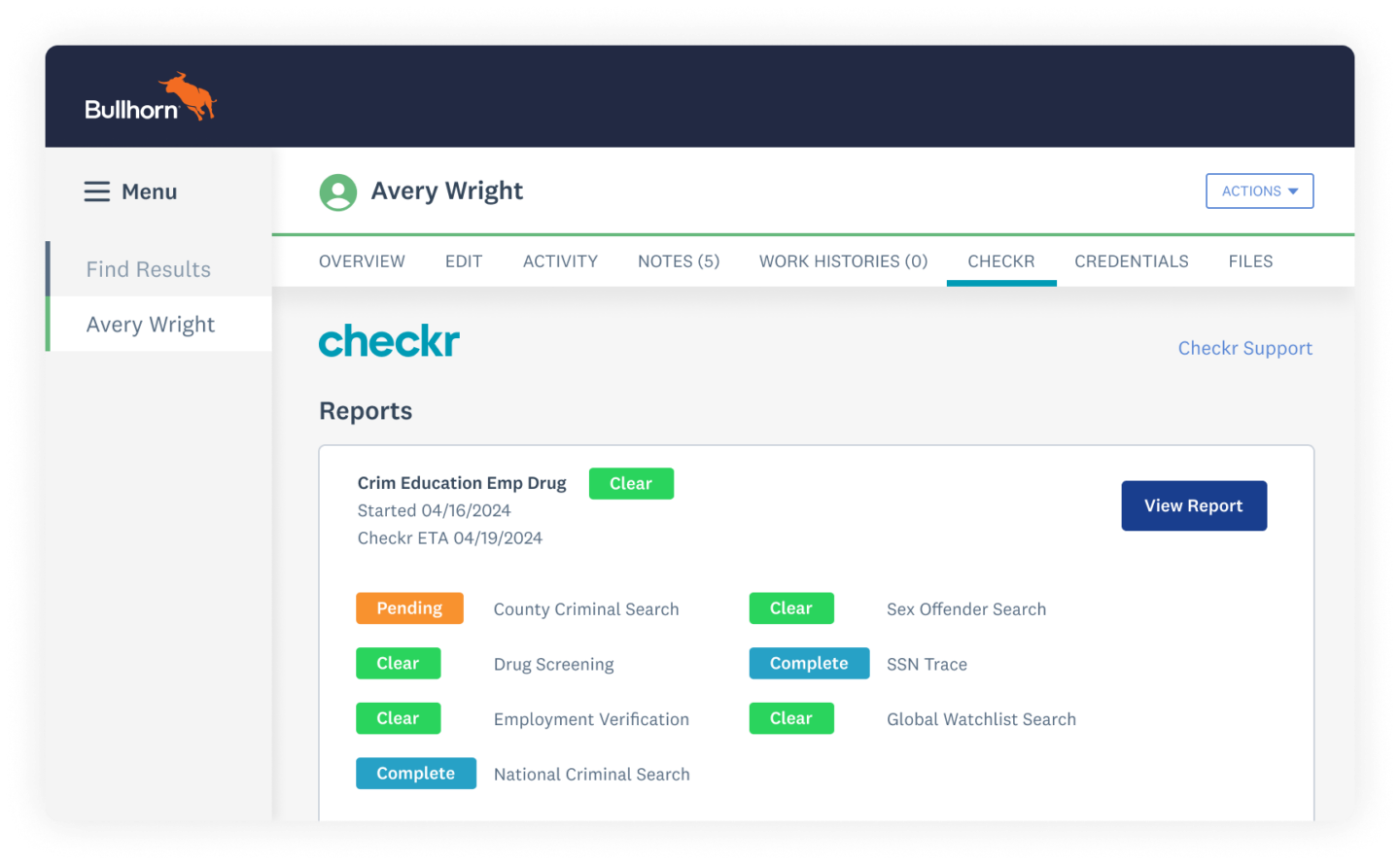
Checkr is a background screening platform that integrates with Bullhorn through the Bullhorn Marketplace to let staffing teams order, track, and adjudicate background checks directly from the ATS candidate record.
The integration is a native, pre-built connector that operates bidirectionally: recruiter actions in Bullhorn trigger screening orders in Checkr, and results flow back automatically.
Key integration capabilities include:
One-click background check ordering from the Bullhorn candidate record with PII pre-filled from ATS data
Real-time status sync pushing screening progress back to the Bullhorn candidate record
Automated adjudication results written directly to Bullhorn based on pre-configured hiring rules
A candidate self-service portal that reduces inbound coordinator inquiries
How Checkr Integrates with Bullhorn
Source: Bullhorn
Checkr is a Bullhorn Marketplace partner with a maintained native connector. No middleware or third-party iPaaS connector is required.
1. One-Click Background Check Ordering with Pre-Filled Data.
Recruiters initiate a background check from the Bullhorn candidate record without leaving the ATS. The integration pre-fills the candidate's name, Social Security Number, and date of birth from existing Bullhorn fields into the Checkr order form, removing manual re-keying that is both slow and a source of FCRA-relevant data-entry errors in high-volume staffing.
2. Real-Time Status Sync.
After a check is ordered, Checkr pushes status updates back to the Bullhorn candidate record as the screening progresses: from invitation sent, through candidate forms completed, to report complete. A recruiter can see at a glance whether a background check is pending, in process, or complete without leaving the ATS.
Checkr processes 89% of criminal checks within one hour, so the status field in Bullhorn typically cycles through completion quickly for standard packages.
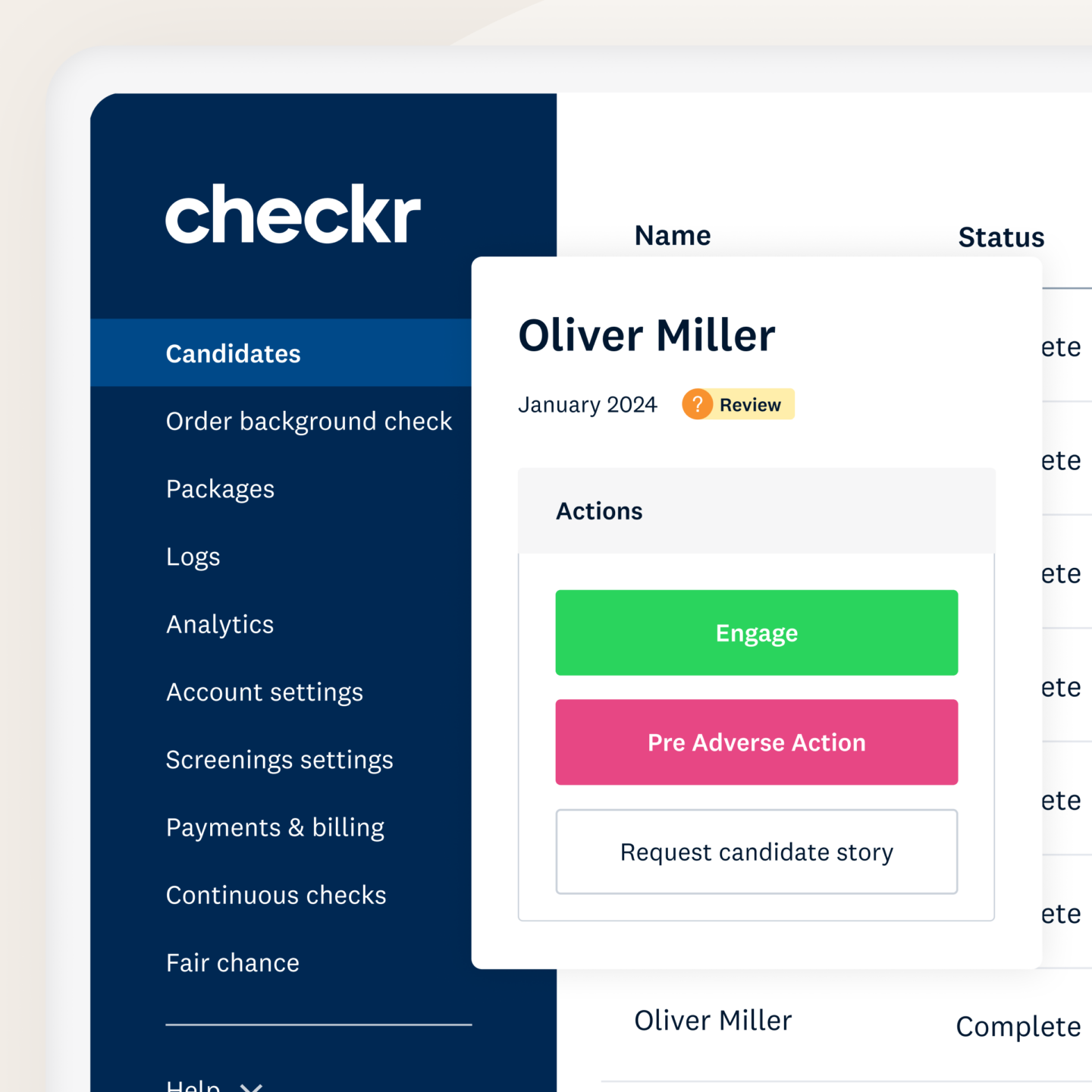
3. Automated Adjudication Rules.
When a Checkr report completes, the integration writes the adjudication result (clear or review) directly to the Bullhorn candidate record, based on rules configured in Checkr's Assess product. Three tiers are available:
Assess Lite (free): 7 criminal record categories, 5 templates, reduces manual review up to 40%
Assess Standard ($2.49/report): 55 categories, 13 guidelines, reduces manual review up to 75%
Assess Premium ($4/report): 235 categories plus MVR filtering, unlimited custom rulesets, reduces manual review up to 85%
Checkr's ML-based charge classifier normalizes inconsistent charge language from different county jurisdictions into a standardized taxonomy, so adjudication logic works against comparable charge descriptions regardless of how a jurisdiction labeled the offense.
4. Candidate Self-Service Portal.
Candidates receive access to Checkr's mobile-first portal where they submit documentation, consent to screening, and track their own check status. The portal reduces candidate contact rates to employers by up to 15%, freeing coordinator bandwidth in high-volume staffing environments.
Checkr Pricing
Checkr uses a pay-per-report model with no monthly seat fees and no required contracts for standard accounts:
Basic: $29.99/report (SSN trace, sex offender registry, global watchlist, national criminal)
Essential: $54.99/report (Basic plus unlimited county criminal)
Complete: $89.99/report (Essential plus state and federal criminal)
Enterprise: Contact sales (custom packages, negotiated pricing, full ATS integration access)
Additional per-check add-ons: MVR at $9.50, employment verification at $12.50-$50, identity verification at $4.99, continuous criminal monitoring at $1.70/individual/month. Pass-through fees from government sources are passed through at cost with no markup. The Bullhorn integration does not require an Enterprise account.
Who Should Use the Checkr Integration?
Agencies running frequent background checks across multiple clients with different compliance requirements that need adjudication rules to enforce those policies consistently without manual coordinator review on every report.
Recruiters whose candidate pipeline is bottlenecked by background check turnaround that need real-time visibility into check status at the ATS record level so they can manage start dates accurately.
Staffing firms placing workers in regulated verticals (healthcare, transportation, light industrial) where specific check types must be ordered consistently and results logged against the Bullhorn candidate record.
6. Zapier: Best Bullhorn Integration for No-Code Workflow Automation Across Non-Native Apps
Source: Bullhorn
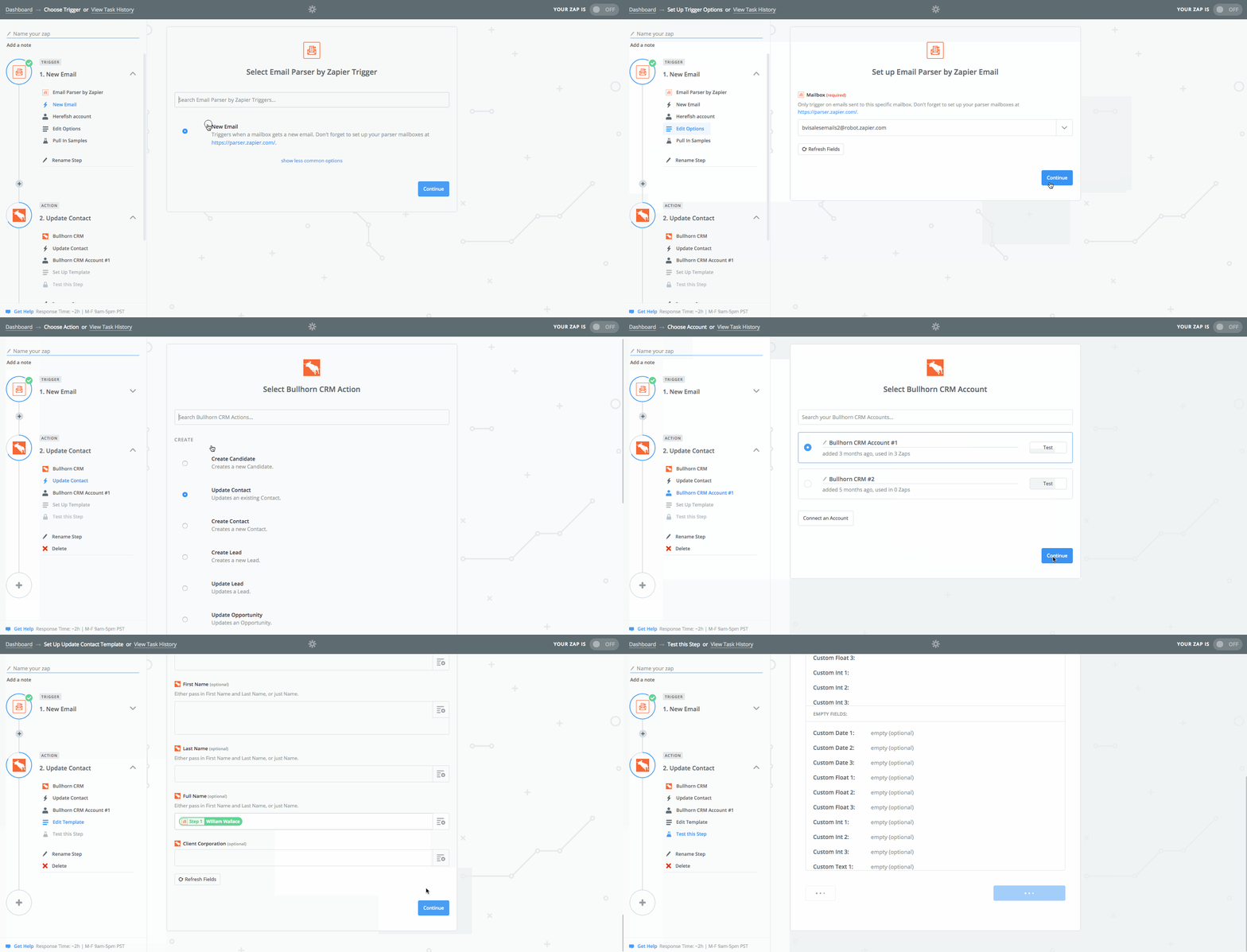
Zapier is a no-code automation platform that connects Bullhorn to over 8,000 applications, letting staffing operations teams automate cross-tool workflows triggered by ATS events without writing code.
Where Bullhorn's Marketplace covers 300+ pre-built partner integrations for established categories, Zapier fills the gap for every other tool in a staffing agency's stack that lacks a direct Bullhorn connector. The integration is listed in the Bullhorn Marketplace as an official partner.
Key integration capabilities include:
Bullhorn ATS events (new candidates, placements created, status changes) fire as Zapier triggers that push data to any connected downstream application
Inbound records from external sources lacking native Bullhorn connectors route into Bullhorn as new candidate or contact records
Multi-step Zap chains link Bullhorn triggers to conditional logic and multiple sequential actions
Zapier Copilot lets non-technical staff describe workflows in plain language and receive suggested automations
How Zapier Integrates with Bullhorn
Zapier connects to Bullhorn through a native connector in Zapier's app directory, using OAuth authentication. The connector polls Bullhorn's API for new events, with polling frequency of 15 minutes on the Free plan, 2 minutes on Professional, and 1 minute on Team and Enterprise.
1. Bullhorn ATS Events as Automation Triggers.
Standard Bullhorn actions (new candidates, job orders opening, placements confirmed, candidate status changes) become configurable Zapier trigger points.
A placement confirmed in Bullhorn can simultaneously trigger a task in Asana for the onboarding coordinator, add a row to a gross margin tracking spreadsheet for finance, and push a notification to the team's Slack channel.
Standard and custom Bullhorn fields can all be mapped to corresponding fields in downstream applications through Zapier's visual field-mapping editor.
2. Routing External Sources into Bullhorn.
Web forms built in Typeform or Jotform, niche sourcing tools that output to Google Sheets, internal referral tracking systems, and partner agency pipelines can all route records into Bullhorn as new candidate or contact entries via Zapier.
This matters for agencies that have built intake channels outside of Bullhorn's native career portal or standard job board integrations.
3. Multi-Step Zaps with Conditional Logic.
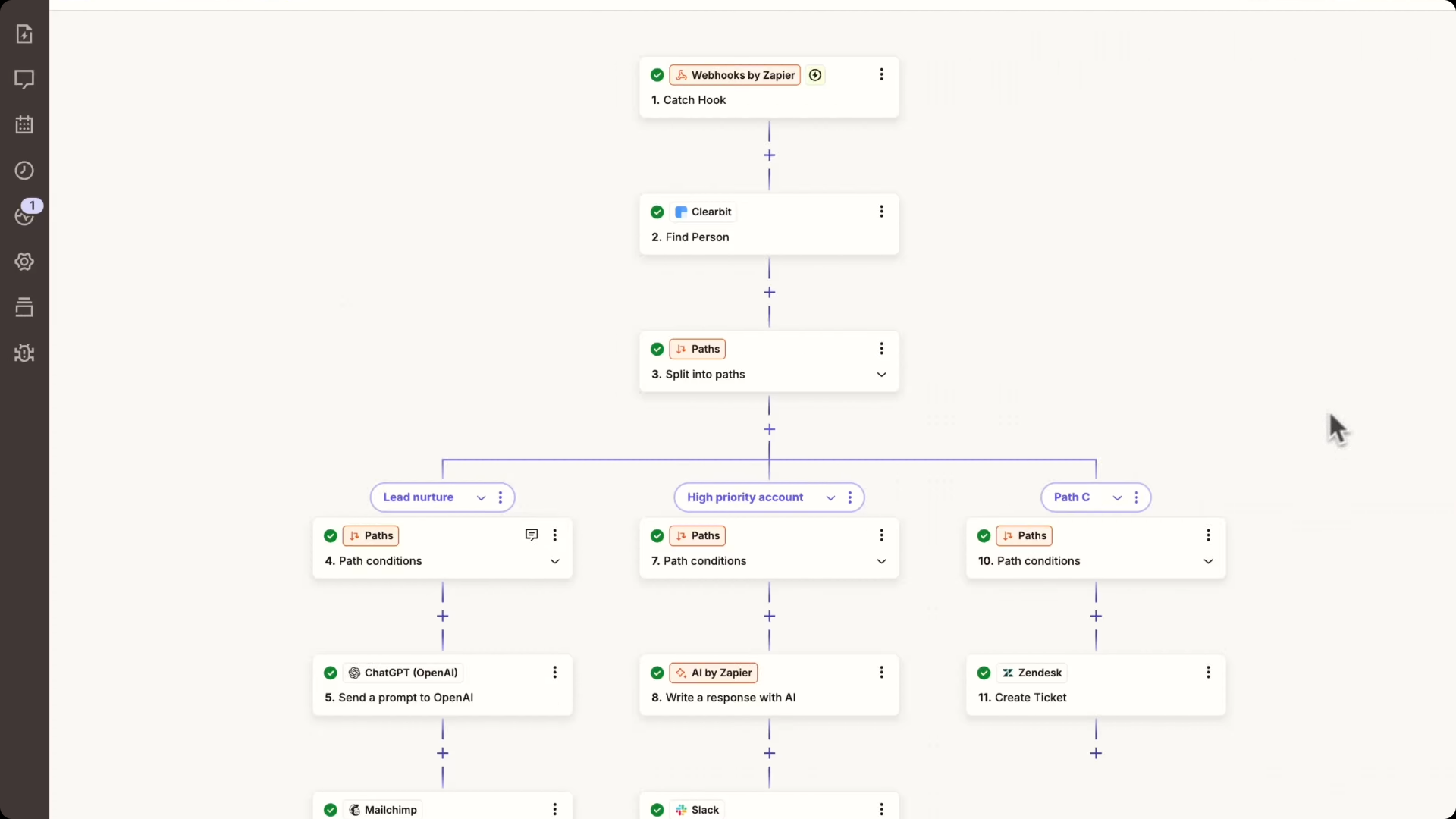
Zapier's Paths feature allows conditional branching: a new candidate with a healthcare specialty routes to a different Slack channel and tracking spreadsheet than an IT candidate, while the same Zap creates a follow-up task for all candidates regardless of specialty.
Source: Zapier
The Formatter step handles data transformation inline (date formats, text normalization), so Bullhorn's native field formats don't need to match each destination application's requirements.
4. No-Code Builder for Non-Technical Staff.
Zapier's Zap builder is designed for non-developers. The visual editor walks users through trigger, authentication, and action configuration, with each step independently testable. Operations managers and admin coordinators can build, test, and modify automations without opening a developer ticket.
Zapier Pricing
Zapier uses task-based pricing where each successful action step counts as one task:
Free: $0/month. 100 tasks/month, two-step Zaps only, 15-minute polling interval. Single user.
Professional: Starts at $19.99/month (annual) for 750 tasks. Multi-step Zaps, conditional logic, 2-minute polling. Single user.
Team: Starts at $69/month (annual) for 2,000 tasks. Up to 25 users in a shared workspace, SAML SSO, 1-minute polling.
Enterprise: Custom pricing. Unlimited users, advanced admin controls, audit logs.
Overages on paid plans are charged at 1.25x the plan's per-task rate, capped at 3x the plan's task limit. On the Free plan, Zaps pause at 100 tasks.
Who Should Use the Zapier Integration?
Agencies using tools that don't appear in the Bullhorn Marketplace (project management platforms, niche sourcing apps, internal tracking spreadsheets) and need them synced with Bullhorn ATS events without manual data entry.
Operations or admin teams that own automation workflows and need to build and modify them independently without developer involvement: Zapier's no-code editor and Copilot are designed for this persona.
Teams routing candidate or contact records from external intake sources (web forms, partner spreadsheets, non-Marketplace sourcing tools) into Bullhorn automatically, replacing manual copy-paste.
7. ADP: Best Bullhorn Integration for Payroll and Back-Office Workforce Data Sync
Source: Bullhorn
ADP is a global HCM and payroll platform that integrates with Bullhorn to sync new hire, time, and payroll data automatically between the ATS and ADP Workforce Now. ADP processes payroll for over 42 million workers worldwide and covers approximately 20,000 annual workplace regulatory changes.
ADP is a featured partner on the Bullhorn Marketplace under Pay & Bill. The integration connects through Staffeto's marketplace app for ADP Workforce Now.
Key integration capabilities include:
New hire records from Bullhorn placements sync automatically to ADP Workforce Now as employee entries
Termination and end-of-assignment events in Bullhorn trigger corresponding separation records in ADP
Time entries from Bullhorn's Middle Office module flow through to ADP for payroll processing
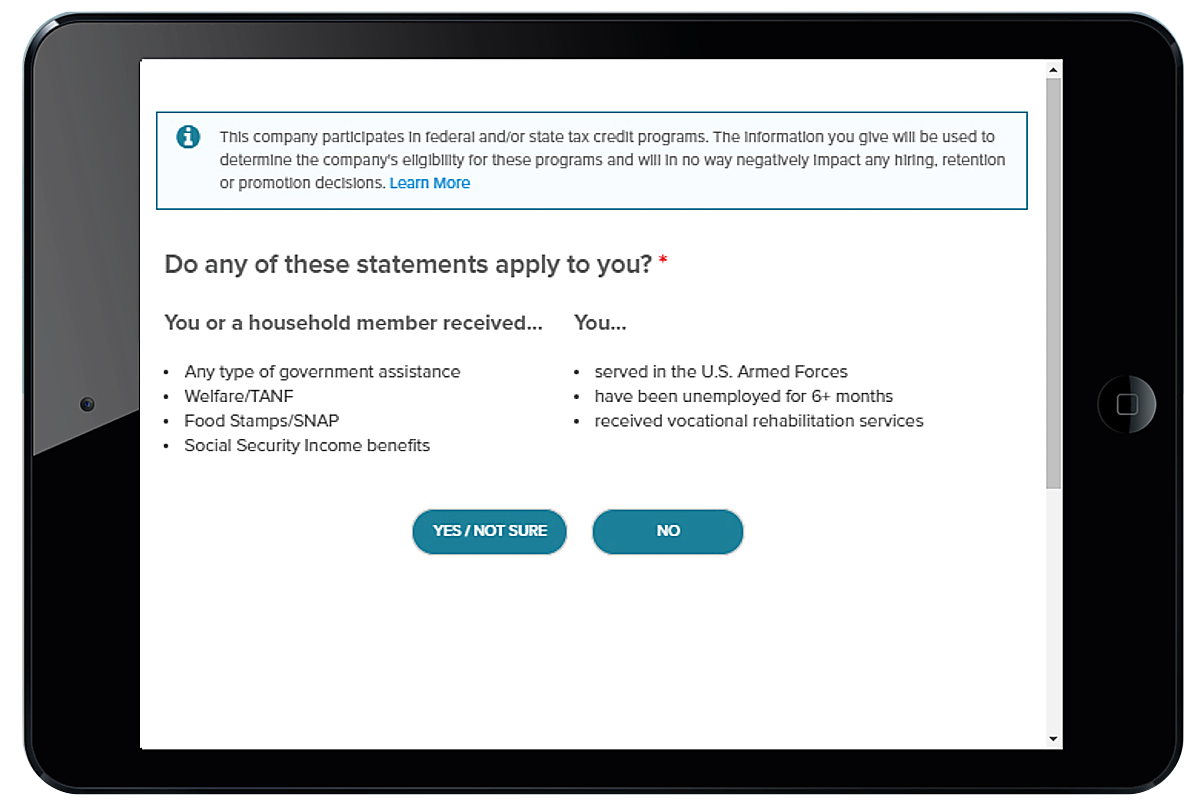
WOTC eligibility screening runs automatically during Bullhorn candidate intake via ADP SmartCompliance
Bidirectional employee data updates (address changes, pay rate revisions) sync between both systems
How ADP Integrates with Bullhorn
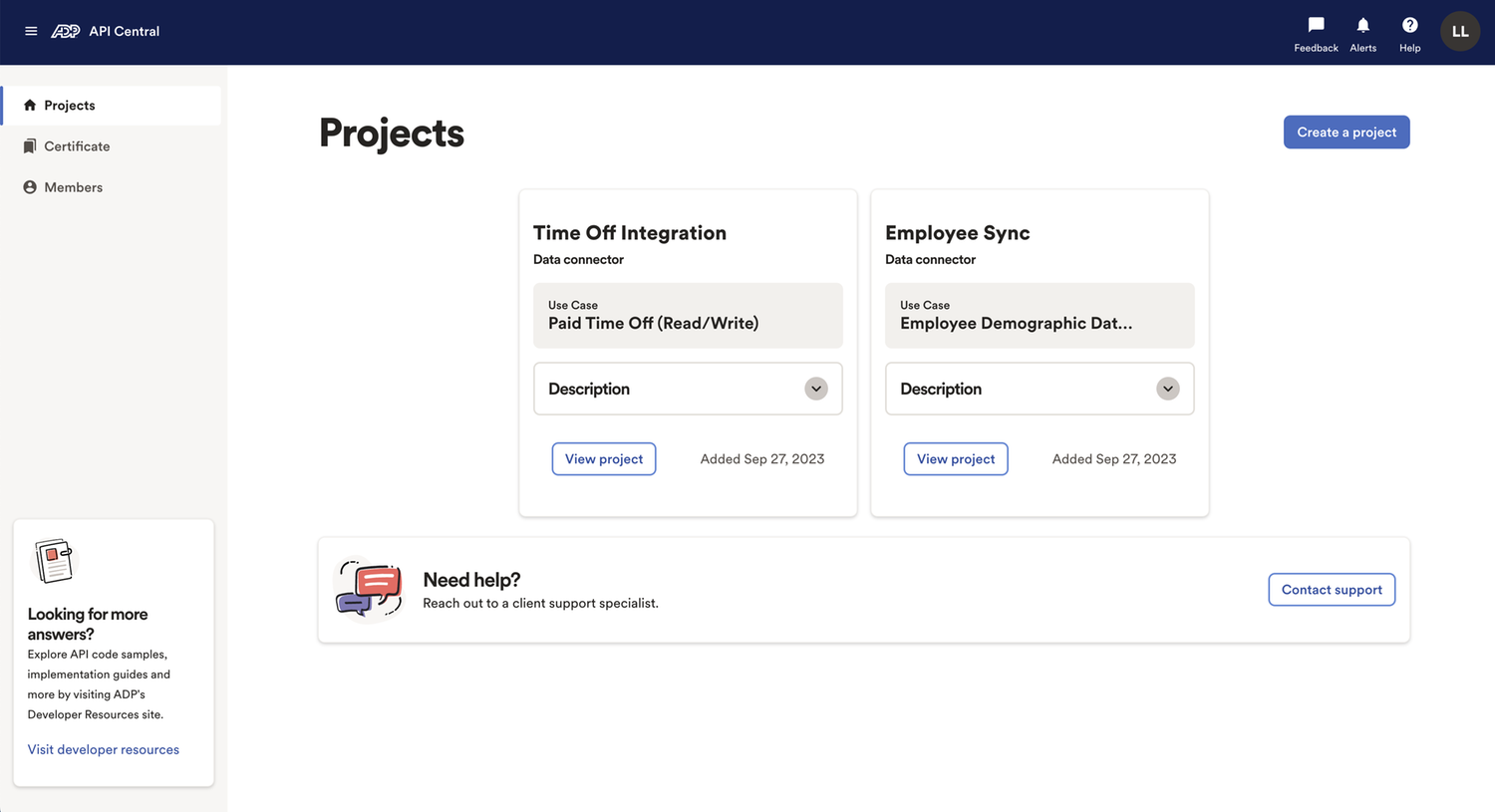
The integration connects ADP Workforce Now to Bullhorn's ATS and Middle Office modules. On the ADP side, connectivity runs through ADP API Central, which provides RESTful API access using OAuth 2.0 authentication. API Central is a paid add-on that must be purchased and activated separately from any ADP Workforce Now tier.
Source: ADP
1. New Hire and Termination Sync.
When a recruiter marks a placement as active in Bullhorn, the integration creates a corresponding new hire record in ADP Workforce Now carrying the candidate's name, role, start date, and pay rate. When Bullhorn logs a termination or end-of-assignment event, a separation record triggers in ADP.
This eliminates manual re-entry that is both slow and error-prone at high placement volumes, and prevents terminated workers from appearing active in ADP.
2. Time Entry Flow from Bullhorn to ADP Payroll.
Bullhorn's Middle Office captures worker time through multiple channels (physical clocks, web time entry, mobile, VMS Exchange) and stores approved data against placement records.
The integration routes approved time entries to ADP Workforce Now for payroll processing, removing the manual export-reformat-reenter workflow that introduces lag and errors. ADP receives time data directly from the approved source in Bullhorn, keeping pay and bill aligned.
3. WOTC Screening During Candidate Intake.
ADP's SmartCompliance Business Tax Credits module screens over 34 million applicants per year for Work Opportunity Tax Credit eligibility.
The Bullhorn integration routes candidate eligibility screening through ADP SmartCompliance during intake, handling IRS form submission without manual intervention. ADP also draws on a proprietary database of 3,000+ tax credit and incentive programs beyond WOTC.
4. Bidirectional Employee Data Sync.
After a new hire exists in both systems, data changes (address updates, tax withholding adjustments, pay rate revisions) propagate bidirectionally. ADP Workforce Now's anomaly detection can flag discrepancies before payroll closes, catching errors that slip through the sync.
ADP Pricing
ADP does not publish public pricing for ADP Workforce Now. All pricing is custom-quoted through ADP sales. Three tiers exist:
ADP Workforce Now Select: Custom quote. Core payroll, real-time processing, ADP Assist AI, digital I-9, performance and compensation management, enhanced analytics.
ADP Workforce Now Plus: Custom quote. Everything in Select, plus Benefits Administration.
ADP Workforce Now Premium: Custom quote. Everything in Plus, plus Workforce Management (time collection, scheduling, PTO tracking).
ADP API Central is a separately purchased add-on with pricing gated behind an ADP account. Buyers should confirm API Central costs alongside the Workforce Now subscription during the sales conversation. ADP does not offer a free trial.
Who Should Use the ADP Integration?
Agencies placing contingent or temporary workers at high volume whose back-office team manually re-enters placement data from Bullhorn into payroll: the new hire and separation sync removes that step and reduces payroll correction frequency.
Firms that want to capture WOTC tax credits systematically without building a separate compliance workflow: ADP's automated screening during Bullhorn intake handles eligibility identification and IRS form submission.
Organizations handling multi-state placements requiring compliance across varying overtime thresholds, wage rules, and state-specific tax requirements: ADP's 2,500+ compliance specialists and all-50-state coverage support this complexity.
Final Verdict
The best Bullhorn integrations close gaps your ATS cannot fill on its own:
ZoomInfo: verified B2B data, buyer intent, and company intelligence enriching candidate and client records; the highest-impact integration on this list if your pipeline depends on data accuracy and sales targeting
LinkedIn Recruiter: bidirectional sync between the world's largest professional network and your ATS, making every sourcing interaction a permanent Bullhorn record
Ringover: automatic call logging and AI conversation summaries that keep Bullhorn records complete without manual recruiter effort
Sense: multi-channel redeployment automation and AI pre-screening that activate the candidate database you already have
Checkr: background screening ordered, tracked, and adjudicated inside the ATS with automated compliance rules
Zapier: no-code connectivity to 8,000+ apps for every tool outside the Bullhorn Marketplace
ADP: payroll and back-office data sync that eliminates manual re-entry between your ATS and payroll system
These integrations also compound: you might run ZoomInfo for data enrichment and sales intelligence, LinkedIn Recruiter for sourcing, Ringover for call logging, Sense for redeployment, and Checkr for compliance on the same Bullhorn instance, each adding a layer of data or automation that makes the others more valuable.
If you connect just one, start with the data layer that makes every other tool more effective. ZoomInfo's native Bullhorn connector gives your recruiters verified direct dials and business emails that actually connect, and gives your sales team intent signals that identify which prospects are actively seeking staffing services. ZoomInfo Lite is a permanent free tier, so you can evaluate the data quality before committing.
Frequently Asked Questions
How many integrations does Bullhorn support?
The Bullhorn Marketplace houses over 300 pre-integrated technology partners across sourcing, background screening, payroll, job boards, onboarding, analytics, and communication tools. Beyond the marketplace, Bullhorn's REST API supports full CRUD operations across all core entities and enables custom integrations with any platform that can make HTTP requests.
Do Bullhorn integrations work on all plans?
Integration availability depends on the Bullhorn tier. The Starter plan ($99/user/month) does not include App Marketplace access. Marketplace integrations are available from Core ($165/user/month) onward.
Enterprise-tier features like Middle Office (which enables payroll integrations like ADP) require the Recruitment Cloud Middle Office or 360 plans. Check each integration's requirements against your Bullhorn subscription level.
How does Bullhorn's API handle data sync with third-party integrations?
Bullhorn's REST API uses a polling-based event subscription system rather than push-based webhooks for most integrations. Developers create subscriptions against entity event types and retrieve queued events on a regular cadence.
Events expire after 7 days if not consumed. For Bullhorn Automation workflows, a dedicated Webhook Step can push real-time data to external URLs. Most native Marketplace integrations handle these details transparently.
Can I connect Bullhorn to tools that aren't in the Marketplace?
Yes. Bullhorn's REST API supports custom integrations with any system that can make HTTP requests. For no-code solutions, Zapier connects Bullhorn to 8,000+ apps through trigger-action automations that non-technical staff can build and maintain. Zapier is an official Bullhorn Marketplace partner and supports bidirectional data flow with Bullhorn's candidate, contact, and placement records.
What should staffing agencies consider when evaluating Bullhorn integrations?
Focus on three factors: whether the integration is a native Marketplace partner (which means maintained field mappings and Bullhorn's partner certification), the data flow direction (one-way push vs. bidirectional sync), and the pricing model relative to your volume.
Agencies placing 50+ candidates per month will see faster ROI from automations that eliminate manual data entry, while smaller teams may find that a few well-chosen integrations deliver more value than a broad stack.
Are Bullhorn integrations secure?
Bullhorn maintains SOC 1 Type 2 and SOC 2 Type II certifications, ISO 27001 certification for designated services, and GDPR and CCPA compliance as a data processor. All API access uses OAuth 2.0 authentication.
The platform uses TLS encryption for data transmission, Okta-managed identity with mandatory two-factor authentication, and stateful firewalls with intrusion detection. Each Marketplace integration goes through Bullhorn's partner certification process before listing.
How do I measure whether a Bullhorn integration is delivering value?
Track metrics specific to each integration category. For data enrichment (ZoomInfo), measure contact rate improvements and data accuracy before and after activation. For engagement platforms (Sense), track redeployment rates and time-to-fill changes.
For telephony (Ringover), compare ATS data completeness and call activity visibility. Bullhorn's native Analytics product can surface how each integration changes placement rates and recruiter KPIs.
What is the best way to enrich Bullhorn candidate and contact records with verified B2B data?
A dedicated B2B data platform provides the most accurate enrichment for Bullhorn records. ZoomInfo's native Bullhorn connector lets recruiters and sales teams export verified contact data from a database of 500 million contacts, 100 million companies, and 135 million+ verified phone numbers directly into matching Bullhorn records.
The data flows through a verification pipeline backed by 300+ human researchers, so the direct dials and emails that land in Bullhorn are current and accurate.
For staffing agencies where reaching the right candidate or client contact on the first attempt directly affects placement speed and sales conversion, a B2B data platform closes the gap between what Bullhorn captures and what your team needs to act on.
