
Choosing between CallTrackingMetrics (now CTM) and Invoca for call tracking and conversation intelligence comes down to five questions:
Are you a mid-market team or agency that needs call tracking, a softphone, and AI in one platform, or an enterprise brand that needs dedicated AI-powered call analysis?
Do you need transparent pricing you can evaluate on a webpage, or are you prepared for a custom sales process?
Is outbound calling as important as inbound call tracking for your team?
Do you need AI you configure with open-ended prompts, or AI that trains itself on your actual call outcomes using patented machine learning?
Are you confident that the marketing campaigns driving your inbound calls reach the right buyers in the first place?
In short, here's what we recommend:
CTM (formerly CallTrackingMetrics, rebranded in January 2026) is the combined platform for mid-market teams and digital marketing agencies. It bundles call tracking, a built-in softphone, omnichannel messaging (SMS, chat, forms), and AI-powered conversation analytics in one system, starting at $79/month. Its agency sub-account architecture, open-ended AI prompts via AskAI, and outbound dialing tools make it strong for teams that need marketing attribution and sales execution under one roof. The trade-off is a steep learning curve and usage-based billing that can be hard to predict.
Invoca is the enterprise AI platform for large consumer brands where phone calls drive high-value revenue. Its patented Signal AI trains custom machine learning models on your actual calls to detect conversion outcomes automatically. PreSense delivers a caller's full digital journey to agents before they pick up the phone. And automated Quality Management scores 100% of calls without manual review. Invoca charges premium pricing (quote-based, no public rates) and requires implementation support, but for enterprises spending heavily on campaigns that generate inbound calls, the AI depth justifies the investment.
Both platforms track what happens when a prospect picks up the phone. But neither addresses the question that determines whether those calls are worth tracking: are your marketing campaigns reaching the right buyers?
ZoomInfo is an AI GTM platform that sits upstream of your call tracking stack, providing the B2B intelligence that makes campaigns more targeted and calls more valuable. Built on a B2B data foundation of 500M contacts, 100M companies, 135M+ verified phone numbers, and 200M+ verified business email addresses, ZoomInfo helps marketing teams identify and reach accounts that are actively in-market. Its GTM Context Graph (an intelligence layer that processes 1.5B+ data points daily) fuses this data with your CRM records, conversation transcripts, and behavioral signals to reveal which accounts are ready to buy and why. That intelligence flows to sellers through GTM Workspace, to marketers and RevOps through GTM Studio, or to any tool through APIs and MCP. When the campaigns you track with CTM or Invoca target verified, in-market buyers, the calls that come in convert at higher rates and generate more revenue.
If you want the campaigns feeding your call tracking platform to reach the right buyers, see how ZoomInfo works.
CTM vs. Invoca vs. ZoomInfo at a glance
CTM | Invoca | ZoomInfo | |
|---|---|---|---|
Core focus | Call tracking + contact center + AI in one platform | Enterprise AI-powered call intelligence | AI GTM platform (B2B intelligence and campaign targeting) |
Target buyer | Mid-market teams, agencies, multi-location operators | Enterprise consumer brands ($200M+ revenue) | B2B revenue teams (sales, marketing, RevOps) |
Call tracking | DNI with number pools, 80+ countries | DNI with RingPools, session-level attribution | N/A (upstream intelligence layer) |
AI capabilities | AskAI (open prompts), VoiceAI, ChatAI | Signal AI (patented ML), AI Voice Agent, AI Messaging Agent | GTM Context Graph, AI-powered account research |
Outbound tools | Softphone, Smart Dialer, LeadReactor | No native outbound | GTM Workspace (AI-drafted outreach), sales automation |
Contact center | Built-in softphone, queues, coaching | PreSense screen pops, Quality Management | Enriches contact center data with verified B2B intelligence |
Compliance | SOC 2, HIPAA, GDPR, CCPA, PCI, PIPEDA | SOC 2 Type 2, ISO 27001, HIPAA, PCI DSS, GDPR | ISO 27001, ISO 27701, SOC 2 Type II, TRUSTe GDPR |
Pricing model | Transparent tiers ($79–$1,999/mo) + usage fees | Quote-based, no public prices | Custom-quoted, consumption-based |
Best for | Agencies and mid-market teams needing one platform | Enterprise brands maximizing inbound call revenue | Targeting the right accounts before the phone rings |
Call attribution: accessible depth vs. enterprise precision
Both CTM and Invoca solve the same core problem: connecting inbound phone calls to the marketing campaigns that generated them. They solve it at different scales and with different levels of AI.
CTM's dynamic number insertion (DNI) swaps phone numbers at the session level based on how a visitor arrived, tying each call to its source, keyword, and landing page.
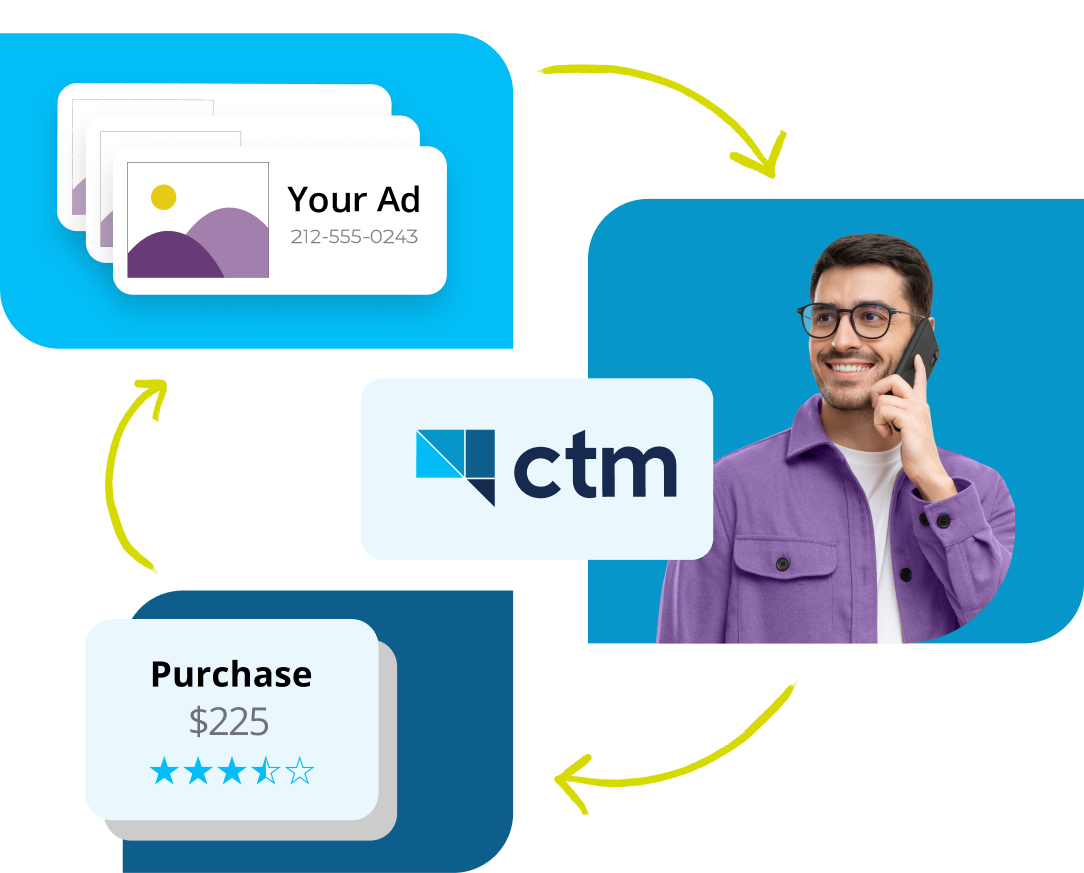
Source: CTM
Number pools handle high-traffic sites by allocating tracking numbers across concurrent sessions. CTM also tracks SMS, chat, and form submissions through the same attribution framework, giving mid-market teams a single view across every inbound channel.
As a certified Google Call Analytics provider and Google Premier Partner, CTM offers bi-directional Google Ads integration that feeds qualified calls back as offline conversions with enhanced conversion support. A Cloudflare Workers integration performs the number swap server-side at the edge, reducing JavaScript overhead.
Invoca's attribution starts with similar DNI mechanics but layers more AI on top. The session-level JavaScript captures the full digital journey (UTM parameters, Google Click ID, landing page, referrer) and associates it with the tracking number. After the call, Signal AI analyzes the conversation to determine call quality, caller intent, and whether a conversion occurred.
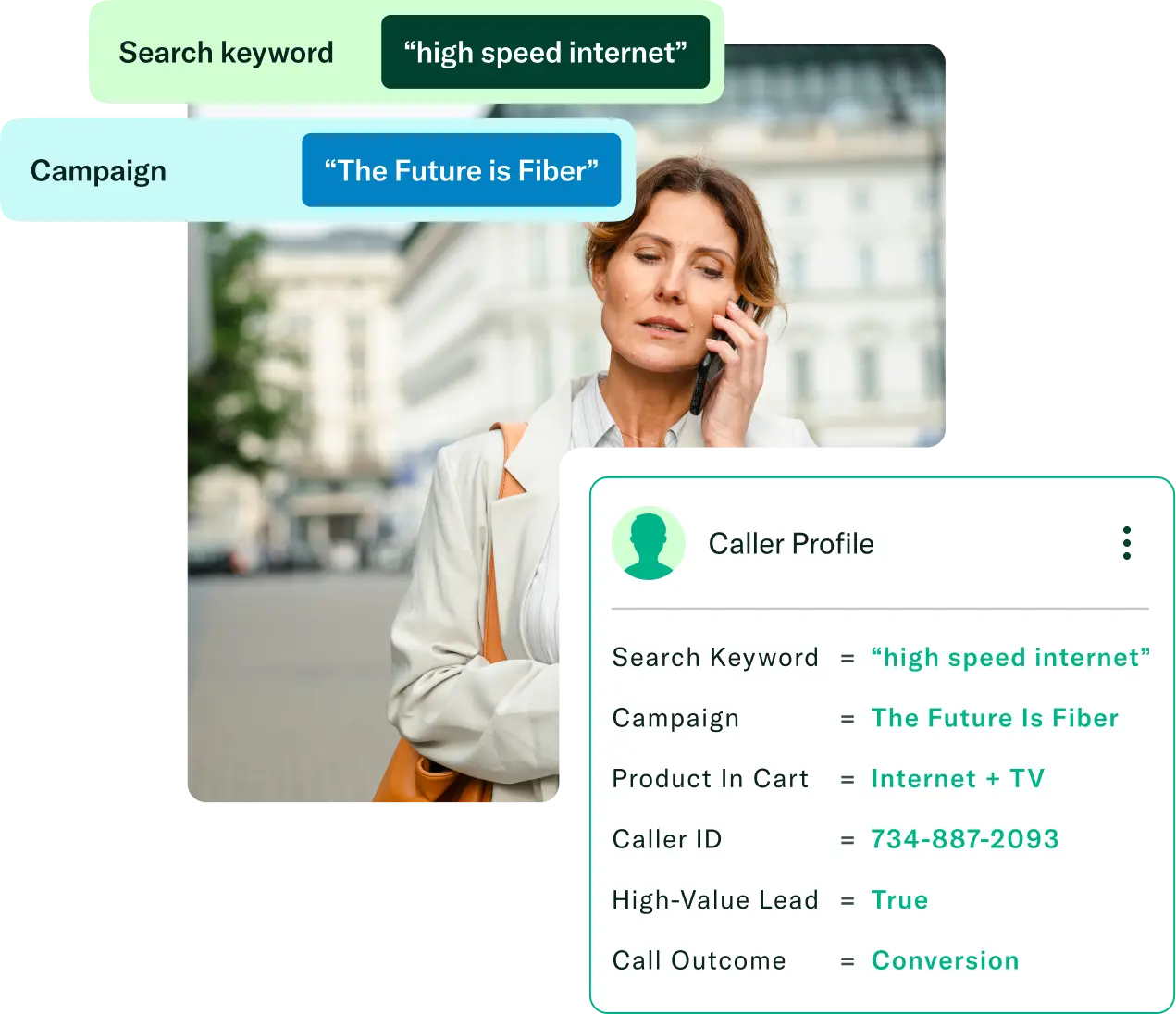
Source: Invoca
Invoca doesn't just count calls from a campaign. It tells you which calls produced revenue, and streams those conversion signals back to Google Ads, GA4, Meta Ads, Microsoft Ads, and TikTok in real time. Ad platforms then receive revenue-quality signals rather than raw call volume, which produces better smart bidding performance.
Invoca reports that marketers often undercount conversions by as much as 40% when relying solely on click-based tracking.
The gap between the two shows most clearly in what happens after call data is captured. CTM gives you the data and lets you build your own analysis with AskAI prompts and Triggers. Invoca's Signal AI produces the analysis automatically, using models trained on your specific calls.
For teams with the budget and call volume to justify Invoca's pricing, the automated analysis loop is worth it. For teams that need attribution across calls, texts, forms, and chat in one platform without enterprise overhead, CTM covers more ground per dollar.
Conversation intelligence: open prompts vs. patented machine learning
The gap between CTM and Invoca is widest in how they analyze what happens on calls.
CTM's AskAI is an open-ended AI layer powered by OpenAI's ChatGPT, launched in Q2 2023. Users write any free-form question or instruction that runs against each call transcript after processing. Want to know if a caller mentioned a competitor? Write that prompt. Need to classify whether a call was a new patient intake or an existing patient follow-up? Write that prompt.
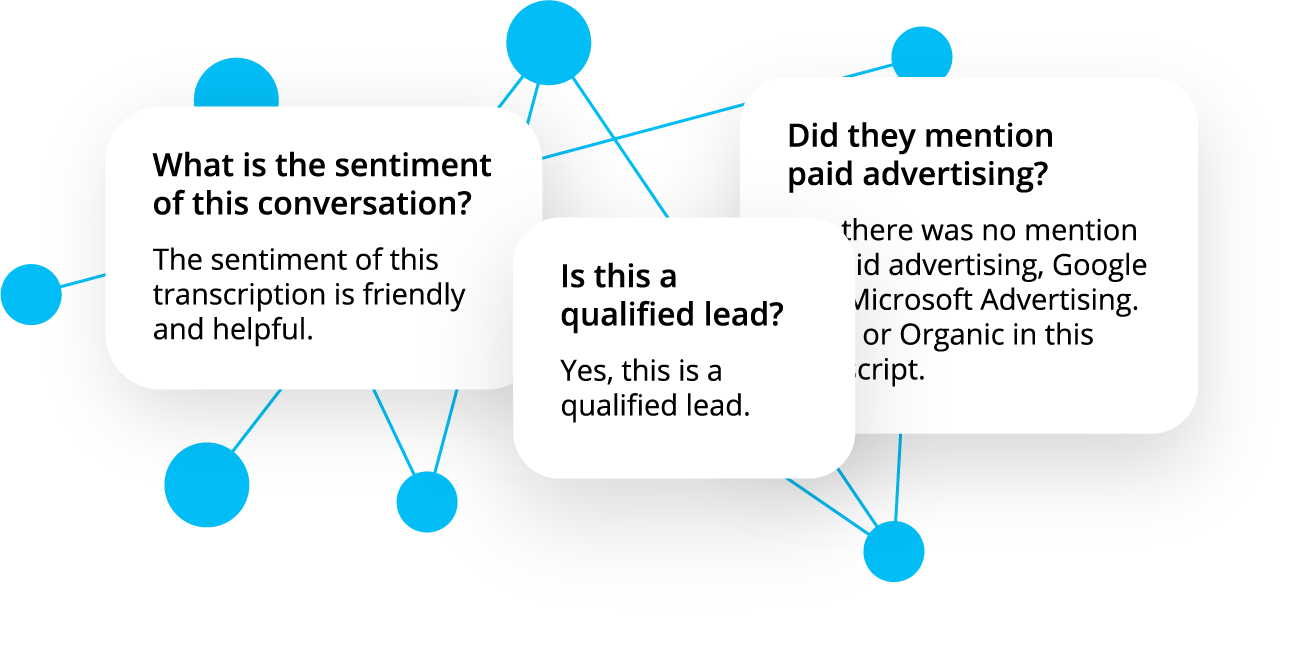
Source: CTM
The flexibility is the differentiator: CTM positions AskAI's customizable prompt architecture against competitors that limit customers to a fixed menu of insight types. AskAI outputs can populate custom fields, drive CRM sync, score calls, tag them, assign conversion values, or fire downstream Triggers.
Pricing starts at $0.01 per question. AskAI Summaries (added Q1 2025) generate automated post-call summaries in nine configurable styles.
Invoca's Signal AI works differently. Instead of open prompts, it uses patented machine learning to train custom AI models on each customer's actual calls.
Source: Invoca
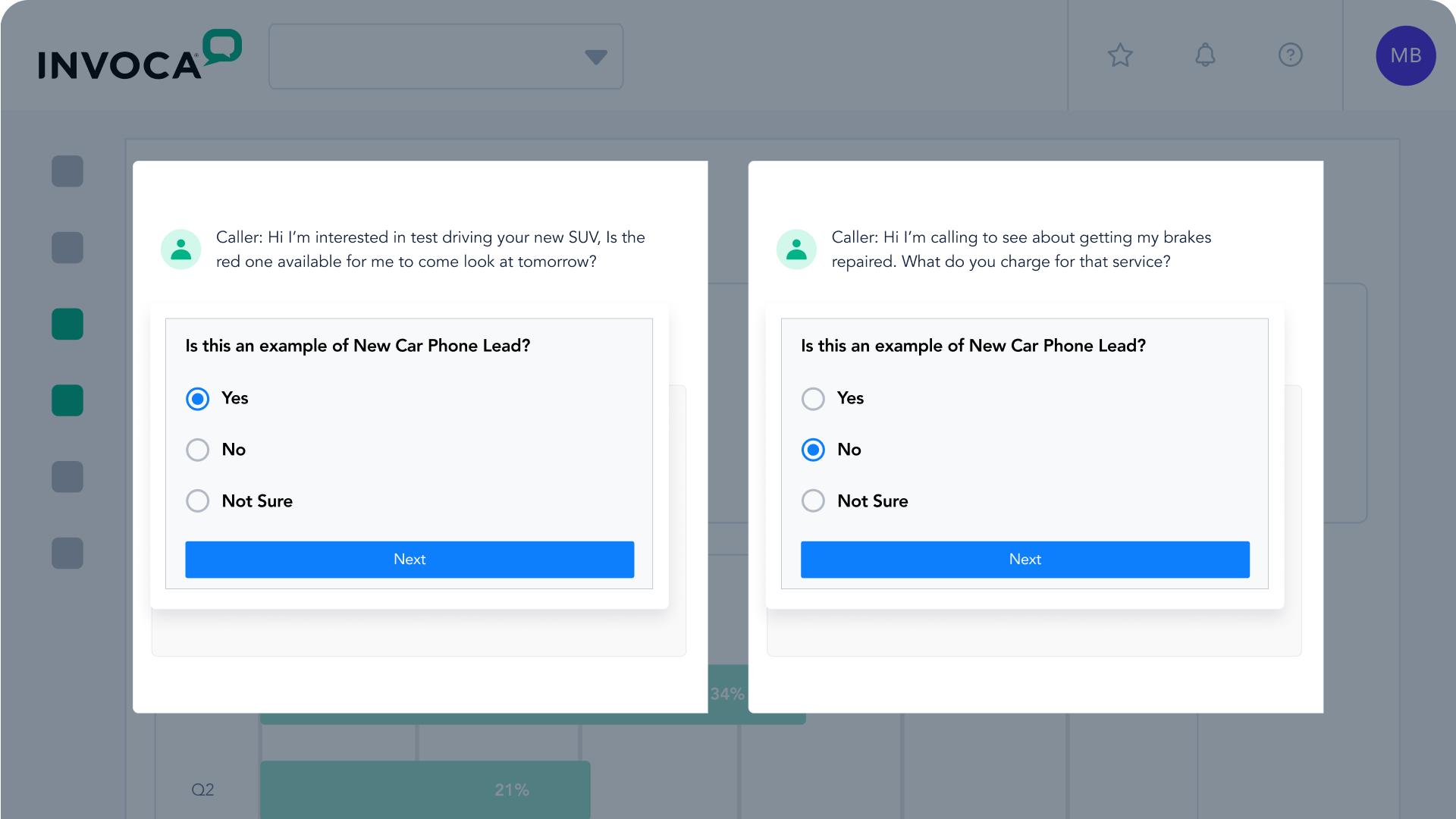
Through Signal AI Studio, a no-code interface, users describe an insight they want to detect in plain language, then label a set of call excerpts as matching or not matching.
Source: Invoca
The model learns from roughly 50 calls and an hour of user review over two days, down from about 1,000 calls previously. These trained Signals then run automatically against every call, producing structured outcome data that flows to ad platforms, CRMs, and contact center systems.
Several additional layers set Invoca's approach apart. Signal AI Autocapture uses named entity recognition to extract structured data from conversations automatically (for example, the year, make, and model of a vehicle discussed on an automotive sales call).
Source: Invoca
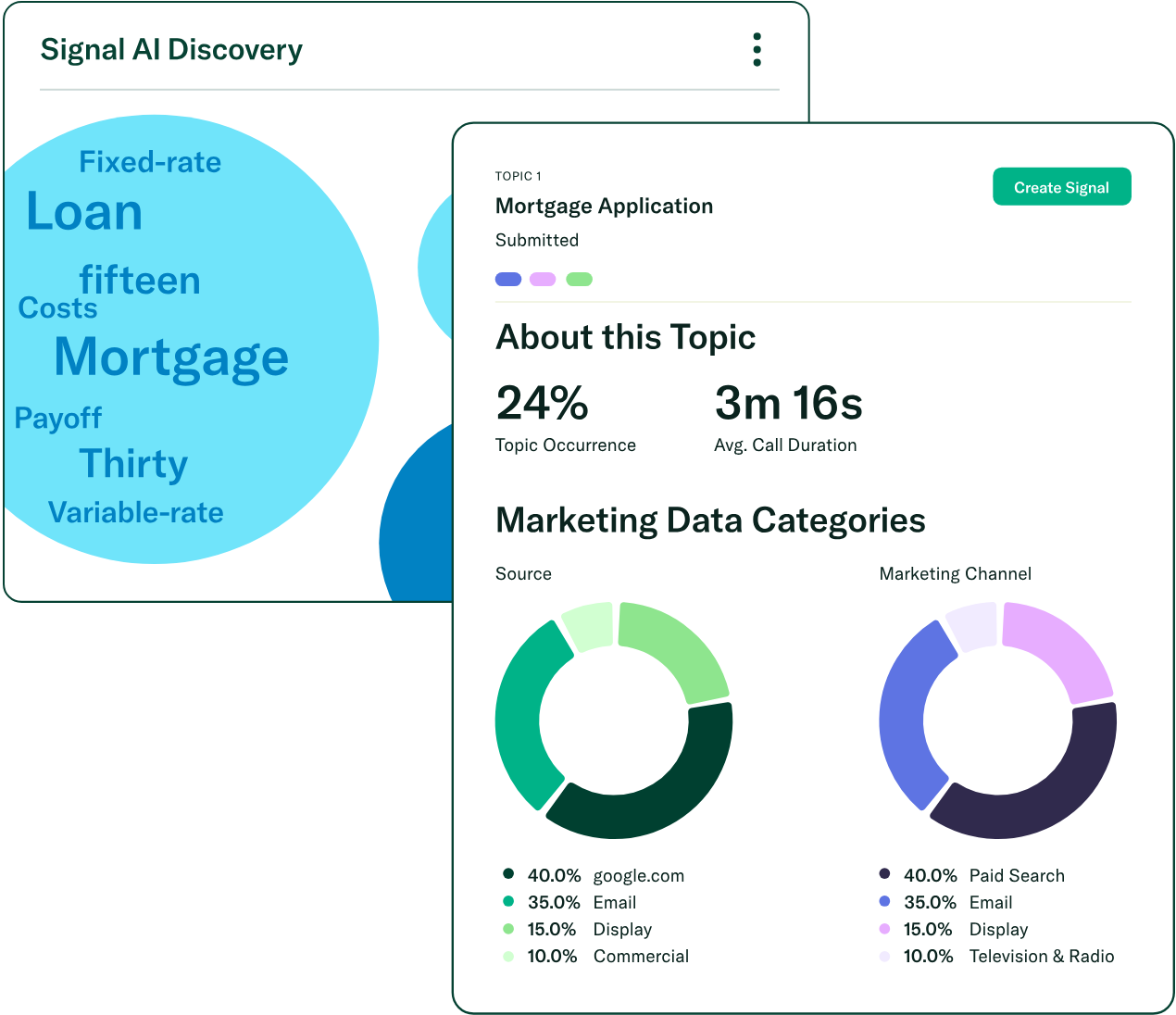
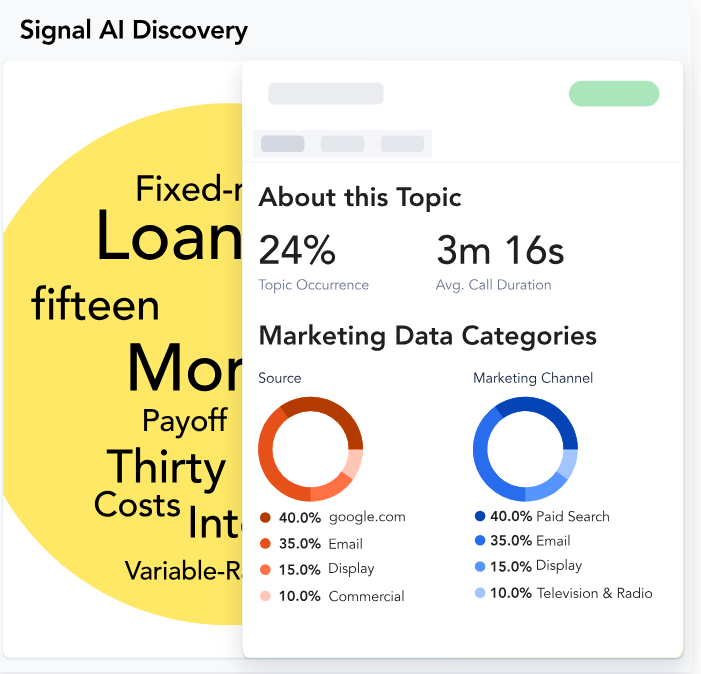
Signal AI Discovery uses unsupervised machine learning to cluster thousands of calls into topic categories, surfacing trends the business wasn't monitoring.
Source: Invoca
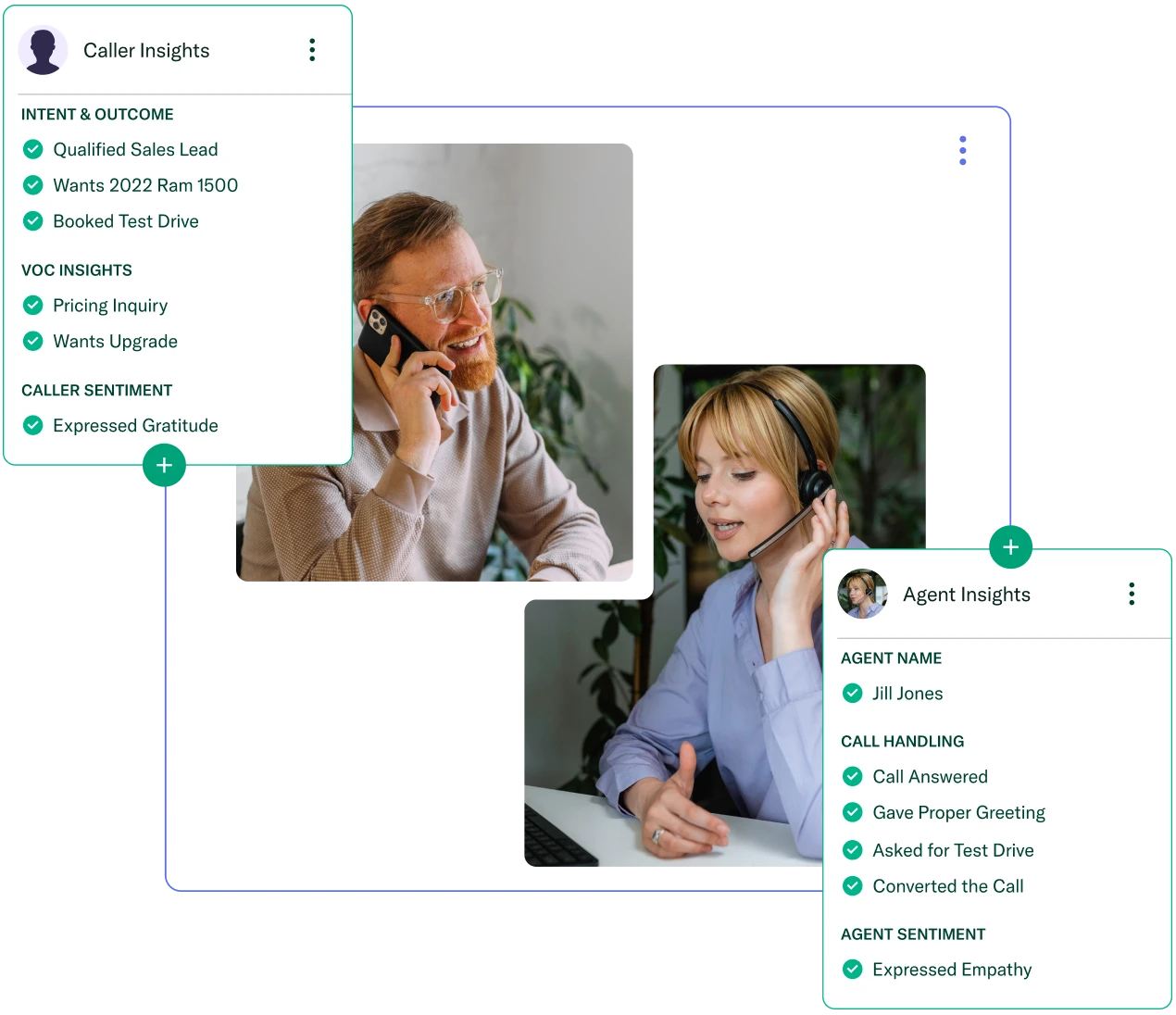
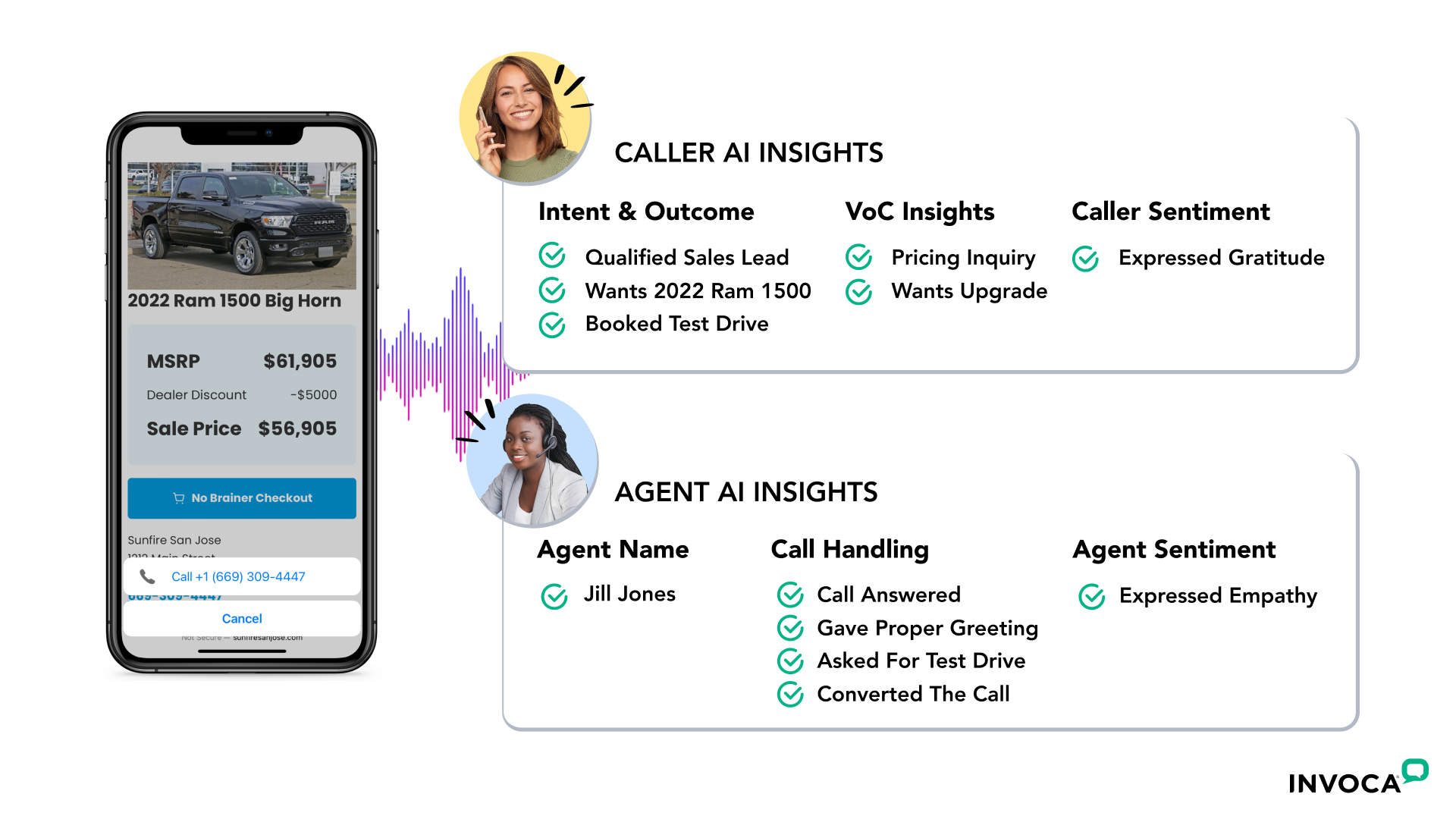
And dual-track sentiment analysis tracks caller and agent sentiment separately throughout each call, rather than producing one aggregate score.
Source: Invoca
The practical difference: CTM's AskAI is more flexible but requires you to know what questions to ask. Invoca's Signal AI is more autonomous but requires training time and higher investment. For teams that want to experiment with AI analysis across diverse use cases, CTM's open-prompt model is more accessible.
For enterprise contact centers that need consistent, automated scoring across thousands of daily calls, Invoca's trained models produce more reliable results at scale.
AI agents step in when humans can't
Both platforms now offer AI voice agents that handle inbound calls autonomously, though the implementations differ.
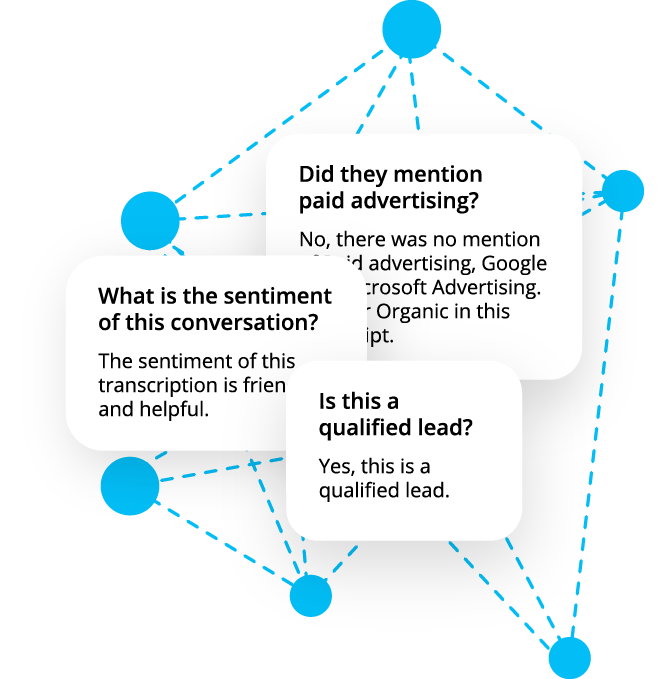
CTM's VoiceAI, launched in 2025, deploys a customizable AI voice agent that qualifies leads, books appointments, and handles overflow around the clock. The agent trains on user-supplied assets (FAQs, scripts, webpages) and runs on HIPAA-compliant infrastructure with a signed BAA.
Source: CTM
VoiceAI sits inside CTM's routing flow, so AI-handled calls follow the same conditional routing rules and feed into the same recordings, transcriptions, and AskAI pipeline as human-handled calls. Pricing is $0.12/minute after 250 free minutes per agent.
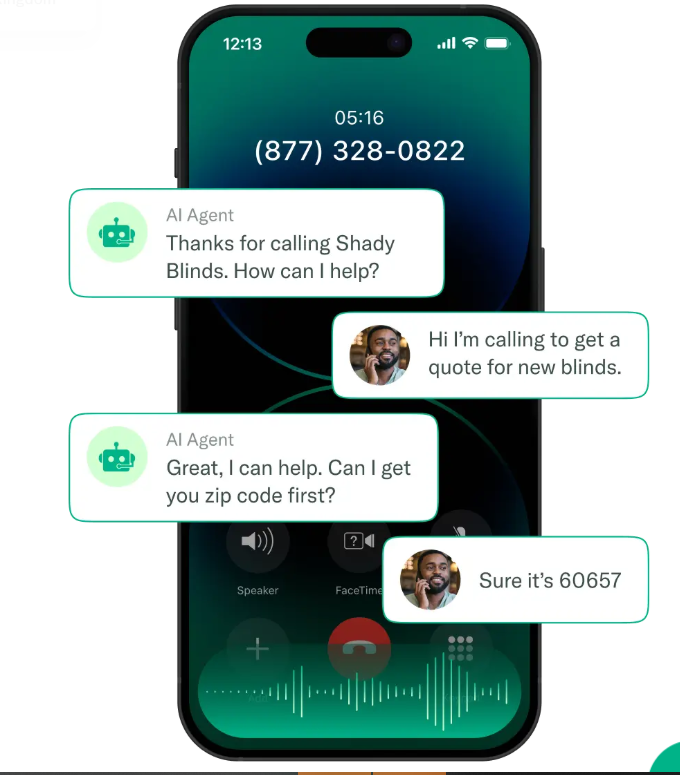
Invoca's AI Voice Agent takes a different approach to training. Instead of user-supplied scripts, the agent trains on the business's highest-performing calls, learning which conversation flows lead to conversion. Before each conversation begins, the agent already has the caller's digital journey data via PreSense: the ad they clicked, pages they viewed, and prior interaction history.
Source: Invoca
The agent determines actions dynamically based on the interaction's state, not from predefined sequences.
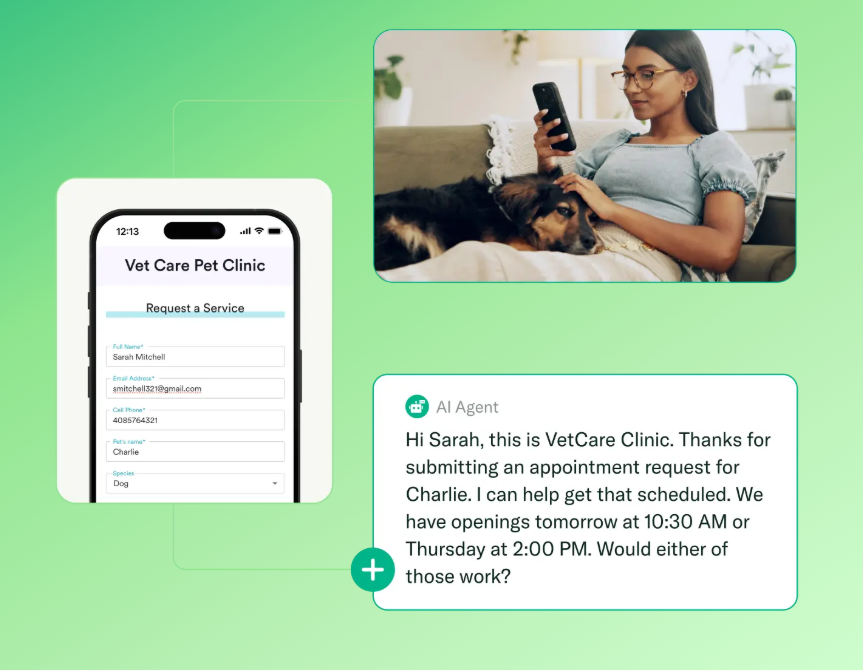
Invoca also offers an AI Messaging Agent for SMS-based lead engagement. It responds instantly to web form submissions and missed calls via two-way text, qualifies intent, books appointments, and escalates to human agents with full context. Implementation typically takes less than two weeks.
Source: Invoca
CTM offers SMS capabilities too (inbound attribution, automated follow-up, bulk campaigns), but as a messaging channel rather than an autonomous AI agent.
CTM's advantage is price transparency and operational integration: VoiceAI sits inside your existing routing, queuing, and attribution infrastructure at a known per-minute cost. Invoca's advantage is training depth: the agent arrives trained on real winning calls and loaded with each caller's digital context.
Contact center operations: built-in vs. bolt-on
CTM and Invoca take different approaches to contact center functionality.
CTM includes a full contact center stack on its Sales Engage plan ($329/month). The CTM Softphone is a web-based VoIP phone with no per-seat license fee on Sales Engage, showing agents the caller's marketing source, attribution data, and conversation history during the call. Smart Router provides If/Then conditional routing based on caller geo-location, campaign source, visitor history, and applied tags, with Smart Routers able to chain for complex multi-location flows.
Live coaching (whisper, barge, and listen modes) and real-time team dashboards are built into the softphone. Outbound tools include a Smart Dialer for automated list-based dialing and LeadReactor with 94% accurate answering machine detection for personalized voicemail drops.
Invoca does not include a native softphone or outbound dialer. Instead, it integrates with existing contact center platforms (Genesys, Five9, Amazon Connect, Salesforce) and adds intelligence on top. PreSense captures a caller's pre-call digital journey and delivers it as a screen pop to the agent's existing contact center desktop before the call is answered.
The distinction is clear: CTM replaces your phone system. Invoca makes your existing phone system smarter. For mid-market teams without an established contact center platform, CTM's built-in approach eliminates the need for a separate telephony vendor. For enterprises already running Genesys or Five9, Invoca layers AI on top without ripping out existing infrastructure.
The upstream gap: your calls are only as good as your campaigns
CTM and Invoca both measure what happens after a prospect calls. But the quality of those calls depends on what happens before the phone rings: which accounts your campaigns target, whether those accounts are in-market, and how accurately your ads reach decision-makers.
ZoomInfo fits in this area. As an AI GTM platform, ZoomInfo provides the B2B intelligence that makes marketing campaigns more precise.
The platform covers three dimensions: identity data (500M contacts, 100M companies, 135M+ verified phone numbers, and 200M+ verified business email addresses), company context (org charts, technographics, and more across 100M companies), and dynamic signals that reveal when accounts are actively researching solutions.
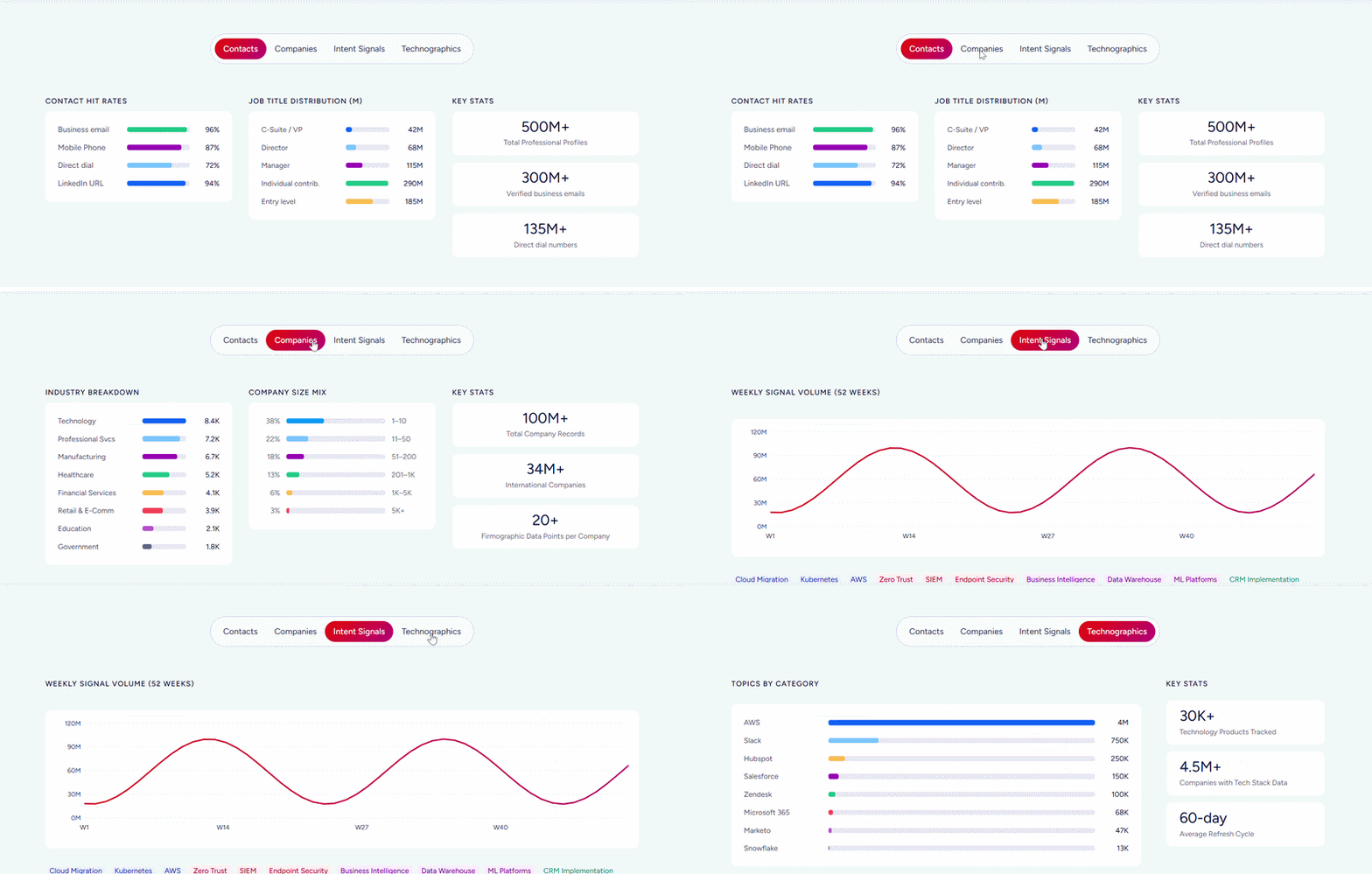
The practical effect is direct. ZoomInfo Intent tracks signals from 210M+ IP-to-Org pairings and 6 trillion+ new keyword-to-device pairings sourced monthly.
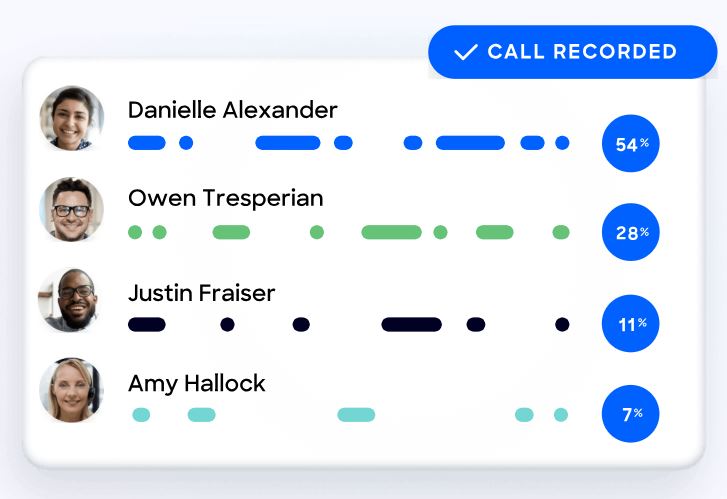
Guided Intent, exclusive to ZoomInfo, identifies topics historically correlated with deal success rather than requiring manual topic selection.
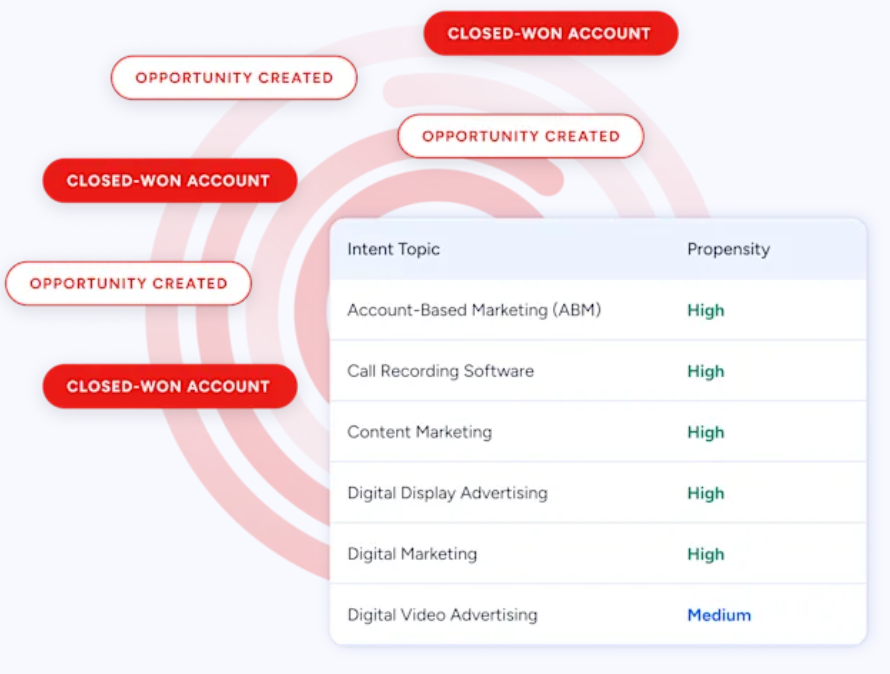
When these signals feed your paid search, display, and social campaigns, the calls arriving in your CTM or Invoca account come from accounts that are genuinely evaluating solutions, not from unqualified clicks.
ZoomInfo's GTM Context Graph takes this further by fusing intent signals with CRM data, conversation intelligence, and behavioral signals into a layer that captures not just what happened in a deal, but why it happened.
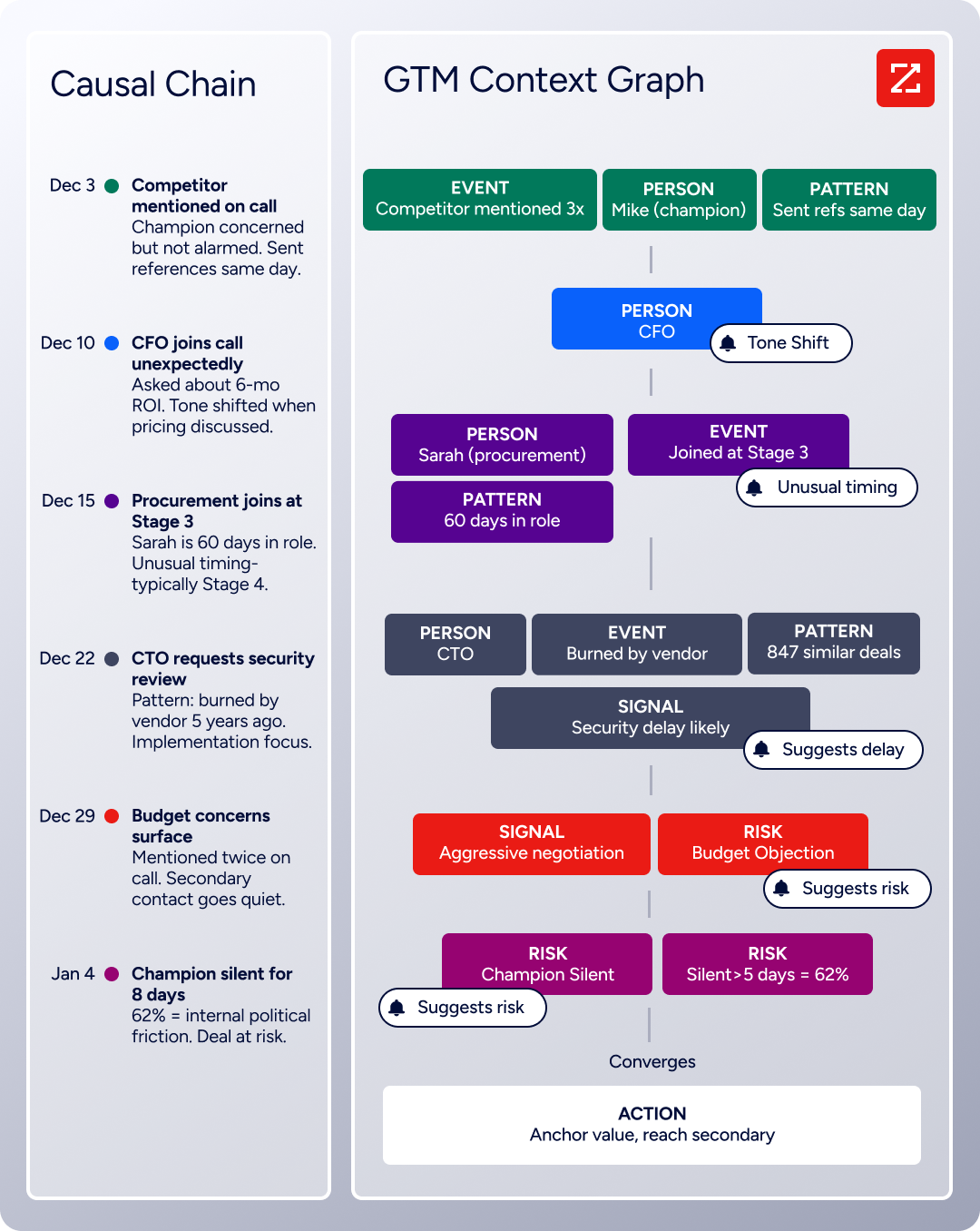
This feeds into GTM Studio, where marketers describe audiences in plain language and launch multi-channel plays targeting accounts that match proven win patterns.
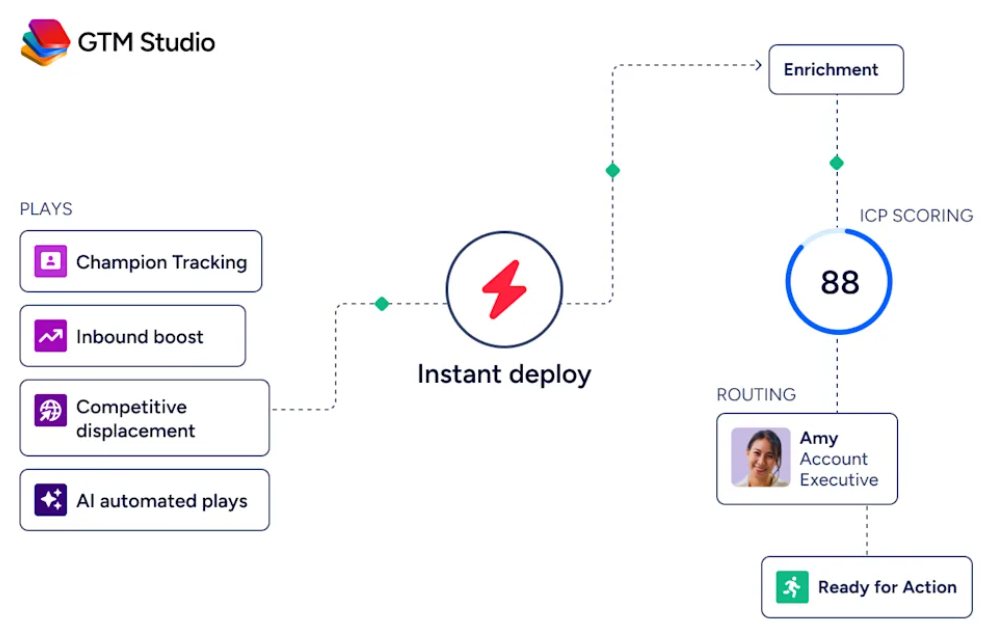
For sellers, GTM Workspace delivers prioritized accounts with AI-drafted outreach based on full account context. For teams building custom workflows, APIs and MCP expose the same intelligence to any tool or AI agent.
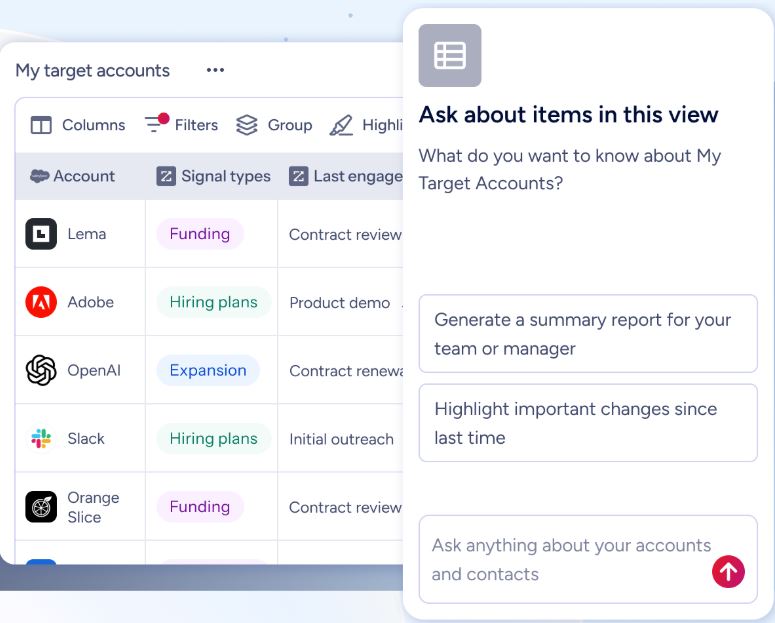
The connection to call tracking is straightforward. Both CTM and Invoca push call outcome data back to CRMs like Salesforce and HubSpot. ZoomInfo enriches those same CRMs with verified contact data, intent signals, and company intelligence.
Combined, your team sees the full picture: ZoomInfo showed that an account was researching your category, your campaign reached the right decision-maker, CTM or Invoca tracked the resulting call and measured its outcome, and that outcome fed back into campaign optimization. Each layer makes the others more effective.
Redwood Logistics achieved a 99% reduction in CPC and 310% increase in CTR by using ZoomInfo's audience insights to target the right accounts at the right time across the full buyer journey. (Redwood Logistics)
Pricing models expose different markets
CTM and Invoca target different segments, and their pricing reflects it.
CTM publishes four tiers with clear pricing:
Plan | Monthly | Annual |
|---|---|---|
Marketing Lite | $79 | $65 |
Marketing Pro | $179 | $149 |
Sales Engage | $329 | $274 |
Enterprise | $1,999 | $1,999 |
A critical detail: no plan includes phone numbers or minutes. Local numbers cost $2.00/month each, toll-free $3.00/month. Call forwarding runs $0.04/minute (local) to $0.055/minute (toll-free). Transcriptions cost $0.02/minute. AskAI questions are $0.01 each. VoiceAI is $0.12/minute after included minutes. These charges add up quickly for high-call-volume businesses, and multiple reviewers flag usage cost unpredictability as a concern.
CTM offers month-to-month engagements with no contracts as the default, with discounts for annual and two-year commitments. The first month's subscription fee is waived on any plan, though usage charges still apply.
Invoca publishes no prices. The Pro tier includes 6,000 annual phone numbers and 5 custom Signals; Enterprise doubles the numbers to 12,000 and expands to 50 custom Signals. Signal AI, PreSense, and Quality Management are add-ons on Pro and included on Enterprise.
Subscriptions auto-renew for 12 months by default, fees automatically increase by 10% on each annual cycle, and subscriptions cannot be cancelled mid-term unless the Order Form allows it. G2 and Capterra reviewers consistently flag cost as a top concern.
ZoomInfo also uses consumption-based pricing with no publicly listed prices for paid tiers. However, ZoomInfo offers a permanent free tier called ZoomInfo Lite with access to 100M+ verified profiles, 10 monthly export credits, individual and company search, and a Chrome extension. A 7-day free trial of the full platform is also available.
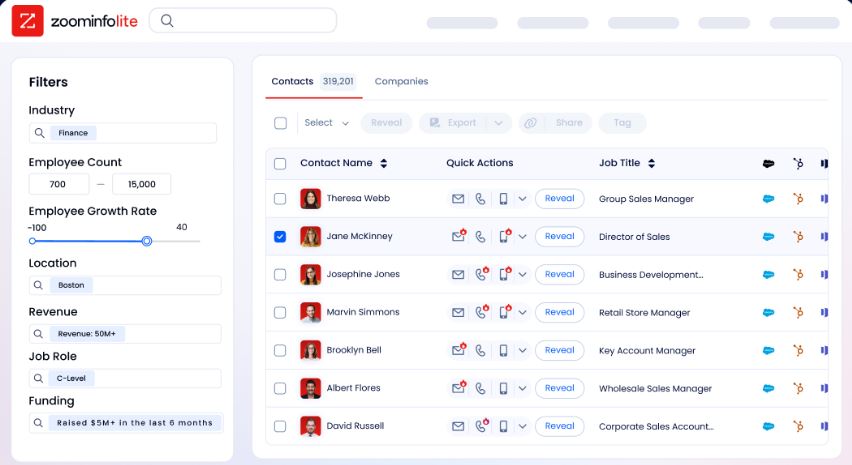
For teams evaluating whether upstream intelligence improves call quality before committing to a paid plan, ZoomInfo Lite provides a zero-risk entry point.
Seismic attributed 39% of active pipeline to opportunities identified or influenced by ZoomInfo signals, with sales teams reporting 54% productivity gains and 11.5 hours saved per week per seller. (Seismic)
Integration ecosystems and compliance
How well a call tracking platform fits an existing tech stack often comes down to integrations.
CTM advertises 40+ no-code native integrations, with 65 named integrations on the integrations page. Key connections include Google Ads (bi-directional with enhanced conversions), HubSpot, Salesforce (Open CTI with full softphone embed), Microsoft Dynamics 365, Facebook, Gong, Zoom, Calendly, Slack, Microsoft Teams, Shopify, and Zendesk.
Zapier and Make.com are available on Marketing Pro and above for connecting to thousands of additional apps. Integrations are tiered by plan: core marketing integrations on Lite, premium CRM and ad platform integrations on Pro and Sales Engage.
CTM's open REST API includes a Postman-based reference guide, a Python 3 example application on GitHub, and weekly API Office Hours with senior CTM engineers every Wednesday. API access, webhooks, and Lambda functions require Marketing Pro or above.
Invoca operates the Invoca Exchange, with integrations spanning digital advertising, social, CTV/video, CRM, contact center, and customer data platforms. Named integrations include Google Ads (enhanced conversions for phone leads, May 2025), ChatGPT Ads (first to integrate, May 2026), Genesys, Five9, Salesforce, Adobe Experience Platform, LinkedIn Ads, Reddit Ads, Dynamic Yield, and CTV platforms including tvScientific, iSpot, and Innovid.
Invoca's integration pace has accelerated through 2025–2026, with LinkedIn, Reddit, Dynamic Yield, Optimizely, StackAdapt, and VWO all added in recent quarters.
Invoca's developer portal documents eight distinct APIs, including the Transactions API, Signal API, Call Ingestion API, and Calls In Progress API. However, no official SDKs exist, and some APIs require Customer Success Manager enablement rather than self-serve activation.
ZoomInfo's Marketplace lists 172+ integration partners, including Salesforce, HubSpot, Microsoft Dynamics 365, Snowflake, AWS, Google Cloud, and Databricks. The ZoomInfo MCP server connects AI models directly to ZoomInfo's data, with support for Claude, ChatGPT, and other MCP-compatible clients. API access is included in all relevant plans.
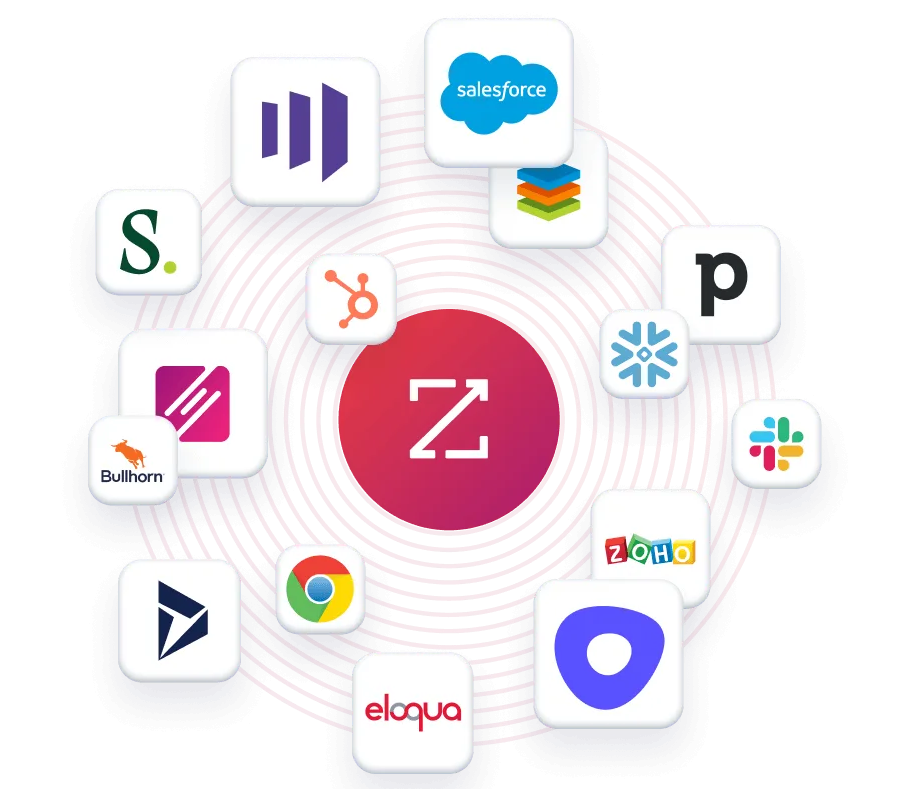
Because ZoomInfo, CTM, and Invoca all integrate with Salesforce and HubSpot, the three platforms can share a common data layer without a direct integration between them.
ZoomInfo enriches the CRM with verified contacts and intent data; CTM or Invoca pushes call outcomes to the same CRM; and the combined view gives revenue teams full-funnel visibility from intent signal to closed deal.
On compliance, all three platforms meet enterprise security requirements.
CTM holds SOC 2, HIPAA, GDPR, CCPA, PCI, and PIPEDA certifications with a downloadable security white paper.
Invoca carries SOC 2 Type 2, ISO 27001, HIPAA (with BAA), PCI DSS, GDPR, and CCPA certifications, reporting 99.999% uptime across geographically isolated US and EU infrastructure.
ZoomInfo maintains ISO 27001, ISO 27701, SOC 2 Type II, and TRUSTe GDPR/CCPA certifications, all renewed annually. For regulated industries like healthcare and financial services, all three platforms provide the compliance infrastructure needed to operate.
CTM vs. Invoca vs. ZoomInfo: Which should you choose?
The right choice depends on where your biggest gap is: tracking calls, analyzing calls, or generating better calls in the first place.
Choose CTM if:
You need call tracking, a softphone, outbound dialing, and AI in a single platform
You're a digital marketing agency managing multiple client accounts
Transparent pricing and month-to-month flexibility matter to your budget process
You want to customize AI analysis with your own prompts rather than training ML models
Your team handles both inbound tracking and outbound sales execution
Choose Invoca if:
You're an enterprise brand where phone calls drive high-value revenue (insurance, automotive, healthcare, telecom)
You need AI that trains on your actual call outcomes to produce automated conversion signals
Pre-call digital journey data for agents (PreSense) would measurably improve your close rates
100% automated call scoring across your contact center would replace manual QA sampling
Integrations with enterprise ad platforms (CTV, ChatGPT Ads, LinkedIn) are part of your media mix
Add ZoomInfo if:
You want the campaigns driving calls to target verified, in-market buyers rather than broad audiences
Intent signals that reveal which accounts are actively researching your category would improve your paid media ROI
You need enriched contact and company data in your CRM to close the loop between marketing spend and revenue
Your revenue team needs one intelligence layer across prospecting, campaigns, and deal execution
Explore ZoomInfo's GTM intelligence with a free trial.
CTM and Invoca have both earned their positions in call tracking. CTM gives mid-market teams and agencies more capability per dollar than any competitor in its class. Invoca gives enterprise brands AI-powered call intelligence that no lighter-weight tool can match.
And ZoomInfo provides the upstream B2B intelligence that makes whatever call tracking platform you choose more effective, because the calls worth tracking start with campaigns that reach the right buyers.
CallTrackingMetrics vs. Invoca vs. ZoomInfo FAQ
What is the core difference between CTM, Invoca, and ZoomInfo?
CTM (formerly CallTrackingMetrics) is a conversation analytics platform combining call tracking, a built-in softphone, omnichannel messaging, and AI in one system for mid-market teams and agencies. Invoca is an enterprise AI platform that uses patented machine learning to analyze inbound calls, train custom conversion models, and deliver pre-call digital journey data to agents.
ZoomInfo is an AI GTM platform that sits upstream of both, providing verified contact data, intent signals, and account intelligence to make the marketing campaigns tracked by CTM or Invoca more targeted and effective.
Which platform is more affordable?
CTM is more accessible on price, with published tiers starting at $79/month and going up to $1,999/month, plus usage-based charges for phone numbers, minutes, and AI features. Invoca does not publish prices and requires a custom quote, with reviewers consistently flagging its cost as higher.
ZoomInfo offers a permanent free tier (ZoomInfo Lite) with limited credits and a 7-day free trial of the full platform, with paid plans custom-quoted.
Does either call tracking platform include outbound sales tools?
CTM includes a built-in softphone with no per-seat licensing on its Sales Engage plan ($329/month), plus a Smart Dialer for automated outbound calling and LeadReactor with 94% accurate answering machine detection for voicemail drops. Invoca is inbound-only and does not offer a native softphone, outbound dialer, or sales sequencing tools.
Teams needing outbound alongside inbound would either choose CTM or pair Invoca with a separate outbound platform.
How do the AI capabilities compare?
CTM's AskAI lets users write custom, open-ended prompts that run against call transcripts at $0.01 per question, providing flexibility but requiring users to know what to ask. Invoca's Signal AI uses patented machine learning to train custom models on the business's actual calls, automatically detecting outcomes like appointments booked, products discussed, or competitors mentioned.
Invoca also offers Signal AI Discovery for unsupervised topic detection, dual-track sentiment analysis, and Agent Voice ID using voice biometrics.
Can I use ZoomInfo alongside CTM or Invoca?
Yes. ZoomInfo is complementary to both platforms. ZoomInfo enriches CRM systems like Salesforce and HubSpot with verified contact data and intent signals, while CTM and Invoca push call outcome data to those same CRMs.
Combined, your team sees the full revenue cycle: ZoomInfo identifies which accounts are in-market, your campaigns reach those accounts, CTM or Invoca tracks the resulting calls and measures their outcomes, and that data feeds back into campaign optimization.
Which platform is best for digital marketing agencies?
CTM is built for agencies. Its sub-account architecture lets you manage dozens of client accounts from a single interface, with white-label options, custom billing, and Triggers that can be saved globally across all sub-accounts. Invoca also serves agencies but is designed for enterprise-scale engagements.
CTM's transparent pricing, month-to-month contracts, and agency-specific features make it the more practical choice for most agency operations.
Which platform has stronger compliance certifications?
Both platforms meet enterprise compliance requirements. CTM holds SOC 2, HIPAA, GDPR, CCPA, PCI, and PIPEDA certifications. Invoca holds SOC 2 Type 2, ISO 27001, HIPAA with BAA support, PCI DSS, GDPR, and CCPA certifications, and reports 99.999% uptime across geographically isolated infrastructure.
For regulated industries like healthcare and financial services, both platforms provide the certifications needed to operate.
What happens to call data if I cancel?
CTM provides access to past activity and reports for 60 days after cancellation, then deletes data. Available Balance refunds must be claimed within 90 days. Number porting out is free. Invoca's terms state that subscriptions cannot be cancelled mid-term unless the Order Form allows it, fees are non-refundable by default, and subscriptions auto-renew for 12 months with a 30-day non-renewal notice window.
Related breakdowns to help you choose:
