
Choosing between Capital IQ and PitchBook comes down to five questions:
Are you analyzing public companies with standardized fundamentals, or researching private capital markets where data is scarce?
Do you need precedent transaction comps for M&A pitch books, or deal sourcing and fund benchmarking for PE/VC workflows?
Is consensus estimate data from sell-side analysts critical to your research, or do you need fund performance scoring and LP allocation tracking?
Do you live in Excel building financial models, or do you need CRM integrations and AI-driven deal screening?
Once you've identified the right companies, can you actually reach the decision-makers there?
In short, here's what we recommend:
S&P Capital IQ Pro serves investment bankers, equity research analysts, and credit professionals who need public company fundamentals paired with a broad private company database. Its Excel Plug-In pulls financial data directly into models. The M&A transactions database covers 1.2M+ deals with filters that competitors don't match on private targets. The Visible Alpha integration delivers granular consensus estimates built from actual sell-side analyst models. Capital IQ Pro's strength is connecting public and private company fundamentals in one interface. The trade-offs: enterprise pricing with no public rate card, a steep learning curve, and no real-time market data for trading desks.
PitchBook serves PE and VC professionals, limited partners, and credit investors who need private capital markets intelligence. Covering nearly 6 million companies, 2.7 million investments, 570,000 investors, and 147,000 funds, PitchBook provides the deal sourcing, fund benchmarking, and LP tracking that private market participants depend on. The LCD acquisition from S&P Global brought the industry-standard leveraged loan dataset in-house. All clients get access to all platform data at no additional cost, which simplifies budgeting for teams working across asset classes. The trade-offs: similarly opaque pricing, weakness in the corporate client segment among smaller firms, and no SOC 2 or ISO 27001 certification.
Both platforms do their jobs well: they help you understand companies, markets, and deals. But understanding is only half the workflow. When you need to reach decision-makers at target companies, source deals through direct outreach, or identify which accounts are actively evaluating solutions, financial data platforms hit their limits.
ZoomInfo is an AI-driven go-to-market platform that provides the contact-level data and outreach capabilities that financial intelligence platforms lack. With 500M contacts, 100M companies, 135M+ verified phone numbers, and 200M+ verified business email addresses, ZoomInfo lets deal teams, business development professionals, and corporate development groups move from "we've identified the right companies" to "we've reached the right people." For PE firms sourcing deals, investment bankers doing BD outreach, or service providers targeting active dealmakers, ZoomInfo complements whichever financial data platform you choose by adding the contact and outreach layer that turns research into conversations.
If adding verified contact data and outreach intelligence to your deal workflow sounds like the missing piece, see how ZoomInfo works.
Capital IQ vs. PitchBook vs. ZoomInfo at a glance
S&P Capital IQ Pro | PitchBook | ZoomInfo | |
|---|---|---|---|
Primary focus | Public & private company fundamentals, M&A comps | Private capital markets intelligence | B2B contact data & go-to-market execution |
Company coverage | |||
Contact/People data | Executive profiles, compensation, board data | ||
M&A/Deal data | Intent signals for active buyers | ||
Excel integration | Plug-in (GDSP/GDSHE functions) | Chrome extension, CRM integrations | |
AI capabilities | ChatIQ, Document Intelligence 2.0 | Navigator, Valuation Estimates | GTM Context Graph, AI agents |
Pricing | Quote-only, enterprise contracts | Quote-only, all-inclusive data access | Consumption-based, free tier available |
Best for | IB analysts, equity research, credit teams | PE/VC firms, LPs, credit investors | Deal sourcing outreach, BD, corporate dev |
Two platforms, two different visions of financial intelligence
Capital IQ and PitchBook started from opposite ends of the financial data spectrum and have been moving toward each other for over a decade.
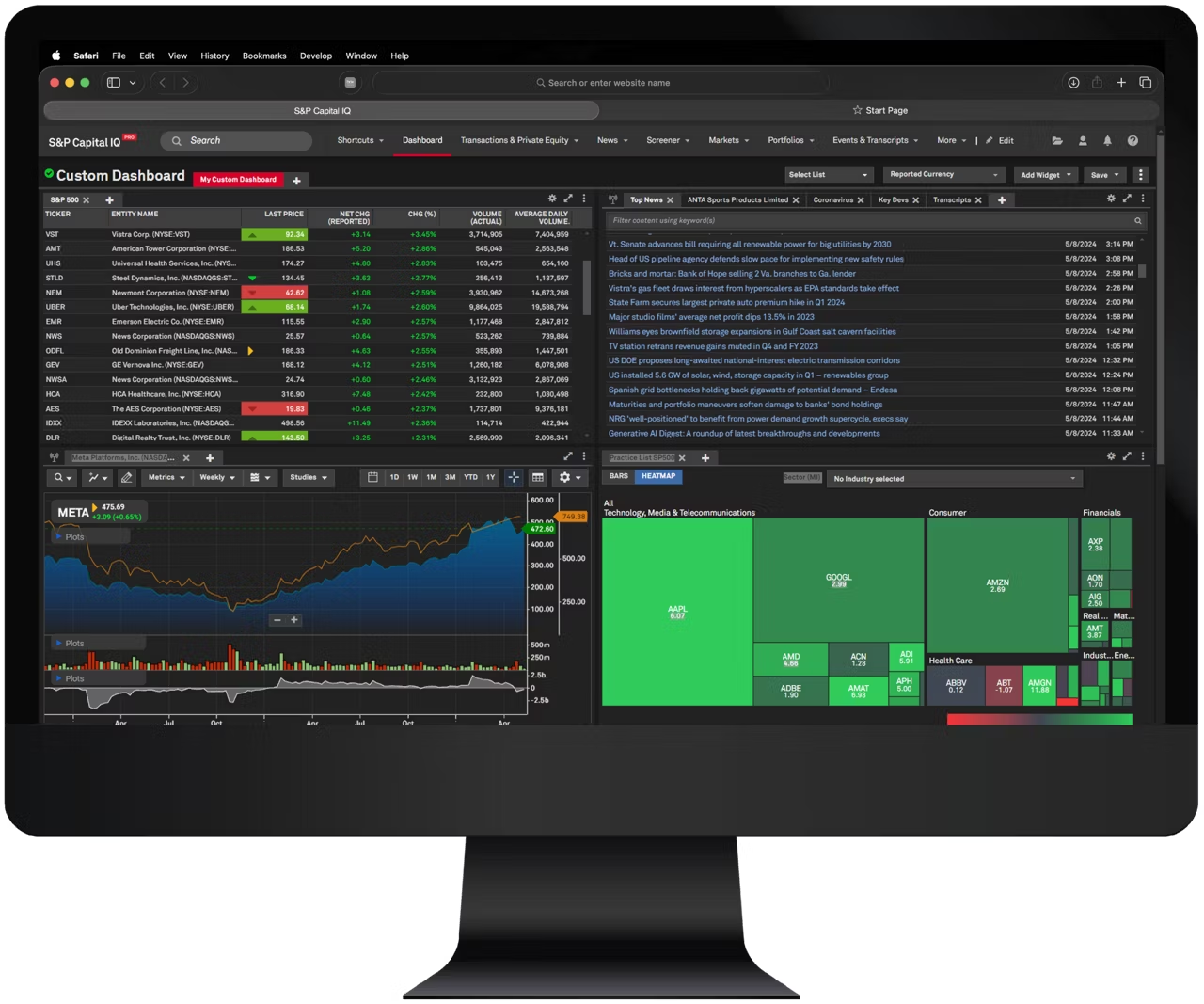
S&P Capital IQ Pro grew out of a 1998 startup that aimed to bring technology-first data delivery to an industry dominated by Bloomberg's hardware-locked terminals. S&P acquired it in 2004 for over $200 million. It absorbed SNL Financial's sector-specific datasets in 2015 and IHS Markit's commodity and shipping data after the 2022 merger. Today it sits within a $15 billion parent company and covers everything from standardized public company financials to regulatory-grade sector data for banking, energy, and insurance.
Source: S&P Global
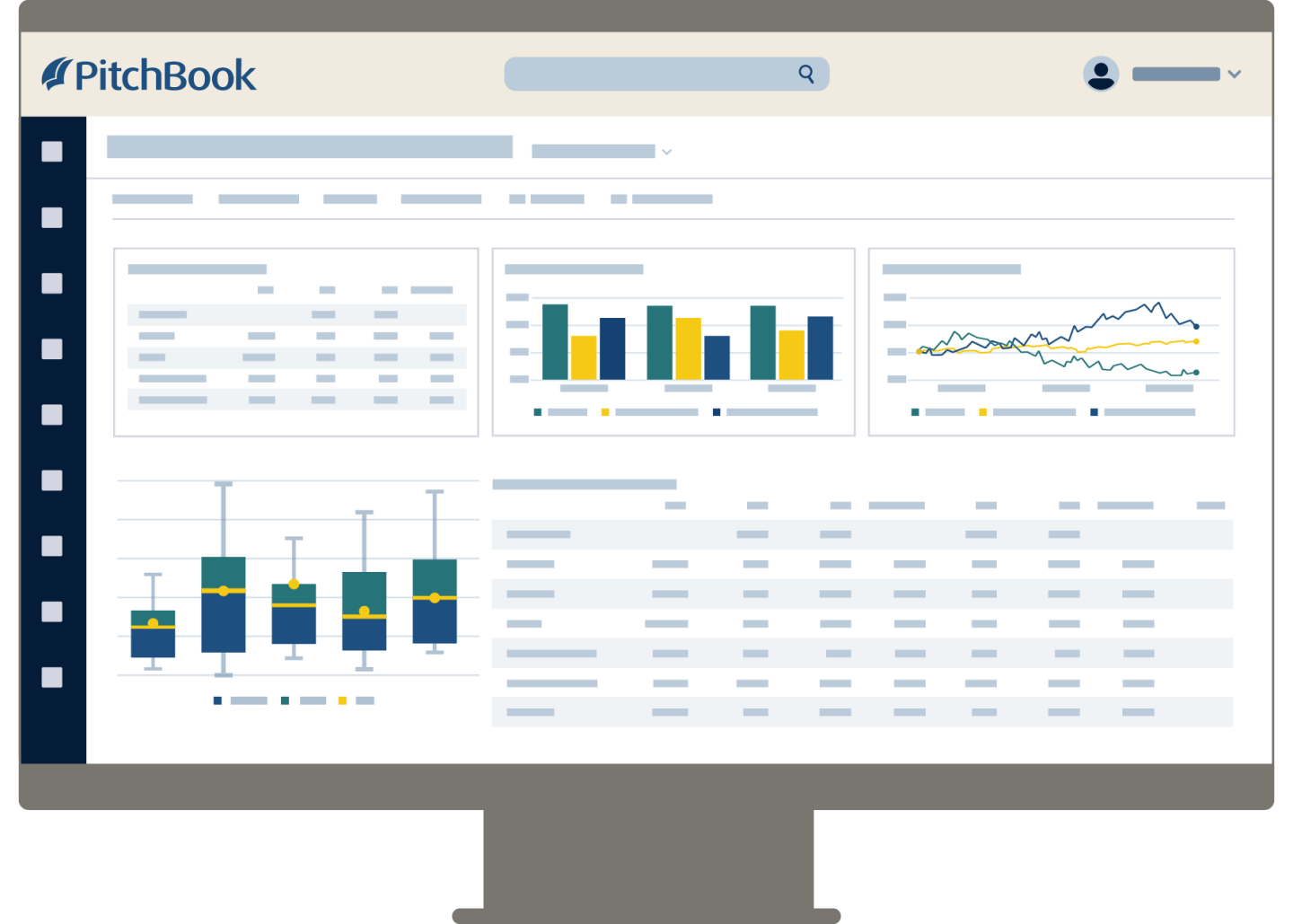
John Gabbert founded PitchBook in 2007 after spending nine years at VentureOne watching the PE and VC industry struggle with fragmented, unreliable data. After more than 200 rejections from potential investors, he cold-called Morningstar founder Joe Mansueto and secured a $1.2 million Series A in 2009. Morningstar acquired PitchBook outright for $225 million in 2016. That relationship brought public company data into PitchBook's platform via Morningstar and, later, the LCD leveraged loan dataset acquired from S&P Global for up to $650 million.
Source: PitchBook
The result is two platforms that overlap in some areas (both cover private companies, both have M&A data, both offer Excel integration) but differ in emphasis. Capital IQ Pro serves analysts who need standardized financial statements, precedent transaction multiples, and consensus estimates. PitchBook serves dealmakers who need to track fund performance, source investments, and monitor private capital flows across asset classes.
Capital IQ Pro leads in public company fundamentals and financial modeling
If your work centers on public company analysis, financial modeling in Excel, or precedent transaction comps, Capital IQ Pro has the deeper toolkit.
The financial data covers 60M+ private and 109K+ public companies, with 16M+ private companies carrying recent financials. S&P normalizes this data for apples-to-apples comparison across geographies and accounting standards, a quality built over 25+ years that investment banks trust for registered deal documents.
The Excel Plug-In is where Capital IQ Pro pulls ahead for modeling. Using GDSP and GDSHE functions directly in spreadsheet cells, analysts pull historical financials, projections, and ownership data into models without copy-paste. G2 users consistently cite this integration as a primary reason for choosing the platform. Screening can be initiated directly within Excel, letting analysts run a company screen and populate results into a spreadsheet in one step.
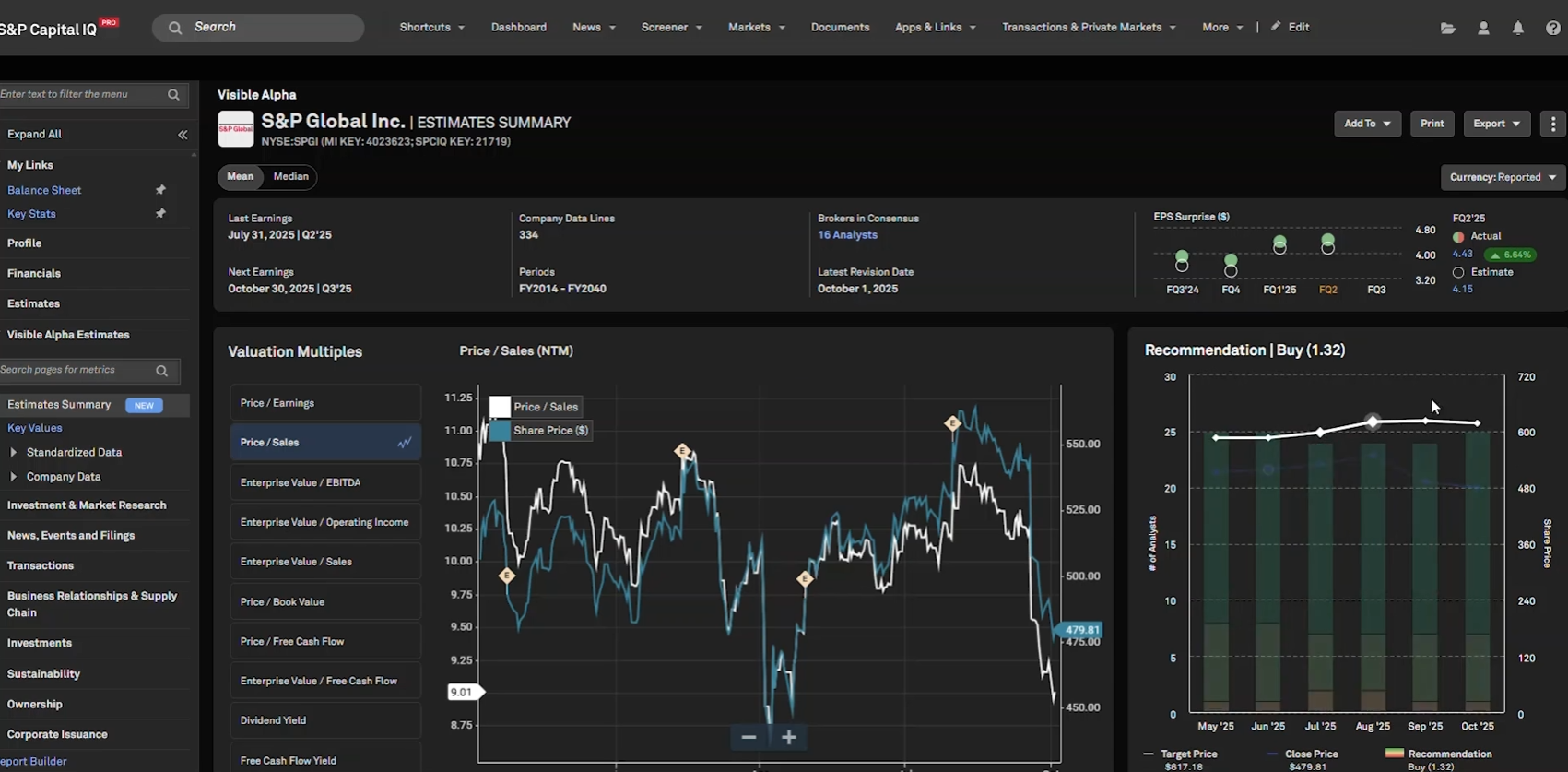
The Visible Alpha integration, launched in March 2025, adds 1M+ line items of sell-side estimate data from 200+ contributors across 7,300+ companies. Unlike traditional consensus platforms that aggregate headline EPS numbers, Visible Alpha is built from actual analyst Excel models, averaging 156 line items per company including KPIs and segment-level data. Analysts can click through from any consensus number to the source analyst model. This estimate data was previously available only through a standalone Visible Alpha subscription.
Source: Capital IQ Pro
Where Capital IQ Pro falls short: it does not provide real-time market data, so trading desks still need Bloomberg. And the platform carries a well-documented learning curve. G2 reviewers note that migration from the legacy interface introduces "way too many" differences, and new users face a long onboarding period before reaching full productivity.
PitchBook dominates private capital markets and credit intelligence
If your work centers on PE/VC deal sourcing, fund performance analysis, LP fundraising, or credit markets, PitchBook has the most complete dataset available.
The numbers tell the story: nearly 6 million companies, 2.7 million investments, 570,000 investors, 56,000 limited partners, 147,000 funds, and 4.4 million people. 1,800+ researchers worldwide have logged over 10 million hours of research and communicate directly with companies, advisors, investors, lawyers, and accountants to cross-validate data. Datasets are updated six times a day.
PitchBook's credit intelligence, built on the LCD acquisition, gives it a structural advantage. LCD is the industry-standard database for leveraged loan data, tracking deal structure, pricing, yield, and secondary market performance. A credit analyst can move from a loan news story to full sponsor and borrower profiles (PE fund history, VC backing, prior financing rounds) without leaving PitchBook. Owning the Morningstar LSTA index, the benchmark for the leveraged loan market tracking roughly $1.53 trillion in outstanding broadly syndicated loans, means credit funds benchmarked against it need PitchBook's data for performance attribution.
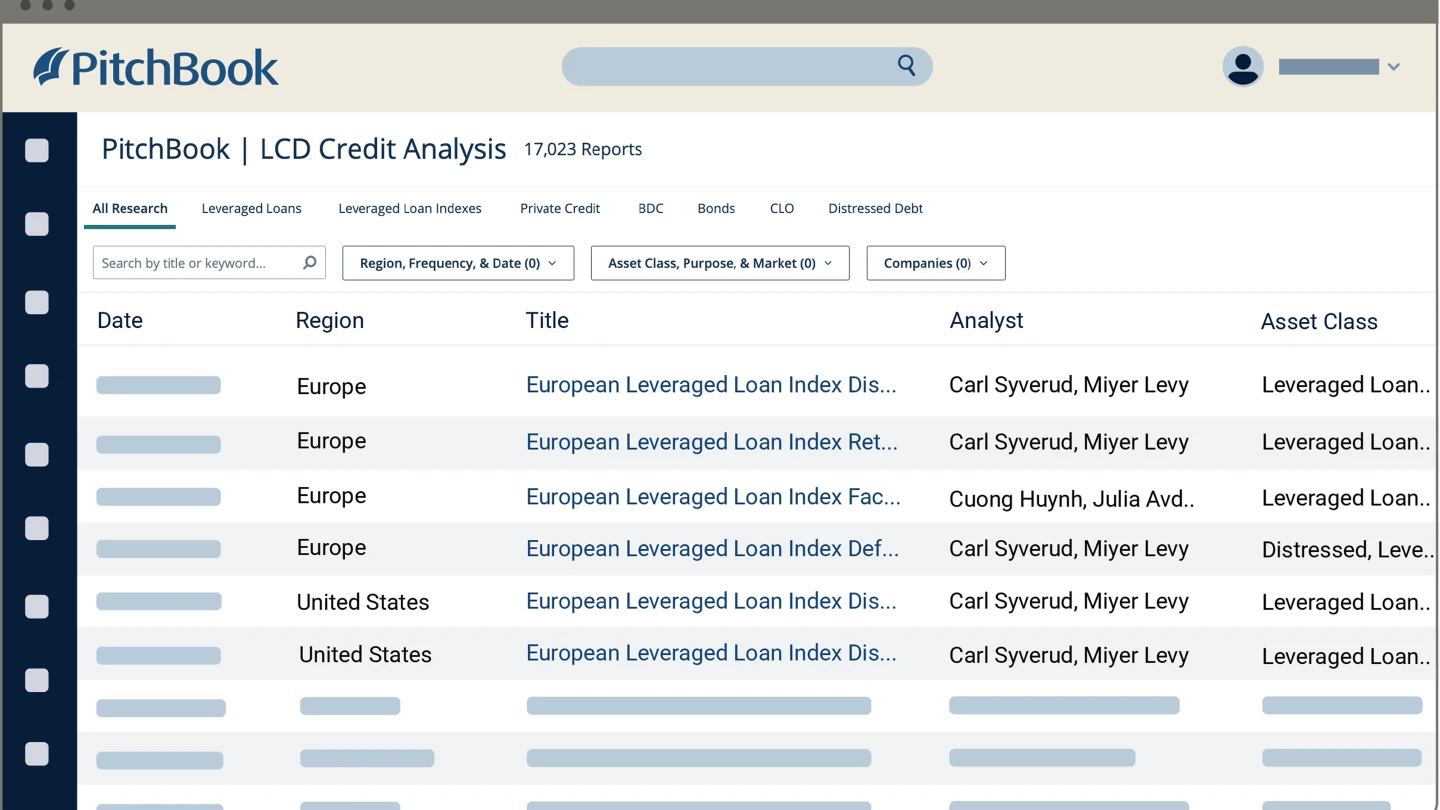
Source: PitchBook
For LPs evaluating fund managers, PitchBook offers Manager Scores on a 1-100 scale covering fund performance, capital call speed, and distribution speed, plus Custom Benchmarks built from performance data from 5,000+ funds. No competitor offers this combination of LP-facing tools within a platform that also covers VC, PE, M&A, and credit.
One key commercial difference: every PitchBook client gets access to all platform data at no additional cost. Capital IQ Pro's modular structure means Visible Alpha, SNL sector datasets, and API access may be scoped and priced separately. For teams working across asset classes, PitchBook's all-inclusive model avoids the add-on surprise.
Where PitchBook falls short: its public company financial data, while strengthened by the Morningstar integration, doesn't match Capital IQ Pro's depth of standardized fundamentals or Visible Alpha's consensus estimates. And the platform lacks SOC 2 Type II or ISO 27001 certifications, a gap that matters for financial institutions with strict vendor security requirements.
M&A transaction data: different strengths for different deal types
Both platforms serve precedent transaction analysis, but they cover different corners of the deal market.
Capital IQ Pro covers 1.2M+ M&A transactions, 340,000+ equity offerings, 330,000+ debt offerings, and 907,000+ funding rounds (including 258,000+ from Crunchbase). Wall Street Prep's competitive analysis notes that Capital IQ Pro screens private-target M&A deals "more deeply than competitors," making it the standard for precedent transaction comps in investment banking pitch books and fairness opinions.
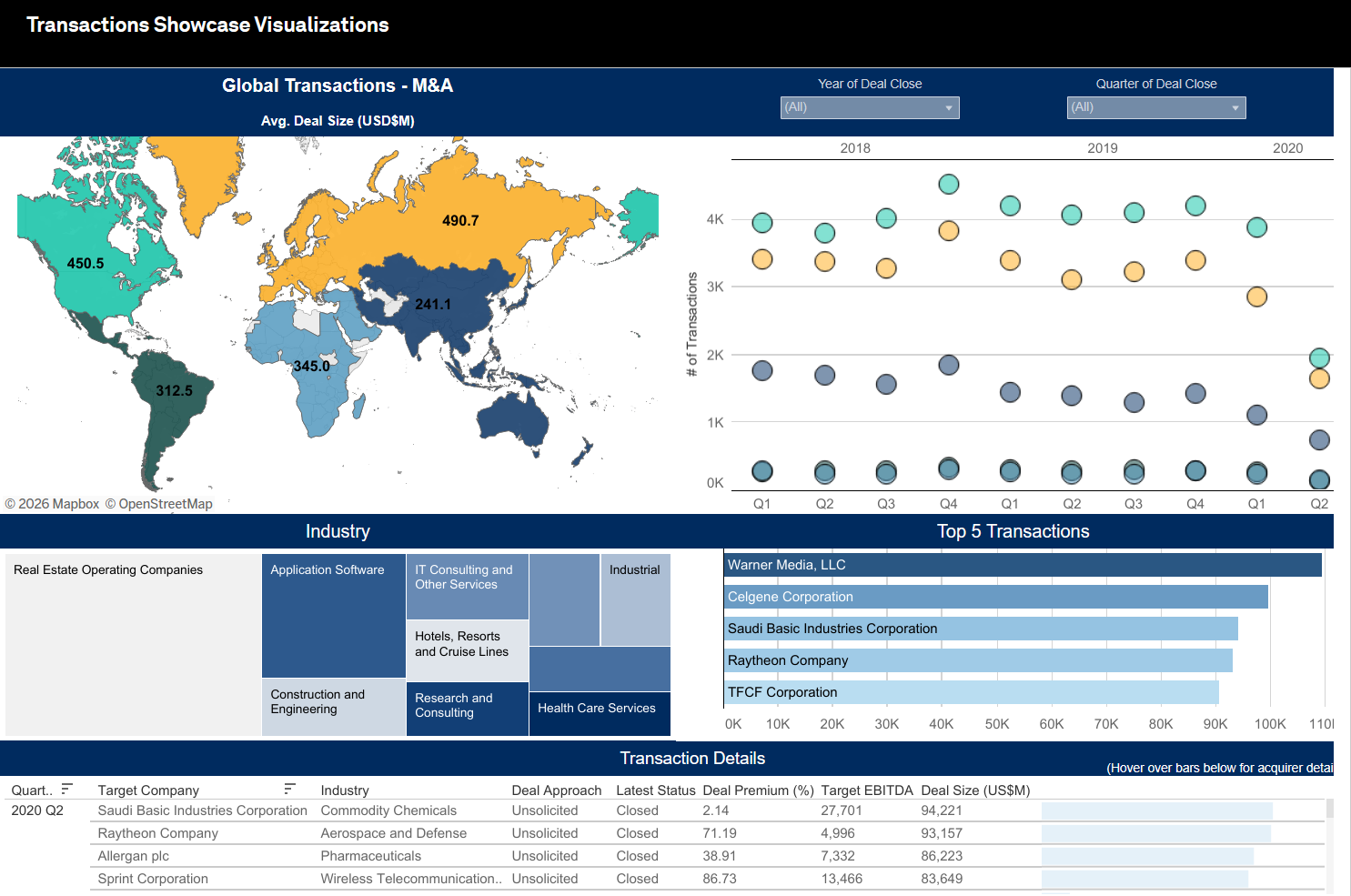
Source: Capital IQ Pro
PitchBook covers over 2.8 million deals and 156,000+ funds. Its advantage is the context around each deal: pre- and post-money valuations, cap tables, financing history, and fund performance data that Capital IQ Pro doesn't match in VC and growth equity. The VC Exit Predictor is an ML model that adds predictive analytics that no financial terminal offers for venture-backed companies.
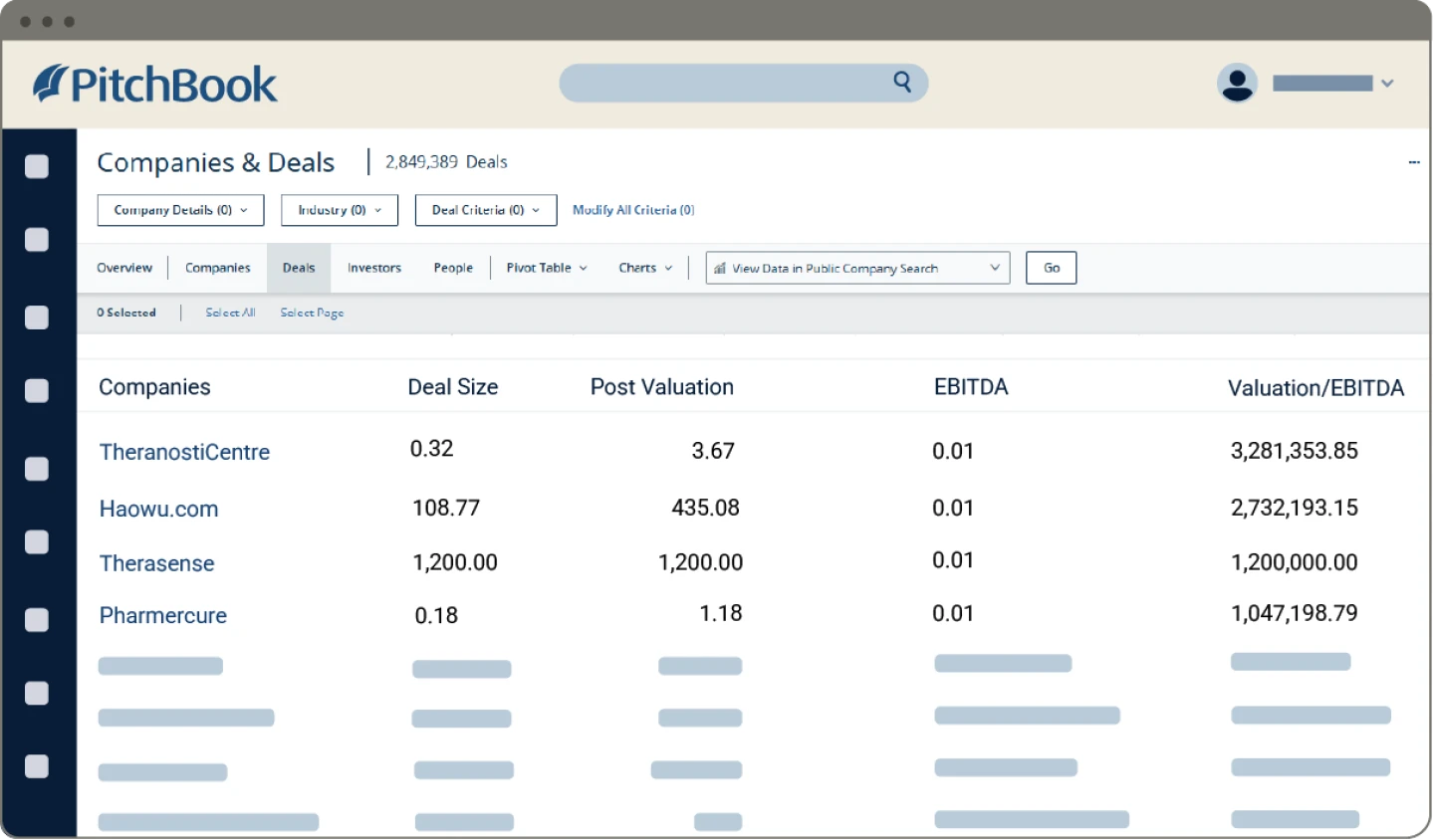
Source: PitchBook
For leveraged buyouts, add-ons, and sponsor-backed transactions, PitchBook's LCD data combined with its PE fund database creates a more complete picture of the sponsor landscape. For middle-market and large-cap M&A with public or mixed-ownership targets, Capital IQ Pro's standardized transaction multiples and data normalization are harder to replicate.
AI research tools: both platforms are investing heavily
Capital IQ Pro and PitchBook have each invested in AI, though they apply it differently.
Capital IQ Pro's AI centers on document analysis and research. Document Intelligence 2.0, launched in October 2025, uses generative AI to analyze and compare multiple documents at once, with citation traceability linking every insight to its source passage. ChatIQ provides a conversational interface that draws only from Capital IQ Pro's own database, avoiding the hallucination risk of open-web AI tools. Natural Language Screening converts plain-English descriptions into structured filter criteria. S&P Global has reorganized its entire Market Intelligence division around agentic AI built on proprietary data as its core strategy for 2026.
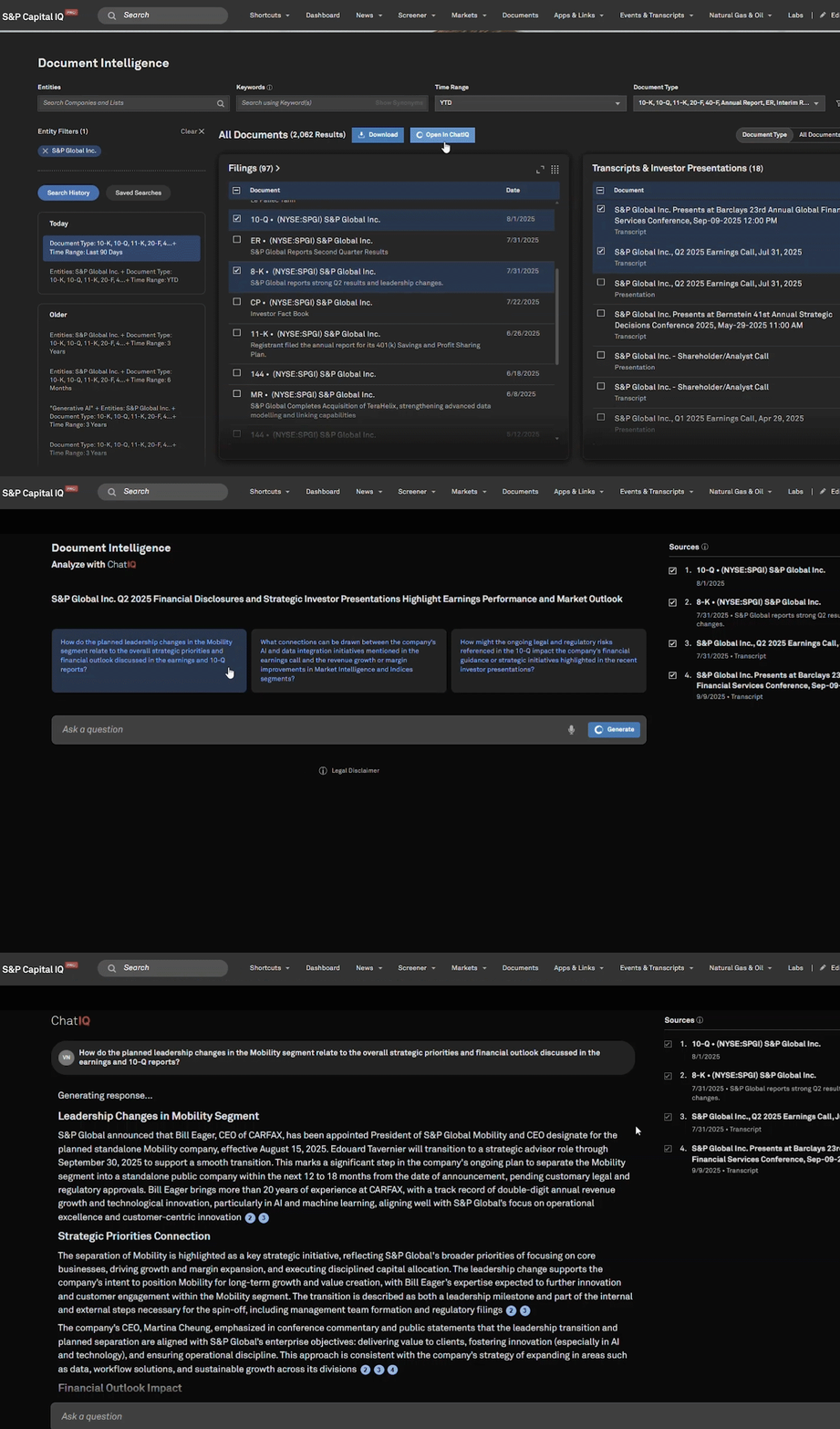
Source: Capital IQ Pro
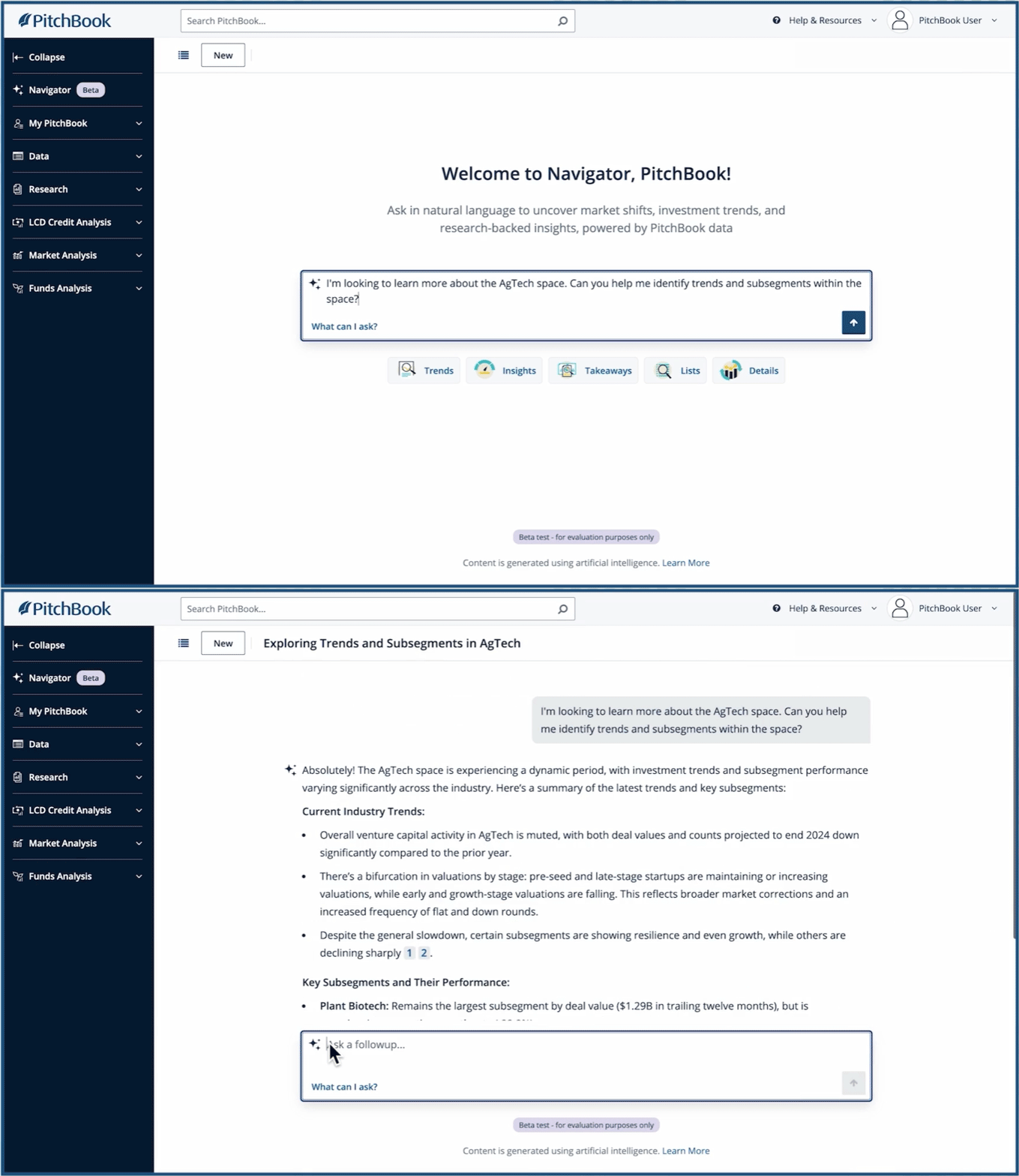
PitchBook takes a different path: AI embedded across workflows rather than offered as a separate tool. PitchBook Navigator enables natural-language queries across the platform, using a proprietary AI + HI (Artificial Intelligence + Human Insights) methodology that keeps human researchers in the validation loop. Valuation Estimates, the industry's first daily valuation model for private companies, covers 15,000+ VC-backed companies and applies ML to a problem that has historically required manual analysis and stale quarterly marks.
Source: PitchBook
Both platforms also position their data as infrastructure for external AI systems. Capital IQ Pro's Kensho LLM-ready API includes an MCP server for use with Claude, ChatGPT, and other compatible systems. PitchBook has launched LLM partnerships with Anthropic, OpenAI, Perplexity, Rogo, and Hebbia to make its data available inside AI workflows.
The execution gap both platforms share
Capital IQ Pro and PitchBook help you understand companies. They do not help you reach the people at those companies.
Both platforms have people data. Capital IQ Pro provides executive profiles, board member data, employment history, and compensation information. PitchBook tracks 4.4 million people with profiles covering roles, fund affiliations, and deal histories. But this data serves research and analysis, not outbound outreach. Neither platform provides verified direct-dial phone numbers at scale. Neither tracks buyer intent signals that reveal when a company is actively evaluating solutions. Neither integrates with the CRM and sales engagement tools that business development teams use daily.
This gap matters more than it appears. Consider a PE associate sourcing platform acquisitions: she screens targets in PitchBook or Capital IQ Pro, builds a list of 50 companies that fit the thesis, and then needs to reach the CEO or founder of each one. The financial data platform has done its job. The associate is left researching LinkedIn profiles and guessing at email formats.
Or consider the investment banker developing new advisory relationships: he tracks M&A activity in Capital IQ Pro, identifies companies likely to pursue a transaction, and then needs verified contact information for the CFO, head of corporate development, or board members. The platform tells him who holds those titles. It doesn't give him a phone number that rings.
ZoomInfo fills this gap. With 500M contacts, 135M+ verified phone numbers, 120M direct-dial phone numbers, and 200M+ verified business email addresses, ZoomInfo provides the contact layer that financial data platforms lack. The data is verified through a multi-source pipeline backed by 300+ human researchers, reaching up to 95% accuracy on first-party data. In a Fortune 500 competitive RFP analyzing 25 million contacts across vendors, the independent consultant concluded that "no other competitor came even close."
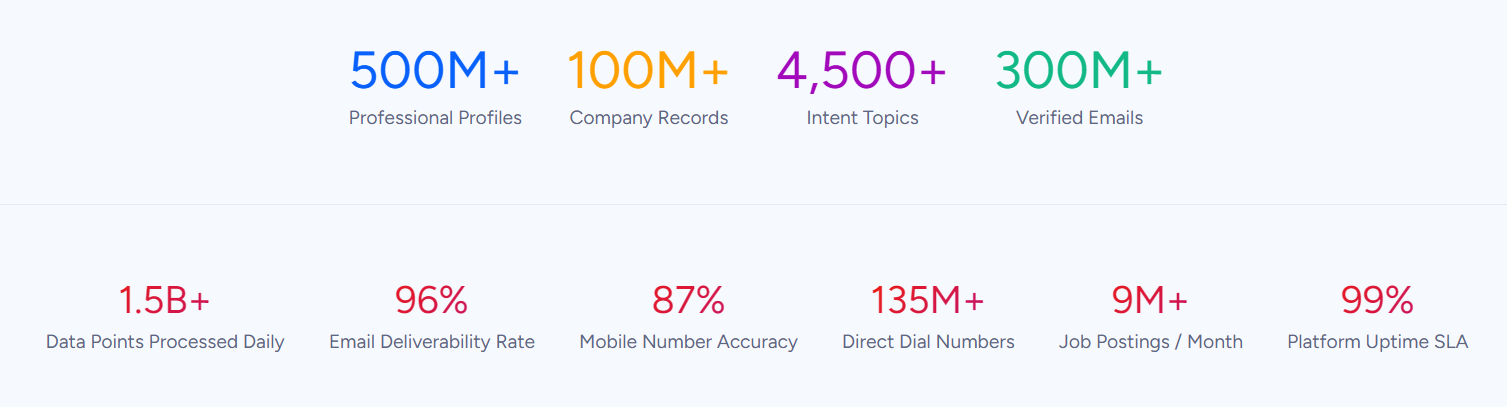
Beyond contact data, ZoomInfo adds capabilities that financial platforms were never built to provide. Buyer Intent data tracks signals from 210 million IP-to-Organization pairings, showing which companies are actively researching relevant topics. WebSights resolves anonymous website traffic to companies, including buying team identification. The GTM Context Graph combines ZoomInfo's B2B data with a customer's CRM records, conversation transcripts, and behavioral signals to show not just what happened in a deal, but why. And the GTM Workspace gives sellers a single interface where AI agents research accounts, draft personalized outreach, and update CRM without leaving the page.
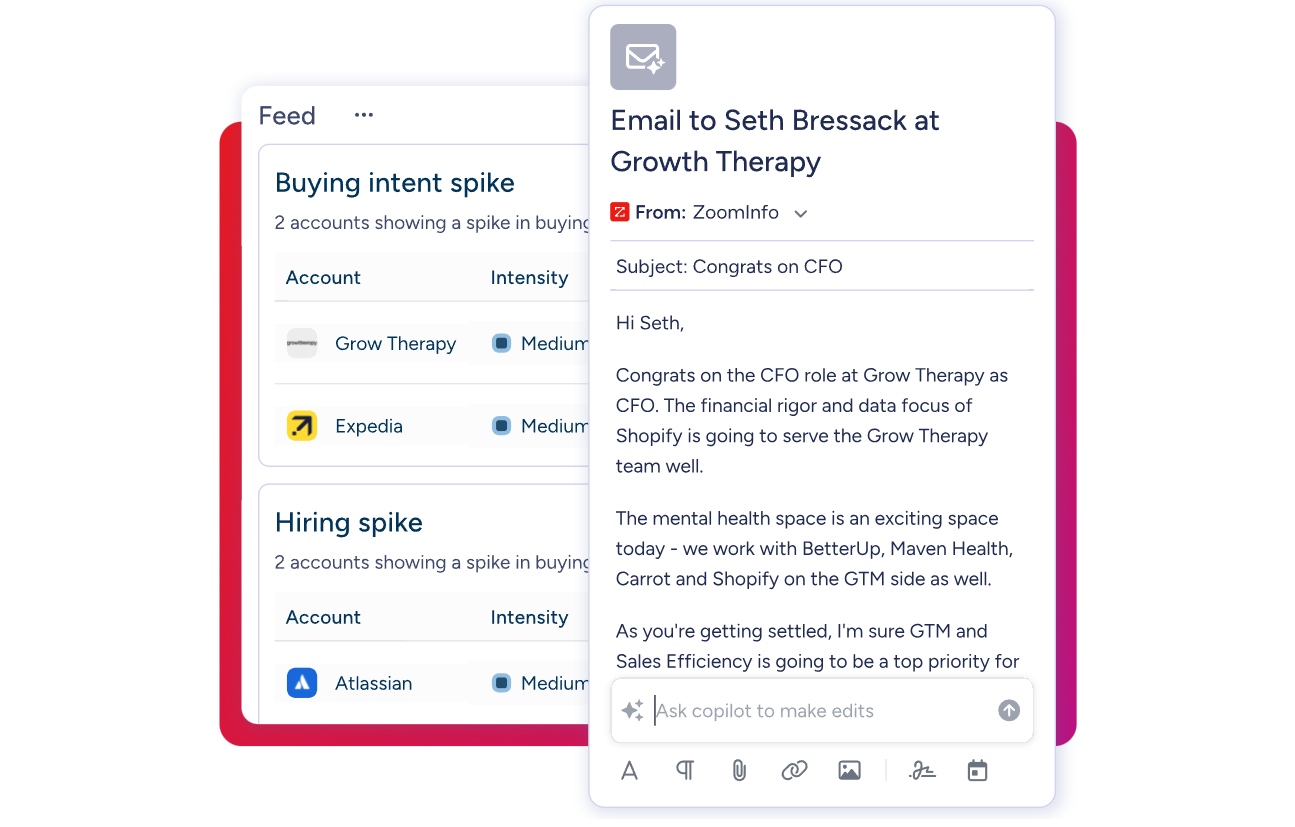
For deal teams, this combination works. Use Capital IQ Pro or PitchBook to identify the right companies. Use ZoomInfo to find and reach the right people at those companies, at the right time.
Seismic's sales team attributed 39% of active pipeline to opportunities identified or influenced by ZoomInfo signals, boosted productivity by 54%, and saved 11.5 hours per week per seller. (Seismic Case Study)
Integration and API access
All three platforms offer programmatic data access, but the implementations reflect their different users.
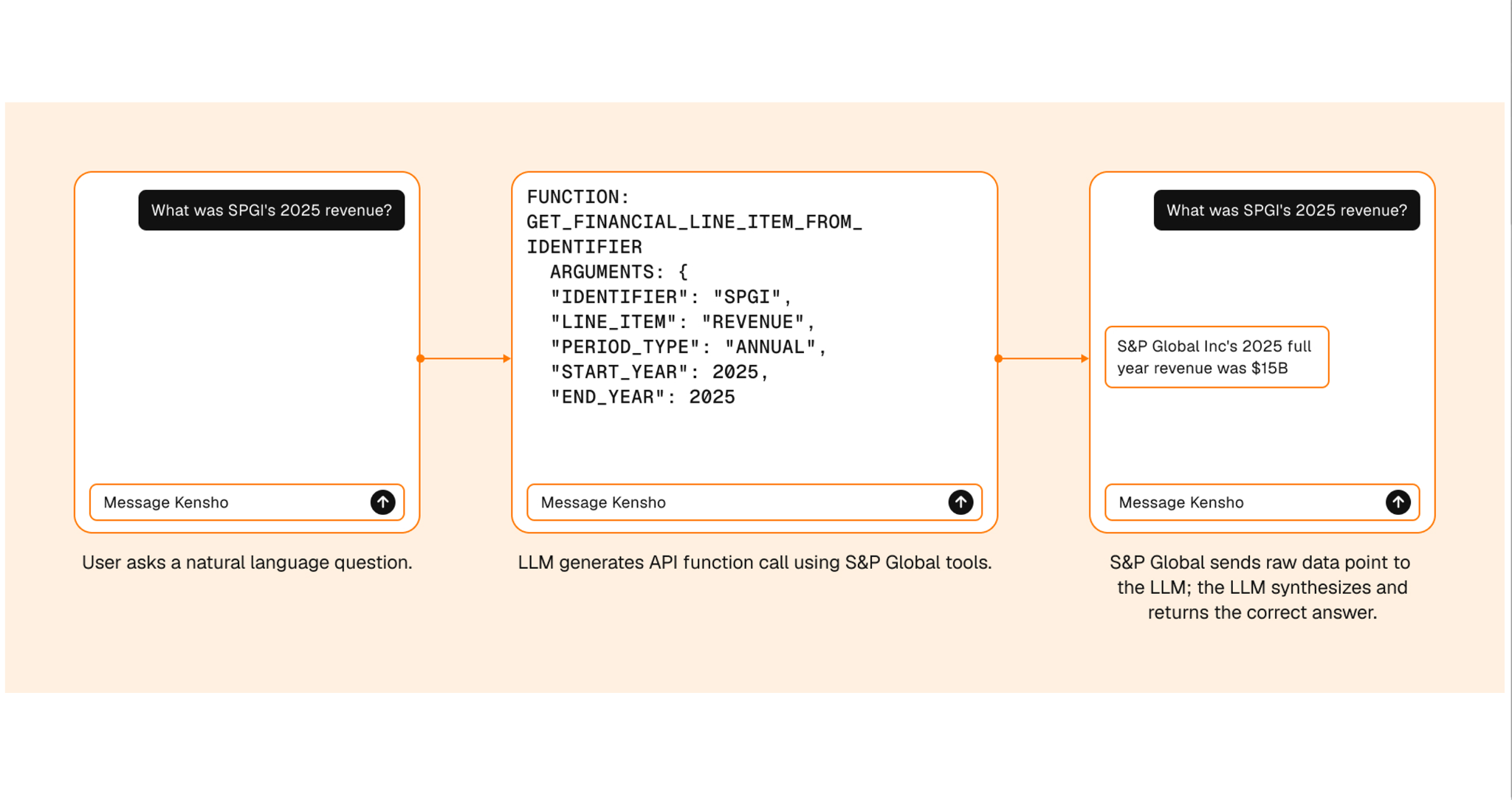
Capital IQ Pro's primary integration is its Excel Plug-In, still the most widely used way for financial analysts to pull data into models. The GDS REST API provides programmatic access to Capital IQ datasets, but S&P sells it separately from the web platform and requires enterprise data agreements. The Kensho LLM-ready API is a separate premium add-on for teams building AI workflows.
Source: Capital IQ Pro
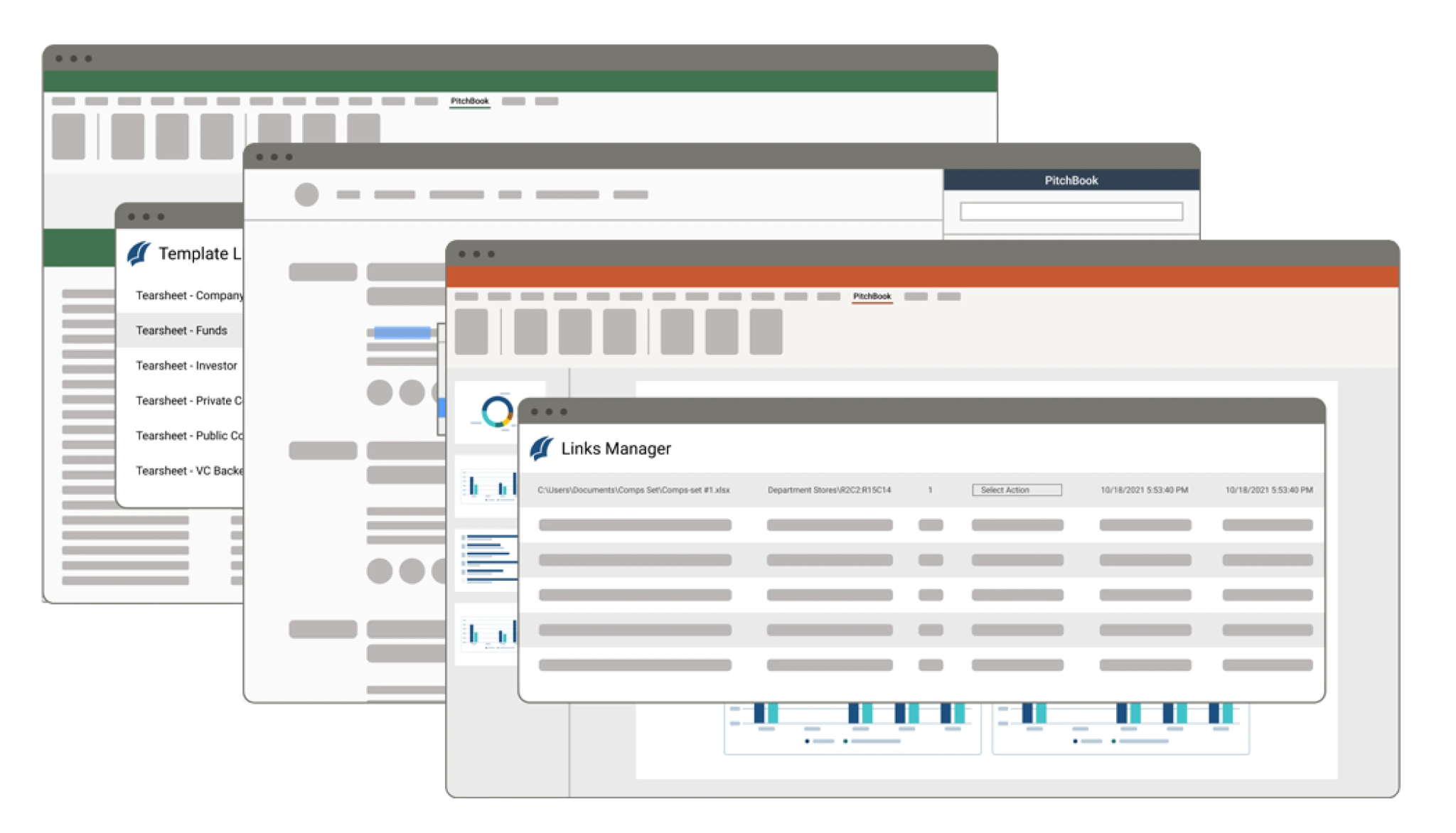
PitchBook's integration catalog is broader. The Excel plugin and Chrome extension come free with all subscriptions. CRM integrations for Salesforce, HubSpot, and Microsoft Dynamics are available as premium add-ons. The Direct Data API and Data Feed are enterprise products priced separately. PitchBook's Premium Connectors embed data into Microsoft Word, Excel, PowerPoint, and Teams, including Microsoft 365 Copilot workflows.
Source: PitchBook
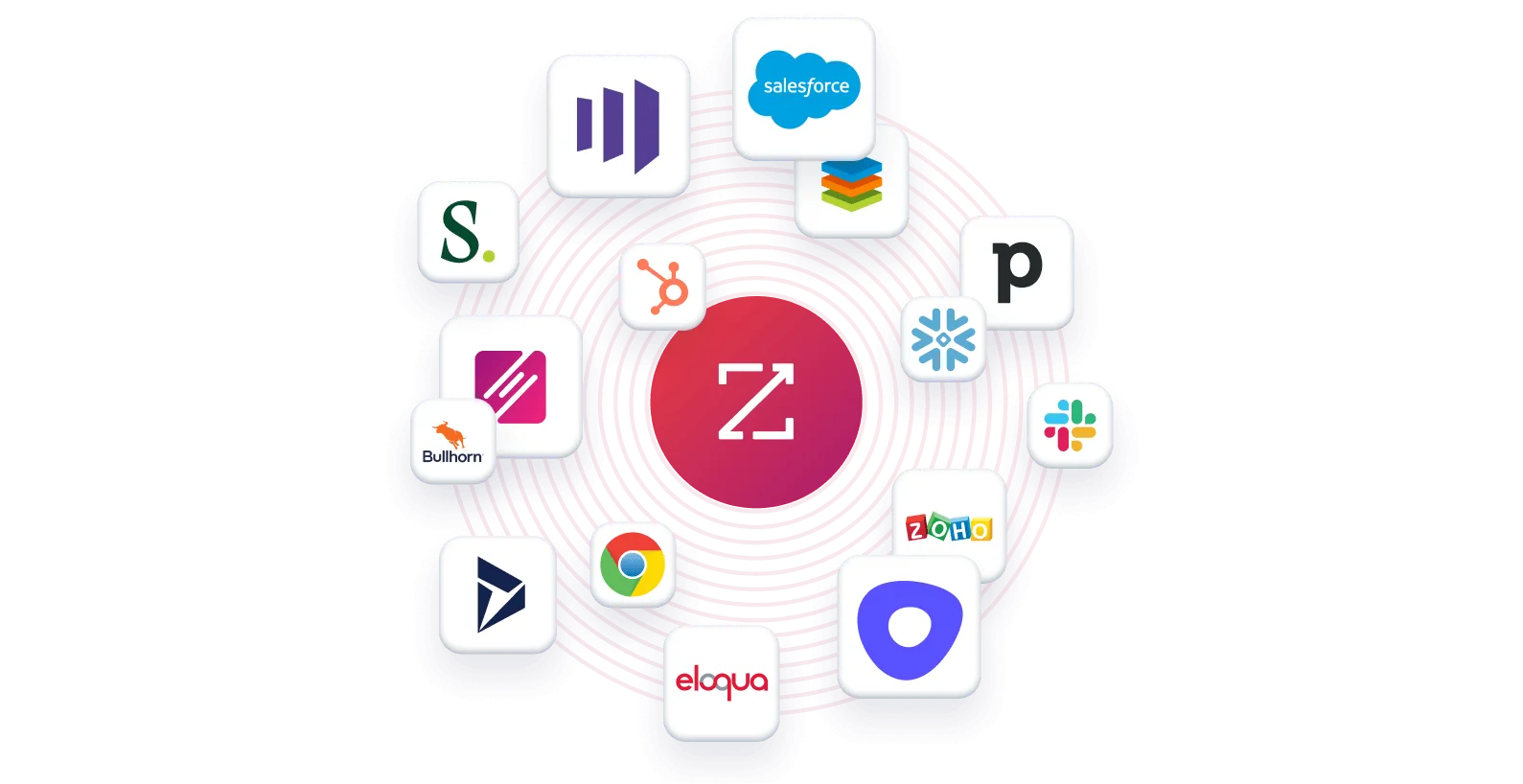
ZoomInfo takes a different approach. API access comes included in all relevant plans, not as a premium add-on. The ZoomInfo MCP server connects AI models to ZoomInfo's B2B data with no custom coding, currently supporting Claude and ChatGPT. The App Marketplace lists 172+ integration partners across CRM, marketing automation, sales engagement, and data warehouse categories. Cloud Partners delivers ZoomInfo data into AWS, Google Cloud, Snowflake, and Databricks. This breadth reflects ZoomInfo's role as operational infrastructure: data that flows into the tools teams already use, rather than requiring a context-switch to a dedicated terminal.
BDO Canada cut time spent updating internal data dashboards by 87% by integrating ZoomInfo's API into their internal systems. (BDO Canada Case Study)
Pricing: all three require enterprise conversations
None of these platforms publish transparent pricing. All three require a sales conversation for quotes, reflecting their enterprise positioning.
Capital IQ Pro contracts reportedly range from roughly $14,800 to $215,000 per year based on third-party procurement data, depending on firm type, number of users, geographic region, and included modules. Visible Alpha, SNL sector datasets, and API access may be priced separately from the core platform. No free trial or free plan is publicly documented.
PitchBook does not disclose pricing but generates license-based revenue through subscriptions sold on either a per-user or enterprise basis. License agreements typically run one to three years. PitchBook offers a free trial of the Desktop platform (with restricted data) and a separate free trial for LCD/Credit. The all-inclusive data model means no surprise add-ons for accessing different datasets within the platform, though Credit, CRM integrations, and Direct Data are priced separately.
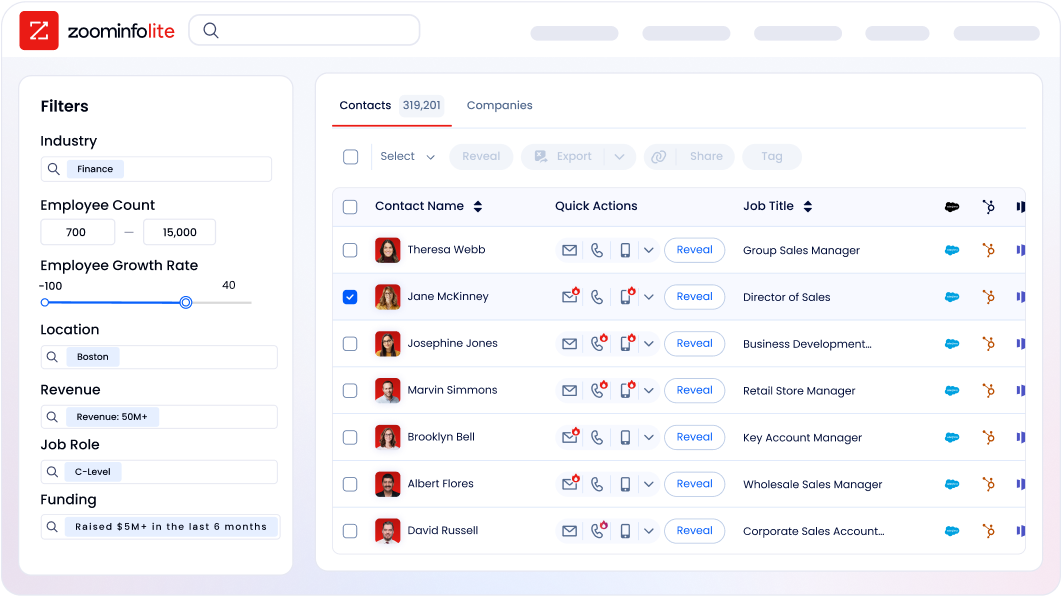
ZoomInfo uses consumption-based pricing with seat-and-credit mechanics. Paid plans are custom-quoted, but ZoomInfo offers something neither financial data platform does: ZoomInfo Lite, a permanent free tier with access to the B2B database, 10 monthly export credits, contact searches, the Chrome extension, and WebSights Lite. A 7-day free trial of the full platform is also available. For deal teams weighing whether contact intelligence is worth adding, these entry points eliminate the commitment the financial data platforms require.
Capital IQ vs. PitchBook vs. ZoomInfo: Which should you choose?
The best choice depends on what stage of the deal workflow you're optimizing for.
Choose Capital IQ Pro if:
You build financial models in Excel and need a direct data pipeline into spreadsheets
Public company fundamentals, standardized comps, and consensus estimates are central to your work
You run precedent transaction analysis on M&A deals, particularly with private targets
Your firm needs sector-specific regulatory data for banking, energy, insurance, or real estate (SNL datasets)
You want a single platform covering both public and private company fundamentals
Choose PitchBook if:
Your work centers on PE, VC, or private credit deal sourcing and fund analysis
LP evaluation, fund benchmarking, and allocation tracking are part of your workflow
You need leveraged loan data (LCD) integrated with private company and sponsor profiles
All-inclusive data access matters more than modular pricing flexibility
You want embedded AI for private company valuation and exit prediction
Add ZoomInfo if:
You've identified target companies but need verified contact data to reach decision-makers
Deal sourcing, business development, or investor outreach requires direct phone numbers and emails
You want intent signals showing which companies are actively evaluating solutions
Your team uses CRM or sales engagement tools and needs data that flows into those workflows
You need a go-to-market layer that turns financial research into conversations
Try ZoomInfo on a free trial here.
Capital IQ Pro and PitchBook both excel at their core job: making financial data accessible, analyzable, and actionable for investment decisions. The choice between them depends on whether your work skews toward public company analysis and M&A comps (Capital IQ Pro) or private capital markets and fund intelligence (PitchBook).
But whichever you choose, the moment your workflow shifts from "understand the company" to "reach the people," you'll feel the gap that financial data platforms weren't built to fill. ZoomInfo closes that gap with verified contact data, buyer intent signals, and outreach tools that turn the intelligence you gather in your financial platform into conversations that move deals forward.
Capital IQ vs. PitchBook vs. ZoomInfo FAQ
What is the fundamental difference between Capital IQ and PitchBook?
S&P Capital IQ Pro serves analysts who need standardized public and private company fundamentals, precedent transaction comps, and consensus estimates from sell-side analysts. PitchBook serves PE/VC professionals, LPs, and credit investors who need private capital markets intelligence, fund performance data, deal sourcing tools, and leveraged loan data via LCD. Capital IQ Pro covers 60M+ private and 109K+ public companies with detailed financial data; PitchBook covers nearly 6 million companies with deeper context on VC/PE deal terms, valuations, and fund performance across 147,000+ funds.
Which platform is better for M&A precedent transaction analysis?
Capital IQ Pro is the standard for precedent transaction comps, particularly for deals involving private targets. It covers 1.2M+ M&A transactions with filter depth that Wall Street Prep describes as exceeding competitors on private-target deal history. PitchBook covers more total investments (2.7 million) but its strength lies in VC and PE deal context (pre- and post-money valuations, cap tables, sponsor histories) rather than the standardized transaction multiples investment bankers use in pitch books.
Which platform has better Excel integration?
Capital IQ Pro's Excel Plug-In is the deeper integration. Its GDSP and GDSHE functions operate as native Excel formulas, pulling any financial data point or historical range directly into spreadsheet cells. Analysts can initiate company screens inside Excel and populate results into models in a single step. PitchBook's Excel plugin is solid for its purpose (30+ pre-built templates for tearsheets, comps, and valuations with one-click refresh) but is more template-driven than Capital IQ Pro's formula-level integration.
Does either platform provide verified contact data for outreach?
Both platforms include people data, but neither serves outbound outreach. Capital IQ Pro provides executive profiles, board member data, and compensation information for research purposes. PitchBook tracks 4.4 million people with roles, fund affiliations, and deal histories. Neither platform provides verified direct-dial phone numbers or business email addresses at the scale or accuracy needed for BD outreach. ZoomInfo fills this gap with 500M contacts, 135M+ verified phone numbers, and 200M+ verified business email addresses, verified through a multi-source pipeline with up to 95% accuracy on first-party data.
How do the pricing models compare?
All three platforms use quote-based enterprise pricing. Capital IQ Pro contracts reportedly range from roughly $14,800 to $215,000 per year based on third-party procurement data, with modules like Visible Alpha and API access potentially priced separately. PitchBook uses per-user or enterprise pricing with all platform data included at no additional cost, though Credit (LCD), CRM integrations, and Direct Data products are separate. ZoomInfo uses consumption-based pricing and is the only platform offering a permanent free tier (ZoomInfo Lite) and a 7-day free trial.
Which platform is better for a PE firm doing deal sourcing?
PitchBook is the stronger choice for PE deal sourcing, with deeper private capital markets coverage across VC, PE, M&A, credit, and real assets, plus fund benchmarking, LP tracking, and predictive tools like the VC Exit Predictor. Capital IQ Pro's private company coverage is broader by count (60M+ vs. 6M companies), but PitchBook provides more context around each deal (cap tables, sponsor histories, valuation estimates). For PE firms that also need to reach target company executives directly, adding ZoomInfo's contact data and intent signals to either platform creates a more complete deal origination workflow.
Do these platforms have AI capabilities?
Both financial data platforms have invested in AI. Capital IQ Pro offers ChatIQ (conversational AI for company research), Document Intelligence 2.0 (multi-document analysis with citation traceability), and Natural Language Screening. PitchBook offers Navigator (natural-language platform queries), AI-generated profile summaries, daily Valuation Estimates for 15,000+ VC-backed companies, and the VC Exit Predictor. ZoomInfo's GTM Context Graph takes a different approach, combining B2B data with CRM records, conversation intelligence, and behavioral signals to show why deals move or stall, and powering AI agents in the GTM Workspace that automate account research, outreach, and CRM updates.
Can I use more than one of these platforms together?
Many financial professionals do. Capital IQ Pro and PitchBook serve overlapping but distinct use cases, and firms with both investment banking and PE practices often subscribe to both. ZoomInfo works as a complementary layer: its APIs and MCP server integrate with CRM, sales engagement, and cloud data platforms, and it adds contact intelligence and outreach execution that neither financial data platform provides. A financial data platform (for company research and deal analysis) plus ZoomInfo (for reaching decision-makers and tracking buying signals) covers the full workflow from research through execution.
