
Chili Piper occupies a specific niche in B2B sales technology: turning inbound interest into booked meetings as fast as possible. The platform combines form routing, lead distribution, AI chat, and scheduling into one system built to close the gap between a prospect raising their hand and talking to a rep. For teams stuck in manual lead routing and losing deals to slow follow-up, it solves a real problem.
To write this Chili Piper review, we analyzed the platform extensively. We believe it's the right choice if:
You have high-volume inbound lead flow that needs instant routing and qualification
Your biggest conversion problem is the gap between form submission and booked meeting
You use Salesforce as your primary CRM and need detailed routing logic
You have dedicated RevOps resources to configure and maintain the platform
You need to coordinate handoffs across SDR, AE, and CS teams
However, Chili Piper might not be the best choice if:
You need prospecting data, intent signals, or account intelligence alongside routing
Your GTM motion depends on outbound as much as inbound
You want a single platform covering data, engagement, and conversion
You lack technical RevOps staff to manage ongoing configuration
You need transparent, predictable pricing without mandatory platform fees
In this case, consider ZoomInfo: a GTM platform that covers the full go-to-market cycle, from identifying buyers and recognizing when they're in-market, to enriching CRM data, routing leads, optimizing web forms, and running AI-driven outreach. Where Chili Piper converts demand that already exists, ZoomInfo helps you find, create, and convert demand across the entire revenue cycle.
We've included a detailed look at ZoomInfo later in this review for teams that need more than conversion tooling. If you're ready to explore a broader GTM platform, you can start with ZoomInfo's free tier.
What is Chili Piper?
Chili Piper is a Demand Conversion Platform founded in 2016 by Alina and Nicolas Vandenberghe. The company grew from frustration with outdated enterprise software. Nicolas was running sales for a telecom startup while Alina was building consumer apps at a Fortune 500 company, and both saw how "the Digitalization of Sales" was driving demand for faster, more automated buyer-seller connections.
The company's first customer, Stephanie Ouadah at Fivestars, asked for help with round robin distribution of meetings. That early request showed how critical the scheduling handoff is to pipeline velocity and shaped Chili Piper's trajectory.
Today, Chili Piper serves 2,000 customers including Gong, monday.com, Toast, and PandaDoc, generating $43M in annual revenue with 164 employees across 36 countries. The company has raised $55.5M in total funding, with its Series B led by Tiger Global.
The product suite includes five tools: Form Concierge for qualifying and booking meetings from web forms, Distro for automated lead routing in Salesforce, Chat AI for 24/7 website engagement, Handoff for SDR-to-AE scheduling, and ChiliCal for one-click meeting booking. The platform fits B2B revenue teams with complex routing needs and high-volume inbound, particularly those on Salesforce or HubSpot.
Chili Piper Pros & Cons
Pros | Cons |
|---|---|
Instant booking from web forms with 8-second lead response time | Per-user fees plus mandatory platform fees create pricing complexity |
Routing rules based on any CRM field | Admin dependency for configuration changes |
92% average meeting show rate | Salesforce integration is deeper than HubSpot |
Strong customer support with transparent metrics | No outbound prospecting or contact data capabilities |
Visual router builder with preview mode | Learning curve for new users navigating multiple products |
Round-robin fairness across all channels | Chat AI priced separately at $20,000/year |
SOC 2 Type 2 and ISO 27001 certified | Email reminder design and customization options are limited |
Chili Piper Review: How it Works & Key Features
Form Concierge: Instant meeting booking from web forms that eliminates the gap between submission and conversation.
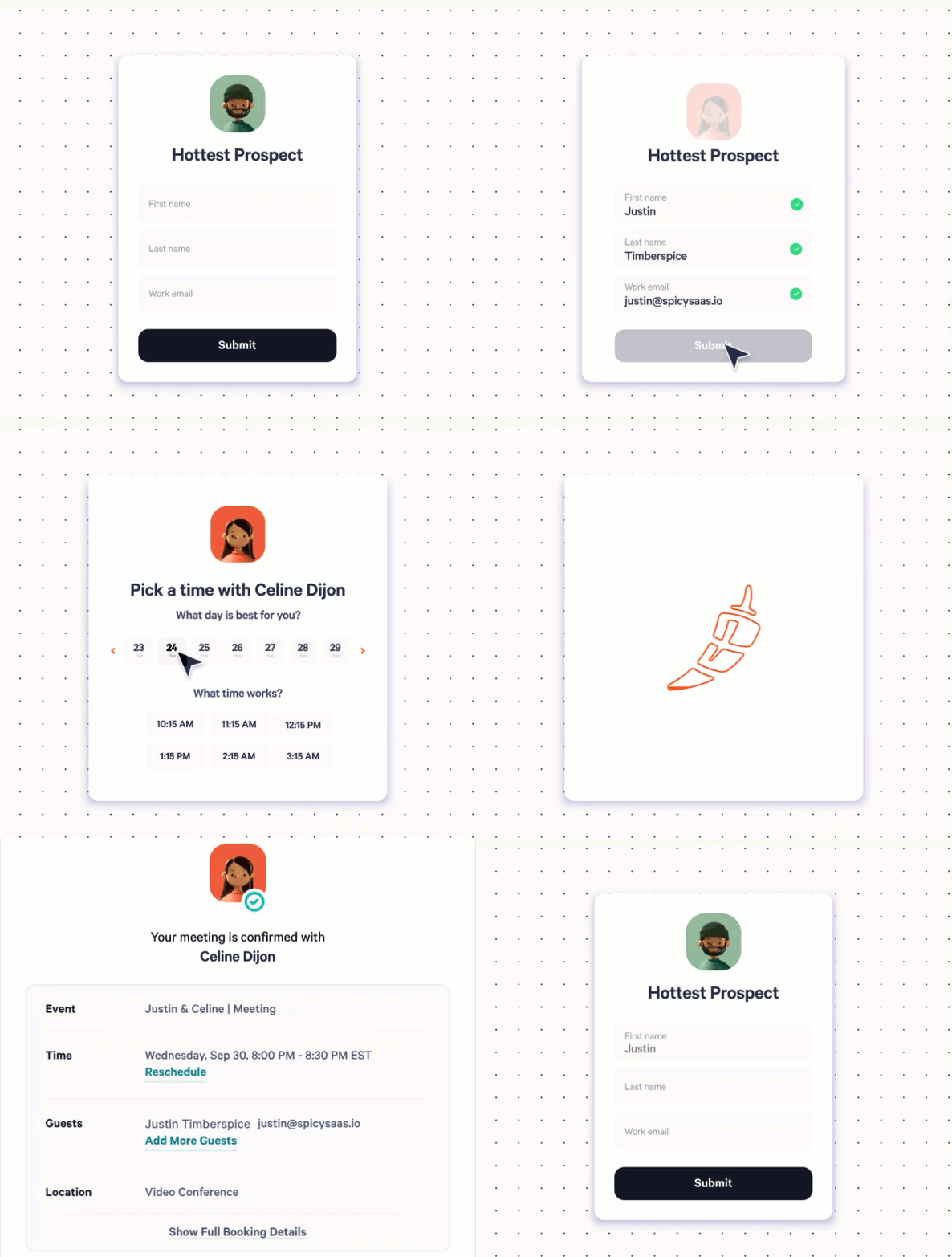
Form Concierge is Chili Piper's flagship product. When a prospect submits a web form, the system qualifies, routes, and books a meeting with the right rep, all without the prospect leaving the page. The process takes seconds rather than the hours or days a traditional follow-up requires.
Source: Chili Piper
The routing engine builds rules from any standard or custom CRM field: territory, company size, industry, or account ownership. It integrates with marketing automation platforms like HubSpot, Marketo, and Pardot, pulling availability from GSuite and Outlook365.
Form Concierge includes enrichment from data providers like ZoomInfo, Clay, Lusha, LeadIQ, and Apollo, letting teams use shorter forms that still produce complete records.
The Spam Checker uses AI to filter fake submissions and competitor domains before they reach sales calendars. Multi Round-Robin scheduling pulls in the right people for each deal, handling AE-plus-SE demos, renewal handoffs, and enterprise kickoffs automatically.
Distro: Automated Salesforce lead routing that replaces manual assignment with rules-based distribution.
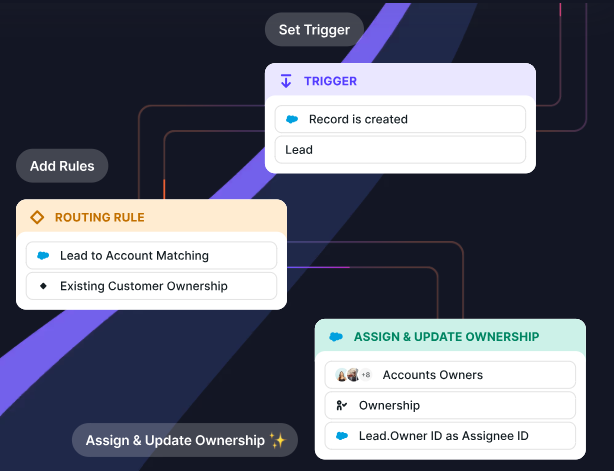
Distro takes over when leads enter Salesforce from webinars, events, content downloads, or other sources that don't trigger Form Concierge. It distributes Salesforce records to the right reps based on triggers and rules, eliminating manual assignment.
Source: Chili Piper
The visual router builder uses a step-by-step workflow instead of the tangled logic found in competing tools. Admins select a Salesforce object, define triggers (record creation, field updates, or both), set routing rules, and configure assignment actions. Triggers support AND/OR operators for precise conditions, and admins can add delays so enrichment tools populate fields before routing fires.
Distro handles any standard or custom Salesforce object beyond leads: contacts, accounts, opportunities, cases, and custom objects. The distribution algorithm supports round-robin with customizable weighting, ownership-based routing, and catch-all fallbacks.
Capping features limit how many records reps receive per day, week, or month, and the system syncs with calendars to detect out-of-office periods without manual input.
One practical advantage: admins can test routers in preview mode using actual Salesforce record IDs before going live, seeing exactly how routing will execute without touching CRM data. Version history with rollback lets admins restore previous configurations if changes break something.
Setup is fast. Distro takes about one hour to configure, compared to weeks or months for alternatives. L.L. Bean reported that updates taking weeks with their old system now take about two minutes in Distro.
Chat AI: An AI-powered website assistant that qualifies visitors and books meetings around the clock.
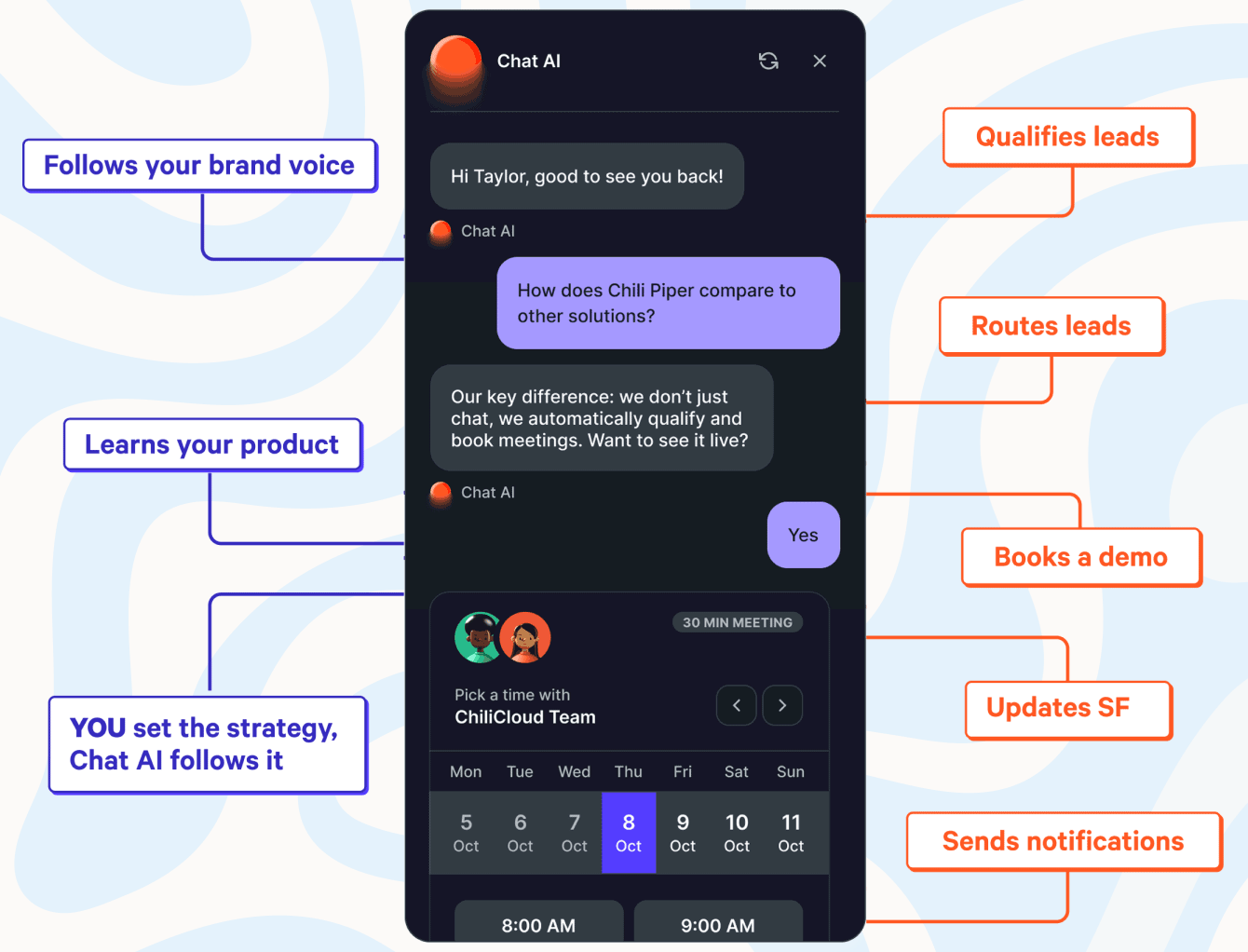
Chat AI engages website visitors, answers questions using company-approved content, and books qualified meetings automatically. Unlike traditional chatbots that require manual flow building, Chat AI learns from website content and documentation through a configurable Knowledge Base that ingests pages, help articles, and product docs.
Source: Chili Piper
The system runs on four components. The Knowledge Base stores what Chat AI knows. Personality settings define tone and identity. Strategies define intents to detect (meeting requests, pricing questions) and trigger specific actions. Guidances act as playbooks for sensitive topics like competitor mentions or pricing discussions.
Chat AI runs on GPT-5.2 Turbo with Chili Piper-specific routing logic and guardrails. It tracks visitor behavior, such as repeated pricing page visits, to gauge when someone is ready to talk versus just browsing. Qualified visitors book meetings through Chili Piper's routing and round-robin logic.
Every conversation is logged and synced to Salesforce and marketing automation platforms, giving sales teams full context on what prospects asked and cared about. The system also supports live chat escalation for complex or high-value conversations.
Chat AI costs $20,000 per year plus platform fees, separate from Chili Piper's per-user products.
Handoff: Automated SDR-to-AE scheduling that removes routing friction in the handoff process.
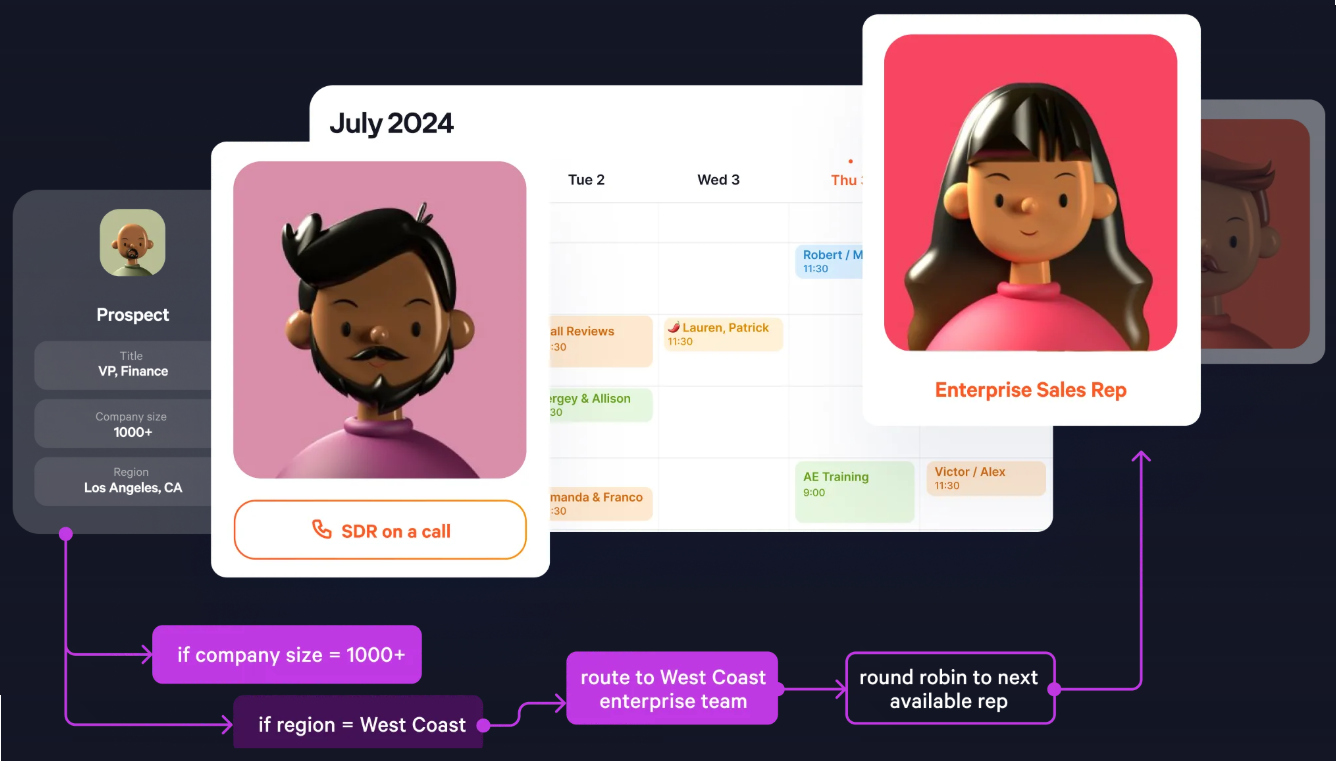
Handoff lets SDRs and BDRs book meetings on behalf of AEs and other team members in under 30 seconds. When an SDR qualifies a prospect, they trigger the Handoff Scheduler from their CRM or sales engagement platform, Chrome extension, or keyboard command. The system checks the prospect's information against routing rules, shows combined calendar availability, and books the meeting.
Source: Chili Piper
Handoff Live adds real-time transfers for live calls, checking who is available, in the right territory, and next in the queue. This matters when SDRs qualify prospects on the phone and want to transfer them to an AE immediately rather than scheduling days later.
The platform includes a "Prevent Cherry Picking" setting that hides the assigned rep's name, keeping SDRs honest about following the distribution algorithm. The system maintains fair distribution across all channels (Handoff, Concierge, Chat, and email campaigns) so reps get equal opportunities regardless of source.
ChiliCal: One-click scheduling for revenue teams that reduces booking friction.
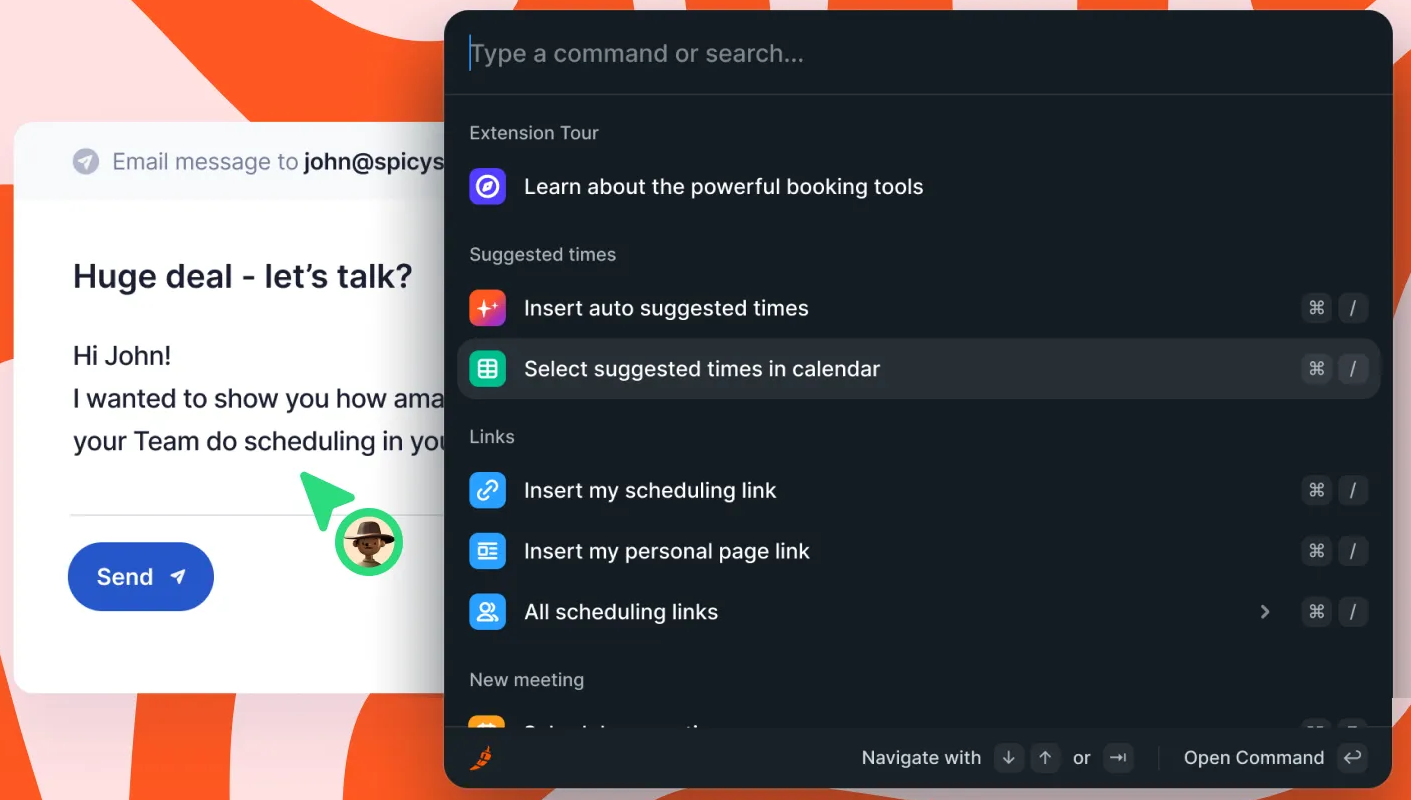
ChiliCal is Chili Piper's scheduling tool, designed to replace Calendly and similar products for sales teams. Its Priority Scheduling feature automatically reschedules lower-priority calendar blocks (lunch, prospecting time, internal meetings) when higher-priority customer meetings are booked.
Source: Chili Piper
The Co-Pilot browser extension works inside Gmail, Outlook, Salesforce, HubSpot, Outreach, and SalesLoft. Users trigger it with a keyboard shortcut to access scheduling without leaving their current workflow. ChiliCal generates personal links, single-use links, round-robin team links, and ownership-based links.
ChiliCal comes free with any other Chili Piper product purchase, bundled rather than billed separately.
Where Chili Piper Falls Short
Chili Piper does its core job well, but several limitations show a platform built for one stage of the revenue process, not the full go-to-market cycle.
No Prospecting or Contact Data: Chili Piper doesn't cover top-of-funnel prospecting. It converts demand but doesn't help you find or create it. Teams using Chili Piper for inbound still need separate tools to build prospect lists, access verified contact data, monitor buyer intent signals, or identify in-market accounts. That means paying for additional platforms to cover the earlier stages of the revenue cycle.
Pricing Complexity: Chili Piper's model charges per-user license fees ($15-$45/user/month) plus mandatory platform fees ($150-$1,500/month) per product. A team of 10 reps using Form Concierge on monthly billing would pay $300 in user fees plus $150-$1,000 in platform fees (depending on lead volume) for just one product. Chat AI adds $20,000/year on top.
Multi-product bundles lower per-user costs, but the platform fee structure and no-discount policy mean costs add up. Some users report surprise fees and frustration with pricing transparency.
Admin Dependency: Small changes (territory tweaks, new queues, edge-case routing) often require a knowledgeable admin, making the platform less self-serve for non-technical ops or marketing users. Without dedicated RevOps resources, day-to-day management becomes a bottleneck.
HubSpot Integration Gap: The Salesforce integration is deeper and more mature than HubSpot, so HubSpot teams may find feature gaps. Since Chili Piper's routing logic depends on CRM data, a weaker integration limits what the platform can do.
Limited Customization in Communications: Email design for meeting confirmations and reminders could be improved, and users want the ability to hyperlink text in emails. No-show logging is manual, which hurts reporting accuracy and downstream nurture campaigns.
Point Solution by Design: Chili Piper converts well but creates tool sprawl by necessity. Teams still need separate solutions for contact data, intent signals, conversation intelligence, ABM campaigns, and CRM enrichment. Each added tool brings cost, integration maintenance, and context-switching for reps piecing together information from multiple systems.
These are the natural consequences of a platform focused on one thing (demand conversion) and doing it well. But for teams looking to consolidate their GTM stack or move beyond inbound, the gaps become real constraints.
The Broader Alternative: ZoomInfo
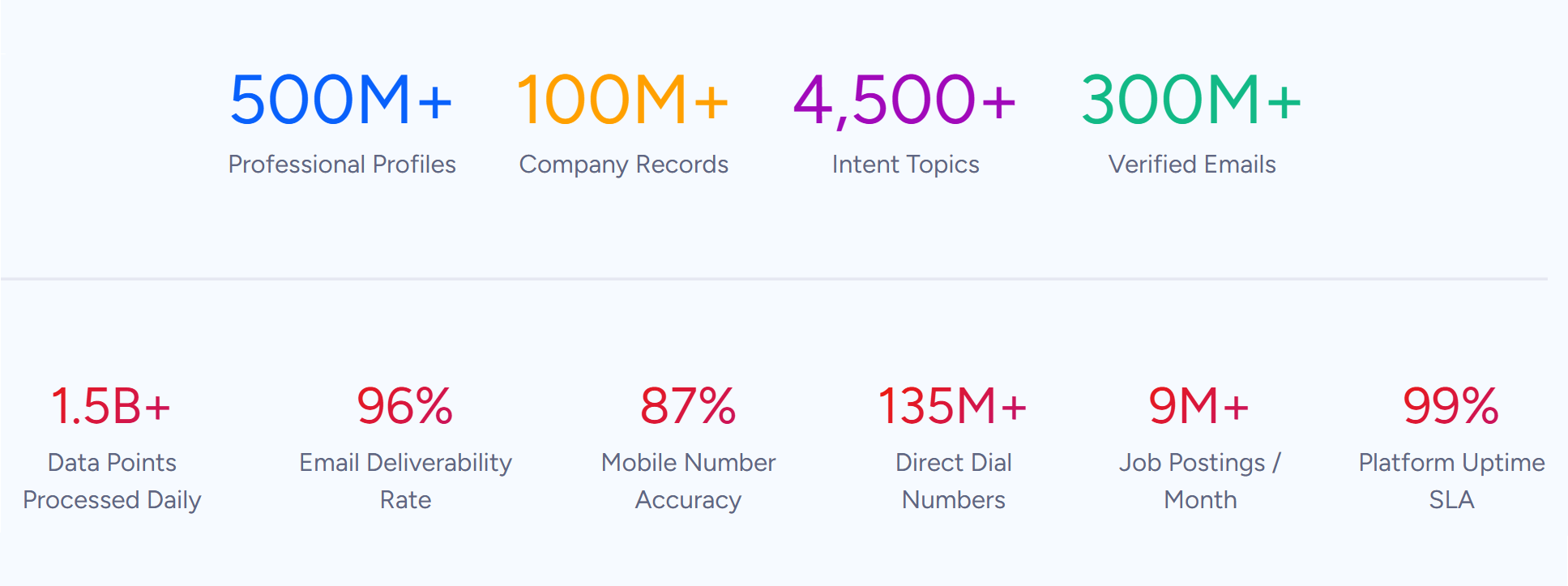
ZoomInfo is a GTM platform built on a large data foundation: 500M contacts, 100M companies, 135M+ verified phone numbers, and 200M+ verified business emails. Its GTM Context Graph processes 1.5B + data points daily, combining this data with your CRM records, conversation transcripts, and behavioral signals to show the context of your accounts.
Source: ZoomInfo
That context tells AI not just what happened, but why, and what to do next. Your team can then act from the GTM Workspace (for sellers), GTM Studio (for marketers and RevOps), or their own tools through the API and MCP.
Where Chili Piper focuses on conversion, ZoomInfo provides the intelligence and tools that feed every stage of the revenue process.
B2B Data: The foundation that makes every downstream action more effective.
ZoomInfo operates the largest B2B data platform in the market: 500M contacts, 100M companies, 135M+ verified phone numbers, 120M direct-dial phone numbers, and 200M+ verified business emails. A multi-source verification pipeline backed by 300+ human researchers achieves up to 95% accuracy on first-party data.
For teams evaluating Chili Piper, data quality matters because Chili Piper's routing is only as good as the data entering the system. Chili Piper relies on third-party enrichment providers like ZoomInfo to fill in lead information during form submission. ZoomInfo provides that enrichment natively, along with prospecting, intent monitoring, and account intelligence that Chili Piper doesn't offer.
The data covers three areas: identity data (who buyers are and how to reach them), company context (100M companies with org charts and technographics), and signals that reveal when accounts are actively in-market. Buyer Intent tracks signals from 210 million IP-to-Organization pairings and 6 trillion+ keyword-to-device pairings monthly.

Source: ZoomInfo
WebSights identifies companies behind anonymous website traffic, including buying team members and direct contact info.

Source: ZoomInfo
External evaluations confirm this data quality. In a Fortune 500 competitive RFP analyzing 25 million contacts across vendors, the independent consultant concluded that "no other competitor came even close." ZoomInfo has been named a Leader in the Forrester Wave for Intent Data Providers B2B (Q1 2025) and a Leader in the Gartner Magic Quadrant for ABM Platforms for the second consecutive year.
"ZoomInfo gives us the information we need to execute. We don't have to spend our time digging. It's already there, so we can be three steps ahead." (Vensure)
GTM Context Graph: An intelligence layer that connects signals to outcomes across every deal.
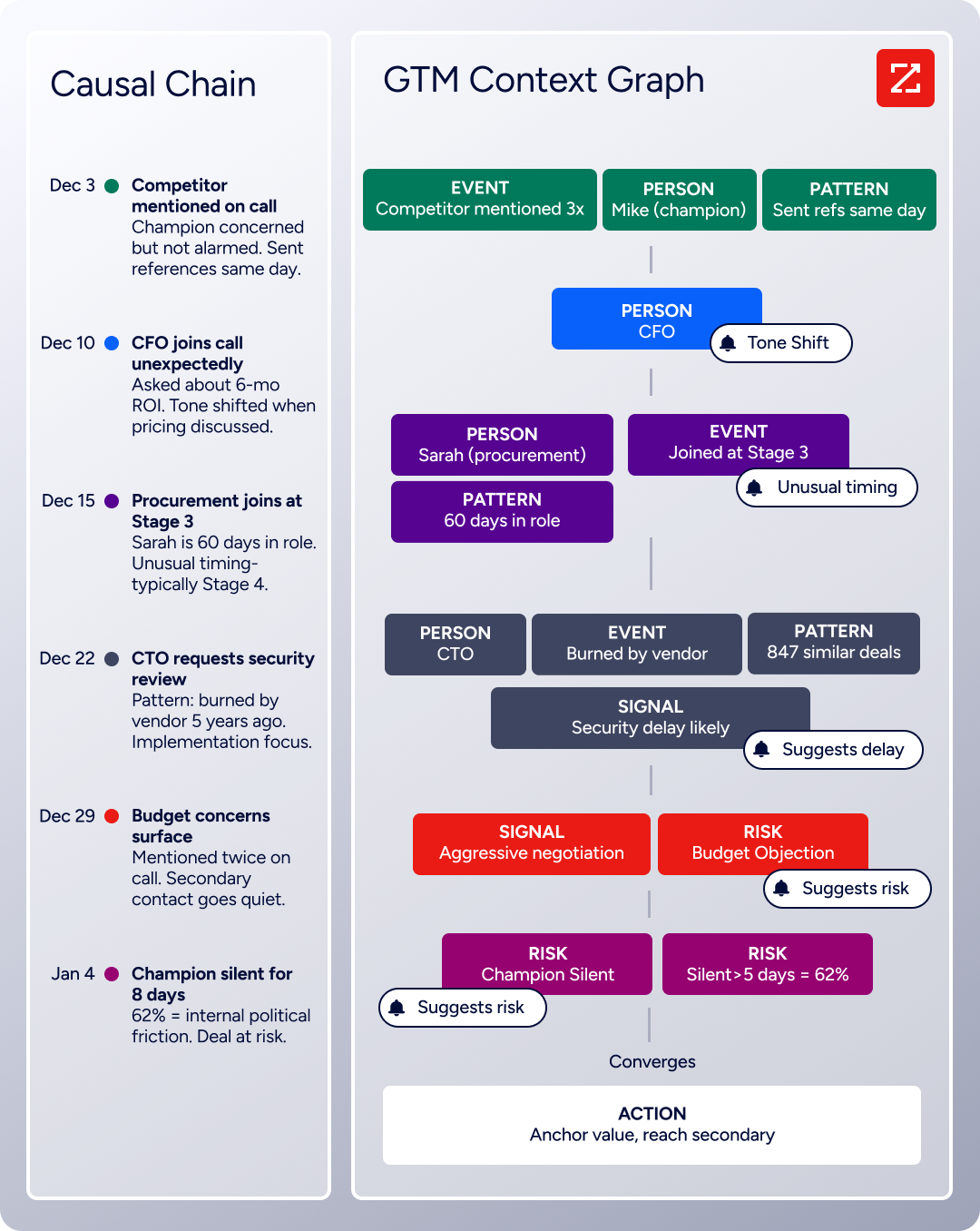
ZoomInfo's GTM Context Graph processes 1.5B + data points daily, combining ZoomInfo's third-party data with a customer's CRM records, conversation transcripts, email interactions, and behavioral signals into a single intelligence layer.
Source: ZoomInfo
The difference between data and intelligence matters. A CRM records that a deal moved from Stage 3 to Stage 4, but not why. As ZoomInfo's CPO Dominik Facher writes: "The CRM recorded the state change. It has no record of why it happened."
The GTM Context Graph captures that context: executive sponsorship entering at a specific stage, ROI-focused questions from the call, third-party signals showing the company is hiring new VPs and researching competitors.
This intelligence feeds every downstream action: outreach that addresses the specific concern a decision-maker raised, plays targeting accounts whose signal patterns match actual wins, and forecasts weighted by buying evidence rather than stage labels.
For teams using Chili Piper for conversion, the GTM Context Graph adds the understanding that answers not just "who should get this meeting" but "why this account is ready to buy and what the rep should say."
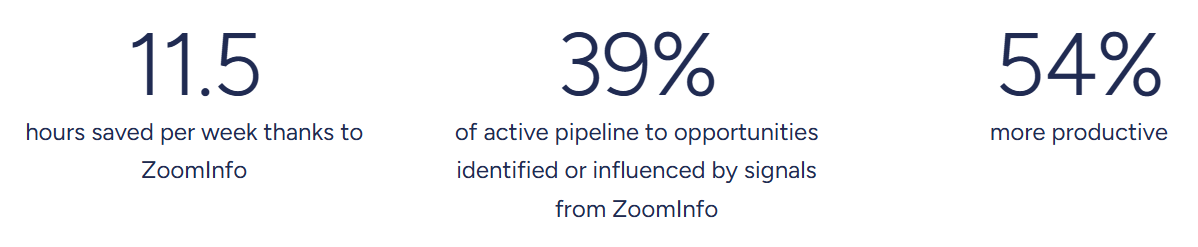
"That combination of our internal CRM data, external signals, and AI that's given all that context has helped us craft very specific account- and persona-based messages. And people have responded to them right away." (Seismic)
Source: ZoomInfo
GTM Workspace and GTM Studio: Interfaces designed for sellers, marketers, and RevOps.
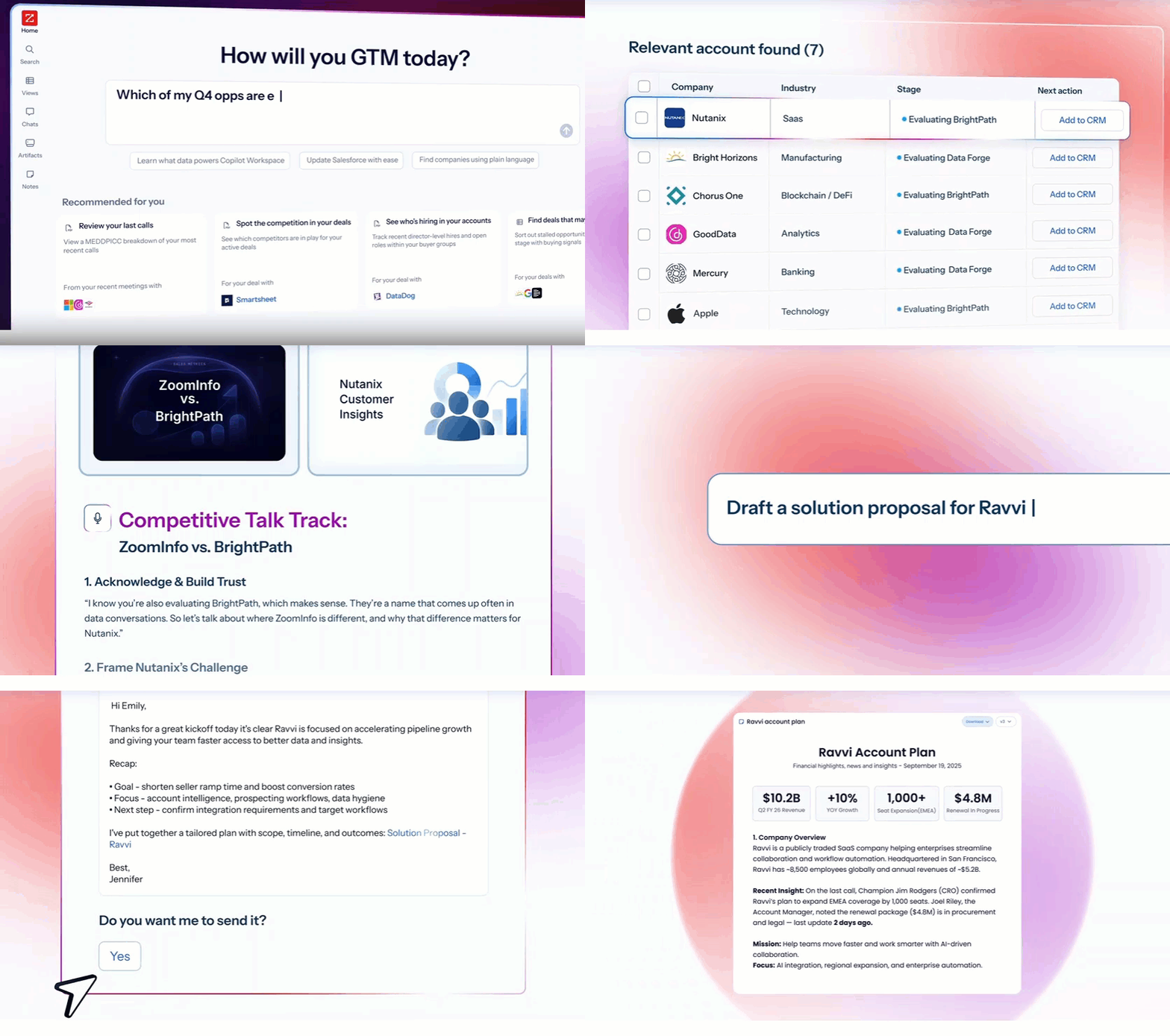
ZoomInfo delivers its intelligence through separate interfaces for different teams. GTM Workspace gives sellers a single view where prioritized accounts, AI-drafted outreach, and deal execution come together. AI agents research accounts, generate follow-ups, monitor signals, and update CRM, answering three questions for every rep: who to contact, when to engage, and what to say.
Source: ZoomInfo
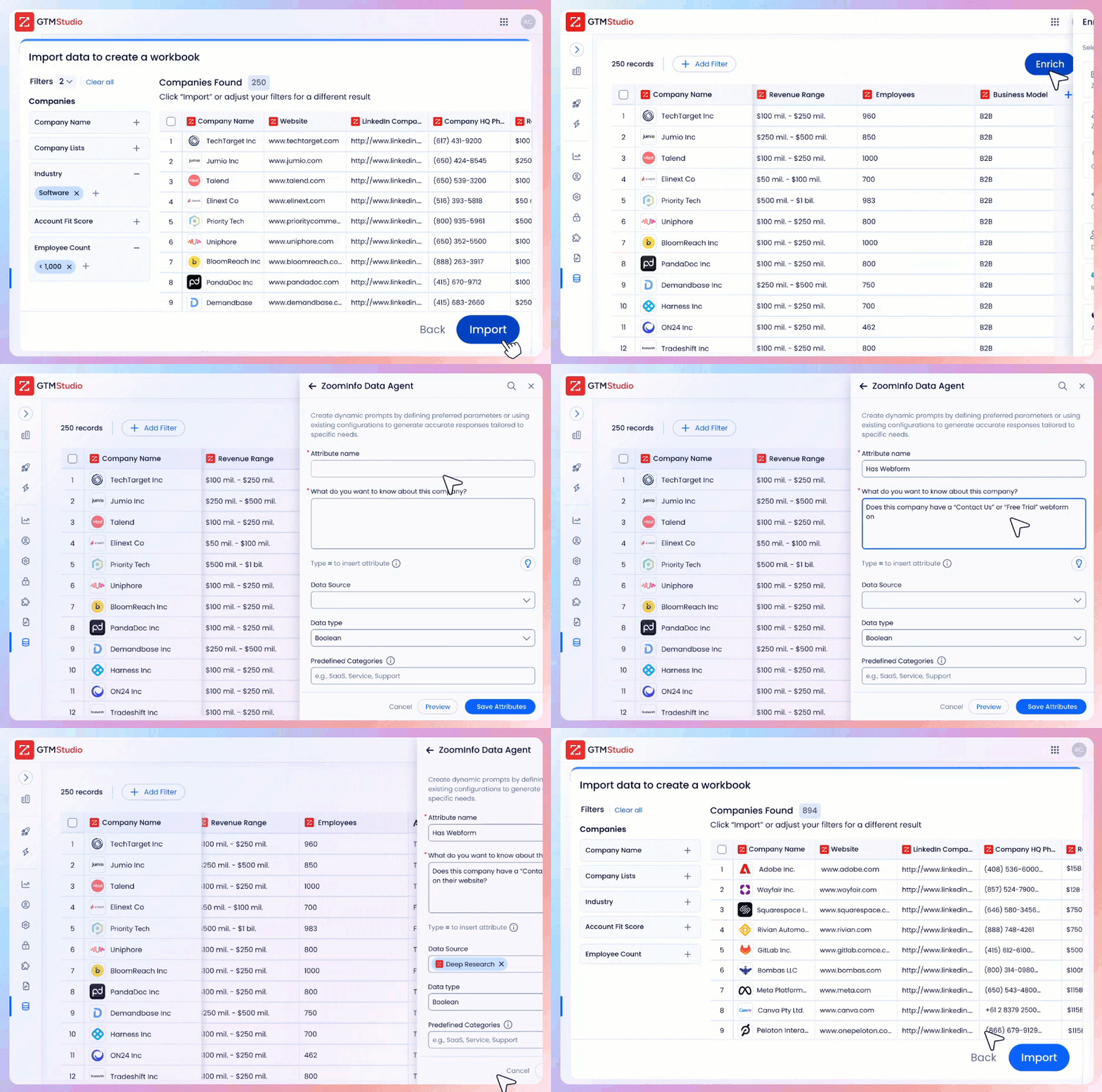
GTM Studio gives marketers, RevOps, and GTM engineers a builder for audience definition, campaign orchestration, and pipeline measurement. Teams describe audiences in natural language, launch multi-channel plays, and measure pipeline impact without engineering tickets. Expansion plays that used to take 3 weeks now launch in 30 minutes.
Source: ZoomInfo
For operations teams familiar with Chili Piper's routing, ZoomInfo's Operations product provides automated deduplication, multi-vendor enrichment from roughly 60 vendors, lead routing via round-robin and territory rules, and lead-to-account matching using company hierarchies.
Momentive cut speed-to-lead from 20 minutes to 60 seconds with it. ZoomInfo's Marketing product includes FormComplete, which reduces web forms to a single field while auto-appending the rest.
"ZoomInfo is our one source of truth for account data, and even more so for contact data. There's no other provider in the market that provides you with that level of detail." (Smartsheet)
Open Platform Access: APIs and MCP for teams that build beyond ZoomInfo's own products.
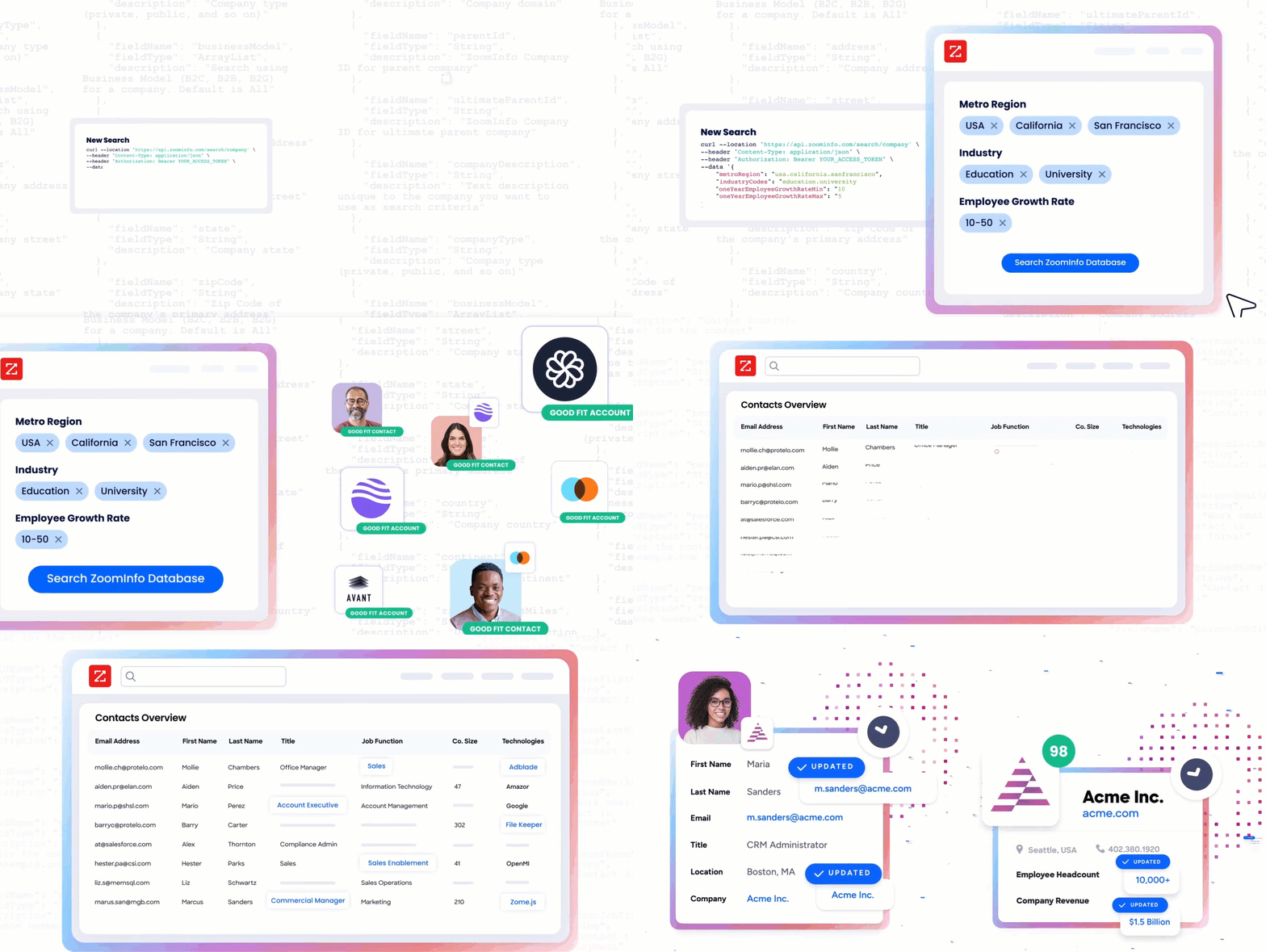
For teams working across multiple tools, ZoomInfo exposes the same intelligence through APIs and MCP (Model Context Protocol), making its data available inside any custom agent, internal tool, or partner platform. API access is included in all relevant plans, and MCP currently supports Claude and ChatGPT.
Source: ZoomInfo
This means teams aren't locked into one interface. The same data powering a seller's GTM Workspace view is available to a custom AI agent or a third-party application. BDO Canada's analyst noted: "The plug-and-play aspect of the API means I can integrate it very easily into any process and get information at a moment's notice," achieving an 87% reduction in time spent updating internal data dashboards.
Chili Piper or ZoomInfo: Comparison Summary
Aspect | Chili Piper | ZoomInfo |
|---|---|---|
Primary focus | Demand conversion (forms, routing, scheduling) | Full go-to-market (data, intelligence, execution) |
Contact and company data | Relies on third-party enrichment providers | 500M contacts, 100M companies, 135M+ verified phone numbers |
Buyer intent signals | Not available | 210M IP-to-Organization pairings, 6T+ keyword signals monthly |
Lead routing | CRM-based routing with visual builder | Round-robin, territory rules, lead-to-account matching, multi-vendor enrichment |
Web form optimization | Form Concierge with instant booking | FormComplete with single-field auto-enrichment |
Website chat | AI-powered Chat AI ($20,000/year) | Data-powered chat with visitor identification |
Conversation intelligence | Not available | Chorus with call recording, transcription, and AI analysis |
CRM integrations | Deep Salesforce, growing HubSpot | Salesforce, HubSpot, Microsoft Dynamics, 120+ marketplace integrations |
AI capabilities | Spam checking, meeting prep, chat | GTM Context Graph, AI-drafted outreach, account summaries, predictive scoring |
Scheduling | ChiliCal (free with other products) | Available through integrations |
Outbound prospecting | Not available | Prospecting with AI agents, workflows, and multi-channel sequencing |
ABM and advertising | Not available | Native DSP, cross-channel orchestration |
Free tier | Basic scheduling features, no CRM integration | ZoomInfo Lite (permanent, 10 monthly exports, B2B database access) |
Pricing model | Per-user + platform fee, custom quotes | Consumption-based pricing, custom quotes |
Security certifications | SOC 2 Type 2, ISO 27001 | SOC 2 Type 2, ISO 27001, ISO 27701, TRUSTe GDPR/CCPA |
Best for | High-volume inbound conversion with complex routing | Full GTM execution from prospecting through conversion |
Final Verdict
The choice between Chili Piper and ZoomInfo depends on the scope of the problem you're solving.
Choose Chili Piper if your main challenge is converting existing inbound demand into booked meetings faster. It fits when your prospect data and pipeline generation are already handled by other platforms, and you need to close the gap between form submission and sales conversation. The platform's routing logic, instant booking, and fair distribution algorithms are built for teams where speed-to-lead is the bottleneck.
If you have dedicated RevOps support and a mature inbound machine that just needs faster conversion, Chili Piper delivers measurable results.
Choose ZoomInfo if you need one platform covering the full go-to-market cycle: finding the right accounts, knowing when they're in-market, enriching your data, routing leads, and running outreach across channels. ZoomInfo fits when your team needs to combine prospecting, intent signals, conversation intelligence, and execution in one system rather than stitching together point solutions.
The GTM Context Graph, B2B data, and multiple access points (GTM Workspace for sellers, GTM Studio for marketers and RevOps, APIs and MCP for custom builds) give teams both the intelligence and the tools to act on it.
Get started with ZoomInfo here.
Chili Piper solves a specific, important problem at the conversion layer. ZoomInfo solves the broader challenge of knowing who to target, why they're ready, and how to reach them across the entire revenue cycle.
If your stack already covers data and prospecting and you just need the scheduling handoff, Chili Piper earns its place. If you want to consolidate your GTM tools and gain intelligence across every stage, ZoomInfo is built for that.
Chili Piper FAQ
What does Chili Piper cost?
Chili Piper charges per-user license fees ($15 to $45/user/month) plus mandatory platform fees ($150 to $1,500/month) depending on the product and usage tier. Multi-product bundles lower per-user costs (to $18/user/month for 4+ products on yearly billing), but the platform fee remains. Chat AI costs $20,000 per year separately. The company maintains a no-discount policy.
ZoomInfo uses consumption-based pricing and offers a permanent free tier (ZoomInfo Lite) for teams that want to evaluate the platform first.
Does Chili Piper offer a free plan?
Chili Piper offers a free version with basic scheduling: personal booking links, suggested times, and email and SMS reminders. The free version doesn't include CRM integrations or access to the full product suite (Form Concierge, Distro, Chat AI, Handoff). A 14-day free trial is available for paid products.
ZoomInfo Lite provides a permanent free tier with B2B database access, 10 monthly export credits, the Chrome extension, and HubSpot integration.
Does Chili Piper handle outbound prospecting?
No. Chili Piper handles inbound demand conversion and doesn't cover top-of-funnel prospecting. Teams using it for inbound still need separate tools to build prospect lists, find verified contact data, and monitor buyer intent. ZoomInfo covers the full cycle from prospecting (500M contacts, 120M direct-dial phone numbers) through intent monitoring, outreach automation, and account intelligence.
How does Chili Piper integrate with CRMs?
Chili Piper integrates natively with Salesforce and HubSpot, though the Salesforce integration is deeper and more mature. For Salesforce users, Distro can route any standard or custom object and execute multi-object ownership updates.
The HubSpot integration has been improving but may have feature gaps compared to Salesforce. Chili Piper also integrates with marketing automation platforms like Marketo, Pardot, and Eloqua, and sales tools like Outreach and SalesLoft.
Is Chili Piper difficult to set up?
Initial setup involves roughly three calls with a dedicated Implementation Specialist over about three weeks. Self-guided onboarding is also available. Users generally praise the admin UI and quick startup. However, ongoing configuration changes (territory adjustments, new routing rules, edge-case logic) often require a knowledgeable admin, which can bottleneck teams without dedicated RevOps resources.
What kind of customer support does Chili Piper provide?
Chili Piper publicly shares real-time support metrics on their website. Support is available through a Help Center, email, and a community forum. G2 reviewers consistently note strong support, effective onboarding, and helpful CSM availability. The company also maintains Chili Piper University for structured learning and a Feature Request portal.
Can Chili Piper reduce no-show rates?
Yes. Chili Piper reports a 92% average meeting show rate and claims to cut no-shows by 50%. The platform sends automated reminders before meetings via text or email, with customizable timing and frequency. However, logging no-shows is currently manual, which can affect reporting accuracy and downstream nurture workflows.
Does Chili Piper work with enrichment providers?
Yes. Form Concierge integrates with enrichment providers including ZoomInfo, Clay, Lusha, LeadIQ, and Apollo to fill lead information automatically during form submission. This lets teams use shorter forms while still collecting complete records.
The enrichment data feeds into Chili Piper's routing rules, so qualification and rep assignment can use enriched fields like company size, industry, or revenue rather than just what the prospect typed.
