

Clari has built its reputation on a specific promise: turning revenue forecasting from guesswork into science. After its December 2025 merger with Salesloft, the platform positions itself as the industry's first Predictive Revenue System, combining deal inspection, conversation intelligence, sales engagement, and AI-powered forecasting in one platform. For enterprise sales organizations managing pipelines across multiple teams, it's a serious contender.
To write this Clari review, we analyzed the platform in detail. We believe it's a good choice if:
You run a large sales organization with multi-quarter forecasting needs
You want to replace spreadsheet-based forecasting with AI-driven predictions
You need visibility into deal health, pipeline changes, and revenue risk across teams
You have dedicated RevOps resources to manage setup and adoption
Your primary challenge is revenue predictability, not prospect discovery
However, Clari might not be the best choice if:
You need B2B contact and company data for prospecting
Your team requires buyer intent signals to identify in-market accounts before outreach
You want a platform that covers the full go-to-market lifecycle, from finding prospects to closing deals
You lack the RevOps resources needed for Clari's initial setup
You need marketing and ABM capabilities alongside your revenue operations
In this case, consider ZoomInfo: a go-to-market platform that covers the full lifecycle from prospecting to close. Built on B2B data (500M contacts, 100M companies, 135M+ verified phone numbers, and 200M+ verified business emails), ZoomInfo pairs that foundation with the GTM Context Graph, which combines its B2B data with your CRM records, conversation transcripts, and behavioral signals, processing 1.5B+ data points daily. The result: AI that understands not just what happened in a deal, but why, and what to do next. Teams access this intelligence through GTM Workspace for sellers, GTM Studio for marketers and RevOps, or APIs and MCP in any third-party tool.
We've included a detailed look at ZoomInfo later in this Clari review, as it takes a broader approach for teams that need prospecting, deal execution, and revenue operations in one platform. If you're ready to explore it, start with ZoomInfo's free trial here.
What is Clari?
Clari is a revenue platform co-founded in January 2013 by Andy Byrne and Venkat Rangan in Sunnyvale, California. The two had worked together at VitalSigns. When they shared their plans with Sequoia Capital, the firm offered to incubate them at its offices, but the founders chose to work from Venkat's garage instead. Sequoia became Clari's first investor.
What started as an AI sales forecasting tool has grown through acquisitions into a broader revenue platform. Clari acquired Wingman in June 2022 for conversation intelligence (now Clari Copilot), acquired Groove in August 2023 for sales engagement, and merged with Salesloft in December 2025 to create what it calls the first Predictive Revenue System.
The company has raised $510 million in funding across seven rounds and reached a $2.6 billion valuation in 2024. It remains private. Clari claims to manage $5 trillion in revenue for 1,500+ customers, including Adobe, IBM, 3M, and Zoom. The platform was named a Leader in Gartner's MQ for Revenue Action Orchestration in December 2025 and holds a 4.6/5 rating on G2 with 5,587 reviews.
The platform includes eight core products: Revenue AI Agents, Capture (data quality), Inspect (opportunity management), Groove (sales engagement), Align (buyer collaboration), Copilot (conversation intelligence), Forecast (pipeline management), and Guide (AI Action Hub). These are unified by RevDB (Clari's revenue database) and Revenue Cadences (its structured workflow framework).
Clari's target customers are enterprise B2B sales organizations with complex pipelines, long deal cycles, and dedicated RevOps teams. It serves revenue teams across sales, RevOps, and marketing, as well as post-sales, finance, and sales engineering.
Clari Pros & Cons
Pros | Cons |
|---|---|
AI-powered forecasting with reported 98% accuracy by week two of quarter | Unintuitive interface with steep learning curve |
Automatic data capture eliminates manual CRM entry | No B2B prospecting database or contact data |
Deal inspection with AI health scores | Acquisition integrations (Groove, Salesloft) remain works-in-progress |
Named a Leader in Gartner's MQ for Revenue Action Orchestration | Opaque pricing with no publicly listed plans |
Revenue Cadences create repeatable workflows | Users report administrative burdens that slow deal velocity |
Real-time battlecards and conversation intelligence via Copilot | Lacks marketing/ABM capabilities and buyer intent signals |
Multi-model forecasting (subscription, consumption, hybrid) | Requires dedicated RevOps resources for setup and maintenance |
Clari Review: How it Works & Key Features
Forecast: AI-powered revenue prediction that replaces spreadsheet-based guesswork.
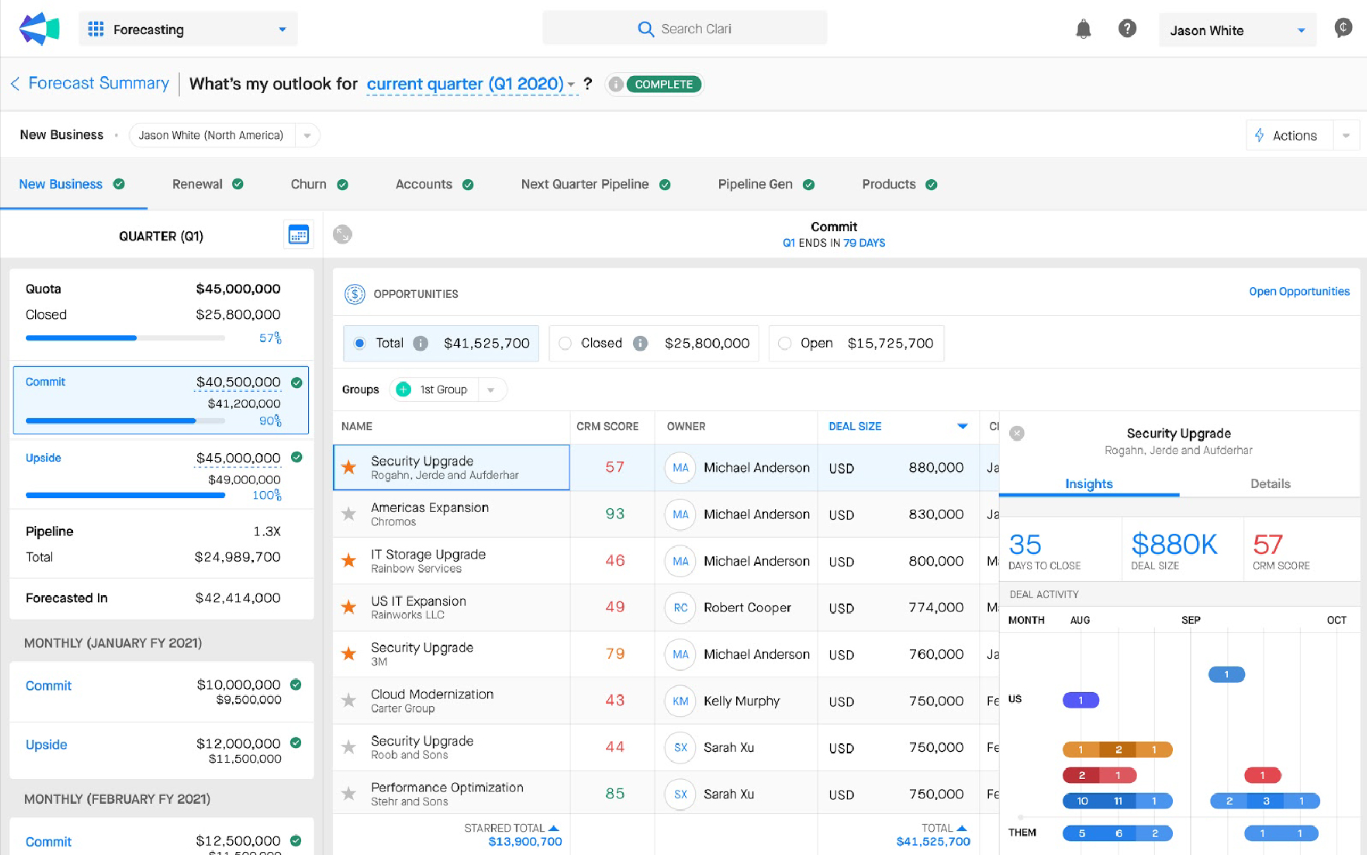
Clari Forecast is the platform's flagship product. It uses machine learning to track deal progress and rep activity in real time, giving managers and executives visibility into pipeline changes as they happen.

Source: Clari
The system pulls data from CRM, email, calendar, and call logs into Clari's Time Series Data Hub, which snapshots, stores, and analyzes data over time. This historical record powers the AI predictions. Clari claims Forecast achieves 98% accuracy by week two of the quarter and helps teams land within 4% of their forecasts on average.
Source: Clari
Forecasts roll up automatically from rep to manager to VP to CRO, eliminating the manual aggregation that eats hours each week. Segment Forecasting lets operations teams slice the forecast by any attribute, while Scenario Forecasting enables what-if analysis by pulling deals in and out.
The product supports multiple revenue models (subscription, consumption, and hybrid) in one platform. It can also toggle between multiple CRMs or roll up forecasts from different CRM instances in a single view.
Inspect: Centralized deal inspection that replaces status interrogation in 1:1s.
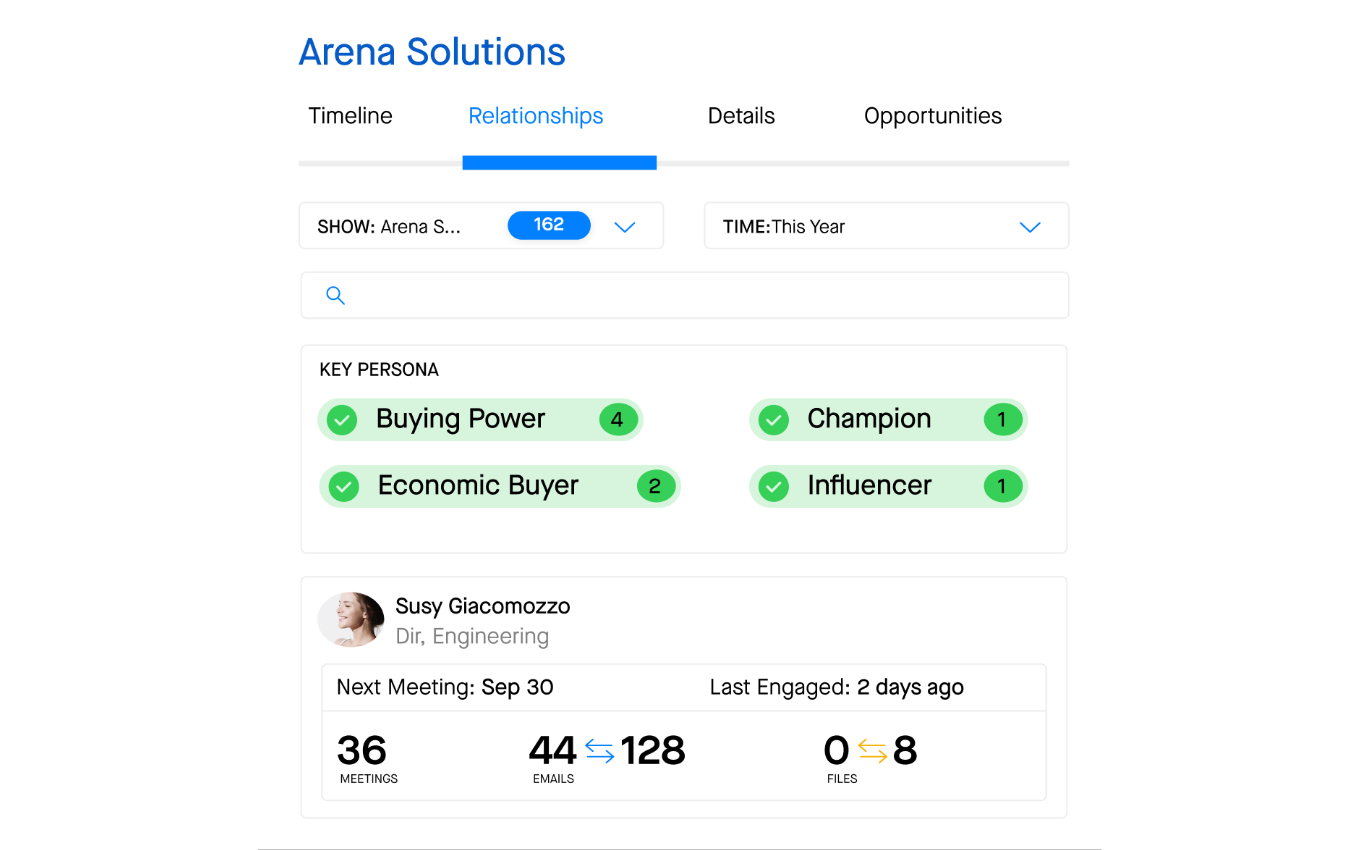
Clari Inspect consolidates deal data into one dashboard, addressing a specific problem: traditional 1:1 sales meetings spend 25 minutes interrogating reps about deal status and only 5 minutes coaching. Inspect flips that ratio by making deal information instantly accessible.
Source: Clari
The platform uses a 4-point inspection methodology. First, it highlights what changed in each deal using color coding (green for positive, red for negative, blue for nondirectional). Second, it provides an AI opportunity score based on historical data. Third, Activity Insights pull data from outside CRM to show engagement patterns. Fourth, a Details Panel tracks whether deals follow the sales methodology (MEDDIC, BANT, SPIN, Challenger, or Sandler).
Inspect provides AI health scores and risk indicators to help managers prioritize deals that need attention.
Capture: Automatic data logging that eliminates manual CRM updates.
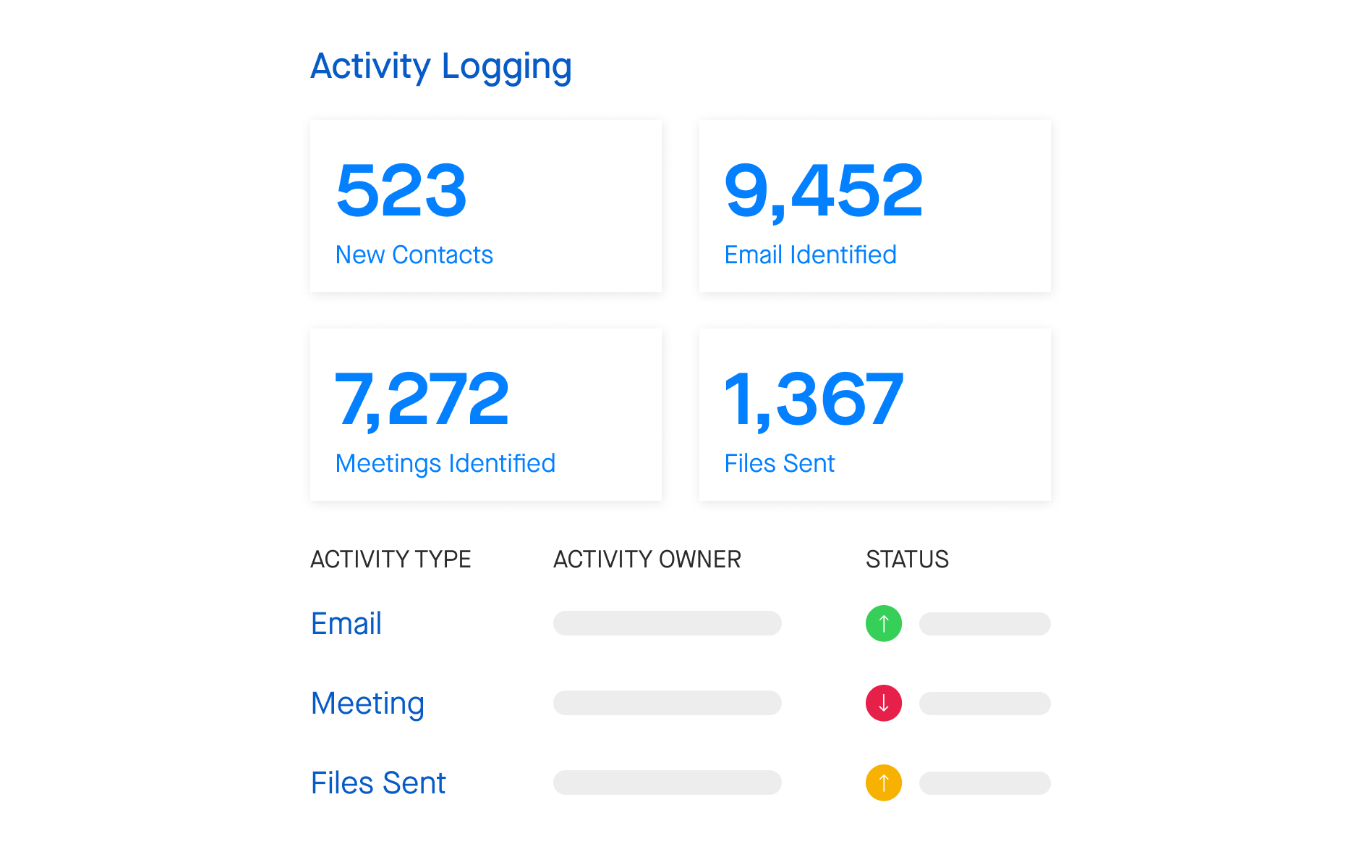
Clari Capture addresses one of the oldest problems in sales: reps don't update CRM. The feature collects and syncs activity data to CRM automatically by integrating with reps' emails and calendars, recording every customer interaction as it happens.
Source: Clari
The system processes over 300 million sales emails and 40 million sales meetings annually and captures 47% more contact data than manual logging. When reps engage with new stakeholders, Capture creates CRM contacts automatically and enriches records with job titles, phone numbers, and company information.
Beyond logging, Capture maps stakeholder relationships, tracks engagement levels, and pinpoints gaps in deal coverage.
Copilot: Real-time conversation intelligence and coaching during live calls.
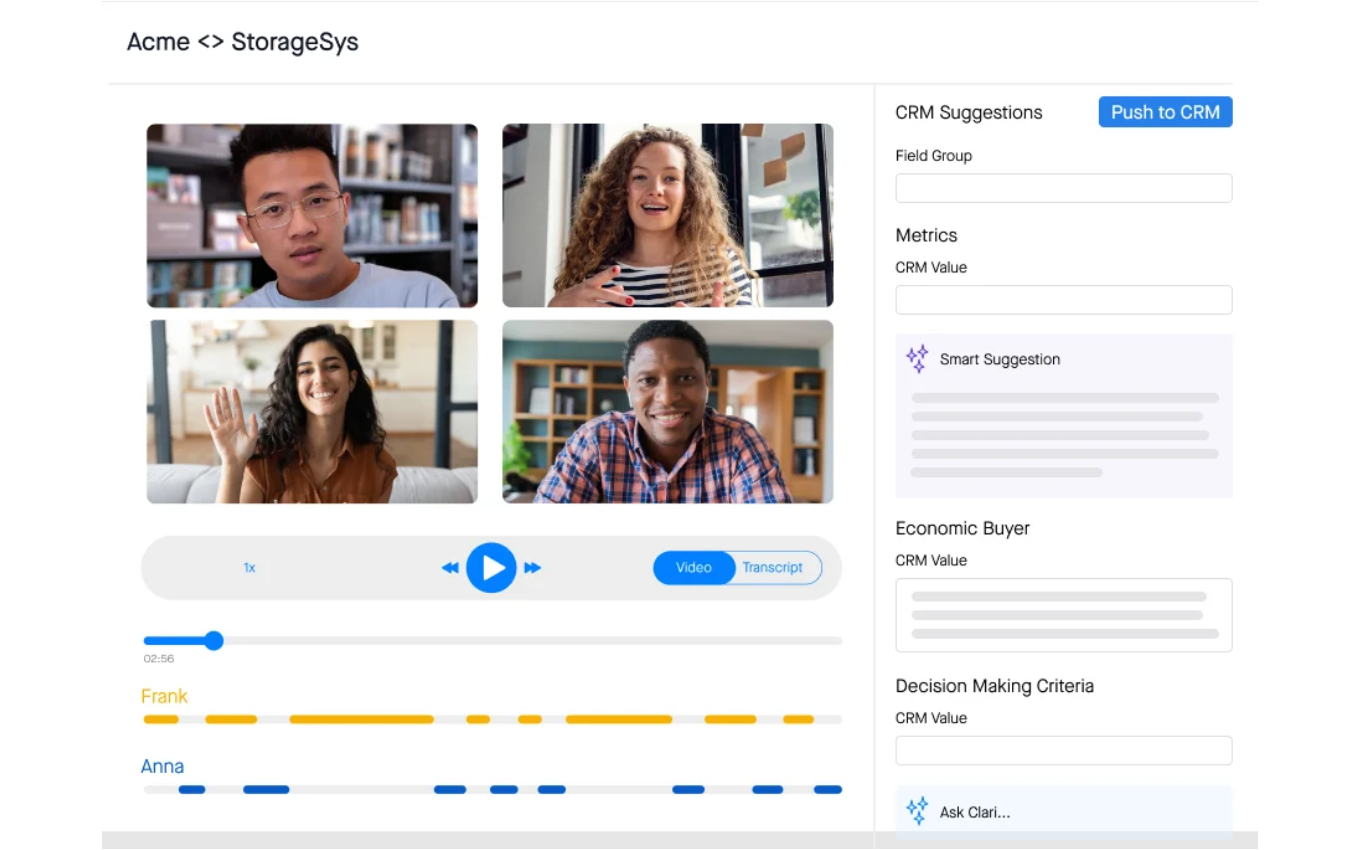
Clari Copilot (built on the Wingman acquisition) records and transcribes sales conversations, then guides reps during calls. Unlike most conversation intelligence tools that focus on post-call analysis, Copilot provides real-time answers during the call itself.
Source: Clari
When a buyer says something like "too expensive" or "what about competitor X," Copilot populates relevant battlecards on screen in real time. It comes with seven built-in battlecards covering pricing, competitor, and product conversations. Clari reports that sellers using real-time battlecards see 10% more wins on average.
After calls, RevGPT handles follow-up work: drafting emails, summarizing calls, and identifying next steps. CRM Suggestions capture meeting insights and create update recommendations that reps approve with one click.
Groove and Align: Sales engagement and buyer collaboration tools.
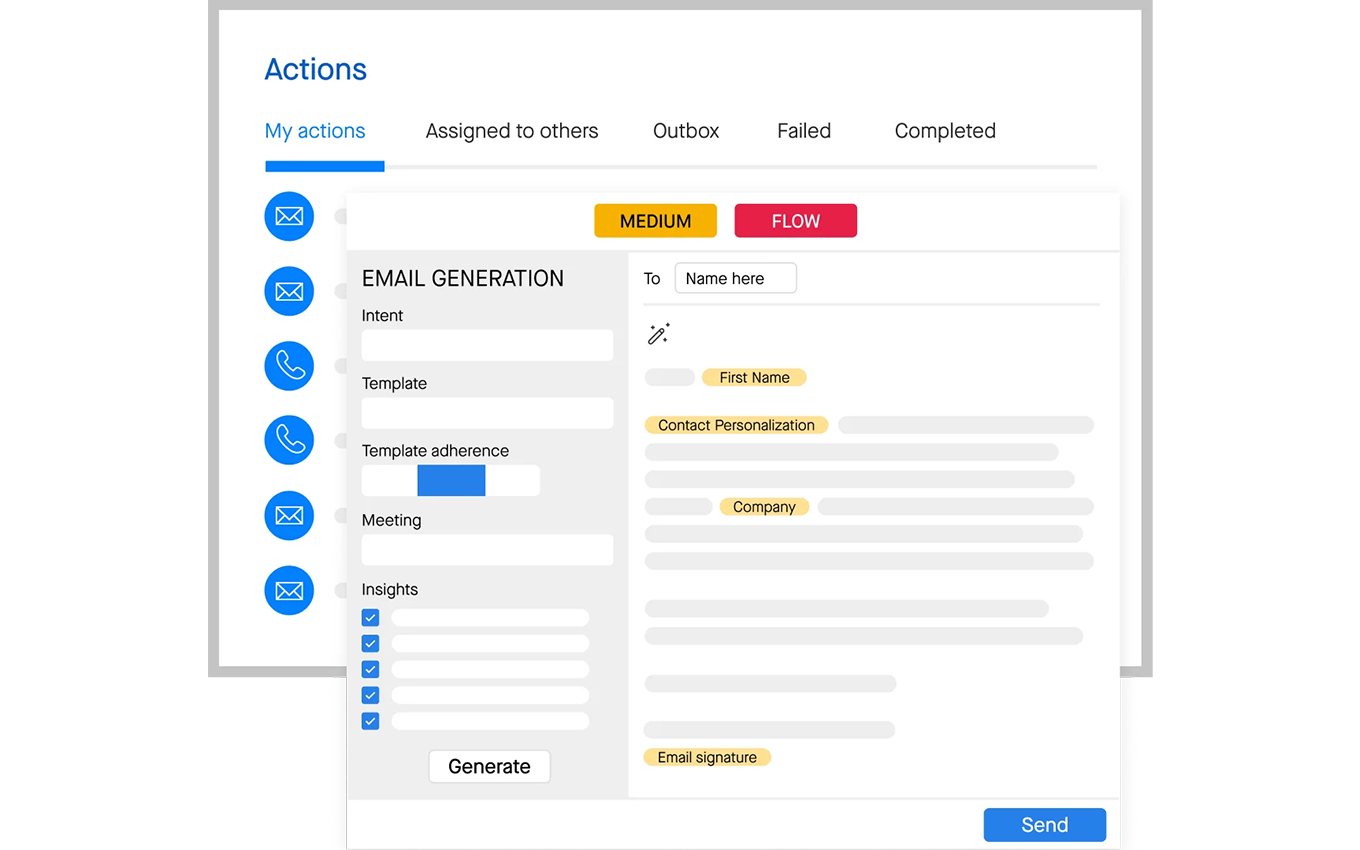
Groove is Clari's sales engagement platform, acquired in August 2023, serving 75,000+ users at organizations including ADP, Google, and Uber. As a Salesforce-native platform, it runs automated multi-step campaigns across email, calls, SMS, LinkedIn, and direct mail.
Source: Clari
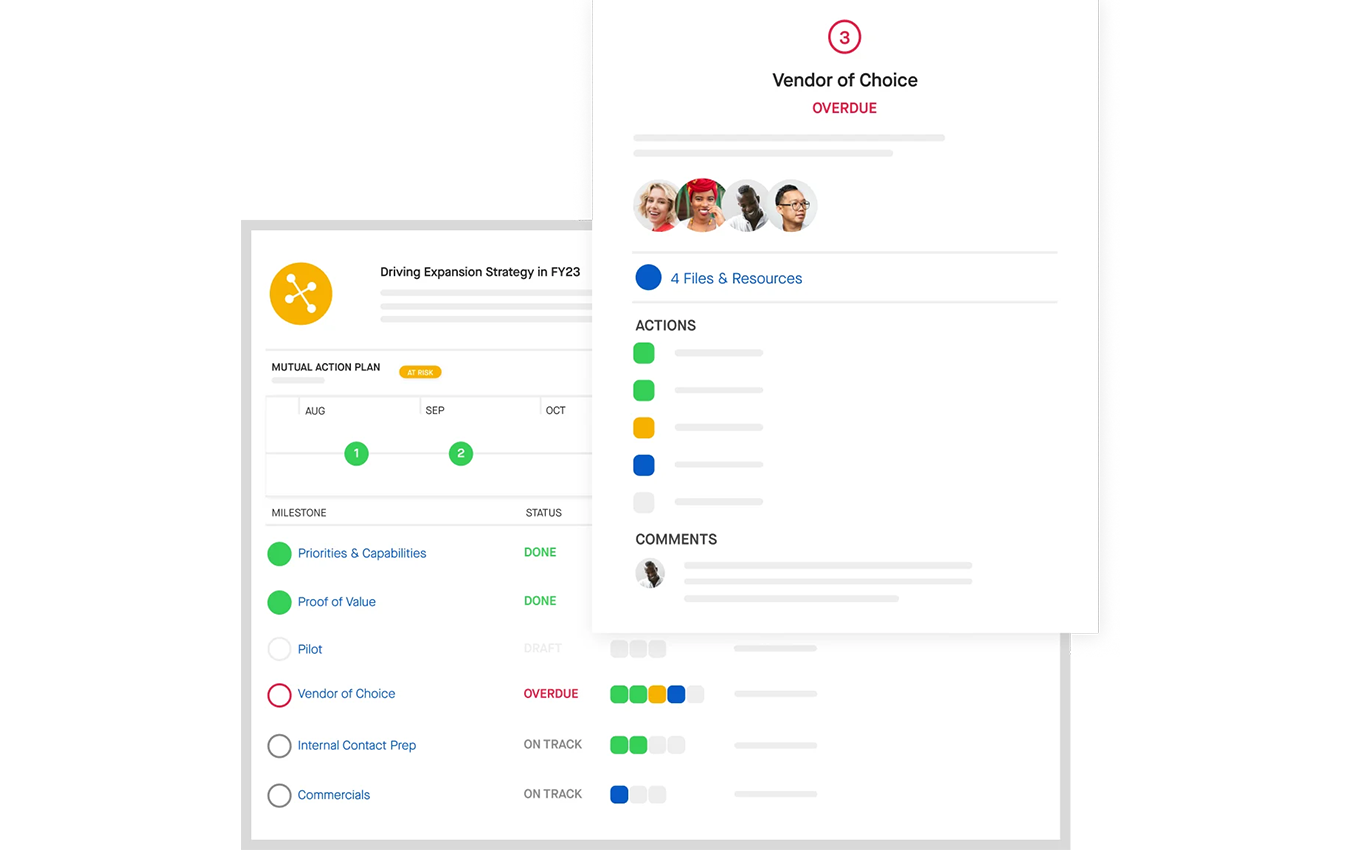
Clari Align provides mutual action plans and digital sales rooms for buyer collaboration. Sellers create shared workspaces where both parties track milestones, share documents, and monitor progress. The platform feeds buyer engagement data into inspection and forecasting cadences, connecting engagement signals to deal health.
Source: Clari
Guide: An AI Action Hub that connects strategy to daily execution.
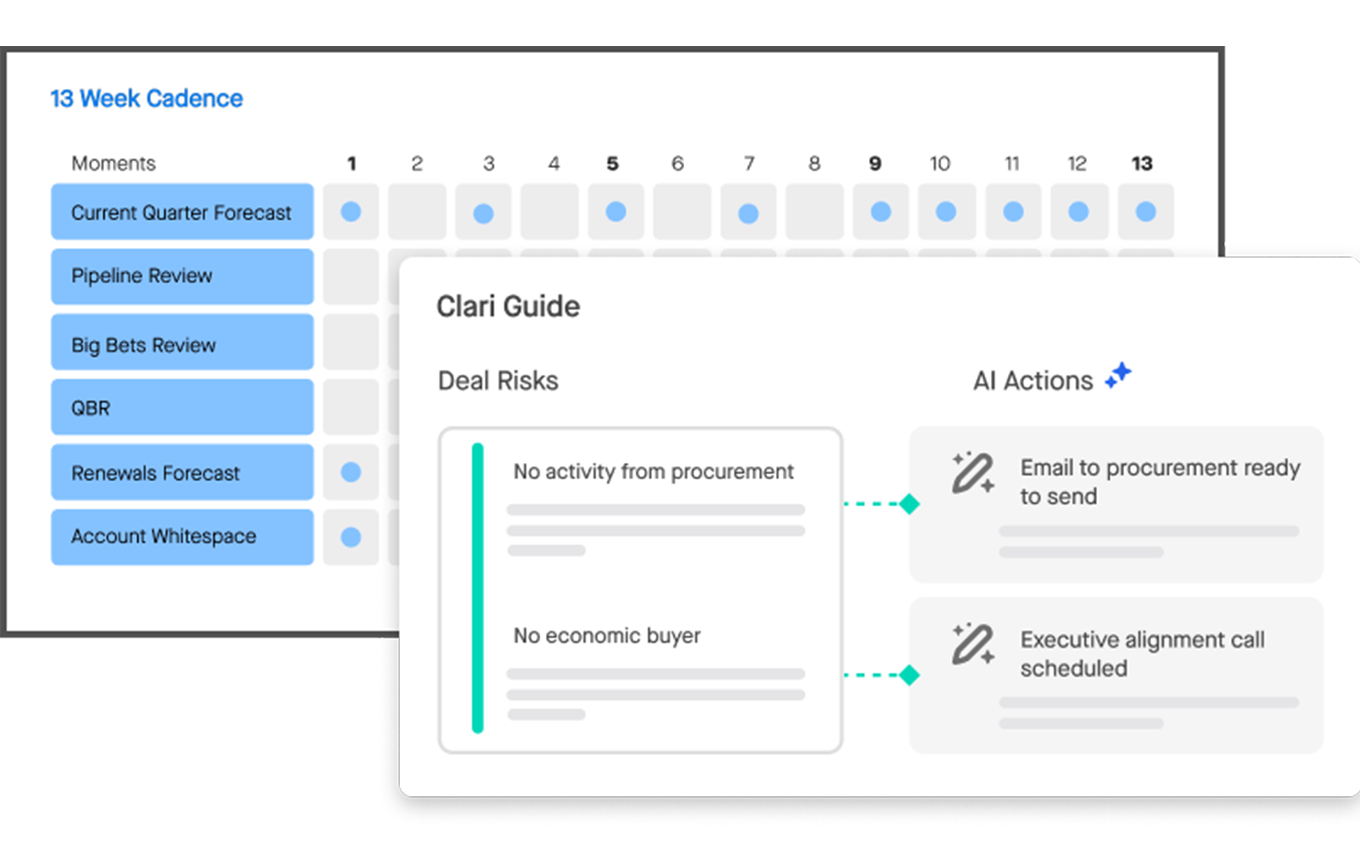
Clari Guide serves as the platform's central workspace where reps manage pipeline, prioritize deals, and receive AI-guided next steps. When enabled, all users land on Guide's homepage, which collects everything across Clari that needs their attention.
Source: Clari
Guide operates through Revenue Cadences, repeatable workflows that standardize how teams run pipeline reviews, forecast calls, and deal inspections. Organizations can set up Cadences in minutes and focus each week on different parts of the sales cycle. Revenue AI Agents inspect deals around the clock and give sellers guidance to close faster, while Smart Deal Summaries combine emails, call transcripts, and notes into one view, saving 30 minutes per deal on reviews.
Where Clari Falls Short
Clari is a strong platform for enterprise revenue forecasting and deal management. But several limitations show up with regular use, particularly for teams that need more than pipeline visibility.
No Prospecting Data or Buyer Intelligence. Clari helps you manage and forecast deals already in your pipeline, but it provides no B2B contact database, company intelligence, or buyer intent signals to help you build that pipeline. Teams still need a separate data provider to identify target accounts, find decision-makers' contact information, and detect when companies are researching solutions. This gap means Clari covers the middle and end of the revenue cycle but not the beginning.
Complex Interface and Steep Learning Curve. Users consistently report that Clari's interface is not intuitive and feels overwhelming for new users. Reviews call the UI clunky, and some users keep separate spreadsheets to track deals despite having Clari. New users require weeks to become proficient.
Incomplete Acquisition Integrations. Clari's acquisition strategy has expanded its capabilities, but integration work lags behind. Groove was acquired in 2023, and two years later that integration remained incomplete. The Salesloft merger closed in December 2025, with the joint roadmap still developing as of early 2026. For buyers evaluating the combined platform, the "one company, one platform" vision remains a future state.
Opaque Pricing. Clari does not publish pricing tiers or per-seat costs. The pricing page sends buyers to a "Get a quote" form. The company says there are no platform fees for integrations or ongoing support, but the lack of transparency makes it hard for teams to budget or compare costs before talking to sales.
Data Transparency Gaps. Users report a lack of transparency into how analytics are derived, making it difficult to understand the reasoning behind insights. When your forecast depends on AI-generated scores and risk indicators, knowing what data feeds those calculations matters.
No Marketing or ABM Capabilities. Clari is built for sales and revenue operations. It offers no account-based marketing tools, no advertising capabilities, no website visitor identification, and no demand generation features. Organizations that want sales and marketing on the same platform need to look elsewhere.
These limitations reflect Clari's decision to specialize in revenue forecasting and deal management. For enterprise sales organizations with dedicated RevOps teams and separate tools for prospecting and marketing, that specialization delivers value. But teams looking for broader go-to-market coverage will find gaps.
Top Clari Alternative for Full Go-to-Market Coverage: ZoomInfo
ZoomInfo fills Clari's gaps by covering the full go-to-market lifecycle in one platform. Where Clari specializes in managing and forecasting existing pipeline, ZoomInfo starts earlier (identifying and reaching the right buyers) and extends further (marketing, data operations, and conversation intelligence), backed by a data foundation that goes beyond what revenue forecasting tools offer.
Comprehensive B2B Data: The foundation Clari doesn't have.
The main difference between Clari and ZoomInfo is data. Clari works with whatever data already exists in your CRM. ZoomInfo provides the data itself: 500M contacts, 100M companies, 135M+ verified phone numbers, 120M direct dials, and 200M+ verified business email addresses.
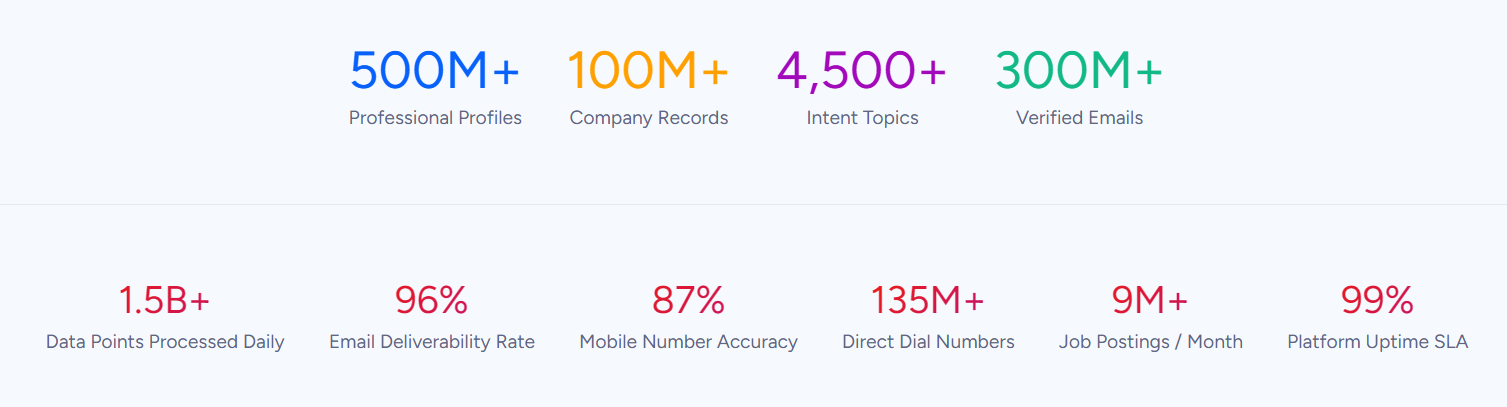
This data runs through a multi-source verification pipeline: automated ML scanning of 28 million site domains daily, third-party partner data covering 95 million businesses, a community of 200,000+ Lite users who share data back, and an in-house Data Training Lab of 300+ human researchers. First-party data reaches up to 95% accuracy.
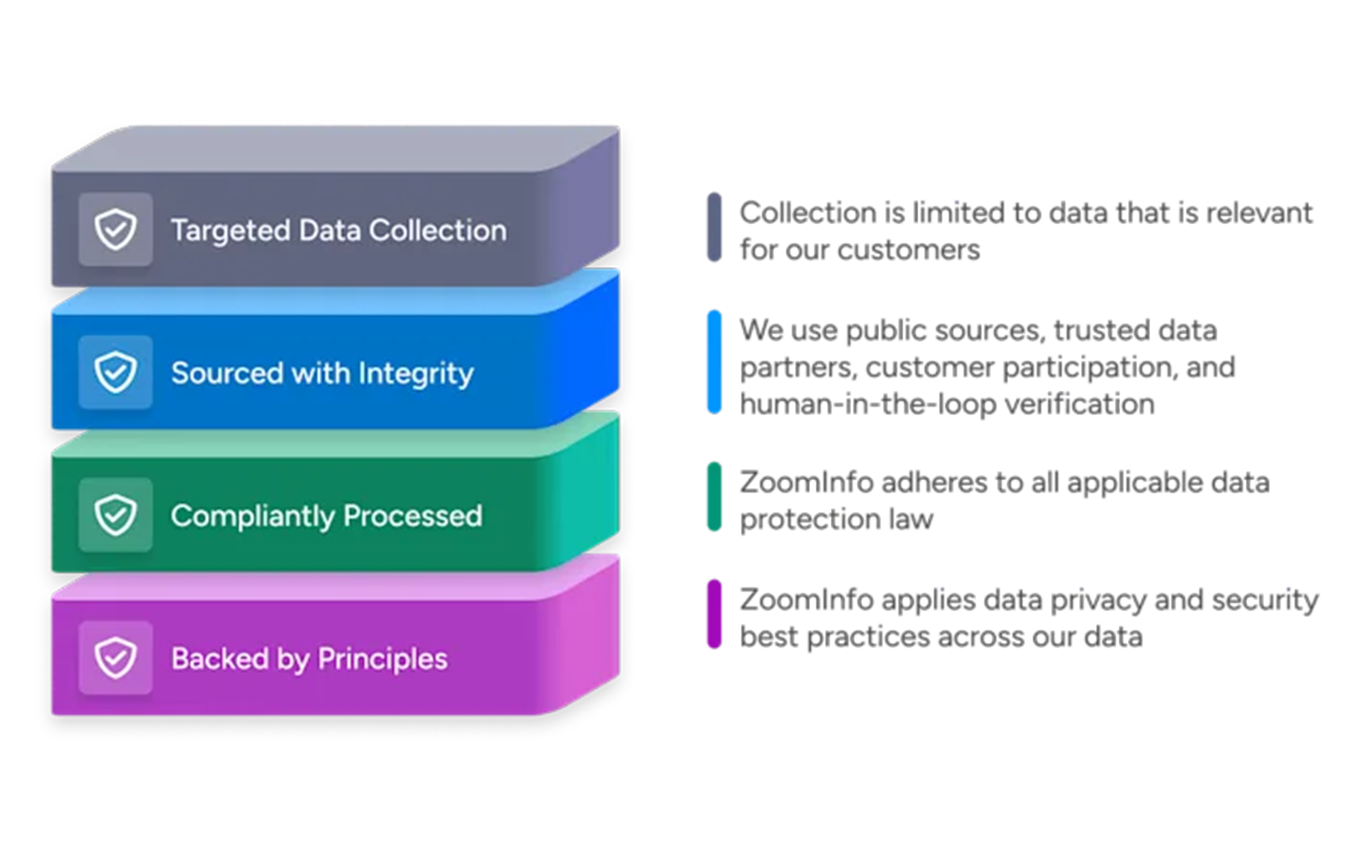
Third parties have validated this lead. In a Fortune 500 RFP analyzing 25 million contacts across vendors, the independent consultant concluded that "no other competitor came even close." ZoomInfo holds 133 No. 1 rankings on G2 across Sales Intelligence, Buyer Intent, Data Quality, and related categories, and was the only vendor in the Customers' Choice quadrant in Gartner's Voice of the Customer report.
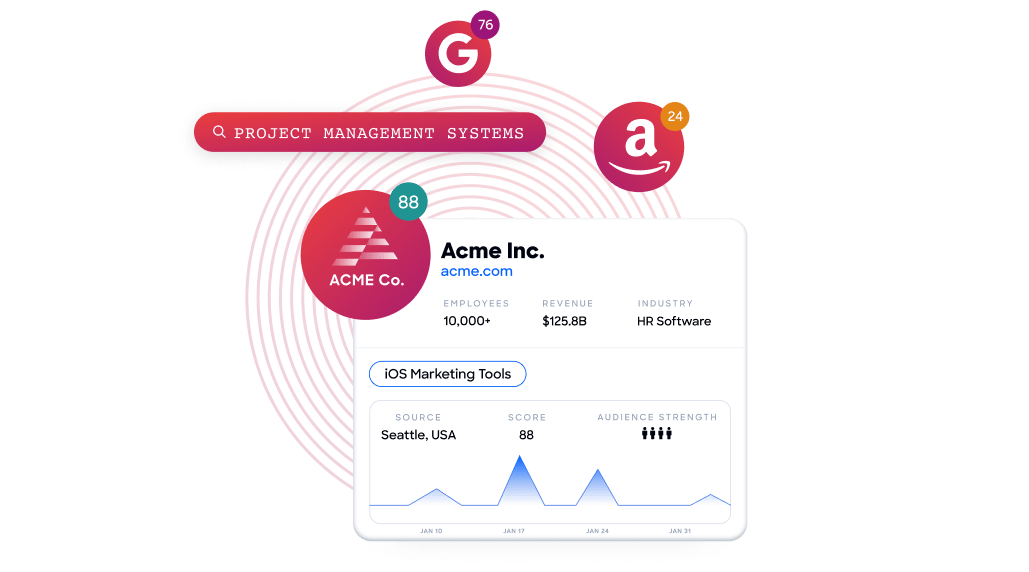
Beyond contacts and companies, ZoomInfo includes Buyer Intent Data that tracks signals from 210M IP-to-Org pairings and 6 trillion+ keyword-to-device pairings monthly. Guided Intent, exclusive to ZoomInfo, identifies topics historically correlated with deal success rather than requiring manual topic selection. Teams can detect when target accounts are researching solutions before those accounts enter the pipeline.
Vensure scaled prospecting using ZoomInfo's data, with their VP of Revenue Operations noting: "ZoomInfo gives us the information we need to execute. We don't have to go through and spend our time digging. It's already there, so we can be three steps ahead." (Vensure)
GTM Context Graph: Intelligence that captures why deals move, not just that they moved.
Clari's RevDB captures historical snapshots of deal data. ZoomInfo's GTM Context Graph goes further, combining ZoomInfo's B2B data with a customer's CRM records, conversation transcripts, email threads, and behavioral signals, and processing 1.5B+ data points daily into a single intelligence layer.
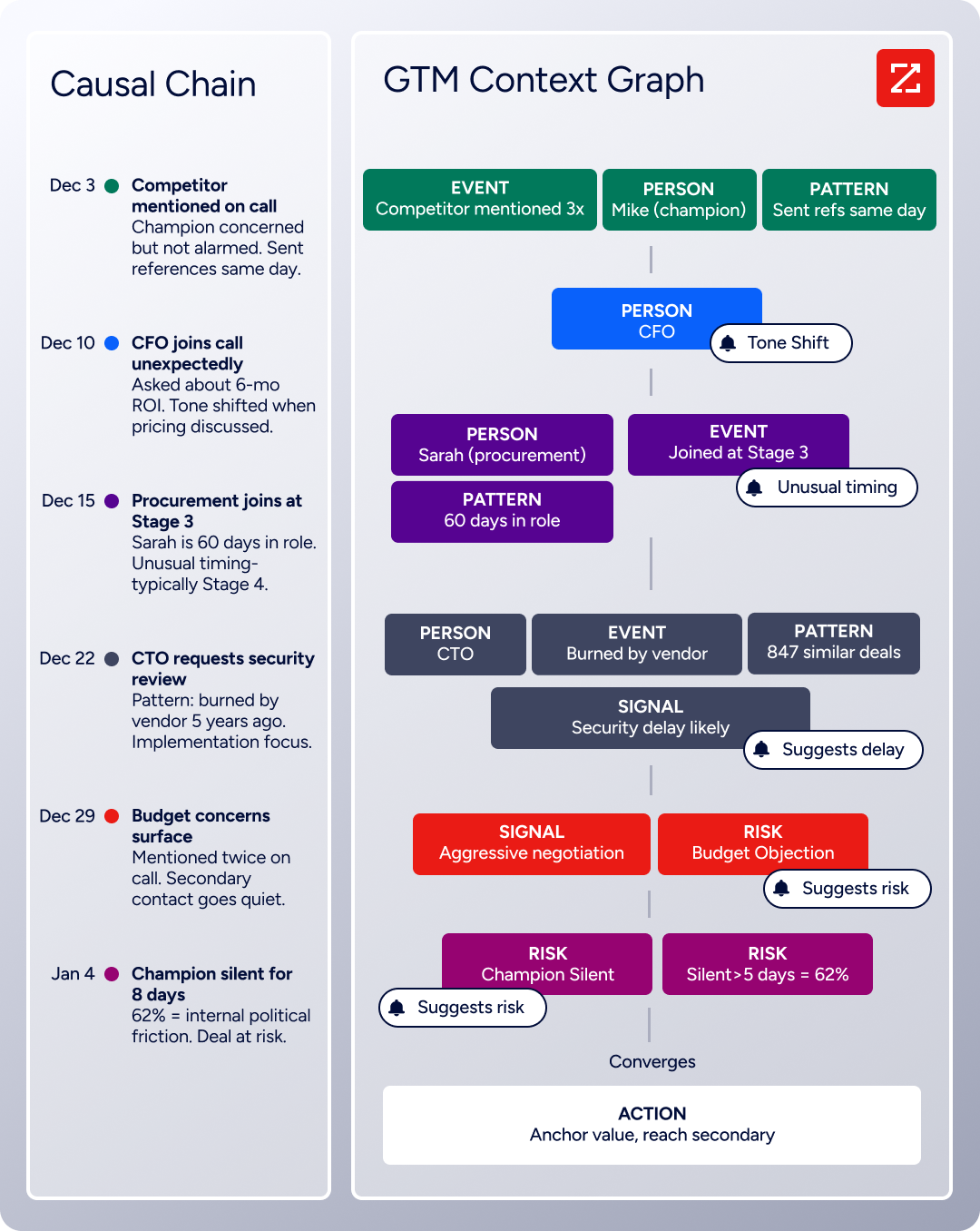
The distinction matters. A CRM records that a deal moved from Stage 3 to Stage 4. Conversation intelligence transcribes what the VP of Finance said on the last call. Intent data logs a spike in research activity. The GTM Context Graph reasons across all three to capture why the deal moved, connecting executive sponsorship at a specific stage with ROI-focused questions and external signals like hiring patterns and competitor research.
This layer exists because ZoomInfo spent 20 years building a B2B data unification platform, then extended that infrastructure to first-party data through acquisitions like Chorus (conversation intelligence). As ZoomInfo's Chief Product Officer Dominik Facher writes: "The CRM recorded the state change. It has no record of why it happened." The GTM Context Graph makes that decision context machine-readable.
Seismic attributed 39% of active pipeline to opportunities identified or influenced by ZoomInfo signals. Their Chief Business Officer noted: "That combination of our internal CRM data, external signals, and AI that's given all that context has helped us craft very specific account- and persona-based messages. And people have responded to them right away." (Seismic)
Universal Access: Use the intelligence anywhere, not just inside one tool.
Clari's intelligence lives inside Clari. ZoomInfo delivers its data and GTM Context Graph through three channels, so teams use it wherever they work.
GTM Workspace is the seller's front-end: an AI workspace where prioritized accounts, AI-drafted outreach, deal context, and CRM updates converge in one place. AI agents (built on Anthropic's Claude) handle account research, outreach generation, signal monitoring, and CRM updates. Thomson Reuters increased closed-won deals by 40% and Databricks reached prospects 50% faster.
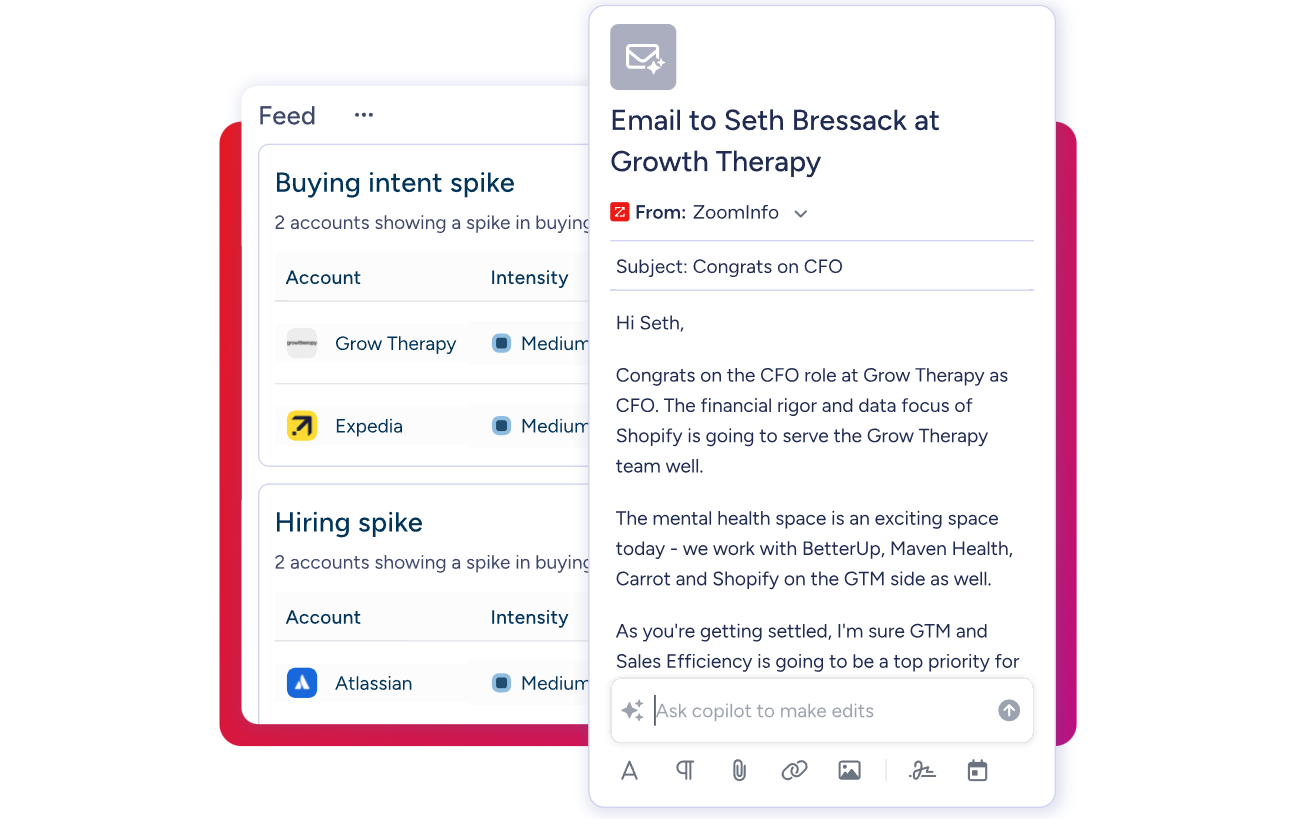
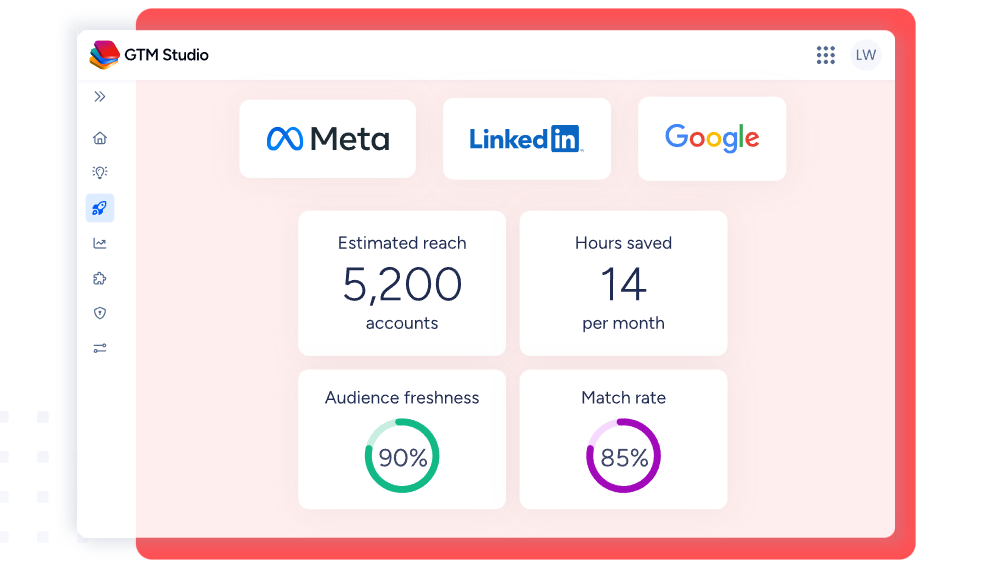
GTM Studio serves marketers, RevOps, and GTM engineers with a builder where audience definition, campaign orchestration, and pipeline measurement happen in natural language. Expansion plays that used to take 3 weeks now launch in 30 minutes without engineering support.
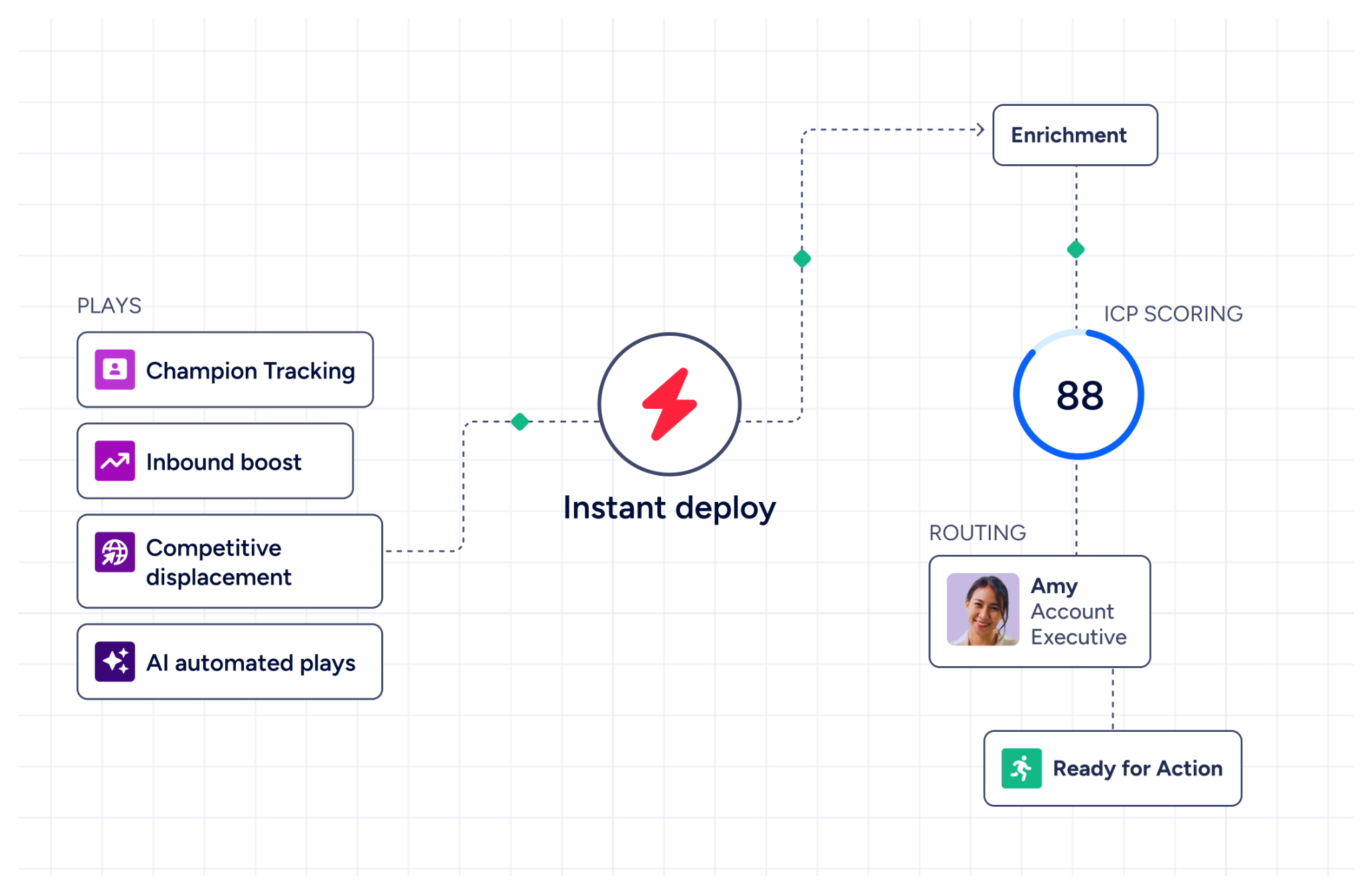
For teams building beyond ZoomInfo's own products, APIs and MCP expose the same intelligence to any custom agent, internal tool, or partner platform. API access is included in all plans.
BDO Canada activated ZoomInfo data within their internal systems. Their Senior Marketing Intelligence Analyst noted: "The plug-and-play aspect of the API means I can integrate it very easily into any process and get information at a moment's notice," achieving an 87% reduction in time spent on data dashboard updates. (BDO Canada)
Conversation Intelligence, Marketing, and Operations: Capabilities Clari lacks or limits.
ZoomInfo includes Chorus for conversation intelligence, with a key differentiator: Connected Intelligence shows ZoomInfo's contact profiles, company insights, and relevant signals alongside every call recording. A manager reviewing a call sees every participant's verified contact details and relationship history without switching systems.
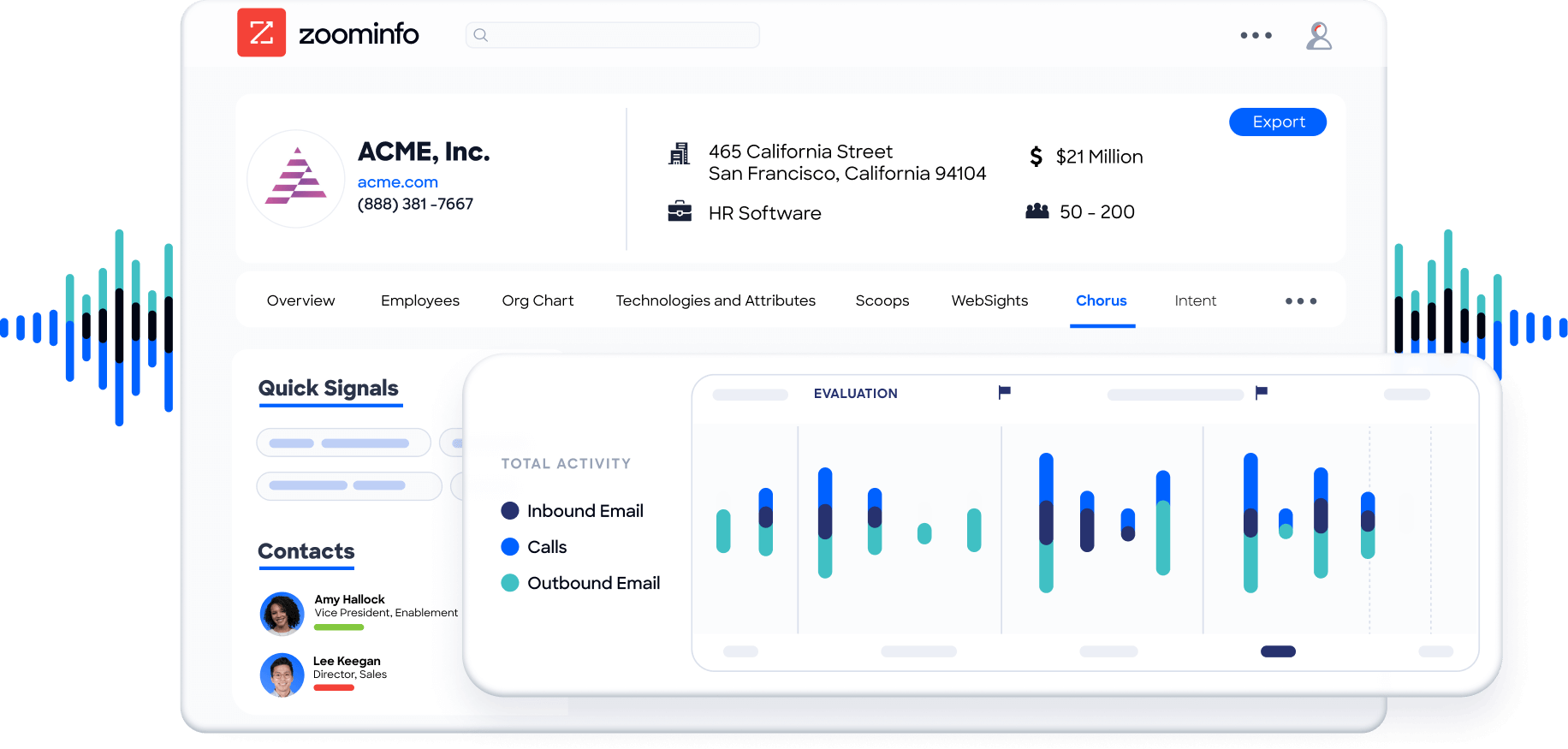
On the marketing side, ZoomInfo offers account-based marketing with a native Demand-Side Platform for display ads, FormComplete (which reduces forms to a single field while auto-appending data), and contact-level website visitor identification. Smartsheet reported a 40%+ increase in form fills and a 59% increase in win rate using these tools.
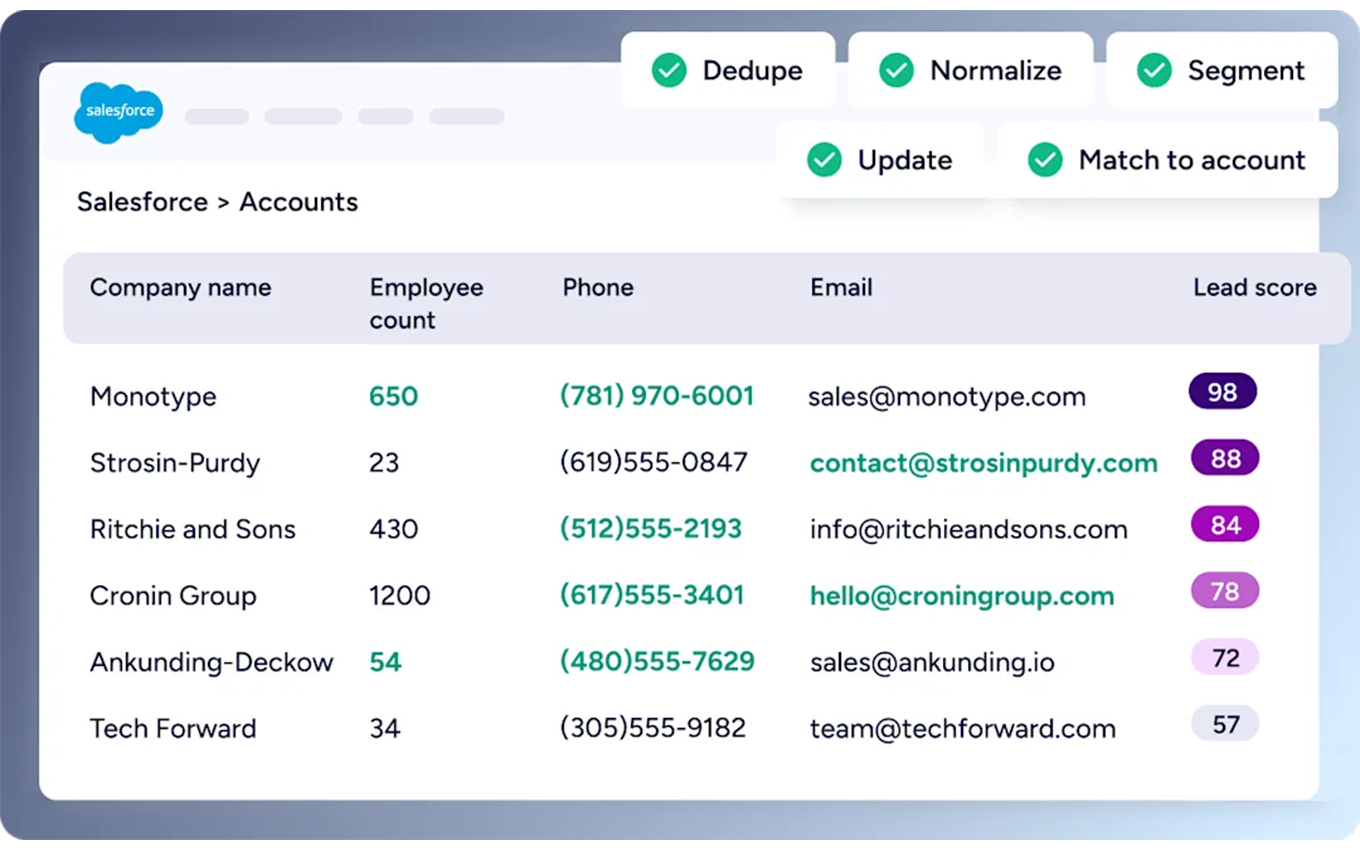
ZoomInfo Operations handles data quality with multi-vendor enrichment from roughly 60 vendors, automated deduplication, and lead-to-account matching. Momentive cut speed-to-lead from 20 minutes to 60 seconds.
Pricing and Accessibility: A free tier and clear entry points.
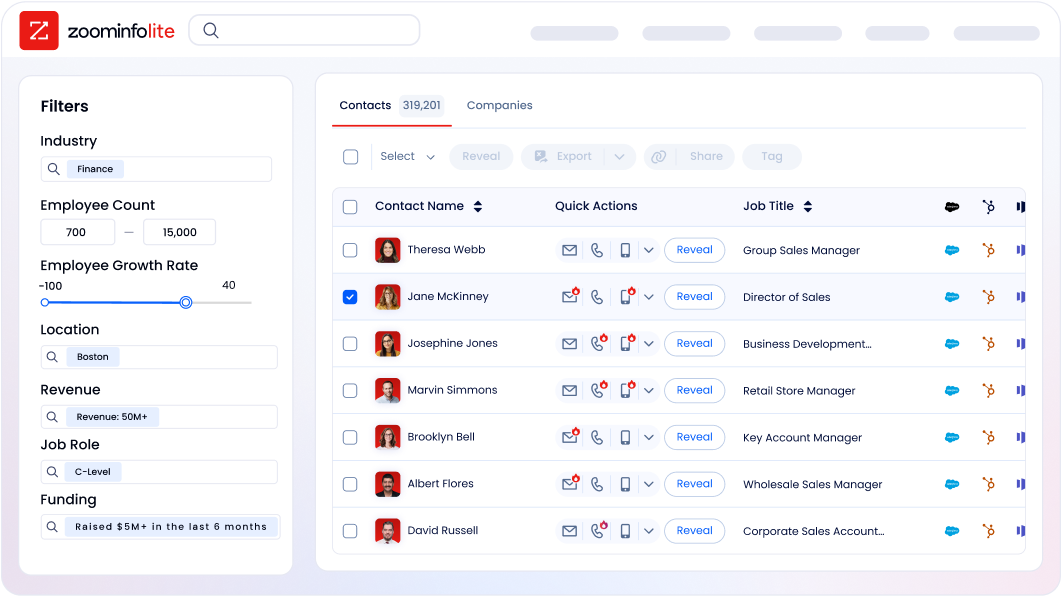
Clari publishes no pricing information. ZoomInfo also custom-quotes paid plans but provides two entry points. ZoomInfo Lite is a permanent free tier (not a trial) with access to ZoomInfo's B2B database, 10 monthly export credits, individual and company searches, a Chrome extension, and WebSights Lite for up to 10 website visitor reveals per day. A separate 7-day free trial gives access to core features with no credit card required.
ZoomInfo's paid plans are organized into Sales, Marketing, and add-on tiers, with consumption-based pricing that scales around seats, credit volume, and feature access. Sales plans span Professional, Advanced, and Enterprise tiers, each unlocking deeper capabilities (intent signals, AI features, advanced integrations).
Clari or ZoomInfo: Comparison Summary
Clari | ZoomInfo | |
|---|---|---|
Primary focus | Revenue forecasting, deal inspection, pipeline management | Full go-to-market: data, prospecting, engagement, marketing, operations |
B2B contact database | None | 500M contacts, 120M direct dials, 200M+ verified emails |
Buyer intent signals | No native intent data | 210M IP-to-Org pairings, 6T+ keyword signals monthly |
Revenue forecasting | Core strength: AI-powered forecasting with historical time-series data | Supported through GTM Context Graph deal intelligence |
Deal inspection | Dedicated Inspect product with 4-point methodology and AI health scores | GTM Workspace with AI agents and deal context |
Conversation intelligence | Clari Copilot with real-time in-call battlecards | Chorus with Connected Intelligence (ZoomInfo profiles in every call) |
Sales engagement | Groove (Salesforce-native) + Salesloft merger | GTM Workspace with AI-powered engagement |
Marketing / ABM | Not available | Native DSP, FormComplete, contact-level visitor ID, ABM orchestration |
Data operations | Capture (activity autocapture and CRM sync) | Operations (multi-vendor enrichment, dedup, lead routing) |
Intelligence layer | RevDB (historical revenue snapshots) | GTM Context Graph (1.5B+ data points daily, first- and third-party data combined) |
Access model | Clari platform only | GTM Workspace, GTM Studio, APIs, MCP (any tool) |
Free tier | Align free tier (5 licenses); Copilot free trial | ZoomInfo Lite (permanent); 7-day free trial |
Pricing transparency | No published pricing | No published pricing; free entry points available |
Analyst recognition | Leader, Gartner MQ for Revenue Action Orchestration (2025) | Leader, Gartner MQ for ABM Platforms (2024 & 2025); Leader, Forrester Wave Intent Data (2025) |
Best for | Enterprise sales teams focused on forecasting and pipeline management | Teams needing the full GTM lifecycle: prospect discovery through deal close |
Final Verdict
The choice between Clari and ZoomInfo depends on what your revenue organization needs most.
Choose Clari if your primary challenge is revenue predictability and deal management. Clari is built for enterprise sales organizations with complex pipelines, layered forecasting, and dedicated RevOps resources. Its AI forecasting, deal inspection, and Revenue Cadences give sales leaders the visibility to catch slipping deals, hold teams to consistent processes, and deliver forecasts their boards can trust. If you already have strong prospecting data and marketing tools and your biggest gap is turning pipeline into predictable revenue, Clari fills that gap.
Choose ZoomInfo if you need a platform that covers the full go-to-market lifecycle. ZoomInfo starts where Clari can't: identifying the right buyers, providing verified contact data, and detecting purchase intent before accounts enter your pipeline. From there, the GTM Context Graph connects prospecting intelligence with your CRM data, conversation history, and behavioral signals to power AI that understands why deals move. With GTM Workspace for sellers, GTM Studio for marketers and RevOps, and APIs and MCP for any third-party tool, ZoomInfo delivers that intelligence wherever your teams work. For organizations that want prospecting, engagement, conversation intelligence, marketing, and data operations on one platform, ZoomInfo provides the broader foundation.
Get started with ZoomInfo here.
Clari and ZoomInfo approach revenue growth from different starting points. Clari asks, "How do we predict and manage the revenue we're already pursuing?" ZoomInfo asks, "How do we find, understand, engage, and win the right buyers across every stage?" Your choice depends on which question matters more to your organization right now.
Clari FAQ
What does Clari cost?
Clari does not publish pricing tiers or per-seat costs on its website. The pricing page directs buyers to request a custom quote. The company says there are no platform fees for integrations or ongoing support, but specific pricing is not disclosed. ZoomInfo also uses custom-quoted pricing but offers two free entry points: ZoomInfo Lite (a permanent free tier) and a 7-day free trial with no credit card required.
Does Clari have a free plan or free trial?
Clari offers two free options. Clari Align provides a free tier with five licenses, unlimited workspaces, and no time limit. Clari Copilot offers a time-limited free trial. The core forecasting and deal inspection products have no publicly available free plans. ZoomInfo Lite provides permanent free access to ZoomInfo's B2B database with 10 monthly export credits and basic search features.
Does Clari provide B2B contact data for prospecting?
No. Clari is a revenue operations platform that works with data already in your CRM. It includes no B2B contact database, company intelligence, or verified phone numbers and email addresses for outreach. Teams using Clari need a separate data provider for prospecting. ZoomInfo provides 500 million contacts, 120 million direct-dial phone numbers, and 200 million verified business email addresses, along with buyer intent signals and website visitor identification.
What happened with the Clari and Salesloft merger?
Clari and Salesloft completed their merger in December 2025, with Steve Cox appointed as CEO. The company's long-term vision is one platform, but the joint roadmap was still in development as of early 2026. This follows a similar pattern with Clari's 2023 Groove acquisition, where integration work continued for over two years after the deal closed.
Who is Clari best suited for?
Clari is designed for enterprise B2B sales organizations with multi-quarter pipelines and dedicated RevOps teams. The platform works best where sales cycles are long, deals involve multiple stakeholders, and layered forecasting is a priority. Organizations without dedicated RevOps resources may struggle with setup and ongoing configuration. Smaller teams with simpler sales processes will likely find the platform over-engineered for their needs.
Does Clari include marketing or ABM capabilities?
No. Clari focuses on sales and revenue operations. It does not offer account-based marketing tools, advertising capabilities, website visitor identification, demand generation features, or marketing campaign orchestration. Organizations wanting unified sales and marketing from one platform should consider alternatives like ZoomInfo, which includes a native demand-side platform for display ads, form optimization, contact-level visitor identification, and multi-channel campaign orchestration.
How does Clari's conversation intelligence compare to standalone tools?
Clari Copilot provides real-time transcription, in-call battlecards, and post-call AI summaries. Its advantage is real-time guidance during live calls, which most conversation intelligence tools don't offer. However, Copilot currently analyzes only one call at a time, making bulk transcript analysis difficult. ZoomInfo's Chorus takes a different approach with Connected Intelligence, showing verified contact profiles, company insights, and relationship history alongside every call recording.
What integrations does Clari support?
Clari integrates with Salesforce as its primary CRM, along with communication tools (Slack, Google Workspace, Microsoft Teams, Zoom, Webex), data platforms (PostgreSQL, Snowflake, BigQuery), and sales tools (Outreach, Gong, Chorus, Highspot). The platform also offers public APIs and a developer portal. ZoomInfo's integration ecosystem includes 120 partner integrations across CRM, marketing automation, sales engagement, data warehouse, and other categories, plus APIs and MCP access for connecting to any AI agent or custom application.
Researching Clari? These comparisons and alternatives help you decide:
