
Choosing between Close and Salesforce for your sales team comes down to five questions:
Are you a small team that needs to start selling immediately, or an organization building long-term CRM infrastructure?
Do you need built-in calling, email, and SMS in one tool, or a platform that connects to specialized tools for each channel?
Is your priority speed and simplicity, or customization and cross-department visibility?
Can your team afford the time and resources to implement and administer a complex platform?
How important is it that your CRM data is accurate, enriched, and useful from day one?
In short, here's what we recommend:
Close is the CRM for small, outbound-focused B2B sales teams that want to sell, not configure software. With built-in calling, email, and SMS, a Power Dialer for high-volume calling, and workflow automation that saves reps 3+ hours per week, Close gets teams from setup to selling in days. It claims to be 50% faster than Salesforce, HubSpot, and Pipedrive. But Close lacks marketing automation, enterprise customization, and the depth that large organizations need.
Salesforce is the world's #1 CRM by market share, serving over 150,000 companies with a platform spanning sales, service, marketing, commerce, and AI-powered agents. Organizations that need customization, cross-department visibility, and an ecosystem of 9,000+ partner apps get it here. But that scope comes with complexity, high pricing, and implementation timelines measured in weeks or months.
Both platforms manage your sales process. Neither solves the upstream problem on its own: finding the right prospects, knowing when they're ready to buy, and understanding why deals move or stall. That intelligence is what turns a CRM from a record-keeping system into a revenue driver.
ZoomInfo is a B2B data and go-to-market platform built on the largest B2B database in the industry: 500M contacts, 100M companies, 135M+ verified phone numbers, and 200M+ verified business email addresses. Its GTM Context Graph processes 1.5B+ data points daily, combining this data with your CRM records, conversation transcripts, and behavioral signals to show not just what's happening in your pipeline, but why. ZoomInfo integrates with Salesforce, HubSpot, and other CRMs, and its GTM Workspace gives sellers a single place for AI-powered research, outreach, and signal monitoring on top of whichever CRM they choose.
If feeding your CRM with verified data and real-time buying signals sounds like the missing piece, see how ZoomInfo works with your sales stack.
Close vs. Salesforce vs. ZoomInfo at a glance
Close | Salesforce | ZoomInfo | |
|---|---|---|---|
Primary function | CRM with built-in communication | Enterprise CRM platform | B2B data and GTM intelligence |
Starting price | $9/seat/month (Solo, annual) | $0 (Free Suite, max 2 users) | Free (ZoomInfo Lite); paid plans custom-quoted |
Built-in calling | Yes (Power Dialer + Predictive Dialer) | No (requires add-ons or integrations) | No (complements your CRM's communication tools) |
Built-in email | Yes (two-way sync, templates, sequences) | Yes (Einstein Activity Capture) | AI-generated outreach via GTM Workspace |
AI capabilities | Call transcription, email rewriting, lead summaries | Agentforce agents, Einstein scoring, forecasting | GTM Context Graph, AI-drafted outreach, intent signals |
Contact database | Only what you import | Only what you import | 500M contacts, 200M+ verified emails, 135M+ verified phones |
Implementation time | Days | Weeks to months | Deploys in weeks |
Customization | Limited | Virtually unlimited | Configurable data and workflow layer |
Integrations | 100+ via native, Zapier, API | 9,000+ via AppExchange | 120+ native integrations, APIs, MCP |
Best for | Small outbound sales teams (1-25 reps) | Mid-market to enterprise organizations | Any sales team that needs better data and signals |
Close is built for speed, Salesforce for scale
Close and Salesforce solve the same problem (managing a sales pipeline) with opposite philosophies.
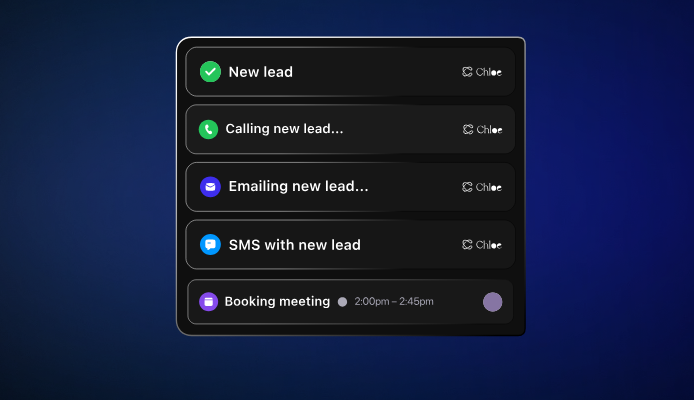
Close strips the CRM to what inside sales teams use daily: a lead page, a communication timeline, a pipeline view, and automation for the rest.
The product assumes your reps are making calls, sending emails, and closing deals, not configuring software. That simplicity is deliberate.
Close targets startups and SMBs with teams of 1-25 salespeople. The Solo plan supports 1 user with up to 10,000 leads. Even the Scale plan, at $139-149/seat/month, serves teams that need advanced permissions and predictive dialing, not enterprise CRM infrastructure. The company is bootstrapped and profitable with 100 team members, growing independently since 2013.
Source: Close
Salesforce operates at a different scale.
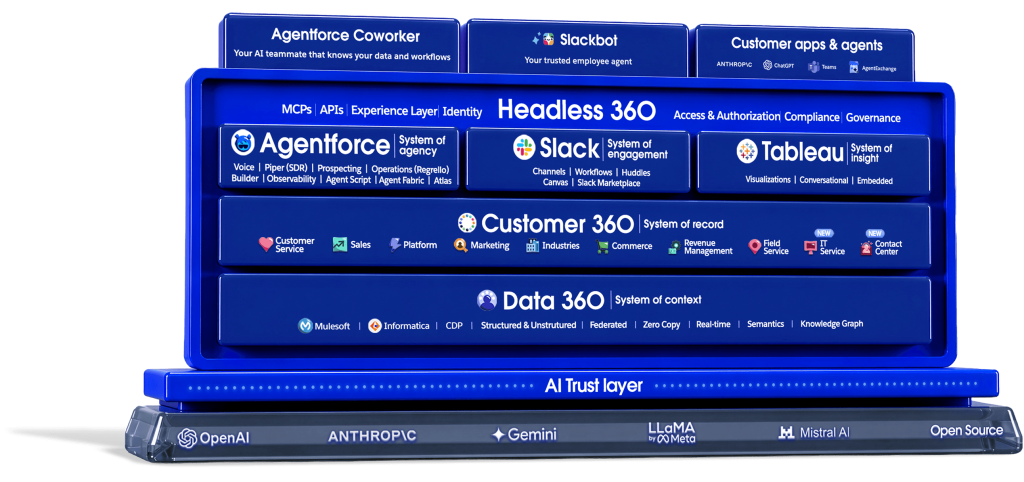
With $41.5 billion in annual revenue and 76,000+ employees across 105 offices in 92 cities, Salesforce has spent 27 years building a platform that handles nearly any business process. Sales Cloud is just the starting point. Add Service Cloud for support, Marketing Cloud for campaigns, Commerce Cloud for storefronts, and Data Cloud for analytics, and you have a system for the entire customer lifecycle.
But that breadth has a cost.
Salesforce acknowledges it was historically built for enterprises. Configuration beyond the basics requires trained administrators. Over 70% of implementations are partner-led, adding cost and time. And Salesforce's own data shows that 72% of sales reps' time goes to non-selling activities on traditional CRMs.
Source: Salesforce
For a 5-person sales team that needs to start calling tomorrow, Salesforce is overkill. For a 500-person organization that needs sales, service, marketing, and analytics on one platform, Close can't keep up.
Communication: built-in vs. build-it-yourself
This is where Close's design pays off most clearly.
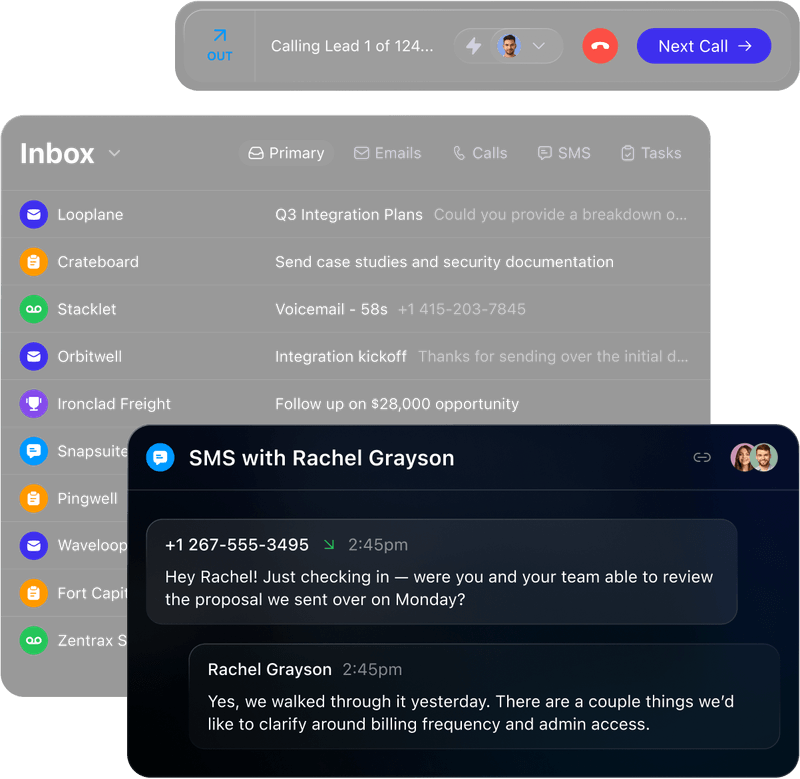
Close embeds calling, email, and SMS in the CRM.
Reps call with one click from any lead page. The Power Dialer works through a list one by one, while the Predictive Dialer calls multiple numbers at once and connects reps only when someone answers. Texts go from the same interface. Every interaction logs automatically to the lead's timeline.
Close also handles meetings through calendar sync, native Zoom integration, and AI meeting transcription. The recently launched Close Notetaker joins meetings automatically to record, transcribe, and summarize conversations.
Source: Close
Salesforce approaches communication differently.
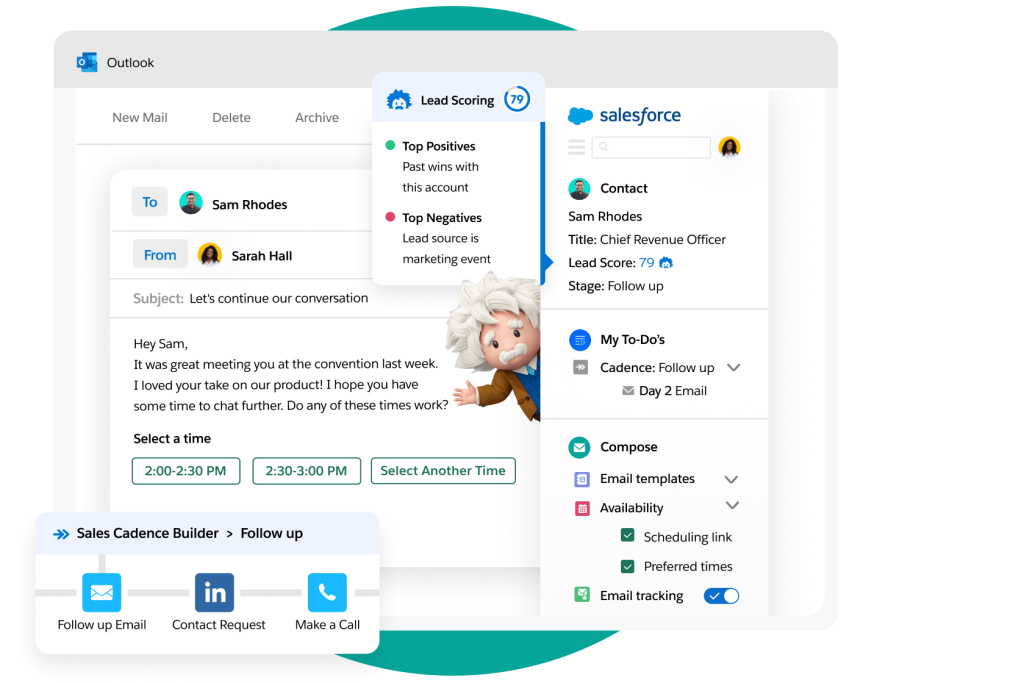
The platform handles email through Einstein Activity Capture, which syncs with Gmail and Outlook. But native calling requires add-ons or third-party tools.
Salesforce's strength is its ecosystem: connect Gong for conversation intelligence, Outreach or Salesloft for sequences, and any dialer through AppExchange. You assemble the stack you want. Sales Engagement features like cadences and a prospecting center exist, but they sit alongside the broader platform rather than forming its core.
This flexibility works for enterprise teams with specific requirements for each channel. For small teams, it means more subscriptions, more configuration, and more places where data falls out of sync.
Source: Salesforce
Automation and AI follow the same divide
Close's automation reflects its market: practical, focused on sales.
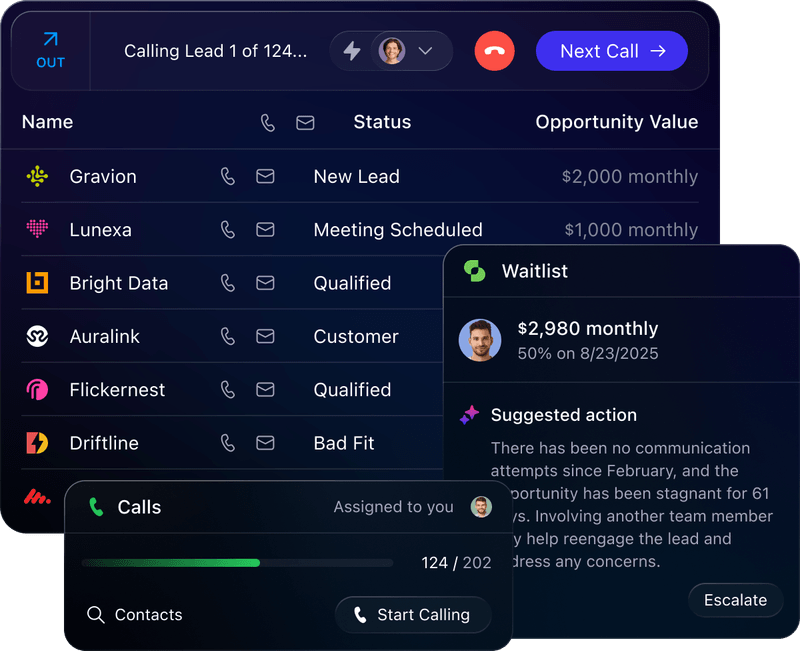
Workflows on the Growth and Scale plans automate follow-ups, lead routing, task creation, and CRM updates based on triggers like lead creation, email opens, or call outcomes. Each workflow uses a trigger-step-run structure with configurable communication windows (defaulting to Monday-Friday, 9 AM to 4 PM in the contact's timezone) so automated emails don't arrive at 2 AM.
Workflow Goals pause sequences automatically when prospects respond, preventing the awkward "sorry for the automated follow-up" moment.
Source: Close
Close's AI features include Call Assistant for transcription and summaries, AI email rewriting with tone adjustment, AI-generated lead summaries analyzing the last 90 days of activity, and AI Enrich for data enrichment at $0.05 per field.
Close also launched an MCP Server connecting the CRM to AI assistants like Claude and ChatGPT. These tools help individual reps, but they aren't built to orchestrate enterprise processes.
Salesforce's AI ambitions are larger.
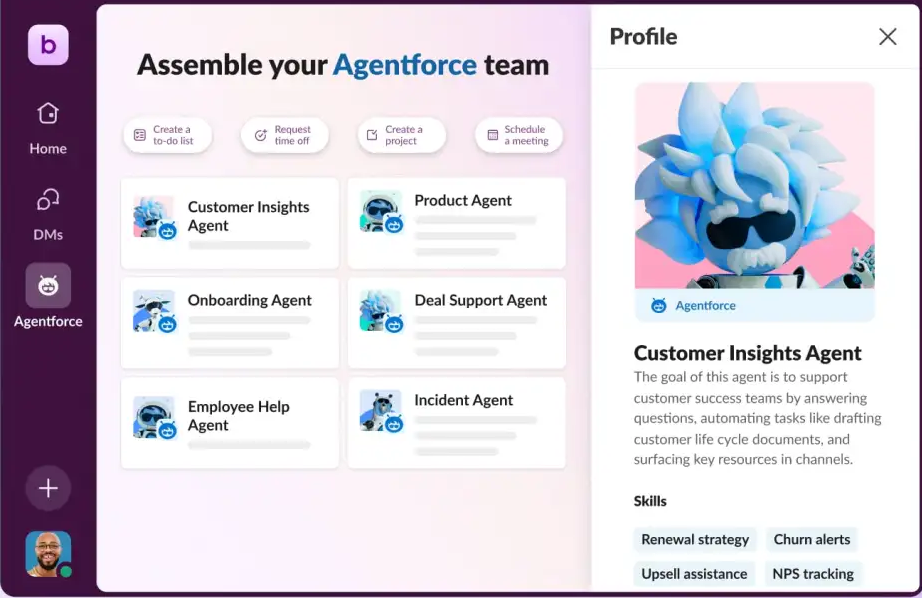
Agentforce, powered by the Atlas Reasoning Engine, deploys autonomous AI agents that handle prospecting, lead engagement, sales coaching, quoting, and customer service without constant human input. These include pre-built agents like SDR Agent, Sales Coach, Personal Shopper, and Campaign Assistant.
Source: Salesforce
The AI gap between the two will likely widen. Salesforce is investing billions in Agentforce and acquiring companies (like Qualified, Cimulate, and Momentum) to expand those capabilities. Close invests in AI for its audience, but operates with a different resource base.
The data problem neither CRM solves
Here's what Close and Salesforce share: they're only as good as the data inside them.
Close gives you a fast CRM. Salesforce gives you a customizable one. But neither tells you who to call next, when to reach out, or why a deal is stalling. They record what happens after a rep acts. They don't surface what should happen before.
A CRM can track that a deal moved from stage 2 to stage 3. It can't tell you that the CFO just joined the buying committee, that the company is researching your competitor, or that accounts with this signal pattern close 2x more often. That context lives outside the CRM.
This is where ZoomInfo fits.
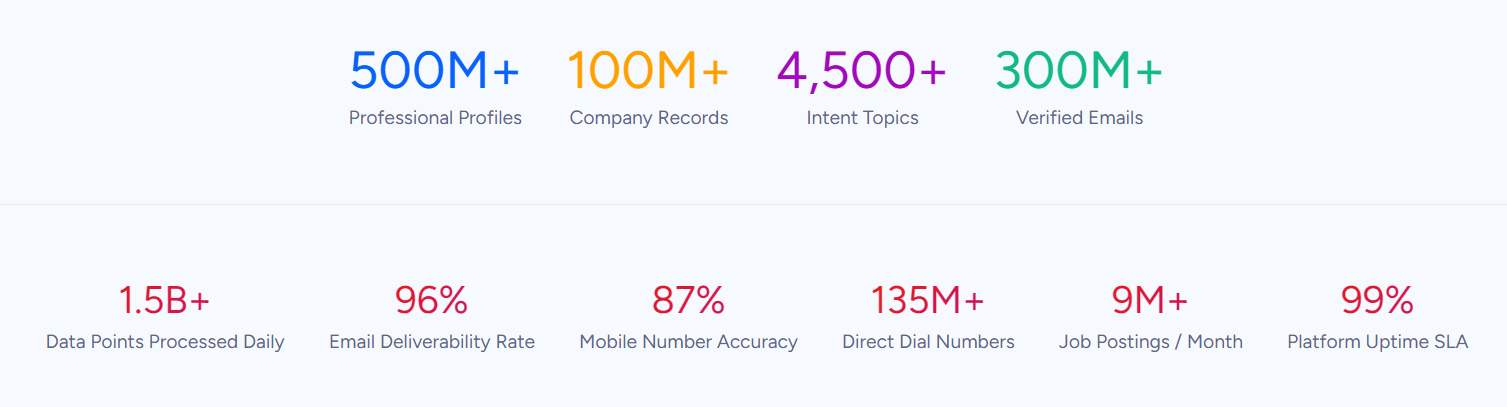
ZoomInfo's B2B data platform provides the contacts, company intelligence, and buying signals that CRMs don't generate. Instead of reps researching prospects manually or relying on purchased lists of unknown quality, ZoomInfo delivers 120M direct-dial phone numbers and 200M+ verified business email addresses, backed by 300+ human researchers and up to 95% accuracy on first-party data.
In a Fortune 500 competitive RFP analyzing 25 million contacts across vendors, an independent consultant concluded that "no other competitor came even close."
Source: ZoomInfo
But the data is the foundation, not the whole story.
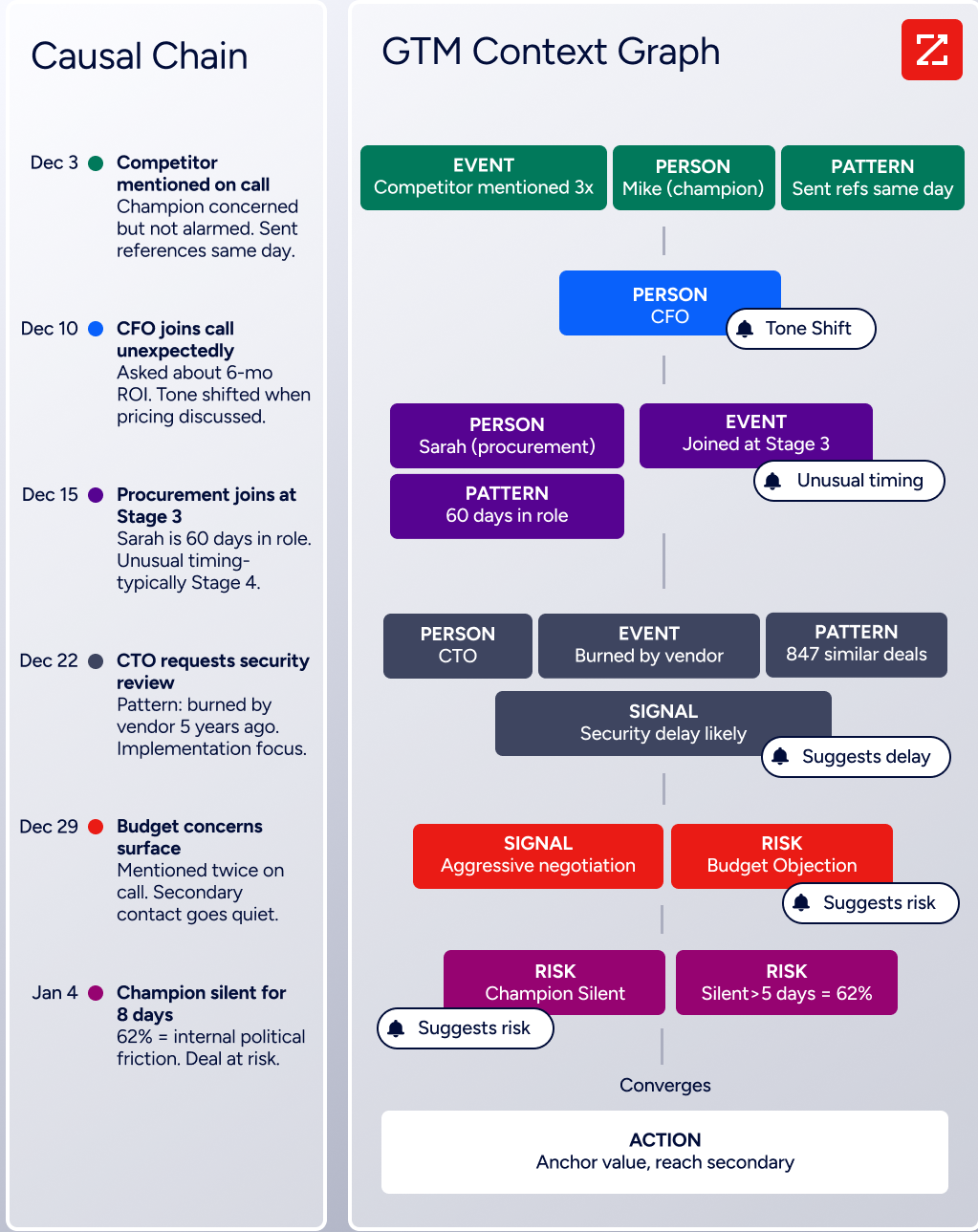
ZoomInfo's GTM Context Graph combines ZoomInfo's third-party intelligence with your CRM records, conversation transcripts, and behavioral signals, processing 1.5B+ data points daily.
As ZoomInfo's CPO Dominik Facher writes: "The CRM recorded the state change. It has no record of why it happened." The GTM Context Graph captures that missing context, connecting people, actions, patterns, and outcomes so AI can reason about what's actually happening in a deal.
Source: ZoomInfo
Buyer Intent data tracks signals from 210 million IP-to-Organization pairings and 6 trillion+ new keyword-to-device pairings sourced monthly. Guided Intent, exclusive to ZoomInfo, identifies topics historically correlated with closed deals rather than requiring manual topic selection. WebSights resolves anonymous website traffic to companies, including buying team identification and direct contact info.
For Close users, ZoomInfo fills gaps a small-team CRM wasn't designed to cover: prospecting data, intent signals, and account intelligence. For Salesforce users, ZoomInfo enriches the CRM data already there, turning a record-keeping system into an intelligence-driven pipeline.
Seismic's sales team attributed 39% of active pipeline to opportunities identified or influenced by ZoomInfo signals, while boosting productivity by 54%. CBO Toby Carrington said: "That combination of our internal CRM data, external signals, and AI that's given all that context has helped us craft very specific account- and persona-based messages." (Seismic case study)
For a direct comparison of how Salesforce and ZoomInfo stack up against each other, see our Salesforce vs. ZoomInfo comparison.
ZoomInfo works inside whichever CRM you pick
ZoomInfo doesn't replace your CRM. It works inside it, alongside it, or through any third-party tool you prefer.
You can access ZoomInfo's intelligence three ways:
GTM Workspace is the seller's front end. It pulls together your CRM data, ZoomInfo signals, conversation history, and market intelligence into one workspace with AI agents that handle account research, outreach drafting, CRM updates, and signal monitoring. The AI, built on Anthropic's Claude, answers three questions for every rep: who to contact, when to engage, and what to say.
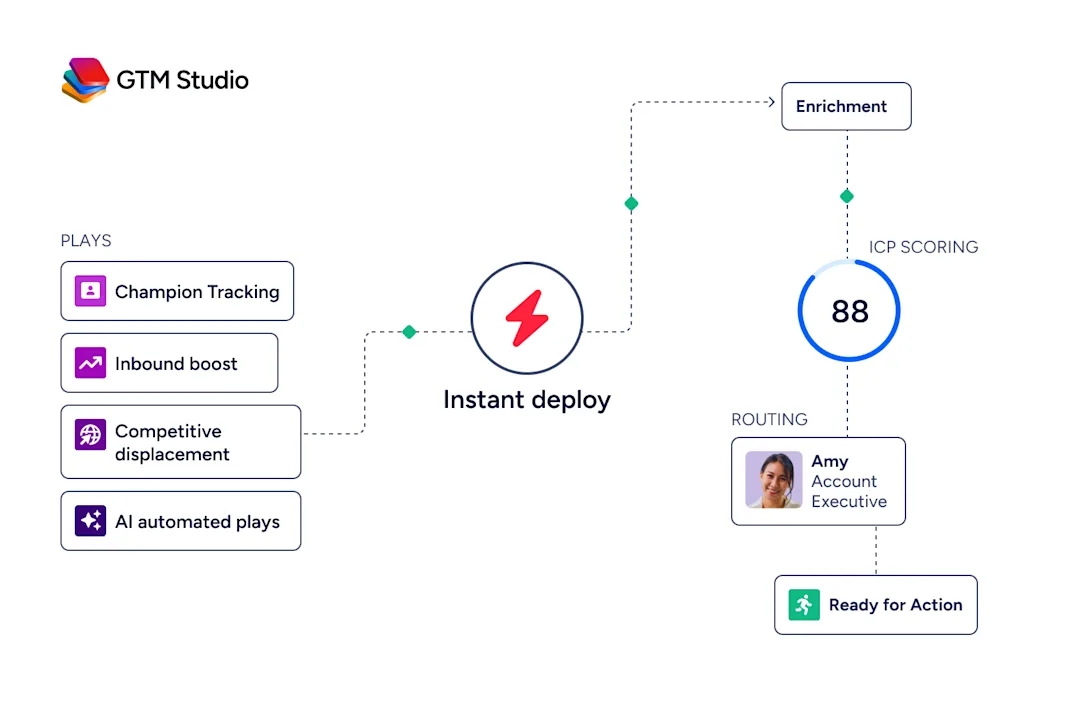
GTM Studio gives marketers, RevOps, and GTM engineers a canvas to build audiences in natural language, enrich data, set triggers, and launch multi-channel campaigns. Expansion plays that used to take 3 weeks now launch in 30 minutes, without engineering support.
Source: ZoomInfo
APIs and MCP expose the same intelligence to any custom agent, internal tool, or partner platform. ZoomInfo MCP is listed in the Claude directory and supports Claude and ChatGPT. API access is included in all relevant plans.
All three draw from the same GTM Context Graph. Same data, same intelligence, same model that keeps learning. Where you work doesn't limit the intelligence available.
Smartsheet's Thor Sanderson, Senior Manager of Sales Technology Enablement: "ZoomInfo is our one source of truth for account data, and even more so for contact data. There's no other provider in the market that provides you with that level of detail." (Smartsheet case study)
Pricing reveals who each platform serves
Close's pricing is transparent:
Solo: $9/seat/month (annual) or $19/month (monthly), limited to 1 user and 10,000 leads
Essentials: $35/seat/month (annual) or $49/month, unlimited contacts and leads
Growth: $99/seat/month (annual) or $109/month, adds workflows, Power Dialer, and AI features
Scale: $139/seat/month (annual) or $149/month, adds role-based permissions, Predictive Dialer, and Custom Objects
Additional costs include per-minute calling via Twilio's pricing, SMS per unit, and AI tools (Call Assistant at $0.02/minute, AI Enrich at $0.05/field). No contracts required on any plan. A 14-day free trial is available with no credit card needed.
Salesforce's pricing takes more navigation:
Free Suite: $0/user/month, max 2 users with basic lead management
Pro Suite: $100/user/month (annual required)
Enterprise: $175/user/month (annual required)
Unlimited: $350/user/month (annual required)
Agentforce 1: $550/user/month (annual required)
Per-seat pricing is just the start.
AI costs extra via Flex Credits at $500 per 100,000 credits. The Premier Success Plan adds 30% of net license fees for priority support and coaching. Digital engagement ($75/user/month), contact center ($150/user/month), and field service (from $175/user/month) are separate add-ons.
Implementation typically requires partners, adding further cost. And Enterprise/Unlimited list prices increased by an average of 6% in August 2025.
ZoomInfo uses custom-quoted, consumption-based pricing with no public prices.
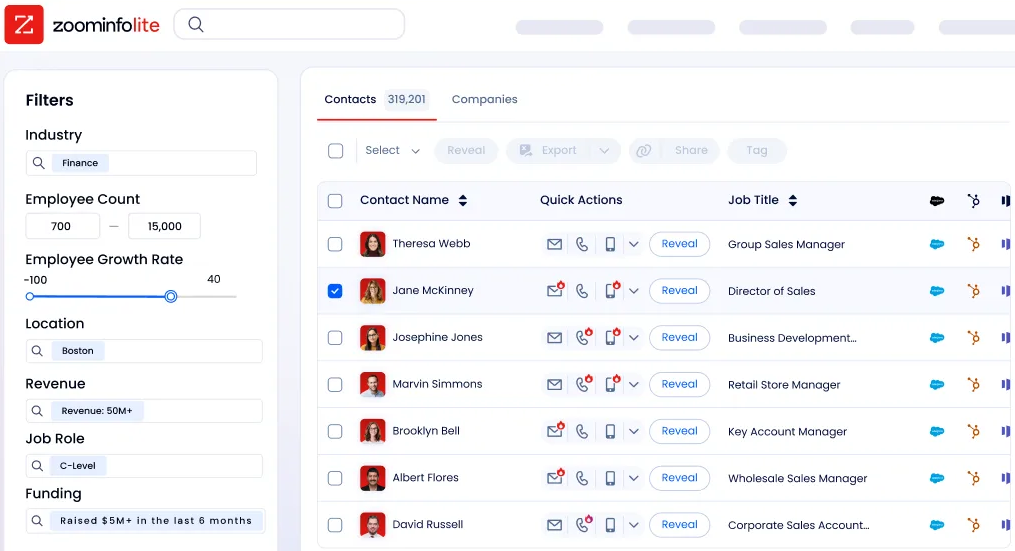
Plans divide into Sales tiers (Professional, Advanced, Enterprise) and Marketing tiers (Marketing Demand, ABM Lite, ABM Enterprise), priced by seats, credits, and feature access. Credits are straightforward: 1 credit equals 1 export of a professional or company profile; searching and viewing data costs nothing.
ZoomInfo Lite provides a permanent free tier with access to the B2B database and 10 monthly export credits, while a 7-day free trial offers broader access.
Source: ZoomInfo
The comparison that matters isn't per-seat cost alone. It's the total cost of the sales stack.
A Close team paying $99/seat/month plus Twilio charges has a predictable bill. A Salesforce team at Enterprise tier pays $175/seat/month before add-ons, implementation, and administration.
Adding ZoomInfo to either stack is an investment, but teams report clear returns: Snowflake saw accounts tracked with ZoomInfo-powered scores show 90% higher opportunity open rates and 2x higher customer conversion rates.
Implementation and learning curve
Close can be running in days.
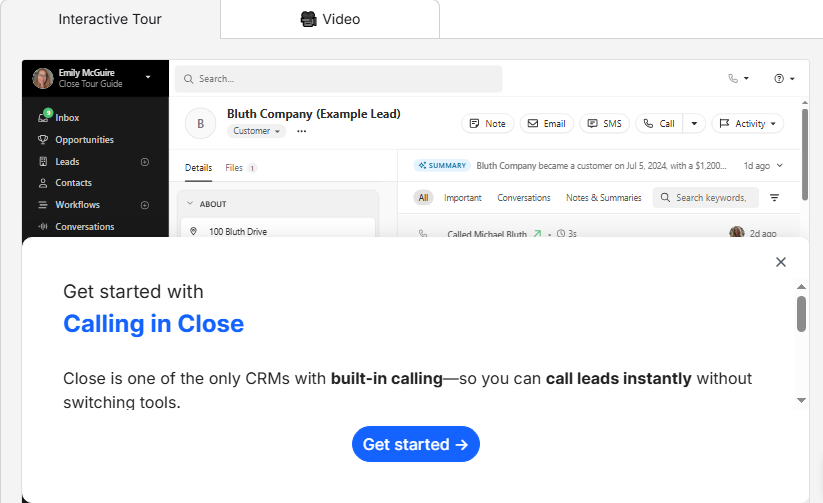
The onboarding process is an 11-step guided experience with interactive demos and video tutorials, plus a Sales Playmaker tool to help teams define their sales process first.
Source: Close
Salesforce's timeline depends on scope.
A basic Sales Cloud deployment takes weeks. An enterprise multi-cloud deployment with custom objects, integrations, and Agentforce configuration can take 3-12 months. Salesforce provides Trailhead with 6+ million learners and 1,500+ badges for training. The Trailblazer Community spans 20 million members across 1,300+ local groups in 90 countries. The community is strong, but serious configuration requires dedicated administrators.
ZoomInfo sits between the two.
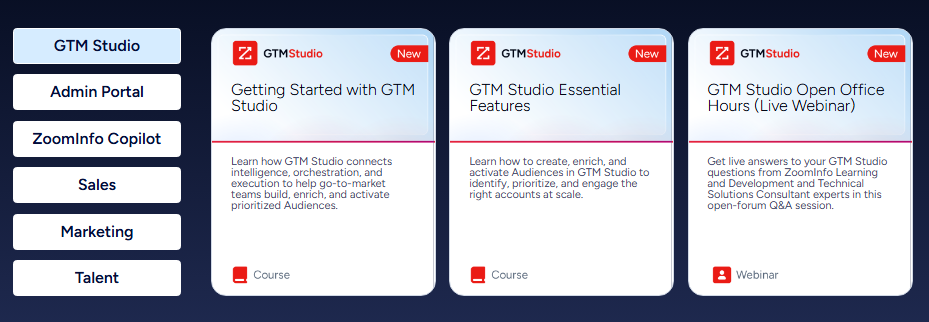
The platform's breadth requires onboarding investment, but ZoomInfo redesigned its onboarding into a structured 90-day program covering planning, technical setup, education, and adoption, producing a 25% improvement in CSAT. GTM Workspace "deploys in weeks, not months". ZoomInfo University provides role-specific learning paths for Sales, Marketing, and Administrator roles.
Source: ZoomInfo
Where each platform falls short
No platform does everything well. Knowing the limits helps you build the right stack.
Close's limitations:
No native marketing automation: you need separate software for marketing workflows, landing pages, or social campaigns
Limited customization on lower tiers: restricted custom fields and advanced views on Solo and Essentials
Not built for enterprise complexity: lacks the CRM objects and cross-department workflows large organizations need
Features target SaaS sales: the platform emphasizes closing deals, not post-sale retention
SMS limited to selected countries with per-unit charges on top of subscription pricing
No free plan beyond the 14-day trial
Salesforce's limitations:
Pricing complexity that Salesforce itself acknowledged "needed to be easier to understand, more predictable, and more flexible"
Data readiness barrier: CEO Marc Benioff acknowledged "you have got to get your data right" before AI features deliver value
Implementation typically requires partner firms, adding cost and extending timelines
The full platform demands dedicated administration that small teams can't justify
Multiple credit types, consumption tiers, and add-on layers confuse buyers (a Gartner survey cited by Salesforce found 90% of CIOs say managing AI costs limits value)
ZoomInfo's considerations:
Custom-quoted pricing means you can't see costs before talking to sales
As a data and intelligence platform, it complements your CRM rather than replacing it
The full platform (GTM Workspace, GTM Studio, APIs, Chorus) requires onboarding investment
Premium pricing that benefits from documented ROI to justify
Close vs. Salesforce vs. ZoomInfo: Which should you choose?
The decision depends on your team size, sales process, and where you need the most help.
Choose Close if:
You run a small outbound sales team (1-25 reps) focused on inside sales
Built-in calling, email, and SMS in one tool matters more than customization
You want to be making calls within days, not weeks
Your sales process is straightforward: find leads, reach out, close deals
Budget matters and you want predictable per-seat pricing
Choose Salesforce if:
You need a CRM that scales across sales, service, marketing, and commerce
Customization, complex workflows, and cross-department visibility are requirements
You have the budget and staff to implement and administer an enterprise platform
AI-powered autonomous agents for sales, service, and marketing are on your roadmap
Your organization is large enough to justify the investment in training and administration
Add ZoomInfo to either CRM if:
Your reps spend too much time researching prospects instead of selling
Your CRM data is incomplete, outdated, or doesn't show who's ready to buy
You need verified contact data, buyer intent signals, and account intelligence
You want AI that understands why deals move, not just that they moved
You're ready to turn your CRM from a record-keeping system into a pipeline engine
Start with ZoomInfo Lite for free or request a demo to see the full platform.
A CRM organizes your sales process. But the quality of the data flowing through it determines whether that process generates revenue or just tracks activity. Close gives small teams a fast CRM. Salesforce gives large organizations a configurable platform. ZoomInfo gives both the verified data, buying signals, and context that turns sales activity into closed deals.
Vensure's William Kenimer, Vice President of Revenue Operations: "ZoomInfo gives us the information we need to execute. We don't have to go through and spend our time digging. It's already there, so we can be three steps ahead." (Vensure case study)
Close vs. Salesforce vs. ZoomInfo FAQ
What is the core difference between Close, Salesforce, and ZoomInfo?
Close is a CRM for small outbound sales teams, with built-in calling, email, and SMS to reduce tool-switching and data entry.
Salesforce is an enterprise CRM platform spanning sales, service, marketing, commerce, and AI-powered agents, serving organizations of any size with extensive customization.
ZoomInfo is a B2B data and go-to-market intelligence platform that provides verified contact data, company intelligence, and buying signals that CRMs need but don't generate.
Which platform is cheapest for a small sales team?
Close is the most affordable CRM option, starting at $9/seat/month on an annual plan for a solo user. Salesforce offers a free CRM for up to 2 users and a Starter Suite at $25/user/month, but useful features like customization, quoting, and forecasting require the $100-175/user/month tiers plus annual contracts.
ZoomInfo uses custom-quoted pricing for paid plans but offers ZoomInfo Lite as a permanent free tier with access to its B2B database and 10 monthly export credits.
Can ZoomInfo replace Close or Salesforce?
No. ZoomInfo is not a CRM. It provides the data, intelligence, and signals that feed your CRM and make it more effective. ZoomInfo integrates with Salesforce, HubSpot, and other CRMs, and its GTM Workspace gives sellers an AI-powered workspace alongside their existing CRM.
The most effective sales stacks pair a CRM for pipeline management with ZoomInfo for prospect data and buying signals.
Which CRM is better for high-volume outbound sales teams?
Close was built for high-volume outbound selling. Its Power Dialer and Predictive Dialer, native SMS, and automated email sequences are all built in, no third-party integrations needed. Salesforce supports outbound sales through add-ons and partner tools like Salesloft or Outreach, but the communication stack is assembled from separate parts rather than built into the core product.
How does Salesforce's AI compare to Close's?
Salesforce's Agentforce platform deploys autonomous AI agents that handle prospecting, lead engagement, coaching, and customer service, backed by the Atlas Reasoning Engine and $800M in annual recurring revenue. Close's AI is more focused: call transcription and summaries, email rewriting, lead summaries, and data enrichment at $0.05 per field.
Salesforce's AI scope is broader, but Close's focused approach means its features work without extensive configuration.
Does ZoomInfo integrate with both Close and Salesforce?
ZoomInfo has a native Salesforce integration in its App Marketplace, enabling direct data enrichment, lead routing, and signal delivery within Salesforce. Close is not a native ZoomInfo integration, but data can be exported from ZoomInfo into Close or connected through Zapier and APIs. ZoomInfo also offers API and MCP access for custom integrations with any tool, and API access is included in all relevant plans.
Which platform has the best reporting and analytics?
Salesforce leads in reporting depth, with customizable dashboards, Einstein AI forecasting, and Tableau for advanced analytics. Close offers real-time reports covering pipeline stages, rep activity, opportunity funnels, and deal velocity, built for sales managers who need answers without writing SQL. ZoomInfo provides analytics focused on go-to-market execution: engagement tracking, funnel progression, and AI-powered dashboards through GTM Studio.
What happens if I outgrow Close?
Close targets teams of 1-25 salespeople and offers custom pricing for 10+ users, but its limited customization, lack of marketing tools, and absence of enterprise features like complex role hierarchies mean larger organizations often migrate to Salesforce or HubSpot. Adding ZoomInfo to either platform eases that transition by keeping your data and intelligence layer consistent regardless of which CRM you use.
