

Crayon has built a strong reputation as the competitive intelligence platform for B2B sales teams. It automates what used to be a manual discipline: tracking competitors, creating battlecards, and getting the right intel to the right rep at the right time. For companies in crowded markets where deals are won and lost on positioning, that matters.
To write this Crayon review, we've analyzed it extensively. We believe it's the ideal choice if:
You have a dedicated competitive intelligence team or program owner
You need automated monitoring of competitor websites, pricing changes, and product launches
You want AI-powered battlecard creation and distribution integrated into Salesforce and Slack
You're a mid-market or enterprise B2B SaaS company competing in a fast-moving market
Your primary goal is enabling sales reps with competitive talk tracks and objection handling
However, Crayon might not be the best choice if:
You lack dedicated CI resources to manage and evangelize the platform
You need market intelligence that goes beyond direct competitor tracking
You want competitive insights, prospecting data, and buyer intent signals in a single platform
You prefer transparent pricing and a free tier to evaluate before committing
You need your competitive intelligence connected to verified contact data and deal execution
In this case, you should consider ZoomInfo: an all-in-one AI GTM platform that embeds competitive intelligence within a complete go-to-market execution system.
Where Crayon specializes in tracking competitors and creating battlecards, ZoomInfo provides competitive signals alongside 500M contacts, 100M companies, 135M+ verified phone numbers, and 200M+ verified business emails, unified by a GTM Context Graph, an intelligence layer that captures not just what happened in a deal, but why.
Because of that, we've included a detailed look at ZoomInfo later in this Crayon review, as the natural next step for teams that want competitive intelligence integrated into their broader GTM execution. If you're ready to explore a platform that connects competitor insights to data, intent signals, and AI-powered outreach, you can start with ZoomInfo's free trial here.
What is Crayon?
Crayon is a competitive intelligence platform co-founded in 2015 by Jonah Lopin and John Osborne in Boston, Massachusetts. Lopin, previously VP of Customer Success at HubSpot, built Crayon to transform competitive intelligence from a manual research discipline into a software-driven one.
The platform monitors more than 300 million pages across 7.6 million domains and 2.4 million companies, using AI and machine learning to surface insights about competitors. It has been named a Leader in The Forrester New Wave for Market And Competitive Intelligence Platforms and voted the Competitive Intelligence Leader in the PMA Pulse for three consecutive years.
With $36.35 million in total funding across seed and Series B rounds, Crayon serves B2B SaaS companies including Gong, Dropbox, ZoomInfo, Zendesk, Intuit, and Discover. The platform's core value proposition centers on driving competitive wins through automated insights, helping sales teams close more deals by delivering the right competitive intelligence at the right moment.
Crayon's ideal customers are mid-market to enterprise B2B companies with dedicated competitive intelligence roles and established go-to-market teams. The platform targets competitive intelligence professionals, product marketing managers, and sales leaders who need to move their compete programs from reactive, manual efforts to proactive, data-driven operations.
Crayon Pros & Cons
Pros | Cons |
|---|---|
- AI-powered competitor monitoring across millions of pages | - No public pricing; requires sales engagement to evaluate |
- Automated battlecard creation and updates via Sparks | - No free trial or free plan available |
- Deep integrations with Salesforce, Slack, and enablement tools | - Requires dedicated program owner for effective adoption |
- Measurable revenue impact with win/loss analytics | - Data noise and filtering challenges despite AI scoring |
- Crayon Answers provides conversational AI for sales reps | - Scope limited to competitor tracking; no broader market intelligence |
- Unlimited battlecards and users | - Steep learning curve due to feature complexity |
- Captures field intelligence from Gong, Chorus, and Slack | - Adding or modifying tracked competitors can incur delays |
Crayon Review: How it Works & Key Features
Crayon AI: An automated intelligence engine that collects, analyzes, and distributes competitive insights without manual intervention.
Crayon AI is the platform's core differentiator: an automated competitive intelligence system that serves as analyst, content creator, and enablement engine. It addresses the reality that 58% of CI professionals struggle to keep battlecards updated, and only 26% of CI teams update them monthly.
Source: Crayon
The system operates in three phases. First, it collects intelligence from both external sources (competitor websites, news, press releases) and internal ones (call recordings from Gong and Chorus, messaging from Slack and Teams, file storage from Google Drive and OneDrive, and win-loss analysis through Clozd).
Second, it analyzes that data: automatically classifying intelligence into more than 80 subcategories, using NLP to grade sentiment, and tracking trends to alert when significant anomalies occur. Third, it transforms that analysis into sales-ready content.
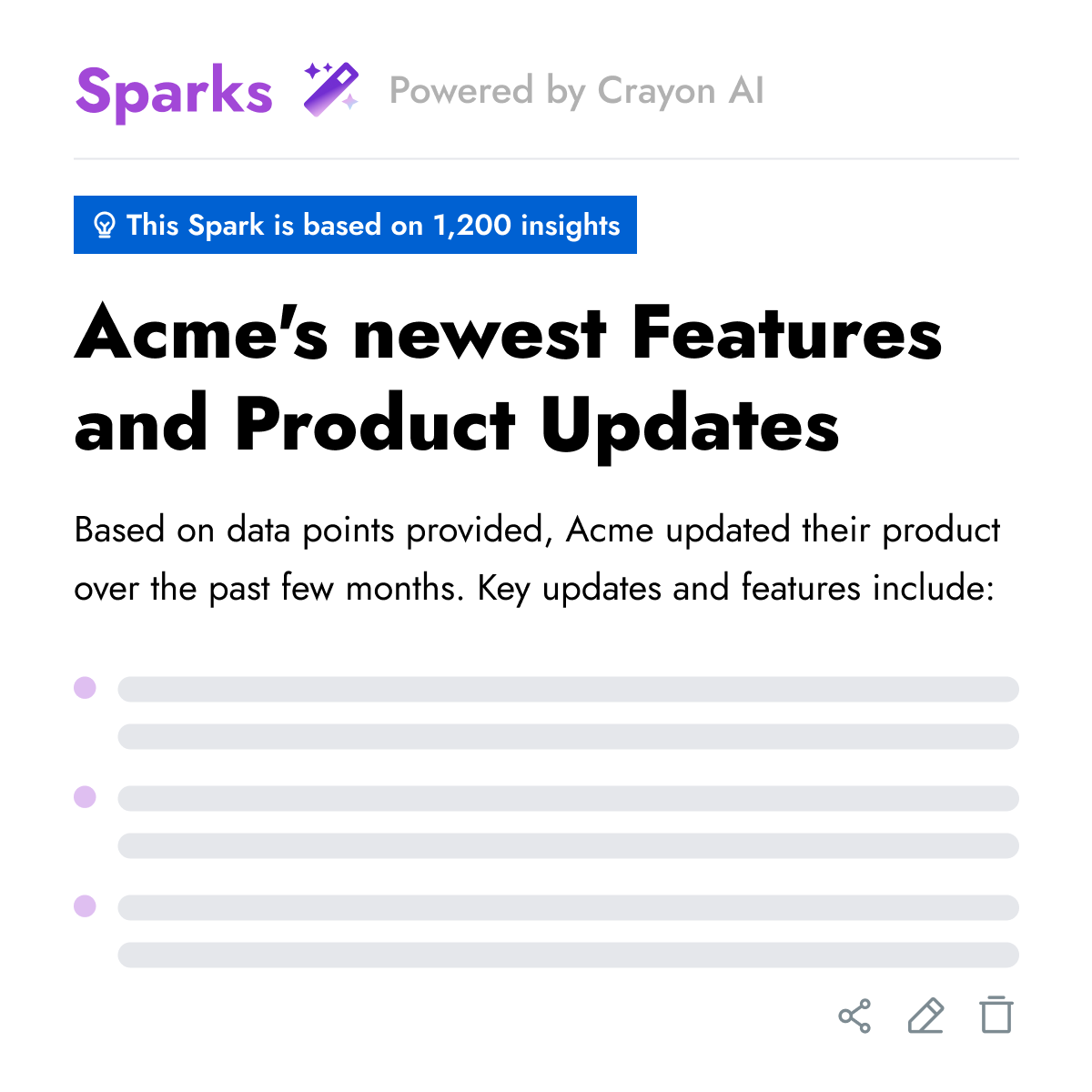
The standout capability here is Sparks, which Crayon calls the industry's first AI agent built for competitive research, analysis, and enablement. Users select a template or write custom prompts, and Sparks generates competitive analysis from hundreds of data points.
It can surface insights from product updates and launches in seconds, run SWOT analyses on news and reviews, and analyze sales calls to find common objections. Sparks can also be scheduled to run automatically on a weekly or monthly basis.
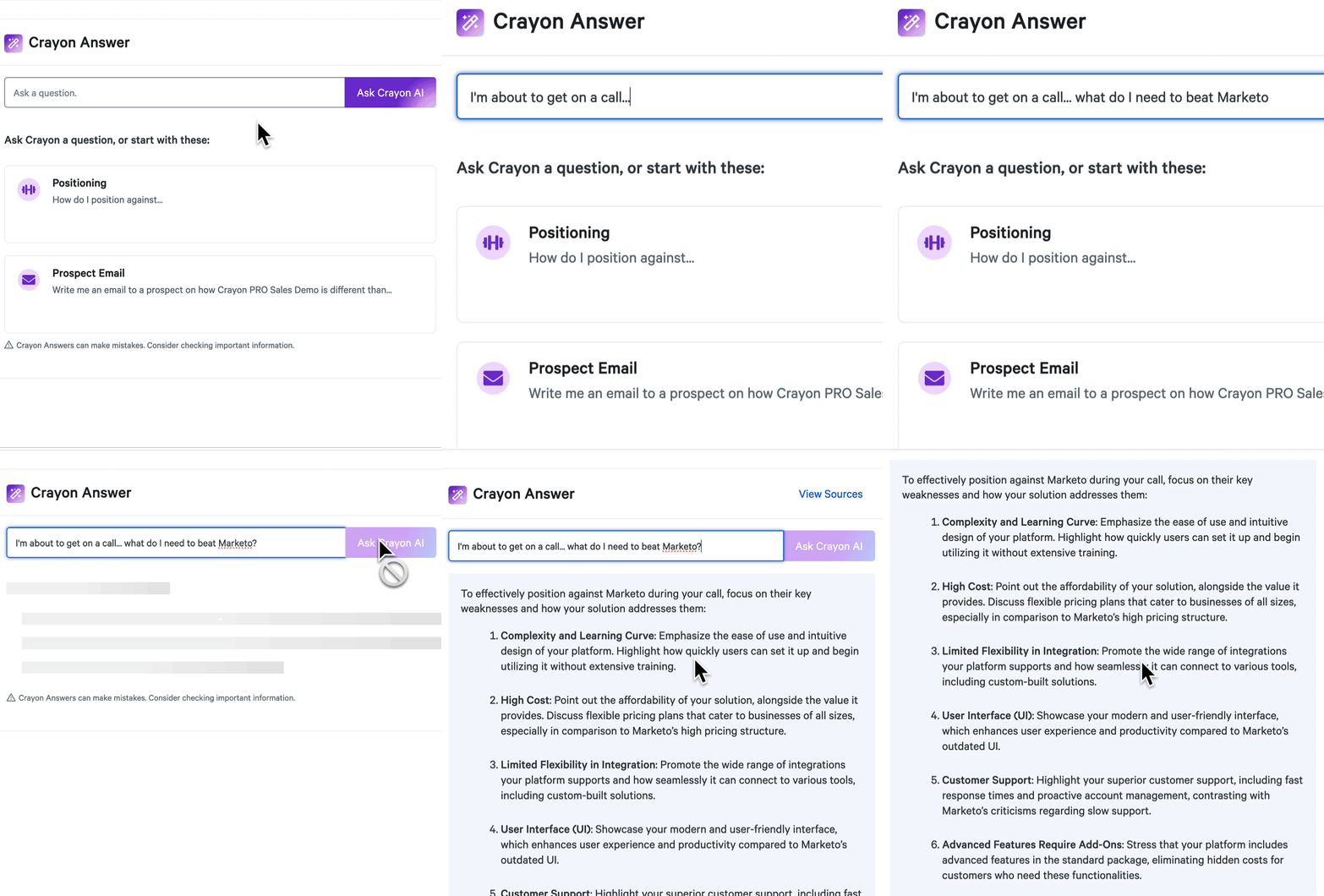
Crayon Answers is the other notable AI feature: a Gen AI compete assistant that gives immediate, conversational answers to pressing competitive questions. Sales reps can type /crayon in Slack followed by their question and get instant, context-aware responses. This addresses the gap between static battlecards and the dynamic questions reps actually face in live deals.
Source: Crayon
Crayon has also launched the industry's first MCP Server for competitive intelligence, connecting competitive data into AI tools like ChatGPT, Claude, Copilot, Glean, and Coveo.
Competitive Monitoring: Crayon tracks competitors' entire digital footprint and aggregates internal field intelligence in one feed.
Crayon's Aggregate feature captures intelligence from multiple layers of the competitive landscape. On the external side, it monitors competitors' entire digital footprint, surfacing meaningful "before and after" changes to web pages in real-time. This includes pricing page updates, product launches, messaging shifts, and executive changes.

Source: Crayon
What distinguishes Crayon's monitoring from basic alerting tools is the internal intelligence layer. The platform taps into actionable intel from buyers, sellers, and live deals through integrations with call recording platforms, messaging tools, and win-loss analysis.
The Slack and Teams integration captures competitive moments from sales team conversations, turning informal mentions of competitors into structured intelligence.
The platform uses machine learning algorithms trained on billions of captured insights to determine what's important. Every time a user interacts with an insight, Crayon's ML gets smarter about what CI leaders consider valuable.
Users can configure the system to send an email every morning with a list of the most important insights from the previous day, and Crayon's AI automatically distills articles about competitors into actionable takeaways.
The system also supports building comprehensive Saved Searches that incorporate win-loss transcripts alongside hundreds of other insight types and includes word cloud and keyword matching tools to uncover potential trends.
Battlecard Creation & Sales Enablement: Crayon builds, distributes, and keeps competitive content current across every sales channel.
Crayon's Publish and Enable features work together to solve a persistent problem: 41% of sales teams don't use battlecards as much as their CI teams would like. The platform attacks both sides of this problem: making battlecards easier to create and making them impossible to miss.
For creation, teams can build battlecards in minutes using proven templates drawn from 13 battlecard templates organized around four strategies.
Source: Crayon
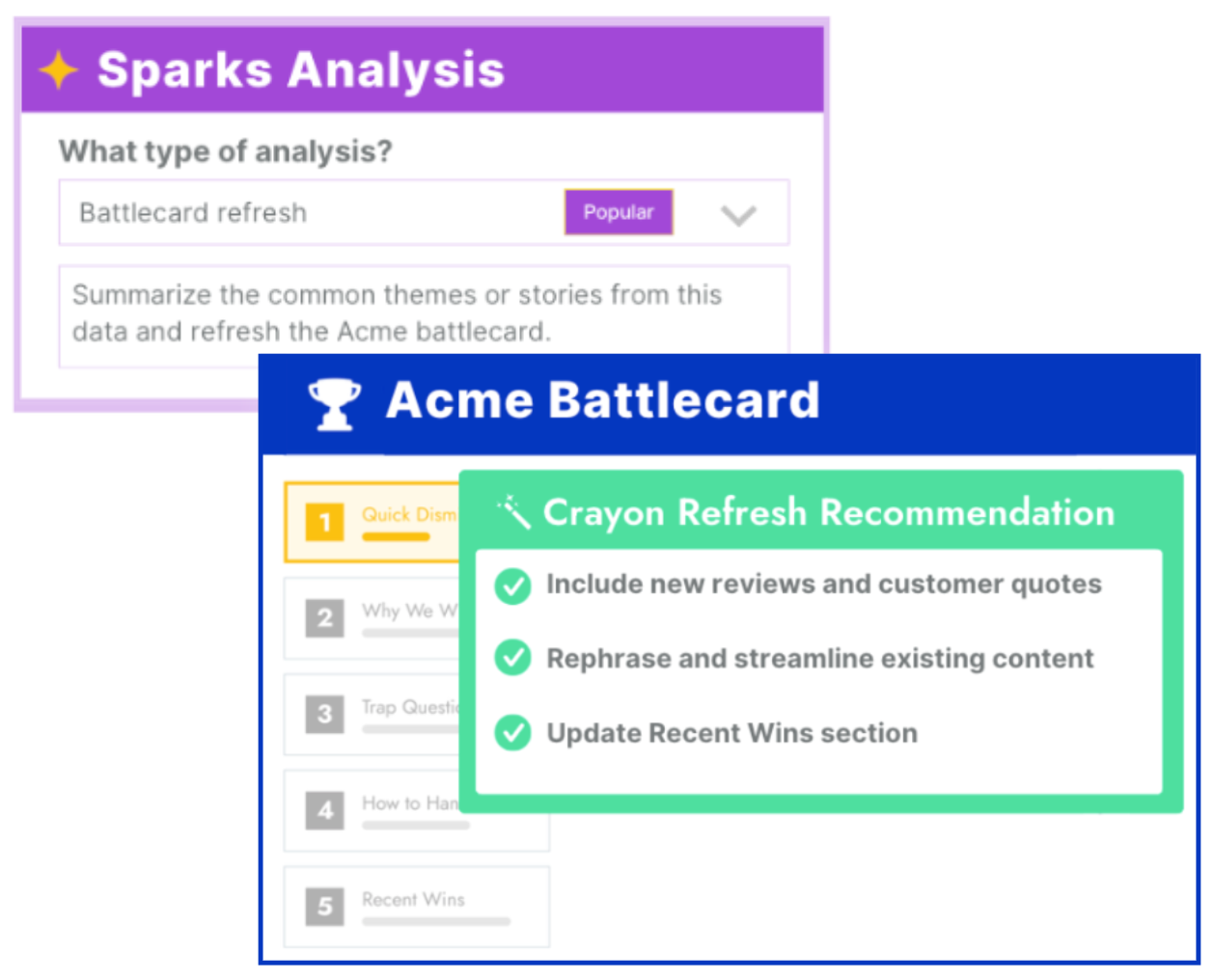
Sparks can auto-generate, update, or create content automatically, and the one-click conversion from Sparks analysis to battlecard updates eliminates the manual bottleneck. Users can also set up custom prompts that run on a schedule, keeping content current without ongoing effort.
For distribution, Crayon embeds competitive content where sales teams already work. Integrations span Salesforce, HubSpot, and FreshSales for CRM (where battlecards embed directly into opportunity records), Slack and Microsoft Teams for communication, and sales enablement tools including Highspot, Seismic, Showpad, and Guru.
Compete Hub serves as a real-time feed where PMMs can designate important updates with a single click. The system automatically summarizes the week's announcements into a single consolidated email, and reps can "like" announcements or start conversations directly within the hub.
The enablement approach is bidirectional. A two-way integration allows team members to send competitive intel from Slack into Crayon in seconds, and reps can submit field intel through Crayon directly or through integrations. This creates a feedback loop where frontline observations flow back into the intelligence system and inform future battlecard updates.
Measurement & Analytics: Crayon connects competitive enablement to revenue outcomes through automated win/loss tracking.
Crayon's Measure module addresses a long-standing challenge: competitive intelligence has historically been perceived as "fluffy", making it difficult to justify program investments. Measure transforms competitive enablement from an unmeasurable cost center into a data-backed function.
Source: Crayon
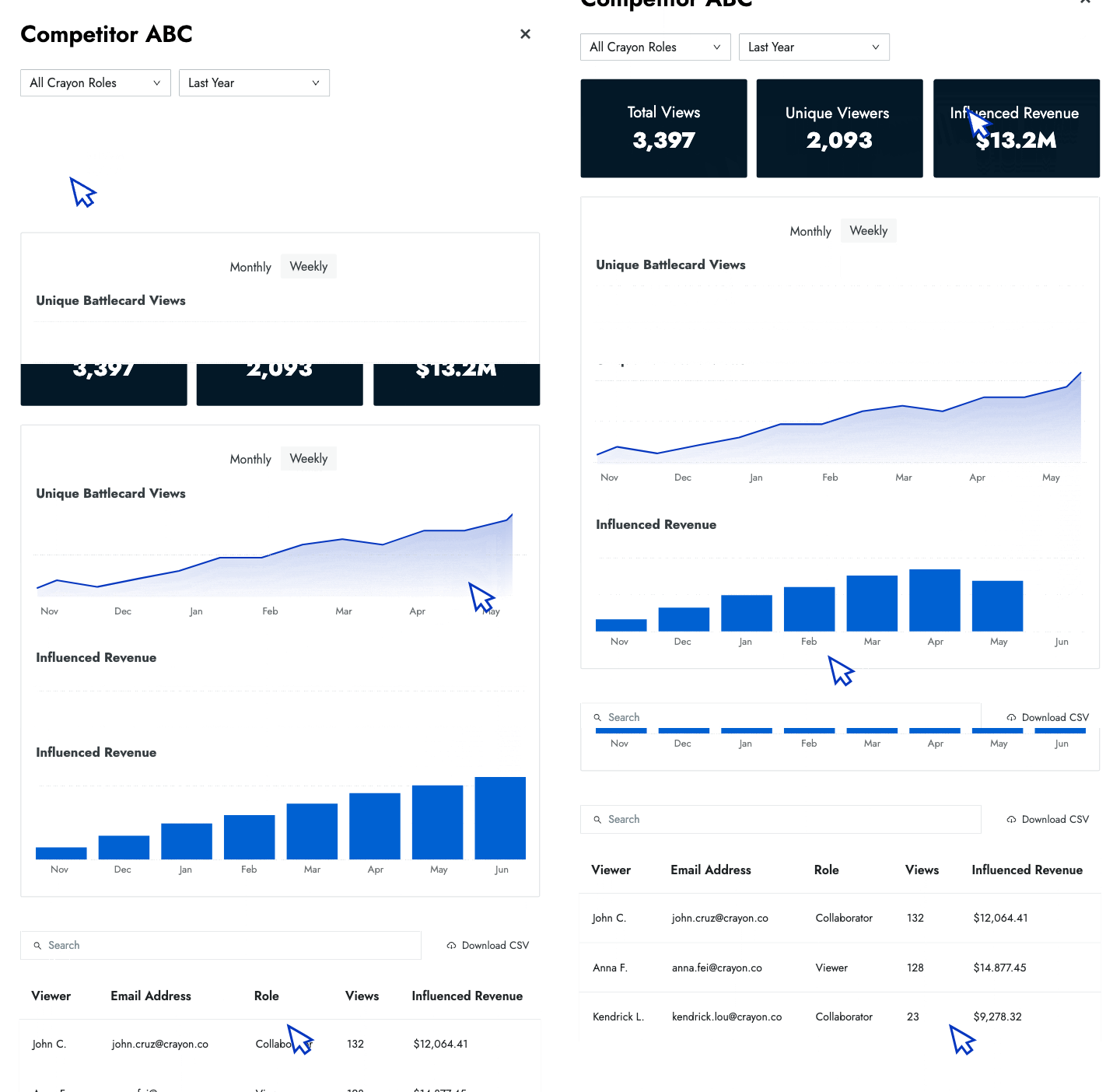
The feature operates through a bidirectional integration with Salesforce, automatically syncing opportunity data in real time. Metrics are captured automatically, eliminating manual exports. The system tracks win rates by competitor, common reasons for wins or losses, and competitive frequency, providing a clear picture of where competitive enablement is making an impact.
The Influenced Revenue metric is particularly useful: it measures the total amount of revenue your sales team won thanks to their usage of compete materials. The calculation is straightforward: if a sales rep views a competitor's battlecard before closing a deal, influenced revenue equals the amount of that closed deal.
Seller Engagement Analytics reveals which sellers are engaging with battlecards AND winning deals, correlating individual rep performance with competitive intelligence usage. The Seller Performance Matrix automatically groups sellers into an easy-to-read matrix based on win rates and battlecard views, helping CI leaders identify which reps need coaching and which are already leveraging the content effectively.
The Competitive Pipeline view helps compete teams and sales managers identify competitive risk in open pipeline opportunities, shifting the function from retrospective analysis to proactive deal support. All visualizations can be downloaded as PNG files for sharing with stakeholders.
Where Crayon Falls Short
While Crayon excels at dedicated competitive intelligence, several limitations become apparent depending on a team's broader go-to-market needs. These reflect a platform deliberately optimized for competitor tracking rather than comprehensive GTM execution.
Narrow Scope Beyond Competitor Tracking: Crayon is built primarily for competitor tracking and sales enablement, and does not offer market intelligence, industry trend monitoring, or the ability to track customers, partners, and other strategic entities beyond direct competitors.
For teams that need to understand the full buying landscape (who the buyers are, what signals they're showing, and how to reach them) alongside competitive positioning, Crayon provides only one piece of the puzzle.
Data Noise Despite AI Filtering: Users report noise as a recurring challenge, with the platform's AI deduplication and relevance filtering being below standard, resulting in cluttered feeds requiring significant manual effort. Despite Crayon's investment in AI scoring and prioritization, the platform outputs a lot of junk data that CI teams must sift through to find actionable intelligence.
Requires Dedicated Program Ownership: Crayon's effectiveness depends heavily on having someone drive adoption. Without a committed owner, adoption with Sales drops quickly, requiring continuous evangelism and stakeholder engagement. This means the platform delivers the most value to organizations that can dedicate headcount to competitive intelligence, a resource smaller teams may not have.
Opaque Pricing and No Free Entry Point: Crayon does not offer a free trial or free plan. The only way to evaluate the platform is to request a demo through the sales team.
Pricing is customized to each program with no published rates, and subscriptions automatically renew unless customers provide 60 days' written notice. Customers who cancel during a subscription period remain obligated to pay for the entire committed period with no refunds.
Scalability Constraints: Reliance on human analysts for data verification slows workflows and limits scalability, with adding or modifying tracked competitors often incurring delays and additional costs. For organizations that need to monitor a large and shifting competitive landscape, this creates friction.
Steep Learning Curve: The platform presents a complex user interface with a steep learning curve due to numerous features and complicated navigation. While Crayon provides thorough onboarding with dedicated Customer Success Managers, the ramp-up time is a consideration for teams already juggling multiple tools.
These limitations aren't failures. They're the natural result of building a focused competitive intelligence tool. But they leave a gap for teams that want competitive insights integrated into a broader system, one that also provides the data, signals, and execution capabilities to act on those insights.
Top Crayon Alternative for Complete GTM Intelligence: ZoomInfo
ZoomInfo addresses Crayon's scope limitations by embedding competitive intelligence within an all-in-one AI GTM platform. Instead of treating competitive intelligence as a standalone discipline, ZoomInfo makes it one layer of a unified system that also provides verified B2B data, buyer intent signals, conversation intelligence, and AI-powered execution.
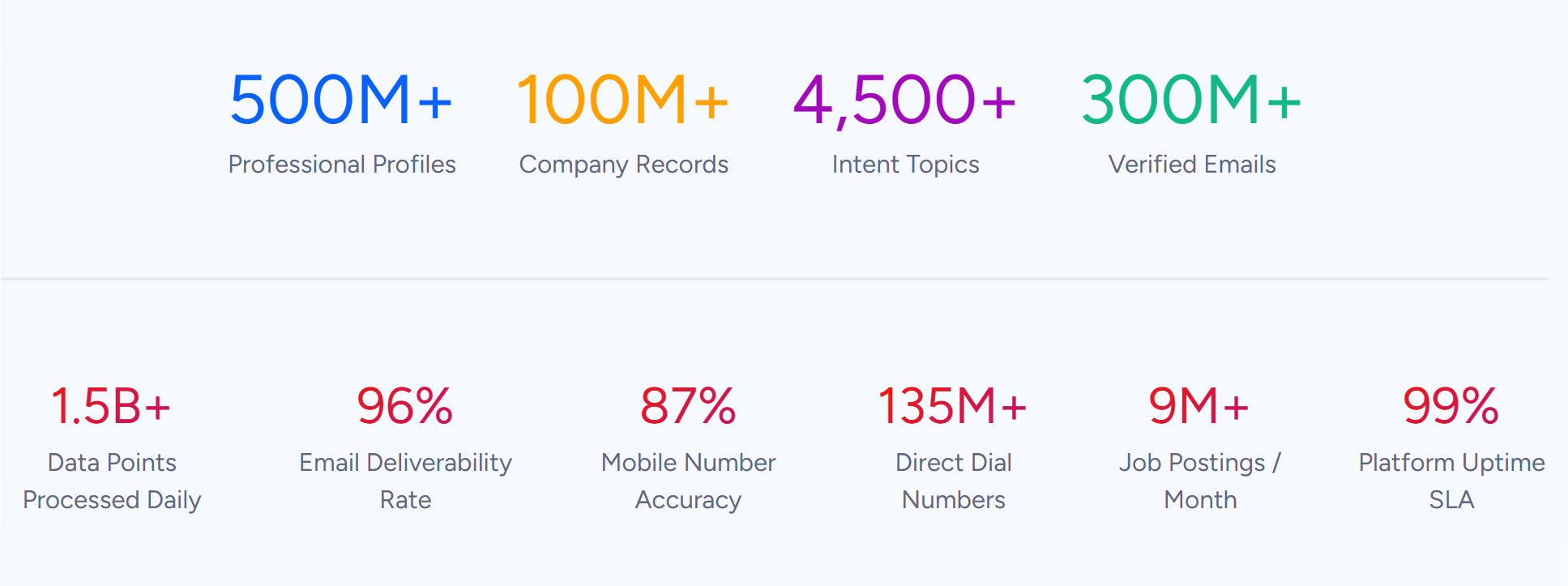
Built on the industry's most comprehensive B2B data foundation (500M contacts, 100M companies, 135M+ verified phone numbers, and 200M+ verified business emails), ZoomInfo fuses this data with your CRM records, conversation transcripts, and behavioral signals through its GTM Context Graph, an intelligence layer that processes 1.5B+ data points daily.
Source: ZoomInfo
The result is a platform that captures not just what competitors are doing, but what your buyers are doing, why deals move or stall, and which actions to take next.
Competitive Intelligence Within a Comprehensive Data Platform: ZoomInfo captures competitive signals alongside the verified contact data and buyer intent needed to act on them.
Where Crayon monitors competitor websites and aggregates external intelligence, ZoomInfo's competitive capabilities are built on a fundamentally broader data layer. Chorus, ZoomInfo's conversation intelligence engine, captures and analyzes all customer calls, meetings, and emails, extracting competitive mentions, objection patterns, and market intelligence at scale.

Source: ZoomInfo
When a prospect mentions a competitor on a sales call, Chorus doesn't just flag the mention; it captures the context: what concern drove it, how the rep responded, and what the outcome was.
This conversation-level intelligence feeds directly into the broader platform. ZoomInfo's Enterprise tier includes competitor alerts that surface competitive signals alongside Buyer Intent data tracking signals from 210 million IP-to-Organization pairings and 6 trillion+ new keyword-to-device pairings sourced monthly.

Source: ZoomInfo
Guided Intent, exclusive to ZoomInfo, identifies topics historically correlated with deal success rather than requiring manual topic selection.
The critical difference is that ZoomInfo connects competitive signals to verified contact data. Knowing that a competitor changed their pricing page is useful; knowing that, combined with the fact that three of your target accounts are researching alternatives and you have verified direct dials for their buying committee, is actionable.
Seismic attributed 39% of active pipeline to opportunities influenced by ZoomInfo signals. As CBO Toby Carrington put it: "That combination of our internal CRM data, external signals, and AI that's given all that context has helped us craft very specific account- and persona-based messages." (Seismic)
The GTM Context Graph: Intelligence that captures why deals move, not just what competitors do.
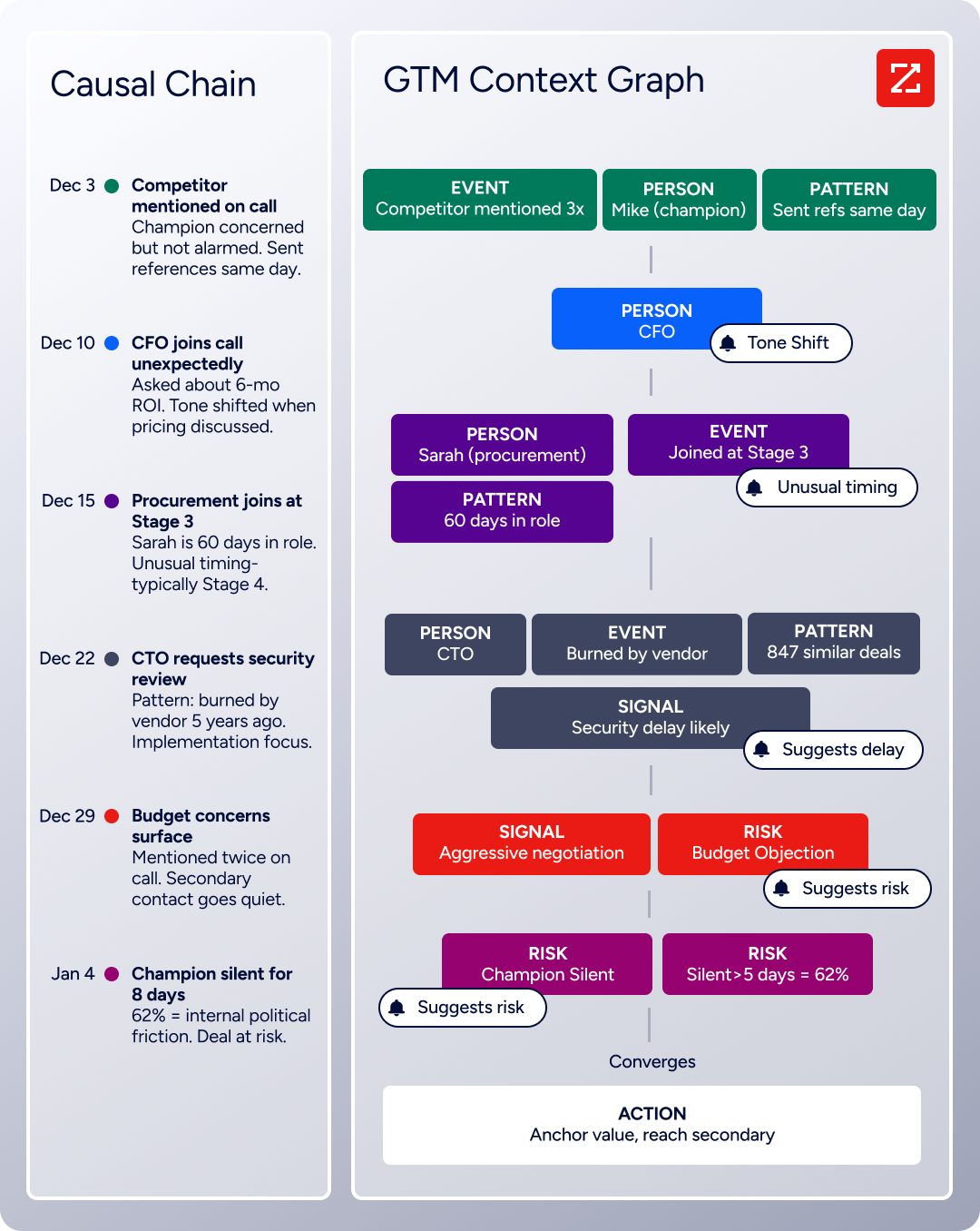
Crayon excels at answering "what are our competitors doing?" ZoomInfo's GTM Context Graph, its intelligence layer, answers a broader question: "why are deals moving or stalling, and what should we do about it?"
Source: ZoomInfo
The GTM Context Graph unifies ZoomInfo's B2B data with a customer's own first-party data: CRM records, conversation intelligence from Chorus, email interactions, and behavioral signals. It then reasons across all of it to capture the connections between signals and outcomes.
As ZoomInfo's Chief Product Officer Dominik Facher writes: "The CRM recorded the state change. It has no record of why it happened." The GTM Context Graph makes that decision context machine-readable.
This means competitive intelligence isn't siloed in a separate tool. When a rep opens an account, they see competitive mentions from recent calls, intent signals showing the account is researching alternatives, org chart changes that indicate a new decision-maker, and AI-drafted outreach that addresses the specific concerns raised in the last conversation. The competitive context is embedded in the execution workflow.
Levanta's CEO Ian Brodie put it directly: "ZoomInfo's not just a contact data company anymore. GTM Intelligence actually works the list, writes the outreach, triggers the play, and helps drive predictable growth." (Levanta)
Universal Access: Use ZoomInfo's intelligence in any tool, any workflow, any AI agent.
Crayon integrates with sales tools to distribute battlecards. ZoomInfo takes a broader approach: its intelligence is accessible through three lanes, ensuring teams work wherever they're most effective.
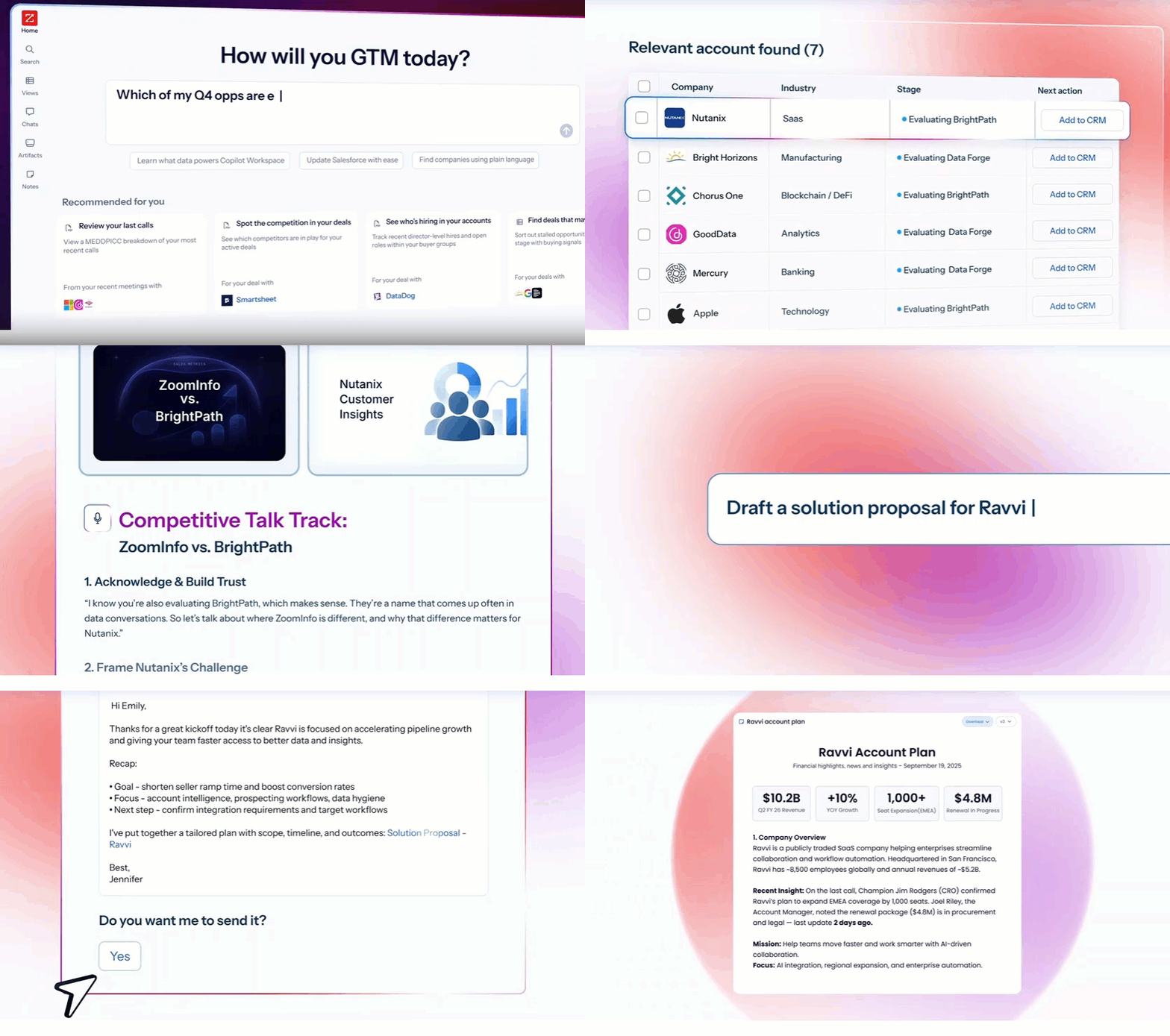
GTM Workspace gives sellers a single execution surface where prioritized accounts, AI-drafted outreach, and deal context converge. Instead of switching between a CI tool, a prospecting database, and a CRM, sellers get everything in one view.
Source: ZoomInfo
AI agents handle researching accounts, generating follow-ups, monitoring signals, and updating CRM fields. Spekit found that opportunities at higher-scoring accounts were 43% more likely to turn into qualified pipeline and moved 58% faster through qualification.
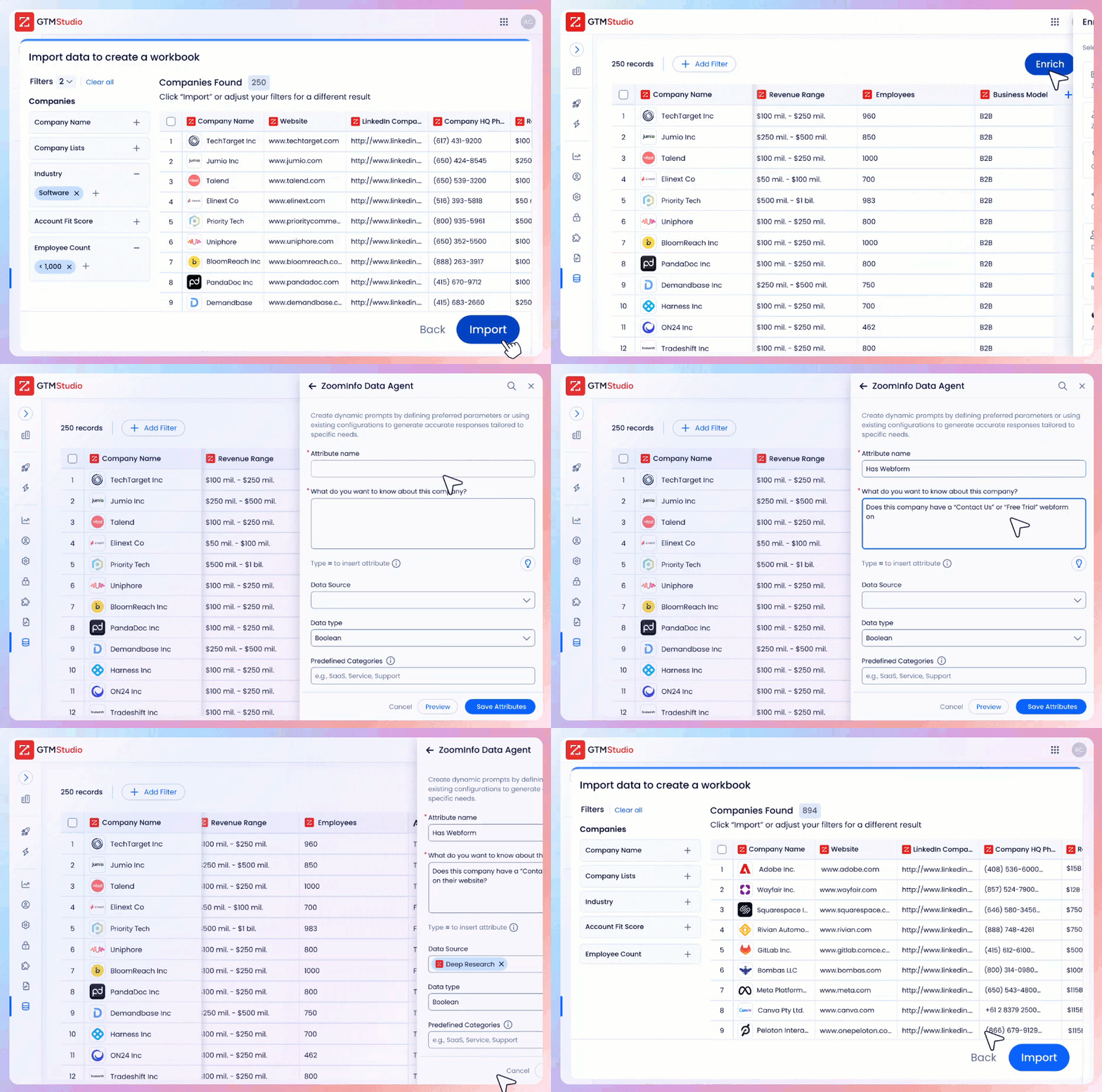
GTM Studio gives marketers, RevOps, and GTM engineers a canvas for designing audience segments, orchestrating campaigns, and launching GTM plays using natural language. Expansion plays that used to take 3 weeks now launch in 30 minutes, without engineering support.
Source: ZoomInfo
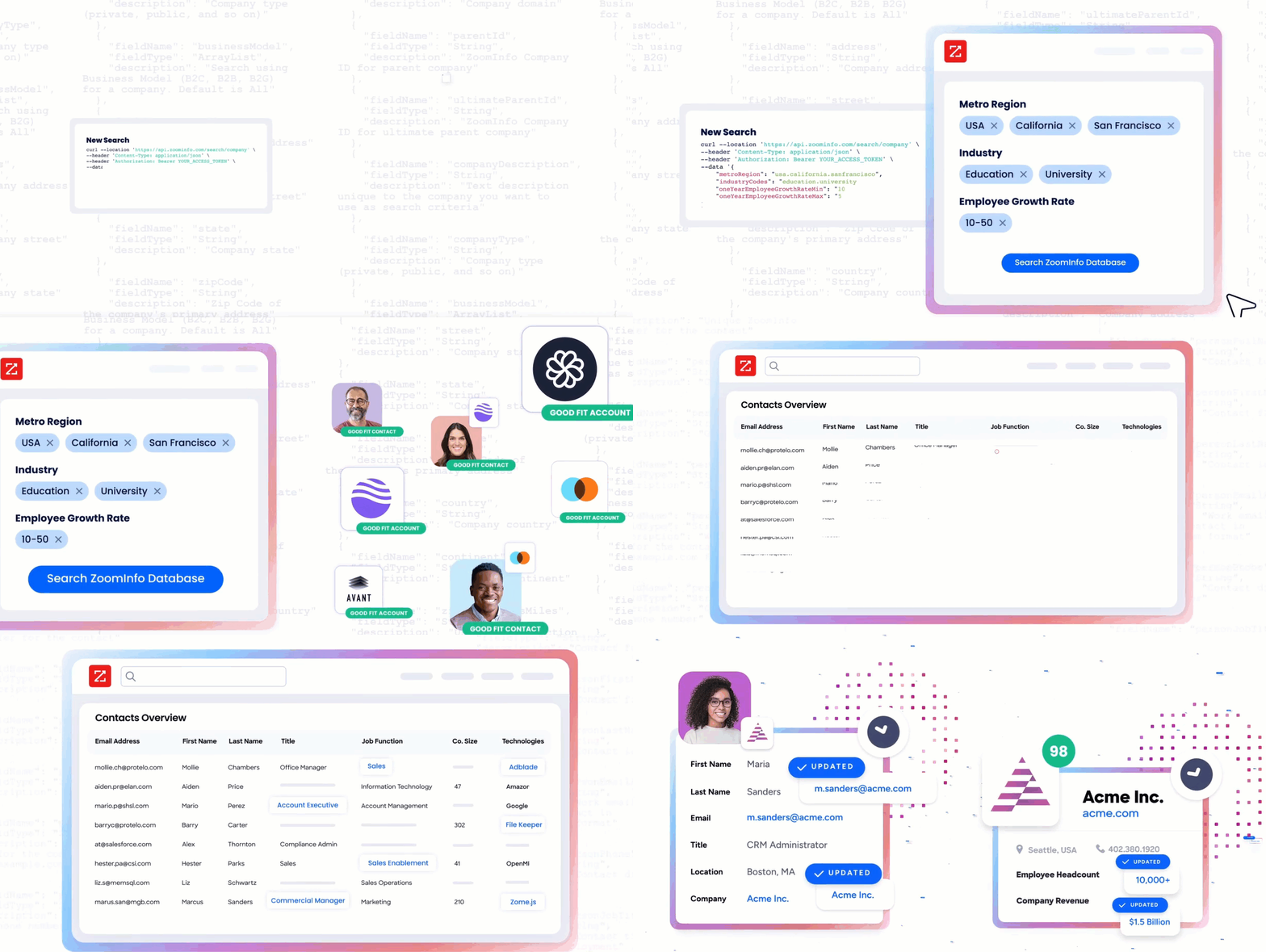
For teams building custom tools, APIs and MCP expose the same intelligence to any application or AI agent. API Access is included in all relevant plans, and ZoomInfo MCP is listed in the Claude directory and supports Claude and ChatGPT. All three lanes draw from the same GTM Context Graph, so the choice of where to work never limits the intelligence available.
Source: ZoomInfo
"The plug-and-play aspect of the API means I can integrate it very easily into any process and get information at a moment's notice," said Jerry Wilson, Senior Marketing Intelligence Analyst at BDO Canada, whose team saw an 87% reduction in dashboard update time. (BDO Canada)
Pricing & Getting Started: ZoomInfo offers free entry points and transparent evaluation options.
Where Crayon requires a sales engagement just to see the product, ZoomInfo provides two ways to evaluate the platform before committing.
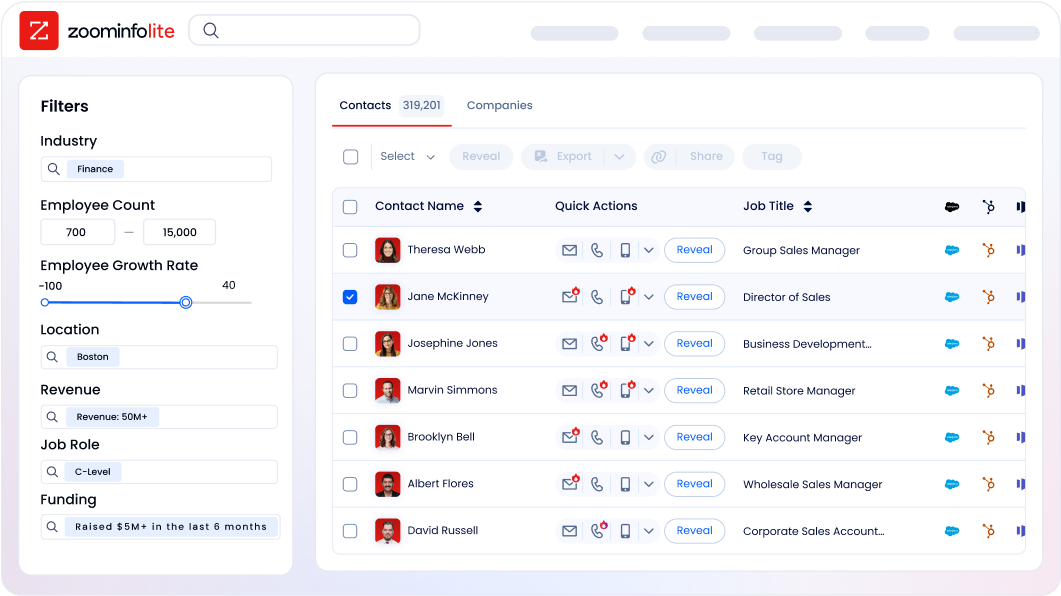
ZoomInfo Lite is a permanent free tier (not a trial) that includes access to ZoomInfo's B2B database with 100M+ verified profiles, 10 monthly export credits, individual and company searches with advanced filters, the ReachOut Chrome Extension and mobile app, WebSights Lite with up to 10 website visitor reveals per day, built-in email sending, and HubSpot integration.
Source: ZoomInfo
ZoomInfo also offers a 7-day free trial with no credit card required, providing access to core platform features including contact and company search, sales intelligence tools, intent signals, and email outreach.
Paid plans are organized across Sales, Marketing, and Operations product lines, each with tiered pricing. ZoomInfo uses a consumption-based pricing model where costs scale with usage (seats, credits, API consumption, and AI activity).
While specific prices are custom-quoted, the credit system is straightforward: 1 credit = 1 export of a professional or company profile, and searching or viewing data within ZoomInfo does not consume credits.
Crayon or ZoomInfo: Comparison Summary
Aspect | Crayon | ZoomInfo |
|---|---|---|
Primary focus | Competitive intelligence and sales enablement | All-in-one AI GTM platform |
Intelligence scope | Competitor tracking only | Competitors, buyers, intent, market signals |
B2B contact data | Not included | 500M contacts, 135M+ verified phone numbers |
Buyer intent signals | Not included | 210M IP-to-Org pairings, 6T+ keyword pairings monthly |
Conversation intelligence | Integrates with Gong/Chorus | Native (Chorus), with AI analysis on competitive mentions |
Battlecard creation | AI-powered via Sparks | Competitive alerts and AI account summaries |
CRM integration | Salesforce, HubSpot, FreshSales | Salesforce, HubSpot, Microsoft Dynamics |
AI capabilities | Sparks, Crayon Answers | GTM Context Graph, AI agents, AI-drafted outreach |
Free plan | None | ZoomInfo Lite (permanent, no credit card) |
Free trial | None | 7-day trial, no credit card required |
Pricing transparency | Custom-quoted, not published | Custom-quoted, consumption-based |
Ideal for | Dedicated CI teams in B2B SaaS | GTM teams needing data, signals, and execution in one platform |
Analyst recognition | Forrester New Wave CI Leader | Gartner MQ Leader (ABM), Forrester Wave Leader (Intent) |
Final Verdict
The choice between Crayon and ZoomInfo depends on whether you need a dedicated competitive intelligence tool or competitive insights embedded within a comprehensive GTM platform.
Choose Crayon if your primary need is a focused competitive intelligence program with deep automation. It's the right tool for organizations that have dedicated CI professionals, need granular tracking of competitor website changes and messaging shifts, and want AI-powered battlecard creation distributed directly into sales workflows.
Choose ZoomInfo if you want competitive intelligence connected to the data, signals, and execution capabilities needed to act on it. Rather than maintaining a separate tool for CI alongside your prospecting database, intent data provider, and sales engagement platform, ZoomInfo unifies these functions through the GTM Context Graph.
Your team gets competitive signals from Chorus conversation intelligence, buyer intent data, verified contact information for the buying committee, and AI-powered outreach, all in one platform. For organizations that see competitive intelligence as one dimension of a broader go-to-market strategy rather than a standalone discipline, ZoomInfo provides the complete picture.
Get started with ZoomInfo for free here.
The distinction comes down to scope. Crayon answers the question "what are our competitors doing?" ZoomInfo answers that question alongside "who should we be talking to, what signals are they showing, and what should we say?" For teams that need the full picture, a platform that connects competitive context to data and execution will always outperform a tool that handles only one piece.
Crayon FAQ
What is Crayon used for?
Crayon is a competitive intelligence platform designed for B2B companies that need to track competitors, create sales battlecards, and enable revenue teams with competitive positioning.
The platform monitors competitor websites, pricing changes, product launches, and executive movements, then uses AI to analyze and distribute that intelligence through tools like Salesforce, Slack, and sales enablement platforms. Its primary users are competitive intelligence professionals, product marketing managers, and sales leaders at mid-market to enterprise organizations.
Does Crayon offer a free trial or free plan?
No, Crayon does not offer a free trial or free plan. The only way to evaluate the platform is to request a demo through the sales team. By contrast, ZoomInfo provides a permanent free tier (ZoomInfo Lite) with access to its B2B database and 10 monthly export credits, plus a 7-day free trial with no credit card required for access to core platform features.
How much does Crayon cost?
Crayon does not publicly disclose its pricing. Costs are customized based on the number of competitors tracked, authorized users, competitive assets, and specific features required. Subscriptions automatically renew unless customers provide 60 days' written notice, and cancellations during a subscription period still require payment for the full committed term with no refunds.
ZoomInfo also uses custom-quoted pricing but offers a free tier and free trial to evaluate the platform before committing.
What integrations does Crayon support?
Crayon integrates across five categories: CRM suites (Salesforce, HubSpot, FreshSales), communications platforms (Slack, Microsoft Teams, Yammer), sales enablement tools (Highspot, Seismic, Showpad, Guru, SharePoint, Notion, Confluence), conversation intelligence (Gong, Chorus), and SSO systems (Azure, Google, Okta, OneLogin, Jumpcloud).
The platform also provides APIs and an MCP Server for connecting competitive intelligence into AI tools.
Does Crayon track more than just competitors?
No. Crayon is built primarily for competitor tracking and sales enablement. It does not offer market intelligence, industry trend monitoring, or the ability to track customers, partners, and other strategic entities beyond direct competitors.
Organizations needing broader go-to-market intelligence, including buyer intent signals, verified contact data, and market signals, would need additional tools or a platform like ZoomInfo that combines these functions.
What is Crayon's Sparks feature?
Sparks is Crayon's AI agent for competitive research, analysis, and enablement. Users select a template or write custom research prompts, and Sparks generates competitive analysis from hundreds of data points in seconds. It can surface product update insights, run SWOT analyses, analyze sales call patterns, and auto-update battlecards.
Sparks can be scheduled to run on a weekly or monthly basis, and its output can be converted into battlecard updates with one click or distributed through Slack, Teams, and email.
Does Crayon require a dedicated competitive intelligence team?
While Crayon can technically be used by any team, its effectiveness depends heavily on dedicated program ownership. Without a committed owner who continuously evangelizes the platform and builds feedback loops with sales, adoption tends to drop.
Companies that get the most value from Crayon typically have dedicated CI analysts or product marketing managers focused on competitive enablement. Organizations without these resources may find better results with a platform that integrates competitive insights into existing workflows rather than requiring a standalone program.
How does Crayon's measurement work?
Crayon's Measure module connects to Salesforce through a bidirectional integration, automatically tracking win rates by competitor, competitive frequency, influenced revenue, and battlecard engagement. The Influenced Revenue metric calculates the total revenue won on deals where a sales rep viewed a competitor's battlecard before closing.
Seller Engagement Analytics correlates individual rep performance with battlecard usage, and the Competitive Pipeline view identifies competitive risk in open opportunities. All metrics update in real time without manual data exports.
