

Creatio has earned its reputation as an agentic CRM and workflow platform. Its composable architecture, BPMN 2.0 process engine, and embedded AI agents make it a strong choice for mid-market and enterprise organizations that need CRM, workflow automation, and custom application building on a single platform.
But as your go-to-market strategy evolves, Creatio's strengths come with trade-offs that affect daily operations. Its slow load times, steep learning curve, $10,000/year minimum spend, limited mobile experience, and narrower integration marketplace compared to larger ecosystems can create friction, especially for teams that need depth in specific areas.
That's where this guide comes in. Whether you're looking to:
Build a single GTM intelligence layer with B2B data, AI-driven deal context, and access across any tool
Scale to Fortune 500 complexity with the deepest integration ecosystem and autonomous AI agents
Run CRM alongside ERP-grade operations within the Microsoft stack you already use
Start with a free CRM that bundles marketing automation without enterprise contract minimums
Give your sales reps a visual, rep-first pipeline tool that works on day one without admin overhead
Deploy structured process automation on a budget, with a free tier for small teams
Model your CRM around your business with a flexible, AI-native data architecture
We'll explore platforms that excel in these specific areas.
This isn't about finding a "better" platform than Creatio. It's about finding the right fit for how your team works, what your budget allows, and where your business is headed. Some teams might complement Creatio with a specialized tool; others might replace it entirely with a platform better suited to their scale, workflow, or industry.
Let's dive in.
The Best Creatio Alternatives
Best Alternative for B2B Data & AI-Powered GTM Intelligence We chose ZoomInfo because it delivers the largest B2B data platform in the industry, paired with a proprietary GTM Context Graph that reveals not just what's happening in your deals, but why. It fits revenue teams that need intelligence-driven prospecting, outreach, and pipeline acceleration. |
|---|
Best Alternative for Enterprise Teams Needing AI Agents & the Deepest Integration Ecosystem We chose Salesforce because its Agentforce AI, 9,000+ AppExchange apps, and enterprise-scale architecture make it the most proven path forward for organizations that have outgrown Creatio's integration depth, mobile experience, or analytics capabilities. |
Best Alternative for CRM Plus ERP Convergence in the Microsoft Ecosystem We chose Microsoft Dynamics 365 because its zero-configuration integration with Outlook, Teams, and the Power Platform, combined with modular CRM and ERP applications, provides the strongest operational depth for teams already standardized on Microsoft. |
Best Alternative for Small Businesses That Want Marketing Automation Built In We chose HubSpot because its permanently free CRM, integrated Marketing Hub, and structured onboarding make it the fastest path from zero to a full go-to-market stack, without Creatio's $10,000 annual minimum or dedicated admin requirements. |
Best Alternative for Teams That Want Pipeline Clarity Without Suite Overhead We chose Pipedrive because its visual kanban pipeline, activity-based selling enforcement, and zero-admin setup make it the most focused sales pipeline tool for teams that need CRM fundamentals done well, without the complexity Creatio carries. |
Best Alternative for Budget-Conscious Teams Needing Structured Process Automation We chose Zoho CRM because its Blueprint process automation delivers Creatio-style stage enforcement and governance at a fraction of the cost, with a functional free plan for up to three users and paid tiers starting at $14/user/month. |
Best Alternative for GTM Teams That Need a Flexible, AI-Native CRM Architecture We chose Attio because its fully custom data model, automatic relationship intelligence, and sub-50ms performance make it a strong next-generation CRM for fast-moving tech teams that need flexibility without sacrificing depth. |
What is Creatio?
Source: Creatio
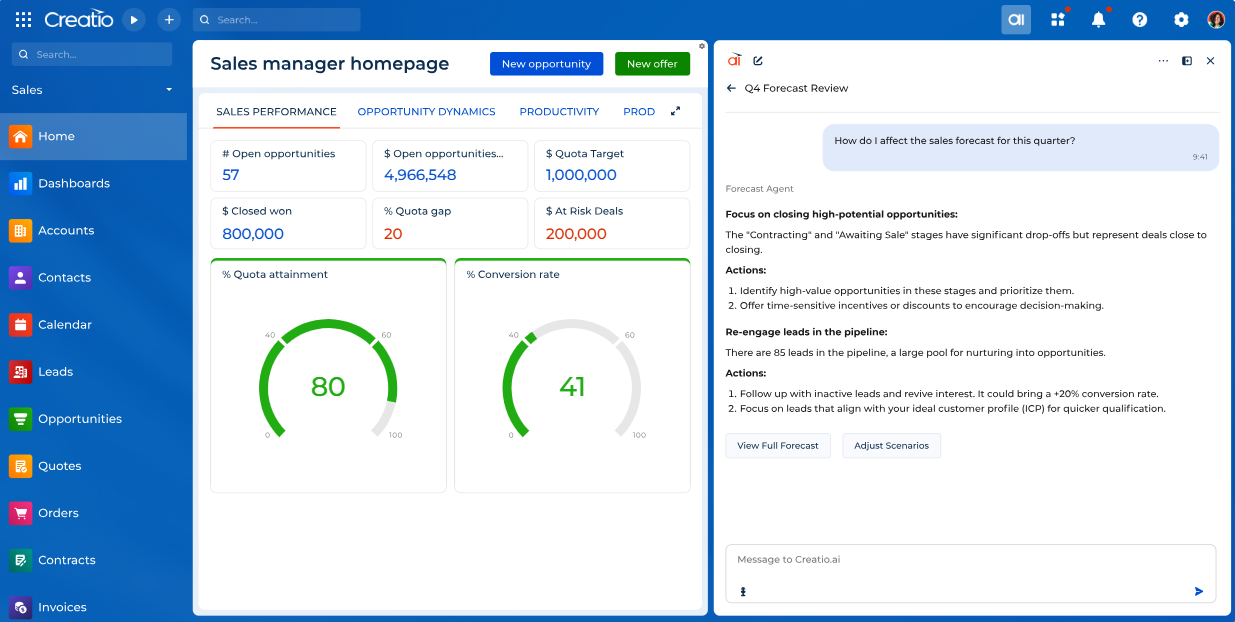
Creatio is an agentic CRM and workflow platform that combines AI agents, no-code application building, and CRM functionality (Sales, Marketing, Service) on a single composable architecture. Founded in 2002 as Terrasoft, the company rebranded to Creatio in 2019 and raised $200 million at a $1.2 billion valuation in 2024, signaling a push toward AI-native enterprise automation.
Its key features include:
No-Code Studio with a Freedom UI Designer, BPMN 2.0 Process Designer, and a No-Code Agent Builder for creating enterprise applications and AI agents without developer involvement
Creatio.ai embedding predictive, generative, and agentic AI across Sales, Marketing, and Service modules, with all AI features included in the base license at no additional cost
Out-of-the-box AI agents for account research, quote generation, email creation, campaign management, case resolution, and more
Composable architecture where business teams assemble and modify applications using pluggable, reusable components
Industry-specific templates spanning 20 verticals including Banking, Insurance, Manufacturing, and Telecom
Flexible deployment options: cloud (shared or dedicated on AWS/Azure), on-premise, or managed private cloud
The composable no-code architecture is Creatio's strongest card, and including AI at no additional per-seat cost is a genuine differentiator against vendors that gate AI behind premium tiers. But as organizations grow, specific needs may exceed what one platform delivers well: the slow load times tied to its .NET compilation model, the steep learning curve from feature breadth, the mobile app weakness, and the limited connector marketplace compared to larger ecosystems can push teams toward specialized alternatives.
That's why we focused on platforms that excel where Creatio's breadth-first approach creates gaps.
Looking for B2B data and AI-powered GTM intelligence to fuel your sales and marketing? ZoomInfo combines 500M contacts, 100M companies, and a proprietary GTM Context Graph to show your team not just what's happening in your deals, but why.
How We Curated Our List of Creatio Alternatives
After testing Creatio and researching the market, we focused on platforms that address specific gaps or serve specific buyer profiles better than Creatio's all-in-one approach. While Creatio excels at composable no-code CRM and workflow automation, businesses often need more:
B2B data and AI-driven deal intelligence to fuel prospecting and pipeline acceleration
Third-party integrations without custom development
CRM alongside ERP-grade operations within an existing Microsoft stack
Marketing automation and CRM without enterprise contract minimums or dedicated administrators
A visual, focused pipeline tool that works on day one
Structured process governance on a budget below a $10,000/year minimum
A CRM data model that adapts to how the business works, not the other way around
Each tool on this list leads in one of these areas. You might use them alongside Creatio or switch entirely; it depends on where your team needs depth.
DISCLAIMER: We aren't covering every CRM or GTM tool on the market! Our focus is on the best alternatives that address Creatio's limitations for various use cases and business sizes. The goal is to provide insights into tools that serve specific business needs. |
|---|
1. ZoomInfo — Best Alternative for B2B Data & AI-Powered GTM Intelligence
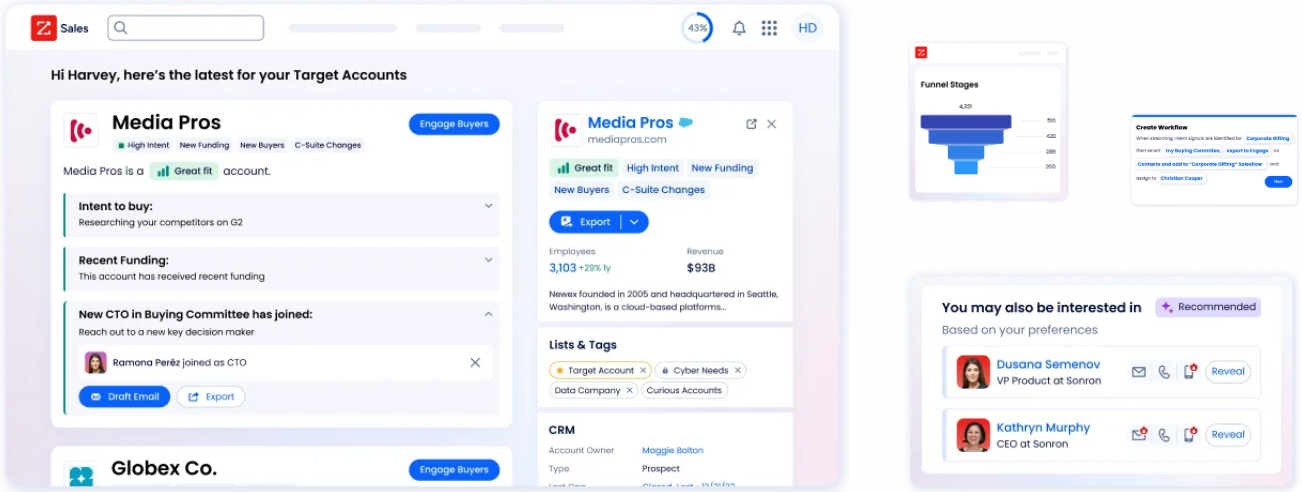
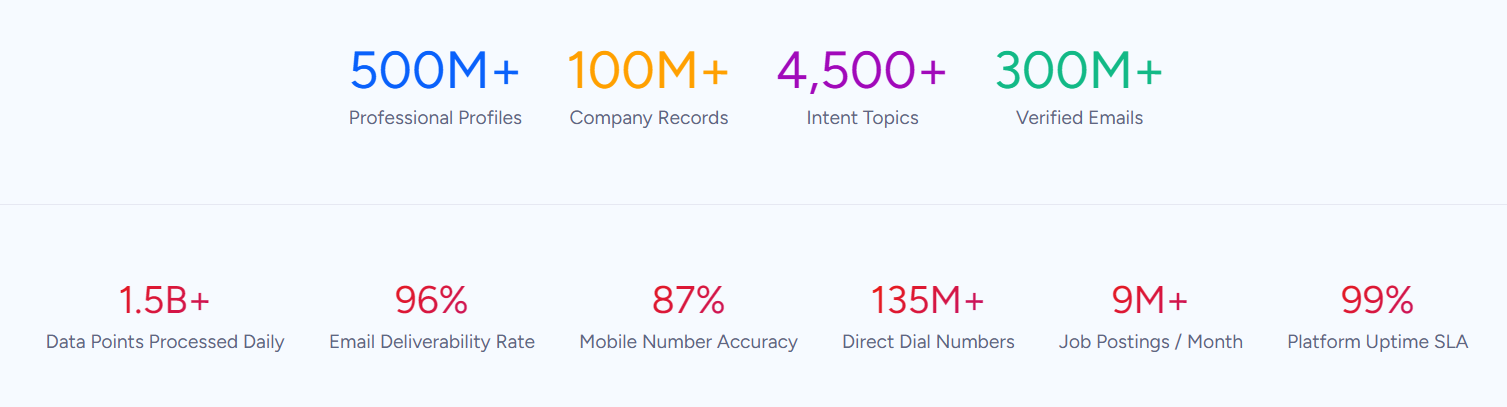
ZoomInfo is an AI GTM platform built on the industry's largest data foundation: 500M contacts, 100M companies, 135M+ verified phone numbers, and 200M+ verified business emails. Its GTM Context Graph processes 1.5B+ data points daily, unifying this data with your CRM records, conversation transcripts, and behavioral signals to reveal the full context of your accounts. That context fuels AI that shows not just what happened, but why it happened, and what to do next. Your team can drive sales from GTM Workspace, run GTM plays from GTM Studio, or power their own tools through the API and MCP. Its key features include:
B2B data platform: 500M contacts, 100M companies, 135M+ verified phone numbers, 120M direct-dial phone numbers, and 200M+ verified business email addresses, verified by 300+ human researchers and reaching up to 95% accuracy on first-party data
GTM Context Graph: An intelligence layer that fuses ZoomInfo's B2B data with your CRM records, conversation intelligence, and behavioral signals to capture not just what happened, but why it happened
Buyer Intent Data: Tracks signals from 210 million IP-to-Organization pairings and 6 trillion+ new keyword-to-device pairings sourced monthly, with Guided Intent identifying topics historically correlated with deal success
Universal access: GTM Workspace for sellers, GTM Studio for marketers and RevOps, and APIs & MCP for any tool, workflow, or AI agent
While Creatio focuses on CRM process automation and no-code application building, ZoomInfo addresses a different problem: giving your go-to-market teams the intelligence they need to find, prioritize, and engage the right buyers at the right time. For revenue teams that need B2B data, intent-driven prospecting, and AI that understands the context behind every deal, ZoomInfo provides capabilities that Creatio's CRM-centric architecture was not designed to deliver.
Why Choose ZoomInfo Over Creatio for GTM Intelligence
While Creatio excels at workflow orchestration and no-code CRM customization, ZoomInfo is designed for intelligence-driven go-to-market execution. Here's where ZoomInfo steps up.
B2B Data: The Foundation Creatio Doesn't Provide
Creatio is a CRM and workflow platform. It stores and orchestrates your customer data, but it does not generate the intelligence that feeds that CRM in the first place. Sales reps using Creatio still need to find prospects, verify contact information, and identify which accounts are in-market. That prospecting layer is where ZoomInfo operates.
ZoomInfo's data platform covers three dimensions simultaneously: identity data (who buyers are and how to reach them), company context (org charts, technographics across 30,000+ technologies, and more), and dynamic signals that reveal when accounts are actively researching solutions. In a Fortune 500 competitive RFP analyzing 25 million contacts across vendors, an independent consultant concluded that "no other competitor came even close."
For revenue teams using Creatio as their CRM, ZoomInfo feeds verified contacts, company intelligence, and buying signals directly into their workflows. For teams considering a broader platform change, ZoomInfo's native GTM Workspace provides an AI-powered seller experience where prioritized accounts, AI-drafted outreach, and deal execution converge in one workspace.
ZoomInfo in Action: When your sales team opens GTM Workspace, they don't start with an empty pipeline. The system surfaces accounts showing buying signals (intent data, website visits, key personnel changes), identifies decision-makers with verified direct dials and emails, and drafts personalized outreach addressing the concerns driving each account's research activity.
The GTM Context Graph: Intelligence That Understands Why Deals Move
CRMs record that a deal moved from Stage 3 to Stage 4. Conversation intelligence transcribes what the VP of Finance said on the last call. Intent platforms log a spike in research activity. But as ZoomInfo's Chief Product Officer Dominik Facher writes: "The CRM recorded the state change. It has no record of why it happened."
The GTM Context Graph connects these data sources to capture the decision context behind every deal. Maybe the CFO joined the last call and asked about six-month ROI; that's what accelerated the deal. Maybe the VP went quiet for eight days during an internal budget battle; that's what nearly stalled it.
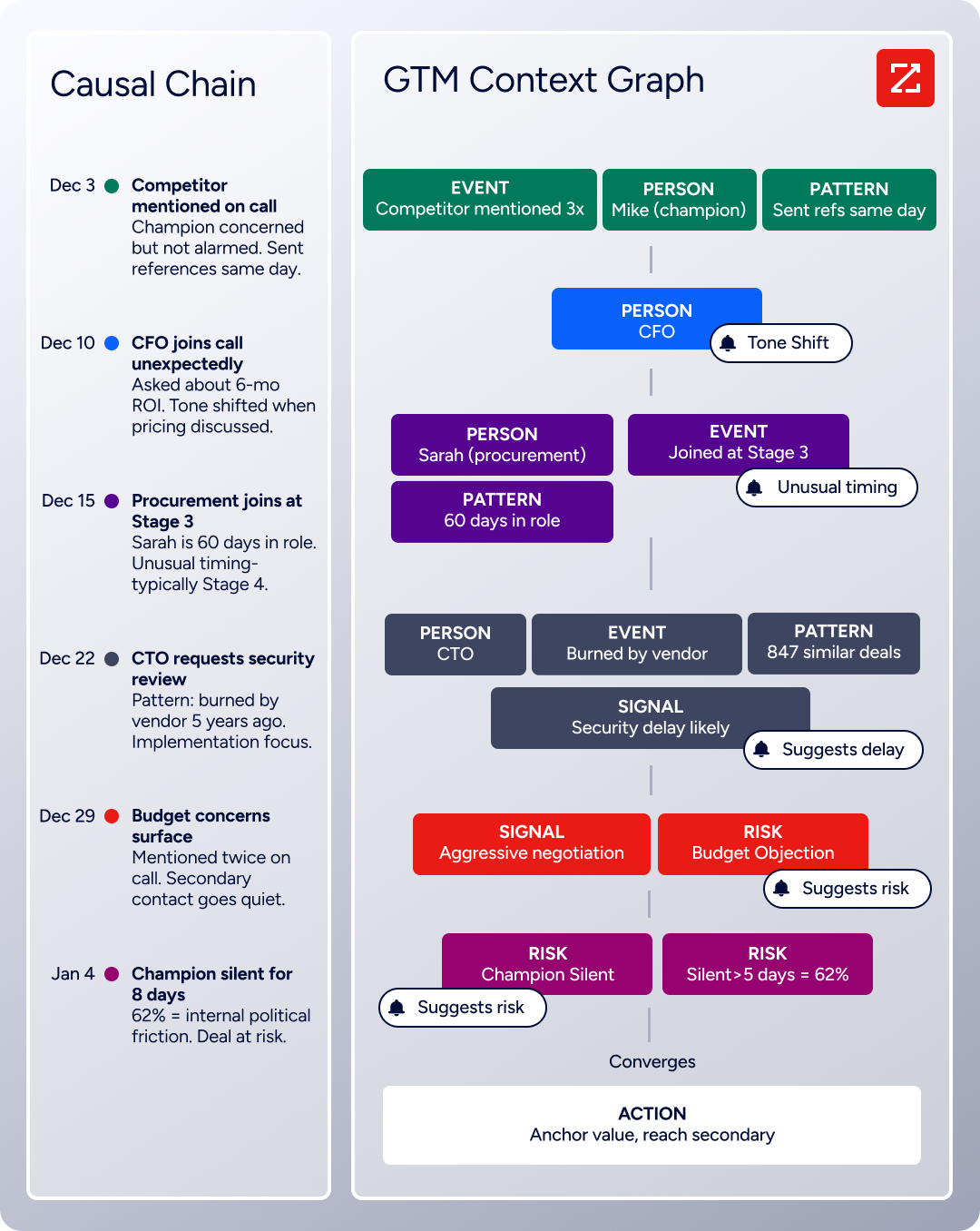
Creatio's AI agents operate within the CRM's data model, executing tasks like summarizing cases, generating quotes, and routing leads. ZoomInfo's intelligence layer works at a different level: it fuses first-party CRM data with third-party signals across your entire go-to-market surface, then surfaces what those patterns mean for your next action.
ZoomInfo in Action: Your team notices a deal has stalled. Rather than guessing, ZoomInfo's GTM Context Graph connects the dots: the champion changed roles two weeks ago (org chart signal), the company just posted three new VP positions (hiring signal), and a competitor's technology was detected on their stack (technographic signal). The follow-up email your rep sends addresses the concern the new stakeholder is likely evaluating, because the system understands the underlying dynamics, not just the CRM stage.
Universal Access: Use Intelligence in Any Tool, Any Workflow
Creatio's AI and data live within the Creatio platform. ZoomInfo's intelligence is accessible everywhere your team works.
APIs and MCP expose the same GTM Context Graph to any custom agent, internal tool, or partner platform, from Anthropic Claude to Google to proprietary systems. GTM Workspace is the native front-end for sellers.
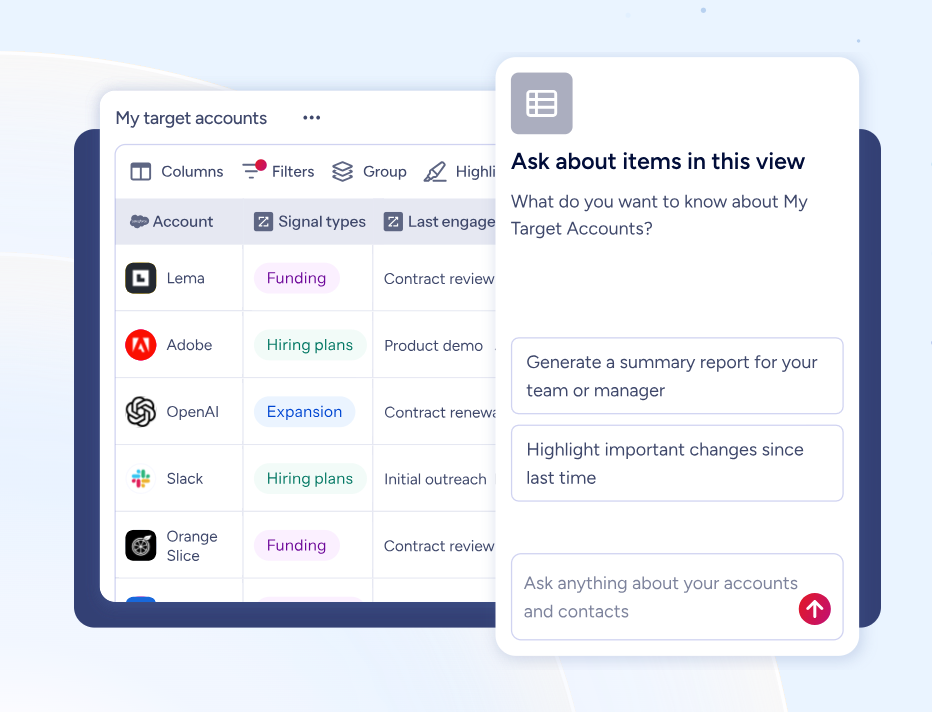
GTM Studio is the front-end for marketers, RevOps, and GTM engineers who can describe audiences in plain language and launch multi-channel plays without engineering tickets.
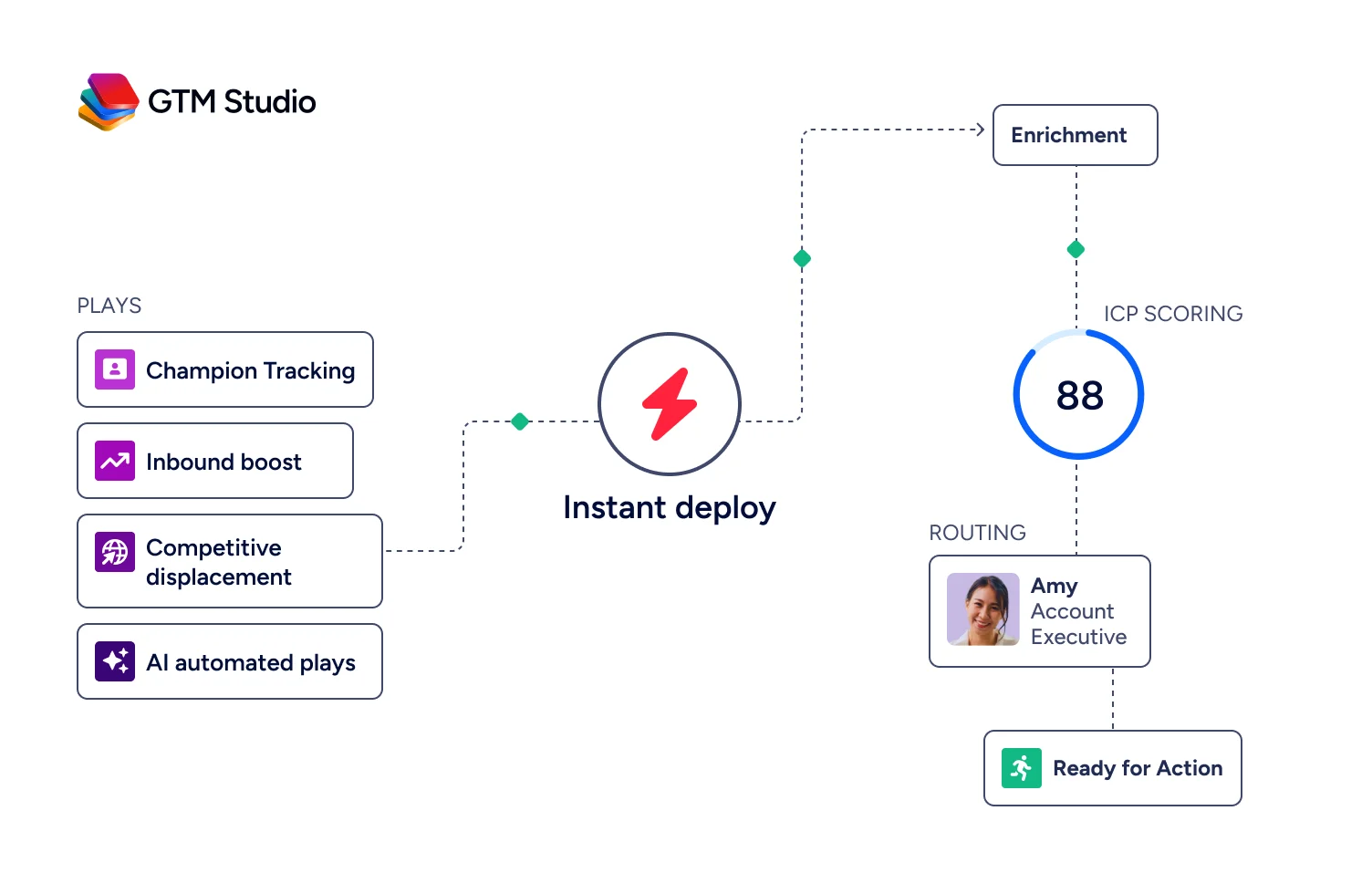
The key architectural point: all three access methods draw from one GTM Context Graph. The same data, the same intelligence, the same continuously learning model. Nothing is degraded or siloed by surface.
ZoomInfo in Action: A marketer in GTM Studio describes an audience in plain language: "Mid-market SaaS companies with 200-1,000 employees that are actively researching CRM solutions and have had a VP-level hire in the past 60 days." The system builds that audience from verified data, launches a multi-channel play targeting those accounts, and delivers hot accounts directly into GTM Workspace for seller follow-up. An engineer simultaneously plugs the same intelligence into a custom internal tool via MCP. Every surface draws from the same intelligence.
BDO Canada achieved an 87% reduction in dashboard update time using ZoomInfo's API. "The plug-and-play aspect of the API means I can integrate it very easily into any process and get information at a moment's notice." (BDO Canada)
NOTE: We looked into other B2B data and intelligence platforms. Apollo.io offers a solid contact database at a lower price point, well-suited for outbound-heavy SMB teams. Cognism excels in European mobile number coverage and GDPR-compliant data sourcing. Neither matches ZoomInfo's data scale (500M contacts, 135M+ verified phone numbers), the depth of the GTM Context Graph's contextual intelligence across first-party and third-party signals, or the access architecture that delivers intelligence into any tool via APIs and MCP.
ZoomInfo Pricing
ZoomInfo uses a consumption-based pricing model organized into two product lines: Sales and Marketing. Pricing scales based on usage patterns, number of users/seats, monthly credit volume, features, company size, and contract length.
Sales Plans are available in three tiers:
Professional: Contact and company data, profiles, CRM integrations, Chrome extension, mobile app, and AI-powered email generation
Advanced: Adds AI-driven account prioritization, Buyer Intent signals, website visitor tracking, Champion Tracking, and automated outreach workflows
Enterprise: Adds real-time buyer intent signals, custom Intent signals, advanced workflows, AI-generated account summaries, and a dedicated customer service manager
Marketing Plans range from Marketing Demand (audience targeting and campaign reporting) through ABM Lite and ABM Enterprise, with increasing intent topic limits, display network capabilities, and AI-powered audience tools.
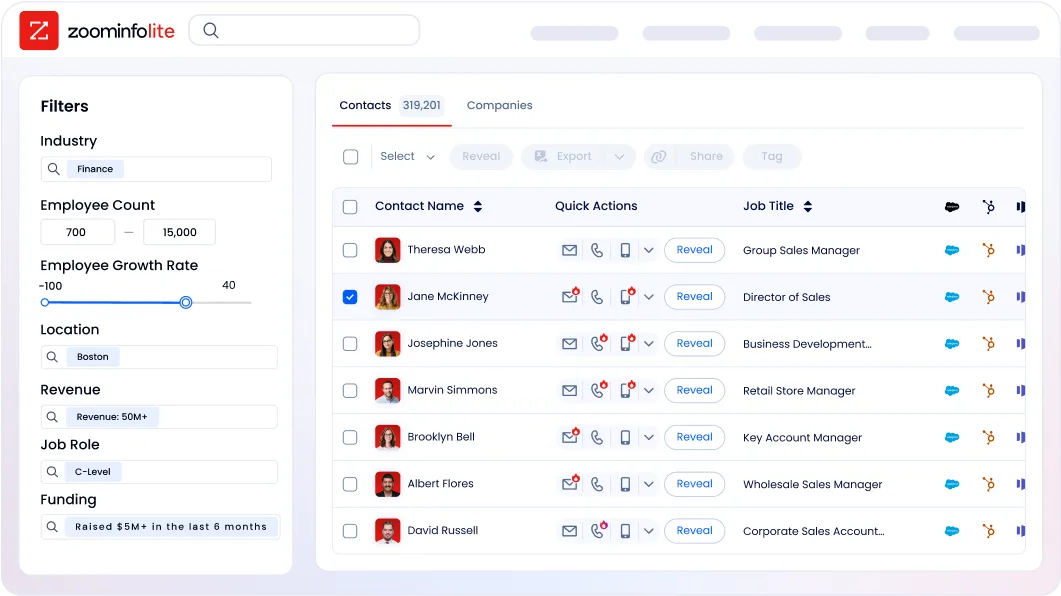
ZoomInfo also offers ZoomInfo Lite, a permanent free tier with access to the B2B database, 10 monthly export credits, individual and company searches, and a Chrome extension. A 7-day free trial with broader feature access is available separately.
Who Should Use ZoomInfo?
Choose ZoomInfo if:
Your revenue team needs B2B data to fuel prospecting, and you're tired of bounced emails, disconnected phone numbers, and incomplete account profiles degrading your outreach.
You want AI that understands the context behind your deals, not just CRM stage labels, and you need intelligence that connects intent signals, conversation patterns, and org chart changes into actionable next steps.
You need your GTM intelligence accessible everywhere your team works: in a native seller workspace, through a marketer-friendly orchestration canvas, or piped into any custom tool or AI agent via API and MCP.
You're evaluating Creatio for its CRM capabilities but need a platform that also generates the prospect intelligence and buying signals that feed the pipeline, rather than just managing what's already in it.
Ready to see the full context behind your deals? Start your ZoomInfo free trial and experience the GTM Context Graph in action, or request a demo to see how B2B data and AI-powered intelligence can change your go-to-market execution.
2. Salesforce — Best Alternative for Enterprise Teams Needing AI Agents and the Deepest Integration Ecosystem
Source: Salesforce
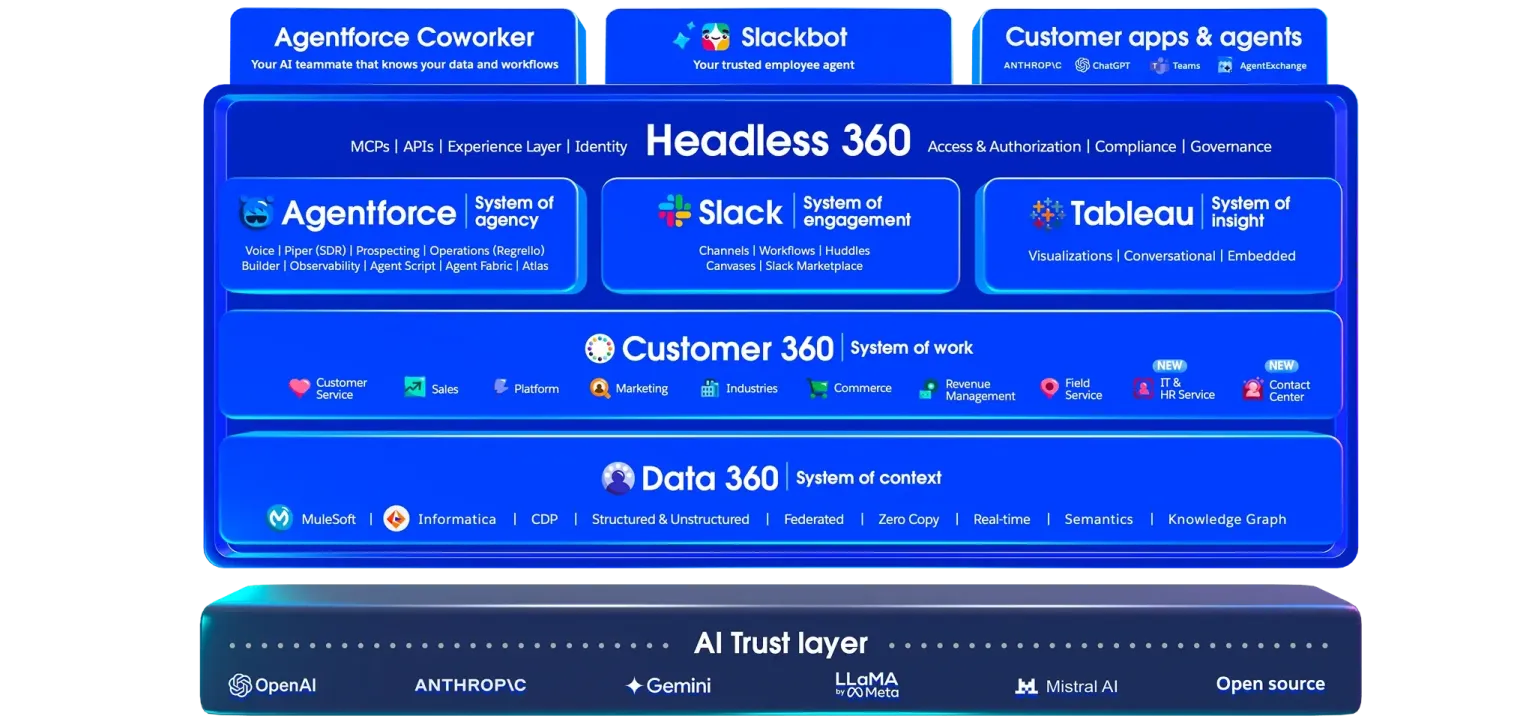
Salesforce is the world's #1 CRM by IDC market share, a $41.5 billion enterprise platform covering autonomous AI agents, CRM applications, data infrastructure, and enterprise collaboration on a single codebase. For Creatio users outgrowing their platform's integration marketplace, mobile experience, or reporting capabilities, Salesforce is the most established enterprise-grade path forward. Its key capabilities include:
Agentforce: Autonomous AI agents powered by the Atlas Reasoning Engine, capable of multi-step execution across sales, service, and marketing without constant human prompting
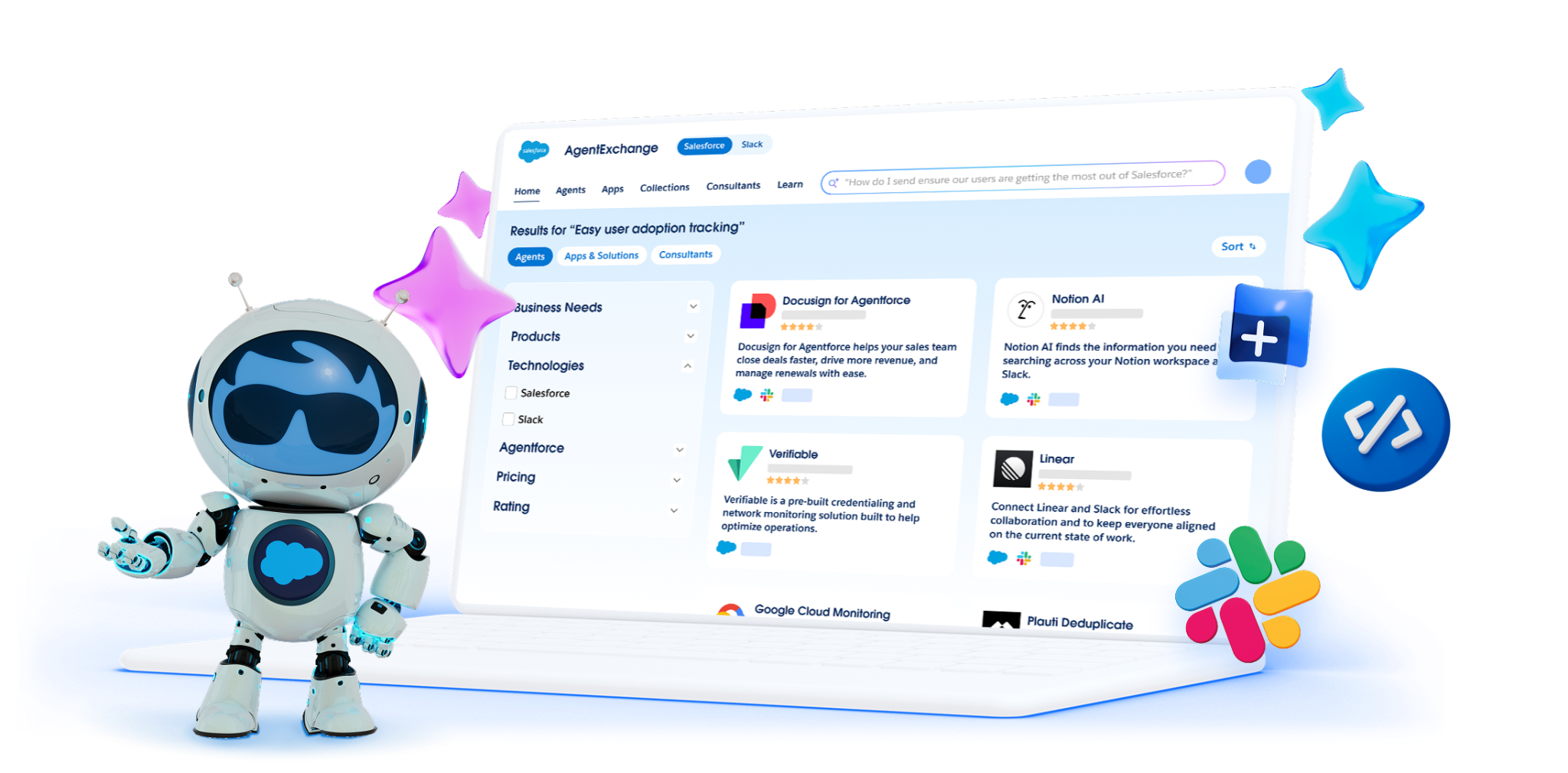
AppExchange: 9,000+ partner apps and 14+ million installs
Einstein analytics and Tableau: Native business intelligence with AI-powered forecasting, customizable dashboards, and agentic analytics
Mobile excellence: One of the highest-rated enterprise CRM mobile experiences, with Apple Intelligence integration on iOS and full offline access
Why Choose Salesforce Over Creatio for Enterprise AI and Integration Depth
Salesforce stands out in the following areas:
Agentforce AI at Proven Scale
Creatio's no-code Agent Builder and embedded Creatio.ai architecture differentiate it at the mid-market level. But Salesforce's Agentforce operates at a different scale: 29,000 enterprise deals closed and 2.4 billion Agentic Work Units delivered in FY26. Creatio positions itself at supervised autonomy ("human-in-the-loop"); Salesforce has enterprise-scale deployments of fully autonomous resolution at volume.
AppExchange Ecosystem vs. Creatio's Marketplace
Creatio's Marketplace has grown to 400+ solutions, but users consistently flag that legacy system integrations require custom development. Salesforce's AppExchange is a different category: 9,000+ apps with 91% of customers using at least one.
Source: Salesforce
If a system exists in your enterprise stack, there is almost certainly a pre-built AppExchange connector. MuleSoft's Anypoint Platform extends this further with hundreds of pre-built enterprise connectors for complex integration scenarios.
Analytics, Mobile, and Enterprise Scalability
Creatio users flag reporting limitations around calculated variables and export capabilities. Salesforce's CRM Analytics and Tableau provide full business intelligence with live connections, calculated measures, and interactive dashboards. Customers increase close rates by 28% using CRM Analytics. On mobile, Salesforce's apps include Apple Intelligence integration, offline access, and voice input, directly addressing Creatio's documented mobile weakness. On scalability, Hyperforce supports regional data residency and 150,000+ enterprise customers including Fortune 500 deployments.
NOTE: We also evaluated Microsoft Dynamics 365 and Oracle CRM for this enterprise slot. While Dynamics 365 excels for organizations embedded in the Microsoft 365 ecosystem, and Oracle CRM is strong for companies running Oracle ERP, Salesforce offers the deepest Agentforce AI deployment, the largest AppExchange ecosystem, and the broadest analyst recognition for teams evaluating an enterprise-scale Creatio alternative.
For a direct comparison of Creatio and Salesforce across AI capabilities, integration depth, and enterprise scale, see our Creatio vs Salesforce analysis.
Salesforce Pricing
Salesforce uses multi-cloud, multi-tier pricing. Most products require annual contracts.
Sales Cloud / Service Cloud:
Free Suite: $0/user/month (max 2 users); basic lead, account, and opportunity management
Starter Suite: $25/user/month; unlimited users, AI email sync, lead routing
Pro Suite: $100/user/month; customization, quoting, forecasting, AppExchange access
Enterprise: $175/user/month; AI for sales/service, pipeline insights, workflow automation
Unlimited: $350/user/month; full AI suite, conversation intelligence, Premier Success Plan
Note: Salesforce's pricing complexity is well-documented. Sticker prices don't include Data Cloud credits, Premier Support (30% of net license fees), or implementation costs (70%+ of deployments are partner-led). The all-in cost for a mid-market deployment is materially higher than per-seat list prices suggest, which contrasts with Creatio's more transparent composable pricing.
Who Should Use Salesforce?
Choose Salesforce if:
Your organization needs a CRM that scales to Fortune 500 complexity without a platform migration, with enterprise-grade org management and global data residency infrastructure.
You need the deepest pre-built integration marketplace in the CRM industry, eliminating custom development work for legacy and niche system connections.
You are making autonomous AI agents a core infrastructure investment and need proven enterprise-scale deployments, not a platform at the supervised-autonomy stage.
Your team relies heavily on mobile CRM access and has been frustrated by Creatio's documented mobile app limitations.
3. Microsoft Dynamics 365 — Best Alternative for CRM Plus ERP Convergence in the Microsoft Ecosystem

Source: Microsoft Dynamics 365
Microsoft Dynamics 365 is a suite of AI-powered CRM and ERP applications covering the full front-office and back-office spectrum. For organizations already standardized on Microsoft 365, it is the most natural Creatio alternative because the ecosystem integration is structural, not additive: no connectors to build, no data sync jobs to maintain, no middleware between your CRM and your Outlook inbox. Its key capabilities include:
Native out-of-the-box connections with Outlook, Teams, Excel, SharePoint, and Azure
Microsoft Copilot AI embedded in seller workflows for meeting summaries, email drafts, and opportunity scoring
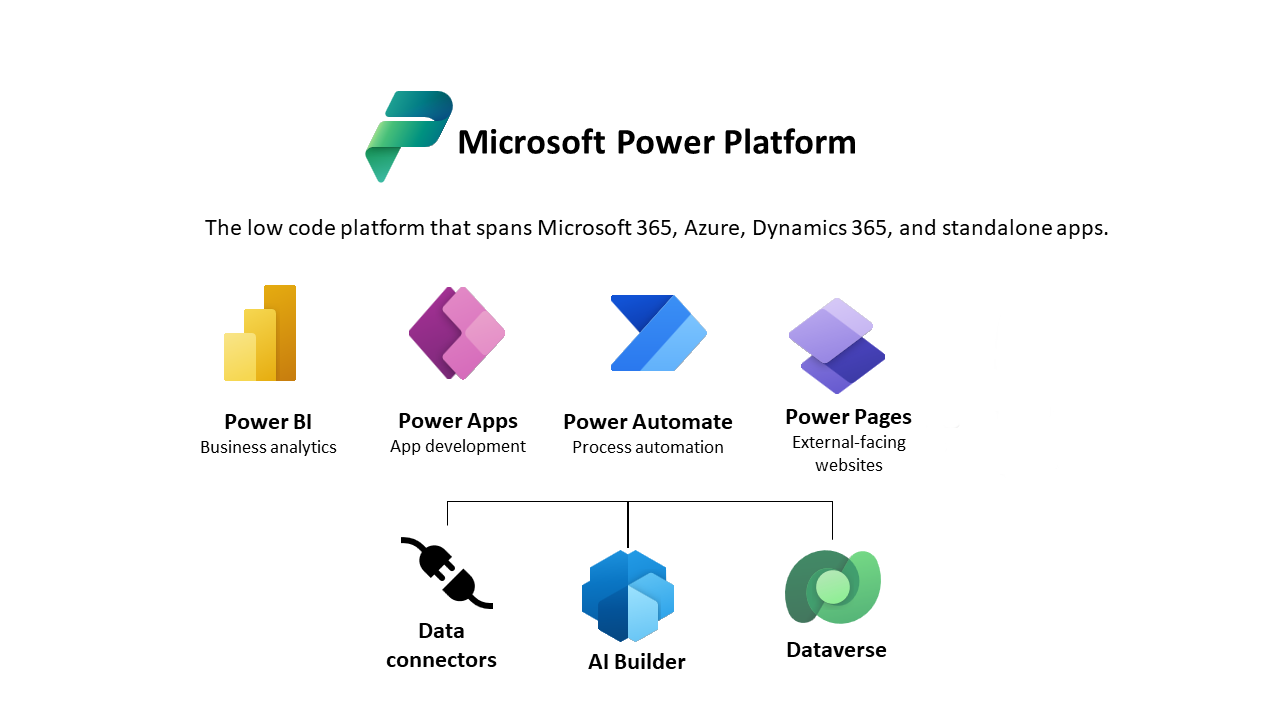
Power Platform (Power Apps, Power Automate, Power BI) for no-code application building and advanced analytics
Modular licensing across Sales, Customer Service, Field Service, and ERP modules (Finance, Supply Chain, Business Central)
Why Choose Microsoft Dynamics 365 Over Creatio for Microsoft Ecosystem Integration
Dynamics 365 stands out in the following areas:
Zero-Configuration Microsoft 365 Integration
Creatio users frequently encounter friction connecting legacy systems that require custom development.
Dynamics 365 is built on Microsoft Dataverse and shares a common data model with Microsoft 365. Seller activity in Outlook and Teams flows into CRM records automatically. Copilot draws simultaneously on Dynamics 365 records, Microsoft 365 signals, SharePoint documents, and LinkedIn profiles, so AI context spans the seller's entire work environment rather than just CRM data. For a team already on Microsoft 365, that integration is structural, not additive.
Source: Microsoft Dynamics 365
Power BI Closes Creatio's Analytics Gap
Creatio users consistently flag reporting limitations around calculated variables and export capabilities. Power BI, connected natively to every Dynamics 365 module via Dataverse, provides full business intelligence: live connections, calculated measures, relationship modeling, and interactive dashboards. Power Apps enables no-code custom interfaces, and Power Automate provides workflow orchestration with 1,000+ prebuilt connectors. Both platforms offer strong no-code tooling, but Dynamics 365's Power Platform stands apart in analytics depth and its native connection to the broader Microsoft stack.
Azure-Backed Performance and CRM-to-ERP Growth Path
Creatio reviewers flag "views and login load times are often slow", attributed to the platform's .NET compilation model. Dynamics 365 runs on Microsoft Azure with enterprise SLAs and global CDN distribution. More importantly, Dynamics 365 covers eleven applications across both CRM and ERP (Finance, Supply Chain, Commerce, Human Resources, Business Central). When needs grow beyond CRM into finance automation or supply chain visibility, Creatio requires separate ERP tooling. Dynamics 365 handles that growth within a single vendor, data model, and identity layer.
NOTE: We also evaluated HubSpot and Freshworks for this slot. While HubSpot excels at marketing-led growth with strong CRM usability for smaller teams, and Freshworks suits SMBs wanting lightweight tooling at lower prices, Microsoft Dynamics 365 offers the tightest CRM-plus-operational depth for teams already standardized on Microsoft who need more than standalone CRM.
Microsoft Dynamics 365 Pricing
Dynamics 365 uses modular, per-user monthly pricing billed annually:
Sales Professional: $65/user/month; core SFA, Microsoft 365 interoperation
Sales Enterprise: $105/user/month; adds Copilot and advanced customization
Sales Premium: $150/user/month; adds Sales Insights and AI data enrichment
Customer Service Professional: $50/user/month
Business Central Essentials (SMB ERP): $80/user/month
Note: like Salesforce, Dynamics 365's module-by-module pricing makes TCO difficult to predict, and Copilot Credits for agentic AI are not bundled in most base plans. Implementation and partner fees are significant additional costs, particularly for ERP modules.
Who Should Use Microsoft Dynamics 365?
Choose Microsoft Dynamics 365 if:
Your organization is already standardized on Microsoft 365 and wants CRM data flowing natively into Outlook, Teams, and SharePoint without building integrations.
You need analytical depth beyond what most CRM platforms provide and want Power BI connected directly to your CRM data model.
Your business is growing toward ERP-grade complexity (finance, supply chain, field service) and you want to handle that growth within a single vendor and data model.
You've been frustrated by Creatio's load time performance or its dependency on custom developer work to connect legacy systems.
4. HubSpot — Best Alternative for Small Businesses That Want Marketing Automation Built In
Source: HubSpot
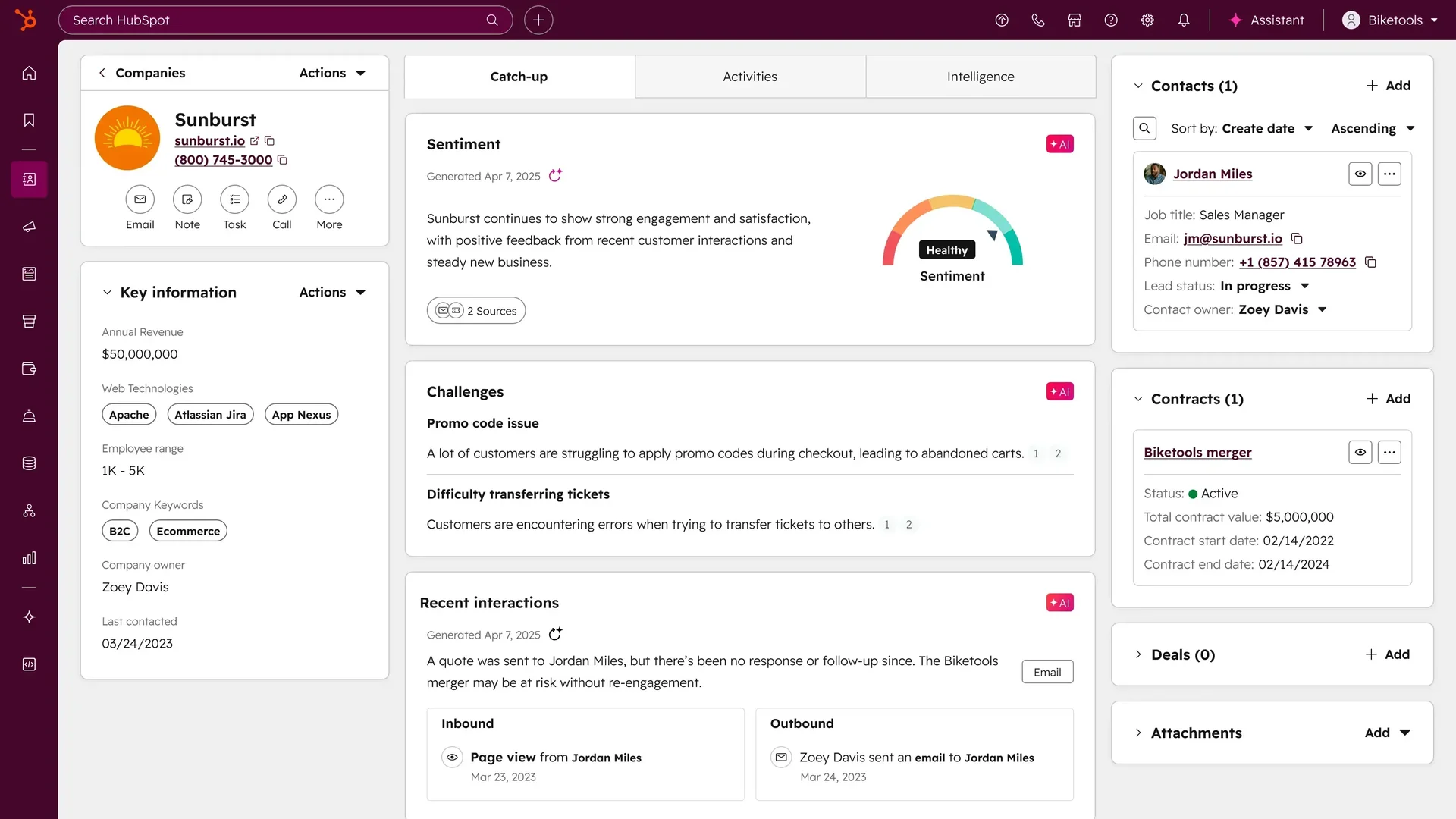
HubSpot is a CRM and customer platform built around a permanently free core that scales from solo founders through mid-market teams, bundling marketing automation, sales pipeline management, customer service, and content tools on a shared data layer. With 288,706 customers across 135+ countries, it is the dominant platform for growing businesses. Its key capabilities include:
Free CRM with unlimited contacts (up to 1 million records) and no minimum annual spend
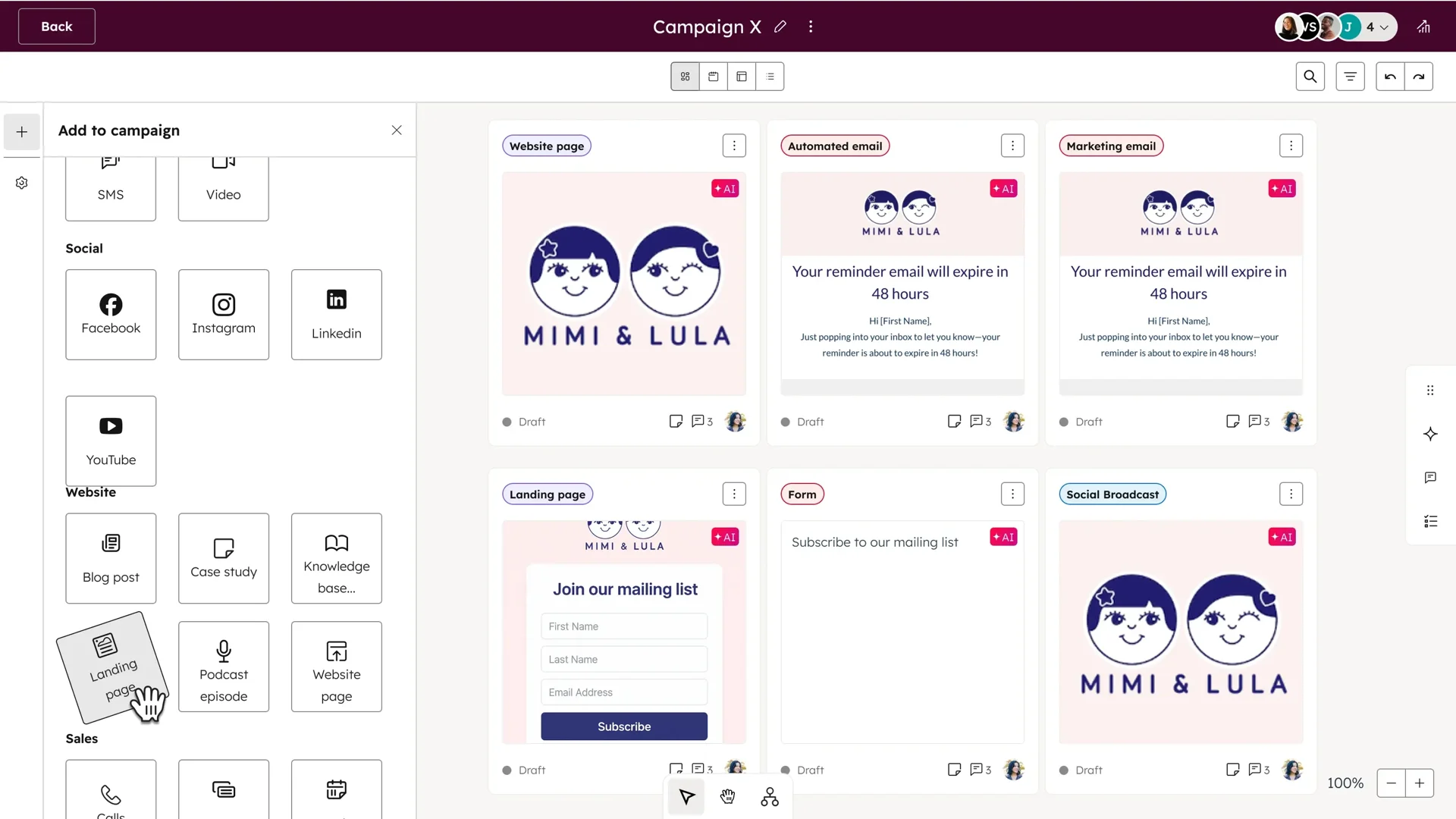
Marketing Hub with email marketing, landing pages, social media management, and ad tracking connected natively to the CRM
App Marketplace with over 2,000 integrations
Breeze AI layer for automated prospecting, content generation, and customer service
Why Choose HubSpot Over Creatio for Small and Mid-Market Businesses
HubSpot stands out in the following areas:
No Minimum Spend: A Real Free Tier That Works
Creatio's $10,000/year minimum spend and standard three-year contract are designed for enterprise buyers. For small businesses, that floor is a hard stop. HubSpot's free CRM tier is permanently free: unlimited contacts (up to 1 million records), a deal pipeline, email integration, meeting scheduling, live chat, forms, and landing pages, all at zero cost. Starter plans begin at $9/seat/month. For teams evaluating CRM before committing, HubSpot's free product handles the job at a level Creatio structurally cannot offer at that price point.
Integrated Marketing Automation
Creatio's marketing capabilities exist as a separate CRM product layer at $15/user/month stacked on top of the platform subscription.
HubSpot's Marketing Hub is built on the same Smart CRM as Sales Hub and Service Hub. Every marketing interaction (email opens, landing page conversions, ad clicks) writes automatically to the same contact record a sales rep sees. When a lead fills out a landing page, they're already in the CRM and can trigger a sales sequence immediately, with no integration step.
Source: HubSpot
Faster Time to Value Without a Dedicated Admin
Creatio's reviewers flag that "the numerous capabilities can cause a sense of overload for new users" and that benefiting from the software requires "somebody dedicated to customizing the features". HubSpot claims customers achieve meaningful value within 90 days, and HubSpot Academy provides structured onboarding with over 200,000 certified professionals. A non-technical marketer can configure a functioning pipeline on day one.
NOTE: We also evaluated Zoho CRM and Freshsales for this archetype. While Zoho CRM offers a comparable free tier and broad feature set, its interface fragmentation across 50+ products creates coordination overhead. Freshsales provides an accessible entry point but thinner marketing automation at lower tiers. HubSpot offers the most complete path from a functional free CRM through full go-to-market capability without requiring a separate platform or enterprise contract.
For a detailed comparison of how Creatio and HubSpot stack up on pricing, ease of use, and marketing automation, see our Creatio vs HubSpot breakdown.
HubSpot Pricing
Free: $0, permanently free. Up to 1 million contact records, 2 user seats, deal pipeline, basic CRM tools
Starter Customer Platform: $10/seat/month; bundles Starter editions of Marketing, Sales, Service, Content, and Data Hub with 1,000 marketing contacts
Marketing Hub Professional: $890/month, 3 seats included, 2,000 marketing contacts, full marketing automation. One-time $3,000 onboarding fee
Sales Hub Professional: $100/seat/month; full sequences, CPQ, conversation intelligence. One-time $1,500 onboarding fee
Note: HubSpot's mixed-tier seat amplification rule means that if a team subscribes to multiple Hubs at different tiers, all Core Seats bill at the highest-tier rate. This can increase total costs significantly.
Who Should Use HubSpot?
Choose HubSpot if:
Your team is priced out of Creatio's $10,000/year minimum or three-year contract commitment, and you need a CRM that scales from free to full go-to-market capability.
You want marketing automation and CRM on a single shared database without integration overhead.
Your team lacks a dedicated CRM administrator and needs a platform where non-technical users can go live within days.
Mobile CRM access matters: HubSpot's apps consistently score higher in usability than Creatio's mobile experience.
5. Pipedrive — Best Alternative for Teams That Want Pipeline Clarity Without Suite Overhead
Source: Pipedrive
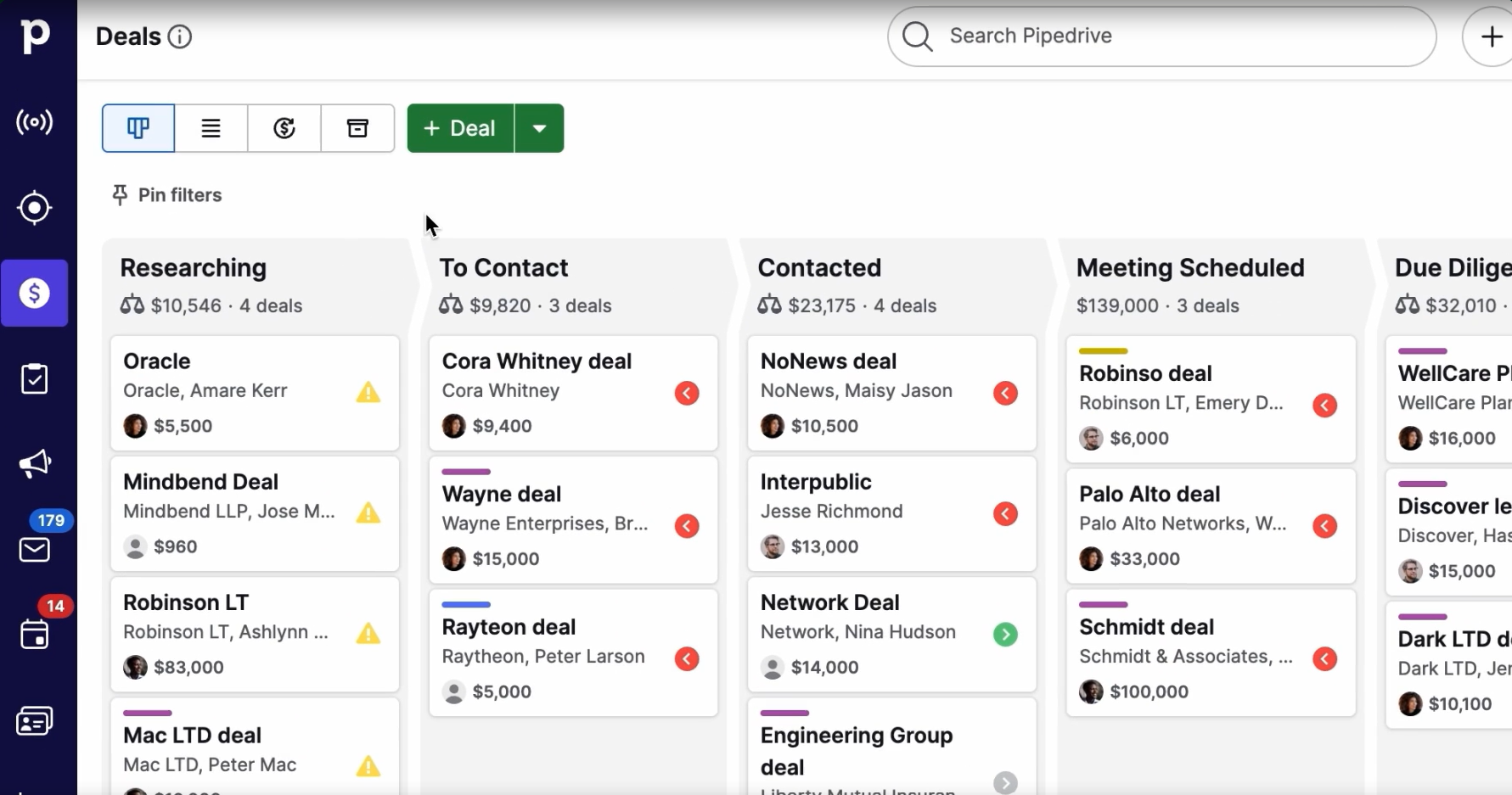
Pipedrive is a sales CRM built for small and medium-sized businesses that want a clean, visual system for tracking deals. Founded in 2010 by salespeople frustrated by CRMs built for managers rather than reps, Pipedrive pioneered the kanban-style pipeline view and now serves 100,000+ companies across 179 countries. Its key capabilities include:
Visual kanban pipeline with drag-and-drop deal management and Deal Rotting alerts
Activity-based selling that enforces a scheduled next step on every deal
Workflow automation with if/else branching on trigger events and date-based conditions
AI Sales Assistant for deal prioritization, next-action prediction, and AI email writing
Plans starting at $14/user/month with no annual contract floor
Why Choose Pipedrive Over Creatio for Sales Pipeline Clarity
Pipedrive stands out in the following areas:
Visual Pipeline-First Interface Built for Reps
Creatio is architected for operations teams and IT leaders building enterprise-grade workflows. Creatio reviewers flag that capabilities "can cause a sense of overload for new users."
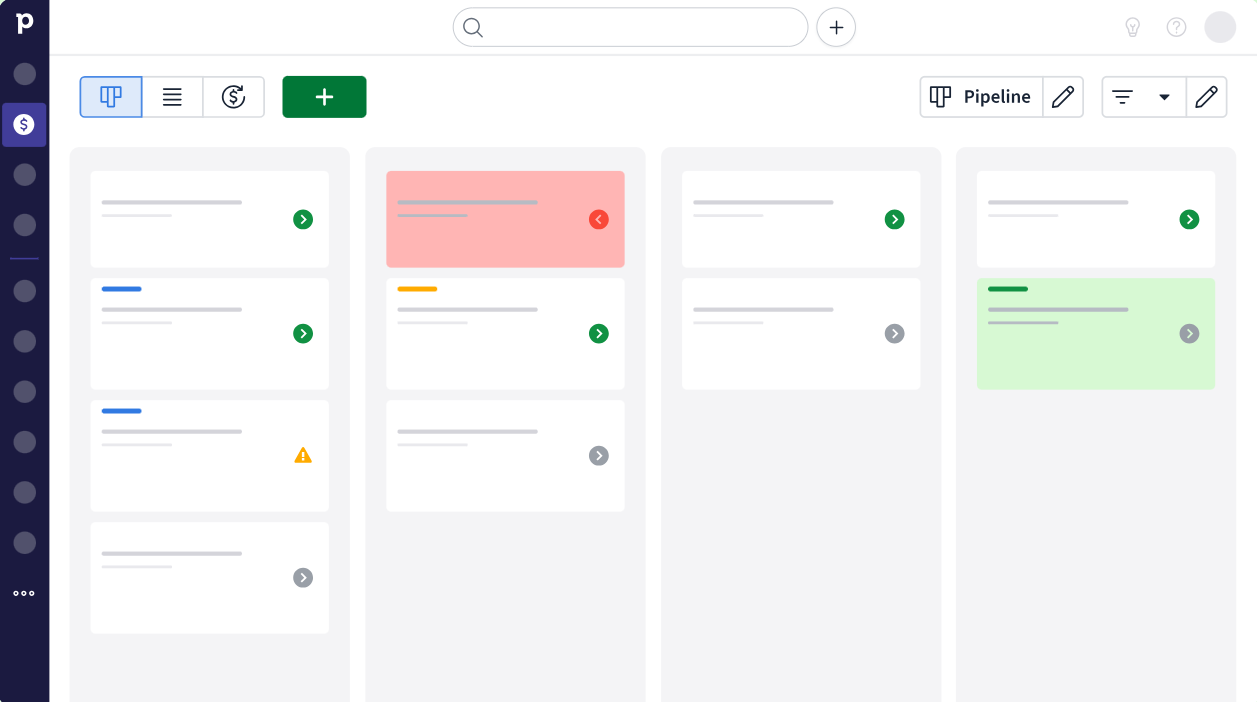
Pipedrive's kanban-style pipeline view displays every deal as a card with value, expected close date, and next activity visible at a glance. Deal Rotting indicators appear when deals sit idle, and activity-based selling surfaces overdue activities at login.
Source: Pipedrive
Self-reported outcomes show an average 93% increase in pipeline deals and 46% faster closing time. The mobile apps support offline mode, in-app calling, and a "Nearby" feature for field sales, directly addressing Creatio's mobile weakness.
Transparent Pricing With No Minimum Spend
Creatio requires a $10,000/year minimum on a standard three-year contract. Pipedrive offers four plans starting at $14/user/month with no annual floor. Features that competitors gate behind higher tiers (including unlimited pipelines, product catalogs, custom reports, and API access) are available across all plans. A 14-day free trial with full access, no credit card required, lets teams evaluate the product before committing.
Zero-Admin Setup
Creatio requires "somebody dedicated to customizing the features" per user reviews. Pipedrive's onboarding is self-service: Knowledge Base, Pipedrive Academy courses, and an in-app chatbot guide. A working pipeline can be live within hours. Business users own configuration end-to-end without IT involvement.
NOTE: We also evaluated Monday CRM and Freshsales for this slot. While Monday CRM excels at project-and-sales hybrid workflows and Freshsales offers a broader freemium tier, Pipedrive is the most focused sales pipeline specialist, with the strongest track record for frontline rep adoption and the most transparent per-seat pricing among the options we evaluated.
For a direct look at how Creatio and Pipedrive compare on pipeline management and pricing, see our Creatio vs Pipedrive comparison.
Pipedrive Pricing
All plans include unlimited pipelines, deal rotting, products catalog, custom fields, API access, 500+ Marketplace integrations, and AI-powered report creation.
Lite: Starts at $14/user/month; unlimited customizable pipelines, mobile apps, Google and Microsoft sync
Growth: Adds email sync, templates, open/click tracking, workflow automations with if/else branching, sequences, and forecast view
Premium: Adds Smart Docs, Projects, LeadBooster, AI email creation, phone support
Ultimate: Adds contact data enrichment, security alerts, highest usage limits
14-day free trial with full product access, no credit card required. Annual billing offers up to 42% savings vs. monthly.
Who Should Use Pipedrive?
Choose Pipedrive if:
Your team needs a visual, rep-operated pipeline tool, not a no-code enterprise platform that requires admin bandwidth to configure.
You're on Creatio but have concluded its process automation depth exceeds what your revenue team actually uses, and you're paying $10,000+ annually for features that sit idle.
Your sales reps need consistent daily workflow discipline (scheduled next activities, deal rotting alerts) without manager intervention or workflow rule maintenance.
You want pipeline management, email tracking, automation, and AI-assisted selling at $14/user/month with no long-term contract floor.
6. Zoho CRM — Best Alternative for Budget-Conscious Teams That Need Structured Process Automation
Source: Zoho CRM
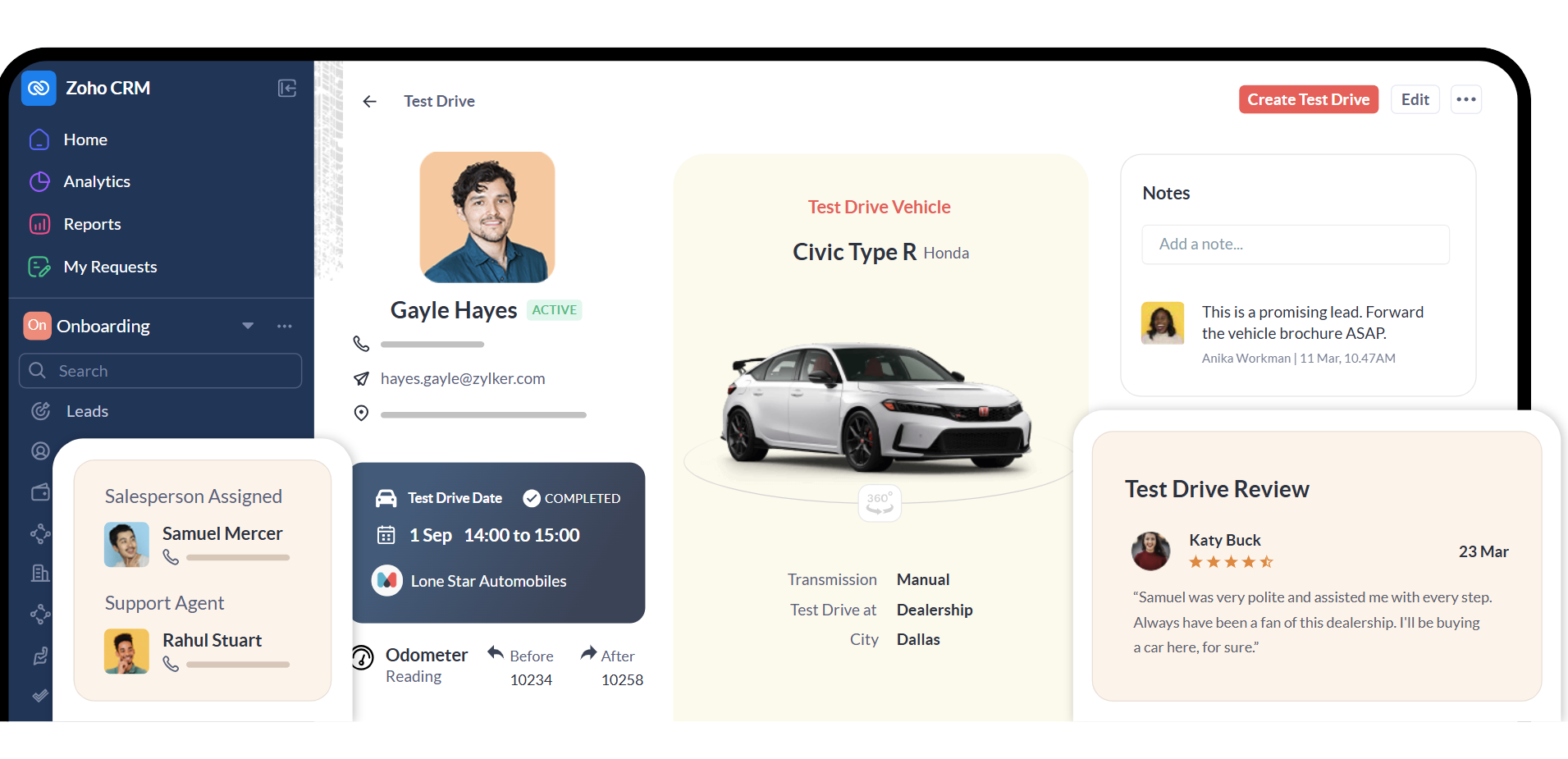
Zoho CRM has been on the market since 2005, built by a fully bootstrapped company serving 300,000+ businesses worldwide. It delivers a functionally complete CRM (from lead capture through territory assignment, CPQ, and AI-powered forecasting) with pricing designed for teams that Creatio's $10,000 annual minimum would exclude. Its key capabilities include:
Permanently free plan for up to three users with full lead, contact, account, and deal management
Blueprint process automation with enforced stage conditions, approval gates, and transition rules
Zia AI assistant with predictive scoring, email sentiment analysis, anomaly detection, and agentic AI tasks
Strong iOS and Android mobile apps with offline mode and voice note capture
1,100+ pre-built integrations and the option to bundle with Zoho One (50+ apps)
Why Choose Zoho CRM Over Creatio for Budget-Conscious Process Automation
Zoho CRM stands out in the following areas:
A Functional Free Plan
Creatio's $10,000/year minimum and three-year contract term create a hard floor that excludes most small teams. Zoho CRM offers a permanently free plan for up to three users with full lead, contact, account, and deal management; basic workflow automation; customizable dashboards; mobile access; and API access. The entry paid tier is $14/user/month. For three-person teams, the TCO difference is the entire contract value: Creatio costs $10K/year minimum; Zoho costs $0.
Blueprint Delivers Creatio-Style Process Governance
One of Creatio's genuine strengths is its BPM engine, which enforces required field completion, approval gates, and transition validation.
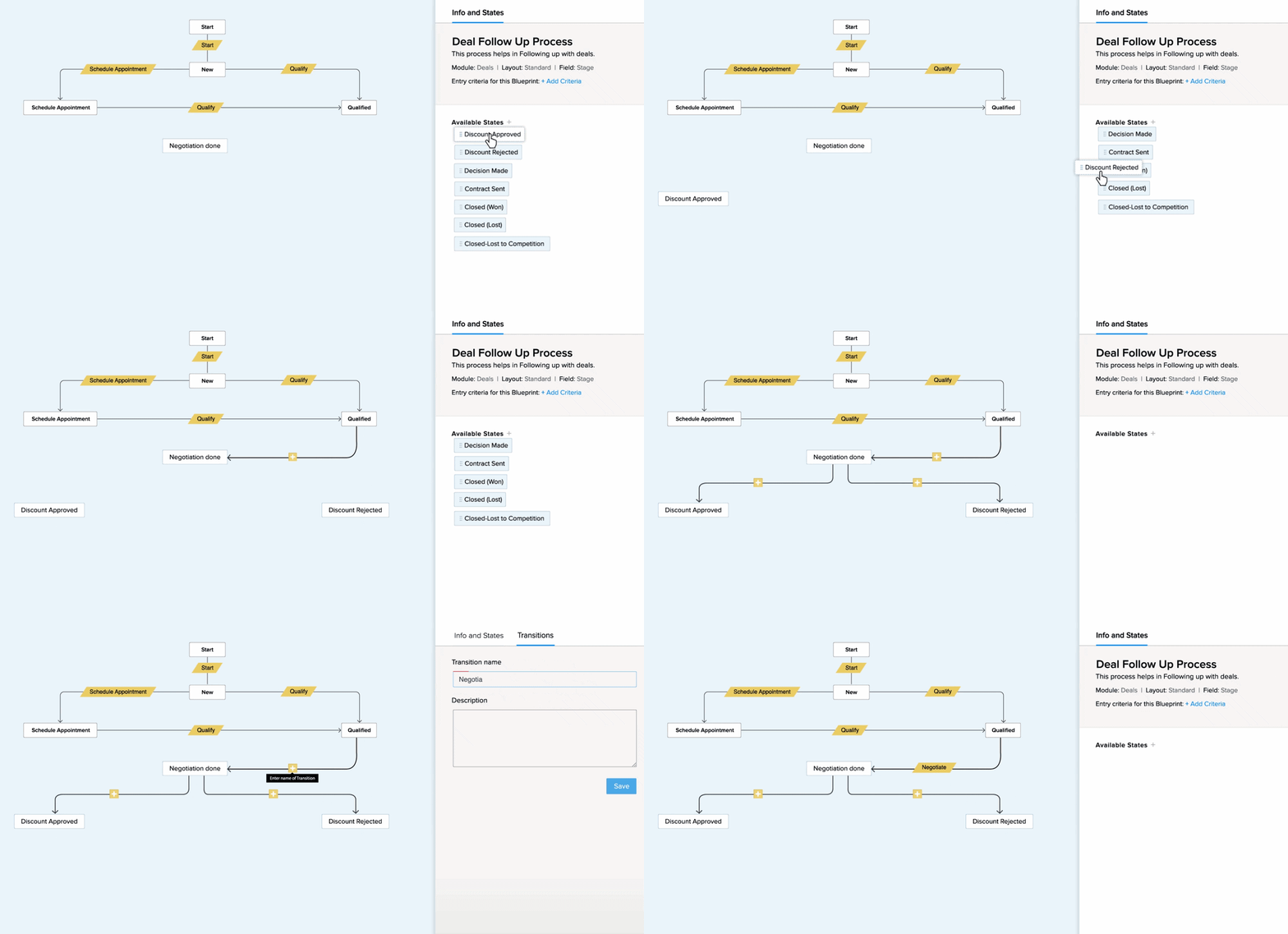
Zoho CRM's Blueprint provides comparable governance: admins build a visual state machine where stages connect by transitions, and reps cannot advance a deal without meeting defined conditions (fields filled, calls logged, approvals obtained). Stagnation alerts fire for idle records, and bottleneck reports surface velocity problems.
Source: Zoho CRM
Blueprint arrives at $23/user/month on the Professional tier. For teams whose primary reason for evaluating Creatio was process discipline rather than platform breadth, Blueprint is a defensible alternative at a fraction of the cost.
Mobile App Addresses a Known Creatio Weakness
Creatio's mobile experience is consistently flagged as lacking: "Creatio's mobile app lacks intuitiveness and needs enhancement". Zoho CRM's mobile app delivers full CRM functionality: viewing and updating records, logging calls, running workflow-driven deal advancement, push notifications, and offline mode. Voice note capture lets reps dictate meeting summaries without typing. The app has high ratings on both iOS and Android, and a Mobile Web SDK supports custom mobile tools.
NOTE: We also evaluated HubSpot's free tier and Freshsales Free for this archetype. While HubSpot's free CRM offers an exceptional experience with marketing integration, it lacks structured process enforcement tools like Blueprint and gates most automation behind paid plans. Freshsales Free is viable for individual reps but too limited for teams needing workflow rules and AI scoring. Zoho CRM offers the most complete free plan, the most affordable paid tiers at scale, and the deepest process automation below the enterprise pricing threshold.
For a detailed look at how HubSpot and Zoho CRM compare on free plans and process automation, see our HubSpot vs Zoho CRM breakdown.
Zoho CRM Pricing
Free: $0 for up to 3 users; leads, contacts, accounts, deals, mobile apps, basic workflow automation
Standard: $14/user/month; workflow automation (30 rules/module), AI agents, Cadences, sales forecasting
Professional: $23/user/month; Blueprint process automation, CPQ, email intelligence, inventory management
Enterprise: $40/user/month; Zia AI predictions, Journey Orchestration, Territory Management, Sandbox
Ultimate: $52/user/month; enhanced limits, custom AI/ML via QuickML
Zoho One is also available at approximately $37/employee/month for the full suite of 50+ Zoho apps. Classic Support (24x5 phone, email, chat) is included on all paid plans at no additional cost.
Who Should Use Zoho CRM?
Choose Zoho CRM if:
Your team is three people or fewer and you need a full-featured CRM at no cost.
Your primary reason for evaluating Creatio was structured process enforcement, but the $10,000+ annual commitment doesn't fit your budget or company stage.
You have field sales reps or a distributed team that depends on mobile access, and Zoho's mobile app with offline mode is a consistent advantage over Creatio's weaker mobile experience.
You want a CRM that grows with you, starting free and scaling through $14-$52/user/month tiers without triggering a major contract renegotiation at each step.
7. Attio — Best Alternative for GTM Teams That Need a Flexible, AI-Native CRM Architecture
Source: Attio
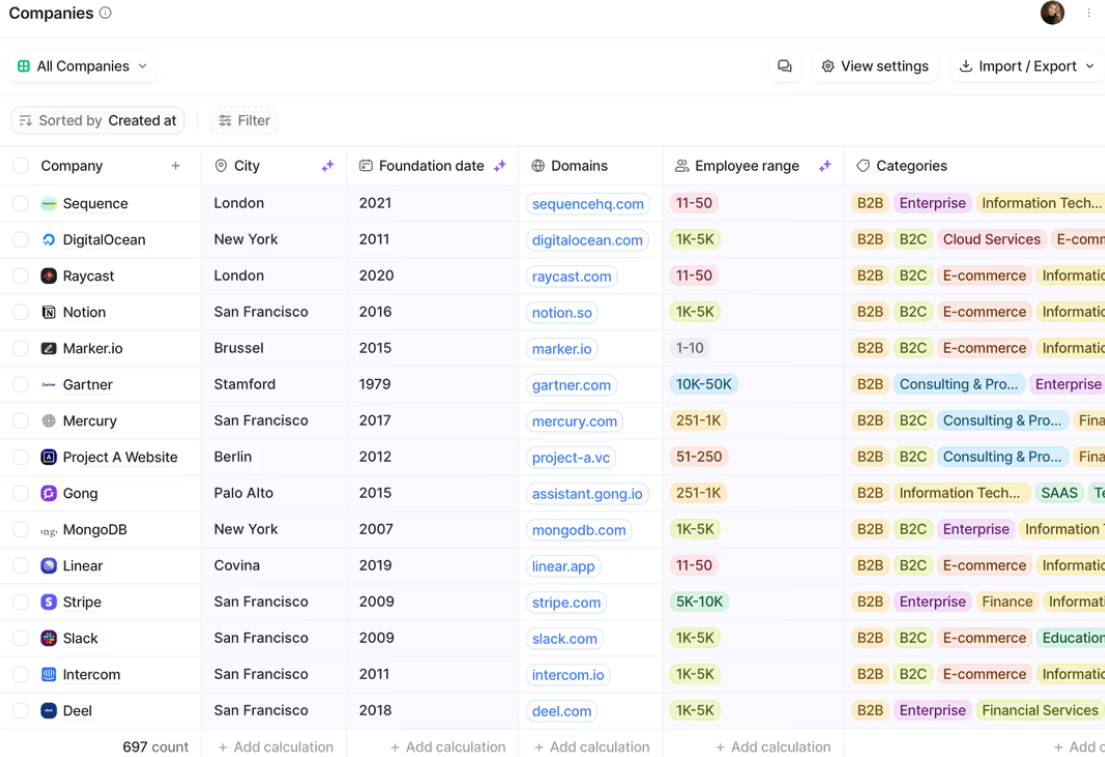
Attio is an AI-native CRM built for go-to-market and technology teams that want to model their CRM around how their business actually operates. It has raised $116 million across four rounds and reports 5,000 paying customers as of August 2025, including Granola, Modal, Railway, Flatfile, and Snackpass. Its key capabilities include:
Fully custom data model: create any object type, attribute, and relationship without developer involvement
Automatic relationship intelligence: every meeting and email thread captured and attached to the correct records
AI-native features embedded at the data layer for enrichment, smart field suggestions, and workflow triggers
Sub-50ms performance across all views and record types
Free plan for up to three users, with paid plans starting at $29/user/month
Why Choose Attio Over Creatio for Flexible, AI-Native CRM
Attio stands out in the following areas:
A Data Model You Build Around Your Business
Creatio's CRM data model is organized around predefined objects (Contacts, Leads, Accounts, Opportunities, Cases). Extending it requires navigating the composable architecture and, for complex scenarios, IT support.
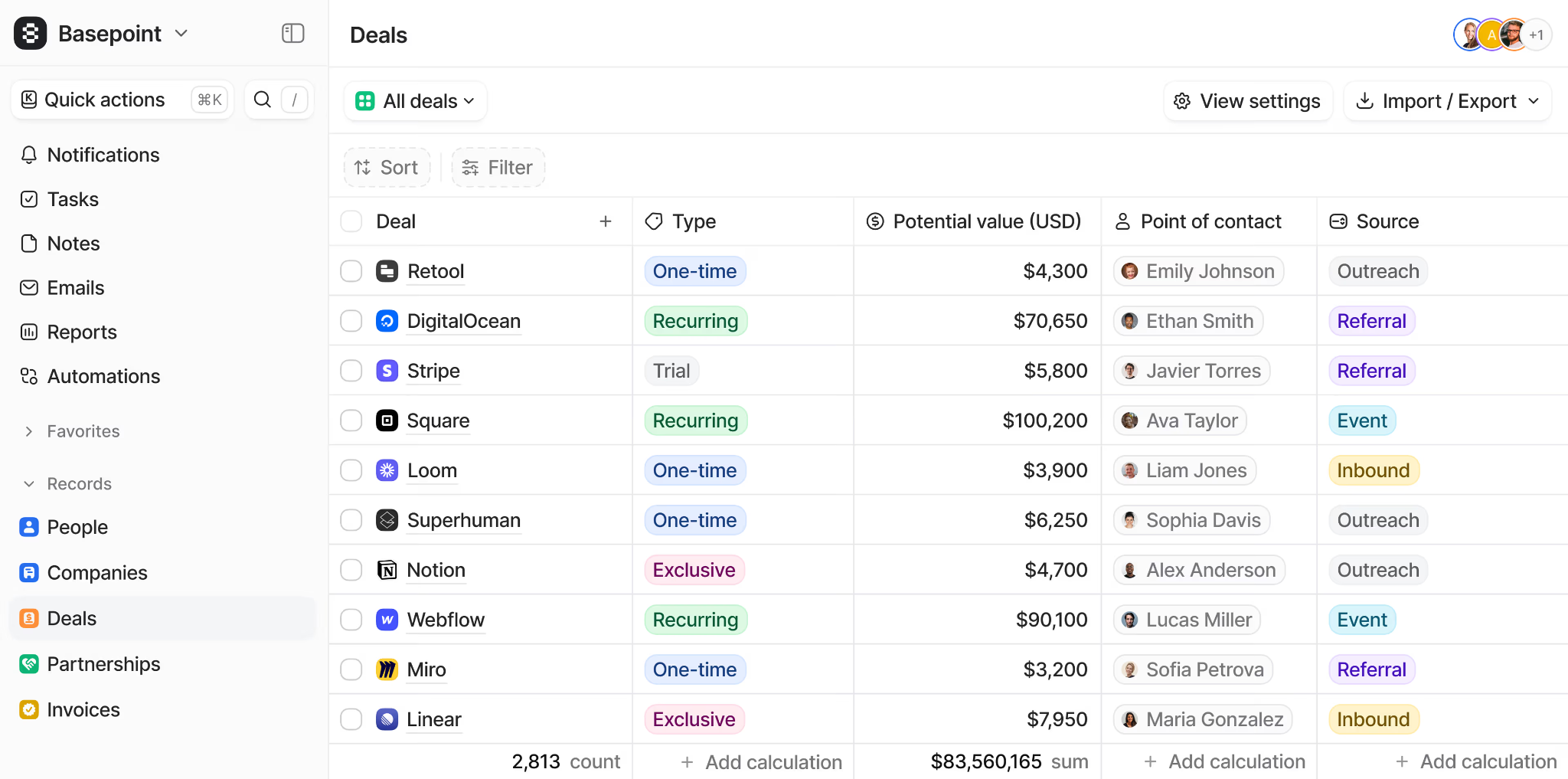
Attio's relationship database model lets teams create fully custom objects (Subscriptions, Partnerships, Investor Portfolios, whatever the business tracks) with 17 distinct attribute types, all configurable without code. G2 rates Attio 9.4/10 for ease of customization.
Source: Attio
Automatic Relationship Intelligence Eliminates Manual Data Entry
Creatio reviewers note "to benefit from the software you need somebody dedicated to customizing the features." Much of that overhead is data hygiene: getting reps to log calls and maintain interaction history. Attio eliminates this at the infrastructure level. When a user connects Gmail or Outlook, Attio automatically captures every email thread and calendar event and attaches it to the correct records. Teams report eliminating dedicated CRM admin roles and saving hours weekly on deal updates after switching to Attio.
AI Embedded in the Data Model, Not Layered Over It
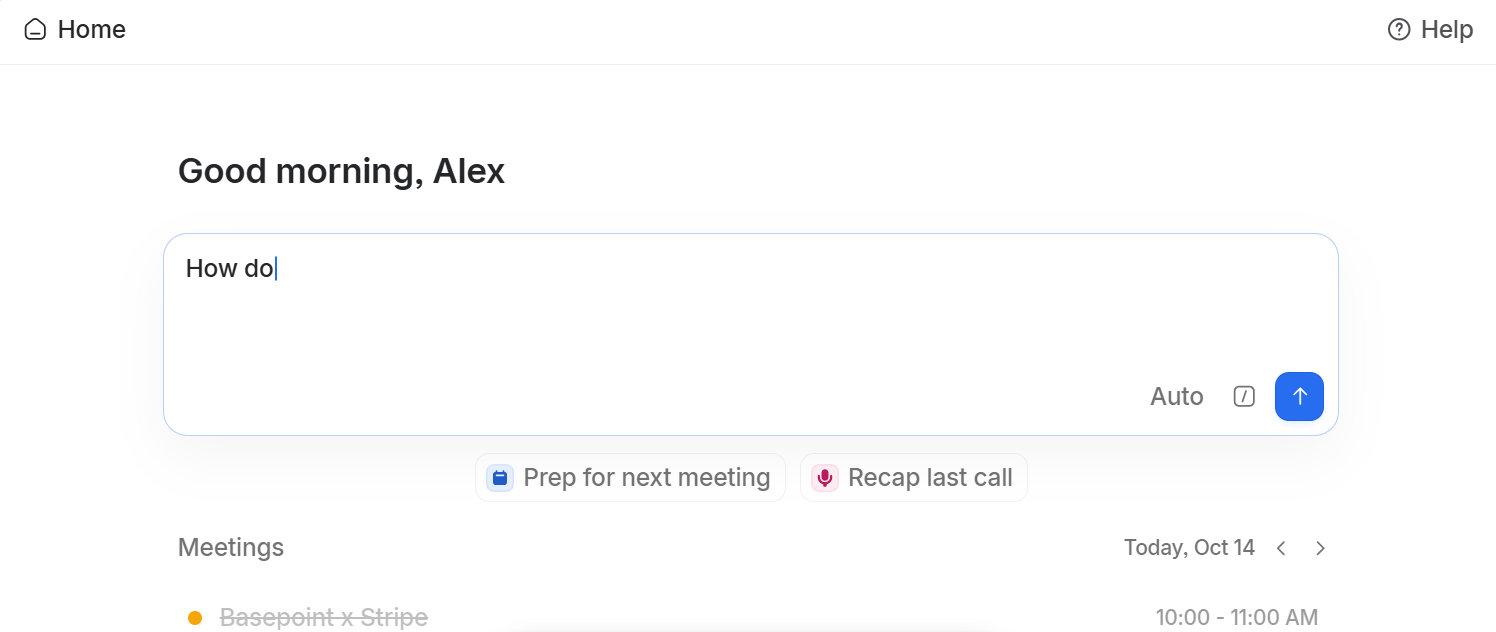
Creatio.ai operates as a chat panel mounted on top of the CRM. Attio's AI-native design means intelligence is built into the data model: automatic enrichment populates company attributes directly into records as they're created.
Ask Attio, powered by Claude Sonnet and Gemini Pro, operates through Universal Context, a semantic index of every record, email, call transcript, and note in the workspace.
Source: Attio
Performance That Doesn't Punish Scale
Creatio reviewers flag "views and login load times are often slow", attributed to the .NET compilation model. Attio was built with sub-50ms latency across all views, including when filtering millions of records. For fast-moving teams where CRM responsiveness affects adoption, this is a daily operational difference.
NOTE: We also evaluated Clay and Notion CRM for this archetype. While Clay excels at data enrichment and outbound sequencing, and Notion CRM offers a familiar document-first interface, Attio is the most purpose-built CRM for GTM-forward teams that need flexible data architecture combined with native AI, without compromising on CRM depth or performance.
Attio Pricing
Free: $0 for up to 3 seats; 50,000 records, up to 3 custom objects
Plus: $36/user/month; unlimited seats, 250,000 records, Ask Attio and AI agents, Call Intelligence
Pro: $86/user/month; 1,000,000 records, up to 12 custom objects, Sequences, advanced permissions, priority support
Enterprise: Custom pricing; unlimited objects and records, SSO, migration service
Attio also runs a startup program with 80% off the annual Pro plan for the first year for teams affiliated with venture firm or Attio startup partners.
Who Should Use Attio?
Choose Attio if:
Your team is a seed-to-Series-B startup that needs a CRM evolving with the business, from contact management through complex multi-object GTM operations, without a painful migration at each stage.
You run a product-led growth motion and need product usage and behavioral data directly in the CRM to trigger targeted outreach, via native Segment integration and reverse ETL support.
Your current CRM requires a dedicated admin to stay clean, and you'd rather solve data quality at the infrastructure level by automating email and calendar sync.
You're an engineering-driven organization that cares about API quality, developer documentation depth, and the ability to build custom integrations, with Attio's MCP server, REST API, and App SDK.
You're migrating away from a platform whose complexity, pricing floor, or performance no longer matches where the business is.
The Final Verdict
Creatio delivers genuine strength in composable no-code CRM and workflow automation, with AI capabilities included at no additional cost. But growing businesses often need specialized depth in areas where Creatio's breadth-first approach creates trade-offs. Based on our research, here are the best alternatives:
ZoomInfo for B2B data, AI-powered GTM intelligence, and universal access that fuels prospecting and pipeline acceleration across any tool
Salesforce for enterprise-scale AI agents, the deepest integration ecosystem, and analytics that grow to Fortune 500 complexity
Microsoft Dynamics 365 for CRM-plus-ERP convergence within the Microsoft stack, with Power BI and Power Platform closing Creatio's analytics and reporting gaps
HubSpot for small businesses that want a free CRM with integrated marketing automation, without enterprise contract minimums
Pipedrive for teams that want visual, rep-first pipeline management done well, without suite overhead or admin requirements
Zoho CRM for budget-conscious teams that need Creatio-style process governance at a fraction of the cost, with a free plan for up to three users
Attio for GTM-forward tech teams that need a flexible, AI-native CRM data architecture with sub-50ms performance and automatic relationship intelligence
You don't have to choose between Creatio and these alternatives exclusively. Many organizations use Creatio alongside specialized tools to address specific gaps in their go-to-market stack. Consider your needs, budget, team size, and growth trajectory when deciding which solution fits.
Ready to see the full context behind your deals? ZoomInfo combines the industry's largest B2B dataset with a proprietary GTM Context Graph that reveals not just what's happening in your pipeline, but why. Start your free trial or request a demo to experience intelligence-driven go-to-market execution.
Creatio Alternatives FAQ
Why do businesses look for Creatio alternatives?
Creatio is a strong platform for composable no-code CRM and workflow automation, but businesses often look elsewhere due to its $10,000/year minimum spend and standard three-year contract, slow load times tied to its .NET compilation architecture, a steep learning curve requiring dedicated admin resources, a mobile app that reviewers consistently describe as lacking intuitiveness, and a third-party integration marketplace narrower than larger ecosystems like Salesforce AppExchange.
What is the best overall Creatio alternative?
There is no single best alternative because Creatio covers multiple functions. ZoomInfo is the top choice for B2B data and AI-powered GTM intelligence. Salesforce leads for enterprise-scale AI agents and integration depth. HubSpot is the strongest option for small businesses wanting marketing automation built into a free CRM. The right choice depends on your team's primary need.
Is there a free alternative to Creatio?
Yes, several alternatives offer free plans. HubSpot's free CRM includes unlimited contacts, a deal pipeline, and basic marketing tools permanently at no cost. Zoho CRM's free plan supports up to three users with full pipeline management. Attio offers a free tier for up to three seats with 50,000 records. ZoomInfo also offers ZoomInfo Lite as a permanent free tier with database access and 10 monthly export credits.
Which Creatio alternative is best for small businesses?
HubSpot is the strongest choice for small businesses because it offers a permanently free CRM with integrated marketing automation, structured onboarding through HubSpot Academy, and no minimum annual spend. Pipedrive is the best option for teams focused purely on sales pipeline management, starting at $14/user/month with no contract floor.
How does Creatio's pricing compare to these alternatives?
Creatio's platform starts at $25/user/month (Growth tier) plus $15/user/month per CRM module, with a $10,000/year minimum spend and standard three-year contract. By comparison, HubSpot starts free, Pipedrive starts at $14/user/month, Zoho CRM starts free for three users ($14/user/month for Standard), and Attio starts free for three seats ($29/user/month for Plus). ZoomInfo, Salesforce, and Dynamics 365 use custom or tiered enterprise pricing that varies by usage and features.
Which alternative is best for teams already using Microsoft 365?
Microsoft Dynamics 365 is the most natural fit because it shares a common data model with Microsoft 365 through Dataverse. Seller activity in Outlook and Teams flows into CRM records automatically, Copilot AI draws from both CRM and Microsoft 365 data, and Power BI provides native analytics. No third-party connectors or sync jobs are required.
Which Creatio alternative has the best mobile app?
Creatio's mobile app is a documented weakness across review platforms. HubSpot, Pipedrive, and Zoho CRM all offer significantly stronger mobile experiences. Pipedrive's mobile app includes offline mode, in-app calling with automatic logging, and a "Nearby" feature for field sales. Salesforce's mobile app includes Apple Intelligence integration and full offline access. Zoho CRM offers voice note capture and offline mode.
Can I use ZoomInfo alongside Creatio rather than replacing it?
Yes. ZoomInfo and Creatio address different layers of the go-to-market stack. Creatio manages your CRM workflows, process automation, and customer data orchestration. ZoomInfo provides the B2B intelligence layer that feeds your CRM: verified contacts, company data, buyer intent signals, and deal context. Many organizations use a GTM intelligence platform alongside their CRM to improve prospecting quality, enrich existing records, and identify in-market accounts before competitors reach them.
