
If you're comparing Demandbase and Oracle BlueKai, you need to know one thing first: Oracle BlueKai reached End of Life on September 30, 2024. The platform is gone, its documentation pulled offline, and former customers had to migrate elsewhere.
That changes this comparison. Instead of weighing two living products, you're asking a different set of questions:
What did Oracle BlueKai do, and why did it shut down?
Does Demandbase fill the gap BlueKai left?
Are you looking for a data management platform (DMP), or has your need evolved into something broader?
Do you need account-level targeting with advertising built in, or the underlying B2B data and intelligence that powers targeting across every channel?
How important is it that your platform covers sales, marketing, and RevOps in one place?
Here's what we recommend:
Demandbase is the surviving platform in this comparison, and a strong one. It combines account-based marketing, a native B2B demand-side platform, intent data from over 2 trillion signals per month, and sales intelligence into a single suite called Demandbase One.
For enterprise B2B marketing teams that ran programmatic campaigns through BlueKai's DMP, Demandbase's advertising and account identification capabilities are the closest functional replacement.
However, Demandbase serves enterprise buyers only, publishes no pricing, and cannot be purchased as individual modules (with exceptions for Advertising and Data standalone).
Oracle BlueKai was a data management platform that organized audience data in the cloud to personalize marketing campaigns. It operated the world's largest third-party data marketplace with over 700 million profiles.
Its dependence on third-party cookies and Oracle's broader privacy problems caused advertising revenue to collapse from $2 billion in 2022 to $300 million in 2024, leading Oracle to shut down its entire advertising business.
Demandbase covers advertising and ABM well, but its scope is narrow: it's a marketing and account intelligence platform. If you need a single platform that combines B2B data, sales execution, marketing orchestration, and AI-driven intelligence across your entire go-to-market team, there's a broader option worth considering.
ZoomInfo is an AI GTM platform built on a large B2B data foundation: 500M contacts, 100M companies, 135M+ verified phone numbers, and 200M+ verified business emails. Its GTM Context Graph processes 1.5B+ data points daily, combining this data with your CRM records, conversation transcripts, and behavioral signals to reveal what's happening in your accounts, and why.
Where Demandbase focuses on account-based marketing and advertising, ZoomInfo covers the full go-to-market workflow: sales teams execute from GTM Workspace, marketers and RevOps build plays in GTM Studio, and developers pipe the same intelligence into any tool through APIs and MCP.
If a broader go-to-market platform sounds like what your team needs, see ZoomInfo in action with a free trial.
Demandbase vs. Oracle BlueKai vs. ZoomInfo at a glance
Demandbase | Oracle BlueKai | ZoomInfo | |
|---|---|---|---|
Status | Active | Discontinued (Sept 2024) | Active |
Primary focus | ABM & B2B advertising | Audience data management (DMP) | AI GTM platform |
B2B contact data | Not a contact data platform | 500M contacts, 200M+ verified emails | |
Company data | Not a company data platform | ||
Intent data | No native intent data | ||
Native advertising | Yes (own B2B DSP) | Was a DMP, not a DSP | Yes (native DSP) |
Sales tools | Account intelligence only | None | Full prospecting + AI execution |
Pricing | Custom, no published prices | N/A | Custom, consumption-based; free tier available |
Best for | Enterprise ABM teams | (No longer available) | Full GTM teams: sales, marketing, RevOps |
Oracle BlueKai's shutdown changed the landscape
Understanding why BlueKai failed helps clarify what to look for in its replacement.
Oracle acquired BlueKai in 2014 for approximately $400 million to anchor what became the Oracle Data Cloud. At its peak, BlueKai was impressive infrastructure.
The DMP scaled to 1 million transactions per second, its data marketplace included over 200 million user profiles from more than 200 providers, and its in-memory processing engine enabled sub-second audience segmentation.
But the platform was built on a foundation the industry pulled out from under it: third-party cookies. As browsers tightened privacy restrictions and regulators enforced consent requirements, third-party cookie deprecation rendered DMPs (including Oracle's BlueKai) ineffective.
Oracle also lost its data sharing agreement with Facebook following the Cambridge Analytica scandal and faced tightening privacy restrictions across the industry, including GDPR.
The collapse was swift. Oracle's advertising revenue fell from $2 billion in 2022 to $300 million in 2024. On June 11, 2024, Oracle announced it would exit the advertising business entirely, with all products reaching End of Life on September 30, 2024. Oracle tried to offload BlueKai and Datalogix, but found no buyers.
When the shutdown hit, third-party audiences licensed from Oracle were removed from targeting and combined audiences across platforms like Display & Video 360. Thousands of marketers who depended on BlueKai's audience segments had to rebuild their targeting from scratch.
The lesson matters for anyone evaluating a replacement: any platform that depends on third-party cookie data for its core value is vulnerable to the same fate. Both Demandbase and ZoomInfo built their intelligence on proprietary data collection rather than third-party cookies, which is why they survived the privacy shift that killed BlueKai.
Demandbase picked up where BlueKai left off on advertising
For teams that used BlueKai for programmatic audience targeting, Demandbase is the most direct functional replacement.
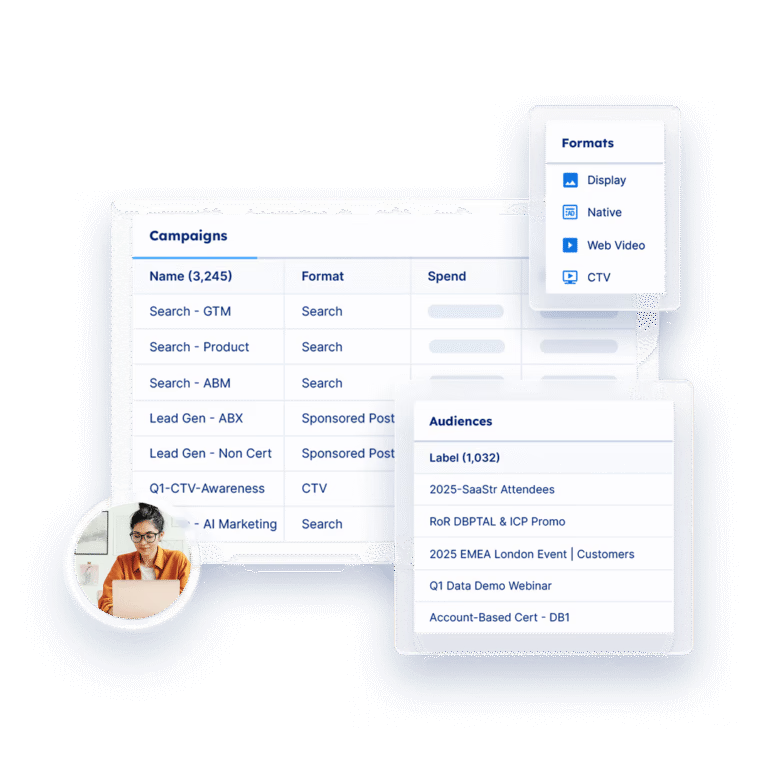
Demandbase operates the only demand-side platform built specifically for B2B advertising. While BlueKai was a DMP (organizing and activating audience data through third-party ad platforms), Demandbase's DSP, named Piper, buys the media directly.
Its targeting engine, AdsIQ, sets bids based on both user and account intent, balances frequency at the account level, and weighs intent strength to allocate spend.
Source: Demandbase
The ad formats cover display, retargeting, native, video, and connected TV, with CTV launched as the first B2B-specific connected TV solution in July 2023. Social audience sync supports LinkedIn, Facebook, Instagram, Google, YouTube, Bing, Adobe, and X.
BlueKai's main advantage was its third-party data marketplace. Demandbase doesn't operate a marketplace, but it doesn't need to. Instead of buying third-party audience segments, Demandbase sources intent signals from its own DSP's bidstream, processing over 2 trillion intent signals per month from more than 70 billion page views per day.
This creates a reinforcing loop: account identification powers DSP targeting, DSP interactions generate intent signals, and intent signals improve bid optimization.
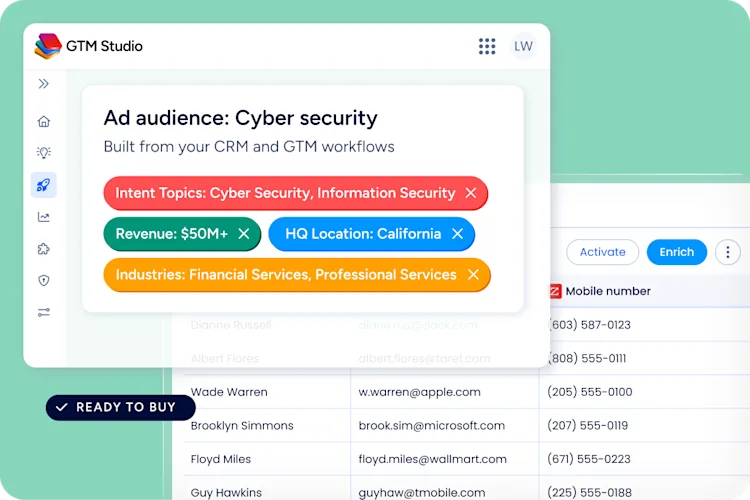
ZoomInfo also offers native advertising through a DSP that deploys display ads based on 300+ company attributes and targets audiences across major networks. But ZoomInfo's advertising is one component of a broader platform, not the headline capability.
Source: ZoomInfo
For teams whose primary need is B2B programmatic advertising, Demandbase's specialization in that area gives it an edge.
For a deeper look at Demandbase's platform and what it delivers in practice, see our Demandbase review.
ZoomInfo's data foundation is larger and wider
Data is where BlueKai's former users should pay close attention, because the gap between platforms is significant.
BlueKai was a data management and marketplace platform. It organized audience data but didn't generate proprietary B2B contact or company intelligence. Demandbase and ZoomInfo both do, but at different scales.
Demandbase maintains 176M+ contacts with 109M validated emails and 54M direct dials, 104M+ companies with 3.1M corporate hierarchies, and 47,000+ technologies tracked across 136M+ domains.
This data comes from acquisitions: InsideView and DemandMatrix joined in 2021, adding firmographics, technographics, and sales intelligence to what was originally an advertising-focused platform.
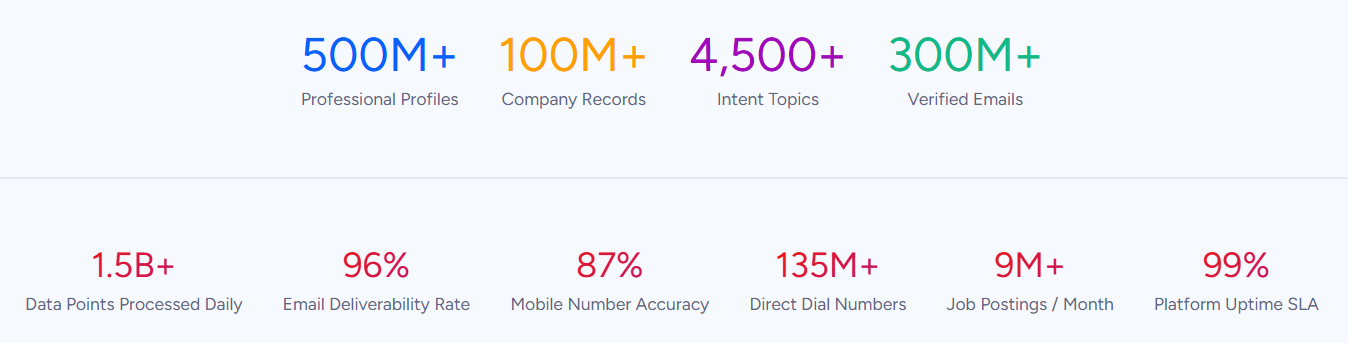
ZoomInfo's data platform is larger: 500M contacts, 100M companies, 135M+ verified phone numbers, 120M direct-dial phone numbers, and 200M+ verified business email addresses.
Source: ZoomInfo
The verification pipeline includes automated ML scanning of 28 million site domains daily, 95 million businesses via third-party partners, a community of 200,000+ ZoomInfo Lite users who share data back, and a Data Training Lab of 300+ human researchers. First-party data reaches up to 95% accuracy.
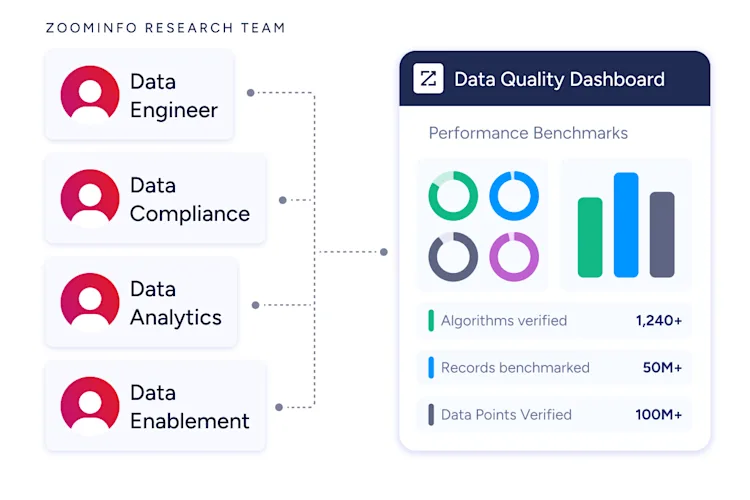
Source: ZoomInfo
The difference matters practically. When a seller needs to reach a buying committee, more verified contacts mean more seats at the table. When marketing builds a target account list, broader company coverage means fewer blind spots. In a Fortune 500 competitive RFP analyzing 25 million contacts across vendors, an independent consultant concluded that "no other competitor came even close."
"ZoomInfo gives us the information we need to execute. It's already there, so we can be three steps ahead." — William Kenimer, VP of Revenue Operations (Vensure)
Intent data: two different approaches
Intent data is what makes both Demandbase and ZoomInfo far more useful than a static data platform like BlueKai. Instead of building audiences from behavioral cookies and third-party segments, both platforms detect active buying signals to identify accounts researching solutions right now.
Demandbase collects intent from its own advertising infrastructure, processing 810,000+ intent keywords in 133 languages with NLP validation to reduce false positives. The intent library also incorporates third-party sources like Bombora Surge, G2, and TrustRadius.
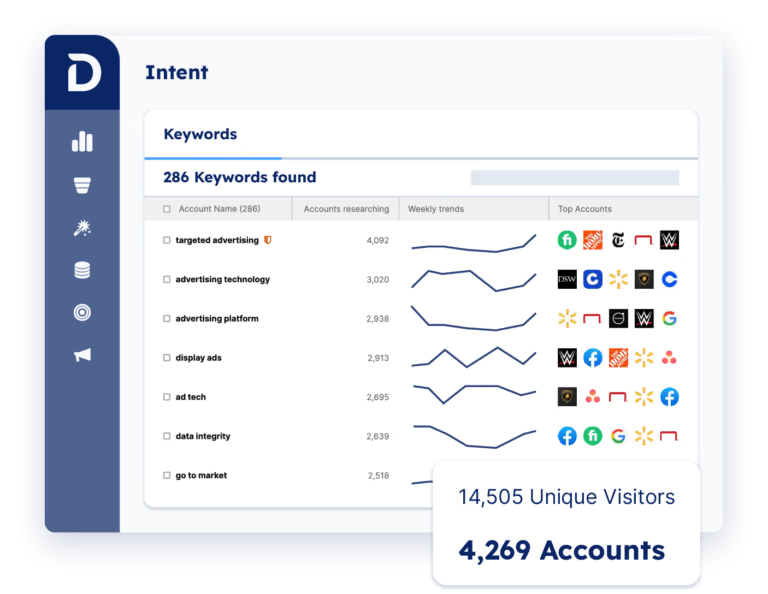
Source: Demandbase
Because intent comes from the bidstream via Demandbase's own DSP, it feeds directly into ad targeting, creating a tight loop between signal detection and campaign execution.
ZoomInfo's Intent tracks signals from 210 million IP-to-Organization pairings and 6 trillion+ new keyword-to-device pairings sourced monthly.
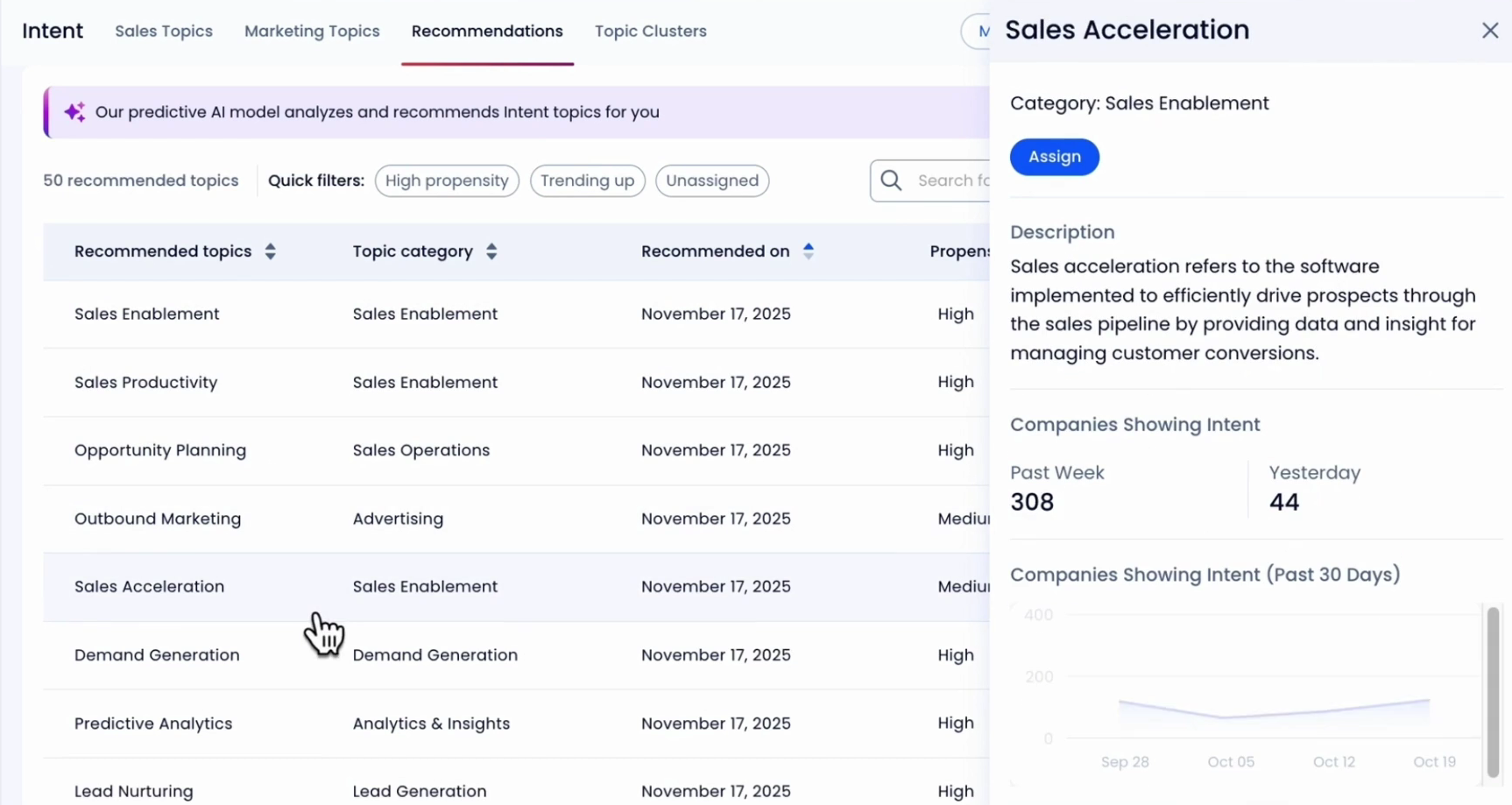
What sets ZoomInfo apart is Guided Intent, which identifies topics historically correlated with deal success rather than requiring manual topic selection. Instead of guessing which keywords matter, the system learns from your actual closed-won patterns.
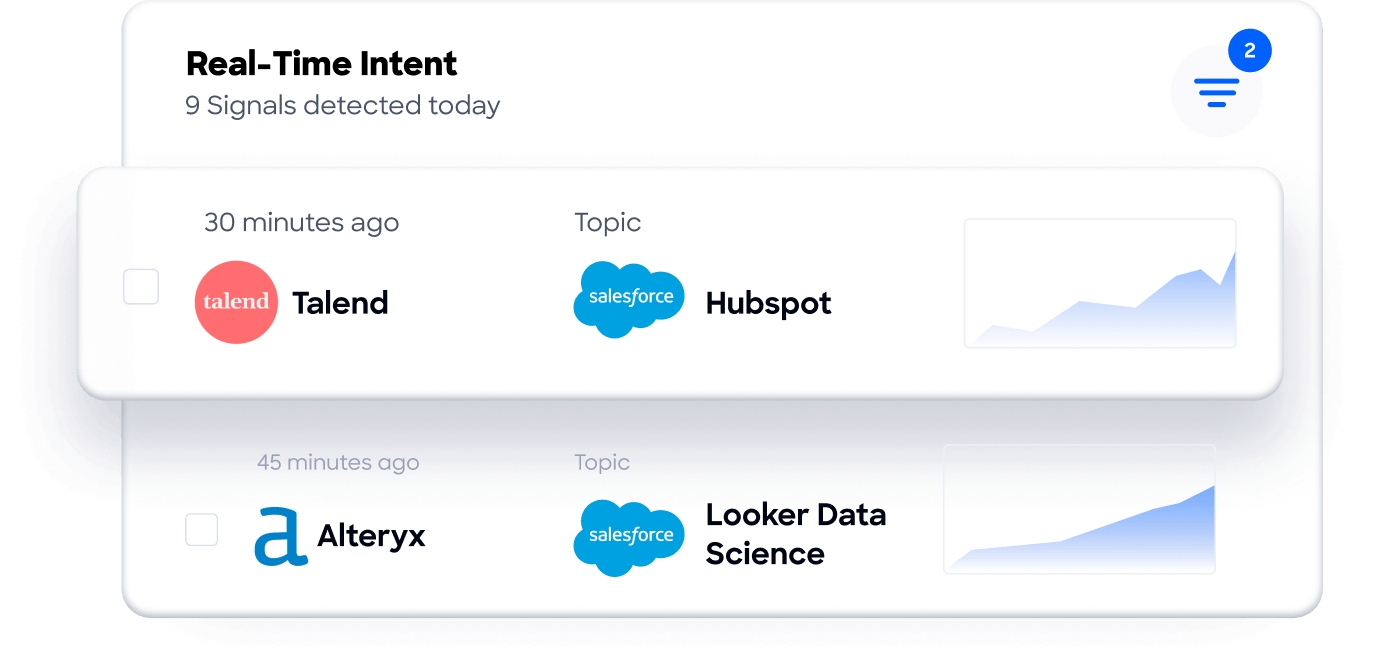
Source: ZoomInfo
The practical difference: Demandbase's intent is optimized for advertising activation. ZoomInfo's intent is optimized for sales and marketing execution across every channel. If your primary motion is ABM advertising, Demandbase's DSP integration is valuable. If intent needs to drive sales outreach, pipeline prioritization, and multi-channel campaigns at the same time, ZoomInfo's broader application wins.
Seismic attributed 39% of active pipeline to opportunities identified or influenced by ZoomInfo signals. "That combination of our internal CRM data, external signals, and AI has helped us craft very specific account-based messages, and people have responded right away." — Toby Carrington, Chief Business Officer (Seismic)
Demandbase is marketing-first; ZoomInfo spans the full GTM team
This is the fundamental architectural difference between the two surviving platforms.
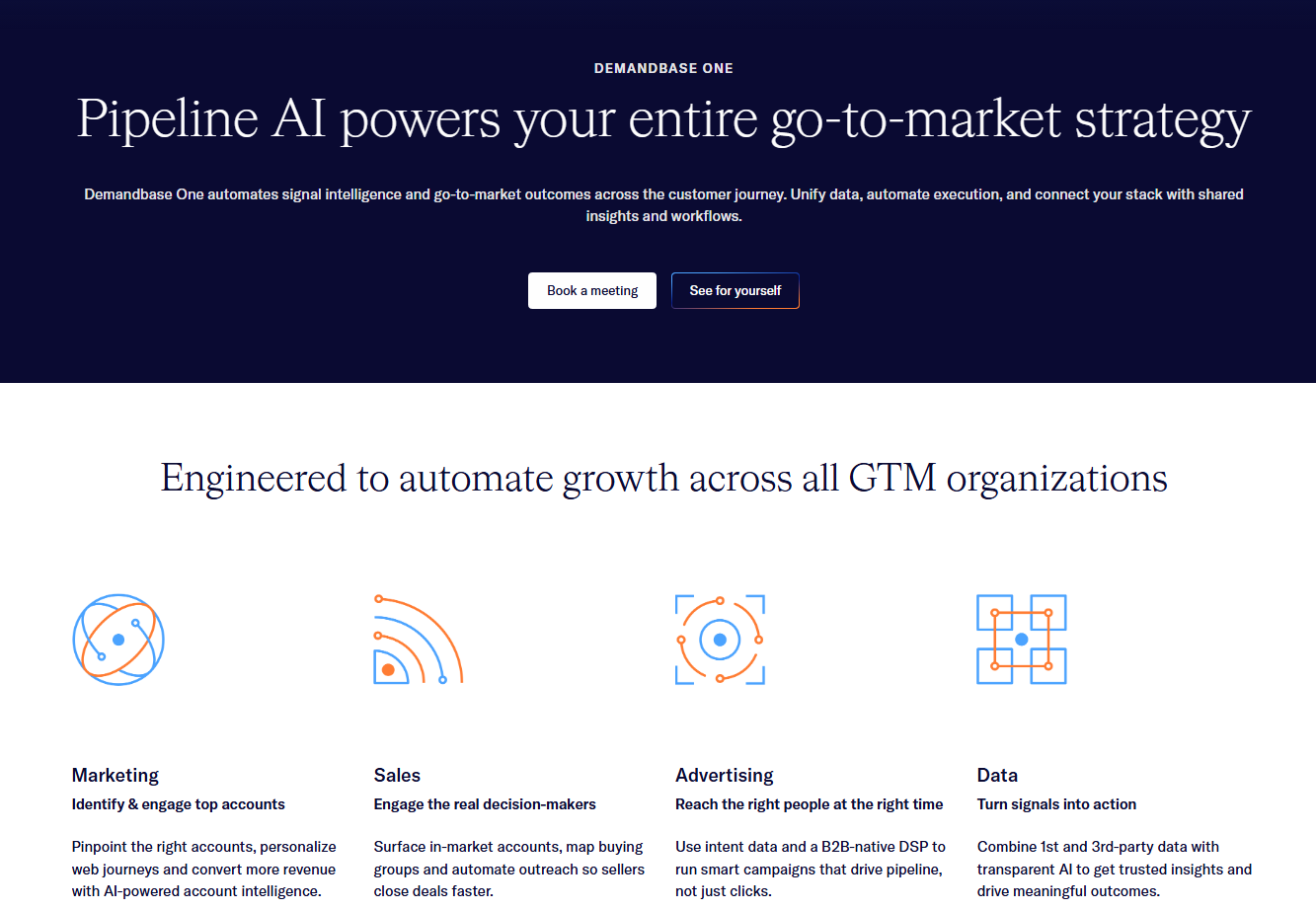
Demandbase started as an ABM company in 2006 and has evolved through several positioning phases, most recently rebranding as a "Pipeline AI platform." Its Demandbase One suite covers Marketing, Advertising, Sales Intelligence, and Data.
Source: Demandbase
But Demandbase's sales capabilities stop at intelligence: the platform surfaces account insights and intent signals to sellers but does not include native email sequencing or a dialing platform. Sellers must integrate with Outreach, Salesloft, or Gong for outreach execution.
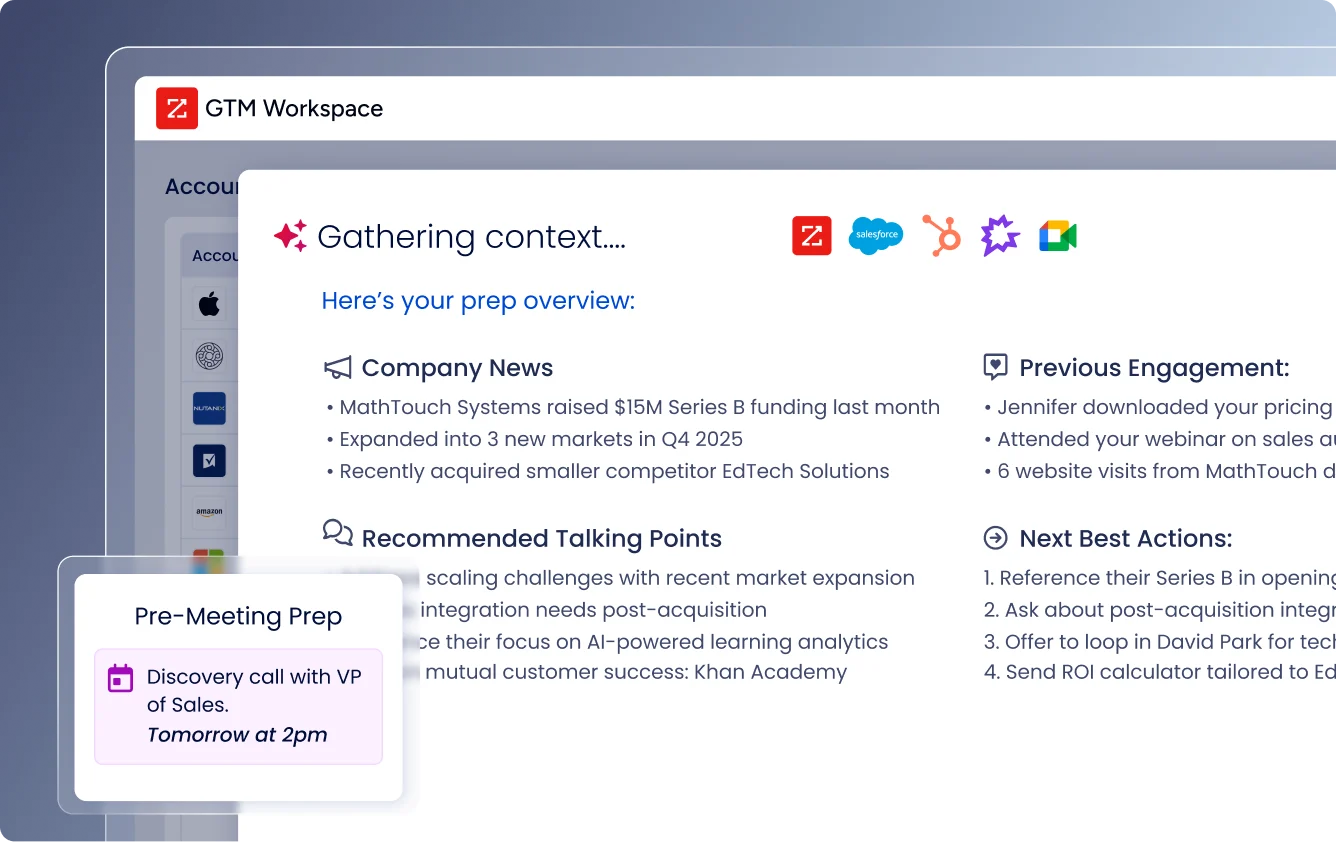
ZoomInfo built its reputation as a sales intelligence platform and expanded outward. GTM Workspace gives sellers a single environment where AI agents research accounts, generate follow-ups, monitor signals, and draft outreach.
Source: ZoomInfo
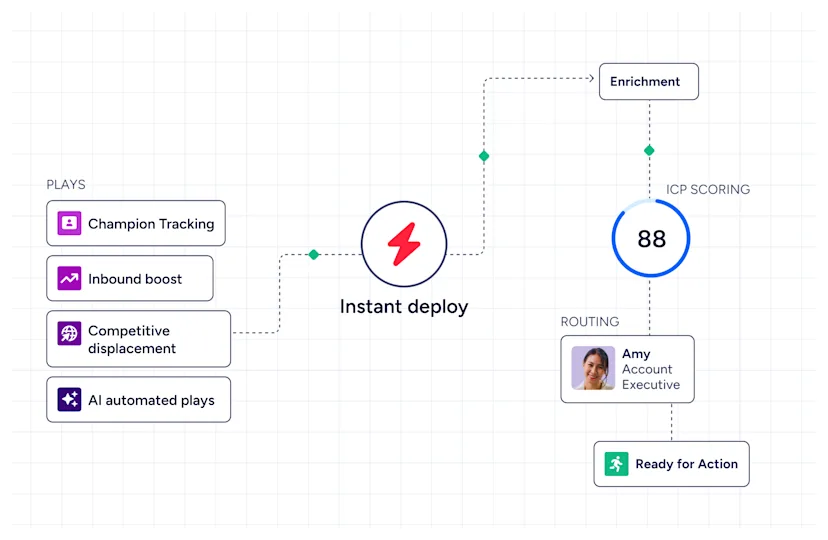
GTM Studio gives marketers and RevOps a canvas to build audiences in natural language, orchestrate campaigns, and measure pipeline impact.
Source: ZoomInfo
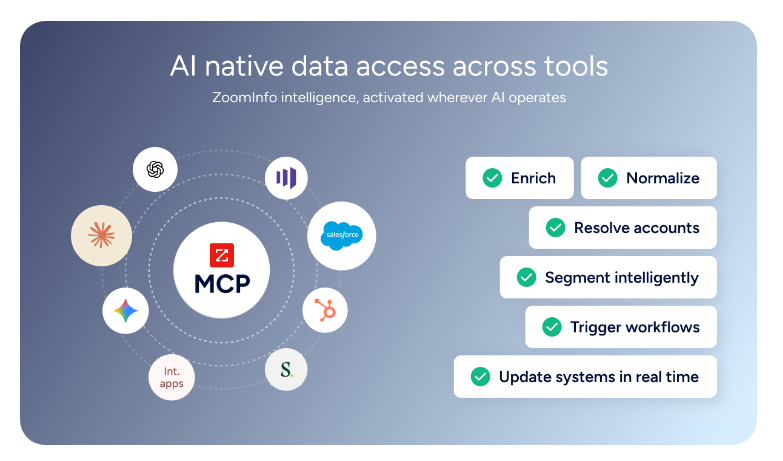
For teams that build beyond ZoomInfo's products, APIs and MCP deliver the same intelligence to any third-party tool or AI agent.
Source: ZoomInfo
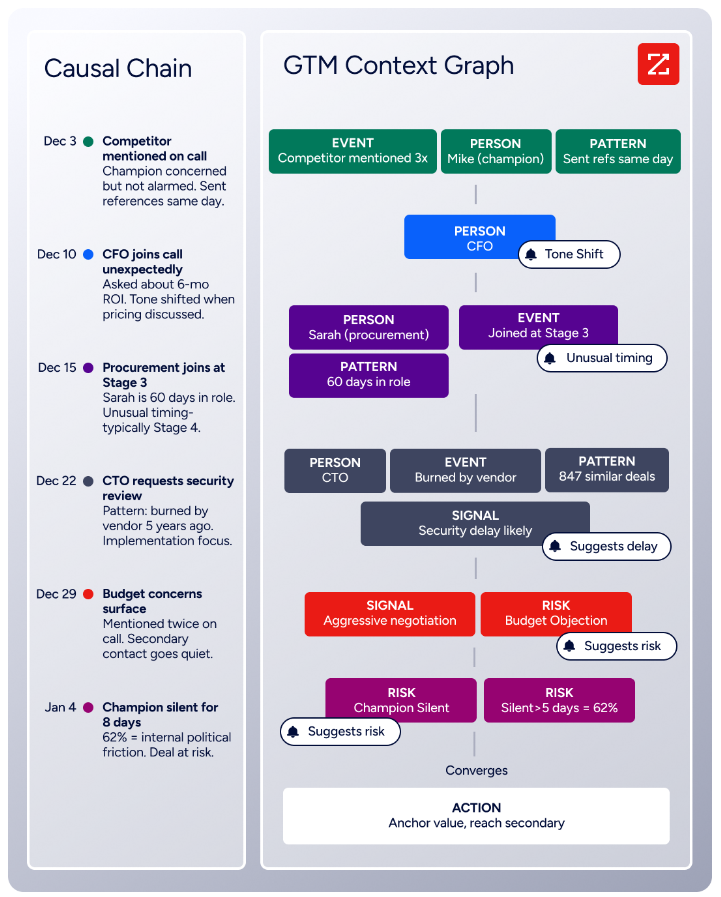
The GTM Context Graph ties this together. It combines ZoomInfo's B2B data with a customer's CRM records, conversation transcripts from Chorus, and behavioral signals into a single intelligence layer that processes 1.5B+ data points daily.
Source: ZoomInfo
CRMs record that a deal moved stages. Chorus captures what the VP of Finance said on the last call. Intent data logs a research spike. The GTM Context Graph processes all three to surface why the deal moved, and that context flows into every downstream action.
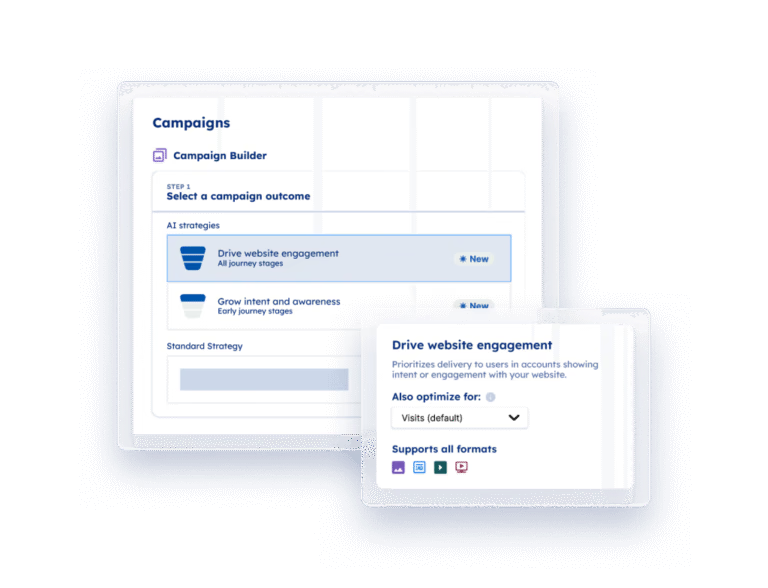
Demandbase has its own AI initiative, Agentbase, launched in March 2025. Live agents include the Campaign Outcomes Agent (ad optimization), Account Engagement Agent (account summaries), and Intent Agent (AI-summarized signals). The set is still narrow.
Source: Demandbase
The Campaign Outcomes Agent reported 40% higher CTR and 25% greater lift in page visits compared to standard campaigns, a promising start, though the roadmap language signals the system is still being built out.
Spekit saw opportunities at higher-scoring accounts 43% more likely to turn into qualified pipeline. "ZoomInfo offers a unified view, eliminating the need to navigate between systems." — Ben Perceval, RevOps Manager (Spekit)
For a direct side-by-side breakdown of how Demandbase and ZoomInfo compare, see our Demandbase vs. ZoomInfo comparison.
Account identification and buying groups
Both platforms tackle the challenge of identifying anonymous accounts visiting your website and mapping the buying committees behind deals.
Demandbase has classified over 3.7 billion IP addresses and maintains 2.9 billion active cookies and Extended IDs for account identification. Their model prioritizes accuracy over inflated match rates, arguing that wrong identification is worse than no identification.
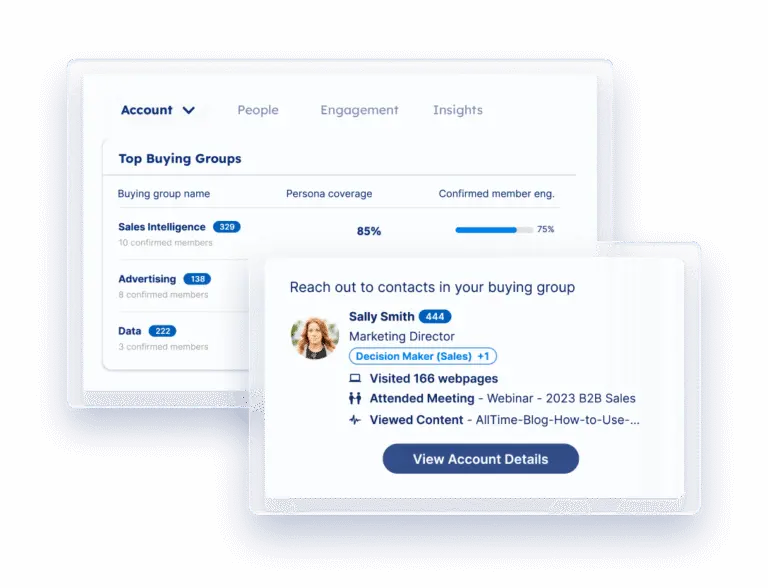
Demandbase also introduced Buying Groups as a core platform object, claiming to be the first GTM platform to do so. AI builds buying groups in seconds from their 150M+ contact database, identifying champions, influencers, blockers, and decision-makers.
Source: Demandbase
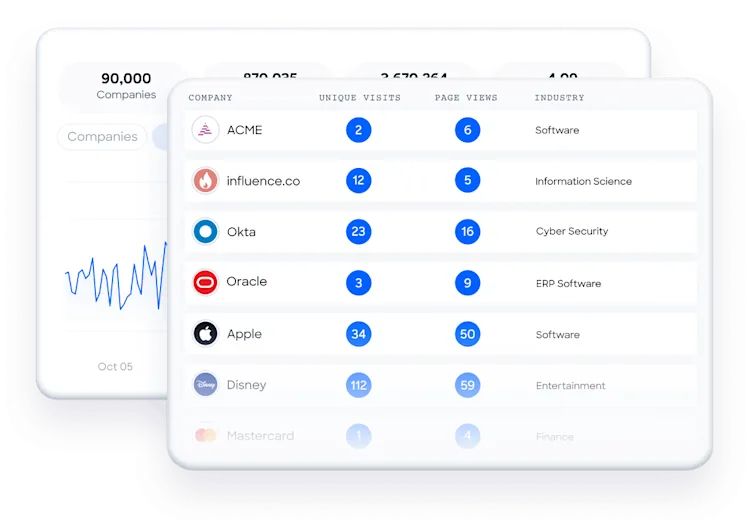
ZoomInfo's WebSights resolves anonymous website traffic to companies, including buying team identification and direct contact info. It includes Automatic Traffic Filtering to separate real company traffic from bots.
Source: ZoomInfo
ZoomInfo Marketing also offers contact-level site visitor identification, identifying who visited, not just which company.
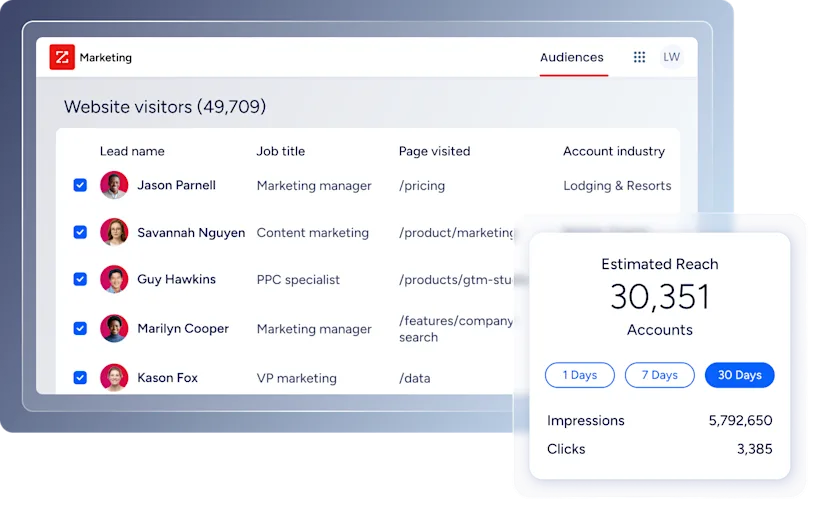
Source: ZoomInfo
Both platforms address buying groups, but from different angles. Demandbase treats buying groups as a formal data object with dedicated workflows. ZoomInfo surfaces buying group intelligence through GTM Workspace's AI agents, which identify hidden stakeholders and whitespace across the account. Demandbase's approach is more structured; ZoomInfo's is more embedded in the daily selling workflow.
Pricing and accessibility
Demandbase and ZoomInfo both use custom-quoted pricing for their full platforms. Neither publishes dollar amounts. The differences lie in accessibility and structure.
Demandbase's pricing page confirms a hybrid platform fee plus per-user fee, but all specifics require a sales conversation.
The platform cannot be purchased as standalone Marketing or Sales modules. Advertising and Data can be purchased separately as starting points, but the core Demandbase One suite is all-or-nothing. There is no free trial of the full platform and no self-serve entry point.
For a detailed breakdown of Demandbase's pricing structure and what's included, see our Demandbase pricing guide.
ZoomInfo offers more entry points. ZoomInfo Lite is a permanent free tier (not a trial) with access to the B2B database, 10 monthly export credits, individual and company searches, a Chrome extension, and WebSights Lite.
There's also a separate 7-day free trial for the full platform. Paid plans use consumption-based pricing, organized into Sales tiers (Professional, Advanced, Enterprise) and Marketing tiers (Marketing Demand, ABM Lite, ABM Enterprise), so teams can start with what they need rather than buying the entire suite at once.
For former BlueKai users, this matters. BlueKai charged on a CPM basis through its data marketplace. Neither Demandbase nor ZoomInfo uses CPM pricing, so the cost structure is fundamentally different. Budget planning requires direct conversations with both vendors.
Analyst recognition and market validation
Both surviving platforms carry strong analyst validation.
Demandbase has been named a Gartner Magic Quadrant Leader for ABM Platforms for five consecutive years (through 2025), positioned furthest for Completeness of Vision and ranked highest across all Use Cases. Forrester named Demandbase a Leader with the highest Strategy score in its Wave for Revenue Marketing Platforms, Q1 2026.
ZoomInfo is a Gartner Magic Quadrant Leader for ABM Platforms for two consecutive years (2024 and 2025), and a Leader in the Forrester Wave for Intent Data Providers, B2B, Q1 2025, receiving the highest possible scores across eight criteria.
Gartner's 2025 Voice of the Customer report positioned ZoomInfo as the only vendor in the Customers' Choice quadrant, with the highest volume of reviews and a 4.7/5.0 average rating. On G2, ZoomInfo holds 133 No. 1 rankings across Sales Intelligence, Buyer Intent, Data Quality, and other categories.
Oracle BlueKai, prior to shutdown, was recognized as one of the top data management platforms, but that recognition is now moot.
Security and compliance
Privacy matters here because BlueKai's downfall was partly caused by its privacy approach. Oracle has retired the BlueKai Privacy Policy and according to Privacy Bee, BlueKai does not comply with deletion requests. That's a cautionary tale for anyone evaluating data platforms.
Demandbase maintains ISO 27001:2022 and SOC 2 Type 2 certifications, GDPR compliance with Standard Contractual Clauses and IAB TCF registration, and publishes a Trust Center with security documentation.

Source: Demandbase
Its AI principles include a policy that customer data is not used to train AI models without explicit consent.
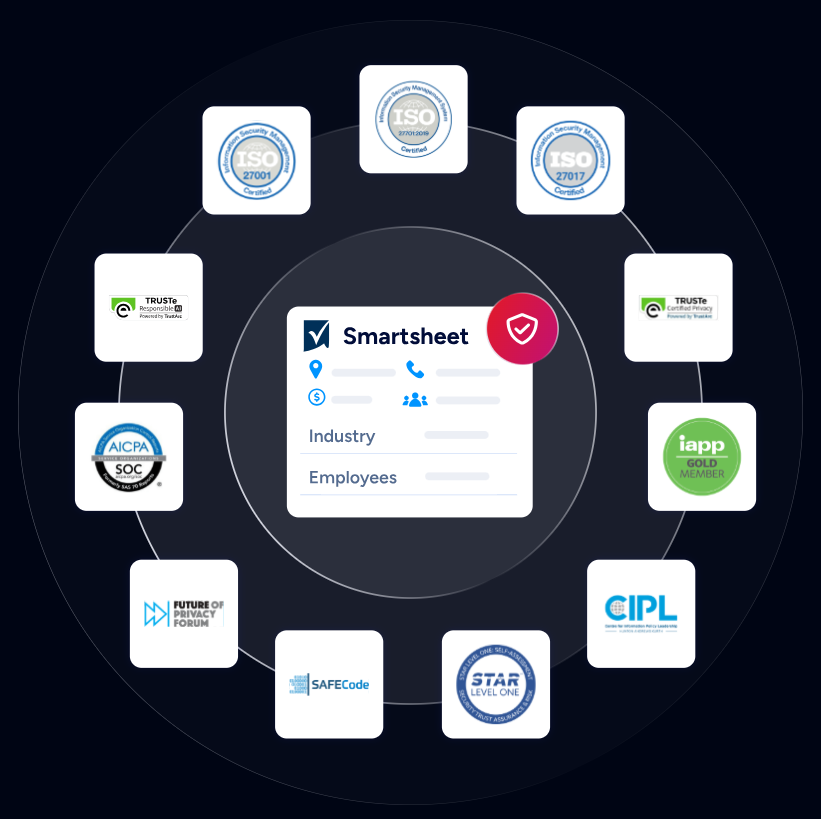
ZoomInfo carries ISO 27001, ISO 27701, SOC 2 Type II, TRUSTe GDPR, and TRUSTe CCPA certifications, all renewed annually.
Source: ZoomInfo
The company is a registered data broker in California and Vermont. ZoomInfo's ISO 27701 certification specifically covers privacy information management, a distinction worth noting for teams in regulated industries.
Both platforms exceed what BlueKai offered on compliance. For former BlueKai users in regulated industries, both Demandbase and ZoomInfo provide the certifications and transparency that BlueKai's final years lacked.
Demandbase vs. Oracle BlueKai vs. ZoomInfo: Which should you choose?
Oracle BlueKai is no longer an option. The question is which of the two surviving platforms fits your needs.
Demandbase makes sense if:
B2B programmatic advertising is your primary use case
You need the closest functional replacement for BlueKai's audience activation capabilities
Your team is marketing-led and focused on ABM
You value the native B2B DSP with intent-based bid optimization
You have the budget and ops resources for an enterprise deployment
ZoomInfo makes sense if:
You need a platform that spans sales, marketing, and RevOps
Data coverage and contact accuracy are your top priorities
You want AI-driven execution, not just intelligence delivery
Your team builds custom workflows and needs API/MCP access to power other tools
You want to start with a free tier before committing to a paid plan
See how ZoomInfo's AI GTM platform works with a free trial.
BlueKai's shutdown signaled that the DMP model (built on third-party cookies and rented audience data) had reached its limit. Both Demandbase and ZoomInfo represent what comes next: platforms that own their data, generate their own signals, and don't depend on infrastructure they can't control.
The difference between them is scope. Demandbase is a focused ABM and advertising platform. ZoomInfo is a full go-to-market platform with the data, intelligence, and execution tools to power every revenue team from a single foundation.
For teams that used BlueKai for advertising audience segments, Demandbase is the natural next step. For teams that want to move beyond audience management into finding, winning, and growing customers from one platform, ZoomInfo covers more ground.
Demandbase vs. Oracle BlueKai vs. ZoomInfo FAQ
Why was Oracle BlueKai shut down?
Oracle BlueKai depended on third-party cookies for its core functionality. As browsers tightened privacy restrictions and regulations like GDPR increased compliance pressure, the DMP model became ineffective.
Oracle's advertising revenue dropped from $2 billion in 2022 to $300 million in 2024. Oracle announced the exit from its advertising business on June 11, 2024, and all products reached End of Life on September 30, 2024.
What should former Oracle BlueKai customers use instead?
For B2B teams, Demandbase and ZoomInfo are the two strongest options. Demandbase is the closest functional replacement for BlueKai's advertising audience activation, with its native B2B DSP and intent-based targeting.
ZoomInfo is the broader option, covering sales prospecting, marketing orchestration, and data enrichment alongside advertising capabilities.
How do Demandbase and ZoomInfo compare on data coverage?
ZoomInfo has the larger data platform: 500M contacts, 100M companies, 135M+ verified phone numbers, and 200M+ verified business emails. Demandbase maintains 176M+ contacts with 109M validated emails and 54M direct dials, plus 104M+ companies. ZoomInfo's first-party data reaches up to 95% accuracy, verified through automated ML scanning, third-party partners, a community of 200,000+ users who share data back, and 300+ human researchers.
Which platform is better for account-based advertising?
Demandbase has the edge for advertising. It operates the only DSP built for B2B, with intent-based bid optimization, account-level frequency capping, and connected TV support.
ZoomInfo also offers a native DSP with cross-channel advertising, but Demandbase's advertising capabilities are deeper and more mature.
Can ZoomInfo replace both BlueKai and Demandbase?
ZoomInfo covers the full go-to-market workflow including sales prospecting, marketing, advertising, data enrichment, and AI-driven execution. It can replace BlueKai's audience targeting function and offers broader capabilities than Demandbase.
However, Demandbase's native B2B DSP and Buying Groups as a core data object provide depth in ABM advertising that ZoomInfo approaches differently, with intelligence embedded in daily seller and marketer workflows rather than a standalone ABM layer.
Do either Demandbase or ZoomInfo offer a free plan?
Demandbase does not offer a free plan or free trial of its full platform. ZoomInfo offers both a permanent free tier (ZoomInfo Lite, with 10 monthly export credits and access to the B2B database) and a separate 7-day free trial of the full platform.
Which platform has better analyst recognition?
Both are strong. Demandbase has been a Gartner Magic Quadrant Leader for ABM Platforms for five consecutive years and a Forrester Wave Leader in Revenue Marketing Platforms.
ZoomInfo is a two-year Gartner MQ Leader for ABM Platforms, the only vendor in Gartner's Customers' Choice quadrant for the category, and a Forrester Wave Leader in Intent Data Providers with the highest possible scores across eight criteria.
Is Demandbase or ZoomInfo better for sales teams?
ZoomInfo is the stronger choice for sales teams. GTM Workspace provides an AI-powered execution environment for sellers, with account research, AI-drafted outreach, signal monitoring, and CRM updates in one place.
Demandbase delivers account intelligence and intent alerts to sellers but does not include native email sequencing or dialing. Sales teams using Demandbase need to integrate with separate tools like Outreach, Salesloft, or Gong for outreach execution.
If you're looking beyond Demandbase and Oracle BlueKai these related breakdowns go deeper:
