
Ebsta is a revenue intelligence platform that sits inside Salesforce and HubSpot, turning CRM activity into signals about deal health, relationship strength, and forecast accuracy. For B2B sales teams that want to know which deals are at risk, which relationships are cooling, and whether the forecast will hold, Ebsta offers an unusual commercial proposition: outcome guarantees on quota attainment and forecast accuracy, with financial remedies if the platform doesn't deliver.
To create this Ebsta review, we analyzed it extensively. We believe it's the right choice if:
You run your sales operation on Salesforce or HubSpot and want intelligence layered into that CRM
You need relationship scoring that measures engagement quality, not just activity volume
You value contractual outcome guarantees over feature lists
Your team follows a structured methodology like MEDDPICC or BANT and needs it enforced inside the CRM
You're a mid-market B2B organization (50-500 employees) with complex, multi-stakeholder sales cycles
However, Ebsta might not be sufficient if:
You need a verified B2B contact database for prospecting and list building
You want buyer intent signals to identify in-market accounts before they contact you
You require marketing automation or multi-channel campaign orchestration
You want prospecting, conversation intelligence, pipeline analytics, and intent data in a single platform
You need API or AI-agent access to your GTM data
In this case, consider ZoomInfo: an AI GTM platform that combines prospecting data, buyer intent signals, conversation intelligence, and pipeline analytics in a single system, built for teams that need intelligence across the full go-to-market lifecycle, not just within the CRM.
We've included a detailed look at ZoomInfo later in this Ebsta review as the broader alternative for teams that need more than CRM-layer intelligence. If you're ready to explore a full GTM platform, you can start with ZoomInfo's free trial here.
What is Ebsta?
Ebsta is a revenue intelligence platform founded in 2012 by Guy Rubin in London, UK. Rubin started the company after two decades in GTM technology, first building a CRM data tool for recruiters before expanding to serve the broader B2B sales market.
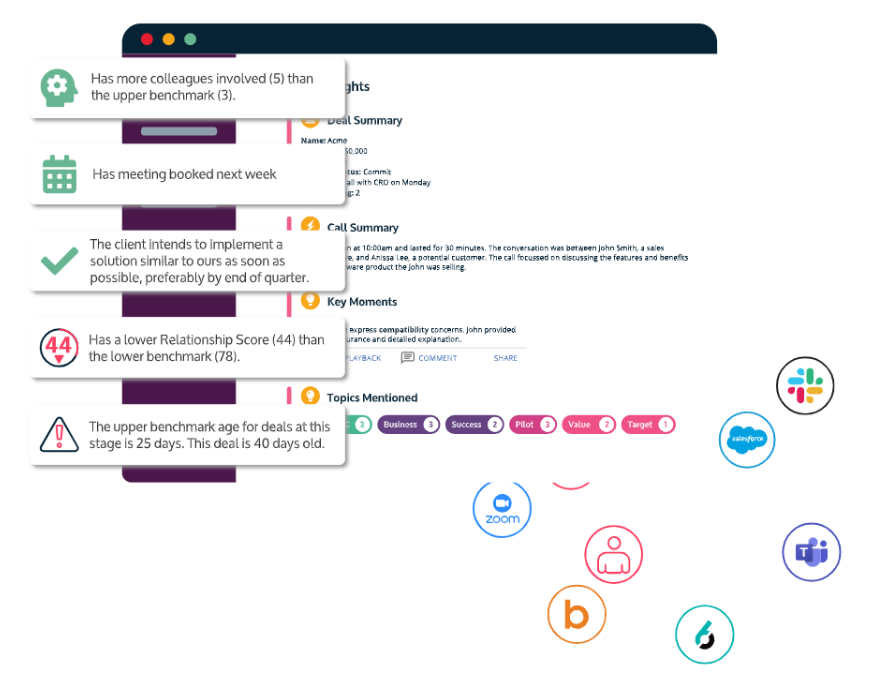
The platform calls itself the only revenue intelligence platform that combines data enrichment, guided selling, and Revenue Insights as a Service (RIaaS).
Source: Ebsta
In practice, Ebsta layers three modules on top of your existing CRM: Conversation Intelligence (capturing details from sales calls), Relationship Intelligence (scoring the strength of your relationships with prospects and customers), and Revenue Intelligence (deal management, pipeline management, and forecasting).
Ebsta serves 750+ customers across professional services, SaaS, manufacturing, and media. Its buyers are sales leaders who want pipeline confidence, managers who need to coach to quota, and reps who want guided selling frameworks. The platform integrates with Salesforce, HubSpot, and Bullhorn.
In August 2025, Ebsta was acquired by Fullcast, Inc., a GTM planning platform based in Salt Lake City. The product and brand continue under the Ebsta name, now positioned as the revenue intelligence layer within Fullcast's broader RevOps offering.
Ebsta Pros & Cons
Pros | Cons |
|---|---|
- Contractual outcome guarantees on quota and forecast | - No B2B contact database for prospecting |
- CRM-native integration (Salesforce & HubSpot) | - Only integrates with Salesforce, HubSpot, and Bullhorn |
- Relationship scoring based on engagement quality | - No publicly listed pricing |
- Methodology-agnostic deal qualification (MEDDPICC, BANT, etc.) | - Limited dashboard customization and reporting |
- Modular pricing (buy only the modules you need) | - Requires Salesforce Enterprise edition or above |
- ISO 27001:2022 certified | - Occasional email and calendar sync delays reported |
- 14-day free trial with full feature access | - No intent data or buyer signal capabilities |
Ebsta Review: How it Works & Key Features
Conversation Intelligence: Ebsta captures and analyzes sales calls, then maps conversation content to deal qualification frameworks inside the CRM.
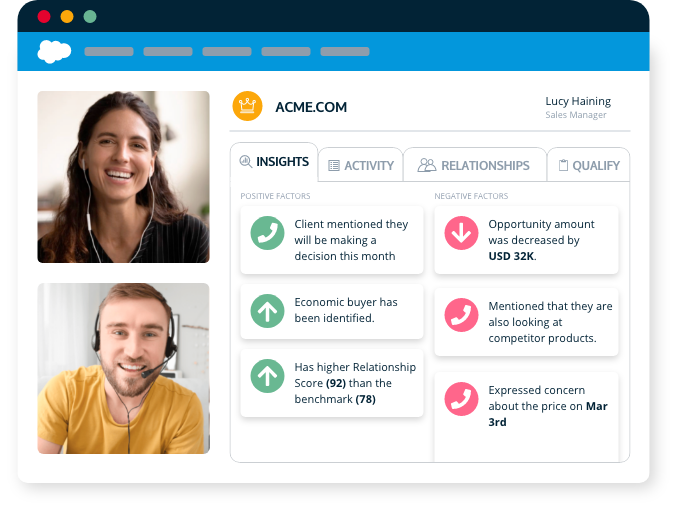
Ebsta's Conversation Intelligence records, transcribes, and analyzes sales calls and meetings from Zoom and Microsoft Teams, then surfaces structured insights inside Salesforce or HubSpot. The goal: turn every conversation into qualification data without requiring reps to take manual notes.
Source: Ebsta
The standout capability is methodology-agnostic deal auto-qualification. After a call ends, the AI engine analyzes the transcript against whichever sales methodology the team has configured (MEDDPICC, BANT, SPIN, STRONGMAN, or custom criteria) and syncs those qualification details back to the linked CRM opportunity in real time.
Administrators can define custom topics (competitor names, pricing objections, product features) and Ebsta will identify and timestamp every instance those topics appear across calls, with a trend chart showing frequency over time.
Additional features include Key Moment and Call Summaries generated from administrator-defined criteria, snippet sharing for clipping and distributing specific call moments, Slack-integrated alerts that fire when defined topics come up, and an Ebsta AI Bot that drafts follow-up emails and answers questions about call content on demand. All AI prompts used for call summaries are customizable at the admin level.
Relationship Intelligence: Ebsta scores the health of every customer and prospect relationship based on actual engagement patterns.
Relationship Intelligence is where Ebsta separates from competitors that focus only on conversation recording or pipeline analytics. The module connects to employee mailboxes (Gmail or Outlook/Office 365) and calendar systems, then uses communication data to calculate a Relationship Score for every contact and account.
Source: Ebsta
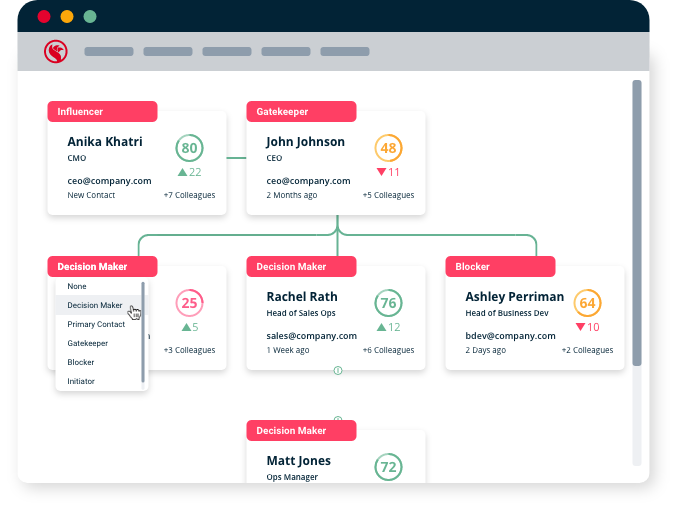
The score evaluates four dimensions: quality, direction, recency, and quantity of engagement. A flurry of low-response outbound emails won't inflate the score, because the system weighs the quality and directionality of exchanges, not just volume. Relationship Score Trends track how these scores move over time, surfacing accounts going cold before they're lost.
Contact Capture scans every employee mailbox and identifies contacts appearing in email threads but not yet in the CRM.
Contact Alerts monitor existing records and update them when job titles change, phone numbers change, or out-of-office and "left business" signals appear.
Relationship Mapping renders the organizational structure visually, showing which employee has a relationship with which contact and how those contacts relate hierarchically within the customer organization.
At Informa, reps use relationship maps to ensure they are multi-threading at the right seniority. The module also provides Account-Based Insights that measure a team's breadth and depth of presence across an account.
For Salesforce customers, all relationship data surfaces natively inside CRM records through a 360 View and customized Salesforce dashboards.
Revenue Intelligence: Ebsta gives sales leaders a data-driven view of deal health, pipeline trends, and forecast accuracy.
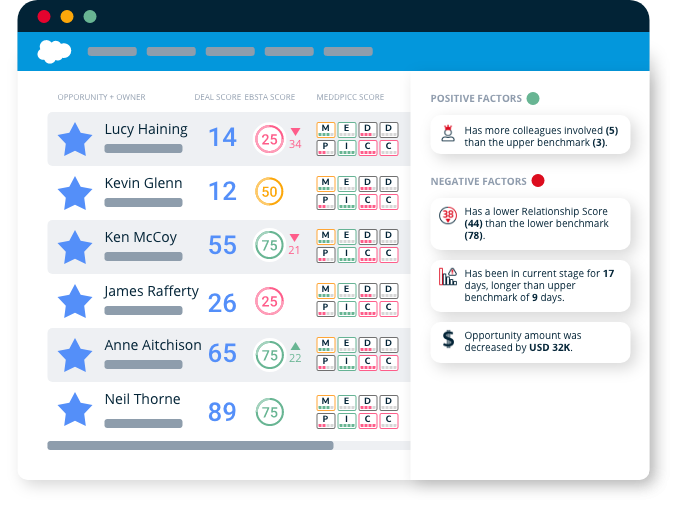
Revenue Intelligence is Ebsta's core analytics module, built to replace gut-feel pipeline reviews with evidence-based deal management.
Source: Ebsta
The module ingests three data streams: CRM records, engagement signals from email and calendar sync, and historical win/loss patterns.
The system learns from every won and lost opportunity to build a scoring model specific to each customer's pipeline, weighing hundreds of factors including conversations, time in stage, and relationships. Each deal receives a Deal Score indicating likelihood of closing, plus positive and negative indicators across 7 performance factors.
Pipeline management features include Pipeline Trends and Flow Charts showing how pipeline composition changes over time, Pipeline Benchmarks for historical comparison, and Funnel Analytics that reveal weaknesses at each sales stage. Pipeline Insights Notifications deliver email summaries with observations about pipeline health.
The forecasting suite includes Projected Revenue, Forecast Roll-Ups, Forecast Pacing against quota, and a Waterfall Chart showing exactly which opportunities drove changes in the commit and upside numbers. Reps and managers can submit evidence-backed forecasts tied to deal health scores and engagement data, creating an audit trail for forecast decisions.
Pricing Structure: Ebsta uses modular, per-seat annual pricing with no publicly listed prices.
Ebsta's pricing is a per-seat subscription billed annually in advance. The platform offers three modular plans that map to its three intelligence modules:
Plan 1: Conversation Intelligence
Call recording, transcription, and AI analysis
Auto-qualification against any sales methodology
Topic tracking, call summaries, and snippet sharing
Ebsta AI Bot and Slack alerts
Plan 2: Relationship Intelligence
Email and calendar sync to CRM
Contact Capture and Contact Alerts
Relationship Scoring and Trends
Relationship Mapping and Account-Based Insights
360 View (Salesforce Managed Package)
Plan 3: Revenue Intelligence
Deal scoring and 7-factor health indicators
Pipeline trends, benchmarks, and funnel analytics
Full forecasting suite (projections, pacing, waterfall, submissions)
Team analytics and KPI reporting
Slack integration
Each module can be purchased independently or in combination. All plans include a dedicated Account Manager, Knowledge Base, email support, SSO support, and sandbox support for Salesforce. An Enterprise plan and a separate Inbox plan also exist but are not detailed publicly.
No dollar amounts appear on the pricing page; every plan shows "Get a Quote." Ebsta offers a 14-day free trial with access to all features. The Enterprise plan trial requires a separate conversation.
One prerequisite: Salesforce Enterprise edition or above with Bulk API enabled is required for full feature access. Teams on Salesforce Professional may face limitations.
Contract terms include annual auto-renewal with 30 days' cancellation notice before the renewal date, no refunds on cancellation, and 60 days' notice for price increases. Adding users mid-term triggers pro-rata charges rounded up to the nearest calendar month.
Where Ebsta Falls Short
Ebsta delivers focused value as a CRM intelligence layer, but several limitations surface for teams with broader go-to-market needs. These reflect a platform built for revenue intelligence, not full-lifecycle GTM coverage.
No Prospecting Data or Contact Database. Ebsta analyzes relationships and deals already in your CRM but does not provide a B2B contact database, verified phone numbers, or company data for prospecting. If your CRM has 5,000 contacts and your addressable market has 500,000, Ebsta cannot help you find the other 495,000.
Teams that need to discover and reach new prospects must use a separate data provider, adding cost and workflow complexity.
No Intent or Buying Signals. Ebsta cannot tell you which companies are researching solutions in your category. Without buyer intent data, sales teams lack early warning that a prospect is in-market, so they always react to inbound interest rather than engaging accounts that show purchase signals.
Narrow CRM Compatibility. Ebsta integrates exclusively with Salesforce, HubSpot, and Bullhorn. Teams running Microsoft Dynamics, Pipedrive, Zoho, or any other CRM have no integration path.
No Public Pricing. All plans require a custom quote, which creates friction for buyers who want to evaluate and compare options before talking to sales. Annual-only billing with no monthly option adds commitment risk for teams exploring the category.
Limited Dashboard Customization. Users report limited flexibility in customizing dashboards and building advanced reports. RevOps teams accustomed to custom reporting in BI tools find the reporting capabilities constrained, particularly for cross-functional analysis.
Acquisition Transition. Fullcast acquired Ebsta in August 2025. While the product and brand continue, mid-acquisition periods typically bring product roadmap uncertainty and potential changes in support. This is worth considering for buyers evaluating a multi-year commitment.
These limitations aren't failures. They reflect the scope of a platform built to augment CRMs rather than replace the broader GTM stack. But they leave clear gaps for teams that need prospecting data, intent signals, and execution tools alongside their pipeline intelligence.
Top Ebsta Alternative for Full GTM Coverage: ZoomInfo
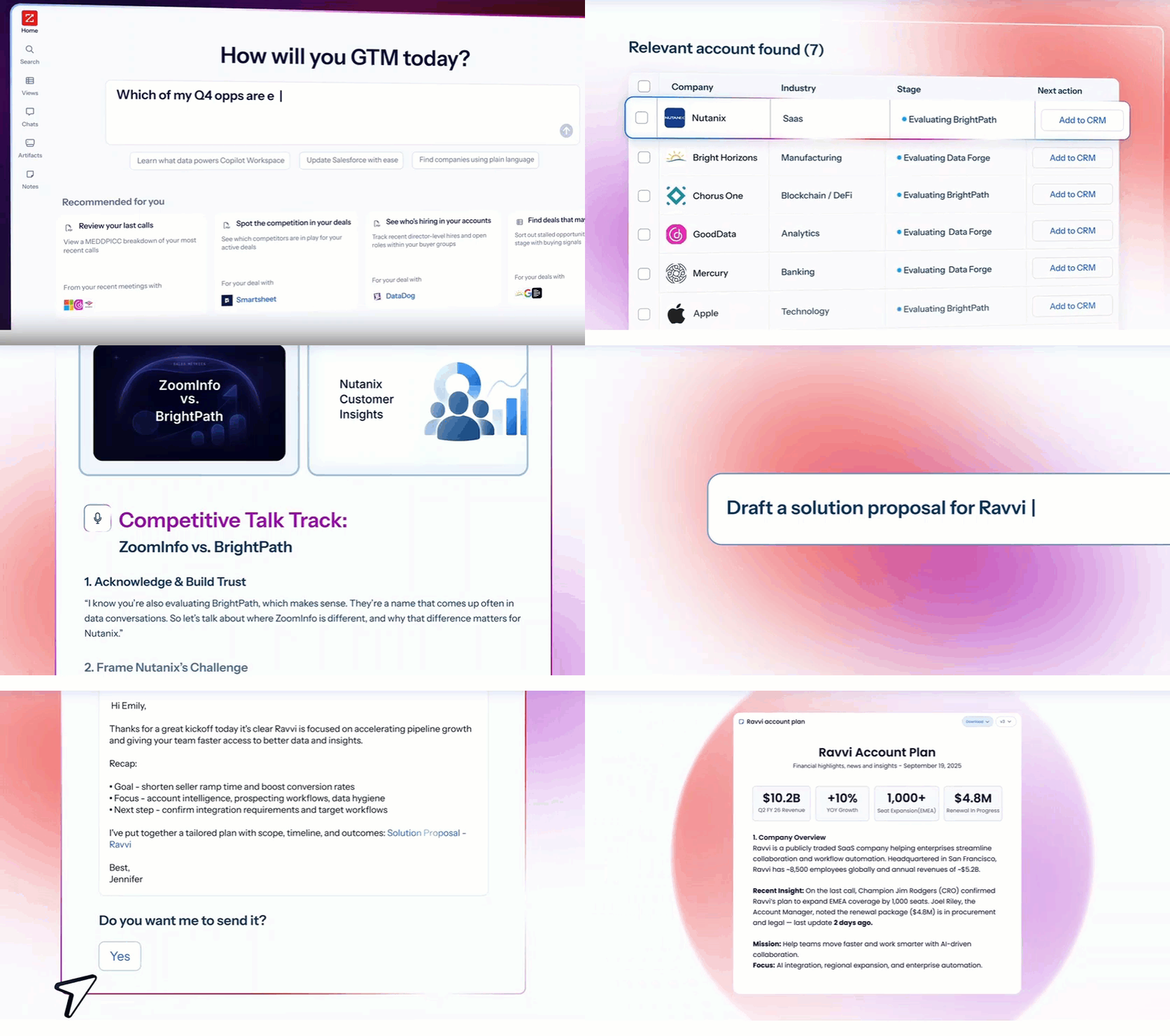
ZoomInfo addresses Ebsta's scope limitations by providing an AI GTM platform that spans the full go-to-market lifecycle. Where Ebsta layers intelligence on top of your existing CRM data, ZoomInfo starts with a large verified B2B database, adds buyer intent and behavioral signals, connects everything through its GTM Context Graph, and delivers it through AI-powered tools for sellers, marketers, and RevOps teams.
Comprehensive B2B Data: ZoomInfo operates a large verified contact and company database, covering the prospecting gap Ebsta leaves open.
The foundational difference between ZoomInfo and Ebsta is data. ZoomInfo maintains 500M contacts and 100M companies, 135M+ verified phone numbers, 120M direct-dial phone numbers, and 200M+ verified business email addresses.
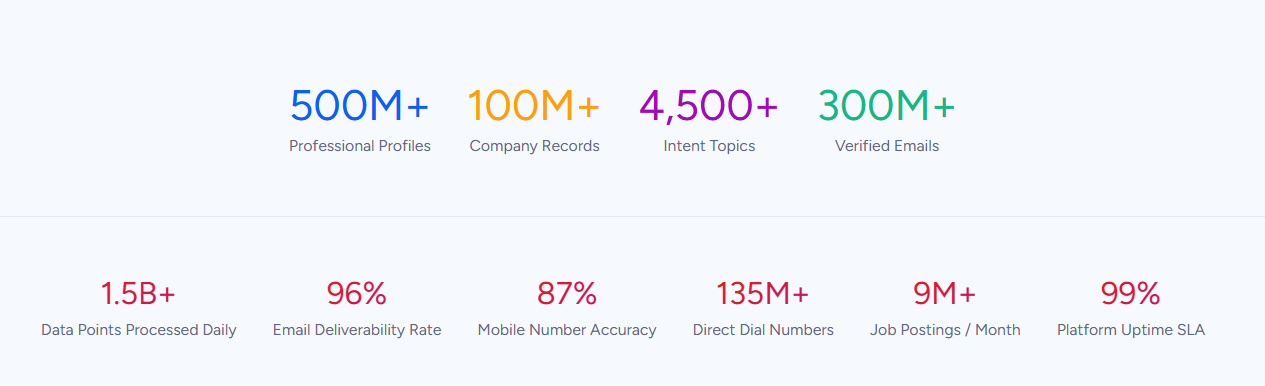
This data comes from multiple sources: automated ML scanning of 28 million site domains daily, third-party partner data covering 95 million businesses, a community of 200,000+ ZoomInfo Lite users who share data back, and an in-house Data Training Lab of 300+ human researchers.
The result is up to 95% accuracy on first-party data. In a Fortune 500 competitive RFP analyzing 25 million contacts across vendors, the independent consultant concluded that "no other competitor came even close."
Beyond contact records, ZoomInfo includes technographics covering 30,000+ technologies across 30+ million companies, buyer intent data from 210 million IP-to-Organization pairings, and website visitor identification that resolves anonymous traffic to companies. Sales teams can find, verify, and reach prospects who aren't in their CRM yet, and prioritize the ones showing buying behavior.
ZoomInfo helped Vensure scale prospecting, with VP of Revenue Operations William Kenimer noting: "ZoomInfo gives us the information we need to execute. We don't have to go through and spend our time digging. It's already there, so we can be three steps ahead." (Vensure)
GTM Context Graph: ZoomInfo fuses first-party CRM data with third-party intelligence to capture why deals move or stall.
Ebsta's deal scoring learns from historical wins and losses within your CRM. ZoomInfo's GTM Context Graph goes further by combining a customer's CRM records, conversation transcripts, email threads, and behavioral data with ZoomInfo's third-party intelligence (contacts, company changes, intent signals, technographics) into a single layer that processes 1.5B+ data points daily.
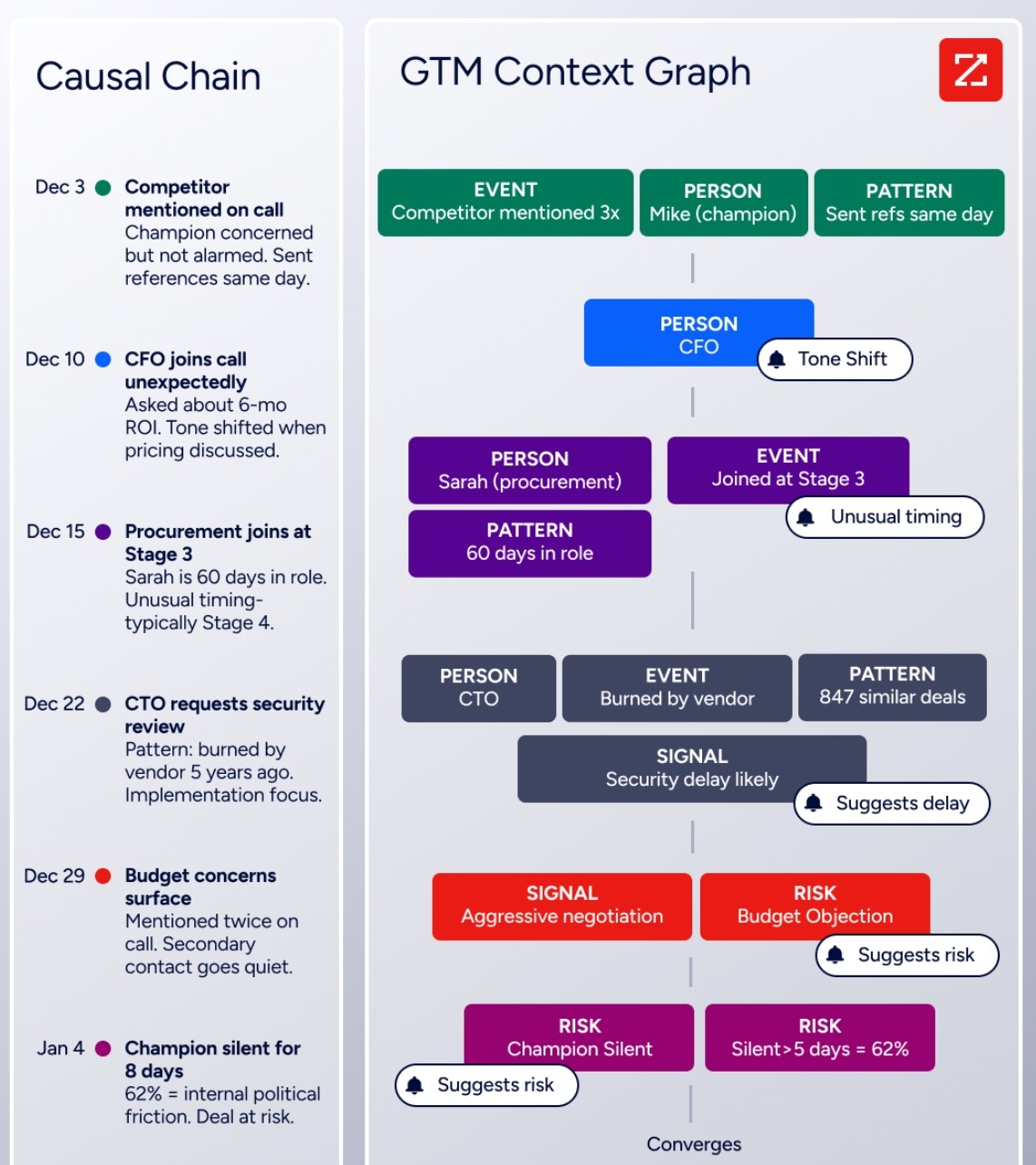
The distinction matters. A CRM records that a deal moved from Stage 3 to Stage 4. Conversation intelligence transcribes what the VP of Finance said on the last call. Intent data logs a spike in research activity.
The GTM Context Graph connects all three to surface why the deal moved: the executive sponsorship entering at this stage lines up with third-party signals showing the company is hiring and researching competitors.
That intelligence flows into every downstream action: the follow-up email addresses the concern the CFO raised, the play targets accounts whose signal combinations match proven win patterns, and the forecast weights deals by buying evidence rather than stage labels.
ZoomInfo built this layer through twenty years of data infrastructure and acquisitions, including Chorus for conversation intelligence and Clickagy for intent signals. As CPO Dominik Facher stated: "If you rebuilt the GTM stack for AI, you'd end up with ZoomInfo for first-party data."
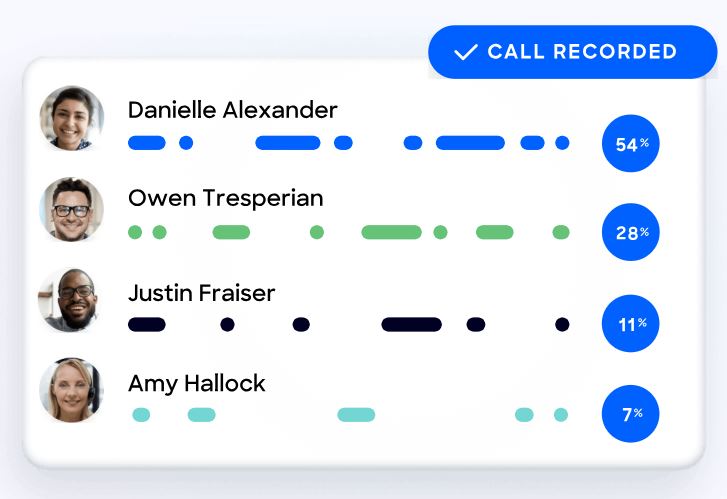
Seismic attributed 39% of active pipeline to opportunities identified or influenced by ZoomInfo signals and reported 54% productivity gains across their sales team. (Seismic)
GTM Workspace and Chorus: ZoomInfo gives sellers an AI-powered workspace with built-in conversation intelligence.
GTM Workspace is ZoomInfo's front-end for sellers, designed to eliminate the context-switching that fragments sales execution across dozens of tools. Built on Anthropic's Claude, GTM Workspace's AI agents answer three questions for every rep: who to contact, when to engage, and what to say.
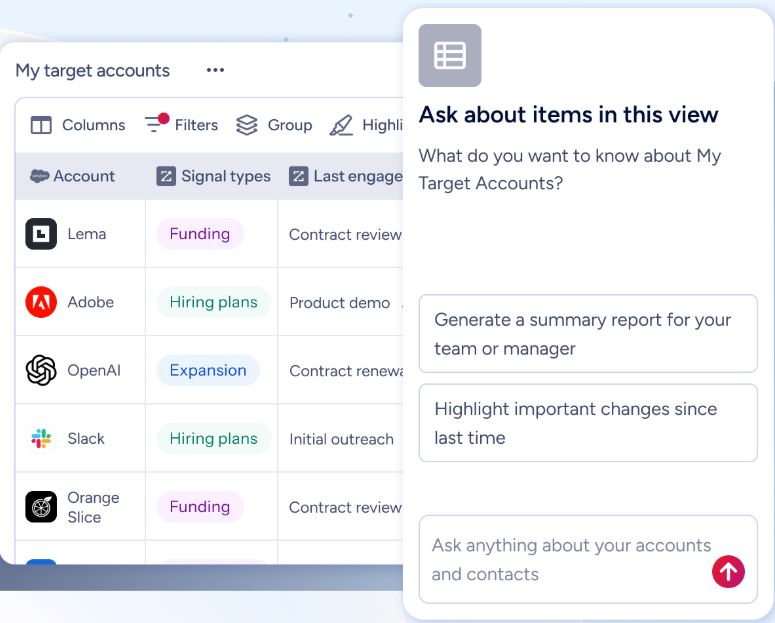
The workspace includes a complete Book of Business view across CRM data, ZoomInfo contacts, conversation history, and market intelligence. An Action Feed surfaces in-market buyers matched to target criteria with pre-drafted actions on every signal.
AI-generated outreach creates personalized emails from full account context in seconds. Native integration with Salesforce, HubSpot, and Microsoft Dynamics means CRM updates happen without leaving the workspace.
For conversation intelligence, ZoomInfo's Chorus records, transcribes, and analyzes sales calls, meetings, and emails. Like Ebsta's Conversation Intelligence, Chorus extracts deal qualification signals and coaching insights. Unlike Ebsta, Chorus feeds into the GTM Context Graph, so conversation data enriches deal risk scores, intent signals, and account intelligence across the platform.
Chorus also includes Connected Intelligence, which surfaces ZoomInfo's full contact profiles and relationship history for every call participant without cross-referencing a separate system.
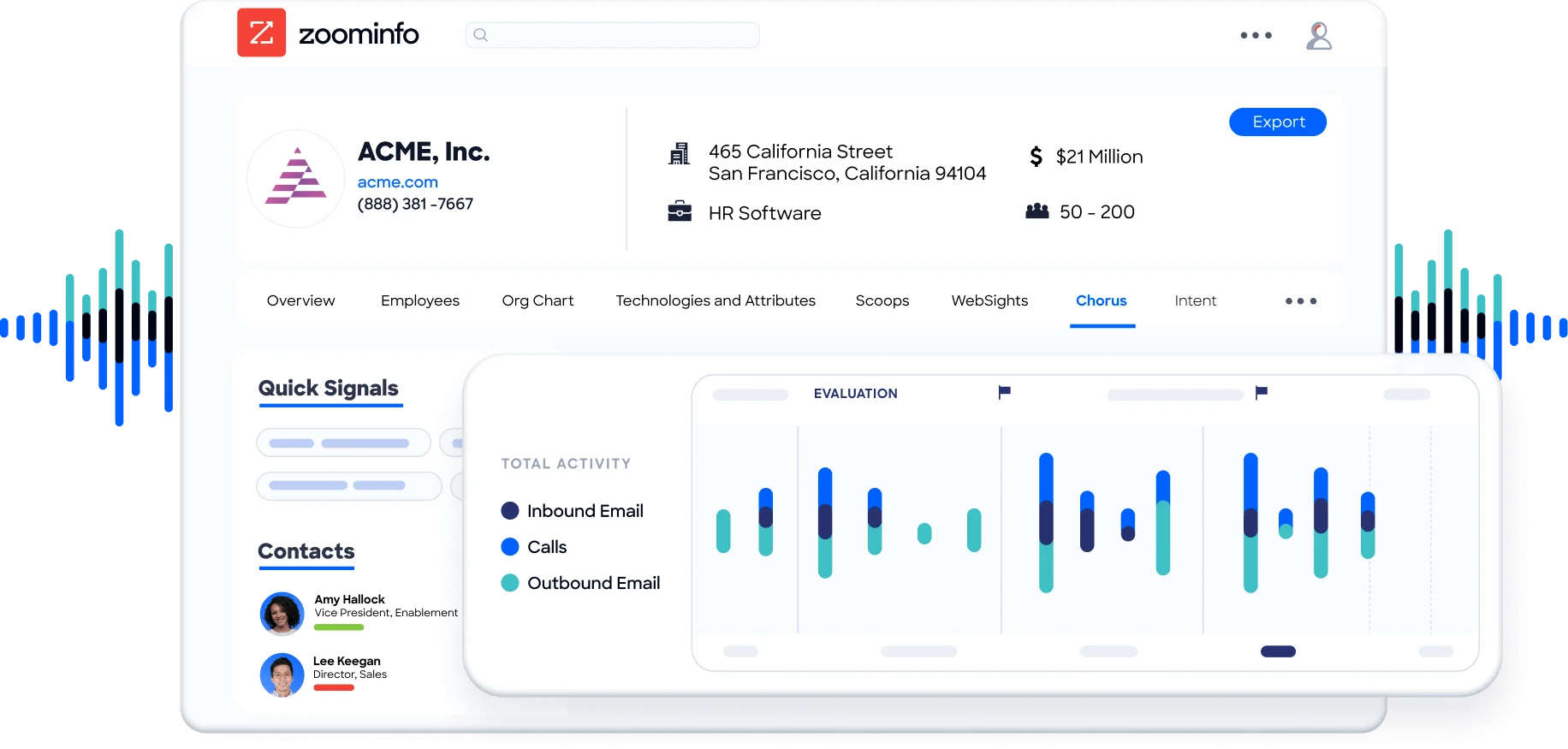
Customer results from GTM Workspace include Thomson Reuters increasing closed-won deals by 40% with 115% average quota attainment, Databricks reaching prospects 50% faster, and Spekit finding that opportunities at higher-scoring accounts were 43% more likely to become qualified pipeline and moved 58% faster through qualification.
Spekit's RevOps Manager Ben Perceval noted: "Anything that minimizes our team's need to switch contexts is beneficial. ZoomInfo offers a unified view, eliminating the need to navigate between systems." (Spekit)
Universal Access and Pricing: ZoomInfo delivers intelligence through APIs, MCP, native products, and a permanent free tier.
ZoomInfo provides three ways to access its intelligence. GTM Workspace serves sellers.
GTM Studio serves marketers, RevOps, and GTM engineers with a builder environment where audience definition, campaign orchestration, and pipeline measurement happen in natural language.
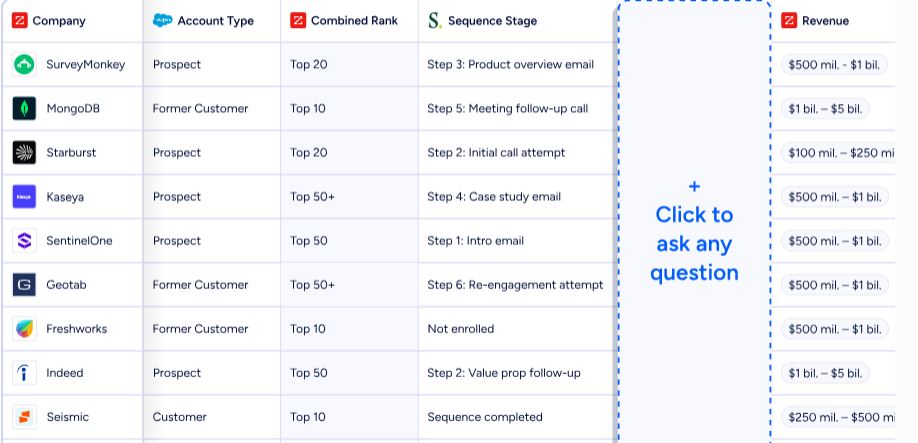
And APIs and MCP expose the same intelligence to any custom agent, internal tool, or partner platform. All three draw from one GTM Context Graph: the same data, the same intelligence, regardless of how you access it.
On pricing, ZoomInfo uses a custom-quoted model organized into Sales, Marketing, and standalone product tiers, each with Professional, Advanced, and Enterprise levels. Like Ebsta, specific dollar amounts require a sales conversation. However, ZoomInfo offers two entry points Ebsta does not:
ZoomInfo Lite: A permanent free plan (not a trial) with access to ZoomInfo's B2B database, 10 monthly export credits, contact search, the ReachOut Chrome Extension, WebSights Lite (up to 10 website visitor reveals per day), and HubSpot integration.
7-day free trial: Access to core platform features including contact and company search, intent signals, and email outreach, with no credit card required.
Note: ZoomInfo is transitioning toward a consumption-based pricing model.
API access is included in all relevant plans, with MCP available through partners including Anthropic Claude and Google. This positions ZoomInfo as infrastructure for the agentic AI era, where the same data powering ZoomInfo's own products is accessible to any AI model or custom agent a customer builds.
BDO Canada achieved an 87% reduction in time spent updating internal data dashboards using ZoomInfo's API, with Senior Marketing Intelligence Analyst Jerry Wilson noting: "The plug-and-play aspect of the API means I can integrate it very easily into any process." (BDO Canada)
Ebsta or ZoomInfo: Comparison Summary
Aspect | Ebsta | ZoomInfo |
|---|---|---|
Primary Focus | CRM-layer revenue intelligence | AI GTM platform |
B2B Contact Database | None | 500M contacts, 100M companies |
Verified Phone Numbers | None | 135M+ verified, 120M direct dials |
Buyer Intent Data | None | Intent from 210M IP-to-Org pairings |
Conversation Intelligence | Built-in (Zoom, Teams) | Chorus (calls, meetings, emails) |
Relationship Scoring | Yes (quality, direction, recency, quantity) | Via GTM Context Graph engagement analysis |
Deal Scoring | Team-specific ML model | GTM Context Graph with first + third-party data |
Forecasting | Full suite with waterfall, pacing, submissions | Via GTM Workspace and pipeline analytics |
CRM Integrations | Salesforce, HubSpot, Bullhorn | Salesforce, HubSpot, Microsoft Dynamics, 120+ marketplace apps |
Marketing Automation | None | ABM, display advertising, form optimization |
API / MCP Access | Not publicly available | Included in all relevant plans |
Free Plan | None (14-day trial) | ZoomInfo Lite (permanent) + 7-day trial |
Outcome Guarantees | Quota attainment + forecast accuracy | Not offered |
Security Certifications | ISO 27001:2022 | ISO 27001, ISO 27701, SOC 2 Type II |
Best For | Mid-market teams optimizing existing CRM data | Teams needing data + intelligence + execution in one platform |
Final Verdict
The choice between Ebsta and ZoomInfo depends on where your needs begin and end in the go-to-market lifecycle.
Choose Ebsta if your CRM already contains the contacts and accounts you need, and your primary challenge is extracting more value from that data. Ebsta tells sales teams which deals are healthy, which relationships need attention, and whether the forecast is on track, all inside Salesforce or HubSpot.
The contractual outcome guarantees (improved quota attainment in 6 months, forecast accuracy within 10%) reduce adoption risk. For mid-market B2B sales teams running structured methodologies on Salesforce or HubSpot, Ebsta provides focused, measurable intelligence without requiring a broader platform investment.
Choose ZoomInfo if your go-to-market needs extend beyond CRM intelligence into prospecting, intent monitoring, conversation analysis, and multi-channel execution. ZoomInfo starts where Ebsta cannot: with a large verified B2B database, buyer intent signals, and website visitor identification.
Its GTM Context Graph then fuses that data with your CRM, conversations, and behavioral signals to power AI-driven execution through GTM Workspace for sellers and GTM Studio for marketers. For teams that want one platform covering the full cycle from finding prospects to closing deals to managing accounts, ZoomInfo provides the breadth that a CRM intelligence layer alone cannot.
Get started with ZoomInfo here.
Ebsta FAQ
What CRMs does Ebsta integrate with?
Ebsta integrates with Salesforce, HubSpot, and Bullhorn. Full feature access requires Salesforce Enterprise edition or above with Bulk API enabled. Teams on Microsoft Dynamics, Pipedrive, Zoho, or other CRMs cannot use the platform. ZoomInfo supports Salesforce, HubSpot, and Microsoft Dynamics natively, with 120+ additional integrations available through its App Marketplace.
Does Ebsta offer a free plan?
No. Ebsta offers a 14-day free trial with access to all features across its three modules. ZoomInfo provides both a permanent free tier (ZoomInfo Lite, with 10 monthly export credits and access to its B2B database) and a separate 7-day free trial with no credit card required.
How much does Ebsta cost?
Ebsta does not publish pricing. All three plans (Conversation Intelligence, Relationship Intelligence, Revenue Intelligence) display "Get a Quote" on the pricing page. Billing is annual with no monthly option, and adding users mid-term triggers pro-rata charges. ZoomInfo also uses custom-quoted pricing, though its free Lite tier provides a no-cost entry point for evaluating the platform.
What are Ebsta's outcome guarantees?
Ebsta guarantees improved seller quota attainment in the first 6 months (or the option to exit the contract), forecast accuracy within 10% of the final number in 6 months (or custom forecast training worth $1,000 per user), and live implementation within 30 business days (or a 30-day contract extension at no charge). These are contractual commitments with defined financial remedies.
Does Ebsta include a B2B contact database?
No. Ebsta analyzes relationships and deals already in your CRM but does not provide contact or company data for prospecting. Teams that need to discover new prospects, build targeted lists, or enrich existing records must use a separate data provider. ZoomInfo includes 500M contacts, 100M companies, 135M+ verified phone numbers, and 200M+ verified business email addresses as part of its core platform.
What happened with the Fullcast acquisition?
Fullcast, Inc. acquired Ebsta on August 28, 2025. The product and brand continue under the Ebsta name, with Ebsta positioned as the revenue intelligence layer within Fullcast's broader RevOps platform. The combined vision: design GTM territories and quotas in Fullcast, then execute and measure in Ebsta. Acquisition terms were not disclosed.
Does Ebsta have buyer intent data?
No. Ebsta monitors engagement and relationship signals from communications already happening between your team and prospects or customers. It does not track third-party buyer intent signals, so it cannot identify accounts researching solutions in your category before they contact you.
ZoomInfo includes buyer intent data from 210 million IP-to-Organization pairings and tracks signals from 6 trillion+ keyword-to-device pairings monthly.
What sales methodologies does Ebsta support?
Ebsta supports MEDDPICC, BANT, SPIN, STRONGMAN, and custom qualification frameworks. The Conversation Intelligence module auto-qualifies deals by extracting methodology data from call transcripts and syncing it to CRM fields in real time. The deal scoring engine penalizes deals missing key qualification evidence, reinforcing methodology adoption across the team.
Researching Ebsta? These comparisons and alternatives help you decide:
