

Factors.ai works well as an AI-powered ABM platform for B2B go-to-market teams. It combines website visitor identification, LinkedIn and Google Ads optimization, multi-touch attribution, and AI account scoring into a single account intelligence layer that cuts tool-hopping for demand gen teams.
But as your GTM strategy matures, you may find that a platform built around account-level intent aggregation and ad optimization doesn't cover every job your revenue team needs. You may need predictive intelligence trained on your own win data, a contact database with built-in outreach sequencing, attribution analytics with AI-driven insights, or specialized ad measurement at a fraction of enterprise ABM pricing.
That's where this guide comes in. We'll explore Factors.ai alternatives that excel where you need them most, whether you're looking to:
Predict where target accounts are in the buying journey with proprietary intent data and per-customer AI models
Coordinate account intelligence with native B2B advertising execution in one platform
Find verified contacts and launch outbound sequences without assembling a multi-tool stack
Try website visitor intelligence with a meaningful free plan before any paid commitment
Run multi-touch attribution with an AI analyst that answers pipeline questions in plain language
Prove LinkedIn and Google Ads ROI at a price point that doesn't require procurement approval
Access ZoomInfo's B2B data platform, AI-powered deal intelligence, and GTM execution tools
This isn't about finding a "better" platform. It's about finding the right fit for your specific GTM needs. Some teams might use these tools alongside Factors.ai for deeper capability in a specific area, while others might switch to a different primary platform entirely.
Let's get started.
The Best Factors.ai Alternatives |
|---|
Best Alternative for Comprehensive B2B Data and AI-Powered GTM Execution We chose ZoomInfo because its B2B data foundation (500M contacts, 135M+ verified phone numbers), GTM Context Graph intelligence layer, and access through APIs, MCP, GTM Workspace, and GTM Studio make it the most complete AI GTM platform. |
Best Alternative for Enterprise ABM Powered by Proprietary Buying Stage Intelligence We chose 6sense because its proprietary Signalverse intent network, per-customer predictive buying stage models, and native B2B DSP deliver enterprise ABM intelligence that no aggregated-data approach can replicate. |
Best Alternative for Mid-Market Teams Needing Advertising-Coordinated Account Intelligence We chose RollWorks because it combines automatic ICP grading, contact-level visitor deanonymization, and a native DSP in a single platform accessible to mid-market teams without enterprise budgets. |
Best Alternative for Small Teams Needing Contact Data and Outreach in One Tool We chose Apollo.io because it puts 270M+ verified B2B contacts, buying intent signals, and multichannel outreach sequencing into a single self-serve platform starting with a permanent free tier. |
Best Alternative for a Free Entry Point to Visitor Intelligence With Autonomous Outreach We chose Warmly.ai because its permanent free plan with 500 monthly identified visitors, person-level deanonymization, and autonomous AI chatbot provide the lowest-friction way to evaluate website visitor intelligence. |
Best Alternative for AI-Powered Multi-Touch Attribution Without BI Complexity We chose HockeyStack because its Odin AI Analyst answers attribution questions in plain language, runs nine simultaneous models, and eliminates the reporting backlog that limits Factors.ai's dashboard flexibility. |
Best Alternative for LinkedIn and Google Ads Attribution Without Enterprise Pricing We chose Fibbler because its exclusive LinkedIn Company Intelligence API access surfaces 10x more company data than standard integrations, with flat pricing from $89/month and a 30-day free trial. |
What is Factors.ai?
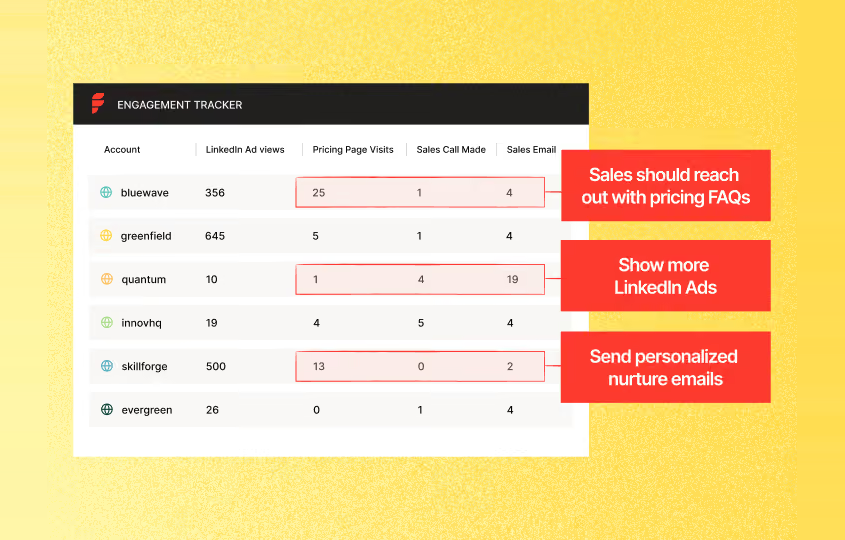
Source: Factors.ai
Factors.ai is an AI-powered Account-Based Marketing platform built for B2B go-to-market teams. It pulls intent signals from website visits, LinkedIn, Google Ads, G2, CRM activity, and third-party sources into a single account-level view, then layers AI automation on top to run campaigns and outreach with less manual work.
Its key features include:
Account Intelligence: Real-time intent signals and website visitor de-anonymization using waterfall enrichment across multiple providers, identifying over 75% of companies visiting the site
LinkedIn AdPilot: LinkedIn Ads optimization with Smart Reach impression capping, intent-based audience sync, and Conversions API integration
Google AdPilot: B2B Google Ads optimization with ICP-filtered audience targeting and enhanced conversion feedback
Sales Intelligence: Account signals and buying committee data surfaced for sales reps with real-time Slack alerts
Attribution and Analytics: Multi-touch attribution connecting ad spend to pipeline and revenue with eight model options
Scout AI Agents: ABM automation with natural language queries, automated reports, and autonomous workflow agents
Factors.ai ties these together so that when a target account visits your website, engages with LinkedIn content, or shows intent on G2, the system scores and segments that account, alerts sales, and can adjust ad targeting automatically. For growth-stage B2B SaaS teams running LinkedIn-heavy demand gen, it pulls the pieces into one place.
However, Factors.ai identifies companies rather than individuals by default (person-level identification requires the RB2B add-on), reviewers have noted dashboard and visualization limitations, and its integration ecosystem is still maturing.
For teams needing deeper predictive intelligence, more contact data, native advertising execution, or specialized attribution analytics, the alternatives below offer targeted solutions.
Looking for B2B data and AI-powered GTM intelligence? ZoomInfo combines 500M contacts, the GTM Context Graph, and access through APIs, GTM Workspace, and GTM Studio to power every go-to-market motion.
How We Curated Our List of Factors.ai Alternatives
After testing Factors.ai and researching the B2B GTM intelligence market, we found that its account-level ABM approach doesn't cover every need across different team sizes, maturity stages, and GTM motions. While Factors.ai handles cross-channel intent aggregation and LinkedIn ad optimization well, some businesses need more from:
Verified B2B contact data with direct dials and business emails at scale
Buying stage prediction with proprietary intent networks and per-customer AI models
Account-targeted advertising run directly from the same platform as account intelligence
A single self-serve tool for finding contacts and running outbound sequences
A meaningful free plan for evaluating website visitor intelligence before committing
Attribution answers in plain language without BI tooling or reporting backlogs
LinkedIn and Google Ads ROI proof at accessible, transparent pricing
Each tool on this list leads in one of these areas. You might use them alongside Factors.ai or switch entirely; it depends on what your revenue team needs most.
DISCLAIMER: We aren't covering every tool in the market. We're highlighting the best alternatives that address specific Factors.ai limitations for various use cases. |
|---|
1. ZoomInfo: Best Alternative for Comprehensive B2B Data and AI-Powered GTM Execution
ZoomInfo is an AI GTM platform built on a large data foundation: 500M contacts, 100M companies, 135M+ verified phone numbers, 120M direct-dial phone numbers, and 200M+ verified business email addresses. Its key features include:
B2B data platform: 500M contacts and 100M companies with identity data, company context, and buying signals, verified by 300+ human researchers and achieving up to 95% accuracy on first-party data
The GTM Context Graph: An intelligence layer that processes 1.5B+ data points daily, fusing ZoomInfo's B2B data with your CRM records, conversation intelligence, and behavioral signals to capture not just what happened, but why
Universal access: GTM Workspace for sellers, GTM Studio for marketers/RevOps/GTM engineers, and APIs and MCP for any tool, any AI agent, any custom application
Buyer Intent Data: 210 million IP-to-Organization pairings and 6 trillion+ keyword-to-device pairings sourced monthly, with Guided Intent that identifies topics historically correlated with deal success
Conversation Intelligence (Chorus): Captures and analyzes customer calls, meetings, and emails with AI-generated insights, deal intelligence, and coaching
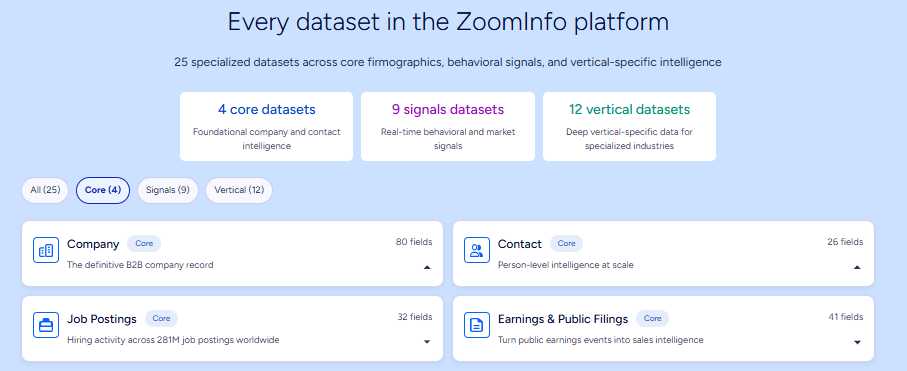
ZoomInfo is a broader platform than Factors.ai. Where Factors.ai aggregates third-party intent signals and optimizes LinkedIn and Google ad spend, ZoomInfo provides verified contact data, an intelligence layer, and an execution environment that covers the GTM motion from prospecting through deal close.
For teams that need verified contacts (not just company identification), plus deal intelligence and the flexibility to access data in any tool, ZoomInfo is the most complete alternative.
Why Choose ZoomInfo Over Factors.ai for GTM Intelligence
Factors.ai handles account-level intent aggregation and LinkedIn ad optimization well. ZoomInfo operates at a different scale. Here's where it differs.
Comprehensive B2B Data: Verified Contacts at Scale
Factors.ai's core product identifies companies visiting your website, but identifying the actual people at those accounts requires a separate enrichment step.
The platform's most frequent limitation in G2 reviews is that "it only provides organizational details like the company name and some basic information" when individual data isn't available. In practice, most Factors.ai users pair the platform with a contact database to act on account-level signals.
ZoomInfo eliminates that dependency. The platform provides 120M direct-dial phone numbers, 200M+ verified business email addresses, department org charts, and 300+ company attributes for market segmentation.
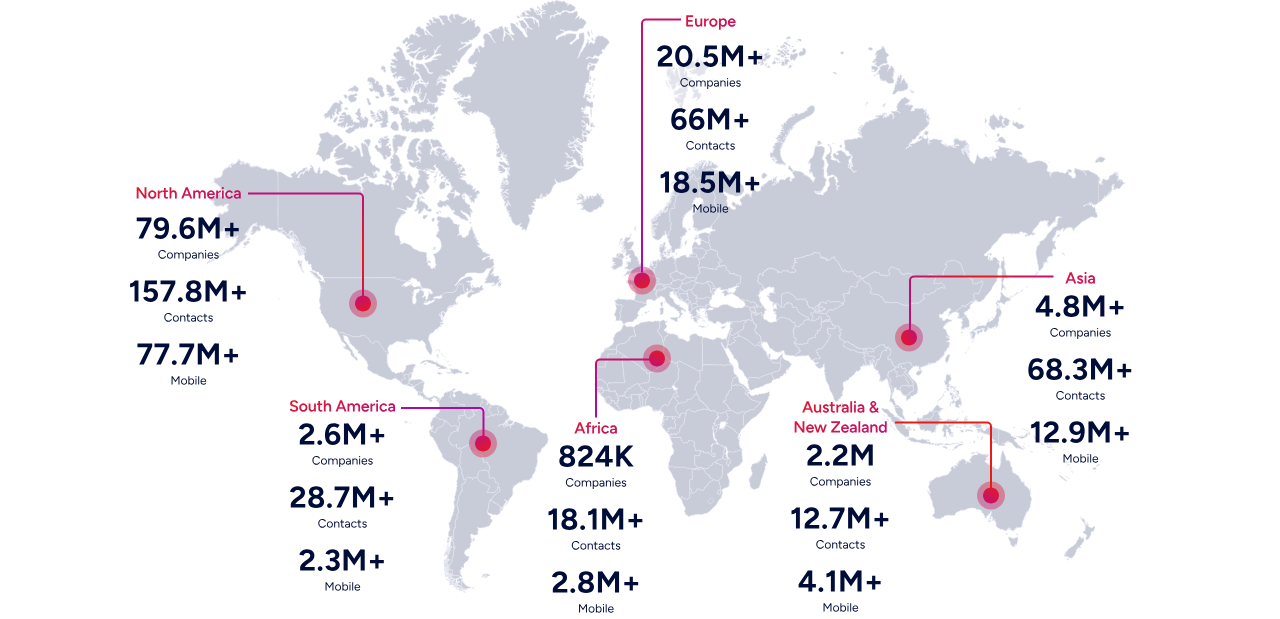
When your team identifies an in-market account, ZoomInfo already has verified contact details for the buying committee, the company's tech stack, their corporate hierarchy, and real-time signals like job changes and funding rounds.
This data advantage has outside validation. In a Fortune 500 competitive RFP analyzing 25 million contacts across vendors, the independent consultant concluded that "no other competitor came even close."
ZoomInfo holds 133 No. 1 rankings on G2 across Sales Intelligence, Buyer Intent, Data Quality, and Account Data Management categories. It has been named a Gartner Magic Quadrant Leader for ABM Platforms for two consecutive years and a Forrester Wave Leader for Intent Data Providers.
ZoomInfo in Action: When a target account shows buying signals, ZoomInfo doesn't just tell you the company is in-market. It surfaces verified direct dials and business emails for each member of the buying committee, maps the org chart so you know who reports to whom, shows what technologies the company uses, and tracks real-time signals like executive hires and funding rounds.
Your rep walks into the call knowing who to reach, how to reach them, and what's happening inside the account. No second tool, no manual research, no data gaps.
Vensure scaled prospecting with ZoomInfo's data. "ZoomInfo gives us the information we need to execute. We don't have to go through and spend our time digging. It's already there, so we can be three steps ahead." (Vensure)
The GTM Context Graph: AI That Understands Why Deals Move, Not Just What Happened
Factors.ai's engagement scoring ranks accounts based on weighted behavioral signals, and its predictive scoring uses machine learning to estimate conversion likelihood.
These are useful features. But they operate on the signals Factors.ai tracks: website visits, ad interactions, G2 intent, and CRM stage changes. The scoring tells you an account is active; it doesn't explain the dynamics driving that activity.
ZoomInfo's GTM Context Graph captures something different. It fuses ZoomInfo's B2B data with your CRM records, conversation intelligence from Chorus (every call, meeting, and email), and behavioral signals into an intelligence layer that maps connections between signals and outcomes.
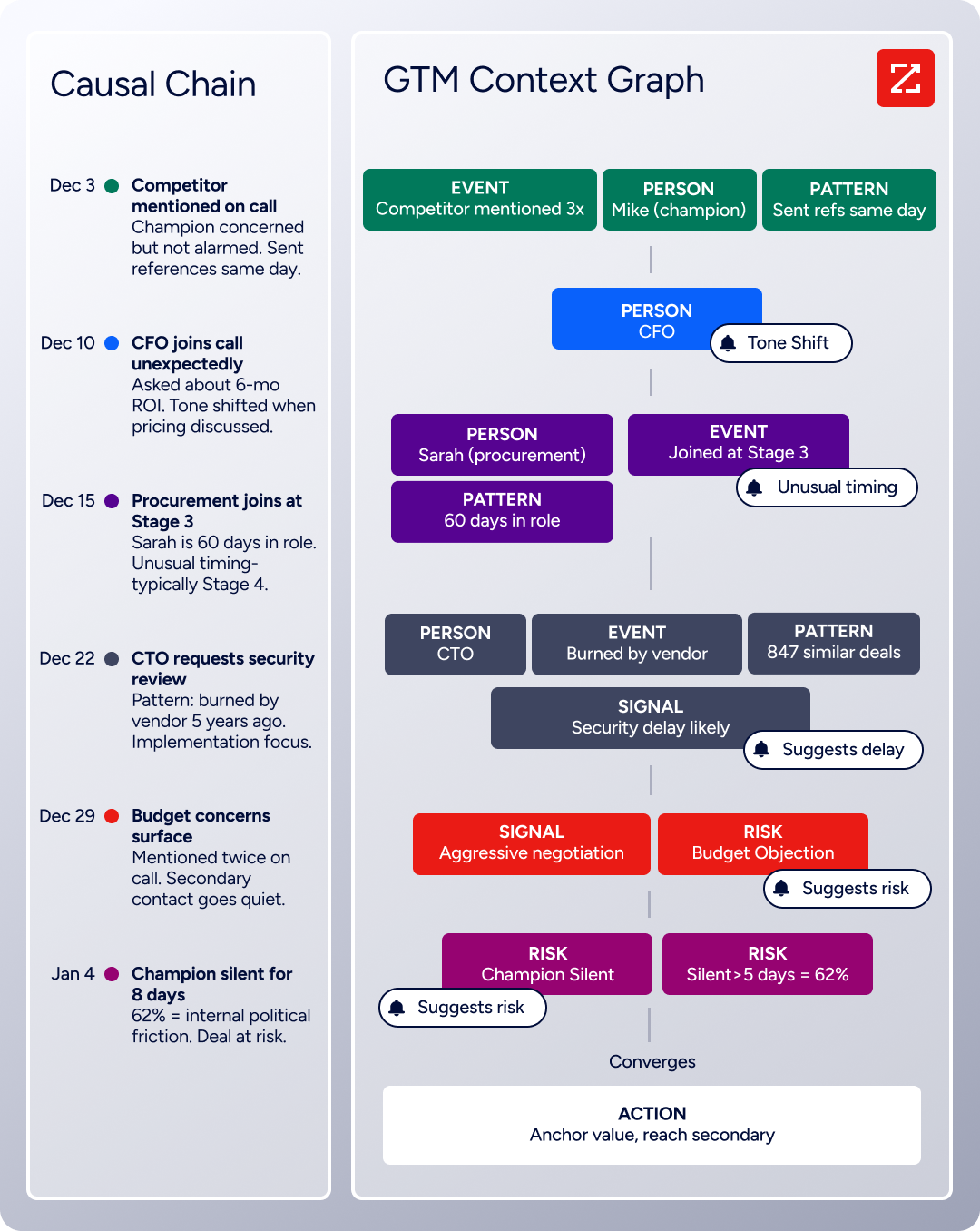
A CRM records that a deal moved to Stage 4. Chorus captured that the CFO joined the last call and asked about six-month ROI. The GTM Context Graph connects these facts: executive sponsorship entering at this stage, combined with ROI-focused questions, matches the pattern behind closed-won deals in your segment.
As ZoomInfo's Chief Product Officer Dominik Facher wrote: "The CRM recorded the state change. It has no record of why it happened."
The GTM Context Graph makes this decision context machine-readable, and that insight flows into every downstream action: the follow-up email addresses the specific concern the CFO raised, the play targets accounts whose signal combinations match your actual win patterns, and the forecast weights deals by buying evidence rather than stage labels.
ZoomInfo in Action: Your team closes a deal after the VP of Engineering championed it through procurement. The GTM Context Graph captures the full pattern: which signals preceded the champion's engagement, what objections were raised in calls, how the buying committee expanded over time, and what competitive mentions appeared.
The next time another account shows a similar signal pattern, ZoomInfo's AI agents in GTM Workspace flag it, draft outreach that speaks to the specific use case, and recommend engaging the engineering stakeholders who match your champion profile.
Seismic's sales team attributed 39% of active pipeline to opportunities identified or influenced by ZoomInfo signals, boosted productivity by 54%, and saved 11.5 hours per week. "That combination of our internal CRM data, external signals, and AI that's given all that context has helped us craft very specific account- and persona-based messages." (Seismic)
Universal Access: Use ZoomInfo's Intelligence in Any Tool, Any Workflow
Factors.ai integrates with CRMs, ad platforms, and workflow tools like Clay, Zapier, and Make.com. Its Factors MCP integration brings data into ChatGPT and Claude. These are real integration capabilities for a growth-stage platform.
ZoomInfo's access works at infrastructure scale. APIs and MCP expose ZoomInfo's data and the GTM Context Graph to any custom agent, internal tool, or partner platform. GTM Workspace gives sellers a single surface where prioritized accounts, AI-drafted outreach, and deal execution converge.
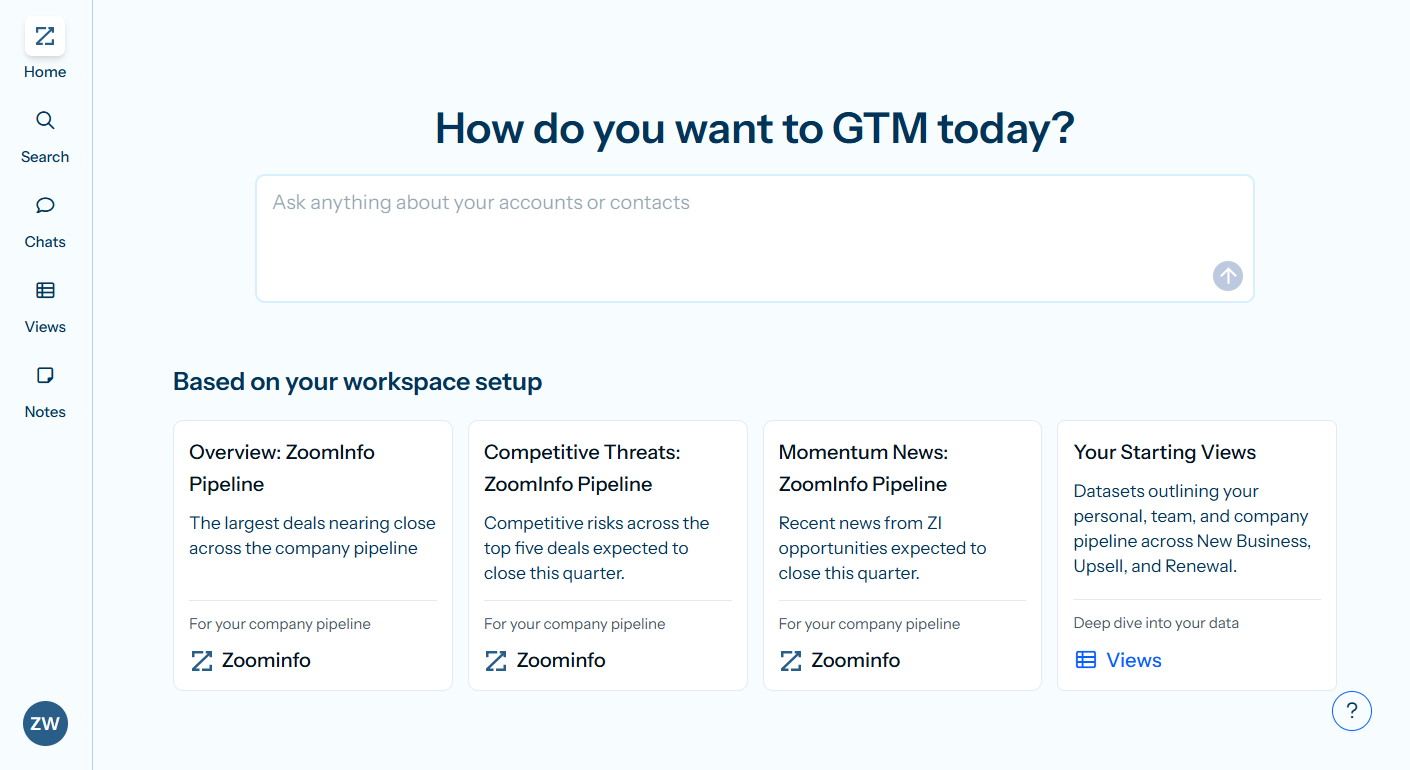
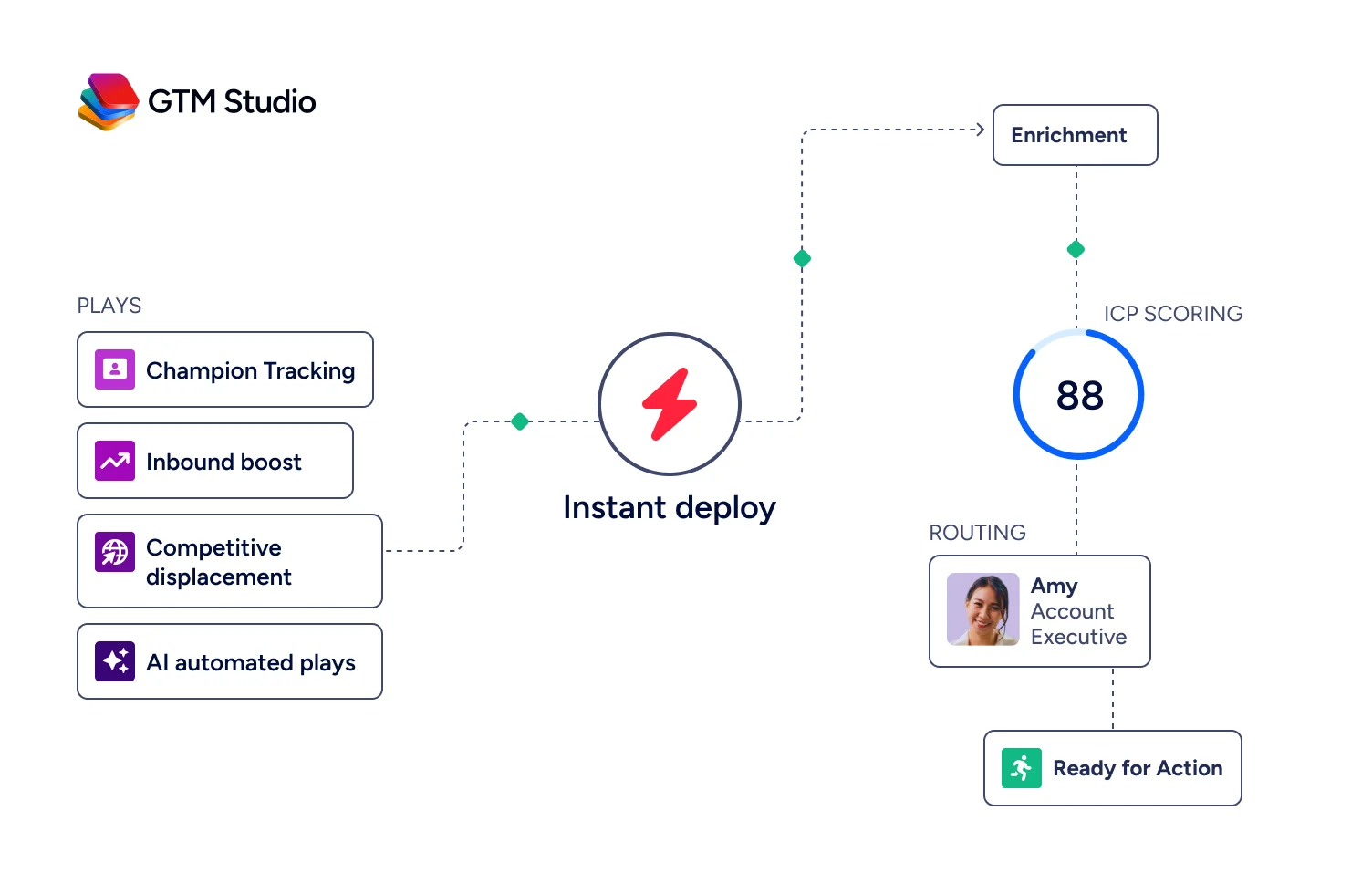
GTM Studio gives marketers, RevOps, and GTM engineers a builder where audience definition, campaign orchestration, and pipeline measurement happen in natural language.
All three draw from one GTM Context Graph: the same data, the same reasoning, the same continuously learning model.
The ZoomInfo App Marketplace lists 172+ integration partners. Cloud Partners enables direct data ingestion into AWS, Google Cloud, Snowflake, and Databricks.
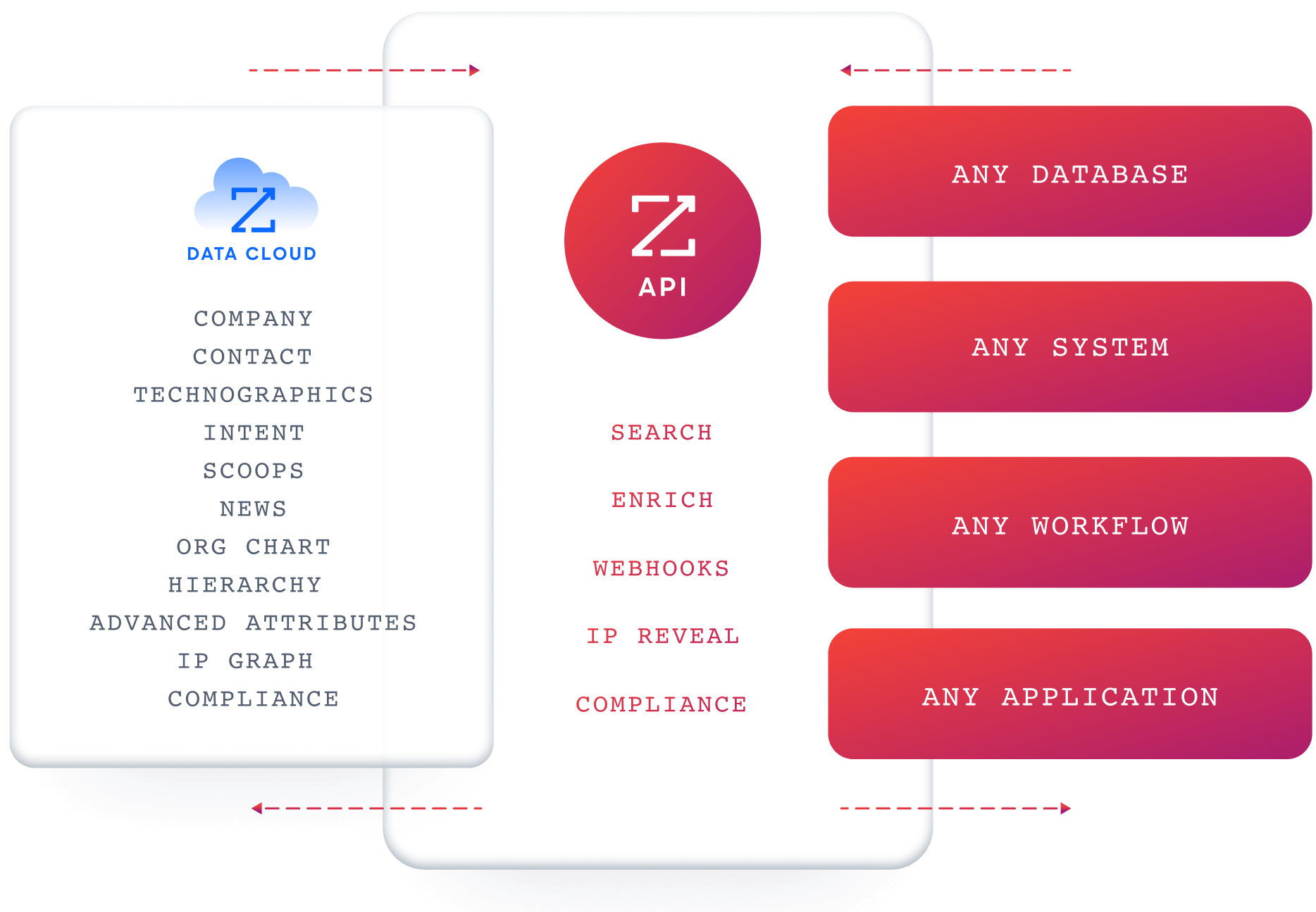
API Access is included in all relevant plans, so the intelligence works everywhere without application lock-in.
ZoomInfo in Action: A marketer in GTM Studio describes an audience in plain language: "Series B+ SaaS companies in North America with 200-500 employees that are researching data integration tools and recently hired a VP of Engineering." GTM Studio builds the audience from ZoomInfo's data, launches a multi-channel play across display, email, and SDR outreach, and pushes hot accounts into GTM Workspace.
The seller opens Workspace to a prioritized feed with AI-drafted outreach that addresses the specific signals the reasoning engine identified. An engineer plugs the same intelligence into a custom agent via MCP. Every surface draws from one intelligence layer.
"The plug-and-play aspect of the API means I can integrate it very easily into any process and get information at a moment's notice." BDO Canada achieved an 87% reduction in time spent on internal data dashboard updates. (BDO Canada)
NOTE: We looked into other GTM intelligence platforms and found Cognism and Lusha among the top contenders. Cognism excels in European and EMEA contact data coverage with strong GDPR compliance, and Lusha offers a clean interface for contact enrichment. Neither matches ZoomInfo's scale across all three areas: data breadth (500M contacts, 100M companies), intelligence depth (conversation intelligence, deal insights, outcome prediction), and access (APIs, MCP, GTM Workspace, GTM Studio). For teams that need the broadest foundation for AI-powered GTM execution, ZoomInfo is the strongest option.
ZoomInfo Pricing
ZoomInfo uses a consumption-based pricing model with custom quotes for all paid tiers. Pricing scales around enterprise license agreements, data access, API consumption, and AI activity.
Sales Plans come in three tiers:
Professional: Contact and company data with profiles, mobile numbers and business email, CRM integrations, Chrome extension, and AI-powered email generation
Advanced: Adds AI-driven account prioritization, buyer intent signals, website visitor identification, Champion Tracking, buying group filters, and automated outreach workflows
Enterprise: Adds real-time buyer intent signals, advanced company attributes, custom integrations, AI-generated account summaries, and dedicated customer service
Marketing Plans include Marketing Demand, ABM Lite, and ABM Enterprise tiers for progressively deeper advertising, audience targeting, and AI-powered campaign execution.
ZoomInfo also offers ZoomInfo Lite, a permanent free tier with access to ZoomInfo's B2B database, 10 monthly export credits, individual and company searches, and WebSights Lite. No credit card, no time limit.
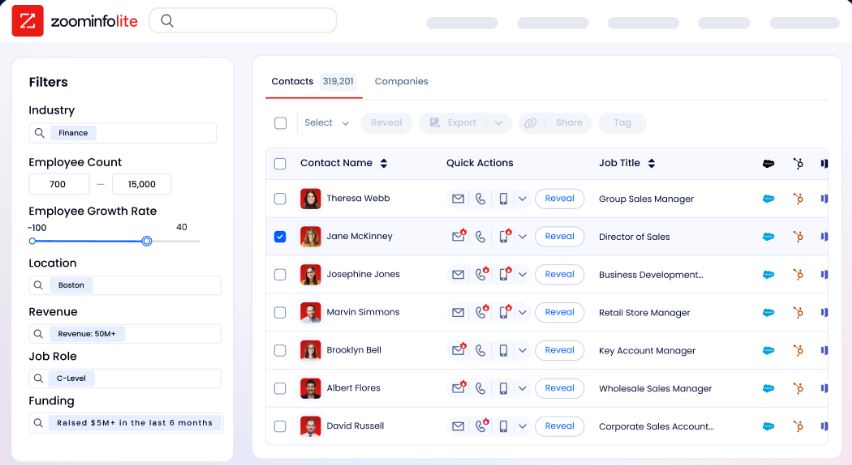
A separate 7-day free trial provides access to core platform features including intent signals and email outreach.
Who Should Use ZoomInfo?
Choose ZoomInfo if:
Your revenue team needs verified direct dials, business emails, and complete buying committee data to act on account signals without a separate enrichment layer. ZoomInfo provides the contact data that Factors.ai's account-level intelligence leaves as a gap.
You need AI that understands the context behind deals, not just which accounts are active. The GTM Context Graph connects CRM data, conversation intelligence, and market signals to explain why deals move and predict what happens next.
Your organization wants GTM intelligence accessible in every tool and workflow. Whether your team works in GTM Workspace, GTM Studio, Salesforce, or custom AI agents via API and MCP, ZoomInfo delivers the same intelligence everywhere without lock-in.
Ready to see what B2B data and AI-powered GTM intelligence can do for your pipeline? Start with ZoomInfo Lite for free or request a demo to explore the full platform.
2. 6sense: Best Alternative for Enterprise ABM Powered by Proprietary Buying Stage Intelligence

Source: 6sense
6sense is an enterprise B2B ABM and Revenue Intelligence platform that replaces the multi-tool intent stack with a single, prediction-driven system built on 13 years of proprietary B2B buyer behavior data. Its key capabilities include:
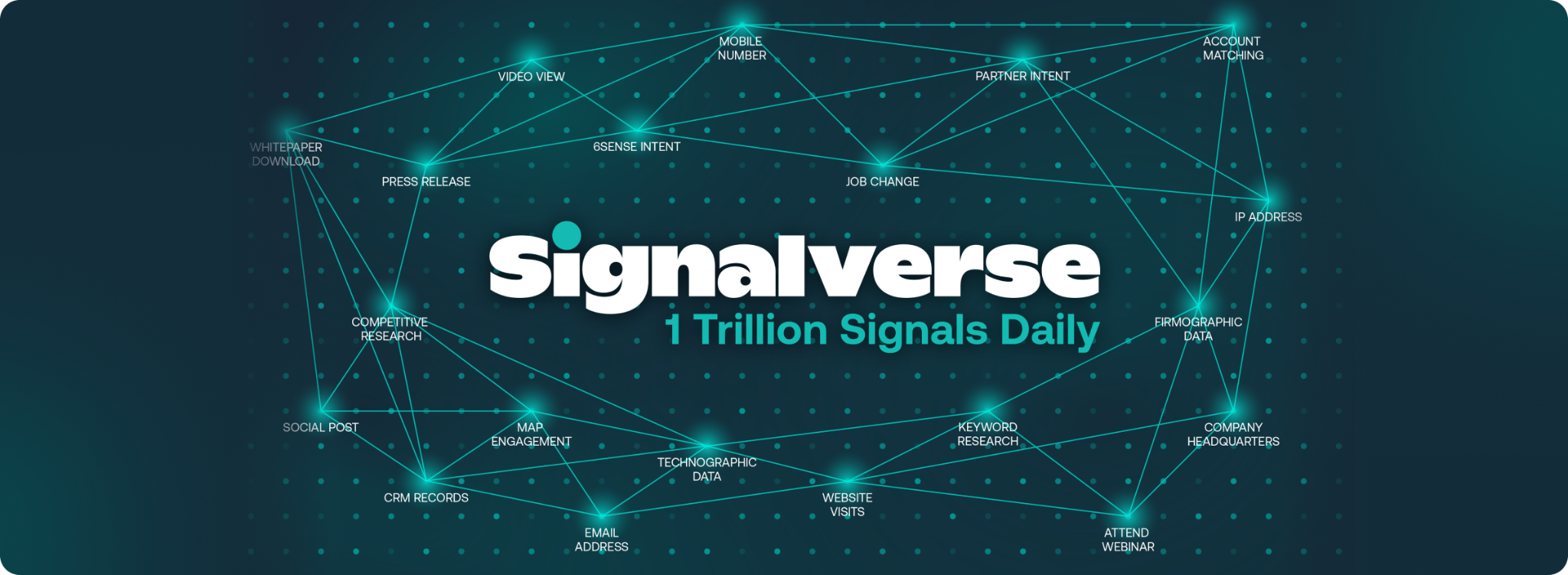
Signalverse intent network processing 1T+ buying signals daily across 415M+ profiles and 65M+ companies
AI-powered buying stage classification predicting in-market probability before accounts self-identify
Per-customer predictive model training calibrated to each vendor's historical won/lost opportunity data
Native B2B DSP (6sense Accelerate) for programmatic display, Connected TV, and LinkedIn advertising driven by live buying stage data
RevvyAI conversational command center for natural language campaign configuration and audience building
AI Email Agents that write, send, follow up, and route qualified conversations to sales
6sense is built for mid-market and enterprise B2B organizations with complex, multi-stakeholder sales cycles that need to predict where target accounts sit in the buying journey.
Why Choose 6sense Over Factors.ai for Enterprise Buying Stage Intelligence
6sense stands out in the following areas:
Proprietary Intent Network Depth vs. Aggregated Third-Party Signals
Factors.ai aggregates intent from external sources like G2, LinkedIn, Bombora, and Clearbit, stitching third-party data into one account view. 6sense built its own proprietary intent network over 13 years. The Signalverse monitors research activity across millions of B2B content pages, processing over one trillion buying signals daily in over 40 languages.
Source: 6sense
Buying Stage Prediction vs. Engagement Scoring
Factors.ai's account intelligence centers on engagement scoring, a weighted composite that ranks accounts as Hot, Warm, Cool, or Ice based on recent activity. This is retroactive by nature. 6sense takes a different approach with its Predictive Buying Stage model, classifying each account into five stages (Target, Awareness, Consideration, Decision, Purchase) based on the likelihood of opening an opportunity within 90 days. The model is trained for each customer using their historical won/lost opportunity data, so predictions are calibrated to actual win patterns rather than admin-configured signal weights.
Native B2B DSP Built Into the Same Intent Engine
Factors.ai builds intent-based segments and syncs them to LinkedIn and Google for advertising. The ads run through LinkedIn's or Google's infrastructure on batch-updated audiences. 6sense operates a proprietary B2B DSP called 6sense Accelerate that bids on programmatic inventory directly, driven by the same Signalverse buying stage data. When an account crosses into the Decision stage, ad targeting adjusts automatically with no manual audience refresh. The platform supports six ad format types including Connected TV and Dynamic HTML5 ads that inject account-specific personalization. Advertising is included with platform subscriptions rather than priced separately.
NOTE: We also evaluated Demandbase and Terminus. Demandbase offers comparable enterprise ABM with strong native advertising and an established data network, while Terminus delivers enterprise ABM advertising with a clean interface. 6sense makes the strongest case for teams that have outgrown mid-market ABM tooling because the Signalverse intent network, per-customer predictive models, and native DSP were built as a single system.
6sense Pricing
6sense does not publish pricing for paid tiers. All commercial conversations require direct engagement with their sales team.
Free Plan (Sales Intelligence): $0 with 50 credits per month. Includes company and people search, sales alerts, list builder, and Chrome Extension. Does not include intent data, predictive scoring, CRM integration, or workflow automation.
Paid Sales Intelligence Plans: Custom quote. Options include single license plus credits, single license plus credits plus predictive intelligence, and single license plus predictive only.
Full ABM Platform: Custom quote. Covers Revenue Marketing, Predictive Modeling, Sales Intelligence, and Intelligent Workflows. No contractual minimum ad spend; minimum campaign budget $100.
For a detailed look at what each 6sense tier includes and how pricing compares, see our 6sense pricing guide.
Who Should Use 6sense?
Choose 6sense if:
Your revenue team has a well-defined ICP, clean CRM data with historical won/lost opportunities, and at least one dedicated RevOps resource to configure predictive models. The buying stage AI requires this foundation.
You need advertising, intent data, and sales orchestration to respond to the same live account signals without rebuilding audiences as accounts move through stages.
Enterprise analyst recognition matters to your procurement team. 6sense has been a Gartner Magic Quadrant Leader for ABM Platforms for five consecutive years and a Forrester Wave Leader for Revenue Marketing Platforms.
For a full breakdown of 6sense's strengths, limitations, and real-world performance, see our 6sense review.
3. RollWorks: Best Alternative for Mid-Market Teams Needing Advertising-Coordinated Account Intelligence
Source: Adroll
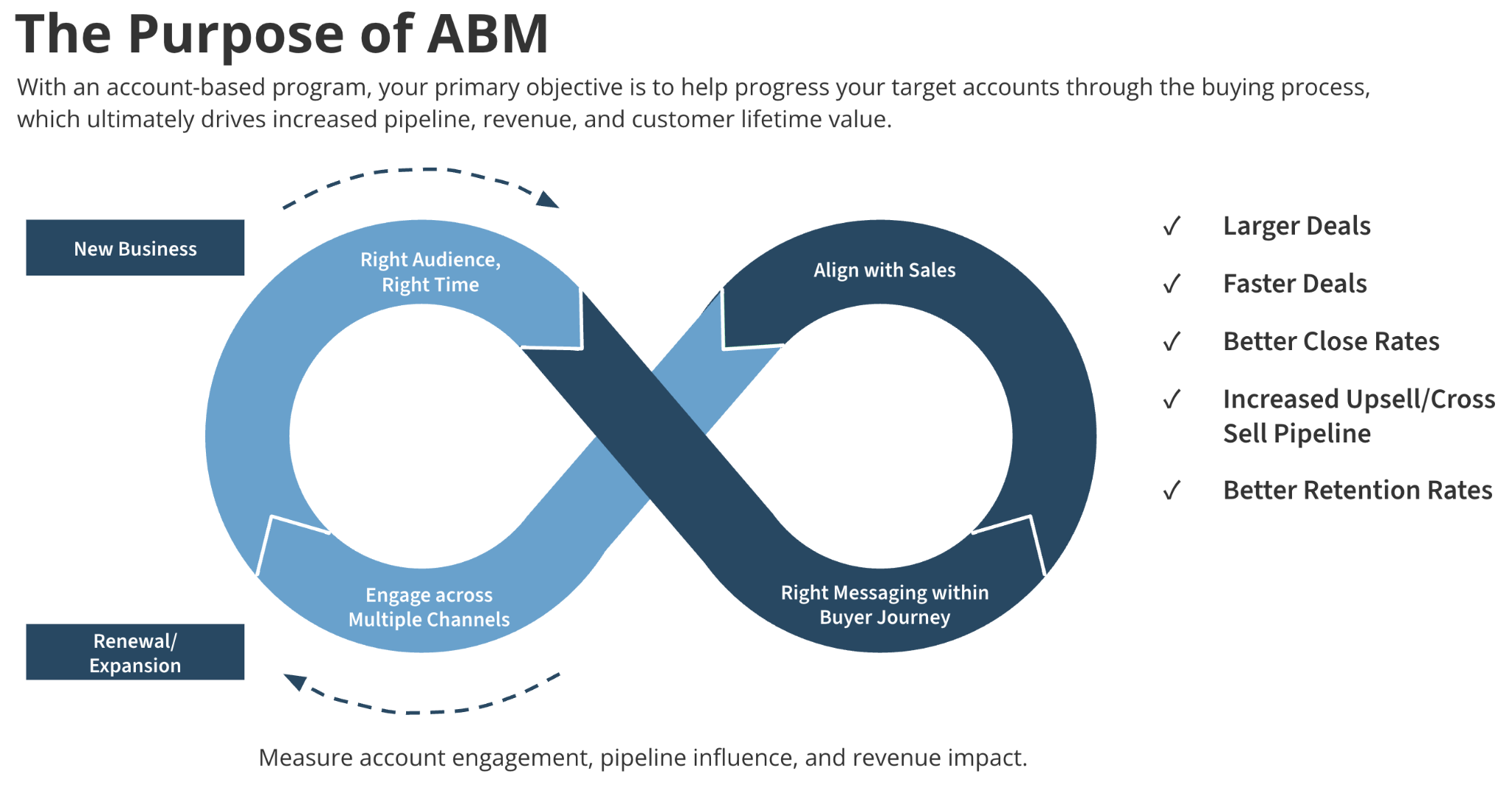
RollWorks (now officially AdRoll ABM) is an account-based marketing platform designed for B2B revenue teams that want buyer intent signals and multi-channel advertising execution in the same tool. Its key capabilities include:
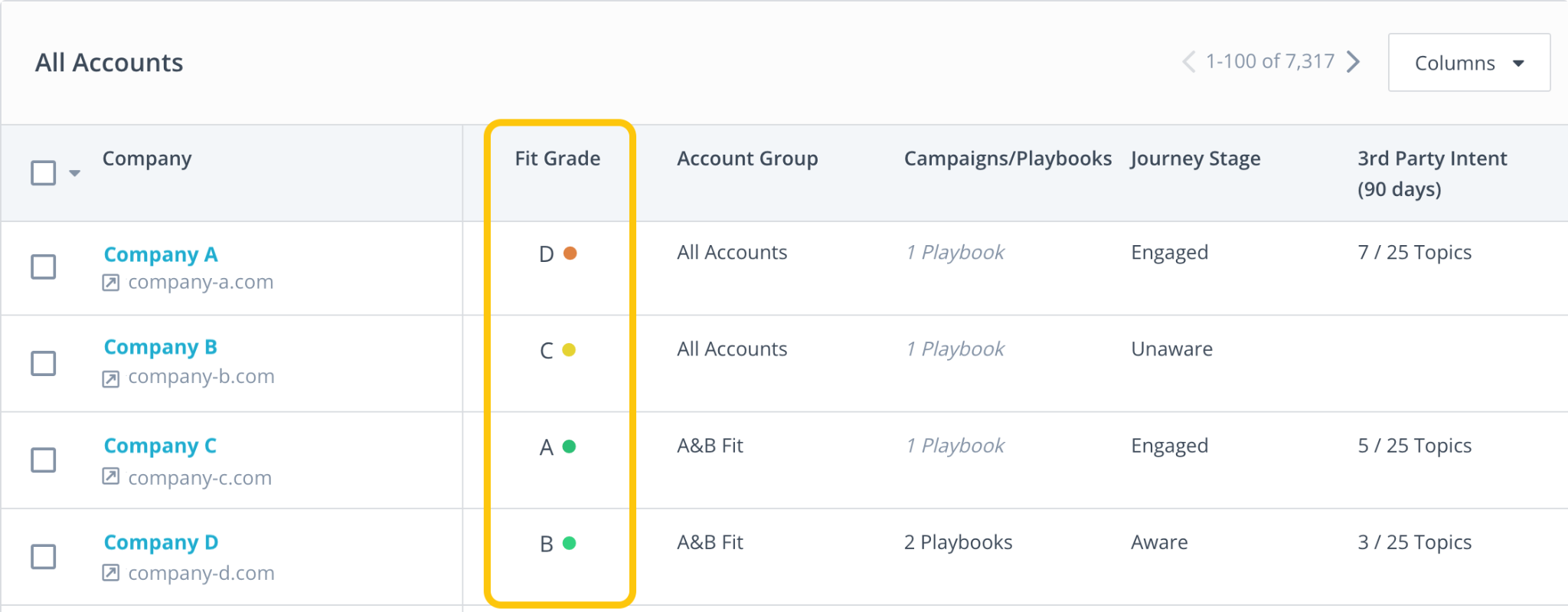
Automatic ICP Fit Grading across every account in your target market, scored A through F on firmographic match
Multi-source intent stacking combining AdRoll Keyword Intent, Bombora Company Surge, and G2 signals into a single account view
Contact-level deanonymization identifying individual visitors with name, title, and contact details
Native DSP executing account-targeted display, video, native, social, CTV, and DOOH campaigns from the same platform
GTM Orchestration via 20+ integrated platforms including Salesforce, HubSpot, Outreach, and Salesloft
RollWorks is sized for midmarket companies, particularly those in the 100 to 500 employee range.
Why Choose RollWorks Over Factors.ai for Mid-Market ABM
RollWorks stands out in the following areas:
Automatic ICP Fit Grading Without Manual Scoring Model Builds
Factors.ai's engagement scoring is flexible but assumes someone with marketing ops knowledge will design and maintain models. RollWorks' ICP Fit Grade system, powered by its InIQ AI engine, automatically grades every account A through F based on firmographic fit and pushes those grades directly into Salesforce and HubSpot. For mid-market teams without a dedicated RevOps function, automated grading delivers usable prioritization from day one.
Source: Adroll
A Native DSP Means Advertising Activates Directly on Intent
Factors.ai aggregates intent signals into an account view, but running ads requires connecting to LinkedIn Campaign Manager or Google Ads separately. RollWorks combines audience segmentation with a cross-channel DSP in one application. When InIQ identifies a surging account, BidIQ (making over 2.5 trillion predictions per day) activates targeted campaigns immediately. No CSV export, no manual audience upload, no lag between signal and ad response.
Contact-Level Deanonymization by Default
Factors.ai's most cited limitation is that it identifies companies, not individuals, by default. Person-level identification requires the RB2B add-on. RollWorks' InIQ engine deanonymizes 2X more contacts than other ABM technologies at the person level, surfacing names, titles, and contact details so sales alerts include information reps can act on directly.
NOTE: We also evaluated Terminus and Demandbase. Terminus offers similar ABM advertising coordination, but its roadmap has trended toward enterprise-scale deployments. Demandbase is enterprise-first in pricing and structure. RollWorks offers the most accessible entry point for growing B2B teams that need account identification, intent stacking, and native advertising in one platform.
RollWorks Pricing
RollWorks offers four ABM tiers on its pricing page. No dollar figures are published for sales-gated tiers.
Account-Based Retargeting: No platform fee, pay only for media consumed. Self-service signup available.
Account-Based Advertising: First-party data activation and multi-channel advertising. Requires a demo.
Account-Based Marketing: Full buyer insights, ICP Fit Grading, journey stages, workflow orchestration, and advertising playbooks. Requires a demo.
Account-Based Marketing + Advertising: End-to-end ABM and advertising strategy. Requires a demo.
For a detailed breakdown of what each RollWorks tier includes, see our RollWorks pricing guide.
Who Should Use RollWorks?
Choose RollWorks if:
Your primary ABM motion is account-targeted paid advertising and you want intent signals and ad execution in the same platform without routing through a separate DSP.
Your team is in the 100 to 500 employee range and needs account intelligence that produces usable prioritization out of the box, without building custom scoring models.
You want contact-level visitor deanonymization included by default rather than adding a separate enrichment tool.
For a deeper look at how RollWorks performs in practice, see our RollWorks review.
4. Apollo.io: Best Alternative for Small Teams Needing Contact Data and Outreach in One Tool
Source: Apollo.io
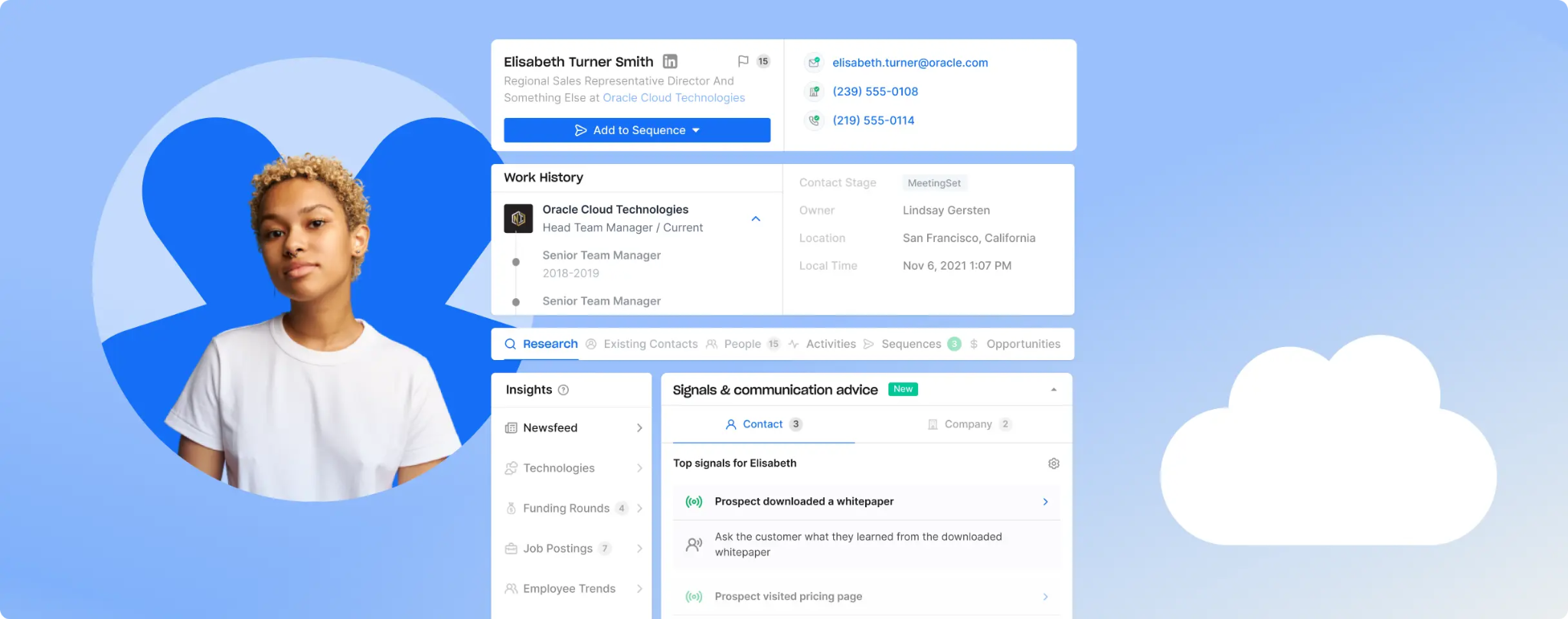
Apollo.io is a B2B AI sales platform that puts contact prospecting, email sequencing, intent signals, and CRM enrichment into a single self-serve product. Its key capabilities include:
270M+ verified B2B contacts and 70M companies with emails, direct dials, and 65+ firmographic, technographic, and behavioral filters
Buying Intent data covering 1,600+ topics included on all paid plans
Multichannel outbound sequences with email, phone, LinkedIn steps, A/B testing, and a built-in Parallel Dialer
A free-forever Starter plan and paid tiers starting at $49/seat/month
Chrome Extension for in-context prospecting on LinkedIn and company websites
Apollo.io covers the core outbound workflow: find contacts, qualify them with signals, sequence them.
Why Choose Apollo.io Over Factors.ai for Small Teams
Apollo.io stands out in the following areas:
Person-Level Contact Access From Day One
Factors.ai surfaces which companies show buying intent, but identifying actual people requires a separate enrichment layer. Factors.ai's own AI Contact Relevance Workflow queries Apollo's API to fill this gap. Apollo.io provides 270M+ contacts with a claimed 91% email accuracy rate. SDRs can search against 65+ filters and get a working prospect list with verified emails and direct dials, with no intermediate enrichment step.
Native Outreach Sequencing Eliminates a Second Tool
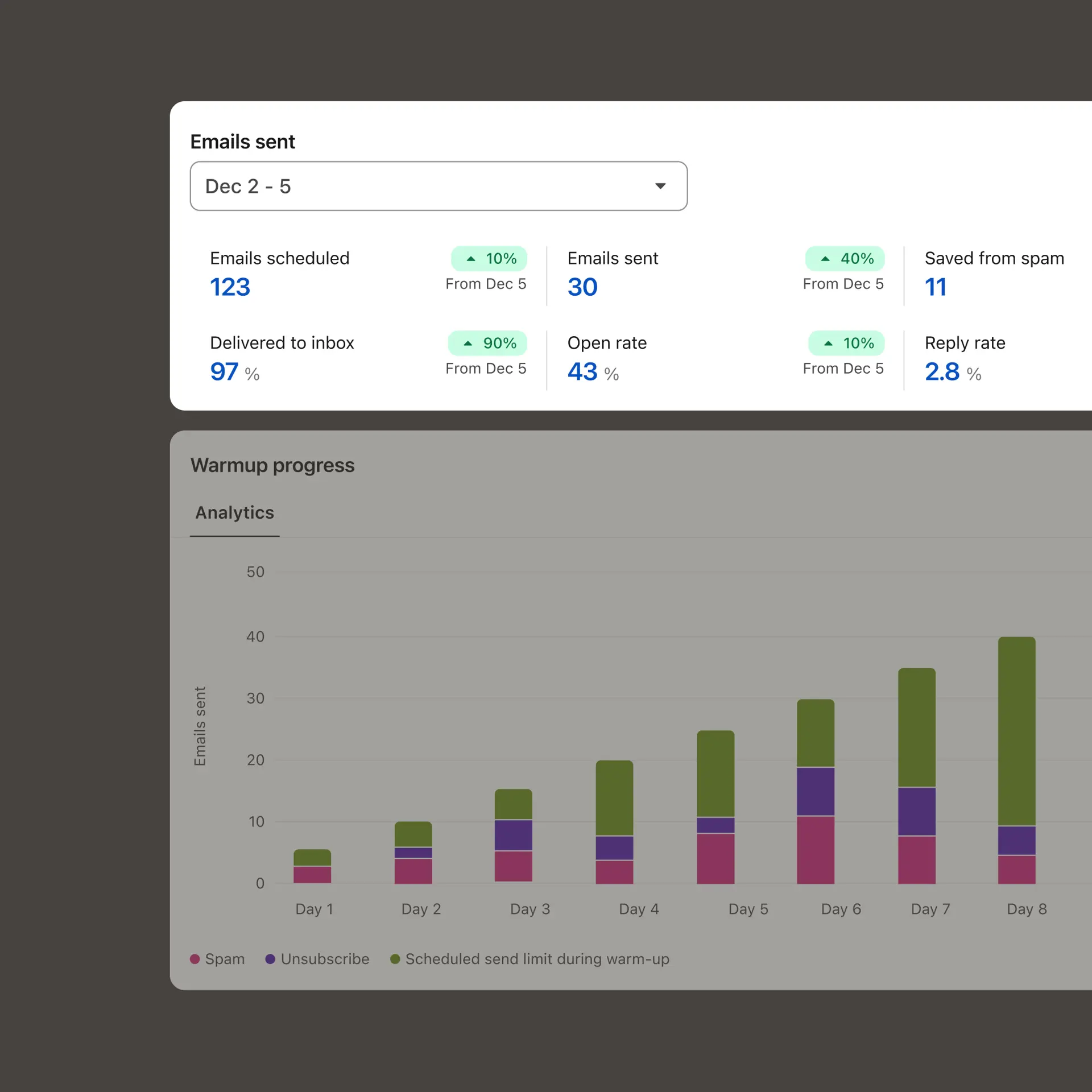
Factors.ai surfaces signals and routes alerts, but outreach requires a separate sales engagement platform. Apollo.io includes multichannel sequences natively: email, phone calls, LinkedIn connections with A/B testing, personalization tokens, AI-generated email copy, and built-in deliverability tooling including domain purchase, SPF/DKIM/DMARC setup, and mailbox warm-up.
Source: Apollo.io
Transparent Self-Serve Pricing With a Permanent Free Tier
Factors.ai's paid plans start at $6,000/year (Basic) with no self-serve checkout. Apollo.io's free-forever Starter plan provides 75 credits per month, two active sequences, and Chrome Extension access. Paid plans start at $49/seat/month with published pricing. Apollo for Startups offers 50% off for companies with fewer than 20 employees.
NOTE: We also evaluated UpLead and Snov.io. UpLead offers strong data accuracy at affordable per-credit pricing, but has no native sequencing or intent data. Snov.io offers email-focused outreach at accessible pricing but with a narrower database and no integrated intent signals. Apollo.io bundles the core outbound workflow most completely in one self-serve platform.
Apollo.io Pricing
Apollo.io uses a per-seat plus credit-consumption model. All four solution areas (Outbound, Inbound, Data Enrichment, Deal Execution) are included at every tier.
Free (Starter): $0 forever. 75 credits/month, 2 active sequences, Chrome Extension. No credit card required.
Basic: $49/seat/month billed annually. 2,500 credits/month, multiple seats, 14-day free trial.
Professional: $79/seat/month billed annually. 4,000 credits/month, unlimited sequences, Buying Intent data, CRM and CSV enrichment.
Organization: $119/seat/month billed annually. 72,000 credits/year, SSO, advanced API access. Minimum 3 seats.
Who Should Use Apollo.io?
Choose Apollo.io if:
Your team runs outbound-first sales motions and needs verified contacts, intent signals, and email sequencing in one platform without managing data across three separate tools.
You are a small team of one to ten people that can't justify Factors.ai's $6,000+ annual entry point and needs a product you can validate on a free plan first.
Your bottleneck is finding contacts within target companies and reaching them, not cross-channel attribution or LinkedIn ad optimization.
For a comprehensive review of Apollo.io's features, data quality, and limitations, see our Apollo.io review.
5. Warmly.ai: Best Alternative for a Free Entry Point to Visitor Intelligence With Autonomous Outreach
Source: Warmly
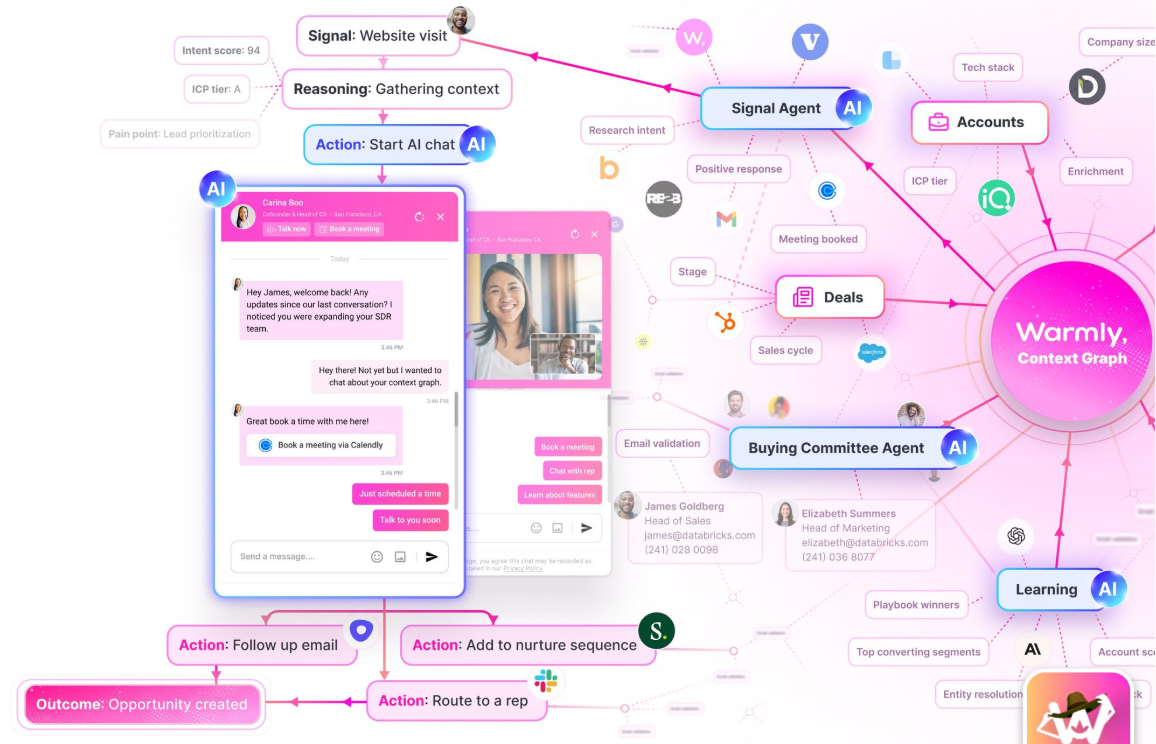
Warmly.ai is a GTM AI platform that identifies website visitors at the person level, maps their buying committees in real time, and deploys AI agents to engage and route qualified visitors. Its key capabilities include:
Permanent free plan with 500 de-anonymized company visits per month, real-time Slack alerts, and CSV export
Person-level visitor identification using a waterfall of multiple enrichment vendors
Buying committee mapping surfacing champions, decision-makers, and influencers with verified contacts
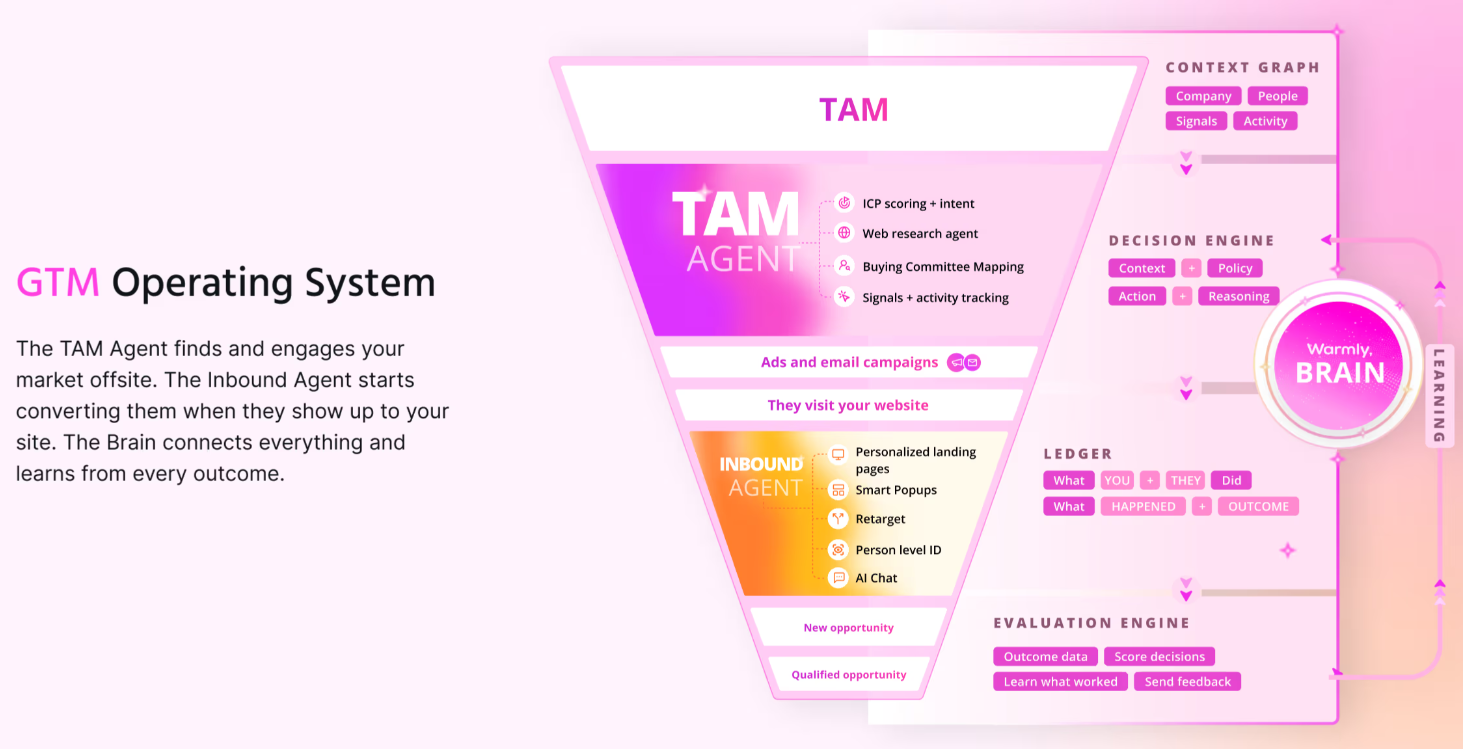
Autonomous Inbound Agent that identifies visitors, pulls CRM history and intent context, books meetings, and routes to reps 24/7
TAM Agent for off-site orchestration with intent scoring, dynamic audience building, and LinkedIn ad audience sync
Bombora third-party intent signals included in the subscription
As of July 2026, Warmly is being acquired by HubSpot, validating the platform's person-level intent architecture and signaling deeper HubSpot integration going forward.
Why Choose Warmly.ai Over Factors.ai for Website Visitor Intelligence
Warmly.ai stands out in the following areas:
A Permanent Free Plan That Delivers Useful Visitor Intelligence
Factors.ai's free tier covers basic company identification, traffic analysis, and Slack/Teams alerts but stops short of giving teams enough signal to act on. Warmly's free plan identifies up to 500 companies visiting the website per month, fires real-time Slack alerts, and allows CSV export, all with no credit card and no time limit. The quarterly pay option ($4,875/quarter) lets teams graduate to paid without signing an annual contract.
Person-Level Identification as the Default
Factors.ai identifies companies by default; person-level identification requires the separately priced RB2B add-on. Warmly resolves visitors at the individual level natively, surfacing name, job title, email, and company. Typical B2B traffic yields 20-40% person-level resolution, with about 15% resolved at the individual level at 90%+ accuracy. The Context Graph immediately pulls CRM records, previous visits, and intent signals for each resolved individual.
Autonomous Inbound Conversion Without Human Coverage
Factors.ai surfaces signals and routes alerts; outreach requires human execution. Warmly's Inbound Agent identifies visitors before the first message, opens personalized conversations drawing on the Context Graph, qualifies intent, and books meetings directly on the rep's calendar without a human rep online. Sixty percent of B2B research happens outside business hours, and Warmly's agent covers this gap around the clock.
Source: Warmly
NOTE: We also evaluated ZoomInfo Lite (permanent free tier focused on prospecting and list-building) and Factors.ai's own free plan (basic company identification with Slack alerts). Warmly.ai offers the most functional website visitor intelligence experience at no cost, making it the clearest free entry point for teams evaluating before any paid commitment.
Warmly.ai Pricing
Warmly uses flat-fee pricing billed annually or quarterly. Quarterly carries about a 30% premium over annual.
Free: $0. 500 de-anonymized company visits/month, Slack alerts, CSV export, Bombora intent signals. No credit card required.
AI Web-Deanonymization: $10,000/year or $4,875/quarter. Website visitor identification at contact and company level, CRM sync, retargeting.
Inbound Chat: $20,000/year or $6,500/quarter. Adds AI Chatbot with one AI Studio Agent, live chat, and automated email follow-up.
AI Inbound Autopilot: $30,000/year or $9,750/quarter. Unlimited AI Studio Agents, Autopilot Agent, AI slide generation, and auto-learn capabilities.
Who Should Use Warmly.ai?
Choose Warmly.ai if:
You want to evaluate website visitor intelligence with zero upfront spend before committing to any paid platform.
You're on HubSpot and want tight CRM alignment.
Your top priority is converting inbound website traffic into booked meetings, particularly replacing an expensive chatbot with an agent that identifies visitors and books meetings on its own.
6. HockeyStack: Best Alternative for AI-Powered Multi-Touch Attribution Without BI Complexity
Source: HockeyStack
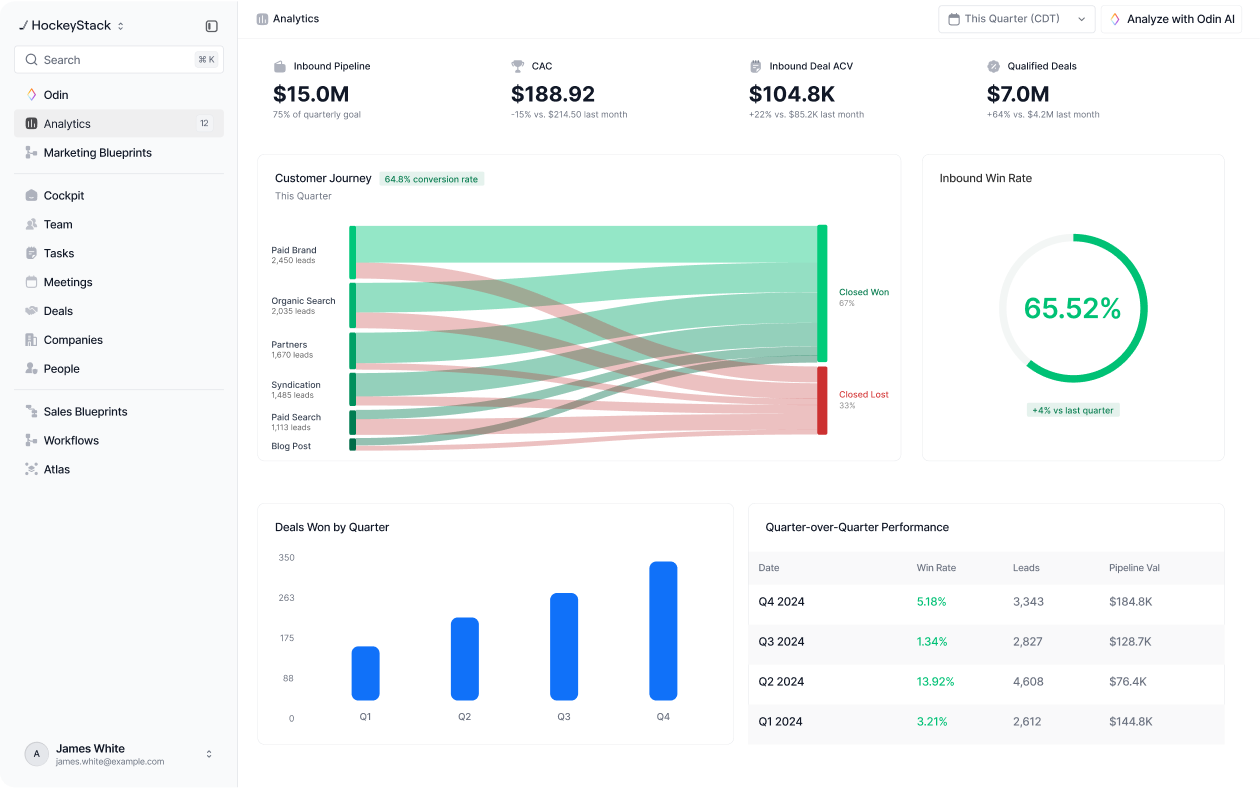
HockeyStack is a B2B revenue data intelligence platform that unifies CRM, ad platform, product, and customer success data into a single account timeline, then layers an AI analyst and agent library on top. Its key capabilities include:
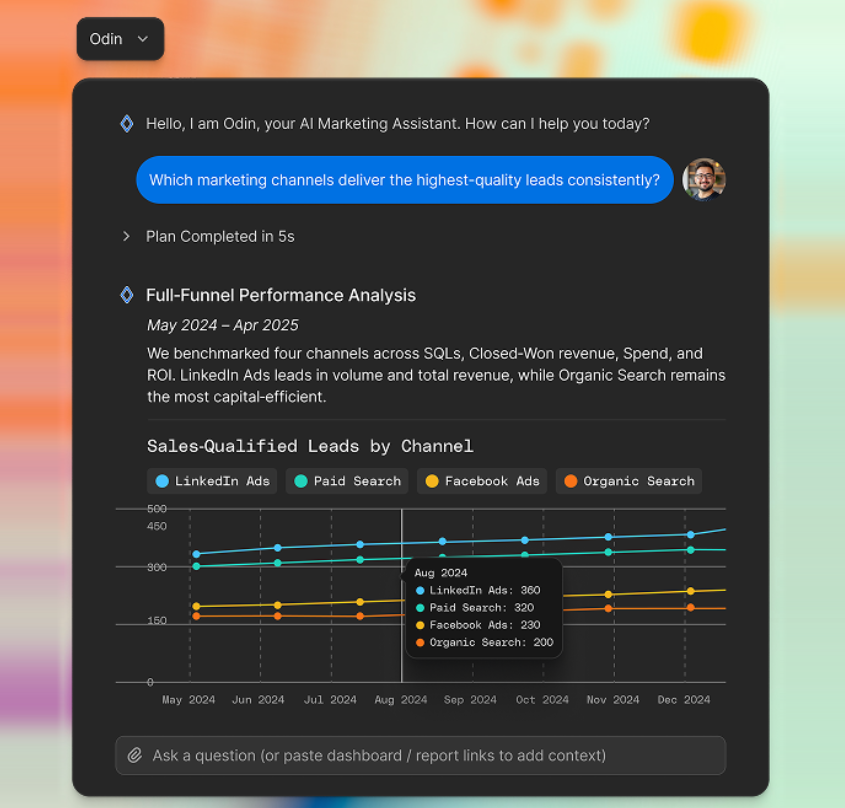
Odin AI Analyst for natural language attribution queries, accessible in-platform and via Slack
Nine simultaneous attribution models with custom weighting, configurable lookback windows, and no-code report building
Atlas data foundation ingesting 20+ GTM tools into a single deduplicated account timeline
Nova AI sales assistant generating pre-call briefs with buying committee activity, intent spikes, and competitive signals
Custom GTM agent builder for automated deal resurrection, budget reallocation, and pipeline monitoring
HockeyStack is built for mid-market to enterprise B2B marketing and revenue ops teams that run complex multi-channel programs and need attribution answers without analyst intervention.
Why Choose HockeyStack Over Factors.ai for Multi-Touch Attribution
HockeyStack stands out in the following areas:
An AI Analyst That Answers Attribution Questions in Plain Language
Factors.ai reviewers on Capterra consistently flagged dashboard limitations: "improvement in visualization and dashboards," "visual representation of data can be better," and the absence of URL-shareable dashboards. HockeyStack's Odin AI Analyst is a multi-agent orchestration system that uses deterministic data science code rather than LLM inference to extract insights. Asking "Which campaigns influenced our last 50 closed-won deals?" produces a structured, auditable answer in seconds, accessible via Slack by tagging @hockeystackodin.
Source: HockeyStack
Nine Simultaneous Attribution Models With Side-by-Side Comparison
Factors.ai supports eight attribution models and allows multiple to run side by side, but reviewers noted the "dashboard is less straightforward for custom configurations." HockeyStack runs nine models simultaneously, including Lift Reporting that estimates causality rather than just correlation, through a no-code report builder any team member can use. It also combines quantitative attribution with qualitative self-reported attribution for a fuller picture.
Implementation Speed at Enterprise Data Scale
Factors.ai reviewers raised implementation complexity: "the implementation process can be complex and resource-intensive". HockeyStack's Atlas data foundation is designed to go live in days. HockeyStack claims to process 400 billion rows per day at sub-second speed.
NOTE: We also evaluated Unify GTM and Common Room. Unify GTM takes a signal-aggregation approach but starts at over $1,400/month with no self-serve trial. Common Room focuses on community signal aggregation, a different use case from revenue attribution. HockeyStack offers the most complete attribution analytics with natural language queries, multi-model flexibility, and fast implementation.
HockeyStack Pricing
HockeyStack uses a custom-quoted, sales-led pricing model. No tiers or ranges are published publicly.
GTM Intelligence: Custom quote. Includes GTM Reporting, Odin AI Analyst, Blueprints, 2 out-of-the-box AI Agents, Account Overview, Scoring, Audience Sync, Enrichment, Workflows, and Salesforce iFrame.
GTM Execution: Custom quote. Everything in GTM Intelligence plus all prebuilt agents, Custom Agent Builder, and 250,000 Agent Credits.
Both plans include hands-on success team support and real-time ROI tracking. A free interactive demo and Account Research Tool are available without a sales call.
For a deeper breakdown of what HockeyStack's plans include and how pricing is structured, see our HockeyStack pricing guide.
Who Should Use HockeyStack?
Choose HockeyStack if:
Your marketing team spends more time building attribution reports than acting on them. Odin removes the analyst bottleneck so leadership can get campaign ROI answers on demand.
You need multiple attribution models running side by side across a complex, multi-channel GTM motion without data engineers writing queries.
Your GTM stack spans 15-25+ tools and you're losing hours reconciling data across them. Atlas ingests and deduplicates everything into one account timeline.
For a full review of HockeyStack's attribution capabilities and platform experience, see our HockeyStack review.
7. Fibbler: Best Alternative for LinkedIn and Google Ads Attribution Without Enterprise Pricing
Source: Fibbler
Fibbler is a paid ads attribution and activation platform built for B2B SMBs that need to prove LinkedIn Ads and Google Ads drive pipeline and revenue. Its key capabilities include:
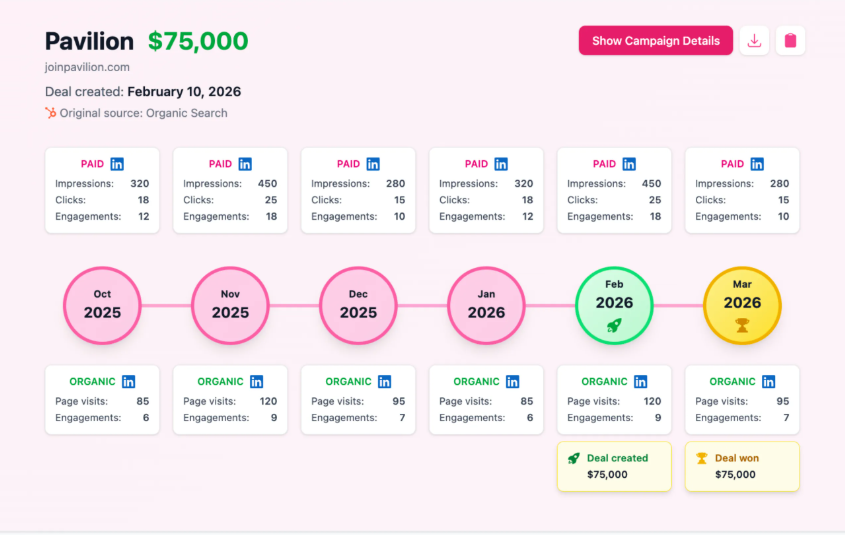
Exclusive access to LinkedIn's Company Intelligence API, one of only 5 vendors globally with this access, surfacing about 10x more companies than standard integrations
Revenue attribution connecting ad exposure to influenced pipeline and closed-won deals in HubSpot, Salesforce, Attio, and Pipedrive
Monthly impression caps automatically redistributing LinkedIn ad budget away from oversaturated accounts
Lift Analysis comparing close rates, deal sizes, and sales cycle velocity between LinkedIn-influenced and non-influenced deals
Flat pricing from $89 to $129 per month on a 30-day free trial with no credit card required
Fibbler covers the paid media attribution layer without the account intelligence, scoring, or AI agent features that drive up the price of full ABM platforms.
Why Choose Fibbler Over Factors.ai for LinkedIn and Google Ads Attribution
Fibbler stands out in the following areas:
Exclusive LinkedIn Company Intelligence API Access
Fibbler is one of only 5 companies globally with access to LinkedIn's dedicated Company Intelligence API, which returns all companies that have seen or engaged with ads with no upper limit. Factors.ai operates on LinkedIn's standard AdAnalytics API, which caps results at 15,000 companies per request.
Flat, Self-Serve Pricing That Requires No Demo
Factors.ai's paid plans require a demo call and start at $6,000/year. The LinkedIn impression control feature (Smart Reach) is gated behind Factors.ai's Enterprise tier ($30,000+/year). Fibbler charges $89 to $129 per month flat regardless of account list size or ad spend volume, with impression caps on all plans. The 30-day free trial requires no credit card and provides full access including CRM sync and attribution reports. Fibbler Unlimited ($129/month = $1,548/year) versus Factors.ai's Basic tier ($6,000/year) is a 4x difference for LinkedIn-focused attribution.
Multi-CRM Compatibility Including Pipedrive
Factors.ai reviewers on G2 and Capterra flagged "limited integrations (early-stage)" as a recurring con, with Pipedrive specifically requested by multiple independent reviewers. Fibbler supports HubSpot, Salesforce, Attio, and has Pipedrive on its short-term roadmap. Setup takes under five minutes via the Quick Start guide, with teams seeing campaign-to-pipeline insights within an hour.
NOTE: We also evaluated Dreamdata (comparable multi-touch attribution starting around $1,000/month with longer implementation) and Bizible/Adobe Marketo Measure (enterprise-only with significant setup complexity). Fibbler is the most focused and affordable LinkedIn and Google Ads attribution option, covering the paid media use case without bundling ABM features smaller teams don't need.
Fibbler Pricing
Fibbler uses a flat-fee subscription model. All plans include a 30-day free trial with no credit card required. Annual billing saves up to 22%.
Growth: $89/month. 1 user, 1 LinkedIn Ads account. HubSpot and Attio integrations. Unlimited Company Insights, Customer Journeys, Lift Analysis, and Audience Exclusions.
Unlimited: $129/month. Unlimited users, 1 LinkedIn Ads account. All Growth features plus Salesforce integration, Priority Support, and MCP server access (Coming Soon).
Agency: $159/month. Unlimited users, 2 client accounts included (additional at $69/account/month). All Unlimited features plus client-switching view.
Google Ads add-on: $59/account/month. Identifies companies behind Google Ads clicks with a separate 14-day free trial. Up to 1,000 identified companies per month.
Who Should Use Fibbler?
Choose Fibbler if:
Your team runs meaningful LinkedIn Ads spend and needs to prove to leadership that those campaigns influence pipeline and revenue, with proof in your CRM within hours, not weeks.
Your budget doesn't stretch to a full ABM platform and you want impression frequency capping and attribution at $89-$129/month flat with no usage-based overages.
You're running HubSpot, Salesforce, Attio, or Pipedrive (coming soon) and want ad engagement data written directly to CRM company records as custom fields.
The Final Verdict
Factors.ai delivers solid account-level ABM intelligence with strong LinkedIn ad optimization, but different team sizes, GTM maturity stages, and use cases call for specialized tools. Based on our research, here are the best alternatives:
ZoomInfo for the broadest B2B data platform, AI-powered deal intelligence via the GTM Context Graph, and access through APIs, MCP, GTM Workspace, and GTM Studio
6sense for enterprise ABM with proprietary buying stage prediction, per-customer AI models, and native B2B advertising
RollWorks for mid-market teams that need automatic ICP grading, contact-level deanonymization, and a native DSP in one accessible platform
Apollo.io for small teams that need verified contacts, buying intent signals, and multichannel outreach sequencing with a permanent free tier
Warmly.ai for teams that want to evaluate website visitor intelligence at no cost with person-level identification and autonomous inbound conversion
HockeyStack for AI-powered multi-touch attribution that answers pipeline questions in plain language without BI complexity
Fibbler for focused LinkedIn and Google Ads attribution at transparent, SMB-friendly pricing
You don't have to choose between Factors.ai and these alternatives exclusively. Many B2B teams use multiple tools together to build the GTM stack that fits their motion. Consider your team's size, budget, primary use case, and growth trajectory when deciding which solution works best.
Looking for B2B data and AI-powered GTM intelligence? ZoomInfo delivers 500M contacts, the GTM Context Graph, and access through any tool. Start with ZoomInfo Lite for free or request a demo to see how the platform can power your go-to-market strategy.
Factors.ai Alternatives FAQ
Why do businesses look for Factors.ai alternatives?
Factors.ai is a solid ABM platform, but businesses look elsewhere because it identifies companies rather than individuals by default, has dashboard and visualization limitations flagged by multiple reviewers, and its integration ecosystem is still maturing. Teams with specific needs (enterprise predictive intelligence, contact databases, or specialized attribution analytics) may find more depth in focused tools.
What is the best overall Factors.ai alternative?
There is no single best alternative because Factors.ai covers multiple functions. ZoomInfo is the most complete option for teams needing verified B2B contact data, AI-powered deal intelligence, and access across any tool. 6sense leads for enterprise ABM with proprietary buying stage prediction. Apollo.io is the top choice for small teams needing contacts and outreach in one affordable platform.
Is there a free alternative to Factors.ai?
Yes. Apollo.io offers a permanent free plan with 75 credits per month and two active outreach sequences. Warmly.ai provides a permanent free plan with 500 identified website visitors per month, Slack alerts, and CSV export. ZoomInfo Lite offers a permanent free tier with access to its B2B database and 10 monthly export credits. 6sense offers a free Sales Intelligence plan with 50 credits per month.
Which Factors.ai alternative is best for LinkedIn Ads optimization?
Fibbler is the most focused and affordable option for LinkedIn Ads attribution, with exclusive Company Intelligence API access that surfaces 10x more company data than standard integrations, starting at $89 per month. For teams that also need audience sync and impression capping alongside a broader ABM platform, 6sense and RollWorks both offer native LinkedIn advertising within their ABM suites.
How does ZoomInfo compare to Factors.ai for contact data?
ZoomInfo operates at a different scale. It provides 500M contacts, 120M direct-dial phone numbers, and 200M+ verified business email addresses with up to 95% accuracy on first-party data. Factors.ai identifies companies visiting your site but does not include a native contact database. Most Factors.ai users pair the platform with a contact enrichment tool to bridge this gap.
Which alternative is best for small B2B teams on a budget?
Apollo.io offers the strongest value for small teams, with a permanent free plan and paid tiers starting at $49 per seat per month that include contact data, intent signals, and email sequencing. Fibbler is the most affordable option for teams focused on LinkedIn and Google Ads attribution, at $89 to $129 per month flat. Warmly.ai's free plan provides useful visitor intelligence at no cost.
Can I use Factors.ai alongside these alternatives?
Yes. Many B2B teams use Factors.ai for LinkedIn ad optimization and cross-channel attribution alongside a contact database like ZoomInfo or Apollo.io for verified contact data. Fibbler can complement Factors.ai by adding deeper LinkedIn attribution at a fraction of the cost of upgrading to Factors.ai's Enterprise tier. The right combination depends on which capabilities your team needs most.
