
Choosing between folk and Pipedrive for your sales CRM comes down to five questions:
Do you need a lightweight tool for managing relationships, or a structured system for running a full sales process?
Is your team small enough that simplicity matters more than scale, or are you managing multiple pipelines across dozens of reps?
Do you rely on LinkedIn and social channels for prospecting, or does your team work through email and phone?
Are you looking for a CRM that handles outreach and pipeline, or do you also need B2B data and intelligence to fill the pipeline in the first place?
How important is it that your CRM data stays accurate, enriched, and connected to real buying signals?
In short, here's what we recommend:
folk is the CRM for small teams that value speed and simplicity over enterprise features. Built for sales teams and agencies, startups, and partnerships teams, folk captures contacts from LinkedIn, Gmail, Outlook, WhatsApp, and 5,000+ integrations into a clean, spreadsheet-like workspace. Its AI Assistants handle follow-up suggestions, relationship recaps, and company research automatically.
With setup in about 20 minutes and unlimited contacts, folk removes the friction that makes traditional CRMs feel like a chore. That said, folk is less suitable if your sales process depends on detailed analytics, large-scale automation, or enterprise forecasting, and teams managing 500+ leads per week or 100+ active deals may outgrow its manual workflows.
Pipedrive is the pipeline-first CRM for salespeople who need structure without complexity. Pipedrive pioneered the kanban-style pipeline view that became an industry standard, and its activity-based selling philosophy keeps reps focused on the next action rather than data entry.
With 100,000+ companies using the platform across 179 countries, Pipedrive offers deeper sales automation, email integration, reporting, and a 500+ integration marketplace. Its Pulse prospecting toolkit adds data enrichment and automated sequences. But Pipedrive remains a pre-sale tool with no native customer-success or post-sale functionality, and its marketing automation is limited compared to full-suite platforms.
Both folk and Pipedrive help you manage the deals already in your pipeline. Neither answers a more basic question: are you talking to the right people in the first place? That's a different problem, and it's where a different category of tool becomes essential.
ZoomInfo is an AI GTM platform that operates upstream of your CRM, providing the data and intelligence that determine whether your pipeline is built on solid ground. With 500M contacts, 100M companies, 135M+ verified phone numbers, and 200M+ verified business email addresses, ZoomInfo gives your team the verified contact data, buyer intent signals, and account intelligence that CRMs don't provide.
Its GTM Context Graph combines this data with your CRM records, conversation transcripts, and behavioral signals to reveal not just what's happening in a deal, but why. Your team can access this intelligence through GTM Workspace for sellers, GTM Studio for marketers and RevOps, or APIs and MCP in any tool you already use.
If building your pipeline on verified data and real buying signals sounds like the missing piece, see how ZoomInfo works.
folk vs. Pipedrive vs. ZoomInfo at a glance
folk | Pipedrive | ZoomInfo | |
|---|---|---|---|
Primary function | Relationship-focused CRM | Pipeline-focused sales CRM | AI GTM platform (data + intelligence + execution) |
Contact database | Contacts you add manually or via enrichment | Contacts you add manually or via Prospector | 500M contacts, 200M+ verified emails, 135M+ verified phones |
Data enrichment | Built-in waterfall enrichment (50-60% hit rate) | Multi-source verified data, up to 95% accuracy | |
Buyer intent signals | None | Limited (Pulse feed) | 210M IP-to-Org pairings, 6T+ keyword signals monthly |
AI capabilities | 4 AI Assistants (Follow-up, Recap, Research, Workflow) | AI Sales Assistant, AI email writer, AI reports | GTM Context Graph, AI agents, GTM Workspace, GTM Studio |
Pipeline management | Visual kanban pipelines | Visual kanban pipelines with deal rotting | Deal execution via GTM Workspace |
Integrations | 500+ marketplace + open API | 120+ native integrations + APIs + MCP | |
Starting price | Custom pricing (free Lite tier available) | ||
Free trial | |||
Best for | Small teams, agencies, startups | SMB sales teams | Enterprise and mid-market GTM teams |
The CRM manages your pipeline. It doesn't fill it.
folk and Pipedrive both organize deals well once they exist. But neither was designed to answer the question that comes before pipeline management: who should you be selling to?
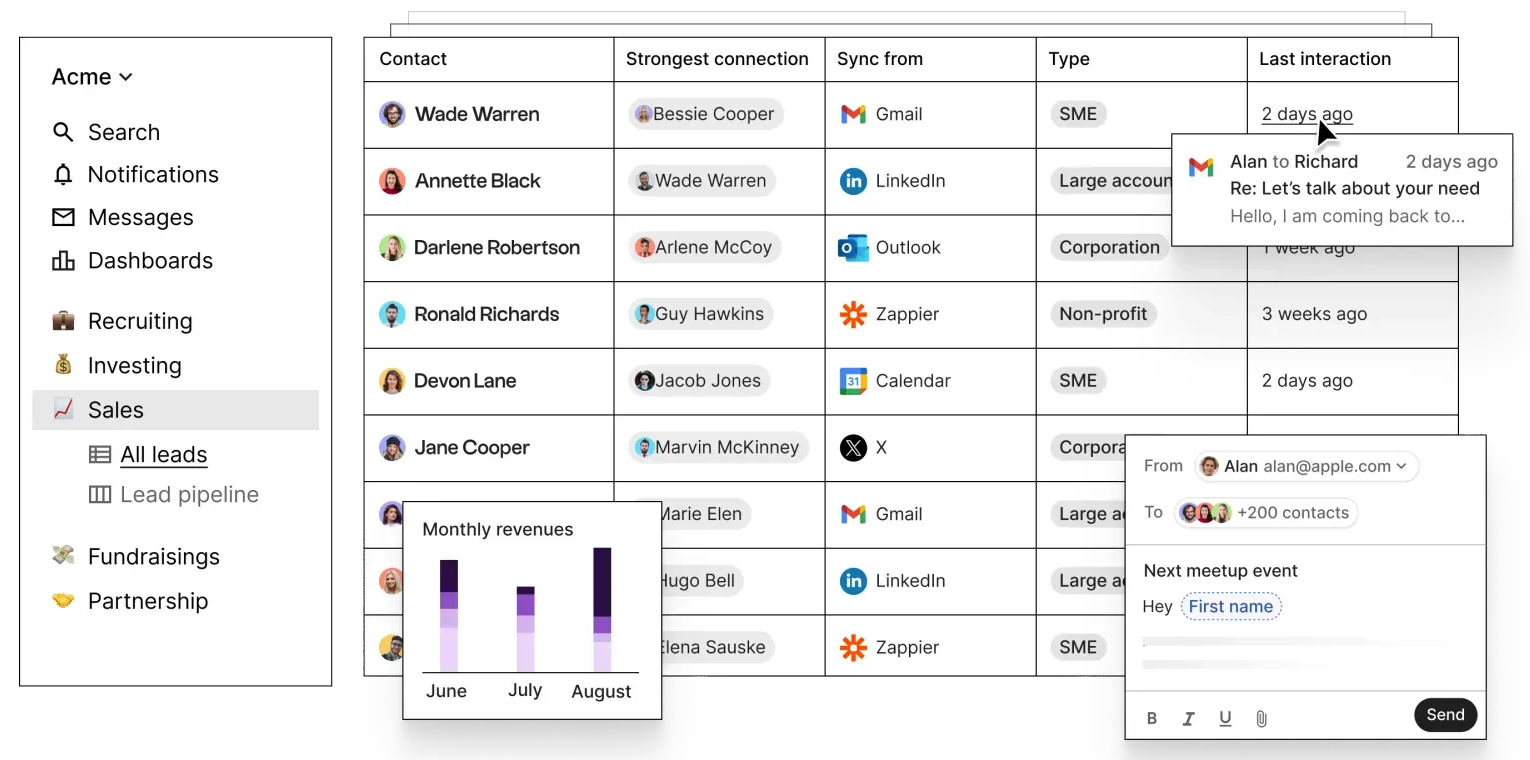
folk meets contacts where they already are. The folkX Chrome extension pulls contacts from LinkedIn profiles, Gmail threads, and Google Meet calls directly into the CRM. It's fast and convenient for teams that prospect through social channels.
The built-in enrichment uses a waterfall of providers (including Apollo.io, People Data Labs, and Clearbit) to fill in emails and phone numbers. But the enrichment success rate is typically 50-60%, meaning roughly half your contacts may still have gaps.
Source: folk
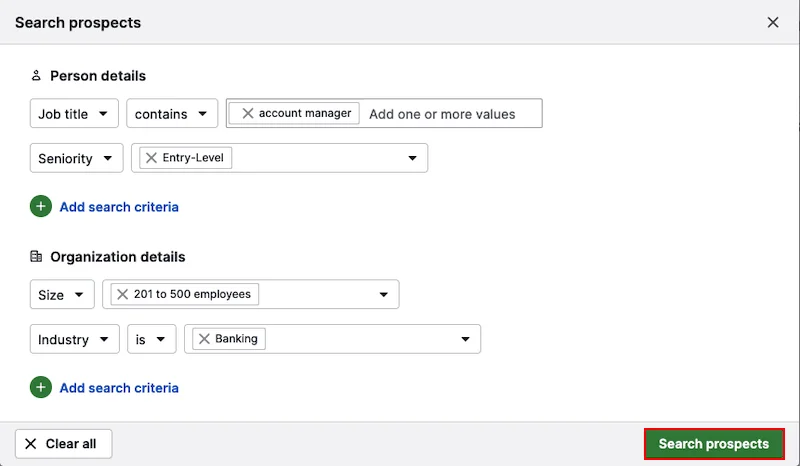
Pipedrive has expanded into prospecting with Prospector, which offers access to over 400 million profiles and 10 million companies. An AI engine verifies and updates up to 800,000 profiles daily. This is a step forward, but Prospector is an add-on to the LeadBooster bundle ($32.50/company/month), and bulk contact enrichment is still noted as coming soon.
Source: Pipedrive
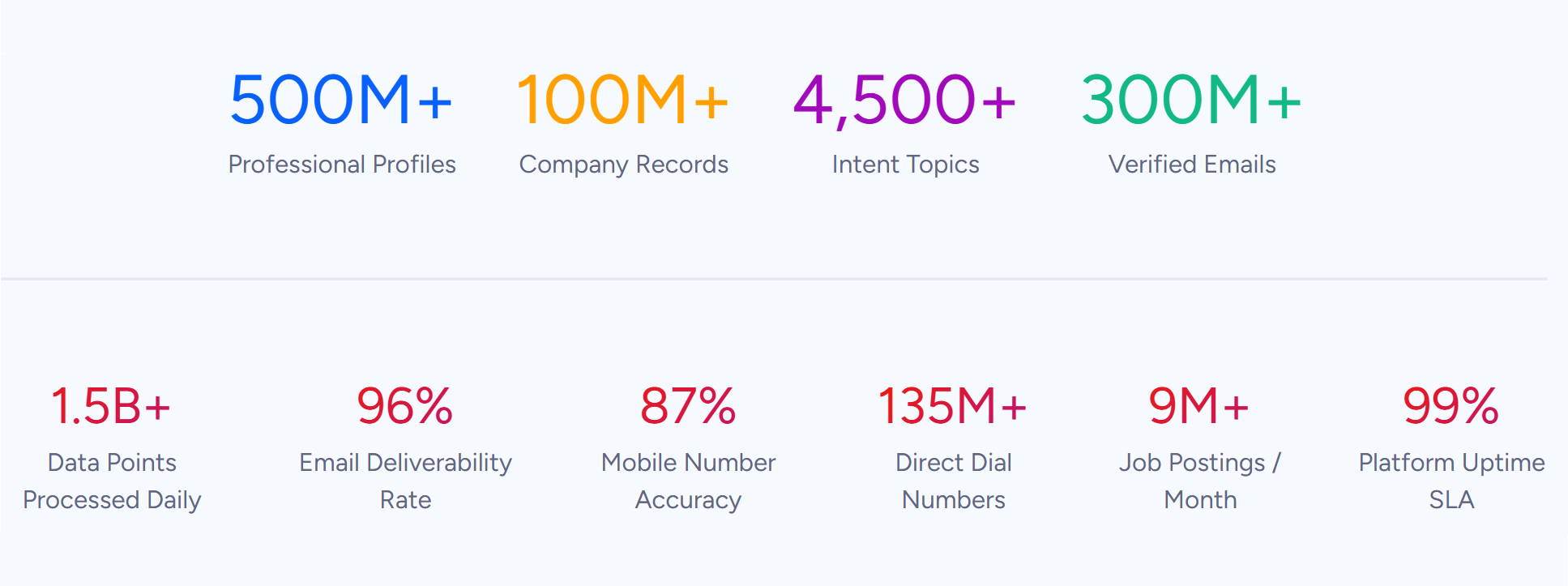
ZoomInfo operates at a different scale. The platform maintains 500M contacts and 100M companies, verified through a multi-source pipeline backed by 300+ human researchers. In a Fortune 500 competitive RFP analyzing 25 million contacts across vendors, the independent consultant concluded that "no other competitor came even close."
Source: ZoomInfo
This data isn't just for searching. It feeds the GTM Context Graph, which processes 1.5B+ data points daily by combining your CRM data, conversation intelligence, and behavioral signals to identify which accounts are worth pursuing and why.
Vensure scaled its prospecting using ZoomInfo's data: "ZoomInfo gives us the information we need to execute. We don't have to go through and spend our time digging. It's already there, so we can be three steps ahead." (Vensure case study)
folk wins on simplicity, Pipedrive wins on sales structure
These two CRMs serve different working styles.
folk is built for people who think in relationships, not funnels. The platform feels like a spreadsheet you actually want to use. You can set up a workspace in about 20 minutes, start importing contacts from LinkedIn with a few clicks, and customize pipelines for whatever workflow you need: sales, recruiting, partnerships, fundraising, or investor relations.
The tag-based contact system avoids the rigid list structures of traditional CRMs, and the AI Assistants handle follow-up reminders and relationship summaries without manual input.
Source: folk
The trade-off is depth. folk offers unlimited contacts but limited analytics. Sequences require the Premium plan at $48/seat/month. And while the platform works well for teams under 50 seats, teams that need detailed pipeline reporting, multi-product quoting, or extensive customization will find folk too lightweight.
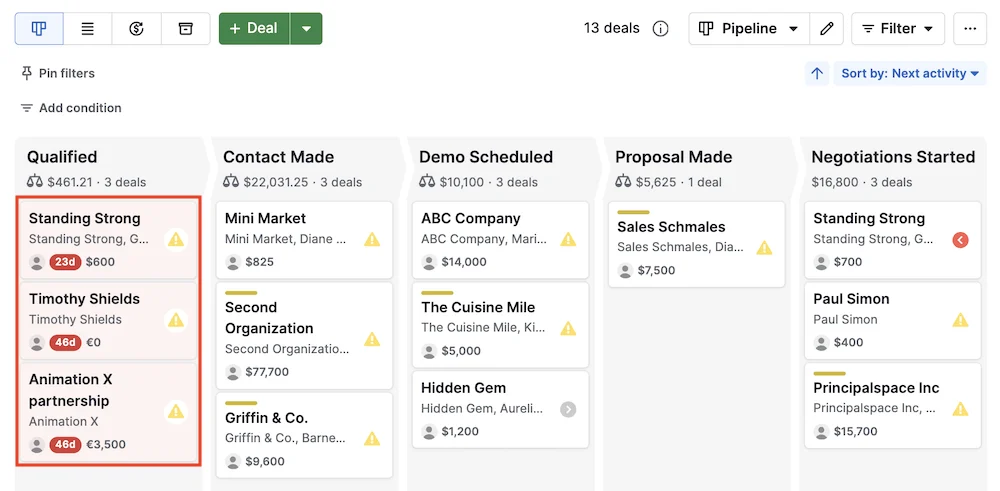
Pipedrive is built around a disciplined sales methodology. Every deal has a stage, an expected close date, and a next activity. The deal rotting feature flags deals that sit idle too long. The activity-based selling approach keeps reps focused on actions that move deals forward rather than record-keeping.
Source: Pipedrive
Pipedrive's automation engine adds real depth. Available from the Growth plan and above, it supports event triggers, date triggers, if/else branching, delay steps, and native notifications to Slack and Teams. According to Pipedrive's research, people who automate tasks are 16% more likely to hit their targets.
Email sync, a meeting scheduler, and Smart Docs for proposals and eSignatures round out a workflow that covers the deal from first email to signed contract.
Where Pipedrive falls short is anything beyond the sale itself. There's no native customer-success functionality, limited marketing automation (the Campaigns add-on is separate), and the platform isn't positioned for enterprise complexity.
AI capabilities reflect three different philosophies
All three platforms have invested in AI, but they're solving different problems.
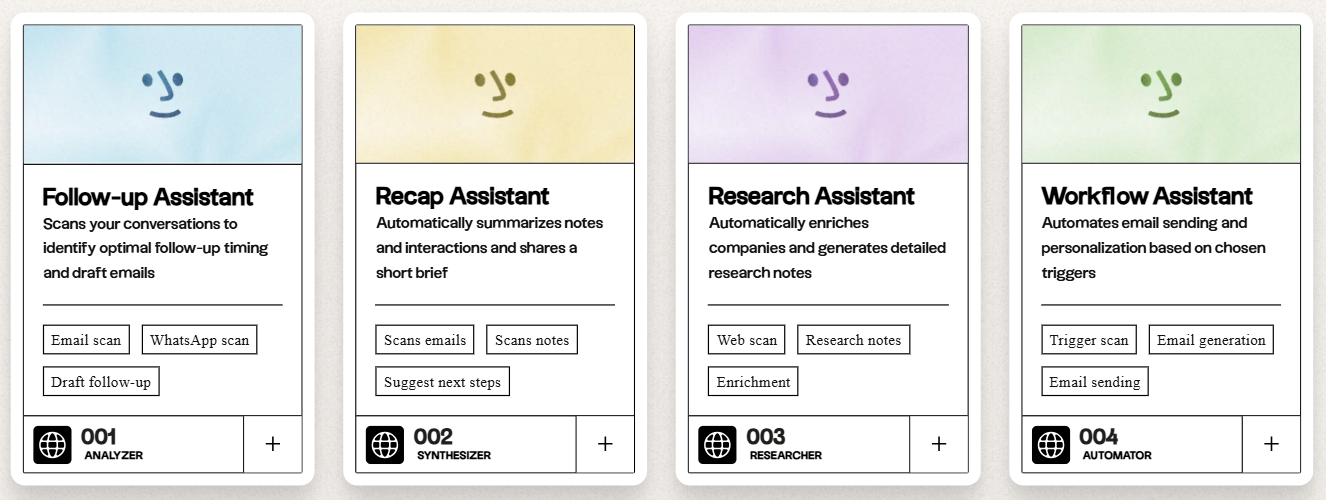
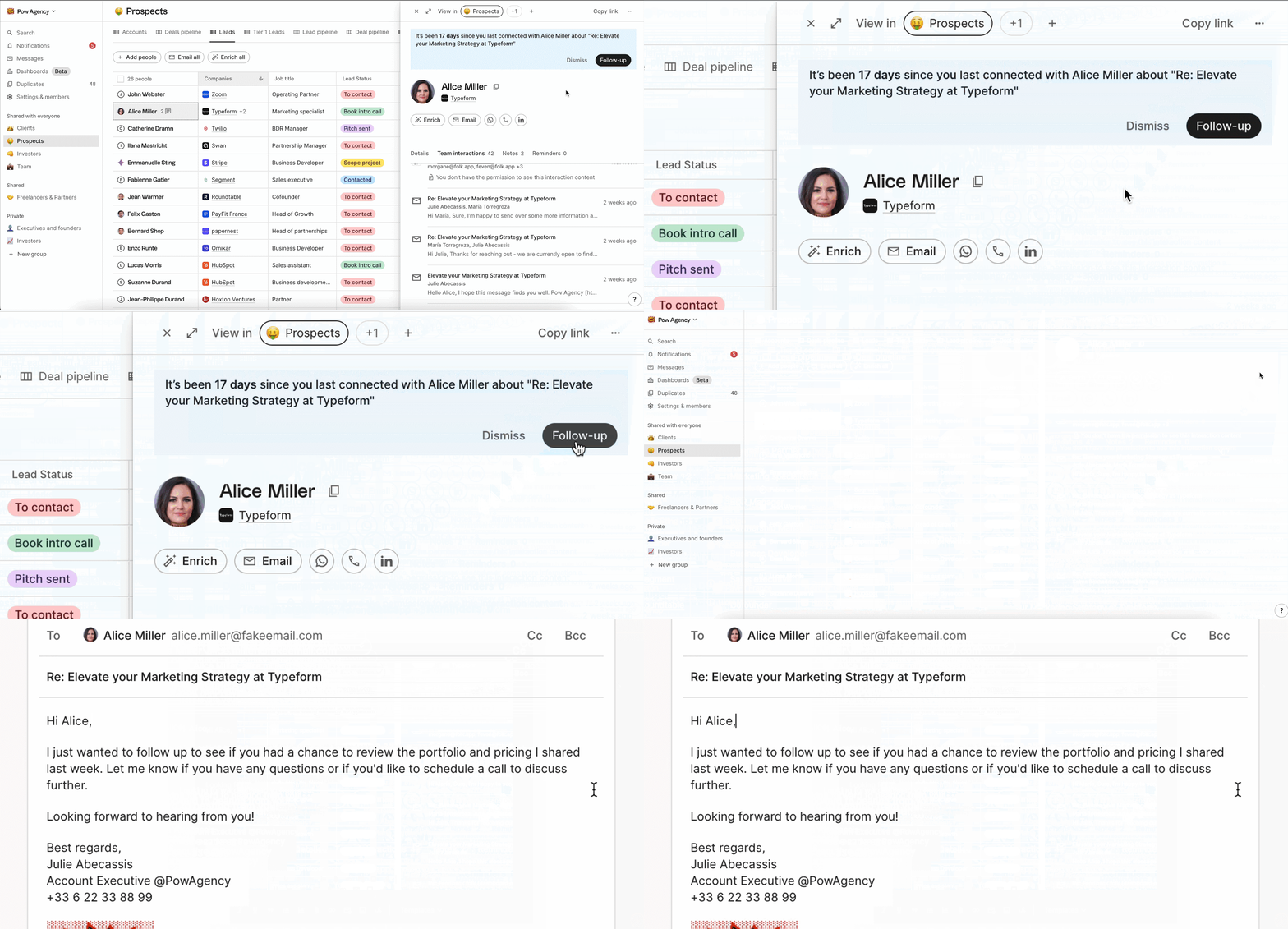
folk's four AI Assistants reduce the busywork of relationship management. The Follow-up Assistant analyzes inbox, calendar, and WhatsApp conversations to spot when a conversation has gone cold and generates context-aware follow-up drafts. The Recap Assistant synthesizes recent interactions into summaries that can be customized for methodologies like MEDDIC or BANT.
Source: folk
The Research Assistant enriches company profiles using People Data Labs and Perplexity. And the Workflow Assistant creates trigger-based email automations with AI personalization that adapts messages using real interaction history. These assistants are practical and immediate, but they work only within folk's own data.
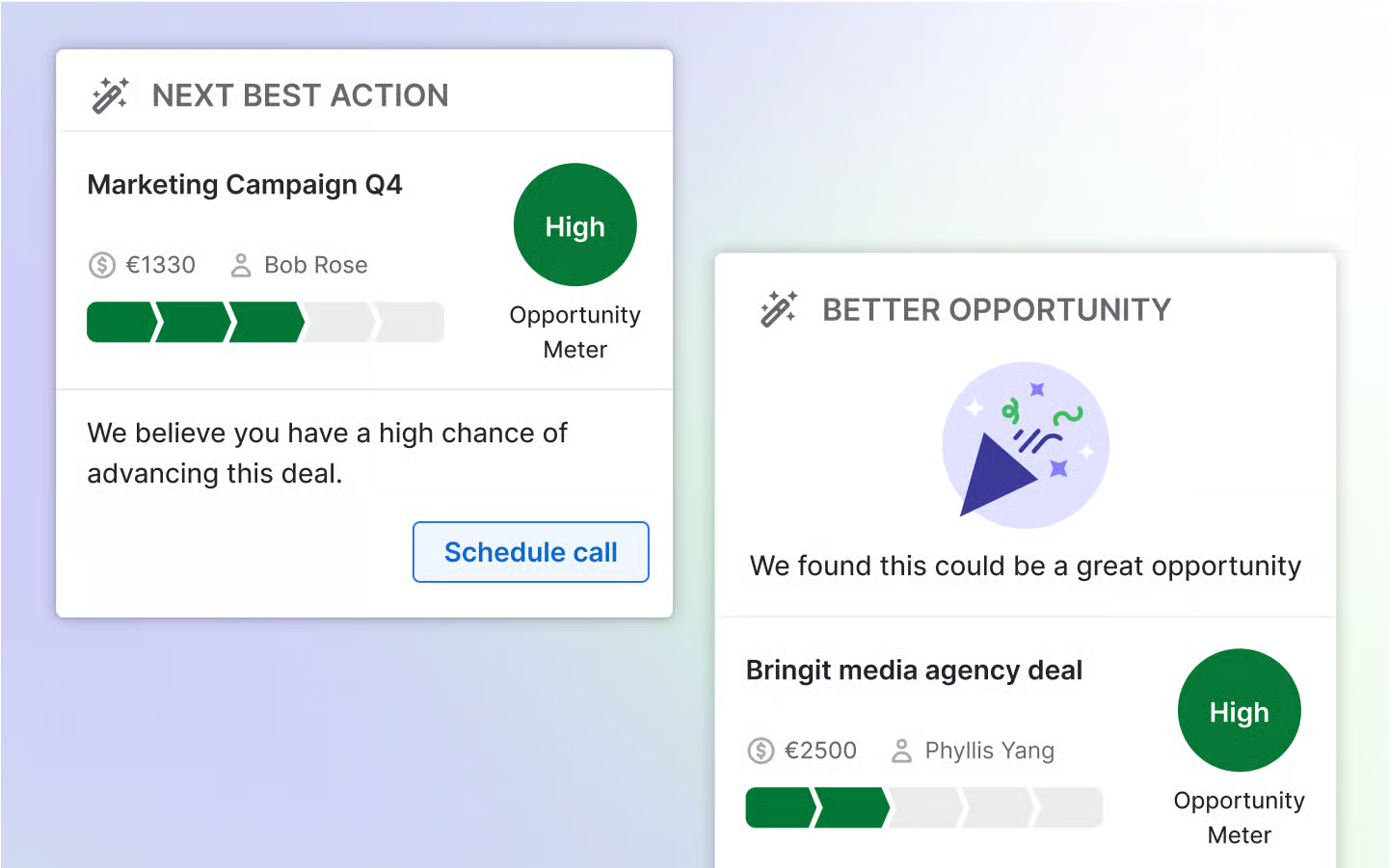
Pipedrive's AI is framed around its "Pipedrive 3.0" vision of an AI-native CRM. The AI Sales Assistant surfaces win-probability predictions, deal activity reminders, and next-action recommendations. The AI email writer generates drafts from prompts with configurable tone and length.
Source: Pipedrive
Natural-language AI report generation lets managers query CRM data conversationally. A ChatGPT integration lets reps query Pipedrive data inside ChatGPT, though it's currently unavailable for EU data residency accounts. The AI email summarization feature is still labeled BETA.
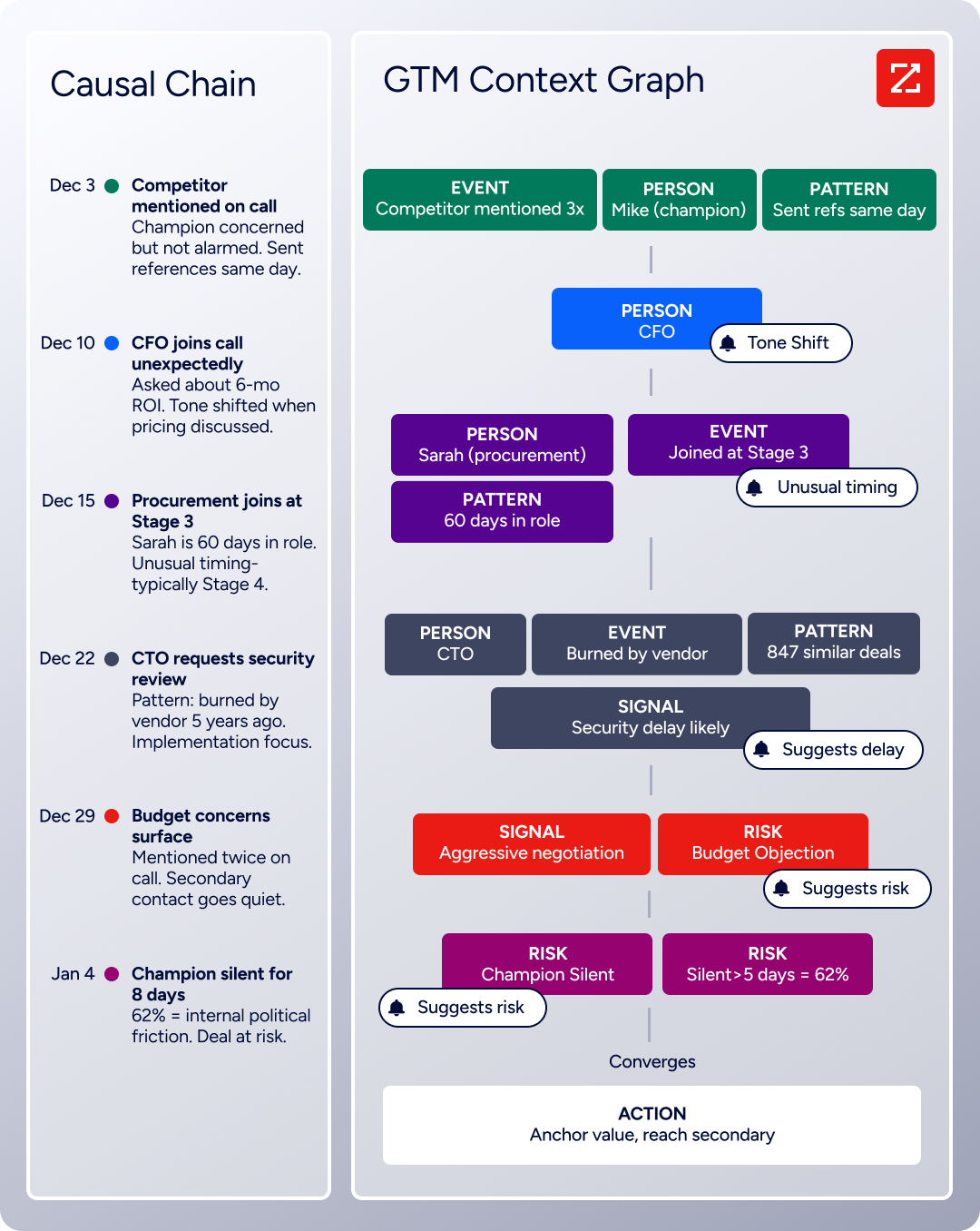
ZoomInfo's AI operates on a different layer. Rather than adding AI to a CRM, ZoomInfo built the GTM Context Graph as the foundation that AI reasons against. As ZoomInfo's CPO Dominik Facher writes: "The CRM recorded the state change. It has no record of why it happened."
Source: ZoomInfo
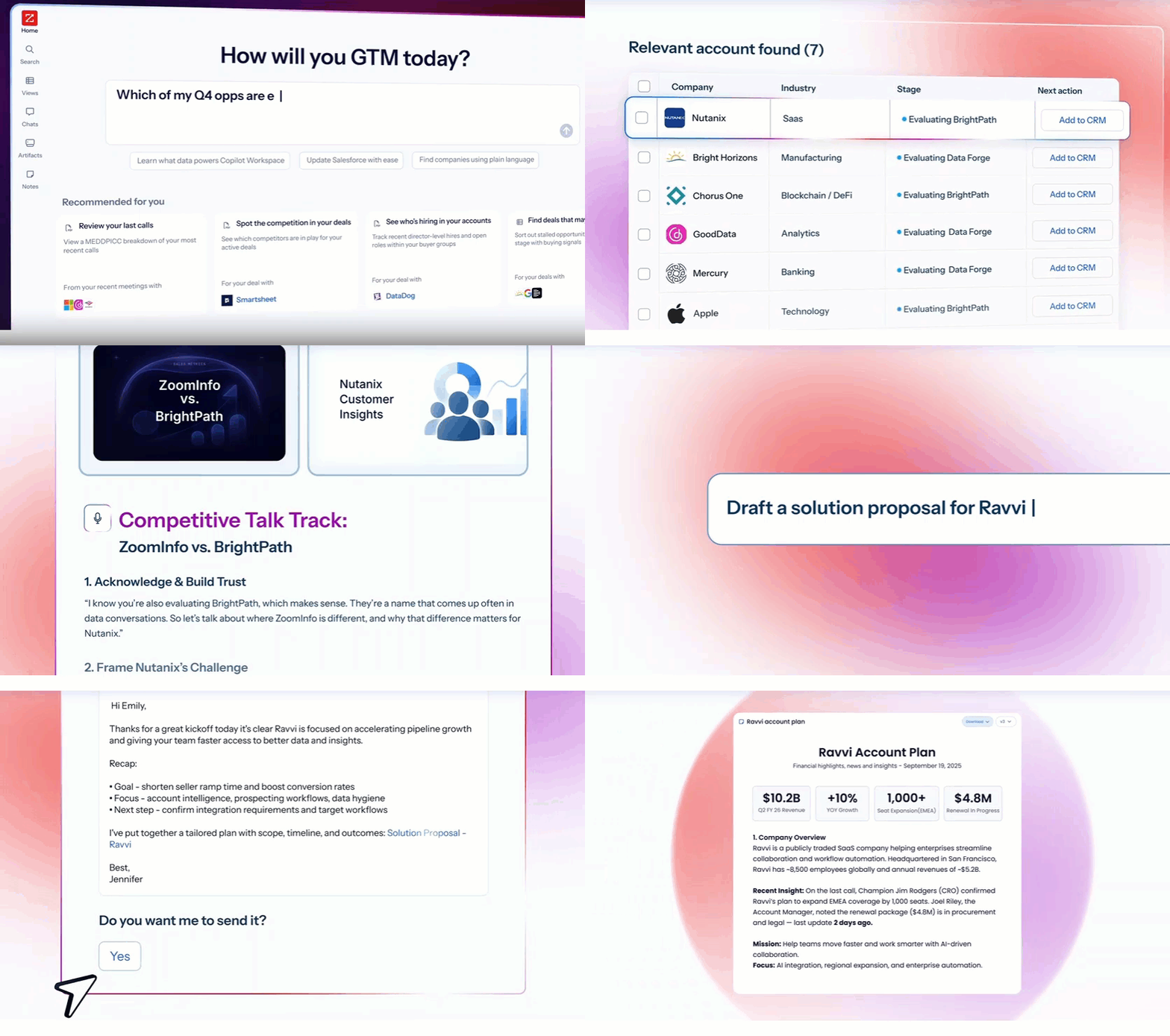
The GTM Context Graph captures those underlying signals, connecting people, actions, outcomes, and patterns across thousands of deals. In GTM Workspace, AI agents handle account research, outreach generation, CRM updates, and signal monitoring, drawing on both ZoomInfo's third-party data and your first-party records. The difference is the scope of what the AI can see and reason about.
Source: ZoomInfo
Seismic's sales team attributed 39% of active pipeline to opportunities identified or influenced by ZoomInfo signals, reported 54% productivity gains, and saved 11.5 hours per week. As CBO Toby Carrington noted: "That combination of our internal CRM data, external signals, and AI that's given all that context has helped us craft very specific account- and persona-based messages. And people have responded to them right away." (Seismic case study)
Pricing reflects different markets and value propositions
folk keeps pricing simple. Standard at $24/seat/month on annual billing includes unlimited contacts, pipeline management, email campaigns (2,000 messages/member/month), and the AI Assistants. Premium at $48/seat/month unlocks sequences, dashboards, API access, and advanced permissions.
A Custom tier starts at $80/seat/month. The 14-day free trial includes all Premium features with no credit card required. folk also offers special discounts for students, NGOs, and startups.
Pipedrive recently replaced its five-tier structure with four plans: Lite, Growth, Premium, and Ultimate. Entry starts at $14/seat/month, but the Lite plan lacks email sync, automations, and sequences.
Most teams need at least Growth for email sync and automation, or Premium for Smart Docs, Projects, and LeadBooster (which are included on Premium rather than charged as add-ons). Annual billing offers up to 42% discount. Add-ons like Campaigns and Web Visitors are billed separately.
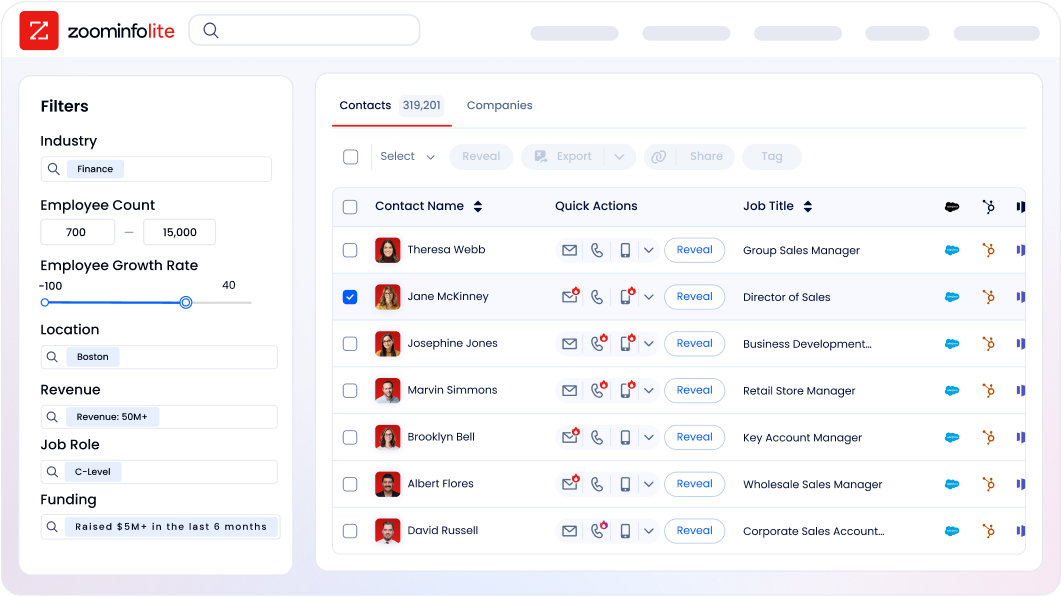
ZoomInfo uses custom-quoted, consumption-based pricing with no published prices. Costs depend on usage, seats, credit volume, features, and contract length. For teams not ready to commit, ZoomInfo Lite offers permanent free access to the B2B database with 10 monthly export credits, advanced search, the Chrome extension, and HubSpot integration. A 7-day free trial provides broader access.
Source: ZoomInfo
ZoomInfo is a premium investment, but documented outcomes back the cost for outbound-dependent teams: Snowflake achieved 200% higher conversion rates on top-scoring accounts, and Thomson Reuters increased closed-won deals by 40%.
Intent signals and prospecting intelligence separate the categories
This is where the comparison moves beyond CRM features into a different class of capability.
folk has no buyer intent signals. It captures and enriches the contacts you already know about but can't tell you which companies are actively researching solutions like yours.
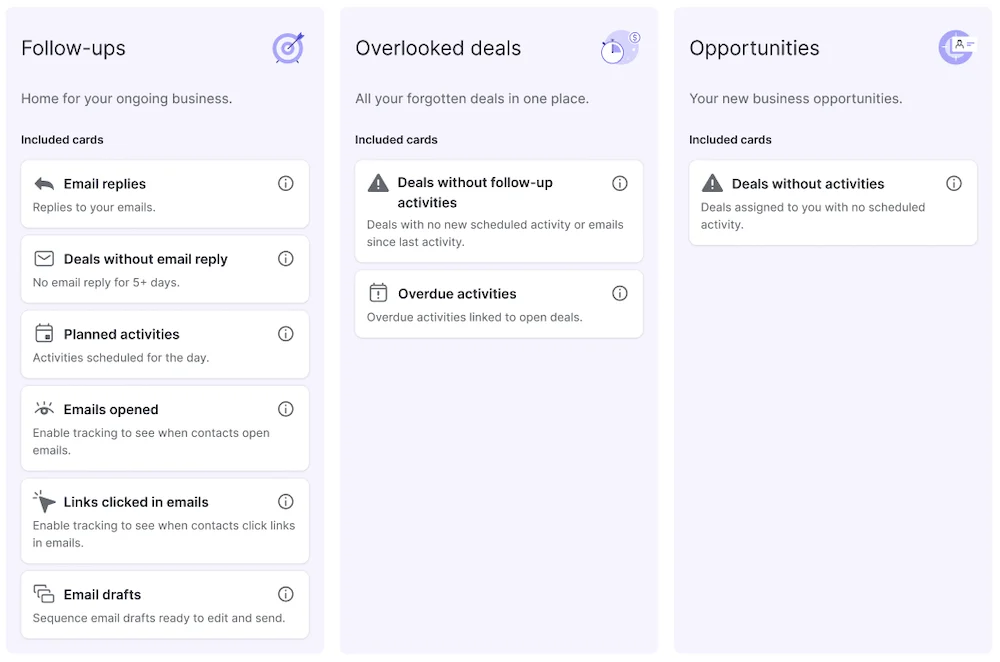
Pipedrive's Pulse feed adds basic intent-like features (follow-up suggestions, overlooked deals, opportunity surfacing), but it's built on CRM activity data rather than external buying signals.
Source: Pipedrive
ZoomInfo's Intent data tracks signals from 210 million IP-to-Organization pairings and 6 trillion+ new keyword-to-device pairings sourced monthly. Guided Intent, exclusive to ZoomInfo, identifies topics historically correlated with deal success rather than requiring manual topic selection.

Source: ZoomInfo
WebSights resolves anonymous website traffic to specific companies and buying team members. And technographic data profiles the tech stacks of 30+ million companies across 30,000+ technologies.

Source: ZoomInfo
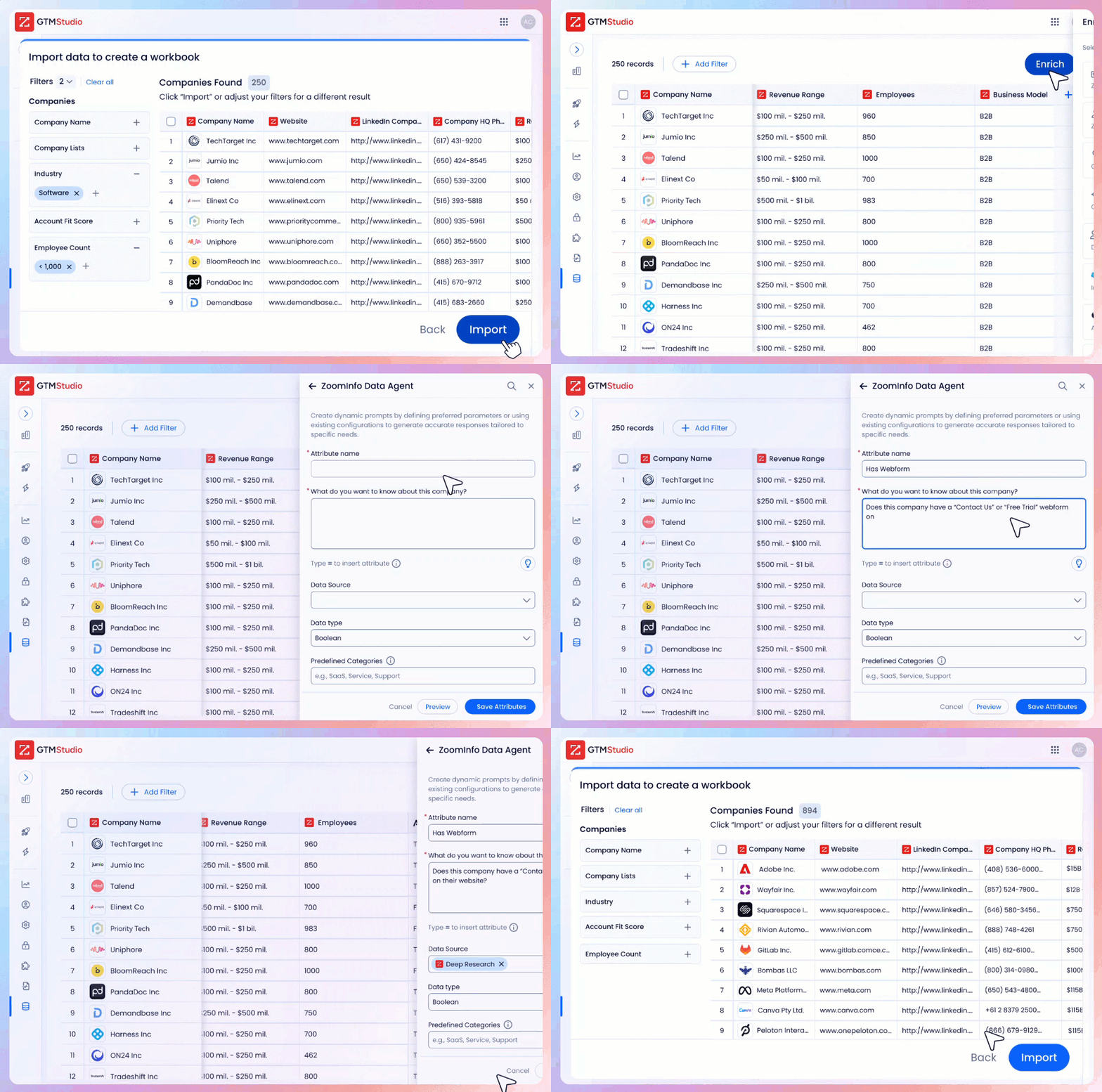
This intelligence feeds directly into action. In GTM Studio, marketers and RevOps teams describe audiences in natural language, launch multi-channel plays, and watch pipeline impact in real time. Expansion plays that used to take three weeks now launch in 30 minutes.
Source: ZoomInfo
In GTM Workspace, sellers see an Action Feed with pre-drafted actions for every buying signal: G2 comparisons, funding events, executive hires. No CRM can replicate this because CRMs work with the data you put in. ZoomInfo provides the data you didn't know you needed.
Redwood Logistics improved targeting and ROI with data-driven insights: "It's not just the data itself. It's more about the right data at the right time to help us reach out with the right message across that full buyer journey," said Chelsea Kenyon, Senior Director of Digital Strategy. The result: 99% reduction in CPC, 310% increase in CTR, and 20-25 hours saved per week. (Redwood Logistics case study)
Integration approaches reveal different design priorities
folk connects to the tools small teams use daily. The folkX extension works across LinkedIn, Sales Navigator, Gmail, Google Meet, WhatsApp, Twitter, Instagram, TikTok, and Facebook. Native integrations cover Gmail, Outlook, LinkedIn, WhatsApp, Kaspr, PandaDoc, and ChatGPT, with 5,000+ connections via Zapier and Make.

Source: folk
The folk REST API is available on Premium and Custom tiers. For small teams living in LinkedIn and Gmail, folk's integrations cover the daily workflow well. The limitation is depth: LinkedIn integration can be flaky, and there's no native Salesforce sync for moving prospects into a formal sales pipeline.
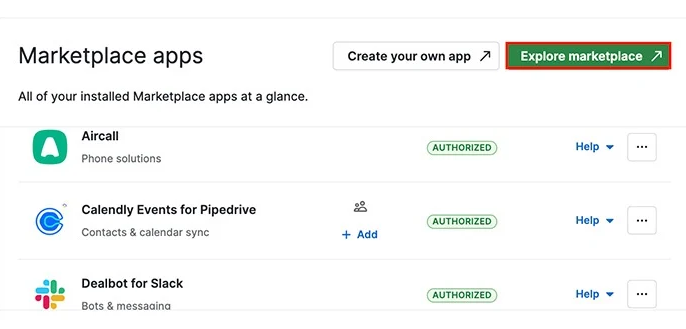
Pipedrive's marketplace has 500+ integrations covering the full sales stack: Zapier, Make, Google Meet, Microsoft Teams, Mailchimp, PandaDoc, DocuSign, QuickBooks, Xero, Slack, and JustCall.
Source: Pipedrive
The open REST API is available on all plans, with a Developer Hub providing documentation, interactive testing, sandbox accounts, and official Node.js and PHP clients. App extensions let developers embed UI directly inside Pipedrive. For SMBs, this ecosystem covers most needs.
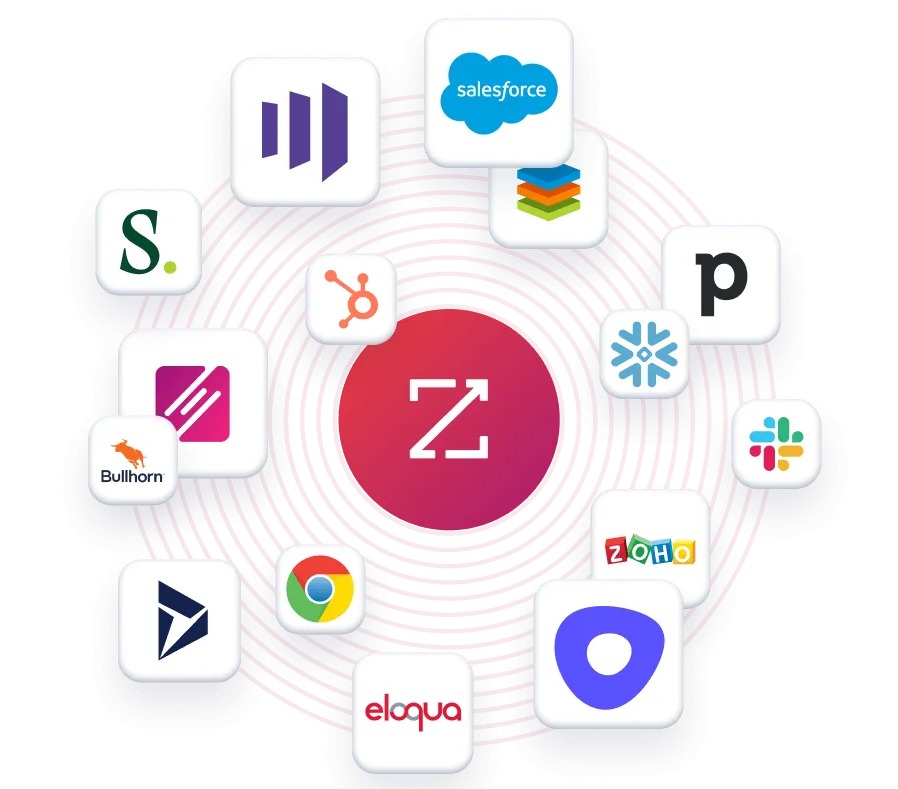
ZoomInfo's integration strategy serves a different purpose. Rather than connecting to tools for workflow convenience, ZoomInfo connects to tools to power them with intelligence. The App Marketplace lists integrations with Salesforce, HubSpot, Microsoft Dynamics 365, Snowflake, and more.
Source: ZoomInfo
Cloud Partners enable direct data ingestion into AWS, Google Cloud, Snowflake, and Databricks. API Access is included in all relevant plans, and the MCP server connects AI models directly to ZoomInfo's data with no custom coding.
BDO Canada activated ZoomInfo data directly within internal systems: "The plug-and-play aspect of the API means I can integrate it very easily into any process and get information at a moment's notice," said Jerry Wilson, Senior Marketing Intelligence Analyst, achieving an 87% reduction in time spent on data dashboard updates. (BDO Canada case study)
Security and compliance for different scales
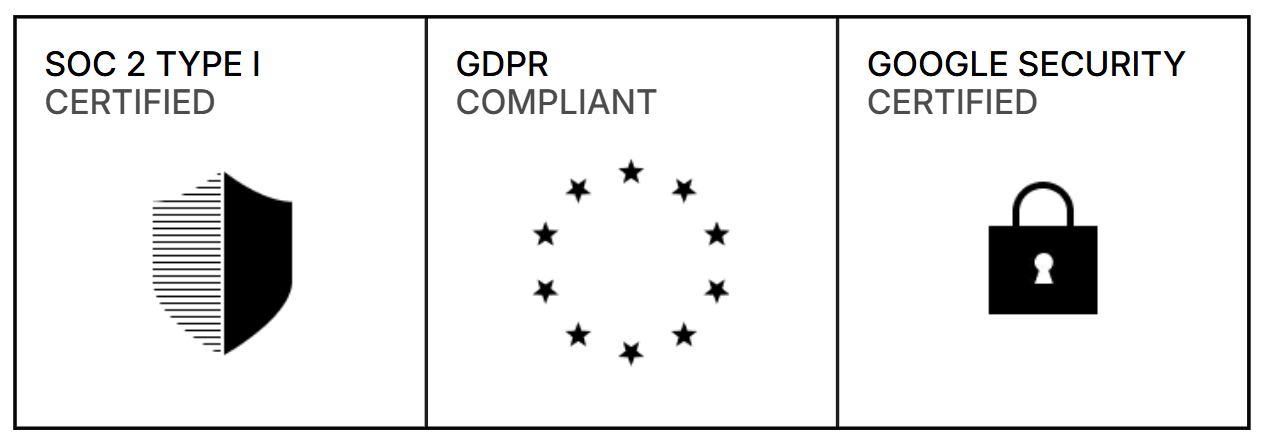
folk maintains SOC 2 Type I certification, is GDPR compliant, and holds Google Security certification. The platform is hosted on AWS in North Virginia with encrypted storage at rest and MFA enforcement for all team members. folk reports no history of data breaches.
Source: folk
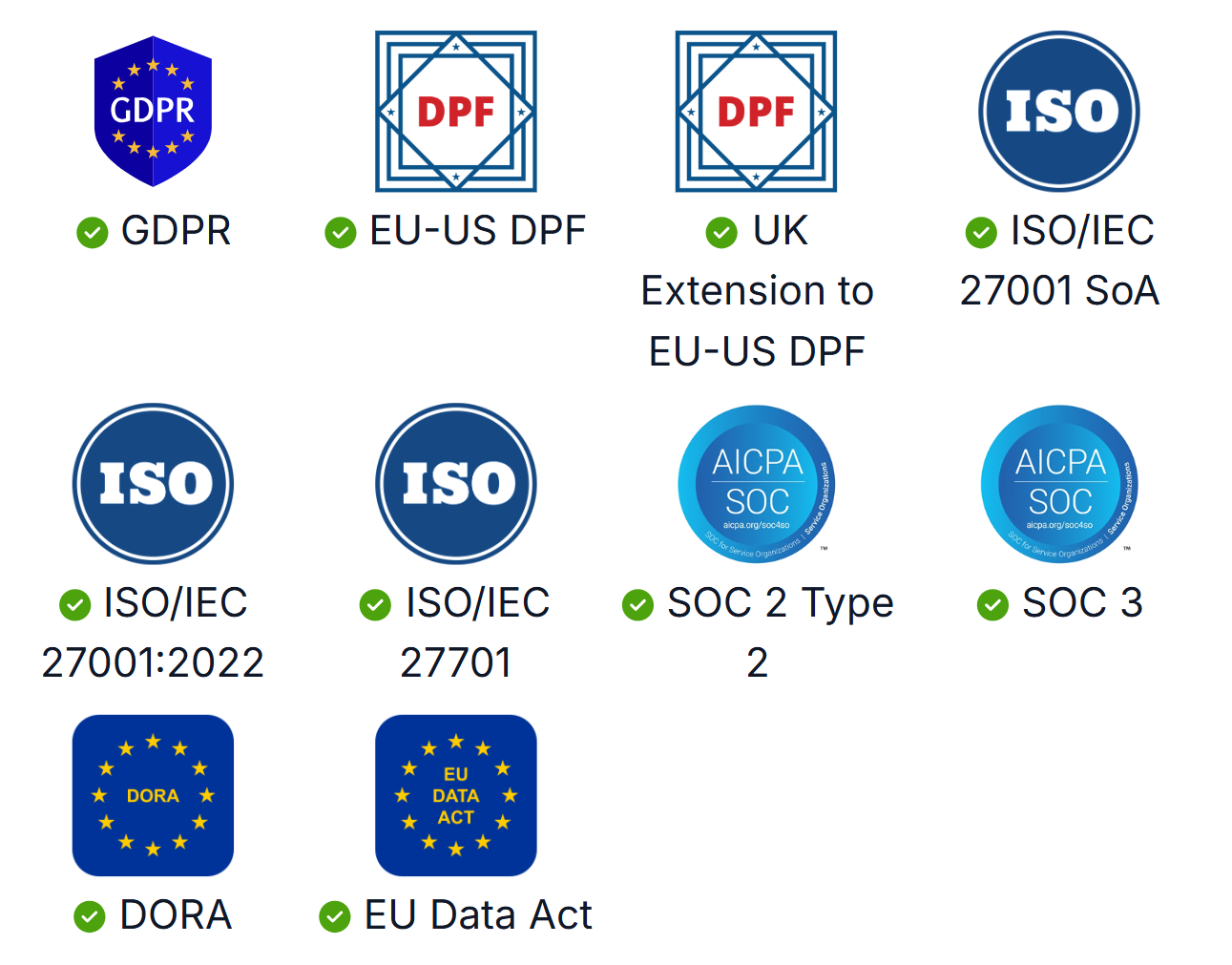
Pipedrive holds ISO/IEC 27001:2022, ISO/IEC 27701:2019, SOC 2 Type 2, and SOC 3 certifications. It's GDPR compliant, certified under the EU-US Data Privacy Framework, and compliant with the Digital Operational Resilience Act (DORA) for EU financial sector requirements.
Source: Pipedrive
Data is hosted on AWS in Europe and US with separate databases per customer. Access controls include SSO via SAML 2.0, two-factor authentication, and a Security Center dashboard. Pipedrive achieves a SecurityScorecard grade of A.
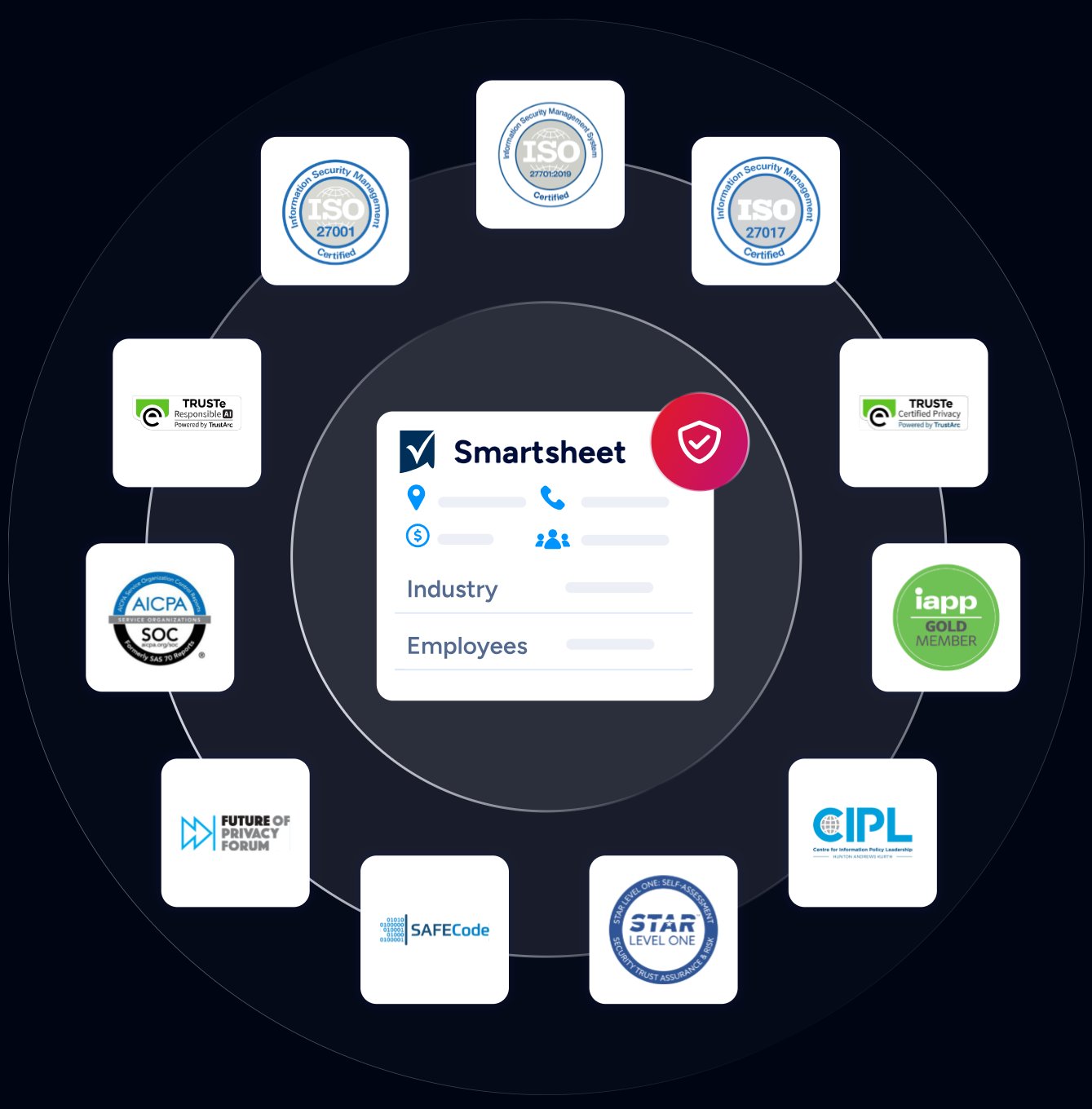
ZoomInfo maintains ISO 27001, ISO 27701, SOC 2 Type II, TRUSTe GDPR, and TRUSTe CCPA certifications, all renewed annually. It's a registered data broker in California and Vermont and maintains a dedicated Trust Center.
Source: ZoomInfo
For enterprises in regulated industries, ZoomInfo's compliance infrastructure is built into the data layer itself. Pipedrive's AI also explicitly does not permit third parties to use client data to train AI models, a meaningful consideration for privacy-conscious teams.
folk vs. Pipedrive vs. ZoomInfo: Which should you choose?
The choice depends on what your team needs now and where you expect to grow.
Choose folk if:
Your team is under 50 people and you need a CRM that's ready in minutes
You prospect through LinkedIn, events, and referrals rather than structured outbound
Relationship management matters more than pipeline analytics
You want built-in AI assistants for follow-ups and recaps without extra cost
You value unlimited contacts and simple pricing over extensive customization
Choose Pipedrive if:
You run a structured sales process with defined pipeline stages
Activity-based selling and deal rotting alerts keep your reps accountable
You need sales automation, email sync, and meeting scheduling in one tool
Your budget is tight but you need more depth than a lightweight CRM
You want a proven platform used by 100,000+ companies worldwide
Choose ZoomInfo if:
You need verified B2B data to fill your pipeline, not just manage it
Buyer intent signals and account intelligence would change how your team sells
You want AI that reasons across your CRM, conversations, and market signals together
Data accuracy matters because your team's outreach depends on direct dials and verified emails that actually connect
You're ready for a platform that powers your entire go-to-market motion, whether through ZoomInfo's own products or via API and MCP in the tools you already use
See ZoomInfo in action with a free trial, or start with ZoomInfo Lite at no cost.
folk and Pipedrive are both well-designed CRMs that serve their audiences well. folk is the fastest path to organized relationship management for small teams. Pipedrive is the most intuitive pipeline tool for SMB sales organizations. But both operate downstream of a more basic question: do you have the right contacts, the right signals, and the right intelligence to make your pipeline worth managing?
ZoomInfo answers that question. With the largest B2B data platform in the industry, a GTM Context Graph that reveals why deals move, and access that delivers this intelligence wherever your team works, ZoomInfo turns your CRM from a record-keeping system into a revenue engine.
folk vs. Pipedrive vs. ZoomInfo FAQ
What is the core difference between folk, Pipedrive, and ZoomInfo?
folk is a lightweight, relationship-focused CRM for small teams, agencies, and startups who need fast setup and simplicity. Pipedrive is a structured, pipeline-first sales CRM for SMB sales teams who follow activity-based selling.
ZoomInfo is an AI GTM platform that provides B2B data (500M contacts, 200M+ verified emails), buyer intent signals, and an intelligence layer called the GTM Context Graph. It operates upstream of CRMs to power prospecting, account intelligence, and AI-driven execution.
Which platform is cheapest for a small sales team?
Pipedrive has the lowest entry price at $14/seat/month on annual billing, though the Lite plan lacks email sync and automations. folk starts at $24/seat/month with more features at the base tier, including unlimited contacts and AI Assistants. ZoomInfo uses custom pricing for paid plans but offers a permanent free tier (ZoomInfo Lite) with 10 monthly export credits, advanced search, and HubSpot integration.
Can I use ZoomInfo with folk or Pipedrive?
ZoomInfo integrates natively with major CRMs including Salesforce, HubSpot, and Microsoft Dynamics 365. For folk and Pipedrive, ZoomInfo data can flow through API connections, Zapier workflows, or manual export. ZoomInfo's MCP server also lets AI assistants query ZoomInfo data directly.
The key point: ZoomInfo provides the data and intelligence layer while your CRM manages the relationships and pipeline.
Which platform has the best AI features?
Each platform's AI serves a different purpose. folk's four AI Assistants automate follow-up reminders, relationship recaps, company research, and email workflows within the CRM. Pipedrive's AI Sales Assistant predicts deal outcomes, generates emails, and creates reports from natural language queries.
ZoomInfo's GTM Context Graph processes 1.5 billion data points daily, combining CRM data, conversation intelligence, and buying signals to reveal why deals move or stall. It powers AI agents in GTM Workspace that handle account research, outreach generation, and CRM updates.
Which platform handles data enrichment best?
ZoomInfo leads by a wide margin with 500M contacts verified through 300+ human researchers and automated systems, achieving up to 95% accuracy on first-party data. folk's waterfall enrichment through six providers yields 50-60% success rates. Pipedrive's Prospector offers 400M+ profiles with daily verification of up to 800,000 profiles, but bulk enrichment is not yet available.
Does folk or Pipedrive offer buyer intent signals?
folk does not include buyer intent functionality. Pipedrive's Pulse feed surfaces follow-up suggestions and overlooked deals based on CRM activity, but does not track external buying signals.
ZoomInfo provides dedicated intent data tracking signals from 210 million IP-to-Organization pairings and over 6 trillion keyword-to-device pairings monthly, with Guided Intent that identifies topics historically correlated with closed deals.
Which platform is best for agencies and consulting firms?
folk is designed for agencies and consultancies that need to track clients, prospects, referral partners, and follow-ups in a shared workspace. Its flexibility across use cases (sales, partnerships, recruiting, fundraising) and its LinkedIn-centric prospecting make it a natural fit.
Pipedrive works for agencies with a defined sales process, and ZoomInfo works for agencies that need large-scale prospecting data and account intelligence for their clients.
How do the platforms compare on mobile access?
Pipedrive offers the most complete mobile app with pipeline views, deal editing, in-app calling with automatic logging, offline mode, a Nearby feature for field selling, and a business card scanner on iOS. folk provides mobile access with fewer dedicated mobile features. ZoomInfo offers a mobile app and Chrome extension for on-the-go access to its data and intelligence.
