
Choosing between FrontSpin and Salesloft for outbound sales comes down to five questions:
Is phone the primary channel your reps use to generate pipeline, or do you need orchestration across email, social, chat, and calls?
Do you need a tool that makes dialing faster, or a platform that tells reps which accounts to prioritize before they pick up the phone?
Is your team 10 SDRs working through call lists, or a 200-person revenue organization spanning prospecting through renewals?
How important is knowing not just who to call, but why they're likely to answer right now?
Are you solving for call volume, or for the intelligence that determines whether those calls convert?
In short, here's what we recommend:
FrontSpin is built for inside sales teams and outbound agencies where phone is the primary revenue channel. Its Power Dialer and AI-Assisted Parallel Dialer help reps contact up to 3x more prospects per day, while patented Salesforce integration keeps CRM data clean without manual entry.
FrontSpin's differentiator is call deliverability: continuous phone number scanning, automatic rotation, and spam remediation matter because up to 75% of outbound calls get labeled as spam. However, its integration ecosystem is narrow beyond Salesforce, reporting is limited, and email features lag behind the dialing core.
Salesloft serves mid-market and enterprise revenue teams that need a platform spanning the full sales cycle. Salesloft combines multi-channel cadences, AI-powered action prioritization via Rhythm, conversation intelligence, deal management, and forecasting in one system.
Following the December 2025 merger with Clari, the platform now processes over 10 billion revenue interactions. But Salesloft's enterprise focus means steep pricing, no native auto-dialer for high-volume calling teams, and a learning curve that matches the platform's complexity.
Both platforms solve execution problems. FrontSpin maximizes conversations per rep. Salesloft orchestrates the full revenue workflow. But neither answers the foundational question: are your reps calling the right people at the right time with the right context?
ZoomInfo is an AI GTM platform built on its B2B data: 500M contacts, 100M companies, 135M+ verified phone numbers, and 200M+ verified business emails.
By combining this data with your CRM records, conversation transcripts, and behavioral signals, ZoomInfo's GTM Context Graph (processing 1.5B + data points daily) surfaces the context behind your accounts, showing not just what happened in a deal but why.
Your team can run sales plays from the GTM Workspace, build GTM plays in GTM Studio, or feed their own tools through the API and MCP in any front-end, including Salesloft itself.
To see how ZoomInfo's intelligence layer works, start here.
FrontSpin vs. Salesloft vs. ZoomInfo at a glance
FrontSpin | Salesloft | ZoomInfo | |
|---|---|---|---|
Core strength | Phone-first execution and call deliverability | Full-funnel revenue orchestration | B2B data intelligence + AI-powered GTM |
Dialer | Power Dialer + AI Parallel Dialer (up to 5 lines) | Built-in dialer (no auto-dialer) | Intelligent dialing via GTM Workspace |
Multi-channel | Phone, email, SMS, social touches | Phone, email, SMS, social, chat, video | Email, phone, ads, direct mail, chat, social |
AI capabilities | AI human/machine detection on calls | Rhythm AI, AI Agents, AI Email, AI Scorecard | GTM Context Graph, AI agents, GTM Workspace Copilot |
CRM integration | Salesforce (patented sync) | Salesforce, HubSpot, Dynamics 365 | Salesforce, HubSpot, Dynamics 365 |
Contact data | None (BYOD) | None (BYOD) | 500M contacts, 135M+ verified phones |
Buyer intent | None | Third-party via Rhythm signals | Native intent (210M IP-to-Org pairings) |
Conversation intelligence | Basic call recording; Gong integration | Native (Conversations module) | Native (Chorus, 14 patents) |
Pricing | Custom quote only | Custom quote only (Advanced / Elite) | Custom quote; free tier (ZoomInfo Lite) |
Best for | SDR teams and sales agencies on Salesforce | Enterprise revenue teams (50+ reps) | Any GTM team needing data, signals, and AI execution |
FrontSpin wins on call deliverability, Salesloft wins on workflow breadth
Each platform was designed around a different bet about what drives outbound success.
FrontSpin bet on the phone. Founder Mansour Salame, who previously built SaaS contact centers at Contactual before its acquisition by 8×8, created FrontSpin to fill a specific gap: sales reps were trying to close deals with tools that couldn't match what support agents already had.
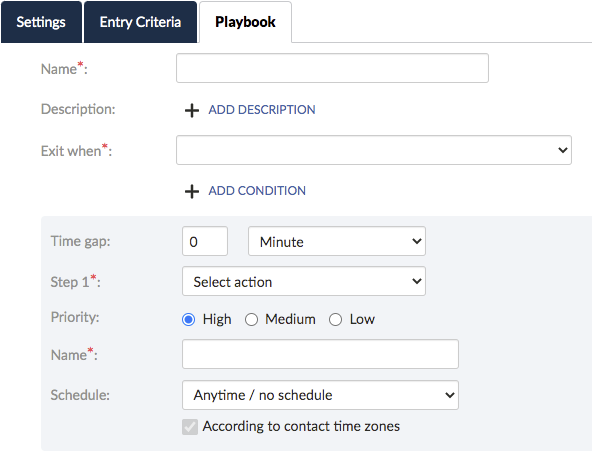
The result is a dialer-first platform where every feature, from Cadence Playbooks to email steps, orbits around maximizing live conversations.
Source: FrontSpin
That phone-first bet pays off in two ways. First, FrontSpin's single-line Power Dialer eliminates the 1–3 second dead-air pause that plagues parallel dialers, so reps are present the moment a prospect speaks. Second, the platform runs continuous phone scanning and automatic rotation to prevent spam labeling before it starts.
Salesloft made a broader bet. Starting as a sales email tool in 2011, it evolved through sales engagement into what it now calls the Predictive Revenue System.
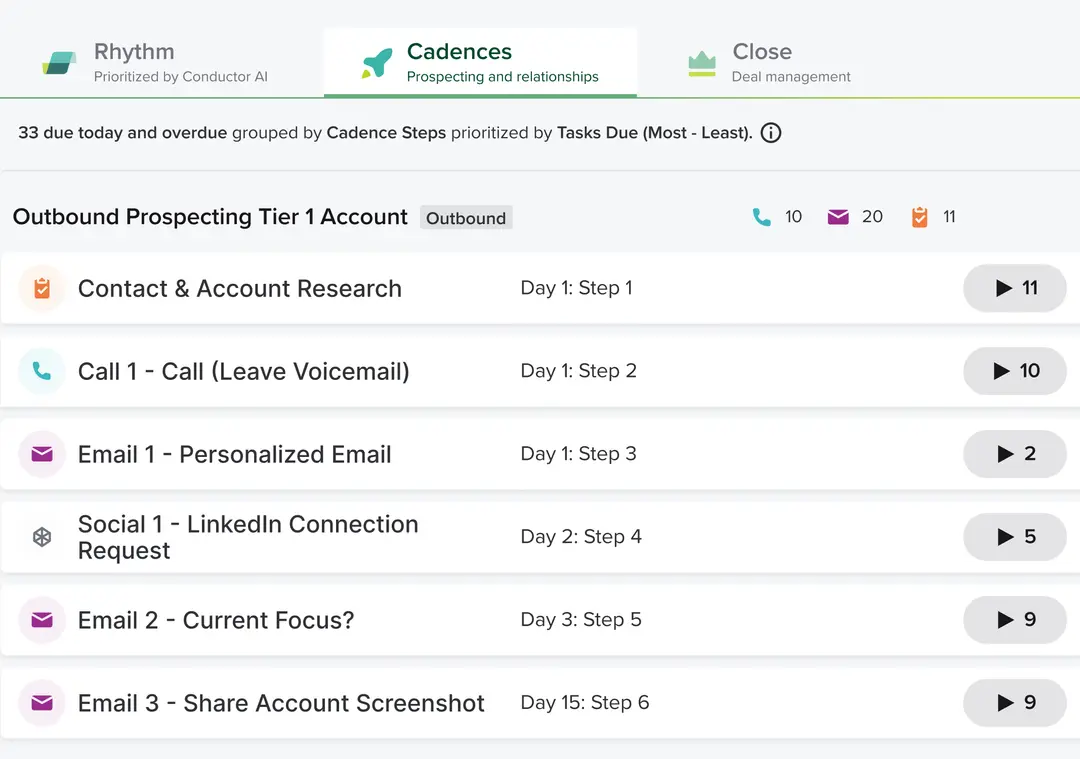
The platform spans nine modules: Cadence for multi-touch sequences, Rhythm for AI-driven prioritization, Conversations for call intelligence, Deals for opportunity management, Forecast for pipeline prediction, and more.
Source: Salesloft
The tradeoff is clear. FrontSpin's SDRs making 80 calls a day will out-dial any Salesloft team. But Salesloft's SDRs know which calls matter most, because Rhythm has already ranked their task list on live buyer signals.
Both platforms share a blind spot: data
Neither FrontSpin nor Salesloft generates its own contact data, company intelligence, or buyer intent signals. Both are execution platforms that assume your data already exists somewhere else.
FrontSpin pulls call lists from Salesforce reports or manual uploads. Its partners page lists DiscoverOrg/ZoomInfo as a data partner, acknowledging this dependency. Salesloft ingests contacts from CRM or third-party enrichment tools and can receive intent signals through Rhythm's partner ecosystem (G2, UserGems, Highspot, and others) but does not produce those signals itself.
This matters because the quality of your outbound is limited by the quality of your data. A perfect dialer calling wrong numbers wastes time. A well-orchestrated cadence sent to the wrong persona wastes money. Without intent signals, every call is a cold call.
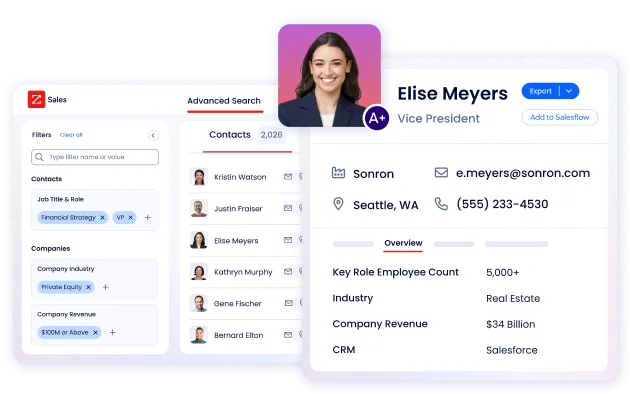
ZoomInfo fills this gap. The platform provides 120M direct-dial phone numbers and 200M+ verified business email addresses, verified through a pipeline backed by 300+ human researchers and achieving up to 95% accuracy on first-party data. In a Fortune 500 competitive RFP analyzing 25 million contacts across vendors, the independent consultant concluded that "no other competitor came even close."
Source: ZoomInfo
Beyond static contact records, ZoomInfo's Buyer Intent tracks signals from 210 million IP-to-Organization pairings and 6 trillion+ new keyword-to-device pairings sourced monthly. Guided Intent, exclusive to ZoomInfo, identifies the topics historically correlated with deal success rather than requiring manual topic selection.

Source: ZoomInfo
"ZoomInfo gives us the information we need to execute. We don't have to spend our time digging. It's already there, so we can be three steps ahead." (Vensure)
Salesforce integration tells you what each platform cares about
All three platforms integrate with Salesforce. How they do it reveals their priorities.
FrontSpin holds two U.S. patents covering real-time data synchronization and predictive queue management for its Salesforce connection. The sync keeps CRM records mirrored without exceeding API limits, solving the race conditions that plague cloud data systems.
FrontSpin also offers a Chrome Extension that renders as a side-panel within Salesforce, adding click-to-dial on every lead and contact.
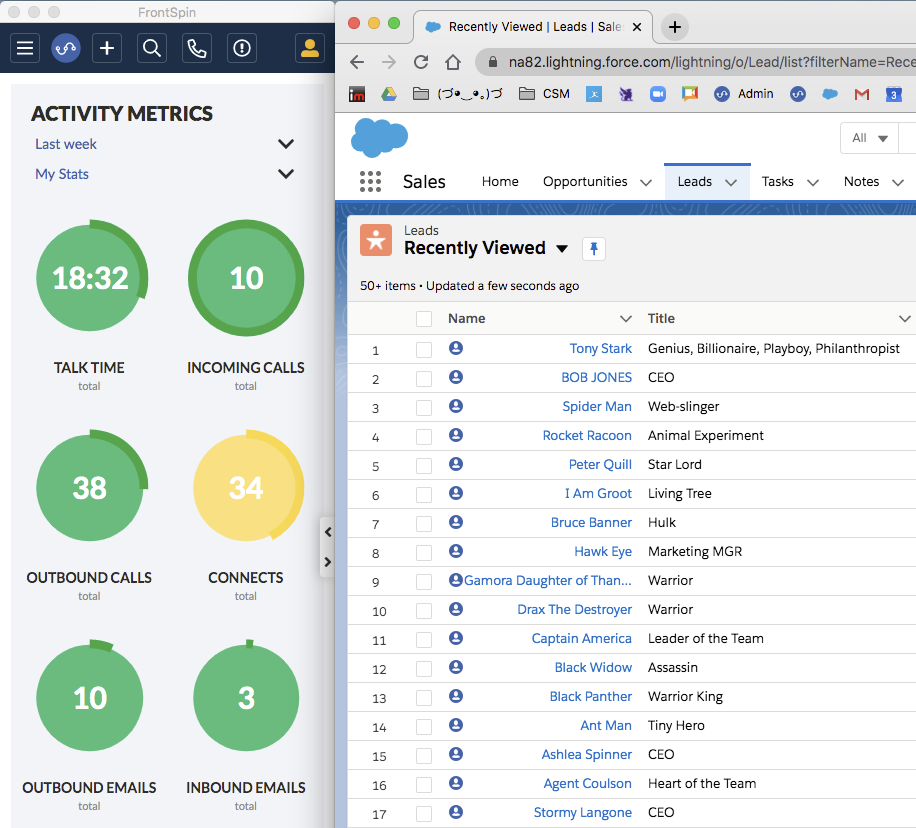
Source: FronSpin
But FrontSpin's integration depth is also its limitation. Beyond Salesforce, the ecosystem is narrow. Capterra reviewers want more third-party integrations, and the partners page shows no HubSpot, Outreach, or Salesloft native integrations.
Salesloft takes a broader approach with integrations across Salesforce, HubSpot, and Microsoft Dynamics 365. The Salesloft Connect Chrome extension lets reps run cadence steps inside Salesforce without switching tools, with automatic bidirectional sync. The integrations marketplace lists 180+ partners across 16 categories.
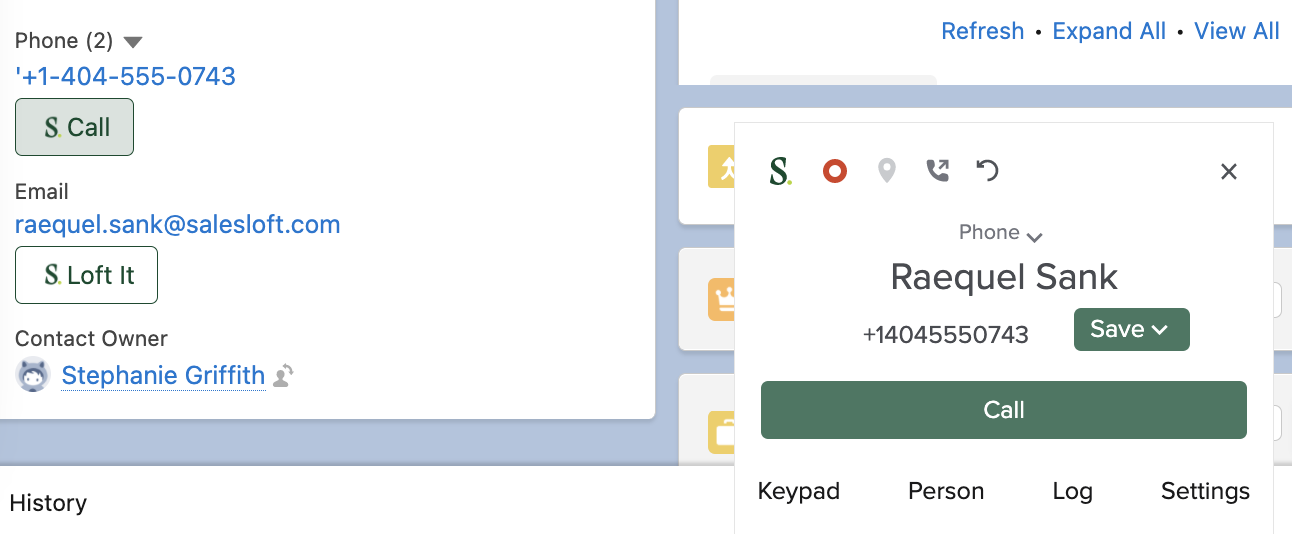
Source: Salesloft
That breadth brings its own complexity: G2 and TrustRadius both flag sync reliability issues that occasionally require manual intervention.
ZoomInfo integrates natively with Salesforce, HubSpot, and Microsoft Dynamics, and its App Marketplace lists 172+ integration partners. What sets ZoomInfo apart is the MCP server and Enterprise API, which expose the same intelligence to any tool, including Salesloft.
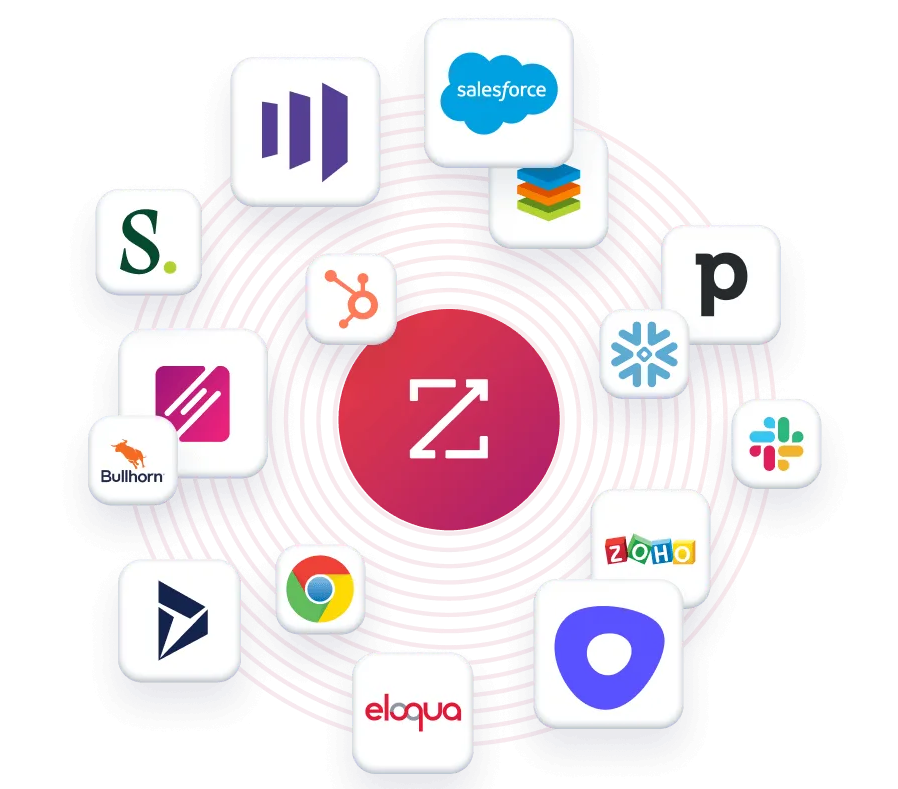
Source: ZoomInfo
ZoomInfo's partnership with Salesloft connects ZoomInfo Buying Signals directly to Salesloft Rhythm for AI-prioritized engagement. ZoomInfo functions as infrastructure for other platforms, not as a competitor on execution.
"The plug-and-play aspect of the API means I can integrate it easily into any process and get information at a moment's notice." (BDO Canada)
AI takes three different shapes across these platforms
FrontSpin's AI focuses on call mechanics. The AI-Assisted Parallel Dialer performs real-time human/machine detection with low latency, routing live humans to reps while automatically dropping voicemails and queuing callbacks. Before a dial session, FrontSpin's AI filters bad numbers and classifies leads, so the dialer works from a pre-cleaned list.
Following the February 2026 acquisition by TitanX, FrontSpin plans to add TitanX's Phone Intent model (trained on over one billion calls) to predict which contacts are statistically likely to answer.
Salesloft's AI spans the full revenue workflow. Rhythm's Conductor AI (patent-pending) ranks seller actions by likelihood to progress a deal, aggregating signals from email engagement, call outcomes, website chat data, and third-party partners.
The AI Email Agents draft personalized emails at each cadence step. The AI Scorecard Agent pre-populates coaching scorecards from call transcripts.
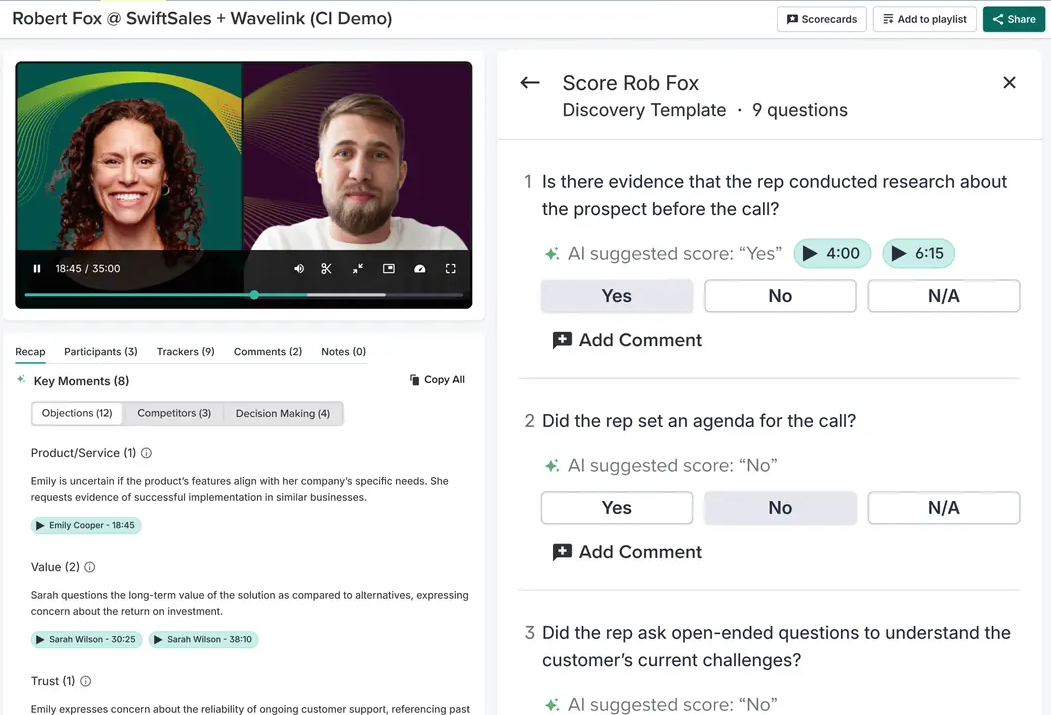
Source: Salesloft
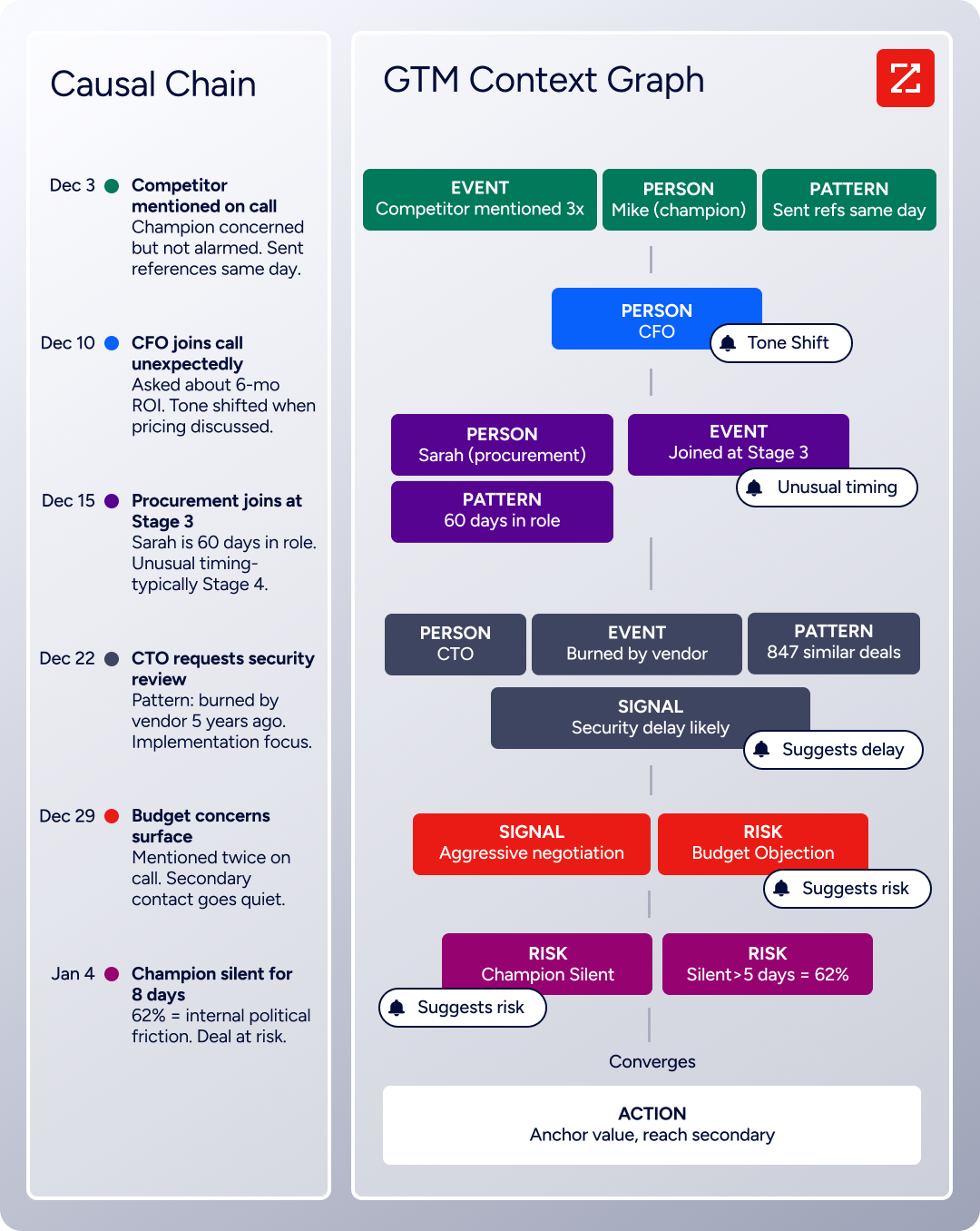
ZoomInfo's AI operates at a different level. The GTM Context Graph doesn't just detect anomalies or prioritize tasks. It reasons across your CRM, conversation intelligence, intent signals, and behavioral data to capture why deals move or stall. As CPO Dominik Facher writes: "The CRM recorded the state change. It has no record of why it happened."
Source: ZoomInfo
The GTM Context Graph captures the decision context: the CFO joining a call and asking about ROI, the champion going quiet because of an internal budget battle. That intelligence flows into GTM Workspace, where AI agents handle account research, outreach drafting, CRM updates, and signal monitoring in one place.
"That combination of our internal CRM data, external signals, and AI that's given all that context has helped us craft very specific account- and persona-based messages. And people have responded to them right away." (Seismic)
Conversation intelligence: bolt-on vs. built-in vs. foundational
How each platform handles call intelligence reflects its architectural priorities.
FrontSpin records calls and offers live call monitoring with Whisper coaching, where managers coach reps in real time without the prospect hearing. Call recordings can go to Gong or ExecVision for transcription and analysis.
But FrontSpin itself does not transcribe, summarize, or analyze calls. Its reporting tracks activity: dials, connects, talk time. Users who want AI-generated call summaries or keyword tracking need a separate tool.
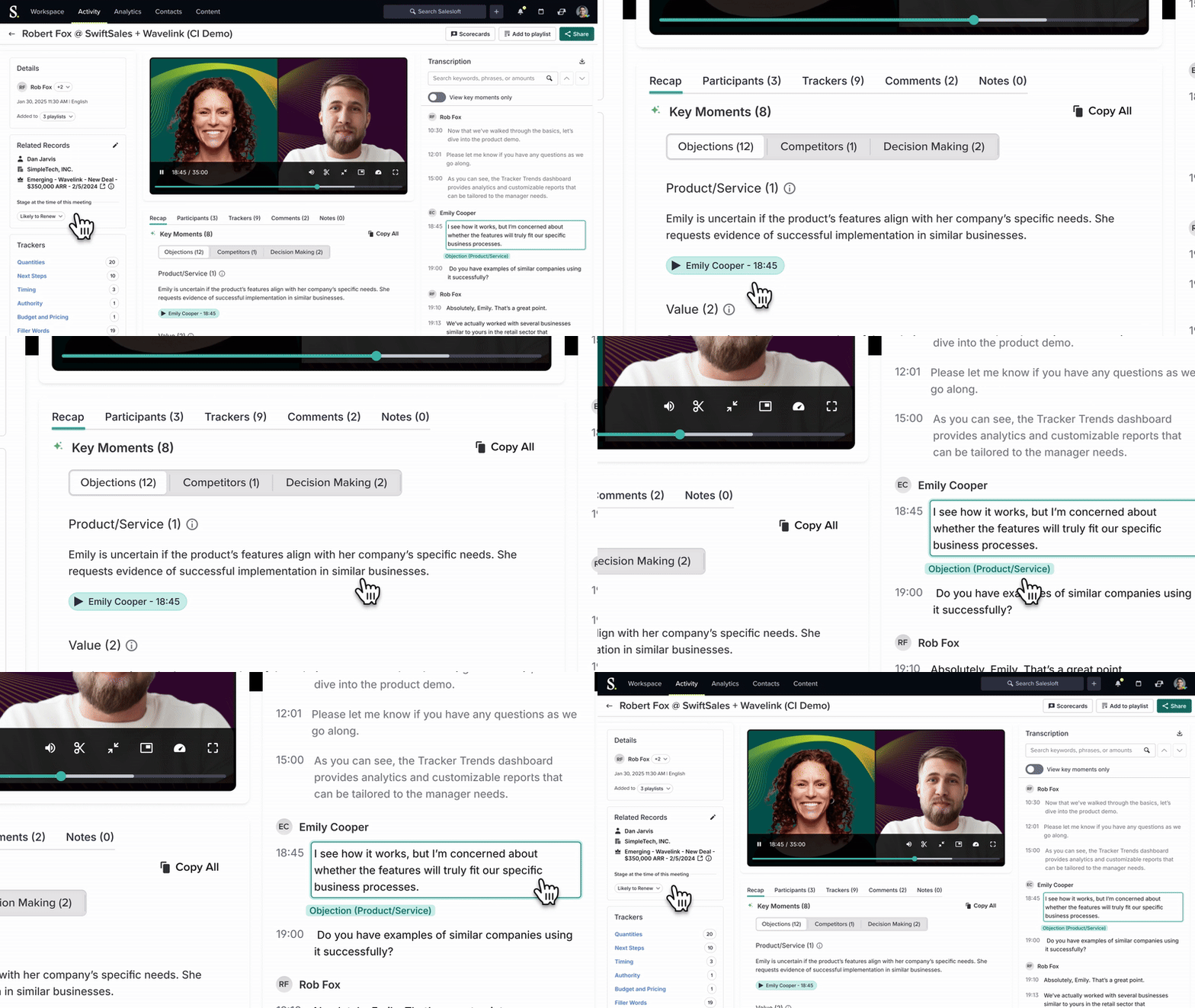
Salesloft's Conversations module records, transcribes, and analyzes calls natively. The Conversation Summary AI Agent generates summaries and action items. The Key Moment AI Agent surfaces competitor mentions, objections, and decision-maker involvement.
Source: Salesloft
These insights link directly to deal records and feed the manager's coaching workflow. The advantage over FrontSpin is clear: everything stays in one system, and insights flow into Rhythm's prioritization engine.
ZoomInfo's approach through Chorus goes further. Backed by 14 technology patents, Chorus doesn't just transcribe. It feeds the GTM Context Graph, extracting not just who said what, but why a deal accelerated, why a champion went quiet, or what a competitive mention predicts about deal risk.

Source: ZoomInfo
Combined with ZoomInfo's third-party data (org changes, funding, intent signals), this creates an intelligence layer that standalone conversation tools cannot replicate. Connected Intelligence surfaces ZoomInfo's full profile and relationship history for every call participant inside the interaction record.
Pricing comparison
Comparing pricing across these platforms means navigating three different levels of opacity.
FrontSpin does not publish pricing. The pricing page offers only a custom quote form. It promises "unlimited minutes with no hidden costs" and "fast implementation."
The Terms of Service reveals that contracts are non-cancellable for the full term, auto-renew unless canceled with 30 days' notice, and renewal pricing resets to current rates rather than locking in the original price. A 14-day free trial is available by request.
Salesloft offers two tiers, Advanced and Elite, both requiring a demo for pricing. The MSA confirms that all fees are non-cancellable and non-refundable. Additional costs include per-minute dialer usage fees outside the Unlimited Dialer plan, Account Agent overages beyond 100 runs per user per month, and separately purchased professional services for implementation and training.
G2 reviewers cite minimum seat requirements as a barrier for smaller teams. For a detailed look at what Salesloft's tiers actually cost, see our Salesloft Pricing Breakdown.
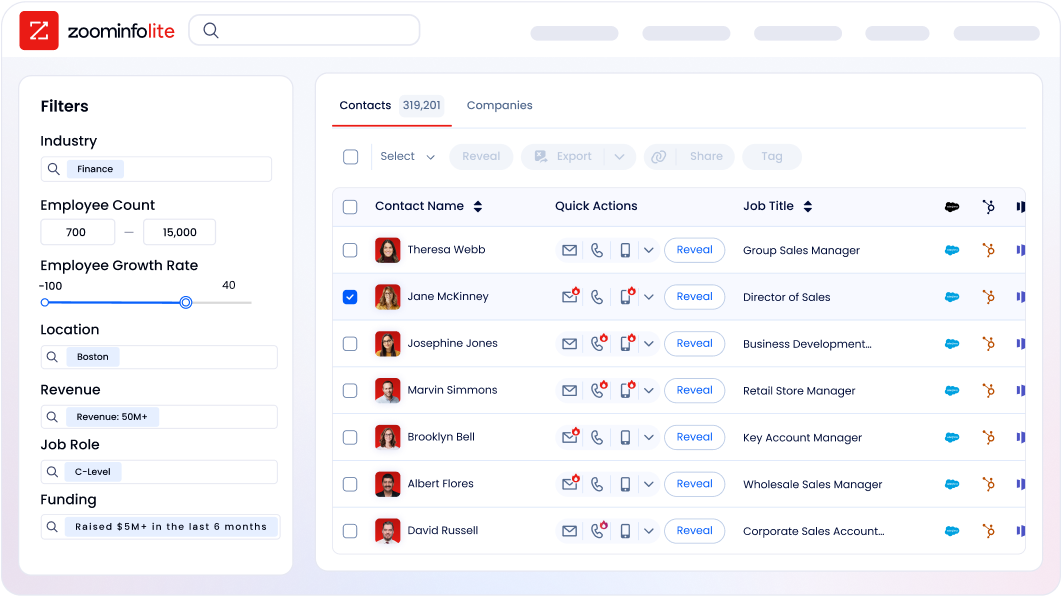
ZoomInfo also uses custom pricing but offers two no-cost entry points that neither competitor matches. ZoomInfo Lite is a permanent free tier (not a trial) with access to the B2B database, 10 monthly export credits, individual and company searches, Chrome extension, and HubSpot integration.
Source: ZoomInfo
A separate 7-day free trial provides access to the full platform. Paid plans span Sales, Marketing, and standalone products, with consumption-based pricing where credits determine export volume and AI usage.
The practical comparison: FrontSpin costs less but does less. Salesloft costs more and does far more, but the full platform requires dedicated RevOps to configure and maintain. ZoomInfo's cost depends on usage patterns and which products you need, but the free entry points let teams test data quality before committing.
Who each platform is actually built for
The three platforms target different buyers, and understanding those differences matters more than feature lists.
FrontSpin is built for sales agencies and inside sales teams running high-frequency phone-first outbound on Salesforce. The ideal user is an SDR team or outsourced appointment-setting agency doing sustained prospecting where phone is the primary channel and number health matters more than short-burst list-burning.

Source: FrontSpin
Salesforce is a prerequisite. With approximately 21 employees and a bootstrapped history (now backed by TitanX's $27 million Series A), FrontSpin is a lean operation optimized for a specific use case.
Salesloft is built for mid-market to enterprise B2B organizations with sales teams of 50+ reps and dedicated RevOps functions. The 2025 Forrester TEI study modeled a composite $7B enterprise with a 1,500-person revenue organization.
Targeted industries include Professional Services, Manufacturing, Medical Software & Devices, and Logistics. Customer logos include IBM, Stripe, Siemens, 3M, and SAP Concur. Salesloft is not designed for teams under 10–15 reps, SMBs without RevOps support, or organizations needing a lightweight point solution.
ZoomInfoserves enterprises and upper mid-market teams35,000+ companies worldwide, with particular strength in enterprise and upper mid-market. Named customers include Adobe, Microsoft, AWS, Snowflake, Thomson Reuters, and Databricks.
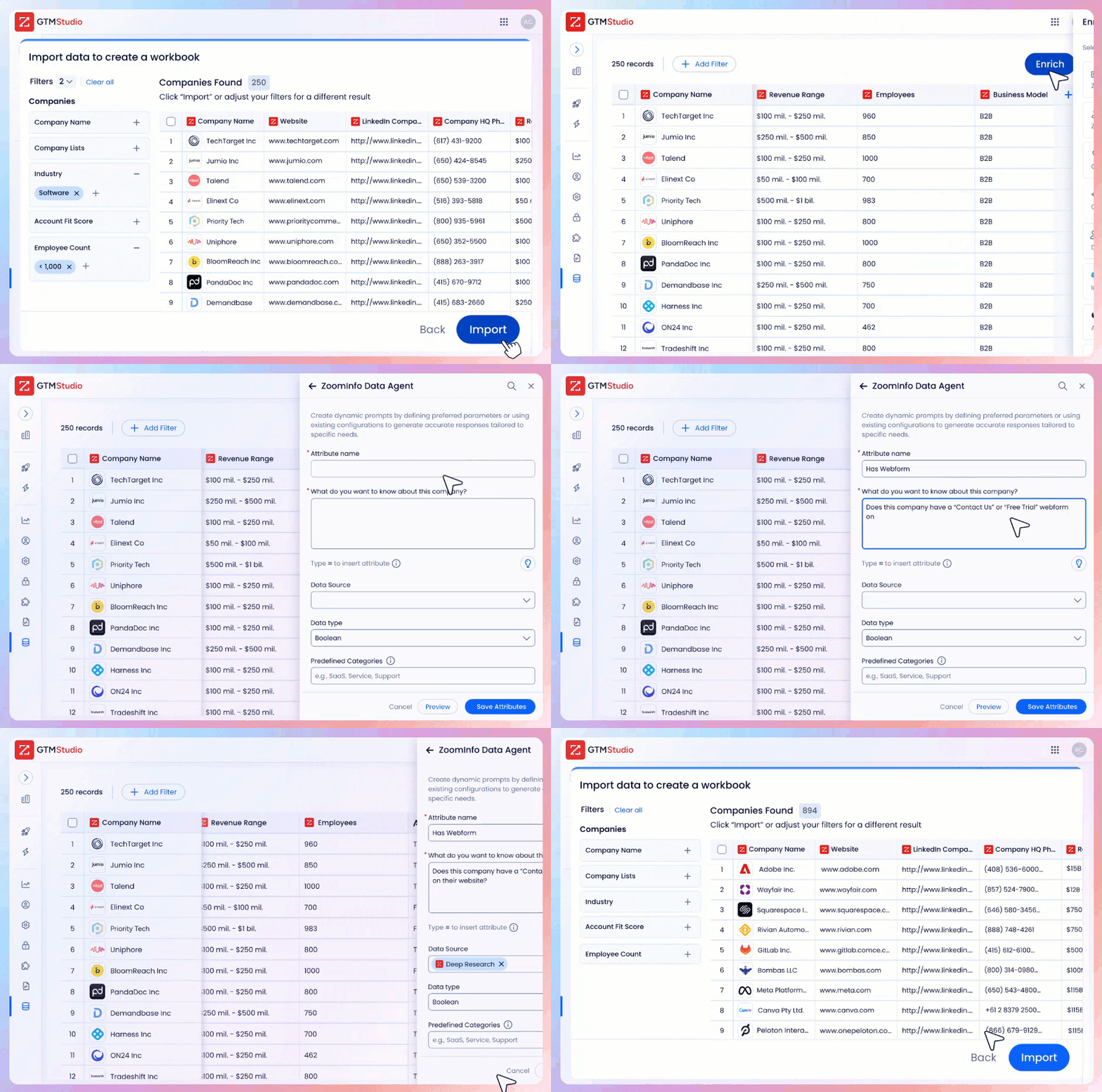
Unlike FrontSpin and Salesloft, ZoomInfo serves both sides of the GTM organization: sales teams use GTM Workspace for prospecting and deal execution, while marketers and RevOps use GTM Studio for audience orchestration and play design.
Source: ZoomInfo
"Without ZoomInfo, it would be difficult (if not impossible) to achieve our business objectives. Without it, we wouldn't be able to understand the market, have the right contact data, and make meaningful connections." (Smartsheet)
The dialer comparison matters for phone-heavy teams
For teams where phone calls are the primary outbound channel, the dialing experience deserves close attention.
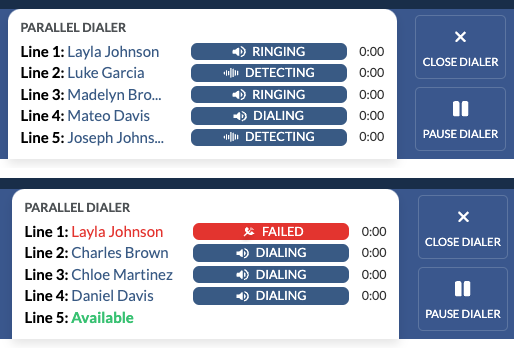
FrontSpin's Power Dialer sequences through a prioritized contact list automatically, with pre-recorded voicemail drops, Local Presence caller ID (matching the prospect's area code), and Double Tap Dialing to increase pickup probability. The AI-Assisted Parallel Dialer dials up to five numbers simultaneously with real-time human/machine detection.
Source: FrontSpin
Admins can enforce call result logging before the dialer advances and set duplicate contact protection. The platform supports BYOC (Bring Your Own Carrier) alongside Twilio, InTouch, and FS Telecom. Capterra reviewers report individual SDRs increasing daily call volume from 45 to 80 calls.
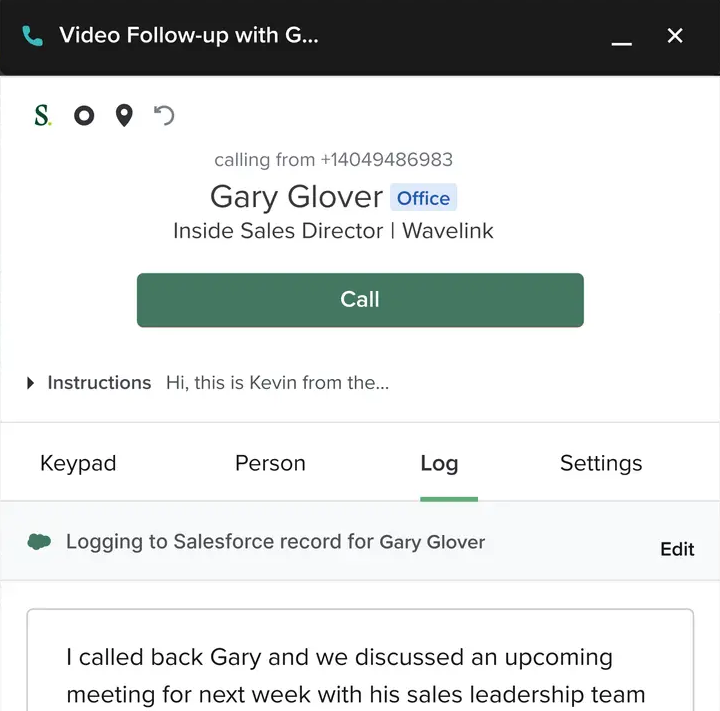
Salesloft includes a built-in dialer that supports calling from the platform, cell phone, or hardline with automatic call logging. Calls feed into Conversations for transcription and AI analysis. But G2 reviewers flag the absence of an auto-dialer and domain rotation, along with poor caller ID accuracy, voicemail delays, and manual texting.
Source: Salesloft
For phone-heavy teams, Salesloft's dialer is adequate but not its strength. The platform coordinates calling within a multi-channel workflow; it does not maximize raw dial volume.
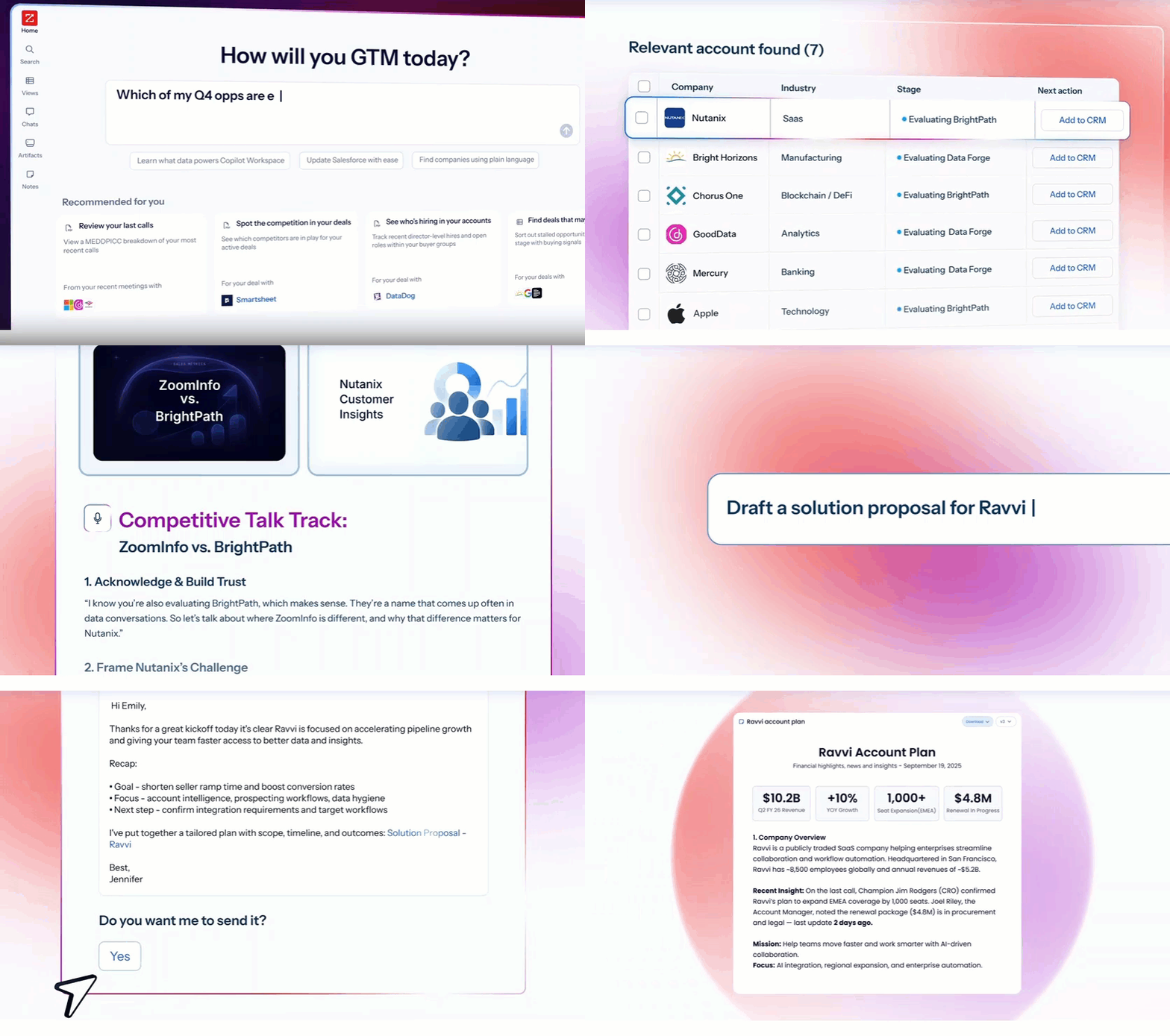
ZoomInfo's GTM Workspace includes intelligent dialing, but the real value for phone teams is what happens before the call. The Action Feed surfaces in-market buyers with pre-drafted actions on every signal, so reps call accounts showing active buying behavior rather than working through a static list.
Source: ZoomInfo
Guided Intent identifies which topics correlate with your deal outcomes, and WebSights reveals which companies are on your website right now. ZoomInfo customers report booking 60% more meetings per week and being first to engage an account in over half of cases.

Source: ZoomInfo
Onboarding and learning curve
FrontSpin keeps its learning curve shallow. The platform describes onboarding as "Easy as 1-2-3": Schedule a Demo → Connect Your CRM → Start Dialing. The JumpStart program provides a structured ramp-up with separate tracks for Salesforce and Standalone users.
The platform runs entirely in Google Chrome with no desktop application required.
Salesloft requires more investment. The platform offers professional services ranging from webinar-based self-service to facilitated onboarding, plus Salesloft Academy with role-specific learning paths for administrators, SDRs, AEs, and managers. Daily Office Hours at 11am ET provide live support.
But with nine interconnected modules after the Clari merger, G2 reviewers describe the platform as complex to set up, particularly for importing contacts, building cadences, and navigating analytics. Simple teams can get operational quickly; full utilization for enterprise use cases takes longer.
ZoomInfo's breadth (data platform, GTM Context Graph, Chorus, chat, marketing automation) represents a real onboarding investment. The company redesigned its onboarding from 30 to 90 days, producing a 25% improvement in CSAT.
ZoomInfo University offers role-specific learning paths, certifications, and live webinars. CEO Schuck has noted that GTM Workspace "deploys in weeks, not months", with the seller-facing experience designed for faster adoption than the full platform.

Source: ZoomInfo
Security and compliance
For enterprise buyers, security certifications determine whether a tool can even enter the evaluation.
FrontSpin holds ISO/IEC 27001:2013 certification and complies with GDPR and CCPA. The platform implements 90-day data retention for backups and logs, with full encryption for data in motion and at rest. Admins can block call recording by U.S. state for consent compliance.
This is solid for a company of FrontSpin's size, though it does not publicly document SOC 2 certification, penetration testing, or data residency options.
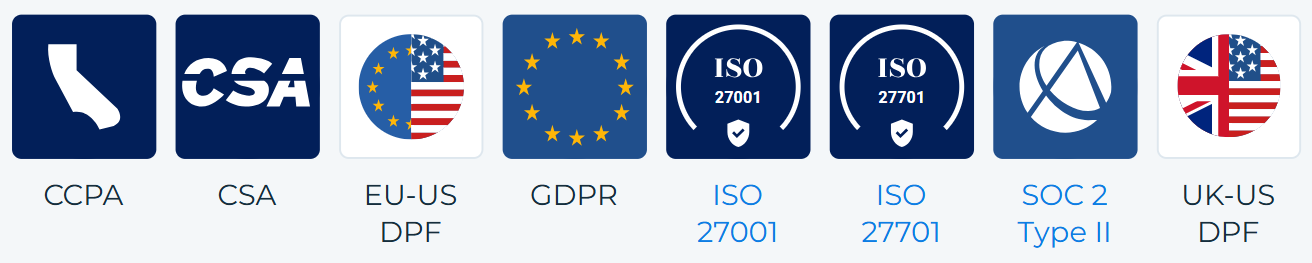
Salesloft carries a broader certification stack: SOC 2 Type II, ISO 27001, ISO 27701, GDPR, CCPA, CSA, and EU-US Data Privacy Framework. Infrastructure runs on AWS and GCP (US and EU regions) with AES-256-GCM encryption at rest and TLS 1.2+ in transit. Enterprise features include SAML-based SSO, PAM with pre-defined role-based permissions, and 24x365 security monitoring.
Source: Salesloft
One note: in August 2025, a suspected intrusion into the Drift product environment involved API calls and code exfiltration. Mandiant confirmed no spread to the core Salesloft environment, and remediation was completed.
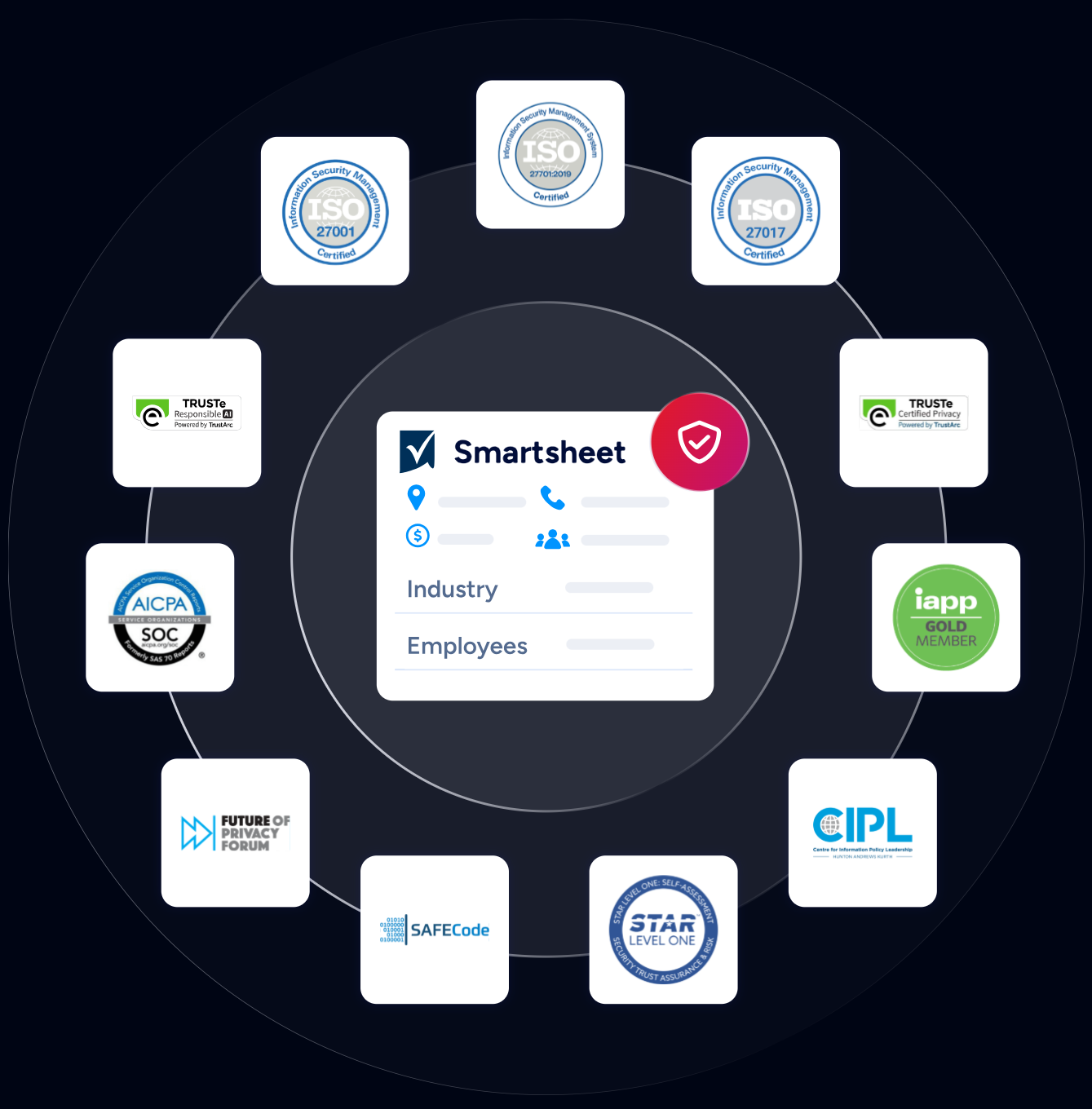
ZoomInfo's compliance infrastructure reflects its role as a data platform handling hundreds of millions of records. Certifications, all renewed annually, include ISO 27001, SOC 2 Type II, ISO 27701, TRUSTe GDPR, and TRUSTe CCPA.
Source: ZoomInfo
ZoomInfo is a registered data broker in California and Vermont and maintains a dedicated Trust Center. For enterprise buyers in regulated industries, this compliance depth is often a deciding factor.
FrontSpin vs. Salesloft vs. ZoomInfo: Which should you choose?
The right platform depends on what's limiting your outbound today.
Choose FrontSpin if:
Phone is your primary outbound channel and call volume is the main KPI
Your team runs on Salesforce and needs the tightest possible CRM sync
Spam labeling and call deliverability are hurting your connect rates
You want a dialer your reps can learn in a day, not a platform that takes months to configure
You're an outsourced sales agency or SDR team focused on setting appointments
Choose Salesloft if:
You need a platform spanning prospecting through forecasting in one system
Your revenue team is 50+ reps with dedicated RevOps support
AI-driven action prioritization and coaching analytics are priorities
You want native conversation intelligence without adding a separate tool
Your sales cycle is multi-touch, multi-stakeholder, and multi-channel
Choose ZoomInfo if:
You need the data and intelligence layer that makes every outbound tool more effective
Knowing who to call, when to call, and why they're in-market matters more than dialing faster
You want AI that understands your deals, not just your activities
You need one platform for sales prospecting, marketing orchestration, and operations
You want the flexibility to power your own tools and workflows via API and MCP
Start with ZoomInfo Lite for free, or request a demo of the full platform.
These platforms solve different layers of the same problem. FrontSpin maximizes what happens when a rep is on the phone. Salesloft coordinates every touchpoint across the buyer journey. ZoomInfo provides the intelligence that determines whether those calls and touchpoints reach the right person at the right moment with the right message.
For many organizations, the strongest outbound motion uses more than one layer, and ZoomInfo is designed to be the foundation underneath whichever execution tool you choose.
FrontSpin vs. Salesloft vs. ZoomInfo FAQ
What is the core difference between FrontSpin, Salesloft, and ZoomInfo?
FrontSpin is a phone-first sales platform built to maximize live conversations per rep through its Power Dialer and call deliverability features. Salesloft is a full-funnel revenue orchestration platform spanning cadences, conversation intelligence, deal management, and forecasting for enterprise sales teams.
ZoomInfo is an AI GTM platform providing B2B data (500M contacts, 135M+ verified phone numbers), buyer intent signals, and contextual intelligence that power effective outbound across any execution tool.
Which platform is best for high-volume phone-based outbound?
FrontSpin is built for phone-heavy teams. Its Power Dialer and AI-Assisted Parallel Dialer (up to 5 simultaneous lines) are designed for high call volume, with continuous phone number scanning and automatic rotation to prevent spam labeling. Salesloft includes a built-in dialer but lacks an auto-dialer and domain rotation.
ZoomInfo's GTM Workspace includes intelligent dialing, but its primary value for phone teams is ensuring reps call accounts that are actively in-market.
Do FrontSpin or Salesloft provide their own contact data?
Neither platform generates B2B contact data. Both are execution tools that require you to bring your own data from a CRM or third-party provider. ZoomInfo is the data platform, offering 500M contacts, 100M companies, 120M direct-dial phone numbers, and 200M+ verified business email addresses. ZoomInfo has a direct partnership with Salesloft, and FrontSpin lists ZoomInfo as a data partner.
Which platform has the best Salesforce integration?
FrontSpin holds two U.S. patents on its real-time Salesforce sync and has the tightest native integration for phone-centric workflows. Salesloft offers strong bidirectional Salesforce sync with its Connect Chrome extension, plus integrations with HubSpot and Dynamics 365.
ZoomInfo integrates natively with Salesforce, HubSpot, and Dynamics 365, and also delivers data into Salesforce via its API and managed packages.
Can ZoomInfo work alongside FrontSpin or Salesloft?
Yes. ZoomInfo is designed as infrastructure that powers other tools. Its partnership with Salesloft connects ZoomInfo Buying Signals directly into Salesloft's Rhythm AI for prioritized engagement. FrontSpin lists ZoomInfo as a data partner.
ZoomInfo's API and MCP server expose the same intelligence to any third-party tool. Many organizations use ZoomInfo for data and intelligence alongside a separate execution platform.
Which platform is easiest to get started with?
FrontSpin has the shallowest learning curve. Its three-step onboarding and browser-only deployment mean reps can be dialing within hours.
ZoomInfo's GTM Workspace deploys in weeks, and ZoomInfo Lite offers a permanent free tier for testing the data. Salesloft requires the most setup, particularly for enterprise deployments using multiple modules, though its Academy and professional services support structured adoption.
How does pricing compare across the three platforms?
All three use custom, quote-based pricing. FrontSpin promises unlimited minutes with no hidden costs but requires a sales conversation. Salesloft offers Advanced and Elite tiers with additional costs for dialer usage, AI agent overages, and professional services.
ZoomInfo uses consumption-based pricing and offers two free entry points: ZoomInfo Lite (permanent free tier with 10 monthly export credits) and a 7-day free trial of the full platform.
Which platform has the strongest AI capabilities?
ZoomInfo's GTM Context Graph provides the most capable AI, combining B2B data with CRM records, conversation intelligence, and behavioral signals to reason about why deals move or stall.
Salesloft's Rhythm AI and its AI agents (for email, coaching, deal analysis, and prioritization) are the most mature for workflow automation. FrontSpin's AI focuses on call mechanics (human/machine detection and pre-call list filtering), with broader capabilities expected through the TitanX acquisition.
More Salesloft comparisons and breakdowns:
