

GetProspect has built a following among small sales teams and solo prospectors who need one thing: verified email addresses from LinkedIn. The platform pairs a Chrome extension with a B2B database, email verification, cold email sequencing, and a lightweight CRM in a single workspace. For teams that live on LinkedIn and want to keep their tools (and costs) in one place, it works.
To write this GetProspect review, we analyzed the platform in detail. We believe it's the right choice if:
You rely on LinkedIn as your primary prospecting channel
You want one workspace for finding, verifying, and emailing contacts
You need affordable monthly billing with credit rollover
Your team is small and doesn't need intent data or advanced analytics
GDPR compliance and EU data hosting matter to your buyers
However, GetProspect might not be the best choice if:
You need data coverage across 500M+ contacts with verified direct dials
Buyer intent signals and technographic intelligence are central to your strategy
You require AI-driven account prioritization and deal execution tools
Your team needs conversation intelligence, ABM orchestration, or advanced analytics
You're building or scaling an enterprise go-to-market operation
In this case, you should consider ZoomInfo: a GTM platform built on 500M contacts, 100M companies, 135M+ verified phone numbers, and 200M+ verified business emails. ZoomInfo combines this data with your CRM records, conversation transcripts, and behavioral signals through its GTM Context Graph, showing not just what happened in your deals, but why. Your team can access that intelligence through GTM Workspace for sellers, GTM Studio for marketers and RevOps, or APIs and MCP in any front-end.
We've included a detailed look at ZoomInfo later in this review as the next step for teams that have outgrown a point email finder. If you're ready to explore a full GTM platform, you can start with ZoomInfo Lite for free.
What is GetProspect?
GetProspect is a B2B email finder and contact database founded in 2016 by Dmytro Shulha in Kyiv, Ukraine. Shulha had run a web agency since 2012 and built the original email-finding tool as a side project. That project grew into a company that now reports 400,000+ total customers and 40,000+ active users.
The platform centers on a data asset of 200M B2B contacts with emails, 230M corporate emails, 26M international companies, and 130M mobile phone numbers. Users access this data through a LinkedIn Chrome Extension (rated 4.8/5 from 1,000+ Chrome Web Store reviews), a searchable B2B database, CSV enrichment, an email verifier, cold email software, and a built-in CRM.
GetProspect is bootstrapped with no outside funding, run by a core team of roughly 6-10 people. All infrastructure is hosted on DigitalOcean in Amsterdam, Netherlands, making it GDPR-compliant by default. The deal is simple: you only pay for verified, deliverable emails, and credits roll over month-to-month.
The platform targets small outbound sales teams, agencies, and recruiters who need affordable contact data without the complexity or cost of enterprise platforms.
GetProspect Pros & Cons
Pros | Cons |
|---|---|
- LinkedIn Chrome extension with 4.8/5 rating and bulk export | - Data accuracy varies by industry and geography |
- Only charged for verified, deliverable emails | - Limited database coverage for niche and non-English markets |
- Monthly billing with credit rollover | - Only 5 phone credits per month on standard plans |
- All features available across all paid tiers | - No buyer intent data or technographic signals |
- GDPR compliant with EU data hosting | - Basic cold email analytics compared to dedicated tools |
- Unlimited teammates on all paid plans | - Platform reliability issues reported (slow loads, export failures) |
- Proprietary catch-all email verification technology | - No refund policy on any paid fees |
GetProspect Review: How it Works & Key Features
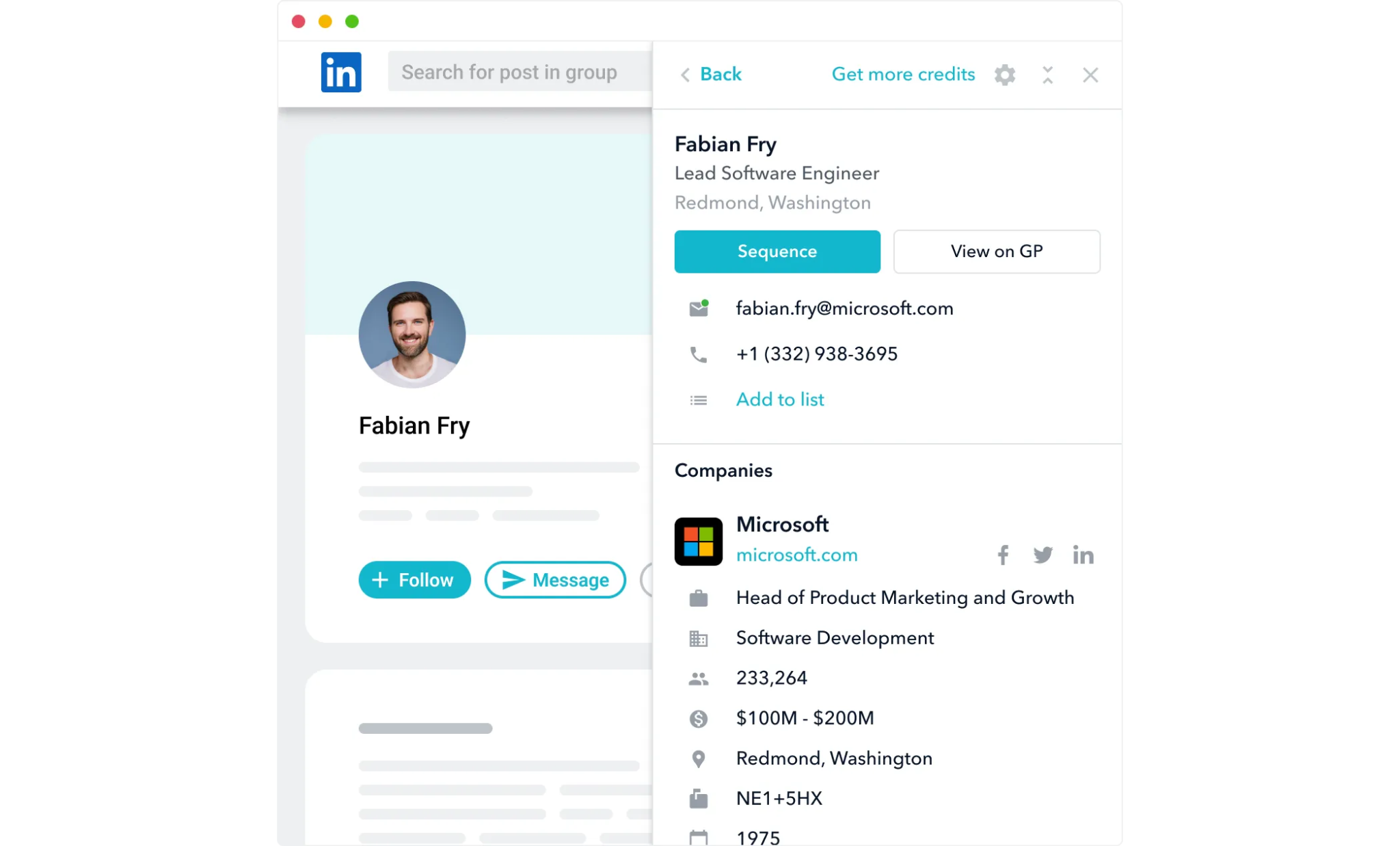
LinkedIn Email Finder: GetProspect's Chrome extension extracts verified contacts directly from LinkedIn searches.
The LinkedIn Email Finder Chrome Extension is GetProspect's flagship product and main acquisition channel. It extracts verified business email addresses and phone numbers from LinkedIn profiles, Sales Navigator searches, and LinkedIn Groups without opening profiles one by one.
Source: GetProspect
The extension operates in two modes. Regular Mode visits each profile to collect full data (name, email, job title, location, company details, LinkedIn URL) but counts against LinkedIn's Commercial Use Limits (800 leads per day on basic LinkedIn, 1,800 on Sales Navigator). Scan Mode collects only data visible on search pages without visiting profiles, bypassing LinkedIn's page-view limits for higher daily volumes.
The extension enforces LinkedIn's daily limits automatically, stopping when the threshold is reached to protect users' LinkedIn accounts. Users can export up to 2,500 leads at once from Sales Navigator searches. Automatic data cleansing removes emojis from names, strips organizational suffixes (Ltd., Inc., LLC), and deduplicates contacts across lists.
The credit model favors the user: emails are verified in real time before a credit is consumed, and there is no charge for contacts where no email is found or for duplicate lookups.
Beyond LinkedIn, the extension also works on company websites, surfacing employee data filterable by job title. A bulk email finder via CSV upload handles up to 50,000 records, and a Google Sheets add-on lets users run bulk searches in spreadsheets.
B2B Contact Database: A searchable repository with 17+ filters for building prospect lists from scratch.
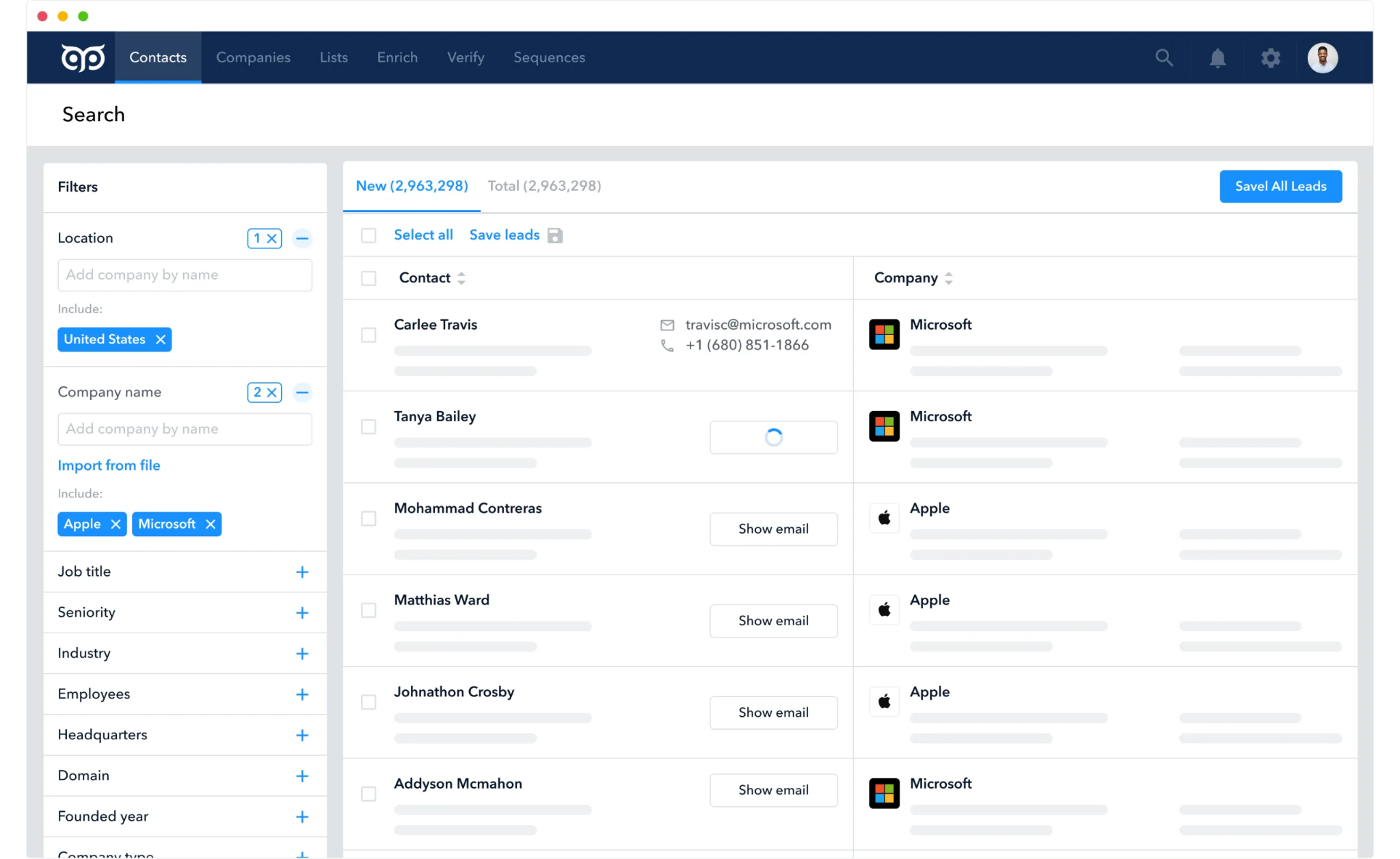
The B2B Contact Database is GetProspect's web-based search tool for teams that want to build lists without LinkedIn. Users apply filters and get matching contacts with verified emails and phone numbers inside the platform.
Source: GetProspect
The database supports 17+ search filters: job title, department, seniority level, location (including postal code), industry and sub-industry, company size, technologies used (3,000 tracked), revenue range, company type (public, private, nonprofit, government), founded year, and company keywords. The technology filter is particularly useful: it lets teams find prospects based on the specific tools a company runs.
GetProspect maintains data quality through an 8-step pipeline that includes public web crawling, licensed third-party data, machine learning categorization, validation testing, and a real-time email status check when a user requests a record. The platform claims 95%+ accuracy, backed by a credit-refund policy for inaccurate records.
Users can save filter configurations and receive automated notifications when 100+ new contacts matching a saved search appear. Contacts are organized into named lists, nested folders, and self-updating dynamic views. Exports support up to 50,000 records to CSV, with native push to HubSpot, Zoho, Salesforce, and Pipedrive.
Email Verifier: A 12-step verification process with proprietary catch-all domain technology.
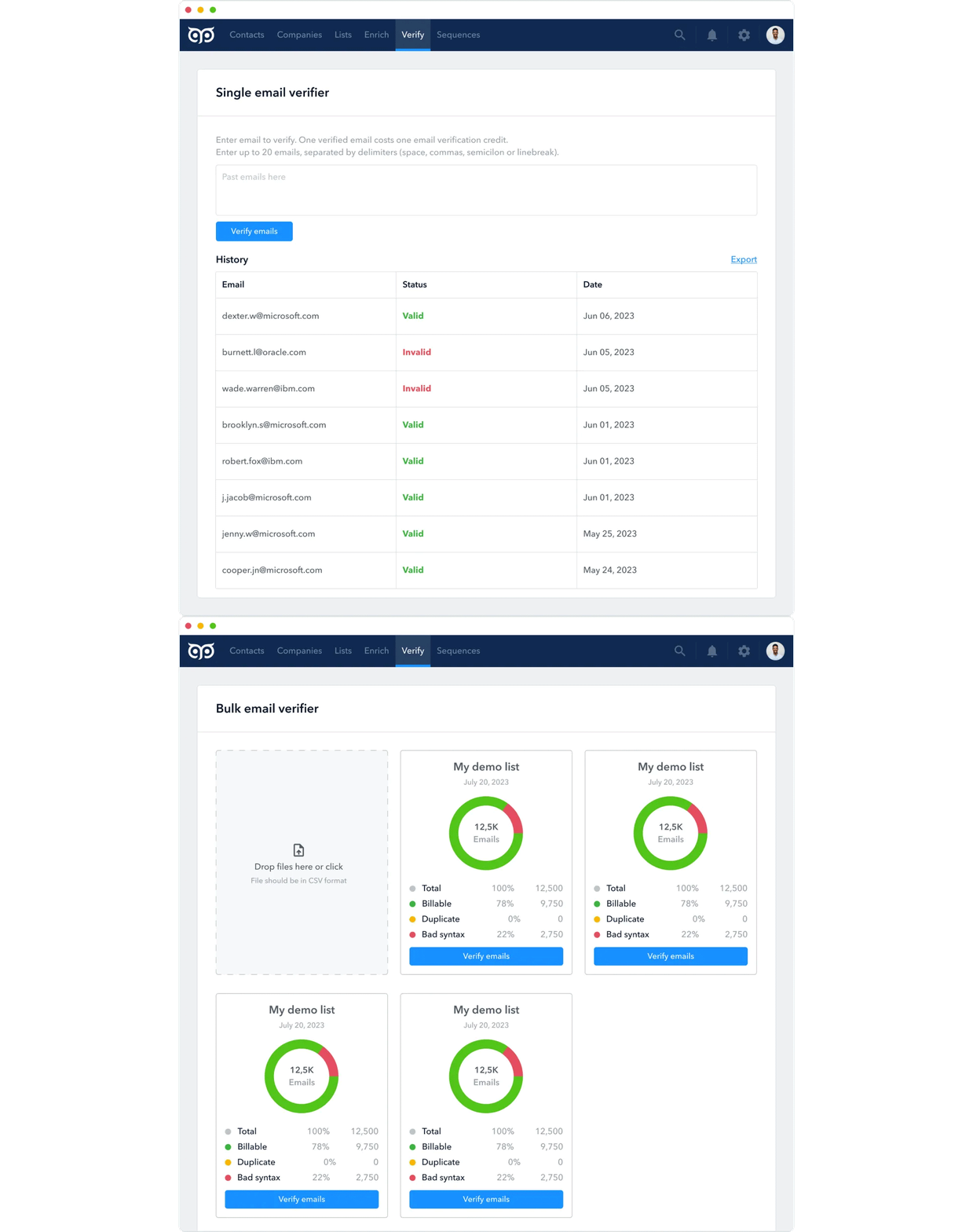
The Email Verifier runs each address through a 12-step process that includes syntax checking, domain health validation, MX record verification, disposable email detection, SMTP validation, greylisting retry logic, and Yahoo/AOL-specific checks. Each address gets one of four statuses: Valid, Invalid, Accept-all, or Unknown.
Source: GetProspect
GetProspect's most notable technical claim is its proprietary catch-all email verification. Most verification tools return "catch-all" as an inconclusive status, leaving users unsure whether those addresses will deliver. GetProspect claims to resolve a meaningful portion of these, reportedly improving determination accuracy by up to 20% over competitors.
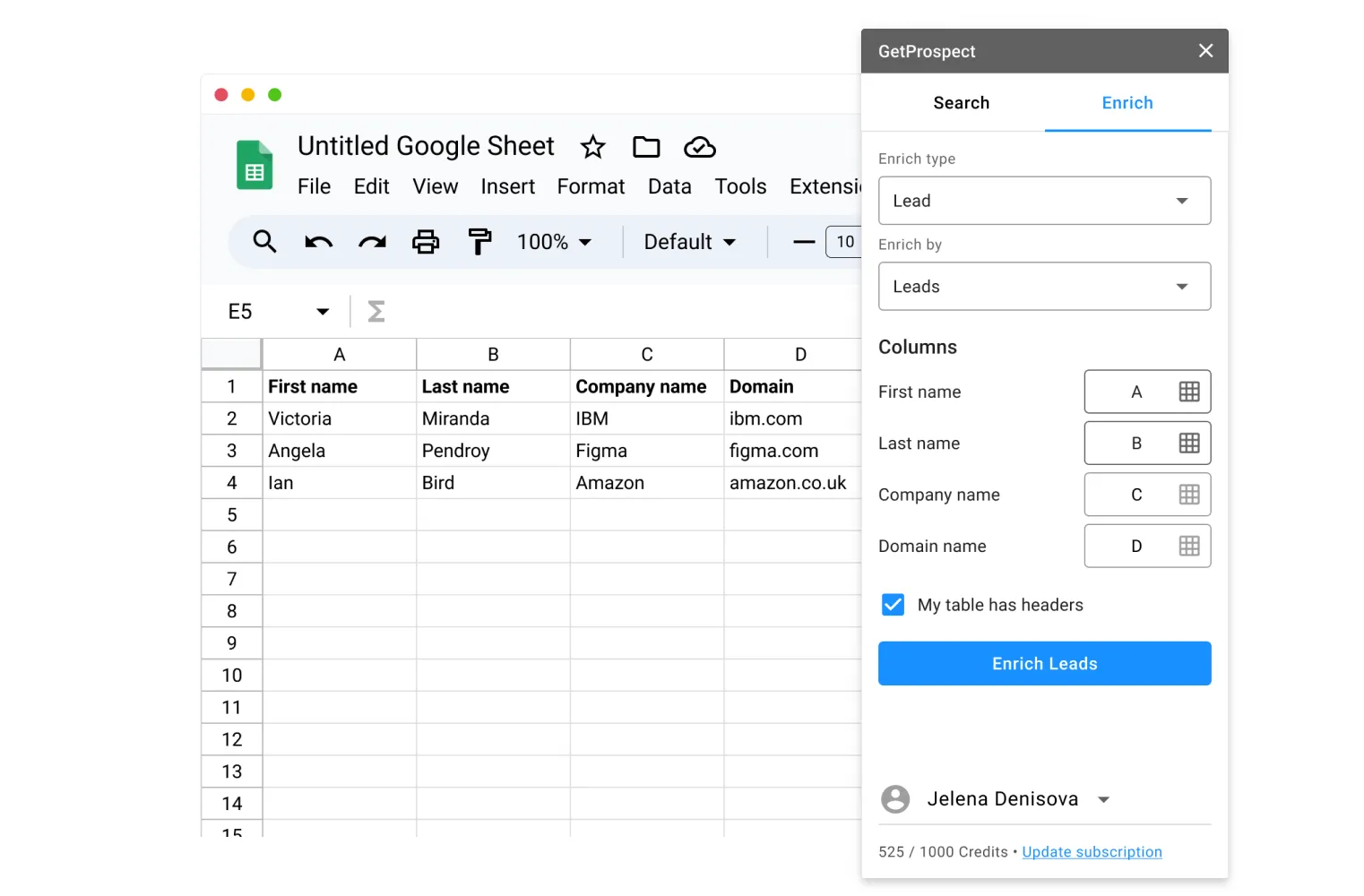
The verifier handles up to 100,000 addresses in about 5 minutes via CSV or XLSX upload, or up to 20 at once via copy-paste. It also works through the Google Sheets add-on and the API.
Source: GetProspect
The free plan includes 100 verification credits per month. Standalone verification credits can be purchased separately and never expire (10,000 for $29, up to 10 million for $2,499), making the verifier usable as an occasional list-cleaning tool without a subscription. Verification credits bundled with paid plans (2,000 on Starter, 10,000 on Growth 5k) are separate from email-finding credits.
Cold Email Software: Built-in outreach sequencing that connects directly to the prospecting pipeline.
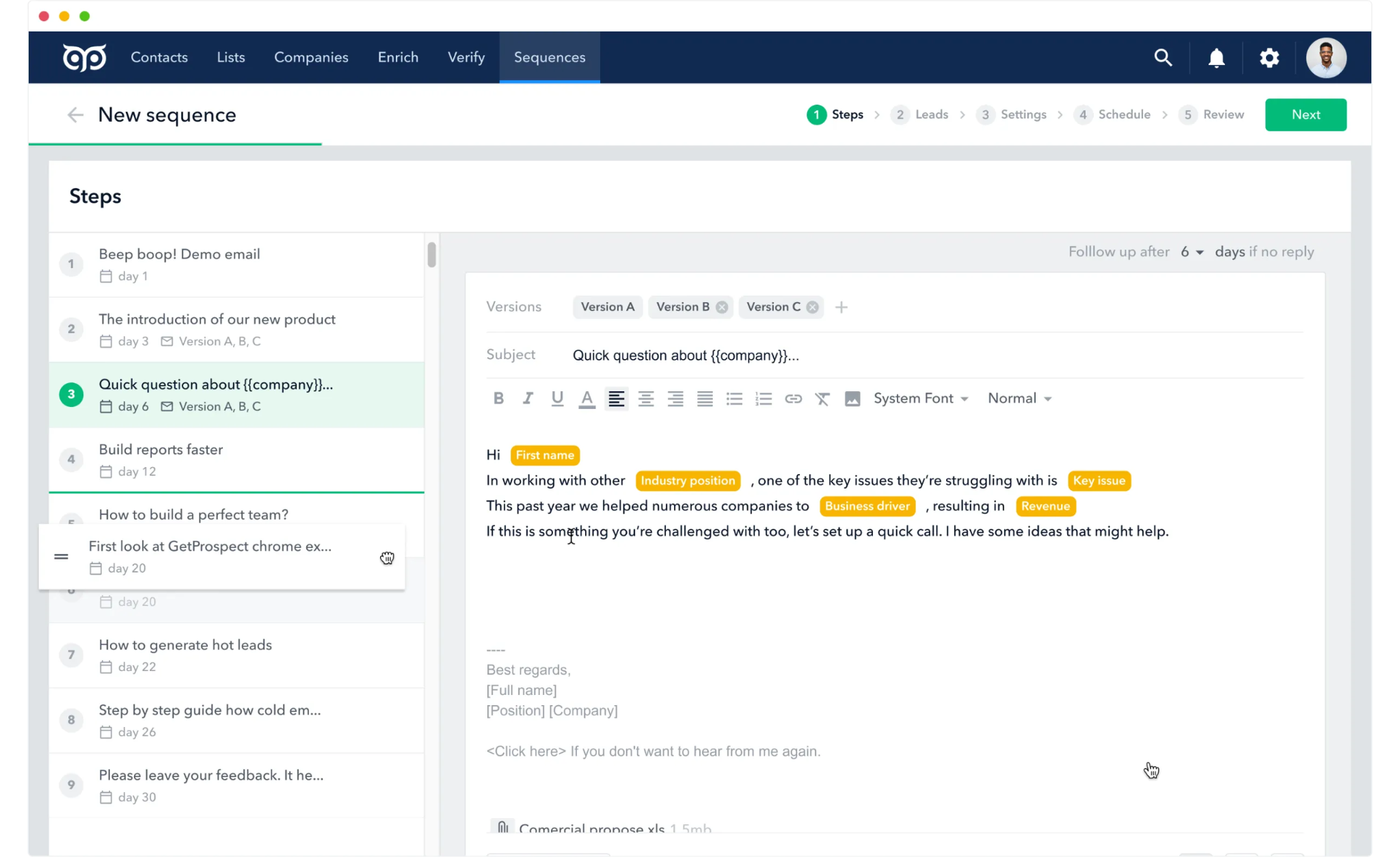
GetProspect's Cold Email Software lets users send personalized email sequences from the same platform where they find and verify contacts. No exporting leads to a separate tool.
Source: GetProspect
Users connect their Gmail or Outlook account, then build multi-step sequences with unlimited steps and configurable delays. Personalization variables pull from contact records (name, company, job title, custom fields). A/B testing supports unlimited variants for subject lines, message bodies, and CTAs, tracked by opens, clicks, and replies.
Sequences stop automatically when a prospect replies or clicks a tracked link. Deliverability controls include randomized sending intervals, SPF/DKIM authentication checks, custom domain tracking, and timezone-aware scheduling with daily send caps.
Contact and domain blacklisting prevents sending to opted-out records. Team features include shared templates and unified campaign visibility. Native CRM sync flows data both ways with HubSpot, Salesforce, Zoho, and Pipedrive.
The key advantage is continuity: a user can discover a contact, verify the email, and add it to a sequence without leaving the platform. That said, the cold email analytics are basic compared to dedicated tools, lacking time-of-day analysis, persona-level breakdowns, and funnel metrics.
Built-in CRM: A lightweight contact management system included on all plans, including free.
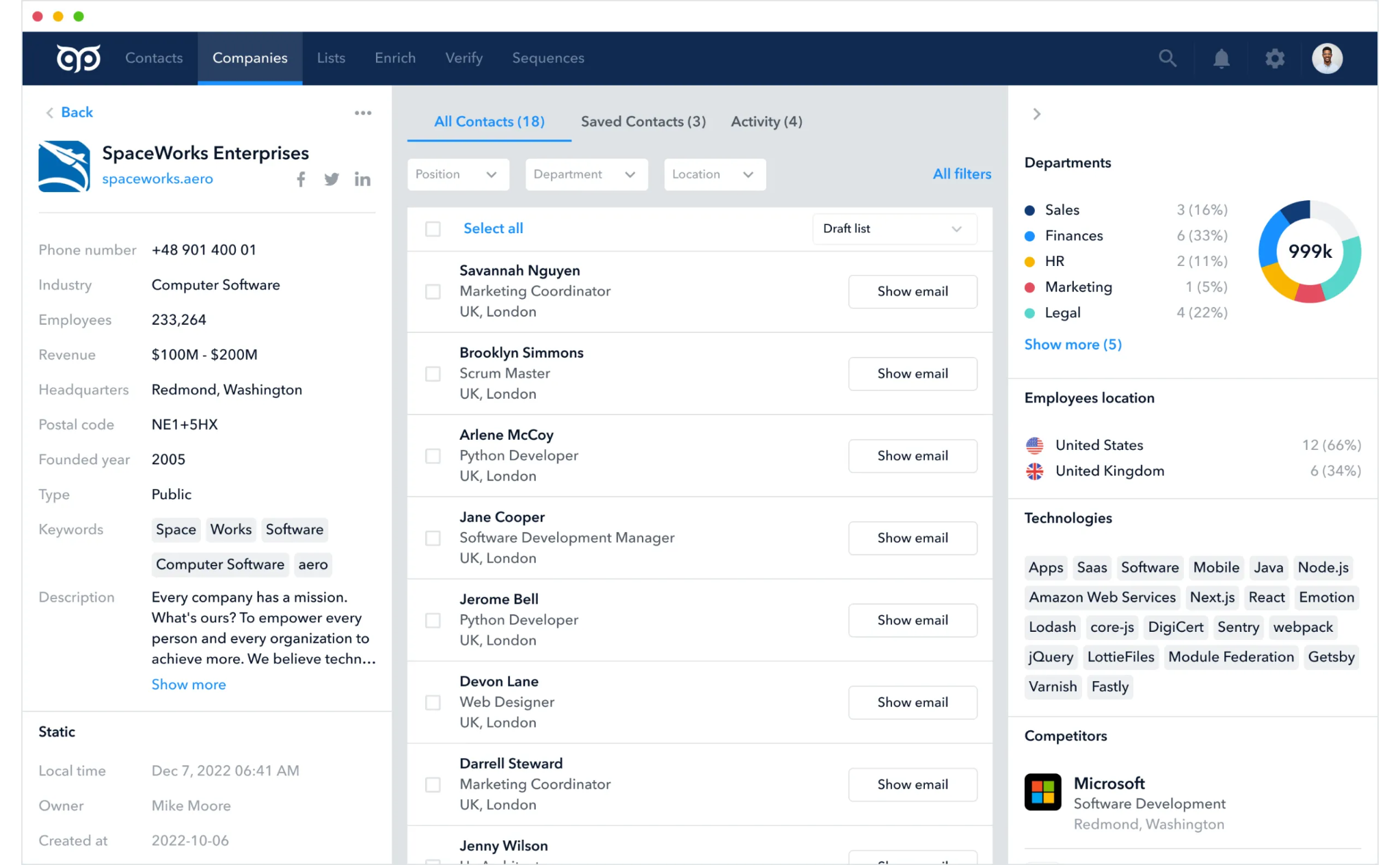
GetProspect's CRM is a contact and company management layer inside the platform. It is not a full sales pipeline CRM with deal stages and forecasting. Instead, it keeps prospect records organized and connected to enrichment history, email verification status, and outreach activity.
Source: GetProspect
The CRM supports contacts and companies as separate but linked objects, with 20+ enrichment attributes populated from GetProspect's database. Users can create custom properties (text, number, date, dropdown) that double as personalization variables in cold email sequences. Records are organized into nested folders, static lists, and dynamic views that update automatically as property values change.
Bulk actions cover enrichment, email finding, verification, property editing, and deletion across selected records. Deleted records can be recovered. An ignore list excludes specific contacts or companies from future prospecting.
The CRM is available on the free plan, lowering the barrier for small teams. Native integrations sync data with HubSpot, Salesforce, Pipedrive, and Zoho, with Zapier connecting to 5,000+ additional apps.
Pricing: Credit-based plans with monthly billing, credit rollover, and unlimited teammates.
GetProspect uses a credit-based model where credits are consumed only when a verified email is found and saved. All paid plans include unlimited teammates sharing the same credit pool. Tiers differ only by volume.
Plan | Monthly Price | Valid Emails/mo | Verifications/mo | Phone Credits |
|---|---|---|---|---|
Free | $0 | 50 | 100 | 5 |
Starter | $49 | 1,000 | 2,000 | 5 |
Growth 5k | $99 | 5,000 | 10,000 | 5 |
Growth 20k | $199 | 20,000 | — | 5 |
Growth 50k | $399 | 50,000 | — | 5 |
Annual plans save about 30% (the Starter plan drops to roughly $34.30 per month). All features (LinkedIn extension, database access, CRM, integrations, API, bulk finder, Google Sheets add-on) are available across every tier, including free.
Credits roll over month-to-month, capped at one month's allowance. Subscriptions can be paused for 1-3 months on monthly plans, with a 30% discount on the first month back after a pause of one month or longer. There are no overage charges; once credits run out, users must upgrade or wait for the next cycle.
One limitation: phone number credits are capped at 5 per month across all plans, with more available as a paid add-on. For teams that also make calls, this is a real constraint.
The free plan is permanent (not a time-limited trial) with 50 verified emails and 100 verifications per month. No credit card required. However, the Terms of Use state that there is no refund policy on any paid fees.
Where GetProspect Falls Short
GetProspect works as an affordable email-finding tool for small teams, but limitations surface as prospecting needs grow. These reflect a platform built for email discovery, not go-to-market execution.
Data Coverage Gaps: GetProspect claims 200M B2B contacts, but real-world accuracy varies. G2 reviewers report deliverability closer to 60% in certain industries, and coverage thins in niche verticals and non-English-speaking regions. The 95%+ accuracy claim may hold in well-covered markets but falls short elsewhere. With only 38 G2 reviews at the time of writing, independent verification is limited.
No Buyer Intent or Signal Intelligence: GetProspect tells you who someone is and how to email them. It does not tell you whether they're researching solutions, evaluating competitors, or showing buying behavior. There are no intent signals, no technographic triggers, no job-change alerts, and no website visitor identification. For teams that want to prioritize outreach by buying readiness rather than job title and company size, this is a fundamental gap.
Minimal Phone Number Coverage: All plans include just 5 phone credits per month. For any SDR workflow that combines calls with email, this is impractical. Additional phone credits require a separate purchase, and pricing for higher volumes requires contacting support. Multi-channel teams will pay extra or use a separate tool for phone data.
Basic Analytics and Reporting: The cold email module tracks opens, clicks, and replies, but lacks the depth of dedicated outreach tools. G2 reviewers note missing time-of-day analysis, persona-level breakdowns, and funnel metrics. For teams optimizing large-scale campaigns, the analytics provide limited insight.
Platform Reliability Concerns: G2 reviewers report slow loading screens, blank screens, CSV/XLSX export failures, and search UI inconsistencies where filters don't reliably update results. For a tool at the front of your outreach pipeline, these stability issues create friction.
No AI-Powered Execution or Conversation Intelligence: GetProspect lists AI personalization via ChatGPT as "coming soon" on its cold email page, but no AI features are available today. There is no conversation intelligence, no AI-generated account summaries, and no predictive scoring. As the B2B prospecting market moves toward AI-driven execution, GetProspect hasn't followed.
These limitations come naturally from a bootstrapped, small-team operation focused on doing one thing affordably. But for teams whose needs extend beyond finding emails (to understanding which accounts are worth contacting and why), the gaps show.
Top GetProspect Alternative for Growing Teams: ZoomInfo
ZoomInfo addresses GetProspect's limitations by operating at a different scale. Where GetProspect is an email finder with added tools, ZoomInfo is a GTM platform built on 500M contacts, 100M companies, 135M+ verified phone numbers, 120M direct-dial phone numbers, and 200M+ verified business emails. Founded in 2007 by Henry Schuck, ZoomInfo is a publicly traded company (NASDAQ: GTM) serving 35,000+ companies, including Adobe, Snowflake, and Thomson Reuters.
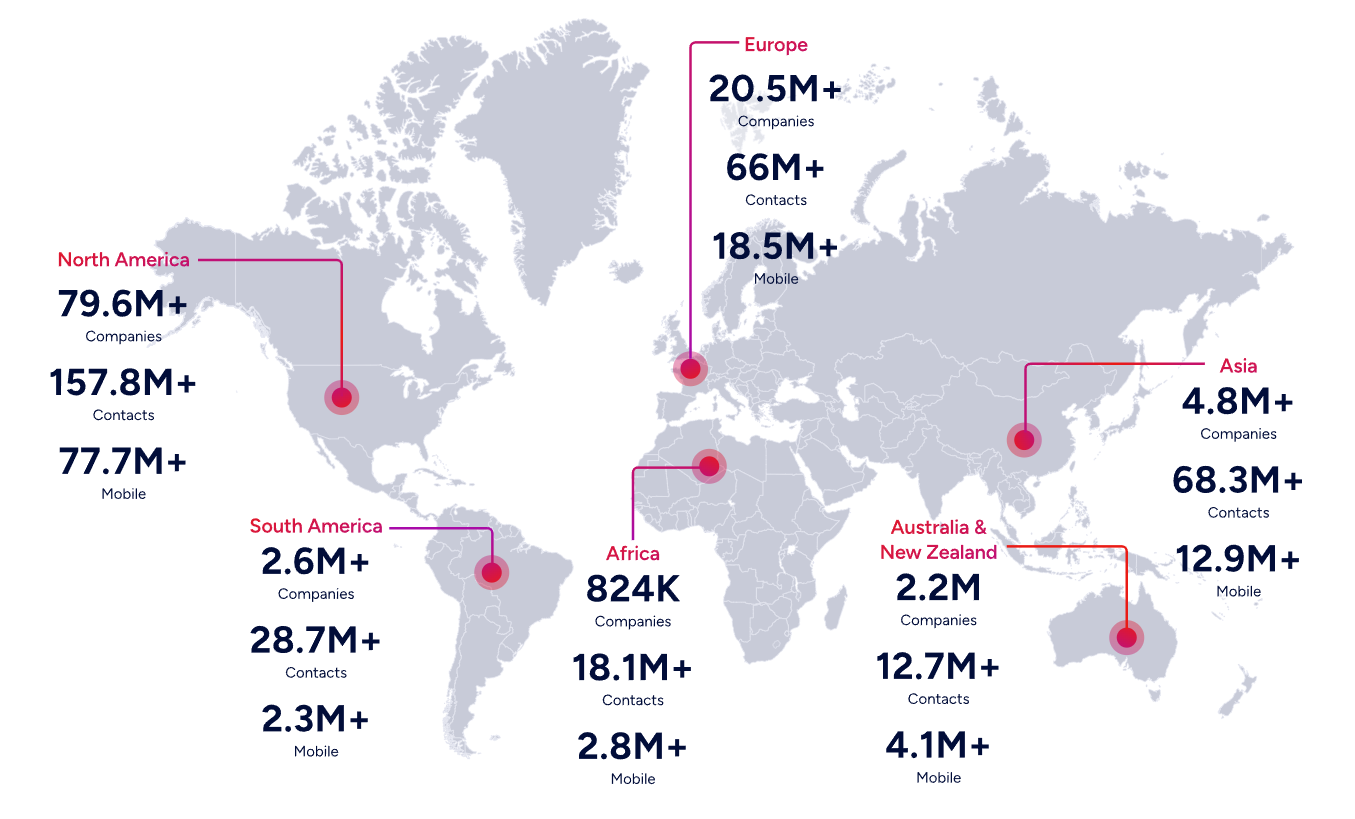
B2B Data: ZoomInfo provides verified B2B data at scale, backed by 300+ human researchers.
GetProspect's 200M contacts cover the basics for SMB prospecting. ZoomInfo operates at a different level: 500M contacts, 100M companies, 135M+ verified phone numbers, and 200M+ verified business emails, maintained by a multi-source verification pipeline with 300+ human researchers and up to 95% accuracy on first-party data.
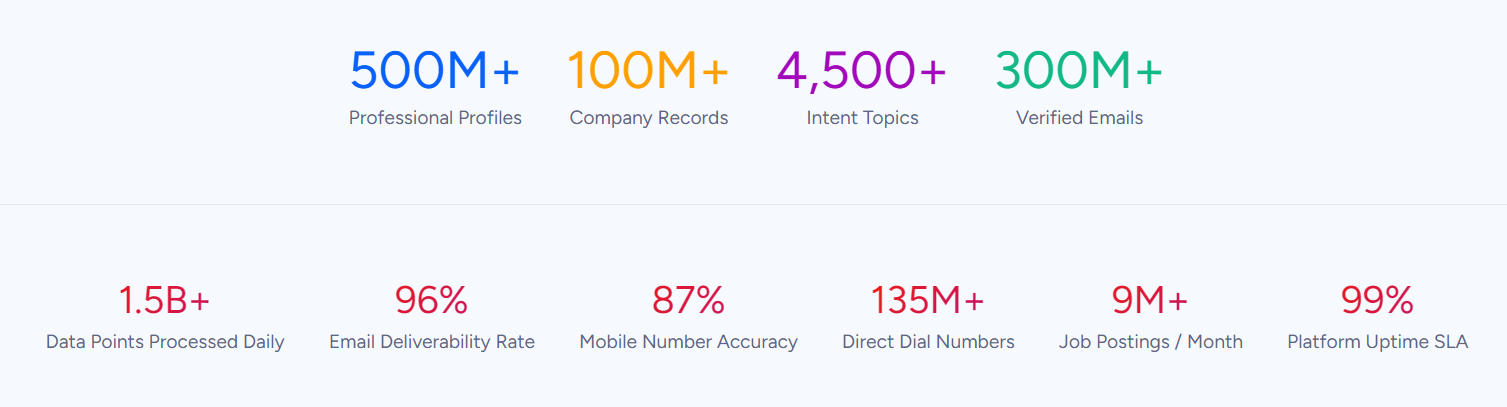
The data covers three dimensions GetProspect does not. Identity data tells you who buyers are and how to reach them. Company context covers org charts, industry data, and technographic profiles across 30,000+ technologies at 30M+ companies. Dynamic signals show when accounts are in-market through intent data tracking 210 million IP-to-Organization pairings and 6 trillion+ keyword-to-device pairings monthly.
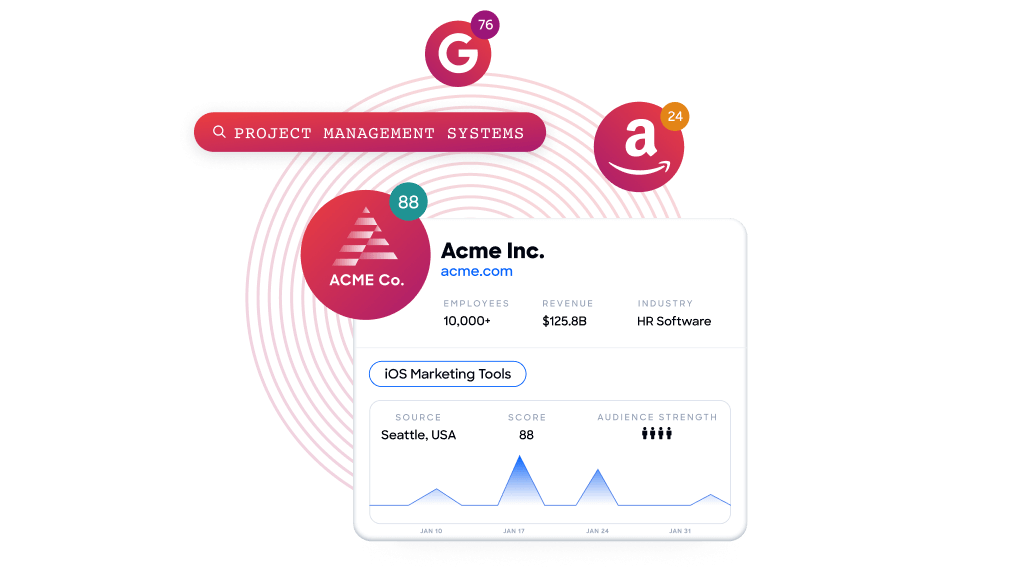
Where GetProspect gives you 5 phone credits per month, ZoomInfo provides 120M direct-dial phone numbers as a core data layer. Where GetProspect's coverage thins in niche verticals, ZoomInfo launched nine vertical datasets in 2025 covering franchise ownership, restaurant operations, and commercial fleet intelligence.
The data advantage has outside validation. In a Fortune 500 competitive RFP analyzing 25 million contacts across vendors, an independent consultant concluded that "no other competitor came even close." ZoomInfo holds 133 No. 1 rankings on G2 across Sales Intelligence, Buyer Intent, and Data Quality categories.
Vensure's VP of Revenue Operations noted that ZoomInfo gives them the information they need to execute without digging across multiple spreadsheets, helping the company reach its goals and acquire clients faster. (Vensure)
GTM Context Graph: ZoomInfo's intelligence layer captures not just what happened in a deal, but why.
GetProspect provides contact data. ZoomInfo provides context. The GTM Context Graph processes 1.5B+ data points daily, combining ZoomInfo's B2B data with a customer's CRM records, conversation transcripts, email threads, and behavioral signals into a single intelligence layer.
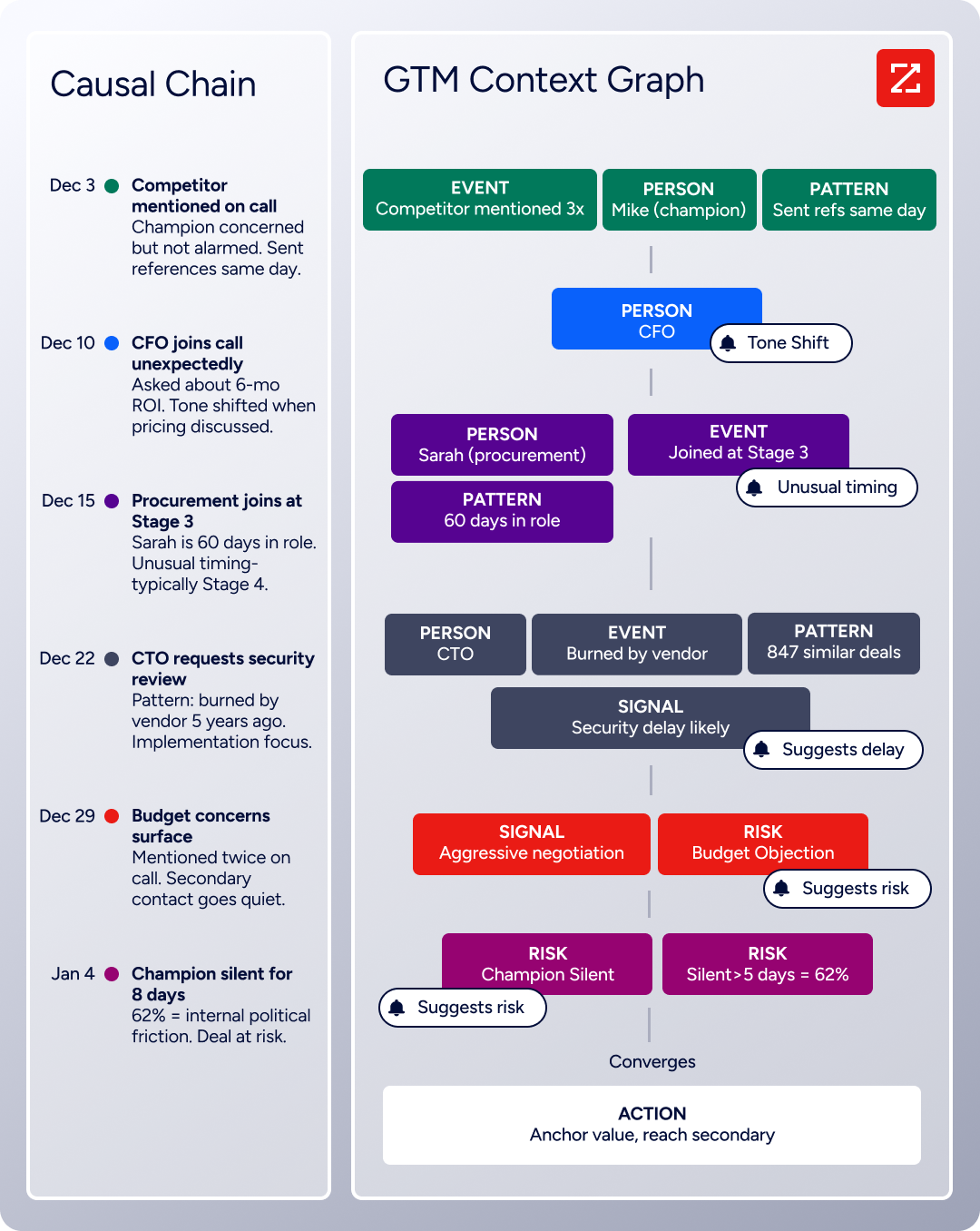
A CRM records that a deal moved stages. Conversation intelligence transcribes what the VP of Finance said on the last call. Intent data logs a spike in research activity. The GTM Context Graph reasons across all three to understand why the deal moved, which actions drove the outcome, and what patterns from similar deals predict next.
This intelligence powers Guided Intent (which identifies topics historically correlated with deal success rather than requiring manual topic selection), WebSights (which resolves anonymous website traffic to companies and buying teams), and Account Fit Scores (predictive scoring that shows which company-level patterns predict conversion).
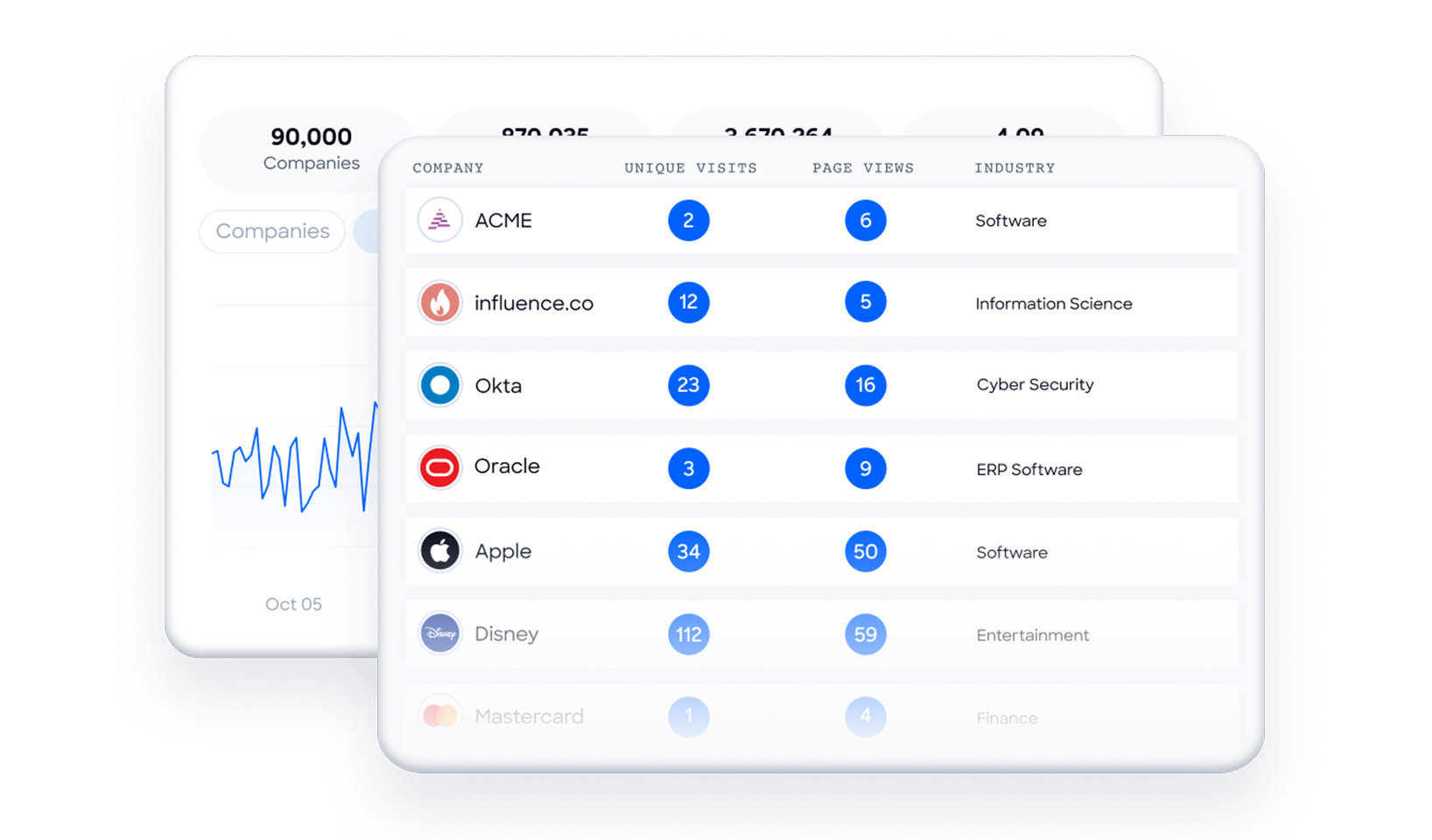
None of this exists in GetProspect. There are no intent signals, no conversation analysis, no predictive scoring, and no cross-signal reasoning. The difference: a tool that tells you someone's email address versus a platform that tells you whether they're worth emailing now.
Seismic attributed 39% of active pipeline to opportunities identified or influenced by ZoomInfo signals, with the sales team reporting 54% productivity gains and 11.5 hours saved per week. Their Chief Business Officer noted that combining CRM data, external signals, and AI-driven context helped craft account-specific messages that people responded to immediately. (Seismic)
Universal Access: Use ZoomInfo's intelligence in any tool, any workflow, any AI agent.
GetProspect integrates with HubSpot, Salesforce, Pipedrive, and Zoho, with broader connectivity through Zapier. ZoomInfo delivers its intelligence through three channels so teams can work wherever they prefer.
GTM Workspace is the seller's front-end: a workspace where prioritized accounts, AI-drafted outreach, and deal execution come together. AI agents handle account research, generate follow-ups, monitor signals, and update CRM fields. GTM Studio serves marketers, RevOps, and GTM engineers: a canvas where audience definition, campaign orchestration, and pipeline measurement happen in natural language rather than engineering tickets.
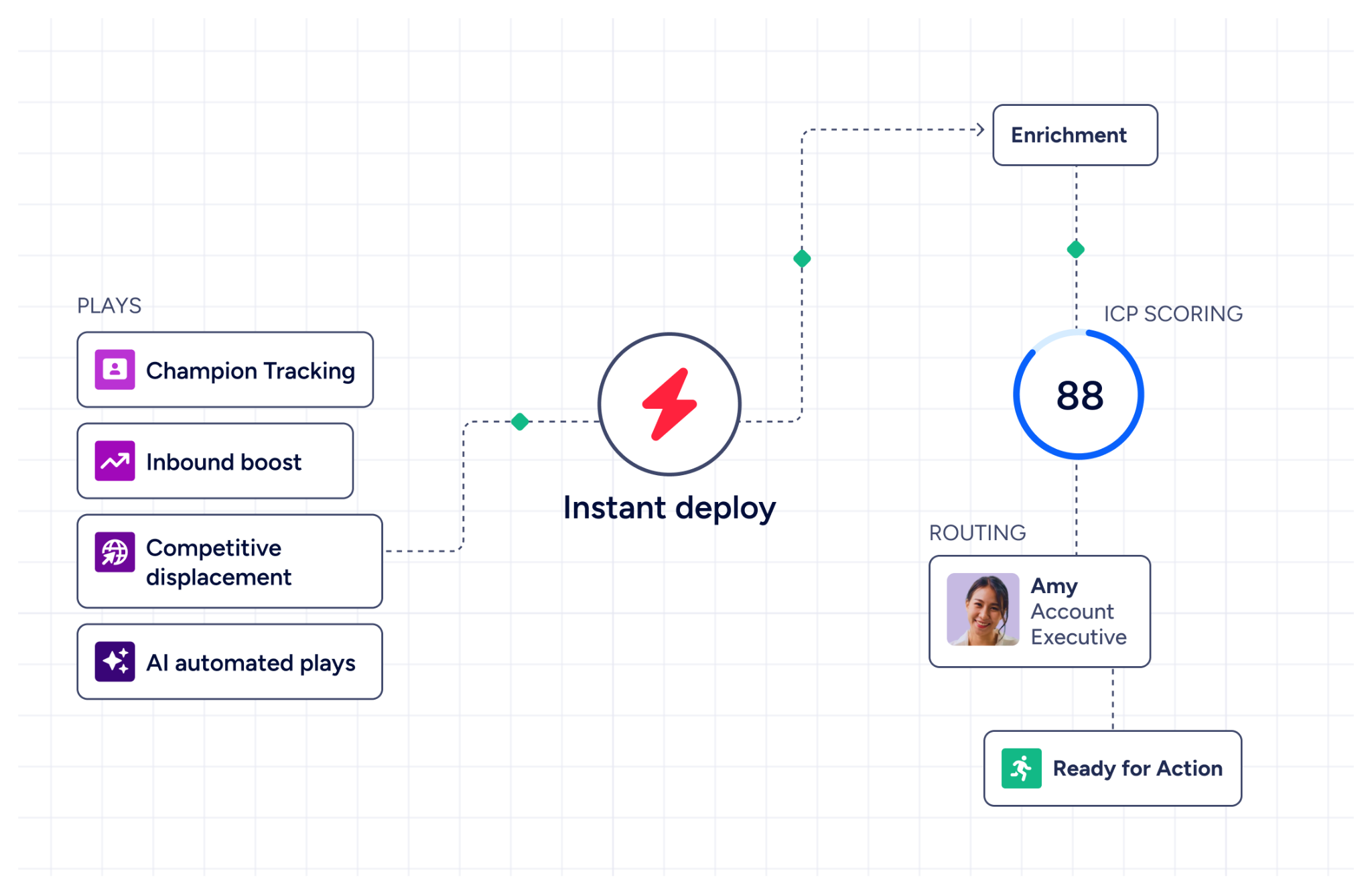
For teams building beyond ZoomInfo's own products, APIs and MCP expose the same intelligence to any custom agent, internal tool, or partner platform. ZoomInfo MCP is listed in the Claude directory and currently supports Claude and ChatGPT. API access is included in all relevant plans.
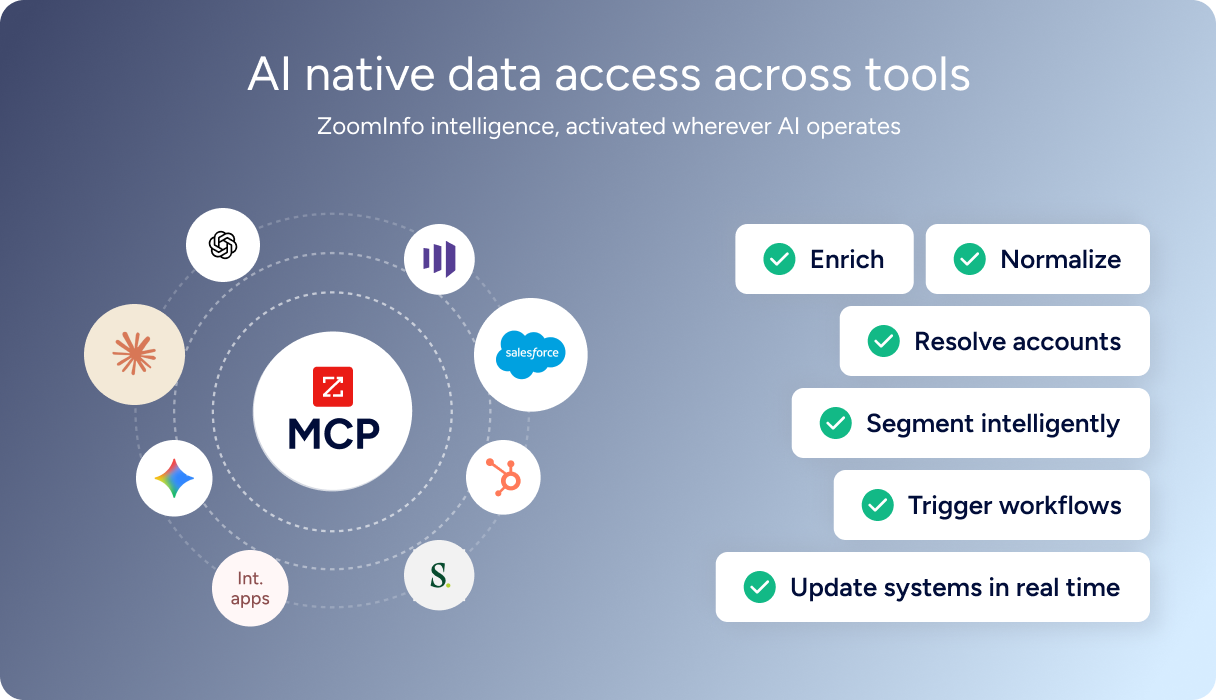
ZoomInfo also integrates with 120+ partner applications across CRM, marketing automation, sales engagement, data warehouses, and communications platforms (including Salesforce, HubSpot, Microsoft Dynamics 365, Snowflake, Outreach, and Salesloft).
BDO Canada's Senior Marketing Intelligence Analyst noted that ZoomInfo's API integrates into any process with information available immediately, reducing time spent on data dashboard updates by 87%. (BDO Canada)
Pricing and Free Entry: Custom-quoted plans with a permanent free tier for individual users.
ZoomInfo uses consumption-based pricing with no public prices, custom-quoted by usage patterns, number of users, credit volume, and features selected. This differs from GetProspect's transparent per-tier pricing, and the cost reflects the platform's enterprise scope.
For individual users and small teams, ZoomInfo Lite provides permanent free access (no credit card, no time limit) with 10 monthly export credits, access to the B2B database with filters, the ReachOut Chrome Extension, WebSights Lite (up to 10 website visitor reveals per day), built-in email sending, and HubSpot integration. A separate 7-day free trial offers access to paid features.
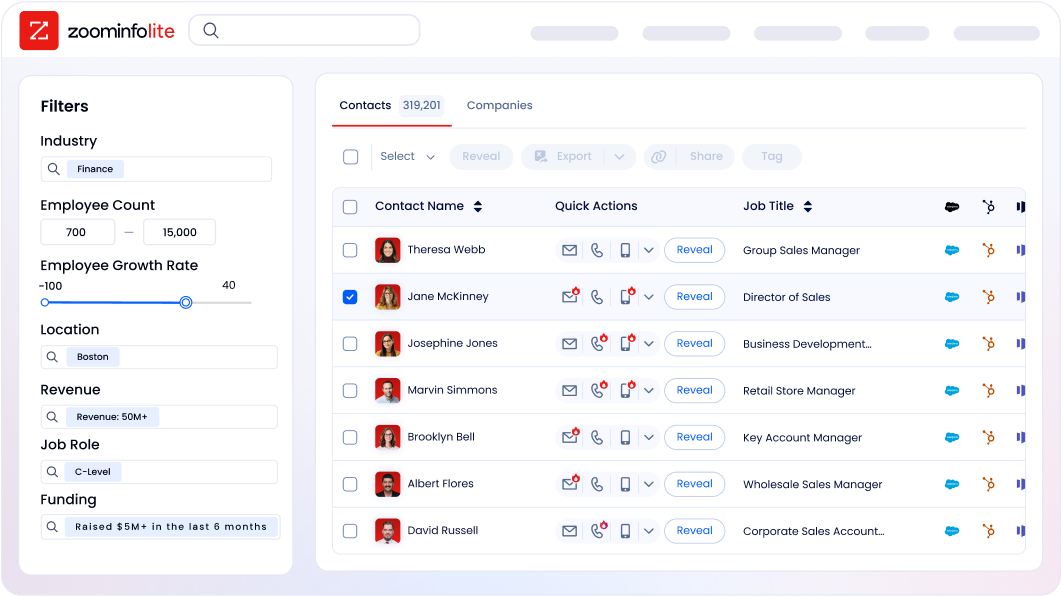
Paid plans span Sales (Professional, Advanced, Enterprise), Marketing (Marketing Demand, ABM Lite, ABM Enterprise), and standalone products (Chorus, Chat). The differences between tiers go beyond credit volume to include different capabilities: intent signals, AI features, integrations, and dedicated support.
ZoomInfo's compliance infrastructure (ISO 27001, ISO 27701, SOC 2 Type II, TRUSTe GDPR and CCPA) is built into the platform, with a Trust Center. GetProspect is GDPR-compliant with EU hosting but does not hold third-party security certifications.
SpringDB's CEO reported getting 10x the value by treating ZoomInfo as a platform rather than a single-team tool, with clients seeing 2-3x increases in campaign conversions, 300% increase in database usability, and 30-50% lift in average deal size. (SpringDB)
GetProspect or ZoomInfo: Comparison Summary
GetProspect | ZoomInfo | |
|---|---|---|
Target audience | SMB sales teams, agencies, recruiters | Enterprise and upper mid-market GTM teams |
Contact database | 200M B2B contacts | 500M contacts, 100M companies |
Phone numbers | 5 credits/month (add-on for more) | 135M+ verified, 120M direct dials |
Email verification | 12-step process with catch-all tech | Multi-source verification, 300+ human researchers |
Buyer intent data | Not available | Intent signals, Guided Intent, website visitor tracking |
AI capabilities | None (AI personalization "coming soon") | GTM Context Graph, AI agents, AI-drafted outreach |
Conversation intelligence | Not available | Chorus (recording, transcription, deal intelligence) |
CRM | Lightweight contact management | GTM Workspace + native CRM integrations |
Marketing/ABM tools | Not available | GTM Studio, native DSP, FormComplete, ABM orchestration |
Integrations | HubSpot, Salesforce, Pipedrive, Zoho, Zapier | 120+ native integrations, APIs, MCP, cloud partners |
Security certifications | GDPR compliant, EU hosted | ISO 27001, ISO 27701, SOC 2 Type II, TRUSTe GDPR/CCPA |
Free plan | 50 emails/month, permanent | ZoomInfo Lite (10 exports/month, permanent) |
Paid pricing | $49-$399/month (transparent) | Custom-quoted (consumption-based) |
Billing flexibility | Monthly or annual, credit rollover | Annual contracts standard |
Team pricing | Unlimited teammates, all plans | Seat-based within custom agreements |
Best for | Affordable LinkedIn-based email finding | GTM intelligence and execution at scale |
Final Verdict
The choice between GetProspect and ZoomInfo depends on where your team sits today and where it's heading.
Choose GetProspect if you need an affordable email-finding tool that works with LinkedIn. It fits solo SDRs, small agencies, and bootstrapped teams whose main workflow is finding verified email addresses, organizing them in a CRM, and running cold email sequences. The transparent pricing, monthly billing, and credit rollover make it practical for teams with variable prospecting volumes. If your strategy is email-first and your budget is tight, GetProspect delivers good value.
Choose ZoomInfo if your go-to-market strategy requires more than contact data. Choose it when you need to know which accounts are in-market, who the decision-makers are and how to reach them by phone, what signals predict deal success, and how to coordinate outreach across your revenue team. ZoomInfo's data, intelligence layer, and AI execution tools answer the questions a point email finder cannot: not just who to contact, but when, why, and with what message. For teams ready to invest in a full GTM platform, ZoomInfo provides the foundation.
Get started with ZoomInfo Lite for free here.
GetProspect finds emails. ZoomInfo is the platform you grow into when finding emails is no longer enough.
GetProspect FAQ
Is GetProspect free to use?
Yes. GetProspect offers a permanent free plan with 50 verified email credits, 100 verification credits, and 5 phone credits per month. No credit card required. All features are accessible on the free plan; only volume is restricted. ZoomInfo also offers a permanent free tier called ZoomInfo Lite, which includes 10 monthly export credits, access to the B2B database, the ReachOut Chrome Extension, and WebSights Lite for website visitor identification.
How accurate is GetProspect's email data?
GetProspect claims 95%+ accuracy backed by a credit-refund policy, with every email verified in real time before a credit is consumed. However, G2 reviews suggest real-world deliverability can be lower in certain industries and non-English-speaking geographies. ZoomInfo maintains up to 95% accuracy on first-party data through a multi-source verification pipeline backed by 300+ human researchers, and has been validated by Forrester, Gartner, and independent Fortune 500 competitive evaluations.
Does GetProspect provide phone numbers?
GetProspect includes only 5 phone credits per month across all plans, including paid tiers. Additional credits require a separate purchase. This makes GetProspect impractical for teams that rely on phone outreach alongside email. ZoomInfo provides 135M+ verified phone numbers and 120M direct-dial numbers as a core data layer across its paid plans.
Does GetProspect offer buyer intent data?
No. GetProspect does not include buyer intent signals, technographic triggers, job-change alerts, or website visitor identification. The platform focuses on contact discovery and email verification. ZoomInfo provides intent data tracking 210 million IP-to-Organization pairings, Guided Intent that identifies topics correlated with deal success, and WebSights for resolving anonymous website visitors to companies and contacts.
Can GetProspect integrate with my CRM?
Yes. GetProspect offers native integrations with HubSpot, Salesforce, Pipedrive, and Zoho, with OAuth-based setup and in-app field mapping. It also connects to 5,000+ apps through Zapier, Make, and Integrately. Only contacts with verified email addresses are eligible for CRM sync. ZoomInfo integrates with 120+ applications natively, including Microsoft Dynamics 365, Snowflake, Outreach, and Salesloft, plus API and MCP access for custom integrations.
What is GetProspect's refund policy?
GetProspect's Terms of Use state that there is no refund or cancellation policy on any paid fees. Users can cancel at any time, with access continuing until the end of the billing period before reverting to the free plan. Subscriptions can be paused for 1-3 months on monthly plans, with a 30% discount on the first month after returning from a pause.
How does GetProspect compare to ZoomInfo for enterprise use?
GetProspect is built for SMBs and small agencies, with a core team of roughly 6-10 people and around $900K in annual revenue. It does not offer intent data, conversation intelligence, AI execution tools, or third-party security certifications. ZoomInfo is publicly traded with $1.25 billion in annual revenue, serving 35,000+ companies including Adobe, Snowflake, and Thomson Reuters. It holds ISO 27001, ISO 27701, SOC 2 Type II, and TRUSTe certifications, and is recognized as a Leader in both the Gartner Magic Quadrant for ABM Platforms and the Forrester Wave for Intent Data Providers.
Does GetProspect support multi-channel outreach?
GetProspect supports cold email only. There is no SMS, phone dialing, LinkedIn messaging automation, or social channel integration. Its outreach capability is limited to email sequences with A/B testing, auto-stop on reply, and timezone-aware scheduling. ZoomInfo supports multi-channel execution through GTM Workspace (seller workflows), GTM Studio (campaign orchestration across email, calls, ads, and direct mail), and its partnership with Salesloft for sequenced phone and email outreach.
Researching GetProspect? These comparisons and alternatives help you decide:
