
Choosing between GoHighLevel and Zoho CRM comes down to a question more basic than features or pricing: what problem are you trying to solve?
Before you commit, ask yourself:
Are you a marketing agency that needs to white-label tools for clients, or a company managing its own sales pipeline?
Do you need a platform that handles everything from funnel building to reputation management, or one focused on CRM customization and sales automation?
Is your challenge automating marketing workflows for local businesses, or finding the right B2B prospects to fill your pipeline?
Do you want unlimited contacts at a flat monthly rate, or per-user pricing that scales with your team?
Is the bottleneck your existing data, or not knowing which accounts to target and when they're ready to buy?
In short, here's what we recommend:
GoHighLevel is built for marketing agencies that want to replace their scattered client tools with one platform and build recurring SaaS revenue. It bundles CRM, funnel building, email and SMS marketing, appointment scheduling, reputation management, and voice agents into a single subscription with unlimited contacts and users. Agencies can white-label the platform and resell it under their own brand (a model HighLevel calls "SaaSPreneurship"). For agencies serving local businesses (dentists, contractors, fitness studios, restaurants), HighLevel replaces five to ten separate tools with one interface. The trade-off: a steep learning curve, an interface that can overwhelm non-technical users, and limited depth for complex B2B sales.
Zoho CRM serves SMBs and mid-market companies that want full CRM capabilities without enterprise pricing. At $40/user/month for the Enterprise tier (compared to Salesforce at $165), Zoho delivers customization through Canvas Design Studio, Blueprint process automation, and AI scoring and forecasting through its Zia engine. It integrates natively with 40+ Zoho apps spanning finance, HR, support, and project management. The trade-off: significant setup time before you see value, inconsistent support on lower tiers, and a marketplace that's a fraction of Salesforce's.
Both platforms manage and nurture leads already in your system. But for B2B teams, the harder problem comes before the CRM: identifying which accounts to target, knowing when they're in-market, and reaching verified decision-makers. That's a different challenge.
ZoomInfo is a B2B data and go-to-market platform built on 500M contacts, 100M companies, 135M+ verified phone numbers, and 200M+ verified business emails. Its GTM Context Graph combines this data with your CRM records, conversation transcripts, and behavioral signals to show not just what's happening in your pipeline, but why deals move or stall. For B2B teams, ZoomInfo solves the problem that sits upstream of any CRM: who to contact, when to engage, and what to say. You can access it through GTM Workspace for sellers, GTM Studio for marketers and RevOps, or APIs and MCP that pipe it into any tool you already use, including Zoho CRM.
If your growth depends on finding the right B2B prospects and knowing when they're ready to buy, see how ZoomInfo works.
GoHighLevel vs. Zoho CRM vs. ZoomInfo at a glance
GoHighLevel | Zoho CRM | ZoomInfo | |
|---|---|---|---|
Primary function | All-in-one marketing platform for agencies | CRM and sales force automation | B2B data and go-to-market execution |
Target buyer | Marketing agencies and their SMB clients | SMBs and mid-market companies | B2B sales, marketing, and RevOps teams |
CRM depth | Basic pipelines, agency-oriented | Customizable, multi-pipeline, Blueprint enforcement | AI account prioritization and deal intelligence |
AI capabilities | Voice AI, Conversation AI, Content AI | Zia (predictive scoring, agentic AI, generative CRM setup) | GTM Context Graph, AI agents, intent signals |
Data source | Your own leads | Your own data + Zia enrichment | 500M contacts, 100M companies, intent signals, technographics |
White-label | Full white-label and resale | Not available | Not applicable |
Pricing model | Flat monthly fee, unlimited contacts/users | Per-user/month, tiered features | Custom-quoted, consumption-based |
Starting price | $97/month | Free (3 users) / $14/user/month | Free tier (ZoomInfo Lite) / custom for paid |
Best for | Agencies serving local businesses | Companies managing their own sales process | B2B teams that need prospect intelligence at scale |
Three platforms, three different problems
These three platforms look similar on a feature checklist. They all have CRM, automation, and AI. But they were designed for different jobs.
GoHighLevel started from a frustration: marketing agencies juggling too many tools.
When Shaun Clark, Varun Vairavan, and Robin Alex founded the company in 2018, the goal was to unify CRM, email marketing, funnel building, scheduling, and reputation management into one platform that agencies could use for clients and resell.
That agency-first origin shapes everything.
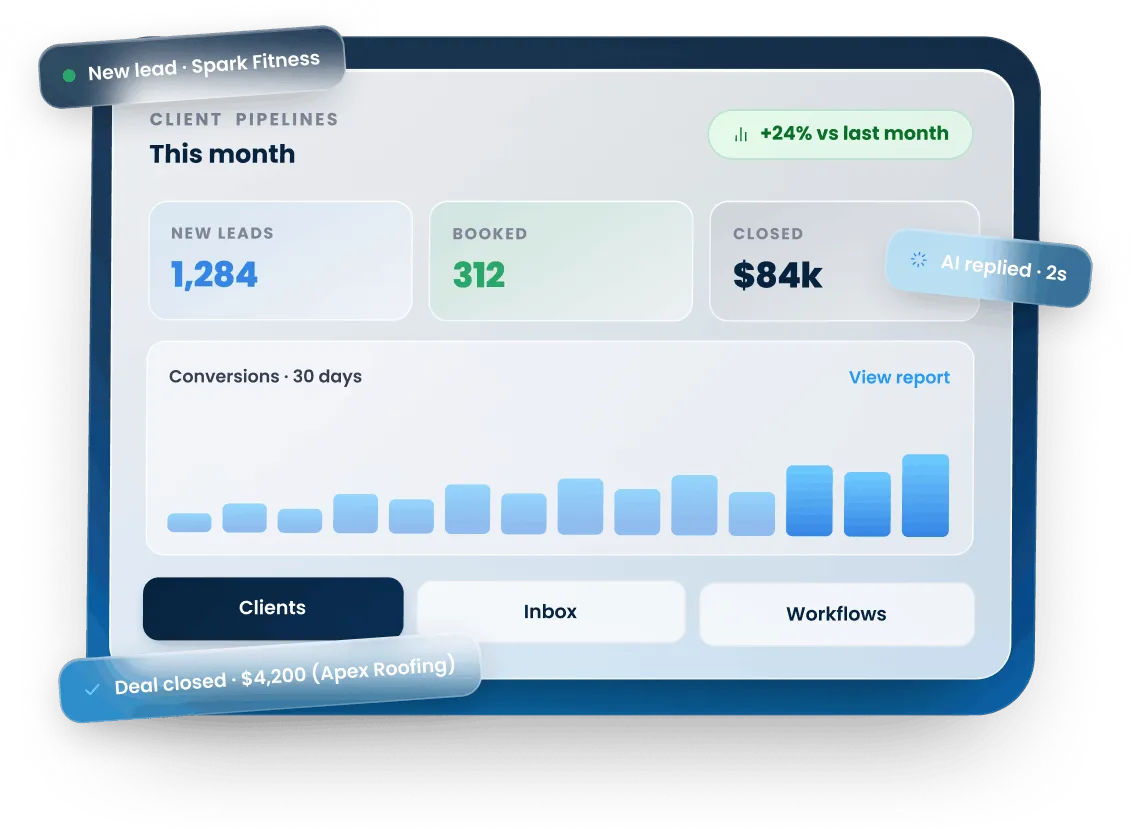
The sub-account architecture lets one agency manage dozens of client businesses in separate environments. The Snapshot system clones client setups instead of rebuilding from scratch. Flat pricing with unlimited contacts means an agency's cost doesn't spike as client lists grow.
Source: GoHighLevel
Zoho CRM started from a different place.
Launched in 2005, it was built for businesses that wanted to manage their own sales pipeline without paying Salesforce prices. Over two decades, Zoho has grown into a 55-app ecosystem covering CRM, finance, HR, marketing, and analytics, all from a single vendor that has never taken venture capital, never conducted an IPO, and never been acquired.
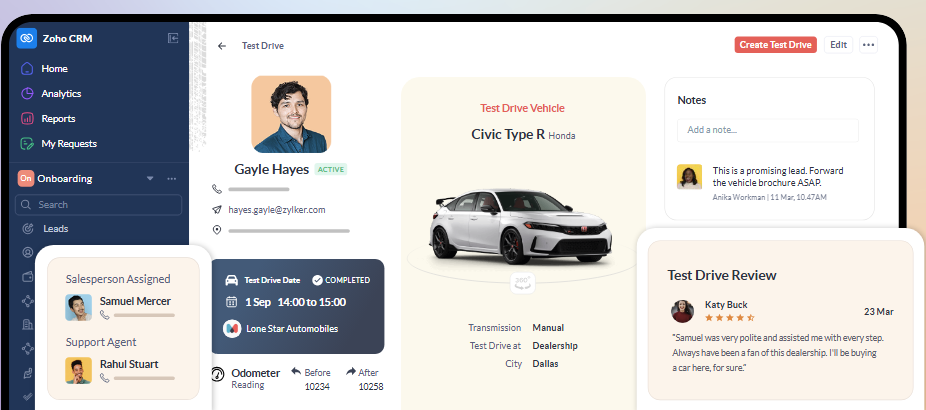
The result is a CRM with depth: configurable pipelines, territory management, CPQ, process enforcement through Blueprint, and a customization stack spanning no-code, low-code, and pro-code paths.
Source: Zoho
ZoomInfo was founded in 2007 on a different conviction: that go-to-market teams can't sell if they don't know who to sell to.
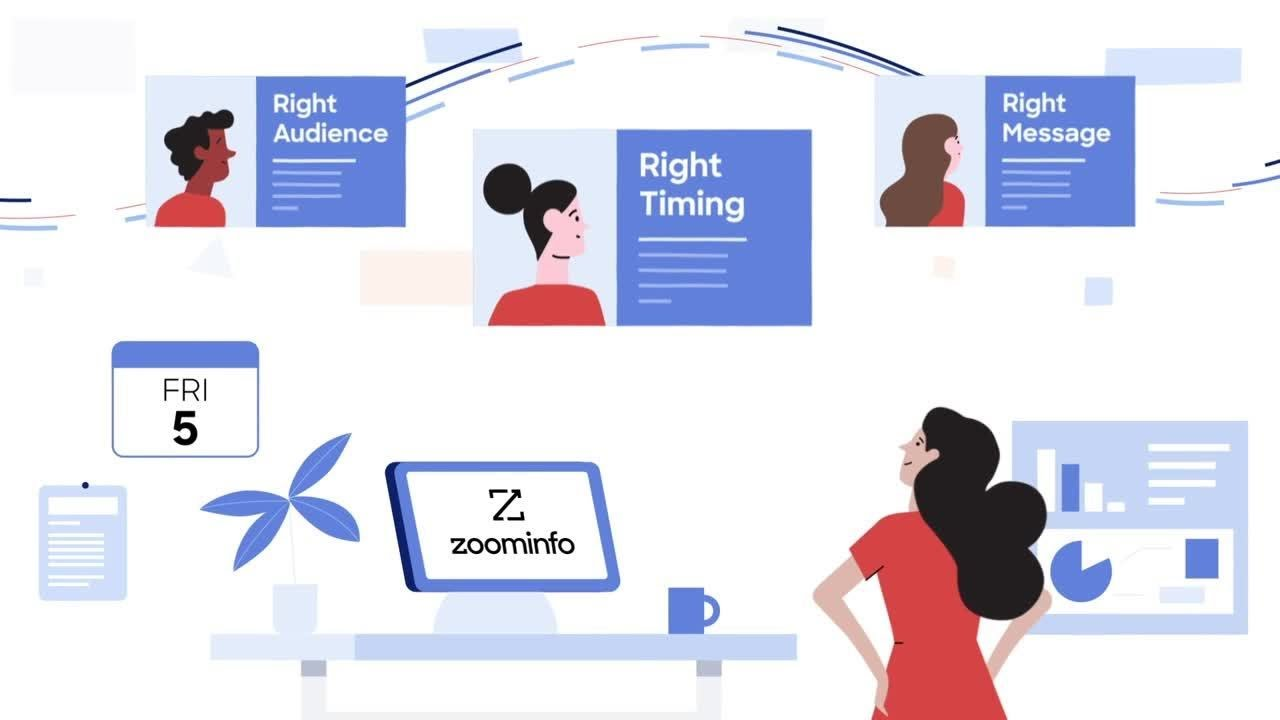
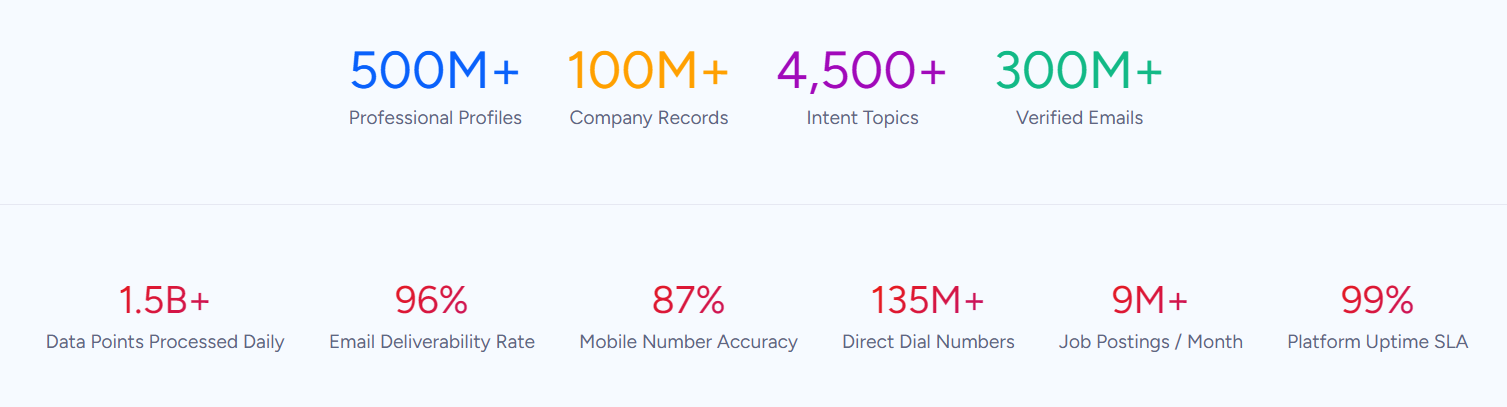
While GoHighLevel and Zoho focus on managing leads you already have, ZoomInfo focuses on finding the leads you should pursue. Its database covers 500M contacts and 100M companies, verified by 300+ human researchers and multi-source AI validation. In a Fortune 500 competitive RFP analyzing 25 million contacts across vendors, the independent consultant concluded that "no other competitor came even close."
The distinction matters because it determines what each platform can and cannot do.
GoHighLevel can build your landing page and send automated SMS follow-ups, but it won't tell you which companies are researching your category. Zoho CRM can enforce a multi-stage sales process with territory rules and approval chains, but it relies on data you bring in from elsewhere. ZoomInfo can tell you that a VP of Operations at a target account just changed jobs, is researching your competitor's product, and is reachable at a verified direct dial, then surface that insight inside your CRM.
CRM and pipeline management
If your primary need is a CRM, GoHighLevel and Zoho CRM take different approaches to the same job.
GoHighLevel's CRM is structured around Contacts and Opportunities.
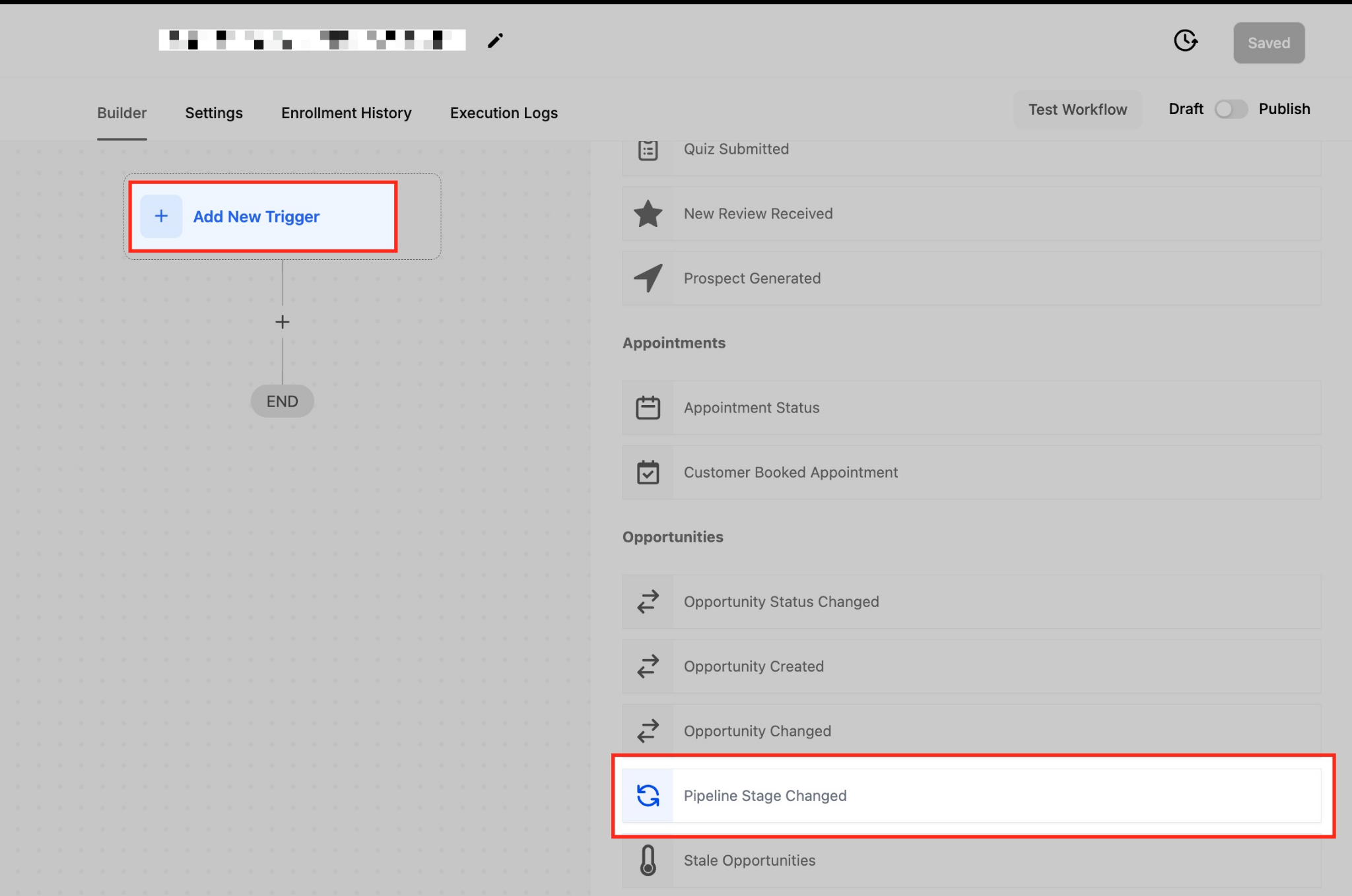
Contacts flow in from landing pages, forms, or inbound calls. Opportunities represent deals moving through pipeline stages. Drag-and-drop Kanban boards show where things stand. The value is in what happens when an opportunity moves: a Pipeline Stage Changed trigger fires a workflow that can send an SMS, assign a task, update a field, or launch an email sequence, all without leaving the platform.
Source: GoHighLevel
For agencies, the advantage is economics. Unlimited contacts and users on every plan means an agency managing 50 client accounts with thousands of contacts each pays the same flat monthly rate. Compare that to CRMs charging per contact or per seat, and the savings add up fast.
But HighLevel's CRM wasn't designed for complex B2B sales. If you need territory management, multi-currency deals, approval workflows, or detailed forecasting, you'll find gaps.
Zoho CRM is built for those scenarios.
The Sales Force Automation suite includes configurable multi-pipeline management (different deal flows for different products or regions), territory management with rule-based account assignment, CPQ for configuring product bundles and generating quotes, and sales forecasting that splits pipeline into Committed, Best Case, and Open categories.
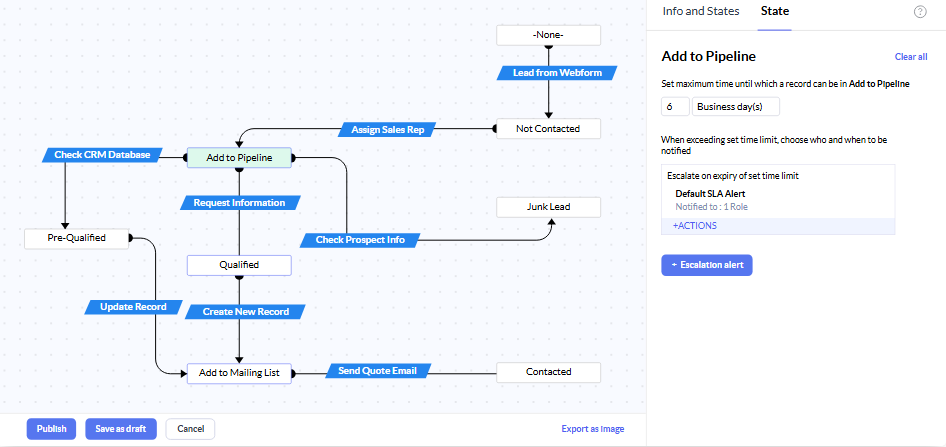
Blueprint is Zoho's process enforcement layer. Unlike pipeline views that are cosmetic, Blueprint requires reps to complete specific actions (logging a call, filling required fields, getting manager approval) before advancing a deal. It's a compliance tool, not a visualization.
Source: Zoho
The CRM runs on Module360 infrastructure, processing over 1 billion events per day and supporting up to 1.5 billion records in a single org. Scale isn't a constraint.
ZoomInfo's approach to pipeline starts earlier in the process.
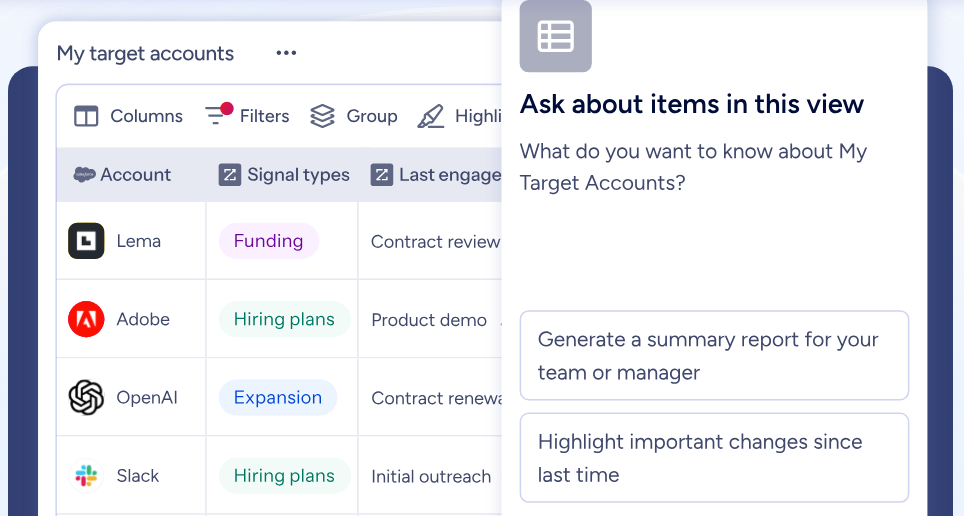
GTM Workspace doesn't replace your CRM. It sits alongside it, surfacing prioritized accounts, deal intelligence, and next actions from the GTM Context Graph. When a target account starts researching your competitor, ZoomInfo detects the intent signal, identifies buying committee members with verified contact data, and pushes the account into your seller's workspace with a pre-drafted outreach message.
Source: ZoomInfo
GoHighLevel and Zoho manage the pipeline. ZoomInfo helps fill and accelerate it.
Spekit saw opportunities at higher-scoring accounts 43% more likely to turn into qualified pipeline, moving 58% faster through qualification. (Spekit)
Marketing automation and outreach
All three platforms automate outreach, but their approaches reflect their audiences.
GoHighLevel covers the most channels.
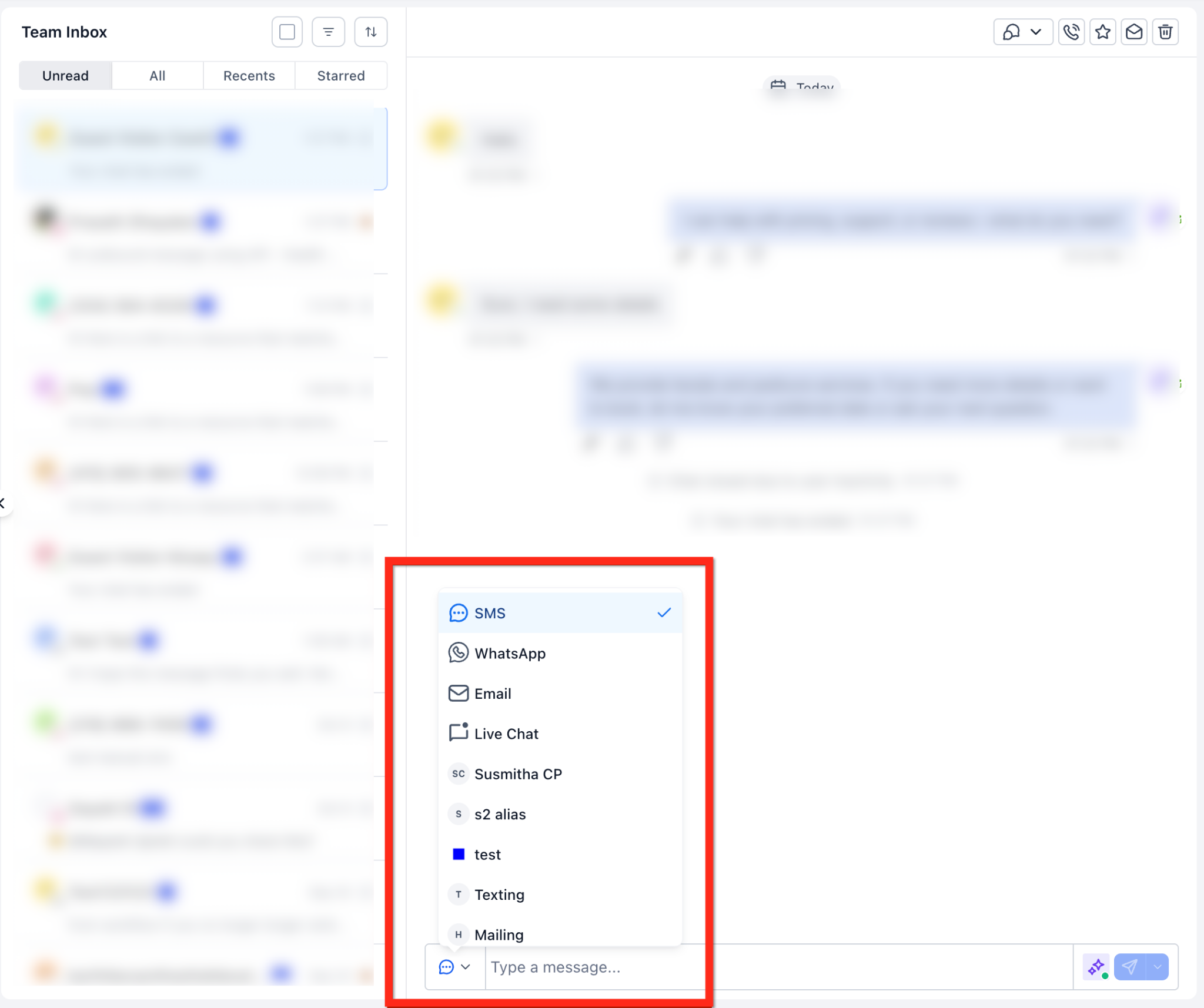
Its workflow automation engine offers 16 native communication actions spanning SMS, email, phone calls, voicemail drops, Facebook Messenger, Instagram DMs, WhatsApp, and Google Business Profile messages, all from a single builder with no Zapier required.
Source: GoHighLevel
For local business marketing (appointment reminders, review requests, reactivation campaigns, missed-call text-backs), this coverage is hard to match. The Unified Conversations inbox puts every channel into one chronological thread per contact, so an agency managing a dental practice can see the SMS, email reply, and Instagram DM from the same patient in one view.
Zoho CRM approaches automation with more structure.
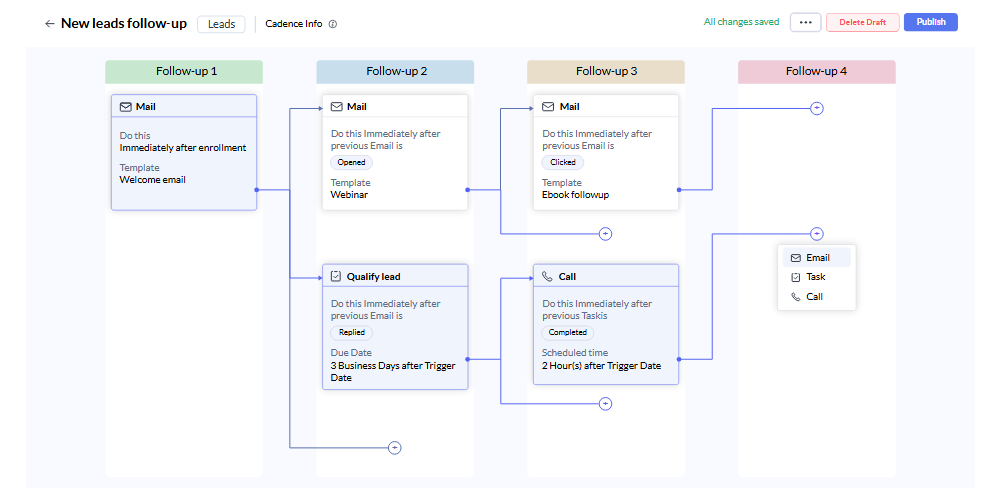
Cadences build branching follow-up sequences that adapt to how a prospect responds. If an email goes ignored, the next step shifts to a phone call. If a link gets clicked, it skips ahead to a meeting request. SalesSignals fires real-time notifications when a prospect opens an email, starts a chat, or engages on social media. At the Enterprise tier, CommandCenter orchestrates customer journeys across departments, with PathFinder showing how customers move through touchpoints.
Zoho's automation is built for sales-led organizations with defined processes. It's more structured than GoHighLevel's but narrower in channel coverage (no native voice AI, no reputation management workflows).
Source: Zoho
ZoomInfo automates at a different layer.
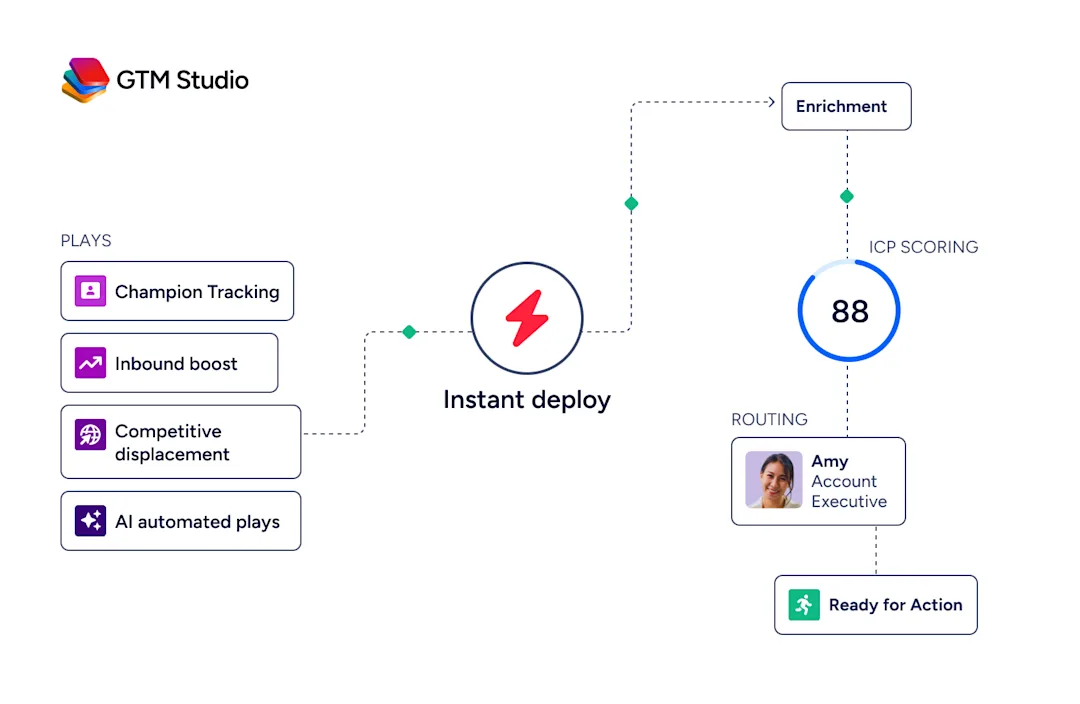
Instead of automating the mechanics of sending messages, GTM Studio decides which messages to send, to whom, and when. Pre-built GTM plays (inbound acceleration, champion tracking, competitive displacement, ICP targeting) launch in one click. It triggers email, calls, ads, and direct mail based on buyer behavior. Expansion plays that used to take three weeks now launch in 30 minutes.
Source: ZoomInfo
GoHighLevel and Zoho automate what you do with leads. ZoomInfo automates finding the right leads and triggering the right play at the right moment.
AI capabilities go in different directions
All three platforms lead with AI, but each applies it to a different problem.
GoHighLevel's AI focuses on replacing manual work in agency operations.
Voice AI runs phone agents that handle inbound and outbound calls around the clock, booking appointments, updating CRM fields, and triggering follow-up workflows during the call. The platform processed 7M+ Voice AI calls in 2025. Conversation AI automates SMS and chat interactions in either suggestive mode (drafts for human review) or full auto-pilot. Content AI generates social posts, email sequences, and funnel copy, with a Brand Voice feature that keeps tone consistent.
The $97/month AI Employee add-on bundles these capabilities at a flat per-sub-account rate.
This is AI designed to cut headcount in agency operations. A solo operator can use Voice AI for intake calls, Conversation AI to qualify leads by text, and Content AI to write social posts, running a one-person shop that works like a team.
Zoho's Zia takes a more analytical approach.
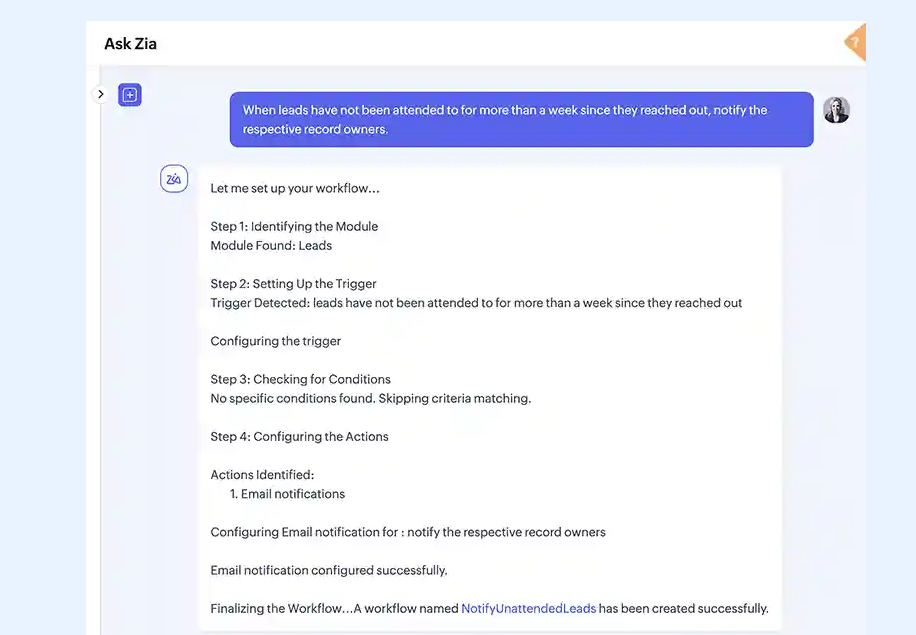
Zia covers three layers: predictive intelligence (lead scoring, churn prediction, field prediction, AI forecasting), generative AI (module creation, workflow creation, and report generation from natural language), and agentic AI (autonomous agents that plan and execute multi-step sales tasks). Zia's email sentiment analysis classifies communications by intent and emotion, while call transcription pulls insights from recorded conversations.
Source: Zoho
The Zia Agents Store offers 100+ pre-built agents integrated with 60+ applications. Zoho runs its own language models rather than relying on third-party AI providers, keeping customer data on its own infrastructure.
Zia makes your CRM smarter: it predicts which deals will close, suggests which reps to assign, and automates routine data entry.
ZoomInfo's AI works on a different foundation.
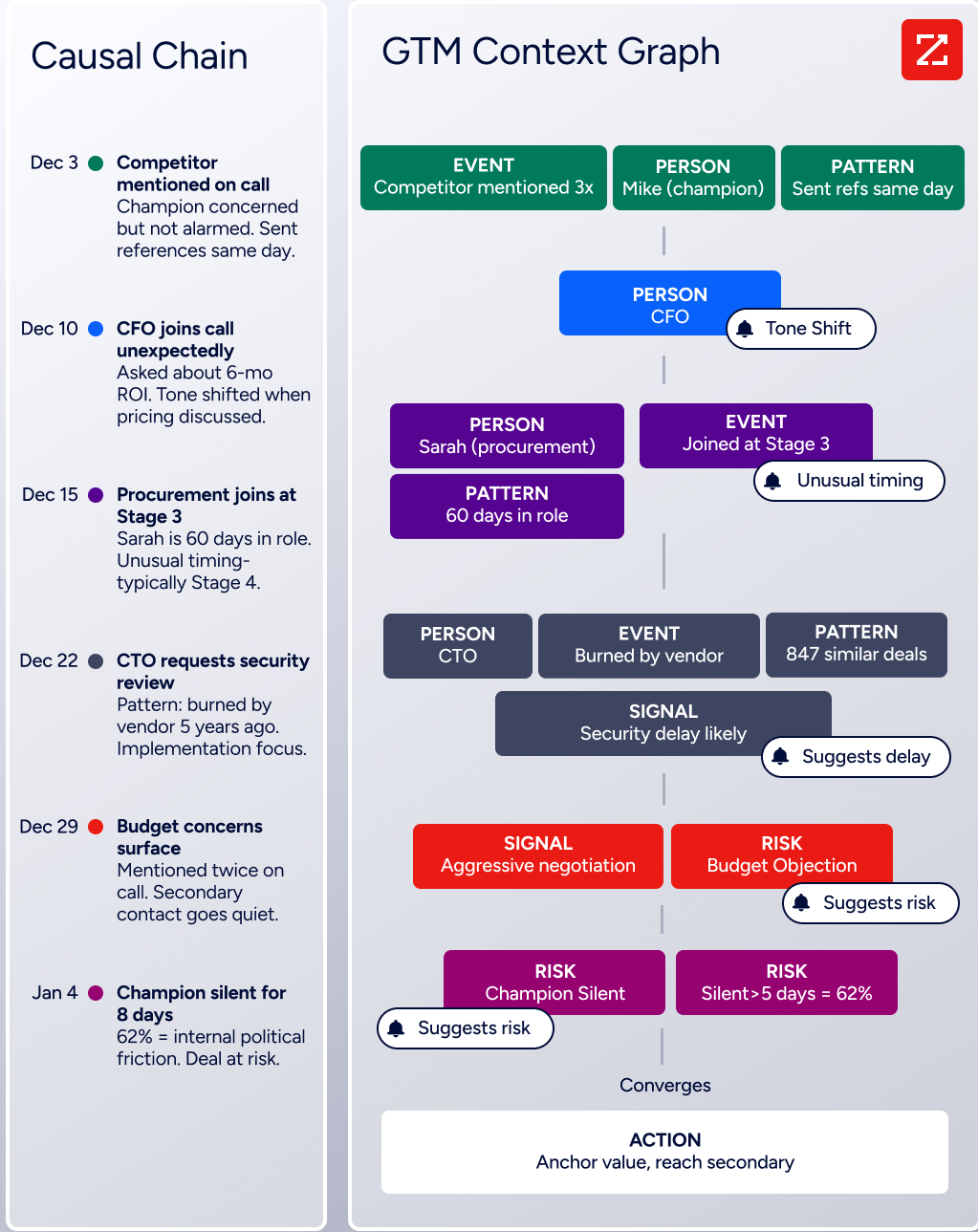
The GTM Context Graph processes 1.5B+ data points daily, combining ZoomInfo's B2B database with customer CRM records, conversation transcripts, and behavioral signals. A CRM records that a deal moved to Stage 3. ZoomInfo's AI reasons about why it moved: the CFO joined the last call and asked about ROI, the company just posted three VP-level hiring ads, and they've been researching your competitor for two weeks.
That reasoning feeds AI agents inside GTM Workspace that draft outreach addressing specific concerns from the conversation, or GTM Studio plays that target accounts matching your actual win patterns rather than generic criteria.
Source: ZoomInfo
Seismic's sales team attributed 39% of active pipeline to opportunities identified or influenced by ZoomInfo signals, with 54% productivity gains. "That combination of our internal CRM data, external signals, and AI that's given all that context has helped us craft very specific account- and persona-based messages," said Toby Carrington, Chief Business Officer. (Seismic)
The data question separates these platforms
This is where the comparison shifts from features to architecture.
GoHighLevel and Zoho CRM are containers for your data. They organize and act on the contacts, companies, and deals you put into them. GoHighLevel captures leads from your landing pages and forms. Zoho CRM imports them from web forms, spreadsheets, or social channels and enriches records through Zia. Both do this well. Neither generates the data itself.
If your leads come from walk-ins, referrals, paid ads, or inbound marketing (as they do for most local businesses and many SMBs), this is fine. The CRM's job is to manage what arrives.
ZoomInfo exists because, for B2B companies, waiting for leads to arrive is not a strategy.
The platform covers 500M contacts with verified business emails and direct dials, 100M companies with company attributes and org charts, technographic profiles covering 30,000+ technologies across 30M+ companies, and intent signals from 210 million IP-to-Organization pairings tracking 6 trillion+ keyword-to-device pairings monthly.
Source: ZoomInfo
The practical impact: a sales rep using GoHighLevel or Zoho CRM sees the leads that found them. A rep using ZoomInfo sees the addressable market, filtered to accounts showing buying signals now, with verified contact data for the decision-makers.
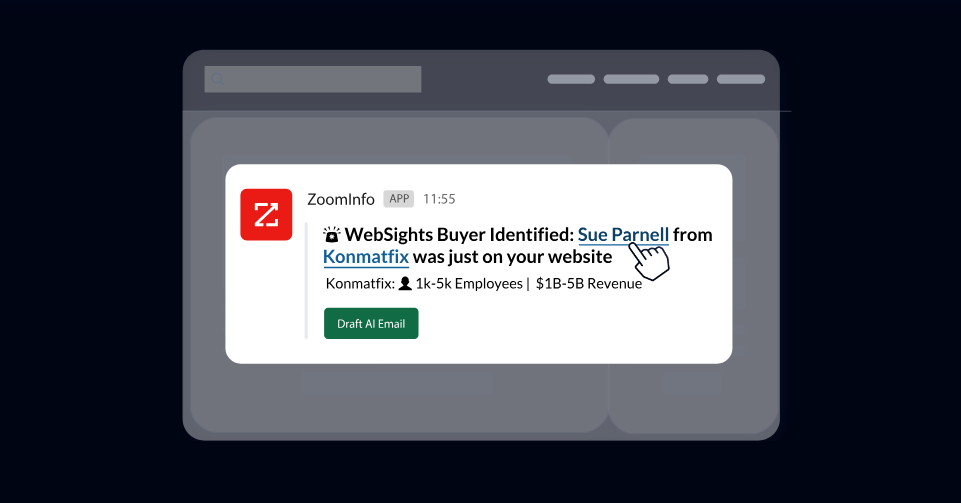
Guided Intent, exclusive to ZoomInfo, identifies the research topics correlated with deal success, so you stop guessing which intent signals matter. WebSights resolves anonymous website traffic to companies, including buying team identification. Contact Tracker monitors job changes across your prospect list so you know when a champion moves to a new company.
Source: ZoomInfo
This data feeds everything downstream. GTM Workspace drafts better outreach because it has the full picture. GTM Studio targets more precisely because its plays are built on actual buying patterns. And because API access is included in all relevant plans, the same data enriches whatever CRM you already use, including Zoho.
"ZoomInfo gives us the information we need to execute. We don't have to go through and spend our time digging. It's already there, so we can be three steps ahead." William Kenimer, VP of Revenue Operations. (Vensure)
Integrations reflect each platform's philosophy
GoHighLevel takes the all-in-one approach: build everything in so you don't need integrations. Website builder, calendar, phone system, email marketing, reputation management, payments, courses, and communities all live inside the platform.
The App Marketplace connects to 500+ tools for cases where native features aren't enough, and Zapier and Make.com integrations extend reach further. The REST API covers 40+ resource areas, though API access isn't on the Starter plan.
The philosophy is consolidation. Replace your tech stack, don't connect it.
Zoho CRM takes a dual approach.
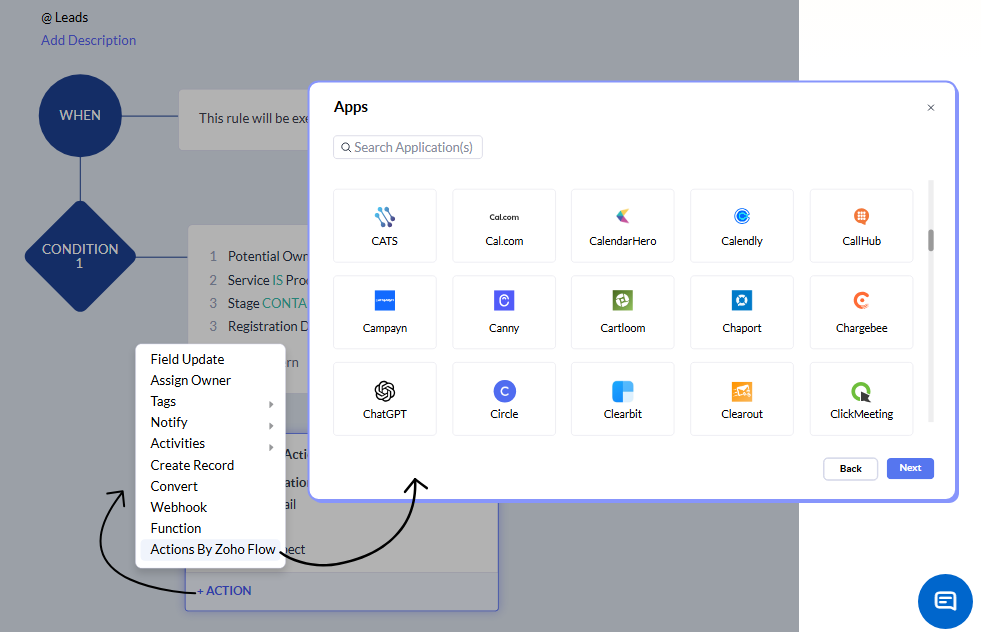
The Zoho ecosystem of 55+ apps provides first-party coverage across the business stack (Books, Desk, Campaigns, Sign, Analytics, SalesIQ, Projects), with native integration that avoids the sync problems of third-party connectors. Beyond the ecosystem, the Marketplace offers 1,100+ extensions, a REST API and GraphQL API, serverless Deluge functions, a Widget SDK, and MCP Server support for AI agents. Zoho Flow handles multi-app workflow orchestration.
The philosophy is ecosystem. Build your business on Zoho, and everything connects natively.
Source: Zoho
ZoomInfo takes the open platform approach.
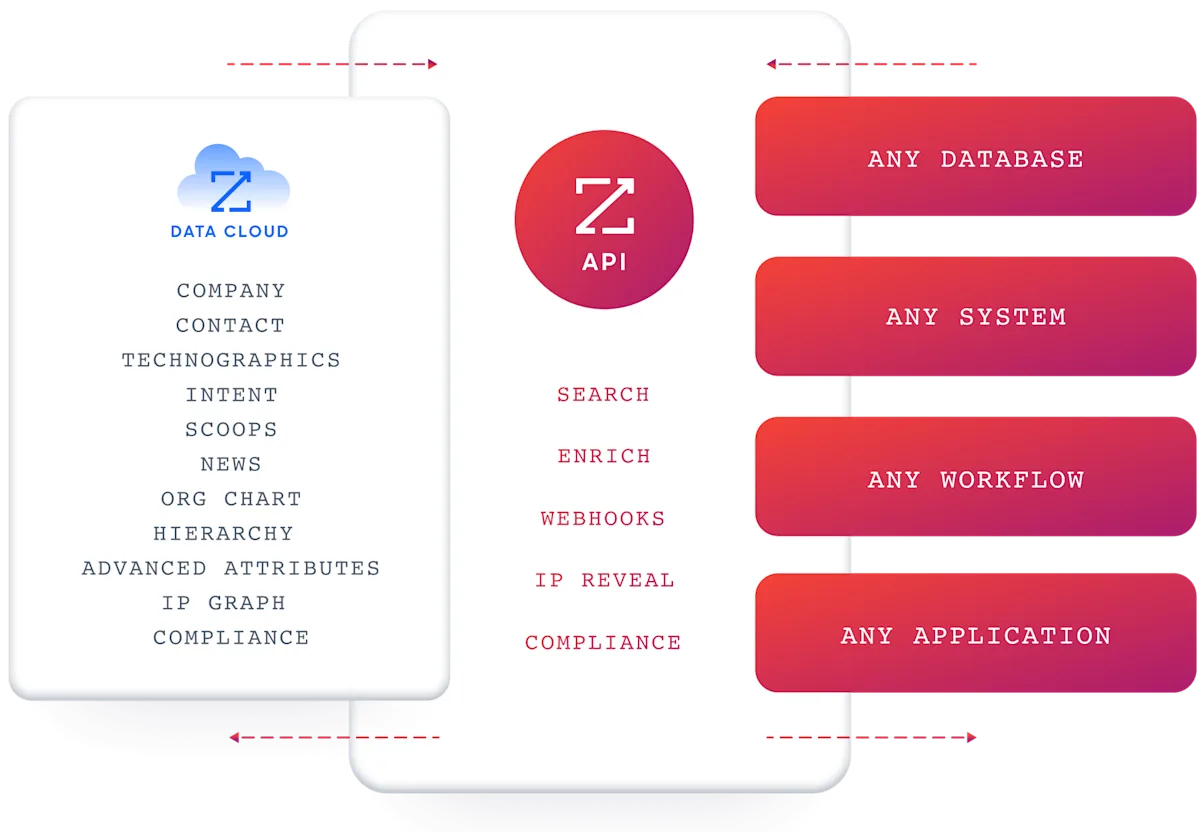
The Enterprise API opens ZoomInfo's intelligence (data search, enrichment, AI account research, intent, and audience management) to any application. The MCP server lets AI models query ZoomInfo's data in natural language. Cloud Partners deliver data into AWS, Google Cloud, Snowflake, and Databricks. The Marketplace lists 172+ integration partners including native connectors for Salesforce, HubSpot, and Microsoft Dynamics 365.
The philosophy is infrastructure. ZoomInfo provides the intelligence; you choose where to use it.
Source: ZoomInfo
"The plug-and-play aspect of the API means I can integrate it very easily into any process and get information at a moment's notice," said Jerry Wilson at BDO Canada, reporting an 87% reduction in time spent on data dashboard updates. (BDO Canada)
Pricing reflects different business models
GoHighLevel uses flat-fee tiered pricing with no per-seat or per-contact charges. Starter runs $97/month (3 sub-accounts), Unlimited is $297/month (unlimited sub-accounts), and Agency Pro is $497/month (adds SaaS Mode for white-label resale). All plans include unlimited contacts and users. A 14-day free trial gives full platform access.
The catch: usage-based costs add up.
Telephony (SMS and calls), the AI Employee add-on ($97/month per sub-account), HIPAA compliance ($297/month), and premium support ($500/month) mean a full setup costs more than the headline price. One Capterra reviewer noted that "if you want to do anything useful (charge customers, call customers) they will charge you a minimum of $2k/month."
For agencies managing many clients, though, the flat rate with unlimited sub-accounts creates a pricing advantage that per-seat models can't match.
Zoho CRM uses per-user pricing with five tiers: Free (up to 3 users), Standard ($14/user/month), Professional ($23/user/month), Enterprise ($40/user/month), and Ultimate ($52/user/month). All prices are annual billing. A permanent free plan and a 15-day free trial of Enterprise (no credit card required) make it easy to start.
Zoho CRM Enterprise at $40/user/month versus Salesforce Sales Cloud at $165 represents 38-76% savings. Month-to-month billing is available with no lock-in contracts. Additional costs come from paid support tiers (Enterprise Support with a dedicated TAM is an add-on), Jumpstart implementation at $200/hour, and data storage at approximately $20/month per GB.
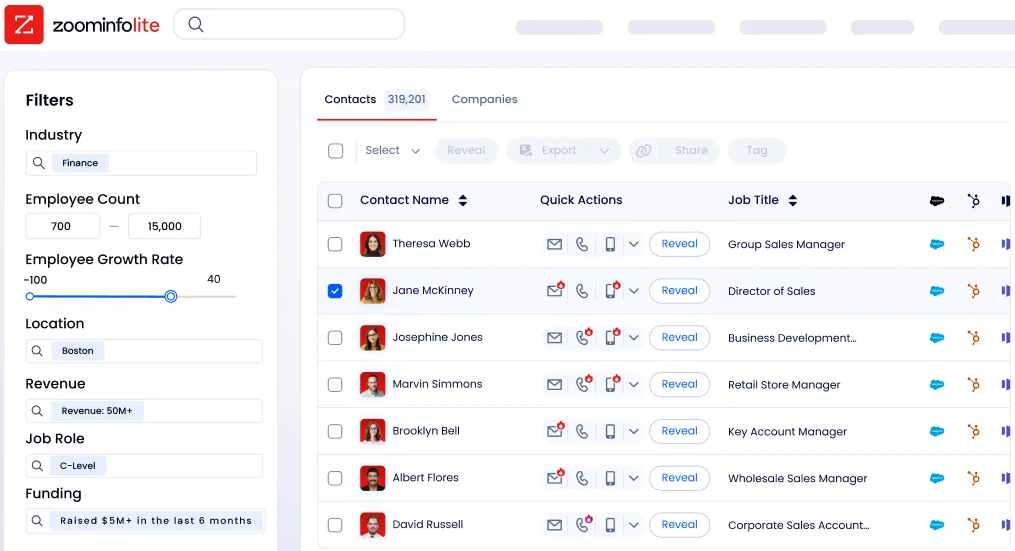
ZoomInfo uses custom-quoted, consumption-based pricing with no published dollar amounts. Costs scale around seats, data credits (1 credit = 1 contact or company export), and AI activity.
ZoomInfo Lite is a permanent free tier with access to the B2B database and 10 monthly export credits. A 7-day free trial of the full platform is also available, no credit card required.
Source: ZoomInfo
ZoomInfo costs more than GoHighLevel and Zoho CRM, but the comparison isn't apples-to-apples. GoHighLevel and Zoho charge for software that manages your data. ZoomInfo charges for the data itself, and the intelligence built on top of it.
The ROI depends on how much more pipeline you generate with verified contacts, intent signals, and AI prioritization than without them.
GoHighLevel vs. Zoho CRM vs. ZoomInfo: Which should you choose?
The right choice depends on your business model, your audience, and which problem is your bottleneck.
Choose GoHighLevel if:
You run a marketing agency serving local or small businesses
You want to white-label a platform and resell it as your own SaaS product
Consolidating 5-10 tools into one subscription matters more than CRM depth
Your clients need funnel building, reputation management, and appointment scheduling
Flat-rate pricing with unlimited contacts is a financial priority
You're willing to invest time learning a platform with many features
Choose Zoho CRM if:
You're managing your own company's sales pipeline across multiple products or territories
You need CRM customization without developer dependency
Budget matters and you want enterprise features at SMB pricing
You value a single-vendor ecosystem that covers CRM, finance, HR, and support
Your sales process requires Blueprint enforcement, approval workflows, and CPQ
You're willing to invest in upfront configuration for long-term payoff
Choose ZoomInfo if:
You sell to other businesses and need to find, qualify, and reach decision-makers
Your growth depends on outbound prospecting or account-based marketing
You want AI that reasons about why deals move, not just what happened
Data accuracy matters: verified direct dials, business emails, and org charts
You need intent signals to know which accounts are in-market right now
You want intelligence that works inside your existing CRM, or inside ZoomInfo's own seller workspace
See how ZoomInfo's data and intelligence can improve your pipeline.
GoHighLevel, Zoho CRM, and ZoomInfo each solve a real problem. GoHighLevel gives agencies one platform to deliver marketing services at scale. Zoho CRM gives growing companies a customizable sales engine at a fair price. ZoomInfo gives B2B teams the data and intelligence that make every sales and marketing action more precise.
For B2B organizations, the question isn't which CRM to pick. It's whether the intelligence powering your CRM is good enough to compete.
GoHighLevel vs. Zoho CRM vs. ZoomInfo FAQ
What is the core difference between GoHighLevel, Zoho CRM, and ZoomInfo?
GoHighLevel is a marketing platform designed for agencies to consolidate CRM, funnel building, SMS/email marketing, reputation management, and scheduling into one white-labelable subscription.
Zoho CRM is a traditional CRM with sales force automation, customization, and AI forecasting, built for SMBs and mid-market companies managing their own sales processes.
ZoomInfo is a B2B data and go-to-market platform that provides 500M contacts, 100M companies, intent signals, and AI deal intelligence to help teams find, prioritize, and engage prospects.
Which platform is cheapest to get started with?
Zoho CRM has the lowest entry point with a permanent free plan for up to 3 users and paid plans starting at $14/user/month. GoHighLevel starts at $97/month (flat rate, unlimited contacts and users) with a 14-day free trial. ZoomInfo offers ZoomInfo Lite as a permanent free tier with 10 monthly export credits, plus a 7-day free trial of the full platform.
At scale, GoHighLevel's flat pricing favors agencies with many clients, Zoho's per-user model favors smaller teams, and ZoomInfo's custom pricing reflects the value of its proprietary data.
Can ZoomInfo work alongside GoHighLevel or Zoho CRM?
Yes. ZoomInfo integrates with existing tools rather than replacing them. It has native integrations with major CRMs including Salesforce, HubSpot, and Microsoft Dynamics 365, plus API and MCP access that can pipe data into any platform. Zoho CRM supports MCP and has a REST API, making data enrichment workflows possible.
Pairing ZoomInfo for prospect intelligence with GoHighLevel or Zoho CRM for lead management gives B2B teams both the data and the execution.
Which platform has the best AI capabilities?
Each platform applies AI to a different problem.
GoHighLevel's AI automates agency operations: Voice AI handles phone calls autonomously, Conversation AI automates text-based interactions, and Content AI generates marketing copy. Zoho's Zia provides predictive lead scoring, churn prediction, workflow suggestions, and generative CRM setup from natural language.
ZoomInfo's GTM Context Graph processes 1.5B+ data points daily to reason about why deals move or stall, powering AI agents that prioritize accounts, draft contextual outreach, and identify buying patterns across thousands of deals.
Which platform is best for marketing agencies?
GoHighLevel is built for agencies. Its white-label SaaS Mode lets agencies resell the platform under their own brand and set their own pricing. The Snapshot system clones client setups across new accounts. Flat pricing with unlimited sub-accounts means agency costs don't scale with client count.
Zoho CRM and ZoomInfo are not designed for white-label agency delivery, though both can serve agencies managing their own business development.
Which platform is best for B2B sales teams?
ZoomInfo is the best fit for B2B sales teams that need to identify, prioritize, and engage prospects at scale. Its database of 500M contacts with verified direct dials and business emails, combined with intent signals and AI account prioritization, solves the upstream problem of knowing who to sell to.
Zoho CRM is the better choice if the primary need is managing and automating an existing sales process with customization. GoHighLevel is generally not suited for complex B2B sales cycles.
How do the platforms handle data security and compliance?
All three maintain strong security postures.
GoHighLevel holds SOC 2 Type II certification, offers HIPAA compliance as a paid add-on, and is hosted on Google Cloud Platform with AES-256 encryption. Zoho CRM holds ISO 27001, ISO 27701, SOC 2 Type 2, and HIPAA certifications, operates its own data centers across 18 global locations, and does not sell customer data or derive revenue from advertising.
ZoomInfo maintains ISO 27001, ISO 27701, SOC 2 Type II, and TRUSTe GDPR/CCPA certifications, and is a registered data broker in California and Vermont.
Do any of these platforms offer a free tier?
All three provide free access. Zoho CRM offers a permanent free plan for up to 3 users with 5,000 records and basic features. ZoomInfo Lite is a permanent free tier with access to the B2B database and 10 monthly export credits. GoHighLevel does not have a free plan but offers a 14-day free trial with full feature access. Both Zoho CRM (15 days) and ZoomInfo (7 days) also offer time-limited trials of their paid tiers.
