
Gong started as a conversation intelligence tool. It now calls itself a Revenue AI Operating System that records every customer interaction, analyzes why deals move or stall, sequences outreach, forecasts revenue, coaches reps, and deploys specialized AI agents across the workflow. This breakdown covers every feature, how it works, who it serves, and which plan unlocks it.
Gong's feature set has you covered if:
You want every sales call, email, and meeting captured, transcribed, and analyzed without reps logging anything manually
You run deal reviews where managers need AI-surfaced risk signals grounded in what buyers said, not what reps entered in the CRM
You need revenue forecasting built on conversation data rather than stage labels and rep optimism
You manage multi-channel outreach sequences with AI-drafted emails informed by prior call context
You want sales coaching scorecards, AI-generated training simulations, and initiative tracking tied to business outcomes
You are consolidating separate conversation intelligence, sales engagement, forecasting, and enablement tools into one platform
You'll reach the edges of its capabilities if:
You need a B2B contact and company database to fuel prospecting before any conversation happens
You want buyer intent data showing which companies are researching your category across the web
You need to identify anonymous website visitors and resolve them to contacts
You run account-based marketing campaigns, display advertising, or multi-channel demand generation
You want to try the platform or see a price before talking to sales
For those needs, the reference point is ZoomInfo: an AI GTM platform built on the largest B2B database in the industry (500M contacts, 100M companies, 135M+ verified phone numbers), a GTM Context Graph that combines that data with CRM records, conversation intelligence, and behavioral signals, and access through APIs, MCP, GTM Workspace, and GTM Studio.
After the feature breakdown, this article covers where Gong stops and how ZoomInfo fills those edges.
Gong Platform Overview
Gong markets itself as the Revenue AI Operating System, targeting CROs, RevOps leaders, sales managers, customer success teams, and enablement professionals across 5,000+ companies worldwide. It serves four verticals: Technology, Financial Services, Healthcare, and Manufacturing. Named customers include Google, ADP, Uber for Business, Morningstar, Sprout Social, Canva, and LinkedIn.
The architecture is organized around three layers and six named applications:
Module | What It Does | Access |
|---|---|---|
Data engine that captures and connects every customer interaction | Foundation layer for all applications | |
Multi-channel outreach sequences with AI-composed emails and integrated dialer | Add-on application | |
Revenue prediction grounded in conversation signals | Add-on application (Essentials and full tiers) | |
Coaching, AI training simulations, and initiative tracking | Add-on application | |
15+ specialized AI agents for deal execution, coaching, and automation | ||
Integration marketplace with 300+ partners | Included with all plans |
Gong uses a quote-based pricing model with per-user licenses plus a platform fee. Customers start with the Gong Foundation platform and layer on specialized applications. No list prices are published; every prospect receives a custom quote after selecting a team-size band (1-50, 51-1,000, 1,001-9,999, or 10,000+).
Here is the full tour.
Gong Revenue Graph: The Data Foundation
Everything Gong does runs on the Revenue Graph, a data engine Gong describes as "the richest source of revenue data to power your AI strategy."
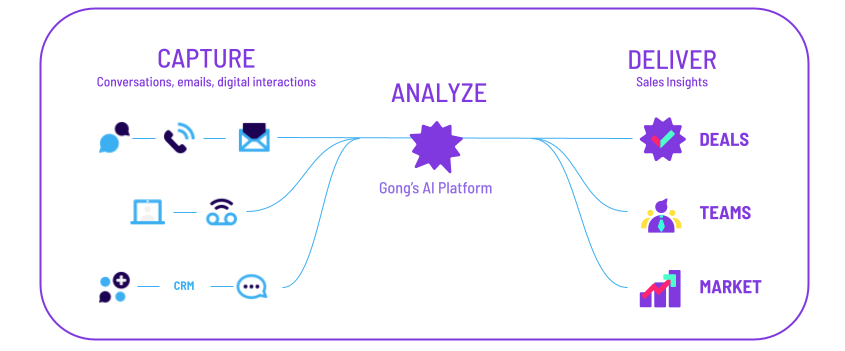
The problem is straightforward: most revenue teams scatter data across separate systems. CRM fields go unfilled, calls never get logged, emails exist outside any deal record. Gong Labs research found that only 1% of customer interactions make it into the CRM. The Revenue Graph captures the other 99%.
The engine works in three stages.
First, it captures every customer interaction: voice (telephony, web conferences), text (emails, SMS), and digital (document signatures, video views, website visits, CPQ interactions, buyer intent signals). No manual logging. Second, it maps each interaction to the right people, accounts, and deals using built-in logic and customizable mapping rules that can be tested in simulation before going live. Third, data flows both ways: Gong integrates with Salesforce, Microsoft Dynamics, and HubSpot, and CRM fields imported into Gong can be edited there and synced back.
Source: Gong
The Revenue Graph accepts signals from over 300 integrations, including 6sense, Outreach, Highspot, and Salesloft. For teams that warehouse data externally, Gong Data Cloud exports enriched data to Snowflake and Databricks. Gong also supports Model Context Protocol as both Client and Server, so external AI agents can query the Revenue Graph and contribute signals to it. The MCP Gateway (inbound) is live; the MCP Server (outbound) is coming soon. An open API and webhooks support custom workflows and data pushes into internal dashboards.
One commitment worth noting: customer data is never used to train generative AI models. Customers can configure bring-your-own-key encryption and granular data collection, redaction, retention, and access permissions by region, role, or use case.
Gong Conversation Intelligence and AI
Gong was founded on conversation intelligence, and it remains the platform's core capability.
The AI layer (called Gong AI) operates in three modes: Advanced Detection (identifying concepts like deal risks and emerging trends beyond keyword matching), Generative AI (producing internal updates and outreach from full deal context), and Predictive Intelligence (using 300+ signals from actual conversations to anticipate deal outcomes). The models are built in-house, tuned for revenue, and trained on more than three billion customer interactions over a decade.
AI Transcriber converts conversations into transcripts across 70+ languages. AI Translator surfaces insights in a manager's preferred language regardless of what language the call was in, so a VP in New York reviewing Singapore calls sees analysis in English without losing the original nuance.
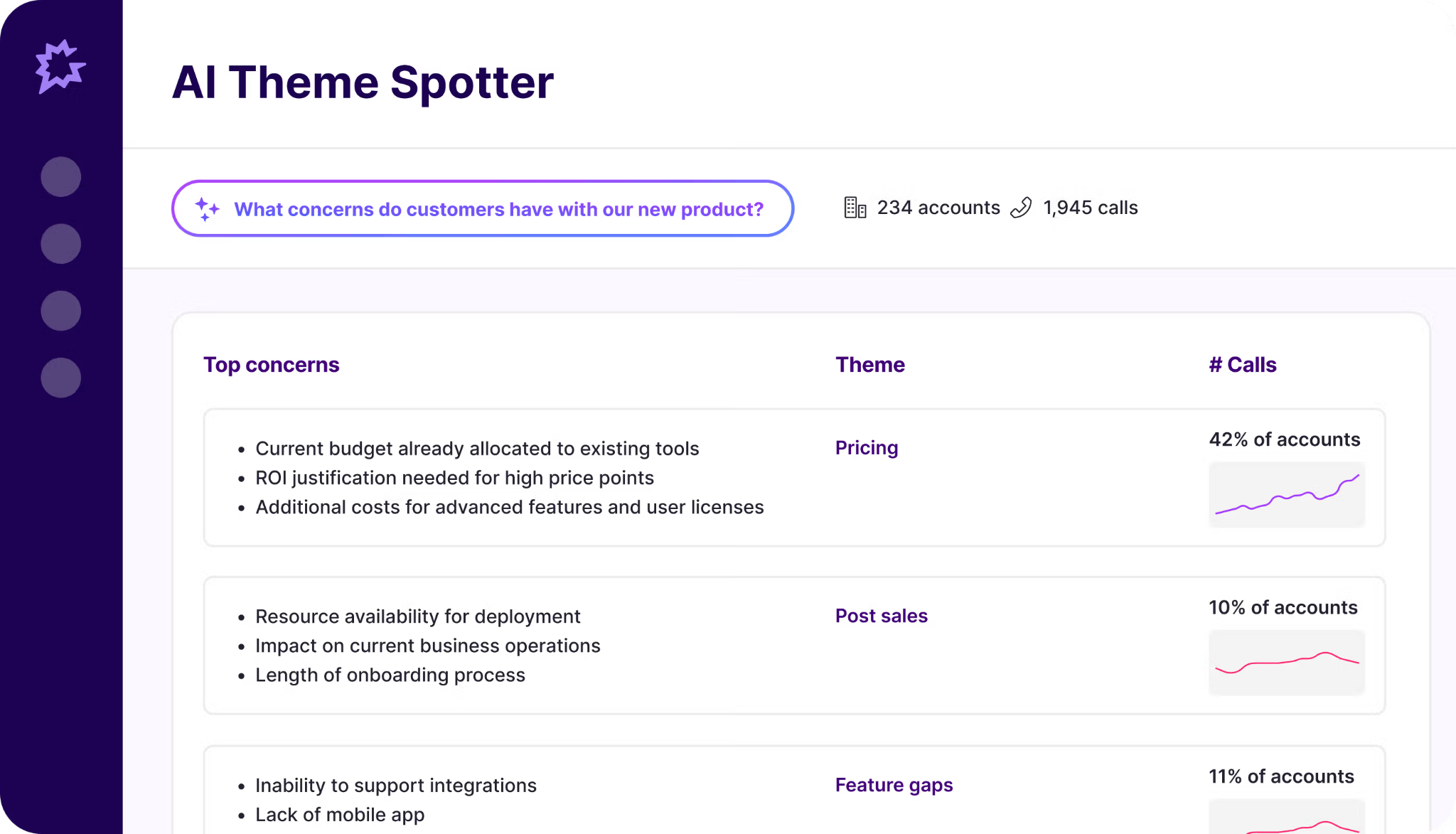
AI Ask Anything answers questions about any account, contact, or deal across all conversations. Instead of searching through recordings, a rep types a question and gets a sourced answer grounded in interaction data. Teams using AI Ask Anything achieved 26% higher win rates. AI Theme Spotter takes a broader view, identifying recurring themes across customers, competitors, and markets by aggregating signals across thousands of conversations to surface patterns no single manager could spot.
Source: Gong
Smart Trackers make conversation intelligence actionable at scale. Gong describes them as the first user-trainable tracking system in the industry. Smart Trackers understand context rather than keywords, detecting conceptual mentions in conversations tied to strategic initiatives, competitive references, product launches, or methodology adoption. Teams using AI Tracker achieved 35% higher win rates.
Gong Assistant, introduced in Mission Andromeda (February 2026), is a conversational AI embedded in workflows. It will let teams ask natural-language questions about their customer base and receive sourced answers. Gong Assistant is not yet generally available; the Mission Andromeda launch blog states it will reach GA "in the coming months." AI Deep Researcher, which turns business questions into evidence-backed reports, is also listed as coming soon.
Gong Engage: Multi-Channel Sales Engagement
Gong Engage is the sales engagement application, launched June 2023 and positioned as the only AI-driven sales engagement solution built on complete customer interactions.
It is available as an add-on application. It addresses three problems: 61% of sellers don't know where to focus their engagement efforts, sellers spend 6+ hours weekly creating personalized emails, and 91% of buyers perceive sales content as not personalized.
Source: Gong
Flows are multi-channel outreach sequences with five step types: manual email, auto email, call, LinkedIn connect/message, and task. Up to 2,000 contacts can be bulk-enrolled in a single action. What separates Engage from standalone sequencing tools is the data behind each step: the AI draws on the Revenue Graph to surface prior call context, buying signals, and account history when composing messages.
AI Composer drafts outreach emails from real conversation context, and Engage users see a 34% higher response rate on AI-composed emails.
The Gong Dialer is an integrated VoIP calling solution with call recording, local dialing (auto-selects an area-code-matched number), call scripts, structured outcome logging, and CRM auto-sync. It is powered by Twilio and supports power dialer integrations like Nooks for 3-5x more prospect reach.
Recommended Contacts uses historical deal data to suggest stakeholders worth contacting, with access to contact data from partners including LeadIQ, Cognism, and Apollo.
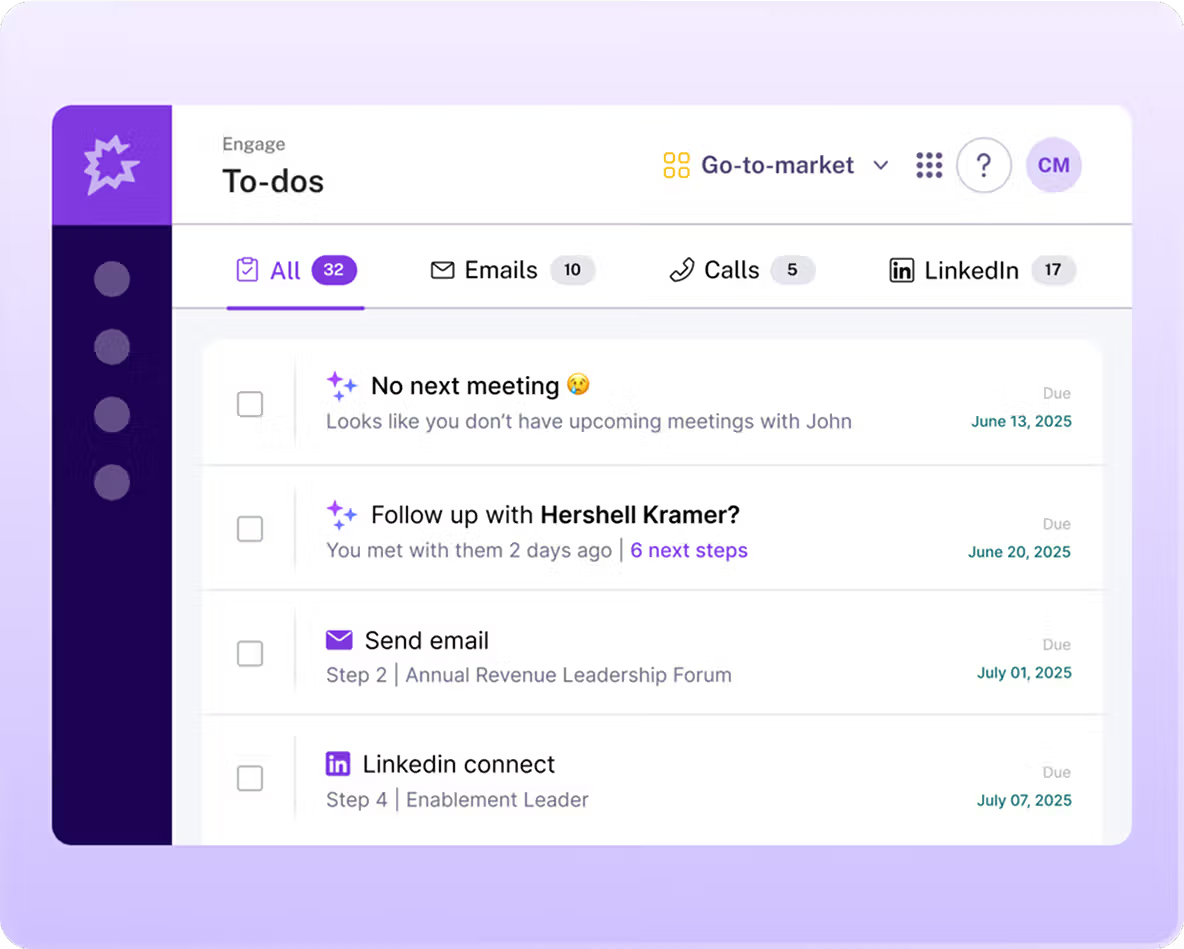
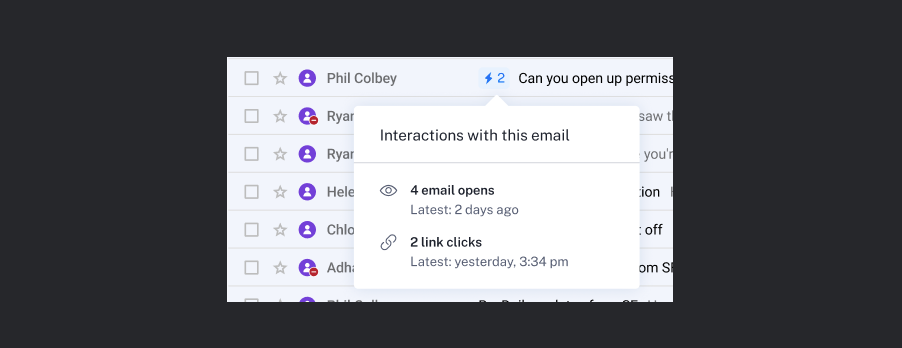
Engage operates as a workspace accessible from the Gong sidebar, organized around To-dos, Accounts, People, Pipeline, and Flows. It connects to Salesforce or HubSpot and syncs changes back to the CRM. The Gong Anywhere Chrome Extension embeds Engage functionality into Gmail, Salesforce, HubSpot, and Dynamics 365, so reps can compose emails, make calls, view activity timelines, and bulk-enroll contacts into flows without leaving the browser. Structured activity, performance, and flow metrics track email open/click/reply rates, call connect rates, and meetings booked.
Source: Gong
Gong Deal Execution and Pipeline Management
Gong's deal intelligence turns pipeline management from a CRM data-entry exercise into a signal-driven system grounded in what buyers said. Three AI agents do the work.
AI Deal Reviewer evaluates deals based on standard or custom sales methodologies like MEDDPICC, BANT, or SPIN, assessing qualification criteria against recorded conversations rather than rep-entered fields.
AI Deal Monitor detects deal signals that humans miss: budgetary constraints mentioned in passing, shifting meeting attendance that signals changing priorities, or competitive mentions that predict risk. Gong Labs research found that 15% of analyzed deals contain email red flags, and flagged deals take 31% longer to close.
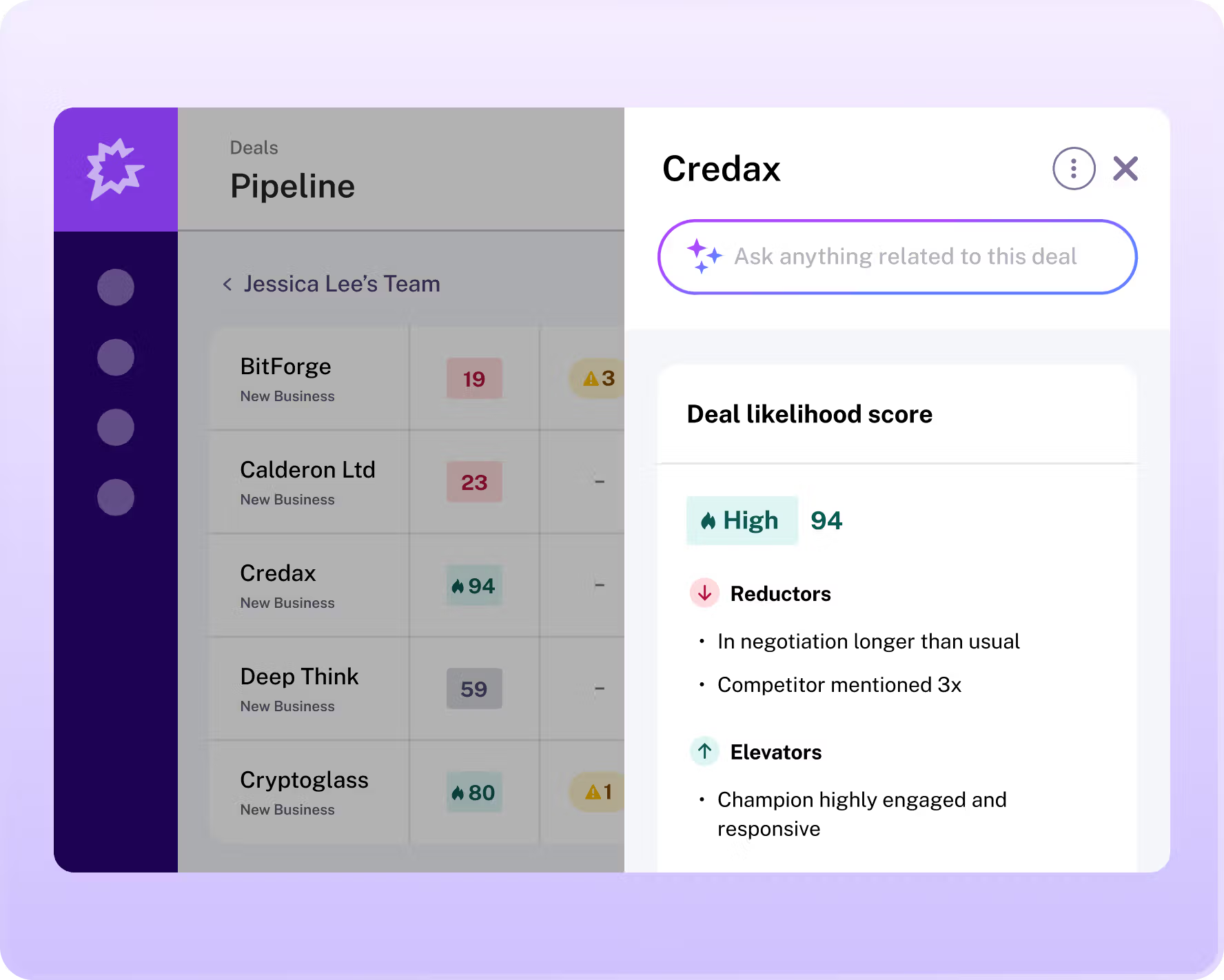
AI Deal Predictor scores deal health and likelihood of closing, trained on 300+ buying signals from 2.5 billion conversations.
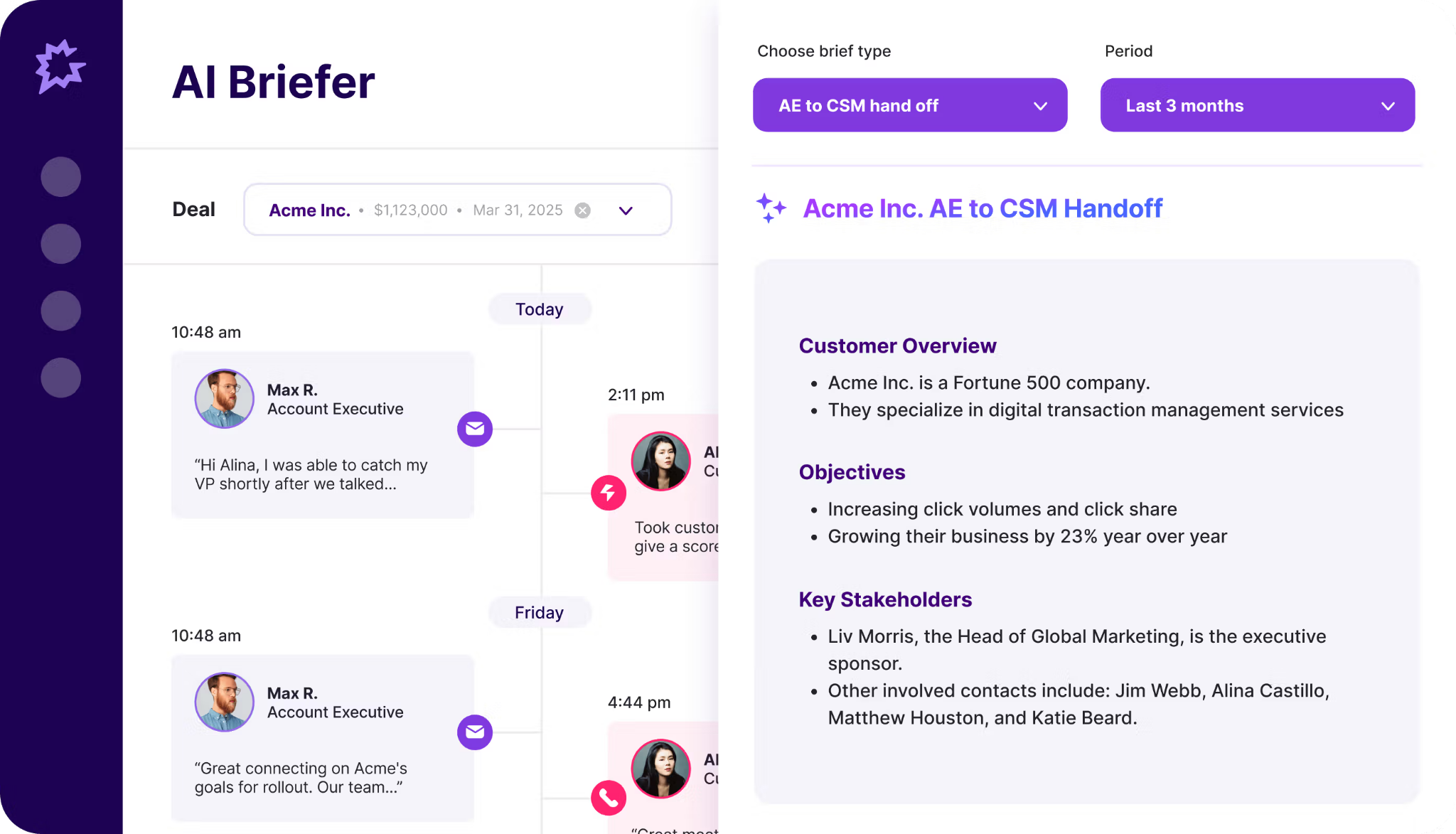
AI Briefer generates structured briefs for every contact, call, deal, or account, so handoffs between sales and customer success don't lose context.
Source: Gong
AI Tasker surfaces prioritized tasks for each rep, so they open Gong to a ranked list of next actions.
For CRM hygiene, AI Data Extractor captures deal details from conversations and populates CRM fields automatically, and AI Activity Mapper links interactions to CRM records without manual logging.
The Mission Andromeda release (February 2026) extended deal intelligence into account management. Account Console and Account Boards monitor account health, risk signals, expansion opportunities, and renewal readiness across the customer lifecycle, not just the sales cycle.
Gong Forecast: AI-Powered Revenue Prediction
Gong Forecast turns revenue forecasting from a spreadsheet exercise into an AI-validated system grounded in customer conversations. It is available in two tiers: Forecast Essentials (Deal Boards, Account Boards, AI Deal Reviewer, Win/Loss Insights) and the full Gong Forecast (adds forecast submission, AI Deal Predictor, Forecast Analytics, and AI Revenue Predictor).
The system works on the principle of reality-based forecasting. Reps submit forecast numbers across all categories in configurable Forecast Boards, with automated reminders when submissions are due.
Separately, AI Revenue Predictor evaluates every deal using behavioral signals from conversations, processing 300+ signals from interaction data. It predicts outcomes with 20% more precision than CRM-only algorithms and 22% more accurately than reps' own predictions. The two forecasts run side by side so managers can compare human judgment against the model.
Source: Gong
Configurable Forecast Boards support separate boards per line of business (new business, renewals, geographies) with a Business Total view aggregating across them. The Trends Report provides a week-by-week historical view of pipeline and forecast movement with projection tools drawing on up to four quarters of data. An Audit Log maintains a complete record of all forecast changes with who, when, and by how much.
Gong Enable: Coaching and Sales Enablement
Gong Enable launched in February 2026 as part of Mission Andromeda. Gong positions it as the only revenue enablement solution grounded in real customer interactions. It is a new module, so its track record with customers is still being established.
AI Call Reviewer scores rep calls automatically using configurable scorecards, replacing manual review with consistent evaluation. Managers don't need to listen to every call; the AI surfaces the moments worth coaching on. The Coaching Inbox provides a workspace for coaching tasks and feedback, surfacing AI-generated recommendations tied to specific call moments. Whisper analyzes conversation data to identify behaviors top-performing reps use, then surfaces coaching nudges in post-call emails.
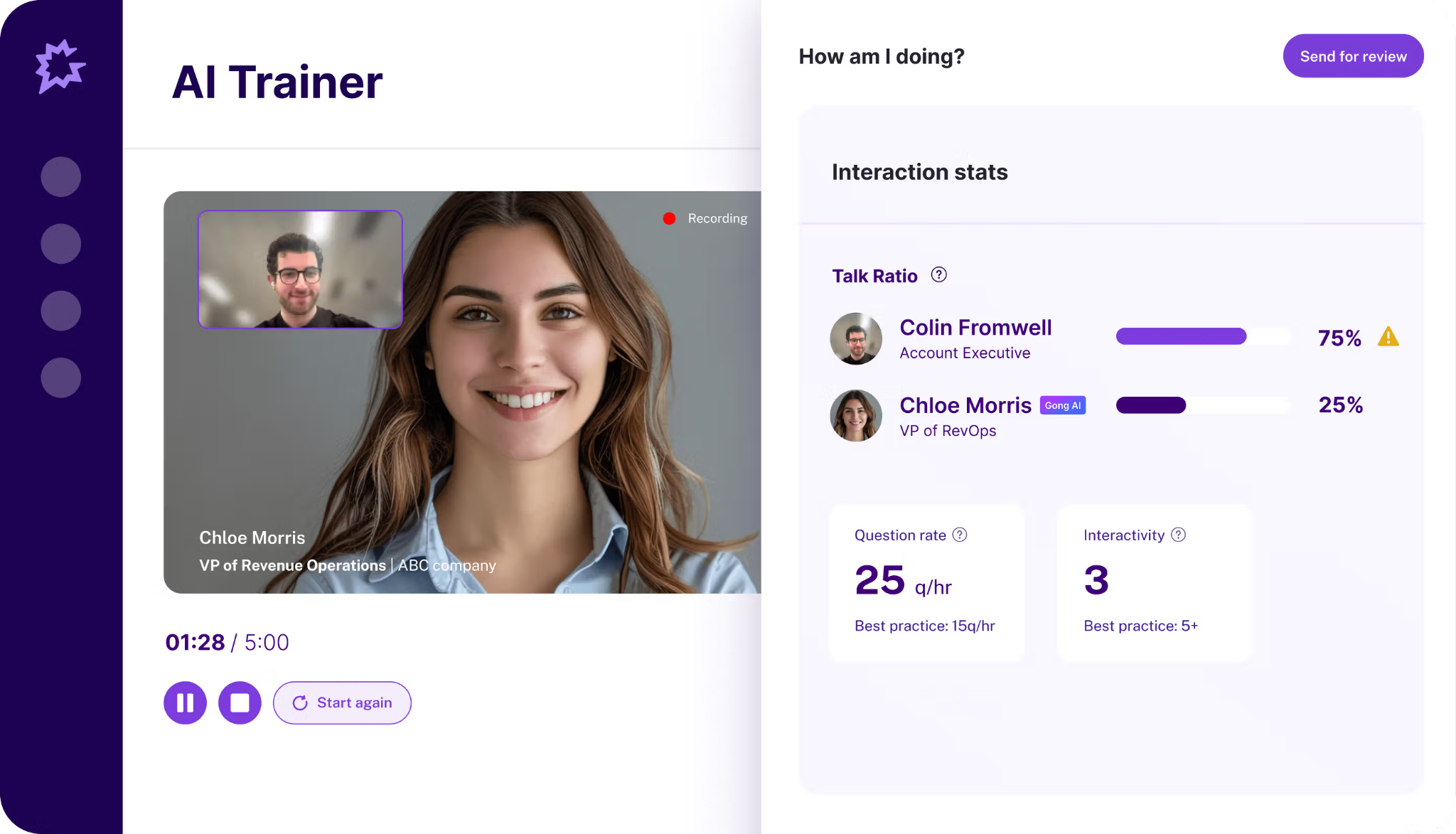
AI Trainer is where coaching becomes active practice rather than passive review. Reps rehearse high-stakes scenarios in a training environment using AI-generated customer personas built from real interactions. Sessions use the same scorecards applied to live calls, keeping evaluation consistent across training and production. Reps can repeat sessions as often as they want.
Source: Gong
AI Builder turns customer insights into repeatable plays and enablement content, and Initiative Tracking measures field adoption of methodologies and correlates behavior change with business outcomes like win rates, deal size, and ramp time. Coaching Metrics tracks how managers coach, creating accountability.
The workflow moves through three stages: Know (find where reps struggle by analyzing talk ratios, topic coverage, and objection handling against top-performer benchmarks), Guide (deliver targeted coaching grounded in winning conversations), and Scale (give managers team-level trends and coaching dashboards).
Gong AI Agents: Automation Across the Revenue Cycle
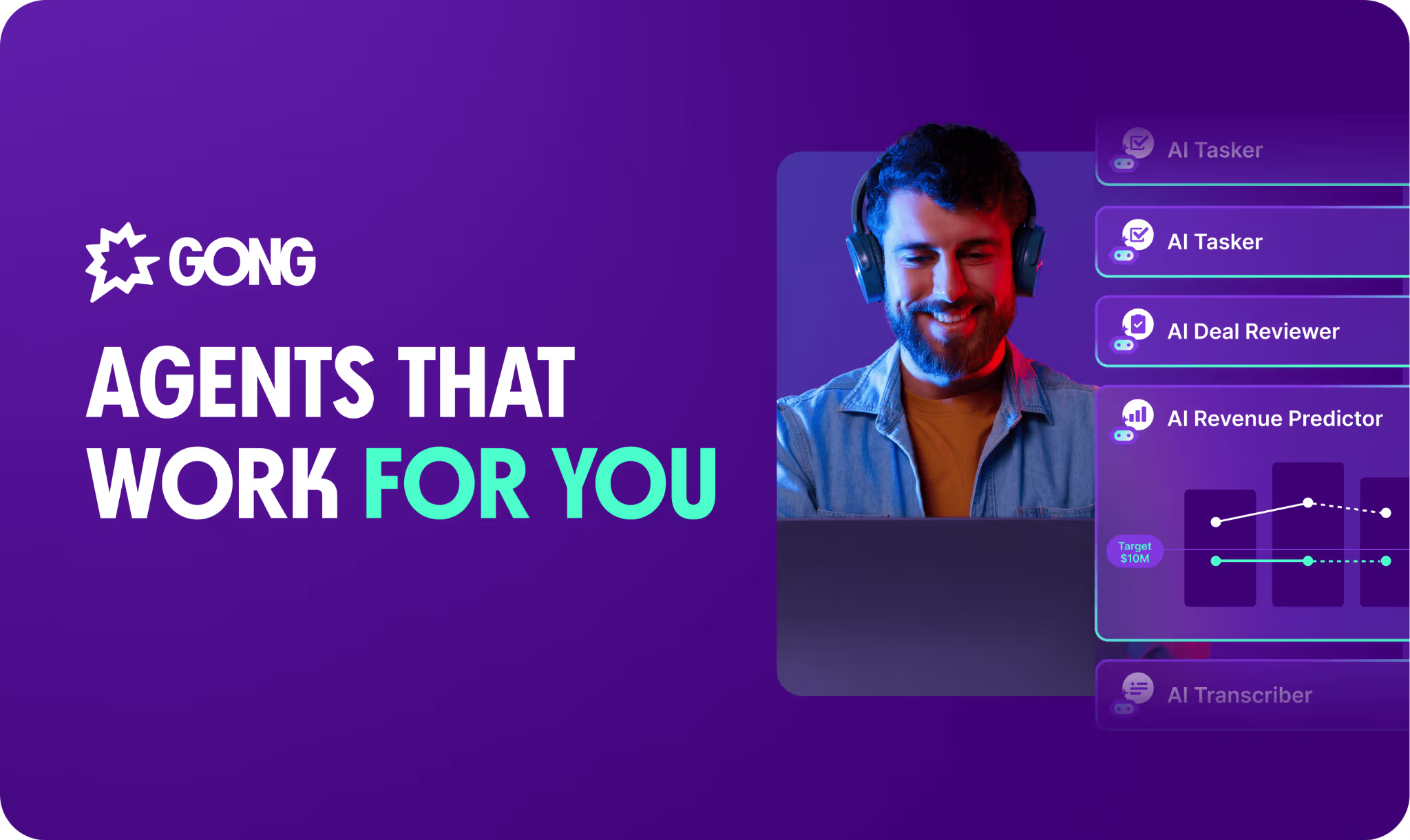
Gong Agents is a suite of 15+ AI agents, launched April 2025, included with Gong licenses at no additional cost. The AI trains on 5B+ buyer-seller interactions, and each agent addresses a specific problem rather than acting as a generic assistant.
Agents are configured through Agent Studio, a no-code drag-and-drop interface where administrators define inputs, outputs, and autonomy levels and preview behavior before deployment. Pre-built templates provide starting points that administrators can customize without IT involvement.
The full roster spans five functional categories:
Strategic Decision: AI Tracker (key moment detection), AI Theme Spotter (cross-customer pattern recognition), AI Ask Anything (deal/account answers), and AI Deep Researcher (coming soon)
Knowledge Transfer: AI Briefer (structured briefs for handoffs)
Coaching and Enablement: AI Call Reviewer (automated scoring), AI Trainer (role-play simulations), AI Builder (plays from insights)
Customer Engagement: AI Tasker (prioritized next actions), AI Composer (follow-up emails from conversation context)
Pipeline and Forecast: AI Deal Reviewer (methodology evaluation), AI Deal Monitor (risk detection), AI Deal Predictor (close probability), AI Revenue Predictor (pipeline forecasting)
Data Capture: AI Transcriber (transcription), AI Activity Mapper (CRM linking), AI Data Extractor (field population), AI Translator (multilingual insights)
Source: Gong
Gong Integrations, API, and Enterprise Infrastructure
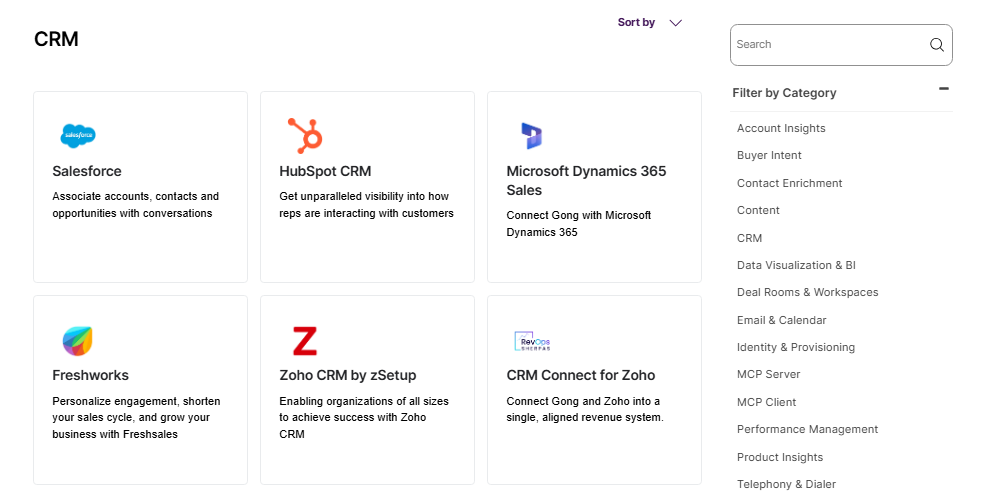
The Gong Collective is Gong's partner and integration marketplace, comprising over 300 technology integration partners, GSIs, and consulting partners. Partner growth doubled over the prior year. Gong is also available on the AWS Marketplace.
CRM integrations are bidirectional and native for Salesforce, HubSpot, and Microsoft Dynamics 365. The Salesforce integration includes a managed package with custom objects, an embedded Gong player, built-in Salesforce Flows for data enrichment, and an Agentforce MCP connection. For other CRMs, a CRM API supports import-only data sync. Web conferencing integrations cover Zoom (with a native Gong app and Zoom Native Recording), Google Meet, Microsoft Teams, Webex, and GoToMeeting.
Source: Gong
The Gong API supports uploading call recordings, retrieving call data (participants, topics, trackers, scorecards, transcripts), retrieving team member activity and statistics, and uploading CRM data. Rate limits sit at 3 calls per second and 10,000 calls per day. API access is available on any Gong plan. Gong Data Cloud shares data directly with Snowflake and Databricks, refreshing daily with calls, emails, meetings, and usage data in normalized tables. iPaaS connections support Zapier, Workato, and Tonkean for multi-step automation workflows.
On security, Gong holds SOC 2 Type II, ISO/IEC 42001:2023 (AI Management), ISO/IEC 27001:2022, ISO/IEC 27017, ISO/IEC 27018, ISO/IEC 27701, PCI DSS SAQ-D, HIPAA support, Cloud Security Alliance STAR, and EU-U.S. Data Privacy Framework certification. The ISO 42001 certification for AI management makes Gong one of the first revenue AI platforms to hold this standard.
Infrastructure runs on Amazon Web Services with 99.5%+ uptime. A mobile app provides access on the go, and Gong Academy provides role-specific training for revenue professionals, managers, and administrators.
Where Gong Stops: The Gaps
Gong's design centers on customer interactions: recording them, analyzing them, coaching from them, and predicting outcomes from them. That focus shapes its strengths, but it also means the platform depends on outside sources for several capabilities revenue teams need.
No native B2B contact or company database.
Gong does not include its own database of contacts, companies, direct dials, or verified business emails. Gong Engage's Recommended Contacts feature surfaces stakeholders to connect with based on historical deal data, but the contact information itself comes from partners like LeadIQ, Cognism, and Apollo. A team using Gong Engage for outreach sequences needs a separate data provider to supply the contacts those sequences run on.
No native buyer intent data.
Gong captures engagement signals from your own interactions (calls, emails, meetings), but it does not include proprietary intent data showing which companies are researching specific topics across the web. Intent signals enter through partner integrations in the Gong Collective, not from Gong's own data collection. Engagement signals tell you who is responding to your outreach; intent signals tell you who is in-market before you reach out.
No website visitor identification.
Gong does not include tools to identify anonymous website visitors at the company or contact level. The Revenue Graph captures digital interactions like website visits when connected through partner integrations, but does not provide native visitor resolution.
No marketing orchestration or ABM capabilities.
Gong covers sales execution, coaching, and forecasting but does not include campaign orchestration, display advertising, audience management, or account-based marketing tools. Marketing teams running demand generation alongside sales execution need a separate platform.
No published pricing or self-serve entry.
Every tier requires contacting sales. Gong does not offer a self-serve free plan or publicly available free trial. The Terms of Service references an "Evaluation Services" mechanism provided at Gong's discretion, and all fees are non-cancelable and non-refundable. Subscriptions renew automatically for one-year periods unless either party gives 60 days' written notice, and renewal of promotional pricing reverts to list price.
How ZoomInfo Covers the Gaps
The gaps share a common thread: Gong analyzes what happens during customer interactions but depends on outside sources for the data, signals, and marketing capabilities that exist before any interaction. ZoomInfo is an AI GTM platform that supplies those upstream layers.
ZoomInfo's B2B Data Platform: The contact and company database Gong does not include
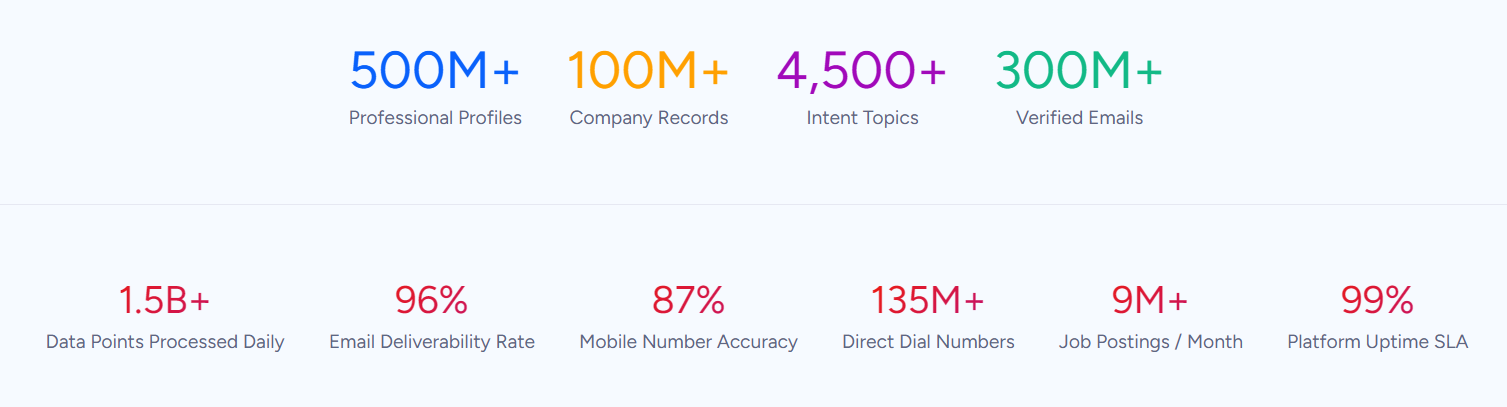
ZoomInfo operates the largest B2B data platform in the industry: 500M contacts, 100M companies, and 135M+ verified phone numbers, 120M direct-dial phone numbers, and 200M+ verified business email addresses. The data flows through a verification pipeline backed by 300+ human researchers and ML scanning 28 million domains daily, reaching up to 95% accuracy on first-party data.
Source: ZoomInfo
For a team using Gong Engage, this fills the gap between having sequences and having contacts to put in them. Gong's AI Composer can draft a follow-up email from call context, but it needs a verified email address to send it to. ZoomInfo provides department org charts with decision-makers' direct dials and emails, 300+ company attributes for segmentation, contact tracking with job-change alerts, and technographic profiles covering 30,000+ technologies across 200+ categories for 30+ million companies.
In a Fortune 500 competitive RFP analyzing 25 million contacts across vendors, an independent consultant concluded that "no other competitor came even close." That quality is externally validated: Leader in the Forrester Wave for Intent Data Providers, Q1 2025, Leader in the Gartner Magic Quadrant for ABM Platforms for the second consecutive year, and the only vendor positioned in the Gartner Voice of the Customer Customers' Choice quadrant with a 4.7/5.0 rating.
ZoomInfo Intent and WebSights: Signals that reveal in-market buyers before any conversation
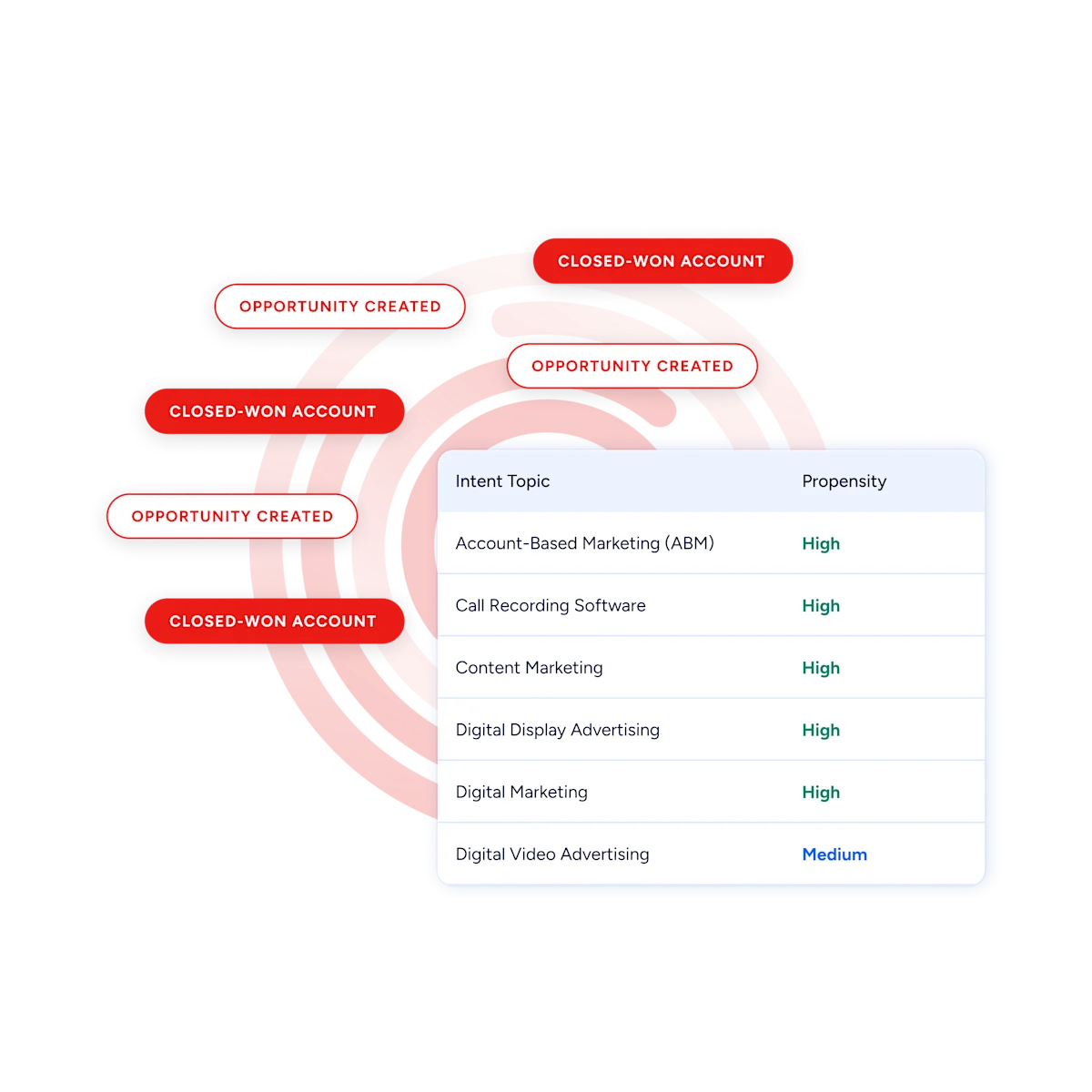
ZoomInfo Intent tracks signals from 210 million IP-to-Organization pairings and 6 trillion+ new keyword-to-device pairings sourced monthly. Gong's conversation intelligence tells you what happened on the last call. ZoomInfo's intent data reveals which companies are researching your product category across the web, before you contact them. Guided Intent, exclusive to ZoomInfo, identifies topics historically correlated with deal success rather than requiring manual topic selection.
Source: ZoomInfo
On the website side, WebSights resolves anonymous website traffic to companies, with Automatic Traffic Filtering that separates real visitors from bots. ZoomInfo Marketing goes further with contact-level visitor identification, showing who visited (not just which company) and triggering outreach. Gong's Revenue Graph can capture website visit data through partner integrations, but it does not identify the visitor.
ZoomInfo's GTM Context Graph: Combining first-party and third-party signals
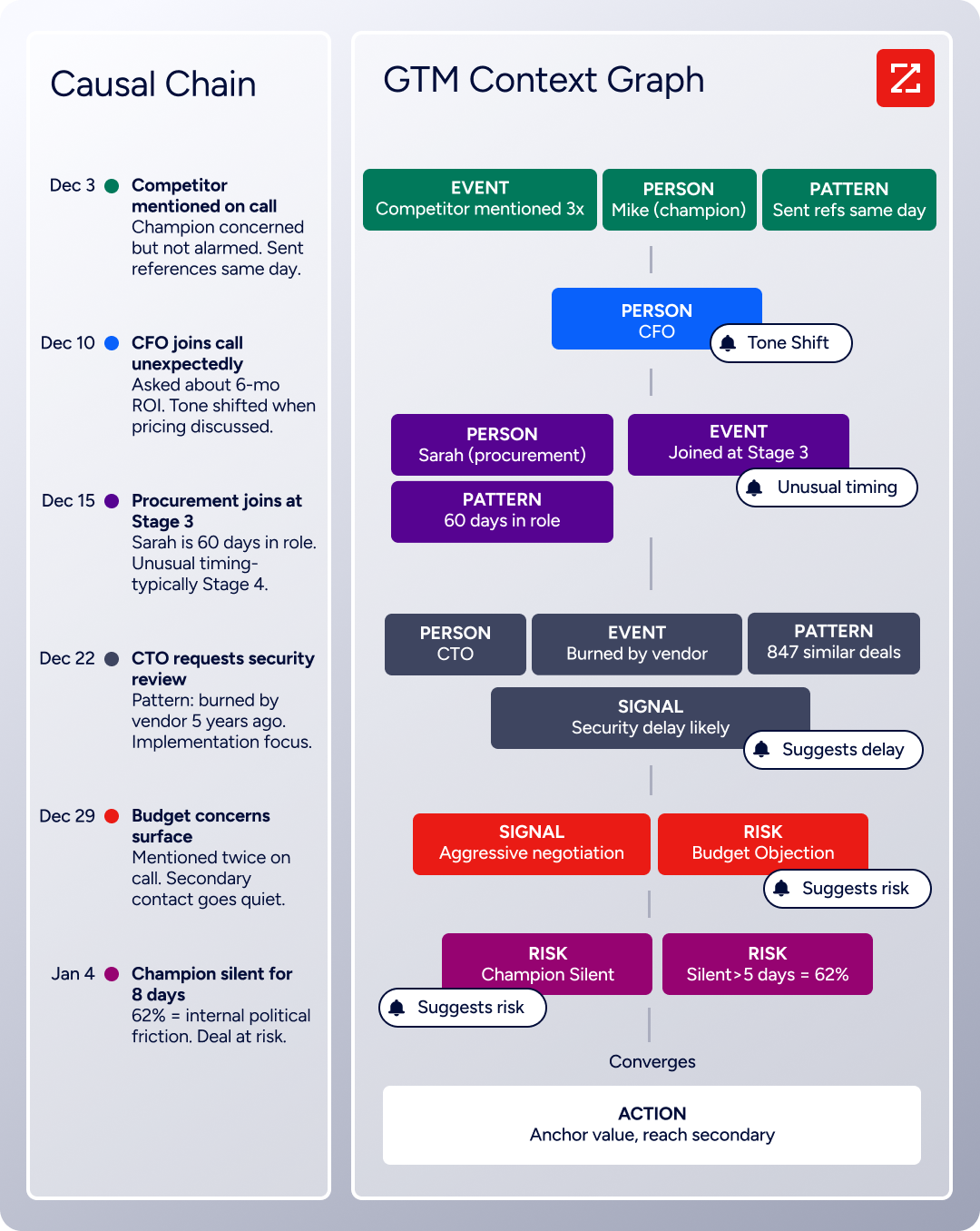
Gong's Revenue Graph captures conversation data and maps it to CRM records. ZoomInfo's GTM Context Graph takes a wider scope, processing 1.5B+ data points daily and combining ZoomInfo's B2B data with CRM records, conversation intelligence (via Chorus, backed by 14 technology patents), email interactions, and behavioral signals into a single intelligence layer.
The distinction matters for teams that need intelligence beyond conversation analysis.
A CRM records that a deal moved from Stage 3 to Stage 4. Gong can tell you what was said on the call that preceded the move. The GTM Context Graph reasons across both: connecting the CFO joining the last call with ROI-focused questions to the pattern behind closed-won deals in the same segment, then linking that to third-party signals showing the company is hiring and researching a competitor. That reasoning flows into every downstream action.
Source: ZoomInfo
ZoomInfo GTM Studio: Marketing orchestration and ABM that Gong does not provide
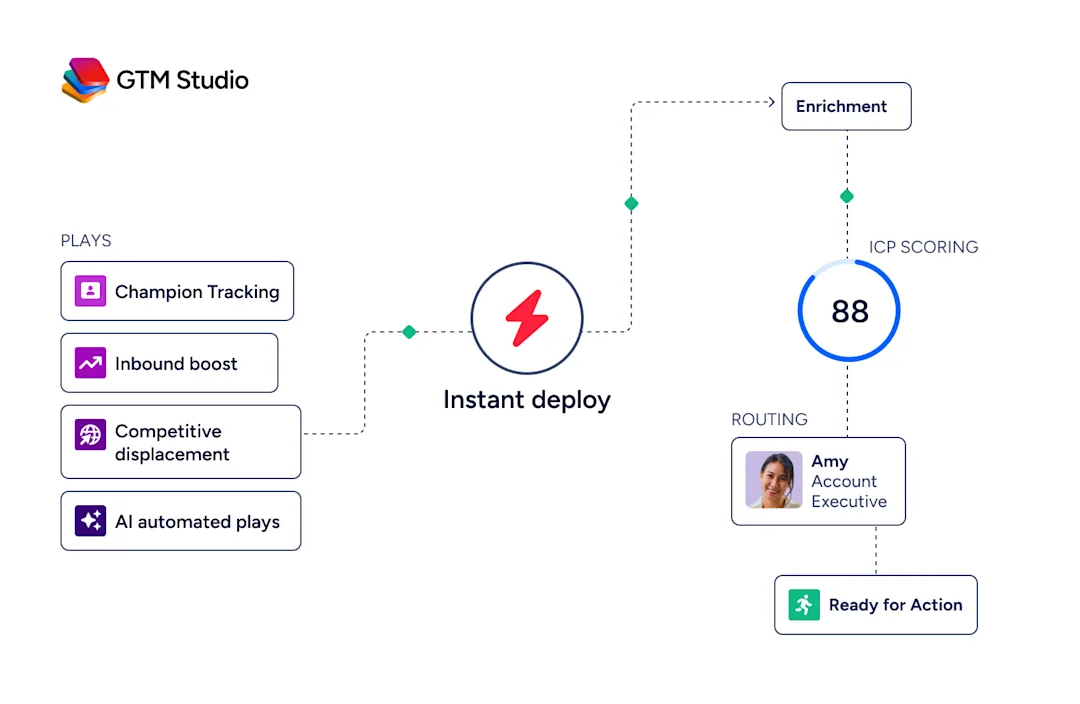
GTM Studio addresses the marketing orchestration gap. Marketers, RevOps teams, and GTM engineers can build audiences using natural language, enrich with first- and third-party data, define triggers, and activate plays across channels (email, calls, display ads, direct mail, LinkedIn, Meta, Connected TV) without engineering support. Pre-built GTM plays cover inbound acceleration, champion tracking, competitive displacement, and ICP targeting. Expansion plays that used to take 3 weeks now launch in 30 minutes.
Source: ZoomInfo
ZoomInfo Marketing includes a native Demand-Side Platform deploying display ads based on 300+ company attributes, FormComplete (reducing forms to a single field while auto-appending data), and Account Fit Scoring (predictive AI scoring 0-100 based on company attribute patterns).
ZoomInfo's Free Entry Points: A way to evaluate the platform before any commitment
ZoomInfo offers what Gong does not: a path into the platform without talking to sales.
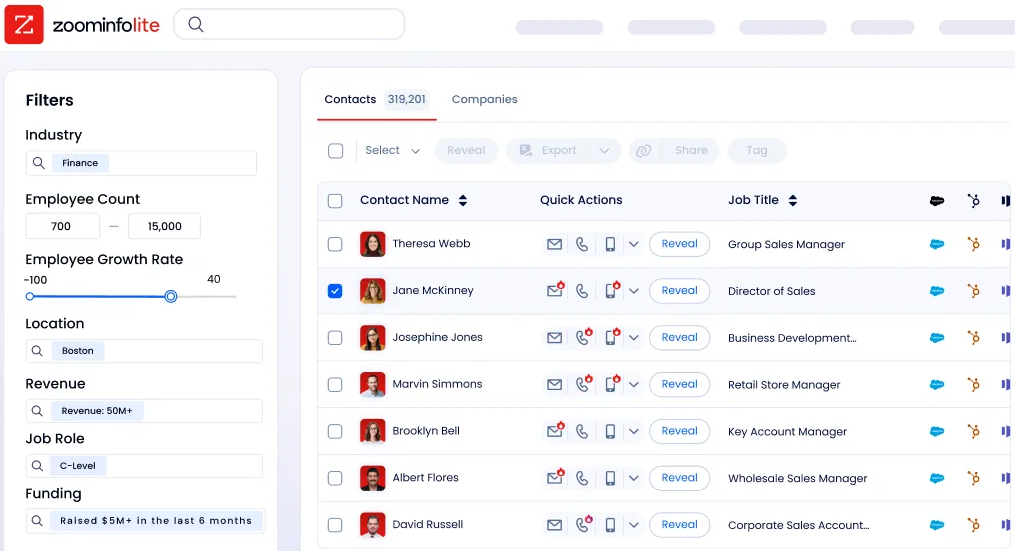
ZoomInfo Lite is a permanent free tier with access to ZoomInfo's B2B database, 10 monthly export credits, individual and company searches, a Chrome extension, and WebSights Lite with up to 10 website visitor reveals per day. A separate 7-day free trial provides broader access with no credit card required.
Source: ZoomInfo
Seismic's sales team attributed 39% of active pipeline to opportunities identified or influenced by ZoomInfo signals, boosted productivity by 54%, and saved 11.5 hours per week per seller. (Seismic Case Study)
Final Summary
Gong is an integrated toolkit for revenue intelligence and sales execution: the Revenue Graph captures every customer interaction, conversation AI surfaces deal risks and coaching moments from what buyers said, Engage sequences multi-channel outreach with AI-composed messages grounded in call context, Forecast delivers predictions trained on 300+ signals from 2.5 billion conversations, Enable builds coaching from real interaction data rather than generic courseware, and 15+ included AI agents automate the work in between.
It fits enterprise revenue teams that want coaching, forecasting, and deal intelligence driven by customer conversations rather than CRM field entries. It is lighter upstream: no native B2B database, no proprietary intent signals, no website visitor identification, no marketing orchestration or ABM capabilities, and no pricing transparency or self-serve entry.
If your bottleneck is before the conversation, that is the ground ZoomInfo covers.
Its 500M-contact, 100M-company database supplies the verified emails and direct dials Gong Engage's sequences run on. ZoomInfo Intent surfaces the accounts researching your category from 6 trillion+ keyword-to-device pairings monthly, before any outreach begins. WebSights identifies site visitors down to the contact level. And GTM Studio gives marketing teams the multi-channel campaign orchestration and ABM capabilities Gong does not include.
Together, ZoomInfo fills the upstream intelligence layer, and Gong turns the resulting conversations into coaching, forecasting, and deal execution.
See what that data adds to your revenue stack: start with ZoomInfo Lite for free, or request a demo to see verified contacts and intent signals flow into your pipeline.
FAQ
Does Gong include a B2B contact database?
No. Gong is a revenue intelligence and sales execution platform, not a data provider. It does not include its own database of contacts, companies, phone numbers, or email addresses. Gong Engage's Recommended Contacts feature surfaces stakeholders to connect with based on historical deal data, but the contact information comes from partners like LeadIQ, Cognism, and Apollo.
Teams pair Gong with a data platform like ZoomInfo, whose 500M contacts, 100M companies, and 120M direct dials supply the contacts that Engage's outreach sequences run on.
Which Gong plan includes forecasting?
Gong Forecast is available in two tiers. Forecast Essentials includes Deal Boards, Account Boards, AI Deal Reviewer, and Win/Loss Insights. The full Gong Forecast tier adds forecast submission, AI Deal Predictor, Forecast Analytics, and AI Revenue Predictor. Both are add-on applications layered on the Gong Foundation platform.
Are Gong's AI agents included or do they cost extra?
All 15+ Gong Agents are included with Gong licenses at no additional cost. They are not sold as premium add-ons. Agents are configured through Agent Studio, a no-code drag-and-drop interface, with pre-built templates that administrators can customize without IT involvement.
Can Gong automate LinkedIn outreach with AI?
Gong Engage supports LinkedIn steps in its Flows (sequences), including LinkedIn connect and LinkedIn message step types. The AI Composer generates personalized email content from conversation context. LinkedIn steps are part of the multi-channel sequence, though AI automation for LinkedIn content depends on the AI Composer's capabilities across all channels.
Does Gong offer buyer intent data?
Gong captures engagement signals from your own interactions (calls, emails, meetings) and can ingest intent signals from partner platforms through the Gong Collective's 300+ integrations. It does not include proprietary third-party intent data showing which companies are researching specific topics across the web.
ZoomInfo Intent tracks signals from 210 million IP-to-Organization pairings and 6 trillion+ keyword-to-device pairings sourced monthly, identifying in-market accounts before any conversation begins.
What CRMs does Gong integrate with?
Gong has native bidirectional integrations with Salesforce, HubSpot, and Microsoft Dynamics 365. The Salesforce integration is the deepest, including a managed package with custom objects, an embedded Gong player, built-in Salesforce Flows, and an Agentforce MCP connection. For other CRMs, a CRM API supports import-only data sync.
Does Gong have a free trial or free plan?
No. Gong does not offer a self-serve free plan or publicly available free trial. Its Terms of Service references an "Evaluation Services" mechanism provided at Gong's discretion following a sales conversation. All fees are non-cancelable and non-refundable.
ZoomInfo, by contrast, offers both ZoomInfo Lite (a permanent free tier with real data access) and a 7-day free trial with no credit card required.
How does Gong's pricing work?
Gong uses a quote-based pricing model with three components: per-user licenses, a platform fee based on the number of users, and tech stack integrations included at no extra charge. Prospects self-select a team-size band before receiving a custom proposal. The current architecture is modular: customers start with the Gong Foundation platform and layer on specialized applications (Engage, Forecast, Enable, Data Cloud). Collaborator seats for non-selling stakeholders are free.
ZoomInfo provides a B2B contact and company database, intent signals, and marketing orchestration capabilities that complement Gong's revenue intelligence and sales execution features.
