
Greenhouse has earned its position as the #1 ATS on G2 across 57 reports, serving 7,500+ companies with a structured hiring platform that covers sourcing, interviewing, onboarding, and analytics.
But an ATS only sees what happens inside its own pipeline.
Greenhouse tracks applications, manages interview stages, captures scorecard evaluations, and routes approvals. On its own, it cannot verify whether a candidate's contact information is accurate before a sourcer sends an InMail, eliminate the scheduling back-and-forth that eats coordinator hours, run compliant background checks inside the candidate profile, or hand off a signed-offer new hire to your HRIS without someone re-entering the data.
The right integrations close those gaps. They feed verified candidate data into your pipeline, automate the administrative work that slows hiring, surface ATS activity where your team already communicates, and connect Greenhouse to the systems that take over after the offer is signed.
This guide covers the strongest integration for each job Greenhouse users most commonly need done:
Enrich your candidate sourcing with verified B2B contact data and company intelligence
Source passive candidates from the world's largest professional network with bidirectional pipeline sync
Automate interview scheduling with self-service booking tied to pipeline stages
Run compliant background checks directly from candidate profiles
Surface recruiting events, approvals, and collaboration into team communication channels
Capture every interview and auto-populate structured scorecards with AI
Synchronize headcount approvals and new hire records with your HRIS
Each section covers how the integration connects with Greenhouse, what data flows between the platforms, pricing, and who benefits most.
Best Greenhouse Integrations at a Glance | |
|---|---|
Best Greenhouse Integration for Candidate Data Enrichment and Recruiting Intelligence Enriches Greenhouse candidate records with verified contact data, company intelligence, and org charts from ZoomInfo's B2B database, giving recruiters accurate sourcing data and context to prioritize the right prospects before first outreach. | |
Best Greenhouse Integration for Professional Network Sourcing Connects LinkedIn's 1.3 billion-member network to Greenhouse through Recruiter System Connect, enabling bidirectional pipeline sync, in-ATS candidate indicators, and one-click prospect export so sourcing activity stays aligned with structured hiring workflows. | |
Best Greenhouse Integration for Interview Scheduling Automation Replaces manual scheduling coordination with stage-triggered, self-service booking that checks real-time interviewer availability across calendars and writes confirmed appointments back to Greenhouse automatically. | |
Best Greenhouse Integration for Closing the Pre-Offer Screening Loop Lets recruiting teams order, track, and receive compliant background check results directly from each candidate's Greenhouse profile, with jurisdiction-aware package filtering and candidate communication handled by Checkr's portal. | |
Best Greenhouse Integration for Recruiting Team Communication and Approval Workflows Pushes configurable ATS notifications into Slack channels and delivers pending offer and job approvals with embedded action buttons, keeping hiring teams informed and approvers responsive without requiring them to log into Greenhouse. | |
Best Greenhouse Integration for AI Interview Intelligence and Scorecard Automation Joins every Greenhouse-scheduled interview automatically, transcribes the conversation, and writes structured AI-generated summaries into scorecard fields so interviewers review and submit feedback rather than write it from scratch. | |
Best Greenhouse Integration for HRIS Synchronization and New Hire Handoff Connects Greenhouse to Workday through dedicated HRIS Link and Hire Link connectors, importing approved job requisitions into Greenhouse and exporting signed-offer new hire records back to Workday to trigger onboarding without manual re-entry. |
What Is Greenhouse?
Source: Greenhouse
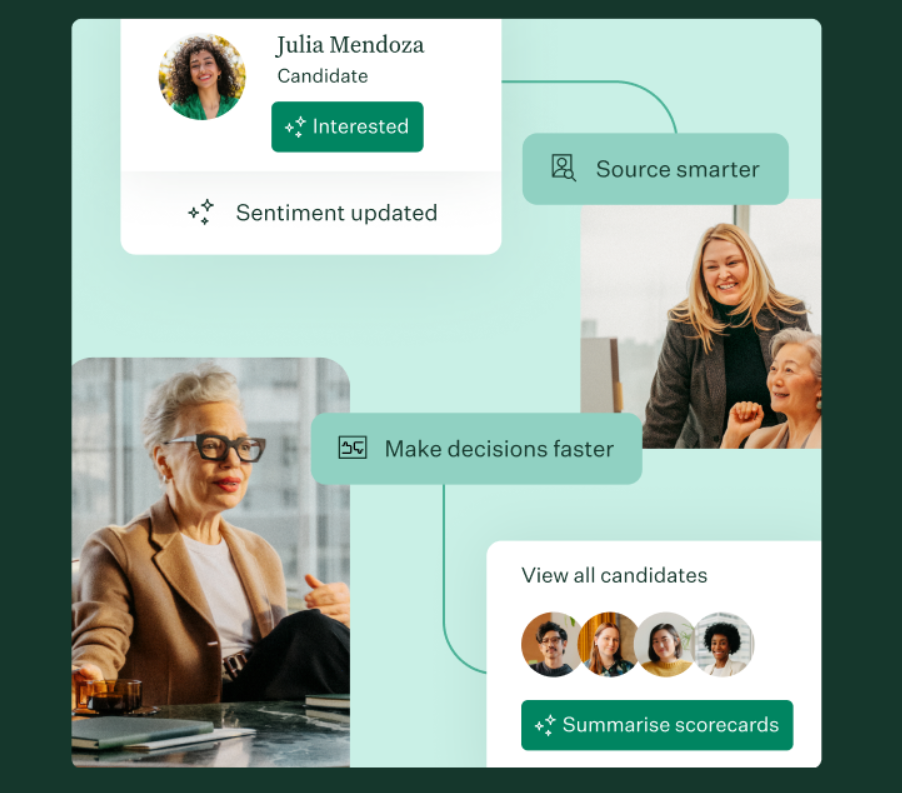
Greenhouse is a hiring platform that covers every stage from sourcing through onboarding, built around the principle of structured hiring: standardized scorecards, defined interview kits, and evaluation criteria established before a job is posted.
The company positions itself as "the only hiring platform you'll ever need", serving organizations from early-stage startups to large enterprises. Its platform covers AI recruiting, talent sourcing and CRM, candidate experience, interviewing and decision-making, talent matching and fraud detection, onboarding, and reporting.
Greenhouse's integration ecosystem is a defining strength.
The Greenhouse Partner Directory houses 500+ pre-built integrations spanning HRIS, job boards, sourcing, background checks, assessments, video interviewing, and more, with reach across 1,000+ global job boards.
On the technical side, Greenhouse maintains a developer platform with eight distinct APIs: the Harvest API for full CRM data access, the Job Board API for custom career pages, the Candidate Ingestion API for sourcing partner submissions, the Assessment API for evaluation platform scoring, and more.
The platform supports OAuth 2.0, webhooks with HMAC signature verification, and a recently launched Model Context Protocol (MCP) server for governed AI tool connectivity.
The integration categories available to Greenhouse users include:
HRIS and onboarding: Workday, BambooHR, Rippling, SAP SuccessFactors
Sourcing and CRM: LinkedIn Recruiter, Indeed, Gem, Hired
Scheduling: Calendly, GoodTime, native self-scheduling
Background checks and screening: Checkr, Sterling, HireRight
Team communication: Slack, Microsoft Teams, Google Chat
Assessments: SHL, Alva Labs, Arctic Shores, HackerRank
Interview intelligence: Metaview, BrightHire, Pillar
Video interviewing: Zoom, Google Meet, Microsoft Teams, Spark Hire
With that ecosystem as context, here are the seven integrations we selected as the best options for extending Greenhouse across the categories that matter most to hiring teams.
1. ZoomInfo: Best Greenhouse Integration for Candidate Data Enrichment and Recruiting Intelligence
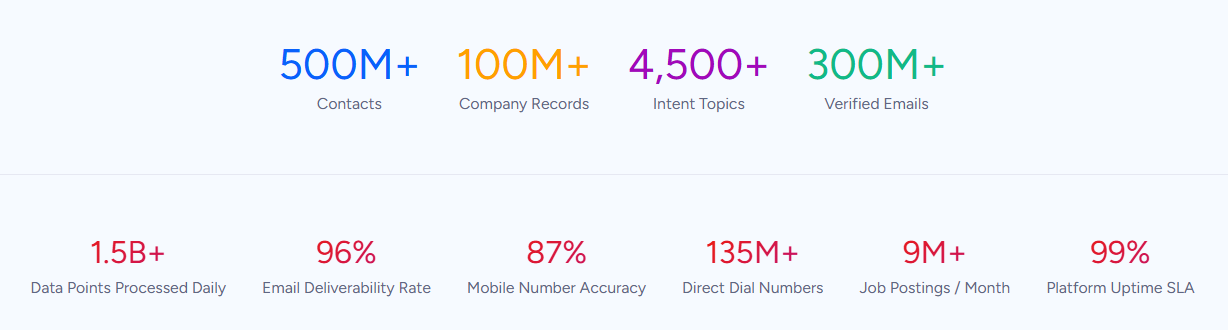
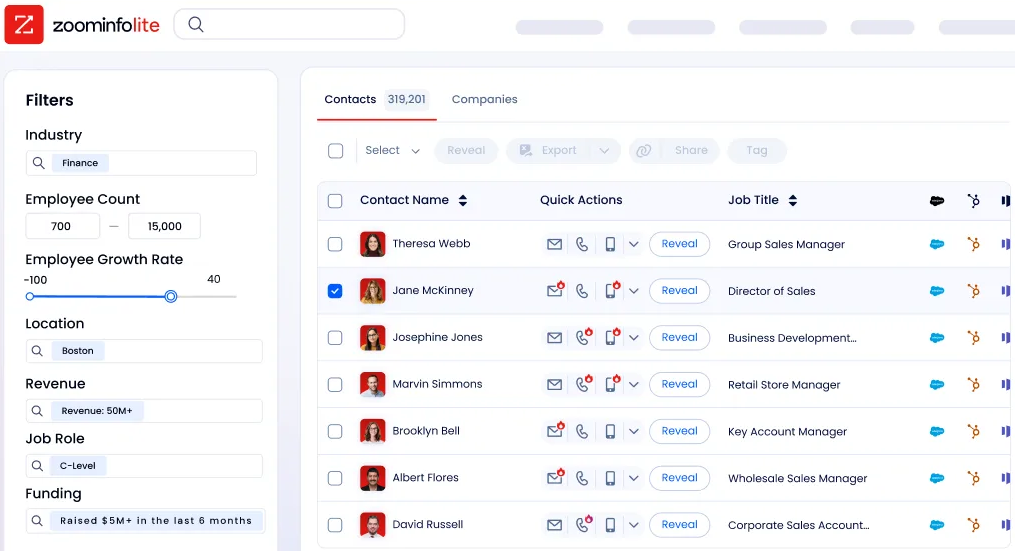
ZoomInfo is a B2B data and go-to-market platform built on a database of 500M contacts, 100M companies, 135M+ verified phone numbers, and 200M+ verified business email addresses. It integrates natively with Greenhouse through ZoomInfo TalentOS, allowing recruiters to export verified candidate data and contact information directly into Greenhouse to enrich ATS records and speed up sourcing.
Connecting the two platforms unlocks:
A sourcing pipeline backed by verified direct dials and business emails, so outreach actually reaches the candidate instead of bouncing or ringing dead numbers
Company intelligence, org charts, and technographic data that give recruiters context on a prospect's organization before the first conversation
The ability to build targeted candidate lists using 300+ company attributes and export directly into Greenhouse prospect pools
One-click candidate transfer from ZoomInfo's database into Greenhouse without manual data entry or copy-paste between systems
How ZoomInfo Integrates with Greenhouse
ZoomInfo connects to Greenhouse through a native integration that lets recruiters push candidate profiles from ZoomInfo's database directly into Greenhouse as prospects or candidates.
The integration uses Greenhouse's Candidate Ingestion API to deliver contact records with verified data fields. Greenhouse maintains a dedicated support article for the connection.
Because both platforms maintain the connector natively, it requires no middleware and stays current with updates on both sides.
Verified Contact Data Export: Start Every Sourcing Conversation with Accurate Information
The foundation of any recruiting outreach is accurate contact data. When a recruiter identifies a target candidate in ZoomInfo's database, the integration transfers verified direct-dial phone numbers, business email addresses, current job title, department, and seniority level directly into a Greenhouse candidate record.
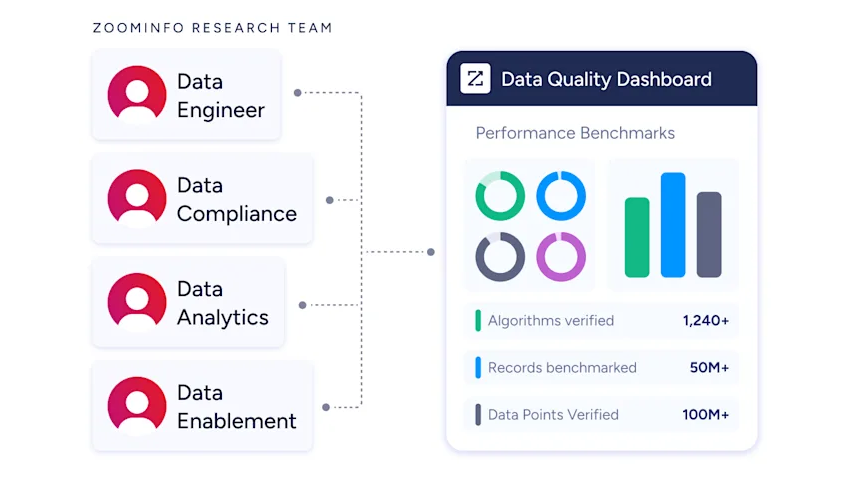
This data flows through ZoomInfo's verification pipeline, backed by 300+ human researchers and reaching up to 95% accuracy on first-party data.
For recruiting teams, the practical difference shows up at the point of outreach: a verified direct dial connects and a verified email lands in the candidate's inbox, rather than bouncing or routing to a generic company address no one monitors.
ZoomInfo in action: A recruiter building a pipeline for a VP of Engineering search uses ZoomInfo to identify 50 qualified candidates at target companies. Rather than spending hours on LinkedIn profile research and email-finding tools, they export all 50 records to Greenhouse in a single action, each with a verified direct dial, business email, current title, and company context.
The sourcing team begins outreach the same afternoon with accurate contact information attached to every Greenhouse prospect record.
Company Intelligence and Org Charts: Understand the Prospect's Organization Before First Contact
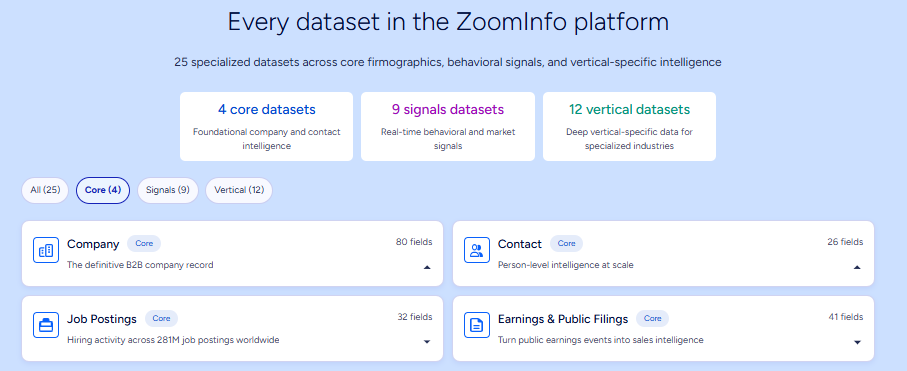
Recruiting outreach performs better when the sourcer understands the candidate's organizational context. ZoomInfo provides company-level intelligence covering 100M companies with revenue, employee count, industry, and headquarters, technographic data spanning 30,000+ technologies, and department org charts with decision-maker mapping.
When a recruiter is sourcing for a specific role, this intelligence shows which companies to target, which departments to prioritize, and how to position the opportunity.
A recruiter sourcing for a fintech startup can filter ZoomInfo's database by companies using specific technology stacks, identify candidates at the right seniority level within the engineering department, and understand the org structure before crafting personalized outreach.
ZoomInfo in action: A recruiting team needs to fill three senior data engineering positions quickly. Using ZoomInfo's technographic filters, they identify 200 mid-market companies running the same data stack their client uses, pull the engineering org charts to find candidates at the right level, and export a prioritized list of 80 prospects to Greenhouse with company context attached to each record.
The hiring manager reviews the list and knows immediately which companies are strong talent sources based on tech stack alignment.
Targeted List Building: Search, Filter, and Export Without Leaving the Workflow
ZoomInfo's Contact and Company Search provides access to 300+ company attributes for building candidate lists: job function, seniority, department, company size, industry, technology stack, location, and more. Recruiters build targeted searches, save them for ongoing monitoring with automated alerts, and export qualifying candidates directly into Greenhouse prospect pools.
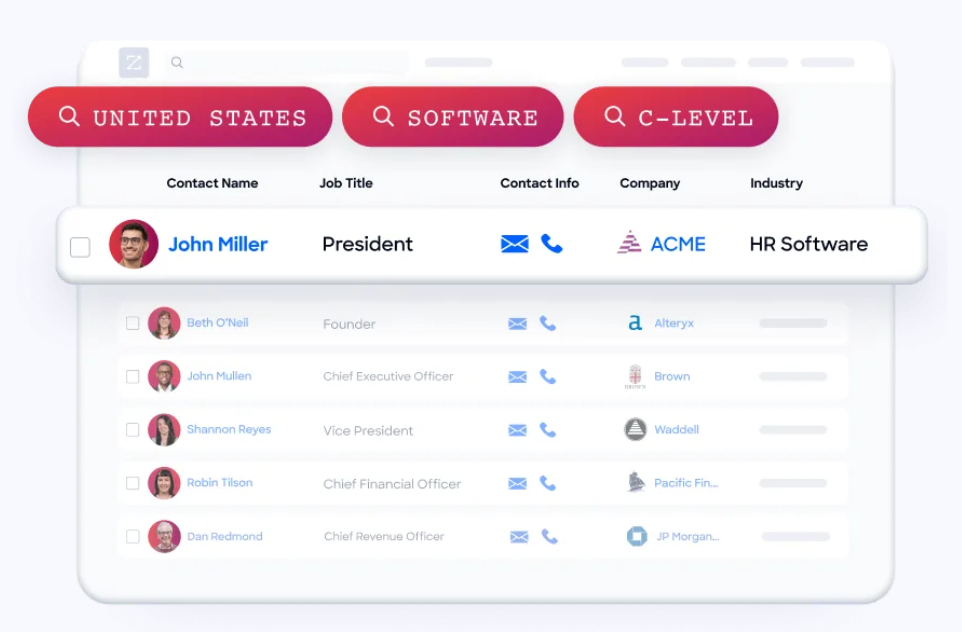
The ReachOut Chrome Extension extends this to passive browsing: when a recruiter finds a promising LinkedIn profile or company website, the extension surfaces ZoomInfo's verified data and enables a one-click export to Greenhouse from within the browser.
Buyer Intent and Hiring Signals: Identify Companies That Are Growing
Beyond contact data, ZoomInfo's Buyer Intent tracks signals from 210 million IP-to-Organization pairings and 6 trillion+ new keyword-to-device pairings monthly.
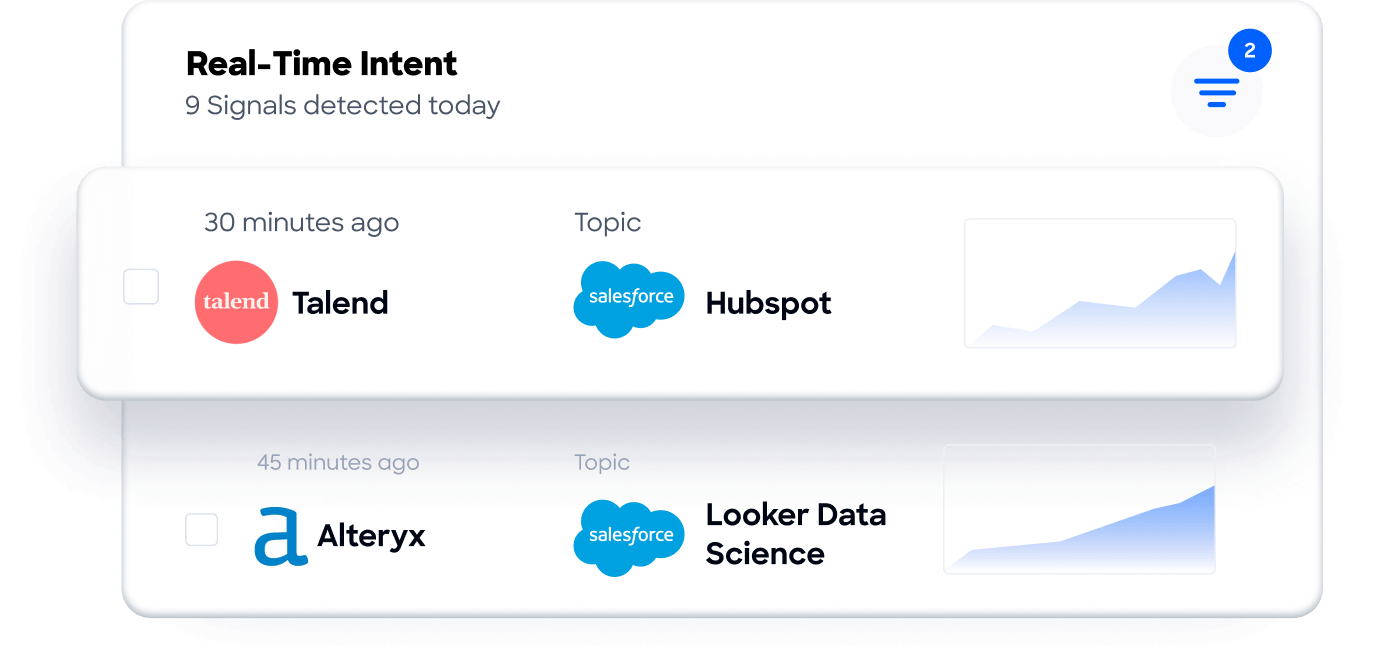
While these signals are designed for sales and marketing teams, they carry recruiting value: a company researching "engineering team expansion" or "cloud migration" is likely hiring, and its employees may be open to conversations about new opportunities as the organization changes.
Combined with job posting change alerts and company news monitoring, ZoomInfo gives recruiting teams a signal layer that identifies where hiring demand is building before those candidates appear in the public talent market.
ZoomInfo Pricing
ZoomInfo uses a consumption-based pricing model with custom quotes based on usage, users, credit volume, and features.
It is organized into Sales, Marketing, and standalone product lines, each in Professional, Advanced, and Enterprise tiers.
The native Greenhouse integration is available through ZoomInfo's marketplace connector, with capabilities scaling by tier: Professional includes core contact and company data with CRM integrations, Advanced adds intent signals and website visitor tracking, and Enterprise adds real-time signals and AI-generated account intelligence.
ZoomInfo Lite is a permanent free tier (no credit card, no time limit) with 10 monthly export credits, searches, the Chrome extension, and CRM integrations, making it a practical way to evaluate the data quality before committing. A separate 7-day free trial covers paid features.
Who Should Use the ZoomInfo Integration?
Recruiting teams whose sourcing pipeline depends on accurate contact data: verified direct dials and business emails are the difference between outreach that connects and messages that bounce, damaging sender reputation and wasting sourcer time
TA operations teams building targeted candidate lists across specific industries, company sizes, or technology stacks who need 300+ searchable attributes rather than basic LinkedIn filters
Organizations scaling their sourcing function that need to export candidate records into Greenhouse prospect pools in bulk without manual data entry for each prospect
2. LinkedIn Recruiter: Best Greenhouse Integration for Professional Network Sourcing
Source: LinkedIn
LinkedIn Recruiter is a talent acquisition platform that integrates with Greenhouse through Recruiter System Connect (RSC), LinkedIn's certified ATS integration program.
The connection creates a bidirectional data bridge between where recruiters source passive candidates and where they manage the hiring pipeline. It is a native, certified integration maintained through LinkedIn's partner program.
Key integration capabilities include:
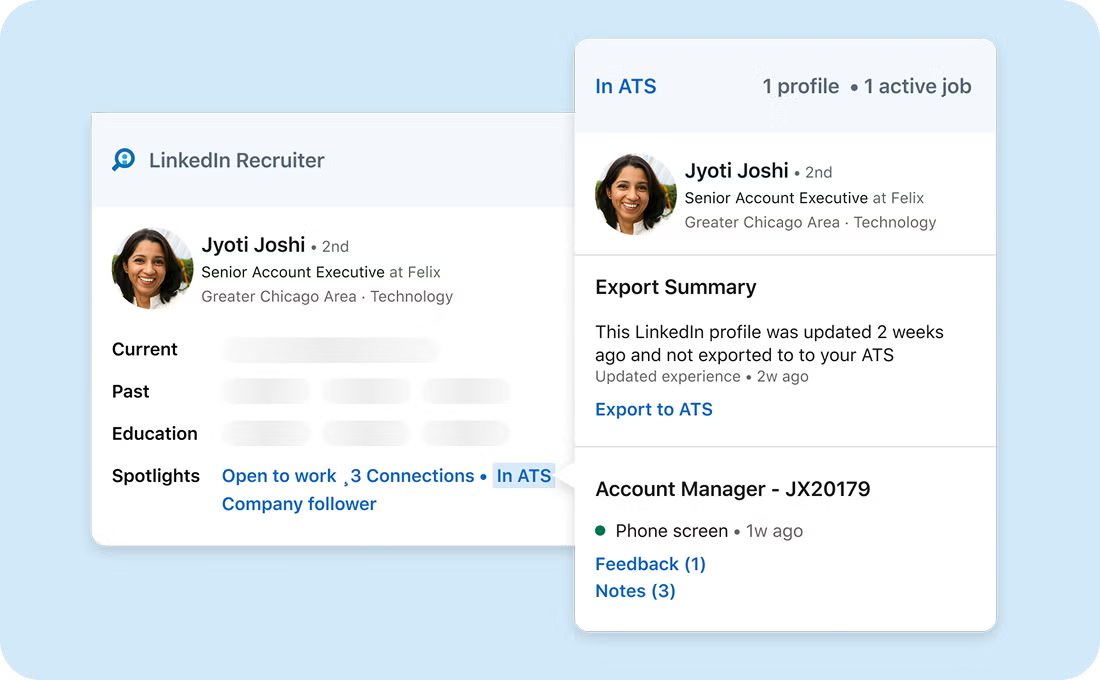
In-ATS indicator showing on LinkedIn profiles when candidates already exist in Greenhouse, preventing duplicate outreach
One-click prospect export that populates Greenhouse records with LinkedIn profile data automatically
Bidirectional applicant stage sync pushing Greenhouse pipeline changes back to LinkedIn Recruiter in real time
InMail and activity log sharing so sourcing conversations appear in Greenhouse's candidate activity feed
RSC+ Connected Projects linking LinkedIn Hiring Assistant evaluations to corresponding Greenhouse job requisitions
How LinkedIn Recruiter Integrates with Greenhouse
Source: LinkedIn
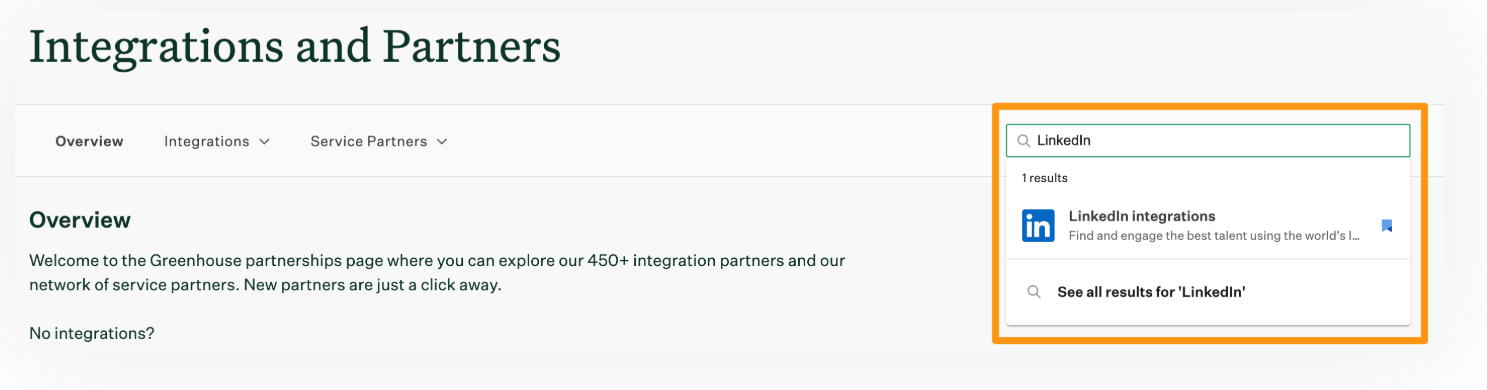
The integration runs through Recruiter System Connect (RSC), LinkedIn's certified API program for ATS platforms. Greenhouse is a certified RSC partner with a pre-built connection enabled through both platforms' admin settings. RSC+ extends the connection to cover LinkedIn's Hiring Assistant, which draws on Greenhouse ATS data when evaluating candidates across both systems.
1. In-ATS Indicator and Rediscovered Candidates.
Once RSC is active, LinkedIn Recruiter surfaces a badge on profile cards showing whether a candidate is already in Greenhouse, their current stage, and whether they have applied to the open role.
Rediscovered Candidates flags people in search results who have prior history in Greenhouse as past applicants, existing prospects, or previous contacts. Recruiters save up to 3.5 hours per week by activating RSC, with much of that coming from eliminating duplicate outreach to candidates already in the pipeline.
2. One-Click Export and Bidirectional Stage Sync.
When a recruiter identifies a qualified candidate in LinkedIn Recruiter, one click adds them to a Greenhouse prospect pool or job pipeline with LinkedIn profile data (title, company, experience) populated automatically. In the other direction, stage changes in Greenhouse push back to LinkedIn Recruiter, keeping the sourcing team's view current without manual reconciliation.
InMails sent through LinkedIn Recruiter and recruiter notes appear in the Greenhouse candidate activity feed, giving hiring managers and interview panelists the full sourcing conversation history without needing a LinkedIn Recruiter seat.
3. RSC+ for Hiring Assistant: Connected Projects.
RSC+ links a LinkedIn Hiring Assistant project directly to its corresponding Greenhouse job requisition, unifying applicants from both systems into a single Hiring Assistant pipeline. Greenhouse resume data and ATS application history feed into Hiring Assistant's evaluation, and its evaluations sync back to Greenhouse in real time.
Hiring Assistant reviews 81% fewer profiles to surface a qualified match. RSC+ requires the Hiring Assistant add-on on LinkedIn's side.
LinkedIn Recruiter Pricing
LinkedIn Recruiter uses a per-seat subscription model. The Greenhouse RSC integration is only available on Recruiter Corporate and above; Recruiter Lite does not include ATS integrations.
Recruiter Lite: $170/month (monthly) or $1,680/year (annual). 30 InMail credits/month, 20+ search filters. No ATS integrations, no RSC connection with Greenhouse.
Recruiter Corporate: Quote-based, annual contracts. 150 InMail credits/month, 40+ advanced search filters, full network access. RSC integration with Greenhouse available. Hiring Assistant available as a separate paid add-on (required for RSC+).
Recruiter Professional Services Plus (RPS+): Quote-based, designed for staffing agencies. 140 InMail credits/month, Hiring Assistant included.
LinkedIn's published cancellation policy states that services purchased under Order Forms are non-cancelable and non-refundable. Teams should evaluate hiring volume before committing to an annual Recruiter Corporate contract.
Who Should Use the LinkedIn Recruiter Integration?
Recruiting teams that actively source passive candidates on LinkedIn and need InMails, notes, and profile views to appear inside Greenhouse's candidate activity feed without manual duplication
Teams running structured hiring workflows in Greenhouse that want stage changes to update in LinkedIn Recruiter automatically so the sourcing team always sees the current pipeline state
Organizations hiring in knowledge-worker, technology, or professional services roles where LinkedIn's 1.3 billion+ member network provides the deepest passive candidate pool
3. Calendly: Best Greenhouse Integration for Interview Scheduling Automation
Source: Calendly
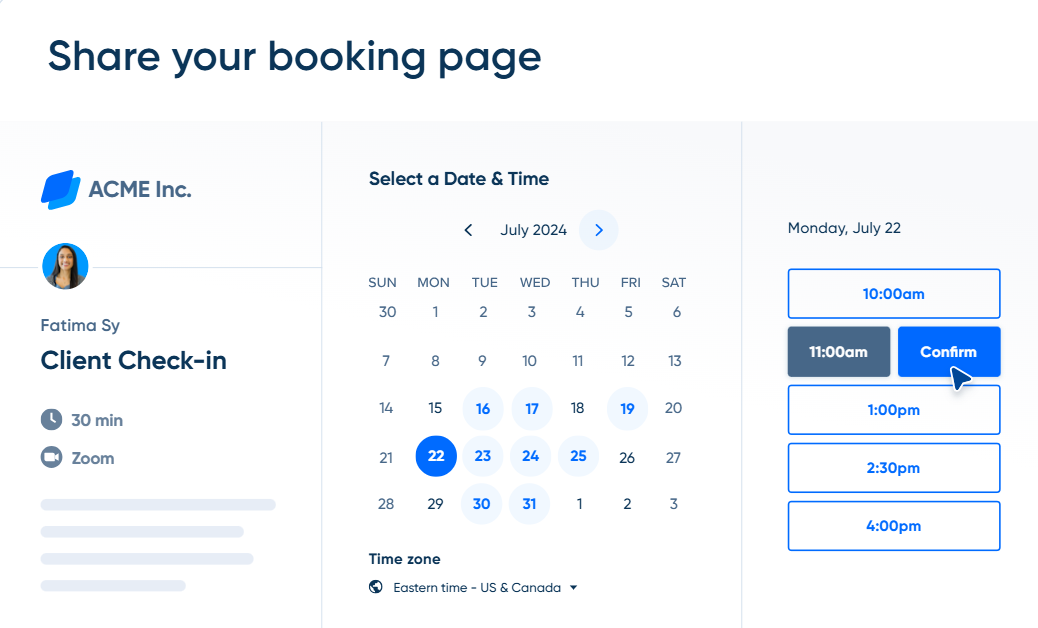
Calendly is a scheduling automation platform used by more than 100,000 organizations that integrates with Greenhouse to replace manual interview scheduling with candidate-driven, self-service booking tied to pipeline stage transitions. The integration is natively listed in the Greenhouse integration marketplace.
Key integration capabilities include:
Stage-triggered scheduling automation sending Calendly booking links automatically when candidates advance through Greenhouse pipeline stages
Real-time calendar conflict prevention across all panelists, offering only times where every interviewer is free
Automatic Greenhouse record updates when bookings are confirmed, removing manual data entry from the scheduling loop
Bulk scheduling actions for volume hiring, triggering links for candidate cohorts within a Greenhouse stage simultaneously
How Calendly Integrates with Greenhouse
Source: Calendly
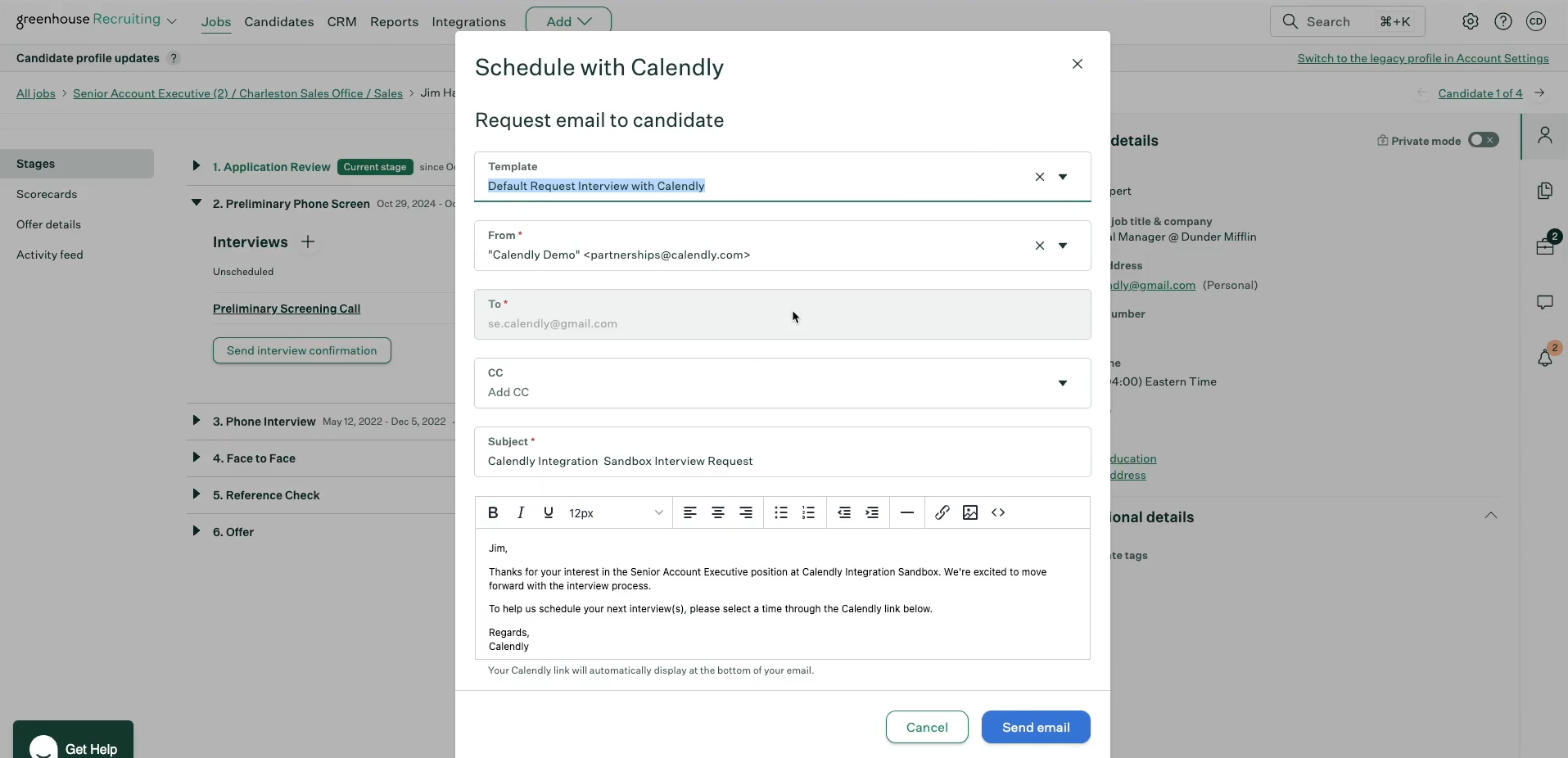
Calendly connects to Greenhouse through the Greenhouse integration marketplace as a native partner. Coordinators configure Greenhouse stage automation to trigger Calendly link delivery, and booking confirmations write back to the candidate's Greenhouse activity record automatically.
1. Stage-Triggered Scheduling Automation.
Without the integration, advancing a candidate to a phone screen requires a coordinator to compose an email, offer times, wait for a reply, confirm the slot, generate a video link, and update the Greenhouse record. With the integration, the stage transition itself triggers the outreach. The candidate receives a branded booking page, selects a slot, and confirms, with the calendar invite and video conferencing link generated automatically. The coordinator's role shrinks to approving the pipeline advancement.
2. Real-Time Calendar Conflict Prevention.
Calendly's Collective event type reads all designated panelists' connected calendars (Google Calendar, Outlook, Exchange) in real time before generating available slots. The booking page only shows times where every required interviewer is free. Because the check happens at booking time rather than link-generation time, slots reflect the calendar state at the moment the candidate is selecting. Buffer times protect interviewers from back-to-back scheduling.
3. Automatic Record Update and Bulk Scheduling.
Confirmed booking details write back to the candidate's Greenhouse profile automatically, keeping ATS data current for reporting. For high-volume roles, coordinators can trigger scheduling links for multiple candidates in the same Greenhouse stage at once, decoupling coordinator effort from candidate volume at the scheduling step.
Calendly Pricing
Calendly uses per-seat pricing with unlimited meetings on all paid plans:
Free: 1 event type, 1 calendar connection. Basic link-based scheduling for single-interviewer screens.
Standard: $10/seat/month (annual). Unlimited event types, 6 calendar connections, automated email and SMS reminders.
Teams: $16/seat/month (annual). Collective event types for panel scheduling, round-robin distribution, managed event templates.
Enterprise: Starts at $15,000/year. SAML SSO, SCIM provisioning, audit logs, dedicated implementation.
For most Greenhouse teams, Standard is the practical minimum for automated reminders and unlimited event types. Teams running panel interviews should consider Teams for Collective event types.
Who Should Use the Calendly Integration?
Recruiting coordinators spending hours on per-candidate scheduling emails when candidates advance through Greenhouse stages, who want that loop replaced with automated link delivery
Teams running multi-person panel interviews where double-booking or availability miscommunication creates rescheduling cycles
Organizations in volume hiring mode that need to trigger scheduling outreach for batches of candidates in the same Greenhouse stage without repeating the action per candidate
4. Checkr: Best Greenhouse Integration for Closing the Pre-Offer Screening Loop
Source: Checkr
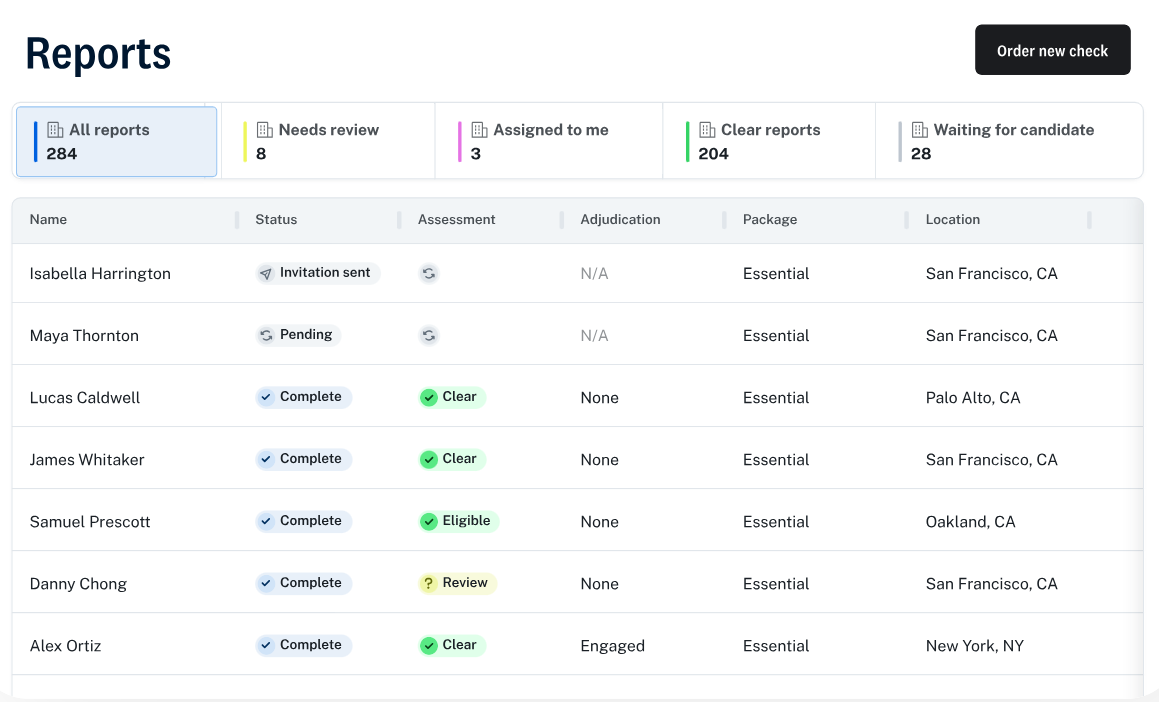
Checkr is an employment background screening platform that integrates with Greenhouse to let recruiting teams order, track, and receive compliant background check results directly from each candidate's Greenhouse application profile.
Checkr holds a Greenhouse Customer Preferred Partner designation and is listed in the Greenhouse integrations marketplace.
Key integration capabilities include:
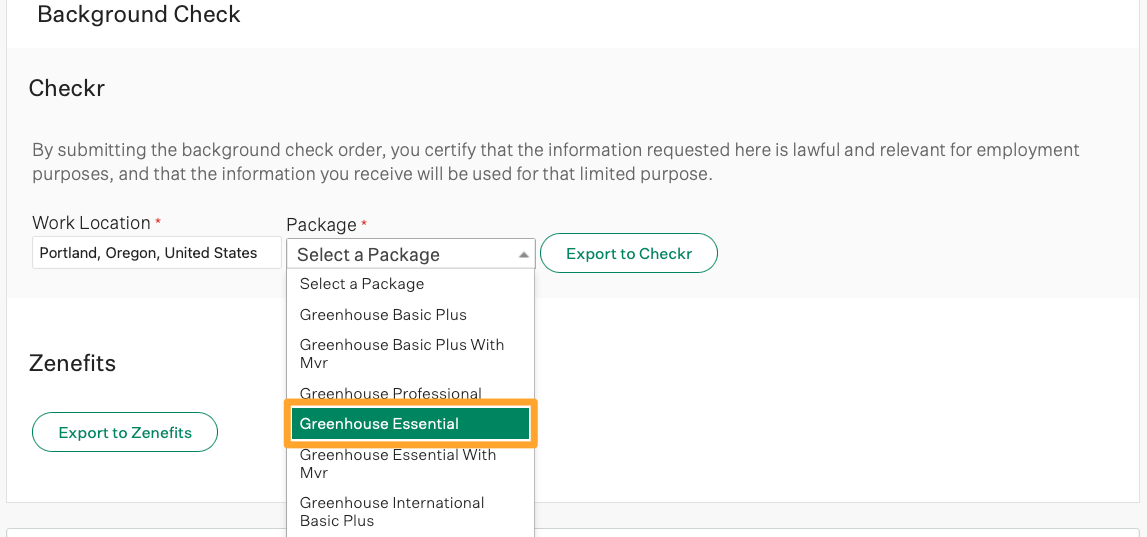
In-profile background check initiation from the Greenhouse application tab by selecting a package and work location
Real-time status and results syncing back to the Background Checks section of the candidate profile
Compliance-filtered package selection surfacing only packages appropriate for the candidate's jurisdiction
Candidate-managed communication with consent, information gathering, and status updates handled by Checkr's portal
How Checkr Integrates with Greenhouse
Source: Greenhouse
The integration surfaces within Greenhouse at the individual candidate application level. A recruiter initiates a check from the candidate's application tab, selects a package, and enters a work location.
From that point, Checkr handles the rest: candidate consent collection, information gathering, and result delivery all flow through Checkr's own mobile-optimized candidate portal.
1. In-Profile Initiation and Status Sync.
Ordering a background check happens directly in Greenhouse without exporting candidate data to a separate system. Once ordered, progress updates and final results push back into the Background Checks section of the Greenhouse application tab, making status visible to anyone with access to the candidate profile.
Checkr processes 89% of criminal background checks within one hour, and 99% of all checks are automated after data retrieval, so results appear in Greenhouse quickly.
2. Compliance-Aware Package Selection.
Background check compliance in the United States is jurisdiction-specific, governed by federal FCRA rules, state criminal history regulations, county-level reporting windows, and city-level Ban the Box ordinances.
The integration filters available packages based on the entered work location, so recruiters choose from a pre-vetted set rather than making compliance determinations manually. A package appropriate for Texas may include search types prohibited in California or New York City; the integration handles that filtering automatically.
3. Candidate Portal and FCRA Process.
After a check is initiated from Greenhouse, Checkr sends the candidate a digital invitation, collects FCRA-required written consent, gathers PII, and keeps the candidate informed through completion. Candidates can check status, access their completed report, and contact Checkr support without involving the recruiting team.
Checkr Pricing
Checkr uses a pay-per-report model with no monthly subscription, seat costs, or long-term contracts:
Basic: $29.99/report. SSN trace, sex offender registry, global watchlist, national criminal search.
Essential: $54.99/report. Adds unlimited county criminal search. Most popular package.
Complete: $89.99/report. Adds state and federal criminal searches.
Enterprise: Custom pricing. Automated adjudication, dedicated support, access to 200+ ATS and HRIS integrations.
Pass-through fees from third-party sources (state court fees, DMV fees, education verification) are charged at cost with no markup.
The Assess adjudication tool carries separate per-report fees: Assess Lite is included free, Assess Standard is $2.49/report (up to 75% reduction in manual review), and Assess Premium is $4/report (up to 85% reduction).
Who Should Use the Checkr Integration?
Teams currently handling background check ordering outside of Greenhouse through separate vendor logins or manual data transfers, who want to consolidate into the ATS
Organizations hiring across multiple U.S. jurisdictions where Ban the Box, state criminal reporting, and FCRA requirements vary, and want package filtering handled automatically
Recruiting teams at scale where disconnected background check management creates a bottleneck between the hiring decision and offer extension
5. Slack: Best Greenhouse Integration for Recruiting Team Communication and Approval Workflows
Source: Slack
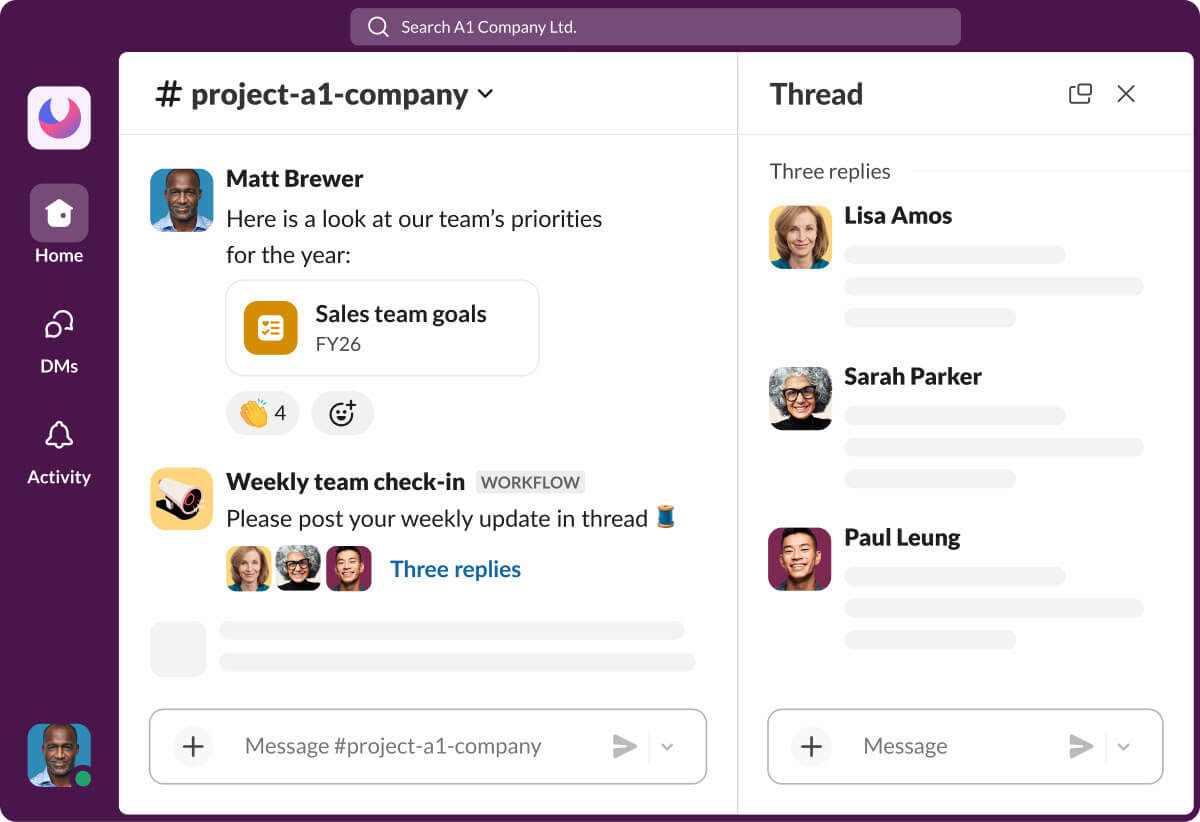
Slack is a team communication platform that integrates with Greenhouse to deliver ATS events, candidate milestones, and hiring workflow approvals directly into channels and conversations. The integration has a dedicated listing in the Slack Marketplace and is a native, first-party connection maintained by Greenhouse.
Key integration capabilities include:
Channel-based recruiting notifications pushing configurable alerts for new applications, referrals, agency submissions, and pending scorecards
In-Slack offer and job approvals with embedded action buttons that remove the need for approvers to navigate into Greenhouse
Mention-based direct messages triggered when a recruiter or hiring manager is tagged in a Greenhouse note or scorecard
How Slack Integrates with Greenhouse
Source: Greenhouse
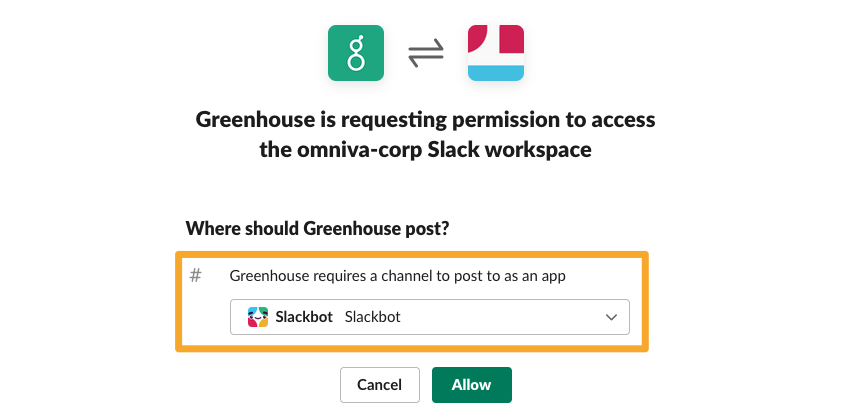
A Greenhouse admin connects the workspace through a standard OAuth flow, authenticates, and configures which event types route to which channels.
No middleware is required. The integration operates primarily as a one-way push (Greenhouse events into Slack), with the exception of approval workflows, which include interactive action buttons.
1. Channel-Based Recruiting Event Notifications.
Greenhouse routes multiple event types to designated Slack channels: new candidate applications, employee referrals, agency submissions, and overdue scorecards.
Teams can assign specific channels per event type (a #new-applications channel, a separate #scorecard-overdue channel), creating clean separation without flooding a single channel. This converts passive ATS notifications into active channel updates that appear in front of the team without requiring daily Greenhouse logins.
2. In-Slack Offer and Job Approvals.
Pending approvals arrive in the approver's Slack workspace as actionable messages. The notification includes candidate name, role, and relevant details alongside "Approve" and "Reject" action buttons. Clicking either completes the action in Greenhouse without requiring the approver to switch tools.
For executive-level approvers who interact with Greenhouse infrequently but must sign off on offers, this cuts approval cycle time.
3. Mention-Based Direct Messages.
When a recruiter or hiring manager is @tagged in a Greenhouse candidate note or scorecard, the integration sends a Slack DM alerting them to the mention.
This surfaces collaboration happening in Greenhouse's note layer into the communication tool team members check most frequently, making the loop immediate rather than dependent on checking an ATS inbox.
Slack Pricing
Slack uses per-seat pricing:
Pro: $7.25/user/month (annual). Unlimited app integrations including the Greenhouse connection, unlimited message history, 24/7 support.
Business+: $15/user/month (annual). Adds SAML SSO, SCIM provisioning, custom retention policies, 4-hour first-response SLA.
Enterprise+: Custom pricing. Multi-workspace management, native DLP, HIPAA compliance, Enterprise Key Management.
The Greenhouse integration is available on all paid plans. Slack's Free plan caps app integrations at 10, which may conflict with organizations running multiple integrations.
Who Should Use the Slack Integration?
Hiring teams and approvers that already live in Slack and need ATS activity surfaced where they spend their day rather than in Greenhouse's internal notification queue
Organizations with multi-party approval workflows where offer or job opening approval lag is a recurring bottleneck, and approvers need to act on decisions without logging into Greenhouse
Recruiters and hiring managers who use Greenhouse's note and scorecard tagging actively and need those mentions to surface in real time through Slack DMs
6. Metaview: Best Greenhouse Integration for AI Interview Intelligence and Scorecard Automation
Source: Metaview
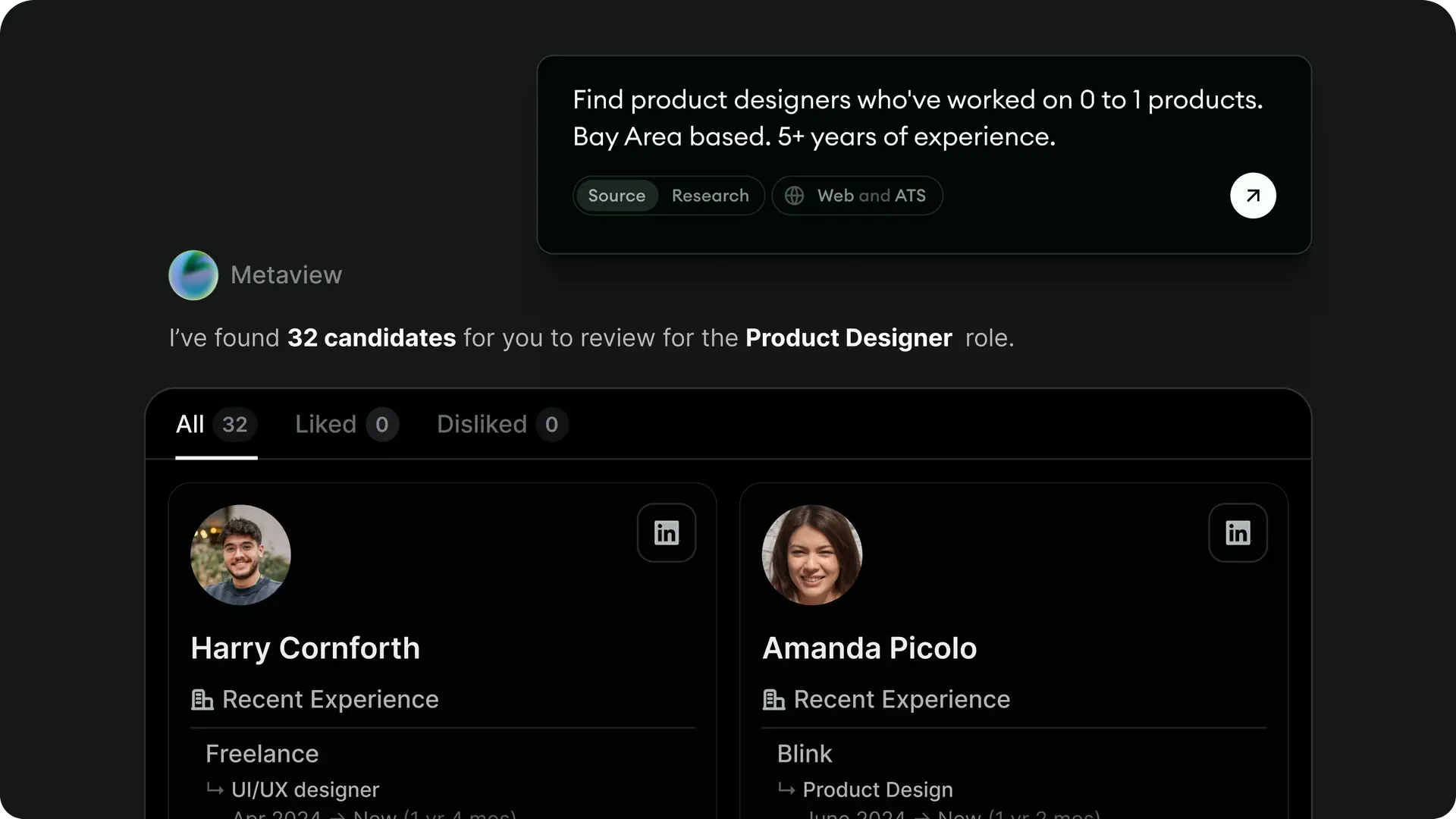
Metaview is a recruiting platform that integrates with Greenhouse to capture every scheduled interview automatically, transcribe the conversation, and write structured AI-generated summaries directly into Greenhouse scorecard fields. The integration is natively listed in the Greenhouse Partner Directory.
Key integration capabilities include:
Automatic joining of every Greenhouse-scheduled interview across Zoom, Google Meet, Microsoft Teams, and Webex, with no interviewer action required
Greenhouse scorecard autofill mapping conversation content to specific competency attributes configured in each job's scorecard
Candidate profile data pull from Greenhouse so AI-generated notes reference role-specific evaluation criteria
Bidirectional navigation links connecting candidate ATS profiles to full interview recordings, transcripts, and summaries
Permission-matched access controls mirroring Greenhouse role assignments in Metaview
How Metaview Integrates with Greenhouse
Source: Greenhouse
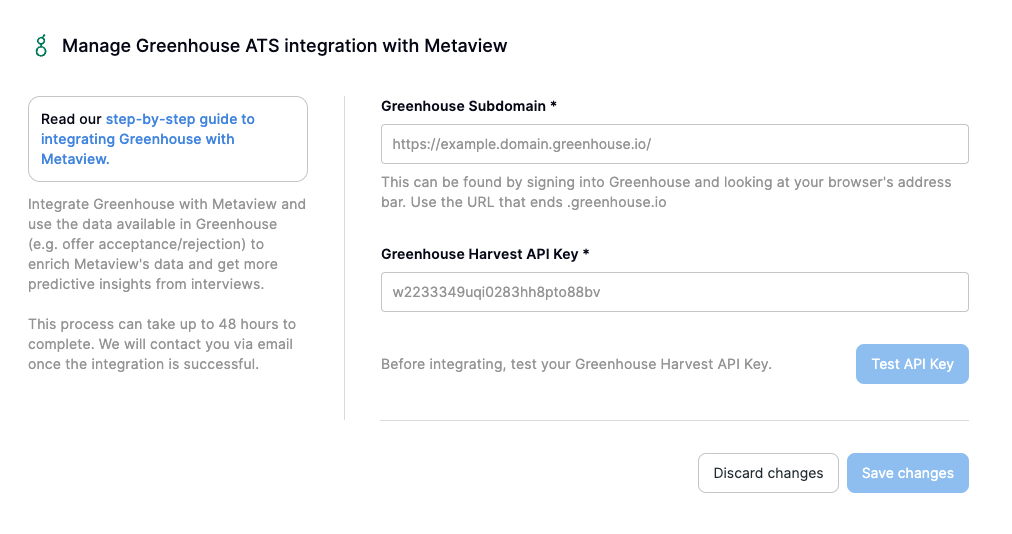
Metaview connects through a native ATS integration configured at the organization level via Greenhouse API credentials. The connection is bidirectional: Metaview pulls candidate and role context from Greenhouse, and pushes structured notes and scorecard content back after each interview.
1. Automatic Interview Capture.
When an interview is scheduled in Greenhouse with a video conference link attached, Metaview automatically joins the call as a bot participant. The auto-join behavior is driven by Greenhouse scheduling data, so every ATS-scheduled interview is captured without relying on individual interviewers to remember to invite the notetaker. Coverage becomes automatic rather than opt-in.
2. Scorecard Autofill from Conversation Content.
After each interview, Metaview maps the conversation to the competency attributes in the job's Greenhouse scorecard and drafts structured responses for each field. The interviewer opens their scorecard to find it pre-populated rather than blank.
A browser extension for Chrome and Edge surfaces autofill directly within Greenhouse's web interface. The interviewer's role becomes reviewing, editing, and submitting, not writing from scratch.
This aligns with Greenhouse's structured hiring philosophy: the platform provides the scorecard framework, but completing it has historically required post-interview work from interviewers. Metaview automates that translation while keeping humans in the review loop.
3. Context-Aware Summaries and Bidirectional Links.
Metaview pulls the candidate's Greenhouse profile (name, title, pipeline stage, resume) into its analysis, so generated notes reference the role-specific criteria for that candidate's current stage.
The template system includes recruiting-specific formats (Recruiter Screen, Technical Debrief, Coding Interview), each producing different output structures. The integration creates linked records in both directions, so a recruiter in Greenhouse can navigate to the full interview recording and a user in Metaview can navigate to the candidate's pipeline record.
Metaview Pricing
Metaview's Notetaker is priced per user. The Greenhouse integration is accessible on all paid plans:
AI Notetaker Free: $0/month. 25 calls/user/month (60-credit team cap), 14-day conversation history.
AI Notetaker Pro: $60/month per user. Unlimited calls, full conversation history, all recruiting-specific template types.
Enterprise: Custom pricing. Custom volume, dedicated support, SOC 2 Type II documentation, SAML/OIDC SSO, SCIM user provisioning.
Teams running more than 25 interviews per recruiter per month will need the Pro tier.
Who Should Use the Metaview Integration?
Organizations where interviewers submit scorecards inconsistently or with vague freeform text, and want structured content generated automatically from the actual conversation
Recruiting teams running 10+ interviews per recruiter per week where note-taking and scorecard completion consume time that should go to candidate evaluation
Teams that have invested in Greenhouse's structured hiring framework (interview kits, competency-mapped scorecards) and want AI to help execute that framework at scale without removing the human review step
7. Workday: Best Greenhouse Integration for HRIS Synchronization and New Hire Handoff
Source: Workday
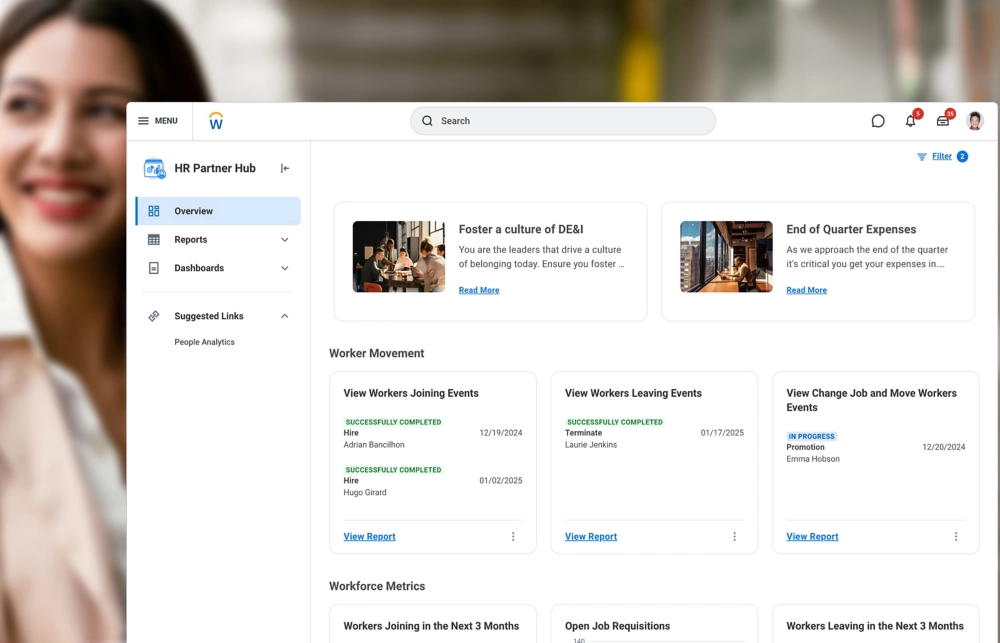
Workday is an enterprise cloud platform for HR, Finance, and IT that integrates with Greenhouse through two dedicated connectors: HRIS Link and Hire Link.
Together, these connectors close the two highest-friction gaps in the ATS-to-HRIS workflow: getting approved headcount into Greenhouse as job requisitions, and getting signed-offer new hires into Workday to trigger onboarding.
These are dedicated, Greenhouse-documented enterprise connectors, not middleware bridges.
Key integration capabilities include:
Job requisition import from Workday through HRIS Link, automatically surfacing approved headcount as Greenhouse jobs
Employee data synchronization on a 15-minute polling cycle, keeping hiring team rosters and org hierarchy current
New hire export through Hire Link, pushing signed-offer records from Greenhouse to Workday to trigger HRIS onboarding
Department and office structure sync, ensuring Greenhouse's reporting, permissions, and job posting hierarchy reflects current Workday structure
How Workday Integrates with Greenhouse
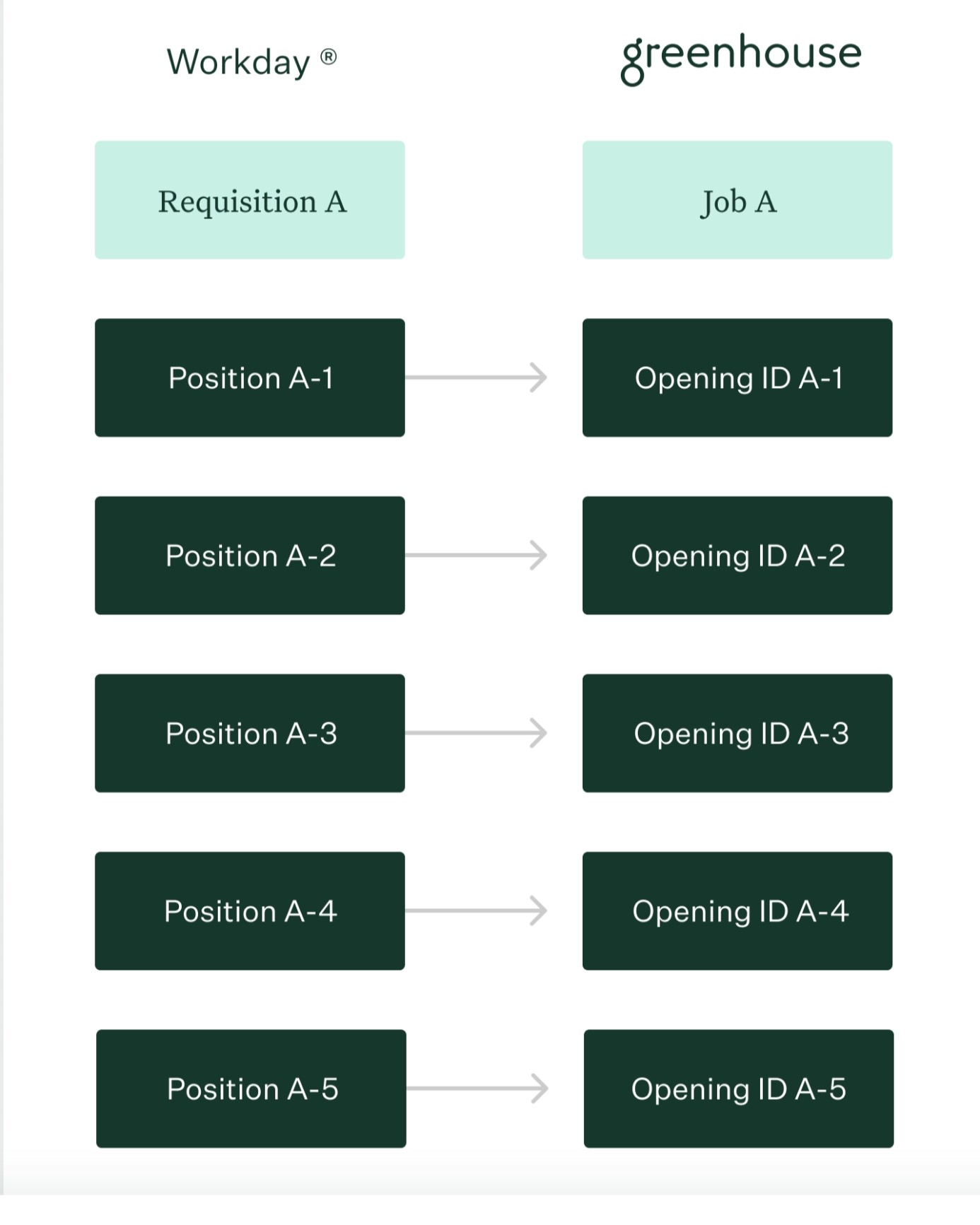
Source: Greenhouse
HRIS Link handles inbound data (Workday to Greenhouse): job requisitions, users, departments, and offices. Hire Link handles outbound data (Greenhouse to Workday): new hire records after offer signature. The two connectors operate on different triggers because they serve different moments in the hiring cycle.
1. Job Requisition Import via HRIS Link.
When a job requisition is created or approved in Workday, HRIS Link surfaces that record in Greenhouse automatically. The job data maps to Greenhouse's configuration fields.
For organizations running dozens to hundreds of active requisitions, this compresses the lag between "headcount approved in Workday" and "job live in Greenhouse" from days of manual re-entry to near-real-time.
It also eliminates the data-quality risk of TA admins transcribing requisitions manually, where title variations and department mismatches create reporting inconsistencies.
2. User and Org Structure Synchronization.
HRIS Link runs a 15-minute polling cycle checking Workday for changes to employee records. Name changes, email updates, department reassignments, and office changes propagate to Greenhouse automatically.
The same sync governs department and office hierarchy: when Workday's org structure changes after a reorg, Greenhouse's reporting, permissions, and job posting structure stay aligned at the next polling interval, without TA ops manually replicating the changes.
3. New Hire Export via Hire Link.
When an offer is signed in Greenhouse, Hire Link exports the new hire record (personal details, role, start date, department) to Workday, triggering the HRIS onboarding workflow. Workday can immediately begin provisioning the new employee's account, IT access, benefits enrollment, and onboarding tasks.
This eliminates the manual data entry gap between ATS and HRIS that delays IT provisioning and creates audit trail gaps.
Workday Pricing
Workday does not publish pricing. All pricing is negotiated through Workday's enterprise sales team and documented in customer Order Forms. First-year cost of ownership typically includes implementation and change management fees beyond the subscription.
The HRIS Link and Hire Link capability is part of Workday's HCM platform rather than a separately priced add-on, though this should be confirmed in the specific Order Form.
On the Greenhouse side, teams should confirm whether HRIS Link and Hire Link access is included in their Greenhouse plan tier or requires a separate arrangement, as these represent Greenhouse's enterprise-grade HRIS integration pathway.
Who Should Use the Workday Integration?
Organizations that have standardized on Workday HCM and need job requisitions approved there to appear in Greenhouse automatically without TA admin re-entry
Enterprise hiring teams where Greenhouse user data must reflect current Workday employee records (names, departments, offices) without manual reconciliation after every org change
Companies where the manual handoff at offer acceptance creates delay in IT provisioning, benefits enrollment, or onboarding task assignment, and want that gap closed to the duration of an automated export
Final Verdict
The best Greenhouse integrations close the gaps an ATS cannot fill on its own:
ZoomInfo: verified B2B contact data, company intelligence, and org charts enriching every sourcing workflow; the highest-value integration on this list if your candidate pipeline depends on data accuracy
LinkedIn Recruiter: bidirectional pipeline sync with the world's largest professional network, keeping sourcing and structured hiring in lockstep
Calendly: self-service interview scheduling that eliminates per-candidate coordination and scales with hiring volume
Checkr: compliant background checks initiated, tracked, and resolved inside the candidate profile
Slack: ATS events and approval actions surfaced in the communication layer your team already uses
Metaview: AI interview intelligence that writes structured scorecard content automatically, executing Greenhouse's structured hiring framework at scale
Workday: enterprise HRIS synchronization that removes manual handoffs at both ends of the hiring cycle
These integrations also compound: you might run ZoomInfo for sourcing intelligence, LinkedIn Recruiter for passive candidate outreach, Calendly for automated scheduling, Slack for team coordination, and Metaview for scorecard automation on the same Greenhouse instance, each removing a layer of manual work that makes the others more valuable.
If you connect just one, make it the data layer that feeds everything else. ZoomInfo's Greenhouse integration gives your sourcing team access to 500M contacts and 135M+ verified phone numbers, so every candidate record that enters your pipeline starts with accurate, verified information. ZoomInfo Lite is a permanent free tier, so you can test the data quality before committing.
Frequently Asked Questions
How many integrations does Greenhouse support?
Greenhouse's Partner Directory houses over 500 pre-built integrations spanning HRIS, job boards, sourcing, background checks, assessments, video interviewing, scheduling, and analytics.
Beyond the marketplace, Greenhouse's developer platform at developers.greenhouse.io provides eight distinct APIs (Harvest, Job Board, Candidate Ingestion, Assessment, Onboarding, Audit Log, and two webhook systems), plus a Model Context Protocol (MCP) server for governed AI tool connectivity.
Any system with a REST API can connect through the Harvest API or webhook endpoints.
Do Greenhouse integrations work on the Core plan?
Many integrations work across all Greenhouse tiers, including Core. The native Slack, Calendly, Checkr, Metaview, LinkedIn Recruiter RSC, and ZoomInfo integrations are available at the Core level. However, advanced platform features that complement these integrations (BI Connector, Sourcing Automation, audit log, developer sandbox) require Plus or Pro tiers.
Confirm integration availability for your specific use case with Greenhouse during the demo process, as some enterprise HRIS connectors may have tier-specific requirements.
How does Greenhouse handle data sync with third-party integrations?
Greenhouse uses different sync mechanisms depending on the partner. API-based integrations use the Harvest API with HTTP Basic Auth and endpoint-scoped permissions. Webhooks fire on recruiting events (application created, candidate stage change, offer approved) with HMAC signature verification and a 7-attempt retry policy over 15 hours. HRIS integrations like Workday use a 15-minute polling cycle for ongoing synchronization. Most native marketplace integrations use OAuth for authentication. The Harvest API enforces rate limits of 50 requests per 10-second window.
Can I connect Greenhouse to AI tools like Claude or ChatGPT?
Yes. Greenhouse launched a Model Context Protocol (MCP) server in June 2026, giving hiring teams a governed way to connect AI tools (including Claude, ChatGPT, and Gemini) directly to Greenhouse data with permissioned, rate-limited, organization-level access. The MCP was developed with design partners including StubHub and Komodo Health.
This lets AI workflows read and act on hiring data while staying within Greenhouse's governance structure, including access controls, audit trails, and data residency compliance.
Does connecting multiple integrations to Greenhouse cause performance issues?
Each integration operates independently through its own API connection or webhook subscription. Running LinkedIn Recruiter, Calendly, Slack, Checkr, Metaview, and Workday simultaneously does not create conflicts.
High-volume integrations consume API rate limits (50 requests per 10 seconds for the Harvest API), so organizations with custom integrations running alongside marketplace partners should monitor their API usage through the Greenhouse developer portal.
How do I evaluate whether a Greenhouse integration is worth the cost?
Track metrics specific to the integration's purpose.
For sourcing integrations (ZoomInfo, LinkedIn Recruiter), measure candidate response rates, sourcing-to-hire conversion, and time saved on manual research.
For scheduling (Calendly), track coordinator hours saved and scheduling-to-interview conversion time.
For background checks (Checkr), measure the gap between hiring decision and offer extension.
For interview intelligence (Metaview), track scorecard completion rates, submission timeliness, and evaluation consistency. Greenhouse's 40+ built-in reports can segment these metrics by source, stage, and time period.
Is Greenhouse secure enough for enterprise integrations?
Greenhouse holds SOC 1 and SOC 2 Type 2 certifications (audited annually), ISO 27001:2022, ISO 27701:2019 (privacy), and ISO 42001:2023 (AI governance). Infrastructure runs on AWS with multi-region availability zones in the US, EU, and APAC, supporting data residency requirements.
All API authentication uses HTTPS with HTTP Basic Auth or OAuth 2.0; webhooks use HMAC-SHA256 signature verification. Enterprise features include SAML 2.0 SSO, SCIM user provisioning, granular permissions, and audit logging on the Pro plan.
What is the best way to enrich Greenhouse candidate records with verified contact data?
Integrating a dedicated B2B data platform gives your sourcing team the most accurate candidate information. ZoomInfo's native Greenhouse integration lets recruiters export verified direct-dial phone numbers, business email addresses, job titles, and company intelligence from a database of 500 million contacts and 100 million companies directly into Greenhouse prospect pools or candidate records.
The data flows through a verification pipeline backed by 300+ human researchers, and the Chrome extension enables one-click export from any web page.
For teams where sourcing quality depends on reaching the right person with accurate contact information, connecting a B2B intelligence platform closes the gap between finding a candidate and being able to reach them.
