

Customer retention strategies: what they are and why they matter
It can cost five times more to acquire a new customer than to keep an existing one (Forbes). That cost differential is the foundational argument for treating retention as a primary growth lever, not an afterthought. This article covers how to define and measure customer retention strategies, how to diagnose the root causes of churn before selecting a strategy, the five core retention strategies for B2B revenue teams, what makes B2B and SaaS retention different from B2C, and how signal-based account intelligence shifts teams from reactive to proactive.
What customer retention strategies actually are (and why they matter)
Customer retention strategies are the deliberate actions a business takes to reduce churn and grow revenue from existing accounts, as distinct from acquisition strategies that focus on landing new customers.
The business case is straightforward. It can cost five times more to acquire a new customer than to retain an existing one (Forbes). And according to Gitnux research cited by Harvard Business School, a 5% increase in retention can boost profitability by 75%. The math consistently favors investing in the customers you already have.
For B2B SaaS leaders, the stakes are even higher because the post-sale relationship is often longer and more complex than the sales cycle itself. Retention is measured through NRR and GRR, not just renewal rate. An NRR above 100% means expansion revenue is outpacing churn. An NRR below 100% means the business is shrinking even if it is signing new logos. These two metrics are the primary scorecards for account management and customer success leaders who want to retain customers and grow their books of business.
Why customers leave: diagnosing churn before applying strategies
Selecting the right retention strategy requires diagnosing the actual cause of churn first. Applying a generic playbook to an account that is leaving because of champion departure looks very different from applying it to an account that never achieved time-to-value. Diagnosis comes before prescription.
The most common root causes of B2B customer churn:
Poor onboarding and time-to-value failure. Customers who do not see measurable value within the first 90 days are significantly more likely to churn at renewal. Mitigation: define a clear success milestone for the first 30 and 90 days and assign ownership to a named CSM.
Champion departure or stakeholder turnover. When the most engaged internal advocate leaves, the account relationship resets to zero unless the team has already mapped the full buying group. One account management team discovered their most engaged leader had left only by checking LinkedIn, not through any CRM signal or alert. Mitigation: map the full buying group at onboarding and monitor for org changes proactively.
Engagement drop-off with no early warning system. Accounts go quiet for weeks or months without triggering any internal flag. By the time the AM notices, the customer is already in recovery mode or evaluating alternatives. Mitigation: set engagement thresholds that trigger automated alerts when activity drops below baseline.
Stale CRM data leading to misaligned account plans. Account managers walk into QBRs and renewal conversations with incorrect contact data, wrong contract end dates, and missing interaction history. Mitigation: implement continuous CRM enrichment so account records reflect current reality, not the state of the account at close.
Unresolved support issues. 85% of CX leaders report customers will leave after a single unresolved support issue (Zendesk CX Trends report). Mitigation: create a closed-loop escalation process that flags unresolved tickets to the account manager before the customer escalates.
Lack of perceived ROI or value demonstration. Customers who cannot articulate the value they are getting from your product will not renew. Mitigation: build ROI documentation into every QBR and strategic review, comparing current results against baseline measurements from before onboarding.
Competitive displacement that goes undetected. By the time the non-renewal notice arrives, the customer has often been in a competitive evaluation for months. Mitigation: monitor intent signals that indicate when accounts are researching alternatives, so you can engage before the evaluation is complete.
Diagnosing which of these drivers is at play in a specific account is the prerequisite to choosing the right strategy to retain customers.
How to measure customer retention: key metrics and formulas
Customer retention rate
Customer Retention Rate measures the percentage of customers a business keeps over a given period, excluding new customers acquired during that time.
Formula: ((Customers at end of period - New customers acquired during period) / Customers at start of period) x 100
Example: If you started with 200 customers, acquired 30 new ones, and ended the period with 210 customers, your retention rate is ((210 - 30) / 200) x 100 = 90%.
Customer churn rate
Churn rate is the inverse of retention rate and measures the percentage of customers lost in a period.
Formula: (Customers lost in period / Customers at start of period) x 100
Example: If you started with 200 customers and lost 20, your churn rate is (20 / 200) x 100 = 10%. A 10% churn rate corresponds to a 90% retention rate.
Net revenue retention (NRR)
NRR is the most important retention metric for B2B SaaS companies because it captures both churn and expansion in a single number. An NRR above 100% means the business is growing from its existing customer base alone.
Formula: ((Starting MRR + Expansion MRR - Churned MRR - Contraction MRR) / Starting MRR) x 100
Example: If you started with $100K MRR, added $15K in expansion, lost $5K to churn, and had $2K in contractions, your NRR is (($100K + $15K - $5K - $2K) / $100K) x 100 = 108%.
Customer lifetime value (CLV)
CLV estimates the total revenue a business can expect from a single customer account over the life of the relationship.
Formula: Average purchase value x Purchase frequency x Average customer lifespan
Example: A customer spending $10K per year on a five-year average contract has a CLV of $50K. Understanding CLV helps account teams prioritize which accounts justify deeper investment and more senior coverage.
Net promoter score (NPS)
NPS measures customer loyalty and satisfaction by asking customers how likely they are to recommend your product or service on a scale of 0 to 10. Unlike the metrics above, NPS is survey-based rather than formula-based. Customers who score 9-10 are Promoters; 7-8 are Passives; 0-6 are Detractors. NPS = % Promoters - % Detractors. A positive NPS indicates more customers are advocates than critics.
Benchmarks by industry: SaaS companies typically target 90%+ customer retention rates, with enterprise SaaS often reaching 95%+. For NRR, a healthy SaaS benchmark is 100%+, with best-in-class companies achieving 120%+. E-commerce and retail average 60-80% retention. These are general industry benchmarks and vary significantly by segment and business model.
Five core customer retention strategies for B2B revenue teams
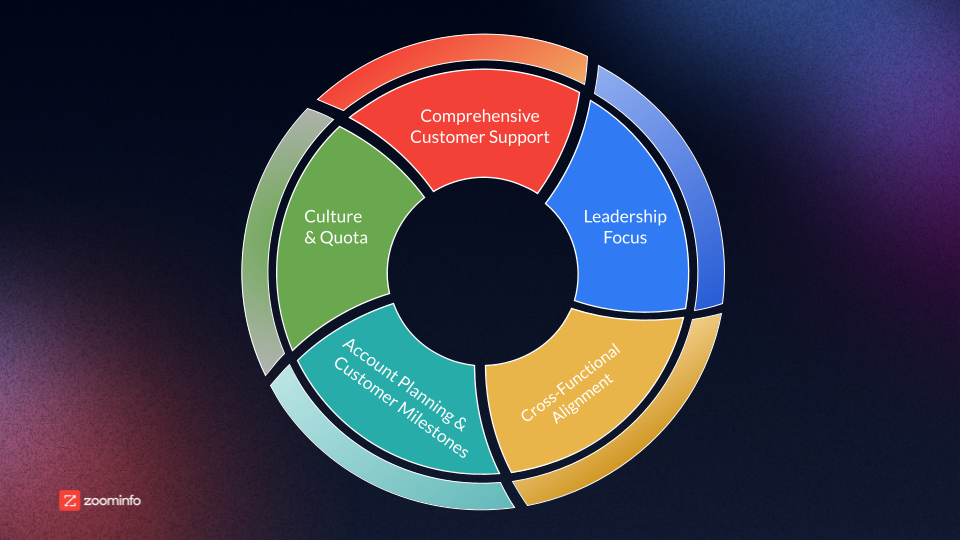
Knowing how to retain customers starts with building the right infrastructure, not just the right playbook. The five strategies below address the structural gaps that cause most B2B retention failures.
Build a customer success infrastructure that scales with your book of business
Getting the CSM-to-account ratio right is the structural foundation of every other retention strategy. When account managers are stretched too thin, onboarding slips, QBRs get deprioritized, and early churn signals go unnoticed until it is too late to act.
That means pacing yourself when you enter a new market. You do not want to onboard more accounts than you can reasonably support, so staff up accordingly. If you are serving international accounts, consider hiring CSMs in local markets to increase familiarity and culture fit.
View the relationship with your customers as a partnership rather than a business exchange. A successful partnership is built on trust, communication, and support, which is more than simply closing a sale.
For B2B SaaS companies, CSM-to-account ratios vary by segment: high-touch enterprise accounts typically support a 1:10 to 1:20 CSM-to-account ratio, while tech-touch and digital-first segments can scale to 1:100 or beyond. Getting this ratio right is foundational to everything else.
Look at the number of accounts in each customer segment (small business, mid-market, enterprise). Focus on keeping current customers happy and building these partnerships. Once you have achieved success with existing accounts, it is much easier to think strategically and build your team for the next market.
Segment your accounts and tailor your approach by customer tier
As your business grows, dedicate focus and attention to each customer segment. Do not treat all customers the same: building trust and rapport with small business owners looks different from working with mid-sized or enterprise customers. The selling motions, timelines, messages, and players involved can be vastly different.
Small businesses tend to need:
More structure
Better discipline
The ability to move quickly
Enterprise customers tend to need:
Greater engagement
Deeper account insights
More features and functionalities
Enterprise accounts also require QBR cadences and executive sponsor alignment that small business accounts do not. A quarterly business review with a Fortune 500 customer involves multiple stakeholders, documented ROI, and forward-looking success plans. Applying the same cadence to a 10-person SMB customer wastes both parties' time.
When you establish clear goals within each customer segment, each individual leader can create personalized strategies with their teams. Continue to make adjustments to keep your teams focused on meeting each account's unique needs.
Align account management and customer success around a single customer experience
The two halves of the customer experience, account management and customer success, are vital to growth and retention. Account managers establish long-term milestones to expand the business, while CSMs support customers' day-to-day needs and adoption.
These two teams must strive to work in harmony. The customer should receive a cohesive experience regardless of their request, whether it is asking about how to troubleshoot a product feature or purchasing more seats.
From a customer's point of view, your two separate teams should function as one and the message should be the same. The closer these two teams collaborate, the better the results.
Customer experience can even be a bigger differentiator between competitors than their product features (Deloitte Digital). You build trust with your customer by delivering a predictable, reliable, and successful experience. Then, when it comes time to renew, their decision becomes much easier.
Build a milestone-driven account plan with proactive renewal triggers
One of the most important aspects of optimizing customer value is putting in place a clear account plan, including regular milestones. By establishing a timeline of goals to achieve for each customer, your team can stay proactive and aligned, and continually highlight value to your customer.
Here is an example of four milestones for a customer account:
Milestone 1: Kickoff call. The customer is successfully onboarded and transitioned to the Customer Success and Account Management teams for a kickoff call.
Milestone 2: Strategic review meeting. Six months into the contract, there is a strategic business review meeting to document progress and identify areas of future growth. This is also an opportunity to start talking about the renewal process and underline how the customer can continue to unlock value within your platform.
Milestone 3: Review results. Nine months into the contract is the critical intervention window before renewal. Compare results against baseline measurements from before onboarding to prove the value and ROI of your solution. An account that cannot demonstrate clear ROI at this milestone is at significant churn risk, and nine months is still early enough to change the trajectory before the renewal conversation begins.
Milestone 4: Contract renewal. By delivering consistent customer value, the renewal should be a straightforward decision for the customer.
Create a performance culture where account teams are motivated to grow accounts, not just protect them
Sales leaders are driven by metrics, performance, and success, but it all begins with people. Your team is on the front lines, so understanding what keeps them motivated, engaged, and feeling supported is critical to delivering excellent customer experience.
Most account management teams rely on data to pave the way. Key performance indicators (KPIs) can make the process of tracking progress much easier for everyone. By establishing KPIs, you are encouraging your team to take control of their own success. Being able to see what each deal means in terms of quota for individual reps is important. This ensures that they can see their achievements, how much they have left to do, and ultimately, what they will earn. The right sales analytics software can surface these metrics automatically, giving reps and managers a shared view of progress against quota.
You will also cultivate ownership, pride, and performance among your team. About three-quarters of employees report they are more effective at their job when they feel heard (Workforce Institute). Building unity across your account team promotes personal growth and goal achievement.
At ZoomInfo, an all-in-one AI GTM Platform, we strive to be 1% better every day. This goal guides our day-to-day work. As long as you strive to be 1% better, you are bound to see far greater success over time.
Our team believes in:
Having mutual respect for one another.
Creating an environment where reps are encouraged to learn continually.
Picking each other up when we fall down.
When reps feel supported to achieve their goals, it has a downstream effect on the entire customer experience. Motivated teammates want to deliver a great experience in order to maintain and expand accounts.
These five strategies apply across B2B revenue teams regardless of segment or business model. Where B2B and SaaS retention diverges from the generic playbook is in the complexity of what comes after the contract is signed.
B2B and SaaS customer retention strategies: what's different
What happens after the contract is signed is where most companies either grow or fade into the background. This practitioner observation captures something that generic retention frameworks miss: in B2B, the post-sale cycle is often longer and more consequential than the sales cycle itself. A SaaS deal that takes three months to close may take three years to fully expand, and every QBR, executive business review, and renewal conversation is an opportunity to either deepen the relationship or lose it.
B2B customer retention strategies are not solely a customer success responsibility. Retention in B2B is a cross-functional team sport involving sales, marketing, product, and CS. Sales owns expansion quota. Marketing owns the content and campaigns that reinforce value between touchpoints. Product owns the adoption signals that indicate whether customers are getting ROI. CS owns the day-to-day relationship. When these functions operate in silos, customers experience inconsistency, and inconsistency is a churn driver.
For SaaS companies specifically, the most effective b2b customer retention strategies center on four levers: product adoption monitoring, usage-based health scores, QBR cadences, and expansion revenue as a retention signal. A customer who is actively using the product, expanding their usage, and showing up to QBRs is a customer who is not churning. A customer who has gone quiet on all three dimensions is a churn risk, regardless of what the CRM says.
The multi-stakeholder risk in B2B has no real equivalent in B2C. When a champion leaves a consumer brand, the brand can win them back with a promotional offer. When a champion leaves a B2B account, the entire relationship resets. The new budget holder has no emotional investment in the prior relationship, no institutional memory of the implementation, and no reason to renew unless the account team rebuilds the relationship from scratch. Champion departure is the single highest-risk churn event in B2B, and most teams only discover it after the fact.
For saas customer retention strategies, the clearest signal that your retention program is working is NRR above 100%. When expansion revenue is outpacing churn, the existing customer base is growing on its own. That is the outcome every account management and CS leader is working toward.
How signal-based account intelligence shifts retention from reactive to proactive
Account managers are often set up to fail by tools that show them what happened after it is too late to act. The CRM logs the non-renewal. The dashboard shows the usage drop. The alert fires when the champion's LinkedIn update is already two weeks old. By the time the data surfaces, the decision has been made.
ZoomInfo, an all-in-one AI GTM Platform, is built to change that dynamic. The platform brings together verified B2B data, a real-time intelligence layer, and a seller-facing workspace to give account teams the signals they need before the situation becomes unrecoverable.
ZoomInfo's B2B data foundation covers 500M contacts, 100M companies, and 135M+ verified phone numbers, with continuous verification by 300+ human researchers. When account managers walk into a renewal conversation, they are working from records that reflect the current state of the account, not the state it was in when the deal closed. Stale CRM data is one of the most common reasons account plans fail; verified, continuously refreshed data removes that variable.
That data feeds the GTM Context Graph, the intelligence layer that processes 1.5B+ data points daily and captures not just what happened but why. The GTM Context Graph fuses ZoomInfo's B2B data with CRM records, conversation intelligence, and behavioral signals to surface churn indicators and expansion opportunities before they appear in the CRM. Spekit qualified pipeline 58% faster and saw 43% more accounts convert to qualified opportunities after using ZoomInfo's signal-based prioritization, demonstrating how early-signal detection translates directly into pipeline quality.
GTM Workspace puts those signals directly in front of account managers and CSMs, giving them a unified view of account health, buying group changes, and expansion opportunities in one place. Rather than piecing together account intelligence from five different tools, account teams see the full picture: which contacts have changed roles, which accounts are showing intent signals for adjacent products, and which accounts are at risk based on engagement patterns. Thomson Reuters saw 40% more closed-won deals and 115% average monthly quota attainment after deploying GTM Workspace across their account management teams.
See how ZoomInfo helps account teams get ahead of churn and expansion opportunities. Request a demo.
Customer retention examples: what good looks like in practice
Signal-based account intelligence is one piece of the retention picture. The examples below show how that approach, alongside the broader strategies covered in this article, produces measurable outcomes across different B2B contexts.
Seismic: signal-based account prioritization
Strategy used: Signal-based account prioritization
Seismic adopted ZoomInfo's signal-based approach to identify which accounts in their book of business were most likely to expand or require intervention. The results were significant: Seismic saved 11.5 hours weekly per seller and attributed 39% of pipeline to ZoomInfo signals after adopting signal-based account prioritization. The team also achieved a 54% productivity gain overall. By replacing gut-feel triage with signal-driven prioritization, Seismic's account teams could focus their time on the accounts most likely to grow, rather than spreading effort evenly across a large book of business. This example connects directly to the performance culture strategy from the five core strategies above: when reps have clear signals about where to focus, quota attainment follows.
Snowflake: data-driven account scoring
Strategy used: Data-driven account scoring
Snowflake used ZoomInfo's account scoring to identify which accounts within their existing customer base had the highest propensity to convert to additional products and expand their footprint. Snowflake doubled conversion rates on ZoomInfo-scored accounts and saw 90% higher opportunity open rates. Rather than treating all accounts as equal candidates for expansion, Snowflake's account teams prioritized the accounts that data scoring identified as expansion-ready, resulting in significantly higher conversion efficiency. This is the data-driven account scoring strategy in action: systematic prioritization based on verified signals, not manual research.
Amazon Prime: proactive value delivery at scale
Strategy used: Proactive value delivery and continuous engagement
Amazon Prime is one of the most studied retention programs in consumer commerce. Rather than waiting for customers to disengage, Amazon continuously adds value to the Prime membership, from streaming content to same-day delivery to exclusive discounts, making cancellation feel like a loss rather than a neutral decision. The principle translates directly to B2B: customers who continuously discover new value in a product are significantly less likely to churn at renewal than customers who feel they have exhausted what the platform offers.
Frequently asked questions
What are five customer retention strategies?
The five core customer retention strategies for B2B revenue teams are: (1) build a scalable customer success infrastructure with the right CSM-to-account ratios; (2) segment accounts by tier and tailor engagement to small business, mid-market, and enterprise needs; (3) align account management and customer success around a unified customer experience so the customer interacts with one coherent team; (4) build milestone-driven account plans with proactive renewal triggers at the 6-month and 9-month marks; and (5) create a performance culture with KPI-driven accountability so account teams are motivated to grow accounts, not just protect them. Knowing how to retain customers at scale requires all five working together.
What are the 8 C's of customer retention?
The 8 C's of customer retention are a structured mnemonic for retention program design: Customization, Communication, Caring, Consistency, Convenience, Commitment, Credibility, and Community. The framework is not universally standardized, but it provides a useful checklist for evaluating whether a retention program addresses the full range of factors that drive customer loyalty. Most B2B retention failures trace back to gaps in one or more of these eight dimensions.
What are the five key factors of customer retention?
The five key factors of customer retention are customer satisfaction, product or service quality, customer service responsiveness, perceived value, and emotional loyalty. These factors interact: a customer who rates high on all five is significantly less likely to churn at renewal than one who scores well on only one or two. Product quality without responsive support, for example, still produces churn when something goes wrong.
How do you calculate customer retention rate?
Customer Retention Rate = ((Customers at end of period - New customers acquired during period) / Customers at start of period) x 100. For example, if you started with 200 customers, acquired 30, and ended with 210, your retention rate is (210 - 30) / 200 x 100 = 90%. This formula is the foundation of customer retention strategies measurement and should be tracked monthly and quarterly.
What is the difference between account management and customer success?
Account managers establish long-term growth milestones and own expansion revenue. Customer success managers support day-to-day adoption and product value realization. Both roles are essential to retention: account managers focus on the commercial relationship while CSMs focus on the operational one. When these two teams operate in sync, the customer experiences a single coherent relationship rather than two separate functions. When they operate in silos, customers notice the inconsistency and it becomes a churn risk. Thomson Reuters saw 40% more closed-won deals and 115% average monthly quota attainment after deploying a unified account management approach with GTM Workspace, demonstrating that alignment between the commercial and operational relationship directly improves renewal and expansion outcomes.
How do you identify expansion opportunities in existing accounts?
Three signals indicate expansion readiness: headcount growth or acquisition activity at the account, increased product usage or adoption of new features, and intent signals showing the account is researching adjacent solutions. Manual research across a large book of business is unsustainable at scale. Signal-based prioritization tools surface these indicators automatically, so account teams can focus on the accounts most likely to expand rather than spreading effort evenly. After adopting ZoomInfo's signal-based prioritization, Spekit saw 43% more accounts convert to qualified opportunities, showing how surfacing the right signals at the right time changes which accounts get attention and when.