

HubSpot has grown from a marketing automation startup into one of the most widely adopted customer platforms in business software. With 288,706 customers across 135+ countries, it offers a unified system where marketing, sales, service, and operations share a single database. The pitch is simple: stop juggling disconnected tools and put everything in one place.
To write this HubSpot review, we've analyzed the platform extensively. We believe it's the ideal choice if:
You want a single platform connecting marketing, sales, service, and operations on shared data
You need marketing automation with visual workflows and multi-channel campaigns
You value fast implementation over deep customization
You're looking for a free CRM tier that's useful and never expires
You need a large integration ecosystem to connect with your existing tools
However, HubSpot's core strength is managing customer relationships and automating workflows. It's not built to be a B2B prospecting data platform.
For companies whose growth depends on outbound sales, the quality of direct dials, the accuracy of contact data, and the ability to detect buyer intent before a prospect fills out a form, HubSpot's native capabilities leave gaps that a specialized intelligence platform needs to fill.
This is where ZoomInfo fits: an all-in-one AI GTM platform built on the industry's most comprehensive B2B data foundation (500M contacts, 100M companies, 135M+ verified phone numbers, and 200M+ verified business emails).
Its GTM Context Graph fuses that data with your CRM records, conversation transcripts, and behavioral signals to reveal why deals move or stall, so your reps walk into every call with context and your marketers target accounts that match proven win patterns. Teams access that intelligence through GTM Workspace for sellers, GTM Studio for marketers and RevOps, or APIs and MCP in any front-end.
ZoomInfo integrates natively with HubSpot, enriching your CRM and powering go-to-market execution directly inside the tools your team already uses.
We've included a detailed look at ZoomInfo later in this HubSpot review, as the essential B2B intelligence layer for teams running their CRM on HubSpot. If you're ready to explore what ZoomInfo can do for your go-to-market, you can start with a free trial here.
What is HubSpot?
HubSpot was co-founded in 2006 by Dharmesh Shah and Brian Halligan while they were MIT graduate students.
Their thesis: consumers had stopped responding to interruptive marketing (cold calls, spam, TV ads) and were researching purchases on their own. They coined the term "inbound marketing" and built software around it.
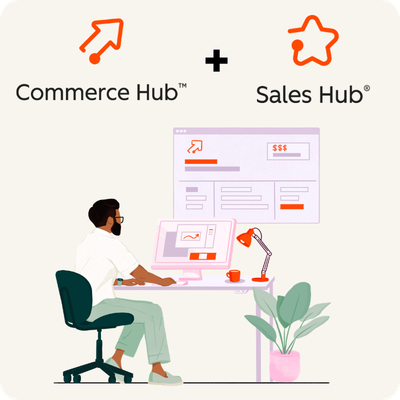
What began as a marketing tool has expanded into a suite of eight connected products, all sharing a single Smart CRM database: Marketing Hub for campaign automation, Sales Hub for pipeline management, Service Hub for customer support, Content Hub for website and content creation, Data Hub for data operations, Commerce Hub for quoting and payments, the Smart CRM as the unifying data layer, and Breeze as the AI engine running across all hubs.
Source: HubSpot
Today, HubSpot generated $3.13 billion in revenue in 2025 (up 19% year-over-year) and was named the #1 Global Software Company by G2. Notable customers include eBay, DoorDash, Reddit, TripAdvisor, and Eventbrite. The company now positions itself as "the agentic customer platform" for scaling companies, with AI as the narrative centerpiece.
The ideal HubSpot customer is a small-to-midsize company that wants to consolidate its marketing, sales, and service stack without the implementation complexity of legacy enterprise CRMs. HubSpot claims customers achieve meaningful value within 90 days, compared to 12+ months for traditional enterprise systems.
HubSpot Pros & Cons
Pros | Cons |
|---|---|
- Unified platform with shared CRM database across all hubs | - Pricing escalates quickly as teams and contacts grow |
- Free tier with genuine utility (unlimited contacts, no time limit) | - Mandatory onboarding fees at Professional and Enterprise tiers |
- 2,000+ app integrations with 2.5 million active installs | - Mixed-tier seat billing inflates costs when combining hubs |
- Fast implementation versus legacy enterprise CRMs | - Native B2B prospecting data lacks the depth of specialized platforms |
- Breeze AI agents for marketing, sales, and service | - Several AI features still in Beta |
- Marketing automation with 500+ pre-built workflow recipes | - Complex implementations depend heavily on partner ecosystem |
- Extensive free education via HubSpot Academy | - Annual billing with no mid-contract cancellation |
HubSpot Review: How it Works & Key Features
Smart CRM & Unified Platform: HubSpot connects every team through a single customer record.
The Smart CRM is what holds HubSpot together.
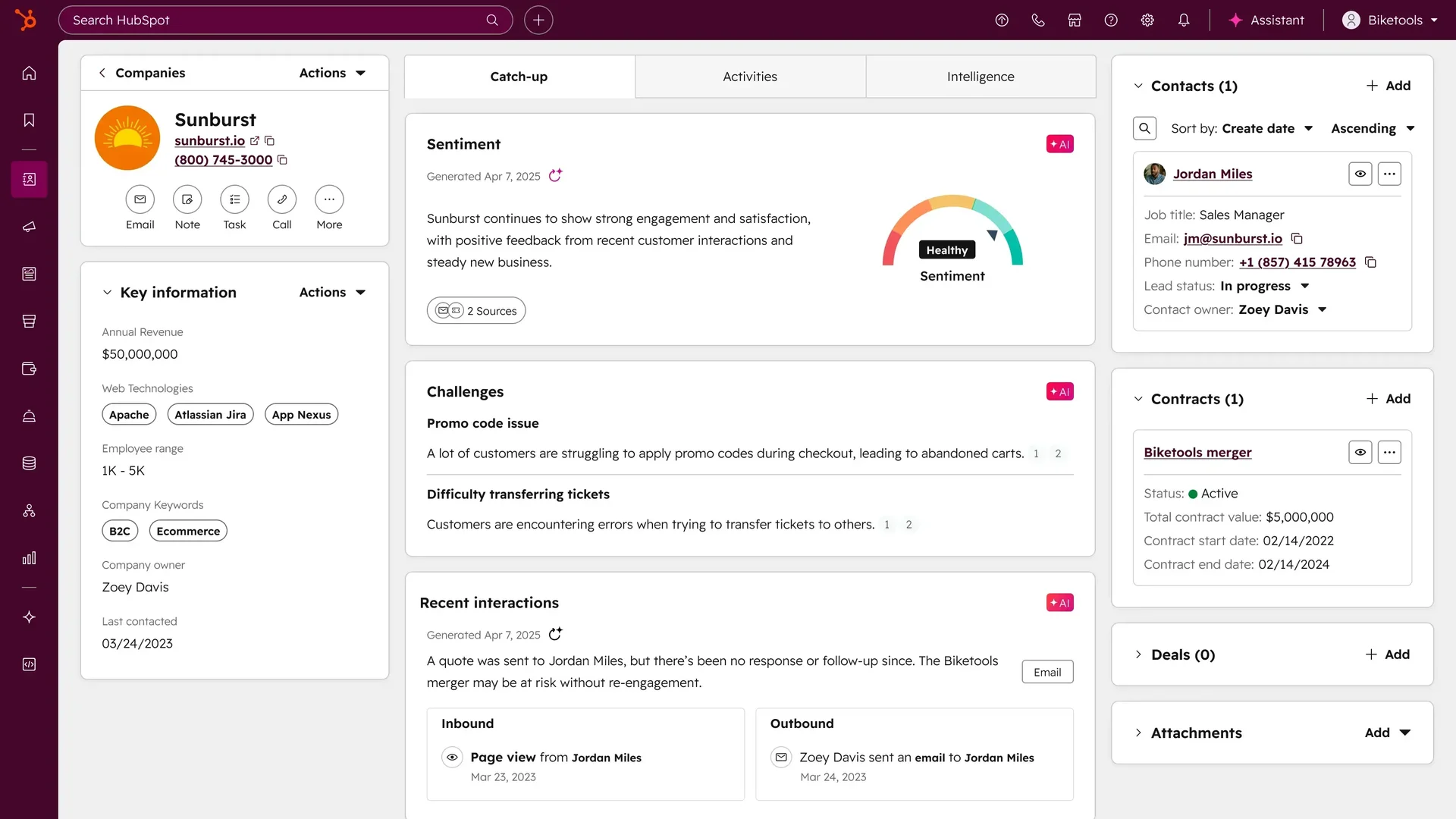
Every contact, company, deal, and ticket lives in one database. When a marketing lead fills out a form, that record is immediately visible to sales. When a customer opens a support ticket, the service agent sees every prior marketing touchpoint and deal interaction.
HubSpot positions this against traditional CRMs with the claim that "other CRMs simply store data. HubSpot's Smart CRM understands it." The CRM includes AI-powered data enrichment (pulling information from email threads, call recordings, and web sources), automatic duplicate detection, and a Data Agent that answers natural-language questions about your customers.
Source: HubSpot
The platform supports a custom data model with custom objects, events, and calculated properties. Enterprise customers get field-level permissions, sandbox environments, and support for up to 15 million contacts, expandable to 50 million. A centralized audit log tracks every action taken by humans, automations, and AI agents.
The free CRM tier is notably generous: unlimited contacts (up to 1 million records per standard object), one deal pipeline, email integration, contact management, and activity logging, capped at two user seats. This permanent free tier functions as HubSpot's primary acquisition engine, letting teams use the platform before committing financially.
Marketing Hub: Full-funnel marketing automation with AI-powered campaign tools.
Marketing Hub is HubSpot's most established product.
It consolidates lead generation, email marketing, social media management, landing pages, and analytics into a single tool connected to the CRM.
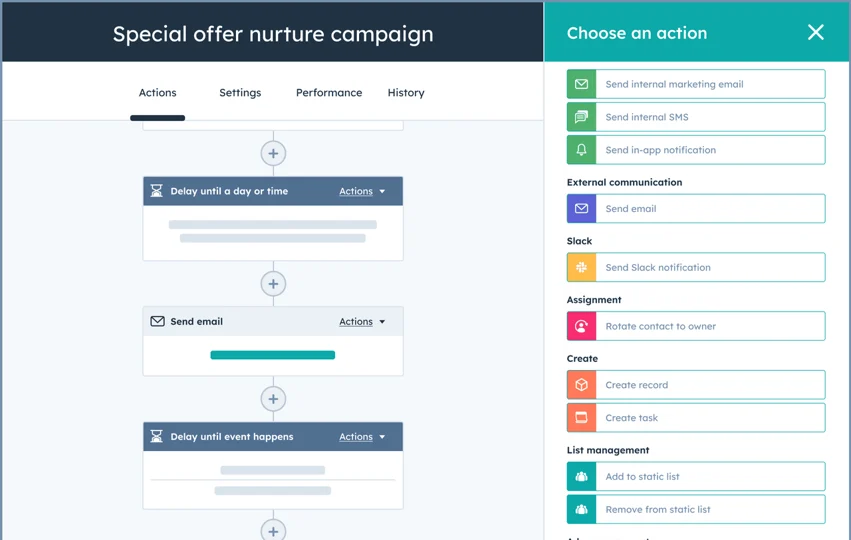
The visual workflow builder supports multi-step, branching nurture sequences triggered by contact behavior, lifecycle stage changes, and form submissions. Over 500 pre-built automation recipes cover common scenarios like welcome series, lead scoring, and re-engagement campaigns. Audience segments update in real time based on CRM properties and behavioral signals.
Source: HubSpot
Email marketing includes a drag-and-drop editor, AI-assisted writing, send-time optimization, and A/B testing. Predictive sending analyzes individual subscriber behavior to deliver emails at optimal times. The platform also supports social media management (publishing, scheduling, and monitoring across accounts), forms, landing pages, and chatbot-based lead capture.
A newer focus is Answer Engine Optimization. HubSpot estimates that chat-based search engines are intercepting up to 25% of traditional search traffic, and Marketing Hub includes an AEO Grader and AEO Strategy tool (currently in Beta) to help content rank in AI-generated search results.
Advanced Marketing Reporting ties campaign activity to revenue with multi-touch attribution and customer journey analytics. Because marketing data automatically flows to sales and service teams, every department works from a shared, live view of each contact.
Sales Hub: Pipeline management, prospecting, and AI-driven selling.
Sales Hub bundles prospecting, pipeline management, quoting, and forecasting in a single interface. Reps manage deal pipelines with customizable stages, deal scoring, and task assignment. Sequences support automated emails, call tasks, and LinkedIn Sales Navigator tasks with configurable delays, and contacts auto-unenroll when they reply or book a meeting.
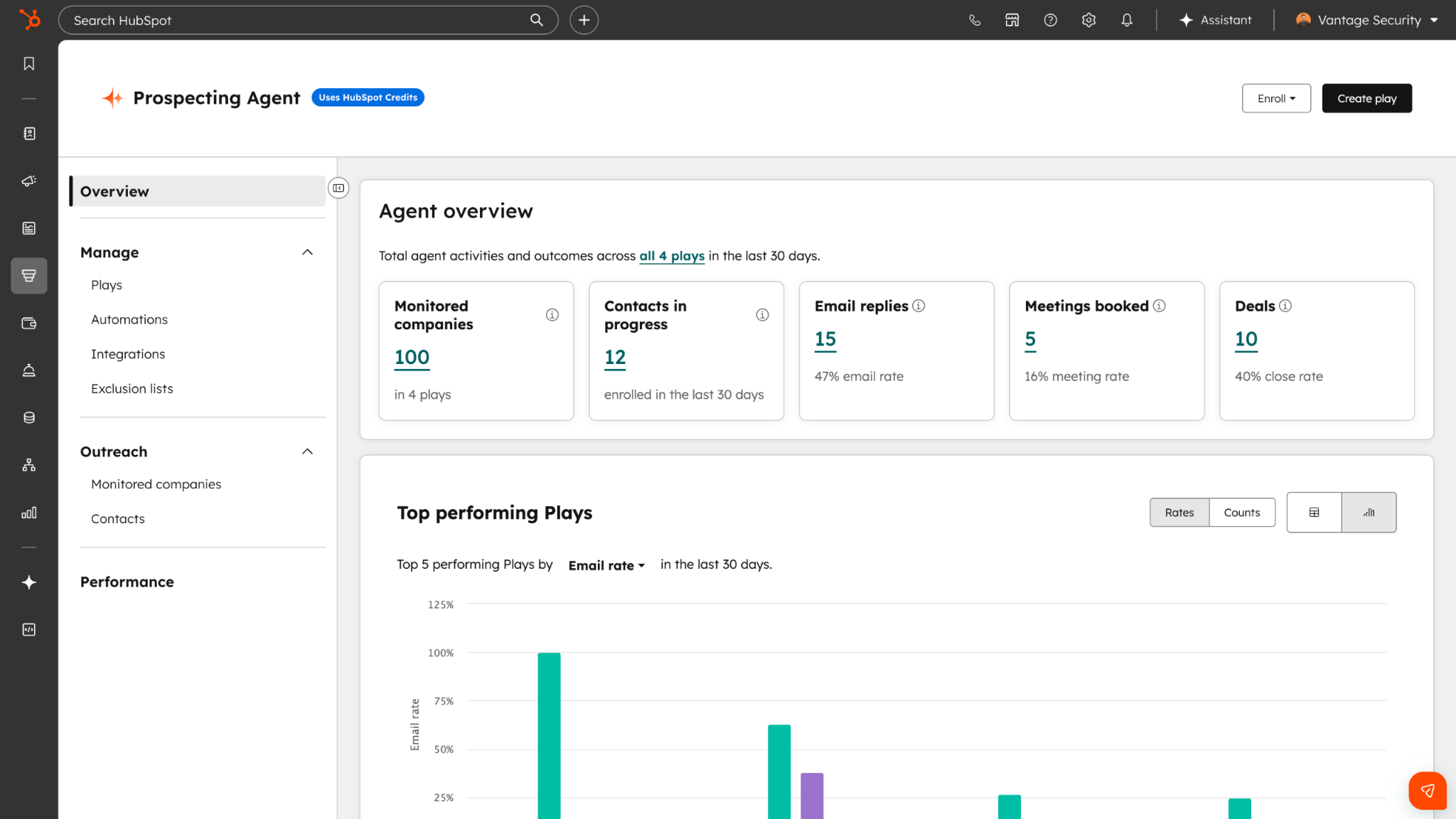
The Breeze Prospecting Agent automates account research, scores prospects against ideal customer profiles, monitors buying signals, and drafts personalized outreach emails.
Source: HubSpot
It draws on the full HubSpot customer history (won deals, support tickets, marketing engagement) to personalize messaging.
AI Guided Selling surfaces prioritized queues, daily action summaries, and target account recommendations. CPQ software generates branded quotes from deal-record context with approval workflows and e-signature. Conversation Intelligence records and transcribes calls, surfacing coaching insights for managers.
Sales Hub integrates with Commerce Hub so reps can move from prospecting to quoting to payment collection without leaving HubSpot. This quote-to-cash capability is a differentiator versus sales tools that stop at the handshake.
Breeze AI: An agent layer running across every hub.
Breeze is not a single product but the AI layer embedded throughout HubSpot.
It comprises three components: the Breeze Assistant (a personal AI companion with CRM context, available on desktop and mobile), Breeze Agents (autonomous AI workflows for marketing, sales, and service), and embedded AI features woven throughout the platform (AI email writer, content remix, conversation intelligence).
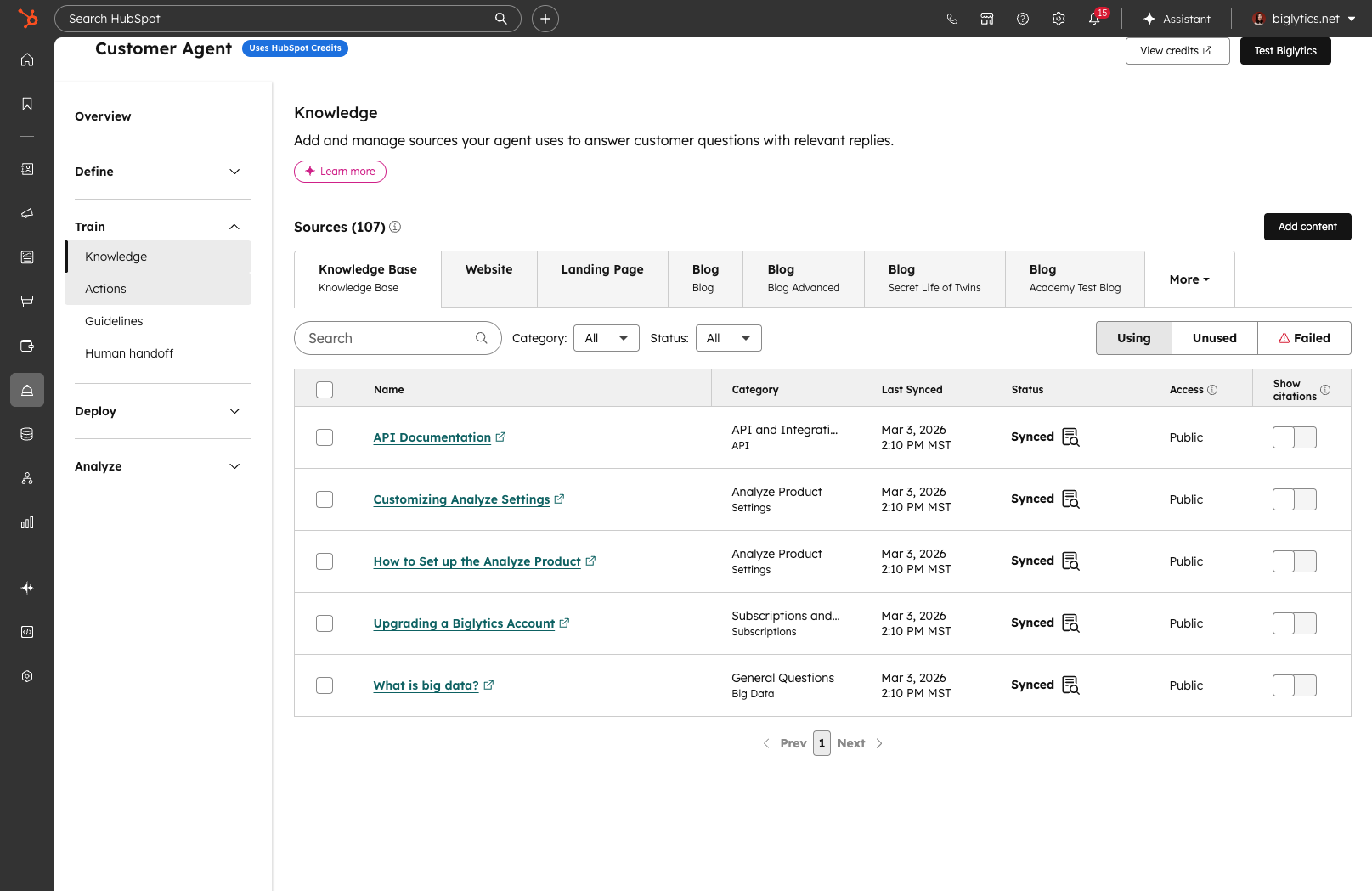
The most prominent agents include: the Customer Agent, which handles support conversations across chat, WhatsApp, email, and voice; the Prospecting Agent, which monitors buying signals and drafts personalized outreach; and the Data Agent, which answers natural-language questions about customers by searching CRM records, call recordings, and email threads.
Source: HubSpot
Agents are configured through Breeze Studio (Beta), where teams define brand voice, approval workflows, and engagement rules. Agents learn from user interactions, customer responses, and content performance over time. HubSpot publishes model cards detailing how each AI system interacts with customer data.
The pricing model for AI is consumption-based: Breeze runs on HubSpot Credits, with monthly allotments included by subscription tier (500 credits for Starter, 3,000 for Professional, 5,000 for Enterprise). Additional credits cost $10 per 1,000 credits/month.
Several Breeze features remain in Beta, including AI-Powered Segmentation, Personalization, AI-Powered Email, Marketing Studio, Breeze Studio, and the Knowledge Base Agent. This signals active development but means some of the most-marketed capabilities are not yet mature for broad production use.
Pricing Structure: Per-seat, per-hub pricing with mandatory onboarding fees.
HubSpot's pricing model combines seat-based pricing, contact-based pricing (for Marketing Hub), flat-fee tiers, and consumption-based AI credits.
Marketing Hub uses flat pricing with included seats:
Plan | Monthly Price | Marketing Contacts Included | Onboarding Fee |
|---|---|---|---|
Free | $0 | N/A (2 users max) | None |
Starter | $15–$20/seat/mo | 1,000 | None |
Professional | $800–$890/mo (3 seats included) | 2,000 | $3,000 |
Enterprise | $3,600/mo (5 seats included) | 10,000 | $7,000 |
Sales Hub and Service Hub charge per seat:
Plan | Monthly Price per Seat | Onboarding Fee |
|---|---|---|
Free | $0 (2 users max) | None |
Starter | $9–$20/seat/mo | None |
Professional | $90–$100/seat/mo | $1,500 |
Enterprise | $150/seat/mo (annual only) | $3,500 |
A critical pricing rule: when subscribing to multiple Hubs at different tiers, all Core Seats are billed at the rate of the highest subscription tier. A company using Marketing Hub Professional and Sales Hub Enterprise would pay Enterprise-rate Core Seats across both, even if the Marketing Hub seats only need Professional access.
Paid subscriptions can only be canceled at the end of the commitment term, not mid-contract. Payment obligations are non-cancelable and non-refundable except in narrow circumstances.
The Starter Customer Platform bundles Starter editions of all Hubs at $9/seat/month (annual) or $15/seat/month (monthly), which is the most affordable path to the full suite. Professional and Enterprise bundles exist but require sales contact for exact pricing.
Where HubSpot Falls Short
HubSpot does many things well, and the unified platform approach solves real problems.
But several limitations become evident for B2B companies running outbound-heavy go-to-market motions.
Native B2B Data Lacks Prospecting Depth. HubSpot's Smart CRM enriches records using AI and its own dataset, but it was built to manage existing relationships, not to source new ones at scale. There is no native B2B contact database comparable to dedicated sales intelligence platforms.
The Breeze Prospecting Agent can draft outreach and monitor signals, but the depth and accuracy of the underlying contact data (direct dials, verified emails, org charts, technographics) depends on what's already in your CRM or what you bring in from external sources. For teams whose pipeline depends on reaching the right person at the right number, this gap matters.
Pricing Complexity and Cost at Scale. The per-seat, per-hub model with mandatory onboarding fees creates a pricing structure that's difficult to predict. A 10-person team using Marketing Hub Professional ($890/month), Sales Hub Professional ($100/seat/month for 10 seats), and Service Hub Starter would face a monthly bill well above $1,800 before counting onboarding fees, contact overages, or AI credits.
The mixed-tier seat cost amplification rule makes this worse: upgrading one Hub to Enterprise raises the seat rate across every Hub in the account.
Intent Signal Limitations. HubSpot tracks website visits, email engagement, and form submissions, which provides useful first-party behavioral data. But it does not offer a dedicated third-party buyer intent engine that monitors off-site research activity across the broader web.
For B2B sales teams that need to know when a target account is actively researching solutions before that account ever visits their website, HubSpot's native signals are insufficient.
AI Features Still Maturing. HubSpot has invested heavily in Breeze, but several significant features remain in Beta: AI-Powered Segmentation, Personalization, AI-Powered Email, Marketing Studio, Breeze Studio, and the Knowledge Base Agent.
For buyers evaluating HubSpot based on its AI marketing, the gap between what's announced and what's production-ready is worth understanding before committing.
Thin Professional Services Bench. Professional services revenue was only $67.3 million out of $3.13 billion total, roughly 2.1% of revenue. This means complex implementations depend heavily on the Solutions Partner ecosystem rather than HubSpot's own services team. For large deployments, this introduces a third-party dependency into what's marketed as an all-in-one platform.
These limitations reflect HubSpot's design priorities: a broad, accessible platform for managing customer relationships. But for B2B companies that need comprehensive prospecting data, intent intelligence, and conversation-level deal context feeding their CRM, a specialized intelligence layer is essential.
Best HubSpot Integration for B2B Intelligence: ZoomInfo
ZoomInfo addresses HubSpot's B2B data and intelligence gaps directly.
Founded in 2007 by Henry Schuck, the company has spent nearly two decades building the most comprehensive B2B data platform in the industry, now extended into an all-in-one AI GTM platform that integrates natively with HubSpot.
Comprehensive B2B Data: The prospecting foundation HubSpot doesn't provide natively.
ZoomInfo's data platform covers three dimensions at a scale no CRM offers natively: identity data (500M contacts, 135M+ verified phone numbers, 120M direct dials, and 200M+ verified business emails), company context (100M companies with firmographics, org charts, and technographics tracking 30,000+ technologies across 200+ categories), and dynamic signals that reveal when accounts are actively in-market.
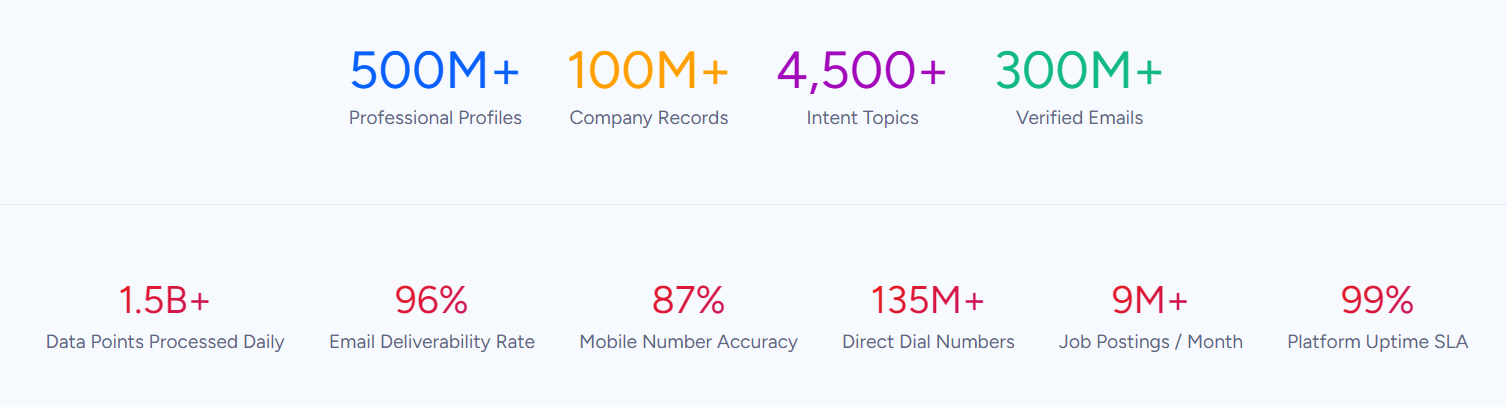
This data is built through a multi-source pipeline: automated ML scanning of 28 million site domains daily, third-party partner data covering 95 million businesses, a contributory community of 200,000+ ZoomInfo Lite users, and an in-house Data Training Lab of 300+ human researchers. First-party data reaches up to 95% accuracy.
The data advantage is externally validated. In a Fortune 500 competitive RFP analyzing 25 million contacts across vendors, the independent consultant concluded that "no other competitor came even close."
ZoomInfo was named a Leader by Forrester for Intent Data Providers (Q1 2025), a Leader by Gartner for ABM Platforms for two consecutive years, and earned 133 No. 1 rankings on G2 in Summer 2025.
For HubSpot users, this means your CRM records can be enriched with verified direct dials, business emails, company attributes, org charts, and technographics, all flowing in automatically rather than requiring manual research or guesswork.
"ZoomInfo gives us the information we need to execute. It's already there, so we can be three steps ahead." — William Kenimer, Vice President of Revenue Operations (Vensure)
GTM Context Graph: Intelligence that connects data to deal outcomes.
Where HubSpot's CRM records what happened in a deal, ZoomInfo's GTM Context Graph captures why.
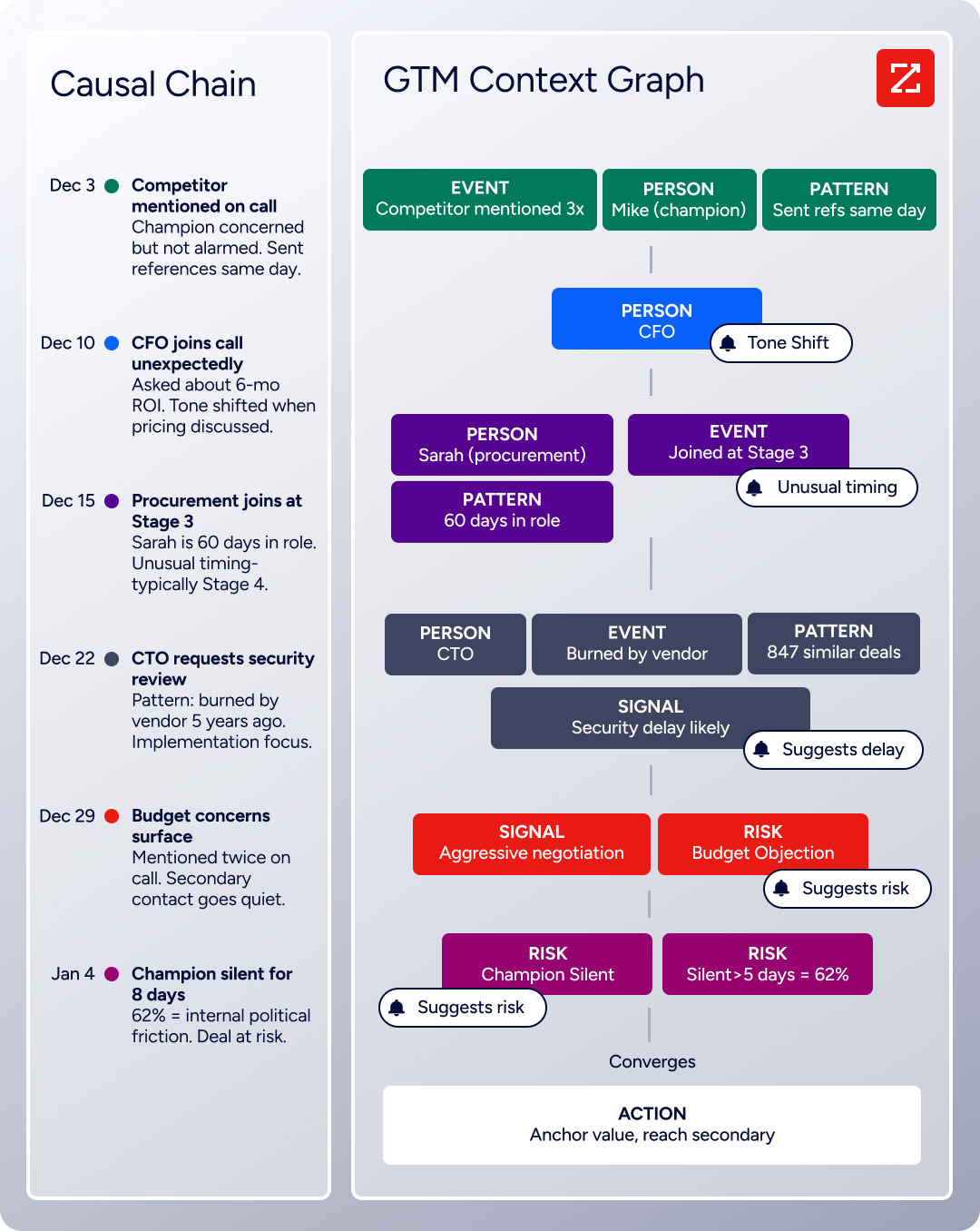
Processing 1.5B+ data points daily, it fuses ZoomInfo's B2B data with a customer's CRM records, conversation transcripts (via Chorus), email interactions, and behavioral signals into a unified intelligence layer.
As ZoomInfo's Chief Product Officer Dominik Facher explains: "The CRM recorded the state change. It has no record of why it happened." A CRM notes that a deal moved from Stage 3 to Stage 4.
But the GTM Context Graph captures that the CFO joined the last call and asked about six-month ROI (which accelerated the deal), or that the VP went quiet for eight days due to an internal budget dispute (which almost killed it). This decision context is what enables AI to make accurate predictions and useful recommendations, rather than simply summarizing CRM fields.
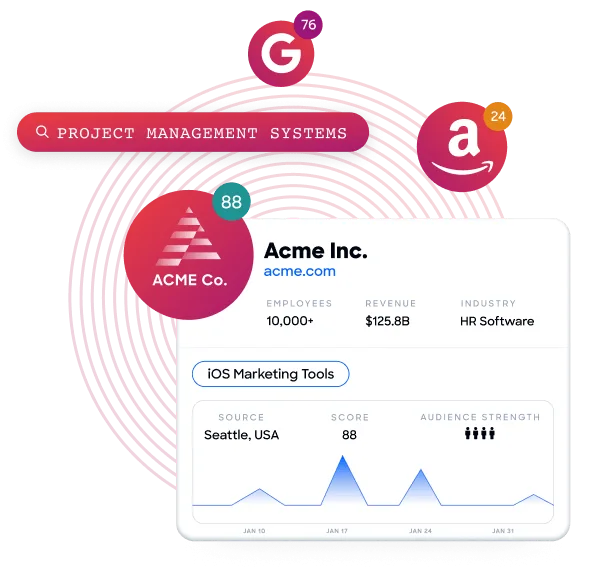
Buyer Intent Data tracks signals from 210 million IP-to-Organization pairings and 6 trillion+ new keyword-to-device pairings sourced monthly. Guided Intent, exclusive to ZoomInfo, identifies topics historically correlated with deal success rather than requiring manual topic selection.
Source: ZoomInfo
For HubSpot users, this adds a layer of intelligence that HubSpot's native capabilities don't cover: knowing which accounts are researching solutions before they ever fill out a form, understanding the people dynamics inside a deal, and correlating signals across first-party and third-party data to predict what happens next.
Seismic's sales team attributed 39% of active pipeline to opportunities identified or influenced by ZoomInfo signals, with 54% productivity gains. Toby Carrington, Chief Business Officer, noted: "That combination of our internal CRM data, external signals, and AI that's given all that context has helped us craft very specific account- and persona-based messages." (Seismic Case Study)
GTM Workspace & GTM Studio: Purpose-built execution for sellers and marketers.
ZoomInfo delivers its intelligence through three access lanes.
GTM Workspace gives sellers a single interface where prioritized accounts, AI-drafted outreach, and deal execution converge. Specialized AI agents automate account research, outreach drafting, CRM updates, and signal monitoring. The Action Feed streams in-market buyers matched to target criteria, with pre-drafted actions on every signal.
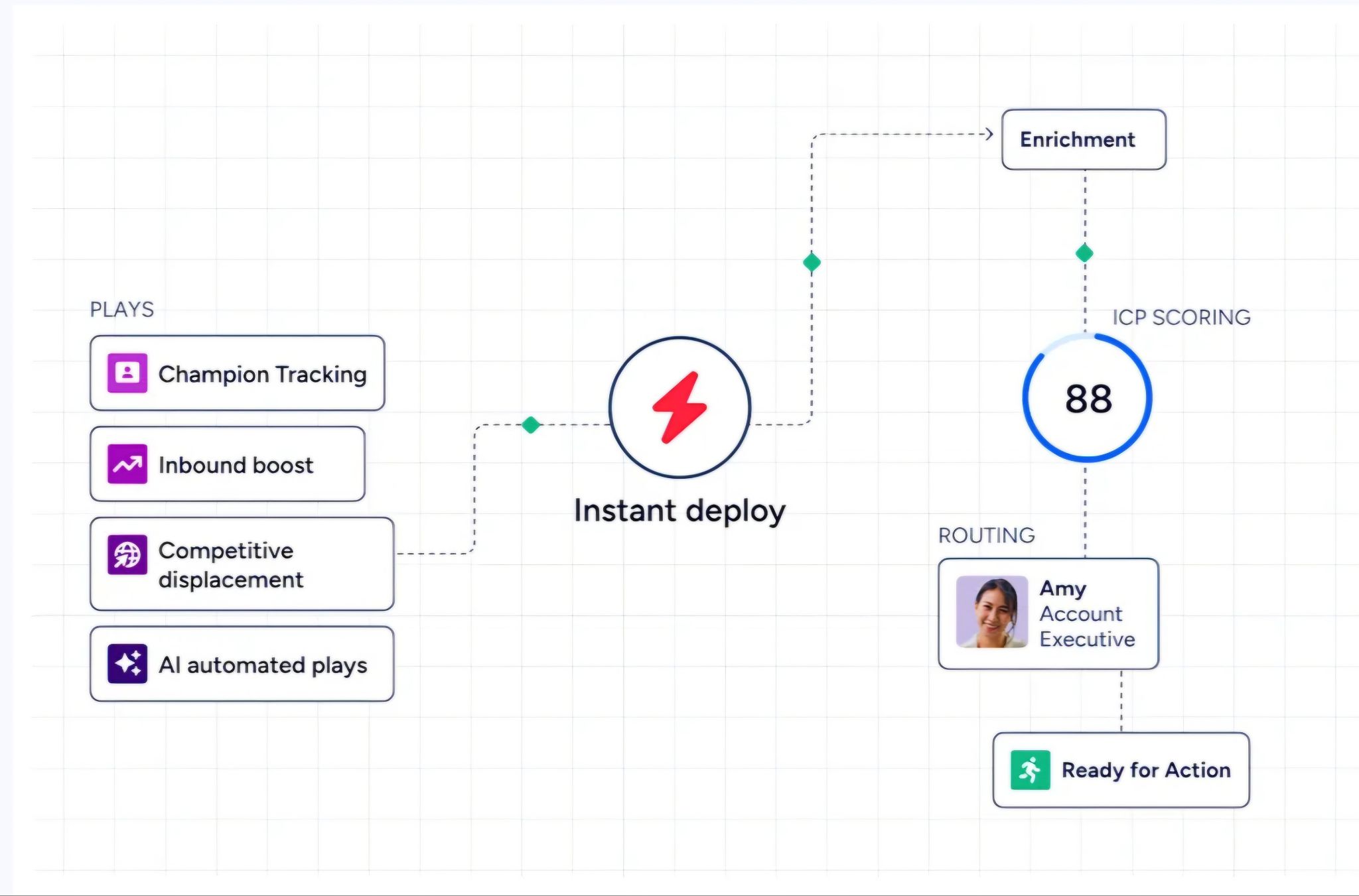
GTM Studio serves marketers, RevOps, and GTM engineers with an AI-powered orchestration canvas. Teams build audiences using natural language, enrich with first- and third-party data, define triggers, and activate plays across channels (email, calls, ads, direct mail) without engineering support.
Source: ZoomInfo
Pre-built GTM plays cover inbound acceleration, champion tracking, competitive displacement, and ICP targeting, launchable in one click.
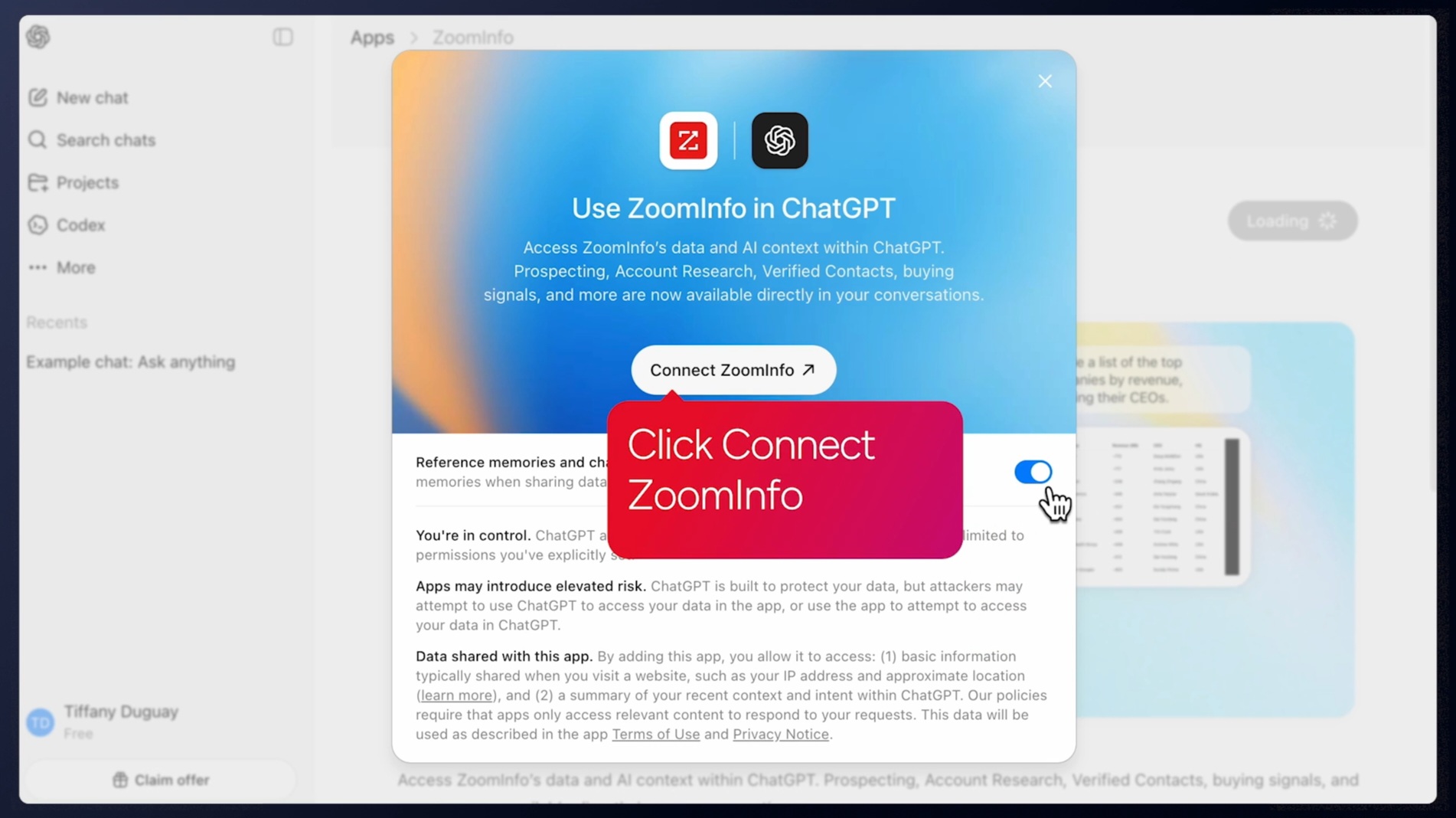
For teams that build beyond ZoomInfo's own products, APIs and MCP expose the same intelligence to any custom agent, internal tool, or partner platform. API access is included in all relevant plans, and the MCP server connects AI models directly to ZoomInfo's data with no custom coding required.
Source: ZoomInfo
All three lanes draw from the same GTM Context Graph: the same data, the same intelligence, the same continuously learning model. The choice of where to work never constrains the quality of intelligence available.
Thor Sanderson, Smartsheet's Senior Manager of Sales Technology Enablement: "ZoomInfo is our one source of truth for account data, and even more so for contact data. There's no other provider in the market that provides you with that level of detail." (Smartsheet Case Study)
Native HubSpot Integration: ZoomInfo intelligence directly inside your CRM.
ZoomInfo has a native HubSpot integration that connects the two platforms without requiring middleware or custom development.
Contact and company data from ZoomInfo flows directly into HubSpot CRM records, enriching them with verified emails, direct dials, firmographics, technographics, and org chart data.
The integration supports bidirectional data sync, so HubSpot activity data also feeds back into ZoomInfo's intelligence layer. This means the GTM Context Graph benefits from your CRM's first-party data while ZoomInfo's third-party intelligence enriches every record in HubSpot.
For teams already running their CRM on HubSpot, ZoomInfo doesn't require ripping out and replacing existing workflows. It strengthens them. The prospecting data that feeds your Sales Hub sequences gets more accurate. The audience segments in your Marketing Hub campaigns get richer. The account intelligence your reps see before every call gets deeper.
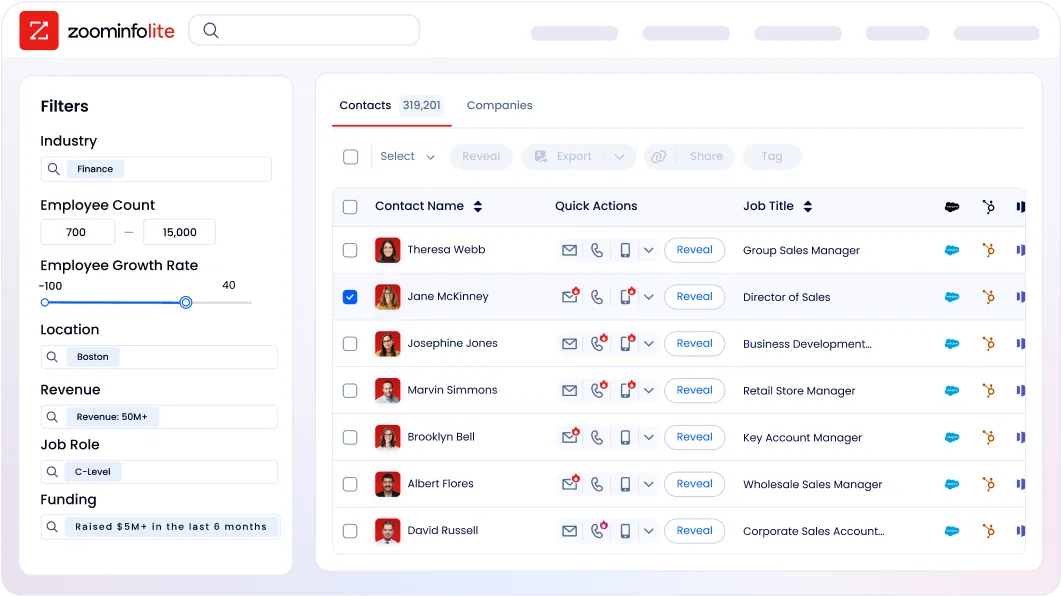
ZoomInfo also offers a permanent free tier (ZoomInfo Lite) with access to the B2B database, 10 monthly export credits, individual and company searches, the Chrome extension, and HubSpot integration. This provides a way to experience ZoomInfo's data quality firsthand before committing to a paid plan.
Levanta's CEO Ian Brodie: "ZoomInfo's not just a contact data company anymore. They've built a full system of execution. GTM Intelligence actually works the list, writes the outreach, triggers the play, and helps drive predictable growth." (Levanta Case Study)
HubSpot and ZoomInfo: Integration Summary
Aspect | HubSpot | ZoomInfo |
|---|---|---|
Primary purpose | CRM and marketing/sales/service automation | B2B data intelligence and GTM execution |
Core strength | Unified customer record across all teams | Comprehensive B2B data with 500M contacts |
B2B contact data | CRM enrichment via AI and HubSpot's dataset | 500M contacts, 135M+ verified phones, 200M+ emails |
Intent signals | First-party website and email engagement tracking | Third-party intent from 210M IP-to-Org pairings, 6T+ keyword signals monthly |
Conversation intelligence | Conversation Intelligence for call recording and transcription | Chorus with deal-level context capture and analysis |
AI agents | Breeze (Customer, Prospecting, Data, Content agents) | GTM Workspace AI agents, GTM Studio orchestration |
Integration ecosystem | 2,000+ app integrations | 120+ partner integrations, APIs, MCP for any AI agent |
Free tier | Permanent free CRM (unlimited contacts, 2 users) | ZoomInfo Lite (permanent, 10 exports/month, HubSpot integration) |
Pricing model | Per-seat, per-hub with contact-based Marketing Hub tiers | Consumption-based pricing |
Best for | Managing customer relationships and automating workflows | Sourcing B2B data, detecting intent, and powering GTM execution |
Together | The workflow and automation engine | The intelligence layer feeding the engine |
For a closer look at how these two platforms compare on data, intent signals, and go-to-market execution, see our HubSpot vs ZoomInfo comparison.
Final Verdict
HubSpot and ZoomInfo serve different but connected purposes. Choosing between them is less about which is better and more about what problem you're solving.
HubSpot is a strong choice for companies that need a unified platform to manage marketing, sales, and service on shared data. Its real advantage is consolidation: instead of juggling five or ten disconnected tools, everything runs through one CRM with consistent contact records, shared workflows, and cross-team visibility.
The free tier is useful for getting started, the marketing automation is mature, and the Breeze AI layer adds meaningful capabilities across every hub. For teams focused on inbound marketing, managing existing customer relationships, and automating repetitive workflows, HubSpot delivers.
ZoomInfo is the essential complement for B2B companies whose growth depends on outbound go-to-market execution. HubSpot manages your customer relationships; ZoomInfo provides the intelligence that identifies who those customers should be, when they're ready to buy, and why a deal is moving or stalling.
The GTM Context Graph adds a layer of intelligence that no CRM offers natively. And because ZoomInfo integrates directly with HubSpot, teams don't have to choose between the two. They work together: ZoomInfo's data and intelligence flow into HubSpot's workflows, and HubSpot's first-party CRM data feeds back into ZoomInfo's context layer.
Get started with ZoomInfo here.
For B2B companies running their CRM on HubSpot, adding ZoomInfo transforms a strong workflow platform into a complete go-to-market system, one where the data is verified, the intent signals are real, and the intelligence behind every outreach and every deal is grounded in context, not guesswork.
HubSpot FAQ
Does HubSpot have a free plan?
Yes. HubSpot offers a permanent free CRM tier with unlimited contacts (up to 1 million records per object), one deal pipeline, email integration, contact management, and basic tools across marketing, sales, and service.
The free tier is capped at two user seats, and HubSpot branding appears on all customer-facing tools. It's useful for small teams getting started, though the limits push growing companies toward paid tiers relatively quickly.
How much does HubSpot cost?
Pricing depends on which Hubs you subscribe to, how many seats you need, and how many marketing contacts you have. Starter plans begin at $9–$20 per seat per month. Marketing Hub Professional is $800–$890 per month with 2,000 marketing contacts included. Sales Hub Professional is $90–$100 per seat per month.
Enterprise tiers run $3,600 per month for Marketing Hub and $150 per seat per month for Sales and Service. All Professional and Enterprise Marketing, Sales, and Service Hubs carry mandatory onboarding fees ranging from $1,500 to $7,000. If you subscribe to multiple Hubs at different tiers, all Core Seats are billed at the rate of the highest subscription, which can significantly increase total cost.
What is Breeze AI and is it included?
Breeze is HubSpot's AI layer, running across all hubs. It includes a personal AI assistant, specialized agents (Customer Agent, Prospecting Agent, Data Agent), and embedded AI features like email writing and content remix.
Breeze is available across all tiers, but runs on HubSpot Credits. Starter plans include 500 credits per month, Professional plans include 3,000, and Enterprise plans include 5,000. Additional credits cost $10 per 1,000 per month. Several Breeze features, including Marketing Studio, AI-Powered Segmentation, and Breeze Studio, are currently in Beta.
Does HubSpot include B2B prospecting data?
HubSpot's Smart CRM enriches existing records using AI and its own dataset, but it does not include a dedicated B2B contact database for prospecting. The Breeze Prospecting Agent can draft outreach and monitor buying signals, but the depth of contact data (direct dials, verified emails, org charts, technographics) depends on what's already in your CRM or imported from external sources.
ZoomInfo integrates natively with HubSpot and provides 500 million contacts, 135 million verified phone numbers, and 200 million verified business emails to fill this gap.
Can you cancel a HubSpot subscription mid-contract?
No. Paid subscriptions can only be canceled at the end of the commitment term by turning off auto-renewal before the renewal date. Mid-contract cancellations are not permitted, and payment obligations are non-cancelable and non-refundable except in narrow circumstances.
Downgrading to a lower tier also requires waiting until the end of the commitment term, with at least five business days' notice before the renewal date.
What integrations does HubSpot support?
HubSpot's App Marketplace includes over 2,000 integrations with 2.5 million active installs, covering CRMs, e-commerce platforms, advertising tools, analytics, and more.
ZoomInfo is among the featured integrations, providing native data enrichment and intelligence directly inside HubSpot CRM records. HubSpot also supports a REST API, webhooks, custom UI extensions, and a developer platform for building native apps.
Does HubSpot offer buyer intent signals?
HubSpot tracks first-party engagement signals, including website visits, email opens, form submissions, and ad clicks. These are useful for understanding how known contacts interact with your content. However, HubSpot does not offer third-party buyer intent data that monitors off-site research activity across the broader web.
For teams that need to identify which accounts of theirs are actively researching solutions before those accounts visit their website, ZoomInfo's Intent Data (tracking signals from 210 million IP-to-Organization pairings) provides the additional coverage.
How does HubSpot compare to Salesforce?
HubSpot and Salesforce serve overlapping markets but with different philosophies. HubSpot prioritizes ease of use and fast time to value, claiming 90 days to meaningful outcomes versus 12-plus months for traditional enterprise systems.
Salesforce offers deeper customization and a more mature feature set built over 25 years, suited for large enterprises with dedicated admin teams. HubSpot is generally the better fit for small-to-midsize companies that want unified marketing, sales, and service without heavy implementation overhead. Both platforms integrate with ZoomInfo for B2B data enrichment and intelligence.
For a detailed side-by-side breakdown, see our HubSpot vs Salesforce comparison.
