

Choosing between HubSpot vs. Insightly for your CRM often comes down to five questions:
Do you need a broad platform covering marketing, sales, service, and content, or a focused CRM with built-in project delivery?
Is a permanent free tier more important than lower per-seat costs at scale?
How much AI automation does your team need right now?
Are you willing to pay mandatory onboarding fees for a fuller system, or do you want to self-serve from day one?
Is your contact data good enough to make either platform generate pipeline?
In short, here's what we recommend:
HubSpot is for companies that want marketing, sales, service, content management, and commerce under one roof. Its Smart CRM connects every hub through a shared database, and Breeze AI automates work across all of them: drafting prospecting emails, resolving support tickets, answering natural-language questions about your pipeline. With 288,706 customers and a free tier, HubSpot works for solo founders and enterprise teams alike. The tradeoff: pricing gets complex (per-seat, per-hub, mandatory onboarding fees at Professional and Enterprise tiers), and when you mix subscription tiers across hubs, all seats are billed at the highest tier's rate.
Insightly targets mid-market teams that want CRM, marketing automation, and customer service without enterprise complexity. What sets it apart is the ability to convert a won deal into a project, carrying over contacts, files, and notes so sales and delivery work from the same record. At $29-99/user/month with no mandatory onboarding fees on CRM plans, it costs less than HubSpot's upper tiers. The tradeoff: reporting is basic compared to HubSpot, the AI Copilot is in Beta with limited monthly queries, and the interface, despite a December 2025 design refresh, still feels a generation behind.
Both platforms manage your customer relationships. But the quality of data inside your CRM determines whether those relationships convert to revenue. A CRM full of outdated contacts, missing phone numbers, and stale company data won't drive pipeline no matter how good its automation is. That's the gap ZoomInfo fills.
ZoomInfo is a B2B data and go-to-market platform built on a large B2B dataset: 500M contacts, 100M companies, 135M+ verified phone numbers, and 200M+ verified business emails. Its GTM Context Graph processes 1.5B+ data points daily, combining this data with your CRM records, conversation transcripts, and behavioral signals to show not just what's happening in your pipeline, but why deals move or stall.
Your team uses GTM Workspace for sales, GTM Studio for marketing and RevOps, or APIs and MCP to connect it to other tools. ZoomInfo integrates natively with HubSpot and connects to Insightly through those APIs, feeding verified contacts, intent signals, and AI insights into whichever CRM you choose.
For teams focused on go-to-market results, ZoomInfo isn't an alternative to HubSpot or Insightly. It's the data foundation that makes either one work.
If verified data and buying signals are what's missing from your go-to-market, see how ZoomInfo works.
HubSpot vs. Insightly vs. ZoomInfo at a glance
HubSpot | Insightly | ZoomInfo | |
|---|---|---|---|
Primary function | Customer platform (CRM + marketing + sales + service + content) | Mid-market CRM + marketing + service + project management | B2B data + go-to-market tools |
Best for | Companies wanting everything under one roof | Mid-market teams needing CRM with post-sale delivery | Teams that need verified B2B data and buying signals for their CRM |
Starting price | Free (limited); Starter at $20/seat/mo | $29/user/mo (no free plan) | Free (ZoomInfo Lite); consumption-based paid plans |
AI capabilities | Breeze AI across all hubs (agents, assistant, embedded tools) | Copilot (Beta): 75-100 queries/mo | GTM Context Graph + AI agents in GTM Workspace and Studio |
Contact database | Stores your contacts (up to 15M, expandable to 50M) | Stores your contacts (up to 500K on Enterprise) | Provides 500M verified B2B contacts to enrich your CRM |
Integrations | 2,000+ native apps | 2,000+ via AppConnect ($249/mo extra) | Native HubSpot integration; APIs and MCP for any tool |
Post-sale tracking | Basic (via Service Hub) | Native project management from won deals | Not applicable (GTM-focused) |
Free tier | Permanent free CRM (limited features) | 14-day trial only | ZoomInfo Lite (permanent, 10 credits/mo) |
HubSpot covers more ground, Insightly stays focused
The biggest difference between HubSpot and Insightly is scope.
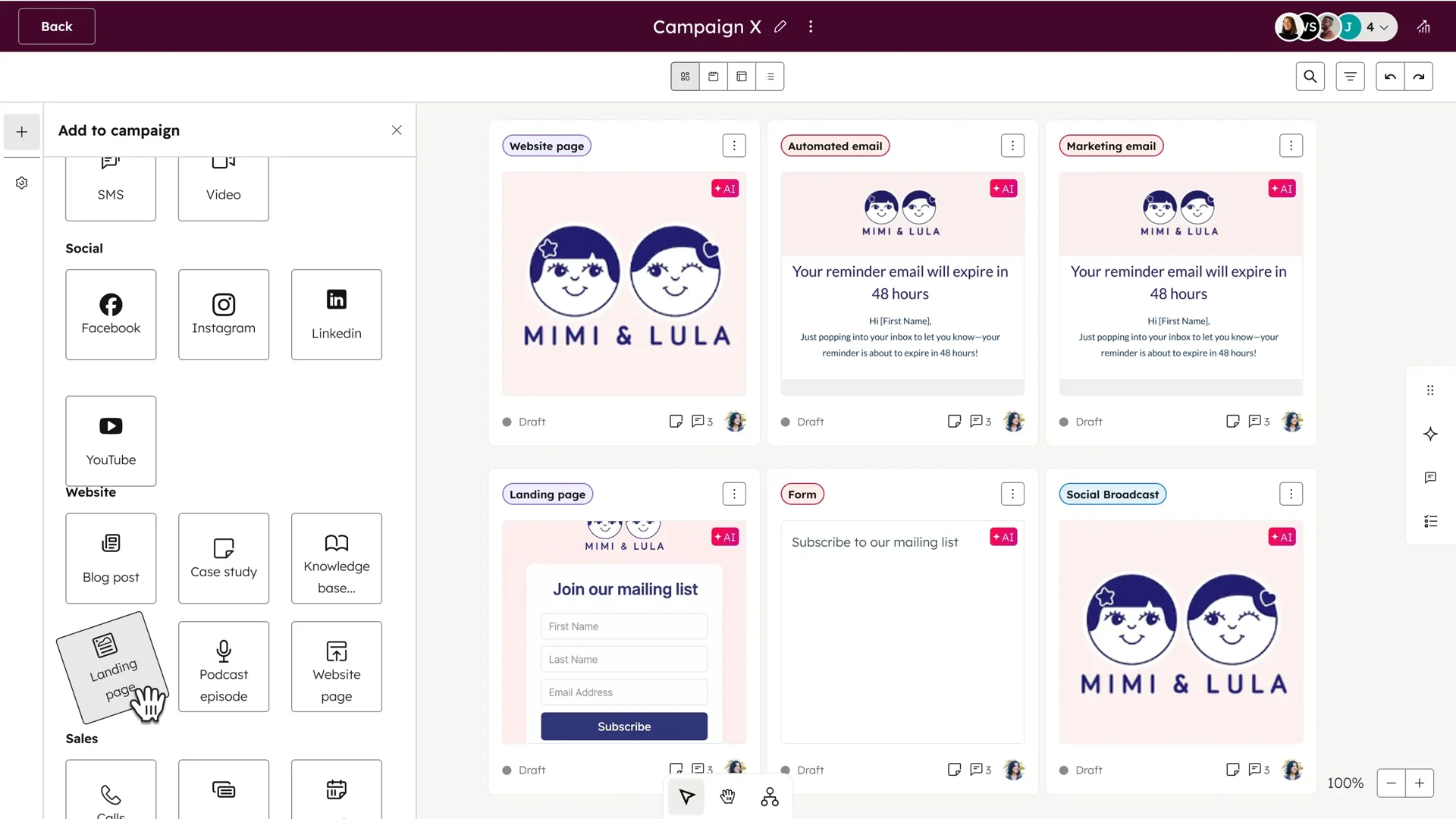
HubSpot offers eight connected products: Marketing Hub, Sales Hub, Service Hub, Content Hub, Data Hub, Commerce Hub, Smart CRM, and Breeze AI. A marketing team can build landing pages, run email campaigns, and track multi-touch attribution.
Source: HubSpot
A sales team can manage pipelines, automate sequences, and generate branded quotes. A service team can handle tickets across email, chat, WhatsApp, and phone. All of it runs on the same contact database.
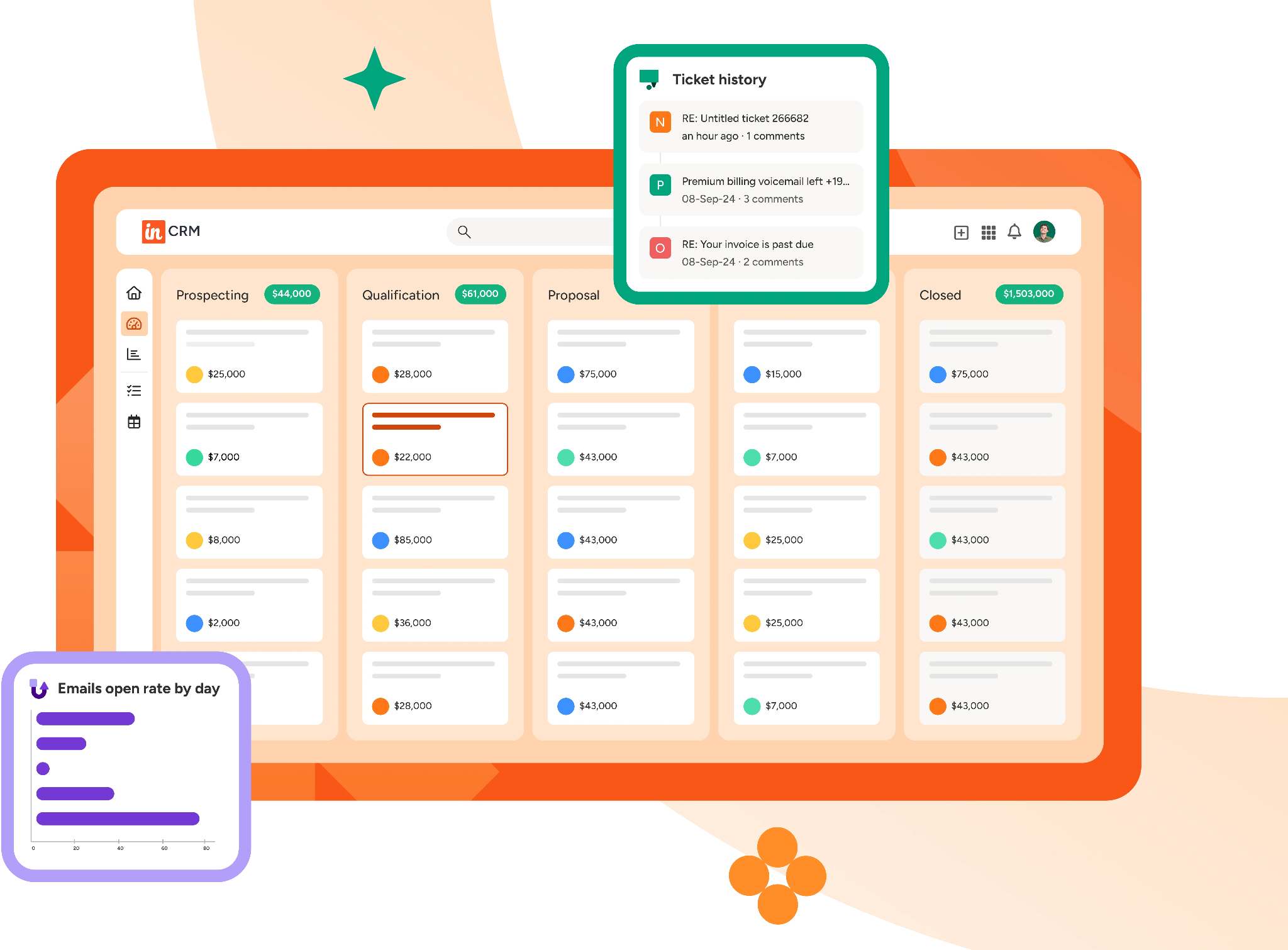
Insightly covers three core modules: CRM, Marketing, and Service. It does not include a content management system, a commerce layer, or a data management product. What it does include (and HubSpot does not) is native project management tied to the sales pipeline.
Source: Insightly
For companies that want one platform to handle marketing, sales, service, content, and payments, HubSpot is the clear choice. For companies that mainly need CRM and marketing automation with a tight connection to project delivery, Insightly offers a simpler path with fewer bills.
Neither platform, however, generates the B2B contact data that fills the CRM in the first place. Both store and manage data you bring in or capture through forms and website visits. The quality of that data (how many contacts have verified direct dials, how current the company attributes are, whether you can see which accounts are in-market) depends on what you feed them.
Pipeline management reflects different priorities
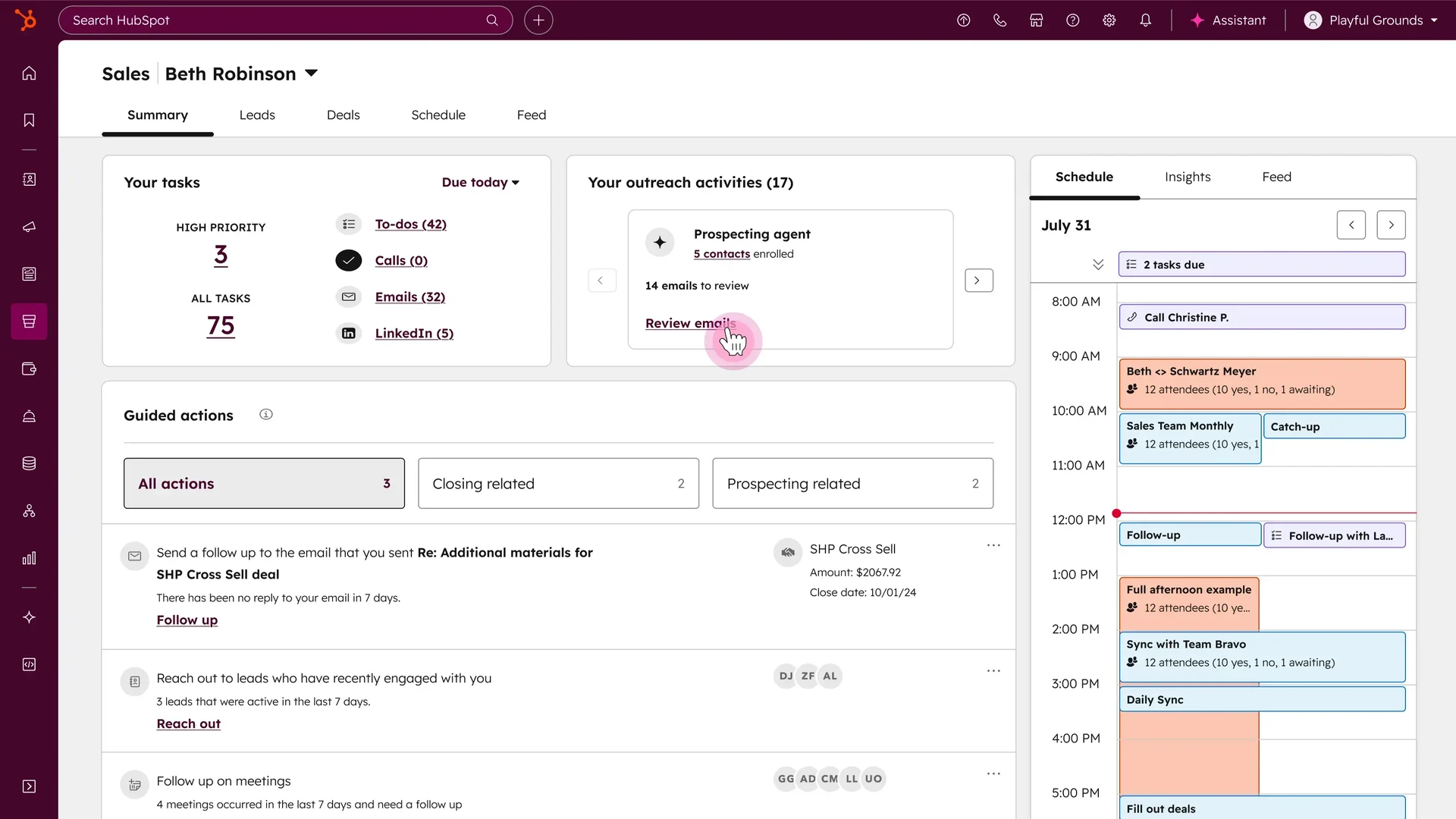
HubSpot's Sales Hub is built for teams that live in their pipeline.
Source: HubSpot
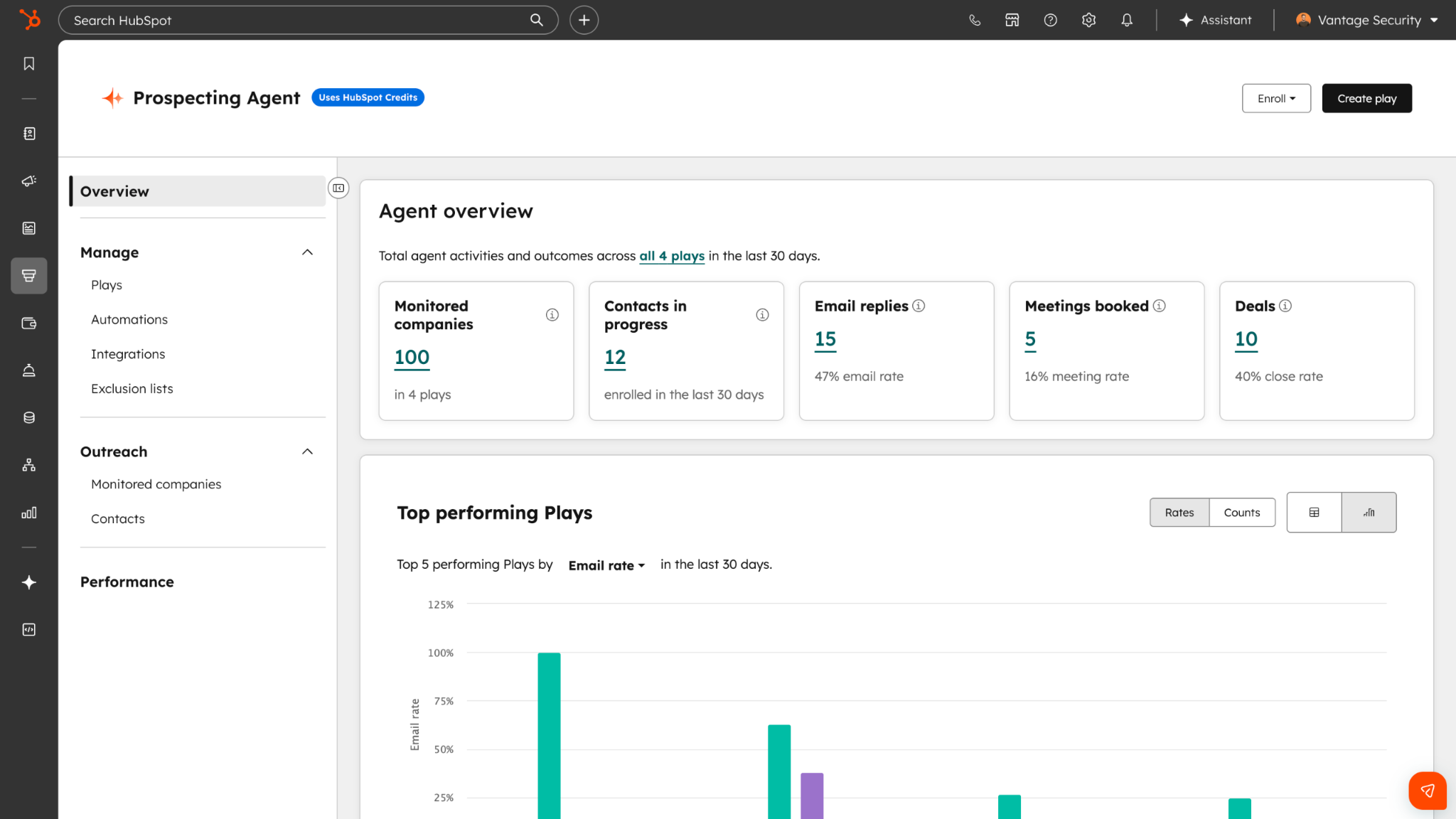
The Breeze Prospecting Agent monitors enrolled prospects for buying signals, drafts personalized outreach from the customer history, and can run autonomously or with rep review.
Source: HubSpot
Sequences support automated emails, call tasks, and LinkedIn Sales Navigator tasks.
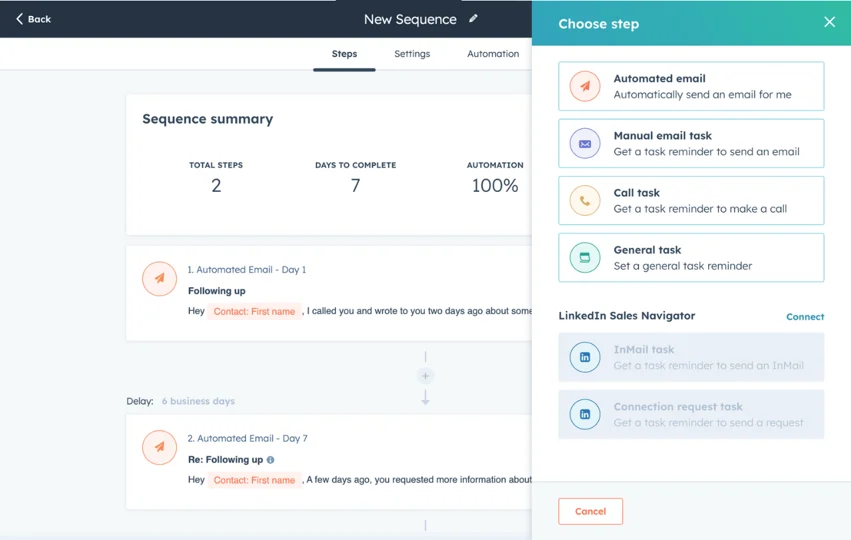
Source: HubSpot
Conversation Intelligence records and transcribes calls for coaching. CPQ software generates branded quotes from deal records.
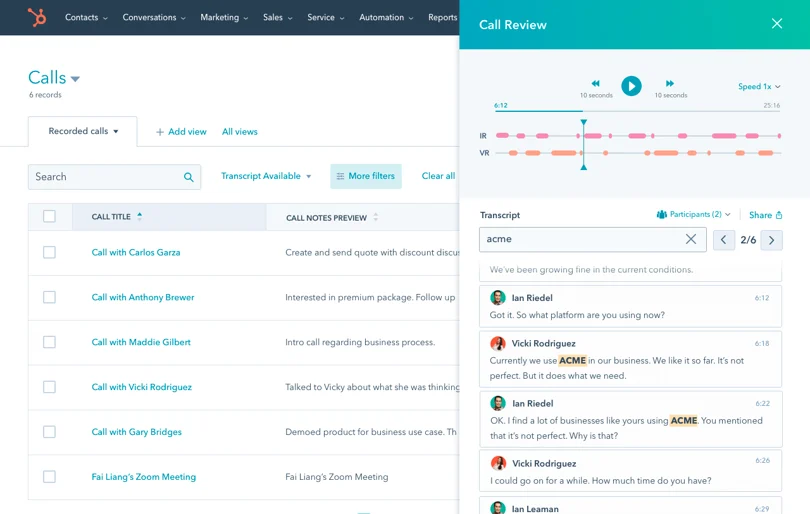
Source: HubSpot
Insightly takes a more straightforward approach. Opportunities move through customizable pipeline stages, with Activity Sets that auto-generate follow-up tasks when a deal advances.
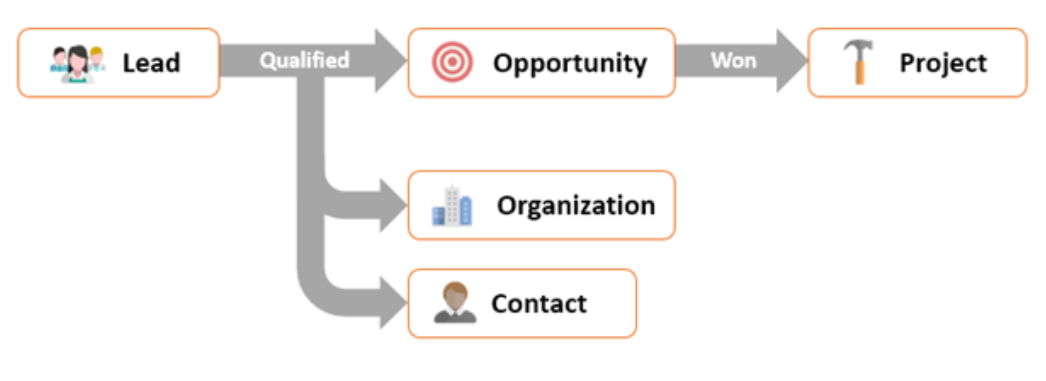
Source: Insightly
The Command Center (launched March 2026) consolidates tasks, opportunities, leads, and emails into a single prioritized view. Products, price books, and quotes are available on Enterprise.
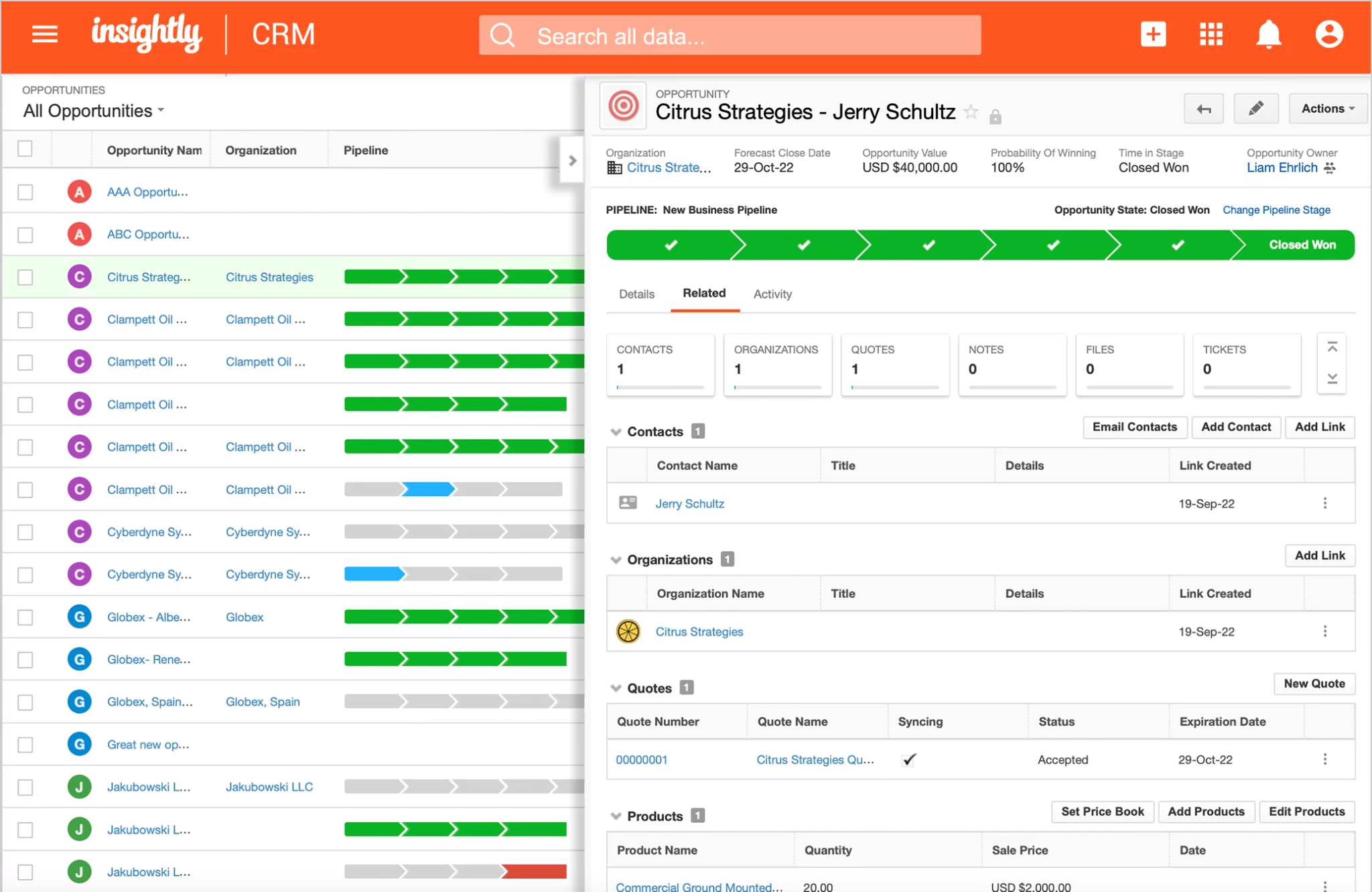
Source: Insightly
Where Insightly pulls ahead is what happens after the deal closes. A won opportunity converts directly into a project with all linked contacts, files, and notes carried over.
For professional services firms, agencies, and consultancies, this eliminates the handoff gap between sales and delivery. HubSpot has no equivalent. Once a deal closes in HubSpot, project delivery requires a separate tool.
Both platforms share a limitation: neither generates the prospect data that fills the pipeline. HubSpot's Breeze Prospecting Agent drafts personalized outreach, but it writes to contacts already in your CRM. Insightly's pipeline stages track deals you already know about. The question "who should we be selling to that we haven't found yet?" is where a data platform changes the equation.
Marketing automation at different price points
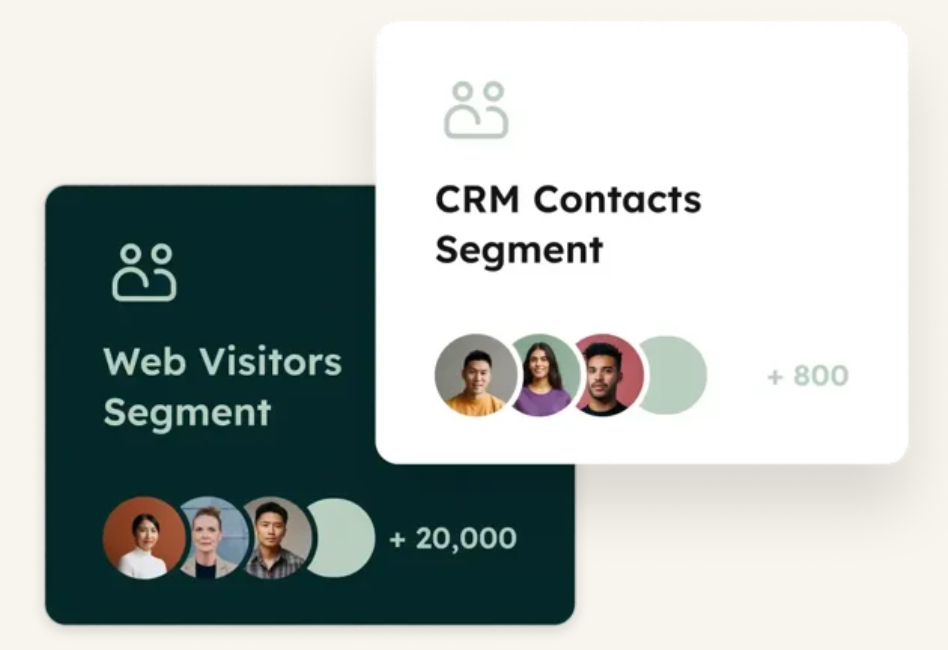
HubSpot Marketing Hub is a full marketing automation engine. Visual workflow builders trigger multi-step email sequences based on contact behavior, lifecycle stage, or form submissions. Audience segments update in real time.
Source: HubSpot
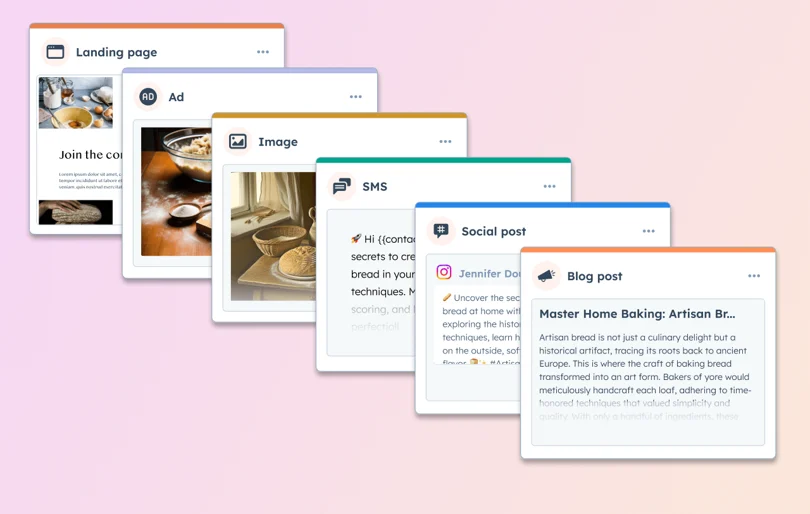
Content Remix transforms a blog post into social posts, email copy, or video scripts.
Source: HubSpot
A built-in AEO Grader helps content rank in AI search results. Marketing Hub Professional starts at $800/month (annual) with a $3,000 mandatory onboarding fee.
Insightly Marketing covers the essentials: a journey builder for automated nurture sequences, prospect scoring based on behavioral signals, prospect grading against an ideal customer profile, landing pages, forms, and A/B testing. Its dual qualification system (numeric engagement score plus letter grade for fit) gives sales a clearer view of readiness than score alone. Pricing starts at $99/month for 2,000 prospects.

HubSpot's marketing automation is broader and deeper. But Insightly's costs less, and its native CRM connection means prospect data flows to sales without integration lag. For mid-market teams running email nurture and lead scoring without a marketing ops function, Insightly covers the core workflow at a fraction of HubSpot's cost.
What neither platform does well is identify which companies outside your database are researching solutions like yours. Both track behavior from known contacts and website visitors, but the universe of buyers who haven't visited your site or filled out a form stays invisible.
AI capabilities: established platform versus early-stage assistant
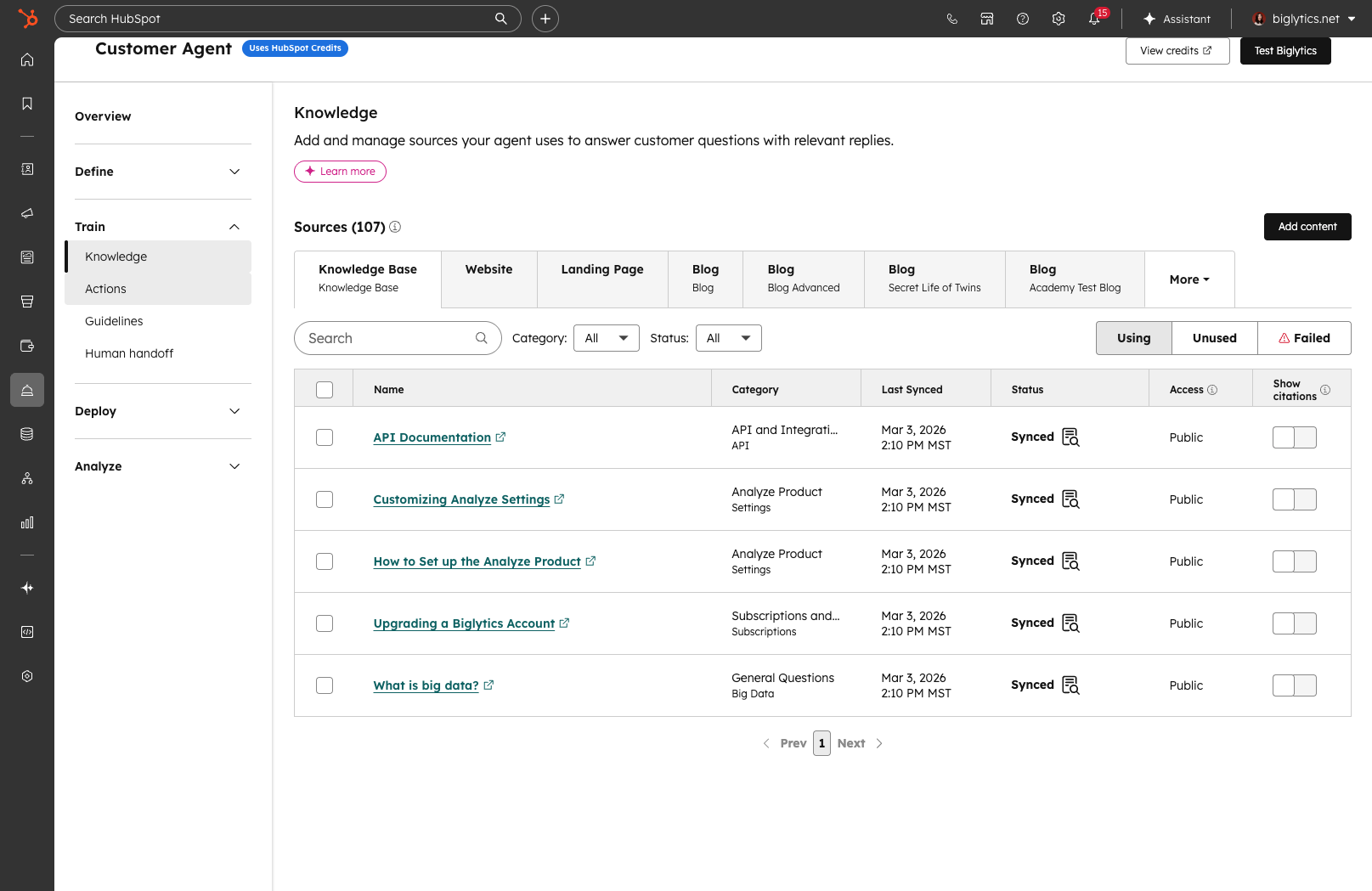
HubSpot has invested heavily in Breeze, its AI system that runs across every hub. The Customer Agent resolves over 50% of customer conversations autonomously.
Source: HubSpot
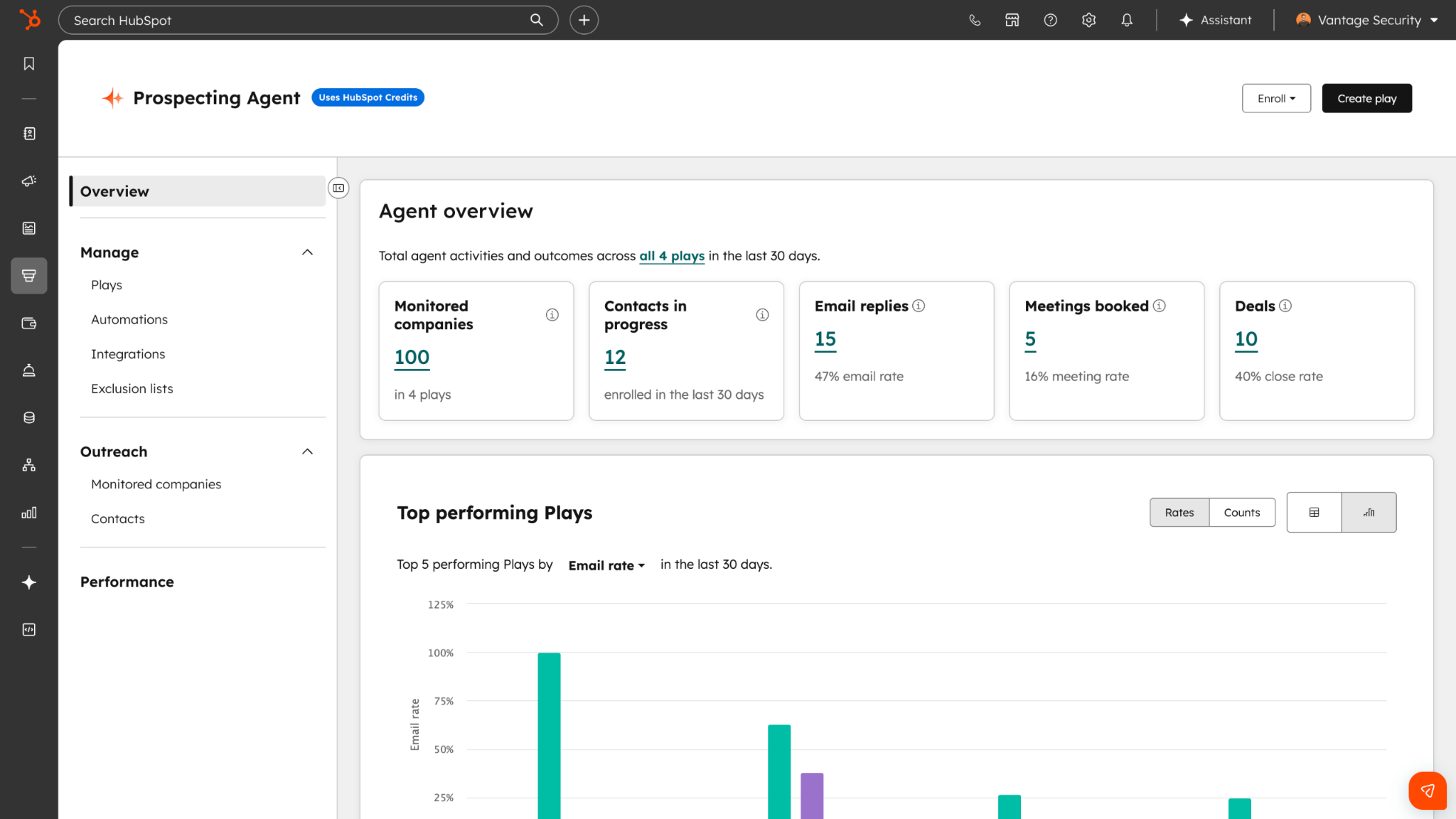
The Prospecting Agent researches prospects, monitors buying signals, and drafts personalized emails using the full HubSpot customer history.
Source: HubSpot
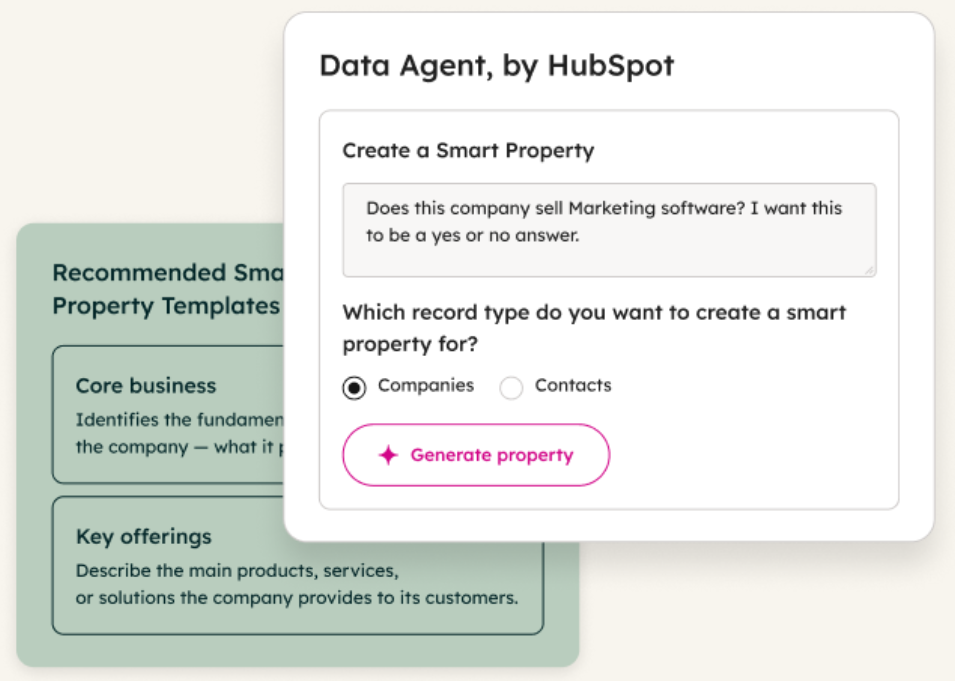
The Data Agent answers natural-language questions about CRM data.
Source: HubSpot
Breeze Agents are included in Professional and Enterprise subscriptions and run on HubSpot Credits (a consumption-based billing unit). Several newer features (AI-Powered Segmentation, Marketing Studio, Flexible CRM Views) are still in Beta, but the AI offering is broad and growing.
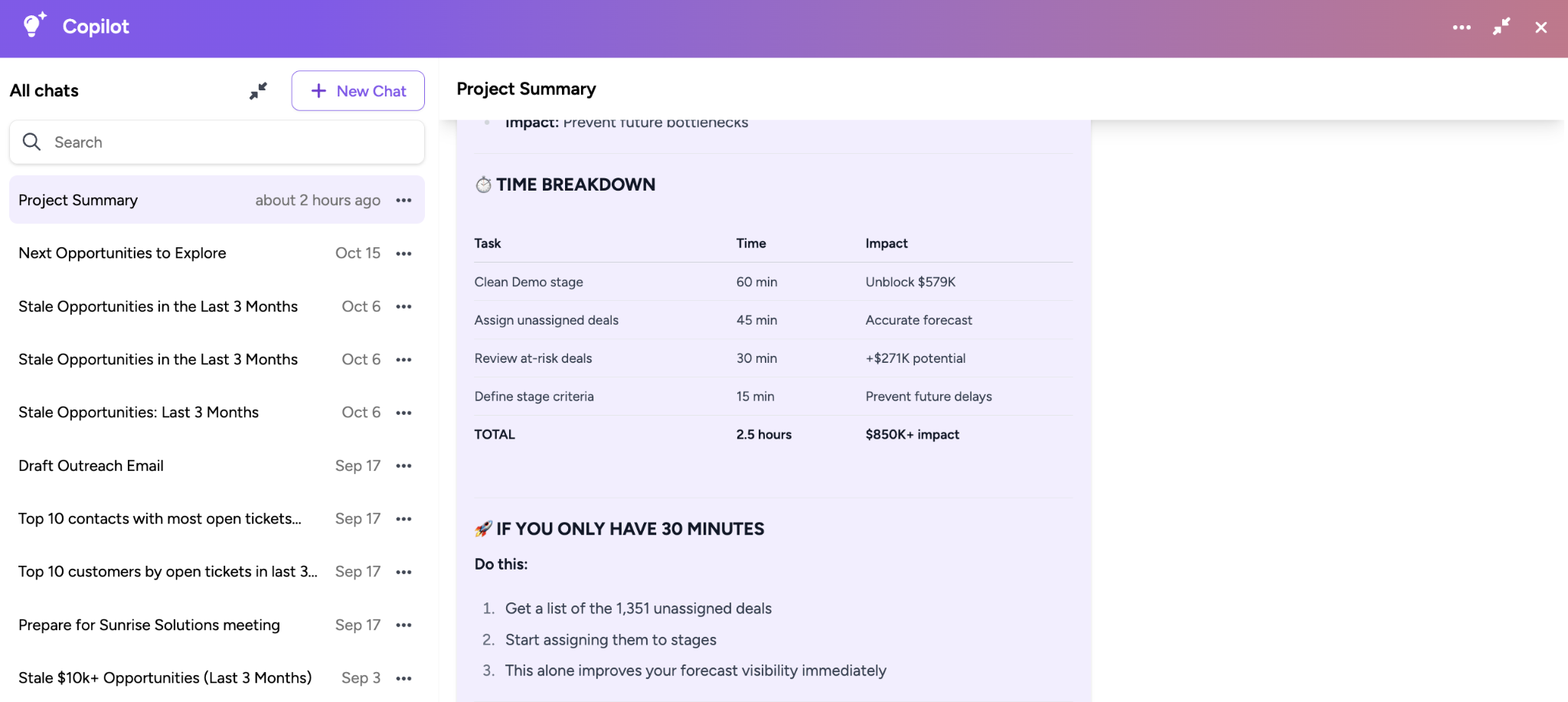
Insightly's AI offering is newer and narrower. Insightly Copilot (launched December 2025, still in Beta) handles natural-language queries, email generation, task creation, and record summarization.
Source: Insightly
It's useful but constrained: Professional seats get 75 queries per month, Enterprise gets 100, and all users on an account share one pooled query bank. Additional queries cost $19 per 100. AI Email Reply and AI Email Summary are available on all plans, but Copilot itself requires Professional or Enterprise.
HubSpot's AI is more established and more broadly deployed. Insightly's is functional but early. Both share the same constraint: their AI reasons only about data already in your CRM. HubSpot's Breeze Prospecting Agent can personalize outreach, but only to contacts it already knows. Insightly's Copilot can summarize a lead's history, but it can't tell you about contacts outside your database.
The data problem neither CRM solves on its own
A CRM is only as good as the data inside it. HubSpot stores up to 15 million contacts (expandable to 50 million). Insightly stores up to 500,000 records on Enterprise. Both platforms manage, segment, and automate actions on those contacts.
Neither platform provides the contacts themselves.
HubSpot's Smart CRM includes some data enrichment from email threads, calls, and its own dataset. Insightly's Copilot can surface data hygiene issues. But when a sales rep asks "who are the VP-level decision-makers at financial services companies using Salesforce with 500-5,000 employees?" neither CRM has an answer.
This is the problem ZoomInfo solves.
ZoomInfo maintains a verified B2B database of 500M contacts, 100M companies, 135M+ verified phone numbers, 120M direct-dial phone numbers, and 200M+ verified business email addresses. That data is verified through multiple sources and 300+ human researchers, achieving up to 95% accuracy on first-party data.
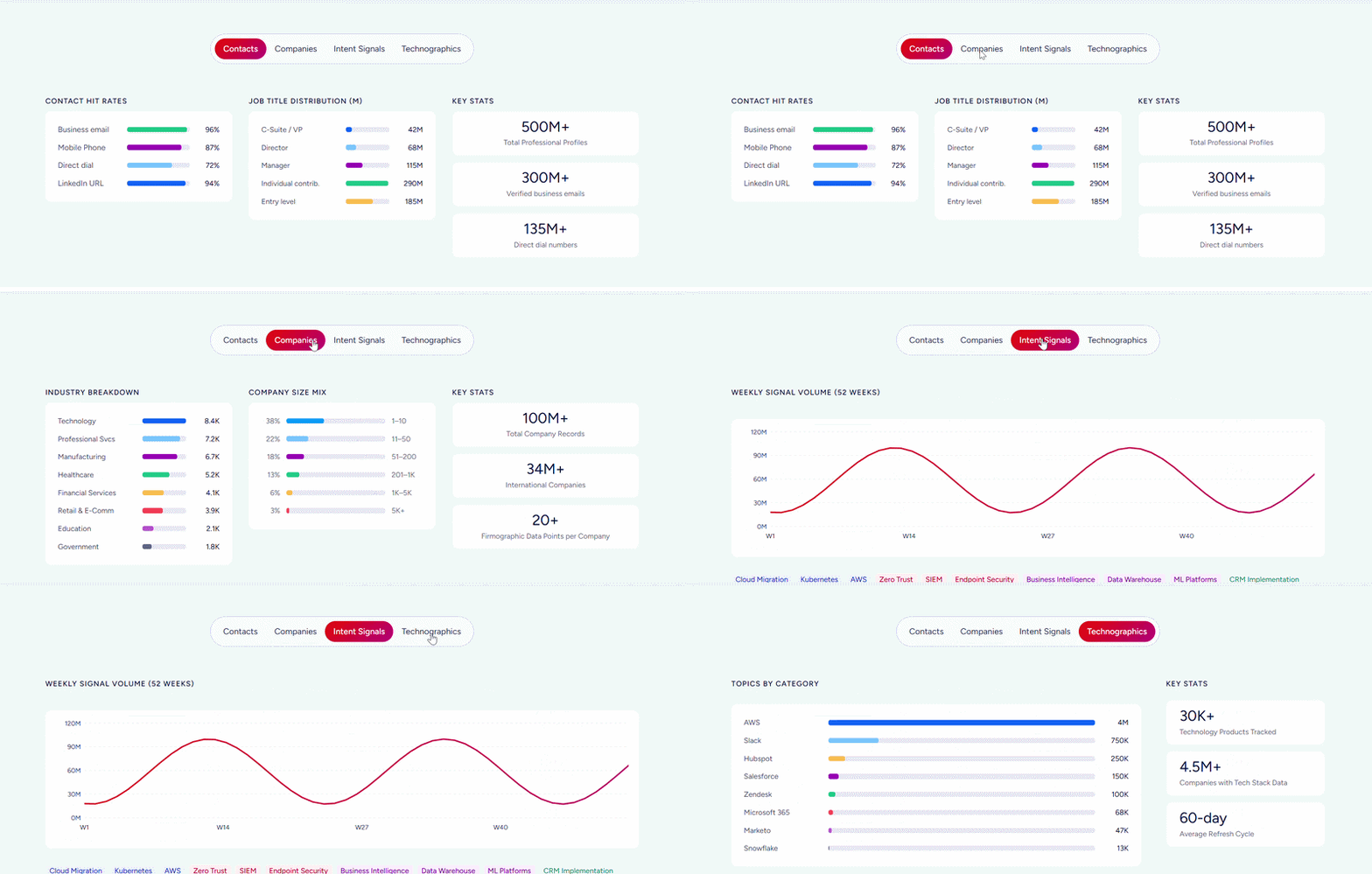
In a Fortune 500 competitive RFP analyzing 25 million contacts across vendors, the independent consultant concluded that "no other competitor came even close."
But data volume alone isn't the point. ZoomInfo's GTM Context Graph combines that data with your CRM records, conversation transcripts, and behavioral signals, processing 1.5B+ data points daily. The result isn't a bigger contact list. It's a system that shows why deals move or stall, which accounts are in-market, and which signals predict conversion.
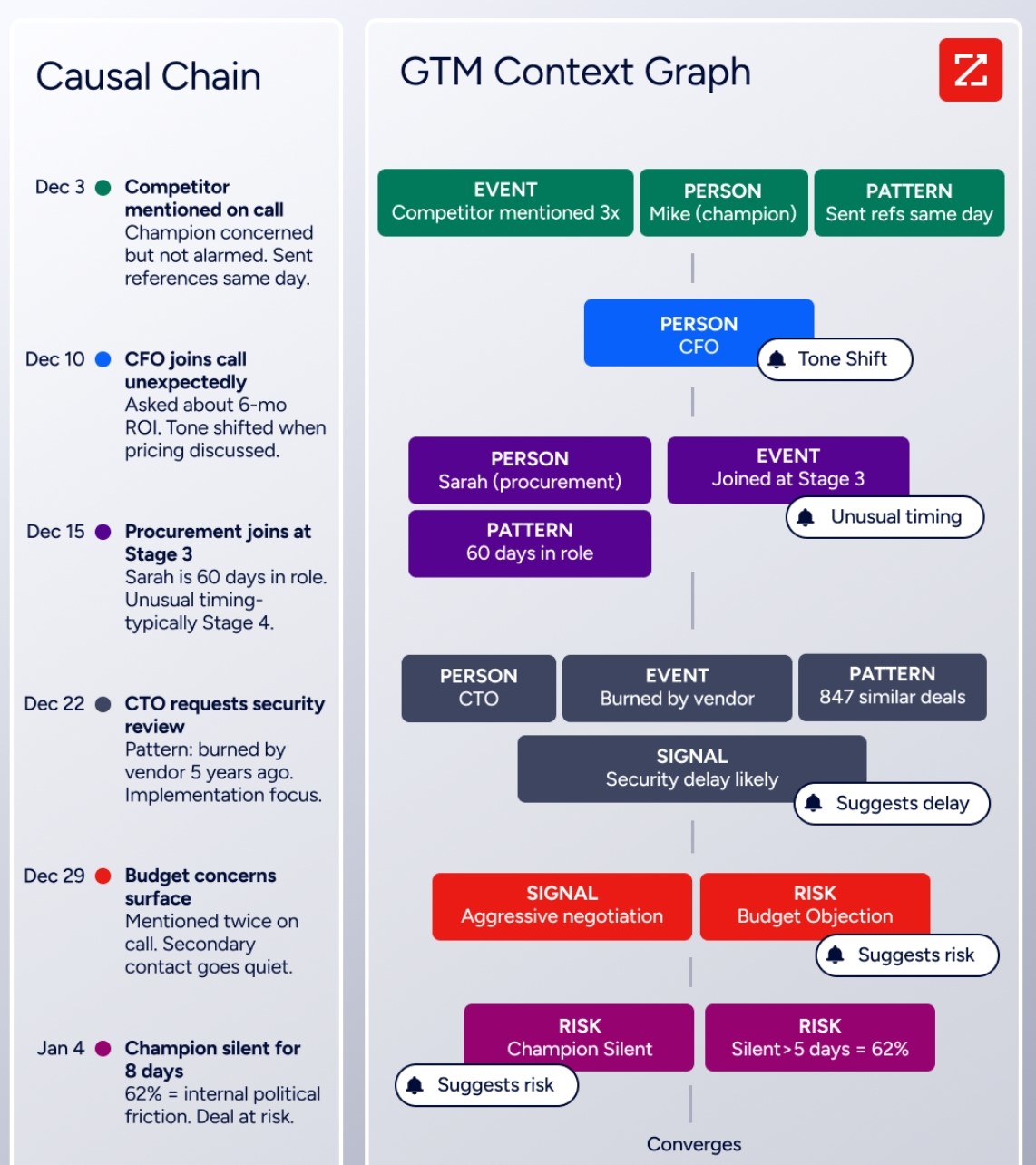
Buyer Intent tracks signals from 210 million IP-to-Organization pairings and 6 trillion+ new keyword-to-device pairings sourced monthly. Guided Intent (exclusive to ZoomInfo) identifies topics correlated with past deal success instead of requiring manual topic selection.
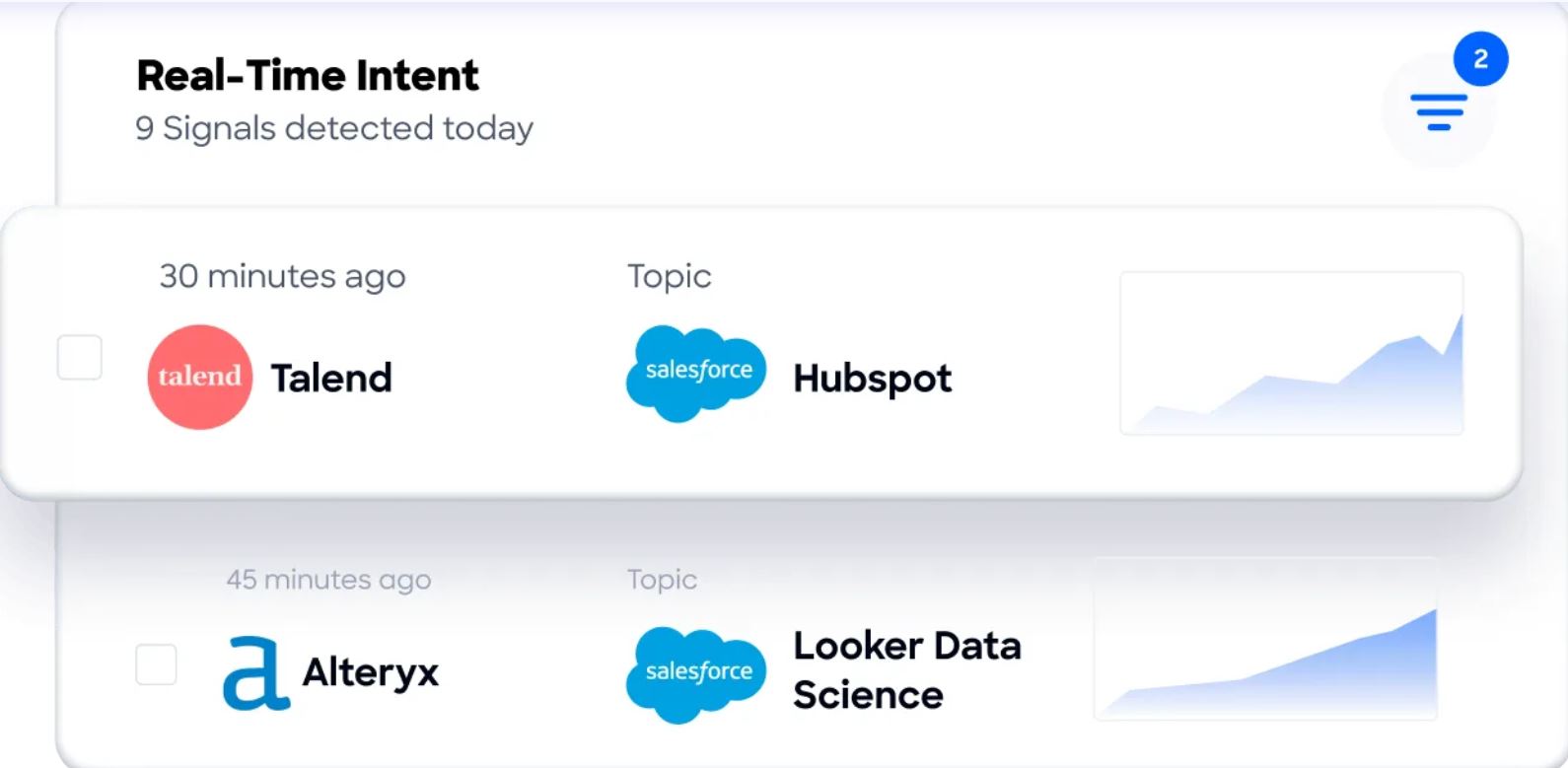
Sellers use GTM Workspace, where the AI agent surfaces accounts and drafts outreach based on verified data and buying signals. Marketers and RevOps build plays in
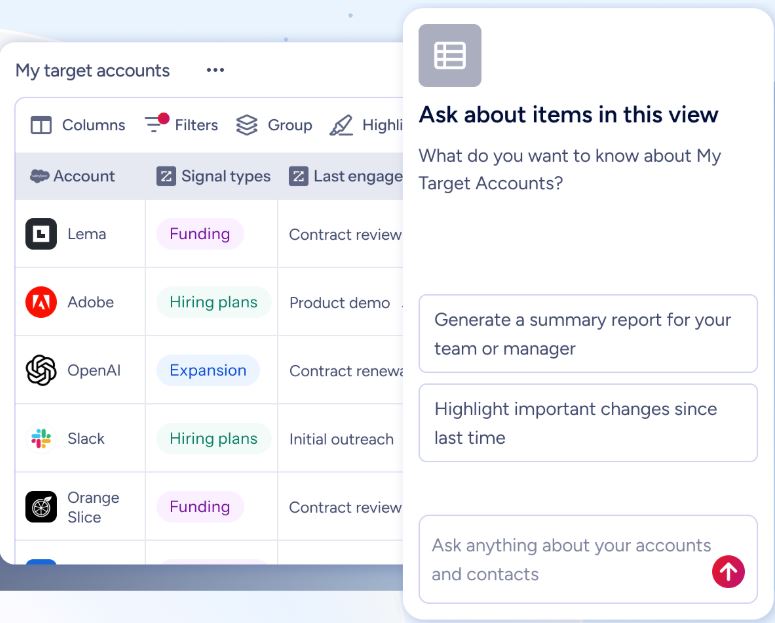
GTM Studio, targeting audiences that match past win patterns. For teams using HubSpot, ZoomInfo integrates natively, enriching CRM records with verified contact data, intent signals, and technographics.
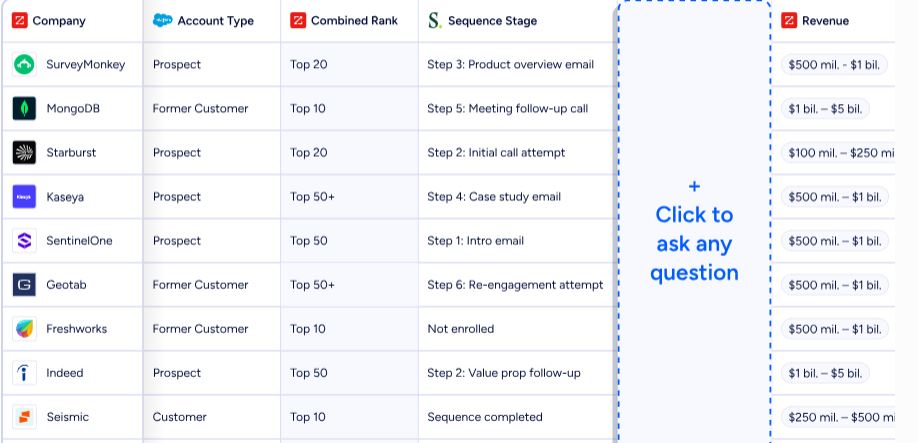
For teams using Insightly, ZoomInfo's APIs and MCP feed the same data into any system. The CRM manages the relationship. ZoomInfo ensures you have the right people to build a relationship with.
For a dedicated side-by-side look at how HubSpot and ZoomInfo compare, see our HubSpot vs. ZoomInfo comparison.
"That combination of our internal CRM data, external signals, and AI that's given all that context has helped us craft very specific account- and persona-based messages. And people have responded to them right away." (Seismic)
Integration ecosystems reflect different strategies
HubSpot's App Marketplace offers over 2,000 integrations with 2.5 million active installs. These are native connections included in your subscription, covering CRMs, ERPs, communication tools, and advertising platforms. The ecosystem is established: most major business applications have a HubSpot connector, and the developer platform supports custom integrations via REST APIs and UI Extensions.
Insightly also claims 2,000+ integrations, but there's a distinction. The core CRM includes basic connections (Gmail sidebar, Outlook sidebar, Zapier). The heavy lifting runs through AppConnect, Insightly's integration platform, which starts at $249/month plus a $3,000 one-time setup fee.
AppConnect handles it well (2,000+ connectors, no-code recipe builder, error handling on serverless AWS infrastructure), but it adds a separate line item to every bill.
ZoomInfo takes a third approach. Rather than building integrations outward from your CRM, ZoomInfo pushes data into your existing tools. Sellers work from GTM Workspace, marketers and RevOps build plays in GTM Studio, and the Enterprise API and MCP server connect ZoomInfo to any other system. API access is included in all plans.
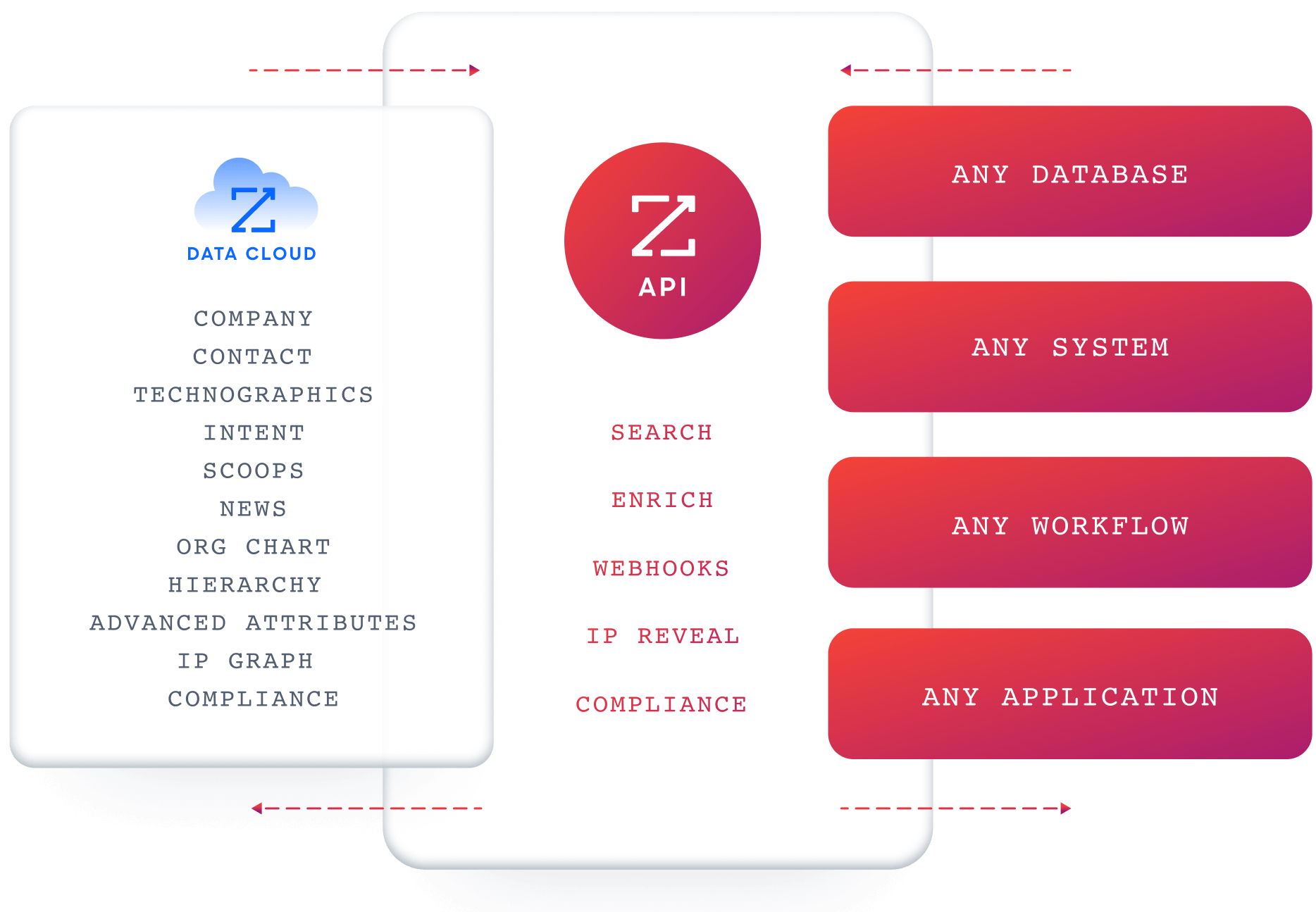
For HubSpot users, the native integration syncs ZoomInfo data into CRM records. For Insightly users, ZoomInfo has been announced as a planned integration on Insightly's roadmap.
"ZoomInfo is our one source of truth for account data, and even more so for contact data. There's no other provider in the market that provides you with that level of detail." (Smartsheet)
Pricing comparison reveals hidden costs on both sides
HubSpot's pricing is free at the bottom and complex at the top.
The free CRM is useful: unlimited contacts (up to 1M records), basic email integration, meeting scheduler, and forms. Starter plans bundle all hubs at $20/seat/month (monthly) or $15/seat/month (annual). But Professional and Enterprise tiers are where costs climb. Marketing Hub Professional runs $800-890/month with a $3,000 mandatory onboarding fee. Marketing Hub Enterprise is $3,600/month with a $7,000 onboarding fee.
Sales Hub Professional is $90-100/seat/month with a $1,500 onboarding fee. And the mixed-tier billing rule means that if you subscribe to Marketing Hub Professional and Sales Hub Enterprise, all Core Seats are billed at the Enterprise rate. Both Professional and Enterprise subscriptions can only be canceled at the end of the commitment term.
Insightly's pricing is simpler but still scales.
CRM plans run $29 (Plus), $49 (Professional), or $99 (Enterprise) per user per month, billed annually. No mandatory onboarding fees on CRM plans (though Guided Onboarding is available as a $1,500 add-on). Marketing automation is a separate product starting at $99/month for 2,000 prospects. Insightly Service adds $29-99/user/month.
The All-in-One Bundle (CRM + Marketing + Service + AppConnect) starts at $349/month. One plan level applies to all users on the account, so you can't mix tiers, but at least you know what you're paying. Like HubSpot, Insightly does not issue refunds.
ZoomInfo uses consumption-based pricing with no published dollar amounts. The free tier, ZoomInfo Lite, provides permanent access to the B2B database with 10 monthly export credits, the ReachOut Chrome Extension, WebSights Lite, and HubSpot integration at no cost.
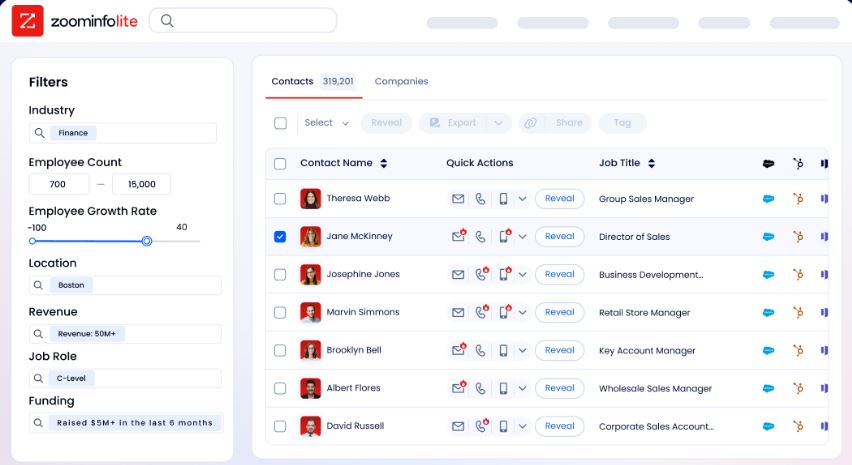
Paid plans scale based on seats, credit volume, features, and contract length. A 7-day free trial of the full platform is also available.
The real pricing question isn't which platform costs less per seat. It's total cost of ownership. A mid-market team running HubSpot Professional across marketing, sales, and service can easily spend $2,000-3,000/month before adding extra seats. The same team on Insightly's Professional tier might spend $500-900/month.
Adding ZoomInfo Lite costs nothing, and a paid ZoomInfo subscription pays for itself if verified data and buying signals improve your conversion rates.
Support and implementation take different approaches
HubSpot's support scales with your subscription. Free users get community forums only. Starter adds email and chat. Professional and Enterprise add phone support. The HubSpot Academy offers free certifications (over 200,000 professionals certified), and the Solutions Partner ecosystem provides implementation help.
HubSpot claims customers see results within 90 days, compared to enterprise CRMs that take 12+ months.
Insightly includes Basic Support with all licenses: email within 24 business hours and phone during business hours (9AM-4PM PT). Premier Support and Success shortens response times and adds integration guidance, developer support, and coaching, but costs 20% of annual investment with a $3,000 minimum.
Insightly claims 2x faster go-live versus competitors, and the guided onboarding checklist (launched February 2026) helps admins self-serve without hiring a consultant.
ZoomInfo redesigned its onboarding from 30 to 90 days, structured across planning, technical implementation, education, and adoption phases. The redesign produced a 25% improvement in customer satisfaction scores and won Rocketlane's Golden Comet award for Best Customer Onboarding Team of 2024.
ZoomInfo University provides role-specific learning paths, certifications, and live webinars. GTM Workspace "deploys in weeks, not months".

HubSpot vs. Insightly vs. ZoomInfo: Which should you choose?
The best choice depends on what problem you're solving.
Choose HubSpot if:
You want marketing, sales, service, content, and commerce in a single platform
Your team needs established AI automation across every customer-facing function
You value a large integration ecosystem with 2,000+ native apps
You're willing to invest in Professional or Enterprise tiers for full capabilities
Platform breadth matters more than per-seat cost
Choose Insightly if:
You're a mid-market team (50-999 employees) that needs CRM without enterprise overhead
Post-sale project management inside your CRM is important to your workflow
You want a simpler pricing model without mandatory onboarding fees
Your marketing automation needs are straightforward (email nurture, lead scoring, landing pages)
Total cost of ownership is a primary buying criterion
Add ZoomInfo to either if:
You need verified B2B contact data (direct dials, business emails) to fill your CRM pipeline
You want to know which companies are researching solutions like yours before they reach out
Your reps spend too much time researching accounts instead of selling
You need outreach built on verified external data, not just the contacts already in your CRM
Data quality is holding back your go-to-market results
Try ZoomInfo free with ZoomInfo Lite here.
The CRM debate (HubSpot vs. Insightly) is about platform scope and budget. HubSpot does more. Insightly costs less. Both are capable CRMs for their target markets.
But the more important question might not be which CRM to use. It might be what data you're putting into it. A CRM with accurate, verified contact data and real-time buying signals outperforms a more sophisticated CRM running on stale records and guesswork. That's the case for pairing whichever CRM fits your needs with ZoomInfo.
"ZoomInfo gives us the information we need to execute. We don't have to go through and spend our time digging. It's already there, so we can be three steps ahead." (Vensure)
HubSpot vs. Insightly vs. ZoomInfo FAQ
What is the core difference between HubSpot, Insightly, and ZoomInfo?
HubSpot is a customer platform combining CRM, marketing automation, sales tools, customer service, content management, and commerce under a shared database. Insightly is a mid-market CRM with integrated marketing automation, customer service, and a native project management module for post-sale delivery.
ZoomInfo is a B2B data platform that provides verified contact data, buyer intent signals, and AI insights to support prospecting and pipeline generation. ZoomInfo complements either CRM rather than replacing it.
Which platform is more affordable for a mid-market team?
Insightly is the most affordable CRM option, with plans from $29-99/user/month and no mandatory onboarding fees on CRM plans. HubSpot's free tier is useful for getting started, but Professional tiers (where the full features live) start at $800-890/month for Marketing Hub and $90-100/seat/month for Sales Hub, with mandatory onboarding fees of $1,500-7,000.
ZoomInfo offers a permanent free tier (ZoomInfo Lite) with 10 monthly export credits. Paid plans are consumption-based.
Does ZoomInfo replace HubSpot or Insightly?
No. ZoomInfo is not a CRM. It does not manage customer relationships, store deal pipelines, or run marketing automation the way HubSpot or Insightly do.
ZoomInfo provides the verified B2B contact data, company intelligence, and buyer intent signals that feed into a CRM. It integrates natively with HubSpot and connects to Insightly through APIs, enriching whichever CRM you choose with data you cannot generate on your own.
Which platform has the strongest AI capabilities?
HubSpot has the most established AI offering with Breeze, which includes agents for prospecting, customer service, content creation, and data analysis across all hubs. Insightly's AI Copilot launched in December 2025 and remains in Beta, limited to 75-100 queries per month depending on plan.
ZoomInfo's AI operates differently. Its GTM Context Graph processes 1.5B+ data points daily, and the AI agent in GTM Workspace helps sellers identify who to contact, when to engage, and what to say, based on verified external data and buying signals rather than CRM records alone.
Which CRM is better for professional services firms?
Insightly has a structural advantage for professional services. Its native ability to convert a won opportunity into a project (carrying over all linked contacts, files, and notes) keeps the full client lifecycle in one system. HubSpot does not have built-in project management; service delivery requires a separate tool.
For firms where the handoff between sales and delivery frequently loses context, Insightly's architecture addresses that directly.
How do the integration ecosystems compare?
HubSpot offers over 2,000 native app integrations included in the subscription. Insightly also claims 2,000+ integrations, but the majority run through AppConnect, a separate product starting at $249/month plus a $3,000 setup fee.
ZoomInfo includes API access in all relevant plans and offers an MCP server for connecting AI models to its data. It integrates natively with HubSpot and can push data into any CRM or tool through its APIs.
Can I use all three platforms together?
Yes. A common configuration is HubSpot or Insightly as the CRM, with ZoomInfo providing the data. ZoomInfo enriches CRM records with verified contacts, surfaces in-market accounts through intent signals, and feeds insights into sales workflows. For HubSpot users, the native integration makes this straightforward. For Insightly users, ZoomInfo's APIs and MCP server provide the connection.
Which platform has the best free tier?
HubSpot's free CRM offers the most for managing contacts and deals: unlimited contacts (up to 1M records), basic email tracking, and meeting scheduling. ZoomInfo Lite provides permanent free access to the B2B database with 10 monthly export credits, a Chrome extension, and HubSpot integration. Insightly does not offer a free plan, only a 14-day trial of the Professional tier.
