
You need verified email addresses for the people you want to reach, and you need to send them something worth opening. Hunter.io handles this: it finds professional email addresses from the public web, verifies them, and runs cold email sequences from a single platform.
This breakdown covers every Hunter.io feature: how it works, who it serves, and which plan unlocks it.
Hunter.io's feature set has you covered if:
You need to find verified business email addresses for contacts at specific companies
You run cold email campaigns with automated follow-ups and want sending, tracking, and reply management in one tool
You want every contact to come with a clickable source URL showing exactly where the email was found, for GDPR and CAN-SPAM compliance
You source leads by company domain, ICP filters, or technology stack and want to move them into outreach without exporting
You need a B2B prospecting database with a free tier and transparent, credit-based pricing
You build tools or workflows on top of email data and need an API with full endpoint coverage
You'll hit its limits if:
You need phone numbers, direct dials, or mobile numbers for multichannel prospecting
You want behavioral intent data showing which companies are researching your category across the web before you contact them
You need conversation intelligence that records, transcribes, and coaches from sales calls
You run multichannel sequences combining email, LinkedIn, phone, and SMS in a single workflow
You require published security certifications (SOC 2, ISO 27001) for enterprise procurement
For those needs, the reference point is ZoomInfo: a GTM platform built on 500M contacts, 100M companies, 135M+ verified phone numbers, and 200M+ verified business email addresses, with a GTM Context Graph that combines B2B data with CRM records, conversation intelligence, and behavioral signals in a single intelligence layer. ZoomInfo covers the data, signals, and multichannel outreach that sit outside Hunter.io's scope.
After the feature breakdown, this article covers exactly where Hunter.io stops and how ZoomInfo fills those edges.
Hunter.io Platform Overview
Hunter.io was created in April 2015 by Antoine Finkelstein and François Grante, who wanted to make email prospecting accessible beyond enterprise sales teams.
The platform now serves 6 million+ accounts, indexes 81 million websites, and maintains 150 million professional email addresses sourced from 650 million public web sources. Named customers include Canva, Semrush, Cursor, Customer.io, Gartner, Vimeo, Cisco, Xero, and Autodesk.
The platform is organized around three workflow stages plus several supporting modules:
Module | What It Does | Plan Access |
|---|---|---|
B2B company database with ICP filters | Free (basic filters); Starter+ (advanced) | |
Find all emails at a company by domain | All plans (1 credit per 1-10 emails) | |
Find a specific person's email by name + domain | All plans (1 credit per result) | |
Validate email addresses before sending | All plans (0.5 credits per verification) | |
Cold email campaigns with automated follow-ups | All plans (limits vary by tier) | |
Per-recipient personalized email drafts | Starter+ | |
Intent data from funding, hiring, and tech changes | All plans (10-Unlimited depending on tier) | |
Find companies by technology stack | Paid plans | |
High-volume API access with 12-month credits | Separate pricing |
Hunter uses a unified credit system shared across all tools, with unlimited team members on every plan at no extra cost. The free plan provides 50 credits/month with no credit card required. Paid plans start at $34/month (annual) for 2,000 credits and scale to $209/month for 25,000 credits on the Scale tier. With that structure in place, here is the full tour.
Hunter.io Email Finding and Discovery
Hunter's core work starts here: finding verified email addresses for the people you want to reach. Three tools handle this job, each suited to a different prospecting task, and all draw from the same dataset of 150 million professional email addresses.
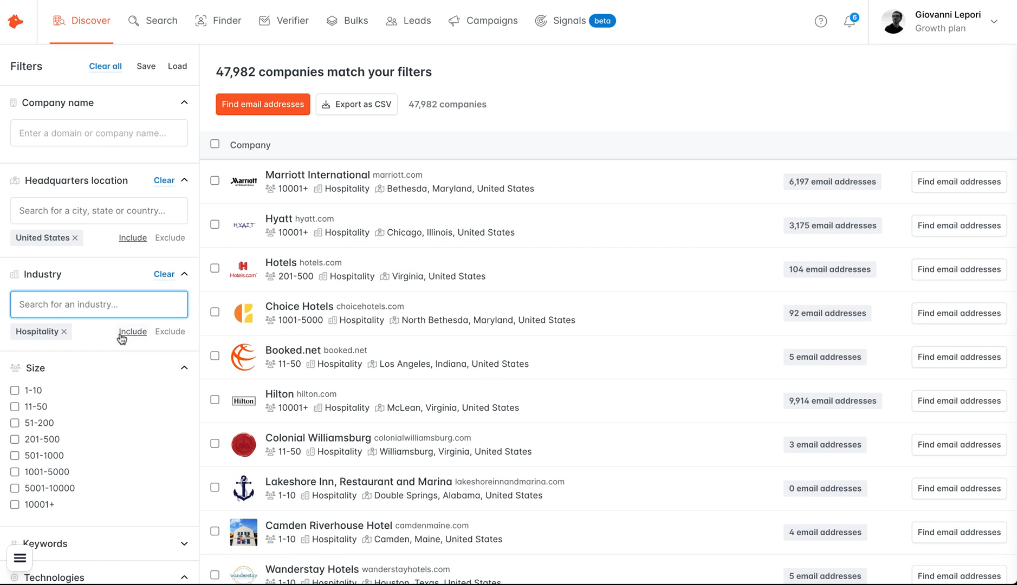
Discover is the broadest entry point.
It works like a B2B lead database: define your target market by combining company-level filters (headquarters location, 487 industries, company size, type, year founded, keywords, technologies, and funding details), and Discover surfaces matching companies with their contacts. An AI Assistant accepts natural-language queries ("Accounting companies in Germany") and auto-configures the filters.
Company browsing and saving is free; credits are consumed only when emails are revealed. Saved searches track ongoing ICP matches, and following a company triggers alerts on new emails, funding events, and job posts at no credit cost. On Starter+ plans, bulk email retrieval covers up to 25,000 companies at once. Technology and funding filters, along with "companies similar to" matching, require a paid plan.
Source: Hunter.io
Domain Search answers a more specific question: "Who works at this company, and how do I reach them?"
Enter a domain, and Hunter returns all indexed contacts with their names, job titles, departments, LinkedIn and Twitter links, verification status and confidence scores, and clickable source URLs with discovery dates. Emails are not revealed by default; users choose which to reveal at 1 credit per email, with all generic emails for a domain costing just 1 credit total. Filtering covers 14 departments, job title, verification status, and email type.
A Decision Makers tab isolates senior roles, and email pattern detection shows the company's format (e.g., {first}.{last}@company.com). Source transparency is what sets Hunter apart: every email comes with the URL where it was found, so you can cite exactly how you obtained the contact's information for GDPR-compliant outreach.
Email Finder handles the narrowest case: you know the person's name and company, and you need their email.
It runs a two-stage process, first searching Hunter's database for a matching public record, then generating the most likely email using the company's known format pattern if no public match exists. Every result goes through an automated deliverability check before being returned. Publicly sourced results show their source URLs; inferred results are labeled as such. The system is free on failure: no credit is consumed when no result is found.
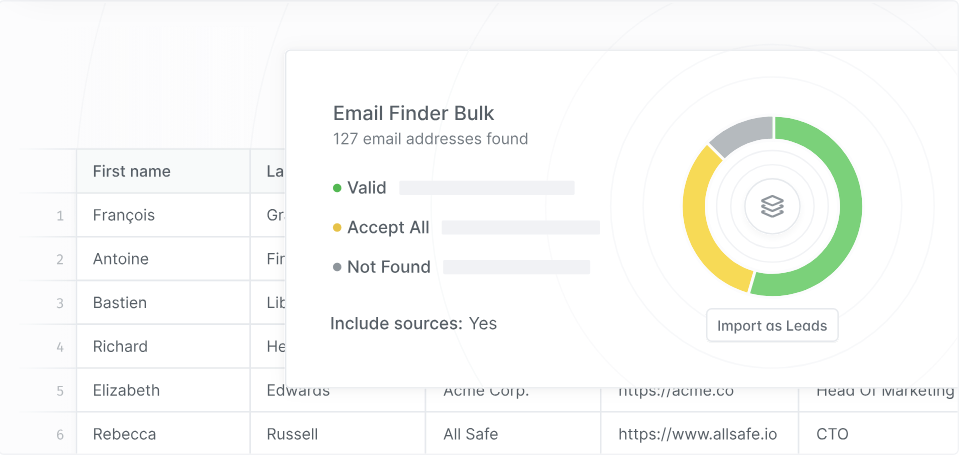
Bulk tasks extend all three tools to batch processing. Upload a CSV of names and domains for Bulk Email Finder, a list of domains for Bulk Domain Search, or an email list for Bulk Email Verifier, with limits of 50,000 emails per task on Starter/Growth and 100,000 on Scale/Enterprise/Data Platform.
Source: Hunter.io
The Chrome extension (also available for Firefox and Edge) brings Domain Search to any website with one click: 600,000+ users and 12,000+ reviews at a 4.7 rating. The extension never saves data from page content; all results come from Hunter's database. The Google Sheets add-on (47,000+ installations) runs Domain Search, Email Finder, and Email Verifier directly in spreadsheets, handling up to 10,000 rows for Finder/Verifier and 1,000 for Domain Search.
Hunter.io Email Verification
Once you have an email address, the question is whether it will land. Hunter's Email Verifier runs eight sequential checks on every address without sending a single email:
Valid format (syntax)
Gibberish detection (randomly generated addresses)
Disposable email check (temporary email services)
Webmail detection (consumer addresses like Gmail, Yahoo)
MX record lookup (confirms the domain has mail servers)
SMTP server check (connects to the mail server)
SMTP verification (asks the server if it will accept email for the address)
Accept-all detection (identifies catch-all domains)
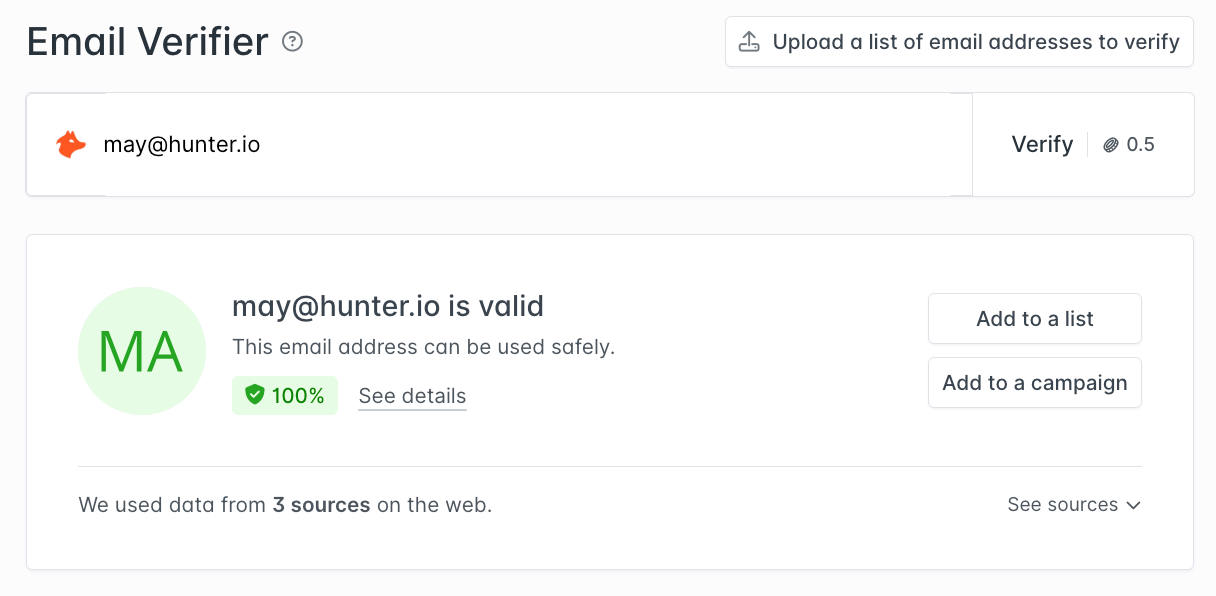
Results return in five statuses: Valid (green), Accept-All (yellow), Invalid (red), Disposable (blue), and Unknown (grey), supplemented by a Confidence Score percentage for borderline cases. Hunter states more than 95% of "valid" addresses will not bounce, with a typically less than 1% bounce rate for verified emails.
Source: Hunter.io
Standard verifiers flag catch-all domains as ambiguous and stop. Hunter's accept-all resolution goes further, resolving these addresses with major providers and converting a subset of ambiguous results to definitive answers. Emails from Email Finder and Bulk Email Finder are already verified at discovery, so credits are not double-spent. Paid subscribers get automatic monthly re-verification of all saved leads at no additional credit cost, and invalid addresses are automatically excluded from Sequences to protect sender reputation.
Verification costs 0.5 credits per address on All-in-One plans. Unknown and Disposable results do not consume credits. A free single-address check is available without signup.
Hunter.io Sequences: Cold Email Campaigns
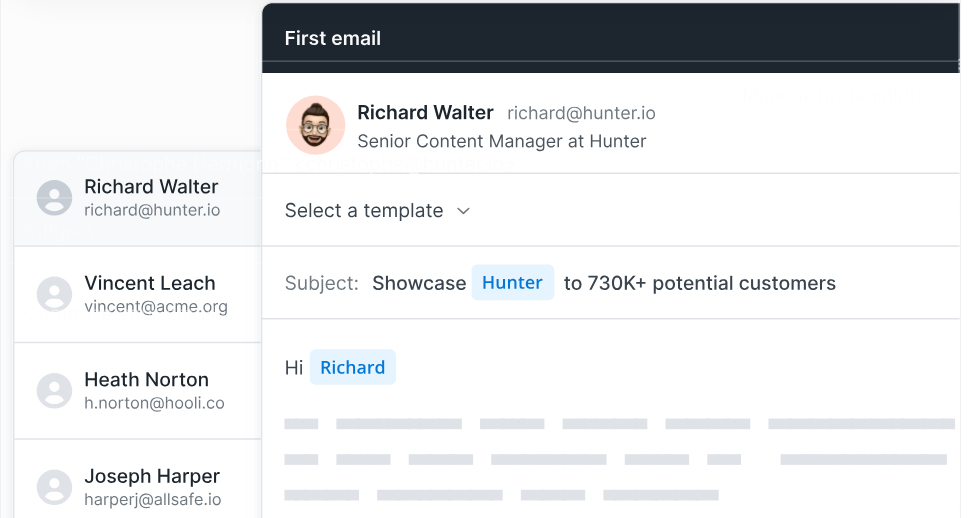
Sequences is where Hunter's data tools connect to outreach. It sends personalized cold emails and automated follow-ups from the user's own connected mailbox until a stop condition is met: reply, unsubscribe, or hard bounce.
Setup starts with connecting a mailbox.
Hunter supports Gmail, Google Workspace, and Outlook natively, with SMTP/IMAP for any provider on paid plans. From there, you build an audience from Hunter Leads, CSV import (with optional verification on import), or directly from Domain Search, Email Finder, or Discover results. Each sequence supports an initial email plus up to 5 follow-ups, each with 1- to 30-day configurable delays.
Source: Hunter.io
Personalization uses custom attributes (name, company, any custom field from your lead data), and email account rotation distributes sends across multiple connected accounts to avoid hitting single-account limits. A custom tracking domain keeps open and click tracking off the shared default, reducing deliverability risk. The platform auto-detects out-of-office replies and unsubscribe requests, pausing outreach automatically.
Sending limits reflect the providers' own constraints:
Parameter | Limit |
|---|---|
15 (ramps during warmup) | |
400 | |
250 | |
250 | |
30 seconds |
The number of connected accounts scales with plan tier: 1 on Free, 3 on Starter, 10 on Growth, 20 on Scale, expandable up to 50 with add-ons at $10/month per account. Recipients per sequence range from 500 on Free to 15,000 on Scale.
The Sequences Reporting dashboard tracks sent, bounced, opened, clicked, replied, and unsubscribed metrics. A unified inbox consolidates replies from all connected mailboxes, and warm lead identification surfaces recipients who engaged (opened, clicked) but have not replied, so you can prioritize manual follow-up.
The advantage is platform integration: leads flow from Domain Search, Email Finder, or Discover into Sequences without export/import cycles. The Free plan includes Sequences access with 1 connected account, unlimited sequences, and open tracking.
One limitation: Hunter Sequences does not support native A/B testing. The workaround is duplicating sequences with split lists, which works but adds manual overhead.
Hunter.io AI Writing Assistant
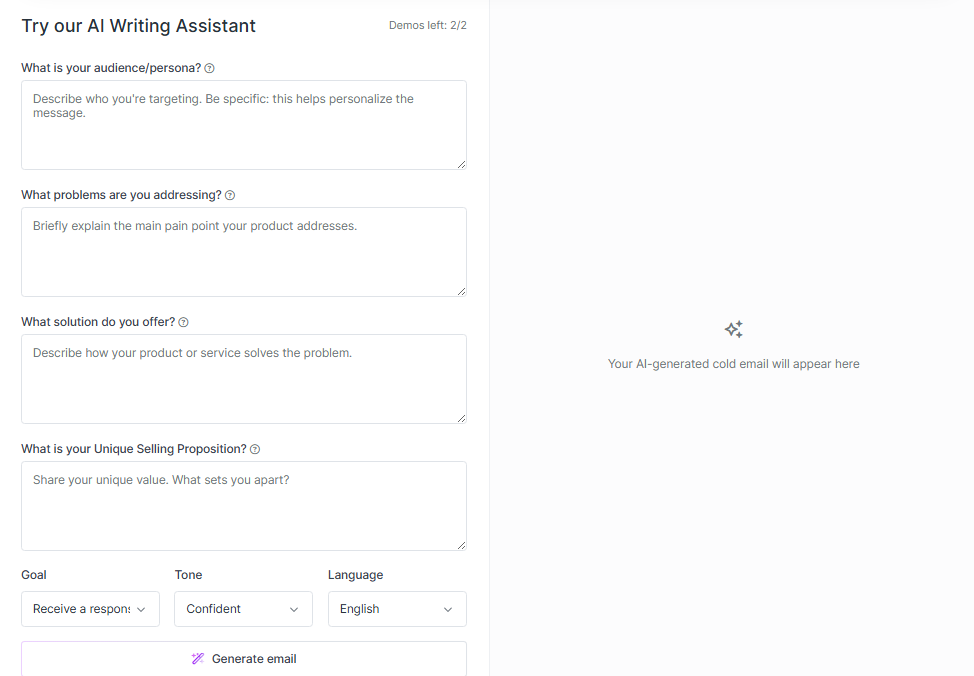
The AI Writing Assistant generates personalized cold email drafts per recipient, built into the Sequences workflow on paid plans.
To configure it, you provide an audience persona (which can be auto-generated from the lead list), your business context, the outreach goal (book a meeting, share content, etc.), tone (6 options), style (4 options), and an optional copywriting framework (AIDA, PAS, PPPP). You also select the underlying AI model from GPT-4.0 mini, GPT-4.1 mini, or GPT-4.1 nano (an unusually transparent disclosure of the underlying model for a B2B SaaS tool).
Source: Hunter.io
The assistant generates a unique message per lead using their company, job title, industry, and any custom attributes from the lead record. It supports English, French, Spanish, and German, generates follow-up steps as part of the sequence setup, and provides full preview and editing before anything sends. The value is speed: personalized outreach for a list of 200 contacts in the time it would take to write 5 emails manually, without losing the per-recipient detail that drives reply rates.
Hunter.io Signals: Event-Driven Intent Data
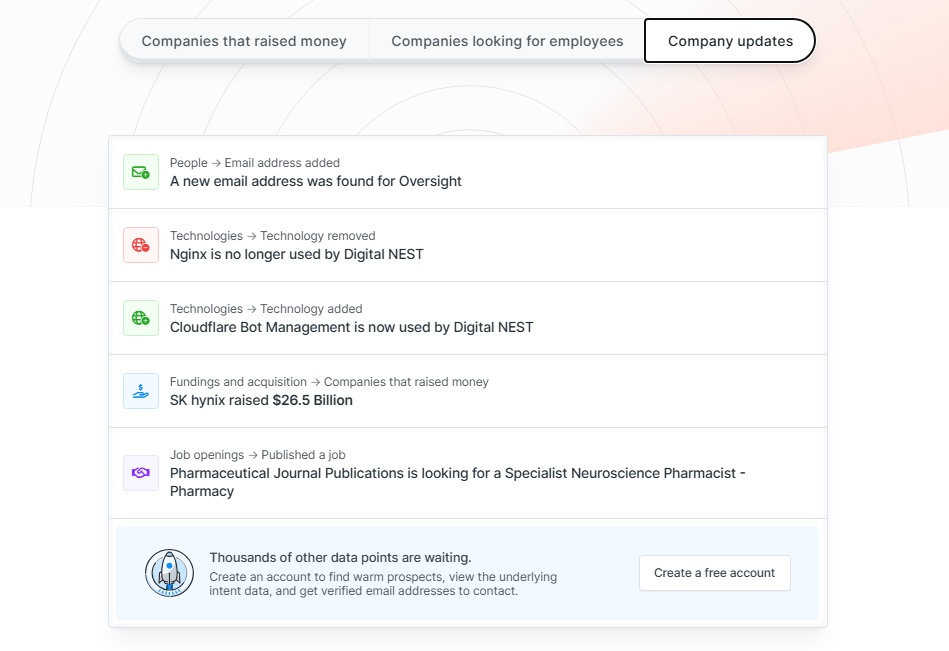
Signals shifts prospecting from static lists to event-driven targeting, surfacing companies showing buying intent through three categories of tracked events.
Fundings and Acquisitions surface companies that recently raised money. Filters let you narrow by round type, amount, headquarters location, company size, and industry. "Companies that got acquired" is listed as coming soon.
Job Openings identifies companies actively hiring in specific roles. Filters cover title keywords, description keywords, seniority, department, and contract type. "Companies on a hiring streak" is coming soon.
Company Signals lets you follow specific companies for alerts on new jobs, funding events, newly discovered email addresses, or technology changes on their site.
Source: Hunter.io
Each user can create up to 50 Signals, each editable, pausable, and duplicable. Updates arrive daily, with email notifications every 48 hours. When a Signal identifies a matching company, you can trigger a Bulk Domain Search to find contact emails immediately. Signals are free for all users; credits are consumed only when you move to finding emails.
The Free plan includes 10 Signals, Starter provides 20, Growth provides 200, and Scale and Enterprise include Unlimited Signals. This works as an early-warning system for funding and hiring events, though the scope is narrower than dedicated intent data platforms that track web-wide research behavior across thousands of topics.
Hunter.io TechLookup and Data Sourcing
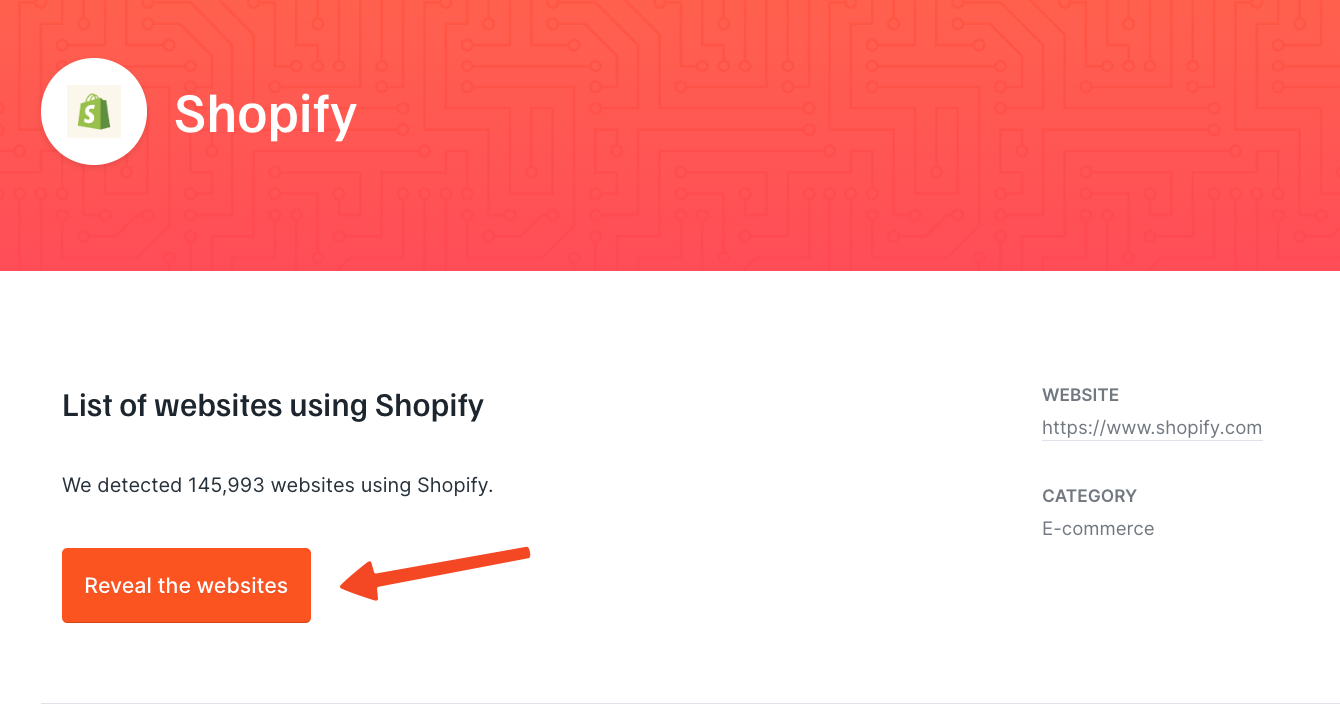
TechLookup lets you prospect by technology stack: browse the technology directory, select a technology (e.g., 1,889,588 websites using WordPress), and the results open in Discover with the Technology filter pre-applied.
From there, you can stack additional ICP filters to narrow the list. No per-lookup cost applies for browsing; costs are incurred only when finding emails from results. TechLookup is available on paid plans only, and the Discover API supports a technology filter for programmatic technographic prospecting.
Source: Hunter.io
Underlying all of Hunter's data tools is a publicly documented sourcing methodology, detailed on hunter.io/our-data. Hunter crawls 30 million web pages every day and indexes only the public web. Four published data principles govern how this works:
All contacts include disclosed public sources with clickable URLs and discovery dates
Contacts without live public sources are removed after six months
Anyone can remove their email via hunter.io/claim
Hunter's crawler follows robots.txt, so website owners can block indexing
This transparency differs from providers that source from undisclosed data brokers. It lets users tell recipients exactly where their information was found, a compliance argument for GDPR, CCPA, and CAN-SPAM outreach.
Hunter.io API, Integrations, and Infrastructure
Hunter's REST API (v2) provides programmatic access to every data tool. API access is included on all plans, including the free tier.
Core endpoints cover Discover (company search, free to call), Domain Search (1 credit per call), Email Finder (1 credit per call), Email Verifier (0.5 credits on All-in-One plans), Enrichment (email, company, and combined enrichment), and Email Count (free). Resource management endpoints provide CRUD operations on leads, companies, templates, sequences, email accounts, and webhooks. A test API key validates parameters and returns dummy responses without consuming credits.
Rate limits are enforced per endpoint:
Domain Search and Email Finder: 15 requests/second, 500 requests/minute
Email Verifier: 10 requests/second, 300 requests/minute
Discover: 5 requests/second, 50 requests/minute
A remote MCP server at https://mcp.hunter.io/mcp enables AI agent integration, connecting Hunter's data tools to Claude and other MCP-compatible assistants.
For users who need high-volume data access without the outreach suite, the Data Platform offers Search and Verification credits purchased independently with 12-month validity and volume discounts. It includes API access, bulk tools, and integrations but excludes Sequences, Discover UI, and Signals.
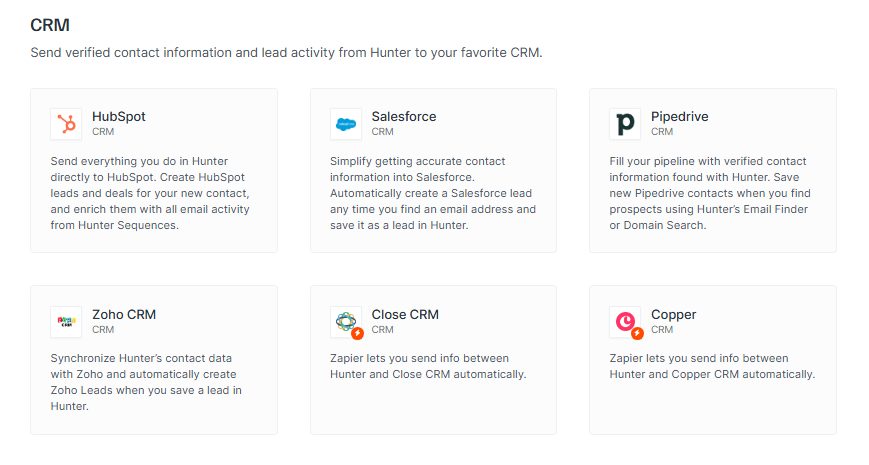
Native CRM integrations cover HubSpot, Salesforce, Pipedrive, and Zoho CRM, with Close CRM and Copper available via Zapier. Automation platforms include Zapier (5,000+ destinations), Make, and Clay.
Source: Hunter.io
The Zapier integration covers both contact data and Sequences email activity triggers (sent, opened, clicked, replied), making it the primary gateway to the broader automation ecosystem. Webhooks for Sequences fire on four events (email sent, opened, link clicked, replied) and are manageable via both the UI and the API.
On security, Hunter hosts on Google Cloud Platform in Belgium, encrypts customer data at all times, uses AES-256-CBC for OAuth tokens and bcrypt for passwords, and enforces 2FA with physical security keys for production access. A Security Bounty Program invites independent researchers. GDPR compliance includes an EU representative in Dublin and a UK representative in Brighton, a published Data Processing Agreement with EU SCCs, and a CCPA-specific California privacy notice.
Where Hunter.io Stops: The Gaps
Hunter's design centers on email: finding email addresses from the public web and sending cold email campaigns from those addresses. That focus gives it clarity and simplicity, but it also means the platform stops where email stops.
No phone number data.
Hunter does not include phone numbers. Its public-web sourcing approach does not capture direct dials or mobile numbers. Teams that cold-call need a separate data provider.
Data limited to publicly indexed contacts.
Because Hunter sources only from the public web, it cannot find contacts who do not appear online. The database covers 150 million professional email addresses, but competitors that supplement with purchased, contributed, or crowd-sourced data cover more hard-to-find contacts.
No multichannel sequences.
Hunter Sequences handles cold email. It does not include LinkedIn steps, call tasks, SMS, or any channel beyond email within its campaign automation. Teams running structured multichannel outreach need a separate sales engagement platform for the non-email steps.
Intent data limited to three signal types.
Signals track funding events, job openings, and technology changes. These are buying signals, but the feature does not track which companies are researching specific topics across the broader web. Behavioral intent data (web-wide research activity across thousands of topics) sits outside Hunter's scope.
No native A/B testing.
A/B testing is not currently available in Sequences. The workaround (duplicating sequences with split lists) adds manual overhead and lacks automated variant optimization.
No formal security certifications.
Hunter does not publicly claim SOC 2, ISO 27001, or other named third-party security certifications. The platform maintains security practices like encryption, 2FA, and a bug bounty, but enterprise buyers with compliance requirements may find the absence of formal certifications a blocking issue in procurement.
How ZoomInfo Covers the Gaps
The gaps above share a common thread: Hunter.io covers email finding, verification, and outreach in one place but depends on external tools for everything else a go-to-market team needs. ZoomInfo is a GTM platform that supplies the data, signals, and multichannel tools beyond Hunter's scope.
ZoomInfo's B2B Data: 500M contacts with direct dials, mobile numbers, and verified emails
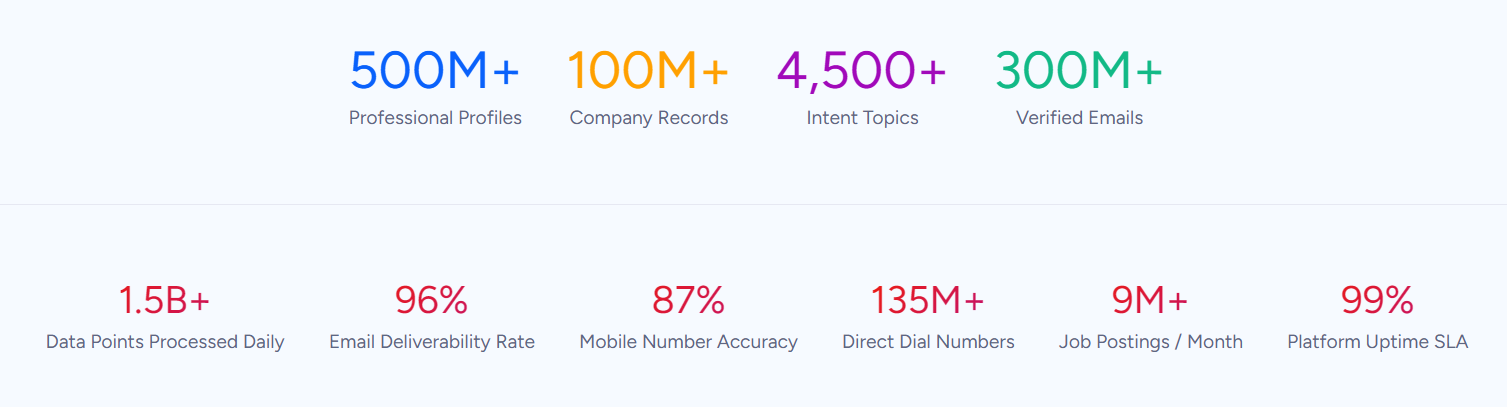
ZoomInfo's B2B data platform covers 500M contacts, 100M companies, 135M+ verified phone numbers, 120M direct-dial phone numbers, and 200M+ verified business email addresses.
Where Hunter indexes 150 million email addresses from the public web, ZoomInfo's data flows through a verification pipeline backed by 300+ human researchers and automated ML scanning 28 million site domains daily, reaching up to 95% accuracy on first-party data.
Source: ZoomInfo
The key difference for teams needing phones is scale: 120M direct-dial phone numbers and 45M+ mobile numbers outside North America. ZoomInfo also provides 300+ company attributes for segmentation, department org charts with decision-makers' contact information, contact tracking with job-change alerts, and global coverage extending to 34M+ company profiles and 200M+ professional profiles outside North America.
In a Fortune 500 competitive RFP analyzing 25 million contacts across vendors, an independent consultant concluded that "no other competitor came even close." The data quality is externally validated: Forrester Wave Leader for Intent Data Providers, Q1 2025, Gartner MQ Leader for ABM Platforms for the second consecutive year, and the only vendor positioned in the Customers' Choice quadrant with a 4.7/5.0 rating.
ZoomInfo Intent and WebSights: Behavioral signals across the web, not just funding and hiring
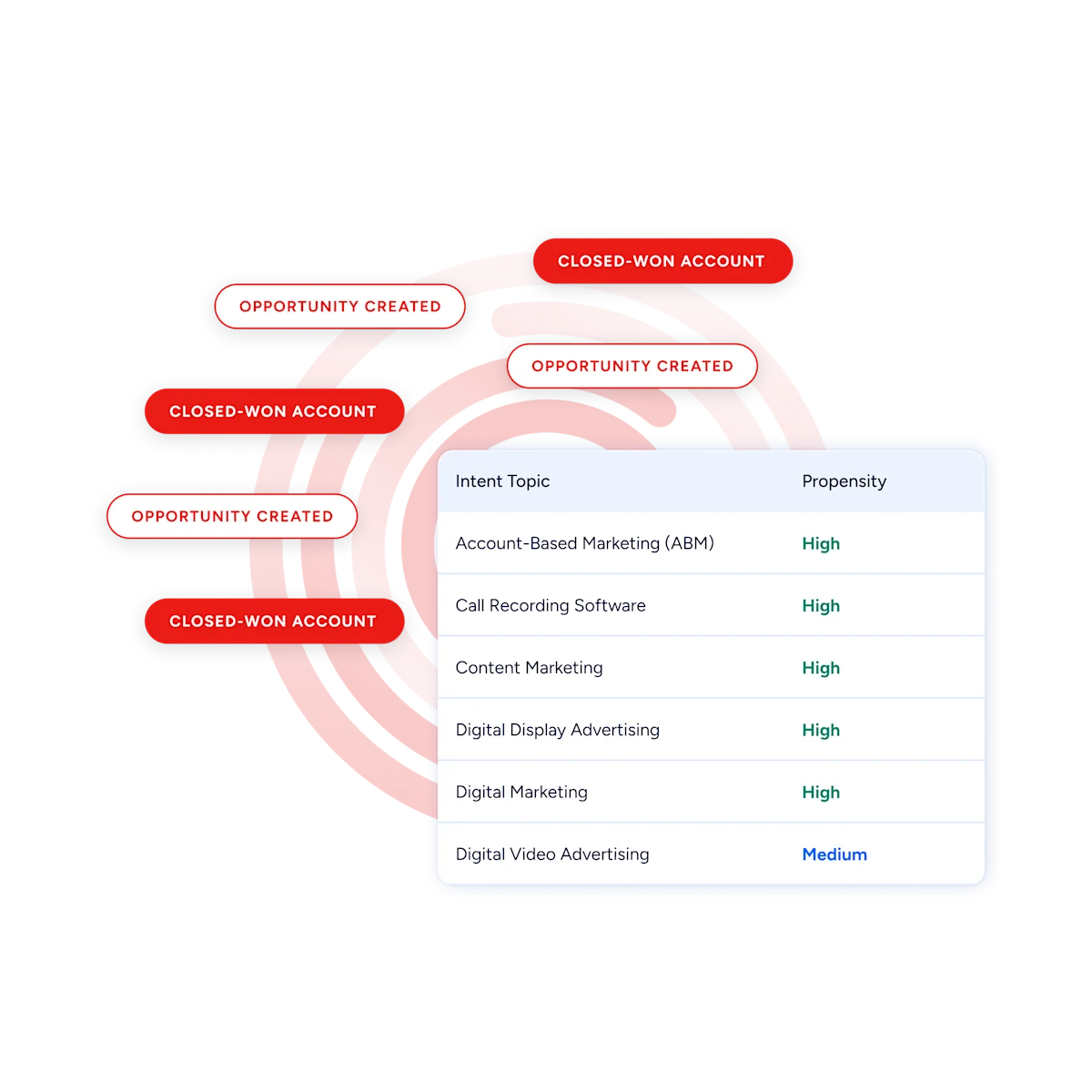
ZoomInfo Intent tracks signals from 210 million IP-to-Organization pairings and 6 trillion+ new keyword-to-device pairings sourced monthly. This reveals which companies are researching topics related to your product across the web, before you have contacted them.
Where Hunter's Signals track three event types (funding, job openings, technology changes), ZoomInfo Intent covers web-wide behavioral research activity across thousands of topics. Guided Intent, exclusive to ZoomInfo, identifies the topics historically correlated with deal success rather than requiring manual topic selection.
Source: ZoomInfo
On the website side, WebSights resolves anonymous website traffic to companies with Automatic Traffic Filtering that distinguishes real visitors from bots. ZoomInfo Marketing goes further with contact-level site visitor identification, identifying who visited (not just which company) and triggering personalized outreach.
ZoomInfo's GTM Context Graph and Chorus: Intelligence from calls, deals, and every channel
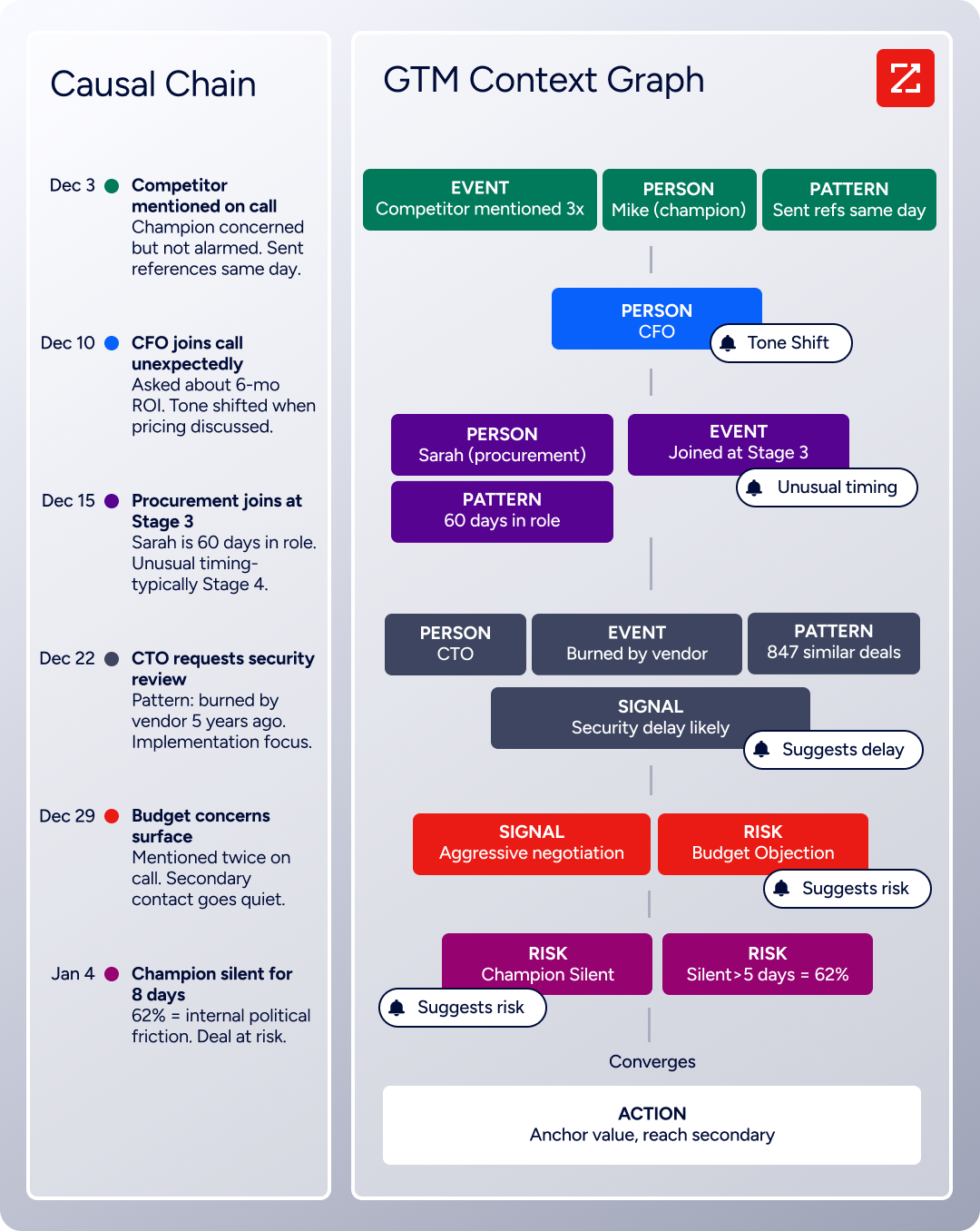
Hunter captures what happens in email (opens, clicks, replies). ZoomInfo's GTM Context Graph captures why deals move or stall by processing 1.5B+ data points daily, combining B2B data with CRM records, conversation intelligence from Chorus, email interactions, and behavioral signals in a single intelligence layer.
Chorus holds 14 technology patents and records and transcribes sales calls, surfaces AI-generated insights (talk ratios, sentiment, objection detection), syncs deal intelligence to the CRM, and provides coaching scorecards and clip sharing. It captures the context that email analytics miss: why a champion went quiet, what a competitive mention means for deal risk, which objection patterns predict closed-lost outcomes.
Source: ZoomInfo
That intelligence flows into GTM Workspace, where sellers see a complete Book of Business view across CRM, ZoomInfo data, conversation history, and market intelligence, with AI agents automating account research, outreach, CRM updates, and signal monitoring. An Action Feed streams in-market buyers matched to target criteria with pre-drafted actions on every signal.
Seismic's sales team attributed 39% of active pipeline to opportunities identified or influenced by ZoomInfo signals, boosted productivity by 54%, and saved 11.5 hours per week per seller. (Seismic Case Study)
ZoomInfo GTM Studio: Marketing orchestration and multichannel execution
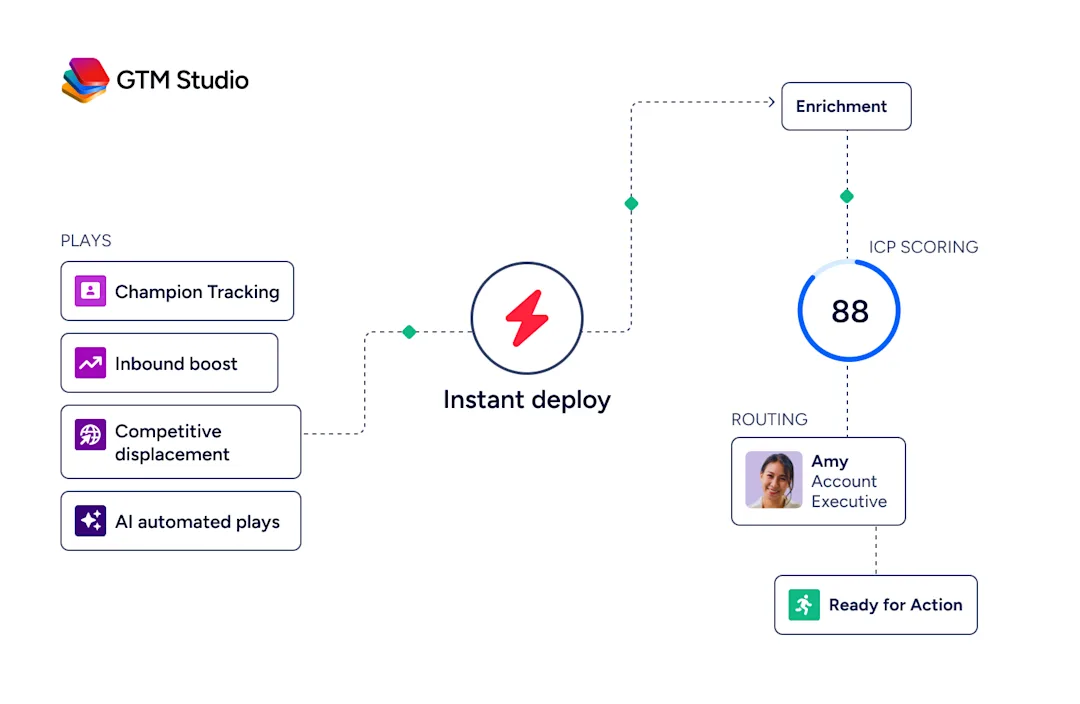
GTM Studio addresses the multichannel and marketing orchestration gap. Marketers, RevOps teams, and GTM engineers can build audiences using natural language, enrich with first- and third-party data, define triggers, and activate plays across channels (email, calls, display ads, direct mail, LinkedIn, Meta, Connected TV) without engineering support. Pre-built GTM plays cover inbound acceleration, champion tracking, competitive displacement, and ICP targeting. Expansion plays that used to take 3 weeks now launch in 30 minutes.
Source: ZoomInfo
ZoomInfo Marketing includes a native Demand-Side Platform deploying display ads based on 300+ company attributes and FormComplete (reducing forms to a single field while auto-appending data).
ZoomInfo Security and Compliance: Certifications that clear enterprise procurement
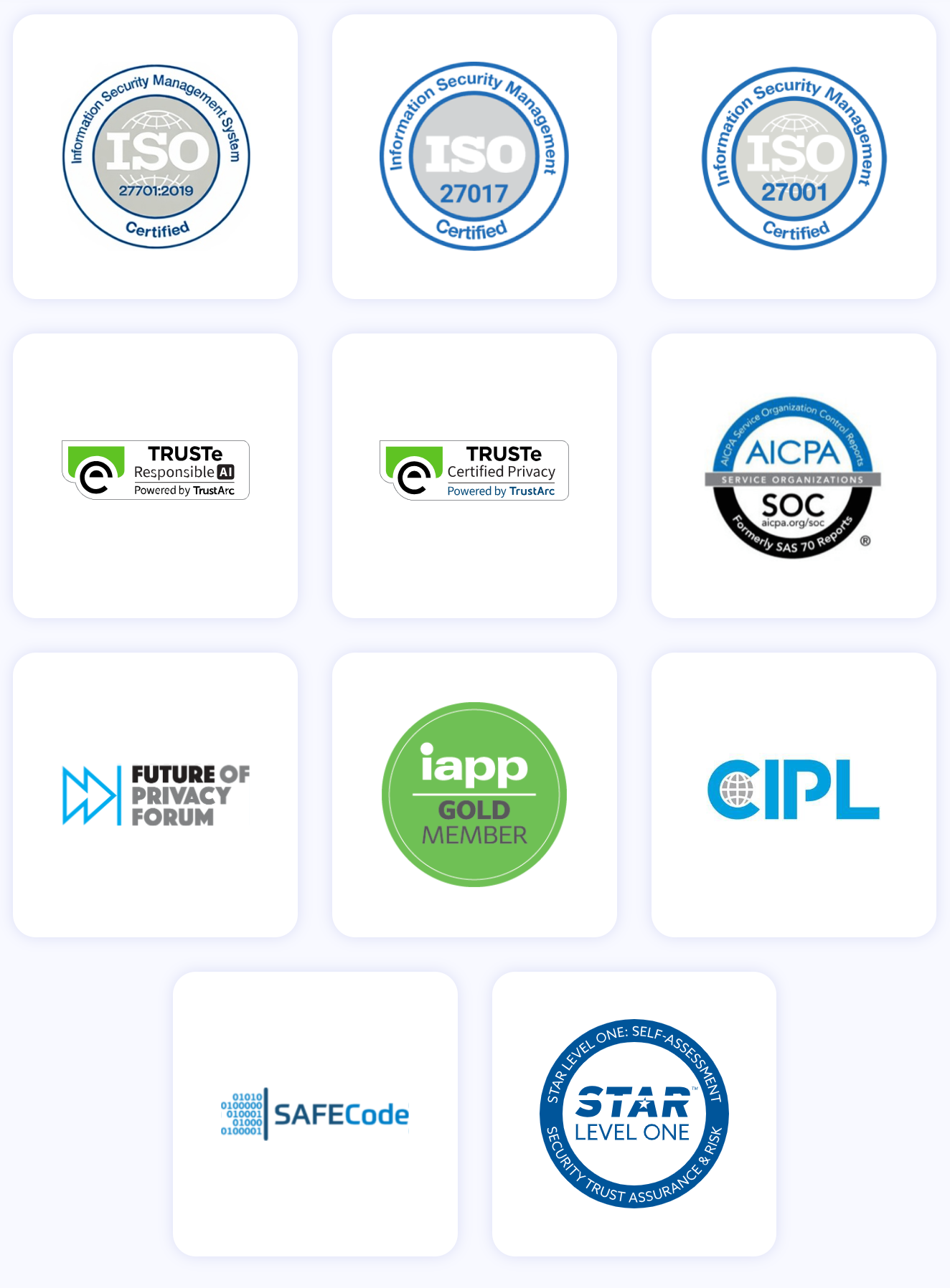
ZoomInfo maintains ISO 27001, ISO 27701, SOC 2 Type II, TRUSTe GDPR, and TRUSTe CCPA certifications, all renewed annually. A dedicated Trust Center at trust.zoominfo.com provides auditable documentation. ZoomInfo is a registered data broker in California and Vermont. For enterprise buyers whose procurement requires verified certifications, this clears a gate that Hunter cannot.
ZoomInfo's Free Entry Points: A way to evaluate the full platform without commitment
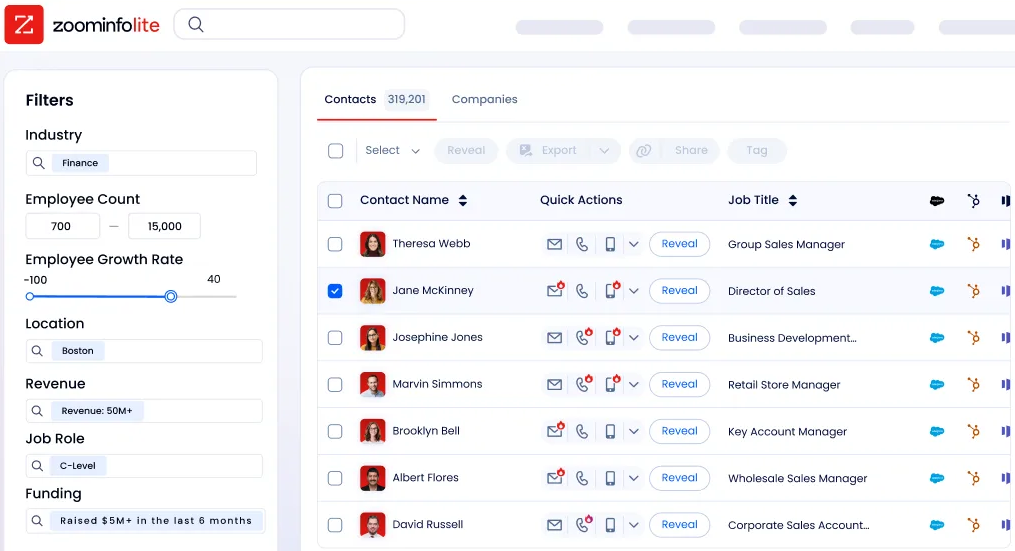
Like Hunter, ZoomInfo offers a permanent free tier. ZoomInfo Lite includes access to ZoomInfo's B2B database, 10 monthly export credits, individual and company searches, a Chrome extension, and WebSights Lite with up to 10 website visitor reveals per day. A separate 7-day free trial provides broader access with no credit card required.
Source: ZoomInfo
Final Summary
Hunter.io is a focused toolkit for email-first prospecting: a 150-million-address database sourced transparently from the public web, an eight-step verification engine with sub-1% bounce rates, cold email Sequences with account rotation and AI-powered drafting, and an API that opens every tool to builders. It covers email finding, verification, and outreach from a single platform, with a free tier and pricing that starts at $34/month. Its strengths are data transparency, verification accuracy, and simplicity.
It is lighter on the layers around email: no phone numbers, no web-wide behavioral intent data, no multichannel sequences, no conversation intelligence, and no formal security certifications for enterprise procurement.
If your needs go beyond email (knowing which companies are in-market before you reach out, reaching buyers by phone, understanding what happened on the call, or running multichannel campaigns), that is the ground ZoomInfo covers.
Its 500M-contact, 100M-company database includes 120M direct-dial phone numbers and 200M+ verified business emails. ZoomInfo Intent surfaces accounts researching your category from 6 trillion+ keyword-to-device pairings monthly. Chorus captures and reasons about every sales conversation. GTM Studio gives marketing teams multichannel orchestration and ABM capabilities. And the GTM Context Graph fuses all of it into a single intelligence layer that captures why deals move, not just that they moved.
See what that data and intelligence layer adds to your prospecting: start with ZoomInfo Lite for free, or request a demo to watch verified contacts, direct dials, and live intent signals flow into your pipeline.
FAQ
Does Hunter.io include phone numbers or direct dials?
No. Hunter sources all data from the public web, which yields professional email addresses but not phone numbers. The platform's database of 150 million contacts contains email addresses, job titles, departments, and social profile links, but no direct dials, mobile numbers, or office phone numbers. Teams that need phone data for cold calling pair Hunter with a separate data provider.
ZoomInfo's database includes 135M+ verified phone numbers and 120M direct-dial phone numbers alongside 200M+ verified business emails.
How many credits does each Hunter.io action consume?
Hunter uses a unified credit system. Finding an email (Domain Search or Email Finder) costs 1 credit. Verifying an email costs 0.5 credits. Enrichment via API costs 0.2 credits. Browsing companies in Discover is free; credits are consumed only when emails are revealed. Failed searches, Unknown results, and Disposable results consume 0 credits. Deduplication applies: the same search or verification within a billing period is counted only once (except bulk uploads).
Can Hunter.io run multichannel sequences with LinkedIn and phone steps?
No. Hunter Sequences handles cold email only. It does not include LinkedIn InMail steps, call tasks, SMS, or any non-email channel within its campaign automation. Teams running structured multichannel outreach need a separate sales engagement platform for the non-email steps.
Does Hunter.io offer A/B testing for email campaigns?
Not natively. Hunter's Sequences does not include built-in A/B testing. The recommended workaround is creating duplicate sequences with manually split recipient lists, then comparing metrics across the two. This works but lacks automated variant optimization or statistical significance tracking.
What kind of intent data does Hunter.io provide?
Hunter's Signals feature tracks three categories of buying intent: funding events and acquisitions, job openings, and company-level alerts (new jobs, funding, discovered emails, technology changes). These are event-driven signals, not behavioral intent. The platform does not track which companies are researching specific topics across the web.
ZoomInfo Intent tracks signals from 210 million IP-to-Organization pairings and 6 trillion+ keyword-to-device pairings sourced monthly, covering web-wide research behavior across thousands of topics.
Is Hunter.io GDPR compliant?
Yes. Hunter built its data sourcing model around GDPR compliance. All contacts include clickable source URLs showing exactly where the email was found publicly, enabling transparent outreach. Hunter maintains an EU representative in Dublin, a UK representative in Brighton, a published Data Processing Agreement with EU Standard Contractual Clauses, and a CCPA-specific California privacy notice. Anyone can remove their data via hunter.io/claim, and Hunter's crawler follows robots.txt.
Hunter does not, however, hold SOC 2 or ISO 27001 certifications. ZoomInfo maintains ISO 27001, ISO 27701, SOC 2 Type II, TRUSTe GDPR, and TRUSTe CCPA certifications, all renewed annually.
Does Hunter.io have a free plan?
Yes. Hunter's free plan is permanent, not a trial. It renews automatically every month with no time limit and no credit card required. It includes 50 credits, 1 connected email account, Sequences (500 recipients per sequence, open tracking), Discover with basic filters, full API access, the Chrome/Firefox/Edge extension, the Google Sheets add-on, 10 Signals, and unlimited team members.
It excludes credit packs, SMTP/IMAP connections, link tracking, Sequences Reporting, AI Writing, automatic lead re-verification, and premium Discover filters.
Does Hunter.io include a B2B contact database beyond email addresses?
Hunter's Discover module works as a B2B company database with contact records, but the contacts are email-centric. Each contact includes name, job title, department, location, LinkedIn and Twitter links, verification status, and source URLs, but no phone numbers or detailed company attribute enrichment beyond what the company profile provides.
ZoomInfo's database covers 500M contacts with 300+ company attributes, department org charts, technographic profiles across 30,000+ technologies, and verified phone numbers alongside emails, providing a broader foundation for account-level research and multichannel outreach.
