
Most B2B teams have access to more intent data than ever, yet fewer are converting those signals into pipeline. The problem isn't signal volume. Sales, marketing, and RevOps teams can pull surge reports and build target lists, but the gap between "this account is in-market" and "this account got a timely, relevant touch" stays wide. Signals sit in dashboards while the buying window moves.
A buyer intent data platform should activate signals inside the tools sales and demand gen teams already use, from CRM task queues and sales sequences to marketing automation triggers and ad audience syncs. This guide covers what intent data is, the signals that matter, how to evaluate a platform, and the top 15 providers.
What is buyer intent data?
Buyer intent data is the set of behavioral signals that reveal when a company or individual is actively researching a solution. These signals include content consumption patterns, search activity, website engagement, and topic research spikes that indicate a prospect is evaluating options before contacting a vendor.
Unlike static firmographic data (company size, industry, revenue band), intent data captures what an account is doing right now. A firmographic profile tells you a company fits your ideal customer profile. Intent data tells you that company is reading competitor comparison content, visiting pricing pages, and downloading solution guides this week.
For a seller, that timing tells you which accounts to prioritize and when to reach out. For a demand gen team, it tells you which accounts to move into an active campaign. The combination of fit and timing is what makes a buyer intent data platform valuable to both sales and demand gen teams.
Intent data comes from multiple source types, each with different collection methods, coverage, and signal quality. Understanding those sources is the first step to building an intent program that actually converts buying signals into pipeline.
Types of buyer intent data
Intent data falls into three categories based on where the signals originate. Each type serves a different role for sales and demand gen teams.
First-party intent data
First-party intent data comes from your own digital properties, including website visits, content downloads, form submissions, demo requests, and product usage signals. These are the highest-fidelity signals available because they reflect direct engagement with your brand.
Examples include pricing page visits, whitepaper downloads filtered by topic, repeat visits to a product comparison page, and free trial activations. For demand gen teams, first-party signals are high-value nurture triggers and lead scoring inputs. For sales teams, they are timing cues. When an account visits your pricing page three times in a week, that should prompt a rep to reach out and a workflow to fire, rather than sit in an analytics dashboard.
The limitation is reach. First-party data only captures accounts that already know you exist and have found their way to your properties.
Third-party intent data
Third-party intent data is aggregated from external publisher networks, data cooperatives, and B2B content platforms. Providers track content consumption across thousands of sites and flag accounts whose research activity on a given topic exceeds their historical baseline. That baseline-normalization concept is central. A company consuming content significantly above its normal volume on a topic like "marketing automation migration" is flagged as in-market.
Examples include topic research spikes across publisher networks, whitepaper downloads from industry media sites, and webinar registrations on relevant subjects. Third-party intent is the primary signal source for net-new account discovery. For demand gen, that powers TAM expansion and audience building. For sales, it is prospecting fuel that lets reps and SDRs build target account lists from accounts already in-market, before those accounts ever visit your site.
Different providers use different collection methodologies. Bombora operates a data cooperative of 4,000+ premium B2B sites. ZoomInfo tracks intent through 210M+ IP-to-Organization pairings and 6 trillion+ new keyword-to-device pairings sourced monthly. The methodology matters because it determines signal coverage, freshness, and exclusivity.
Second-party intent data
Second-party intent data comes from partner properties, including review sites like G2 and TrustRadius, complementary technology vendors, and industry associations. These signals represent a direct exchange of first-party data between organizations through strategic integrations or partnerships.
Examples include G2 comparison page views (an account comparing your product to three competitors), TrustRadius product research activity, and engagement signals from a technology partner's customer base. For demand gen, second-party intent powers competitive displacement campaigns and late-stage targeting. For sales, review-site activity like a G2 comparison is a late-funnel buying signal that warrants immediate, personalized outreach from the account owner, because that research typically happens deep in the evaluation process.
The limitation is dependency on partnership strength and audience overlap. The signals are high quality but narrow in scope.
Key intent signals to track
Buyer intent data tools monitor multiple behavioral signals, each carrying different weight depending on where the account sits in its buying journey. The signals that matter most for sales and demand gen teams include:
Topic surge scores: A sustained spike in content consumption on a specific topic (e.g., "sales engagement platform") above an account's historical baseline. This is the core third-party intent signal and the strongest indicator of early-stage research activity.
Website visitor activity: Repeat visits to high-value pages (pricing, product comparison, case studies) from the same account. When combined with visitor identification, these first-party signals become nurture triggers.
Content consumption spikes: An account downloading multiple assets on a related topic within a short window. A single whitepaper download is noise. Three downloads on the same theme in a week is a signal.
Technology install or removal: An account adding or dropping a technology in your competitive category signals budget reallocation and active evaluation. If a target account uninstalls a competitor's tool, the displacement window is open.
Hiring patterns: A hiring spike in a target department signals budget allocation and expansion. When a company posts five new marketing ops roles in a month, they are building capacity and likely evaluating new tools to support that growth.
Funding events: Companies with recent funding rounds are significantly more likely to adopt new solutions. A Series B or growth equity round often triggers technology evaluation cycles within 90 days.
Competitive research activity: An account viewing competitor comparison pages, reading competitor reviews on G2, or searching for "[competitor] alternatives" is deep in evaluation. These signals warrant immediate, personalized outreach.
Why Buyer Intent Data Matters for B2B Teams
Intent data changes how revenue teams allocate budget, sequence outreach, and measure influence. The shift is from batch-and-blast targeting to signal-driven activation, and what that looks like depends on whether you sit in demand gen or sales.
What intent data changes for demand gen teams
For demand gen, intent turns static targeting into audiences that follow live buying behavior.
Build in-market audiences for paid campaigns. Instead of a static list built from
firmographic filters, build dynamic audiences of accounts researching your topics, so ad spend follows buying behavior instead of lagging it. CreditXpert lifted CTR nearly 50% over programmatic advertising with intent-driven targeting.
Trigger nurture on intent spikes. When an account crosses a topic surge threshold, fire a workflow that enrolls the buying committee, creates a CRM task, and adds the account to a retargeting audience. Smartsheet lifted MQLs 84% and raised opportunity rates 26% with intent-triggered prioritization.
Personalize by research topic and measure influence. Match landing page and ad content to the topic an account is researching, then track whether campaigns move accounts from low-intent to high-intent, closing the attribution loop beyond form fills and MQLs.
What intent data changes for sales teams
For sales, intent answers the two questions reps ask every morning: who to work today, and what to say.
Prioritize and time outreach. Account-Level Intent surfaces which accounts are in-market and Person-Level Intent names the contact behind the research, so reps work a ranked list and reach out while the buying window is open.
Personalize to the exact topic. A rep who references the topic an account is surging on lands a warmer first touch than a generic sequence.
Prospect and displace competitors. Net-new accounts researching your category become target-list fuel, and an account reading competitor reviews on G2 is a late-funnel signal that warrants immediate outreach.
Act inside the seller workflow. When an account crosses a threshold, auto-enroll it in a sequence, create a CRM task, and surface a next-best action in GTM Workspace, so the signal reaches the rep and not just a dashboard.
The activation gap is where most intent programs stall, and it hits both teams the same way. Signals that sit in a dashboard but never reach an ad audience, a nurture track, a CRM task queue, or a rep's sequence are wasted. The platforms that push intent into the tools sales and demand gen teams already use are the ones that turn signals into pipeline.
How to evaluate a buyer intent data platform
Before comparing specific platforms, establish the criteria that separate tools that generate reports from tools that generate pipeline. Five dimensions matter most for sales and demand gen teams:
Signal source breadth: Does the platform combine first-party, third-party, and second-party signals, or does it rely on a single source? Single-source platforms create blind spots. A platform that fuses website visitor data with third-party topic surges and review-site research activity gives you coverage across the full buying journey.
Data quality and verification: How are signals normalized and verified? Does the provider explain its methodology for baseline calculation, IP-to-company matching, and bot filtering? Opaque scoring models that produce a number without explaining the inputs are harder to trust and harder to tune.
Activation and workflow integration: Does the platform push signals into your CRM, MAP, and ad platforms, or does it require manual export? Native integrations with Salesforce, HubSpot, Marketo, and LinkedIn Campaign Manager are table stakes. The question is whether the integration is bidirectional and trigger-capable, not just a one-way data sync.
AI scoring and prioritization: Does the platform score accounts by buying stage, or does it just flag topic spikes? Buying-stage scoring (awareness, consideration, decision) helps demand gen teams sequence campaigns and helps reps prioritize which accounts to call and when. A raw topic surge score without stage context forces manual interpretation.
Compliance posture: GDPR, CCPA, SOC 2, and ISO certifications matter for enterprise marketing teams running international campaigns. Ask for specific certifications, not just "we're compliant."
Top 15 buyer intent data platforms
The following platforms represent the leading intent data providers across different approaches, from all-in-one AI GTM platforms to pure-play intent data layers to review-based signal providers.
1. ZoomInfo
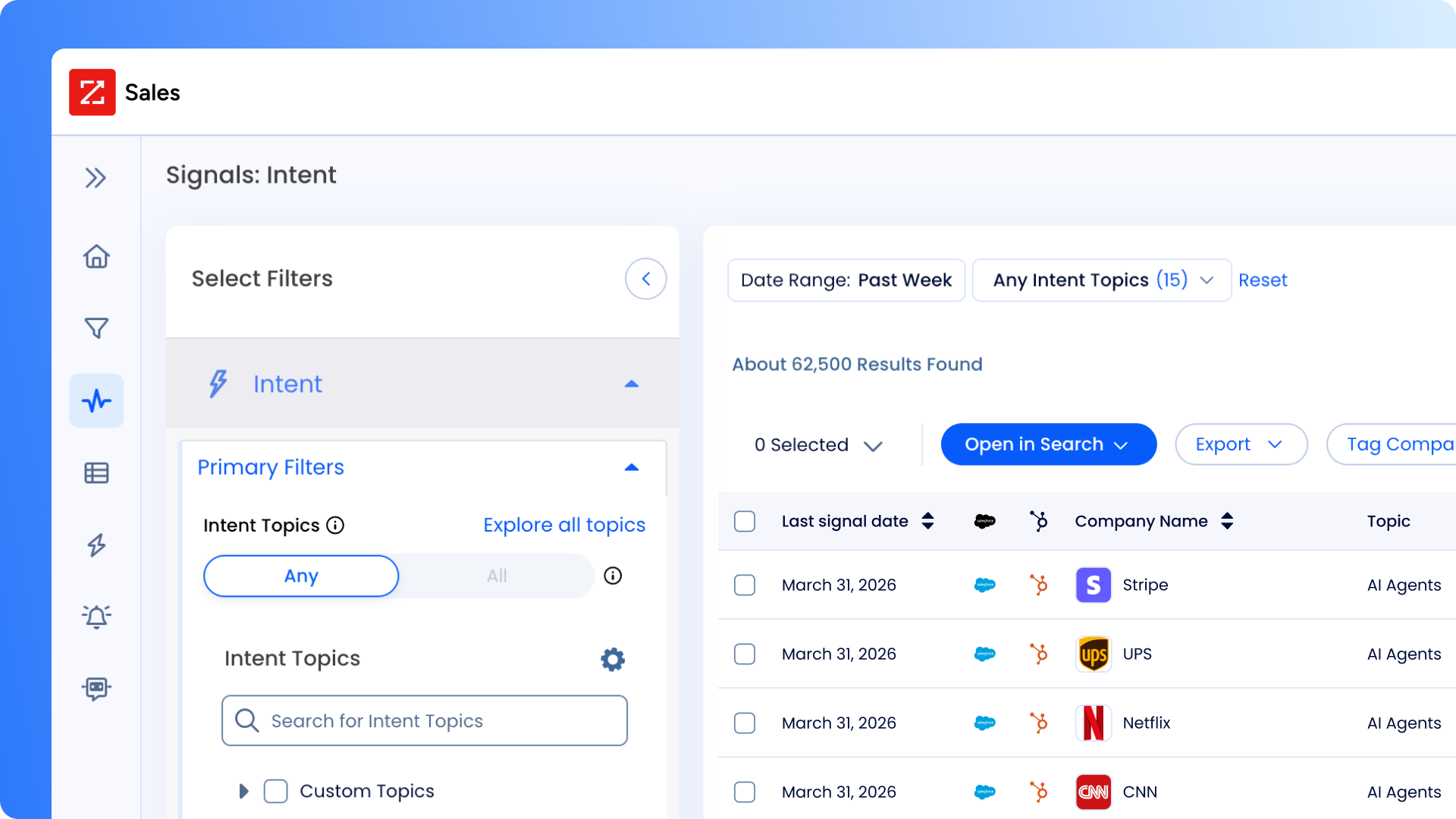
ZoomInfo is an all-in-one AI GTM Platform that combines buyer intent data with the category's largest verified B2B database: 500M contacts, 100M companies, 135M+ verified phone numbers, and 200M+ verified business emails, with 1.5B+ data points processed daily through the GTM Context Graph.
Where other intent platforms tell you which accounts are researching, the GTM Context Graph tells you why, fusing intent signals with CRM history, conversation intelligence from Chorus, and behavioral data to surface the accounts whose signal combinations match your actual win patterns. The reasoning layer connects signals that standalone intent feeds treat as separate data points.
ZoomInfo Intent tracks 12,000+ topics through 210M+ IP-to-Organization pairings and 6 trillion+ new keyword-to-device pairings sourced monthly. ZoomInfo now supports both Account-Level Intent, which identifies accounts researching relevant topics, and Person-Level Intent, which surfaces a named contact associated with that research activity when available—giving sales and marketing teams a more targeted starting point for prioritization and outreach. Guided Intent, exclusive to ZoomInfo, identifies topics historically correlated with deal success rather than requiring manual topic selection. Instead of guessing which topics matter, Guided Intent analyzes your closed-won deals and surfaces the research patterns that preceded them.
GTM Studio is the activation surface for marketers and RevOps teams: natural language audience building, intent-triggered multi-channel plays, and pipeline measurement without an engineering ticket. GTM Workspace serves sellers with AI agents that draft personalized outreach based on intent topics, update CRM fields, and surface next-best actions inside the workflow where reps already work.
ZoomInfo holds Forrester Wave Leader recognition for Intent Data Providers B2B (Q1 2025, highest scores across 8 criteria), Gartner Magic Quadrant Leader for ABM Platforms (2024 and 2025), and G2 No. 1 in Buyer Intent (Summer 2025). The platform maintains ISO 27001, ISO 27701, SOC 2 Type II, TRUSTe GDPR, and TRUSTe CCPA certifications, all renewed annually.
Safety Services built custom intent topics and used ZoomInfo Workflows to surface the accounts most ready to buy and route them straight to sales, increasing MQLs 200% in its first month. David Carter, Vice President of Marketing, said:

"With intent, we're identifying the companies and contacts most ready to buy, warming those leads, qualifying them and then routing them to sales."
Key Features:
Guided Intent (exclusive): AI-identified topics correlated with your win patterns
210M+ IP-to-Organization pairings for third-party intent coverage
GTM Context Graph: 1.5B+ data points daily fusing intent + CRM + conversation + behavioral signals
GTM Studio: natural language audience building and multi-channel play orchestration
GTM Workspace: AI agents that act on intent signals inside the seller workflow
WebSights: anonymous website visitor identification at the contact level
FormComplete: single-field forms that auto-enrich
Native integrations: Salesforce, HubSpot, Marketo, Outreach, Salesloft, LinkedIn Campaign Manager
APIs and MCP for programmatic access in any tool or AI agent
Pricing: Free to start with consumption credits based on usage.
Pros:
Largest verified data foundation in the category (500M contacts, 120M+ direct dials)
GTM Context Graph reasoning layer no pure-play intent vendor can replicate
Guided Intent exclusive to ZoomInfo
Native activation through GTM Studio and GTM Workspace eliminates the signal-to-action gap
Forrester Wave Leader for Intent Data Providers B2B (Q1 2025)
Cons:
Enterprise-grade platform: smaller teams may find the breadth exceeds their immediate needs
Consumption-based pricing requires usage planning
Full platform value requires CRM integration
Request a demo to see how ZoomInfo turns intent signals into pipeline.
2. Bombora
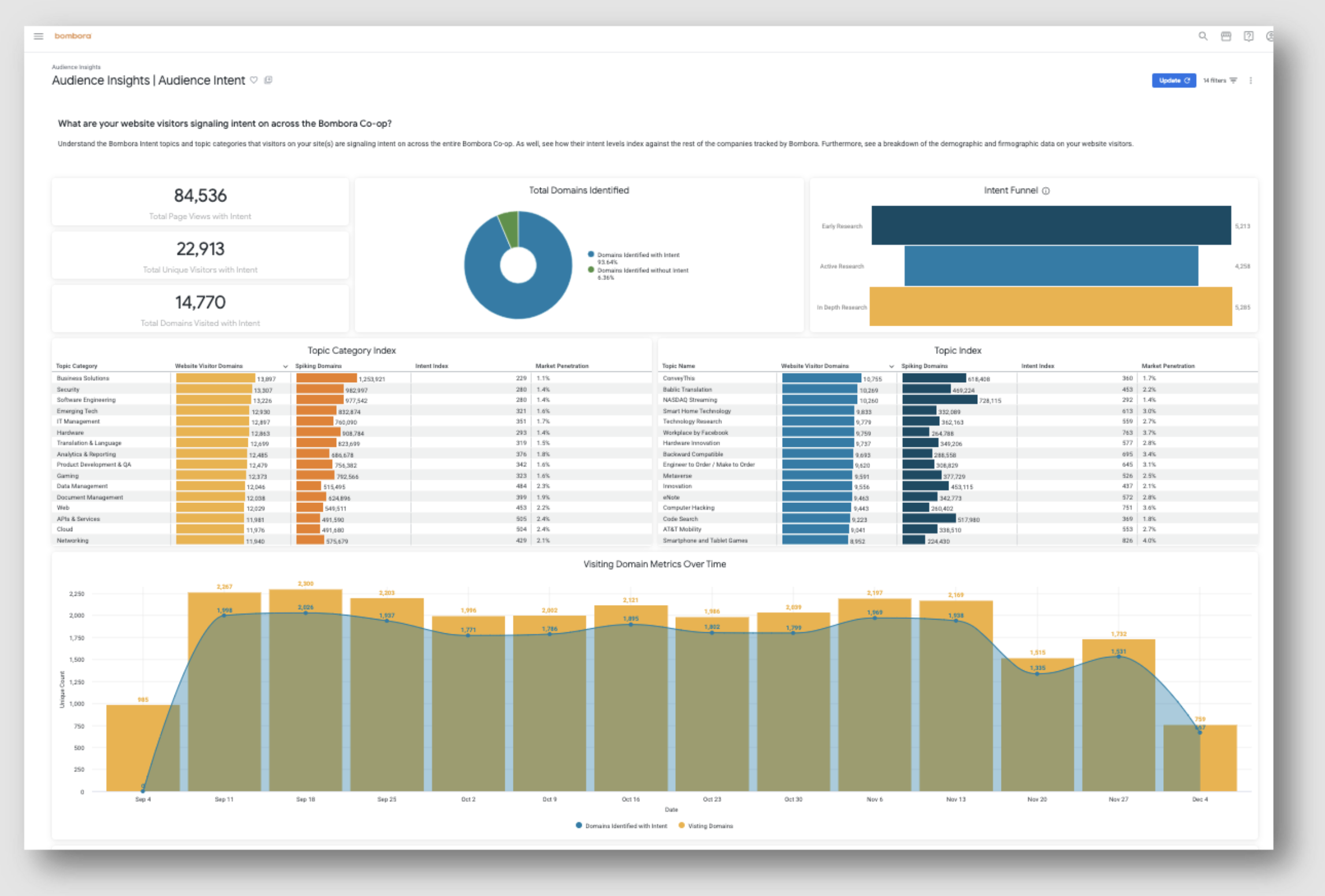
Bombora is the market's leading pure-play intent data provider, powering the Company Surge scoring methodology. Company Surge measures intent as deviation above a company's historical baseline consumption for a given topic: when an account consumes content on a subject significantly above its normal volume, Bombora flags it as in-market. Approximately 70% of Bombora's dataset is exclusive to its cooperative.
That cooperative spans 4,000+ premium B2B sites, where participating publishers both contribute and access shared intent data, making it the largest pure-play intent network in the category. Bombora returns topic-level scores that show how intensely and how recently an account is researching.
On G2, Company Surge holds a 4.4/5 rating across 157 reviews, with users praising how quickly it surfaces in-market accounts and flagging cost, a learning curve, and limited visibility into who inside an account is researching.
Key Features:
Company Surge baseline-normalization scoring
Data cooperative of 4,000+ premium B2B sites
70% exclusive dataset
Topic taxonomy across thousands of categories
Integrations with 6sense, Salesforce, HubSpot, LinkedIn
Audience composition insights for market intelligence
Pricing: Not publicly listed. Typically sold as a data layer integrated through partner platforms.
Pros:
Largest pure-play intent data cooperative
Widely integrated across the ABM ecosystem (6sense, Demandbase, ZoomInfo, and others)
Established baseline-normalization methodology
Cons:
Pure data layer: no native activation, CRM, or outreach tools
Requires a separate platform (6sense, Demandbase, or ZoomInfo) to act on signals
No AI scoring or buying-stage prediction
How Bombora compares against ZoomInfo
Bombora wins on pure intent-data authority: its Company Surge product, sourced from a proprietary co-op of 5,500+ B2B media sites with 86% exclusive coverage, is cited by Forrester as the gold standard for account-level intent and is embedded inside most competing GTM platforms as a trusted upstream signal.
ZoomInfo's edge is Forrester Wave Q1 2025 Leader recognition for intent data paired with a 500M+ contact database, a seller prospecting workspace, and conversation analysis feeding deal intelligence that Bombora does not offer as a data-only company, CRM enrichment, deduplication, and routing workflows that Bombora's Identity and Enrichment product does not cover beyond visitor-level enrichment, and a documented free-trial path that reduces procurement friction while Bombora's pricing is fully gated with no self-service tier.
See the full Bombora vs. ZoomInfo comparison.
3. 6sense
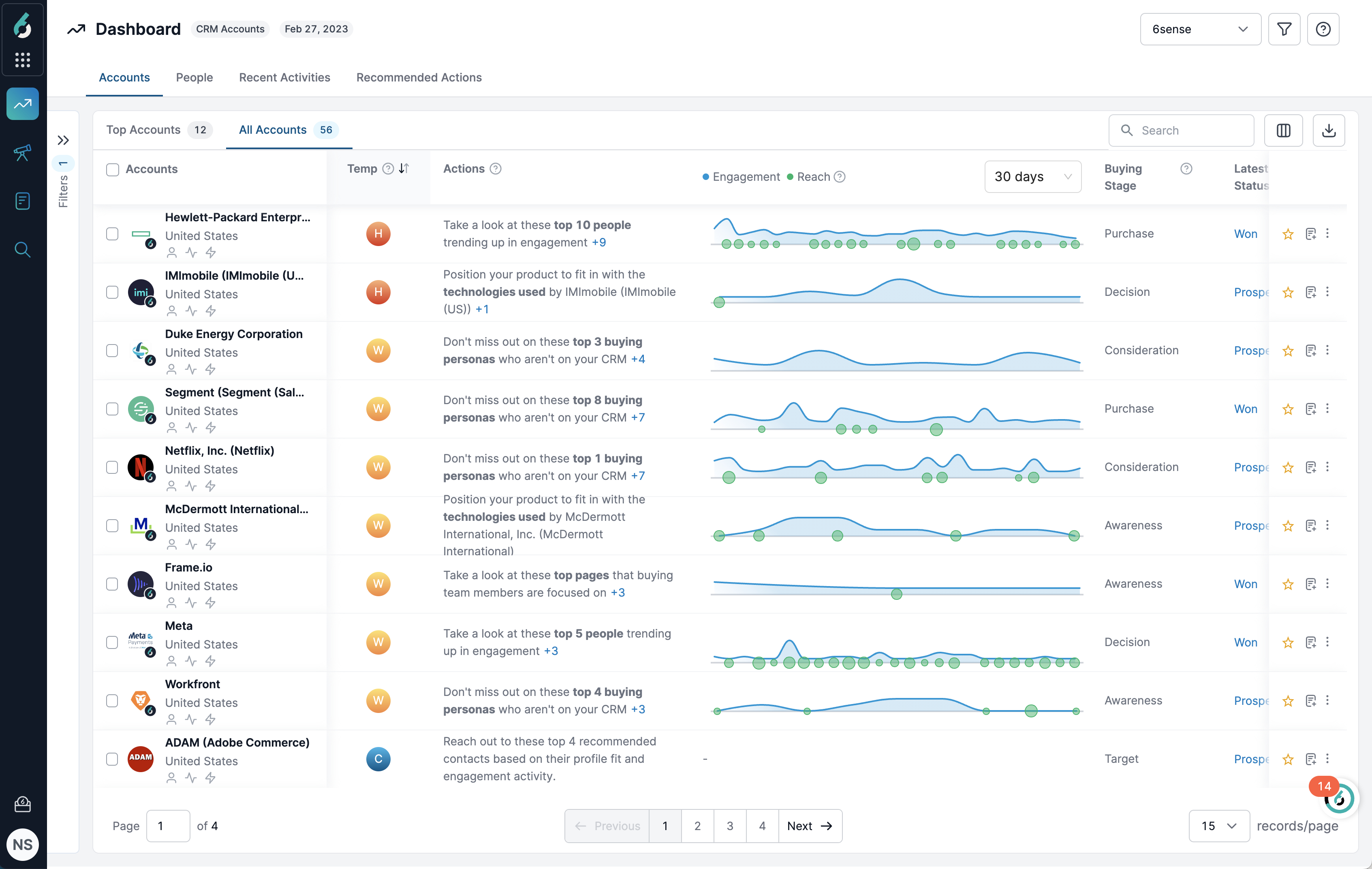
The 6sense ABM Platform combines intent data with predictive AI scoring that assigns buying stages (Awareness, Consideration, Decision, Purchase) to target accounts. The platform aggregates signals from web activity, engagement patterns, and third-party data to recommend which accounts to prioritize and when to engage them.
6sense's predictive model continuously learns from engagement patterns to improve buying-stage accuracy over time. Revenue teams get recommended next-best actions for each account based on demonstrated signals and predicted stage progression. The platform includes multi-channel campaign orchestration across display, LinkedIn, and email, with account-level dashboards showing intent activity, engagement history, and predicted conversion likelihood.
On G2, 6sense earns 3.9/5 across 1,059 reviews: users praise the intent and buying-stage signals for prioritizing accounts, but flag patchy contact accuracy and a steep learning curve.
Key Features:
In-market account identification via predictive AI with buying-stage classification
Multi-channel campaign orchestration across display, LinkedIn, and email
Anonymous buyer-journey identification
Revenue AI recommendations for optimal engagement timing
Account-level intent scoring and prioritization
CRM and marketing automation integration
Campaign performance analytics tied to revenue outcomes
Pricing: Not publicly available. Contact 6sense for enterprise pricing.
Pros:
Native ABM advertising as a first-class channel within the platform
Predictive buying-stage model is the strongest AI scoring approach among pure-ABM competitors
Forrester Wave Q1 2026 Leader recognition for Revenue Marketing Platforms
Cons:
No conversation intelligence equivalent to Chorus
No documented MCP/agent ecosystem at parity with APIs and MCP
Pricing fully quote-based
How 6sense compares against ZoomInfo
6sense wins with native ABM advertising as a first-class channel and AI-driven predictive buying-stage scoring that names funnel stage, capabilities that go beyond ZoomInfo's native ABM orchestration, backed by Forrester Wave Q1 2026 Leader recognition for Revenue Marketing Platforms.
ZoomInfo's edge is Gartner Magic Quadrant ABM Platforms Leader recognition in both 2024 and 2025 while 6sense does not hold a documented 2024-2025 Leader designation in the same category, GTM Context Graph reasoning across CRM signals, intent data, technographics, and Chorus conversation intelligence simultaneously (6sense has no conversation-intelligence equivalent feeding back into its scoring layer), and an APIs and MCP layer exposing a documented Model Context Protocol server for AI agent builders that 6sense has not documented at parity.
See the 6sense vs. ZoomInfo comparison for the full head-to-head.
4. Demandbase
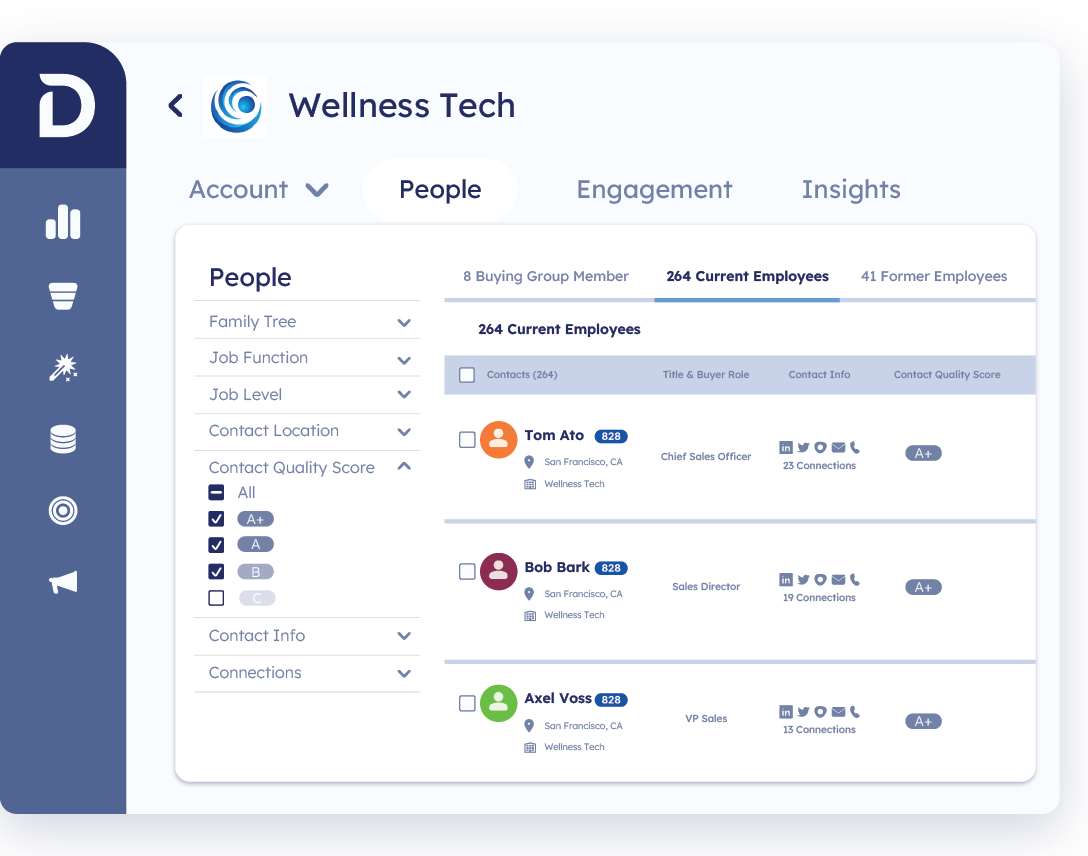
Demandbase One is a unified ABX platform spanning ABM ads, account intelligence, sales intelligence, and data. The platform creates audience segments using account intelligence, CRM data, and intent signals, then activates campaigns across its native ad-buying platform, display, and social channels.
Demandbase's full-funnel approach combines intent data aggregation from web activity, content consumption, and engagement patterns with B2B advertising capabilities and website personalization for high-intent visitors. Pipeline measurement tools track how intent drives revenue impact across the customer journey.
Reviewers tend to echo that pitch, praising the unified account view that keeps sales and marketing working the same signals, though the recurring caveat is that its depth is best suited to larger teams with the ops support and budget to run it (Demandbase One rates 4.4/5 on G2).
Key Features:
Unified ABX platform spanning ABM ads + account intelligence + sales intelligence + data
Native ad targeting and retargeting
Predictive scoring and intent signals
Website personalization for high-intent visitors
Pipeline attribution and revenue analytics
Firmographic data enrichment
ABM campaign orchestration and execution
Pricing: Not publicly available. Contact Demandbase for enterprise pricing.
Pros:
Most established ABM platform competitor by tenure
Native ad-buying platform integrated with account intelligence
Full-funnel ABX approach from awareness through pipeline
Cons:
Pricing fully quote-based
No conversation intelligence (no Chorus equivalent)
No documented MCP/agent ecosystem
How Demandbase compares against ZoomInfo
Demandbase wins as the most tenured ABM-platform competitor with the highest-fidelity competitive content against ZoomInfo: its published competitive report and vs-blog frame a "Full-Funnel ABM vs. Lead-Based Engagement" narrative that resonates with enterprise marketing teams already committed to an account-based motion.
ZoomInfo's edge is Gartner Magic Quadrant ABM Platforms Leader recognition in both 2024 and 2025 while Demandbase does not hold an equivalent current Gartner MQ ABM Platforms Leader designation, GTM Context Graph reasoning fusing cross-signal account intelligence linking intent signals, verified contacts, technographics, and Chorus conversation intelligence into a unified layer (Demandbase has no conversation-intelligence equivalent), and an APIs and MCP layer providing a documented Model Context Protocol server for AI agent builders that Demandbase has not documented.
See the Demandbase vs. ZoomInfo comparison for the full head-to-head.
5. Cognism
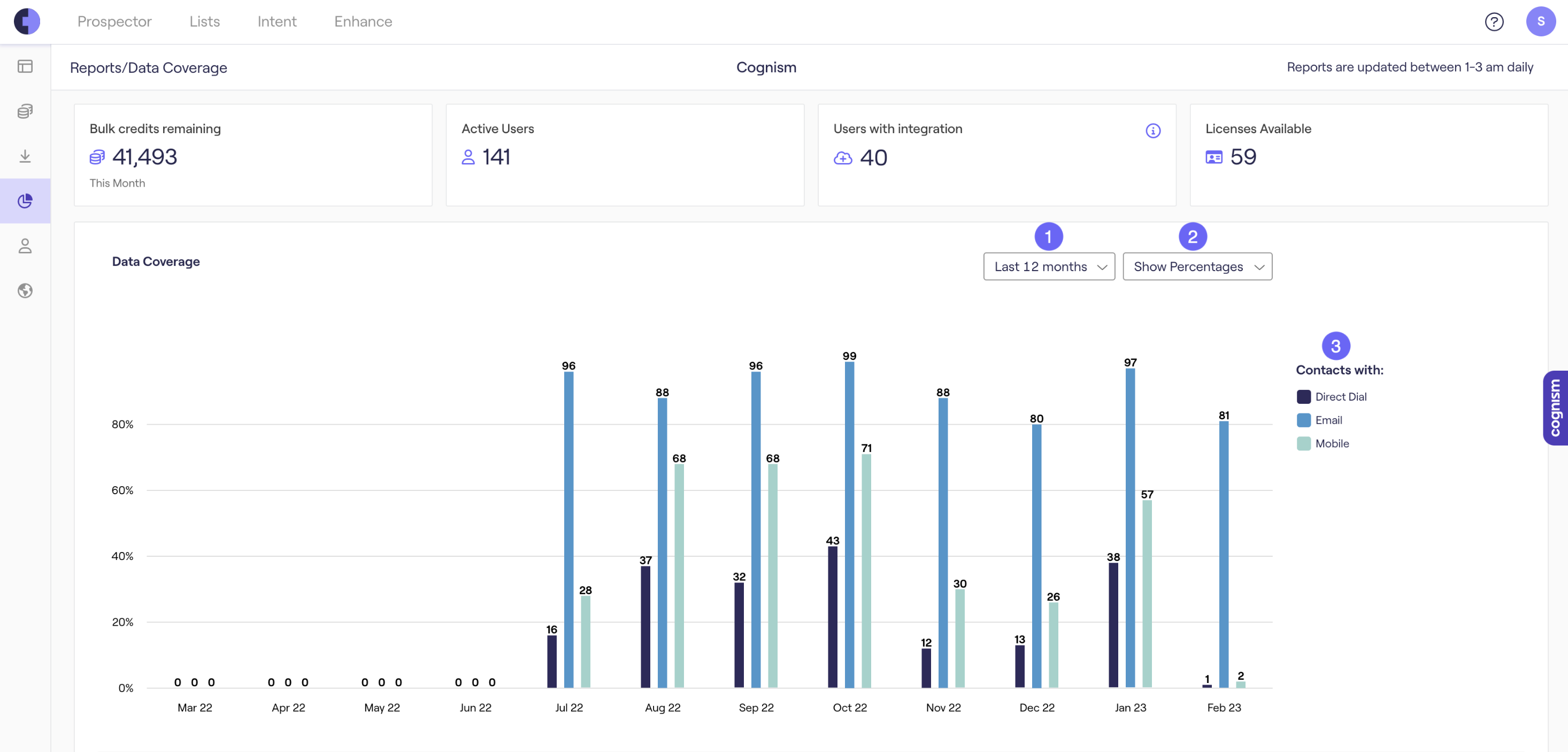
Cognism is a premium B2B sales intelligence platform whose central pitch is European data quality and compliance. Diamond Verified Data is the specific sub-product: phone-verified mobile numbers with an 87%+ accuracy claim on verified records, focused on EU markets. The platform combines contact database capabilities with intent data signals powered by Bombora's Company Surge technology.
Cognism addresses GDPR compliance requirements that challenge other providers by building its data collection and processing around European privacy regulations from the ground up. The platform includes technographic data showing technology stack information for target accounts.
On G2, that reputation holds up: Cognism scores 4.5/5 across 1,363 reviews, with reviewers repeatedly singling out EMEA phone and email accuracy, while the most common gripe is that intent is a lighter, add-on layer rather than a core strength.
Key Features:
Phone-verified mobile numbers (EU focus) via Diamond Verified Data
87%+ accuracy claim on verified records
GDPR/CCPA compliance signaling
Bombora-powered intent data integration
CRM and sales engagement platform integration
Browser extension for prospecting workflows
Technographic data for technology stack targeting
Pricing: Two-tier model (Standard/Pro), quote-based. Contact Cognism for pricing.
Pros:
Strongest EU mobile data verification in the category
Compliance-first positioning built around GDPR
Bombora intent integration for account prioritization
Cons:
Smaller dataset scale than ZoomInfo's 500M contacts globally
No conversation intelligence, ABM motion, or APIs/MCP at parity
Intent data is Bombora-sourced, not proprietary
How Cognism compares against ZoomInfo
Cognism wins on EU phone-data compliance and Diamond Verified mobile accuracy: its manual phone-verification process and GDPR-first positioning make it the preferred choice for European sales teams prioritizing regulatory certainty and high connect rates on mobile numbers.
ZoomInfo's edge is global verified phone coverage spanning 135M+ verified phone numbers, 120M+ direct dials, and 45M+ international mobile numbers across North America, EMEA, APAC, and LATAM, a platform spanning conversation analysis feeding deal intelligence, seller surfaces, and ABM orchestration that Cognism does not offer at any tier, and platform-level compliance certifications including ISO 27001, ISO 27701, SOC 2 Type II, and TRUSTe GDPR/CCPA that extend across all data products and integrations.
See the Cognism vs. ZoomInfo comparison for the full head-to-head.
6. Lead Forensics
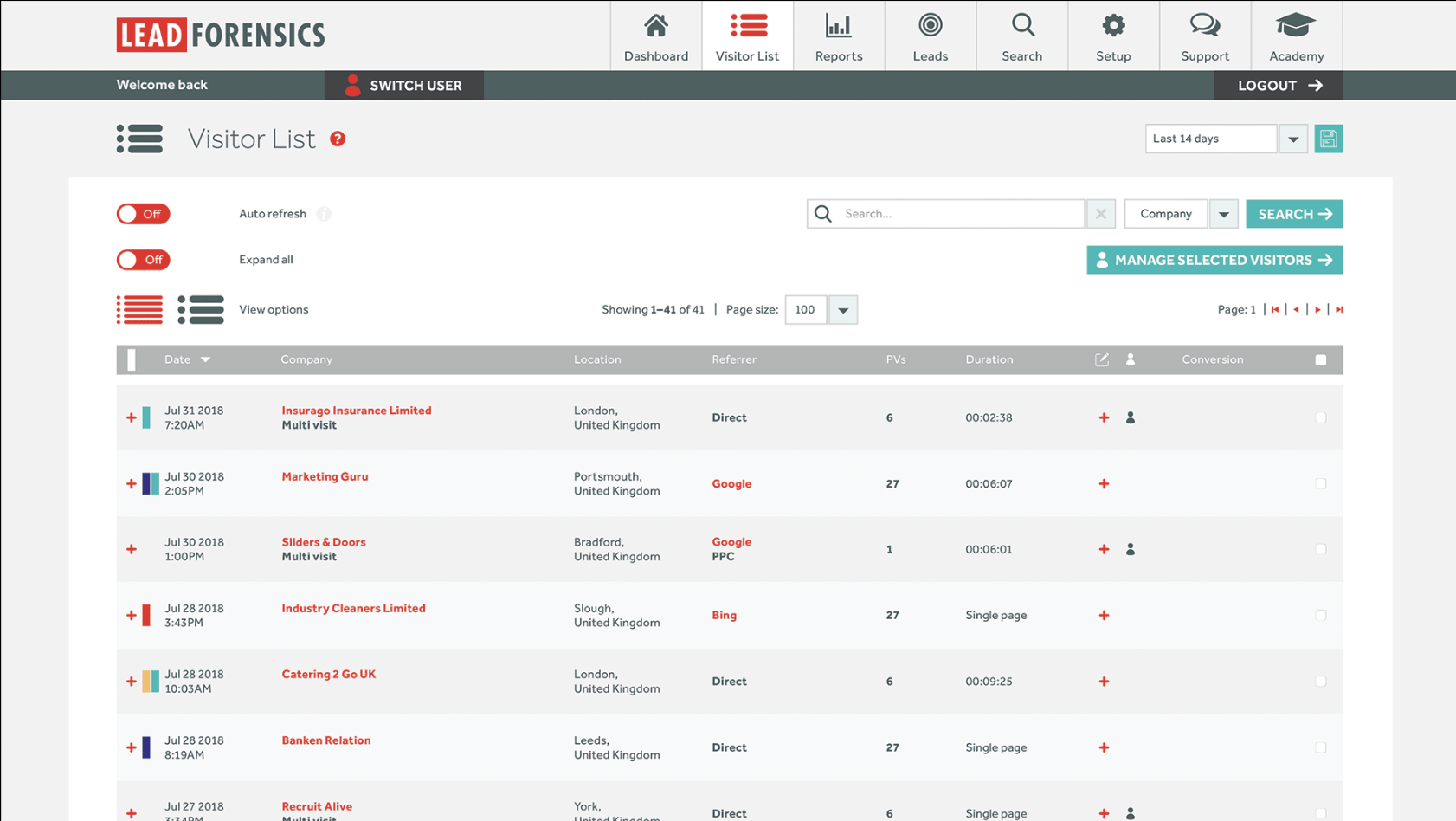
Lead Forensics is a B2B website-visitor-identification vendor selling to sales, marketing, and account management teams that want to convert anonymous website traffic into named-company leads with appended decision-maker contacts.
The platform's core technology is a reverse-IP tracking snippet that matches anonymous sessions against a proprietary IP-to-company database built and maintained solely for Lead Forensics' solution. The Automate tier adds direct CRM integration with Salesforce, HubSpot, and Microsoft Dynamics, plus "The Orchestrator" sequencing engine for routing identified visitors into existing workflows in real time.
Lead Forensics rates 4.4/5 on G2, where reviewers consistently praise the support but note the built-in limit of visitor ID: it names the company, not the person to reach.
Key Features:
Reverse-IP tracking via lightweight on-site snippet
Proprietary IP-to-company database built and maintained solely for Lead Forensics
Real-time alerts when a target company visits, including pipeline accounts re-engaging
Decision-maker contact data appended to each identified company record
ICP and named-account watchlists for selective alerting
The Orchestrator sequencing engine for CRM routing and workflow automation (Automate tier)
Integrations with Salesforce, HubSpot, Microsoft Dynamics, Pipedrive, Zoho
Pricing: Custom pricing. Free trial offered for both Essential and Automate tiers.
Pros:
Real-time visitor-to-contact resolution in a single platform (no separate prospecting step)
Proprietary IP-to-company database with strong match rates on enterprise and mid-market corporate traffic
Orchestrator sequencing lets SDRs move from alert to personalized outreach without switching tools
Free trial available for evaluation
Cons:
Match rate degrades on residential, SMB, and remote-worker traffic
Decision-maker contacts are scoped only to identified visitors, not a general B2B contact universe
No third-party intent network, ABM orchestration, or cross-web signal coverage
Pricing fully gated
How Lead Forensics compares against ZoomInfo
Lead Forensics wins on real-time website-visitor identification with decision-maker contacts appended natively: its proprietary IP-to-company database and Orchestrator sequencing let SDRs move from anonymous visitor alert to personalized outreach in a single platform without a separate prospecting step.
ZoomInfo's edge is WebSights backed by 210M+ IP-to-organization pairings paired with a 500M+ contact database for full-funnel contact resolution beyond a customer's own site traffic, cross-signal intent and behavioral data fusing first-party website behavior with cross-web intent signals, CRM activity, and technographic data into a unified account-intelligence view, Person-Level Intent that surfaces named contacts tied to account research activity alongside Account-Level Intent for more targeted prioritization, and a full ABM orchestration surface spanning audience building, ad targeting, FormComplete, and campaign activation that extends well beyond visitor identification.
7. Foundry
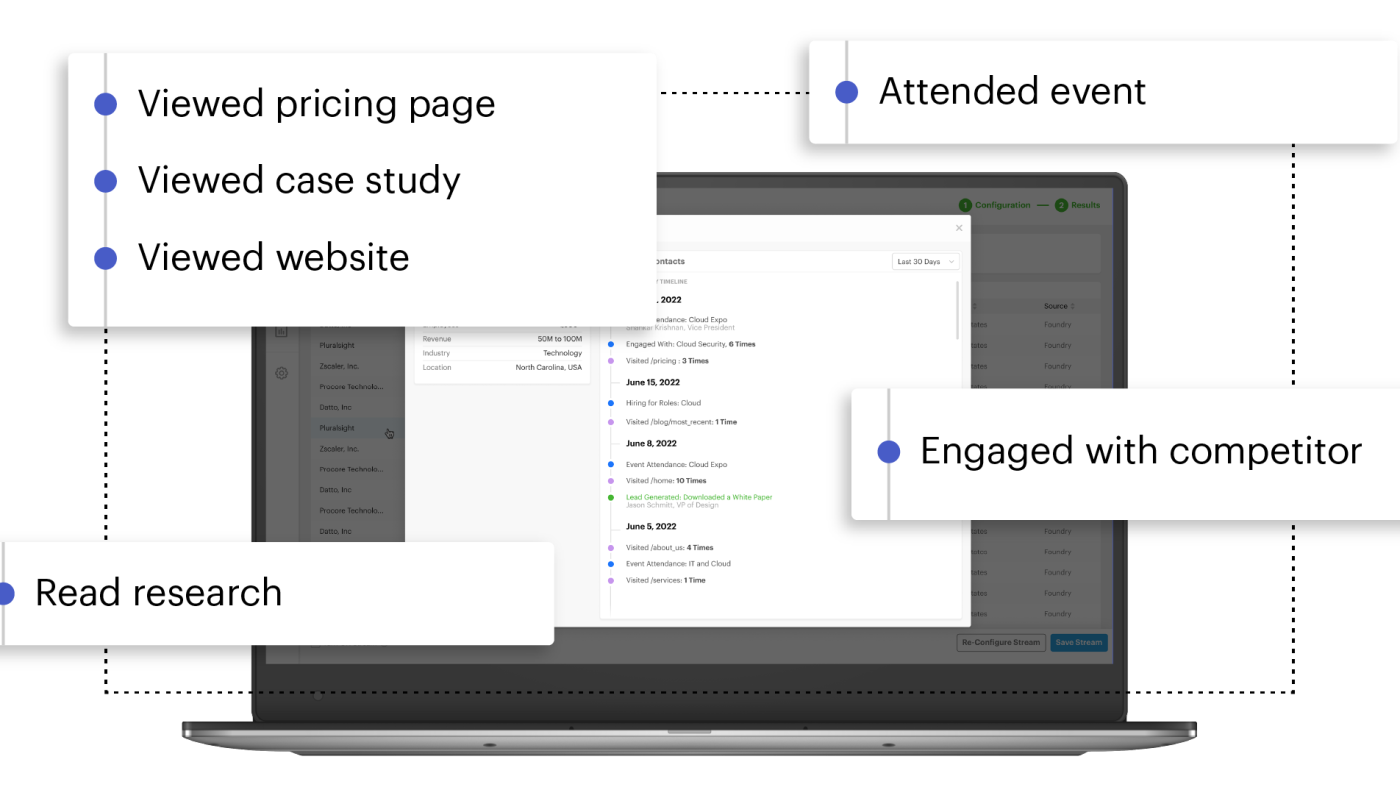
Foundry (formerly IDG Communications) is a B2B tech media and intent data platform that pairs an owned editorial network (CIO, CSO, Computerworld, InfoWorld, Network World) with multi-source intent data, an account-based orchestration platform (Foundry ABM, powered by Triblio), and intent-driven advertising.
Foundry's primary audience is B2B technology marketers targeting IT decision-makers, and its closed-loop approach means intent signals originate from opted-in readers across its own editorial properties plus the public web.
Foundry Intent rates 4.3/5 on G2, with users praising implementation support and its IT-research data, while the common gripes are a dated UI and integration friction.
Key Features:
Multi-source intent data capturing 80M+ signals per week across owned editorial, public web, and customer websites
150M+ reachable audience members with 7,600+ targeting dimensions
Foundry ABM (Triblio): cross-channel orchestration across display, social, website personalization, and 1:1 Smart Pages
AI-driven account scoring fed by proprietary, human-verified intent data
Intent-driven advertising adjacent to CIO, Computerworld, and other owned editorial sites
Integrations with Salesforce, HubSpot, Microsoft Dynamics 365, SugarCRM, Marketo
Pricing: Custom pricing for Intent, ABM, and Ads products. Ads charged on CPC or vCPM basis. Contact Foundry for details.
Pros:
Proprietary editorial intent signals from owned B2B tech media properties (CIO, Computerworld, InfoWorld)
Closed-loop signal sourcing: intent originates from opted-in audiences, not scraped or inferred data
G2 leader badges in Account-Based Orchestration Platforms and Buyer Intent Data Providers
Strong fit for B2B tech marketers targeting IT buyers specifically
Cons:
No verified contact database underneath the intent and ABM layers (contacts must be sourced separately)
No seller workspace, AI agent layer, or APIs/MCP for developer use cases
Intent coverage is strongest in IT/enterprise technology verticals; thinner outside that audience
Pricing fully gated across all products
How Foundry compares against ZoomInfo
Foundry wins for B2B technology marketers targeting IT decision-makers: its owned editorial network (CIO, Computerworld, InfoWorld, Network World) generates proprietary opted-in audience intent that no third-party data vendor can replicate, giving IT-focused ABM campaigns a first-party signal layer grounded in verified reader engagement.
ZoomInfo's edge is a 500M+ contact database covering all industries and functions that Foundry does not offer underneath its ABM and intent layers, a seller-facing prospecting and sequencing surface with AI-drafted outreach that Foundry lacks entirely, and 1.5B+ daily data points fused across signal types into a unified scoring model compared to Foundry Intent's 80M+ signals per week from a narrower, IT-content-focused signal pool.
8. Leadfeeder
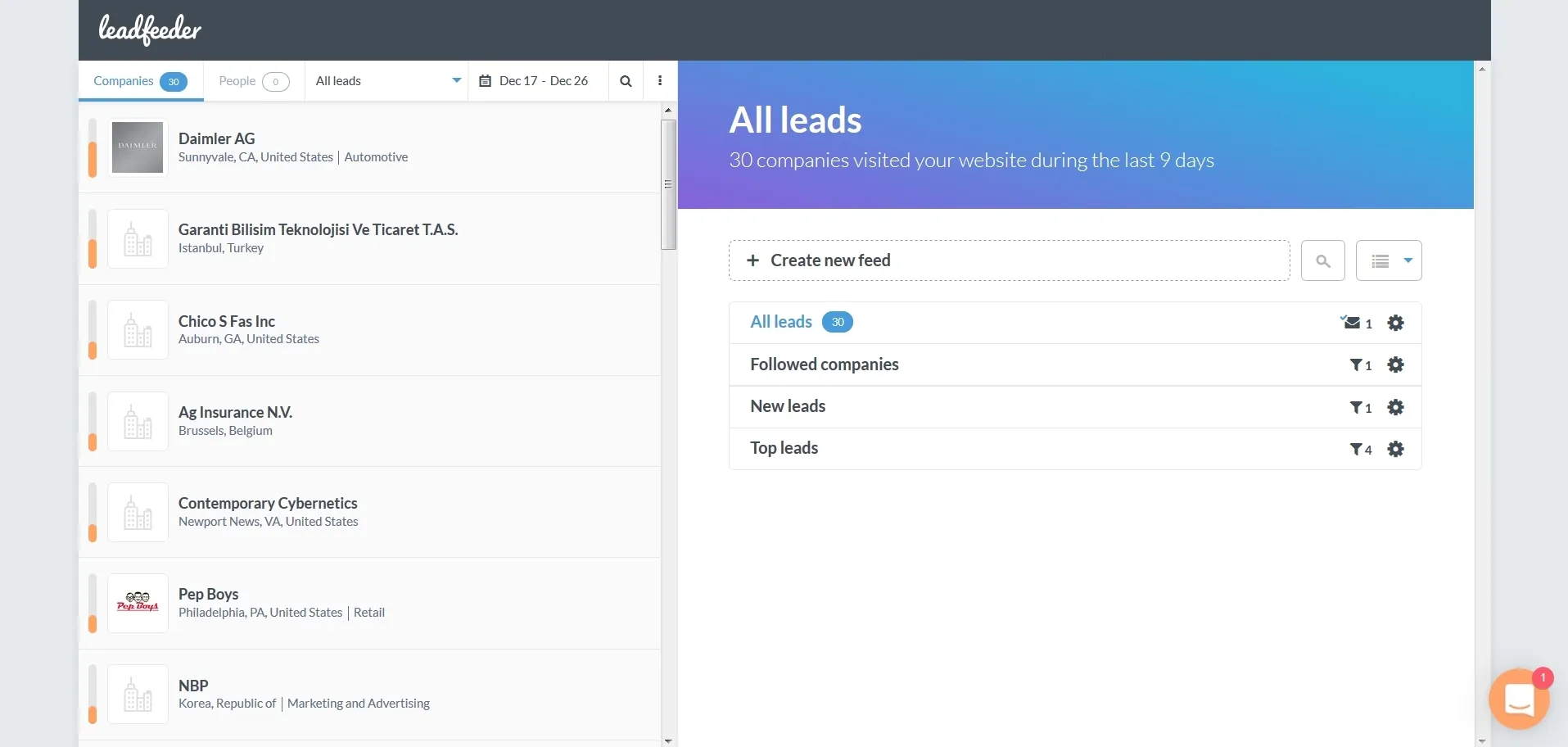
Leadfeeder is a website-visitor identification platform (previously Dealfront), the European GTM platform.
Its central pitch is identifying up to 45% of companies visiting your website by enriching IP traffic with B2B firmographic data. Leadfeeder pairs visitor identification with behavioral intent signals from the its dataset, CRM sync (Salesforce, HubSpot, Pipedrive, Microsoft Dynamics), lead scoring, and custom feeds for sales prioritization. The platform is GDPR-compliant with a European-data focus.
With a 4.3/5 rating on G2, some users note that Leadfeeder's intent is company-level only, it flags which business is showing intent, but not the person behind it.
Key Features:
Anonymous website visitor identification (up to 45% of visiting companies)
Google Analytics-based traffic resolution
Behavioral intent signals from website visits plus Dealfront intent dataset
CRM sync with Salesforce, HubSpot, Pipedrive, Microsoft Dynamics
Lead scoring and custom feeds for sales prioritization
AI-generated visitor summaries and next-best-action recommendations
Pricing: Always-free tier (7 days of data, limited features). Paid plan starts at $99/month for up to 50 leads. Custom enterprise pricing available.
Pros:
Lowest-friction entry point for website visitor identification (always-free tier + $99/month paid)
Transparent public pricing
GDPR-compliant European data focus via Dealfront
Google Ads integration for paid-media targeting from visitor data
Cons:
Website-only signals; no third-party intent network
Company-level identification only (no individual contact reveal)
No verified contact database underneath the visitor-ID layer
No conversation intelligence, ABM orchestration, or APIs/MCP
How Leadfeeder compares against ZoomInfo
Leadfeeder wins on transparent SMB-friendly pricing and low evaluation friction: its always-free tier and $99/month Paid plan give small teams a no-commitment path to website-visitor identification that ZoomInfo's quote-based commercial process cannot match for speed-to-value. ZoomInfo does offer a free-to-start path with consumption-based pricing for teams that want to self-serve before engaging a sales conversation, which narrows that friction gap for smaller teams evaluating the platform.
ZoomInfo's edge is WebSights backed by 210M+ IP-to-organization pairings with contact-level reveal capability paired with a 500M+ contact database (Leadfeeder identifies companies only, with no contact-level reveal from a smaller dataset), a full ABM activation stack spanning FormComplete, intent-triggered audience building, ad targeting, and verified-contact enrichment that goes beyond Leadfeeder's standalone visitor-ID scope, and global enterprise integration depth spanning Salesforce, HubSpot, Marketo, and 300+ CRM/MA connectors while Leadfeeder's Dealfront parent positions it as a European GTM platform with a smaller global footprint.
Talk to our team for a head-to-head Leadfeeder vs. ZoomInfo walkthrough.
9. DemandScience
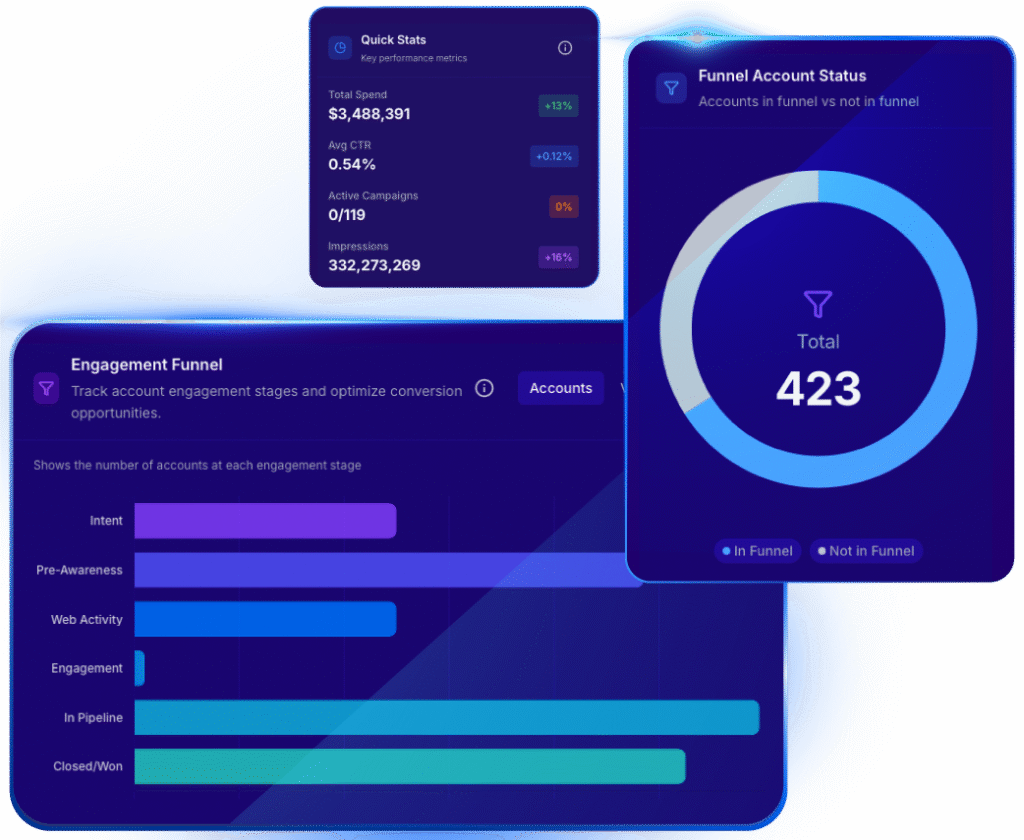
DemandScience is a B2B managed demand-generation services vendor with a 4.4/5 rating on G2, positioning itself as "Precision Performance Marketing as a Service."
The platform combines the IONIC Identity Graph (247M+ verified global contacts across 100+ countries) with multi-source buyer intent data, a Winnable Account System powered by HG Insights and GTM Fabric for switchability scoring, and a Labs managed-services team that runs content syndication, BANT-qualified lead generation, programmatic ads, and managed email on the customer's behalf. DemandScience's primary buyer is the VP of Marketing or Director of Demand Gen who wants guaranteed CPL delivery and done-for-you execution.
Key Features:
IONIC Identity Graph with 247M+ verified global contacts across 100+ countries
Multi-source buyer intent data with real-time buying signals
Winnable Account System (HG Insights + GTM Fabric) for switchability and propensity scoring
Content syndication with guaranteed CPL and lead replacement guarantees
BANT-qualified leads verified by phone before handoff
Labs managed-services team for end-to-end campaign execution
Integrations with Salesforce, HubSpot, Marketo, and major CRM/MA platforms
Pricing: Custom pricing. Contact DemandScience for a quote.
Pros:
Managed-execution model eliminates internal campaign operations overhead
Guaranteed CPL content syndication with lead replacement
BANT-qualified leads verified by phone before delivery
Winnable Account System adds switchability scoring beyond standard intent
Cons:
Smaller absolute contact scale than ZoomInfo's 500M contacts
No self-serve platform: every program requires a services engagement
No conversation intelligence or APIs/MCP for AI agent builders
Pricing fully gated
How DemandScience compares against ZoomInfo
DemandScience wins as a managed-execution partner for demand-gen leaders who want guaranteed CPL content syndication, BANT-qualified leads verified by phone, and done-for-you creative and events that ZoomInfo Marketing does not provide as a managed service.
ZoomInfo's edge is a 500M+ contact database that is more than twice the size of DemandScience's 247M IONIC Identity Graph, Forrester Wave Q1 2025 Leader recognition for intent data while DemandScience carries no equivalent analyst-validated intent leadership, and a self-serve platform spanning ZoomInfo Sales, ZoomInfo Marketing, and APIs and MCP that lets teams activate data and build AI-agent workflows without a services engagement.
Talk to our team for a head-to-head DemandScience vs. ZoomInfo walkthrough.
10. G2 Buyer Intent
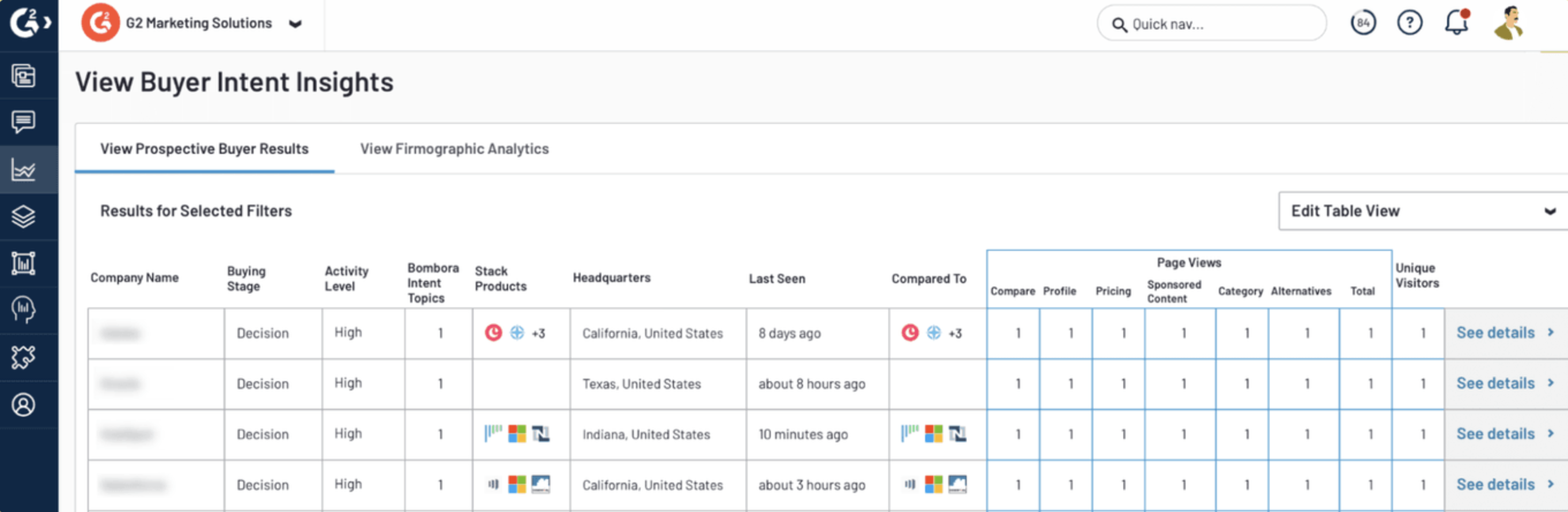
G2 Buyer Intent captures verified first-party signals from over 100M software buyers researching products, categories, and competitors on G2.com.
The platform routes nine signal types (Profile, Pricing, Alternatives, Category, Compare, Sponsored, Licensed, Reference, Competitive) into the customer's sales and marketing stack with daily Buying Stage scoring (Awareness, Consideration, Decision) and Activity Level scoring (Low, Medium, High). G2 Buyer Intent is sold as an add-on to G2 Brand Professional and Enterprise packages and integrates with Salesforce, HubSpot, ZoomInfo, 6sense, Demandbase, Marketo, and Salesloft.
Key Features:
Nine verified first-party signal types from on-platform buyer research
Buying Stage and Activity Level scoring updated daily
ICP filters covering firmographics, geography, target competitors, and signal types
Company-activity timelines with unique-visitor counts and geolocation
CRM and ABM platform integrations (Salesforce, HubSpot, 6sense, Demandbase, Marketo)
Competitive research alerts when buyers evaluate your product against alternatives
Pricing: Add-on to G2 Brand Professional or Enterprise packages. No public dollar pricing.
Pros:
Verified first-party signals from the largest B2B software review platform
Bottom-of-funnel signal quality: buyers on G2 are actively comparing vendors and pricing
Nine granular signal types provide more context than a single intent score
Native ZoomInfo integration for contact resolution on G2 intent signals
Cons:
Bounded to G2's own marketplace: no cross-web bidstream coverage
No B2B contact data foundation of its own (relies on ZoomInfo, LinkedIn, or Bombora for contact resolution)
Software-only coverage (not applicable to non-software B2B categories)
No public dollar pricing
How G2 Buyer Intent compares against ZoomInfo
G2 Buyer Intent wins on signal quality at the bottom of the funnel: its verified first-party signals capture buyers who are actively on G2.com comparing vendors, pricing, and alternatives, making these mid-to-late-funnel signals more conversion-proximate than inferred third-party bidstream intent.
ZoomInfo's edge is cross-web intent data spanning behavioral signals, technographic triggers, CRM activity, and account-level engagement data across the full buyer journey (G2 captures only the fraction of research that happens on G2.com), a 500M+ contact database for direct contact resolution that G2 Buyer Intent does not provide on its own, and native seller and marketer execution surfaces spanning ZoomInfo Sales, ZoomInfo Marketing, and GTM Workspace that let teams act on intent signals without leaving the platform.
Talk to our team for a head-to-head G2 Buyer Intent vs. ZoomInfo walkthrough.
11. IntentData.io
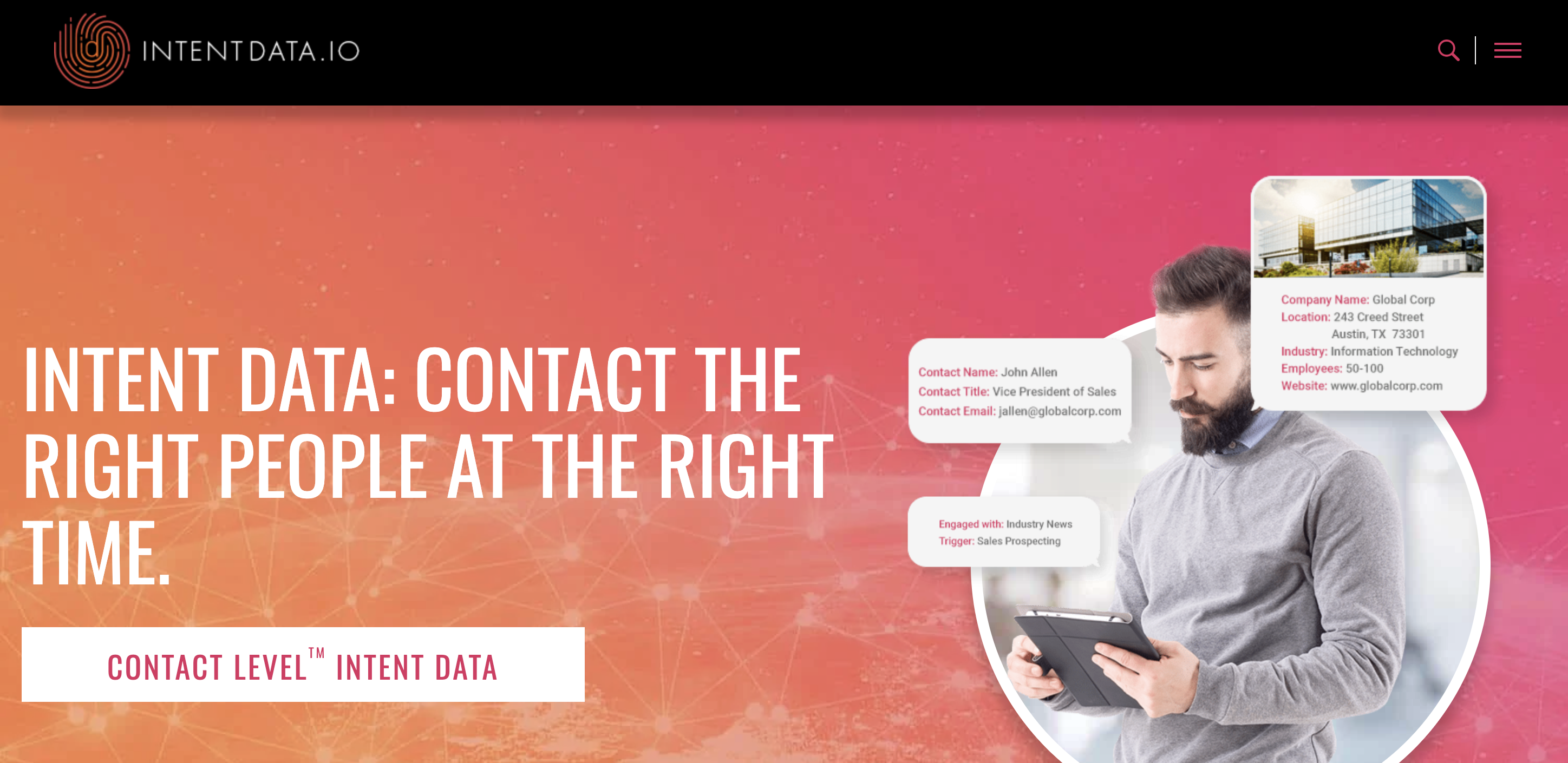
IntentData.io is a B2B contact-level buyer intent data provider whose core differentiator is attaching a named individual and job title to each intent signal, rather than delivering account-only scores.
The platform tracks individual researcher behavior across the open web and routes signals into Salesforce, Marketo, HubSpot, and Terminus via native integrations and form-push delivery. IntentData.io also offers Contextual Technographic Data (TechnoIntent), which blends technographic signals with intent to power pre-built plays like Renewal Disruption (flagging accounts researching alternatives 9-10 months into competitor contracts) and Knockout (surfacing accounts engaging with content about a competitor's known weaknesses).
IntentData.io is the thinnest-reviewed option here, with just a single G2 review (3.5/5), too little to draw any real signal from.
Key Features:
Contact-level intent signals (named individual + job title per signal)
Configurable signal types: competitor engagement, industry news, influencer activity, events, hiring, funding, leadership changes
Contextual Technographic Data (TechnoIntent) blending tech-stack signals with intent
Pre-built plays: Renewal Disruption, Knockout, Product Launch
Native Salesforce integration plus form-push delivery to Marketo, HubSpot, and CRMs with integrated forms
Streams feature for routing subsets of results to CRM, BDRs, CSV exports, or paid-social custom audiences
Pricing: Three tiers (SMB, Pro, Enterprise) with detailed feature configurations. No published dollar amounts; contact IntentData.io for pricing.
Pros:
Contact-level signals attach a named person and title to each intent action (vs. account-only from most third-party providers)
Pre-built plays (Renewal Disruption, Knockout) provide ready-made activation frameworks
Configurable signal types allow granular tracking of competitors, events, hiring, and funding
Open-web sourcing positioned as GDPR- and ICO-compliant
Cons:
No verified contact database (ships signals, not a prospecting DB)
No seller workspace, conversation intelligence, or unified GTM platform surface
No public API or MCP for AI agent integration
No Forrester Wave, Gartner MQ, or equivalent analyst recognition
How IntentData.io compares against ZoomInfo
IntentData.io wins on contact-level intent granularity: attaching a named individual and job title to each intent signal rather than delivering account-only scores, giving BDRs a more actionable starting point for outreach without a separate contact-resolution step.
ZoomInfo's edge is technographic coverage spanning 30,000+ tracked technologies (IntentData.io's TechnoIntent covers fewer mapped technologies bounded to web-tag tracking and job-posting parsing), a native seller prospecting and sequencing surface through GTM Workspace and ZoomInfo Sales that IntentData.io does not offer as a data-delivery-only provider, and Forrester Wave Q1 2025 Leader recognition for intent data with analyst-validated methodology and distribution at scale.
Talk to our team for a head-to-head IntentData.io vs. ZoomInfo walkthrough.
12. Lusha
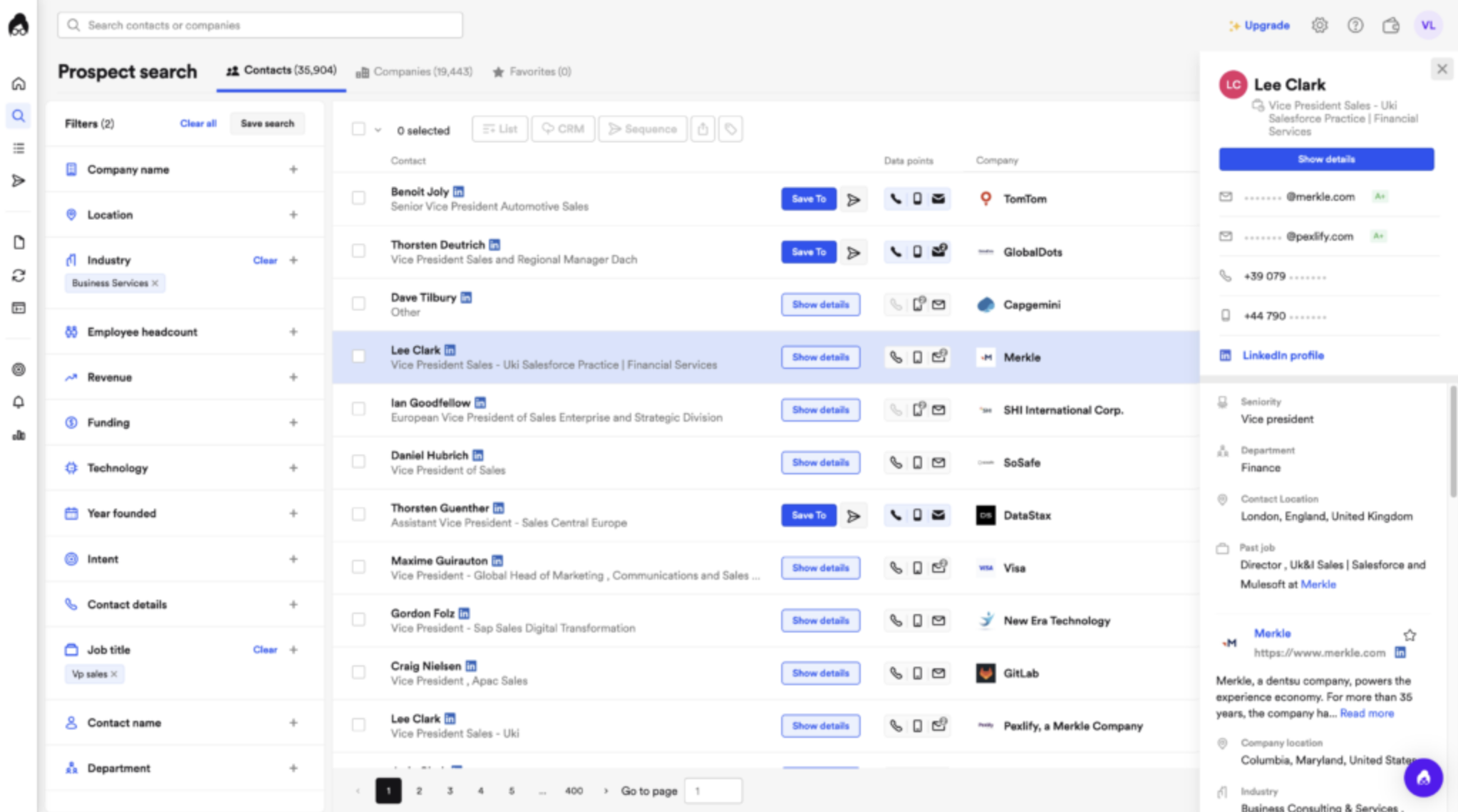
Lusha is a B2B contact data and buying signals platform with three product surfaces: Workspace, API, and Extension. The platform serves 300,000+ GTM teams with contact enrichment, buying signal alerts, and CRM integrations.
A notable development is Lusha MCP, one of only three competitors with a documented MCP offering. Lusha MCP surfaces Lusha's B2B contact data to LLMs and AI agents, compatible with the Claude/ChatGPT/Anthropic agent ecosystem. The MCP server enables AI agents to look up and enrich contacts programmatically.
With a 4.3/5 rating on G2, reviewers like Lusha's easy prospecting but note its intent signals stay light and thin for niche or non-North-American markets.
Key Features:
Search and enrich B2B contacts via Workspace, API, and Extension
Buying signal alerts for account prioritization
CRM integrations (Salesforce + HubSpot)
Lusha MCP for AI agent integration
Credit-based pricing for flexible usage
Bulk enrichment capabilities
Pricing: Fully public. Free, Starter $37.45/mo, Pro $52.45/mo, Premium $299.95/mo, Scale custom.
Pros:
Transparent public pricing with multiple tiers
Strong SMB adoption (300,000+ GTM teams)
MCP offering for AI agent integration
Cons:
Smaller verified contact database than ZoomInfo's 500M
Lower verification rigor (no equivalent to ZoomInfo's 300+ human researchers and 95%+ accuracy)
MCP surfaces contact lookups only, not intent + intelligence + reasoning
How Lusha compares against ZoomInfo
Lusha wins on transparent public pricing and low-friction SMB adoption: its five-tier public pricing structure starting at free and scaling to $37.45/month Starter gives individual reps and small teams a self-serve path to B2B contact data that ZoomInfo's quote-based enterprise process cannot match for speed-to-value. ZoomInfo also offers a self-serve free tier with consumption-based pricing, giving individual reps and small teams their own low-friction path to start without a sales conversation.
ZoomInfo's edge is verified data accuracy backed by 300+ human researchers and 95%+ quality across 500M+ contacts (Lusha's database is smaller with lower verification depth), an MCP server exposing verified contact data, intent signals, account intelligence, and seller-workflow context to AI agents in a single call (Lusha MCP surfaces contact lookups only), and a full seller orchestration surface through GTM Workspace spanning sequences, AI-drafted messaging, deal intelligence, and CRM sync that goes beyond Lusha Workspace's search-enrich-manage scope.
See the Lusha vs. ZoomInfo comparison for the full head-to-head.
13. TrustRadius
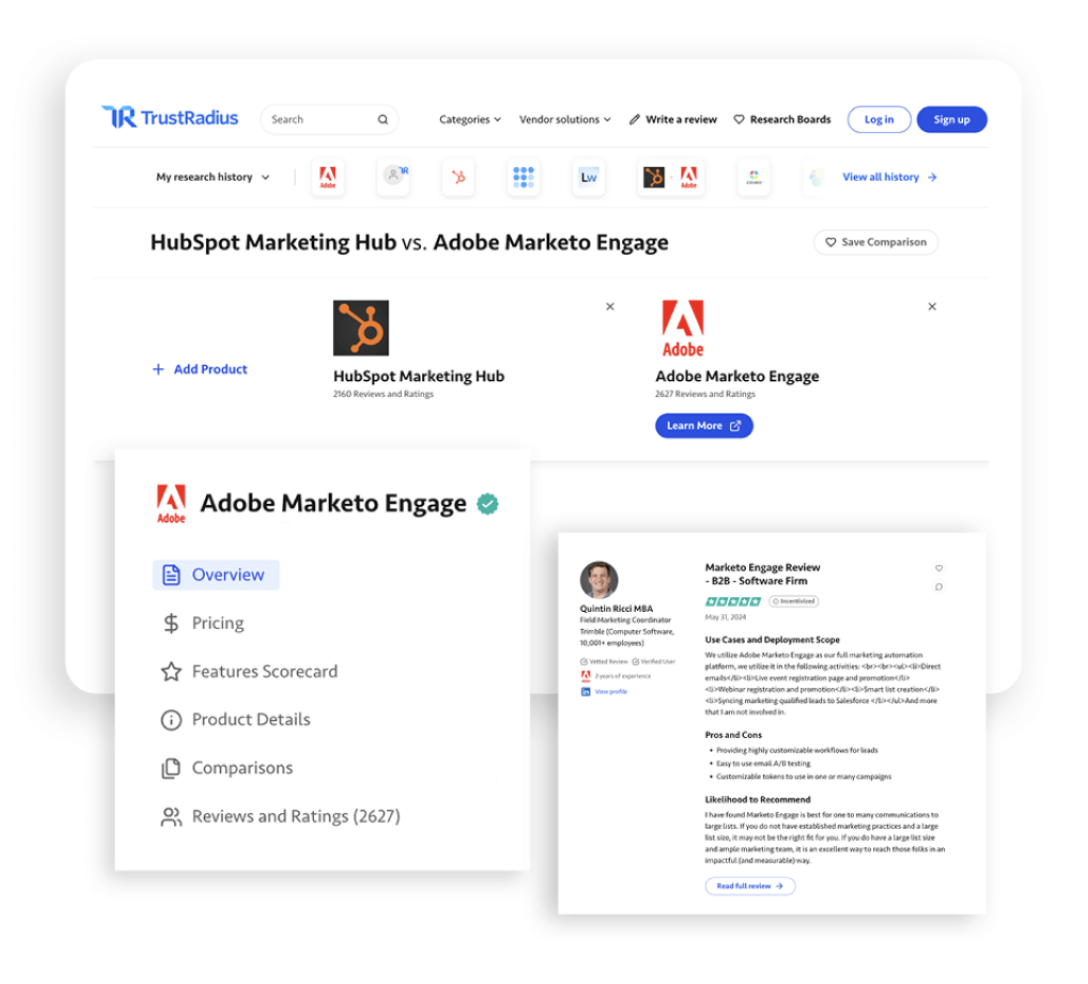
TrustRadius is a B2B buyer intelligence platform (acquired by HG Insights in June 2025) that monetizes on-platform buyer research as second-party "downstream" intent data.
The platform captures granular signals from in-market buyers researching vendors, comparing solutions, and reading detailed product reviews on TrustRadius.com, then routes those signals into vendor CRM, ABM, and paid media stacks. TrustRadius claims 54% mid-market and enterprise buyers with less than 20% audience overlap with G2, and its average review length exceeds 400 words with a 30% rejection rate for fraud or suspicious behavior.
With a 3.5/5 rating on G2, reviewers note TrustRadius skews toward major vendors, so its coverage (and the intent signal that rides on it) thins out for niche or smaller-vendor categories.
Key Features:
Second-party intent from on-platform buyer research (not inferred third-party bidstream)
Granular signals: pricing-page views, comparison views, demo views, feature evaluations
Salesforce Connector for CRM activation and churn alerts
Integrations with LinkedIn, Demandbase, and 6sense for ABM audience activation
Intent-Driven Leads program delivering ICP-qualified, opted-in leads
Content Licensing (TrustQuotes) for embedding review content on vendor websites
Use cases: net-new pipeline, competitive takeout, churn prevention, upsell
Pricing: Customer Voice Package starts at $30,000/product/year (multi-year discount available). Category Intent Data and Intent-Driven Leads are priced as add-ons; contact TrustRadius for details.
Pros:
Second-party signal quality: signals come directly from verified buyer research, not inferred from bidstream
Granular signal types (pricing views, comparison views, demo views) provide buying-stage context
Low audience overlap with G2 (less than 20%), making TrustRadius a complementary signal source
HG Insights acquisition adds technographic and switchability intelligence
Cons:
Account-level only: no contact-level decision-maker data (relies on ZoomInfo for contact resolution)
Audience scope limited to TrustRadius platform users
Software-only coverage (not applicable to non-software B2B categories)
No CRM or seller workflows of its own
How TrustRadius compares against ZoomInfo
TrustRadius wins on second-party intent signal quality: its downstream intent data is sourced directly from on-platform buyer research (pricing views, comparison views, demo views) rather than inferred from third-party bidstream data, giving vendors more conversion-proximate signals for competitive takeout and churn-prevention use cases.
ZoomInfo's edge is cross-web intent data spanning behavioral signals, CRM activity, technographic triggers, and account-level engagement data across the full buyer journey (TrustRadius captures only the fraction of research that happens on TrustRadius.com), a 500M+ contact database for direct contact resolution and seller activation that TrustRadius does not provide (TrustRadius's own ZoomInfo integration page positions the two as complementary precisely because TrustRadius relies on ZoomInfo for the contact-match layer), and native seller and marketer execution surfaces spanning ZoomInfo Sales, ZoomInfo Marketing, and GTM Workspace that TrustRadius does not offer.
Talk to our team for a head-to-head TrustRadius vs. ZoomInfo walkthrough.
14. Lead Onion
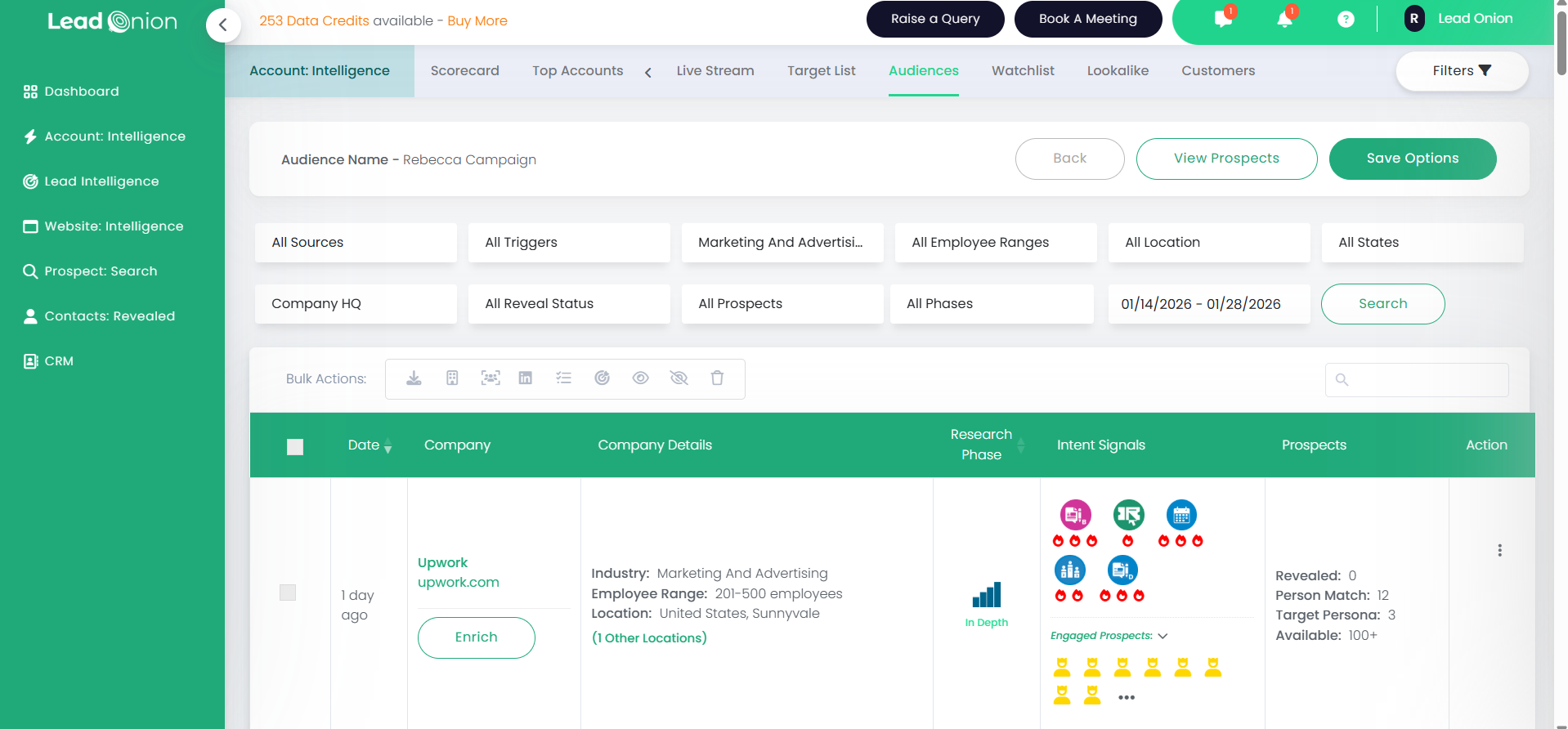
Lead Onion is a UK-based AI-powered buyer-intent and B2B sales-intelligence platform that unifies 24 third-party intent sources (including Bombora, Foundry, Cognism, G2, Delivr.ai, and PharosIQ) into a single interface.
The platform packages multi-source intent with verified contact data, native multi-channel cadences, and CRM sync (Salesforce, HubSpot, Microsoft Dynamics). Lead Onion's Research Quadrant maps each account to one of four buying-journey phases (Initial, Interested, Active, In-Depth), giving demand gen and sales teams a visual classifier for prioritization. The platform targets SMB-to-mid-market GTM teams, with public pricing starting at $500/month.
Lead Onion earns a 4.2/5 on G2, where reviewers highlight its multi-source intent and hands-on support but repeatedly call out a clunky onboarding and dated interface.
Key Features:
24 unified third-party intent sources in a single platform
Research Quadrant buying-journey classifier (Initial, Interested, Active, In-Depth)
Intent Qualified Leads (IQLs) with verified email, direct dial, and LinkedIn profile per contact
Website visitor identification (company-level via IP Flow; person-level via Delivr.ai for US contacts)
Native multi-channel cadences (email, call, LinkedIn) with auto-enrollment on surge thresholds
Aimee AI agent: domain-input intent discovery generating a buyer-intent campaign + contacts + cadence in under 3 minutes
Pricing: Starter $500/month, Growth $1,750/month, Scale $3,000/month, Enterprise POA. Topic Intent capped at 3 topics across all tiers.
Pros:
Lowest public entry price among all-in-one intent platforms ($500/month Starter)
24 aggregated intent sources provide broad signal coverage without multi-vendor procurement
Research Quadrant provides a visual buying-stage classifier for account prioritization
Native cadences and pipeline tracking eliminate the need for a separate sales engagement tool
Cons:
Smaller data footprint than enterprise-grade platforms (209M contacts, 100M emails, 110M dials vs. ZoomInfo's 500M contacts, 200M+ emails, 135M+ phones)
Topic Intent capped at 3 topics across all tiers
No conversation intelligence, APIs/MCP for AI agent builders, or equivalent analyst recognition
No Forrester Wave or Gartner MQ recognition
How Lead Onion compares against ZoomInfo
Lead Onion wins on intent-source breadth at SMB price points: aggregating 24 third-party intent sources (Bombora, G2, Cognism, Foundry, and others) into a single Research Quadrant interface at a $500/month Starter entry price that is substantially lower than ZoomInfo's enterprise pricing.
ZoomInfo's edge is first-party intent signals generated from its own 1.5B+ daily data points across verified contact interactions, web behavior, and account activity (Lead Onion aggregates 24 third-party sources but produces no first-party signals of its own), a contact database covering 500M+ contacts with 200M+ verified emails and 135M+ verified phone numbers compared to Lead Onion's 209M contacts, 100M emails, and 110M direct dials, and Forrester Wave Q1 2025 Leader recognition for intent data while Lead Onion carries no equivalent analyst recognition and caps Topic Intent at 3 topics across all tiers.
Talk to our team for a head-to-head Lead Onion vs. ZoomInfo walkthrough.
15. Datarade
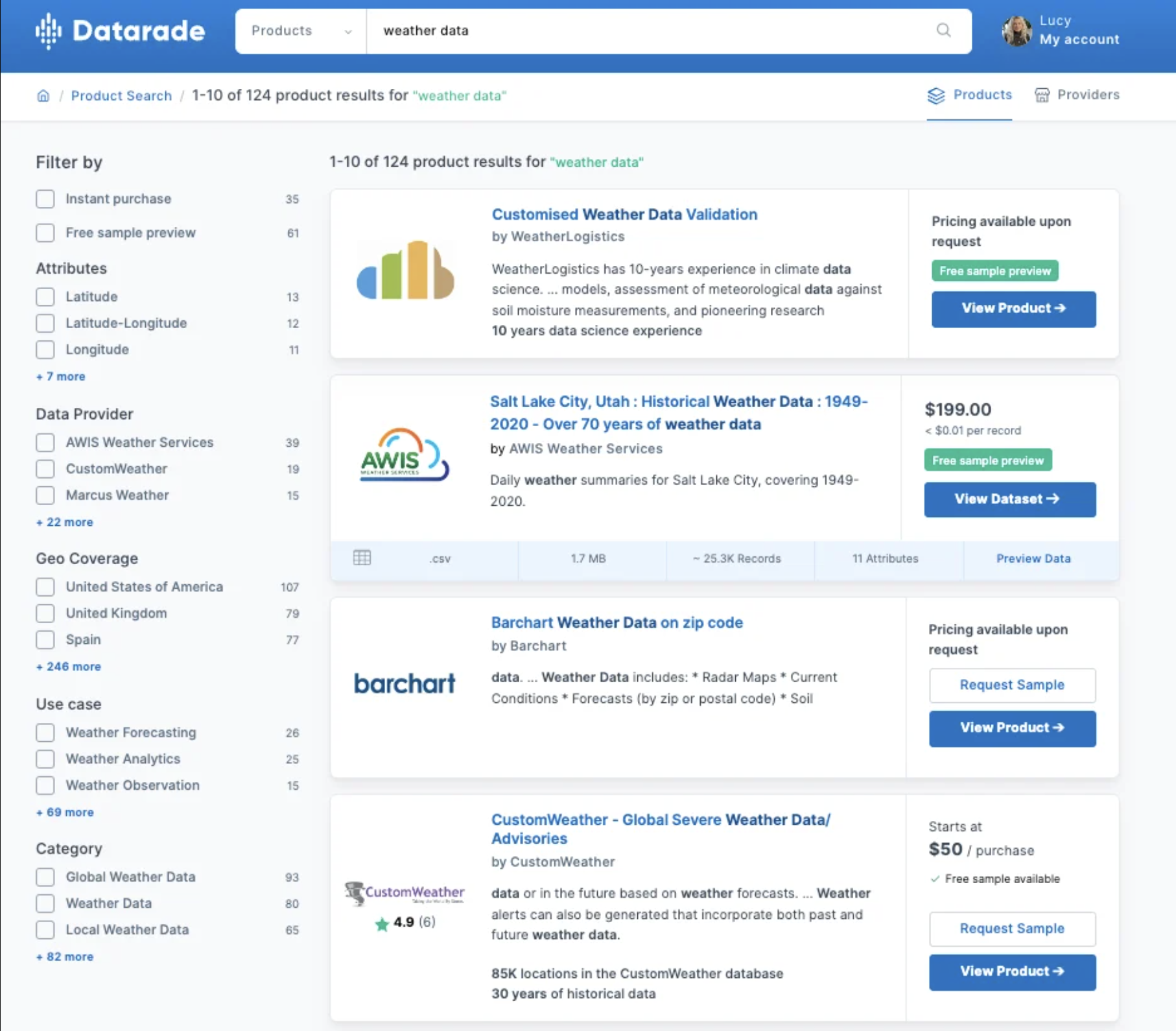
Datarade is a Berlin-based data marketplace (founded 2018) with a 4.5/5 rating on G2. It connects buyers with 2,600+ third-party data providers across 560+ data categories.
Datarade is a procurement and discovery layer, not a GTM tool: buyers search, compare, and procure datasets from competing providers in one catalog, with free sample previews and complimentary sourcing advice from in-house data acquisition specialists. The platform is free for buyers (Datarade is paid by the provider on purchase) and includes a provider-side Data Commerce Cloud
SaaS used by 500+ data providers to list and monetize datasets.
Key Features:
Marketplace spanning 2,600+ data providers across 560+ categories (B2B data, financial, geospatial, consumer, healthcare, AI training)
Free sample previews and pricing benchmarks across competing providers
AI-Ready Data Search hub with RAG API, MCP server, and AI agent integration listings
Data Commerce Cloud (provider-side SaaS) for listing and monetizing datasets
Datarade AI Chat for conversational marketplace queries
Post-a-data-request workflow that lets providers come to buyers
Pricing: Free for buyers. Data Commerce Cloud (provider SaaS) pricing is contact-sales. Per-dataset pricing set by individual providers on the marketplace.
Pros:
Neutral multi-vendor marketplace for comparing intent data providers side by side
Free for buyers with complimentary sourcing advice
Broadest category coverage (560+ data categories) for teams evaluating multiple data types beyond intent
AI-Ready Data Search surfaces datasets for RAG, MCP, and AI agent use cases
Cons:
Sells no first-party data of its own (routes buyers to third-party providers)
No unified intent reasoning, prospecting workspace, or activation tooling
No GTM workflow, seller surface, or marketer activation layer
Per-dataset quality varies by provider; Datarade does not verify underlying data
How Datarade compares against ZoomInfo
Datarade wins as a neutral procurement layer: its marketplace of 2,600+ third-party data providers across 560+ categories lets buyers compare, sample, and benchmark competing data vendors side-by-side without committing to a single vendor's ecosystem.
ZoomInfo's edge is first-party verified contact and company data maintained in-house rather than routing buyers to third-party providers, unified prospecting, sequencing, and ABM activation surfaces through GTM Workspace, ZoomInfo Sales, and ZoomInfo Marketing that Datarade does not offer, and an APIs and MCP layer exposing verified contacts, intent signals, and account intelligence in one call while Datarade's Data Commerce Cloud serves data providers, not buyers building GTM automation.
Check out our full Datarade breakdown.
Turn intent signals into pipeline with ZoomInfo
The 15 platforms split three ways: pure-play data layers (Bombora, G2, TrustRadius) that need another tool to act on their signals; point solutions (Lead Forensics, Leadfeeder, Lusha) that own one slice of the funnel; and full GTM platforms (6sense, Demandbase, ZoomInfo) that pair intent with activation.
Across every profile, the pattern holds: signals are easy to buy, activation is where programs stall. The right pick depends on your stack. But if you need one system that surfaces in-market accounts, resolves the people to reach, and pushes them into your demand gen and sales workflows, ZoomInfo pairs the category's largest verified B2B data foundation with native activation through GTM Studio and GTM Workspace.
Book a demo to see how ZoomInfo turns intent signals into pipeline.
Frequently asked questions
What is the difference between a buyer intent data platform and an ABM platform?
A buyer intent data platform identifies which accounts are actively researching a purchase by tracking behavioral signals across the web and proprietary networks. An ABM platform uses that signal, along with firmographic and CRM data, to orchestrate targeted campaigns across channels. Many modern platforms combine both capabilities, but intent data is the underlying fuel and ABM is the activation layer. ZoomInfo embeds intent signals directly into GTM Workspace so teams can act on intent through their buying signals platform without switching tools.
What is the difference between first-party and third-party intent data?
First-party intent data comes from your own digital properties: website visits, content downloads, demo requests, and product usage signals that only you can see. Third-party intent data is aggregated from external publisher networks, review sites, and B2B content platforms, revealing research activity happening outside your owned channels. The most actionable buyer intent data platform strategies layer both: first-party signals confirm known interest, while third-party signals surface accounts you haven't yet engaged. ZoomInfo sources third-party signals through a curated network and combines them with first-party behavioral data through the GTM Context Graph.
How does AI improve buyer intent data platforms?
AI improves intent platforms across three dimensions: signal aggregation (processing billions of behavioral data points daily to surface patterns no human analyst could detect at scale), predictive scoring (ranking accounts by purchase likelihood based on signal recency, topic clustering, and firmographic fit), and workflow automation (triggering outreach sequences, ad audiences, or CRM tasks the moment an account crosses a scoring threshold). The risk is over-reliance on AI-generated scores without understanding the underlying signal sources. Platforms that expose their ZoomInfo Intent signals methodology are more trustworthy than black-box scores.
Can intent data replace cold outreach?
Intent data does not replace cold outreach. It makes outreach significantly warmer by identifying accounts that are already in an active research cycle. A rep reaching out to an account that has been consuming competitor comparison content for two weeks is not cold; they are timely. The practical shift is from volume-based prospecting to prioritized sequencing: intent signals tell you who to call first, not whether to call at all. Smartsheet increased MQLs 84% using intent-driven prioritization, which reflects better sequencing rather than the elimination of outbound motion.
How do you choose the right buyer intent data platform for your team?
Start with signal coverage, does it track the topics and networks your buyers actually use? Then data freshness, since signals decay fast and daily updates beat weekly batches. Then activation, can it push scores into your CRM, MAP, and ad tools without manual export? Finally, does it pair intent with verified contact data, or will you stitch that together separately? Platforms that unify all three cut the operational overhead that kills most intent programs.