

Kickbox is an email verification tool that does what it promises: it checks whether the addresses on your list are real before you hit Send. For teams dealing with bounced emails, damaged sender reputations, or contact databases full of dead addresses, that promise has real value. But email verification is only one piece of the data quality puzzle, and how you solve it depends on where your data problems start.
To write this Kickbox review, we've analyzed it extensively. We believe it's the right choice if:
You need to verify an existing email list before a major campaign or ESP migration
You want real-time verification at signup forms to block invalid addresses on entry
You value a credit-based, pay-as-you-go model with no subscription commitment
You need SOC II, GDPR, and CCPA compliance for procurement approval
You want access to human deliverability consultants alongside the software
However, Kickbox might not be the best choice if:
Your data quality problems extend beyond email addresses to contacts, companies, and org charts
You need verified B2B contact data in the first place, not just verification of what you already have
You want intent signals, technographics, and buyer behavior data alongside clean emails
You need a platform that connects data quality to sales execution and pipeline generation
Your team spends more time cleaning data than acting on it
In this case, you should consider ZoomInfo: an AI-powered GTM platform that addresses the root cause behind most email verification needs.
Instead of cleaning questionable contact data after the fact, ZoomInfo provides 200M+ verified business email addresses and 135M+ verified phone numbers as part of a B2B intelligence platform, backed by 300+ human researchers and up to 95% accuracy on first-party data. For B2B teams, that means starting with clean, verified data rather than constantly scrubbing what you've collected.
We've included a detailed look at ZoomInfo later in this Kickbox review, as an alternative for teams whose data challenges go beyond email verification. If you're ready to explore what starting with verified data looks like, you can learn more about ZoomInfo here.
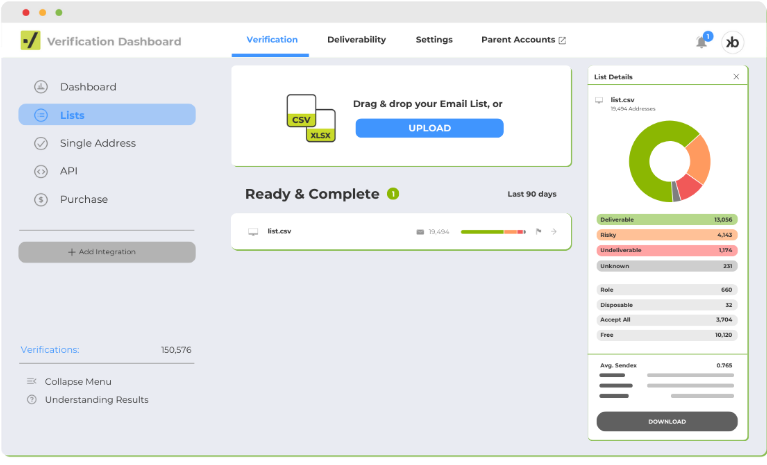
What is Kickbox?
Kickbox is a cloud-based email verification platform founded in 2014 by Daniel Stevens and headquartered in New York, with an EMEA office in London.
Source: Kickbox
The founding team brought over a decade of experience in email infrastructure and anti-abuse work, having previously run an email sending platform. That background gave Kickbox a technical edge at launch: addresses that had already passed through their sending infrastructure could be verified from first-hand data, not just SMTP probing.
The company bootstrapped to acquisition with no outside funding and was acquired by Ziff Davis in August 2020. It now operates as a subsidiary under J2 Martech Corp, alongside Campaigner, iContact, SMTP.com, and FullContact. Kickbox describes itself as "the verification and deliverability intelligence layer of the Ziff Davis Martech Division."
Kickbox's product line has three parts: Email List Verification for bulk list cleaning, an Email Verification API for real-time validation at the point of capture, and Deliverability Consulting for expert-led guidance. The platform serves over 150,000 senders.
Kickbox's stated mission is to "Move Email Forward", ensuring that senders with opt-in contacts get their messages to the inbox. The company is a member of M3AAWG (the Messaging, Malware and Mobile Anti-Abuse Working Group), holds SOC II Type II certification, and maintains GDPR and CCPA compliance with dedicated EU servers.
Kickbox Pros & Cons
Pros | Cons |
|---|---|
- 95% delivery guarantee with financial backing | - "Risky" classifications lack explanation or reasoning |
- Proprietary Sendex quality score (0-1 scale) | - Pricing perceived as premium vs. competitors |
- 100 free verifications, no credit card required | - No internal caching (re-verifying same email costs again) |
- SOC II, GDPR, CCPA compliant with M3AAWG membership | - Accuracy gaps for disposable and accept-all domains |
- 25+ native ESP/CRM integrations | - Credits expire after 12 months |
- Developer-friendly API with sandbox mode | - No automated deliverability monitoring tools |
- Human deliverability consulting available | - UI perceived as dated relative to pricing tier |
- Credit-based pricing with no subscription lock-in | - Limited to email verification only |
Kickbox Review: How it Works & Key Features
Email List Verification: Kickbox cleans existing contact lists through bulk upload with granular result classification.
Kickbox Email List Verification lets marketers upload an existing contact list and receive a validated, annotated version before sending campaigns.
The problem it solves is list decay: email addresses collected over time accumulate invalid entries as people change jobs, abandon inboxes, or enter typos. Sending to these addresses produces bounces that damage sender reputation with mailbox providers like Gmail and Yahoo, reducing inbox placement across all future sends.
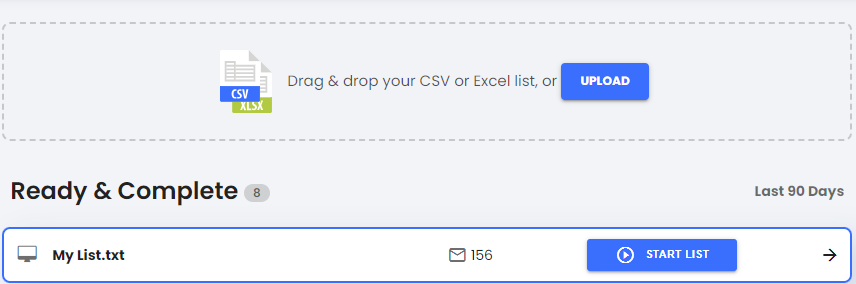
The workflow is straightforward. Users upload a file in CSV, Excel, or ODS format, with lists supporting up to 1 million addresses and 250MB per batch.
Source: Kickbox
Kickbox preserves any additional columns in the file and appends verification results to the end of each row, so the output keeps the original structure with new verification data added. Users can also skip file uploads and import lists directly from a connected ESP or CRM, with 25+ integrations including HubSpot, Mailchimp, Klaviyo, and Campaign Monitor.
Every verified address receives one of four classifications: Deliverable (the mail server confirmed the recipient exists), Undeliverable (the address doesn't exist or has invalid syntax), Risky (accept-all, disposable, or role addresses), or Unknown (the server was unreachable).
Beyond these categories, Kickbox returns one of eleven distinct reason codes per address and flags for free email providers, disposable domains, and role-based addresses like support@ or info@.
The distinguishing feature is the Sendex score, a proprietary quality metric from 0 to 1 assigned to every address. Rather than returning a binary valid/invalid result, this score shows the relative quality of each contact. Scores of 0.70-1.00 indicate "Good" quality for marketing email, 0.40-0.69 "Fair," and below 0.40 "Poor."
Kickbox backs its "Deliverable" classification with a 95% Delivery Guarantee: if more than 5% of messages sent to addresses marked Deliverable bounce, Kickbox issues a refund. Unknown results do not count against the user's verification balance, meaning you only pay for definitive results.
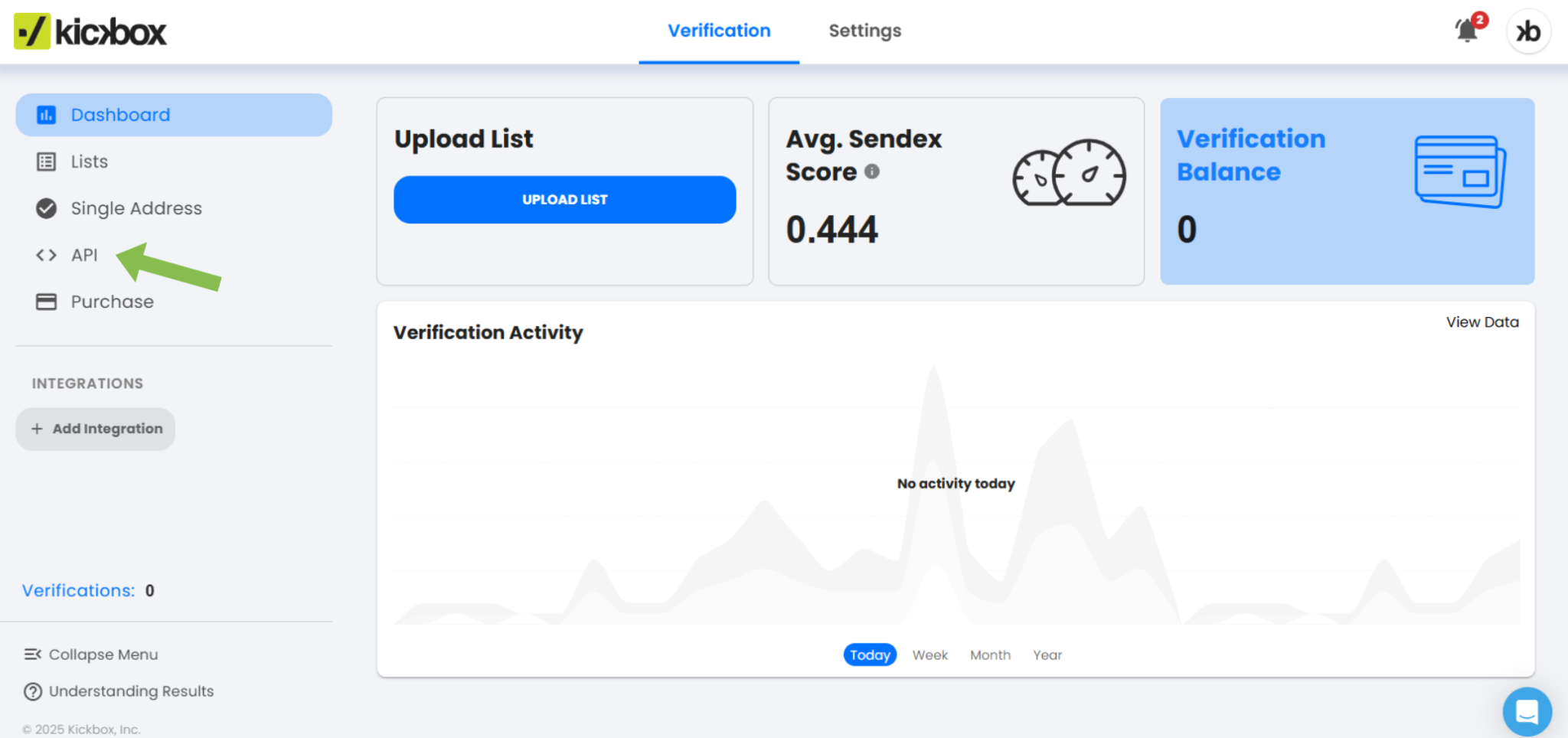
Email Verification API: Real-time validation blocks bad addresses at the point of capture.
The Email Verification API is built for developers who need to verify email addresses the moment they're collected, whether during account registration, checkout, or form submission. Without real-time verification, organizations accumulate fake addresses, typos, and disposable emails that degrade sender reputation over time.
Source: Kickbox
The API has two verification modes. The Single Verification endpoint verifies one email synchronously via a GET request, returning a JSON response with the result classification, reason code, boolean flags for role/free/disposable/accept-all, a typo correction suggestion via the did_you_mean field, and the Sendex quality score. The default timeout is 6,000ms with a maximum of 30,000ms.
The Batch Verification endpoint handles asynchronous bulk processing, accepting up to 1 million addresses per request. Callers can poll for completion or supply a webhook URL via the X-Kickbox-Callback header for push notification when the job finishes.
The typo correction feature is useful at signup forms. When someone enters "user@gmial.com," the API's did_you_mean field suggests "user@gmail.com," letting applications prompt correction before a potential customer is lost.
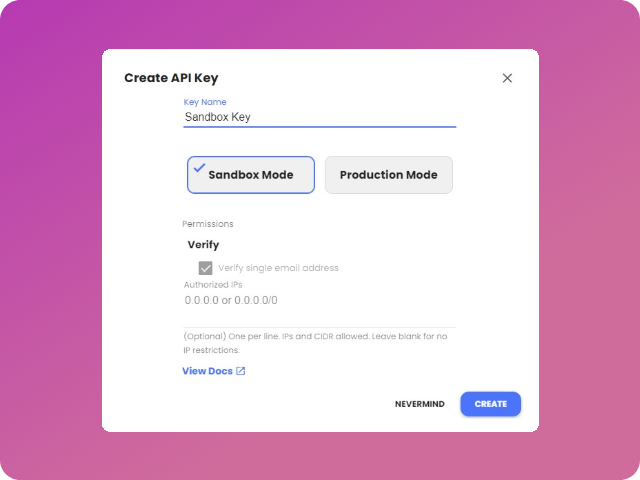
A sandbox mode lets developers test the full integration using a test API key (prefixed test_) that returns mock results without consuming credits. Official client libraries exist for Node.js, PHP, Python, and Ruby, with community libraries covering Java, Go, Laravel, .NET, and Classic ASP.
Source: Kickbox
Kickbox also offers Spike Detection Alerts (currently in beta), which notify teams by email when API verification volume exceeds a configurable threshold, helping identify bot attacks or form abuse in real time.
Deliverability Consulting: Expert-led diagnosis and remediation for inbox placement problems.
Kickbox Deliverability Consulting fills a gap that most email verification platforms don't touch.
When emails land in spam despite clean lists, the problem usually lies elsewhere: authentication records, IP reputation, sending cadence, or DNS configuration. Kickbox offers human experts who diagnose and fix these issues.
The engagement follows four stages: a free consultation to confirm fit, a formal Statement of Work, a two-week audit covering authentication (SPF, DKIM, DMARC), DNS, SSL, domain health, and email headers, followed by findings and a remediation plan with 12 weeks of post-audit support.
During this window, the team monitors implementation, reviews progress, and assists with outreach to blocklist operators and mailbox providers.
Named consultants include Al Iverson and Jennifer Nespola Lantz, both recognized figures in the email deliverability community. Kickbox restricts the service to opt-in email senders only; cold email senders are ineligible.
Pricing: Credit-based, pay-as-you-go with no subscription lock-in.
Kickbox operates on a credit-based model with no monthly subscriptions or seat fees.
Customers purchase a block of verification credits, and each email verified consumes one credit. Published tiers range from 100 free verifications (no credit card required) up to 1,000,000 credits at $2,999, with custom enterprise pricing above that.
The per-verification cost drops with volume. At 500 credits ($5), the rate is $0.010 per verification. At 100,000 credits ($500), it drops to $0.005. At the 1,000,000-credit tier ($2,999), the effective rate reaches roughly $0.003 per address.
Every account, regardless of credit volume, receives the same feature set: list verification, API access, unknown results refunded, auto-recharge capability (capped at 3 events per 24 hours), and full support. Enterprise accounts add parent account management, multi-user access with role-based permissions, Okta SSO, and flexible billing terms.
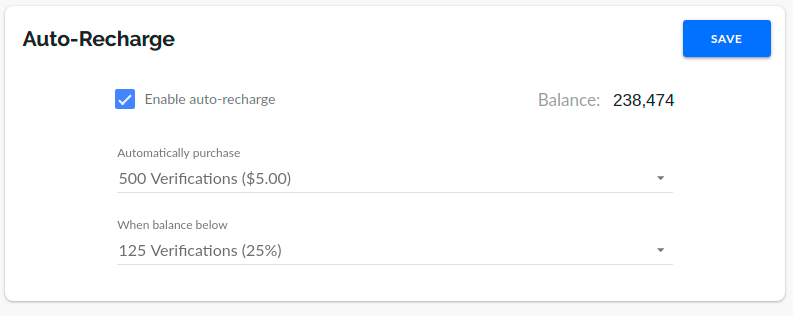
Source: Kickbox
One detail worth noting: credits expire one year from purchase, and unused credits are forfeited. Payments are non-refundable. There's no ongoing contract to cancel; not purchasing more credits ends the relationship.
Where Kickbox Falls Short
Kickbox does email verification well, but several limitations surface for teams whose data quality challenges extend beyond validating existing addresses.
"Risky" Results Without Explanation. The most cited weakness is the lack of reasoning behind "Risky" classifications. One marketing executive noted on Capterra that risky results come with "no data or reason behind them," making it impossible to decide whether to suppress or keep the contact.
When you're managing hundreds of thousands of addresses, a label without context creates more work, not less.
Accuracy Gaps on Difficult Domains. Some reviewers cite struggles with detecting disposable emails and catch-all ("accept-all") domains. Accept-all domains are an industry-wide challenge, but reviewers indicate Kickbox's handling of these cases lags some competitors. For teams relying on verification to gate access or block fraud, this matters.
Premium Pricing for Verification Alone. Multiple reviewers describe Kickbox as more expensive than alternatives like ZeroBounce, Emailable, and Bouncer. At higher volumes, the per-verification cost difference becomes meaningful. For a team processing 1 million emails, a fraction-of-a-cent difference per verification adds up to hundreds of dollars.
No Caching for Re-verification. The same email address verified multiple times is charged each time, since Kickbox does not maintain a user-accessible cache. For platforms running frequent re-engagement campaigns or periodic list hygiene, this cost compounds over time.
Verification Addresses a Symptom, Not the Cause. This is the structural limitation. Kickbox assumes you already have email addresses and need to check them. But for B2B teams, the deeper problem is often that the contact data was incomplete, outdated, or unreliable to begin with.
Verifying a bad list makes it a smaller bad list. It doesn't give you the right people at the right companies with the right context for reaching them.
No Automated Ongoing Hygiene. Kickbox wound down its automated deliverability monitoring tools (inbox placement testing, blocklist monitoring, DMARC reporting) after the Ziff Davis acquisition. Users who want combined verification and automated deliverability monitoring in a single platform will need to look elsewhere.
These limitations reflect Kickbox's deliberate focus on verification as a standalone utility. But they leave a gap for teams whose real need is pre-verified B2B contact data connected to the intelligence and execution tools that make that data useful.
Top Kickbox Alternative for B2B Teams: ZoomInfo
ZoomInfo addresses the problem upstream from where Kickbox operates.
Rather than verifying email addresses after you've collected them, ZoomInfo is an AI-powered GTM platform built on a large B2B data foundation: 500M contacts, 100M companies, 135M+ verified phone numbers, and 200M+ verified business email addresses.
Its GTM Context Graph, which processes 1.5B+ data points daily, unifies this data with your CRM records, conversation transcripts, and behavioral signals to reveal why deals move or stall. That intelligence reaches your team through the GTM Workspace for sellers, GTM Studio for marketers and RevOps, or APIs and MCP in any other front-end.
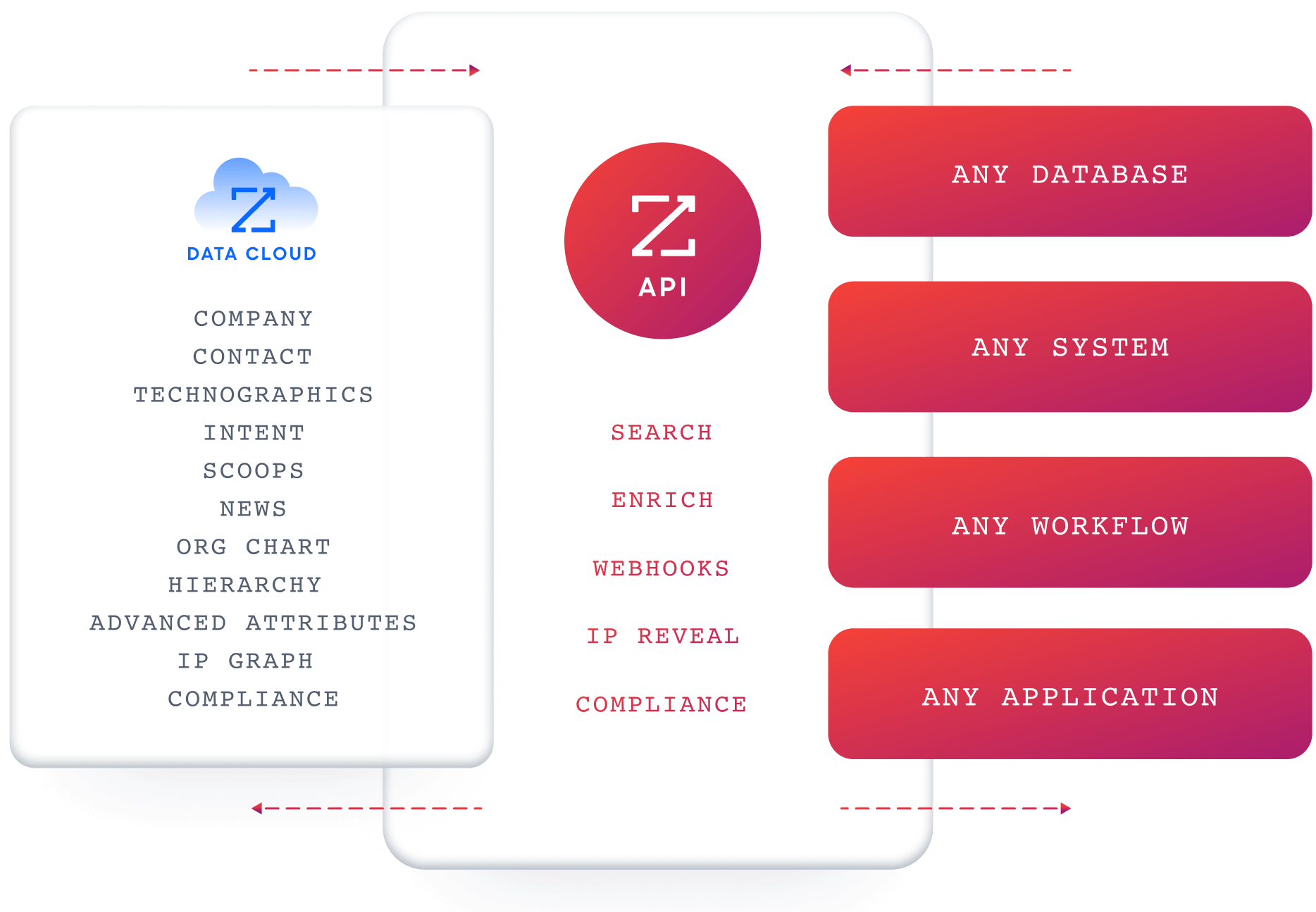
For B2B teams, this changes the math: rather than spending on verification to clean data of uncertain quality, you start with data that's already been verified through a multi-source pipeline backed by 300+ human researchers and achieving up to 95% accuracy on first-party data.
Comprehensive B2B Data: ZoomInfo maintains a large verified B2B contact and company database.
ZoomInfo's data covers three dimensions: identity data (who buyers are and how to reach them), company context (org charts, technographics, industry data), and dynamic signals (intent data and buying behavior).
The scale covers 500M contacts, 100M companies, 135M+ verified phone numbers, 120M direct-dial phone numbers, and 200M+ verified business email addresses, with global coverage including 34M+ company profiles outside North America and 200M+ professional profiles outside NA.
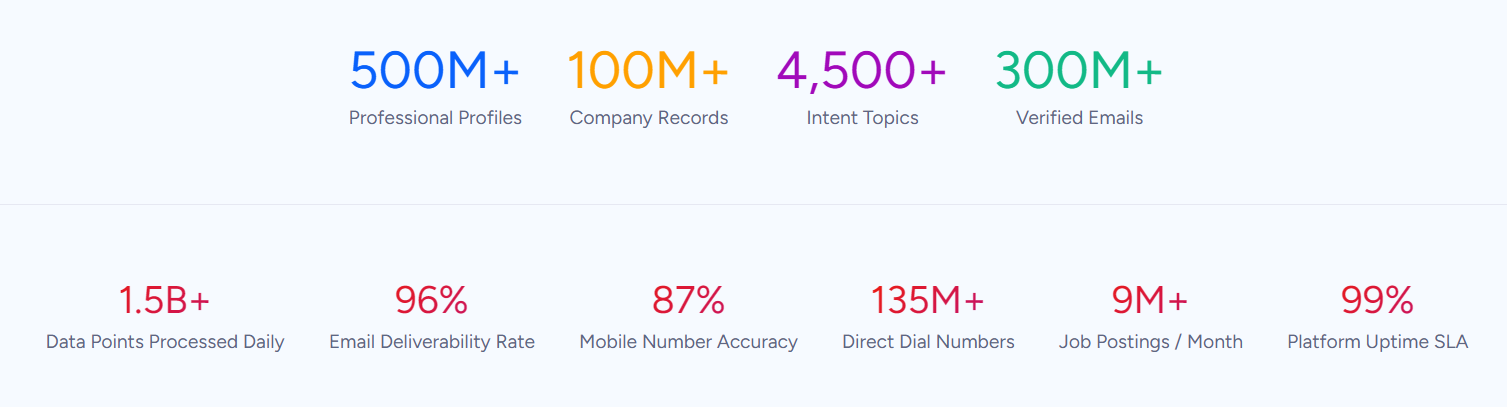
The data pipeline combines automated ML scanning of 28 million site domains daily, third-party partner data covering 95 million businesses, a community of 200,000+ ZoomInfo Lite users who share data back, and an in-house Data Training Lab of 300+ human researchers. ZoomInfo continuously tests, monitors, and updates records in real time when changes are detected.
The data quality isn't self-reported. In a Fortune 500 competitive RFP analyzing 25 million contacts across vendors, the independent consultant concluded that "no other competitor came even close." ZoomInfo has been named a Leader in the Forrester Wave for Intent Data Providers B2B (Q1 2025) and a Leader in the Gartner Magic Quadrant for ABM Platforms for two consecutive years.
For teams currently spending on email verification because their B2B contact data is unreliable, this changes the equation. Instead of collecting emails from forms and then paying to check them, you access pre-verified contacts with direct dials, company context, and org charts attached.
"ZoomInfo gives us the information we need to execute. We don't have to go through and spend our time digging. It's already there, so we can be three steps ahead." (Vensure)
GTM Context Graph: ZoomInfo captures why deals move or stall.
Clean data is a starting point.
The GTM Context Graph, which processes 1.5B+ data points daily, unifies ZoomInfo's B2B data with a customer's own first-party data (CRM records, conversation transcripts, email interactions, product usage signals) into a single intelligence layer. The result: AI that understands not just what happened in a deal, but why.
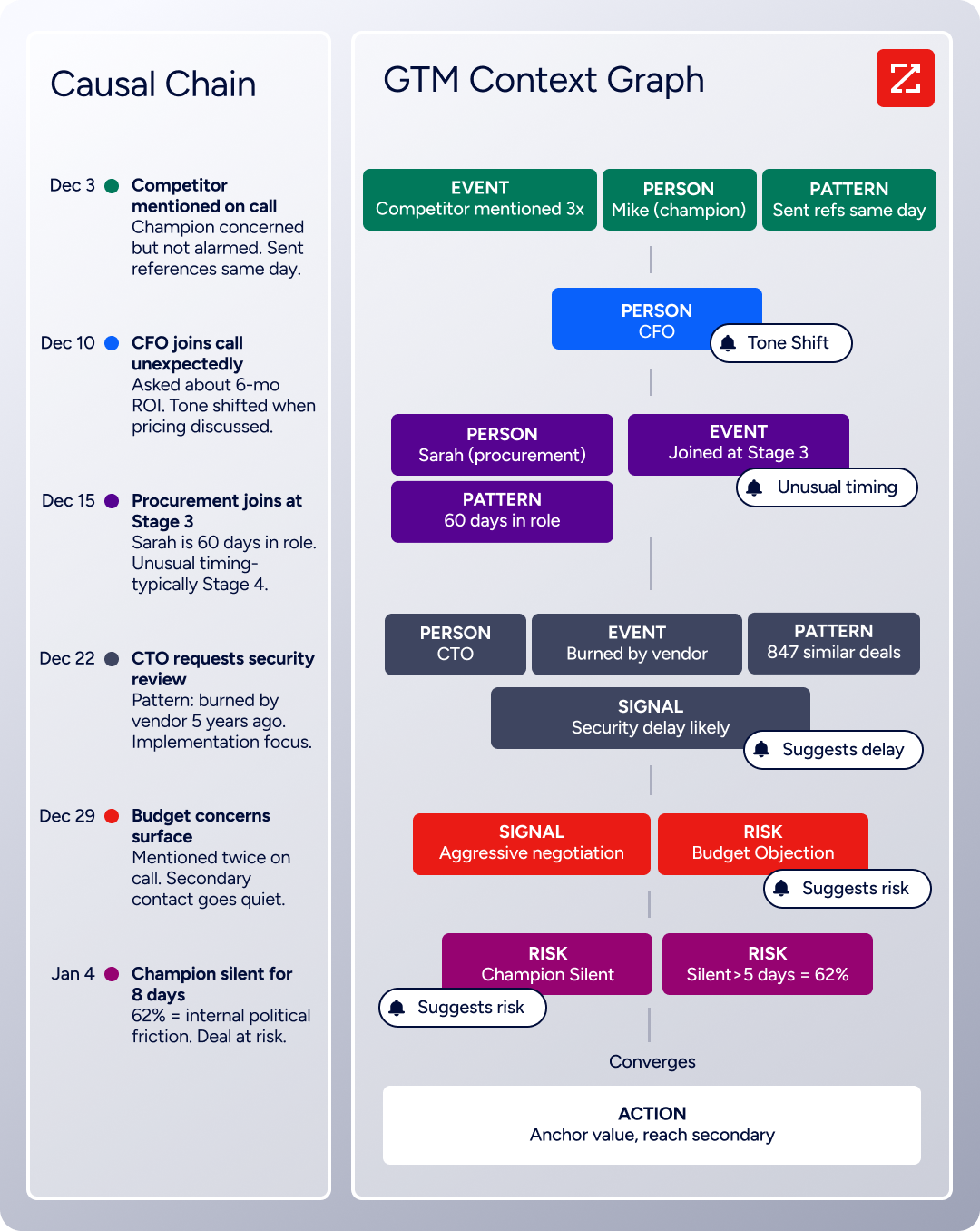
A CRM records that a deal moved stages. Conversation intelligence captures what the VP of Finance said on the last call. Intent data logs a spike in research activity.
The GTM Context Graph reasons across all three to identify the pattern, so follow-up emails address the specific concern the CFO raised, plays target accounts whose signal combinations match actual win patterns, and forecasts reflect buying evidence rather than rep optimism.
This intelligence layer exists because ZoomInfo spent two decades building the data unification infrastructure (entity resolution, identity matching, data quality at scale) and then acquired conversation intelligence engines like Chorus to capture the context behind every customer interaction.
Seismic attributed 39% of active pipeline to opportunities identified or influenced by ZoomInfo signals. "That combination of our internal CRM data, external signals, and AI that's given all that context has helped us craft very specific account- and persona-based messages." (Seismic)
Universal Access: Use ZoomInfo's intelligence in any tool, any workflow.
ZoomInfo delivers its intelligence through three channels.
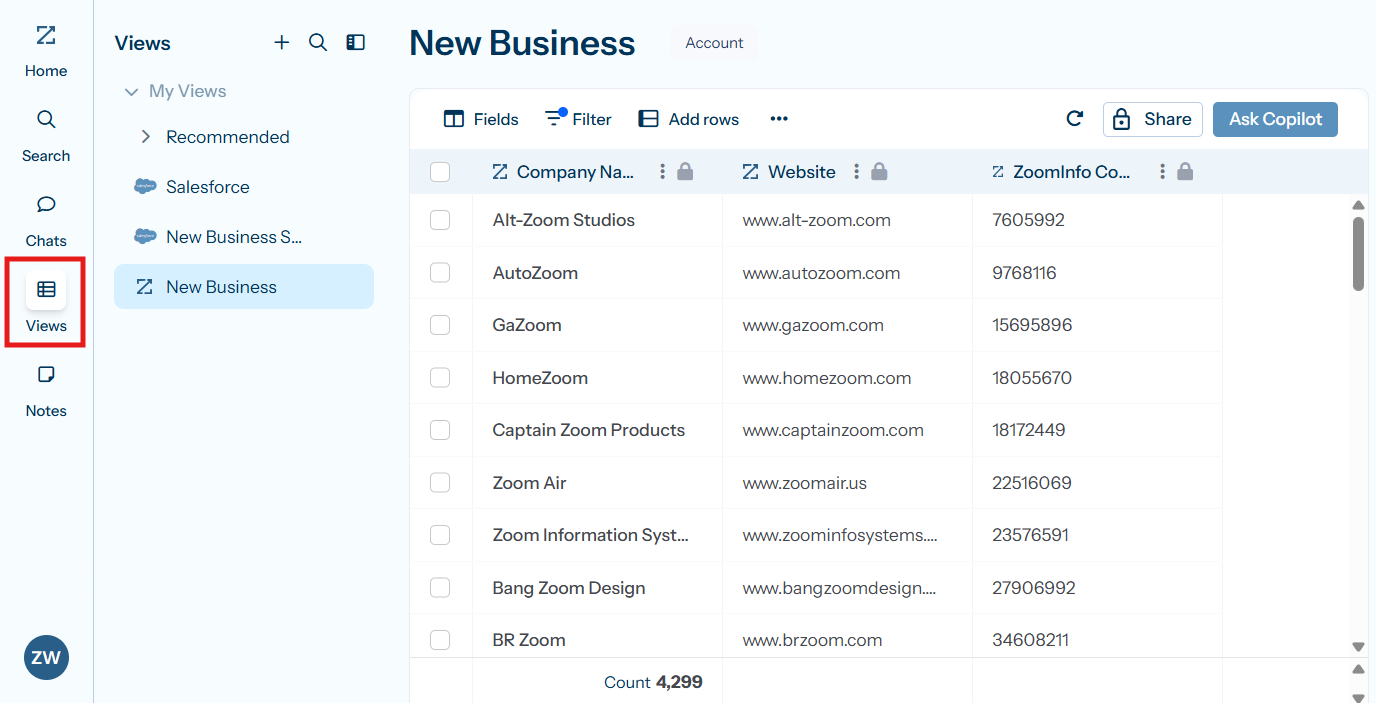
GTM Workspace gives sellers a single screen where prioritized accounts, AI-drafted outreach, and deal execution converge.
Source: ZoomInfo
GTM Studio gives marketers, RevOps, and GTM engineers a canvas where audience definition, campaign orchestration, and pipeline measurement happen in natural language. And for teams building beyond ZoomInfo's own products, APIs and MCP expose the same intelligence to any custom agent, internal tool, or partner platform.
All three draw from the same GTM Context Graph. Where you work never limits the intelligence available.
"The plug-and-play aspect of the API means I can integrate it easily into any process and get information at a moment's notice," with an 87% reduction in time spent on internal data dashboard updates. (BDO Canada)
Pricing: Custom-quoted, consumption-based with a permanent free tier.
ZoomInfo uses a consumption-based pricing model with no published prices.
Pricing scales around data access, API consumption, and AI activity. Sales plans come in three tiers (Professional, Advanced, Enterprise), with Marketing plans offered separately.
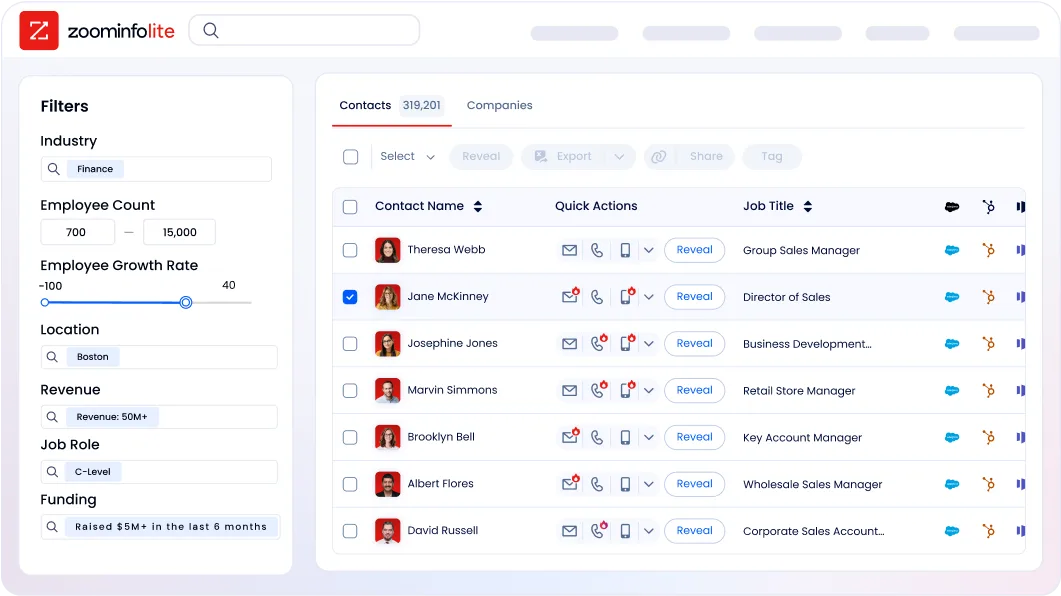
ZoomInfo Lite is a permanent free tier (not a trial) that includes access to ZoomInfo's B2B database, 10 monthly export credits, individual and company searches, contact information and email addresses, the ReachOut Chrome Extension, and HubSpot integration. A separate 7-day free trial provides broader access to paid features.
SpringDB used ZoomInfo's enriched data to achieve 2x-3x increases in campaign conversions, a 300% increase in database usability, and 20-40% reductions in customer churn. "You'll get 10x the value if you think of ZoomInfo as a full platform and not just a tool for one team." (SpringDB)
Kickbox or ZoomInfo: Comparison Summary
Aspect | Kickbox | ZoomInfo |
|---|---|---|
Primary purpose | Email verification and list hygiene | AI GTM platform with verified B2B data |
Core approach | Verify emails you already have | Provide pre-verified contacts, companies, and intelligence |
Email data | Validates existing addresses | 200M+ verified business emails included |
Phone data | Not available | 135M+ verified phone numbers, 120M direct dials |
Company intelligence | Not available | 100M companies with org charts and technographics |
Intent signals | Not available | Buyer intent from 210M IP-to-Organization pairings |
AI capabilities | Sendex quality scoring | GTM Context Graph, AI-drafted outreach, account research |
Integrations | 25+ ESP/CRM integrations, Zapier | 120+ Marketplace integrations, MCP, Enterprise API |
Compliance | SOC II, GDPR, CCPA, M3AAWG | ISO 27001, ISO 27701, SOC 2 Type II, TRUSTe GDPR/CCPA |
Free option | 100 free verifications | ZoomInfo Lite (permanent free tier) + 7-day trial |
Pricing model | Pay-as-you-go credits (from $0.003/verification) | Custom-quoted, consumption-based |
Best for | Cleaning existing email lists | B2B teams needing verified data, intelligence, and execution |
Final Verdict
The choice between Kickbox and ZoomInfo depends on what's causing your data quality problems and how broad your needs are.
Choose Kickbox if your primary need is cleaning email lists you've already collected. It does this well, with a 95% delivery guarantee, granular result classification through the Sendex score, and a pay-as-you-go model that requires no subscription.
If you're a marketer preparing for a critical send, an agency migrating client data between ESPs, or a developer blocking bad addresses at signup, Kickbox provides focused, reliable verification backed by strong compliance credentials.
Choose ZoomInfo if your data challenges extend beyond email verification into contact discovery, company intelligence, and go-to-market execution. For B2B teams, email verification is often a downstream symptom of starting with incomplete or stale contact data.
ZoomInfo addresses this at the source by providing 500M contacts and 200M+ verified business emails as part of a platform that includes intent signals, org charts, technographics, AI-powered outreach, and execution tools. Rather than paying to verify uncertain data, you work with contacts that are already verified and enriched with the context needed to act on them.
Get started with ZoomInfo here.
The distinction comes down to where in the data lifecycle your team spends most of its time. Kickbox solves a specific, well-defined problem at the verification layer. ZoomInfo reduces the need for that layer by starting with verified B2B data and connecting it to the intelligence and execution tools that turn data into pipeline.
Kickbox FAQ
What does Kickbox do?
Kickbox is an email verification platform that checks whether email addresses on your list are valid before you send campaigns. It classifies each address as Deliverable, Undeliverable, Risky, or Unknown, and assigns a proprietary Sendex quality score from 0 to 1.
The platform offers both bulk list verification (upload a file or import from your ESP) and a real-time API for validating addresses at the point of capture, such as signup forms or checkout flows.
How much does Kickbox cost?
Kickbox uses a credit-based, pay-as-you-go model with no monthly subscription. New accounts receive 100 free verifications with no credit card required. Paid credits start at $5 for 500 verifications ($0.010 each) and scale down to roughly $0.003 per verification at the 1,000,000-credit tier ($2,999). Credits expire 12 months after purchase. Enterprise customers can negotiate custom pricing and billing terms.
Does Kickbox guarantee accuracy?
Kickbox offers a 95% Delivery Guarantee: if more than 5% of messages sent to addresses it marked as Deliverable bounce, Kickbox issues a pro-rated refund. The platform claims greater than 99% deliverability for addresses classified as Deliverable, drawing on over 40 billion daily email signals. However, some reviewers note accuracy gaps with disposable email detection and catch-all domains.
What integrations does Kickbox support?
Kickbox offers native integrations with 25+ platforms including HubSpot, Mailchimp, Klaviyo, Campaign Monitor, Constant Contact, SendGrid, Braze, and Iterable.
Real-time verification workflows are supported with Braze, Customer.io, Iterable, and HubSpot. Via Zapier, Kickbox connects to ActiveCampaign, Salesforce, Marketo, MailerLite, and dozens more. The API supports Node.js, PHP, Python, and Ruby with official client libraries.
Does Kickbox offer deliverability consulting?
Yes. Kickbox is one of the few email verification platforms that offers professional deliverability consulting alongside its software.
The service includes a technical audit covering authentication (SPF, DKIM, DMARC), DNS, SSL, and sending practices, followed by 12 weeks of post-audit support. Named consultants include recognized industry experts. The service is restricted to opt-in email senders; cold email senders are ineligible. Pricing is custom and not publicly disclosed.
What is the Kickbox Sendex score?
The Sendex score is Kickbox's proprietary email quality metric, rated from 0 (no quality) to 1 (excellent quality). Unlike a simple pass/fail result, the Sendex score shows the relative value of each address.
For marketing email, scores of 0.70 to 1.00 are considered "Good," 0.40 to 0.69 "Fair," and below 0.40 "Poor." The score comes from machine-learning models trained on millions of email transactions processed per hour.
Is Kickbox secure and compliant?
Kickbox holds SOC II Type II certification, is GDPR and CCPA compliant, and is a member of M3AAWG. All data is transmitted over TLS 1.3, stored encrypted on AWS S3, and automatically deleted after 90 days.
Kickbox states it will never sell or share verified addresses. The platform supports two-factor authentication, Sign in with Google, and Okta SSO. Dedicated EU servers are available for accounts requiring European data residency. A public Trust Center is maintained at trust.kickbox.com.
How does Kickbox compare to ZoomInfo for B2B teams?
Kickbox and ZoomInfo address different parts of the data quality problem. Kickbox verifies email addresses you already have, making it useful for cleaning existing lists before campaigns or ESP migrations.
ZoomInfo provides pre-verified B2B contact data (200M+ verified business emails, 135M+ verified phone numbers, 500M contacts) as part of a GTM platform that includes company intelligence, intent signals, and AI-powered execution tools. For B2B teams, ZoomInfo addresses the root cause of data quality issues by starting with verified, enriched data, while Kickbox solves the symptom of cleaning data after collection.
More related comparisons and breakdowns:
