

Klenty has earned its following among growth-stage B2B sales teams that want structured, multi-channel outreach without the cost of enterprise platforms like Outreach or Salesloft. Founded in 2015 and bootstrapped to over 5,000 customers across 45 countries, it pairs reps with AI to handle research, email writing, dialing, and CRM updates, so SDRs spend their time on conversations instead of admin work.
To write this Klenty review, we analyzed the platform in depth. We believe it fits best if:
You run a defined outbound motion with a named target account list
You need multi-channel cadences spanning email, phone, SMS, WhatsApp, and LinkedIn in one tool
You want AI that drafts emails and handles post-call follow-up rather than just suggesting templates
You're an SDR team of 3-50 reps at a growth-stage B2B company
You need a parallel dialer without buying a separate calling product
You value responsive support and a fast setup over enterprise customization
However, Klenty might not be the best choice if:
You need B2B contact and company data built into the same platform
Your GTM strategy extends beyond sales engagement into marketing, ABM, and operations
You require buyer intent signals, technographics, or org chart intelligence at scale
You need reporting and analytics without exporting to your CRM
Your organization spans sales, marketing, and RevOps teams that need to work from shared intelligence
You're an enterprise buyer that needs SSO, multi-regional admin hierarchies, or custom governance
In this case, consider ZoomInfo: a GTM platform that starts where Klenty stops. Where Klenty focuses on executing outreach sequences, ZoomInfo provides the data foundation (500M contacts, 100M companies, 135M+ verified phone numbers, and 200M+ verified business emails), an intelligence layer to identify which accounts are worth pursuing, and execution tools to act on those signals, unified across sales, marketing, and RevOps.
We've included a detailed look at ZoomInfo later in this review for teams that have outgrown a dedicated sales engagement tool and need data-driven GTM across the full revenue organization. If you're ready to explore that, start with ZoomInfo's free trial.
What is Klenty?
Klenty is a sales engagement platform founded in 2015 by Vengat Krishnaraj and Praveen Kumar.
The co-founders reconnected after careers in technology and consulting, first launching a knowledge repository product that failed to gain traction. They pivoted to cold email automation after market feedback pointed them there, and landed their first paying customer shortly after.
The company is headquartered in California (Klenty Soft Inc.), with engineering and operations in Chennai, India. Klenty is bootstrapped, having grown without venture capital. Vengat Krishnaraj was a finalist for Bootstrap Champ at the Economic Times Startup Awards 2023, a sign the company can scale on customer revenue alone.
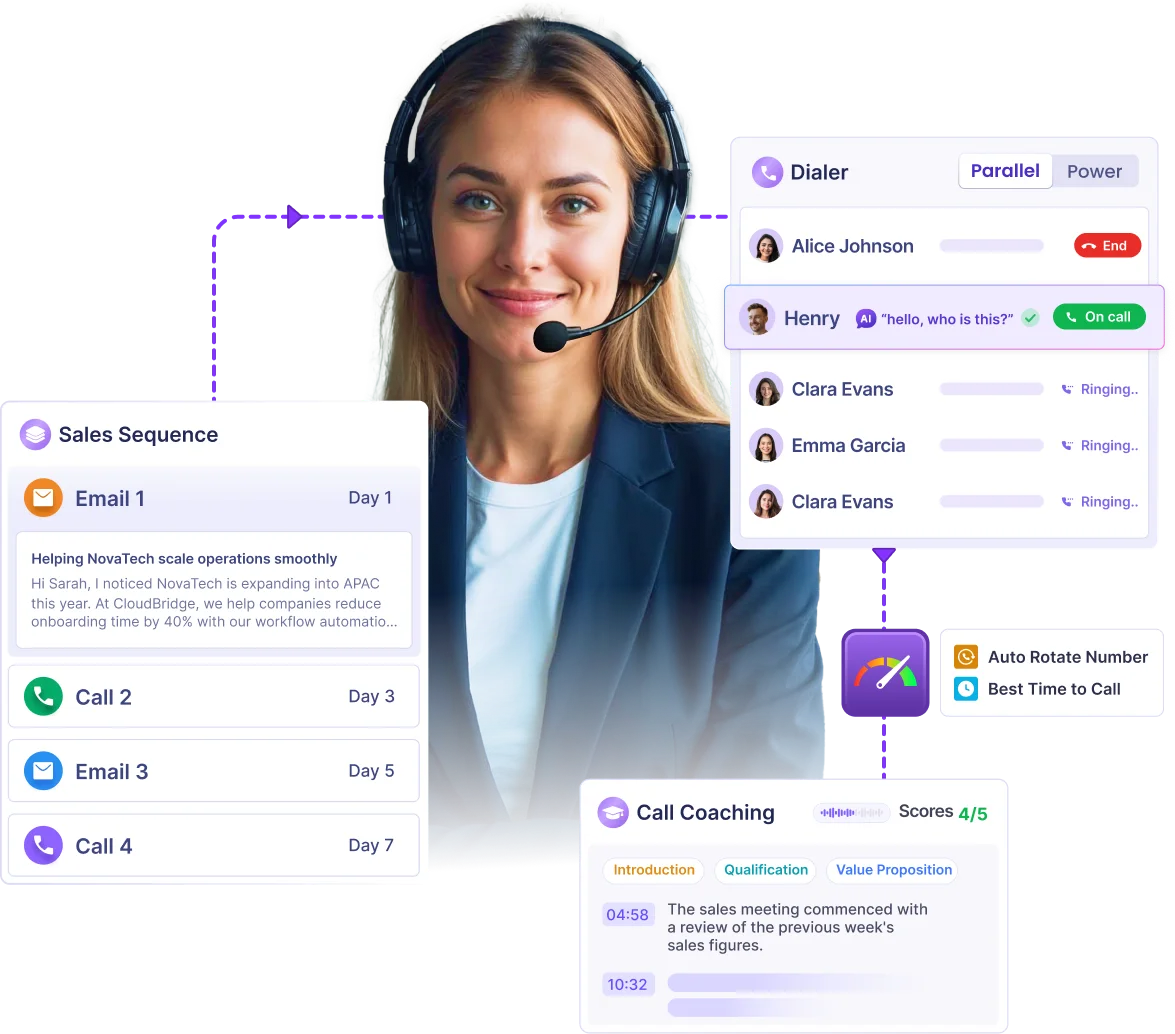
Today, Klenty serves 5,000+ sales teams across 45 countries, with 80+ employees and over 10 million sales emails sent through the platform. Its product has two pillars: Sales Engagement (multi-channel outreach, AI cadences, email deliverability, account-based selling) and a Dialer Suite (parallel dialer, power dialer, AI call coaching).
The platform integrates with Salesforce, HubSpot, Pipedrive, Zoho CRM, and MS Dynamics and holds HIPAA, SOC 2 Type 2, and GDPR certifications.
Source: Klenty
Klenty Pros & Cons
Pros | Cons |
|---|---|
Native multi-channel outreach (email, phone, SMS, WhatsApp, LinkedIn) | Reporting and analytics are difficult to read |
AI that executes tasks, not just assists (Agentic Cadences, Action AI) | No built-in B2B contact database |
Parallel and Power Dialer bundled in one product | Email warmup feature was removed in February 2023 |
Account-based selling with stage-triggered playbooks | Billing practices have drawn negative user feedback |
Competitive pricing ($50-$99/user/month) vs. enterprise SEPs | Mailbox limits constrain high-volume cold outreach |
Fast, responsive support (2.5-minute average response time) | No enterprise tier with SSO or multi-regional admin |
14-day free trial with no credit card required | LinkedIn tasks are semi-automated, not fully automated |
Klenty Review: How it Works & Key Features
Multi-Channel Cadences: Klenty runs outreach across five channels from one interface, with AI that adapts the sequence to each prospect's buying stage.
Klenty's cadence system is the core of the platform.
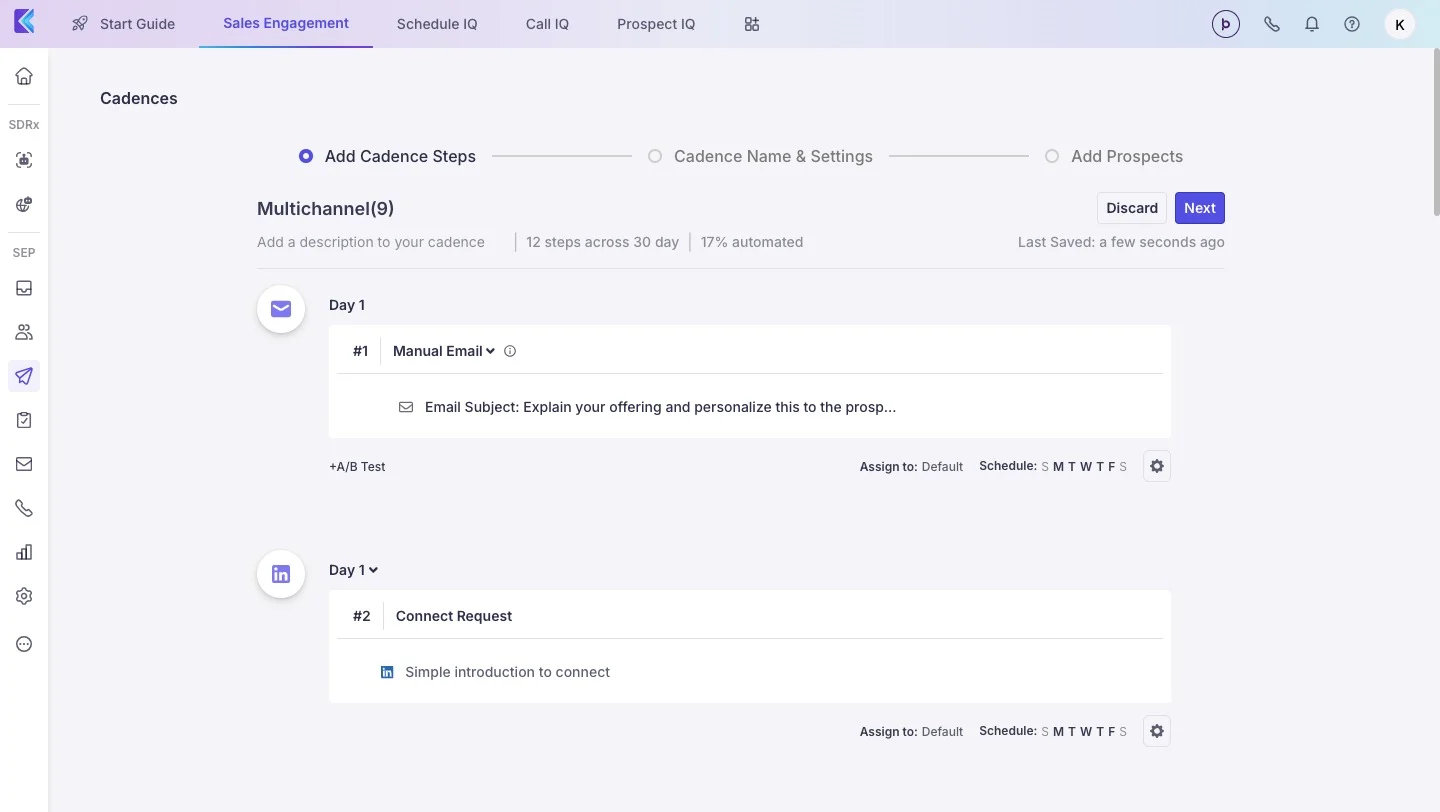
Reps build sequences combining email, phone calls, SMS, WhatsApp, LinkedIn, and manual tasks, set day intervals between steps, and configure delivery windows. They can build cadences from scratch, assemble them from predefined Blueprint frameworks, or let AI generate them.
Once live, emails send automatically (or wait for approval), calls launch from the built-in dialer, LinkedIn steps prompt the rep to act, and SMS/WhatsApp messages fire through Klenty's messaging layer. All replies feed into a Multi-Channel Inbox. Follow-ups pause automatically when a prospect replies, and reps can reorder or insert steps in active cadences without restarting them.
Source: Klenty
What separates Klenty from linear sequencers is the Cadence Playbooks layer.
Instead of running the same step order for every prospect, the Trigger Matrix detects where a prospect sits in their buying journey and adapts. Triggers span engagement-based signals (cold, warm, or hot), call outcomes (answered vs. voicemail), and CRM stage changes. Hot prospects get faster, personalized outreach. Unengaged contacts route into nurture sequences automatically.
On top of Playbooks, Agentic Cadences shift the rep's role entirely.
Instead of researching accounts and writing emails, reps approve AI-generated work. The AI researches accounts across 150+ public data sources and LinkedIn, writes cold emails using sales frameworks, and refreshes stale templates with AI Variables that insert researched subject lines, openers, and CTAs for each prospect.
Dialer Suite: Klenty bundles a parallel dialer, power dialer, and AI call coaching into one product.
Klenty's calling infrastructure is sold separately but integrates with its cadences. It covers four dimensions of outbound calling: speed, connect rate, call quality, and rep skill.
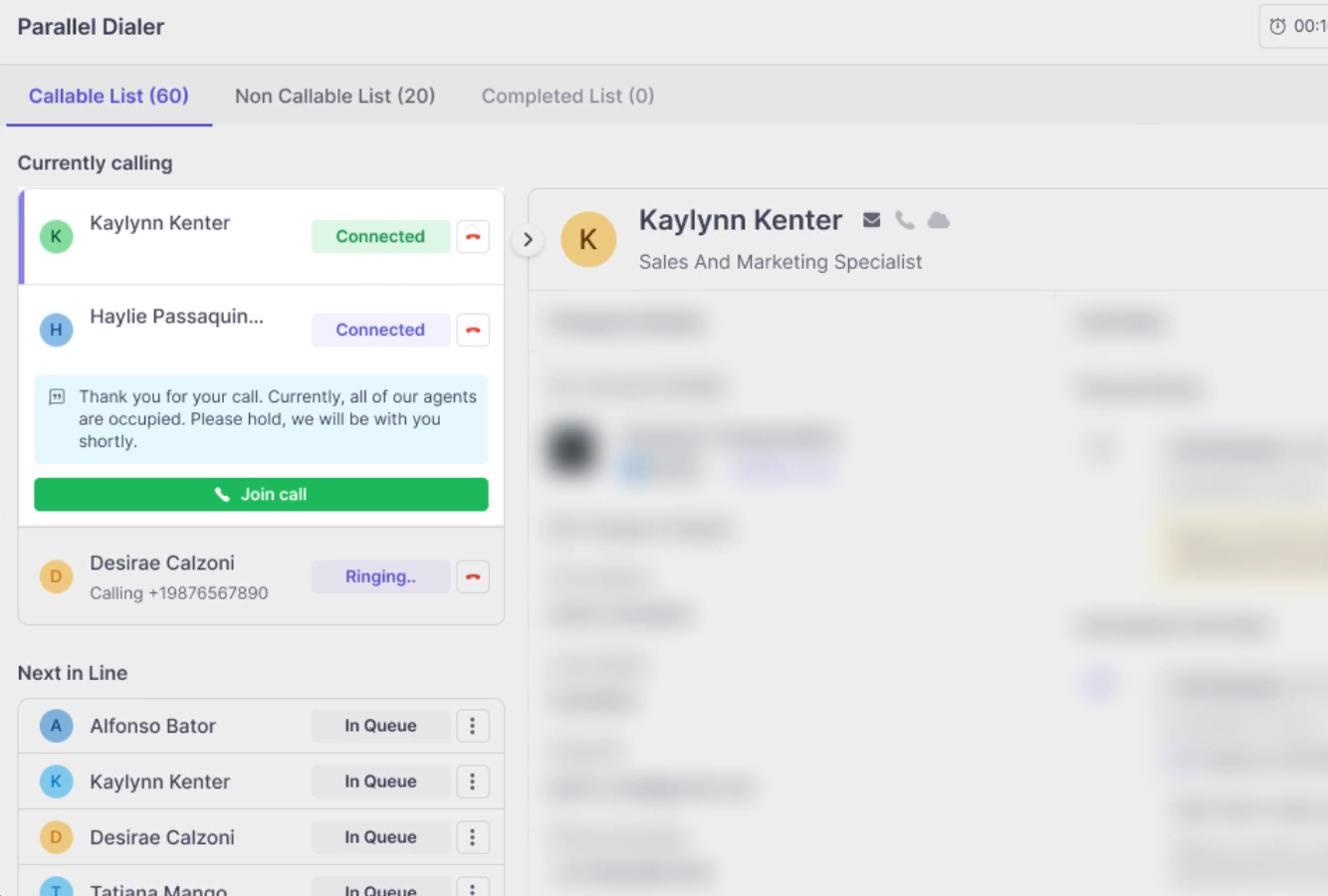
The Parallel Dialer calls up to five prospects at once. AI voicemail detection uses live transcription to identify human pick-ups in real time and connects the rep to the first live answer, dropping the rest. The result: 300-350 dials per hour and 10+ live conversations per hour.
Source: Klenty
The Power Dialer is for calls where conversation quality matters more. It dials prospects one at a time from a pre-built list, with the next number firing as soon as a call ends.
Connect AI sits on top of both dialers and manages the phone number pool. It rotates numbers based on health scores, gives each rep a private batch (no sharing), sets volume thresholds per number, and picks dial times using past connect data and prospect time zones. A live dashboard tracks pick-up rate, hangup rate, voicemail rate, and average call duration per number.
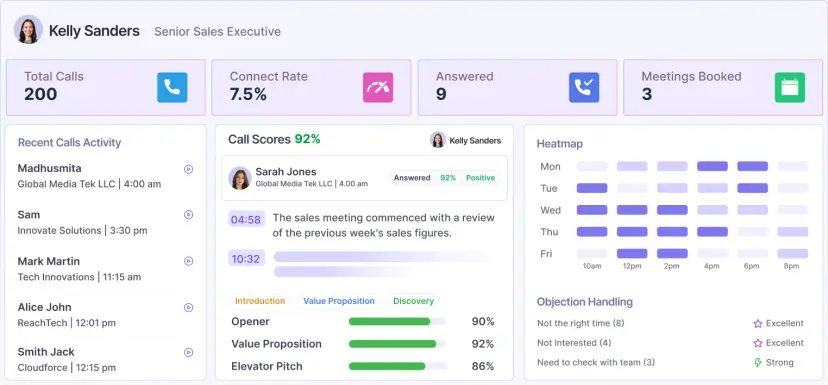
The AI Call Coaching Suite adds coaching to all calling activities. Salesfloor lets managers monitor live conversations and join calls in real time. Rep360 surfaces per-rep coaching data on activity volume, discipline, and talk-track gaps. AI Battlecards surface competitive information and objection-handling tips when specific phrases come up during live calls.
Source: Klenty
AI Features: Klenty's AI executes work rather than just suggesting it.
Klenty's AI acts on behalf of reps, positioning them as approvers rather than executors. Three components make up this layer:
Agentic Cadences handle the research-to-outreach pipeline.
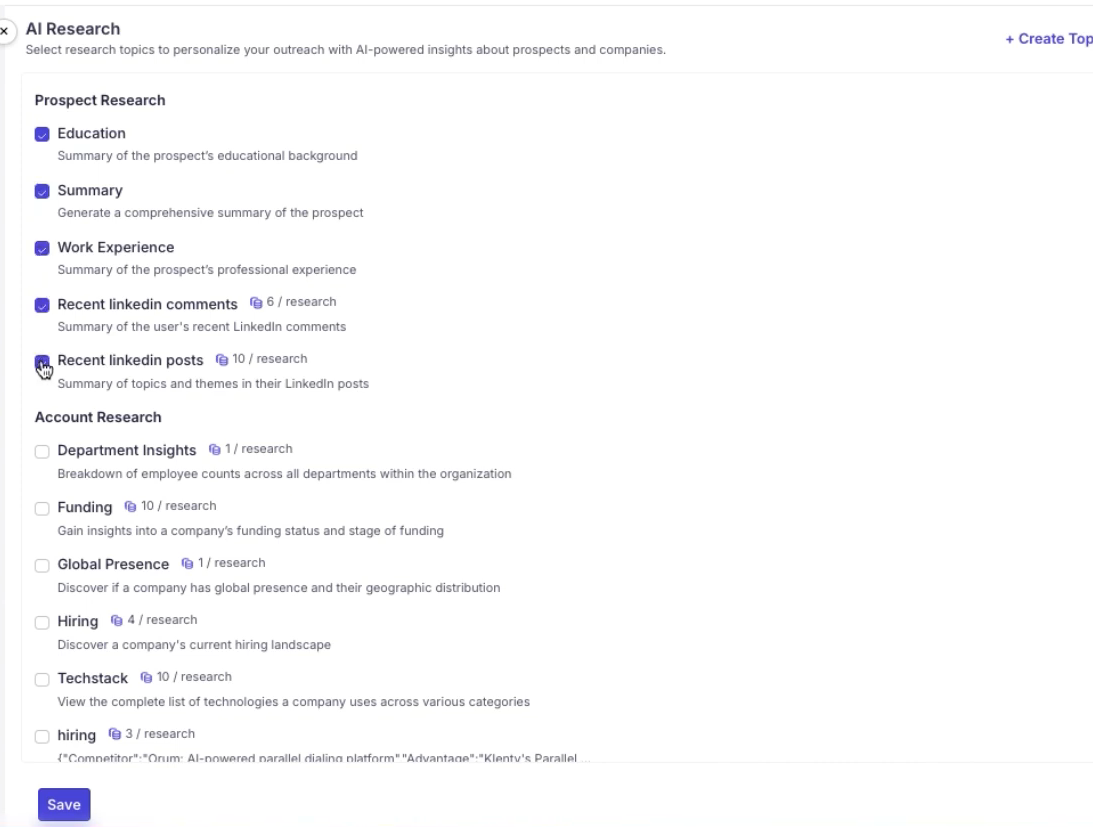
The AI researches accounts across 150+ public data sources (10-K reports, company filings, G2 reviews, LinkedIn, company news, tech stack, hiring updates, and financial trends), maps needs to the seller's value proposition, and drafts emails for each prospect. For template-based cadences, AI Variables insert personalized copy so each email reads differently.
AI Account Research works in four stages: pulling internal CRM data (opportunity fields, discovery conversations, outreach history), scanning public records, matching account needs to the seller's value proposition, and finding the right contacts through a waterfall enrichment model across multiple data providers.
Source: Klenty
Action AI listens to sales conversations and generates the next follow-up action.
If a prospect mentions a callback date, Action AI schedules it. If a new stakeholder comes up, it finds their contact data. If a follow-up email is needed, it drafts one from the conversation. Actions sort into four types: time-based, persona-based, channel-based, and context-based. The rep never manually creates a task.
Email Deliverability: Klenty covers the full lifecycle from domain setup to post-send monitoring.
Cold email fails silently when domains lack authentication, tracking links trip spam filters, or sending volumes spike unnaturally. Klenty structures deliverability as a before-during-after system.
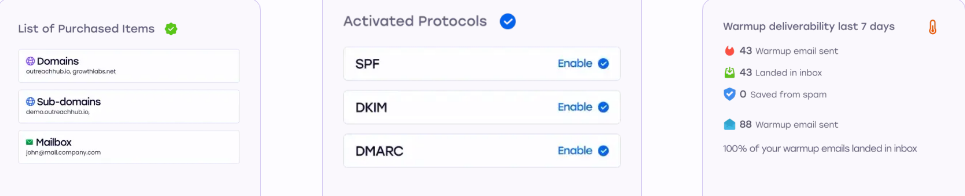
Before outreach, Klenty handles domain and mailbox setup: purchasing domains and configuring SPF, DKIM, and DMARC records. Domain and inbox warmup run before campaigns begin.
Source: Klenty
During outreach, auto-inbox rotation distributes emails across connected mailboxes, keeping follow-ups tied to the inbox that sent the first email. Randomized sending intervals mimic human patterns. Throttling caps daily volume.
Custom domain tracking replaces shared tracking links with a sender-specific subdomain, avoiding the domain mismatch that trips spam filters. AI email validation checks addresses against syntax, DNS, MX records, catch-all detection, and SMTP verification before sending.
After outreach, deliverability dashboards track inbox and domain health, spam alerts flag problems early, and Klenty offers monthly deliverability consulting.
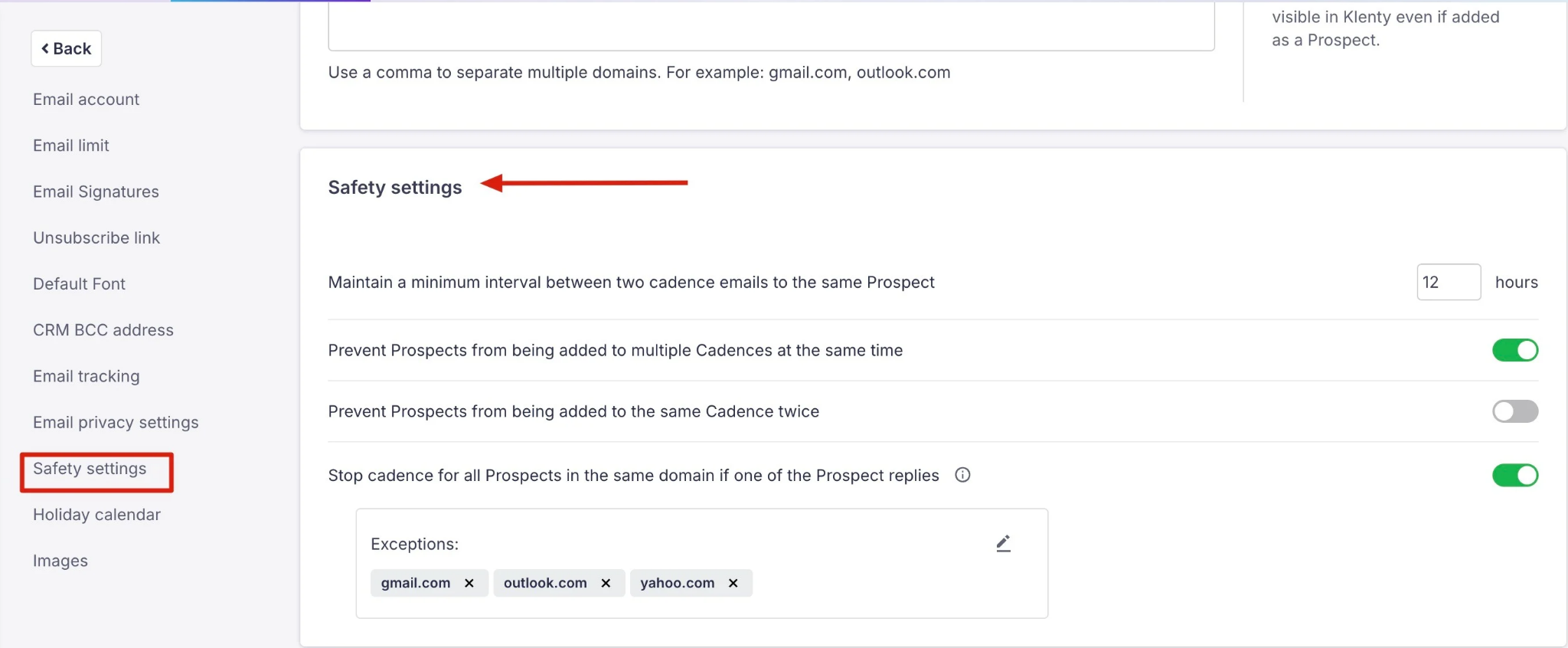
Safety settings prevent sending multiple emails to the same prospect within a 4-hour minimum window (default 12 hours), block prospects from running in multiple cadences at once, and can stop all outreach to a domain when someone replies.
Source: Klenty
Account-Based Selling: Klenty lets teams work account-by-account instead of prospect-by-prospect.
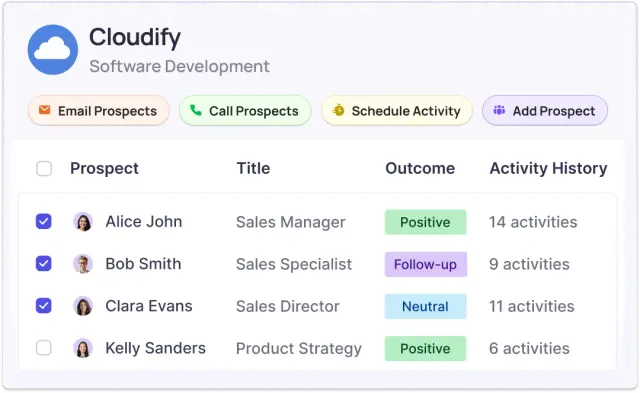
Most sales engagement platforms treat prospects as isolated contacts in sequences. Klenty's Account-Based Selling module groups prospects under accounts and lets reps manage the buying committee from one view.
The Account Panel consolidates all prospects in an account, their engagement history, coverage metrics, and AI research. Reps send emails, make calls, and add stakeholders to multi-thread the buying committee without switching tools.
Source: Klenty
Accounts move through customizable stages (Cold, Decision-Maker Contacted, Meeting Booked). Managers set entry and exit criteria for each stage, and the system triggers the right Account Playbook with the right channel mix, pacing, and messaging. Stage-specific Action Windows set deadlines so reps execute high-priority playbooks on time.
AI validates account lists against ICP criteria, scores and tiers accounts so SDRs know which to focus on each day, and flags accounts showing intent signals (website visits, prospect engagement patterns).
Pricing: Klenty uses per-seat pricing across two separate product lines.
Klenty sells its Sales Engagement and Dialer products independently. Annual billing saves up to 20% versus quarterly rates.
Sales Engagement Plans (annual billing):
Plan | Price | What's Included |
|---|---|---|
Starter | $50/user/month | Email-only; 15,000 contacts/mo, 75,000 emails/mo, A/B testing, custom domain tracking, API, Zapier |
Growth | $70/user/month | Adds calling, CRM integrations, SMS, LinkedIn, SmartLists, number auto-rotation |
Plus | $99/user/month | Adds 4,000 data credits, account-based selling, AI call coaching, Action AI, live transcription |
Sales Dialer Plans (annual billing):
Plan | Price | Calling Minutes |
|---|---|---|
Basic | $35/user/month | 200 free US minutes/user/month |
Advanced | $99/user/month | 2,000 minutes/user/month (US & Canada), Parallel Dialer, AI features |
Additional costs: the Parallel Dialer add-on is $45/user/month on Sales Engagement plans. Call transcription is $40/user/month on Dialer plans. US virtual numbers cost $1.15/month each. Email validation credits run $7 per 1,000. Calling overages are about $0.021/minute for US calls.
A 14-day free trial (no credit card) is available for Sales Engagement. The Dialer trial requires a demo and includes 100 minutes of calling credit.
Where Klenty Falls Short
Klenty does what it does well, but its limitations reflect a platform built for outreach execution, not full GTM intelligence.
No Built-in Contact Database.
Klenty has no B2B contact or company database. Reps bring their own prospect lists or use the 4,000 monthly data credits on the Plus plan for enrichment. Teams that need to build account lists from scratch must source data elsewhere, adding cost and friction. This contrasts with platforms that combine prospecting data and engagement in one system.
Reporting Remains a Weak Spot.
Reviewers on Capterra and G2 describe reports as hard to read, with data "mashed together." Teams that need clean pipeline analytics will end up exporting to their CRM. For a platform that handles this many touchpoints, the lack of clear in-product reporting is a real gap.
No Native Email Warmup.
Klenty removed its warmup feature in February 2023. For teams running cold outreach at volume, warmup is a baseline requirement for building sender reputation before campaigns begin. Without it, teams need a third-party warmup service, adding another tool to the stack.
Mailbox Limits at Lower Tiers.
Starter allows 3 connected email accounts, Growth allows 5, and Plus allows 10. For teams running multi-domain cold outreach, these caps are tight. Capterra reviewers flag this as a constraint.
Billing Practices Draw Criticism.
Reviews on G2 and Capterra mention unexpected charges after canceling auto-renewal and forced price increases mid-contract. The Terms of Service say all payments are non-refundable and Klenty can change pricing with 30 days' notice. Worth noting during evaluation.
No Intent Signals, Technographics, or Org Charts.
Klenty's AI Account Research pulls from 150+ public sources, but the platform offers no buyer intent data, technographic profiles, or org chart mapping. Teams that want to prioritize accounts by who is actively researching solutions, or multi-thread using org charts, need a separate data platform.
Limited Scope Beyond Sales Development.
Klenty is built for SDR/BDR outbound. It does not serve marketing teams (no ABM, no ad targeting, no form optimization), RevOps teams (no enrichment workflows, no lead routing), or account management teams (no customer health monitoring). Organizations that need sales engagement connected to marketing and operations workflows will outgrow Klenty.
These are the natural trade-offs of building a focused sales engagement tool instead of a full GTM platform. For teams whose needs extend beyond outreach into data, intelligence, and cross-functional coordination, they create clear gaps.
Top Klenty Alternative for Full GTM Intelligence: ZoomInfo
ZoomInfo addresses Klenty's scope limitations as a GTM platform covering data, intelligence, and execution.
Its GTM Context Graph processes 1.5B+ data points daily, combining B2B data with CRM records, conversation transcripts, and behavioral signals so teams understand not just what happened in a deal, but why. That intelligence reaches sellers through GTM Workspace, marketers and RevOps through GTM Studio, and any custom tool through APIs and MCP.
Where Klenty helps reps execute outreach, ZoomInfo helps teams identify who to target, why they're worth pursuing, and when to engage, then acts on that intelligence across the revenue organization.
The Most Comprehensive B2B Data Platform: ZoomInfo provides the prospecting foundation that Klenty lacks.
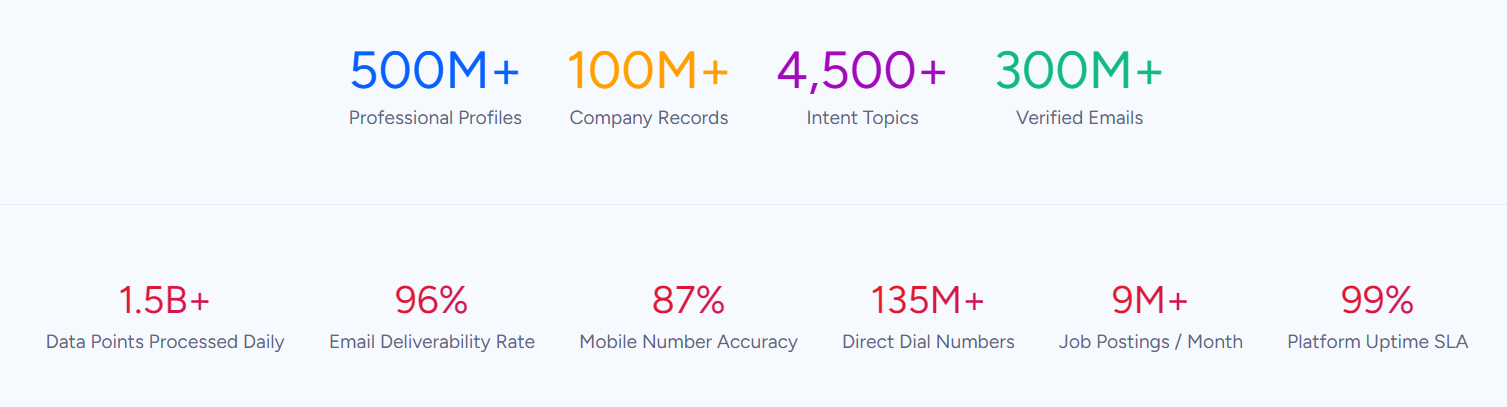
ZoomInfo runs a B2B data platform with 500M contacts, 100M companies, 135M+ verified phone numbers, 120M direct dials, and 200M+ verified business email addresses. The data runs through a multi-source verification pipeline backed by 300+ human researchers, reaching up to 95% accuracy on first-party data.
For sales teams, this means the direct dial rings and the email lands. Enrichment doesn't require stitching together three vendors for a complete account picture, because one platform already has the contact, the firmographics, the org chart, and the technographics.
Source: ZoomInfo
The data covers three dimensions: identity (who buyers are and how to reach them), company context (300+ attributes covering firmographics, technographics, and org charts), and signals that show when accounts are in-market. Buyer Intent tracks signals from 210 million IP-to-Organization pairings and 6 trillion+ new keyword-to-device pairings sourced monthly. Guided Intent, a ZoomInfo exclusive, identifies topics correlated with past deal wins instead of requiring manual topic selection.
These aren't self-reported numbers.
In a Fortune 500 competitive RFP analyzing 25 million contacts across vendors, the independent consultant concluded that "no other competitor came even close." Forrester named ZoomInfo a Leader in Intent Data Providers for B2B (Q1 2025), with the highest scores across eight criteria. Gartner named it a Leader in ABM Platforms for the second consecutive year.
Vensure scaled prospecting using ZoomInfo's data: "ZoomInfo gives us the information we need to execute. We don't have to go through and spend our time digging. It's already there, so we can be three steps ahead." (Vensure case study)
The GTM Context Graph: ZoomInfo's intelligence layer captures not just what happened in a deal, but why.
Good data is a prerequisite for reasoning. You can't map a buying committee if half the contacts are missing, and you can't correlate intent signals to org chart movements if firmographics are stale.
ZoomInfo built the GTM Context Graph on top of its data foundation to solve a problem that CRMs and engagement tools cannot: understanding the context behind deal outcomes.
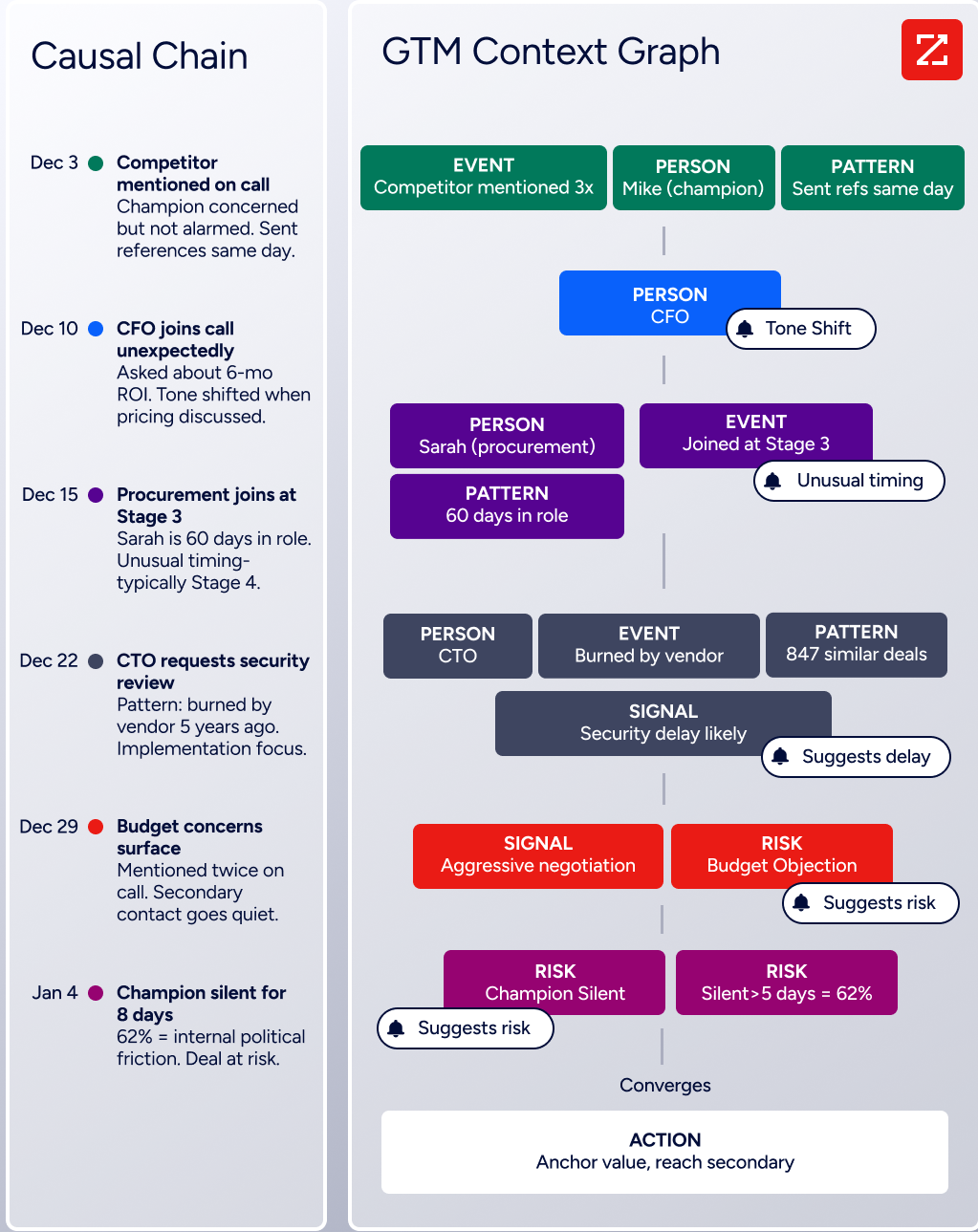
The GTM Context Graph processes 1.5B+ data points daily, combining ZoomInfo's B2B data with a customer's CRM records, conversation transcripts (via Chorus, ZoomInfo's conversation intelligence tool), email interactions, and behavioral signals into a single intelligence layer. A CRM records that a deal moved to Stage 3. Chorus transcribes what the VP of Finance said on the last call. Intent data logs a research spike. The GTM Context Graph connects all three to explain why the deal moved, then feeds that reasoning into every downstream action.
Source: ZoomInfo
For sellers, this means the follow-up email addresses the specific concern the CFO raised, because the system understands why it matters now. The play targets accounts whose signal combinations match actual win patterns, not just fifty that tripped a keyword threshold. The forecast weights deals by the strength of buying evidence rather than stage labels.
Seismic attributed 39% of active pipeline to ZoomInfo signals and boosted productivity by 54%: "That combination of our internal CRM data, external signals, and AI that's given all that context has helped us craft very specific account- and persona-based messages." (Seismic case study)
Universal Access: ZoomInfo delivers intelligence through three channels so every team works from the same foundation.
Data and intelligence are only valuable if they reach every team, every tool, and every workflow. ZoomInfo provides three ways to access them:
GTM Workspace is the seller's front-end. It puts prioritized accounts, AI-drafted outreach, deal execution, and CRM updates in one place. AI agents handle account research, outreach drafting, signal monitoring, and CRM updates. Thomson Reuters increased closed-won deals by 40% and hit 115% average quota attainment monthly using Workspace.
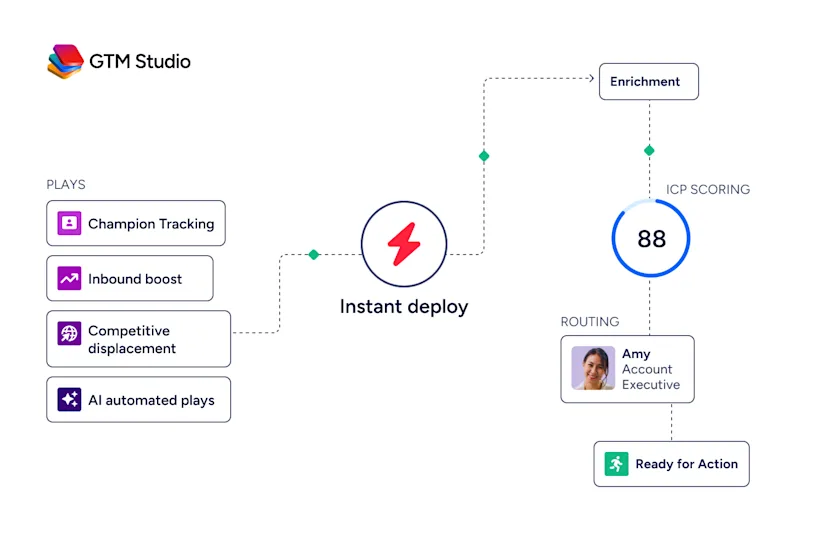
GTM Studio is the front-end for marketers, RevOps, and GTM engineers. Teams describe audiences in natural language, launch multi-channel plays (email, calls, ads, direct mail) triggered by buyer behavior, and track pipeline impact in real time. Expansion plays that used to take 3 weeks now launch in 30 minutes.
Source: ZoomInfo
For teams that build beyond ZoomInfo's own products, APIs and MCP expose the same intelligence to any custom agent, internal tool, or partner platform. ZoomInfo's MCP server is listed in the Claude directory and currently supports Claude and ChatGPT. API access is included in all relevant plans.
All three draw from one GTM Context Graph. The same data, the same reasoning, the same model. Nothing is degraded or siloed by interface.
BDO Canada activated ZoomInfo data directly within their internal systems: "The plug-and-play aspect of the API means I can integrate it very easily into any process and get information at a moment's notice," achieving an 87% reduction in time spent on internal data dashboard updates. (BDO Canada case study)
Pricing: ZoomInfo uses custom quoting with a permanent free tier for evaluation.
ZoomInfo uses a custom-quoted, seat-and-credit-based subscription model.
Pricing depends on the number of users, monthly credit volume, features selected, and contract length. No dollar amounts are published for paid tiers. Sales, Marketing, and standalone products (Chorus, Chat) each have separate tier structures.
ZoomInfo offers two free entry points that Klenty doesn't match:
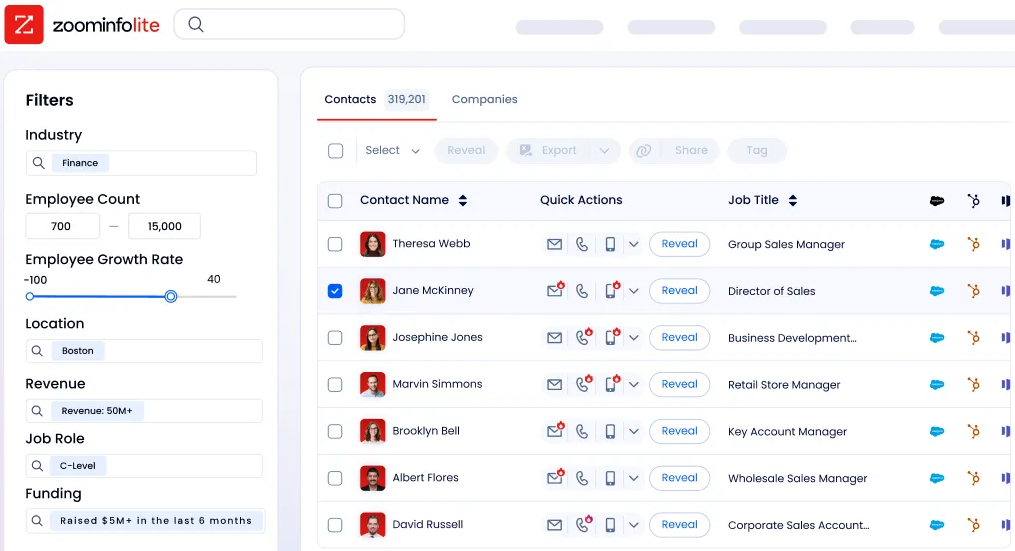
ZoomInfo Lite is a permanent free tier (not a trial) with access to ZoomInfo's B2B database, 10 monthly export credits, individual and company searches, the ReachOut Chrome Extension, WebSights Lite (up to 10 website visitor reveals per day), built-in email sending, and HubSpot integration.
A separate 7-day free trial gives access to core features, no credit card required.
Note: ZoomInfo is transitioning toward a consumption-based pricing model.
Source: ZoomInfo
Klenty or ZoomInfo: Comparison Summary
Klenty | ZoomInfo | |
|---|---|---|
Primary focus | Sales engagement execution | Full GTM intelligence + execution |
Target users | SDR/BDR teams at growth-stage B2B companies | Sales, Marketing, RevOps, Account Management |
B2B contact database | None (bring your own lists) | 500M contacts, 200M+ verified emails, 135M+ verified phones |
Buyer intent data | Not available | 210M IP-to-Org pairings, Guided Intent |
Multi-channel outreach | Email, phone, SMS, WhatsApp, LinkedIn | Email, phone, ads, direct mail (via GTM Workspace + GTM Studio) |
Parallel dialer | 300-350 dials/hour | Available through partnerships |
AI capabilities | Agentic Cadences, Action AI, AI Account Research | GTM Context Graph, AI agents in Workspace and Studio |
Account-based selling | Account Panel, stage-triggered playbooks | ABM across marketing and sales, account intelligence |
CRM integrations | Salesforce, HubSpot, Pipedrive, Zoho, MS Dynamics | Salesforce, HubSpot, MS Dynamics + 120 marketplace integrations |
Marketing capabilities | None | ABM, native DSP, form optimization, audience orchestration |
Conversation intelligence | AI call coaching, live transcription | Chorus (recording, transcription, deal intelligence) |
API and developer access | REST API from Starter plan | Enterprise API + MCP server for AI agents |
Reporting | Basic; frequently cited as a weakness | Detailed analytics, AI-powered dashboards |
Free entry point | 14-day trial (no credit card) | Permanent free tier (ZoomInfo Lite) + 7-day trial |
Pricing transparency | Published ($50-$99/user/month for Sales Engagement) | Custom-quoted (no published prices) |
Best for | Outbound outreach execution for SDR teams | Intelligence-driven GTM across the full revenue org |
Final Verdict
The choice between Klenty and ZoomInfo depends on whether your challenge is executing outreach or knowing who deserves it.
Choose Klenty if your team has a defined prospect list, a working outbound motion, and needs a focused tool to run multi-channel cadences, dial at volume, and keep the CRM current.
It's built for SDR teams of 3-50 reps at growth-stage B2B companies where the selling motion is structured and account-based. Agentic Cadences, a parallel dialer, and intent-adaptive playbooks at $70-$99/user/month deliver what enterprise platforms typically price far higher.
If your data sourcing, intent monitoring, and marketing coordination are handled elsewhere, Klenty gives your reps a solid execution tool.
Choose ZoomInfo if your GTM needs extend beyond sales engagement into the data, intelligence, and cross-functional coordination that drive modern revenue teams.
ZoomInfo provides the B2B data (500M contacts, 135M+ verified phone numbers), the intelligence layer to identify which accounts are worth pursuing and why, and the tools (GTM Workspace for sellers, GTM Studio for marketers and RevOps, APIs and MCP for custom builds) to act on that intelligence across every team.
For organizations where knowing who to call matters as much as how to call them, ZoomInfo operates at a different level of the GTM stack.
Get started with ZoomInfo here.
The distinction is structural. Klenty optimizes the last mile of outbound execution. ZoomInfo provides the intelligence that determines where that last mile should aim, then delivers it to every tool where decisions are made.
Klenty FAQ
What is Klenty used for?
Klenty is a sales engagement platform that helps B2B sales teams run multi-channel outreach across email, phone, SMS, WhatsApp, and LinkedIn. It automates cadence execution, provides parallel and power dialing, uses AI to research accounts and write emails, and syncs activity with CRMs in both directions. SDR and BDR teams primarily use it to open conversations and build pipeline.
How much does Klenty cost?
Klenty's Sales Engagement plans run $50/user/month (Starter, email-only) to $99/user/month (Plus, which adds data credits, account-based selling, and AI call coaching) on annual billing. The Sales Dialer is priced separately at $35-$99/user/month. Add-on costs include the Parallel Dialer ($45/user/month), call transcription ($40/user/month), email validation ($7 per 1,000 credits), and per-minute calling overages.
ZoomInfo does not publish prices but offers a permanent free tier (ZoomInfo Lite) with access to its B2B database and 10 monthly export credits.
Does Klenty have a free plan?
No. Klenty offers a 14-day free trial (no credit card required) for Sales Engagement. The Dialer trial requires a demo and includes 100 calling minutes.
ZoomInfo offers ZoomInfo Lite, a permanent free tier with access to its B2B database, search and filtering, a Chrome extension, WebSights Lite, and HubSpot integration.
Does Klenty include a B2B contact database?
No. Klenty has no built-in contact or company database. Reps must import their own lists via CSV, Google Sheets, or CRM integration. The Plus plan includes 4,000 monthly data credits for contact enrichment, but there is no searchable database within the platform.
ZoomInfo provides access to 500M contacts, 100M companies, and 200M+ verified business email addresses as a core part of the platform.
What CRM integrations does Klenty support?
Klenty integrates with Salesforce, HubSpot, Pipedrive, Zoho CRM, and Microsoft Dynamics. These integrations are two-way: they auto-import leads, log call and email activity, update deal stages, and trigger cadences from CRM events. CRM integrations require the Growth plan ($70/user/month) or higher; Starter is limited to API and Zapier.
Does Klenty offer email warmup?
No. Klenty removed its warmup feature in February 2023. The platform provides domain and inbox warmup as part of pre-outreach setup, but this differs from network-based warmup that sends and receives emails at volume to build sender reputation. Teams needing warmup must use a third-party service.
How does Klenty's parallel dialer work?
Klenty's Parallel Dialer calls up to five prospects at once per rep. AI voicemail detection uses live transcription to identify human pick-ups and connects the rep to the first live answer, dropping the rest. Connect AI manages the number pool by rotating numbers based on health scores, giving each rep a private batch, and picking dial times.
The Parallel Dialer is on the Dialer Advanced plan ($99/user/month) or as a $45/user/month add-on to Sales Engagement plans.
Is Klenty suitable for enterprise teams?
Klenty lists no enterprise pricing tier and offers no SSO, multi-regional admin hierarchies, or custom governance in its published plans. Its customer base skews toward growth-stage B2B companies with SDR teams of 3-50 reps.
Enterprise organizations with complex security requirements, large multi-department deployments, or needs spanning sales, marketing, and RevOps may find ZoomInfo better suited to their scale.
