

LeadFuze has taken a sharp turn. What started in 2014 as a self-serve prospecting tool for sales teams is now a data infrastructure provider, supplying contact data via APIs and bulk licenses to developers building their own applications. The old point-and-click interface is gone. In its place: an Enrichment API, an Identity Resolution Pixel, and a full data license covering 269M+ US profiles.
That pivot changes who LeadFuze serves and how it delivers value. For this LeadFuze review, we analyzed the platform and believe it's the right choice if:
You're building a data-powered application and need an embeddable contact data layer
You want bulk access to a large US identity graph at below-market pricing
Your team has developers who can integrate via REST API and webhooks
You need both B2B and B2C identity attributes in a single dataset
Your use case is primarily US-focused
LeadFuze is not a good choice if:
You need a self-serve prospecting interface for your sales team
Your target market extends beyond the United States
You require SOC 2, GDPR, or CCPA certification from your data vendor today
You want intent data, conversation intelligence, or GTM execution tools alongside your contact data
You need established support with documentation, a help center, and tiered support
In this case, consider ZoomInfo: an AI-powered GTM platform built on 500M contacts and 100M companies. ZoomInfo combines your CRM data, conversation transcripts, and behavioral signals with its B2B dataset through the GTM Context Graph to show not just what's happening in your deals, but why.
Sales teams work from GTM Workspace, marketers and RevOps build plays in GTM Studio, and developers access the same intelligence through APIs and MCP.
We cover ZoomInfo in detail later in this review, as it serves teams that need more than raw data. To explore it now, start a free trial.
What is LeadFuze?
LeadFuze is a US-focused identity data infrastructure company founded by Justin McGill in December 2014. McGill built it from a practical need: his marketing agency needed automated lead sourcing, and the internal system he created became LeadFuze's foundation.
For its first decade, LeadFuze operated as a self-serve B2B lead generation tool. Sales reps, recruiters, and marketers defined targeting criteria and received verified contact records. A proprietary AI assistant called Fuzebot automated list-building by finding leads that matched user-defined criteria.
That product no longer exists. As the pricing page states, LeadFuze has "shut down direct software access and is now exclusively offering a full data license with monthly updates." The company now calls itself the "Contact Data Layer" for Apps, an upstream data supplier for developers, AI teams, and companies building their own enrichment tools, CRMs, and sales automation platforms.
The technical foundation is a "Universal Identity Architecture" that ingests billions of unstructured signals and structures them into a single identity graph, linking B2B and B2C identities, cross-device signals, and online/offline actions into one profile per individual. The database covers 269M+ profiles, 176M+ email addresses, 131M+ mobile numbers, and 101M+ LinkedIn profiles.
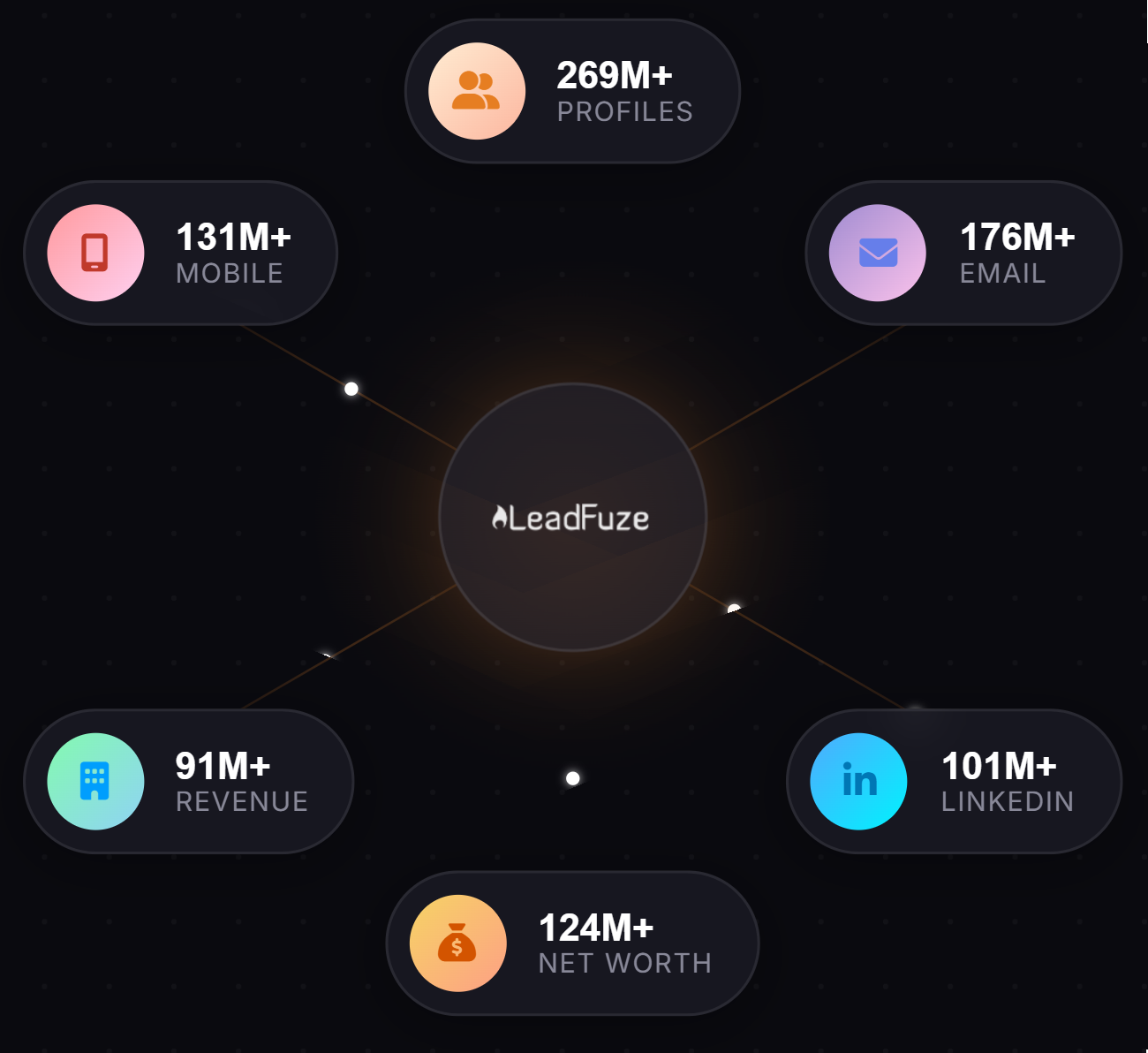
Source: Leadfuze
LeadFuze is privately held and lightly funded, headquartered in Glendale, Arizona. Total confirmed external funding is roughly $275,000 from a 2016 seed round, plus an undisclosed debt round in 2017. The team is small (estimated 1 to 25 employees).
LeadFuze Pros & Cons
Pros | Cons |
|---|---|
Large B2B + B2C identity graph (269M+ profiles) | No self-serve prospecting interface (shut down) |
Sub-200ms Enrichment API response times | Limited to US data |
Flat-rate pricing ($1,500–$2,000/month) | No SOC 2, GDPR, or CCPA certification yet |
Multiple API lookup methods (email, phone, LinkedIn, name+company) | Intent Data product not yet available |
Data Co-Op model for continuous data freshness | No public knowledge base or self-serve support |
Bulk data delivery via AWS S3, GCS, Azure, SFTP | Requires developer resources to integrate |
Personal and professional data attributes in one call | Higher-than-expected email bounce rates reported by users |
LeadFuze Review: How It Works & Key Features
Enrichment API: Real-time contact enrichment with 50+ data fields per profile.
LeadFuze's Enrichment API converts a single input (an email address, phone number, LinkedIn URL, or name-plus-company combination) into a complete contact profile with 50+ verified data points. It draws from a database of 269M+ profiles and is designed for embedding into third-party applications.
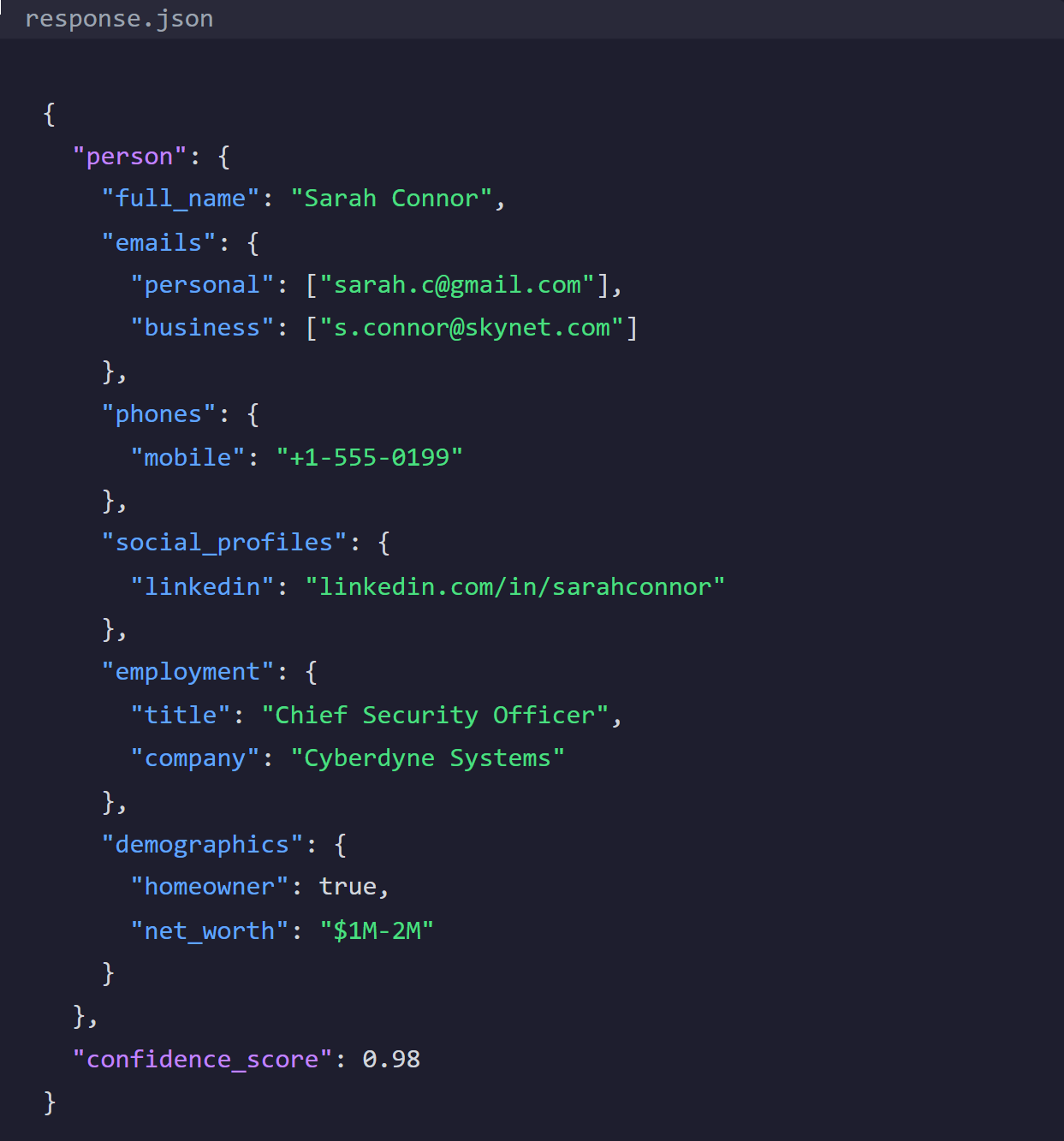
Source: LeadFuze
The API addresses a real tension in lead capture. Every additional field on a form drops conversion by 5–10%, yet sales teams need detailed context to work a lead. The API resolves this by appending missing fields in the background: a user submits only their work email, and the application fills in phone numbers, job titles, company revenue, and seniority.
Response times are advertised at sub-200ms, making the API suitable for synchronous workflows like form auto-fill and real-time CRM enrichment. The API docs show a straightforward REST endpoint (POST /api/enrichment/email) with Bearer token authentication and optional parameters for controlling enrichment scope and caching.
The response schema is broad. A single call returns full name, business and personal emails with validation status and last-seen timestamps, mobile and direct phone numbers, LinkedIn URL, personal and professional addresses, gender, age range, income range, net worth, marital status, homeowner status, job title, seniority level, department, and a confidence score.
Company data includes firmographics like SIC/NAICS codes, revenue band, employee count, and industry. The API also returns programmatic email permutations (likely email format variants for a contact at their company) and a built-in email validation status field.
What sets the Enrichment API apart from most competitors is its combined B2B and B2C coverage. Most enrichment APIs serve either professional or consumer data. LeadFuze's Universal Identity Architecture returns both in one call, including consumer attributes like net worth and homeowner status alongside firmographic fields. For financial services, insurance, or high-value B2C sales, that breadth matters.

Source: Leadfuze
Identity Resolution Pixel: De-anonymizing website visitors at the individual level.
The Identity Resolution Pixel (IDRP) is a JavaScript snippet that identifies anonymous website visitors by matching device fingerprints against LeadFuze's identity graph of 269M+ profiles. Where most IP-intelligence tools resolve a visitor to a company domain, LeadFuze's pixel aims to identify the actual person, returning individual contact fields alongside company data.

Source: LeadFuze
Setup follows a three-step process: install the JavaScript snippet in the site header, configure a webhook endpoint, and begin receiving JSON payloads as visitors browse. The pixel tracks behavioral signals per session (session duration, page paths, time on site, scroll depth), which feed a four-tier lead scoring model:
Hot Lead (80–100): Visited pricing page, 5+ minutes on site, return visitor
Warm Lead (50–79): Viewed 3+ pages, 80% scroll depth, downloaded resource
Cool Lead (25–49): First-time visitor, blog reader, short session
Cold Lead (0–24): Bounce under 10 seconds, no interaction, irrelevant geography
The identification relies on the Data Co-Op network, which maintains roughly 3 billion cookies across work and personal devices, 120B+ IP-company signals, and signals from 500K+ TLDs. Every identified visitor gets enriched with the same 50+ data fields as the Enrichment API and delivered via webhook in real time.
The pixel also serves paid media teams. Because pixel-based retargeting is degrading after iOS 14+ privacy updates, the IDRP captures persistent identifiers tied to the identity graph to build retargeting audiences that survive cookie deletion. LeadFuze claims this approach pushes audience match rates to 70–80%+ on Facebook and Google, compared to the typical 30–40% from sparse lists.
Data License: Bulk access to the full identity graph for $1,500–$2,000/month.
The Data License is LeadFuze's main commercial offering. It grants bulk access to the entire identity graph (269M+ profiles) with monthly refreshes delivered to the customer's cloud infrastructure. Delivery options include AWS S3, GCS, Azure Blob Storage, and SFTP, in either CSV or Parquet format (52 GB and 70 GB respectively).
LeadFuze competes on price. The pricing page states the license costs "$1,500 to $2,000 per month depending on the term," while comparable data typically costs $10,000 to $20,000 per month from other providers.
The dataset includes full name, emails, phones, LinkedIn URLs, job titles, company firmographics, home addresses, net worth, and homeowner status. The Data License page highlights three use cases: building AI/ML models (lead scoring, propensity modeling), building proprietary enrichment or identity resolution tools, and market research for TAM analysis. Data is AES-256 encrypted at rest.
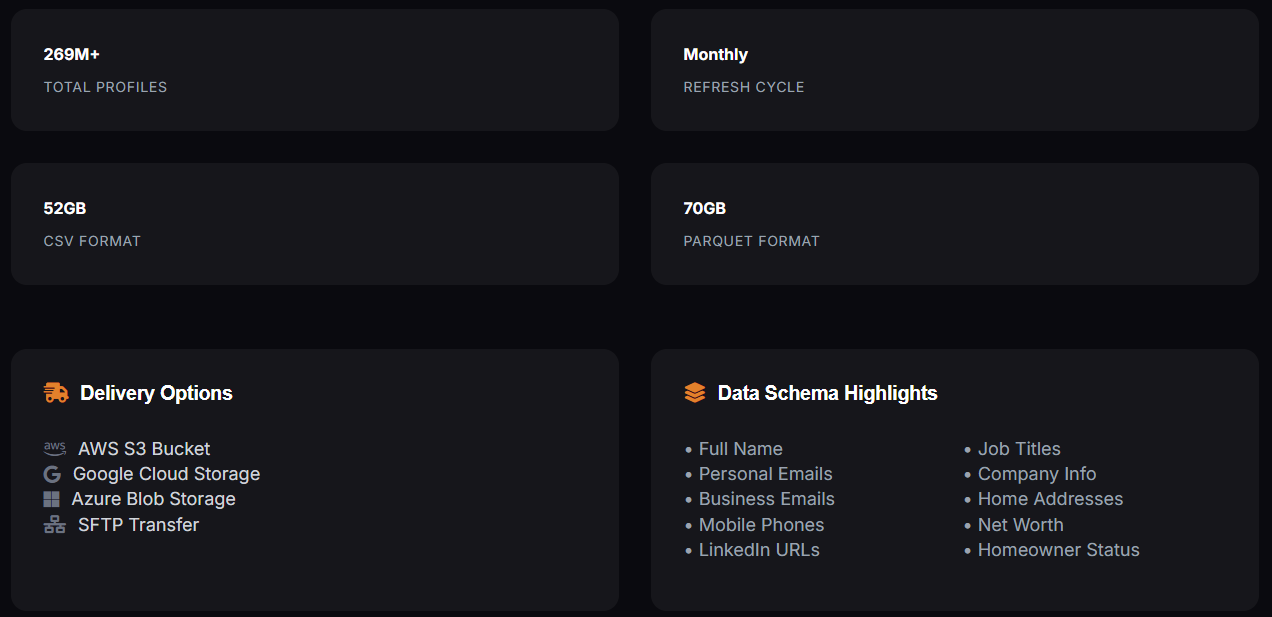
Source: LeadFuze
For companies that need to own their data layer rather than rent API access, the Data License's full-graph delivery at a flat monthly rate is the core value. The trade-off: buyers need engineering resources to process and integrate a 50–70 GB dataset on their own infrastructure.
Data Co-Op: A cooperative model for continuous data freshness.
The Data Co-Op is LeadFuze's main differentiator. Member organizations contribute anonymized data signals in exchange for access to the full identity graph. The co-op ingests these signals to cross-reference and validate contact details, creating what LeadFuze calls a "self-healing" data ecosystem that updates records as new signals arrive rather than relying on periodic scrape cycles.
The network reports roughly 3 billion cookies across work and personal devices, 120B+ IP-company signals, and 1B+ email records in its validation table. As more organizations join, the signal network grows and data freshness improves.
There is a catch: the co-op requires contributing "data exhaust" in return for access. If a member leaves, their contributed data is removed from the graph. Buyers must weigh what signals they can contribute and whether the reciprocal terms work for them.
Intent Data: Announced but not yet available.
LeadFuze has announced an Intent Data product that would track 5B+ signals daily across 35,000+ B2B and 7,000+ B2C categories, delivering daily feeds of in-market profiles. The page is marked "Coming Soon". Until it launches, buyers who need intent signals must use a separate vendor.
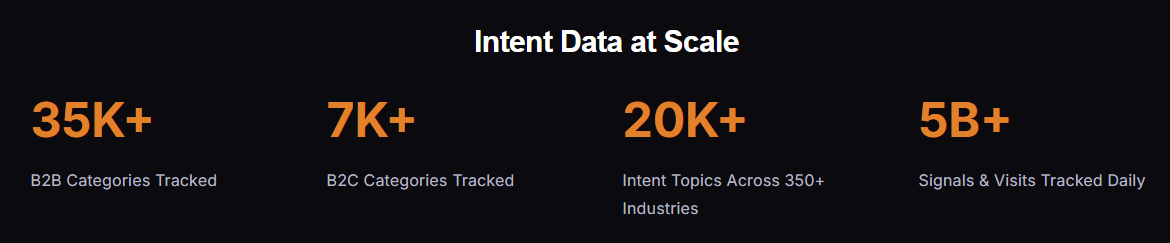
Source: LeadFuze
Where LeadFuze Falls Short
LeadFuze's pivot to data infrastructure creates a focused product, but several gaps emerge when you measure it against what most go-to-market teams need.
No Self-Serve Interface. The biggest limitation for many buyers: LeadFuze has shut down direct software access. Sales reps, SDRs, and marketers who need to search for contacts, build lists, or trigger outreach from a visual interface cannot use LeadFuze. The entire product is API-first and requires developers to integrate. This eliminates LeadFuze for any team that wants a point-and-click prospecting tool.
US-Only Data Coverage. LeadFuze describes itself as "the trusted lead data supplier for the US population." Review-site users have flagged the missing European database as a gap. Companies with international prospects will find the data incomplete.
Compliance Certifications Still In Progress. The Data Co-Op page states LeadFuze is "currently working towards SOC 2, GDPR, and CCPA certifications." These are aspirational, not achieved. For enterprise procurement teams in regulated industries, this may be a non-starter. Larger data vendors already hold these certifications and renew them annually.
Email Deliverability Concerns. Despite advertised verification, users on G2 and Capterra report bounce rates higher than expected, sometimes requiring third-party verification to maintain list quality. Outdated job change data is cited as a factor. This undercuts the time savings of using an enrichment provider.
Limited Support Infrastructure. The legacy knowledge base at kb.leadfuze.com returns HTTP 402. There is no public help center, community forum, or live chat. The API docs tell users to contact their account manager or email support.
For a product that requires technical integration, the lack of documentation (no changelog, no error-handling reference beyond HTTP status codes, no SDK libraries, no sandbox) adds friction.
Small Team, Limited Roadmap Execution. With an estimated 1 to 25 employees and minimal backing, LeadFuze's capacity for feature development, enterprise SLAs, and broad support is constrained. The Intent Data product remains pre-launch with no public timeline. Companies evaluating LeadFuze against larger competitors should weigh execution risk.
These limitations reflect the trade-offs of a small, bootstrapped company that chose data infrastructure over a full platform. They leave a gap for teams that need verified data, intelligence, execution tools, compliance, and support from one vendor.
Top LeadFuze Alternative: ZoomInfo
Where LeadFuze supplies raw data for developers, ZoomInfo is an AI-powered GTM platform that delivers verified data, intelligence, and execution tools for every go-to-market team. Rather than providing contact records alone, ZoomInfo adds intelligence and action on top of a large B2B dataset.
Data Scale and Quality: The largest verified B2B dataset with global coverage.
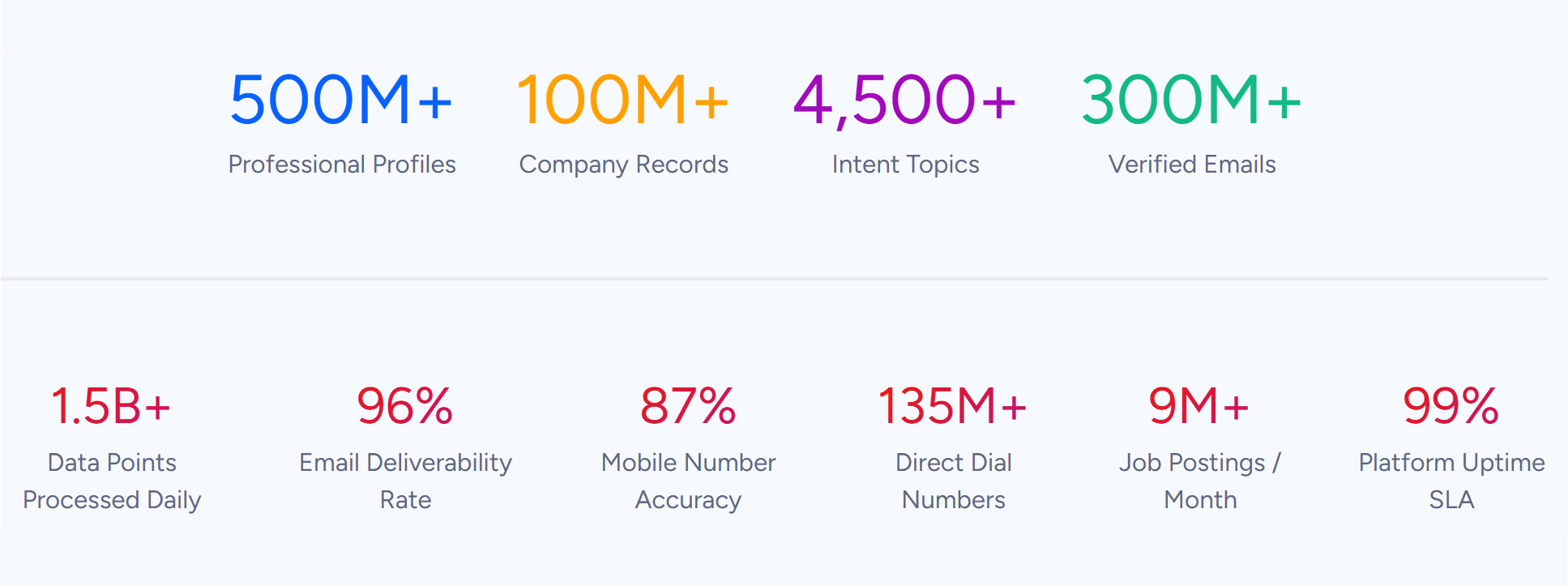
ZoomInfo's data covers 500M contacts, 100M companies, 135M+ verified phone numbers, 120M direct-dial phone numbers, and 200M+ verified business email addresses. That is nearly double LeadFuze's profile count, with global coverage.
Source: ZoomInfo
Where LeadFuze covers only the US, ZoomInfo provides 34M+ company profiles outside North America, 200M+ professional profiles outside North America, and 45M+ mobile numbers outside North America. In 2025, ZoomInfo expanded mobile coverage by 1.8 million numbers across six European markets.
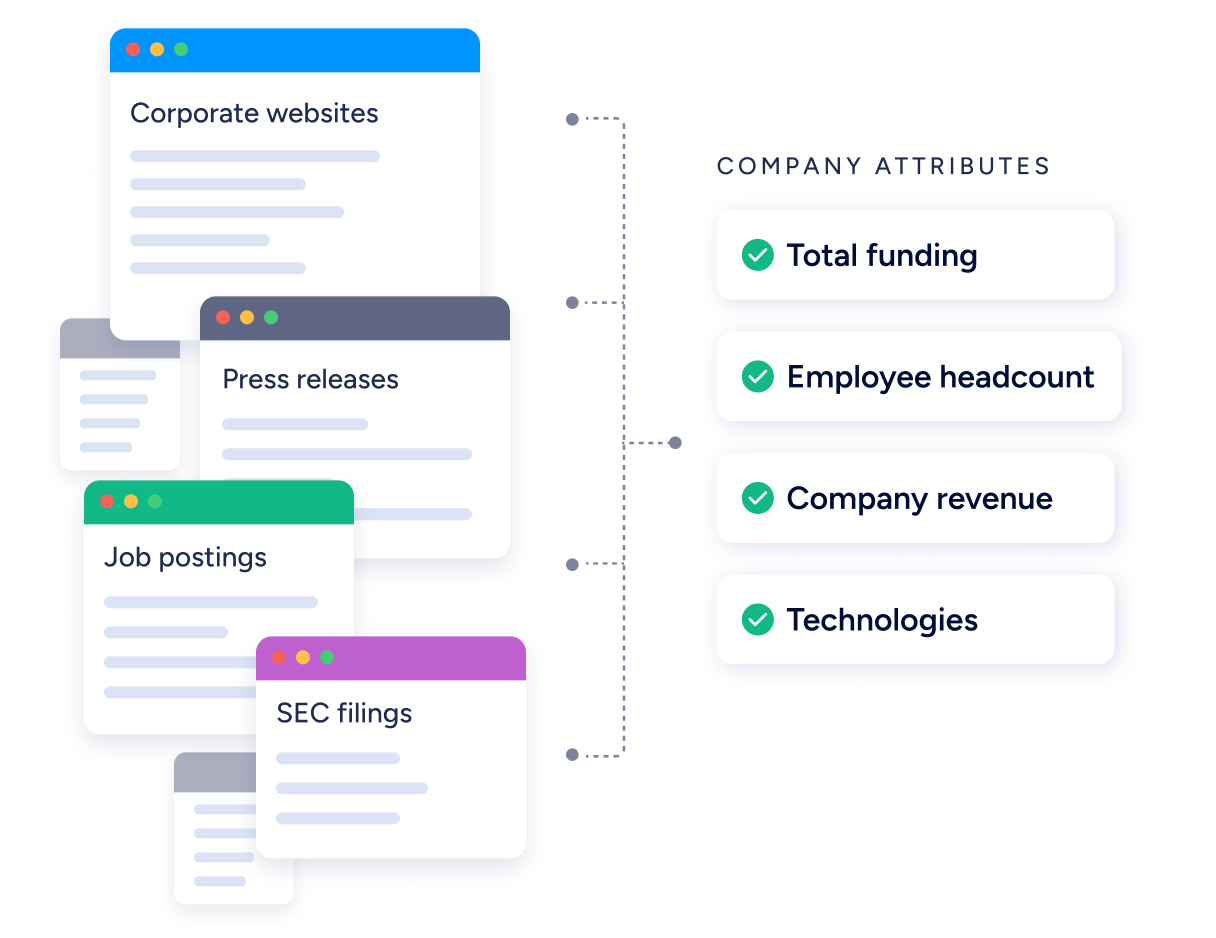
The verification pipeline runs multiple layers: automated ML scanning 28 million domains daily, third-party partner data covering 95 million businesses, a community of 200,000+ ZoomInfo Lite users who share data back, and an in-house team of 300+ human researchers. First-party data reaches up to 95% accuracy.
Source: ZoomInfo
This is not a self-reported claim. In a Fortune 500 competitive RFP analyzing 25 million contacts across vendors, the independent consultant concluded that "no other competitor came even close." ZoomInfo has been named a Forrester Wave Leader for Intent Data Providers (Q1 2025), a Gartner Magic Quadrant Leader for ABM Platforms for two consecutive years, and holds 133 No. 1 rankings on G2.
Compliance is already in place: ISO 27001, SOC 2 Type II, ISO 27701, TRUSTe GDPR, and TRUSTe CCPA certifications, all renewed annually. For enterprise procurement teams, this eliminates the compliance risk that LeadFuze's in-progress certifications present.
SpringDB saw 2x–3x increases in campaign conversions and a 300% increase in database usability after using ZoomInfo's enriched data for precise targeting. (SpringDB)
GTM Context Graph: Intelligence that captures why deals move, not just what happened.
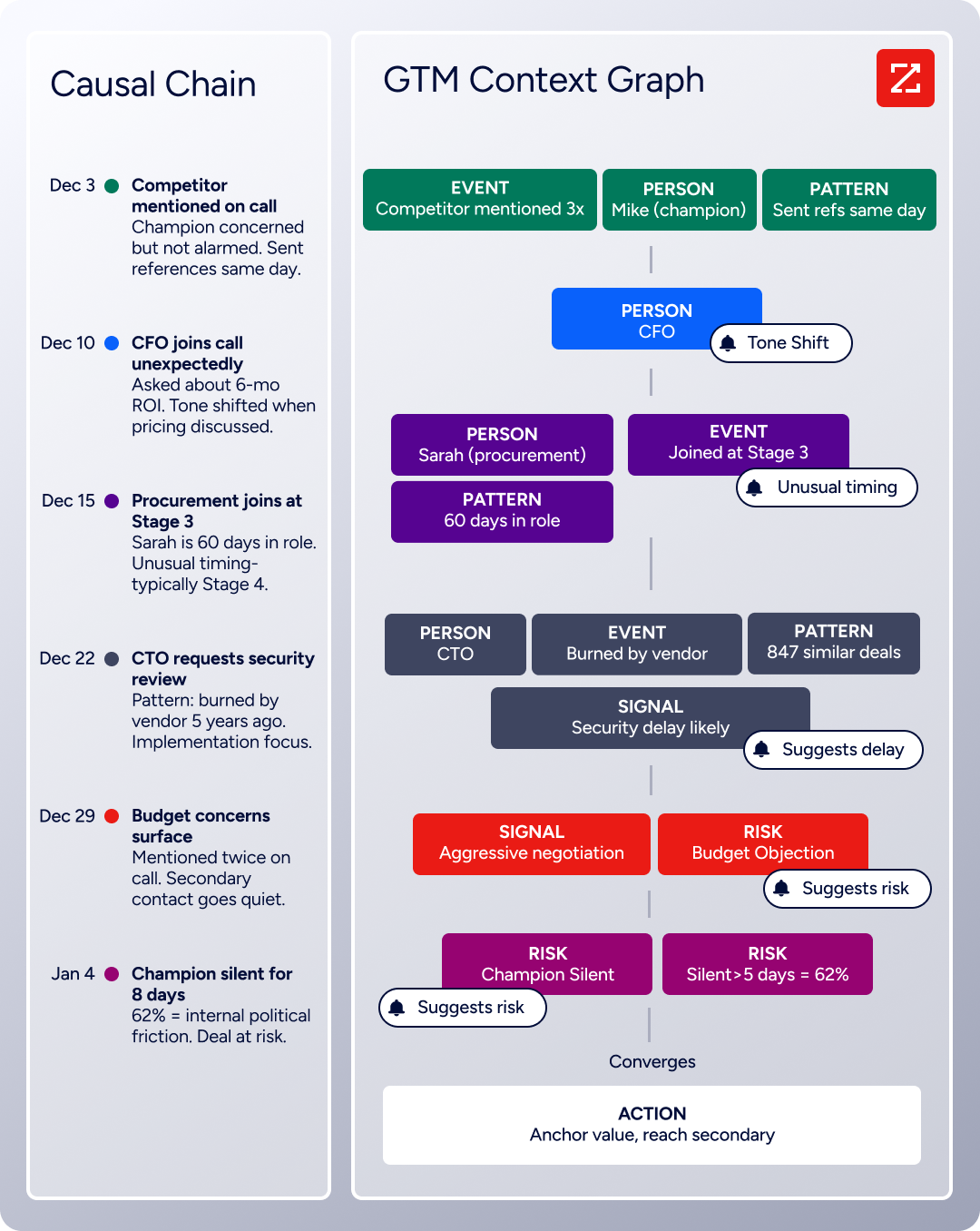
Data alone is a starting point. ZoomInfo's GTM Context Graph processes 1.5B + data points daily, combining ZoomInfo's B2B data with a customer's CRM records, conversation transcripts, email interactions, and behavioral signals into one intelligence layer.
Source: ZoomInfo
The distinction matters. A CRM records that a deal moved from Stage 3 to Stage 4. A conversation intelligence tool transcribes what the VP of Finance said on the last call. An intent platform logs a research spike. The GTM Context Graph reasons across all three to show why the deal moved and what that pattern predicts for similar accounts.
As ZoomInfo's Chief Product Officer Dominik Facher writes: "The CRM recorded the state change. It has no record of why it happened."
This intelligence feeds the tools GTM teams use. Follow-up emails address specific concerns raised on calls. Plays target accounts whose signal combinations match proven win patterns. Forecasts reflect buying evidence rather than stage labels.
LeadFuze supplies raw contact data. ZoomInfo supplies context: the connections between signals and outcomes that let teams act on what matters.
Seismic attributed 39% of active pipeline to opportunities identified or influenced by ZoomInfo signals, reported 54% productivity gains, and saved 11.5 hours per week per seller. (Seismic)
Multiple Access Points: Use it in any tool, any workflow, any AI agent.
LeadFuze delivers data through APIs and bulk files. ZoomInfo delivers intelligence through three channels so every team gets what it needs.
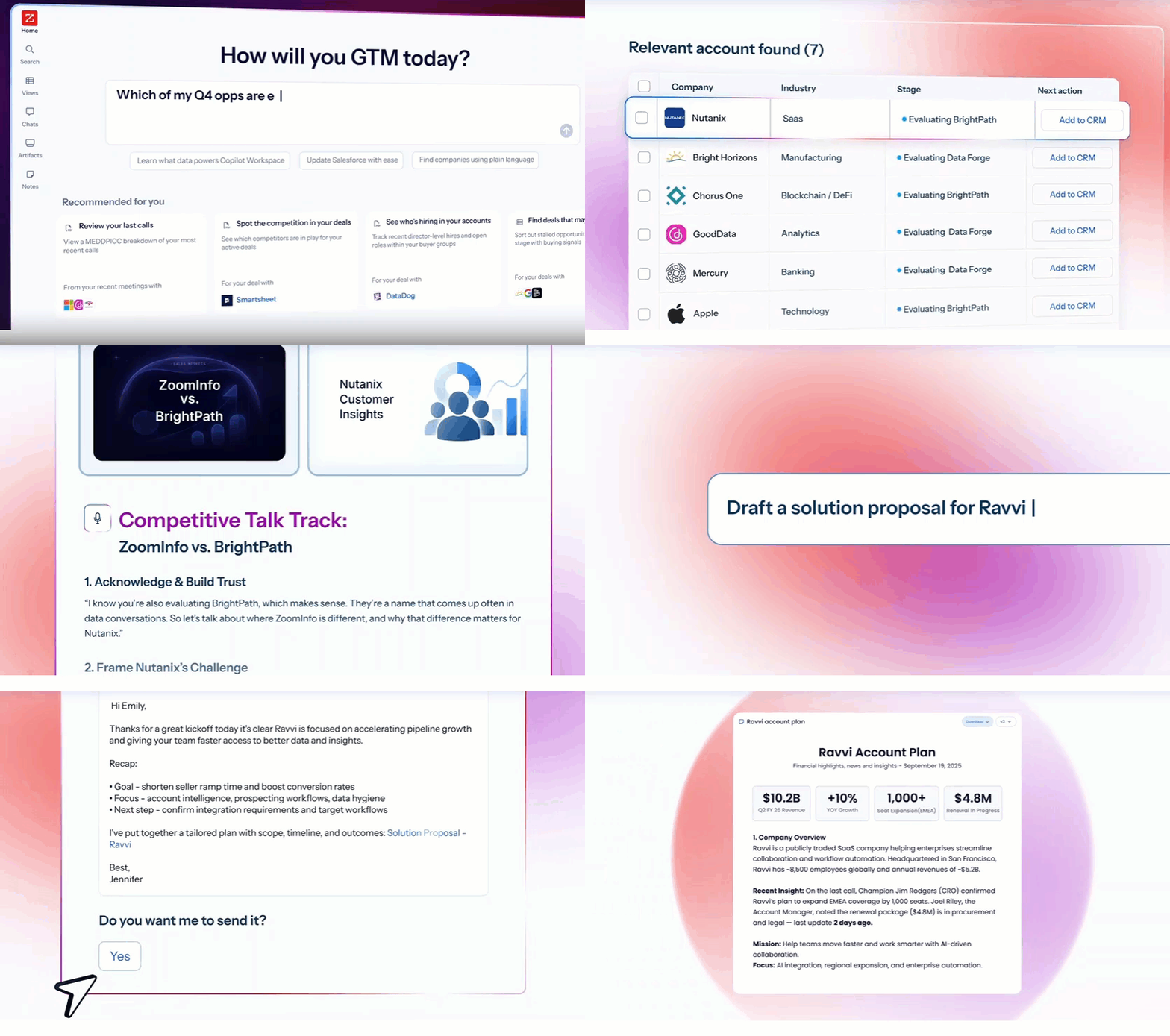
GTM Workspace is the front-end for sellers. Built on Anthropic's Claude, AI agents inside Workspace handle account research, outreach drafting, CRM updates, and signal monitoring.
Source: ZoomInfo
Sellers get a prioritized account feed with AI-drafted messages that address specific deal context, without switching between tools. Thomson Reuters increased closed-won deals by 40% using it. Databricks reached prospects 50% faster.
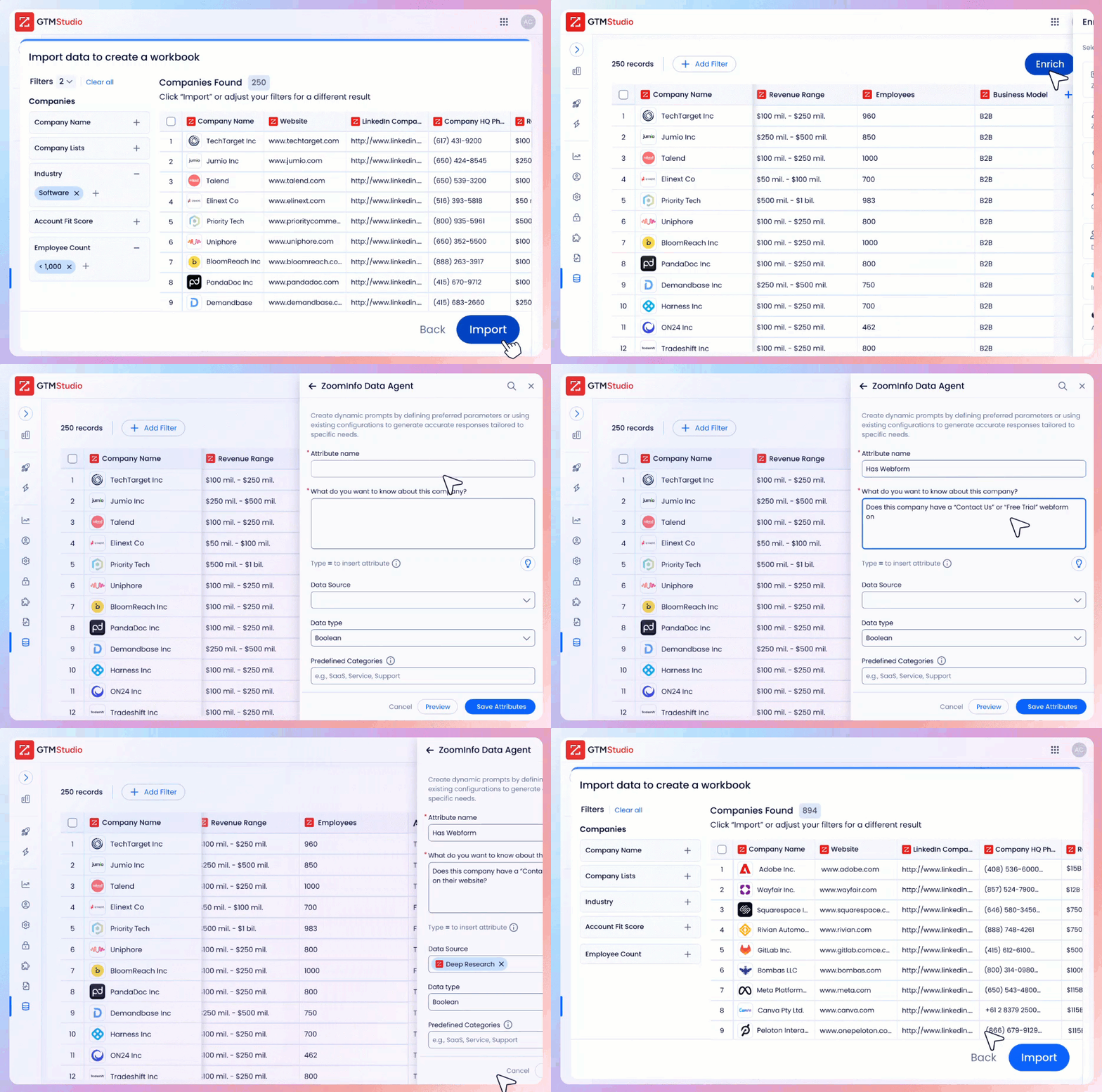
GTM Studio is the canvas for marketers, RevOps, and GTM engineers. Teams describe audiences in natural language, enrich with first- and third-party data, define triggers, and launch multi-channel plays, all without engineering support. Expansion plays that took three weeks now launch in 30 minutes.
Source: ZoomInfo
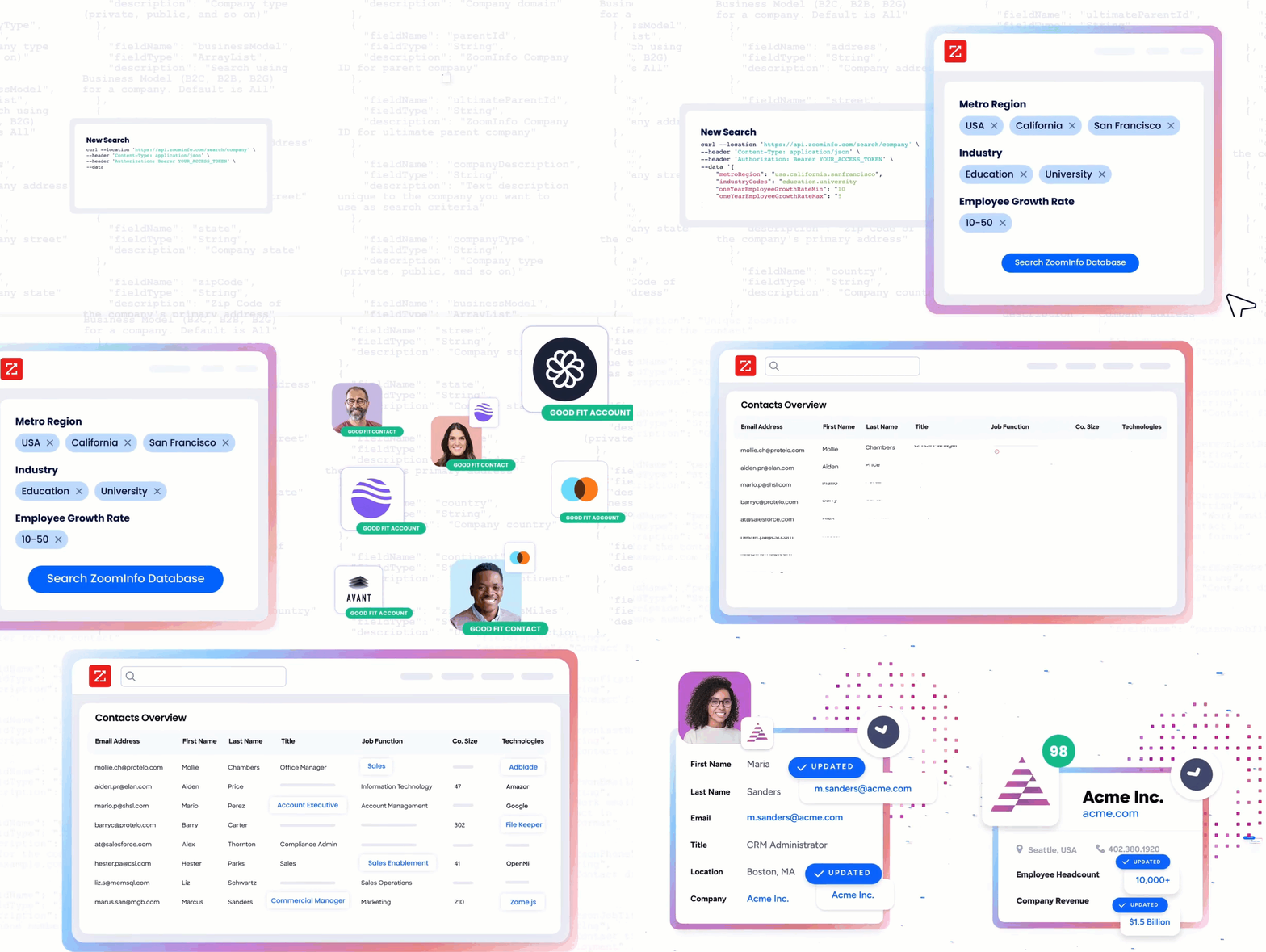
For teams building beyond ZoomInfo's own products, APIs and MCP expose the same intelligence to any custom agent, internal tool, or partner platform. API access is included in all plans, and the MCP server connects with AI assistants including Claude and ChatGPT.
Source: ZoomInfo
All three channels draw from one GTM Context Graph. Same data, same reasoning, same intelligence, regardless of which surface a team works from.
BDO Canada's Senior Marketing Intelligence Analyst Jerry Wilson: "The plug-and-play aspect of the API means I can integrate it into any process and get information at a moment's notice," achieving an 87% reduction in time spent on internal data dashboard updates. (BDO Canada)
Pricing and Accessibility: Multiple entry points from free to enterprise.
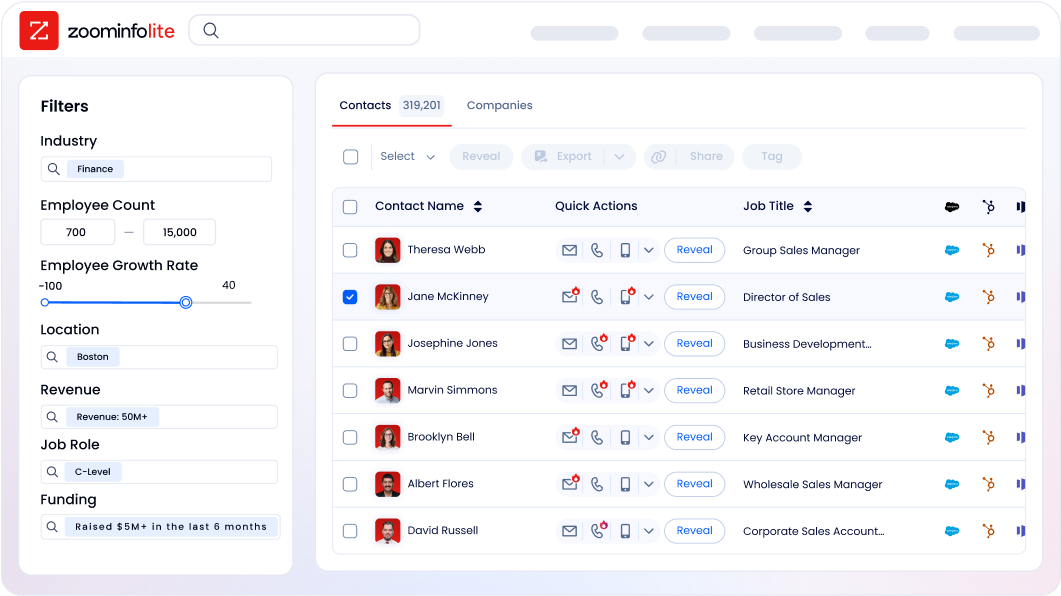
ZoomInfo offers entry points that LeadFuze does not. ZoomInfo Lite is a permanent free tier (not a trial) with access to ZoomInfo's B2B database, 10 monthly export credits, individual and company searches, the ReachOut Chrome extension, WebSights Lite for up to 10 website visitor reveals per day, and HubSpot integration.
Source: ZoomInfo
A separate 7-day free trial gives access to core platform features including contact and company search, intent signals, and email outreach. No credit card required.
Paid plans use a custom-quoted, seat-and-credit model across three tiers (Professional, Advanced, Enterprise) for both Sales and Marketing product lines. Credits are consumed when data is exported, not when searching.
ZoomInfo is premium-priced, but the results are documented: Snowflake achieved 200% higher conversion rates on top-scoring accounts, and Smartsheet reported a 59% increase in win rate using FormComplete.
LeadFuze's $1,500–$2,000/month data license delivers raw data at a flat rate but includes no execution tools, no self-serve interface, and no free entry point.
LeadFuze or ZoomInfo: Comparison Summary
LeadFuze | ZoomInfo | |
|---|---|---|
Primary function | Contact data infrastructure for developers | AI-powered GTM platform |
Database size | 269M+ profiles | 500M contacts, 100M companies |
Geographic coverage | US-focused | Global (34M+ company profiles outside NA) |
Verified phone numbers | 131M+ mobile numbers | 135M+ verified, 120M direct-dial |
Verified emails | 176M+ email addresses | 200M+ verified business emails |
Self-serve prospecting UI | Shut down | Full search, filter, and export |
Intent data | Coming Soon | Live, with Guided Intent |
Conversation intelligence | Not available | |
AI-powered execution | Not available | |
API access | REST API, webhooks | Enterprise API, MCP, API in all plans |
Bulk data delivery | S3, GCS, Azure, SFTP | Cloud Data Cubes via AWS, Snowflake, Databricks |
Website visitor identification | Person-level (IDRP) | WebSights with bot filtering |
CRM integrations | Not documented | Salesforce, HubSpot, Dynamics + 120 marketplace integrations |
Compliance certifications | In progress | ISO 27001, SOC 2 Type II, ISO 27701, GDPR, CCPA |
Free tier | None | ZoomInfo Lite (permanent) |
Data license pricing | $1,500–$2,000/month (flat rate) | Custom-quoted |
Target buyer | Developers, AI teams, ISVs | Sales, marketing, RevOps, developers |
Support | Email/account manager only | Help Center, University, community, phone, Labs |
Final Verdict
The choice between LeadFuze and ZoomInfo depends on whether you need raw data infrastructure or a full GTM platform.
Choose LeadFuze if you're a developer or data engineer building a product that needs a US contact data layer at the infrastructure level. The Enrichment API, Identity Resolution Pixel, and Data License deliver a large B2B/B2C identity graph at competitive pricing for teams with the technical resources to integrate via API.
If your goal is to build your own tools on top of contact data and your market is primarily US-based, LeadFuze offers a cost-effective data foundation.
Choose ZoomInfo if you need more than data. If your sales team needs a prospecting interface, your marketers need ABM orchestration, your RevOps team needs enrichment and routing automation, or your organization needs intent signals, conversation intelligence, and AI-driven execution alongside contact data, ZoomInfo brings it together.
Its GTM Context Graph turns raw data into intelligence teams can act on, and its three access channels (GTM Workspace, GTM Studio, APIs/MCP) deliver that intelligence to every team and tool.
For developers, ZoomInfo's Enterprise API and MCP server provide the same data and intelligence programmatically, with established compliance certifications and global coverage that LeadFuze cannot yet match.
Get started with ZoomInfo here.
LeadFuze FAQ
What happened to LeadFuze's prospecting software?
LeadFuze shut down direct software access and discontinued the self-serve prospecting tool users relied on for list-building and outreach. The company now offers only a full data license with monthly updates and API products. Existing users who built processes around the old interface lost access. LeadFuze now targets developers and data teams rather than individual sales reps.
How much does LeadFuze cost?
The full Data License costs $1,500 to $2,000 per month depending on the contract term. The Enrichment API and Identity Resolution Pixel are custom-quoted based on volume and use case. There is no free trial or free plan. All access requires submitting a form and going through a sales process. ZoomInfo offers a permanent free tier (ZoomInfo Lite) and a 7-day free trial for paid features, with no credit card required.
Does LeadFuze cover international data?
LeadFuze is primarily US-focused. The company describes itself as the trusted lead data supplier for the US population. Users have flagged the absence of a European database as a gap. Companies with international prospects will find the data incomplete outside the United States.
ZoomInfo provides global coverage with over 34 million company profiles and 200 million professional profiles outside North America.
Does LeadFuze have SOC 2 or GDPR certification?
No. LeadFuze states on its Data Co-Op page that it is working towards SOC 2, GDPR, and CCPA certifications, but has not achieved them. For enterprise procurement teams in regulated industries, this may be a barrier. ZoomInfo holds ISO 27001, ISO 27701, SOC 2 Type II, TRUSTe GDPR, and TRUSTe CCPA certifications, all renewed annually.
What is LeadFuze's Data Co-Op?
The Data Co-Op is a cooperative model where member organizations contribute anonymized data signals in exchange for access to LeadFuze's full identity graph. The network processes billions of signals to validate and refresh contact records.
Members must contribute their own data to participate, and contributed data is removed if a member leaves. The model keeps the identity graph fresh without relying on periodic data scrapes.
Can sales teams use LeadFuze for prospecting?
Not directly. Since LeadFuze shut down its self-serve software, there is no interface for searching contacts, building lists, or triggering outreach. All products require API integration, which means you need developers.
Sales teams looking for a self-serve prospecting tool should consider platforms with a visual interface, such as ZoomInfo, which offers contact and company search with over 300 attributes, list building, CRM export, and AI-powered outreach through GTM Workspace.
Does LeadFuze offer intent data?
Not yet. LeadFuze has announced an Intent Data product that would track over 5 billion signals daily across 35,000+ B2B and 7,000+ B2C categories, but the product page is marked Coming Soon with no public launch date. Buyers who need intent signals today must use a separate vendor.
ZoomInfo offers live intent data tracking signals from 210 million IP-to-Organization pairings, including Guided Intent, which identifies topics historically correlated with deal success.
What data does the LeadFuze Enrichment API return?
The API returns over 50 data fields per profile, including full name, business and personal emails with validation status, mobile and direct phone numbers, LinkedIn URL, personal and professional addresses, demographic attributes (gender, age range, income range, net worth, homeowner status), job title, seniority level, department, and company firmographics.
It also returns a confidence score and programmatic email format permutations. The API supports lookups by email, phone, LinkedIn URL, or name-plus-company combination, with advertised sub-200ms response times.
