
Choosing between LeadSquared and Zoho CRM comes down to a few questions:
Are your sales teams handling hundreds of consumer-facing leads daily, or managing a mix of B2B and B2C relationships?
Do you need a CRM pre-configured for a specific industry, or a flexible platform you can shape to any business process?
Is field sales with geo-tracking, offline access, and attendance verification a daily requirement?
Does your budget allow $60+ per user per month, or do you need a credible option starting under $15?
How important is the quality of the prospect data feeding your CRM?
In short, here's what we recommend:
LeadSquared is built for organizations running high-volume sales in specific verticals: financial services, healthcare, education, automotive, and manufacturing. Its CRM ships with industry-specific workflows, a field sales mobile app used by 500,000+ users, and a data model connecting marketing, sales, service, and field operations in one system. For companies processing thousands of leads daily through structured funnels (loan originations, student admissions, patient inquiries), LeadSquared is designed for exactly those motions.
The trade-offs: pricing starts at $40/user/month with mandatory annual contracts, and its strongest market presence remains in India and Southeast Asia.
Zoho CRM is the horizontal platform that adapts to nearly any business. Serving 300,000+ businesses worldwide, it covers sales force automation, marketing, analytics, and process management at a price point that starts with a permanent free plan for three users and scales through four paid tiers. Zoho's Zia AI provides predictive scoring, agentic automation, and natural-language CRM configuration. Backed by an ecosystem of 60+ integrated Zoho apps and month-to-month contracts, it fits SMBs and mid-market teams that need breadth without long-term lock-in.
The trade-off is complexity: advanced configuration demands significant admin time, and support quality can be inconsistent.
Both platforms manage the sales process well once leads enter the system. But neither generates the prospect intelligence (verified contact data, company insights, buying intent signals) that determines whether your team reaches the right people at the right time. For B2B sales teams, that upstream gap is where deals are won or lost before the CRM gets involved.
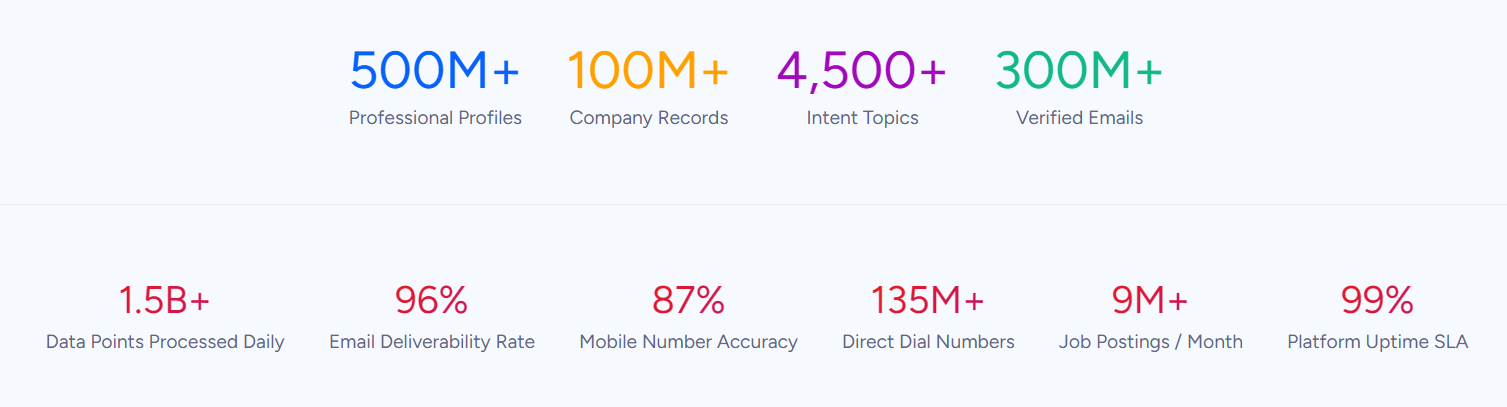
ZoomInfo is a GTM platform built on a B2B data foundation of 500M contacts, 100M companies, 135M+ verified phone numbers, and 200M+ verified business email addresses. Its GTM Context Graph processes 1.5B+ data points daily, combining this data with your CRM records, conversation transcripts, and behavioral signals to reveal not just who your prospects are, but why deals move or stall.
For teams using LeadSquared or Zoho CRM, ZoomInfo provides the data intelligence layer that makes every CRM action more targeted, accessible through direct CRM integrations, the GTM Workspace, GTM Studio for marketers and RevOps, or APIs and MCP that connect to any tool in your stack.
If data-driven sales sounds like the missing piece in your CRM strategy, see how ZoomInfo works with a free trial.
LeadSquared vs. Zoho CRM vs. ZoomInfo at a glance
LeadSquared | Zoho CRM | ZoomInfo | |
|---|---|---|---|
Core focus | High-velocity B2C sales CRM | Horizontal CRM for all business types | B2B data intelligence and GTM execution |
Best for | Financial services, healthcare, education | SMBs and mid-market across industries | B2B sales, marketing, and RevOps teams |
Starting price | $40/user/month (annual) | Free (3 users); paid from ~$14/user/month | Consumption-based; free tier available |
Free plan | No | Yes (3 users, permanent) | Yes (ZoomInfo Lite, permanent) |
AI capabilities | Propensity scoring, next-best-action | Zia: predictive scoring, agentic AI, NLP config | GTM Context Graph, AI agents, intent signals |
Field sales / mobile | Dedicated app with geo-fencing, offline mode | Native app with offline access | GTM Workspace for seller execution |
Vertical depth | Deep (6+ industries with sub-verticals) | Moderate (10+ industry solutions) | B2B-specific (company data, intent, technographics) |
Ecosystem | 162 integrations | 1,100+ integrations + 60 Zoho apps | 120+ integrations + APIs/MCP |
Contract flexibility | Annual only, no refunds | Monthly or annual, 45-day refund | Annual contracts standard |
Two CRMs built for different sales motions
This is the most important distinction. LeadSquared and Zoho CRM rest on different assumptions about how sales works.
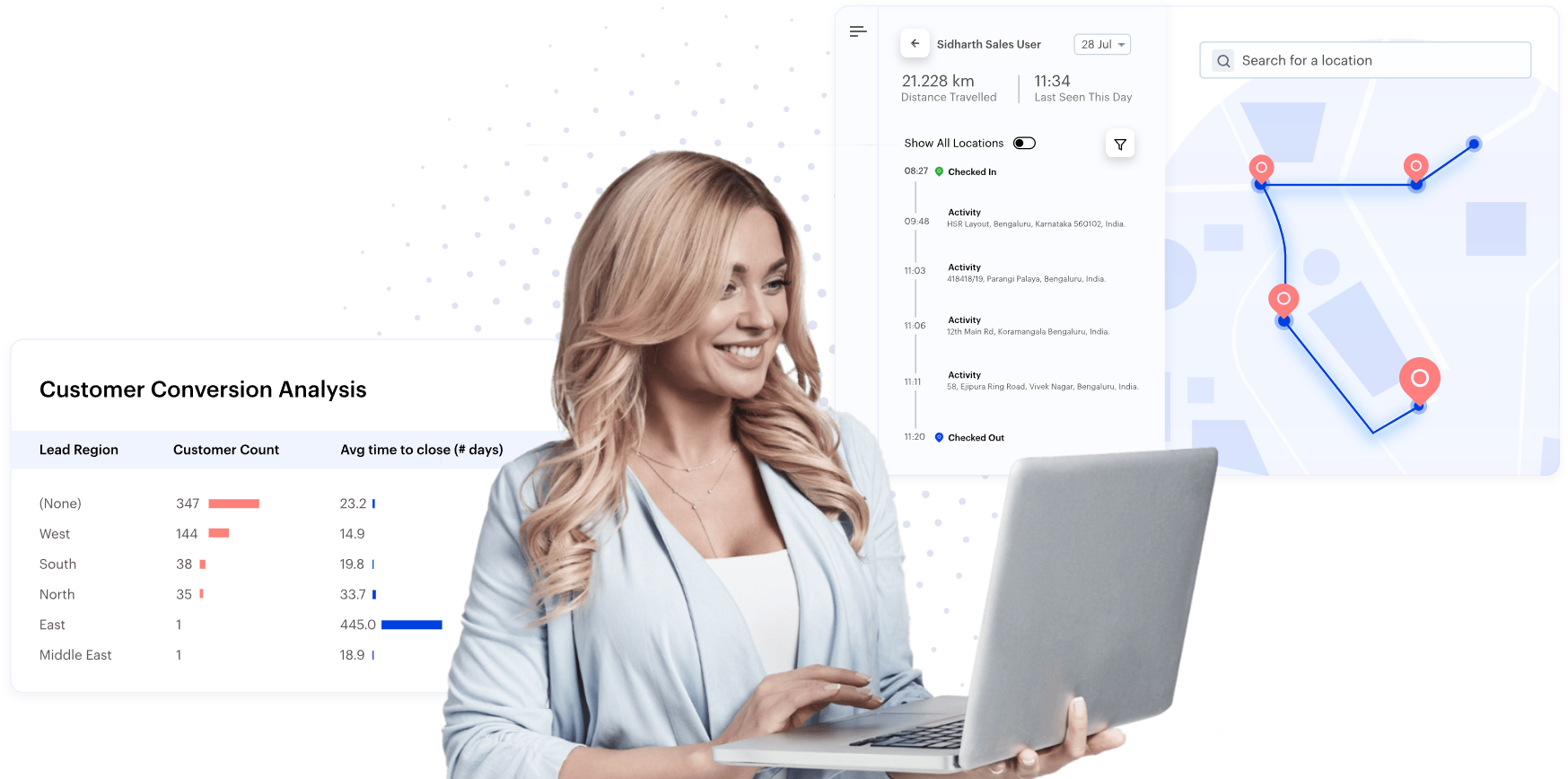
LeadSquared assumes high volume and structured process. Its data model centers on a single contact carrying multiple simultaneous opportunities for different products, each with its own workflow and team. This makes sense for a lending company where one customer might apply for a personal loan, a credit card, and a home loan at the same time. The Weighted Round Robin Distribution Engine routes thousands of leads to the right rep based on weighted criteria, using a running credit algorithm that self-corrects for proportional fairness. Sales regimentation (structured daily targets, achievement tracking, forced process compliance) is a first-class feature, not an afterthought.
Source: LeadSquared
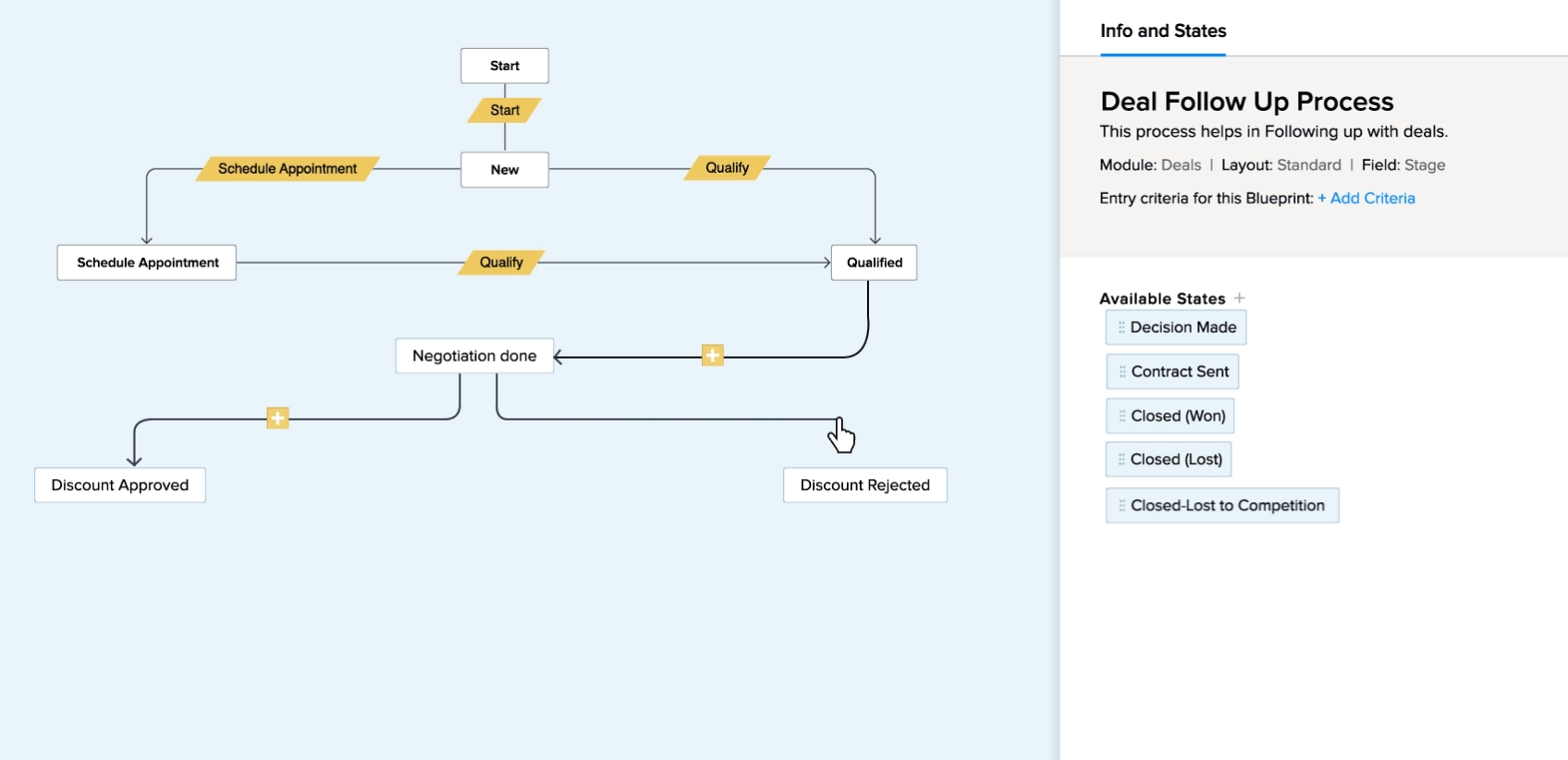
Zoho CRM assumes variety and flexibility. Rather than prescribing how sales should work, Zoho provides the building blocks to model nearly any process. Its Blueprint feature lets you define stage-by-stage sales processes with mandatory steps, required fields, and approval gates. You can configure multiple pipelines for different products or geographies. Canvas Design Studio allows no-code visual redesign of every CRM screen, down to pixel-level control over colors, typography, and layout.
Source: Zoho CRM
This flexibility serves a broader market. A real estate firm, a SaaS startup, a manufacturing distributor, and a consulting practice can all configure Zoho CRM to match their processes without writing code. The trade-off is setup time. G2 reviewers consistently note that while basic use is accessible, deep customization demands significant admin effort.
Your CRM is only as good as the data feeding it
This is the gap that neither LeadSquared nor Zoho CRM closes on its own.
Both platforms manage the sales process well once leads enter the system: routing, nurturing, automating follow-ups, tracking deals through stages. But where do those leads come from? How do you know you're reaching the right contacts at the right companies? How do you identify which accounts are researching solutions before they fill out a form?
LeadSquared captures leads from websites, chatbots, social media ads, phone calls, and third-party aggregators. Zoho CRM captures from web forms, live chat, business card scanning, and social media. Both act on inbound interest. Neither generates the outbound intelligence (verified direct dials, business emails, org charts, technographic profiles, buying intent signals) that B2B sales teams need to build pipeline proactively.
ZoomInfo fills this gap at scale. The platform's B2B data covers 500M contacts and 100M companies, verified through a multi-source pipeline backed by 300+ human researchers with up to 95% accuracy on first-party data. In a Fortune 500 competitive RFP analyzing 25 million contacts across vendors, the independent consultant concluded that "no other competitor came even close."
Buyer Intent data tracks signals from 210 million IP-to-Organization pairings and 6 trillion+ new keyword-to-device pairings monthly, revealing which companies are researching solutions in your category. WebSights resolves anonymous website traffic to specific companies and buying team members, identifying interest before anyone fills out a form.
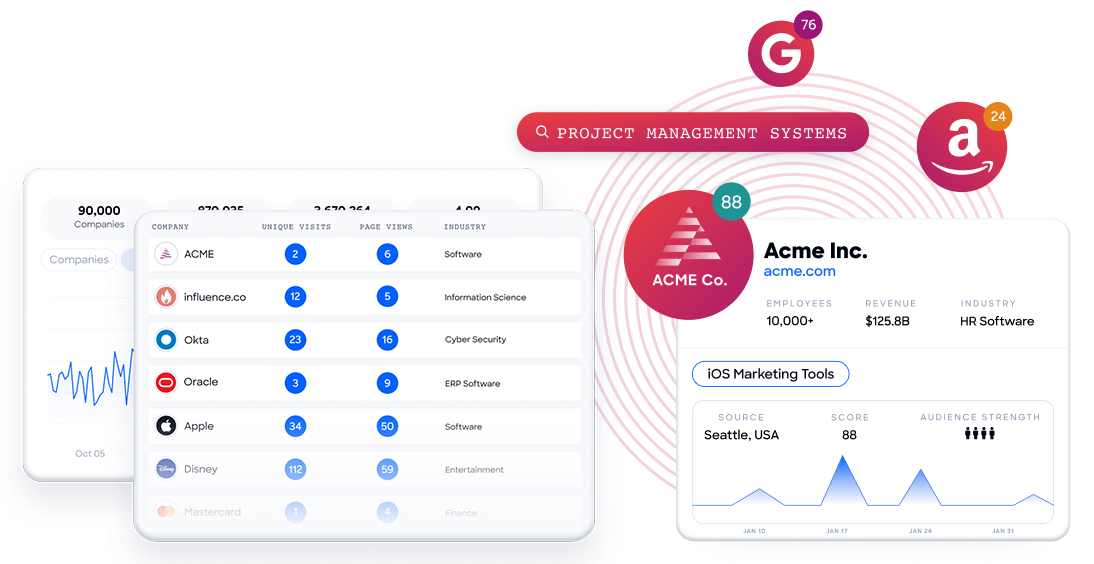
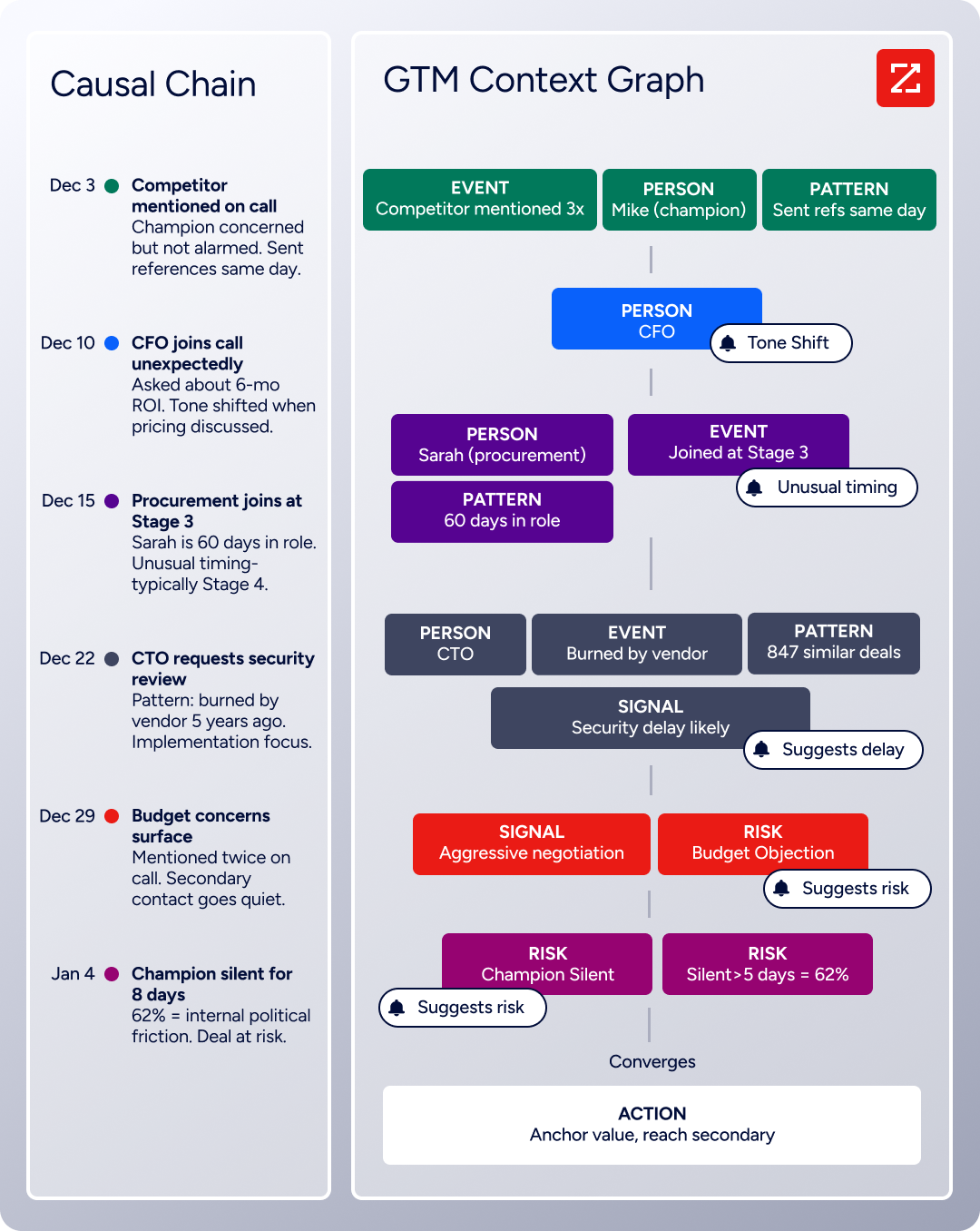
The GTM Context Graph then combines this third-party intelligence with your CRM's first-party data into a single intelligence layer. It captures not just that a deal moved stages, but why: the executive who joined the last call, the intent spike that preceded the meeting request, the competitor research that signals urgency. As ZoomInfo's Chief Product Officer Dominik Facher writes: "The CRM recorded the state change. It has no record of why it happened."
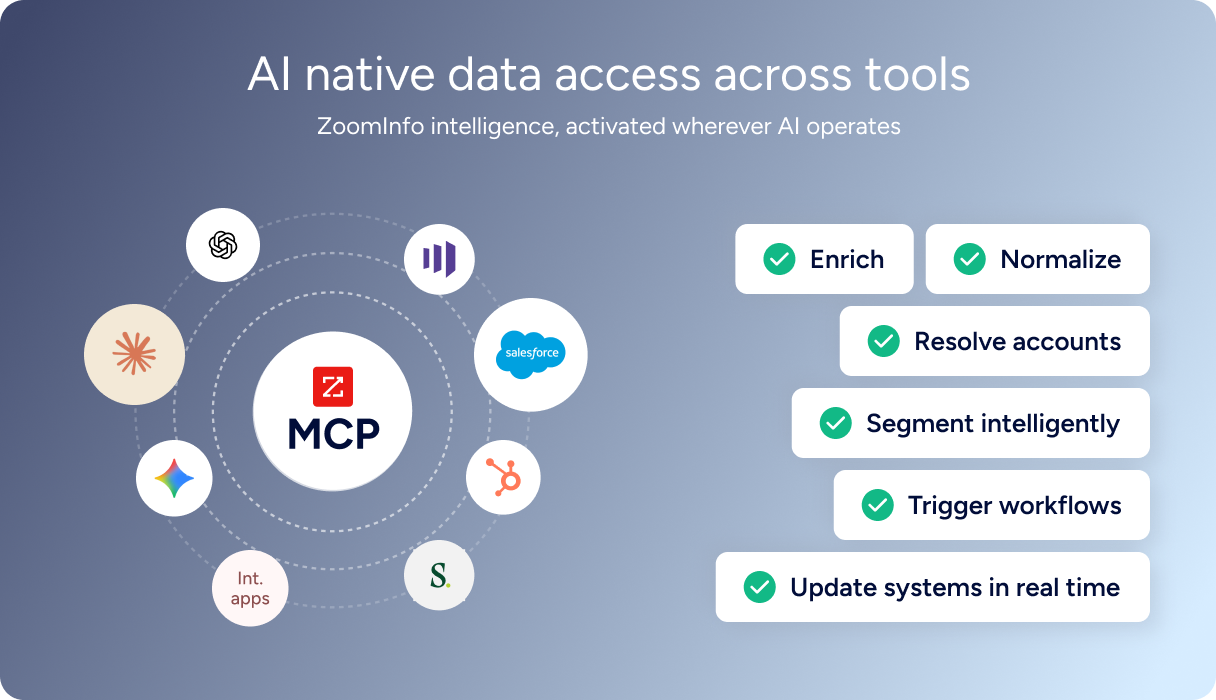
For teams using Zoho CRM, ZoomInfo integrates directly. Zoho is listed as a CRM and MAP integration in ZoomInfo's marketing plans, and API access is included in all relevant ZoomInfo plans. For teams building custom workflows, ZoomInfo's MCP server connects AI models directly to the data layer with no custom coding required.
"ZoomInfo gives us the information we need to execute. It's already there, so we can be three steps ahead." (Vensure)
Sales automation and process enforcement
Both platforms take automation seriously, but their approaches reflect their design philosophies.
LeadSquared's automation is prescriptive. The no-code workflow builder creates automated processes triggered by lead events or time conditions: auto-assigning leads, creating tasks, notifying managers of inaction, reassigning missed calls. The Customer Journey Builder provides a visual canvas for modeling journeys across email, WhatsApp, SMS, chatbot, and field agent handoffs. The marketing suite includes lead capture from every channel, with drip campaigns and triggered communications that fire based on prospect behavior.
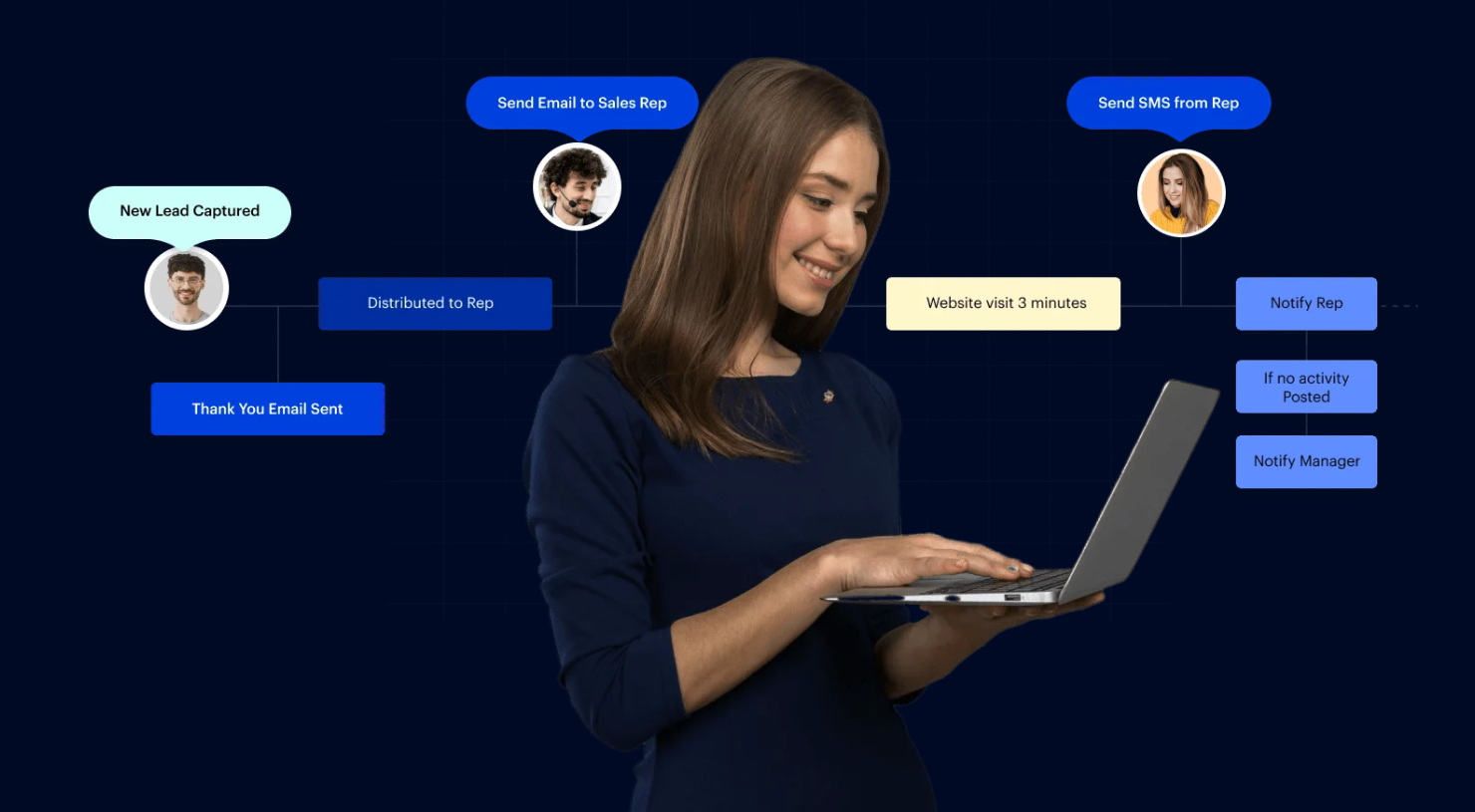
Source: LeadSquared
Where LeadSquared stands out is the BTL Marketing module, which manages field campaigns and trade shows within the same platform as digital campaigns, complete with geo-fenced lead capture and OTP verification. For organizations running both digital and on-ground sales operations, this unification is uncommon.
Zoho CRM's automation is layered. Zoho provides a genuine process hierarchy. Workflow Rules handle trigger-action automation (up to 2,500 rules per org). Blueprint enforces stage-by-stage compliance, preventing reps from moving deals forward without completing required steps. Cadences coordinate multi-channel follow-up sequences (email, call, task, WhatsApp) that branch based on customer responses. And CommandCenter uses PathFinder to discover how customers actually move through your funnel before you design the ideal journey.
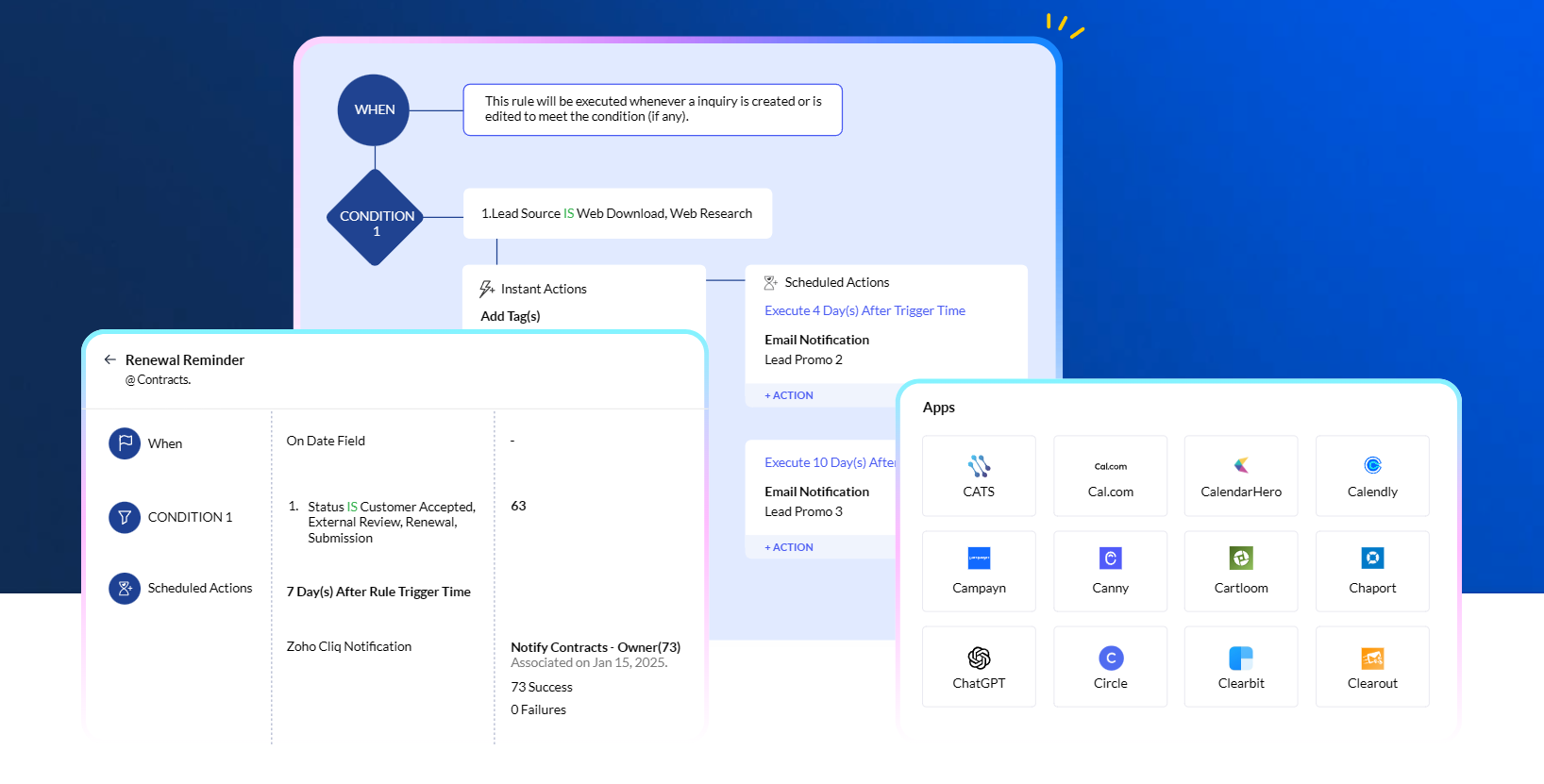
Source: Zoho CRM
The depth here matters. G2 users call out Blueprint as effective at reducing human error and keeping reps on process. Zia also analyzes audit logs to spot repeated manual actions and suggests new workflow rules, improving automation coverage without admin intervention.
AI capabilities across the three platforms
AI has become the central marketing pitch for both CRMs. Here's what each delivers, and where ZoomInfo adds a different dimension.
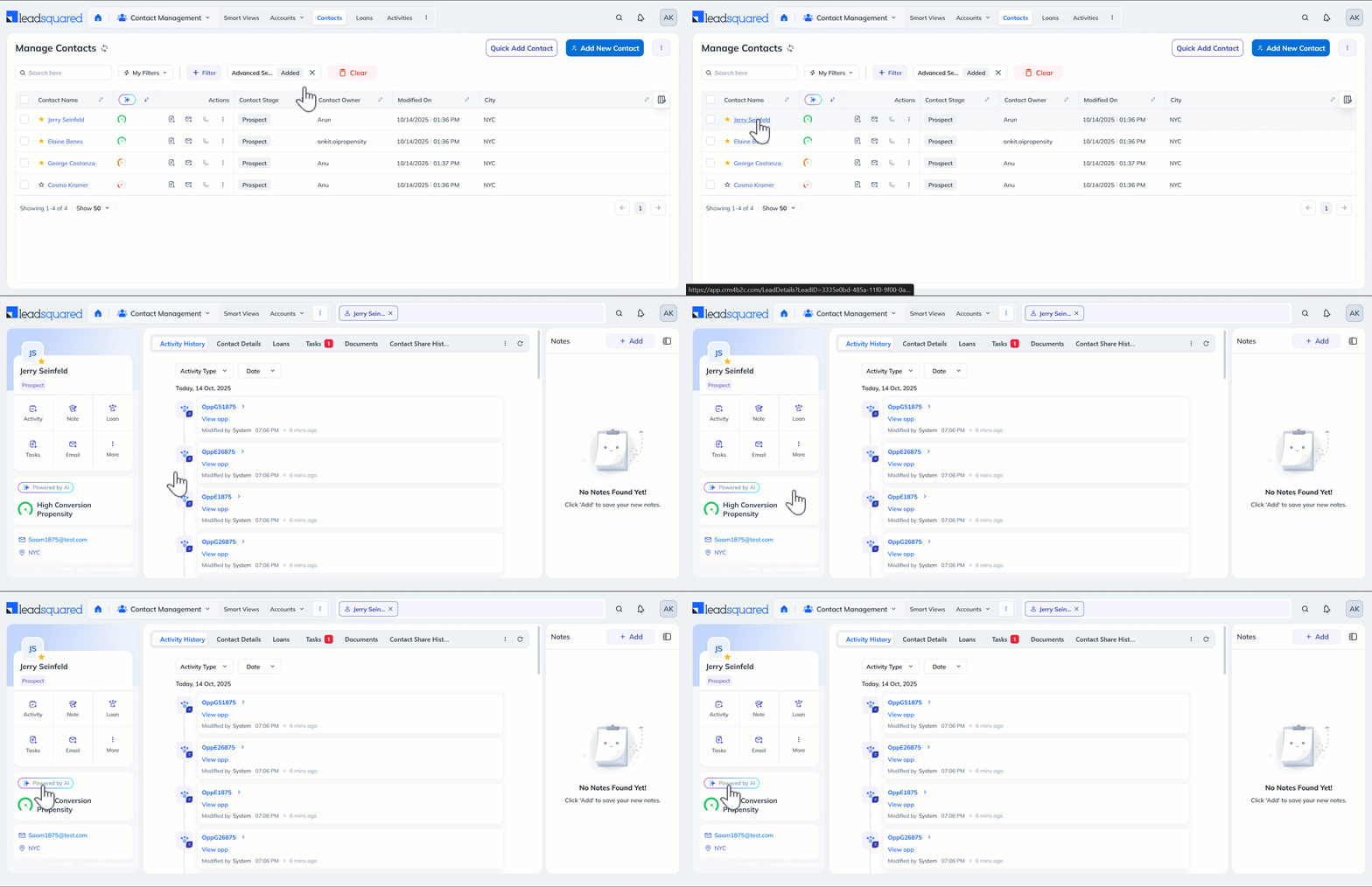
LeadSquared's AI focuses on lead prioritization. The AI Propensity Score analyzes historical lead and opportunity data to classify each lead's conversion likelihood as High, Medium, or Low, retraining as new data arrives. This sits alongside a three-layer scoring system: Lead Quality Score (profile match), Lead Score (historical interactions), and Engagement Score (recent activity within a configurable time window). The Service Cloud includes Lexi AI for conversation summaries, reply drafts, and sentiment tracking.
Source: LeadSquared
LeadSquared's AI is practical but narrow. Co-founder Prashant Singh disclosed in April 2025 that the AI-powered Knowledge Base Bot reduces support interaction load by up to 60%. However, Gartner's 2024 Magic Quadrant evaluation noted that AI/GenAI features were not yet present at time of evaluation, though they appeared on the roadmap.
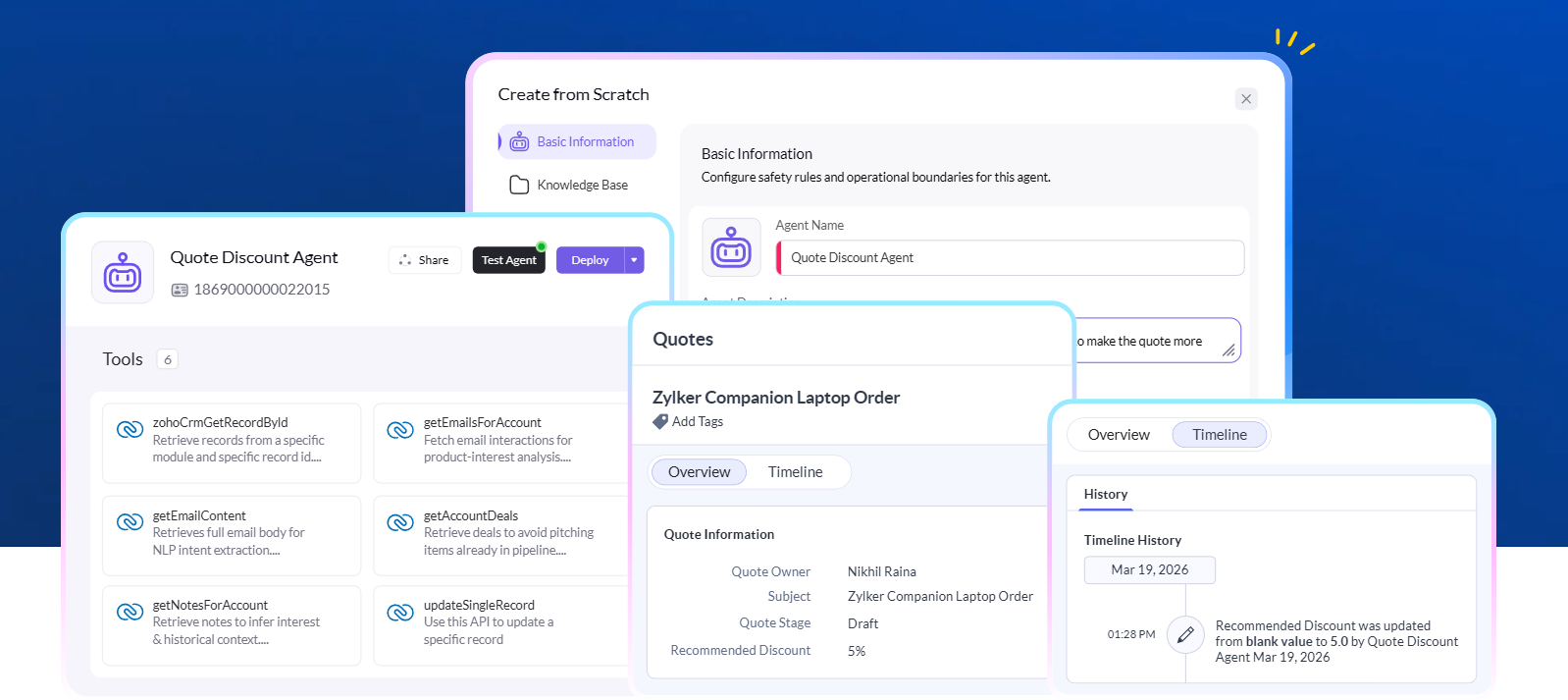
Zoho CRM's Zia covers more ground. Zia spans predictive lead scoring, churn prediction, deal win probability, best time and channel to contact, email sentiment analysis, call transcription, anomaly detection, and seven pre-built AI agents. These include an SDR agent that nurtures leads via targeted emails, a sales coach that delivers feedback on real deals, and a deal analyzer providing win probability and next-best-action suggestions.
Source: Zoho CRM
What distinguishes Zia is its ability to configure the CRM itself. Users can describe a module in natural language and Zia generates it with associated fields. Workflow rules can be created in plain language by describing the logic. The Image to Canvas feature generates CRM layouts from uploaded screenshots. Zoho also launched its own LLM in Q2 2025 to process data within its own environment, allowing customers in regulated industries to use generative AI without exporting data to third-party infrastructure.
ZoomInfo's AI operates at the intelligence layer. While LeadSquared and Zoho CRM apply AI to data already inside the CRM, ZoomInfo's GTM Context Graph applies AI to the broader question of who to sell to and why. Processing 1.5B+ data points daily, it combines B2B contact data, company intelligence, intent signals, CRM records, and conversation transcripts to identify which accounts are actively in-market and what drives their buying decisions.
The practical difference: a CRM's AI tells you which existing leads are most likely to convert. ZoomInfo's AI identifies prospects you didn't know existed, surfaces intent signals showing which companies are researching solutions like yours, and provides the verified contact data (direct dials, business emails) to act on those signals immediately. GTM Workspace's AI agents, built on Anthropic's Claude, handle account research, outreach drafting, CRM updates, and signal monitoring.
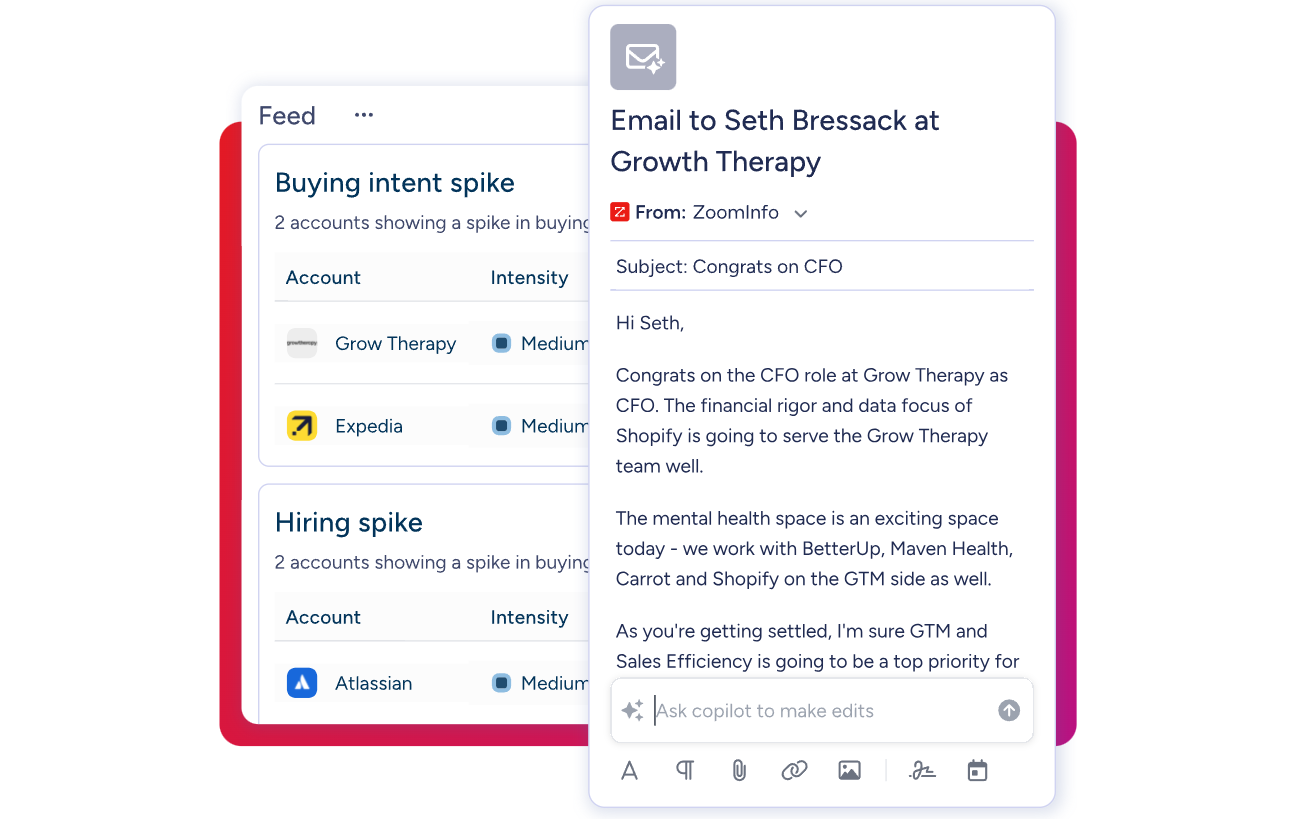
Seismic's sales team attributed 39% of active pipeline to opportunities identified or influenced by ZoomInfo signals, with a 54% productivity boost and 11.5 hours saved per week per seller. (Seismic)
Field sales and mobile CRM
For organizations with ground-level sales teams, mobile CRM capabilities can be decisive.
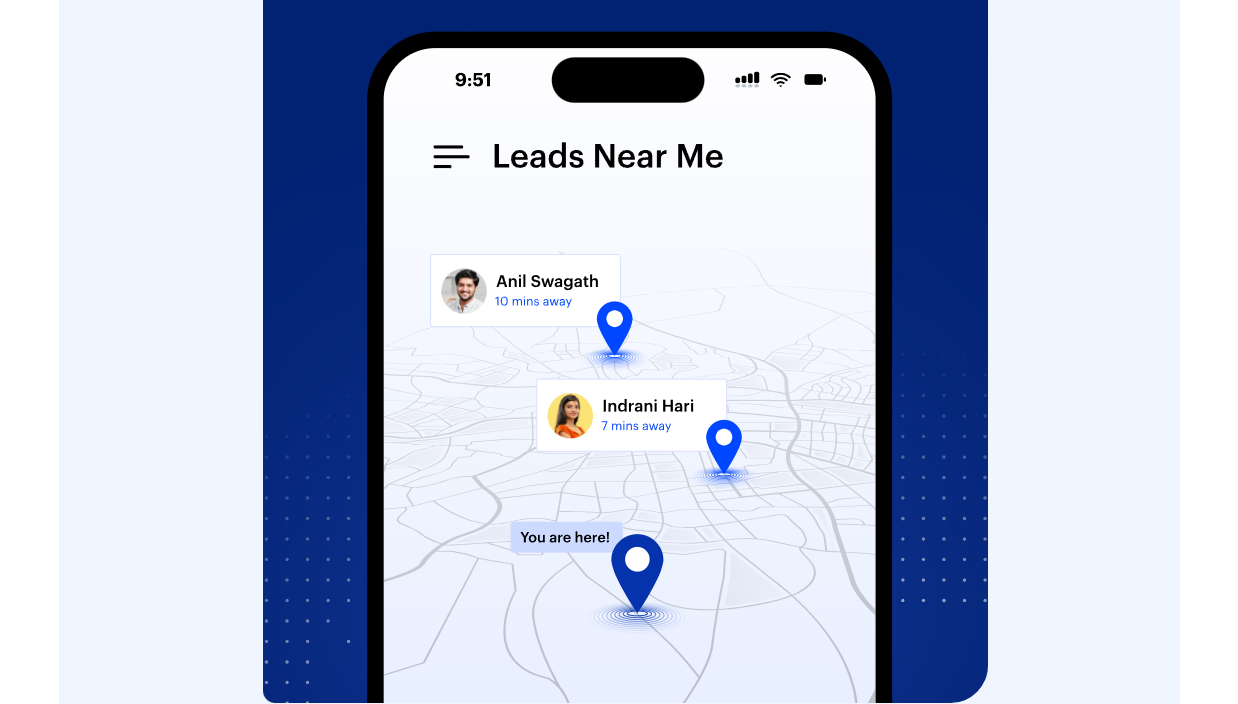
LeadSquared dominates field sales. The Mobile CRM is a dedicated iOS and Android application for reps working outside an office: loan officers, door-to-door agents, merchant onboarding executives, healthcare representatives. Key capabilities:
Leads Near Me shows all leads within a 15-kilometer radius on a map
Activity and Task Geo-fencing requires reps to be physically present at the correct location before marking tasks complete
Image-linked check-in/check-out can require a selfie with face detection for attendance verification
Field Force Insights gives managers animated route playback, distance tracking, and working vs. travel time breakdowns
Offline Mode lets reps complete tasks and fill forms without connectivity, syncing on reconnection
Device Binding locks each user to a single registered device as an anti-fraud control
Territory Management supports up to five nested sub-territory levels, drawn freehand or imported by pincode
Source: LeadSquared
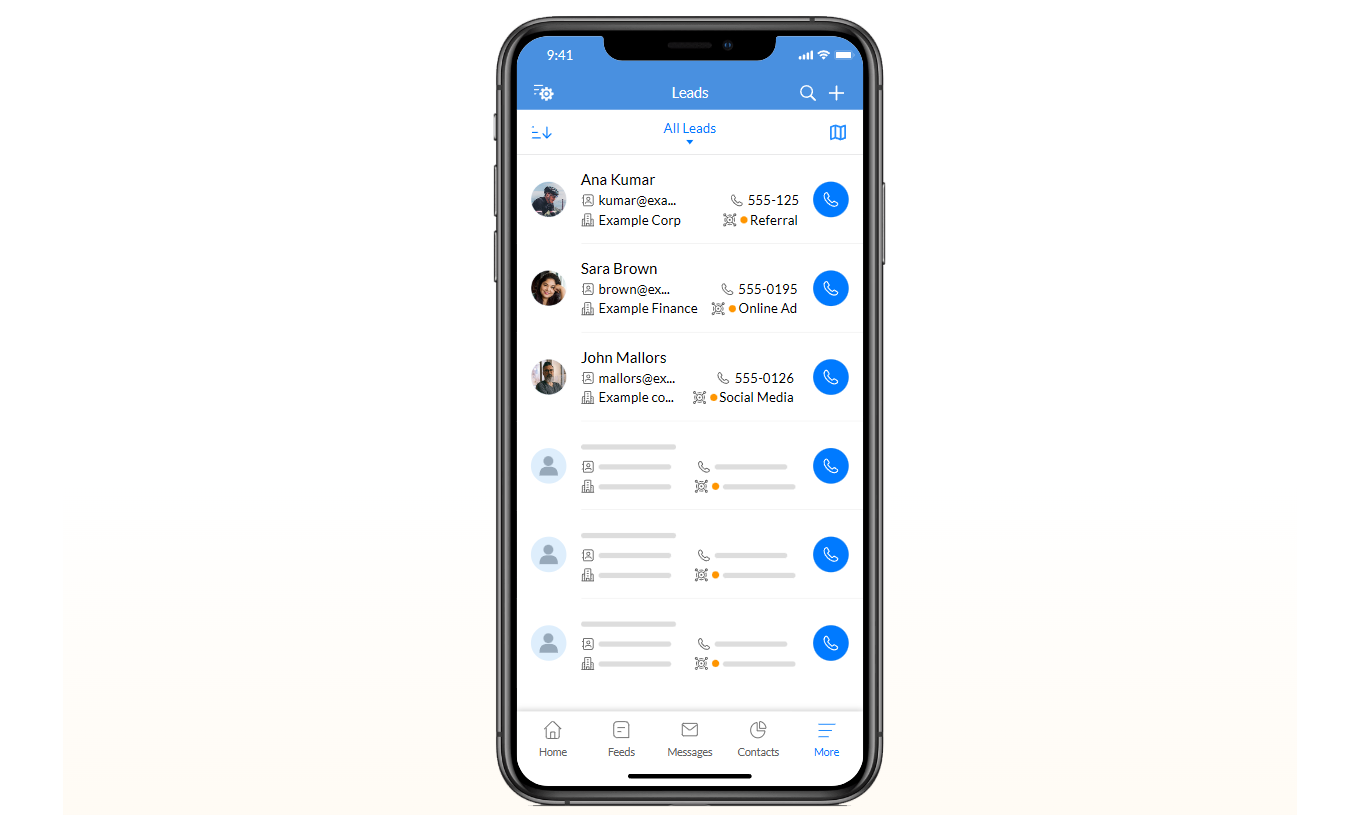
Zoho CRM's mobile app is solid but general. It offers offline access and covers core CRM functions (viewing records, logging calls, checking dashboards) on iOS and Android. But it lacks the geo-fencing, route tracking, beat planning, and field force monitoring that LeadSquared treats as core capabilities. For office-based sales teams who occasionally need mobile access, Zoho's app works. For organizations managing hundreds of field reps across territories, LeadSquared's mobile CRM is in a different category.
Source: Zoho CRM
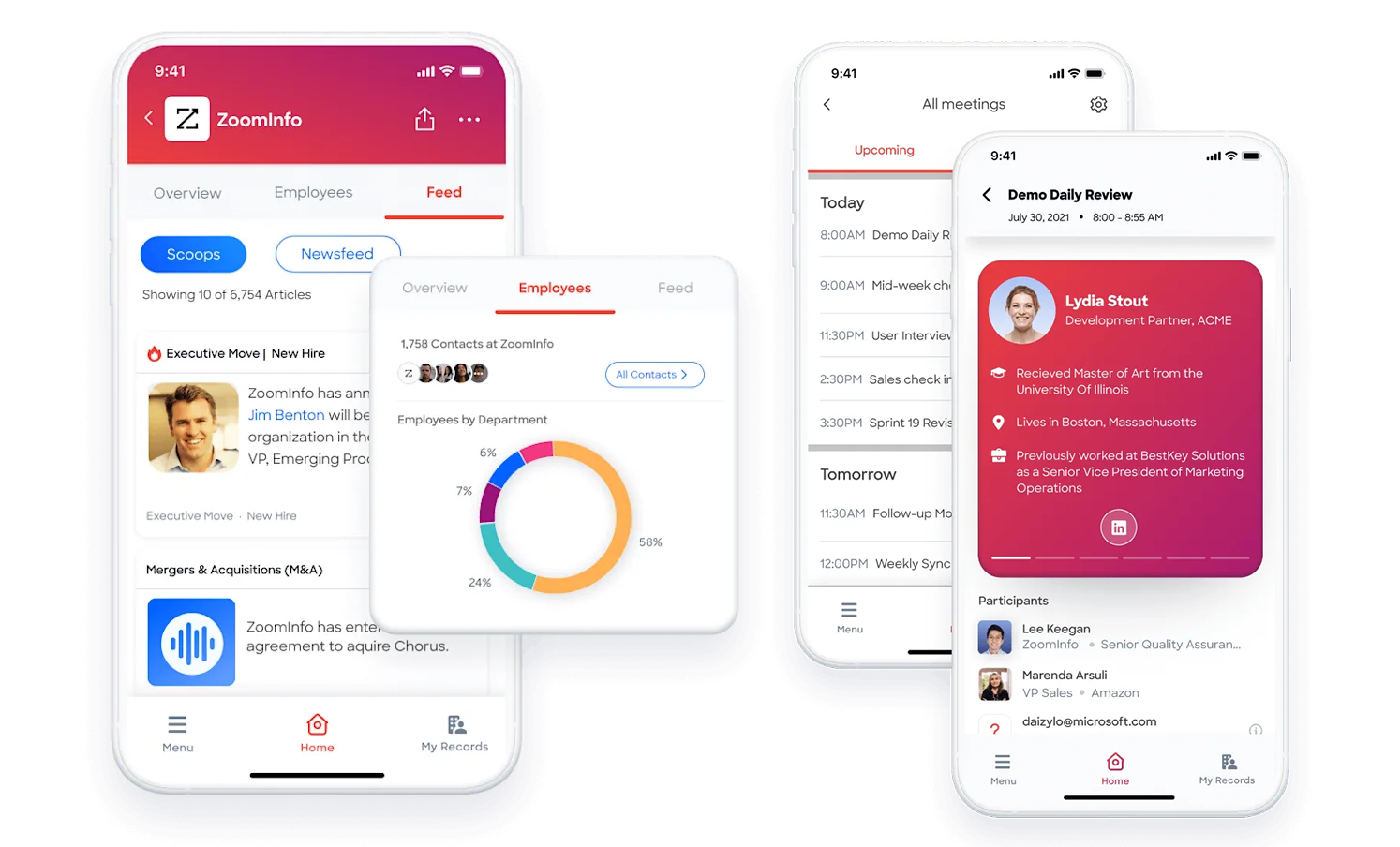
ZoomInfo's value on mobile comes through data. ZoomInfo's ReachOut Chrome Extension and mobile app provide on-the-go access to contact data and company intelligence. The real mobile benefit comes from ZoomInfo's data flowing into whichever CRM your field team uses, enriching the records reps see on their phones with verified contact information and company context.
Pricing reveals different target markets
The pricing structures tell you who each platform is designed for.
LeadSquared prices for mid-market and enterprise. Sales Pro costs $40/user/month; Sales Super costs $60/user/month, both billed annually. The marketing automation suite is priced per account: $1,200/month for Marketing Pro and $2,000/month for Marketing Super. There's no free plan, no visible free trial, and no monthly billing option. Annual commitment is required, with no termination for convenience and no refunds. Add-ons for Portals, Sandbox, Territory Management, and the analytics platform add further costs.
A startup program offers up to 60% off for India-registered startups under five years old with a minimum of five users.
Zoho CRM prices for accessibility. A permanent free plan covers three users with core lead, contact, and deal management. Paid plans start at approximately $14/user/month for Standard (billed annually), scaling through Professional, Enterprise, and Ultimate tiers. Monthly billing is available at a premium. A 15-day free trial requires no credit card. Zoho advertises month-to-month contracts as a differentiator against competitors that lock customers into multi-year deals, and refunds are available within 45 days of annual purchase.
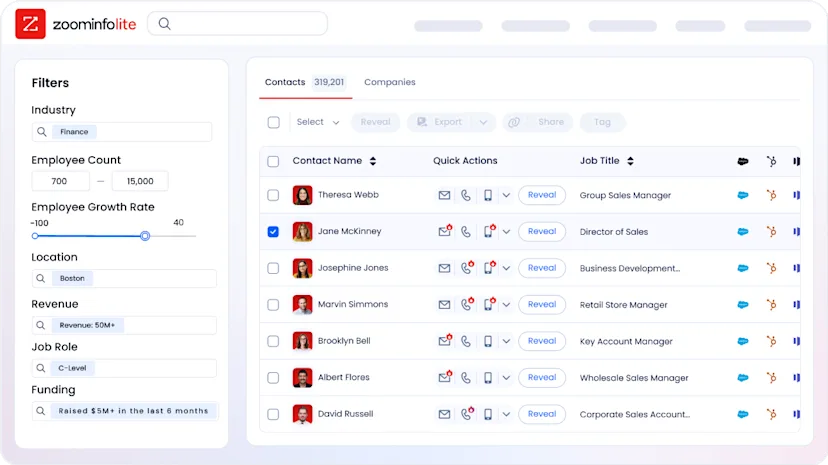
ZoomInfo uses consumption-based pricing. No prices are published. Costs depend on seats, monthly credit volume, features, company size, and contract length. ZoomInfo Lite offers a permanent free tier with access to the B2B database and 10 monthly export credits, and a 7-day free trial is available for paid features. ZoomInfo is premium-priced because it delivers a different kind of value: not CRM functionality, but the data intelligence that determines whether your CRM activity reaches the right people.
Integrations and ecosystem breadth
How well each platform connects to the rest of your tech stack matters as organizations scale.
Zoho CRM's ecosystem is its deepest moat. With 1,100+ pre-built integrations and native connections to 60+ Zoho applications (Zoho Books, Zoho Desk, Zoho Campaigns, Zoho Analytics, Zoho Projects), the platform can serve as an organization's entire operational backbone. The Zoho Marketplace for CRM spans marketing, sales, finance, telephony, and document management categories. For teams already using multiple Zoho products, the compounding value is real. Outside the Zoho ecosystem, however, G2 users flag integration friction when connecting to non-Zoho systems in complex enterprise environments.
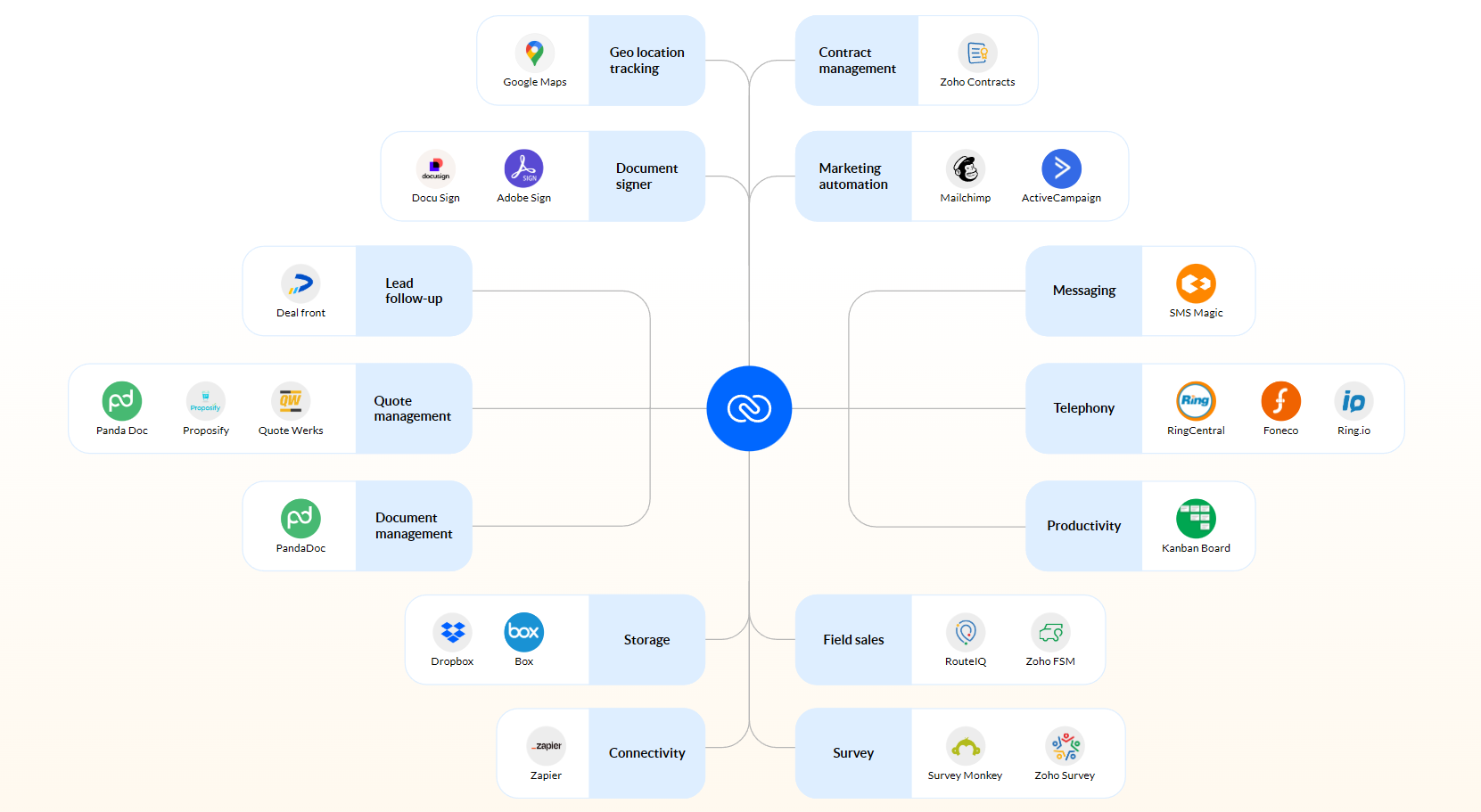
Source: Zoho CRM
LeadSquared's integrations are industry-focused. Its 162 integrations are filterable by industry (BFSI, Education, Healthcare, Real Estate) and region, reflecting its vertical specialization. The REST API covers lead, opportunity, and activity management with an async variant for high-volume operations. Universal Data Sync (UDS) provides a no-code integration builder. The integration count is an order of magnitude smaller than Zoho's, and the catalog is weighted toward Indian business tools and payment gateways (a strength for Indian enterprises, a limitation for everyone else).
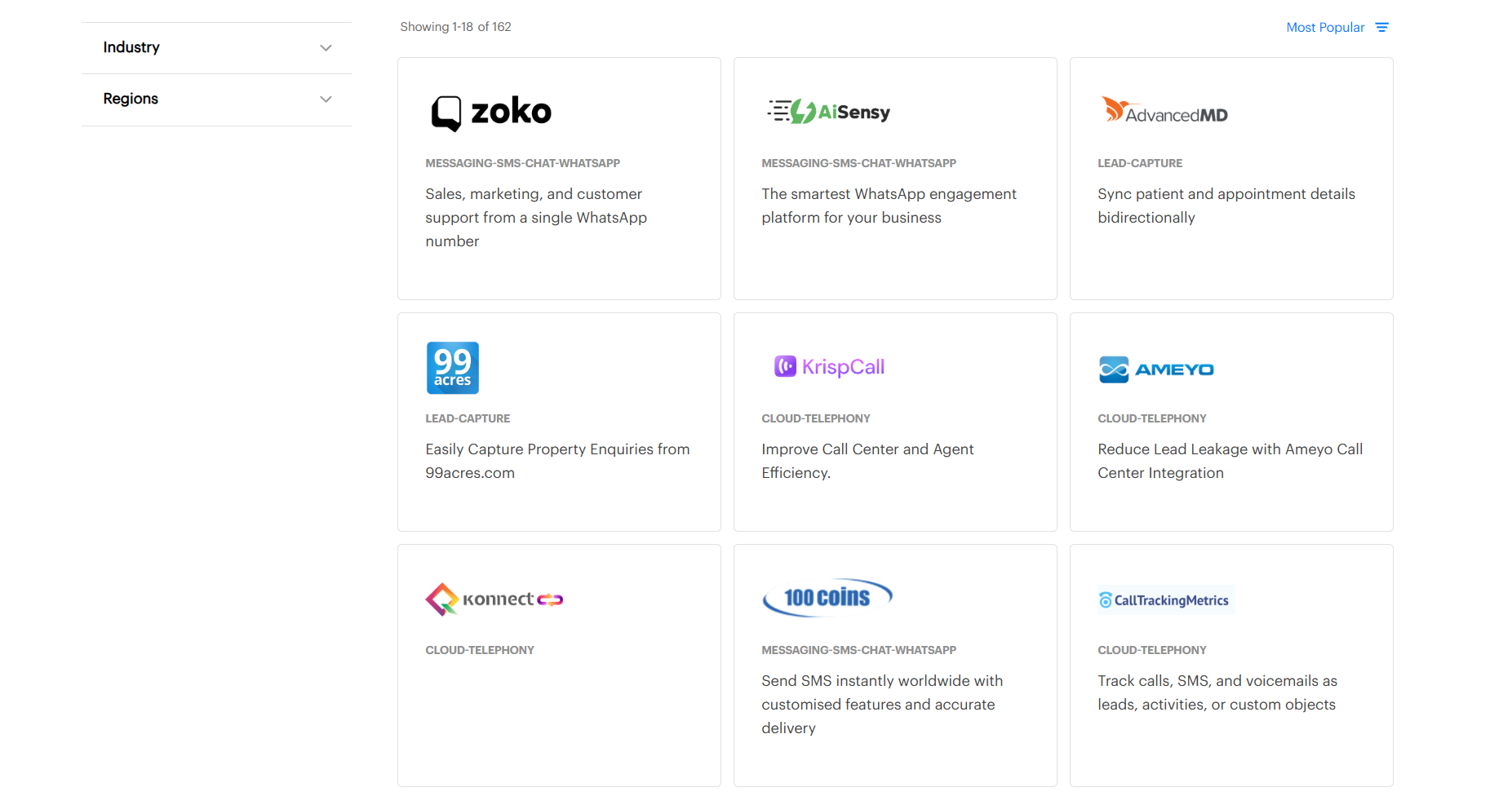
Source: LeadSquared
ZoomInfo integrates as infrastructure. The ZoomInfo App Marketplace lists 120+ partner integrations across CRM, marketing automation, sales engagement, and data warehouse categories. Featured integrations include Salesforce, HubSpot, Microsoft Dynamics 365, Snowflake, and Zoho. Cloud Partners enable direct data ingestion into AWS, Google Cloud, Snowflake, and Databricks. The Enterprise API provides structured access across four areas (Search and Enrich, Copilot AI Intelligence, Marketing Audiences, and Engagements), and MCP access connects ZoomInfo's data to any AI agent or model, including Claude and ChatGPT.
"The plug-and-play aspect of the API means I can integrate it into any process and get information at a moment's notice." BDO Canada achieved an 87% reduction in time spent on data dashboard updates. (BDO Canada)
LeadSquared vs. Zoho CRM vs. ZoomInfo: Which should you choose?
The choice depends on what your organization needs most and where it operates.
Choose LeadSquared if:
You run high-volume, consumer-facing sales in financial services, healthcare, education, or automotive
You need a CRM with industry-specific workflows available out of the box
Field sales with geo-fencing, route tracking, and offline access is a daily requirement
Your organization is based in India or Southeast Asia, where LeadSquared's support and integrations are strongest
You can commit to annual contracts starting at $60/user/month
Choose Zoho CRM if:
You need a flexible CRM that adapts to your specific business process, regardless of industry
Your budget requires an affordable starting point (free to ~$14/user/month)
You want month-to-month contract flexibility without long-term lock-in
Your team benefits from an integrated ecosystem of 60+ business applications under one vendor
You need a platform that scales from three users to thousands without forced migration
Add ZoomInfo if:
Your sales motion includes B2B prospecting and you need verified contact data, direct dials, and business emails to reach decision-makers
Buyer intent signals and in-market account identification would improve your pipeline generation
You want an intelligence layer that makes whichever CRM you choose more effective
You're building data-driven GTM workflows that extend beyond any single tool
See how ZoomInfo's data intelligence powers your CRM with a free trial.
LeadSquared and Zoho CRM solve different problems for different organizations. LeadSquared gives high-velocity sales teams structured execution at scale in specific verticals. Zoho CRM gives flexible teams the building blocks to model any sales process at a fraction of the cost.
But the most effective sales operations combine CRM execution with data intelligence. ZoomInfo provides the prospect data, intent signals, and contextual AI that feed your CRM with the right targets at the right time, whether you choose LeadSquared, Zoho CRM, or something else entirely. The CRM manages the process. ZoomInfo makes sure the process starts with the right people.
LeadSquared vs. Zoho CRM vs. ZoomInfo FAQ
What is the core difference between LeadSquared and Zoho CRM?
LeadSquared is a vertical CRM built for high-volume, consumer-facing sales in specific industries: financial services, healthcare, education, automotive, and manufacturing. It ships with industry-specific workflows, a field sales mobile app, and a data model designed for one contact carrying multiple product opportunities at once. Zoho CRM is a horizontal platform that adapts to nearly any business process through customization, Canvas Design Studio, Blueprint process enforcement, and an ecosystem of 60+ integrated applications. LeadSquared specializes; Zoho CRM flexes.
Which platform is more affordable?
Zoho CRM costs significantly less. It offers a permanent free plan for three users, with paid plans starting at approximately $14/user/month on annual billing. Monthly billing is available at a premium. LeadSquared starts at $60/user/month on annual billing only, with no free plan or visible free trial. For a 50-person sales team, Zoho CRM's Enterprise tier costs roughly a third less than LeadSquared's Sales Pro tier, and Zoho does not require long-term contract commitments.
Which CRM is better for financial services or education?
LeadSquared has deeper pre-built capabilities for these industries. Its financial services CRM includes distinct sub-verticals for lending, insurance, broking, fintech, and banking. Its education CRM covers higher education, overseas admissions, K-12, EdTech, and training institutes with separate workflows for each. Zoho CRM can be configured for these industries through its customization tools and has dedicated industry solutions, but requires more setup work to match LeadSquared's out-of-the-box vertical depth.
Does Zoho CRM have a free plan?
Yes. Zoho CRM offers a permanent free plan for up to three users, with no credit card or time limit. It includes core lead, contact, account, and deal management, along with basic workflow rules, email integration, and web forms. Paid plans starting at the Standard tier add AI agents, cadences, custom reports, sales forecasting, and mass email capabilities. A separate 15-day free trial is available for any paid tier with full feature access.
How does ZoomInfo work with LeadSquared and Zoho CRM?
ZoomInfo provides the B2B data intelligence layer (verified contacts, company data, intent signals, buyer intelligence) that feeds into your CRM. Zoho CRM is listed as a direct integration in ZoomInfo's platform. Both CRMs can also connect through ZoomInfo's Enterprise API or MCP server. ZoomInfo enriches CRM records with accurate contact data, identifies in-market accounts before they reach out to you, and provides AI-driven insights that make CRM execution more targeted.
Which platform has better field sales and mobile features?
LeadSquared is the clear leader for field sales. Its mobile CRM includes geo-fenced task completion, image-linked attendance verification with face detection, route tracking with animated playback, territory management with five levels of nested sub-territories, offline mode, and device binding as anti-fraud controls. Zoho CRM's mobile app covers standard CRM functions with offline access but lacks the specialized field force management features that LeadSquared treats as core capabilities.
Which CRM is easier to set up and use?
For basic use, Zoho CRM has a gentler learning curve. Its free plan lets teams start immediately, and the interface is designed for low-friction onboarding. LeadSquared includes onboarding support at both pricing tiers (business process mapping, migration, and onboarding), but requires a sales conversation to begin. Both platforms become complex at advanced levels. Zoho's customization demands admin time, and LeadSquared's enterprise features require formal implementation support.
Can ZoomInfo replace a CRM?
No. ZoomInfo is not a CRM. It does not manage deals, track pipeline stages, or handle customer service tickets. ZoomInfo provides the upstream data intelligence (prospect identification, contact verification, intent signals, account insights) that makes your CRM more effective. Its GTM Workspace offers a workspace for prospecting and outreach, and GTM Studio serves marketers and RevOps, but most organizations use ZoomInfo alongside their CRM rather than instead of one.
Want more LeadSquared and Zoho CRM comparisons? These related breakdowns go deeper:
