
You need to fill the pipeline, and you need to do it across more than one channel. lemlist is an outbound sales platform that combines a 650M+ contact database, multichannel sequencing (email, LinkedIn, phone, SMS, WhatsApp), deliverability infrastructure, and AI personalization in a single subscription. This breakdown covers every feature, how it works, who it serves, and which plan unlocks it.
lemlist's feature set has you covered if:
You run multichannel outbound sequences combining email, LinkedIn, phone calls, SMS, and WhatsApp from one workflow
You want waterfall enrichment across 10+ email providers and 14 phone providers to maximize contact coverage before outreach begins
You need a built-in deliverability stack (warm-up, inbox rotation, provider matching, placement monitoring) without subscribing to a separate tool
You want AI that builds complete campaigns from a single prompt, including lead sourcing, sequence writing, and personalization
You manage outbound for multiple clients as an agency and need workspace-level separation
You want intent signals (job changes, funding rounds, website visits, hiring activity) triggering automated outreach in the same platform
You'll reach the edges of its capabilities if:
You need behavioral intent data tracking which companies research your category across the broader web, not just signals from job postings and funding events
You want conversation intelligence that records, transcribes, and coaches from sales calls at the platform level
You need account-based marketing orchestration, display advertising, or multi-channel campaign management beyond outbound sequences
You require an intelligence layer that connects CRM records, conversation transcripts, and behavioral signals to explain why deals move or stall
You want a B2B data platform with 500M+ contacts and 120M+ direct dials verified by 300+ human researchers
For those needs, the reference point is ZoomInfo: a GTM platform built on B2B data at scale, a GTM Context Graph that connects B2B data with CRM records, conversation intelligence, and behavioral signals into a single intelligence layer, and access through APIs, MCP, GTM Workspace, and GTM Studio.
After the feature breakdown, this article covers where lemlist stops and how ZoomInfo fills those gaps.
lemlist Platform Overview
Source: lemlist
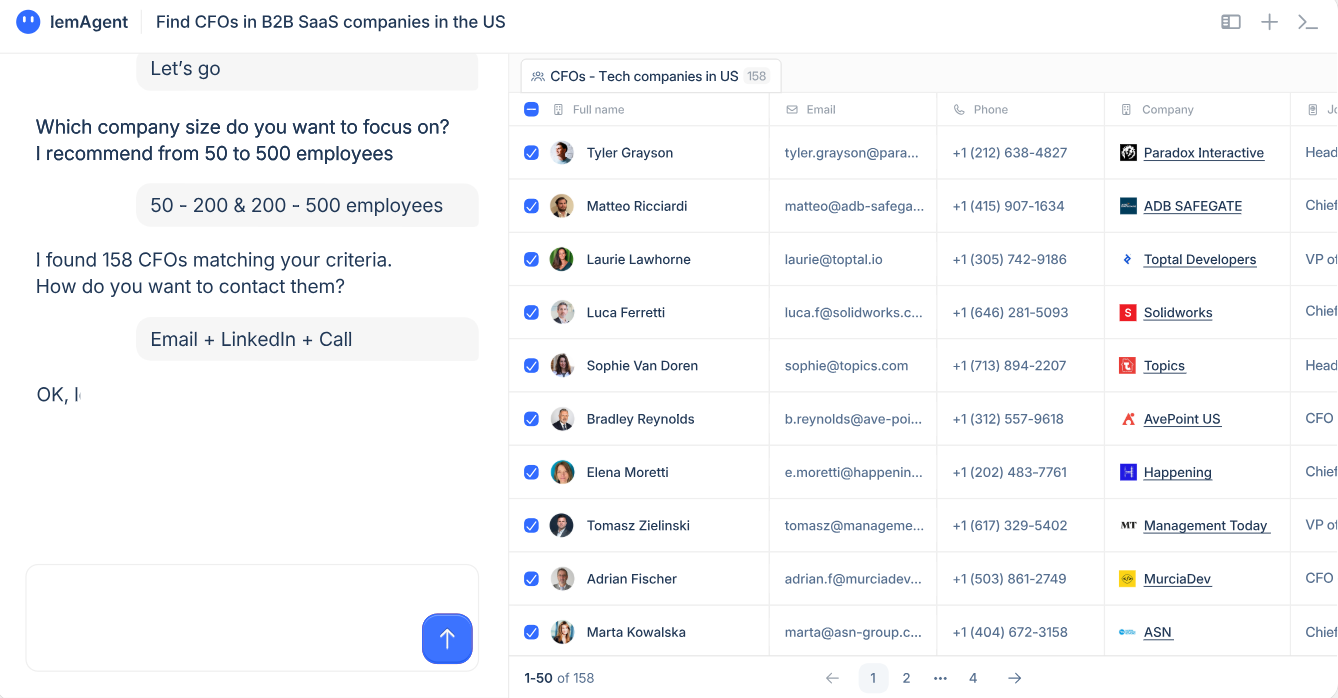
lemlist was founded in 2018 in Paris and has grown to $50M ARR, profitable, with roughly 150 employees and no primary VC funding. It ranks #1 on G2 for sales engagement with a 4.7/5 rating across 1,396 reviews and a 95% CSAT score with an average support response time under 5 minutes.
Customers include ElevenLabs, Pennylane, Spendesk, Brevo, CB Insights, Zowie, and Aexus.
The platform has four pillars:
Module | What It Does | Plan Access |
|---|---|---|
650M+ contacts, 63M+ companies, waterfall email/phone enrichment | All plans (credits-based) | |
Email, LinkedIn, phone, SMS, WhatsApp in one automated workflow | Email (email only); Multichannel+ (all channels) | |
Domain warm-up, inbox rotation, placement monitoring, provider matching | All plans | |
AI Copilot, Intent Signal Agents, agentic enrichment, MCP server | All plans (some features credits-based) |
lemlist's Lead Database and Waterfall Enrichment
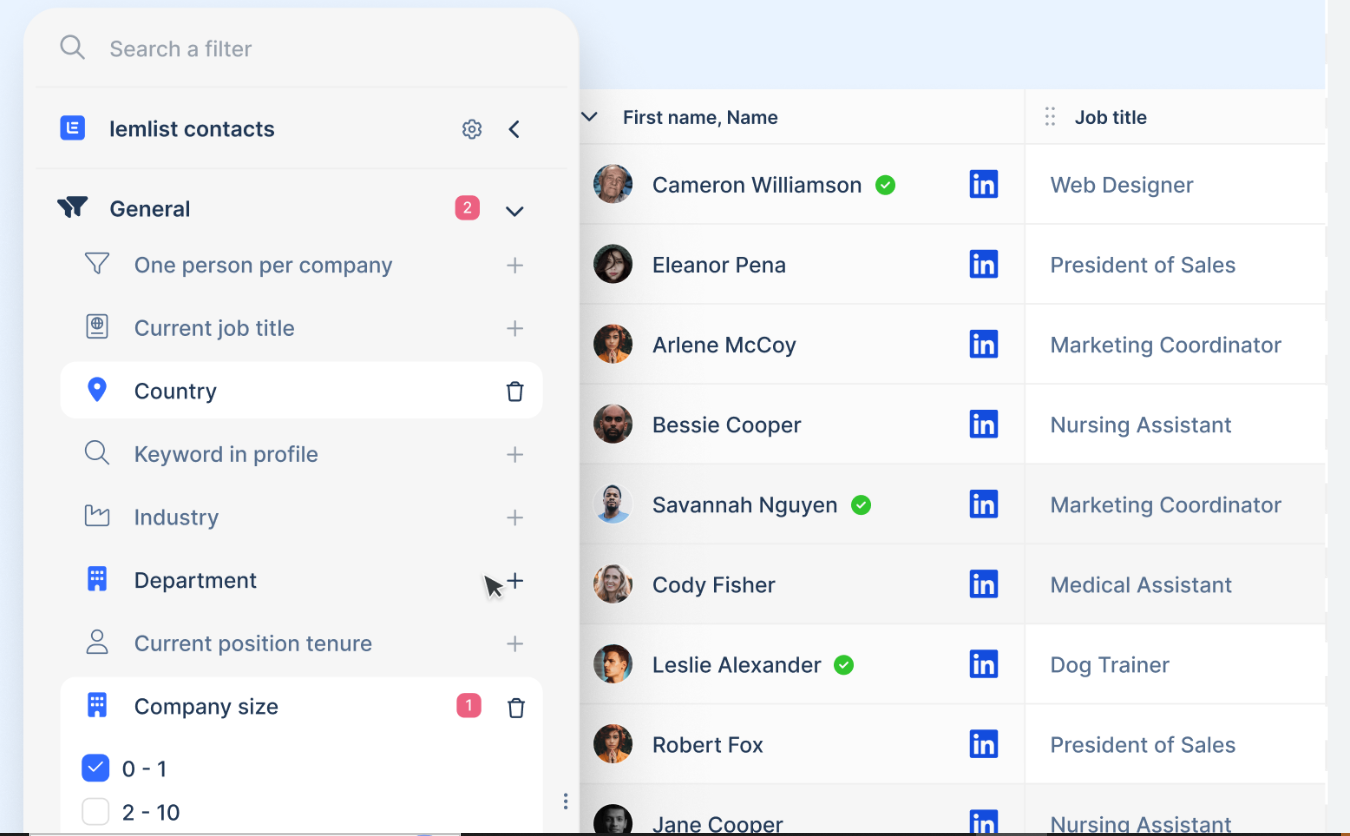
Prospecting in lemlist starts with a 650M+ contact database paired with a 63M+ company database, searchable by industry, revenue, tech stack, funding rounds, hiring trends, job title, seniority, and geography.
Source: lemlist
The database is available on all plans through the credits system, so a rep on the $39/month Email plan has the same search access as an Enterprise user.
The differentiator is what happens after the search.
Waterfall email enrichment queries 10+ data providers in sequence: if the first provider cannot find a valid address, the system tries the next, and every found email is double-verified before delivery. This cascading approach pushes email coverage to roughly 80%, about double the 40–50% find rate from single-source vendors.
Waterfall phone enrichment follows the same logic across 14 providers including Prospeo, ContactOut, Cognism, and Datagma, delivering a 77%+ average find rate. Pricing is 5 credits ($0.05) per verified email and 20 credits ($0.20) per phone number. Failed lookups cost nothing.
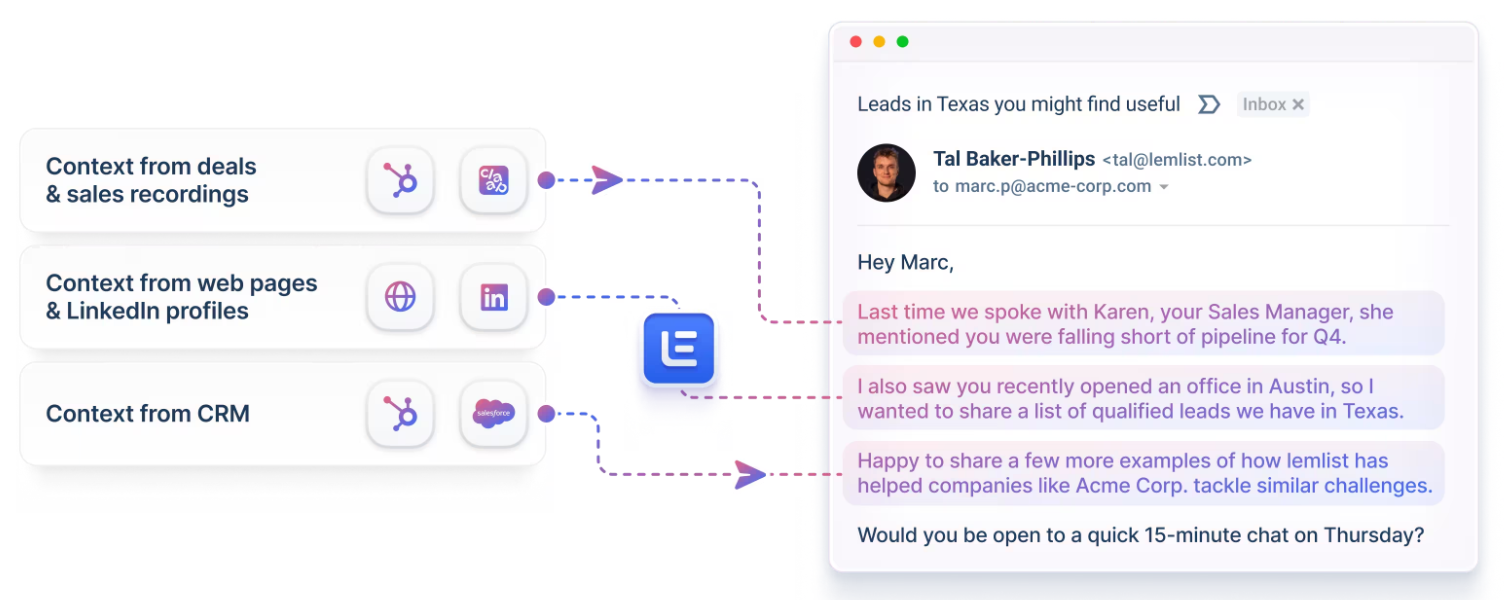
AI Data Enrichment Agents add contextual intelligence on top of raw contact data. These agents pull from up to five sources (company websites, LinkedIn profiles, past Claap sales call recordings, CRM data from HubSpot or Salesforce, and other structured inputs) and return structured outputs usable as personalization variables or lead scoring criteria.
Source: lemlist
The setup requires no code: describe the outcome you want in plain language ("summarize this company's main value prop" or "identify if this person recently changed roles"), and the agent runs across the entire lead list.
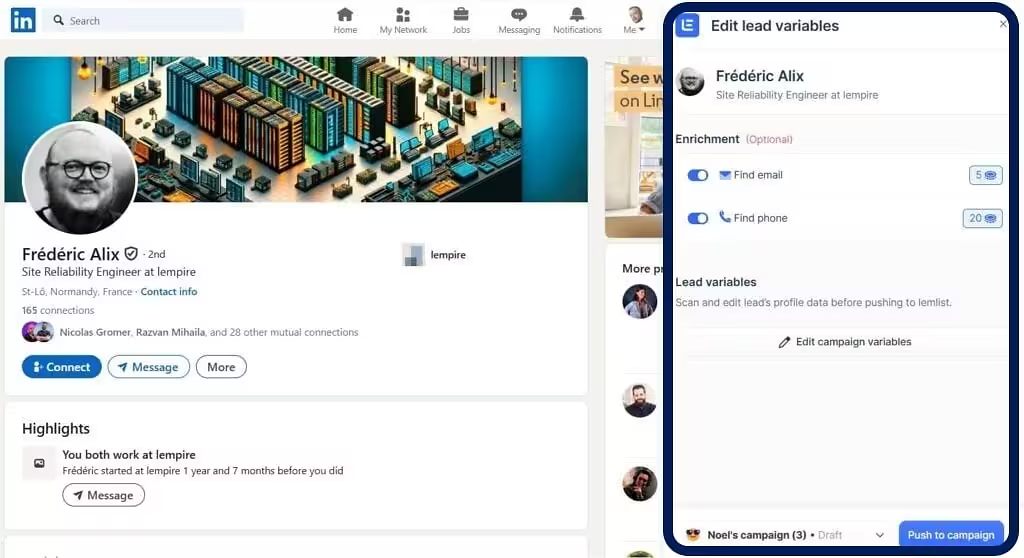
LinkedIn enrichment works through the lemlist Chrome extension, which exports emails and contact data from LinkedIn profiles or bulk Sales Navigator searches with unlimited exports. Once a lead is enriched, one click pushes it into an active sequence with no CSV uploads or integration mapping.
Source: lemlist
The database also supports account-based prospecting by filtering companies first, then drilling into contacts within target accounts. Intent and signal filters (company growth, hiring trends, tech stack, website visitor data) help prioritize in-market prospects before outreach begins.
lemlist's Multichannel Outreach and Sequence Engine
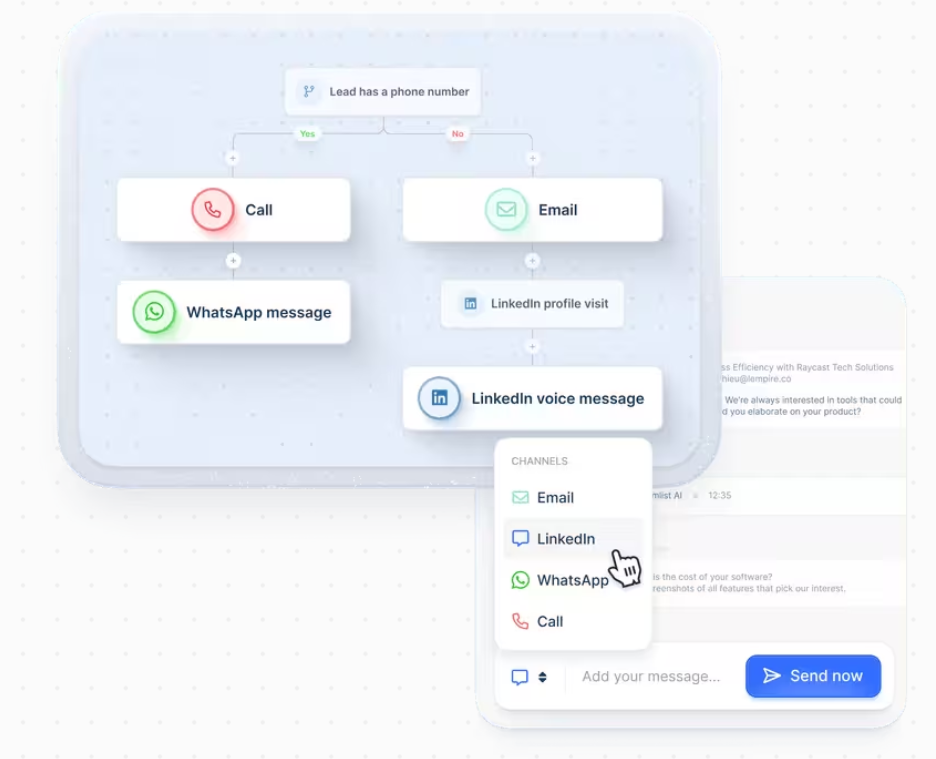
The sequence builder is the core of the platform. It orchestrates automated outreach across email, LinkedIn, phone calls, WhatsApp, and SMS in a single campaign workflow. lemlist reports that adding phone to other channels creates a 3x higher close likelihood, and adding LinkedIn delivers 2.5x more replies.
Source: lemlist
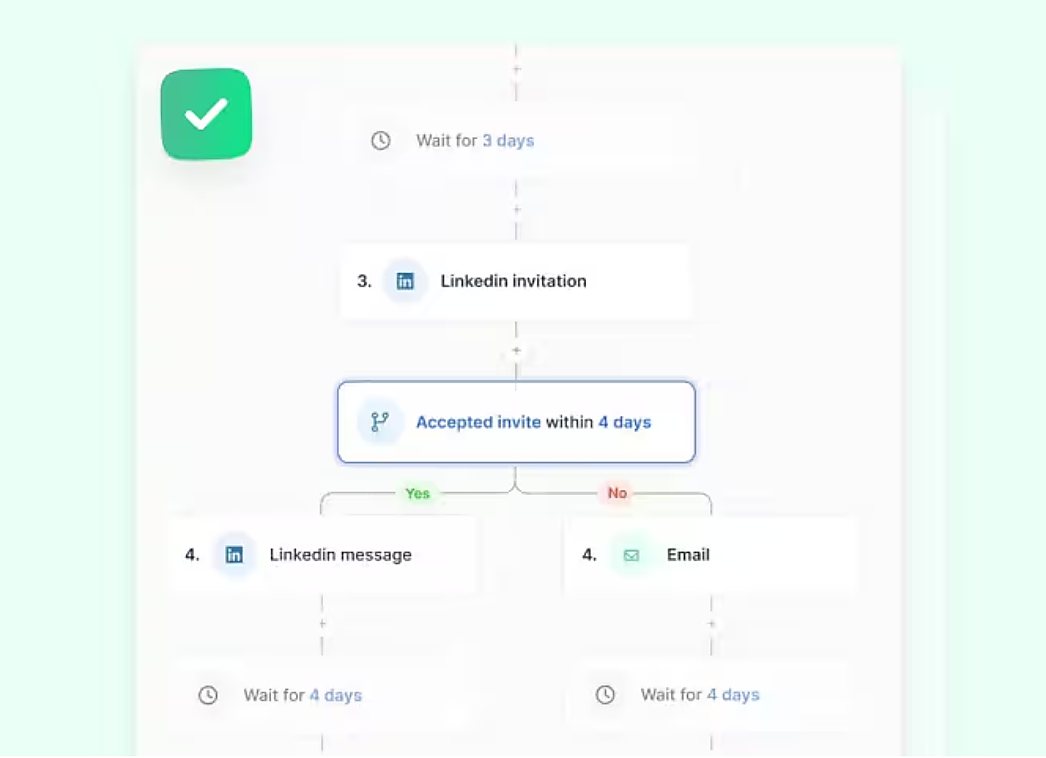
A sequence is a series of steps, each mapped to a channel, a timing delay, and content. You add email, LinkedIn (profile visit, connection request, text message, voice message), phone, WhatsApp, or SMS steps in whatever order fits the strategy.
Advanced conditions let the campaign branch on lead behavior: if a lead ignores an email, lemlist can send a LinkedIn message instead; if a lead engages but does not book, a call reminder fires. Each step uses dynamic fields (name, company, job title) and Liquid Syntax for conditional logic within templates.
Source: lemlist
LinkedIn automation runs through the lemlist Chrome extension and covers five action types: automated profile visits, follows, connection requests, personalized text messages, and voice messages. Voice messages can be recorded once or AI-cloned from a single recording for personalized delivery at scale.
Smart limits and human-like delays protect against LinkedIn restrictions, and actions fire only when engagement-based conditions are met, so only high-priority leads receive automation.
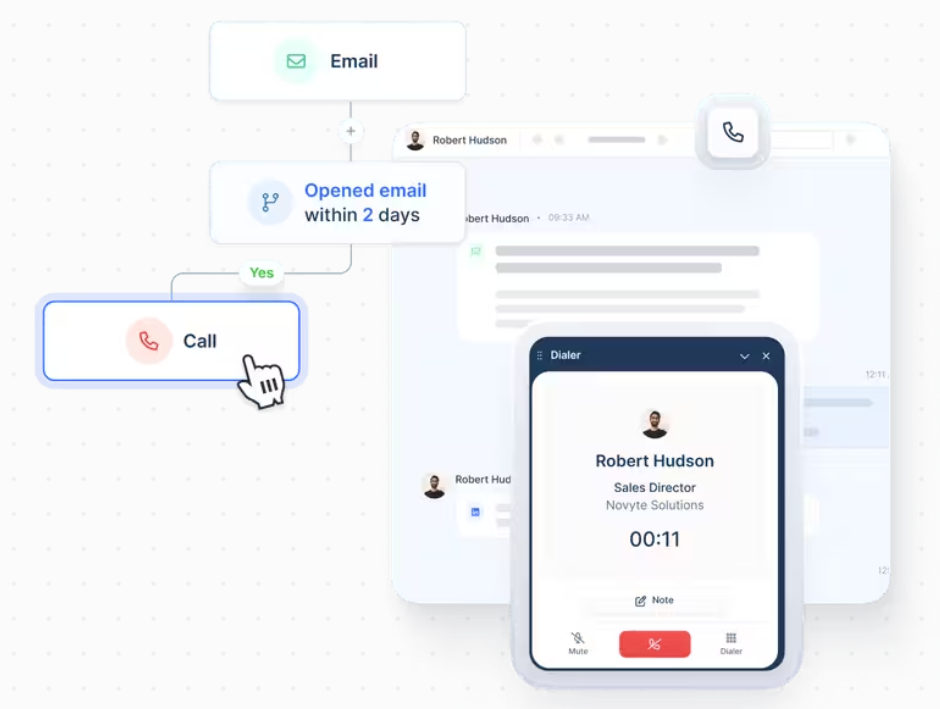
In-app calling uses a built-in VoIP dialer on the Multichannel plan, with Aircall and Ringover integrations for teams already on those tools. Every call is recorded, transcribed, and AI-summarized, with notes syncing to HubSpot, Salesforce, or Pipedrive. Calls are triggered after engagement with an email or LinkedIn step, so reps enter each conversation with context.
Source: lemlist
WhatsApp is available as an add-on and includes built-in number warm-up to protect against flagging. lemlist cites 98% open rates and 30%+ reply rates on the channel.
SMS fits warm follow-up moments: after missed calls, before scheduled calls, after no-shows, and for meeting reminders. lemlist reports 1 in 5 SMS messages receives a reply.
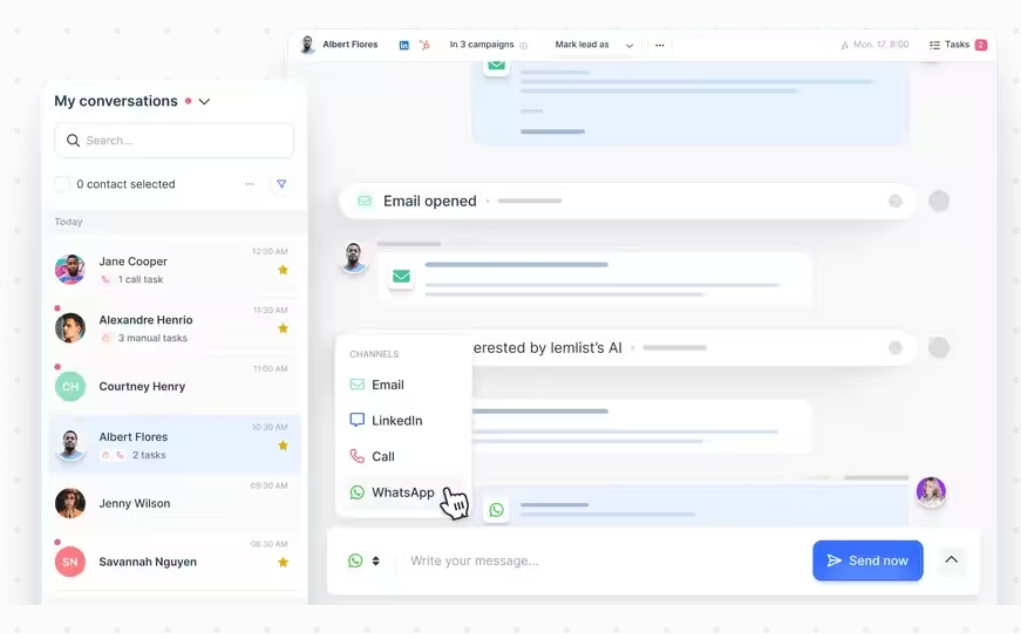
The Unified Inbox consolidates all replies across channels and sending accounts into a single interface, supporting up to 15 connected email addresses per user. lemlist reports that the Unified Inbox speeds up response handling by 46%.
Source: lemlist
It shows multi-account threads in a single lead view, so a rep sees every touchpoint with a prospect regardless of which channel or sending account started the conversation.
The module also includes manual action step reminders (prompting reps to comment on a LinkedIn post, for example), 37,000+ community campaign templates ready to duplicate, multi-threading for reaching multiple contacts within the same account, and API extensibility for adding channels like Sendoso (corporate gifts) and Handwrytten (personalized notes).
The Email plan ($39/month) unlocks email-only sequences with unlimited users and 5,000 emails per month. The Multichannel plan ($109/month per user) adds LinkedIn, phone, SMS, the dialer, and unlimited email volume.
lemlist's Email Deliverability Stack
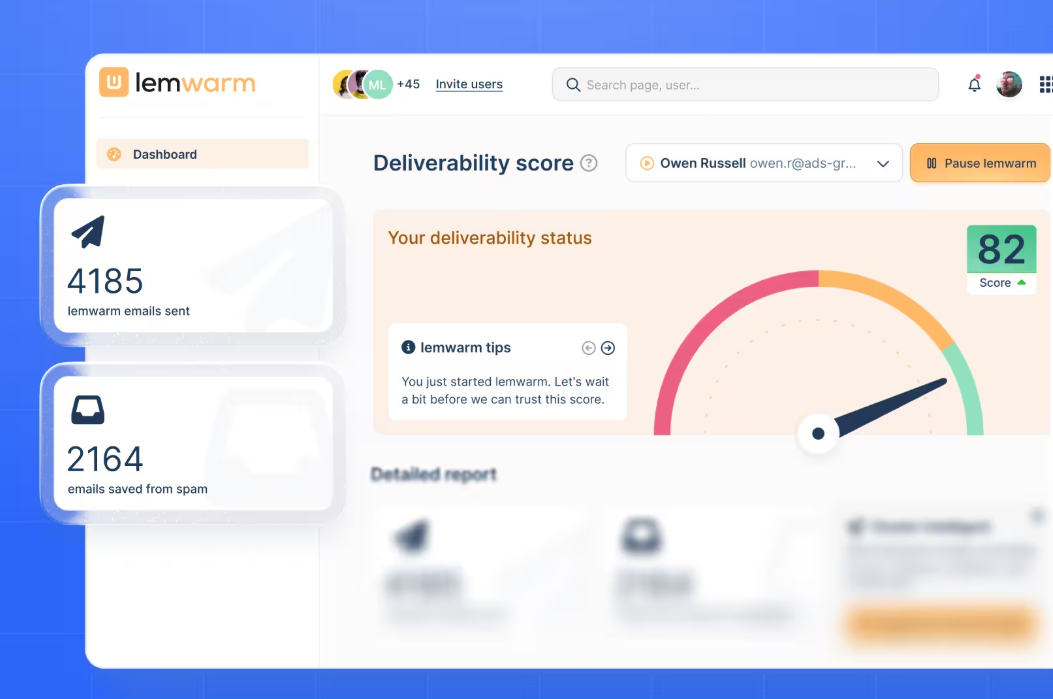
lemlist's deliverability suite is built into the platform, centered on lemwarm. The problem it solves: 1 in 5 outbound emails fails because of infrastructure issues, not poor copy, and most teams discover the damage only after reply rates have collapsed.
Source: lemlist
The system works across four layers. Domain and authentication setup lets users buy a sending domain inside lemlist with SPF, DKIM, and DMARC records configured automatically. A separate sending domain protects the main company domain from reputation damage.
lemwarm automated warm-up then exchanges real emails with real inboxes to build sender reputation before campaign volume begins.
Smart sending controls cap daily volume per inbox and pause automatically before unsafe limits are reached. Inbox rotation spreads outreach volume across multiple mailboxes so no single account carries all the risk.
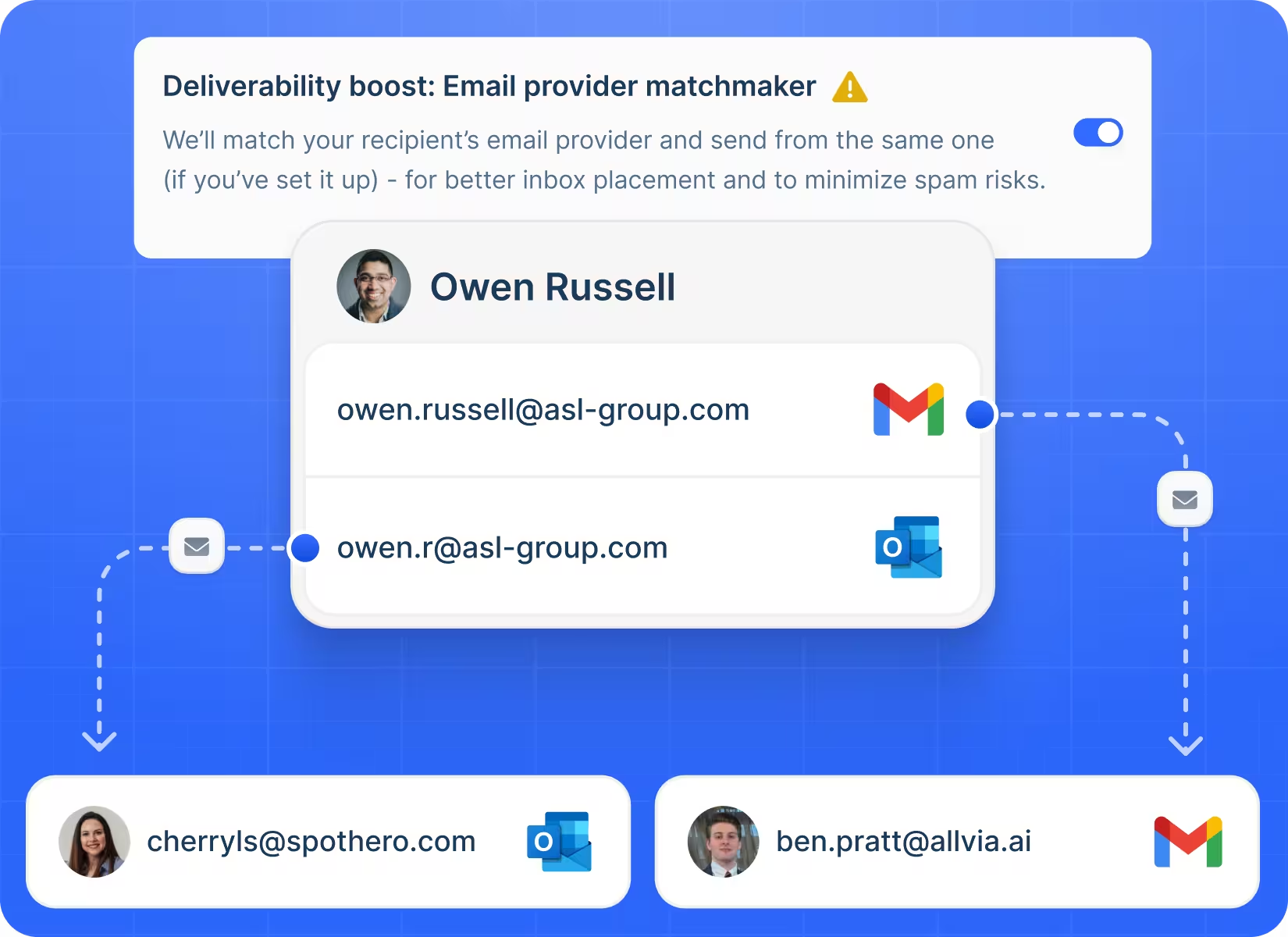
Provider matching routes Gmail senders to Gmail recipients and Outlook senders to Outlook recipients automatically, with no configuration needed.
Source: lemlist
Before campaigns launch, the Deliverability Boost pre-send audit checks copy, technical setup, and inbox placement signals. Email list verification validates contacts before sending to prevent bounce accumulation.
The deliverability dashboard shows warmup health, outreach performance, and inbox placement in one view, filterable by mailbox, provider, or domain, with alerts when bounce rates spike or spam counts rise.
Inbox placement testing sends to real test addresses across Google, Microsoft, and other providers before launch. A per-mailbox tech audit identifies which authentication record or configuration issue affects each mailbox, with specific fixes.
lemwarm comes with all plans. No separate warm-up subscription is required, and the deliverability infrastructure is not a paid add-on.
lemlist's AI-Powered Outbound
lemlist's AI suite has four modules: Intent Signal Agents, Data Enrichment Agents, the AI Copilot with Smart Messaging, and the lemlist MCP server. Together, they compress what lemlist estimates at 45 minutes of manual campaign launch work to under 90 seconds.
Intent Signal Agents monitor buying triggers across four categories:
Company web visits: detects when a target company visits your website via IP matching (20 credits per signal)
Hiring and job changes: tracks new job postings from LinkedIn and ATS platforms (Lever, Greenhouse, Workable) and contact role changes (from 100 credits per signal)
Company fundraising: fires when a tracked company closes a funding round (100 credits per signal)
LinkedIn engagement: detects engagement with your LinkedIn profile or company page (from 400 credits per signal)
When a signal fires, it triggers personalized outreach with real context rather than requiring a manual handoff. Detection and outreach connect natively.
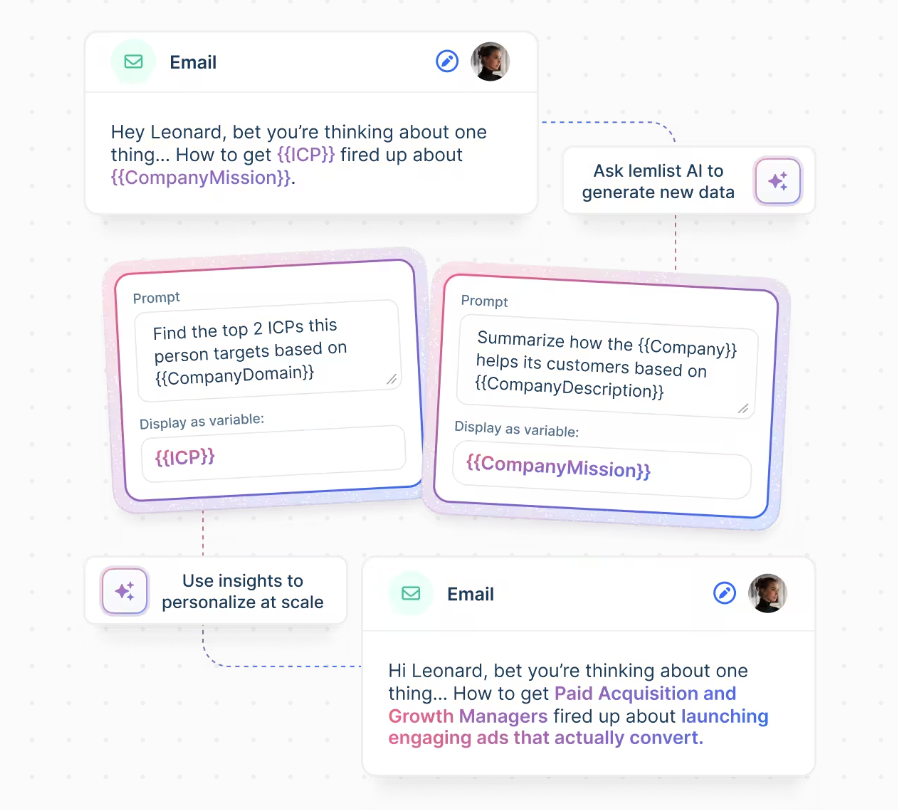
The AI Copilot, powered by Anthropic's Claude, builds complete multichannel campaigns from a single input. It handles three functions: segmentation and scoring (extracting insights from raw data to categorize audiences), sequence generation (creating multichannel sequences from outreach goals), and message personalization (normalizing dates, capitalizing names, cleaning job titles, generating personalized icebreakers).
Source: lemlist
The Copilot draws from three data layers: Memory (business context, website URL, uploaded PDFs, persisted across sessions), ICPs (target profiles the Copilot can generate automatically), and Guidance rules (tone, structure, dos and don'ts for AI-generated copy).
AI Columns Workflows chain multiple LLM steps on lead data using OpenAI, Perplexity, Claude, or Gemini models, letting teams bring their own API keys and run custom AI logic across their lead lists. AI voice cloning generates personalized LinkedIn voice notes at scale from a single recorded sample.
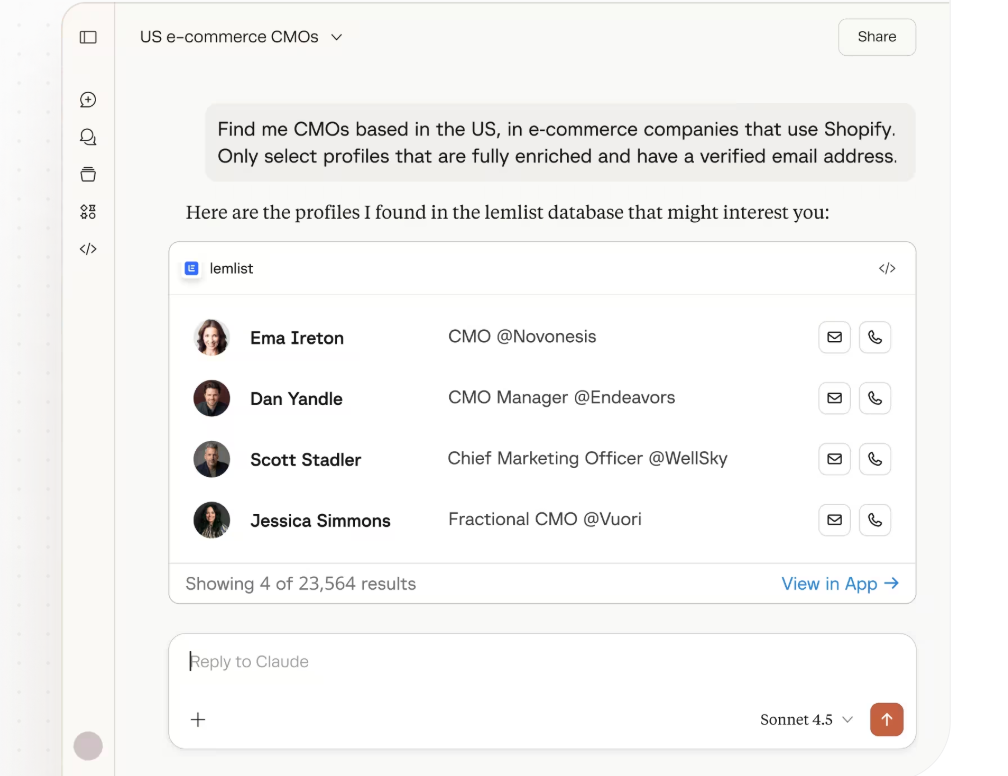
The lemlist MCP server exposes the platform to external AI agents including Claude, ChatGPT, Cursor, and Windsurf. Once connected (setup takes under 2 minutes), the full outbound workflow runs from a single natural-language prompt: find leads, enrich them, generate personalized outreach, add them to sequences, and optimize underperforming steps. The MCP server is included in all paid plans.
Source: lemlist
lemlist's Integrations and API
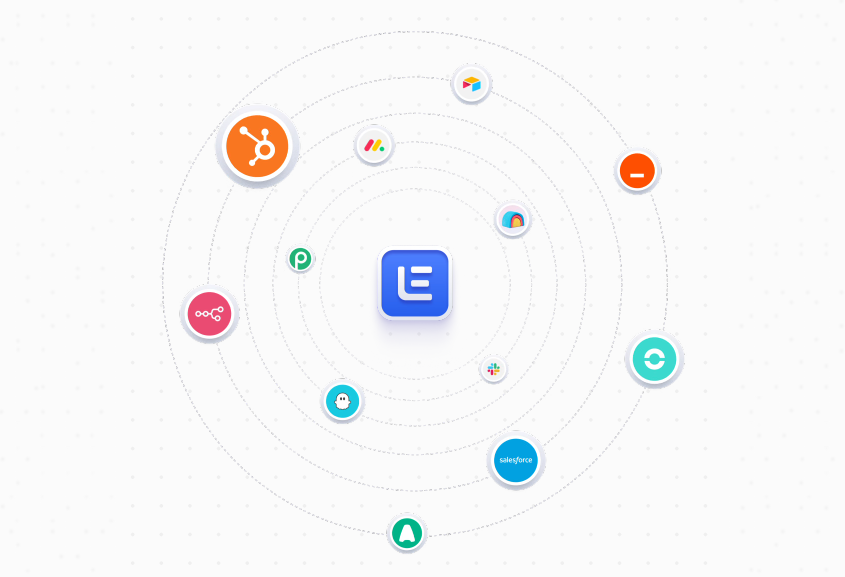
lemlist connects to the broader sales stack through native CRM integrations, a REST API, webhooks, and a marketplace listing 500+ integrations.
Source: lemlist
Native CRM integrations include HubSpot and Salesforce with bidirectional sync of leads and outbound activities, Pipedrive with activity sync and lead transfers, and Close.io, Zoho CRM, and Breakcold for activity sync. Attio lets teams run outbound from the CRM with campaign actions syncing back.
The REST API (v2) gives programmatic access to twenty resource groups including Team, Campaigns, Sequences, Leads, Companies, Contacts, Inbox, Activities, Webhooks, People Database, Enrich, lemwarm, and Signal Agents. API access is included in all paid plans.
The API uses HTTP Basic authentication with a rate limit of 20 requests per 2-second window.
The webhook system covers email events (sent, opened, clicked, replied, bounced), LinkedIn events (25+ covering messages, visits, invites, voice notes), WhatsApp and SMS events, call events (including recording and transcript ready), lead-state aggregates, workspace alerts, enrichment completion, and intent signal detection. An optional secret field enables callback verification.
iPaaS connectors include Zapier (5,000+ tools), Make, n8n, SureTriggers, Pabbly, Cargo, Relay.app, and Pipedream. Enrichment integrations cover Clay, Apollo, Lusha, Uplead, and others. Intent signal integrations include Snitcher, Phantombuster, Lonescale, Trigify, Albacross, and Leadfeeder.
Team collaboration integrations cover Slack, Airtable, Notion, Monday, ClickUp, Asana, and Trello.
lemlist is SOC 2 certified, GDPR compliant, and references ISO 27001 as a platform commitment. SSO/SAML is available on the Enterprise plan only. Two-factor authentication is available on all plans.
Where lemlist Stops: The Gaps
lemlist centers on the outbound sales workflow: finding contacts, building sequences, landing in the inbox, and automating personalization. That focus creates strengths, but it also means the platform hands off to external tools for several capabilities outbound teams eventually need.
No behavioral intent data. lemlist's Intent Signal Agents track events (job postings, funding rounds, LinkedIn engagement, website visits via IP matching), but the platform does not track which companies are researching specific topics across the broader web.
The difference matters: event-based signals tell you a company is growing or hiring; behavioral intent data tells you a company is researching your product category right now. Teams that want to prioritize accounts by topic-level buying intent need an external source.
No conversation intelligence. lemlist records and transcribes calls through its built-in dialer and syncs notes to CRM, but it does not offer platform-level conversation analysis: no AI-driven objection detection across calls, no coaching scorecards, no deal intelligence extracted from meetings. Call recording covers individual rep productivity; conversation intelligence covers team-wide patterns and deal risk.
No marketing orchestration or ABM. lemlist handles outbound prospecting and sequences. It does not include display advertising, audience management, account-based marketing, web form optimization, or multi-channel campaign orchestration for demand generation. Marketing teams running ABM alongside sales outbound need a separate platform.
No intelligence layer across CRM, calls, and behavioral signals. lemlist captures outreach activity (emails, LinkedIn, calls) and intent signals (hiring, funding, web visits), but it does not connect CRM records, conversation transcripts, and third-party behavioral data into a layer that explains why deals move or stall.
The data stays in its channels; there is no cross-system graph linking a champion going quiet to an internal budget battle to a competitor's intent signal spike.
Narrower data than dedicated data platforms. lemlist's 650M+ contact database with waterfall enrichment serves outbound prospecting well, but it lacks the depth of company attributes (technographics across 30,000+ technologies, department org charts, corporate hierarchies) or the verification infrastructure (300+ human researchers, 28M daily domain scans) that dedicated B2B data platforms maintain.
How ZoomInfo Covers the Gaps
The gaps share a common thread: lemlist handles outbound execution but depends on external sources for the intelligence, data depth, and cross-channel capabilities around it. ZoomInfo is a GTM platform that supplies those layers.
ZoomInfo's B2B Data Platform: Deeper contact and company intelligence
ZoomInfo runs a B2B data platform at scale: 500M contacts, 100M companies, 135M+ verified phone numbers, 120M direct-dial phone numbers, and 200M+ verified business email addresses.
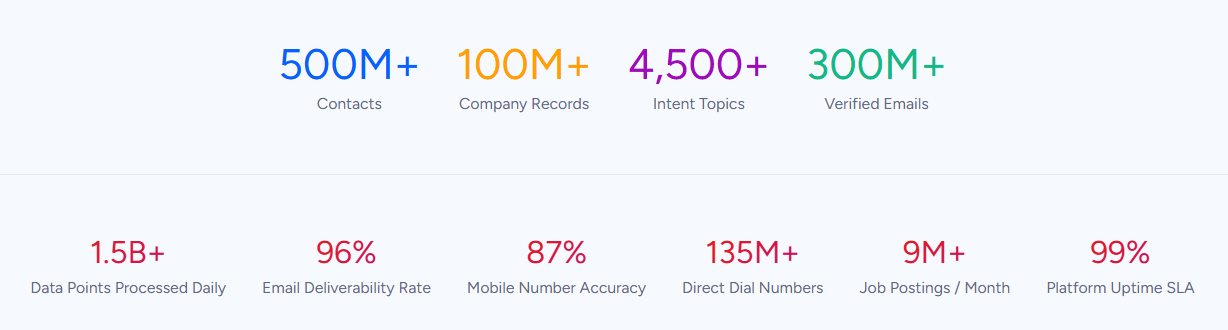
Where lemlist's database covers 650M+ contacts with waterfall enrichment across 10+ providers, ZoomInfo's data flows through a proprietary verification pipeline backed by 300+ human researchers and automated ML scanning of 28 million site domains daily, reaching up to 95% accuracy on first-party data.
The depth goes beyond contact records. ZoomInfo provides 300+ company attributes for market segmentation, department org charts with decision-makers' direct dials and emails, contact tracking with job-change alerts, and technographic profiles covering 30,000+ technologies across 200+ categories for 30+ million companies.
Global coverage extends to 34M+ company profiles outside North America, 200M+ professional profiles outside NA, and 45M+ mobile numbers outside NA.
In a Fortune 500 competitive RFP analyzing 25 million contacts across vendors, an independent consultant concluded that "no other competitor came even close."
ZoomInfo Intent and WebSights: Behavioral signals that show who is in-market before outreach
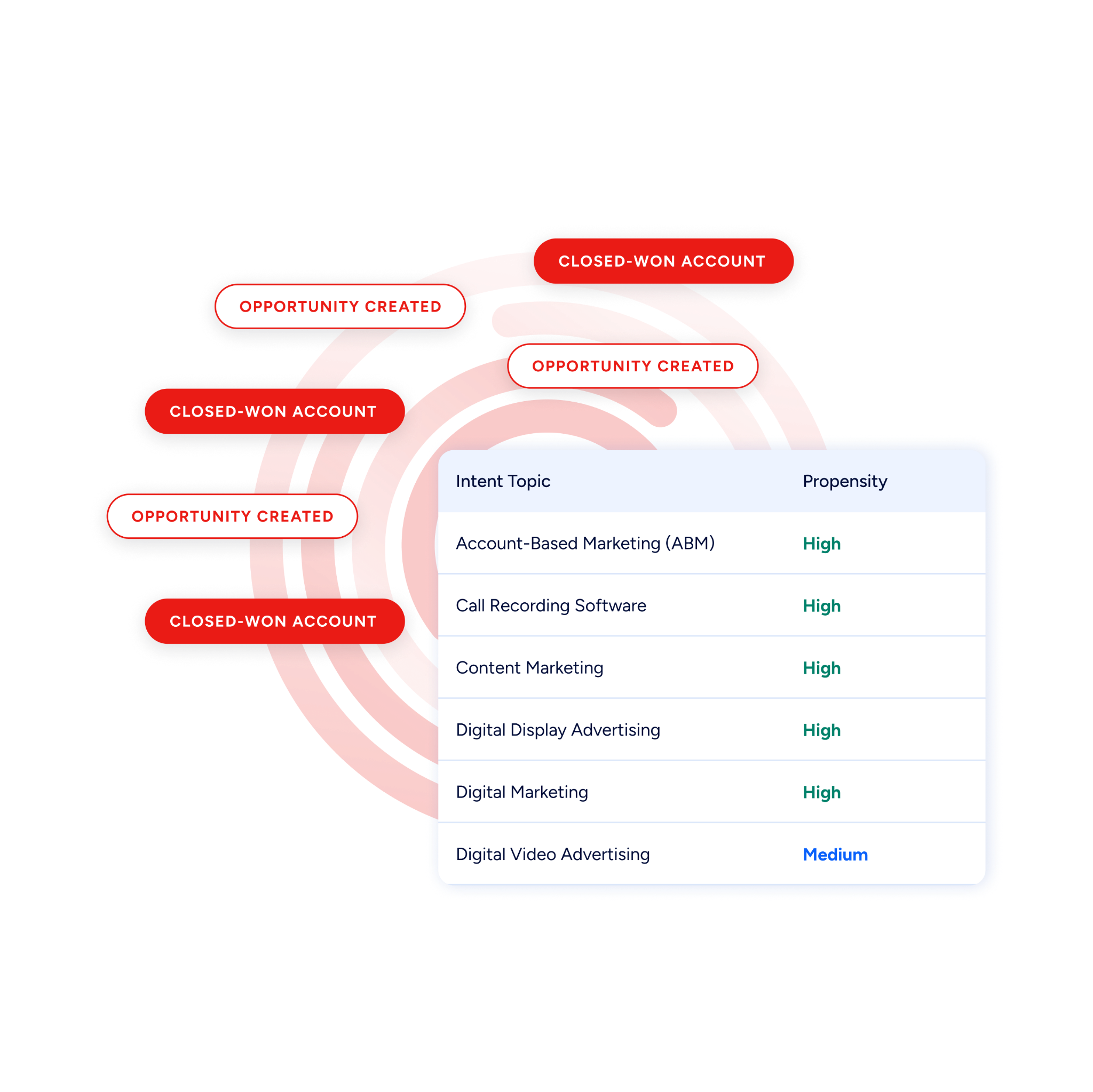
ZoomInfo Intent tracks signals from 210 million IP-to-Organization pairings and 6 trillion+ new keyword-to-device pairings sourced monthly. This reveals which companies are researching topics related to your product across the web, before you contact them.
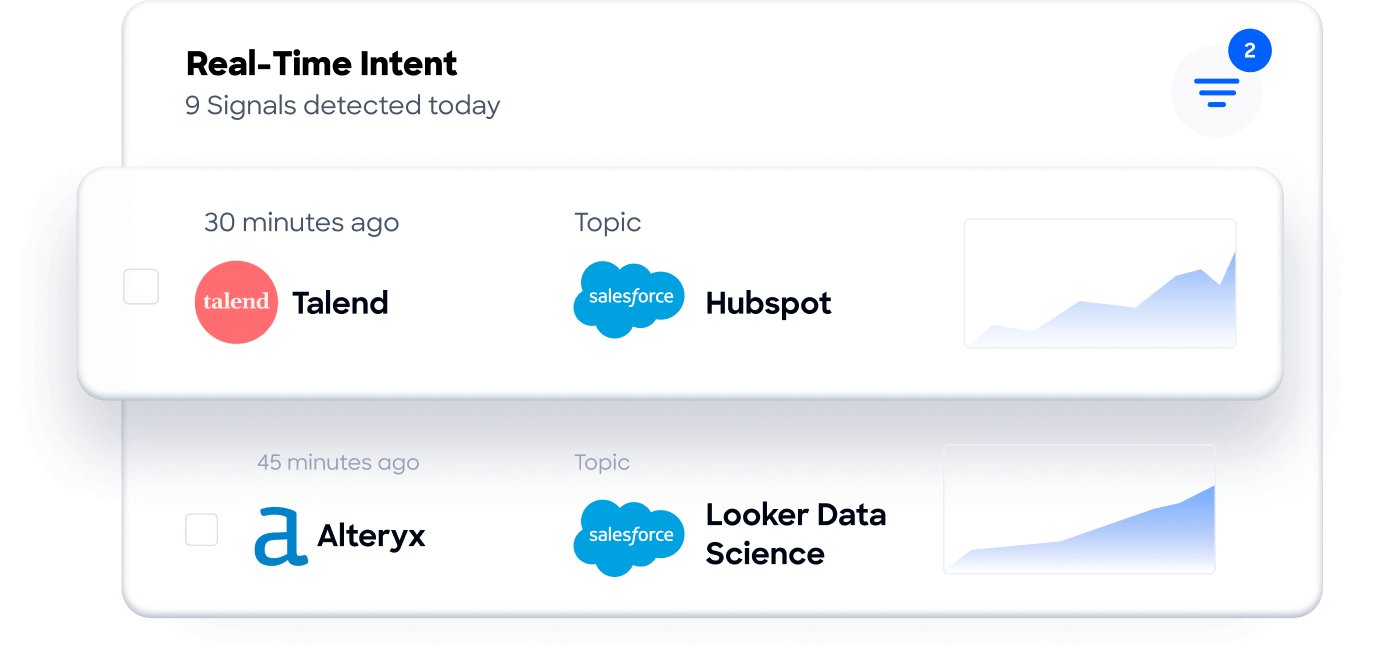
Where lemlist's intent signals detect company events (hiring, funding, web visits), ZoomInfo's intent data works at the topic level: it identifies companies researching "sales engagement software" or "email deliverability tools" right now, based on content consumption patterns across the web.
Guided Intent, exclusive to ZoomInfo, identifies the topics historically correlated with deal success rather than requiring manual topic selection.
On the website side, WebSights resolves anonymous website traffic to companies with Automatic Traffic Filtering that separates real visitors from bots.
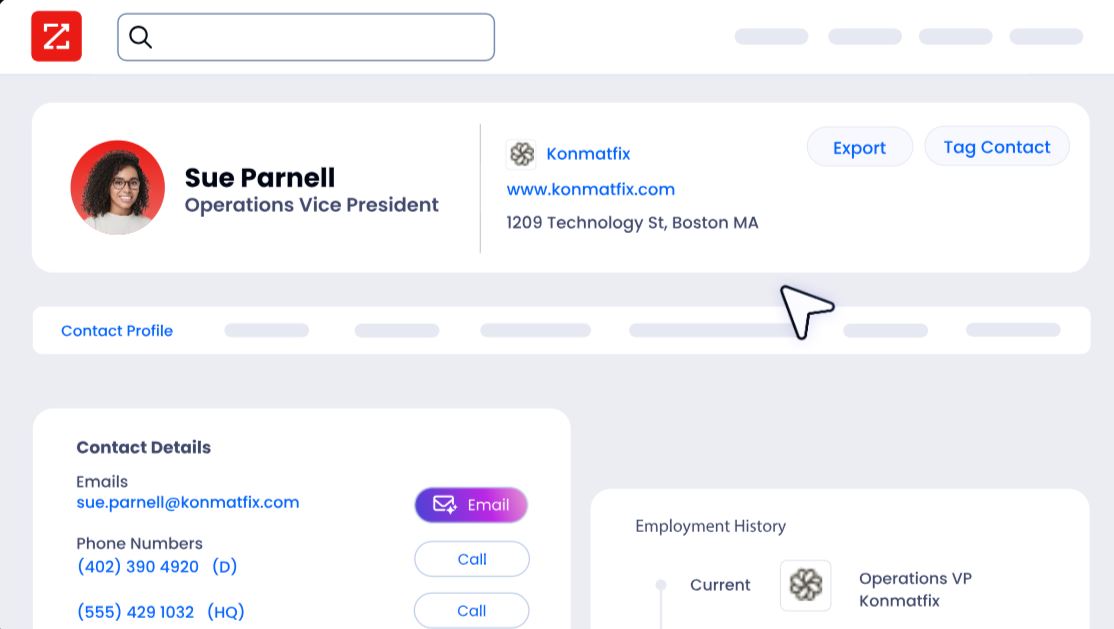
ZoomInfo Marketing goes further with contact-level site visitor identification, identifying who visited (not just which company) and triggering personalized outreach.
ZoomInfo's GTM Context Graph and Chorus: Intelligence that explains why deals move
lemlist captures what happens in outreach (opens, clicks, replies, call recordings).
ZoomInfo's GTM Context Graph captures why deals move or stall by processing 1.5B+ data points daily, connecting B2B data with CRM records, conversation intelligence from Chorus, email interactions, and behavioral signals into a single intelligence layer.
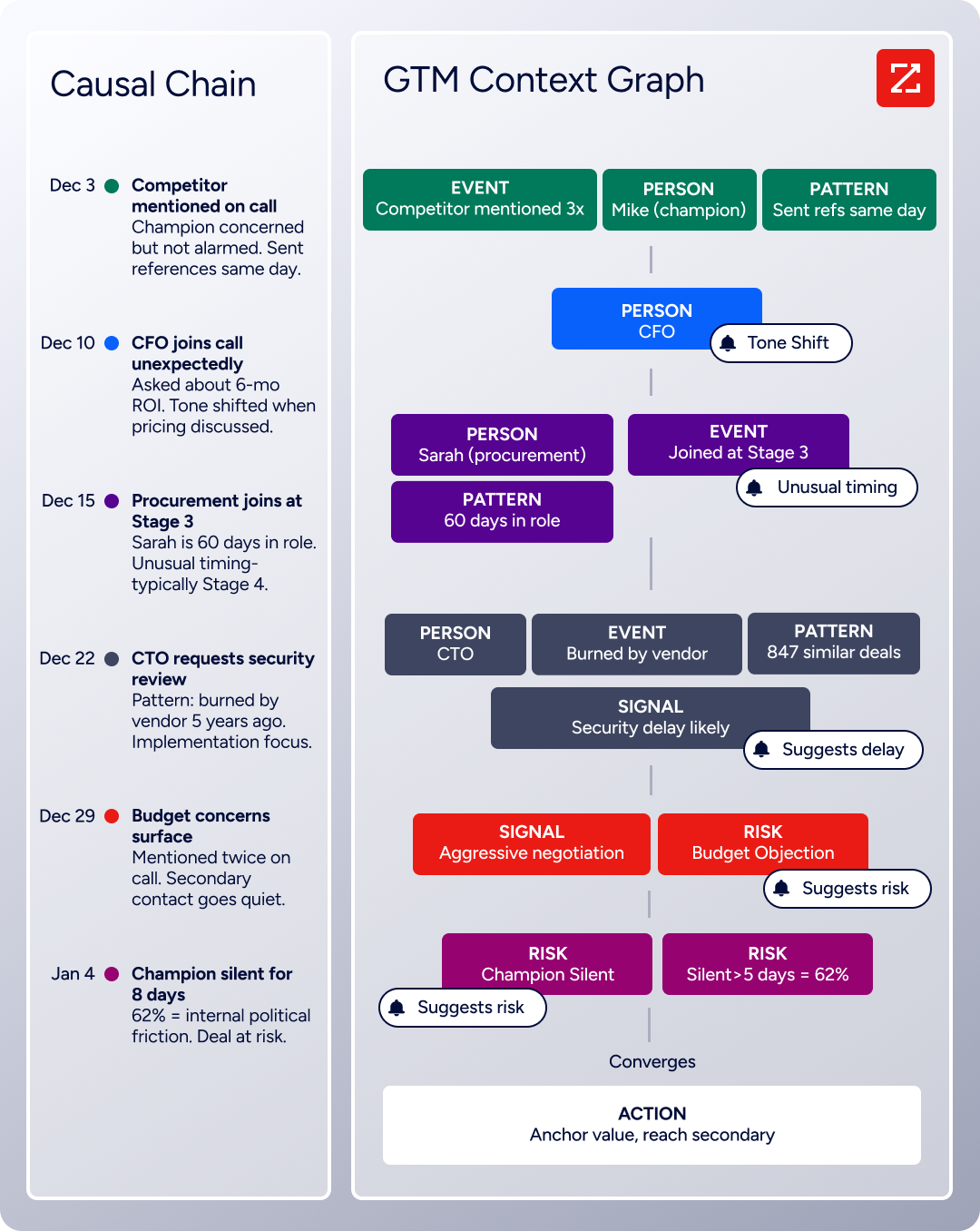
Chorus, backed by 14 technology patents, records and transcribes sales calls, surfaces AI-generated insights (talk ratios, sentiment, objection detection), auto-syncs deal intelligence to the CRM, and provides coaching scorecards and clip sharing.
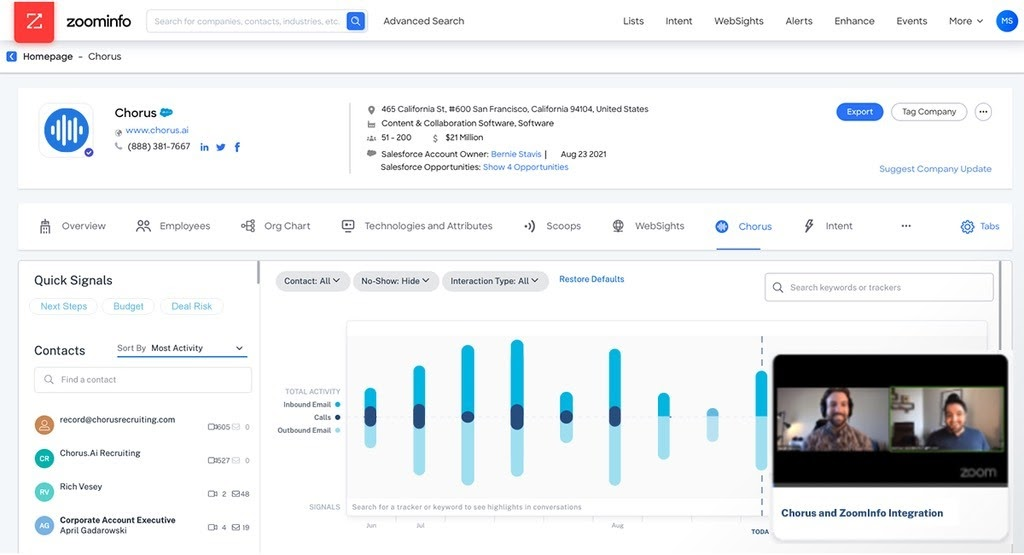
It captures the context outreach analytics miss: why a champion went quiet, what a competitive mention means for deal risk, which objection patterns predict closed-lost outcomes.
A CRM records that a deal moved from Stage 3 to Stage 4. The GTM Context Graph captures why: connecting the CFO joining the last call with ROI-focused questions to the pattern behind closed-won deals in the same segment, then linking that to third-party signals showing the company is hiring and researching a competitor. That intelligence flows into outreach, forecasting, and deal execution.
ZoomInfo GTM Studio: Marketing orchestration and ABM beyond outbound sequences
ZoomInfo’s GTM Studio addresses the marketing orchestration gap directly. Marketers, RevOps teams, and GTM engineers can build audiences using natural language, enrich with first- and third-party data, define triggers, and activate plays across channels (email, calls, display ads, direct mail, LinkedIn, Meta, Connected TV) without engineering support. Pre-built GTM plays cover inbound acceleration, champion tracking, competitive displacement, and ICP targeting.
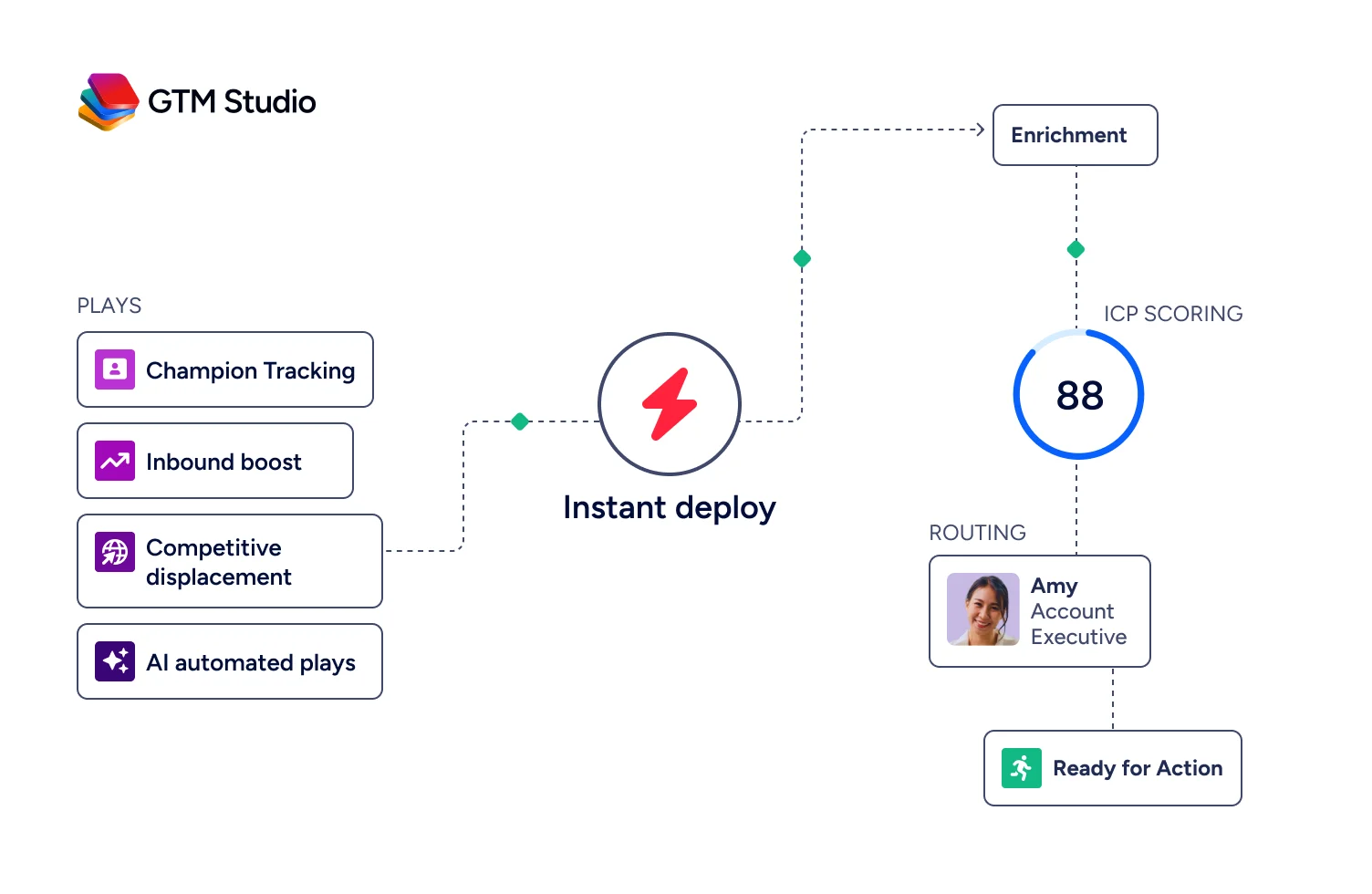
Expansion plays that used to take 3 weeks now launch in 30 minutes.
ZoomInfo Marketing includes a native Demand-Side Platform deploying display ads based on 300+ company attributes, FormComplete (reducing forms to a single field while auto-appending data), and Account Fit Scoring (predictive AI scoring 0–100 based on company attribute patterns).
ZoomInfo APIs, MCP, and GTM Workspace: Access to intelligence across tools
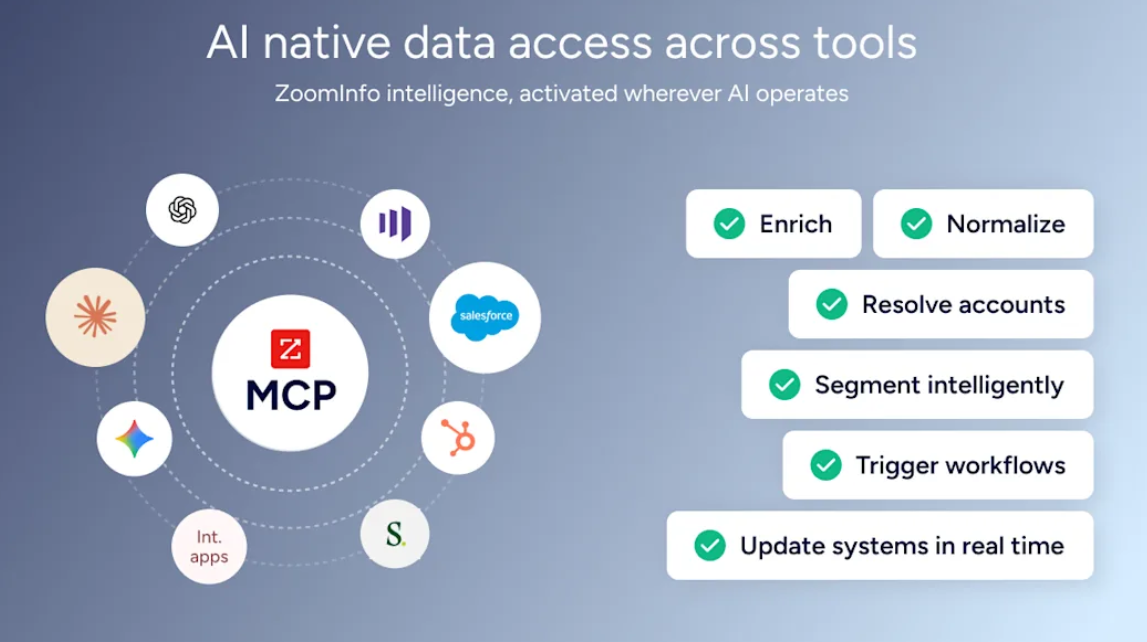
ZoomInfo delivers its intelligence through APIs and MCP so the same data and GTM Context Graph powering ZoomInfo's products is accessible inside any third-party tool or custom AI agent.
The MCP server connects AI models to ZoomInfo's B2B data as a native tool, supporting Claude and ChatGPT. API access is included in all relevant plans.
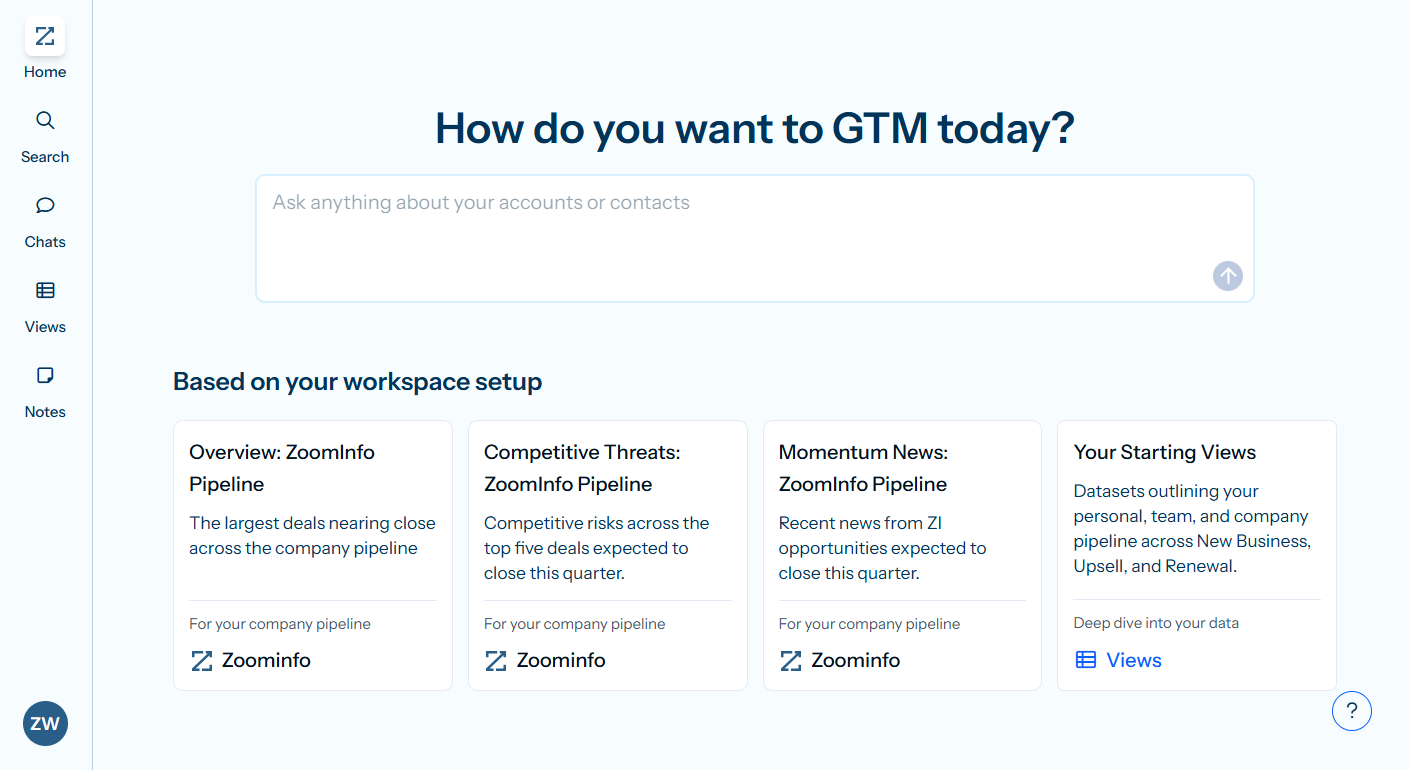
GTM Workspace gives sellers a complete Book of Business view across CRM, ZoomInfo data, conversation history, and market intelligence, with AI agents automating account research, outreach, CRM updates, and signal monitoring.
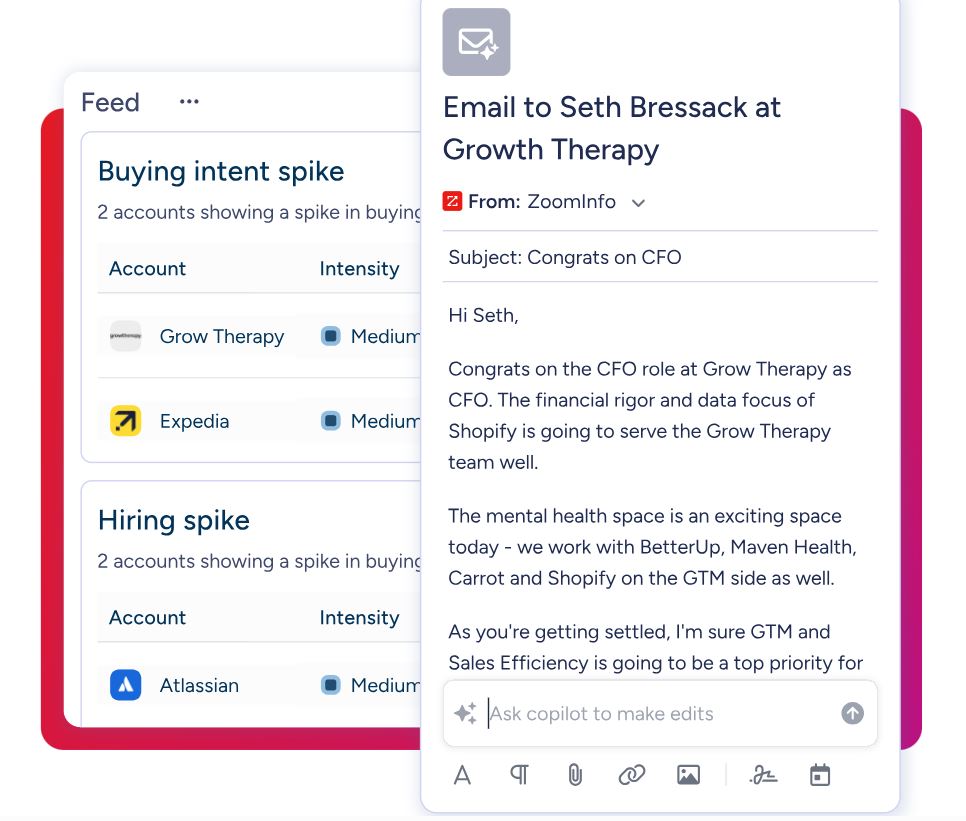
An Action Feed streams in-market buyers matched to target criteria with pre-drafted actions on every signal.
ZoomInfo also offers what lemlist's free trial does not: a permanent free tier. ZoomInfo Lite provides access to ZoomInfo's B2B database, 10 monthly export credits, individual and company searches, a Chrome extension, and WebSights Lite with up to 10 website visitor reveals per day.
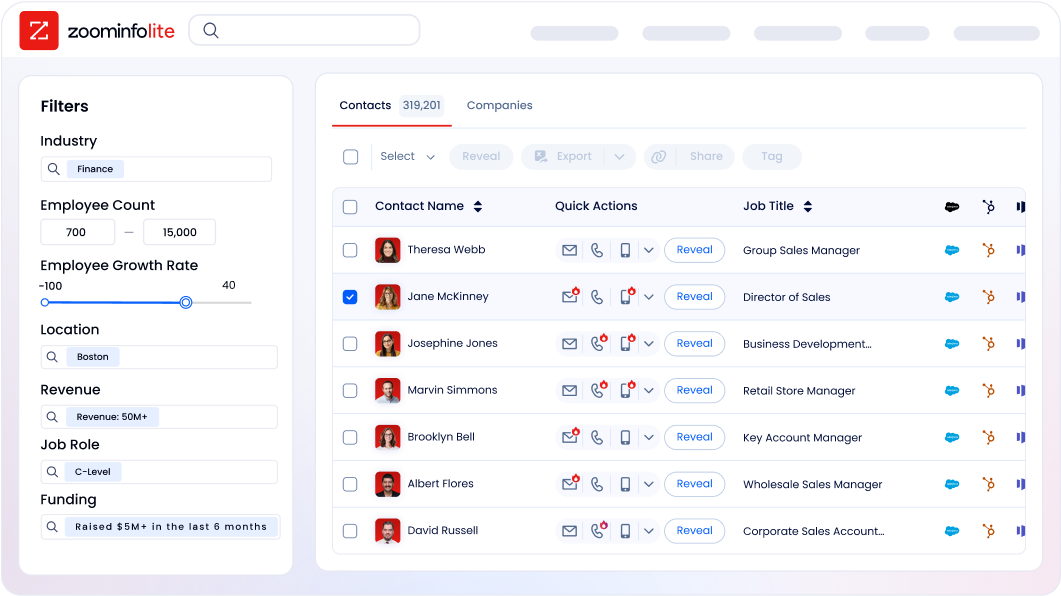
A separate 7-day free trial provides broader access with no credit card required.
Seismic's sales team attributed 39% of active pipeline to opportunities identified or influenced by ZoomInfo signals, boosted productivity by 54%, and saved 11.5 hours per week per seller. (Seismic Case Study)
Final Summary
lemlist is a strong toolkit for multichannel outbound: a 650M+ contact database with waterfall enrichment across 10+ email and 14 phone providers, five native outreach channels in a single sequence builder, a deliverability stack with lemwarm built in, and an AI layer powered by Claude that builds campaigns from a single prompt.
It covers outbound from list building through inbox management, with deliverability and LinkedIn automation as its strongest advantages.
It is lighter on the layers around execution: no behavioral intent data across the broader web, no conversation intelligence for call coaching and deal risk, no marketing orchestration or ABM, and no intelligence layer connecting CRM, conversations, and third-party signals.
If your bottleneck sits upstream of the sequence (knowing which companies are in-market before you reach out, and why your deals are moving) or beyond outbound (orchestrating marketing campaigns, display ads, and ABM alongside sales execution), that is the ground ZoomInfo covers. Its 500M-contact, 100M-company database provides verified emails and direct dials at a scale backed by 300+ human researchers and independent evaluations.
ZoomInfo Intent surfaces accounts researching your category from 6 trillion+ keyword-to-device pairings monthly. Chorus captures and analyzes every sales conversation.
GTM Studio gives marketing teams multi-channel orchestration and ABM. And the GTM Context Graph connects all of it into a single intelligence layer that captures why deals move, not just that they moved.
Start with ZoomInfo Lite for free, or request a demo to see how intent signals and verified contacts flow into your pipeline.
FAQ
Does lemlist include buyer intent data?
lemlist's Intent Signal Agents track four categories of buying triggers: website visits via IP matching, hiring and job changes from LinkedIn and ATS platforms, company funding rounds, and LinkedIn engagement with your profile or page. These are event-based signals, not behavioral intent data tracking topic-level research across the web.
Teams that want to identify companies researching specific product categories before outreach begins need a dedicated intent source.
ZoomInfo Intent tracks signals from 210 million IP-to-Organization pairings and 6 trillion+ keyword-to-device pairings sourced monthly, with Guided Intent identifying topics historically correlated with deal success.
How many outreach channels does lemlist support natively?
lemlist supports five native outreach channels in a single sequence: email, LinkedIn (profile visits, connection requests, messages, voice messages), in-app calling via VoIP, SMS, and WhatsApp (add-on). The Email plan ($39/month) includes email only. The Multichannel plan ($109/month per user) unlocks all five channels.
Additional channels (corporate gifts via Sendoso, personalized notes via Handwrytten, voicemail drops) are available through API steps and integrations.
Which plan includes LinkedIn automation?
LinkedIn automation requires the Multichannel plan ($109/month per user) or Enterprise. The Email plan ($39/month) is email-only and does not include LinkedIn, phone, SMS, or WhatsApp steps. LinkedIn automation covers profile visits, follows, connection requests, text messages, and voice messages, all with smart limits and human-like delays.
Can lemlist record and analyze sales calls?
lemlist's built-in VoIP dialer records, transcribes, and AI-summarizes individual calls, syncing notes to HubSpot, Salesforce, or Pipedrive. It does not include platform-level conversation intelligence: no cross-call objection detection, no coaching scorecards, no deal risk analysis from conversation patterns, and no clip sharing for team training. ZoomInfo's Chorus, backed by 14 technology patents, provides these capabilities and feeds insights into the GTM Context Graph.
How does lemlist's waterfall enrichment pricing work?
lemlist's enrichment runs on a pay-as-you-go credits system at $0.01 per credit. A verified email costs 5 credits ($0.05), a phone number costs 20 credits ($0.20), and credits are charged only on successful finds. Failed lookups cost nothing. Credit bundles start at 1,000 credits ($10).
Intent signals are also credits-based: web visit signals cost 20 credits, hiring/job change signals start at 100 credits, funding signals cost 100 credits, and LinkedIn engagement signals start at 400 credits.
Does lemlist offer a free plan?
lemlist offers a 14-day free trial with full Multichannel plan access and no credit card required. There is no permanent free tier. After the trial, users keep access to their account data but cannot send new campaigns.
ZoomInfo, by contrast, offers ZoomInfo Lite (a permanent free tier with 10 monthly export credits and WebSights Lite) alongside a separate 7-day free trial.
What CRMs does lemlist integrate with natively?
lemlist has native integrations with HubSpot (bidirectional sync), Salesforce (bidirectional sync), Pipedrive (activity sync and lead transfers), Attio (run outbound from CRM), and Close.io, Zoho CRM, and Breakcold for activity sync. Enterprise plan users can use lemlist from within their CRM. Broader integrations are available through Zapier (5,000+ tools), Make, n8n, and the REST API.
Does lemlist include account-based marketing or display advertising?
No. lemlist is built for outbound prospecting and sales engagement. It does not include display advertising, audience management for ad platforms, account-based marketing orchestration, or multi-channel campaign management for demand generation. Marketing teams running ABM alongside sales outbound need a separate platform.
ZoomInfo's GTM Studio provides this, with a native Demand-Side Platform, pre-built GTM plays, and multi-channel orchestration across email, ads, direct mail, LinkedIn, Meta, and Connected TV.
