
Choosing between Less Annoying CRM and Pipedrive often comes down to five questions:
Do you need a simple contact tracker, or a full sales pipeline with deal automation and AI?
Is your team small enough that one flat price covers everything, or do you need tiered features as you scale?
How important is a native mobile app for daily work?
Are you managing existing relationships, or do you also need to find and qualify new prospects?
Do you need verified contact data and buying signals to prioritize outreach, or just a place to organize what you already know?
Here's what we recommend:
Less Annoying CRM is for solo operators and micro-teams who have outgrown spreadsheets but find every CRM stuffed with features they'll never use. At $15/user/month with no tiers, no annual contracts, and no hidden fees, it includes unlimited contacts, pipelines, custom fields, and free human support for everyone (including trial users). It's the #1 easiest-to-use CRM on G2 with a 4.9/5 rating, and it fits consultants, coaches, financial planners, and small service businesses that need contact organization and follow-up tracking without complexity. The tradeoffs: no native mobile app, no in-app email sending, limited automation (launched only in December 2025), and basic reporting with no sales forecasting.
Pipedrive is for sales teams that live inside their pipeline. Its visual, kanban-style deal management (a format Pipedrive claims to have pioneered in CRM) makes it easy to see where every deal stands, with colored cues flagging stale deals and activity-based workflows keeping reps focused on their next step. Serving 100,000+ companies in 179 countries, Pipedrive offers email sync, workflow automation with if/else branching, an AI email writer, native mobile apps with offline mode, and 500+ marketplace integrations. Plans start at $14/month per seat, but many useful features require higher tiers, and add-ons for lead generation, email marketing, and web visitor tracking raise the real cost.
Both platforms help you manage relationships and deals you already have. Neither helps you find new buyers or tells you when target accounts are researching solutions like yours. For businesses that have outgrown reactive contact management, there's a different approach.
ZoomInfo is an AI-powered go-to-market platform built on a B2B database of 500M contacts, 100M companies, 135M+ verified phone numbers, and 200M+ verified business email addresses. Its GTM Context Graph processes 1.5B+ data points daily, combining this data with your CRM records, conversation transcripts, and behavioral signals to show the full picture of your accounts. That context fuels AI that reveals not just what happened, but why, and what to do next. Your team can sell from GTM Workspace, launch plays from GTM Studio, or feed their own tools through APIs and MCP. For businesses that need to find, qualify, and engage buyers with verified data and real-time signals, ZoomInfo provides the intelligence that CRMs alone don't.
If that sounds like the upgrade your team needs, see how ZoomInfo works.
Less Annoying CRM vs. Pipedrive vs. ZoomInfo at a glance
Less Annoying CRM | Pipedrive | ZoomInfo | |
|---|---|---|---|
Primary focus | Simple CRM for small businesses | Sales pipeline management | AI-powered GTM platform |
Pricing | $15/user/month, single tier | $14–99+/user/month, 4 tiers + add-ons | Custom-quoted, consumption-based |
Free plan/trial | 30-day free trial | 14-day free trial | ZoomInfo Lite (permanent free tier) + 7-day trial |
Contact database | Store your own (50K soft cap) | Store your own (limits per tier) | |
Pipeline management | Unlimited pipelines, kanban + list | Unlimited pipelines, kanban + list + forecast | AI-powered deal execution via GTM Workspace |
Automation | Basic (5 action types, launched Dec 2025) | Advanced with if/else branching and delays | AI agents + multi-channel orchestration |
AI features | None | AI email writer, AI Sales Assistant, AI reports | GTM Context Graph, AI agents, enterprise APIs |
Mobile app | No (browser only) | Native iOS + Android with offline | Mobile app + ReachOut extension |
Integrations | ~30 native + Zapier | 120+ marketplace + enterprise APIs + MCP | |
Best for | Solo operators, micro-teams | Growing sales teams | Enterprise and mid-market GTM teams |
Three philosophies of selling
These three platforms weren't built to compete with each other. They answer the same question differently: how should a business manage its selling?
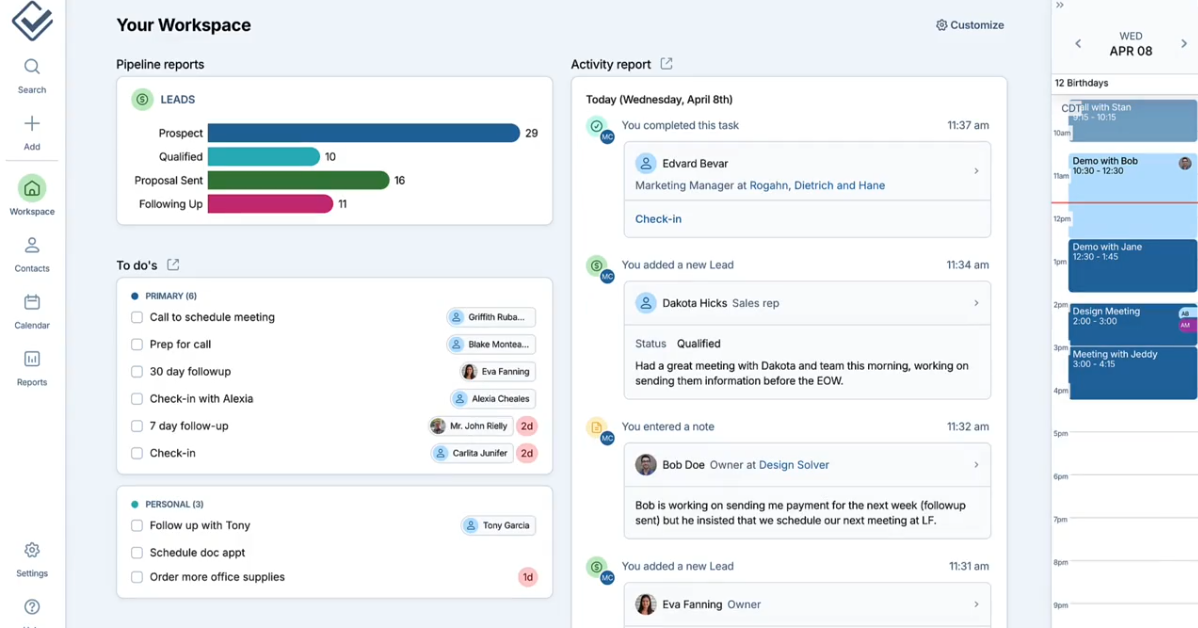
Less Annoying CRM answers with simplicity. Founded in 2009 by two brothers in San Francisco, the company grew from Tyler King's experience as an insurance agent whose employer adopted Salesforce, then spent a full month on setup. LACRM was built against that experience. The homepage leads with "More than a spreadsheet, less than a CRM", and the company has held that position for over 15 years: no outside investors, no enterprise tier, no feature bloat. Every feature targets users who don't want to hire a consultant or spend weeks in onboarding. With roughly 20 employees serving 10,000+ small businesses, LACRM stays small by choice.
Source: Less Annoying CRM
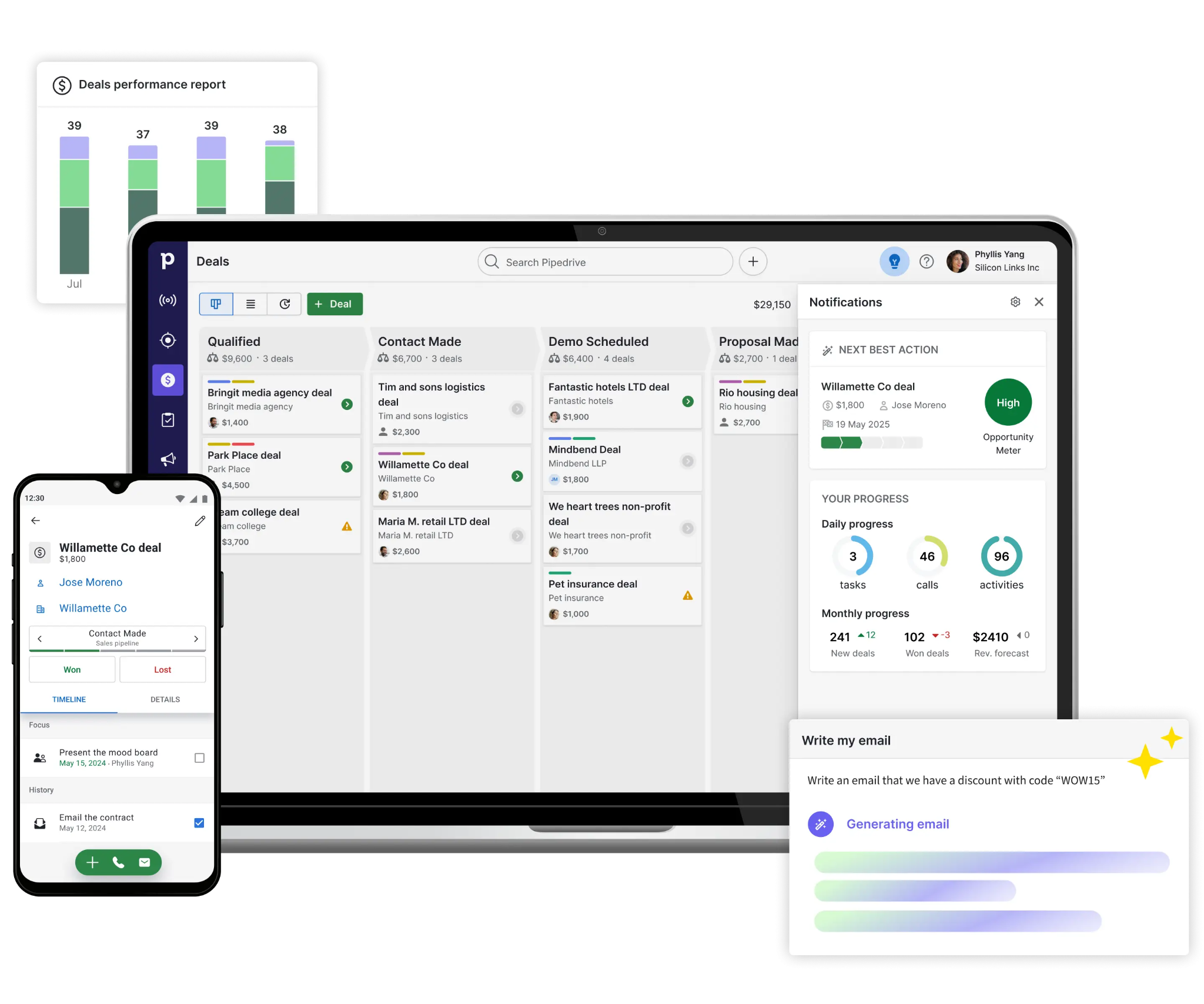
Pipedrive answers with pipeline-first execution. Founded in 2010 by five salespeople frustrated that existing CRMs were built for managers to monitor reps, not for reps to sell. Their founding insight became the product: a visual pipeline that makes selling easier. Now backed by Vista Equity Partners with 800+ employees across eight countries, Pipedrive has grown into a full sales platform and is pushing toward what CEO Paulo Cunha calls "an intelligent, AI-native CRM" in its "Pipedrive 3.0" phase.
Source: Pipedrive
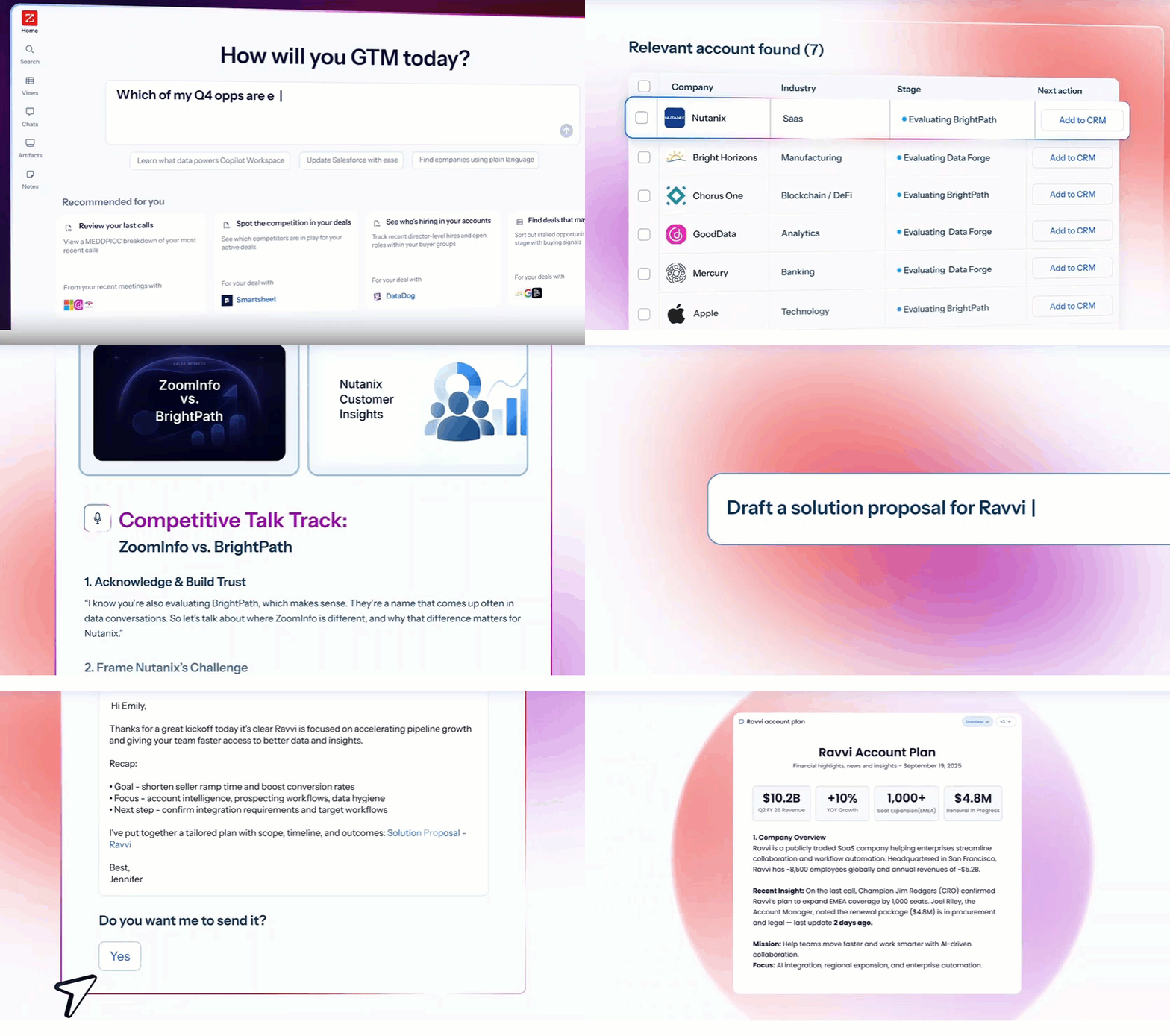
ZoomInfo answers with intelligence. Founded in 2007, ZoomInfo was built on the idea that go-to-market teams need accurate, verified data. Eighteen years and multiple acquisitions later (including Chorus for conversation intelligence and Clickagy for intent signals), ZoomInfo has built a platform that doesn't just store relationships but understands them. The GTM Context Graph captures account context (what changed, why it changed, and what patterns across thousands of similar deals suggest happens next). A CRM records state changes. ZoomInfo reveals what those changes mean.
The choice between these three isn't about features. It's about where your business sits and where it's heading.
Pipeline management: simple tracking vs. smart execution
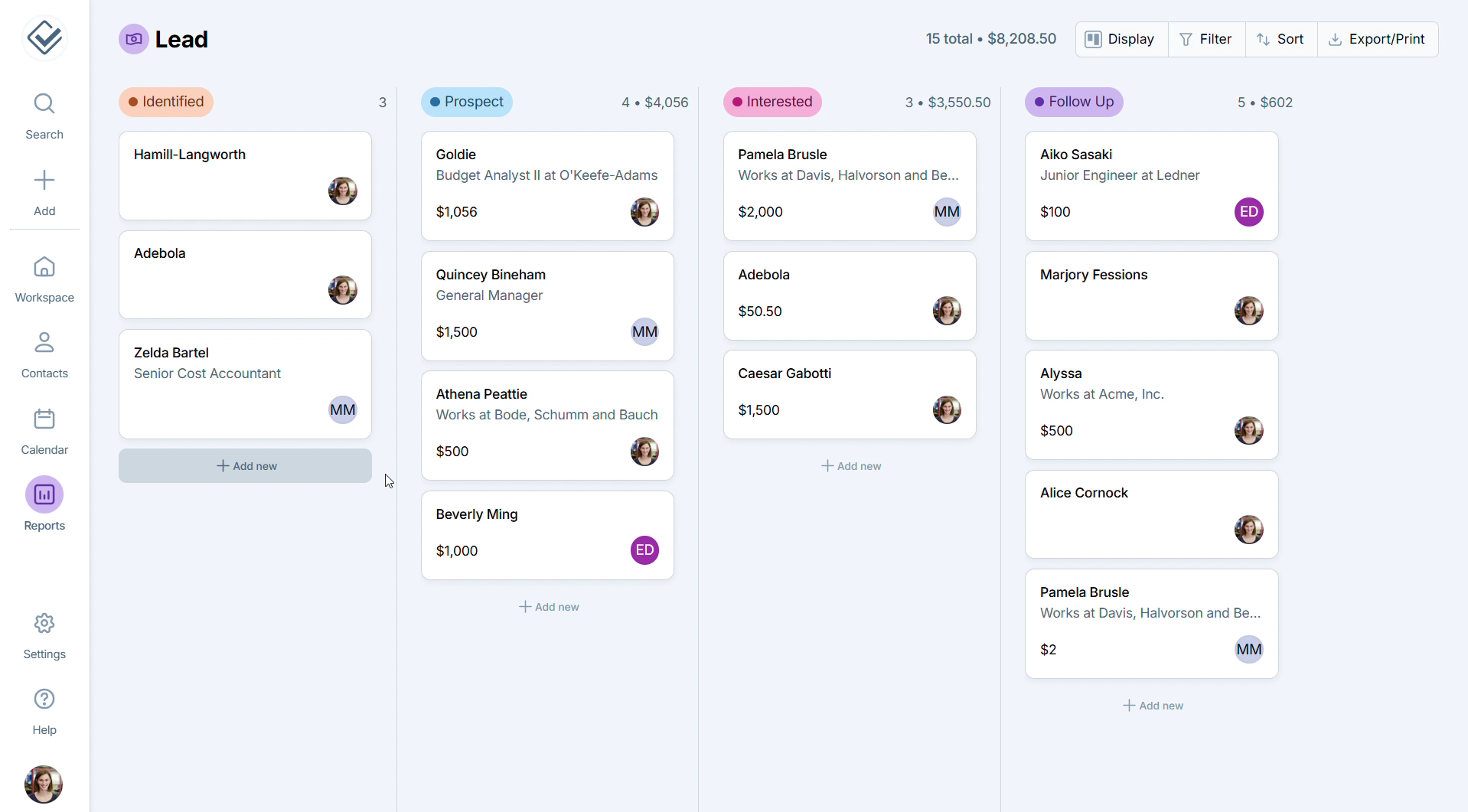
Less Annoying CRM treats pipelines as a flexible tracking tool. Users create unlimited pipelines with custom statuses, custom fields, and both board and list views. Pipeline items always attach to a contact record, keeping deal context inside the full relationship history. A useful touch: the pipeline report can be filtered by follow-up status, surfacing contacts without a scheduled task before they slip away.
Source: Less Annoying CRM
But LACRM's pipelines are deliberately basic. There's no revenue forecasting, no deal scoring, and no weighted probability calculations. When the board view includes a number or currency field, it shows a running total per column, but that's the extent of pipeline analytics. For a five-person consulting firm tracking 30 opportunities, this is plenty. For a 20-person sales team managing hundreds of deals across territories, it falls short.
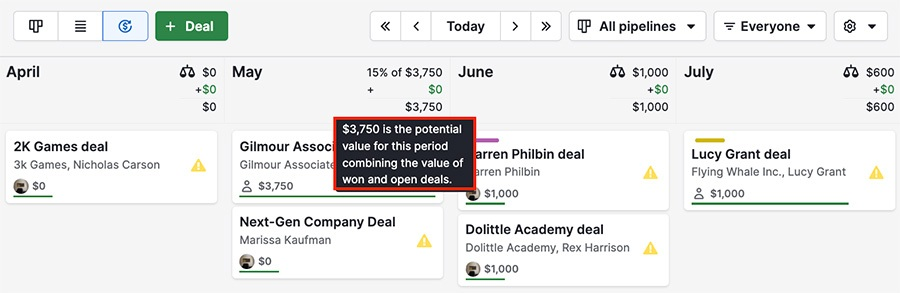
Pipedrive was designed around the pipeline view. Three views (kanban, list, and forecast) give different perspectives on deal health. Deal rotting flags idle deals with colored cues before they go cold. Activity-based selling ensures every deal has a scheduled next step. Revenue forecasting projects expected revenue using close dates and win probability. Custom deal scoring lets reps prioritize by conversion likelihood. The pipeline isn't just a view; it's the workspace.
Source: Pipedrive
ZoomInfo adds intelligence on top of your pipeline. GTM Workspace doesn't replace your CRM's pipeline. It enriches it. While LACRM and Pipedrive show you where deals stand, ZoomInfo's AI agents surface what's driving deal movement and what to do about it. The Action Feed streams real-time buying signals (G2 comparisons, funding events, executive hires) with pre-drafted actions on each signal.
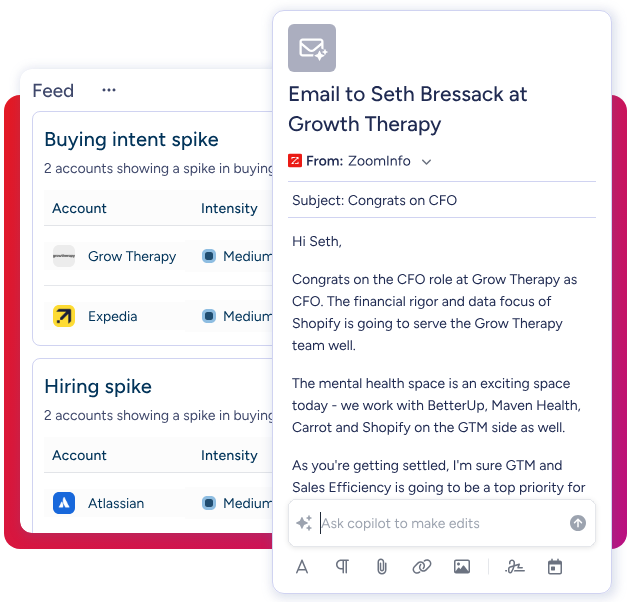
Buying group intelligence identifies stakeholders you didn't know were involved. The result: sellers open their workspace to a prioritized feed where AI has already researched the account, spotted the opportunity, and drafted the outreach.
Seismic's sales team attributed 39% of active pipeline to opportunities identified or influenced by ZoomInfo signals, with reps reporting 54% more productive workflows. (Seismic)
Automation and AI: from checklists to intelligent agents
Automation is where the gap between these three platforms is widest.
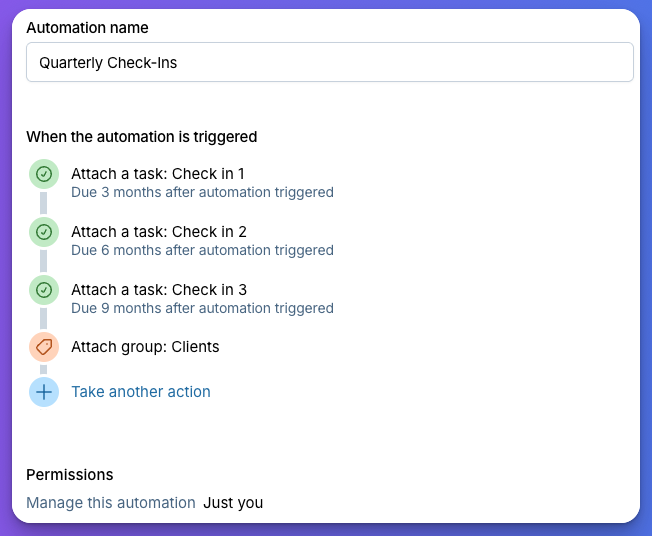
Less Annoying CRM launched its Automations feature in December 2025, making it the newest player here. Automations bundle five action types into reusable workflows: assign to user, attach a note, attach a task, attach a group, and attach a pipeline. Users trigger these manually from a contact record, automatically on pipeline status change, or on form submission.
Source: Less Annoying CRM
Sequence automations (chaining multiple steps into one trigger) are in public beta. There's no visual workflow builder, no conditional branching, and no time-delay scheduling. For a coach who wants to auto-assign a follow-up task and add a new client to a group when they enter a pipeline stage, this works. For anything more complex, it doesn't.
LACRM has no AI features as of mid-2026. No smart suggestions, no email drafting, no conversation analysis.
Pipedrive offers more automation depth. Available on Growth and above, automations support event triggers, date triggers, if/else branching, delay steps, and "wait until event" conditions. Actions include creating, updating, and deleting records, sending emails, adding notes, firing webhooks, and sending Slack, Teams, Trello, or Asana notifications. A library of pre-built templates covers common workflows.
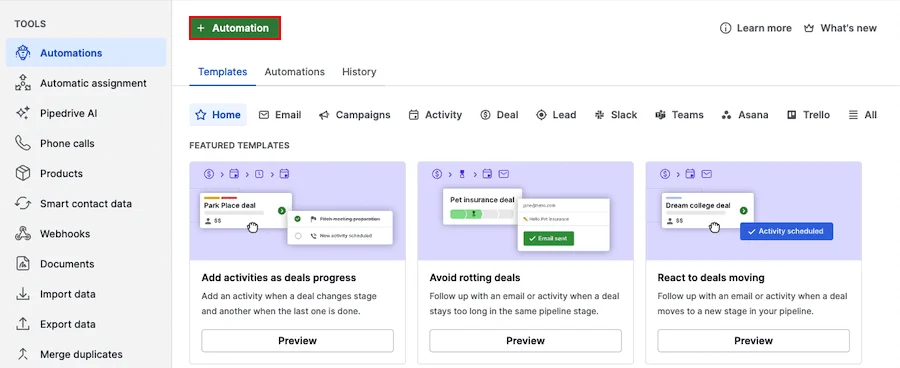
Source: Pipedrive
On AI, Pipedrive is investing heavily. The AI Sales Assistant surfaces deal recommendations and win probability predictions. The AI email writer generates drafts from prompts with configurable tone and length. AI-generated reports let users type natural-language requests instead of configuring filters. A ChatGPT integration lets users query Pipedrive data directly in ChatGPT. AI email summarization is still in beta.
ZoomInfo's AI isn't layered on top of a CRM. It's built on the GTM Context Graph, which fuses ZoomInfo's B2B data with your CRM records, call transcripts, email threads, and behavioral signals. Where Pipedrive's AI drafts an email from a prompt, ZoomInfo's AI agents draft outreach that addresses the specific concern a CFO raised on the last call, because the system understands why that concern matters in the context of your deal. GTM Workspace's AI agents handle account research, signal monitoring, CRM updates, and outreach generation. GTM Studio lets marketers and RevOps teams describe audiences in plain language and launch multi-channel plays, with expansion plays that used to take 3 weeks now launching in 30 minutes.
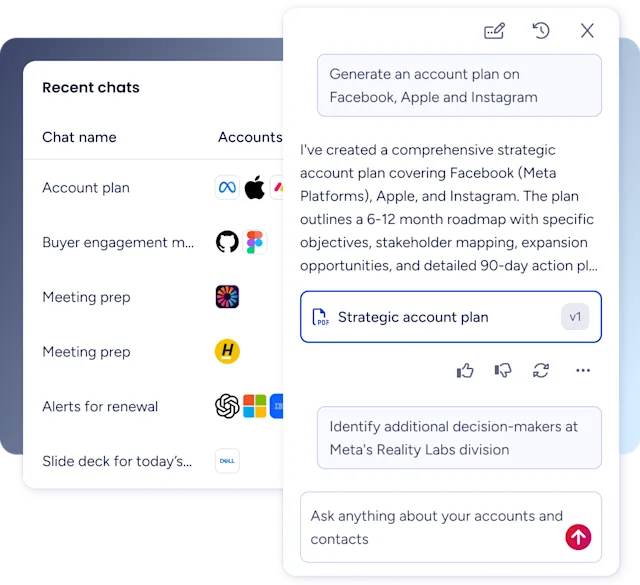
"ZoomInfo's built a system of execution: it works the list, writes the outreach, triggers the play, and helps drive predictable growth." (Levanta, Ian Brodie, CEO & Co-Founder)
Prospecting and data: where CRMs stop and intelligence begins
Less Annoying CRM and Pipedrive hold relationships you've already started. ZoomInfo helps you find and understand the relationships you haven't.
Less Annoying CRM offers no prospecting tools. There's no contact database to search, no data enrichment, and no intent signals. You can capture inbound leads through web forms and sync email campaigns via the Mailchimp integration, but finding new prospects is outside the product's scope. This is deliberate: LACRM is a relationship management tool, not a sales intelligence platform.
Pipedrive has moved into prospecting with its LeadBooster add-on, which bundles a chatbot, live chat, web forms, and a Prospector tool with access to over 400 million profiles and 10 million companies. The newer Pulse toolkit adds data enrichment, custom lead scoring, and automated sequences. These give Pipedrive users prospecting without leaving the platform. But Pipedrive's data is supplementary to its CRM, not its core.
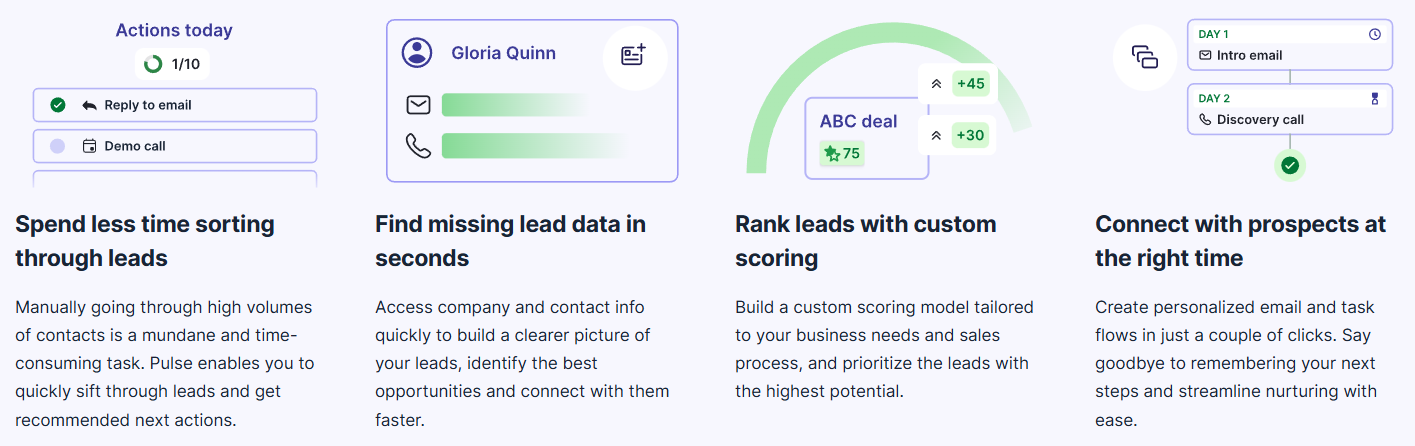
Source: Pipedrive
ZoomInfo was built as the data layer. The numbers: 500M contacts, 100M companies, 135M+ verified phone numbers, 120M direct-dial phone numbers, and 200M+ verified business email addresses. ZoomInfo maintains this database by scanning 28 million site domains daily with automated ML, sourcing third-party partner data from 95 million businesses, and employing 300+ human researchers. First-party data reaches up to 95% accuracy. In a Fortune 500 competitive RFP analyzing 25 million contacts across vendors, the independent consultant concluded that "no other competitor came even close."
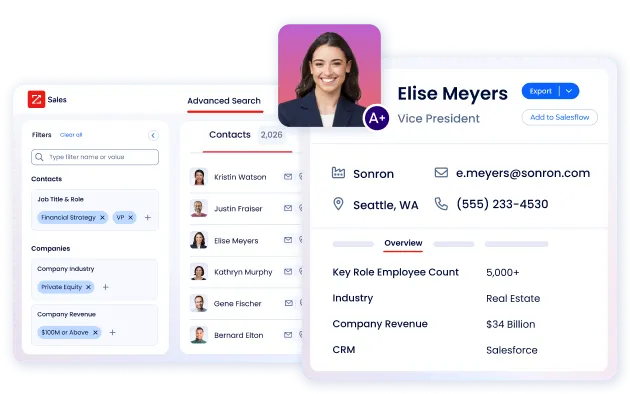
Beyond static contact data, ZoomInfo tracks buying signals. Intent data draws from 210 million IP-to-Organization pairings and 6 trillion+ keyword-to-device pairings sourced monthly. Guided Intent, exclusive to ZoomInfo, identifies topics correlated with deal success rather than requiring manual topic selection. WebSights resolves anonymous website traffic to companies, identifying buying teams with direct contact information. Technographics profiles the tech stack of 30+ million companies across 30,000+ technologies.
For a business that needs to find the right people, reach them through verified channels, and know when they're ready to buy, this is ZoomInfo's advantage.
"ZoomInfo gives us the information we need to execute. We don't have to go through and spend our time digging. It's already there, so we can be three steps ahead." (Vensure, William Kenimer, VP of Revenue Operations)
Mobile access and field selling
For salespeople who spend their days visiting clients, mobile capability matters.
Less Annoying CRM has no native mobile app. Users access the CRM through a mobile browser and can pin a shortcut to their home screen for an app-like experience. There are no push notifications; the main reminder is the daily agenda email sent each morning with the day's tasks and events. For desk-first users, this is fine. For real estate agents, insurance agents, or anyone logging calls between meetings, the lack of a native app is a real limitation.
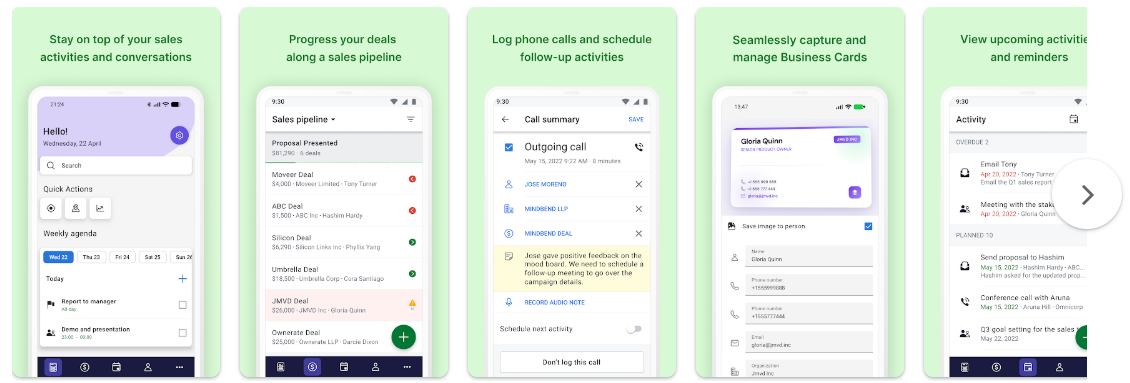
Pipedrive takes mobile seriously. The iOS and Android apps provide pipeline views, deal editing, calendar management, and two-way email sync. Additional features include in-app calling with automatic call logging, offline mode, a business card scanner on iOS, audio notes, photo uploads, a "Nearby" feature showing geographically close clients, and push notifications. For field salespeople, Pipedrive's mobile app is a clear advantage.
Source: Google Play
ZoomInfo offers a mobile app and the ReachOut Chrome Extension for accessing contact intelligence wherever you browse. But ZoomInfo's reach goes beyond a single app. APIs and MCP deliver ZoomInfo's intelligence into any front-end. The same data available in GTM Workspace is available programmatically in any tool your team already uses, including your CRM. Whether a seller is in Salesforce on a laptop, in ChatGPT on a phone, or in a custom internal tool, ZoomInfo's intelligence follows.
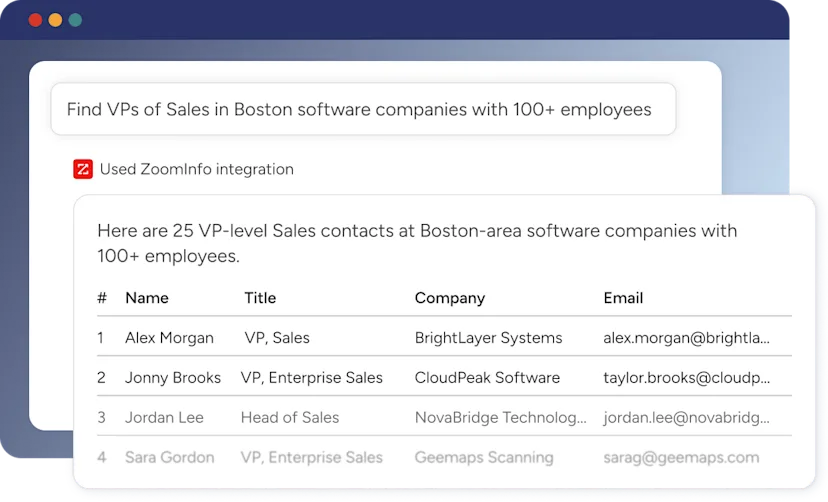
"Anything that minimizes our team's need to switch contexts is beneficial. ZoomInfo offers a unified view, eliminating the need to navigate between systems." (Spekit, Ben Perceval, RevOps Manager)
Support and onboarding
How each company handles support reflects who they're built for.
Less Annoying CRM offers free phone and email support for every user, including those on the 30-day free trial. No paid tiers, no upsells. The support team, called CRM Coaches, average 5+ years of tenure and are product and small business experts, not script-readers. CEO Tyler King publicly lists his email as an accountability channel.
This level of personal support works because LACRM is a 20-person company serving 10,000+ businesses. The question is whether it can scale. For now, it's a real differentiator.
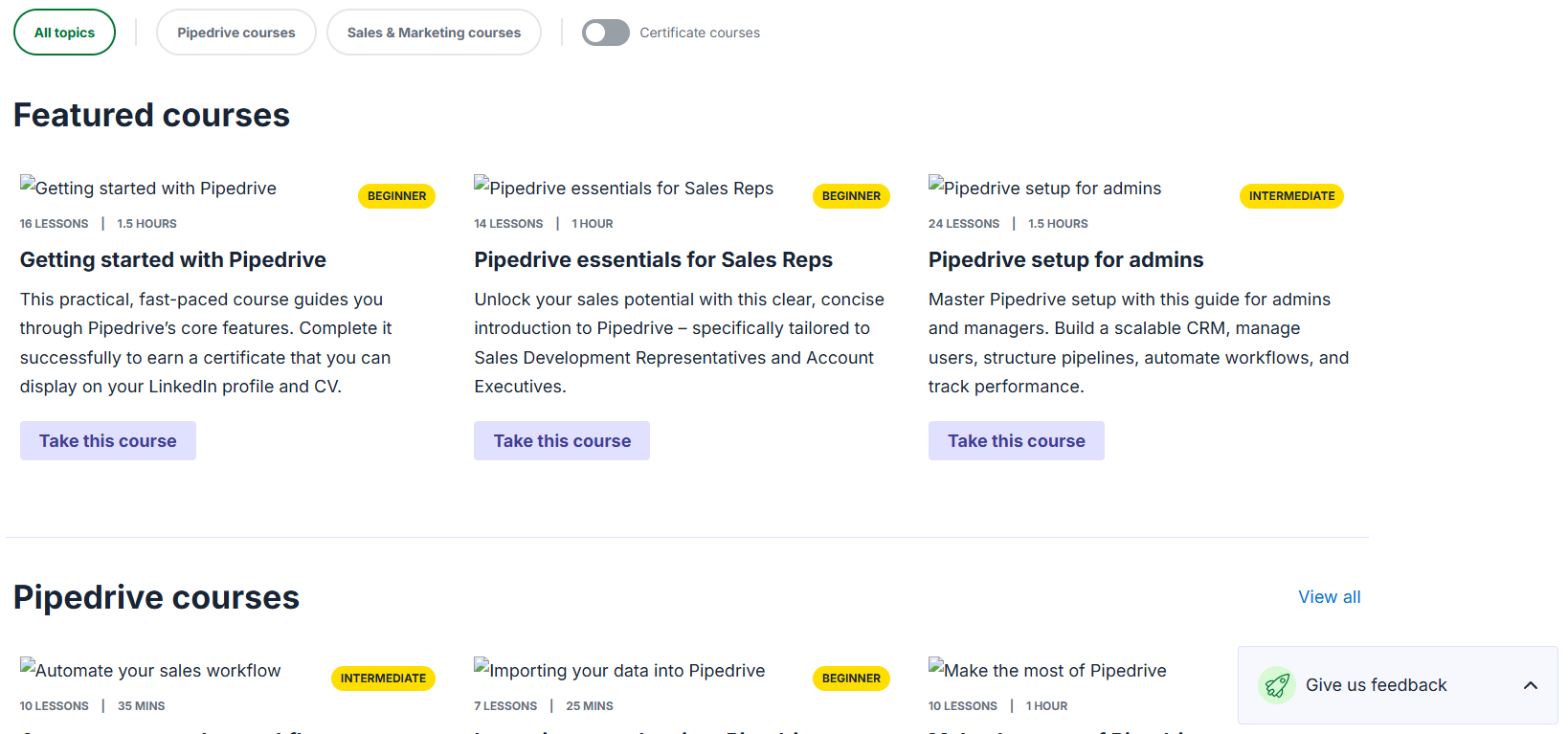
Pipedrive ties support to plan level. All users get email support and chatbot access. Growth adds live chat during business hours. Premium and Ultimate get 24/7 live chat and phone support. A dedicated Customer Success Manager is only available for customers spending over $1,000/month. The Pipedrive Academy provides courses, video tutorials, and certifications. The Knowledge Base covers 23 languages. For most small teams, email and chatbot support will be the daily experience.
Source: Pipedrive
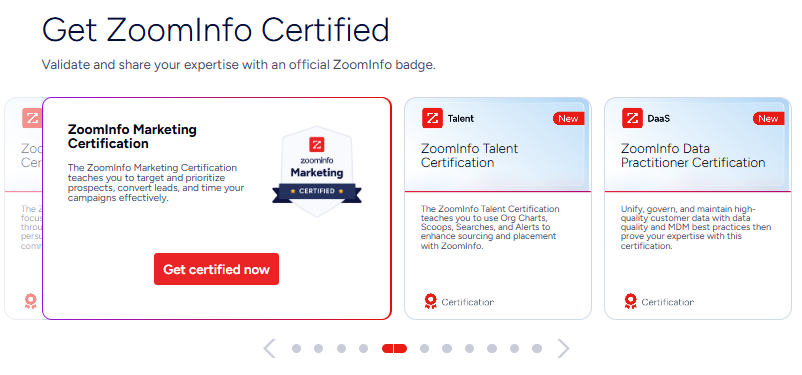
ZoomInfo invests in structured onboarding at enterprise scale. The company redesigned its onboarding from 30 to 90 days, covering planning, technical implementation, education, and adoption. That redesign produced a 25% improvement in customer satisfaction scores and won Rocketlane's Golden Comet award for Best Customer Onboarding Team of 2024. ZoomInfo University provides role-specific learning paths for Sales, Marketing, Administrators, and Customer Success, plus product certifications and live webinars. ZoomInfo Labs provides professional services for teams with complex implementation needs.
Pricing: flat rate vs. tiered vs. custom
The pricing structures reveal what each company values.
Less Annoying CRM charges $15/user/month. That's the full price. No tiers, no add-ons, no annual discount (because there's no annual discount to give). Unlimited contacts, pipelines, custom fields, 25GB file storage per user, and free human support are all included. The company has raised its price once in 15+ years (from $10 to $15 in 2020), and existing customers kept the old rate. The 30-day free trial requires no credit card and includes full functionality.
Pipedrive uses four tiers: Lite, Growth, Premium, and Ultimate. The entry price of $14/month per seat looks competitive until you check what's missing on Lite: no email sync, no automations, no sequences, no meeting scheduler, no forecast view. Most sales teams need at least the Growth plan for email sync and automation.
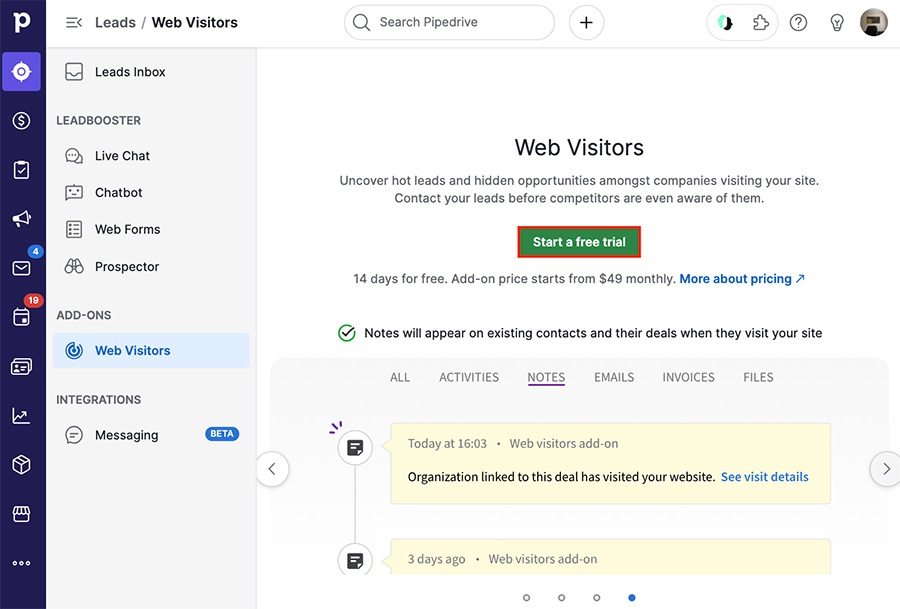
Premium adds Smart Docs, Projects, and LeadBooster (chatbot, live chat, web forms, and a prospecting database of 400 million+ profiles). Separate add-ons for Campaigns (email marketing) and Web Visitors add more cost. Annual billing saves up to 42%, but that means committing upfront with no refunds.
Source: Pipedrive
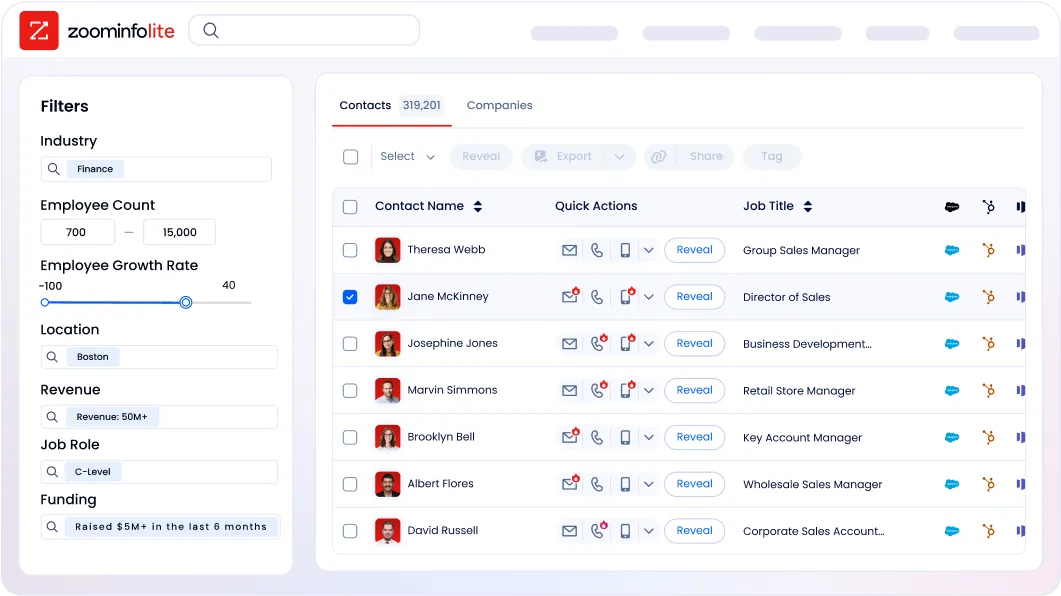
ZoomInfo uses custom-quoted, consumption-based pricing with no public prices. The pricing scales around data access, API consumption, and AI activity. For teams evaluating ZoomInfo, two free entry points exist: ZoomInfo Lite is a permanent free tier (no credit card, no time limit) with access to ZoomInfo's database and 10 monthly export credits, and a 7-day free trial opens broader access to paid features.
The cost comparison isn't straightforward because these platforms serve different needs at different scales. A 3-person consulting firm paying $45/month for Less Annoying CRM and a 50-person sales organization investing in ZoomInfo are solving different problems. The question isn't which costs least; it's which delivers the return your business needs now.
Less Annoying CRM vs. Pipedrive vs. ZoomInfo: Which should you choose?
The right choice depends on your team's size, sales motion, and growth trajectory.
Choose Less Annoying CRM if:
You're a solo operator or micro-team (1–10 people) who needs contact organization and follow-up tracking
Pipeline management without deal scoring or forecasting is enough
$15/user/month flat pricing with no surprises fits your budget
You value free human support from day one, including during your trial
You don't need a native mobile app or in-app email sending
Choose Pipedrive if:
You have an active sales pipeline and need visual deal management with forecasting
Email sync, workflow automation, and AI-assisted selling matter to your process
Your field team needs a native mobile app with offline access and call logging
You're willing to invest in higher tiers or add-ons for prospecting and email marketing
500+ integrations matter for connecting your existing tools
Choose ZoomInfo if:
You need to find and qualify new prospects, not just manage existing relationships
Verified contact data, direct dials, and buying signals would change your team's outreach
Your sales organization has outgrown basic CRM and needs data-driven execution
You want AI that understands deal context and recommends what to do next
You need a platform that delivers intelligence into your existing tools through APIs and MCP
Start exploring ZoomInfo for free with ZoomInfo Lite.
The pattern is straightforward. Less Annoying CRM is where businesses start when spreadsheets aren't enough and enterprise CRMs are too much. Pipedrive is where growing sales teams go when they need pipeline rigor, automation, and mobility. ZoomInfo is where revenue teams arrive when they realize the constraint on growth isn't managing what they have; it's finding what they're missing.
Each solves a real problem. The question is which problem is yours.
Less Annoying CRM vs. Pipedrive vs. ZoomInfo FAQ
What is the core difference between Less Annoying CRM, Pipedrive, and ZoomInfo?
Less Annoying CRM is a contact and relationship management tool for solo operators and micro-teams who need to organize contacts and track follow-ups without complexity. Pipedrive is a sales CRM built around visual pipeline management, deal tracking, and workflow automation for growing sales teams. ZoomInfo is an AI-powered go-to-market platform that provides B2B data (500M contacts, 100M companies), buying intent signals, conversation intelligence, and AI-driven execution for revenue teams that need to find and engage buyers with verified data.
Which platform is the most affordable?
Less Annoying CRM is the simplest to budget for at $15/user/month with no tiers, no add-ons, and no annual contract. Pipedrive starts at $14/month per seat on Lite but requires higher tiers for email sync, automation, and forecasting, making the real cost for most sales teams higher. ZoomInfo uses custom-quoted, consumption-based pricing with no published rates, though ZoomInfo Lite offers a permanent free tier with 10 monthly export credits and access to the B2B database.
Which platform has the best mobile experience?
Pipedrive leads with native iOS and Android apps supporting offline mode, in-app calling with automatic logging, a business card scanner, and a Nearby feature for finding geographically close clients. Less Annoying CRM has no native mobile app; users access the CRM through a mobile browser. ZoomInfo offers a mobile app and the ReachOut Chrome Extension, but its main mobile advantage is delivering intelligence into any tool through APIs and MCP.
Can any of these platforms help me find new prospects?
Only ZoomInfo is built for prospecting, with a verified B2B database of 500M contacts, 135M+ verified phone numbers, and 200M+ verified business email addresses, plus buyer intent signals and website visitor identification. Pipedrive offers some prospecting through its LeadBooster add-on (access to 400 million+ profiles) and its Pulse toolkit for data enrichment and automated sequences. Less Annoying CRM has no prospecting features; it captures inbound leads via web forms but does not help users find new contacts.
Which is best for a solo consultant or small service business?
Less Annoying CRM is designed for this audience. Its flat $15/user/month pricing, free human support, unlimited pipelines, and simple interface make it a fit for consultants, coaches, financial planners, and small service businesses that need contact organization without learning complex software. Pipedrive can work for solo users but is geared toward active sales processes with deal stages and pipeline management. ZoomInfo serves enterprise and mid-market teams with data-intensive sales motions.
How do automation capabilities compare across the three?
Less Annoying CRM has the most basic automation, launched in December 2025 with five action types and no conditional logic or time delays. Pipedrive provides advanced automation on Growth plans and above, including if/else branching, date-based triggers, delay steps, and integrations with Slack, Teams, Trello, and Asana. ZoomInfo offers AI-powered automation through GTM Workspace (AI agents that handle account research, outreach, and CRM updates) and GTM Studio (natural language audience targeting and multi-channel plays), operating at a different level from rule-based automation.
Can ZoomInfo work alongside Less Annoying CRM or Pipedrive?
ZoomInfo integrates natively with Salesforce, HubSpot, and Microsoft Dynamics. Pipedrive is listed in the ZoomInfo App Marketplace. For Less Annoying CRM, ZoomInfo data can be exported and imported via CSV, or connected through Zapier and ZoomInfo's APIs. ZoomInfo is designed to work alongside your existing CRM through APIs and MCP, not to replace it, making it a potential complement to either platform.
Which platform offers the best customer support?
Less Annoying CRM stands out with free support for everyone, no tiers required. Every user, including trial users, gets phone and email access to CRM Coaches who average 5+ years of tenure. Pipedrive ties support to plan level: email and chatbot on all plans, live chat on Growth and above, phone support only on Premium and Ultimate. ZoomInfo provides structured onboarding, ZoomInfo University with role-specific training, a help center, and professional services through ZoomInfo Labs for complex deployments.
