
The question behind every API evaluation is whether you can build on it. With LinkedIn Sales Navigator, that question has a prerequisite: can you get access at all?
LinkedIn Sales Navigator sits on top of the world's largest professional network (1.3+ billion members generating self-reported, continuously updated profile data that no third-party database can replicate). For a developer building B2B sales intelligence into a product, that data is the draw.
The API, called the Sales Navigator Application Platform (SNAP), exposes Display Services, Analytics Services, and Sync Services through a REST interface with OAuth 2.0 authentication.
But there is a hard constraint before any technical evaluation begins.
LinkedIn states on the SNAP documentation page: "We are not currently accepting new partners for access to the LinkedIn Sales Navigator API." The integrations page confirms: "We're not accepting new applications right now." SNAP API access is invitation-only, requires a formal partnership agreement, and is not available to outside developers or companies.
The LinkedIn Sales Navigator API is likely the right choice if:
You are an existing SNAP partner with an approved integration and want to embed Sales Navigator profiles, account views, and messaging inside your application via Display Services.
You need to pull team-level sales activity metrics, SSI scores, and seat-level usage data in bulk through the Analytics Services export API.
You are building a CRM integration that requires bidirectional data sync, activity writeback, and embedded Sales Navigator experiences (Advanced Plus plan required).
You operate a sales engagement or BI platform that LinkedIn has already approved for the SNAP partner program.
Your integration model fits LinkedIn's whitelist approach: partner certification, beta capping at 25 users, and LinkedIn design approval before launch.
However, it might not be the right fit if:
You are not an existing SNAP partner, because LinkedIn is not accepting new applications and has not published a timeline for reopening.
You need a self-serve developer signup, a sandbox environment, or a public API reference you can evaluate before committing to a partnership process.
You want to search, enrich, or export contact and company data programmatically, since SNAP does not expose raw member data to partners through Display Services.
You need webhooks or real-time event-driven notifications, as no webhook capability is documented for SNAP APIs.
You require published rate limits, endpoint schemas, or an OpenAPI spec to scope your integration before building, since these are gated behind the partner portal.
You need official server-side SDKs in any language, as LinkedIn does not publish maintained SDK packages for SNAP.
In this case, consider ZoomInfo, a B2B data and sales intelligence platform whose Enterprise API covers search, enrichment, AI intelligence, and audience management across 500M contacts and 100M companies, 135M+ verified phone numbers, and 200M+ verified business email addresses.
It offers OAuth 2.0 authentication, published rate limits up to 35 req/sec, an interactive API reference, and an MCP server for AI-agent workflows. Where SNAP gates access behind a closed partnership program, ZoomInfo's API is open to any customer with an Enterprise API or GTM Workspace package.
This article reviews both: the LinkedIn Sales Navigator API in full technical depth first (what it offers, what it does not, and what the closed-access model means for a developer), then ZoomInfo's API as the open alternative for B2B intelligence at the API layer.
LinkedIn Sales Navigator API at a Glance
Attribute | Detail |
|---|---|
API type | REST over HTTPS, JSON responses |
Authentication | OAuth 2.0 (3-legged Authorization Code Flow and 2-legged Client Credential Flow) |
Base URL | Not publicly documented (gated behind partner portal) |
Rate limits | Not publicly documented |
SDKs | JavaScript SDK for Display Services (client-side embedding); no official server-side SDKs |
Webhooks | Not documented in any public source |
Documentation | SNAP overview at Microsoft Learn (index page public; sub-pages gated behind partner approval) |
Pricing / access | No standalone API pricing; requires active Sales Navigator subscription per end user plus approved SNAP partnership. Not currently accepting new partners |
LinkedIn Sales Navigator API: What Works Well & What to Plan Around
What works well | What to plan around |
|---|---|
OAuth 2.0 with both 3-legged and 2-legged flows | Closed partner program: not accepting new applications |
Display Services embed Sales Navigator UI modules without exposing raw member data | Detailed endpoint documentation is gated behind partner approval |
Analytics Services provide bulk export of team-level sales metrics and SSI scores | No publicly documented rate limits, base URL, or endpoint schemas |
Sync Services enable bidirectional CRM data sync with activity writeback | CRM Sync and Embedded Experiences require Advanced Plus plan (10+ seats, custom pricing) |
JavaScript SDK handles client-side embedding without server-side data exposure | No official server-side SDKs in any language |
SNAP Terms guarantee 60 days' notice before requiring migration to a new API version | No webhooks, no event-driven delivery, no real-time push notifications |
LinkedIn Sales Navigator API: Authentication & Getting Started
Getting API access to LinkedIn Sales Navigator is not a developer signup.
It is a partnership process. The SNAP documentation describes a closed program that requires a formal agreement, LinkedIn design review, and certification before any integration goes live.
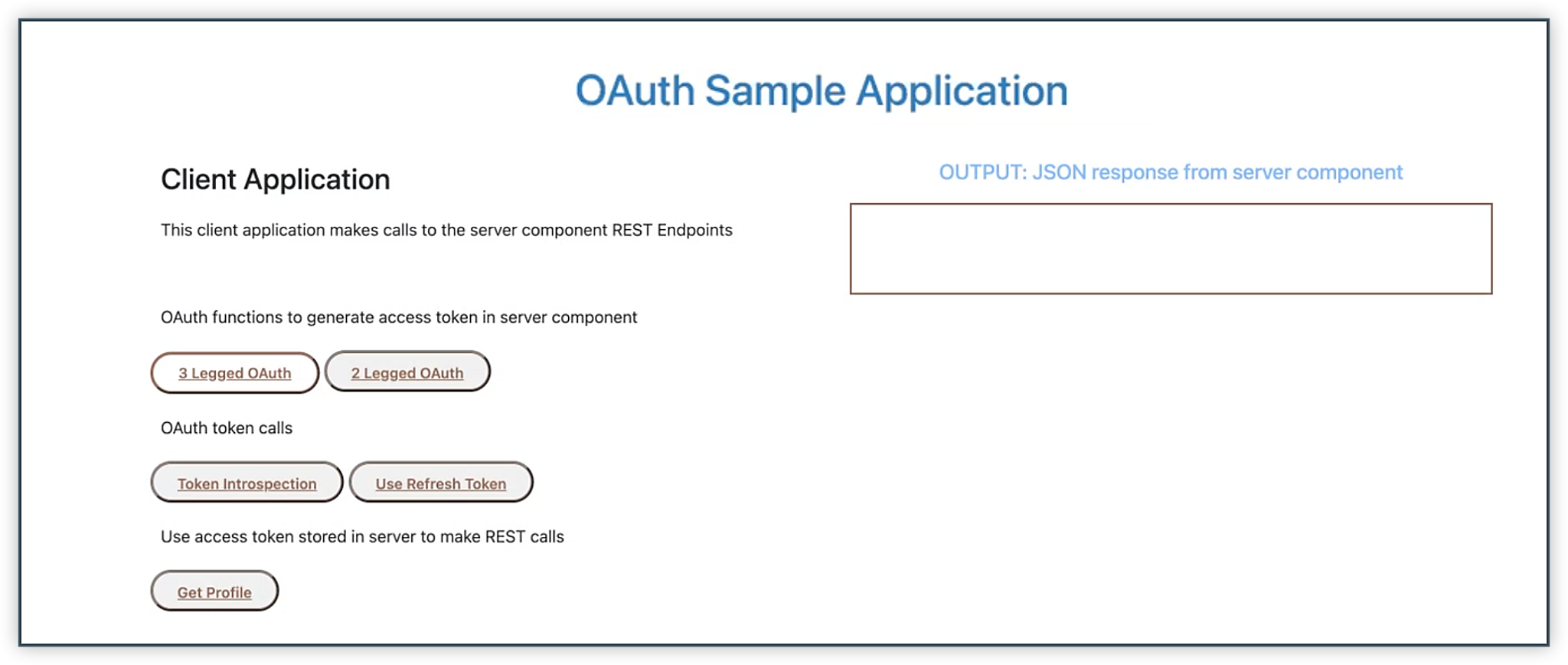
The authentication layer uses OAuth 2.0, the same framework LinkedIn uses across its broader API platform. Two flows are available:
3-legged OAuth (Authorization Code Flow): For requests acting on behalf of individual LinkedIn members. This is the primary flow for Display Services and most SNAP operations, since they surface member-specific data with explicit member consent.
2-legged OAuth (Client Credential Flow): For application-level requests that are not member-specific. LinkedIn notes that not all SNAP APIs support this flow.
You obtain credentials through the LinkedIn developer portal upon SNAP partnership approval. LinkedIn provides a Java OAuth sample application for testing authentication flows, though it is generic to LinkedIn's API platform and not SNAP-specific. For server-side OAuth, LinkedIn's authentication documentation points to third-party open-source OAuth 2.0 libraries but does not maintain official ones.
Source: LinkedIn Sales Navigator
Three constraints to know before you plan:
Every end user must hold an active Sales Navigator license. The SNAP Terms restrict integration access to "Licensed Seat Holders" with active licenses to both your application and LinkedIn Sales Navigator.
Partners cannot charge users for API access. The SNAP Terms prohibit imposing "any add-on fees to the Integration Customers solely for purposes of accessing the Integration."
Data re-use outside the integration is prohibited. Populating a third-party database with LinkedIn data, reselling LinkedIn data, or scraping member information through the API are all banned.
A basic authenticated request follows standard OAuth 2.0 Bearer token patterns:
curl -X GET "https://api.linkedin.com/v2/{endpoint}" \
-H "Authorization: Bearer YOUR_ACCESS_TOKEN" \
-H "Content-Type: application/json"
The exact base URL and endpoint paths for SNAP APIs are not published in any public documentation. LinkedIn does not support TLS 1.0.
LinkedIn Sales Navigator API: Core Endpoints & Capabilities
The SNAP API is organized into three service categories. Detailed endpoint references, request/response schemas, and payload examples are gated behind partner approval.
What follows is drawn from the public SNAP overview, CRM help articles, and the SNAP Terms.
Display Services
Display Services are the client-facing layer of the SNAP API. They deliver Sales Navigator UI modules via iframe or JavaScript SDK, embedding profile views, account pages, activity feeds, and messaging inside a partner application.
What operations are available:
Embed Sales Navigator member profiles and company account views within a partner application
Surface a lead's recent activity, LinkedIn posts, and recommended actions
Send connection requests and InMails to leads from within the partner application
Enrich partner UI presentations with LinkedIn profile photos and links to Sales Navigator profiles via the Profile Associations API
What you would build with this: A CRM or sales engagement tool that shows a Sales Navigator profile card alongside your own contact record, letting reps view LinkedIn activity and send InMails without switching tabs. Gong, Outreach, Salesloft, and Freshworks all use Display Services this way.
The key architectural constraint: Display Services render LinkedIn data within UI components that LinkedIn controls. The partner application does not receive raw LinkedIn member data server-side. This is deliberate: it keeps member data within LinkedIn's control while letting partners present it to users.
Analytics Services
A bulk export API for retrieving team-level sales activity and adoption metrics.
What operations are available:
Export activities performed by sales team seat holders (profile views, searches, InMails sent, leads saved)
Retrieve per-seat metrics including Social Selling Index (SSI), total connections, and total leads saved
Pull usage data for adoption monitoring and ROI reporting
What you would build with this: A BI dashboard in Power BI or Tableau that tracks Sales Navigator adoption across your sales org, correlating SSI scores and InMail activity with pipeline outcomes from your CRM. Both Power BI and Tableau have existing SNAP-powered integrations for this.
Delivery model: This is a batch/pull-based export, not a real-time event stream. You schedule periodic requests to pull updated metrics rather than receiving push notifications when activity occurs.
Sync Services
The deepest integration layer, powering bidirectional CRM sync and embedded experiences. Sync Services require Advanced Plus (10+ seats, custom pricing).
What operations are available:
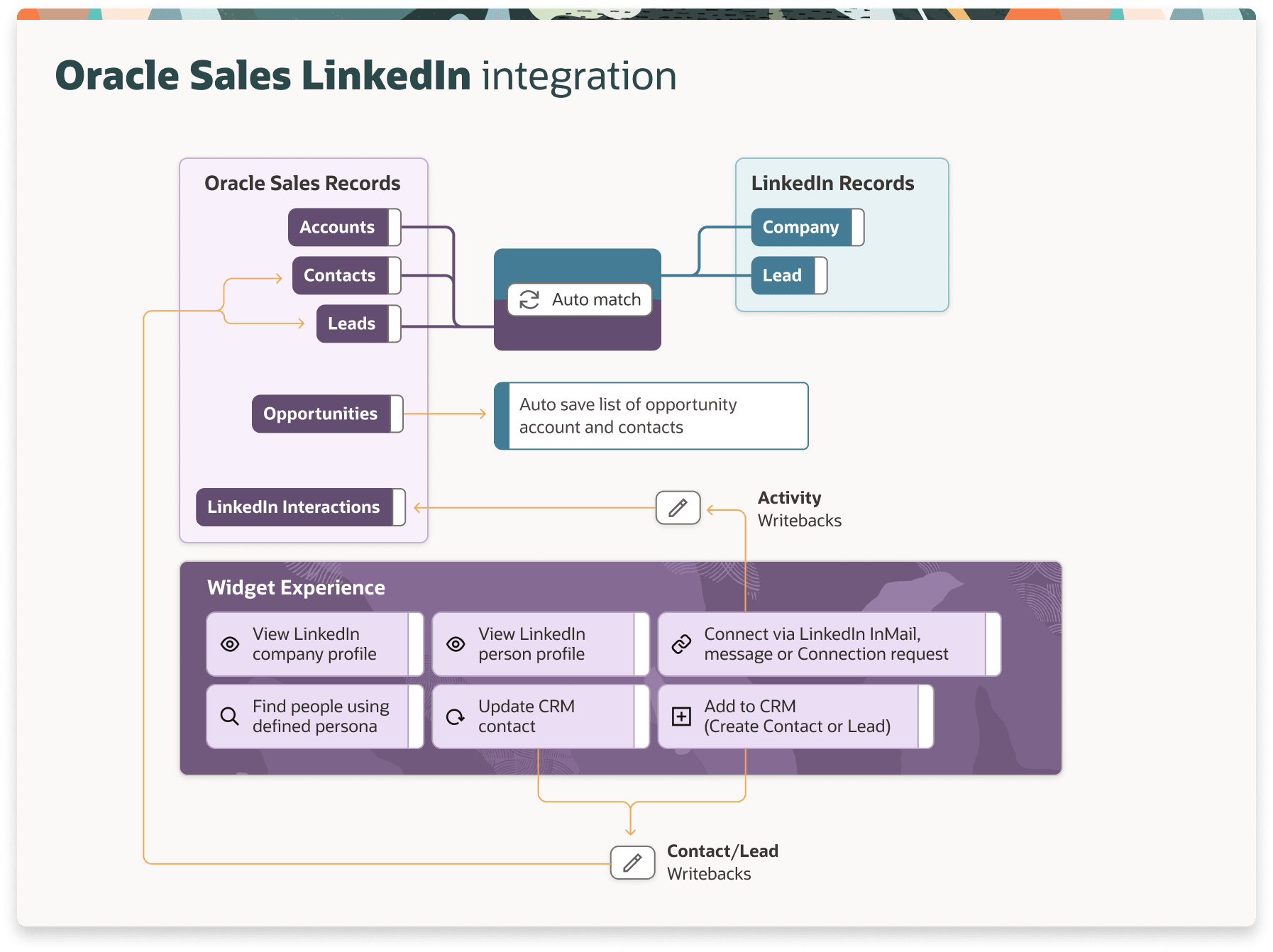
CRM Sync: Auto-import CRM contacts, accounts, and leads into Sales Navigator. Write back Sales Navigator activities (messages, calls, notes) to the CRM as logged activities. Syncs run daily.
Data Validation: Flag CRM contacts who have left their company or have outdated title/location data, using LinkedIn's member data as the source of truth.
Contact Creation: Create new CRM records directly from Sales Navigator with auto-populated fields (name, title, country). Supported for select CRMs including HubSpot, Dynamics 365, Oracle Sales, and Salesforce.
Embedded Experiences: Surface Sales Navigator capabilities (Account IQ, Relationship Map, Find Key People) inside the CRM UI for seat holders.
What you would build with this: A Salesforce integration where reps see Account IQ summaries and Relationship Maps inside their CRM records, with Sales Navigator activities auto-logging as Salesforce tasks. The existing integrations for Salesforce, HubSpot, Dynamics 365, and Oracle Sales all follow this pattern.
Source: LinkedIn Sales Navigator
Data formats follow LinkedIn's standard REST API conventions (JSON), but specific payload schemas are documented only within the gated partner portal.
LinkedIn Sales Navigator API: Webhooks & Events
No webhook capability is documented in any public LinkedIn Sales Navigator source.
The SNAP overview page, the CRM integration help articles, and the SNAP Terms contain no reference to webhook registration, event-driven delivery, or real-time push notifications. The Analytics Services bulk export is a pull-based API (periodic batch requests), not a push mechanism.
For a developer building event-driven workflows (trigger an action when a lead changes jobs, an account shows buyer intent, or an InMail gets a response), this is a real constraint. Sales Navigator surfaces many of these signals in its UI through alerts (job changes, content engagement, intent signals, hiring, leadership changes), but there is no documented way to receive these events through the API.
LinkedIn Sales Navigator API: SDKs, Docs & Rate Limits
SDKs & Libraries
LinkedIn's SNAP program provides a JavaScript SDK as part of Display Services for embedding Sales Navigator UI modules.
It lets partners render iframe-based or JavaScript-driven components within their apps without handling raw LinkedIn member data server-side.
Beyond the JavaScript SDK, there are no official server-side SDKs for SNAP APIs. LinkedIn's authentication documentation references third-party open-source OAuth 2.0 libraries but does not publish or maintain server-side SDK packages in any language.
A Java OAuth sample application is available for testing authentication flows, but it is generic to LinkedIn's API platform, not tailored to SNAP.
Pre-built CRM app packages (Salesforce AppExchange, Microsoft AppSource, HubSpot marketplace, Oracle Application Composer) are installable end-user integration packages, not developer SDKs. If you are building a custom integration, you work with raw REST calls authenticated via standard OAuth 2.0 libraries.
Documentation & Developer Experience
The developer documentation reflects the closed nature of the program:
Public index: The SNAP documentation at Microsoft Learn is publicly accessible and describes the three service areas at a high level.
Gated sub-pages: Detailed documentation for each service (Display, Analytics, Sync) returns 404 or requires authorization without an approved partnership.
Authentication docs: The LinkedIn OAuth 2.0 overview is publicly accessible and covers both 3-legged and 2-legged flows with implementation guides.
CRM setup guides: PDF-format guides for Salesforce, HubSpot, Dynamics 365, and Oracle Sales are linked from the CRM getting-started help page, covering CRM Sync setup, app installation, and security configuration.
There is no interactive API explorer, no OpenAPI/Swagger UI, no Postman collection, no public changelog, and no sandbox environment. The SNAP Terms commit to 60 days' notice before requiring migration to a new API version, but no release notes page tracks changes.
Developer support: Technical SNAP inquiries go to SNAP@linkedin.com (documented in the SNAP Terms). The partner handles end-user support, not LinkedIn. There is no community developer forum for SNAP APIs.
The developer experience is built for enterprise ISVs navigating a certification process, not for individual developers evaluating an API. You cannot assess the API, test endpoints, or estimate integration effort without first being accepted into the program.
Rate Limits & Constraints
Specific rate-limit figures for SNAP APIs are not published in any public documentation. Rate limits appear to be disclosed only within partner agreements and the gated developer portal.
What public sources confirm:
SNAP API access is scoped to Licensed Seat Holders. Data retrieval is bounded by the active Sales Navigator seat count in the partner account.
Analytics Services uses a bulk export model, implying periodic scheduled access rather than unlimited real-time querying.
The SNAP Terms reference LinkedIn's broader API Terms of Use for fair-use governance, which prohibit scraping, unauthorized bulk extraction, and resale of LinkedIn data.
No per-second, per-hour, or per-day rate-limit tiers are documented. No quota headers, 429 response behavior, or Retry-After mechanics are described.
For a developer sizing an integration, the absence of published rate limits means you cannot estimate throughput, plan backoff strategies, or scope polling intervals until you are inside the partner program.
LinkedIn Sales Navigator API Pricing & Access Costs
SNAP API access is not sold as a standalone product and has no public per-call or per-credit pricing. The access model works as follows:
Every end user must hold an active Sales Navigator subscription. The SNAP Terms restrict API access to users holding active licenses to both your application and LinkedIn Sales Navigator.
CRM Sync and Embedded Experiences require Advanced Plus. The most useful API capabilities for a deep integration (bidirectional sync, activity writeback, embedded Sales Navigator modules in CRM) are locked to Advanced Plus, which requires a minimum of 10 seats and custom pricing through a LinkedIn sales representative.
Published subscription pricing (for the underlying Sales Navigator plans):
Plan | Monthly (per seat) | Annual (per seat) | Minimum Seats |
|---|---|---|---|
Core | $119.99 | $1,079.88 | 1 |
Advanced | $159.99 | $1,799.88 | 2 |
Advanced Plus | Contact sales | Contact sales | 10 |
No metered API pricing. There are no per-call charges, credit packs, or consumption-based API fees. The cost of API access is embedded in the Sales Navigator subscription cost per seat.
Partners cannot charge users for API access. The SNAP Terms prohibit add-on fees solely for integration access.
For a developer sizing total cost: before API development begins, you need at minimum the Sales Navigator subscription per end user ($1,080/year on Core annual, $1,800/year on Advanced annual, custom on Advanced Plus). The API adds no incremental cost, but the partnership approval process adds time and uncertainty.
Where the LinkedIn Sales Navigator API Falls Short
These are the constraints a developer should plan around when evaluating this API. Several are deliberate scope decisions that reflect LinkedIn's partner-first, privacy-first approach to API access.
The program is closed to new partners. This is the single largest constraint. LinkedIn is not currently accepting new partners and has not published a timeline for reopening.
A developer evaluating this API for a new integration cannot get access, cannot test endpoints, and cannot estimate development effort. The 15+ existing SNAP partners (Salesforce, HubSpot, Gong, Outreach, Salesloft, and others) hold approved integrations; everyone else is locked out.
No public endpoint documentation. The API reference (endpoint paths, request/response schemas, payload examples) is gated behind partner approval. The public SNAP overview describes capabilities at the service level but does not expose the technical surface a developer needs to evaluate. There is no OpenAPI spec, no Postman collection, and no interactive API explorer.
No webhooks or event-driven delivery. Sales Navigator surfaces real-time signals in its UI (job changes, buyer intent, engagement activity), but there is no documented way to receive these events through the API. The Analytics Services export is batch/pull-based. For workflows that need to react when a champion changes jobs or an account shows intent, this is a gap.
No raw data access through Display Services. Display Services embed LinkedIn UI modules inside partner applications, but the partner does not receive raw member data server-side. You can show a profile card; you cannot extract the contact's email, phone number, or employment history into your own database. LinkedIn prohibits using the API to populate third-party databases.
No official server-side SDKs. Beyond the JavaScript SDK for Display Services, there are no maintained SDK packages in any language. Developers build and maintain the OAuth layer, request handling, and error logic themselves.
Rate limits are undocumented. Without published rate-limit tiers, quota headers, or retry semantics, you cannot scope your integration's throughput or design backoff strategies until you are inside the partner program.
CRM integration requires the most expensive plan. The Sync Services capabilities that make the API most useful for deep integrations (bidirectional CRM sync, embedded experiences, activity writeback) are locked behind Advanced Plus at 10+ seats with custom pricing. Teams of 2 to 9 seats wanting programmatic CRM integration face a steep tier gap.
ZoomInfo API: The Open Alternative for B2B Intelligence
ZoomInfo is a B2B data and sales intelligence platform.
Where LinkedIn Sales Navigator gates API access behind a closed partner program with no public documentation, ZoomInfo's API takes the opposite approach: a public developer portal, an interactive API reference, published rate limits, and OAuth 2.0 flows documented with code examples in five languages.
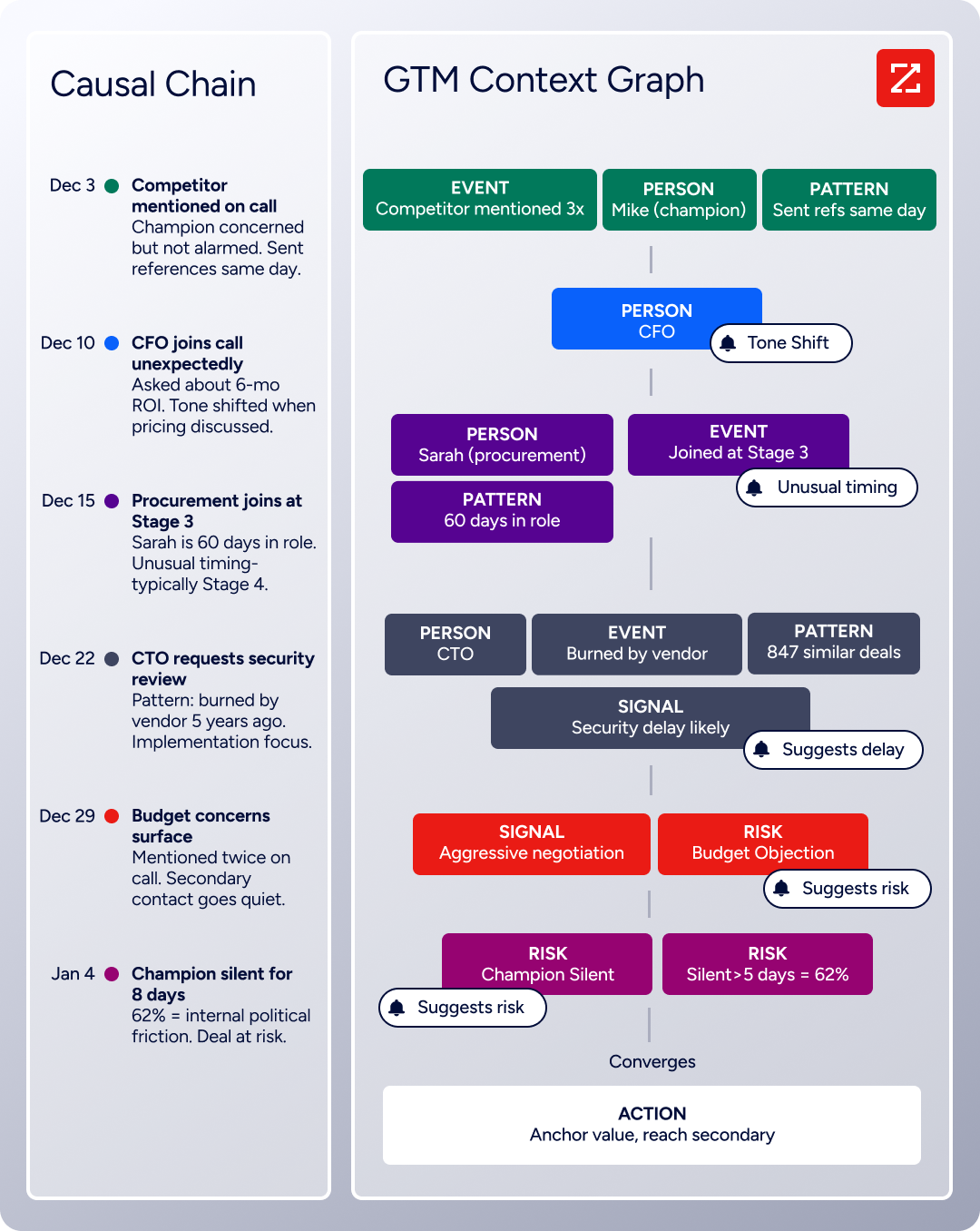
Its GTM Context Graph processes 1.5B+ data points daily, combining ZoomInfo's B2B data with your first-party data to surface signals about why deals progress or stall. A developer can evaluate the full endpoint surface, test requests, and scope an integration before writing production code.
The data layer differs, too. LinkedIn's SNAP API does not expose raw member data to partners.
ZoomInfo's API returns full contact and company records you can store, enrich, and act on: business emails, direct dials, employment history, org charts, technographics, and buyer intent signals across 500M contacts and 100M companies, 135M+ verified phone numbers, and 200M+ verified business email addresses.
What the API Covers
ZoomInfo's Enterprise API is a REST suite served from https://api.zoominfo.com/gtm, organized into four areas:
Data API (Search & Enrich): Search endpoints cover Contacts, Companies, Intent, News, and Scoops, returning matched records without consuming credits. Enrich endpoints unlock the full payload: business emails, direct dials, employment history, corporate hierarchy, org charts, technographics, and hashtag signals (up to 25 records per call). The search-then-enrich pattern lets you filter freely, then pay only for the records you commit to.
AI Intelligence API: Account Summary, Find Similar Companies, Contact Recommendations (AI-ranked buying-committee suggestions by motion: prospecting, deal acceleration, renewals), and Contact Lookalikes for replicating a persona across accounts.
Marketing API: CRUD endpoints for programmatic audience management.
Platform API (Engagements, Beta): Bidirectional engagement data for upserting content interaction signals.
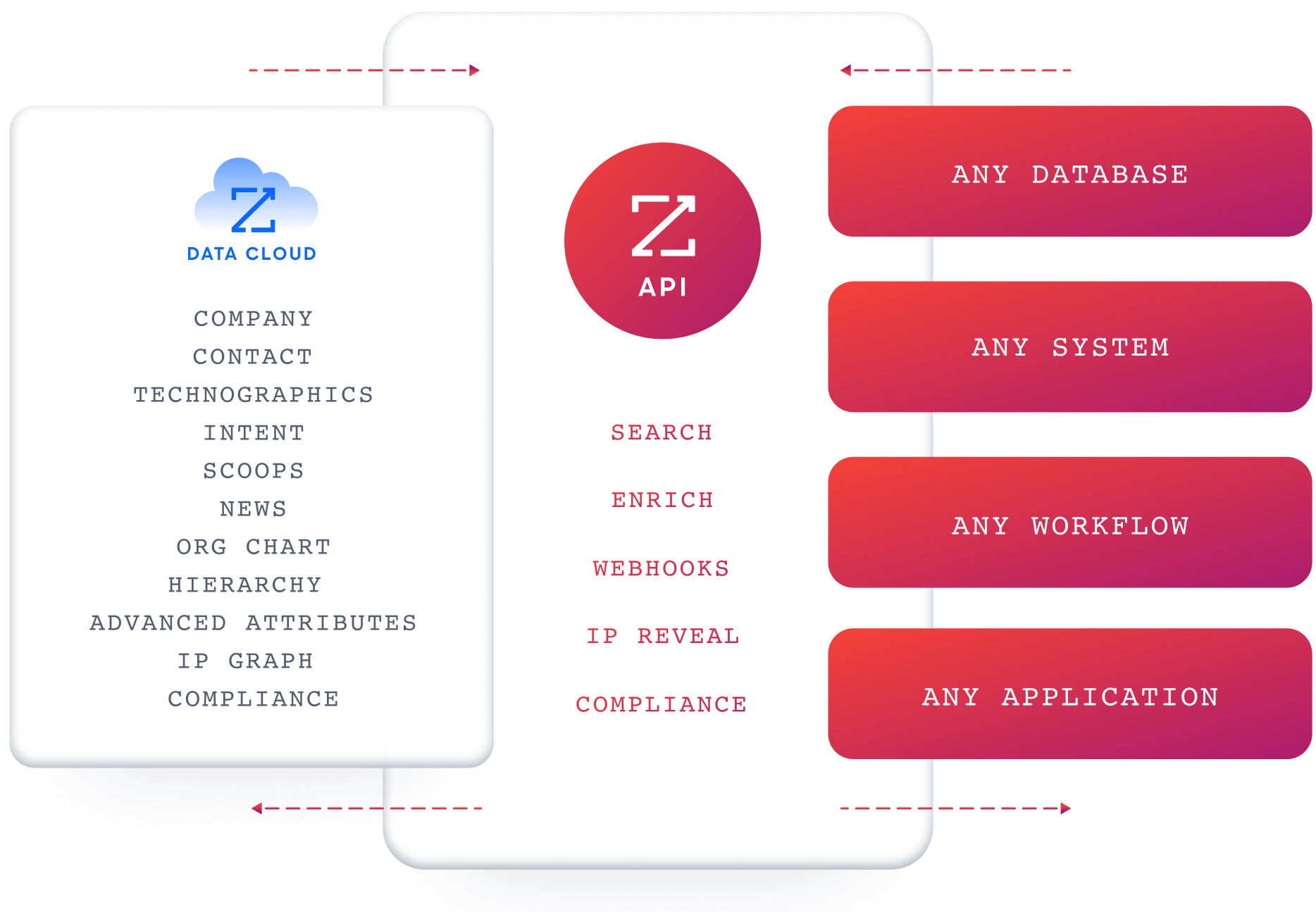
What you would build with this: a prospecting pipeline that searches for contacts matching your ICP, enriches the ones worth pursuing with verified emails and direct dials, then pushes them into your CRM or outreach tool via API.
Authentication & Access
ZoomInfo uses OAuth 2.0 with PKCE via Okta, supporting three flows: Authorization Code with PKCE (web applications), Client Credentials (server-to-server), and Refresh Token (silent token renewal). Access tokens are 24-hour Bearer tokens with rotating refresh tokens.
You register applications through the ZoomInfo Developer Portal, where teams generate credentials, define scopes, and test endpoints.
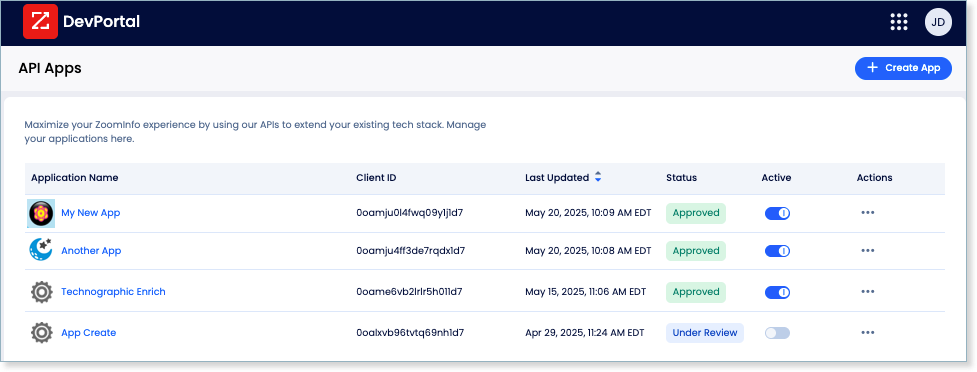
Two app types exist: Custom Applications (auto-approved for internal use) and Partner Applications (requires ZoomInfo review for multi-tenant distribution). The Developer Portal also supports generating bearer tokens directly in the UI for testing without building the full OAuth flow.
This is a different access model from SNAP. ZoomInfo's Developer Portal is open to any customer with an Enterprise API or GTM Workspace package. You can register an app, generate credentials, and test endpoints the same day. SNAP requires a partnership application that LinkedIn is not currently accepting.
Rate Limits, Credits & Webhooks
Rate limits are published by tier: Builder (5 req/sec), Standard (25 req/sec), and Scaling (35 req/sec), with per-hour and per-day sliding-window limits enforced at the same time.
Every response includes quota headers with remaining capacity, and 429 responses include a Retry-After header with exact backoff timing. Rejected requests do not consume quota.
Credits follow a rolling 12-month window: a record enriched for the first time consumes one credit; re-enriching the same record within the year is free. Search and lookup operations are free.
Webhooks are available via Agents API, tied to ZoomInfo's Agent Teams system.
Event types cover bulk enrichment jobs completing, records changing, credit usage crossing thresholds, and new GTM signals (scoops, funding events, intent spikes) becoming available, with retry behavior and throttling configurable per event type. This is the event-driven capability that SNAP does not offer.
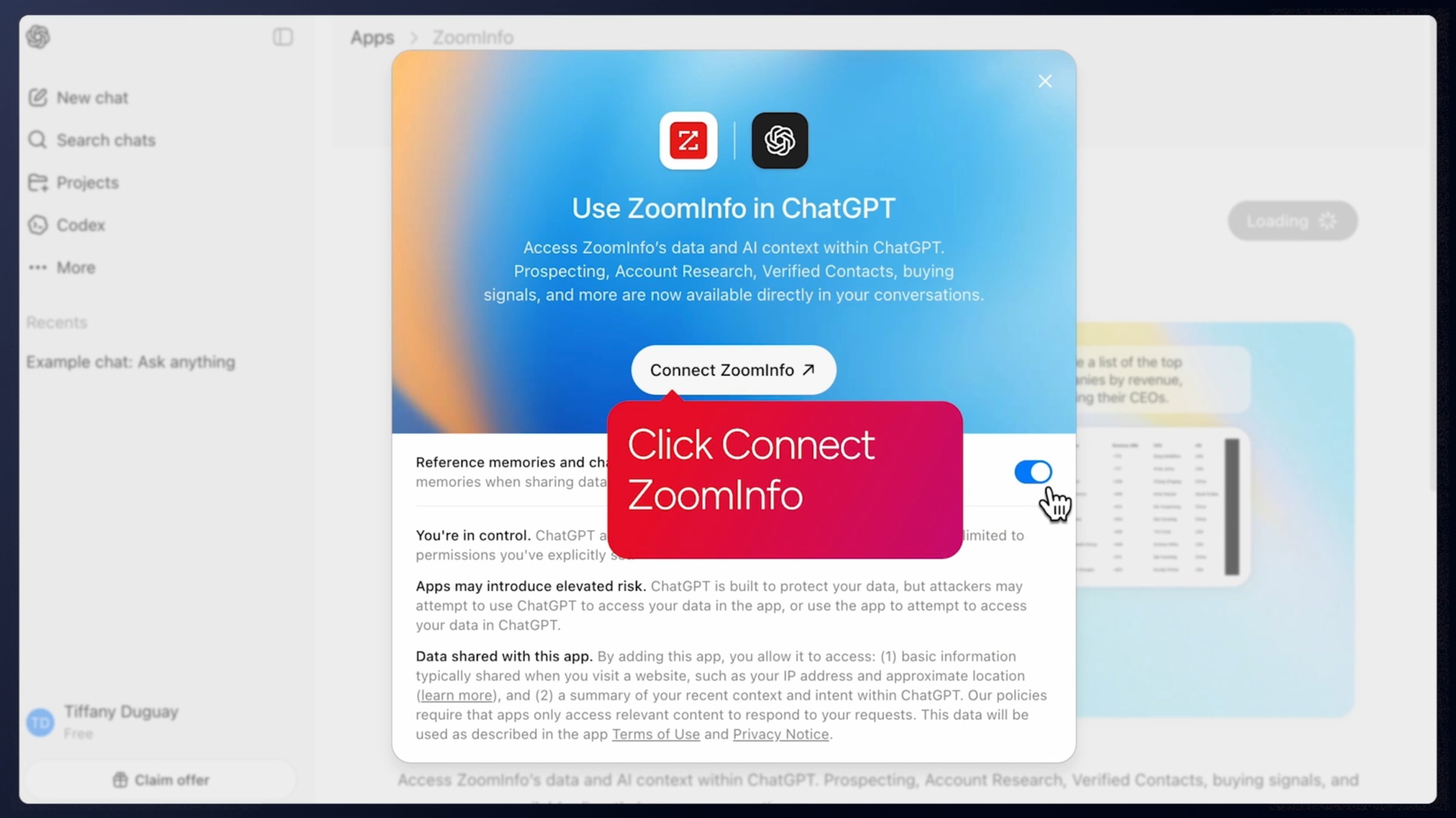
For developers building AI agents, ZoomInfo's MCP server at https://mcp.zoominfo.com/mcp exposes search, enrich, and account research as native tools for MCP-compatible assistants, currently supporting Claude and ChatGPT. Documentation lives at docs.zoominfo.com with an interactive API reference, a Docs MCP server for AI-assisted code generation, and an llms.txt index in OpenAPI format.
Source: ZoomInfo
ZoomInfo does not publish official SDKs either, so both platforms require direct HTTP integration. ZoomInfo uses consumption-based pricing, custom-quoted per customer; API access is included across all relevant plans.
BDO Canada reported an 87% reduction in time spent updating internal data dashboards using the ZoomInfo API, with one analyst describing the integration as plug-and-play across any process. (ZoomInfo)
LinkedIn Sales Navigator API vs. ZoomInfo API
Dimension | LinkedIn Sales Navigator API (SNAP) | ZoomInfo API |
|---|---|---|
API type | REST, JSON (endpoint schemas gated) | REST, JSON:API format (public interactive reference) |
Authentication | OAuth 2.0 (3-legged and 2-legged flows) | OAuth 2.0 with PKCE (Authorization Code, Client Credentials, Refresh Token) |
Access model | Closed SNAP partner program (not accepting new partners) | Open to any customer with Enterprise API or GTM Workspace package |
Primary scope | Embedded UI modules (Display), bulk activity export (Analytics), CRM sync (Sync Services) | Contact/company search, enrichment, AI intelligence, audience management, compliance |
Data access | Partner does not receive raw member data; UI embedding only | Full contact and company records returned for storage and use |
Contact database | Access to 1.3B+ LinkedIn members (through embedded UI, not raw export) | 500M contacts, 100M companies, 135M+ verified phone numbers, 200M+ verified business email addresses |
Intent signals | 180+ buyer intent signals (available in UI, not via API export) | Buyer intent via search and enrichment endpoints, plus GTM signals (scoops, funding, hiring) |
Webhooks | Not documented | Available via Agent Teams API with configurable retry and throttling |
SDKs | JavaScript SDK for Display Services; no server-side SDKs | No official SDKs; code recipes in Shell, Node, Ruby, PHP, Python |
Rate limits | Not publicly documented | 5-35 req/sec by tier, with per-hour and per-day sliding windows; quota headers on every response |
AI endpoints | Not available via API (Account IQ, Lead IQ available in UI only) | Account Summary, Find Similar Companies, Contact Recommendations, Contact Lookalikes |
MCP server | Not available | Available at mcp.zoominfo.com (Claude, ChatGPT) |
Developer portal | Gated behind partner approval | Public portal with self-serve app registration and token generation |
Pricing model | Embedded in Sales Navigator subscription ($119.99-$159.99/month per seat; Advanced Plus custom) | Consumption-based pricing, custom-quoted (search free, enrich consumes credits) |
Best for | ISVs with existing SNAP partnerships building embedded Sales Navigator experiences | Developers building B2B intelligence pipelines with programmatic search, enrichment, and AI |
Final Verdict
LinkedIn Sales Navigator's API (SNAP) offers a sound integration surface for the partners who have access: OAuth 2.0 authentication, embedded UI modules that bring LinkedIn's network data into partner applications, bulk analytics export, and CRM sync with activity writeback.
The data behind it, self-reported by 1.3+ billion members and continuously updated, is structurally unique. No third-party database replicates LinkedIn's first-party professional graph.
But for a developer evaluating an API today, the practical question is access. SNAP is a closed program not accepting new partners, with no public endpoint documentation, no sandbox, no published rate limits, and no timeline for reopening. If you are an existing SNAP partner, the integration surface works. If you are not, there is no path in.
Choose the LinkedIn Sales Navigator API if you are an existing SNAP partner building embedded Sales Navigator experiences into a CRM, sales engagement, or BI platform. The Display Services embedding model, Analytics export, and Advanced Plus CRM sync capabilities suit ISVs that LinkedIn has already approved.
Choose the ZoomInfo API if you need open, self-serve access to a B2B intelligence API today. The public developer portal, interactive API reference, published rate limits, search-then-enrich credit model, AI intelligence endpoints, webhooks, and MCP server give a developer everything needed to evaluate, prototype, and ship an integration without a partnership approval process.
Start with the ZoomInfo Enterprise API or explore the developer docs to see the endpoint surface for yourself.
A developer who needs LinkedIn's first-party network data (member profiles, InMail, TeamLink warm paths, SSI scores) and is not an existing SNAP partner can access it through the pre-built CRM integrations for Salesforce, HubSpot, and Dynamics 365 rather than custom API work.
FAQ
Is the LinkedIn Sales Navigator API free?
There is no standalone API pricing. API access requires an active Sales Navigator subscription per end user (Core at $119.99/month, Advanced at $159.99/month, or Advanced Plus at custom pricing) plus an approved SNAP partnership. There are no per-call charges, credit costs, or metered API fees.
However, the most useful API capabilities (CRM Sync, Embedded Experiences, activity writeback) require the Advanced Plus plan, which starts at 10 seats with custom pricing. The API adds no cost beyond the subscription, but the SNAP partnership program is currently closed to new applicants.
Does LinkedIn Sales Navigator have a REST API?
Yes. LinkedIn describes the SNAP APIs as RESTful throughout its developer documentation, with JSON responses and OAuth 2.0 authentication. There is no GraphQL endpoint.
However, the detailed REST endpoint reference (paths, schemas, payloads) is gated behind partner approval. The public documentation describes capabilities at the service level (Display, Analytics, Sync) without exposing the specific endpoint surface.
What is the LinkedIn Sales Navigator API rate limit?
Specific rate-limit figures are not published in any public documentation. Rate limits are disclosed only within partner agreements and the gated developer portal.
Public sources confirm that API access is scoped to Licensed Seat Holders, that Analytics Services uses a bulk export model implying periodic access, and that LinkedIn's broader API Terms of Use prohibit scraping and unauthorized bulk extraction. No per-second, per-hour, or per-day rate-limit tiers, quota headers, or retry semantics are documented publicly.
Are there official LinkedIn Sales Navigator SDKs?
LinkedIn provides a JavaScript SDK as part of Display Services for client-side embedding of Sales Navigator UI modules. There are no official server-side SDKs in any language for SNAP APIs.
LinkedIn references third-party open-source OAuth 2.0 libraries for authentication and provides a Java sample application for testing OAuth flows, but does not maintain SDK packages for the SNAP API surface itself. Developers integrate using raw REST calls with standard OAuth 2.0 libraries.
Does the LinkedIn Sales Navigator API support webhooks?
No webhook capability is documented in any public LinkedIn Sales Navigator source. The Analytics Services bulk export is a pull-based API (periodic batch requests). Sales Navigator surfaces real-time signals in its UI (job changes, buyer intent, engagement activity), but there is no documented way to receive these events through the API. For event-driven workflows, you would need to poll the Analytics export or rely on CRM Sync (Advanced Plus only) to surface changes through your CRM's own notification system.
What does ZoomInfo's API offer that LinkedIn Sales Navigator's does not?
ZoomInfo's API offers open, self-serve access that SNAP does not: a public developer portal with self-serve app registration, an interactive API reference with endpoint-level documentation, published rate limits (5-35 req/sec by tier with quota headers on every response), and webhooks via the Agent Teams API.
ZoomInfo's API returns raw contact and company data (emails, direct dials, employment history, org charts, technographics) that you can store and use in your own systems, while SNAP's Display Services embed LinkedIn UI modules without exposing raw member data to the partner.
ZoomInfo also exposes AI intelligence endpoints (Account Summary, Find Similar Companies, Contact Recommendations) and an MCP server for AI-agent workflows, neither of which has an equivalent in SNAP.
The two APIs cover different data: LinkedIn has first-party member-generated professional profiles; ZoomInfo has multi-source verified B2B intelligence across 500M contacts and 100M companies with 135M+ verified phone numbers and 200M+ verified business email addresses.
Other tools worth evaluating side by side:
