

PitchBook sits on one of the largest private capital market datasets in the world: nearly 6 million companies, 2.7 million investments, 570,000 investors, and 4.4 million people profiles, updated six times a day by a research team of 1,800+. For a developer who wants that data inside a pipeline, the question is whether the API gives you real programmatic access or whether the platform keeps the data behind its own walls.
The answer is complicated. PitchBook does offer a RESTful JSON API covering all of its core entity types, but the API is an enterprise add-on that requires a separate contract on top of an existing platform subscription. The developer documentation is not publicly accessible. There are no published rate limits, no public endpoint reference, no official SDKs, and no self-serve signup. For a developer evaluating what they can build, that opacity is itself the first finding.
PitchBook's API covers private capital market data: companies, investors, deals, funds, people, limited partners, and service providers. It delivers near-real-time updates suited for CRM enrichment and deal monitoring within a configured entity universe. If your build needs B2B contact intelligence, verified business emails, direct-dial phone numbers, org charts, technographics, buyer intent signals, or AI-powered account research, that is a different data layer that PitchBook's API does not cover.
This is where ZoomInfo enters the picture. Its Enterprise API spans search, enrichment, AI intelligence, and audience management across 500M contacts and 100M companies, with OAuth 2.0 authentication, published rate limits, an interactive API reference, and an MCP server for AI-agent workflows.
This review covers the PitchBook API in full technical depth first, then reviews ZoomInfo's API as the B2B intelligence layer that covers the ground PitchBook's API was never designed to reach.
PitchBook API at a Glance
Attribute | Detail |
|---|---|
API type | REST over HTTPS, JSON responses |
Authentication | API key or token-based (specific mechanism not publicly documented) |
Base URL | Not publicly documented |
Rate limits | Not publicly documented |
Pricing / access | Enterprise add-on requiring a separate contract on top of a PitchBook platform subscription; quote-only |
SDKs | None |
Webhooks | Not supported |
Documentation | Behind platform authentication; not publicly accessible. Help page overview available |
PitchBook API: What Works Well & What to Plan Around
What works well | What to plan around |
|---|---|
Covers all core entity types: companies, investors, deals, funds, people, LPs, service providers | API access requires a separate enterprise contract on top of a platform subscription |
Relational endpoint structure lets you retrieve only the fields you need | Developer documentation is not publicly accessible; visible only to contracted clients |
Sandbox environment available for pre-production testing | No published rate limits, endpoint reference, or OpenAPI spec |
Near-real-time updates suited for CRM enrichment | No official SDKs in any language |
Includes AI-powered VC Exit Predictor data | No webhook support; event-driven patterns require polling |
Configurable entity universe scopes queries to your tracked entities | Scoped to private capital market data only; no B2B contact enrichment, intent signals, or technographics |
PitchBook API: Authentication & Getting Started
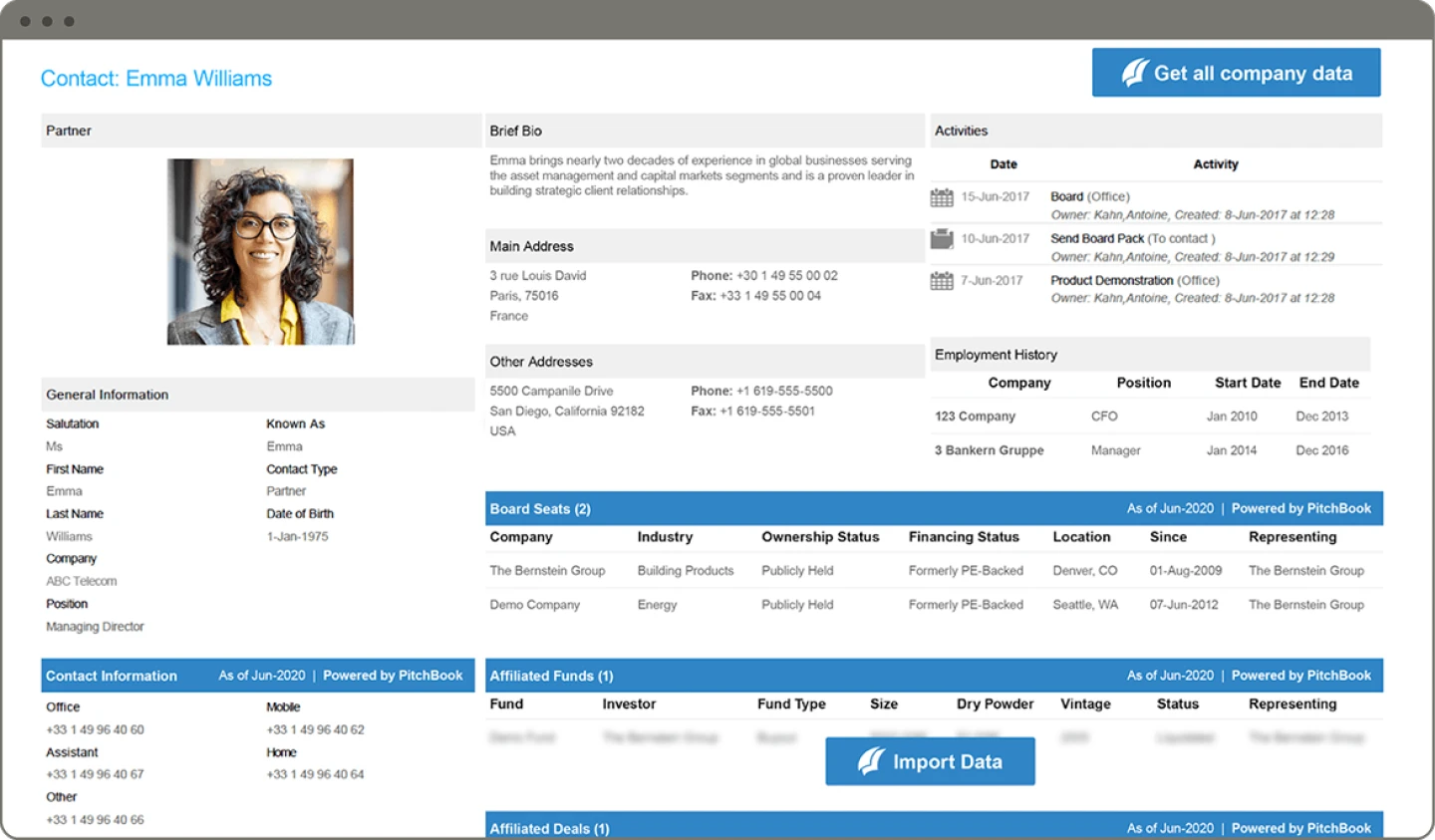
Getting API access is not a self-serve process. The API belongs to PitchBook's Direct Data product line, and access requires a standalone contract separate from a standard platform subscription. There is no developer portal, no API key generator in the dashboard, and no free-trial API access.
Source: PitchBook
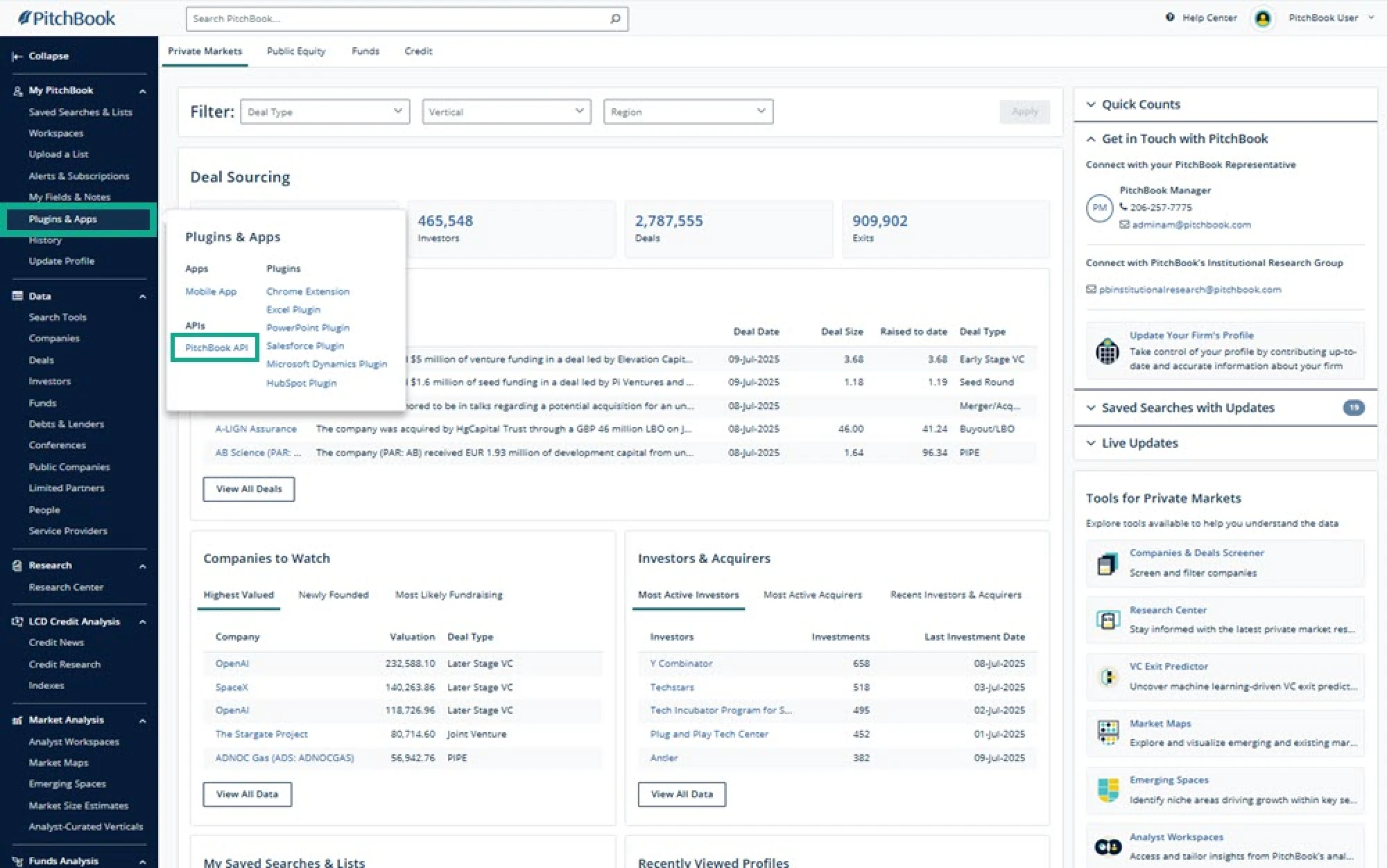
Existing PitchBook platform customers start in the Plugins & Apps section of the Platform sidebar. New customers contact the Direct Data team directly. PitchBook's Direct Data team provisions credentials once a contract is signed.
Source: PitchBook
The API uses API key or token-based authentication. Beyond that description, the specifics are not published publicly. Credential placement (header vs. query parameter), token-expiry or refresh flows, and whether the system supports multiple keys are details visible only to contracted clients.
SSO (SAML 2.0 with Okta, Microsoft Entra, and OneLogin) is available for the PitchBook platform and the Microsoft Premium Connector, but not for the Direct Data API itself.
PitchBook can provision a sandbox environment on request, giving developers a space to test API calls and integrations before going live. The Direct Data team provides onboarding support during this phase.
PitchBook API: Core Endpoints & Capabilities
The API surfaces all of PitchBook's core entity types: companies, investors, deals, funds, people, limited partners, and service providers. Each entity's data spans several relational endpoints, so callers can retrieve only the fields relevant to their integration rather than pulling full entity payloads.
Companies and Deals
The company and deal endpoints expose the core of PitchBook's dataset. Developers can access financing details, deal stock information, and company attributes across nearly 6 million companies and 2.7 million investments. The data spans VC, PE, M&A, private credit, and more.
What you would build with this: a CRM enrichment pipeline that pulls financing history, valuation data, and investor relationships for portfolio companies or M&A targets, keeping your deal database current without manual research.
Investors, Funds, and Limited Partners
Endpoints cover 570,000 investors, 147,000 funds, and 56,000 limited partners. Fund data includes performance metrics. LP profiles include commitment history and mandate breakdowns.
What you would build with this: a fundraising intelligence system that tracks LP allocation preferences, commitment patterns, and fund performance benchmarks, feeding that data into your deal management platform.
People and Service Providers
The people endpoint covers 4.4 million professionals in the private capital ecosystem: executives, board members, advisors, and investment professionals. Service provider data covers law firms, accounting firms, and other deal advisors.
AI-Powered Data: VC Exit Predictor
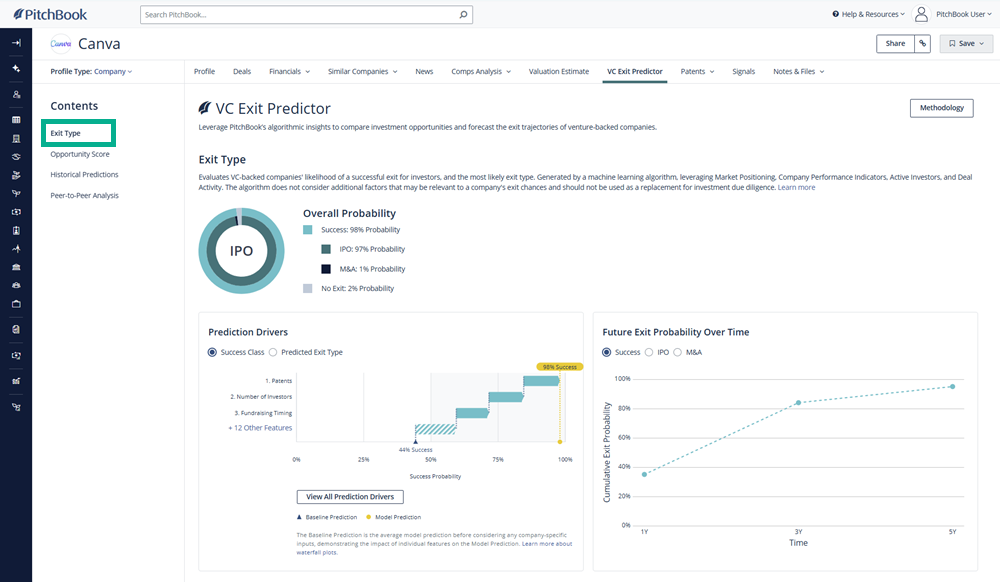
The API includes access to PitchBook's VC Exit Predictor, a machine learning model that predicts exit probability for VC-backed companies.
Source: PitchBook
The model is reportedly 75% accurate, with top-decile companies 3.1x more likely to exit. This is a notable capability for developers building quantitative deal-sourcing tools.
Configurable Universe and Data Delivery
Developers define a configurable universe, a scoped subset of entities they want to track, filtered by criteria such as location and industry. The API delivers near-real-time updates within that universe, making it suited for monitoring rather than exhaustive database crawling.
For bulk extraction or large-scale delivery, PitchBook directs developers to its Data Feed product.
Source: PitchBook
The Data Feed delivers scheduled file batches (.dat, .csv, or Parquet) to Azure, Snowflake, AWS, and other cloud destinations on a daily, weekly, monthly, or quarterly cadence. The API and Data Feed are complementary: the API handles on-demand queries, the Data Feed handles bulk delivery.
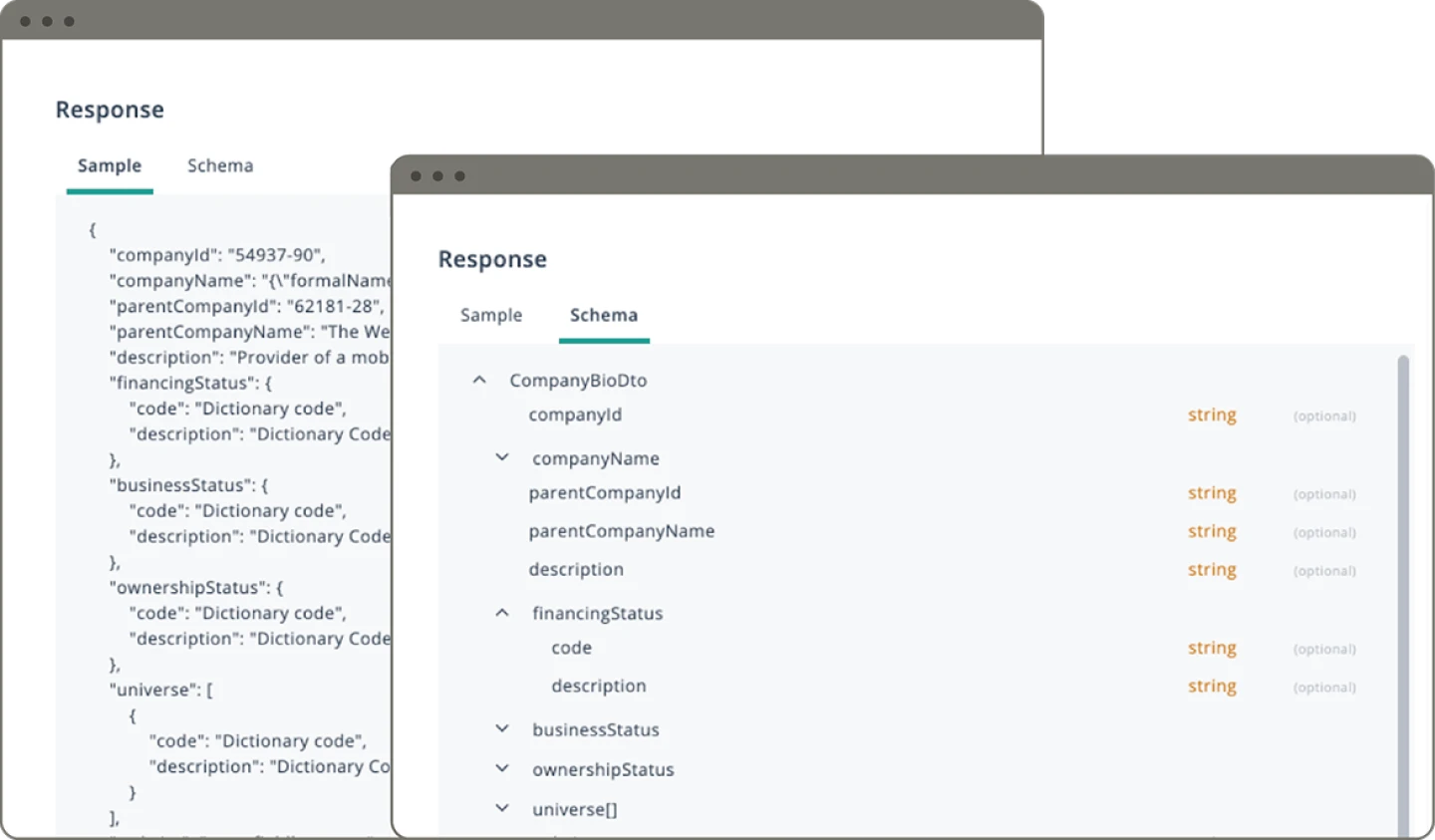
PitchBook publishes an API Endpoints Overview document for contracted clients, but no public OpenAPI spec, Swagger reference, or unauthenticated endpoint list exists. A developer evaluating the API before signing a contract cannot inspect the endpoint surface, request shapes, or response schemas independently.
PitchBook API: SDKs, Docs, Rate Limits & Pricing
SDKs & Libraries
PitchBook does not publish official SDKs or client libraries in any language. The API works with any HTTP client, with no preferred language ecosystem. No community-maintained libraries appear on PitchBook's product or help pages.
Without SDKs, you own the full integration layer: authentication, request serialization, error handling, pagination, and retry logic. That is manageable for a simple enrichment pipeline but adds engineering overhead for a production system making frequent calls across multiple entity types.
Documentation & Developer Experience
PitchBook's developer documentation is not publicly accessible.
The API guide and Endpoints Overview document sit behind platform authentication and are visible only to contracted clients. There is no interactive API explorer (Swagger UI, Redoc, or Postman collection), no public changelog, and no versioning page in any publicly accessible material.
Developer support routes through the assigned account team and Direct Data specialists. There is no public developer forum, community channel, or self-serve support path.
A sandbox environment is available for pre-production testing, and PitchBook's Direct Data team handles onboarding. This hands-on approach may suit enterprise buyers who expect guided integration support, but it creates a real evaluation barrier for developers who want to inspect and test an API before committing to a contract.
Rate Limits & Constraints
PitchBook does not publish rate limits, burst quotas, or call-volume caps in any public documentation. Constraints are set per contract with the Direct Data team. The API is described as suited for a "limited sample of entities" with near-real-time refresh needs, which suggests it is designed for targeted, scoped queries rather than high-volume data pulls.
For large-volume use cases, PitchBook steers developers to the Data Feed, which delivers bulk data over SFTP, AWS S3, Azure, or a specified cloud service.
Pricing & Access Costs
PitchBook does not publish API or Data Feed pricing. Both are premium add-ons to the core platform subscription, and each requires a separate contract. The base PitchBook platform is required before Direct Data can be contracted, which means API access requires at minimum two separate agreements: the platform subscription and the Direct Data contract.
Cost varies by seat count and firm type; all Direct Data pricing is quote-only and negotiated through PitchBook's Direct Data team. No per-call metering, credit-pack costs, or minimum plan tiers appear anywhere on the public site. The platform subscription uses per-user or enterprise-based pricing with license agreements typically ranging from one to three years.
For a developer sizing costs: the total price of building on PitchBook's API includes the platform subscription (undisclosed, enterprise-level), the Direct Data contract (undisclosed, quote-only), and integration engineering costs. There is no free tier, no trial API access, and no way to estimate costs without engaging sales.
Where the PitchBook API Falls Short
These are the practical limits a developer should plan around. Several reflect deliberate scope decisions rather than oversights.
The developer documentation is completely private. No public endpoint reference, no OpenAPI spec, no interactive explorer, no code examples. A developer cannot evaluate the API's capabilities, request shapes, or response schemas without first signing a contract. Most data APIs in this category publish their reference docs publicly, letting developers assess fit before committing.
No published rate limits or usage constraints. Rate limits, if they exist, are negotiated per contract. A developer building a pipeline cannot plan capacity, design retry logic, or estimate throughput without information that arrives only after the commercial agreement is signed.
No official SDKs. Every integration is raw HTTP, with no maintained client library in any language. Combined with private documentation, this means a developer starts cold compared to APIs that provide SDK wrappers and public reference docs.
No webhook support. There is no push-notification or event-driven delivery pattern. Developers who need real-time updates must poll the API directly. The Data Feed offers scheduled delivery, but on a daily-to-quarterly cadence, not event-driven.
Scoped to private capital market data only. The API covers companies, deals, investors, funds, people, and LPs within the private capital ecosystem. It does not provide B2B contact enrichment (verified business emails, direct-dial phone numbers), buyer intent signals, technographic data, or org chart intelligence. If your build spans both private market intelligence and B2B contact/company intelligence, PitchBook's API covers only one side.
Enterprise-only access with layered contracts. API access requires a platform subscription plus a separate Direct Data contract, both quote-only. There is no self-serve path, no free trial for the API, and no way to test the integration before committing commercially.
No iPaaS integrations. No Zapier, Make, Workato, or comparable automation platform connectors. Workflow automation beyond the API and Data Feed requires custom engineering.
ZoomInfo API: The B2B Intelligence Layer PitchBook Does Not Cover
PitchBook's API delivers private capital market data: who invested in what, at what valuation, in which fund. ZoomInfo's API delivers B2B go-to-market intelligence: who works at a company, how to reach them, what technology they use, whether they are researching your category, and where they sit in the org chart.
The two APIs serve different layers of an enterprise data stack. A developer building a deal-sourcing platform might use PitchBook's API for investment data and ZoomInfo's API for the contact intelligence that turns a deal target into an actionable outreach list.
What the API Covers
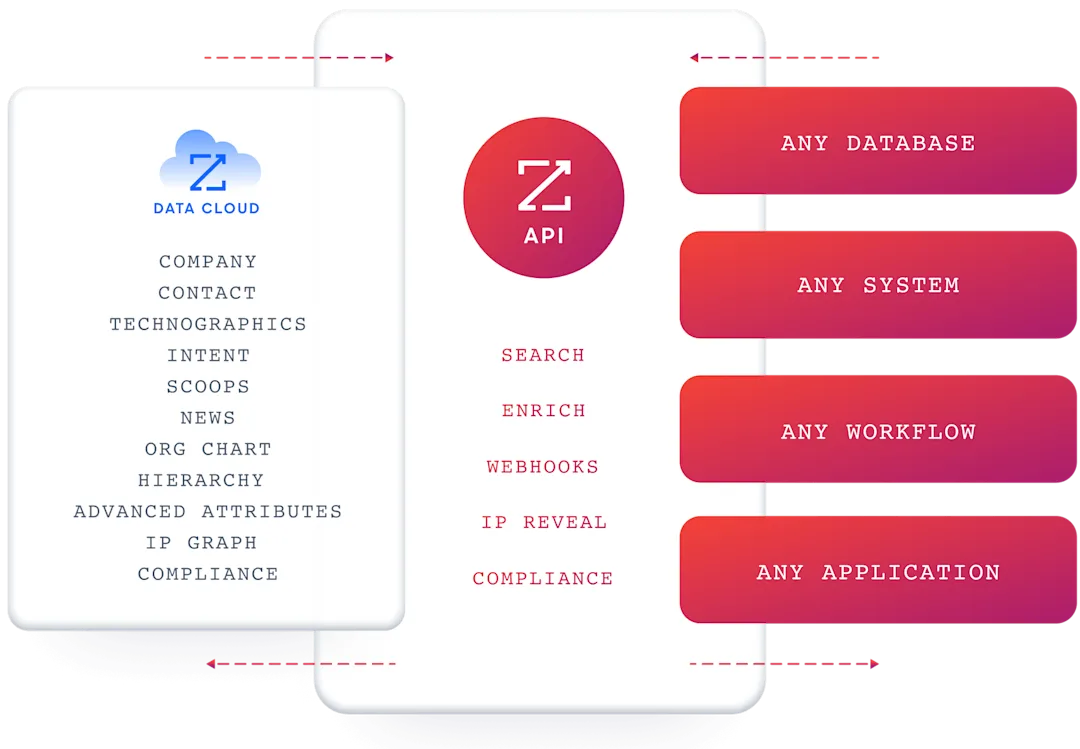
ZoomInfo's Enterprise API is a REST suite served from https://api.zoominfo.com/gtm, organized into four areas documented in the interactive API reference:
Data API (Search & Enrich): Search endpoints cover Contacts, Companies, Intent, News, and Scoops, returning matched records without consuming credits. Enrich endpoints unlock full payloads: business emails, direct dials, employment history, corporate hierarchy, org charts, technographics, and hashtag signals (up to 25 records per call).
The underlying dataset spans 500M contacts, 100M companies, 135M+ verified phone numbers, and 200M+ verified business email addresses. The search-then-enrich pattern means you filter freely, then pay only for the records you commit to.
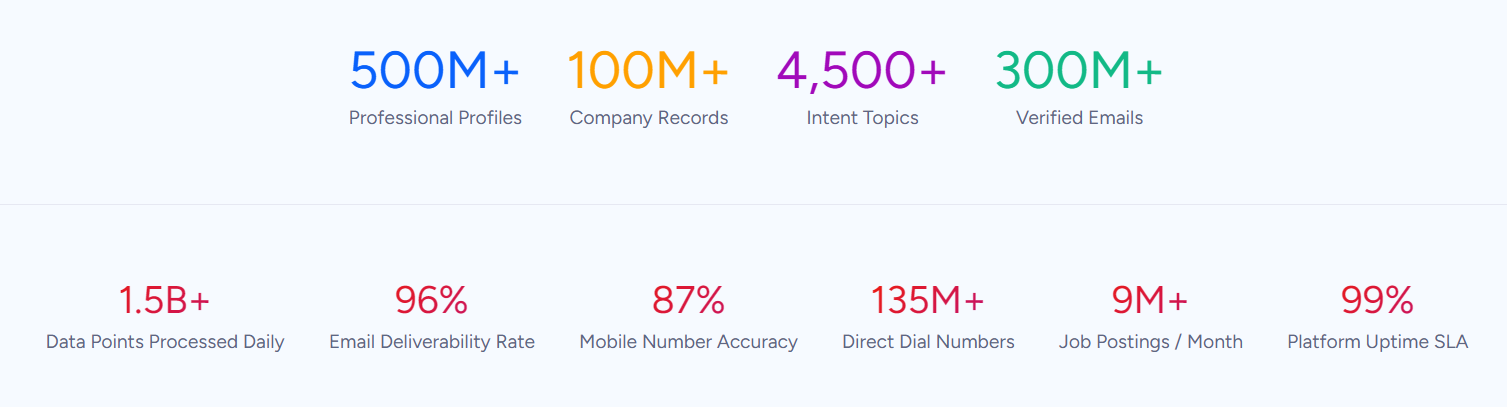
Copilot API (AI Intelligence): Powered by the GTM Context Graph (which processes 1.5B+ data points daily), this surface exposes Account Summary for structured account intelligence with a free-form Q&A endpoint, Find Similar Companies for lookalike expansion, and Contact Recommendations for AI-ranked buying-committee suggestions by motion (prospecting, deal acceleration, renewals).
Marketing API: CRUD endpoints for programmatic audience management.
Platform API (Engagements, Beta): Bidirectional engagement data via the Engagements API.
For a developer working with PitchBook's deal data, the pairing is direct: use PitchBook's API to identify investment targets, then use ZoomInfo's API to find the right contacts at those companies, verify their email addresses, check their org chart position, and detect whether the account shows buyer intent.
Authentication & Access
ZoomInfo uses OAuth 2.0 with PKCE via Okta, supporting three flows: Authorization Code with PKCE (web applications), Client Credentials (server-to-server), and Refresh Token. Access tokens are 24-hour Bearer tokens with rotating refresh tokens.
Teams register applications through the ZoomInfo Developer Portal, where they generate credentials, define scopes, and test endpoints.
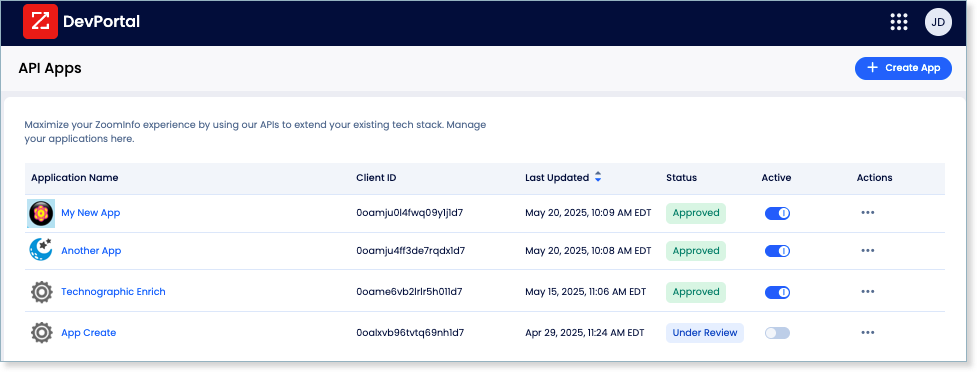
This is a more mature authentication model than static API key auth: it supports delegated access, credential rotation, and scoped permissions. For multi-tenant integrations or enterprise security requirements, OAuth 2.0 is the expected standard.
Rate Limits, Credits & Developer Experience
Rate limits are published by tier: Builder (5 req/sec), Standard (25 req/sec), and Scaling (35 req/sec), with per-hour and per-day sliding-window limits enforced simultaneously. Every response includes quota headers with remaining capacity, and 429 responses include a Retry-After header with exact backoff timing. A developer can plan capacity before writing a line of code.
Credits follow a rolling 12-month window: enriching a record for the first time consumes one credit; re-enriching the same record within the year is free. Search and lookup operations do not consume credits.
For developers building AI agents, ZoomInfo's MCP server at https://mcp.zoominfo.com/mcp exposes search, enrich, and account research as native tools for MCP-compatible assistants, currently supporting Claude and ChatGPT. A separate Docs MCP server lets AI development tools generate integration code against the API spec.
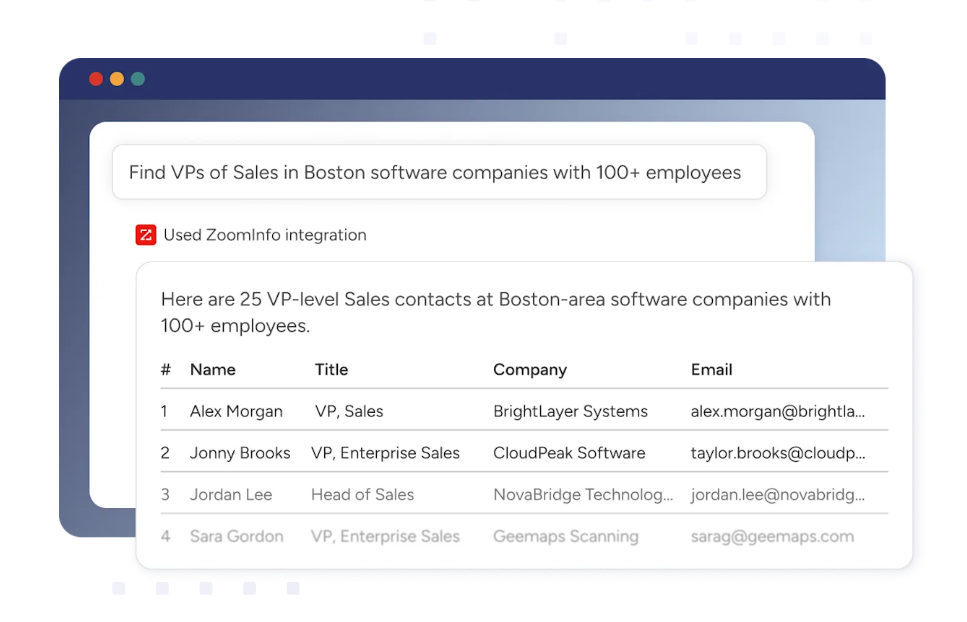
Documentation lives at docs.zoominfo.com with an interactive API reference, OAuth recipes in five languages, and an llms.txt index for AI development tools. ZoomInfo does not publish official SDKs either, so both platforms require direct HTTP integration. ZoomInfo uses consumption-based pricing with API access included across all plans.
Webhooks & Events
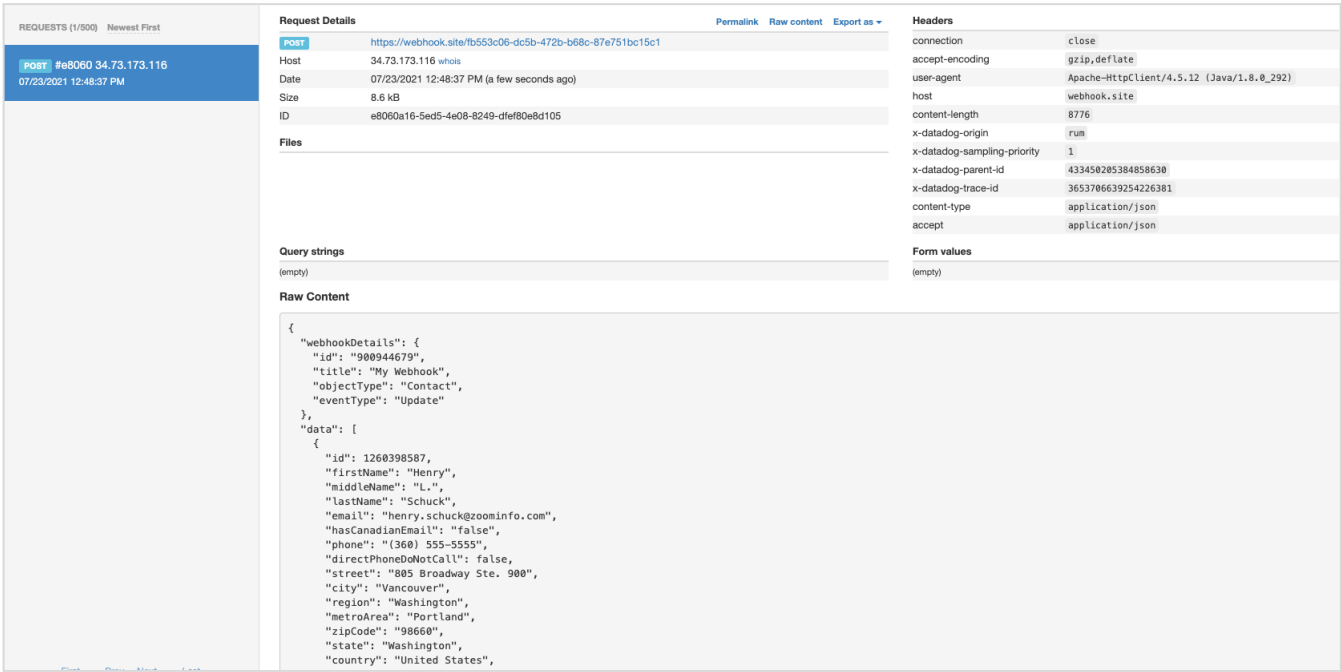
Webhooks are available via the Agents API, tied to ZoomInfo's Agent Teams system. Event types cover bulk enrichment jobs completing, records changing, credit usage crossing thresholds, and new GTM signals (scoops, funding events, intent spikes) becoming available. Retry behavior and throttling are configurable per event type.
BDO Canada reported an 87% reduction in time spent updating internal data dashboards using the ZoomInfo API, with one analyst describing the integration as plug-and-play across any process. (ZoomInfo)
Final Verdict
PitchBook's API provides programmatic access to one of the most thorough private capital market datasets available: companies, deals, investors, funds, LPs, and people across VC, PE, M&A, and credit. The data is research-backed and updated six times daily. For a developer building within private market intelligence (deal sourcing, fund benchmarking, CRM enrichment with investment data), the API delivers a dataset that few competitors match.
The challenge is everything around the data. The developer experience is opaque from the outside: no public docs, no published rate limits, no SDKs, no self-serve access, and no way to evaluate the API without a sales conversation and a separate contract. Enterprise buyers with dedicated integration teams and existing PitchBook relationships may find this acceptable. A developer evaluating multiple APIs against a build specification faces weeks of commercial process before writing a first authenticated request.
Choose the PitchBook API if you are building within the private capital markets: deal monitoring, portfolio enrichment, fund performance tracking, LP intelligence, or M&A pipeline automation. The dataset covers private market entities thoroughly, and the VC Exit Predictor adds a quantitative layer most financial data APIs do not offer.
Choose the ZoomInfo API if your build needs B2B contact and company intelligence: verified emails, direct-dial phone numbers, org charts, technographics, buyer intent signals, or AI-powered account research. The public documentation, published rate limits, OAuth 2.0 authentication, and interactive API reference let you evaluate and prototype before committing commercially, and the MCP server extends the same data to AI-agent workflows. Start with the ZoomInfo developer docs or explore the Enterprise API to see the endpoint surface directly.
A developer who needs both should note that PitchBook covers private capital market data and ZoomInfo covers B2B go-to-market intelligence. If your pipeline spans both (identifying investment targets by deal data, then reaching decision-makers at those companies with verified contact information), the two APIs are complementary layers, not competing surfaces.
FAQ
Is the PitchBook API free?
No. The PitchBook API requires a paid platform subscription plus a separate Direct Data contract, both negotiated through PitchBook's sales team. There is no free tier, no free trial for API access, and no self-serve purchasing path. Pricing is quote-only and varies by firm type, seat count, and data volume requirements. PitchBook offers a free trial of the platform itself, but API access is not included.
Does PitchBook have a GraphQL API?
No. PitchBook offers a RESTful JSON API. No GraphQL endpoint appears in any publicly available material. If you need a GraphQL interface for PitchBook data, you would need to build a wrapper layer on top of the REST API.
What is the PitchBook API rate limit?
PitchBook does not publish rate limits in any publicly accessible documentation. Constraints are reportedly set per contract with the Direct Data team. The API is described as suited for a "limited sample of entities" with near-real-time refresh needs, suggesting it is designed for targeted queries within a configured universe rather than high-volume data extraction. For bulk workloads, PitchBook directs developers to its Data Feed product, which delivers scheduled file batches via SFTP, AWS S3, Azure, or other cloud destinations.
Are there official PitchBook SDKs?
No. PitchBook does not publish official SDKs or client libraries in any programming language. The API works with any HTTP client. No community-maintained libraries appear on PitchBook's product pages. Developers integrate directly over HTTP and own the full authentication, error handling, and retry layer.
Does the PitchBook API support webhooks?
No. PitchBook does not document webhook support in any publicly accessible material. There is no push-notification or event-driven delivery pattern. Developers who need scheduled data delivery can use the Data Feed product, which delivers files on a customer-specified cadence (daily, weekly, monthly, or quarterly). Real-time monitoring requires polling the API directly.
What does ZoomInfo's API add to a PitchBook build?
ZoomInfo's API covers the B2B intelligence layer that PitchBook's API does not: verified business emails, direct-dial phone numbers, org charts, corporate hierarchies, technographics, buyer intent signals, and AI-powered account research across 500M contacts and 100M companies. Where PitchBook tells you a company raised a Series C at a specific valuation with specific investors, ZoomInfo tells you who the VP of Engineering is, what their direct phone number is, what technology stack the company runs, and whether the account is researching your product category. The two APIs use different authentication models (token-based vs. OAuth 2.0) and different access models (contract-gated vs. developer portal with published docs), so plan the integration layer to handle both. ZoomInfo's MCP server extends the same B2B intelligence to AI-agent workflows, adding programmatic access to account research and contact recommendations that PitchBook's API does not offer.
Other tools worth evaluating side by side:
