
If your team outgrew Lusha because:
The credit model got expensive
Database coverage fell short on your target accounts
You kept hitting a wall with Chrome extension dependency
You are not alone. Those are the three most common reasons GTM teams start evaluating Lusha alternatives.
Below we evaluate against options other than Lusha, using three criteria the sales development evaluation mindset weights most heavily: data accuracy and verification depth, platform breadth versus point-tool limitations, and buying signal and intent intelligence. Each entry includes pricing, G2 rating, pros, cons, and a Best for tag so you can self-segment quickly.
1. ZoomInfo
ZoomInfo is an all-in-one AI GTM Platform. That is not a marketing label. It means three structurally distinct things that pure contact-lookup tools cannot match.
The first is data: 500 million contacts, 135 million+ verified phone numbers, 200 million+ verified business emails, 95%+ first-party accuracy backed by 300+ human researchers and a multi-source verification engine. The scale and verification depth are not incremental improvements over Lusha. They are a different category of infrastructure.
The second is the GTM Context Graph, ZoomInfo's intelligence and reasoning layer. It processes 1.5 billion+ data points daily, fusing ZoomInfo's B2B data with customer CRM data, conversation intelligence from Chorus, and behavioral signals into a unified reasoning layer that captures not just what happened in an account, but why deals move. When you understand that your champion just changed jobs, that the account just posted five new RevOps roles, and that three of their competitors signed new deals last quarter, you are operating on intelligence, not data.
The final is universal access: three lanes into the same data and intelligence:
GTM.AI, ZoomInfo's headless layer gives developers and AI agents programmatic access via API or MCP
Integrations through ZoomInfo's partners to enrich and access high-quality data in your own systems
Traditionally, through the ZoomInfo UI
Seismic's BDR and outside sales teams saw 54% productivity gains and saved an average of 11.5 hours per week after deploying ZoomInfo's AI agents in GTM Workspace and intent intelligence tools. Ascent Risk Management Group saw a 175% increase in pipeline and finished at 173% of revenue goal after deploying ZoomInfo's contact data and workflow tools.
Best for: Enterprise and scaling GTM teams that need verified contact data, buying signals, conversation intelligence, and workflow automation in one platform.
Key features:
500M contacts, 135M+ verified phone numbers, 200M+ verified business emails
GTM Context Graph: 1.5B+ data points daily, unified reasoning across data, CRM, and behavioral signals
GTM Workspace with AI agents for prospecting, meeting prep, and outreach
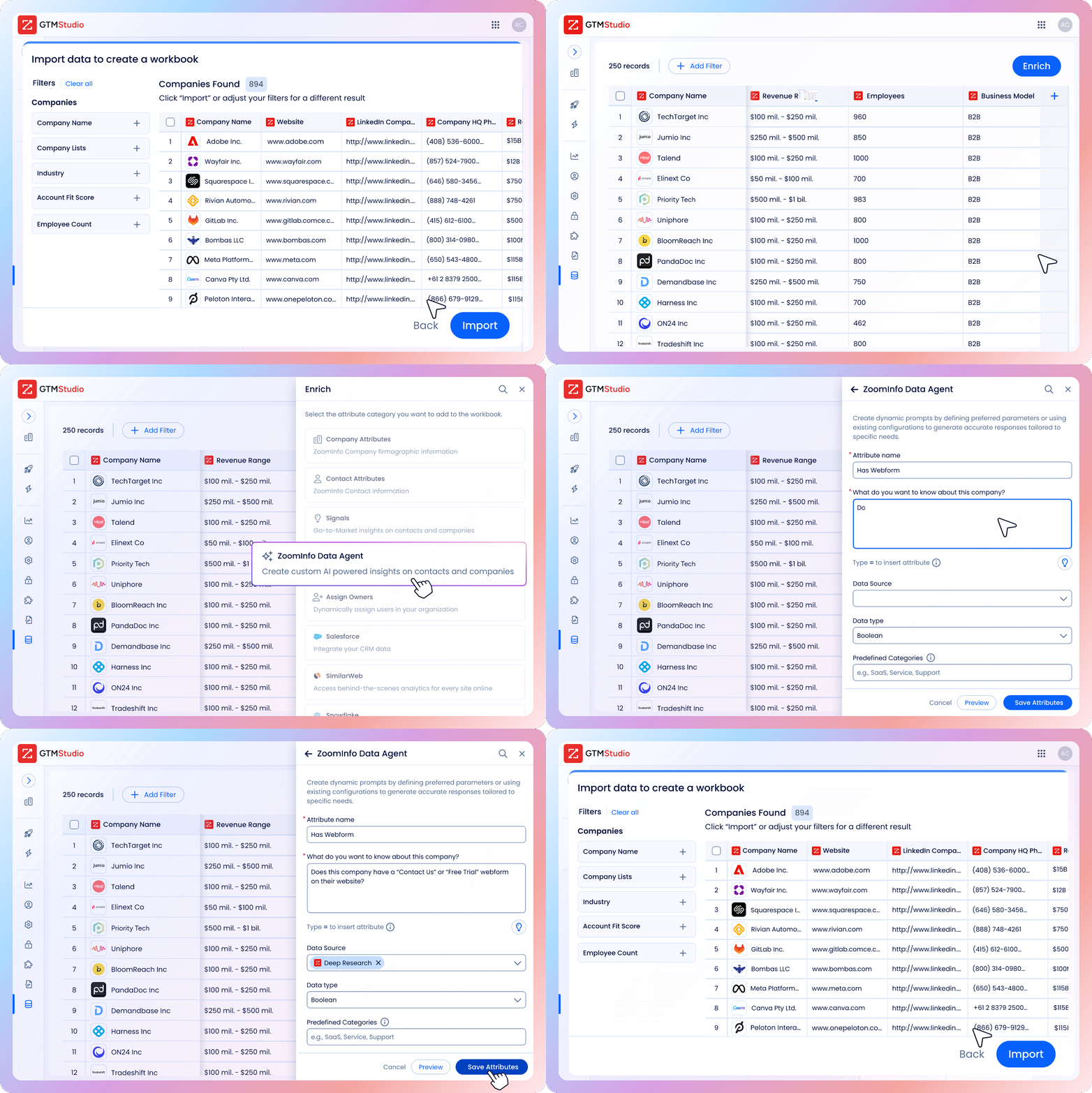
GTM Studio for marketing, RevOps, and GTM engineers
APIs and MCP server for AI agent workflows and programmatic access
Buyer intent signals, Scoops, job change alerts, and hiring pattern tracking
Chorus conversation intelligence
Native Salesforce, HubSpot, Outreach, and Salesloft integrations
Pricing: Free to start with consumption credits based on usage.
Pros:
Largest verified B2B database (500M contacts, 135M+ verified phones)
GTM Context Graph reasoning layer, not just data lookup
Universal Access: APIs, MCP server, Workspace, and Studio cover every buyer persona in your GTM team
Proven customer outcomes at enterprise scale
Cons:
Consumption-based pricing requires a sales conversation to accurately size for your team's volume
More platform than a solo prospector needs, which is a mismatch for individual contributors doing occasional lookups
See how ZoomInfo compares to Lusha directly
2. Apollo
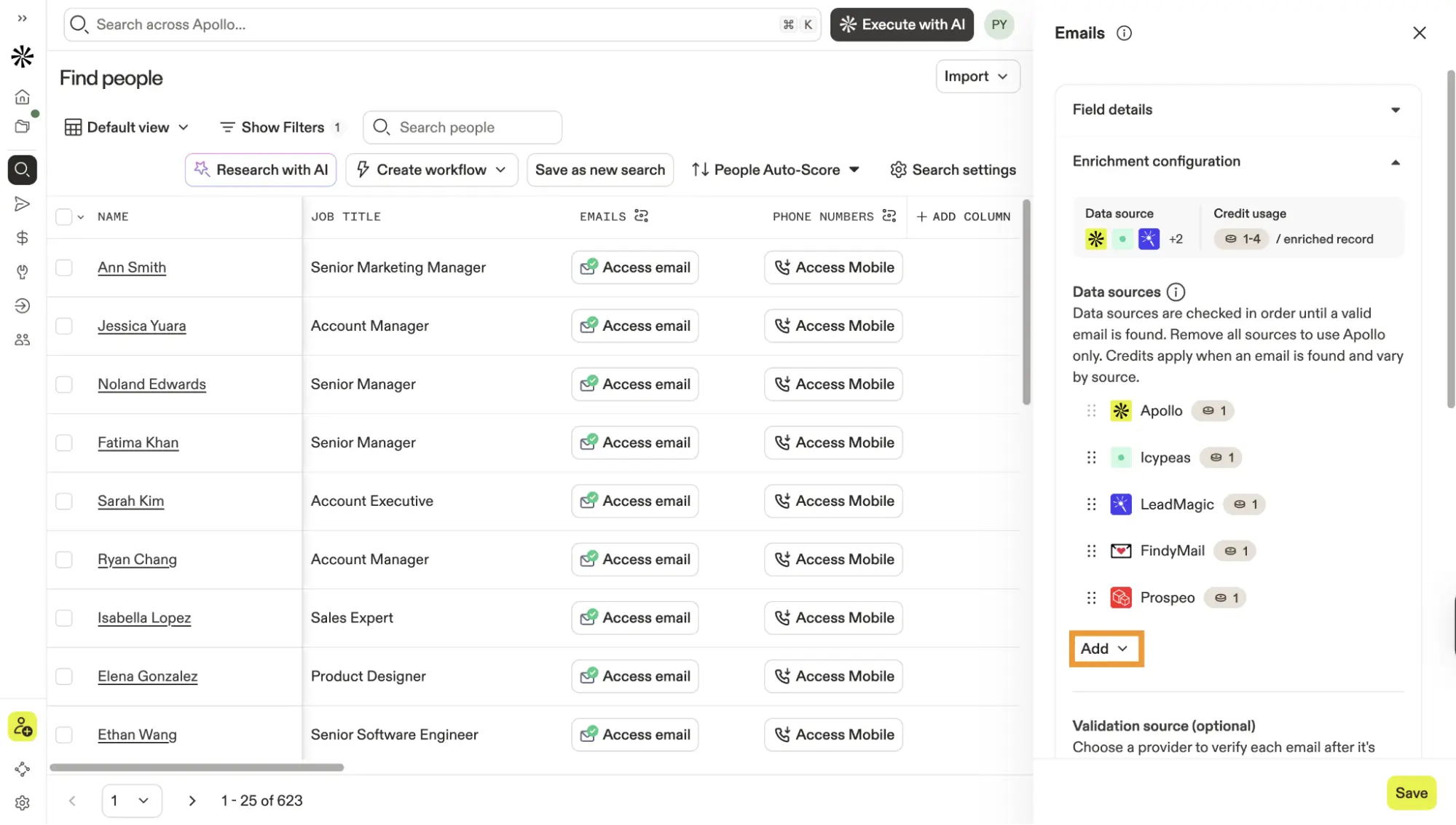
Apollo is positioned against Lusha as a stack consolidator. The pitch: why manage a separate database, sequencer, dialer, and conversation intelligence tool when one platform handles all of it?
Apollo's database covers 230M+ contacts, and the platform includes email sequencing, an AI-powered outreach writer, call recording, and a dialer. Free tier available. Public pricing at every level. That combination is why Apollo has the highest G2 review volume in the category.
Apollo's verification depth lags ZoomInfo's 95%+ first-party verified data and 300+ human researchers. The platform is strong for SMB and mid-market teams running high-volume outbound at a predictable per-seat cost. Teams that need the verification rigor, enterprise data scale, or GTM Context Graph reasoning layer will find the gap meaningful.
Best for: SMB and mid-market teams that want database, sequencing, dialer, and basic conversation intelligence in one tool.
Key features:
230M+ contacts with 97% email accuracy claim
Free tier ($0), Basic $49/seat/mo, Professional $79/seat/mo, Organization $119/seat/mo (all annual)
Bundled email sequencing, AI outreach, and dialer
Conversation intelligence and CRM integrations (Salesforce, HubSpot)
Chrome extension for LinkedIn prospecting
Pricing: Free: $0. Basic: $49/seat/month (annual). Professional: $79/seat/month (annual). Organization: $119/seat/month (annual, minimum 3 seats). Enterprise: custom.
Pros:
Free tier lowers evaluation friction to zero
Fully public pricing makes manager conversations easier
All-in-one: data, sequencing, dialer, and conversation intelligence in one seat
G2 rating 4.8/5 from 7,142 reviews, one of the highest in the category
Cons:
Verification depth lags ZoomInfo's 95%+ first-party verified data and 300+ human researchers
Database is roughly half the scale of ZoomInfo (230M vs 500M contacts)
No GTM Context Graph reasoning layer connecting data, intent, and CRM signals
Apollo vs. ZoomInfo: full comparison. For the Lusha-specific angle, see Apollo vs. Lusha.
3. Cognism
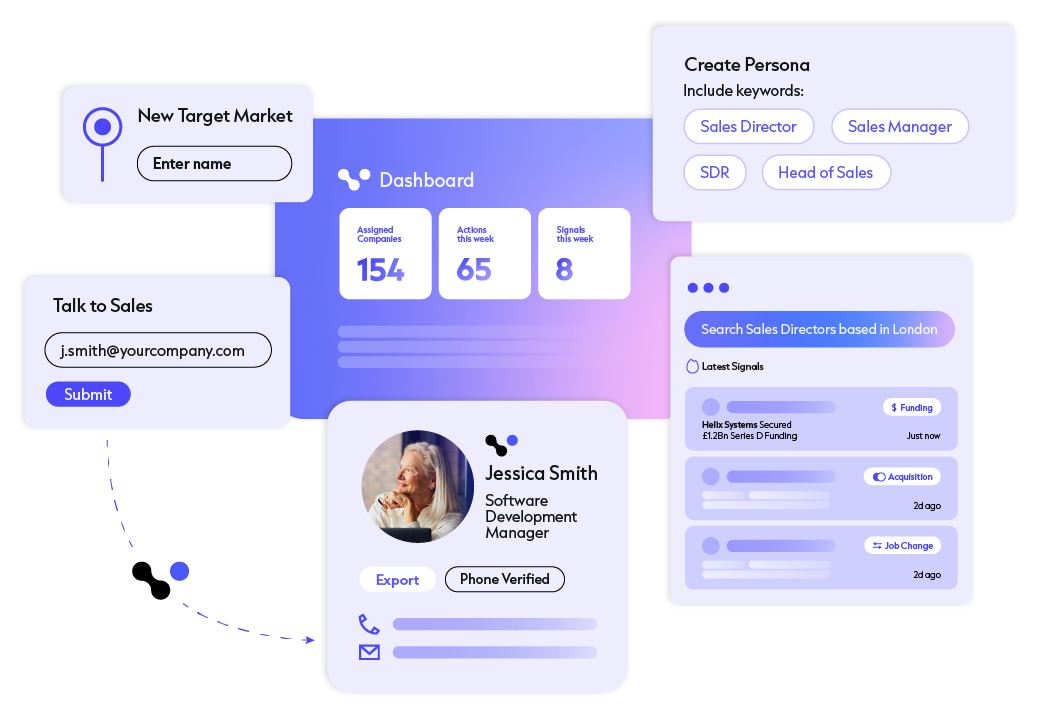
Cognism's single biggest differentiator is phone-verified mobile numbers.
Beyond the phone-verification story, Cognism provides intent data, sales trigger events, a browser extension for LinkedIn, Salesforce, HubSpot, Dynamics, and Pipedrive, and a CRM Enrichment add-on. Cognism pricing is entirely quote-based with no public dollar amounts, and the global dataset scale is smaller than ZoomInfo's 500M contacts.
Best for: Revenue teams with significant EU and UK GTM motions that require GDPR-compliant, phone-verified contact data.
Key features:
Verified phone-verified mobile numbers (strongest EU mobile differentiator in the category)
GDPR and CCPA compliance built into every tier
AI-powered natural language search and Persona Builder
Intent data and sales trigger events
Native Salesforce, HubSpot, Dynamics, and Pipedrive integrations
Pricing: Quote-based. Standard and Pro tiers available. No public dollar amounts. CRM Enrichment and Data-as-a-Service available as add-ons.
Pros:
Phone-verified Diamond Data for EU mobile outreach
GDPR, CCPA compliance built-in at every tier
G2 rating 4.6/5 from 2,415 reviews
CRM integrations included at standard tier
Cons:
Pricing is quote-based with no public dollar amounts, which slows internal evaluation cycles
Smaller global dataset than ZoomInfo
No conversation intelligence or GTM Workspace equivalent
No MCP server
Cognism vs. ZoomInfo: full comparison. Also see Cognism vs. Lusha for a direct head-to-head.
4. RocketReach
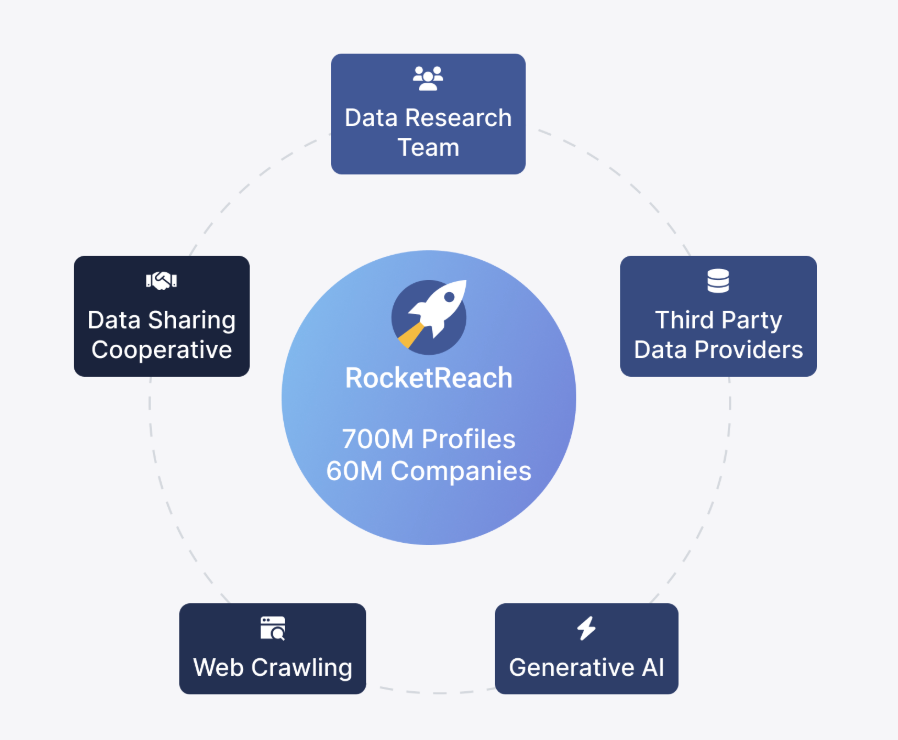
RocketReach stands out for one reason in the Lusha alternative market: the most transparent, self-serve public pricing in the category. You can buy an Essentials plan at $25/month without talking to a salesperson, which is a meaningful differentiator for teams that need to move quickly or operate under tight procurement constraints.
The Essentials tier is email-only. Pro ($62/month) adds phone numbers, technographics, and org charts. Ultimate ($128/month) adds Intent Data. The contact database is smaller than ZoomInfo and Apollo, and there is no built-in sequencing or conversation intelligence, but the pricing clarity and the enterprise reference list (95% of the S&P 500 cited as customers) make it a credible consideration for technology, healthcare, and professional services teams. See our full Lusha vs. RocketReach comparison for the detailed breakdown.
Best for: Budget-conscious teams needing transparent, self-serve contact lookup without a sales conversation.
Key features:
Self-serve public pricing (Essentials from $25/month)
Email-only (Essentials) or email and phone (Pro, Ultimate)
Technographics and org charts on Pro and above
Salesforce, HubSpot, Outreach, and Salesloft integrations
Intent Data available on Ultimate tier
Pricing: Essentials: $25/month or $299/year. Pro: $62/month or $749/year. Ultimate: $128/month or $1,539/year. Custom Team: starts at $6,000/year.
Pros:
Very transparent public pricing, Essentials from $25/month
Strong coverage in technology, healthcare, and recruiting verticals
G2 Leader Spring 2026 recognition
Large enterprise reference list
Cons:
No sequencing built-in; separate tool required for outreach
No conversation intelligence
No GTM Context Graph reasoning layer
G2 rating 4.5/5 from 654 reviews, lower review volume than peers
RocketReach vs. ZoomInfo: full comparison
5. Lead411
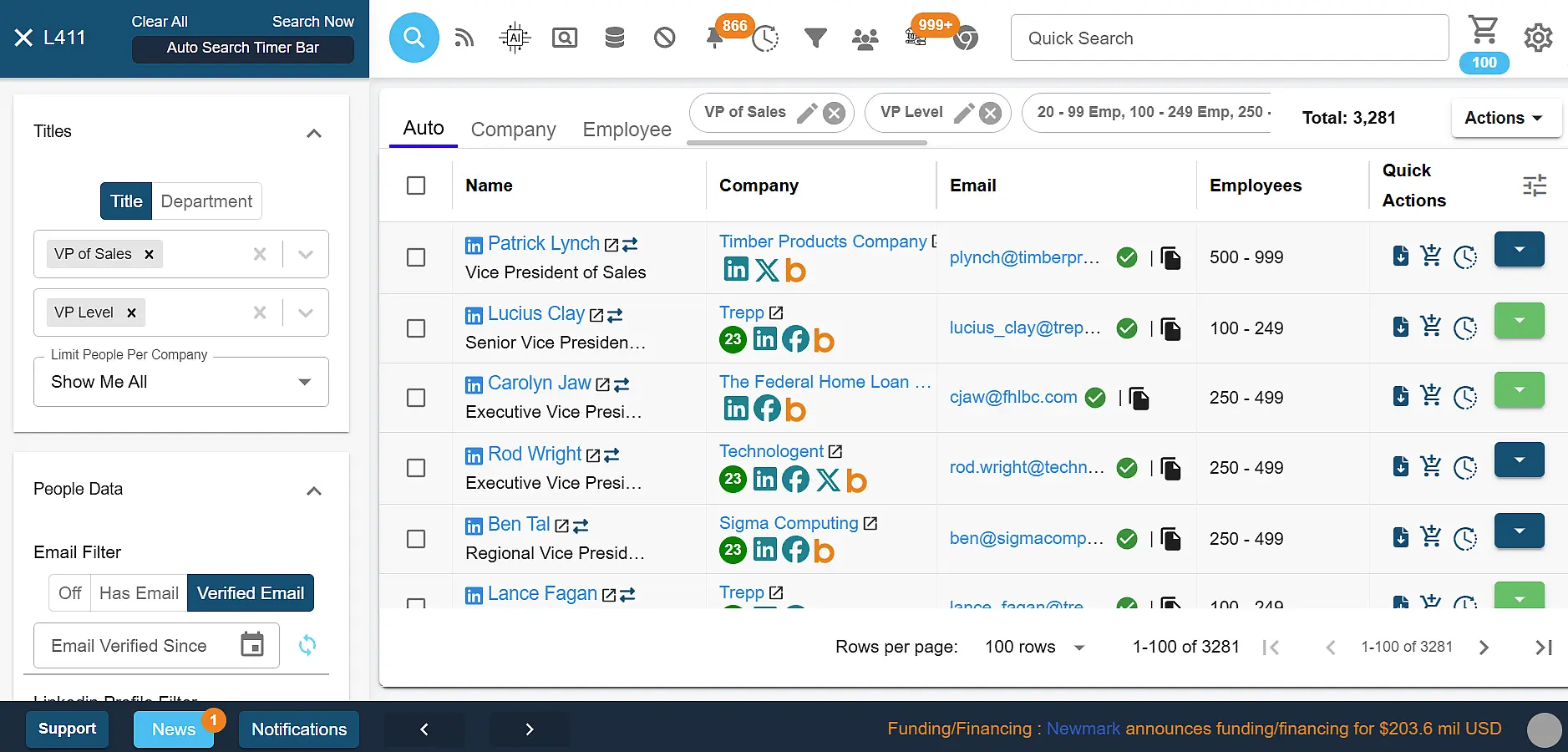
Lead411 takes a different approach to the alternatives market: intent-first, territory-based lead delivery with unlimited downloads on the Enterprise plan. The platform uses triple-verification with a 3-month re-verification cycle, which is a more aggressive freshness cadence than most contact-data tools claim.
The strongest use case is SMB sales teams with defined territories who want leads delivered daily based on intent signals and news triggers, rather than building manual search queries. The database is smaller than ZoomInfo or Apollo, and there is no GTM Workspace equivalent or conversation intelligence, but the intent-trigger-plus-territory workflow is a real differentiator for the teams it fits.
Best for: SMB sales teams focused on intent-driven outreach who want unlimited downloads at a predictable cost with territory-based lead delivery.
Key features:
Triple-verification with 3-month re-verification cycles
Territory-based lead assignment with daily updates
News trigger alerts for timely outreach (funding, hiring, product launches)
B2B direct dials and buyer intent signals
Unlimited downloads on Enterprise plan
Pricing: Basic: from $99/user/month. Enterprise: custom.
Pros:
Triple-verified data with aggressive 3-month re-verification cadence
Territory-based lead delivery reduces manual search overhead
Unlimited downloads on Enterprise plan
G2 rating 4.5/5 from 478 reviews
Cons:
Smaller database than ZoomInfo or Apollo
No conversation intelligence or GTM Workspace equivalent
Limited to web app and Chrome extension only
Pricing is not fully public for higher tiers
6. UpLead
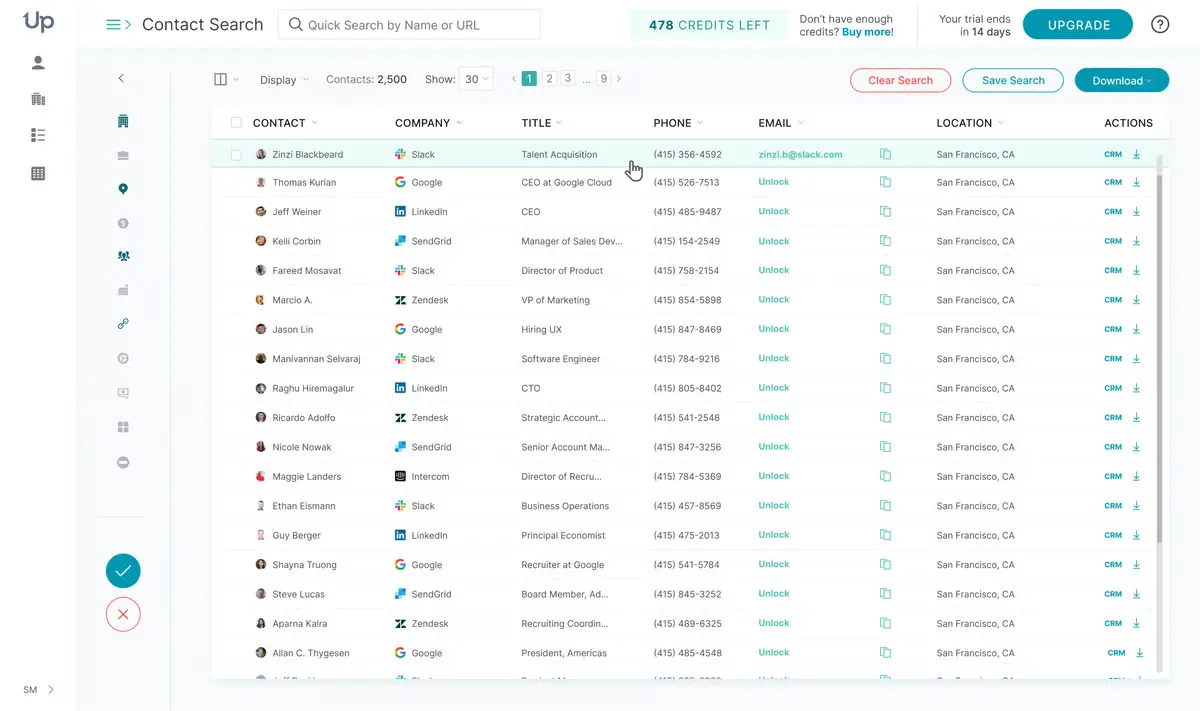
UpLead positions itself around a data accuracy guarantee: 95% accuracy with what the company calls Friendly Credits, where invalid or bounced contacts are refunded. The real-time verification model means contacts are checked at the point of download rather than in a batch refresh cycle.
The platform is best suited for small teams who want a manageable subscription, transparent pricing, and confidence that the data they download is clean. The database is smaller than ZoomInfo and Apollo, and there is no sequencing, conversation intelligence, or intent reasoning built in.
Best for: Small teams wanting a data accuracy guarantee with self-serve pricing and real-time verification.
Key features:
Real-time email verification with 95% accuracy guarantee and credit refunds on bounced contacts
Technographic data filters
CRM integrations with Salesforce and HubSpot
User-friendly interface and fast setup
Pricing: Essentials from $74/month. Plus from $149/month. Professional: custom pricing.
Pros:
95% data accuracy guarantee with Friendly Credits on bounces
Real-time verification at point of download
G2 rating 4.7/5 from 742 reviews
User-friendly for fast onboarding
Cons:
Smaller database than ZoomInfo or Apollo
No sequencing or conversation intelligence
API access gated to Professional (custom pricing) tier
7. Seamless.AI
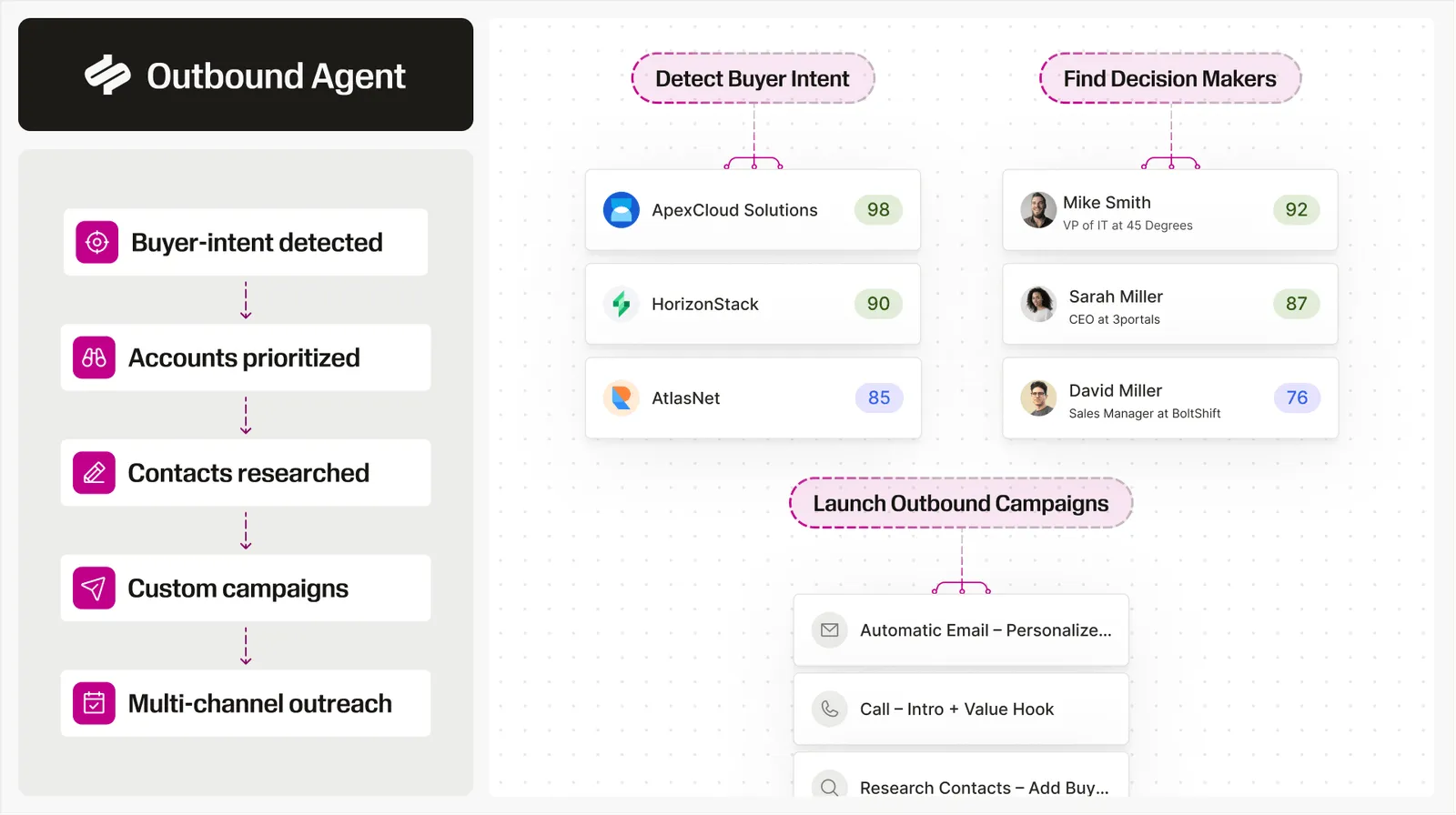
Seamless.AI uses real-time contact search, meaning it builds contacts at query time rather than serving from a static database. The model can surface contacts that database-only tools miss, though data coverage and accuracy vary by market segment and industry.
The platform has a free tier, which reduces evaluation friction for individuals and small teams. CRM integrations cover major platforms. The strongest use case is SDR teams running high-volume outbound who want real-time discovery and a simple interface. See our full Lusha vs. Seamless.AI comparison for a closer look.
Best for: SDR teams wanting real-time contact discovery with an accessible interface and a free entry point.
Key features:
Real-time contact search and discovery model
AI-powered data validation
CRM integrations with major platforms
Chrome extension for browser-based prospecting
Free tier available
Pricing: Free tier available. Pro pricing available on request.
Pros:
Real-time search model can surface contacts database tools miss
Free tier lowers evaluation friction
SDR workflow focus
Cons:
Data coverage and accuracy inconsistent across markets and industry segments
No conversation intelligence or intent reasoning layer
G2 rating 4.3/5 from 4,126 reviews, with user notes on data quality variation
8. HubSpot Breeze Intelligence (Clearbit)
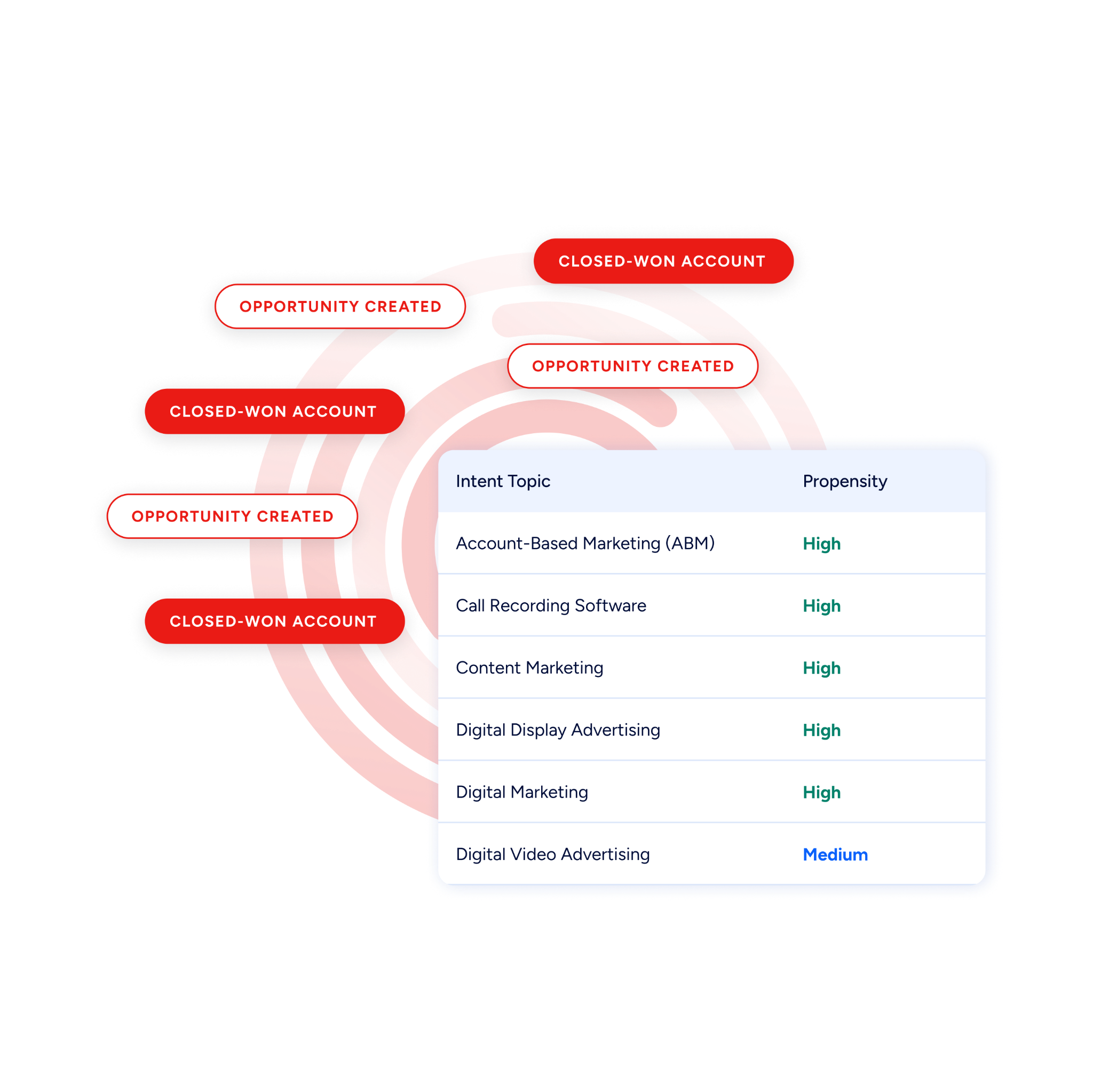
Clearbit was acquired by HubSpot in 2024 and is now branded HubSpot Breeze Intelligence. It is not a prospecting database in the traditional sense. The platform's strength is data enrichment for marketing teams, specifically firmographic enrichment, ICP matching, lead qualification, and form optimization for HubSpot-native workflows.
If your team runs on HubSpot and the primary use case is enriching inbound leads and reducing form friction rather than building cold outbound lists, Breeze Intelligence belongs in your evaluation. If you need a full prospecting database or outbound-focused contact data, it is not the right fit.
Best for: HubSpot-native marketing teams focused on enrichment and form optimization rather than outbound prospecting.
Key features:
Firmographic data enrichment for HubSpot records
ICP matching and lead qualification
Form enrichment to reduce fields and improve conversion
Bundled inside HubSpot, no separate vendor management
Pricing: Included with HubSpot plans (varies by tier).
Pros:
Bundled inside HubSpot, no separate vendor relationship or seat cost
Strong firmographic data quality for enrichment use cases
Form enrichment is a clear differentiator for demand gen teams
G2 rating 4.4/5 from 1,089 reviews
Cons:
Not a primary prospecting database for outbound teams
HubSpot dependency means limited value outside HubSpot
Smaller contact universe than ZoomInfo or Apollo
Clearbit vs. ZoomInfo: full comparison
9. LeadIQ
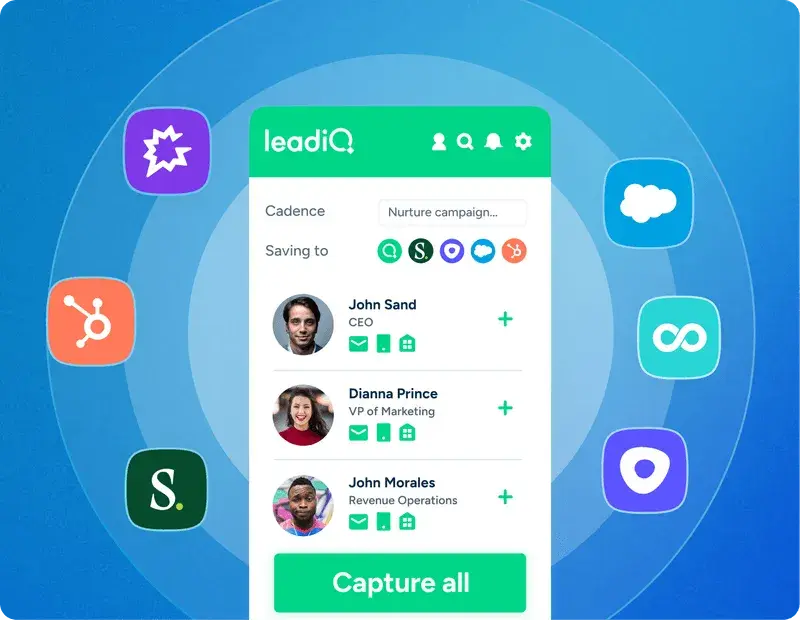
LeadIQ focuses on the LinkedIn-to-Salesforce prospecting workflow. The platform automates contact capture from LinkedIn profiles and Sales Navigator, syncs directly into Salesforce, and includes basic sales engagement automation for teams that do most of their prospecting through social networks.
The platform is well-suited for mid-market sales teams with a LinkedIn-first prospecting motion who need streamlined capture and CRM sync without managing a large separate database. The contact dataset is smaller than enterprise tools, intent signals are limited, and there is no conversation intelligence built in.
Best for: Sales teams that prospect primarily on LinkedIn and need streamlined capture to Salesforce CRM.
Key features:
Automated LinkedIn and Sales Navigator prospecting
Direct Salesforce CRM sync
Contact capture from multiple sources
Basic sales engagement automation
Pricing: Free plan available. Essential: from $45/user/month. Pro: from $89/user/month. Enterprise: custom.
Pros:
Streamlined LinkedIn-to-Salesforce workflow
User-friendly interface, fast to learn
Competitive pricing for small teams
G2 rating 4.2/5 from 1,037 reviews
Cons:
Smaller dataset than enterprise contact databases
Limited intent signals or buying trigger intelligence
No conversation intelligence
10. Kaspr
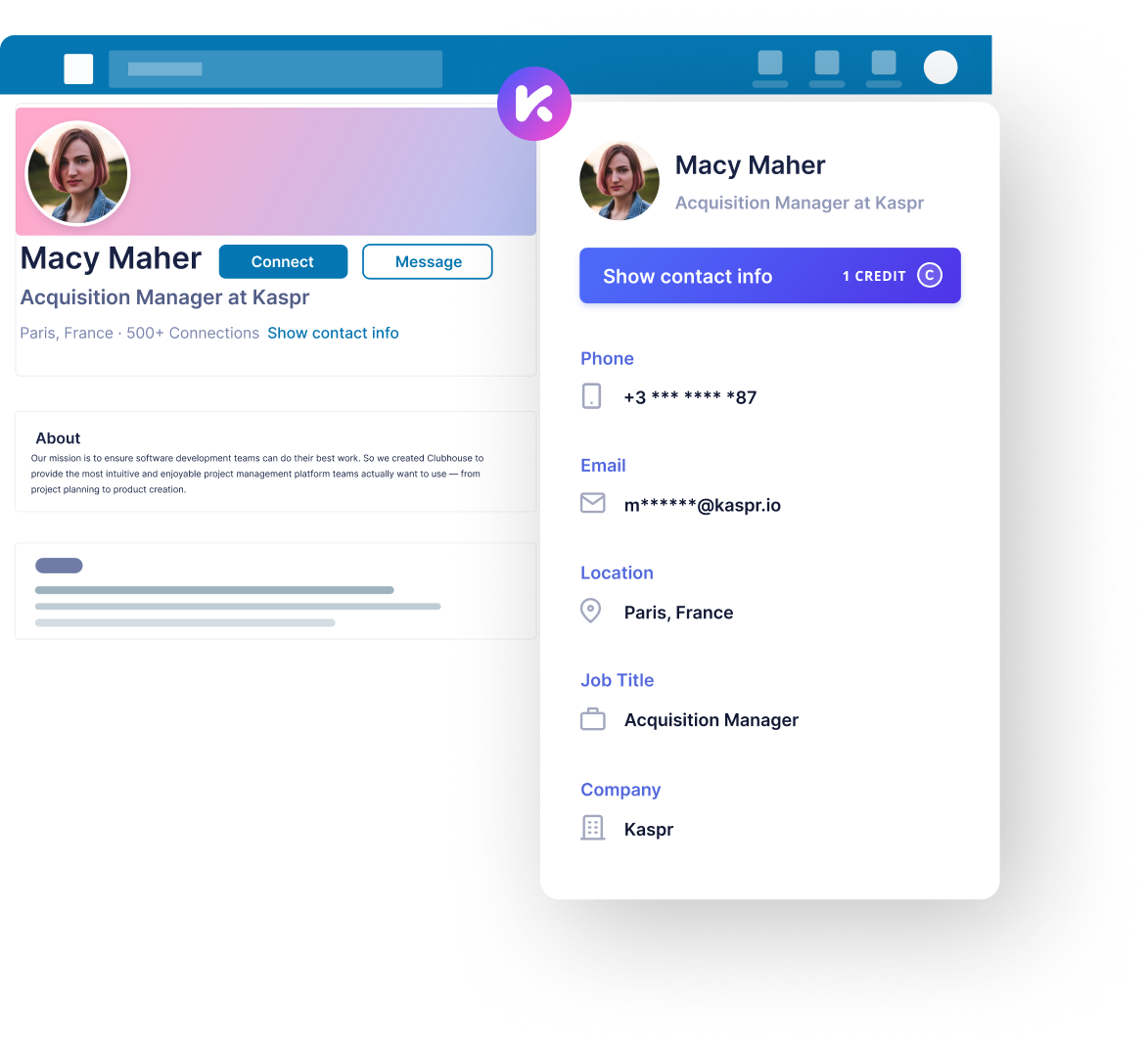
Kaspr is a Cognism-owned tool built around the LinkedIn Chrome extension and European B2B contact coverage. It offers unlimited free B2B email addresses on the free tier, which is among the most generous free tiers in the category. Direct dial credits are available as a paid add-on.
The platform is a strong fit for SDRs doing European prospecting through LinkedIn who want email addresses at no cost and occasional direct dial access without committing to an enterprise contract. The limitations are clear: no intent signals, no buying trigger data, no conversation intelligence, and a contact set that skews European rather than global. See our full Kaspr vs. Lusha comparison for the detailed breakdown.
Best for: SDRs prospecting primarily through LinkedIn in European markets, especially at smaller team sizes.
Key features:
Unlimited free B2B email addresses on free plan
LinkedIn Chrome extension with 120M+ European B2B contacts
Phone credits for direct dial access as paid add-on
European market contact coverage
Pricing: Free plan with unlimited B2B email addresses. Paid plans for phone access starting from approximately $49/user/month.
Pros:
Free unlimited B2B email addresses, most generous free tier for email in the category
Strong European B2B contact coverage (120M+ contacts)
Simple LinkedIn-native workflow
G2 rating 4.4/5 from 802 reviews
Cons:
Limited to LinkedIn and browser workflow
No intent signals or buying trigger intelligence
No conversation intelligence
US contact coverage is smaller relative to European coverage
Is There a Free Lusha Alternative?
Yes. ZoomInfo offers a free entry point through ZoomInfo, which provides consumption-based pricing to access ZoomInfo's verified contact database. Unlike tools that offer a free tier built on a smaller or lower-quality dataset, ZoomInfo's draws from the same 500-million-contact database that enterprise teams use. The free credits give individual contributors and small teams a way to evaluate data quality, run searches, and enrich CRM records before committing to a paid plan.
Lusha's free tier provides 40 credits per month. ZoomInfo provides access to the verified data foundation at the same level as paid plans, with a consumption credit model that scales when you are ready.
Ready to see what a full GTM platform looks like against Lusha's point-tool approach? Request a demo.
Lusha Competitors Comparison Table
Tool | Best For | Database Size | Starting Price | G2 Rating | Intent Signals | MCP Server |
|---|---|---|---|---|---|---|
ZoomInfo | Enterprise and scaling GTM teams | 500M contacts | Free to start (consumption credits) | Category leader | Yes (GTM Context Graph) | Yes |
Apollo | SMB/mid-market, stack consolidators | 230M+ contacts | Free / $49/seat/mo | 4.8/5 (7,142) | Yes (basic) | No |
Cognism | EU/UK GDPR-focused teams | Smaller than ZI | Quote-based | 4.6/5 (2,415) | Yes | No |
RocketReach | Budget-conscious, self-serve | Not disclosed | $25/mo (Essentials) | 4.5/5 (654) | Yes (Ultimate only) | No |
Lead411 | Intent-driven SMB teams | Smaller than ZI | $99/user/mo | 4.5/5 (478) | Yes | No |
UpLead | Small teams, accuracy guarantee | Smaller than ZI | $74/mo | 4.7/5 (742) | No | No |
Seamless.AI | High-volume SDR outbound | Not disclosed | Free / request | 4.3/5 (4,126) | No | No |
HubSpot Breeze Intelligence | HubSpot-native enrichment | Smaller | HubSpot plans | 4.4/5 (1,089) | No | No |
LeadIQ | LinkedIn-to-Salesforce workflow | Smaller | Free / $45/mo | 4.2/5 (1,037) | Limited | No |
Kaspr | EU LinkedIn SDRs | 120M+ EU contacts | Free / ~$49/mo | 4.4/5 (802) | No | No |
Frequently Asked Questions
What is the best alternative to Lusha?
ZoomInfo is the most comprehensive Lusha alternative, offering 500M contacts, 135M+ verified phone numbers, the GTM Context Graph intelligence layer, and Universal Access through APIs, MCP, GTM Workspace, and GTM Studio. For EU-focused teams with GDPR requirements, Cognism's Diamond Verified data is the strongest alternative. For teams on tight budgets wanting free or low-cost entry, Apollo's free tier or RocketReach Essentials at $25/month are the most accessible options. For LinkedIn-primary SDR workflows in Europe, Kaspr covers the basics at no cost.
Why are people looking for Lusha alternatives?
The most common reasons GTM teams evaluate Lusha alternatives: the credit-based pricing model scales poorly once you need more than a few hundred contacts per month, the core database is smaller than enterprise-grade platforms, the primary workflow depends on the Chrome extension which limits complex GTM motions, and Lusha does not offer conversation intelligence, predictive scoring, or a GTM Context Graph reasoning layer. Teams that start with Lusha for lightweight contact lookup typically outgrow it when they need verified direct dials at scale, buying signal intelligence, or a platform that connects data to workflow.
Is ZoomInfo better than Lusha?
For enterprise and scaling teams, ZoomInfo is structurally better: 500M contacts versus Lusha's smaller database, 135M+ verified phone numbers versus Lusha's more limited direct-dial depth, and the GTM Context Graph reasoning layer that Lusha does not have. Lusha is a better fit for individual contributors or small teams that need simple, transparent-priced contact lookup without enterprise complexity. Lusha's transparent public pricing and clean Chrome extension UX are genuine strengths in the segment they serve.
Does ZoomInfo have a free option like Lusha's free tier?
Yes. ZoomInfo offers a free entry point through ZoomInfo Lite, which provides free consumption credits to access the same 500-million-contact database that enterprise teams use. Lusha's free tier gives 40 credits per month from a smaller database. ZoomInfo's free entry draws from the same verified data foundation as paid plans, with credits that scale as your team grows.
What Is Lusha?
Lusha is a B2B contact data and buying signals platform for GTM teams. It offers three product surfaces: Lusha Workspace (search, enrich, and manage prospects), Lusha API (programmatic data access for embedding into internal tools and CRM), and Lusha Extension (the Chrome extension that reveals contact details on LinkedIn and other sites). Lusha MCP is a newer addition, a Model Context Protocol server that exposes Lusha data to AI assistants like Claude.
G2: 4.3/5 from 1,492 reviews.
Lusha pricing:
Tier | Price |
|---|---|
Free | $0 / 40 credits per month |
Starter | $37.45 / month |
Pro | $52.45 / month |
Premium | $299.95 / month |
Scale | Custom |
Where Lusha works well:
Simple, low-friction Chrome extension for LinkedIn prospecting
Transparent, public pricing at every tier below enterprise
GDPR, CCPA, ISO 31700, and SOC 2 Type 2 compliance built-in
MCP server for AI-assisted sales workflows (one of very few in the category)
Clean three-surface architecture for teams that want to pick and choose how they access data
Where teams typically outgrow Lusha:
Database is smaller than enterprise-grade platforms, with credit limits that constrain high-volume prospecting
No conversation intelligence to inform call strategy or review buyer interactions
No predictive scoring or ABM advertising layer
No GTM Context Graph reasoning layer that combines data, intent signals, and behavioral context into actionable intelligence
Primary workflow remains Chrome extension-dependent, which limits complex GTM motions
Pricing scales quickly once you move past the Pro tier
For a deeper look at how Lusha stacks up, see the Lusha review, the Lusha features breakdown, and a side-by-side breakdown on the Lusha pricing page.
If you're weighing Lusha against other tools in the category, you might also like 6sense vs. Lusha, Amplemarket vs. Lusha, and Apollo vs. Lusha. Evaluating a different vendor's ecosystem instead? See our roundups of Apollo alternatives, Clay alternatives, and Kaspr alternatives.