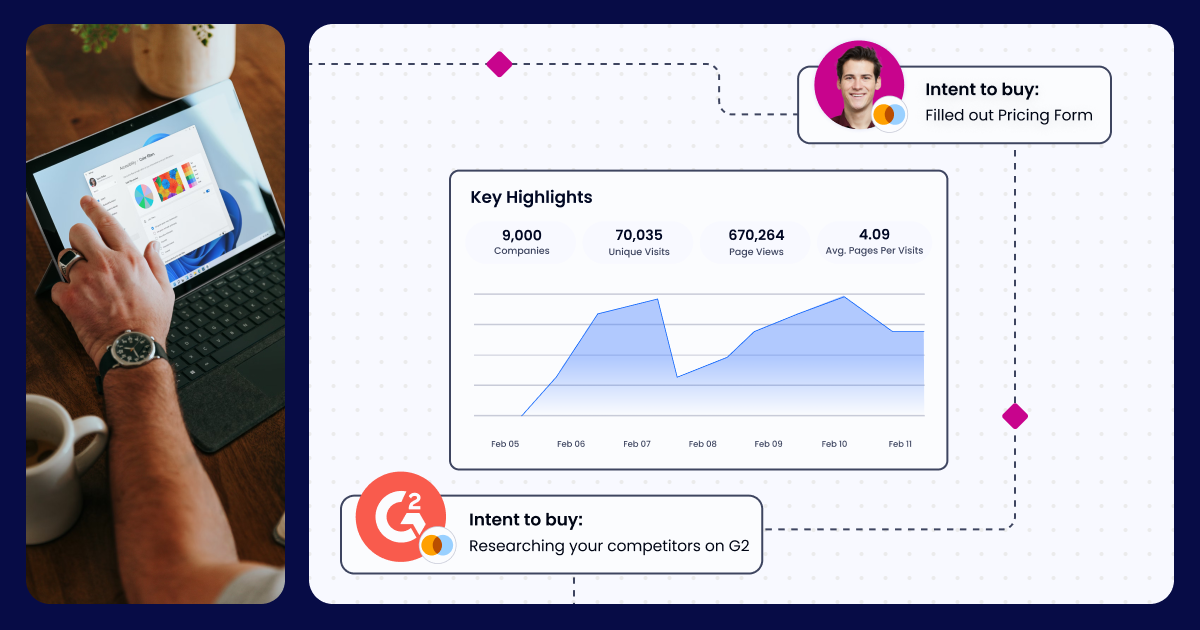

The timing problem in B2B sales is real: most buyers spend weeks researching solutions before identifying themselves to a vendor. Intent data solves that gap by surfacing which accounts are in that research window right now, so your team can engage before they contact a competitor.
Prospects who love your product may not be ready to buy. Buyers in-market today probably haven't asked for a meeting. And those somewhere in the middle could be swayed, if you can reach them.
Sales intent data is the key that helps B2B sales and marketing leaders separate the ready from the rest. Intent shines a light on the digital signals businesses generate as they move through the buyer's journey, giving GTM teams a hyper-efficient way to target accounts getting ready to purchase. Here's how to make the most of the intent data advantage, and how to operationalize it with the right GTM Intelligence Platform.
What Is Intent Data?
B2B intent signals are behavioral data that identify which accounts are actively researching solutions in your category. ZoomInfo captures these signals across 210M+ IP-to-organization pairings, tracking web visits, content downloads, search behavior, and review-site activity to reveal who's in-market before they fill out a form. ZoomInfo also resolves Person-Level Intent, identifying a named contact associated with that research activity when available, so you can see not just which companies are researching but who within those accounts is engaged.
You'll also see it called buyer intent data, B2B intent data, or sales intent data. The underlying concept is the same: behavioral signals that tell you which accounts are evaluating, so you can reach them before a competitor does.
Common intent signals include:
Website visits: Pages viewed, time spent on site, and frequency of visits
Content downloads: Whitepapers, case studies, and guides accessed
Social media interactions: Engagement with relevant topics and industry discussions
Keyword searches: Terms used in search engines that signal buying intent
Types of Intent Data
Intent data falls into distinct categories, each revealing a different aspect of buyer behavior. Understanding these types helps you build a complete picture of which accounts are in-market and, where available, which contacts within those accounts are driving the research.
First-party intent data
First-party intent data comes from your own digital properties: your website, CRM, and marketing automation. It shows what your known prospects do on surfaces you own, from the pages they visit to the content they download.
Examples of first-party intent signals include:
Pricing page visits: Direct signal of purchase consideration
Demo requests: High-intent action indicating active evaluation
Content downloads: Engagement with product materials on your site
Email engagement: Opens, clicks, and responses to your outreach
First-party data only tracks known visitors on your site, so you miss accounts researching solutions elsewhere before they engage with your brand. That's why combining sources matters. Akorbi doubled its leads by pairing first-party visitor identification with third-party intent signals, capturing demand invisible from owned properties alone.
Third-party intent data
Third-party intent data is gathered from external sources across the web: publisher networks, review sites like G2 and TrustRadius, and content syndication platforms. It captures research activity that happens outside your owned properties.
Third-party intent signals come from:
Review sites: Companies comparing solutions and reading user feedback
Publisher networks: Content consumption across industry publications
Content syndication: Whitepaper downloads and webinar attendance on third-party sites
Research platforms: Activity on analyst sites and industry forums
Third-party data catches accounts before they visit your site, so you can engage earlier when they're still researching options. When Person-Level Intent is available, you'll also see which contact at that account is associated with the research activity.
Derived and guided intent
ZoomInfo tracks buyer intent across a continuum of signal strength:
Derived intent signals mix first-party and third-party signals to flag interest behaviors like ad engagement, web activity, topic engagement, and technology use.
Known intent is zero-party intent: ZoomInfo surveys millions of business professionals incentivized to share priorities, projects, and pain points. This is what makes ZoomInfo's Scoops so powerful.
Guided intent identifies the intent topics that spiked for an account before they became an opportunity, telling you which topics to follow when seeking new business.
Champion moves flag buyers and power users who have moved and can influence future sales, one of the most actionable forms of intent data.
Each type brings a unique perspective to your go-to-market strategy. Use them in tandem to reach more buyers at the right time.
Intent data types: a quick reference
Type | Source | Signal Strength | Best Used For |
|---|---|---|---|
First-Party | Your owned digital properties | High (known visitor) | Deepening insight on known pipeline accounts |
Third-Party | External publisher networks, review sites | Medium (anonymous) | Catching in-market accounts before they reach your site |
Derived | Mix of first-party + third-party signals | Medium-High (composite) | Scoring ad engagement, web activity, topic interest |
Guided | Past-conversion intent topics | High (predictive) | Identifying which intent topics precede won deals |
How Is Intent Data Collected?
Intent data is collected by tracking online behavior across publisher networks, review sites, and content platforms when an account's research activity spikes significantly above its normal baseline. The spike indicates an account has moved from passive awareness into active evaluation.
To identify a spike, intent data platforms' algorithms typically factor in:
Amount of content consumed
Number of consumers
Types of content consumed
Time on page
Scroll speed
Intent data is often paired with firmographic and technographic data to narrow the list to accounts that are high-fit. ZoomInfo's GTM Context Graph reasons across collected intent signals plus CRM records, conversation intelligence, and behavioral data, surfacing not just that an account is researching, but why they're likely to convert.
Why Intent Data Matters for B2B Sales and Marketing
Most prospective buyers aren't in-market at any given time. Intent data identifies the subset that's actively researching and targets them with relevant outreach, so your team focuses effort on the accounts most likely to convert.
Sales and marketing teams use intent data to:
Identify interest: Spot companies researching your solution before they fill out a form.
Build targeted lists: Dynamically filter outreach lists for accounts showing active buying signals.
Personalize outreach: Coordinate messaging across the buying journey based on real-time signals.
Streamline lead scoring: Weight your model with intent data to prioritize purchase-ready accounts.
Protect revenue: Monitor customer activity to identify pain points before renewal conversations.
Engage confidently: Use guided intent to target audiences with topics proven to drive conversion.
Palo Alto Networks uncovered 1,500+ net-new accounts by activating intent signals across its enterprise sales motion, turning a broad market into a prioritized pipeline. Knowing how to leverage intent data for sales means connecting signal to action: the right account, the right message, the right moment.
How to Use ZoomInfo Intent Data Effectively (Account-Level and Person-Level)
Intent data becomes most valuable when embedded in every step of your go-to-market strategy. Here are the key ways to incorporate it:
Build a strong data foundation
Intent data works best combined with firmographic, demographic, and technographic data in a unified platform. The combination shows which accounts in your TAM are high-fit and in-market right now. Alchemy Cloud is on pace to generate 3x sales-qualified leads by layering intent on a clean ICP and enriched CRM records.
Automate workflows with intent signals
ZoomInfo Workflows automate repetitive tasks like CRM updates and sequence enrollment based on real-time intent triggers. When a target account spikes on relevant topics, your team responds immediately without manual monitoring. NetSPI grew opportunities 61% by activating intent-based marketing on demand-gen channels, routing high-intent accounts into the right sequences before competitors could engage.
Launch GTM plays at scale
GTM Plays orchestrate coordinated sales and marketing campaigns triggered by intent signals. When an account shows buying interest, both teams engage automatically with the right message at the right moment.
Activate AI agents in GTM Workspace
GTM Workspace uses AI agents grounded in the GTM Context Graph to synthesize intent signals, buying history, and account research, surfacing exactly why an account is in-market and recommending the next best action. Marketers and RevOps teams build intent-triggered audiences and campaigns in GTM Studio, so the same signals routing accounts to sellers also fuel programmatic and nurture motions. This is how to leverage intent data for sales and marketing in one coordinated motion.
What Are the Challenges of Using Intent Data?
Intent data delivers clear advantages, but teams often struggle to turn signals into action. The most common challenges:
Signal noise: Not all intent signals carry equal weight. Low-quality data creates false positives, wasting time on accounts that aren't actually in-market.
Data freshness: Intent signals decay fast. Stale data means you're reaching accounts that already moved past research or chose a competitor.
Integration friction: Intent data that lives in a separate system from your CRM creates manual work and slows response time. Look for platforms that expose data via MCP and APIs so signals reach the tools your team already uses.
Actionability gaps: Raw intent signals don't tell you what to do next. Without guidance on messaging, timing, and channel, teams struggle to convert signals into pipeline.
How Leading Intent Data Providers Compare
Several platforms supply intent data, each with a different operating model. The right fit depends on whether you want a pure data source, an ABX platform, a sales-engagement layer, or a unified GTM intelligence platform consolidating intent across the revenue motion. The three profiles below cover the most common B2B intent data providers teams evaluate against ZoomInfo.
Cognism: Premium EU contact data with Bombora-powered intent
Cognism Pro layers Bombora-powered intent on phone-verified EU contact data. Its two defining features are Diamond Verified data inclusion, which gives EU and UK sales teams confidence in mobile number accuracy, and intent data integration that surfaces buying signal alerts when target accounts spike on relevant topics. Cognism describes the product as data that strengthens existing systems rather than replacing them. That's accurate: Cognism Pro stops at the data-and-signals layer. There is no GTM Context Graph reasoning over CRM, conversation intelligence, and behavioral signals.
How Cognism compares against ZoomInfo
Cognism Pro lands hardest with EU and UK sales teams that need phone-verified mobile data and a clean GDPR posture, and its Diamond Verified mobile dataset is the strongest regional differentiator in the category.
ZoomInfo's edge is global verified data spanning 135M+ phone numbers, 120M+ direct dials, 45M+ international mobile numbers, and 200M+ international professional profiles (scale Cognism's EU-mobile focus does not match), the GTM Context Graph reasoning layer that fuses intent with CRM records and behavioral signals, and conversation intelligence inside Chorus, which Cognism does not offer in any tier.
See the Cognism vs. ZoomInfo comparison for the full head-to-head.
Demandbase: ABX platform combining ABM advertising and account intelligence
Demandbase One delivers Demandbase's "Full-Funnel ABM" positioning as a unified ABX platform spanning ABM ads, account intelligence, sales intelligence, and data in one motion. It also handles account-level orchestration across marketing and sales surfaces, with predictive scoring and intent signals feeding paid media and rep workflows. Demandbase One leads with ABM advertising orchestration, but stops at the ABX motion and lacks an MCP/agent ecosystem.
How Demandbase compares against ZoomInfo
Demandbase One wins where the buyer wants an end-to-end ABM platform with native programmatic display baked in alongside intent and account intelligence, specifically enterprise marketing teams running a Gartner-MQ-recognized ABM motion.
ZoomInfo's edge is a verified contact data foundation Demandbase relies on partners for, the GTM Context Graph fusing intent with CRM records, Chorus conversation intelligence, and behavioral signals, and APIs and an MCP server for AI-agent integration that Demandbase has no documented parity for. Teams that want to wire that same verified data and context graph into their own AI tools, rather than adopting a new interface, can do so through GTM AI, ZoomInfo's context layer for AI tools, which connects ZoomInfo's B2B intelligence to Claude, ChatGPT, or any agent via MCP or one API.
See the Demandbase vs. ZoomInfo comparison for the full head-to-head.
Outreach: Agentic AI platform built on sales engagement legacy
Outreach AI Agents is the product Outreach built on its sales engagement legacy following the 2026 "Agentic AI Platform" rebrand. Its core capability is autonomous prospecting agents that handle top-of-funnel outreach without rep intervention; a second is AI-drafted outreach informed by past conversations. Outreach AI Agents grafts autonomous prospecting onto a sales engagement foundation, but has no native verified B2B data behind those agents (Outreach's own AI workflow materials reference pairing Outreach with 6sense for sourcing pipeline), and no GTM Context Graph equivalent to ground agent recommendations.
How Outreach compares against ZoomInfo
Outreach's sales engagement legacy is the deepest in the category, with sequencing depth, dialer integration, and the Agentic AI Platform rebrand sitting on years of enterprise-scale rep-workflow tooling teams already operate inside daily.
ZoomInfo's edge is the verified B2B data foundation Outreach lacks, with GTM Workspace agents grounded in that data so prospecting, sequencing, and outreach all run off the same continuously updated contact and company intelligence, and an APIs and MCP server layer that exposes those agents and signals to any CRM, sales engagement tool, or AI stack with no platform parity from Outreach.
Talk to our team for a head-to-head Outreach vs. ZoomInfo walkthrough.
People Data Labs: Developer-first data API
People Data Labs (PDL) provides a raw contact and company data API built for data engineers building custom enrichment pipelines. Its product returns structured person, company, and location records via a programmatic API, making it a data-as-a-service layer for teams that want to build their own enrichment workflows rather than operate a turnkey GTM platform.
How PDL compares against ZoomInfo
Choose People Data Labs if your team is a developer building a custom data pipeline that needs raw API access to structured contact and company records. PDL provides the underlying data and leaves scoring, routing, intent signals, and execution entirely to you. There's no built-in intent signal feed, workflow automation, conversation intelligence, or native CRM connectors.
ZoomInfo delivers the same B2B data foundation, verified across 500M+ contacts and 100M+ companies, through its data enrichment API and MCP endpoint, with Forrester-rated intent signals, the GTM Context Graph, and workflow automation already included. For a go-to-market team, the question isn't just which raw dataset is larger. It's whether you want to build an enrichment and activation stack from scratch or start from a complete intelligence platform.
How ZoomInfo Approaches Intent Data
ZoomInfo Intent was named a Leader in B2B intent by Forrester. Read the Forrester Wave analysis for B2B intent data providers for the full breakdown. ZoomInfo also ranks at the top of buyer intent categories on G2 and other independent review platforms, including 142 No. 1 rankings in Spring 2026. That position reflects how ZoomInfo's AI GTM Intelligence Platform turns intent data from a standalone signal into an end-to-end revenue motion.
It starts with verified data. ZoomInfo's contact and company database covers hundreds of millions of professional profiles globally, enriched with technographic, firmographic, and intent signals updated continuously. So when a signal fires, you have the verified contact behind it, not an anonymous account name.
That data flows into the GTM Context Graph, which fuses intent signals with CRM records, conversation intelligence, and behavioral data to answer the harder question: why is this account likely to convert, and what should a seller do next? That reasoning separates an intent data platform from a signal feed, and it grounds every recommendation that lands in front of a rep.
From there, ZoomInfo delivers intent intelligence everywhere GTM teams work. Sellers consume signals inside GTM Workspace, marketing and RevOps build intent-triggered audiences in GTM Studio, and developers pipe the Context Graph into Claude, ChatGPT, or internal copilots through MCP and APIs. Every surface your team operates in consumes the same signals without manual ETL.
ZoomInfo is free to start with consumption credits based on usage. Start for free at gtm.ai or talk to sales for a walkthrough.
How to Choose a GTM Intelligence Platform for Intent Data
When evaluating B2B intent data providers, most teams are really choosing between operating models. The right GTM Intelligence Platform comes down to four priorities:
Data Quality: Broad coverage and granular insights. Low-quality intent data creates more headaches than it solves.
Available topics: Out-of-the-box topics relevant to your business plus the ability to create custom topics for niche pain points only you solve.
Functionality: Updated regularly and customizable as priorities change. Identify the internal-process gaps you want to close with intent.
Platform: Intent data is most valuable as part of a unified GTM intelligence platform. Look for APIs and an MCP server so the platform integrates with whatever CRM, sales engagement tool, or AI agent stack your team runs.
A strong GTM Intelligence Platform consolidates data, signals, and activation in one motion. See how ZoomInfo approaches intent data above.
Intent Data FAQs
What is intent data in B2B sales?
Intent data is market intelligence identifying which B2B accounts are actively researching solutions in your category. It captures digital signals like website visits, content downloads, search behavior, and review-site activity to reveal who's in-market before they fill out a form. Sales teams use B2B intent data to prioritize outreach, time follow-up, and personalize messaging. You'll also see it called buyer intent data or sales intent data.
What is the difference between first-party and third-party intent data?
First-party intent data comes from your own digital properties: your website, CRM, marketing automation, and email systems. It shows what a known prospect does on surfaces you own. Third-party intent data is collected from external sources across the open web, including publisher networks, review sites like G2 and TrustRadius, and content syndication platforms. Third-party catches accounts before they visit your site; first-party deepens what you know about prospects in your pipeline. Most teams combine both intent data types for a complete in-market picture.
What's the best way to activate intent data?
Build a closed loop from signal to action inside the same platform your sellers already work in. Score each account by signal strength (low, medium, or high), route the highest-intent accounts into your sequencing workflow automatically, and trigger the right play (call, email, ad, ABM) so reps act on signal the day it fires. Then measure which signals precede won deals and feed that back into scoring. The pattern only works when sourcing, scoring, routing, and execution all live on the same platform, so intent doesn't decay in a queue.
Who are the leading B2B intent data providers?
Leading intent data providers include ZoomInfo Intent Data (see How ZoomInfo Approaches Intent Data above for the full breakdown), Bombora (third-party intent co-op), Demandbase (account-based experience platform), Cognism (premium EU contact data with Bombora intent), and TrustRadius (second-party downstream intent). The right choice depends on whether you need a pure data layer, an ABM platform, or a unified GTM intelligence motion.
How does intent data integrate with my CRM?
Modern intent data platforms push signals into Salesforce, HubSpot, Microsoft Dynamics, and major marketing automation systems via native connectors, so intent surfaces inside the workflows your team already uses. ZoomInfo also exposes intent data through APIs and an MCP server, so custom AI agents (Claude, ChatGPT, internal copilots) can query the GTM Context Graph directly without manual ETL. Native CRM sync plus API and MCP turns intent from a separate dashboard into actionable signals inside every system of record.
How do I actually get results from intent signals?
Speed and specificity matter more than volume. Score each account against ICP fit and signal strength, then route the highest-score accounts into active sequences so reps receive context-rich notifications the day a signal fires. When Person-Level Intent is available, use it to surface the right buyer at each in-market account, then trigger the right play: a direct call, Intent Recommended Contacts to surface the right buyer at each in-market account, then trigger the right play: a direct call, account-based marketing campaign, or email. Close the loop by tracking which signal patterns appear in won deals and feeding that back into your scoring model.
Do pricing-page views actually predict buying?
On their own, not reliably. Plenty of people browse pricing with no intent to buy. It becomes a strong signal in a pattern, combined with ICP fit, repeat visits, seniority, and third-party intent. ZoomInfo tracks these together, so a target account hitting your pricing page twice in a week while spiking on intent topics is worth acting on right away.