

Choosing between Nimbler and ZoomInfo for B2B prospecting comes down to five questions:
Do you need a contact database, or a go-to-market platform?
Is your team small enough to work from exported CSV lists, or do you need CRM integrations and automated workflows?
Are you prospecting in the US, or do you need global coverage?
Is your budget under $300/month, or can you invest in enterprise data and AI?
Do you just need verified emails and phone numbers, or do you need intent signals, conversation intelligence, and AI-powered execution?
Here's what we recommend:
Nimbler is a contact data platform for small sales teams, marketers, and agencies that need verified US-based B2B contacts without enterprise pricing. Its database covers over 120 million US contacts and 4 million companies, with real-time email validation included on every plan at no extra cost. Unlimited user seats and month-to-month billing keep it affordable. However, limited CRM integrations, US-only data, and quarterly database refreshes mean teams with broader needs will outgrow it.
ZoomInfo is a go-to-market platform built on a data foundation of 500 million contacts, 100 million companies, 135 million+ verified phone numbers, and 200 million+ verified business emails. Its GTM Context Graph processes 1.5 billion+ data points daily, combining your CRM records, conversation transcripts, and behavioral signals with ZoomInfo's B2B data to show what is happening in your deals, and why. Teams access this through GTM Workspace for sellers, GTM Studio for marketers and RevOps, or APIs and MCP in third-party tools.
Both platforms provide B2B contact data, but they serve different purposes. Nimbler is a contact lookup tool. ZoomInfo is the platform behind your go-to-market operation.
Nimbler vs. ZoomInfo at a glance
Nimbler | ZoomInfo | |
|---|---|---|
Core Focus | B2B contact data and enrichment | AI GTM platform |
Database Size | 120M+ US contacts, 4M companies | 500M contacts, 100M companies |
Verified Phone Numbers | Included (volume unspecified) | 135M+ verified, 120M direct dials |
Verified Emails | Real-time validated (96% claimed validity) | 200M+ verified business emails (up to 95% accuracy) |
Geographic Coverage | Primarily US | Global (34M+ company profiles outside NA) |
Intent Data | Not available | Buyer intent from 210M IP-to-Org pairings |
AI Capabilities | Reportedly in development | GTM Context Graph, AI agents, AI-drafted outreach |
CRM Integrations | None (CSV export only) | Salesforce, HubSpot, Dynamics 365, 120+ integrations |
Conversation Intelligence | Not available | Chorus (included) |
Pricing | ~$250/month for 10,000 credits | Custom-quoted (enterprise pricing) |
User Seats | Unlimited on all plans | Seat-based |
Security Certifications | GDPR/CCPA compliant | ISO 27001, ISO 27701, SOC 2 Type II, TRUSTe |
Best For | SMB teams needing affordable US contact data | Enterprise and mid-market GTM teams |
The core difference: Contact data vs. go-to-market intelligence
The gap between Nimbler and ZoomInfo is not just size. It is a difference in what each platform does.
Nimbler started in 2022 as a B2B contact data platform for salespeople and marketers, co-founded by Koko Zarov and Benjamin Fuller. Zarov's time as VP of Enterprise Data Sales at Lifesight, where he sold data to companies like LinkedIn and Coca-Cola, showed him a gap: the contact data available to large enterprises was priced out of reach for smaller businesses.
Nimbler was built to close that gap. The platform provides a searchable database of verified contacts with real-time email validation, enrichment, and audience export tools, at a fraction of what enterprise data vendors charge.
After Inunity acquired it in October 2023, Nimbler has been moving toward sales automation features, though its core remains contact lookup and enrichment.
ZoomInfo has spent nearly two decades building something broader. Founded in 2007 by Henry Schuck, the company started with the same conviction that go-to-market teams need accurate B2B data.
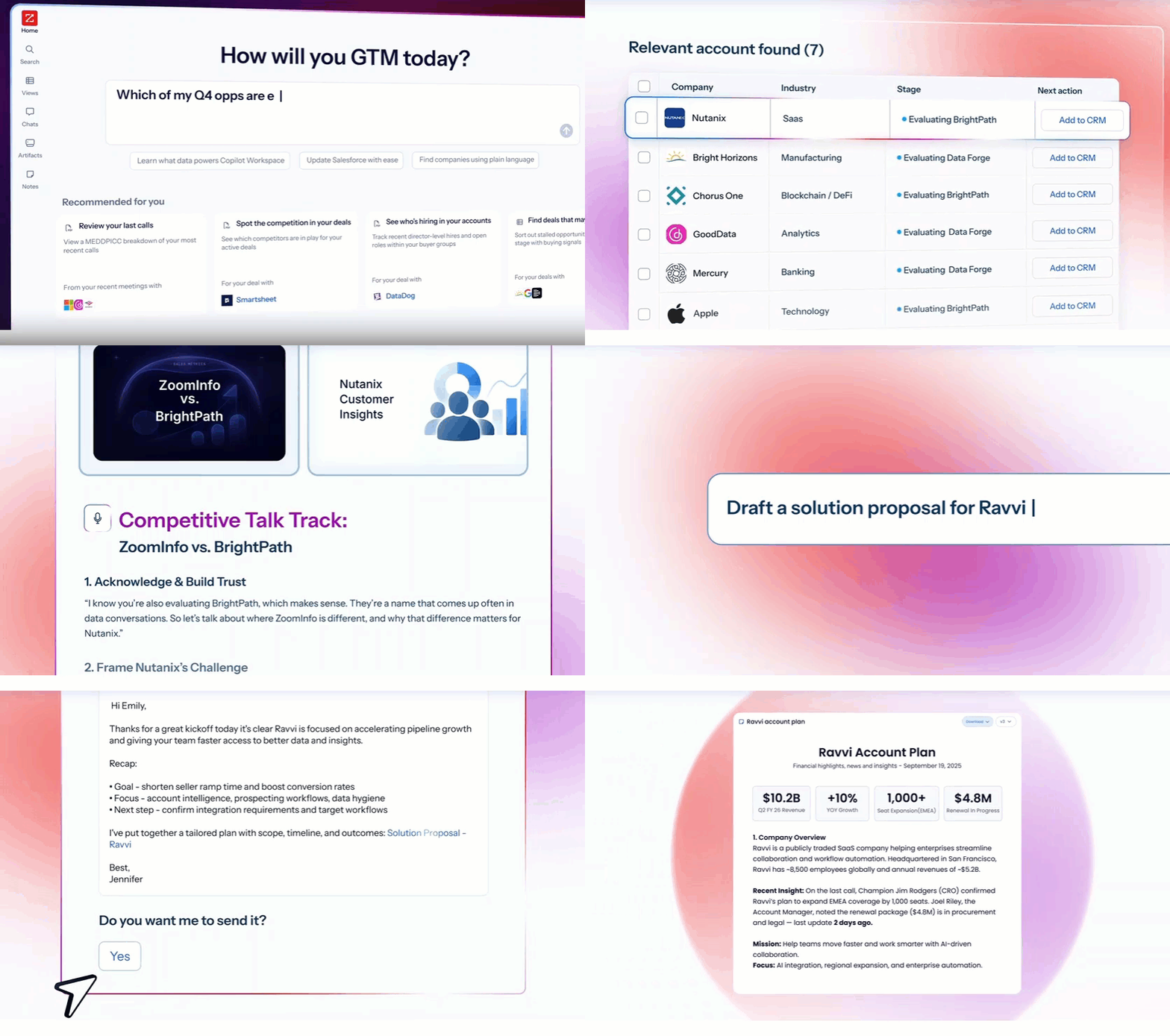
But over 18 years of investment, including acquisitions of Chorus (conversation intelligence), Clickagy (intent signals), NeverBounce (email verification), and RingLead (data orchestration), ZoomInfo grew from a data provider into a go-to-market platform.
The result is three layers that work together. First, the largest B2B data platform in the category. Second, the GTM Context Graph, which processes 1.5 billion+ data points daily, combining that data with your CRM, conversation intelligence, and behavioral signals to understand why deals move or stall. Third, access through native products and open APIs, so the data reaches every team and tool.
Nimbler provides contact records. ZoomInfo provides the infrastructure to act on them.
Nimbler keeps contact data simple and affordable
Nimbler is built to be simple. The platform has three core modules, and each does one thing well.
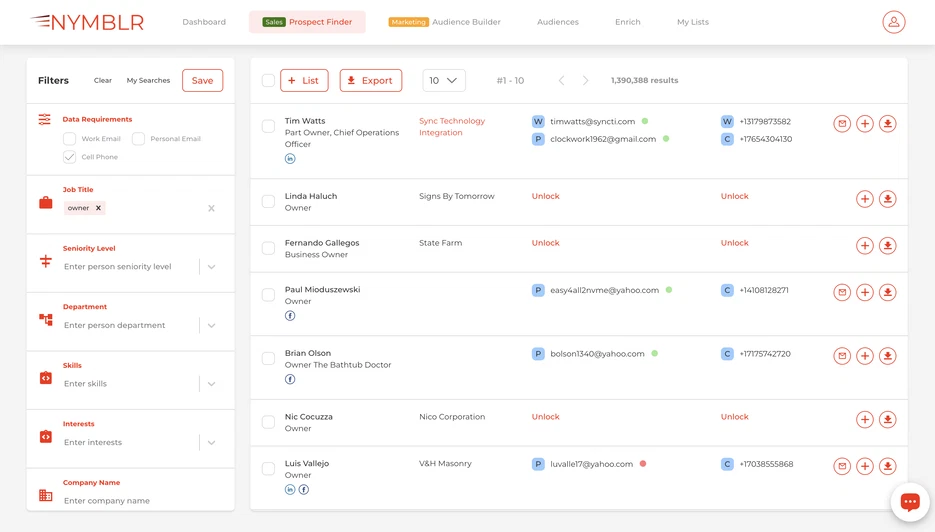
Prospect Finder lets users search the database using filters for job title, seniority, department, industry, SIC code, company size, revenue range, state, and city. One useful feature: users can set data requirement filters before results appear.
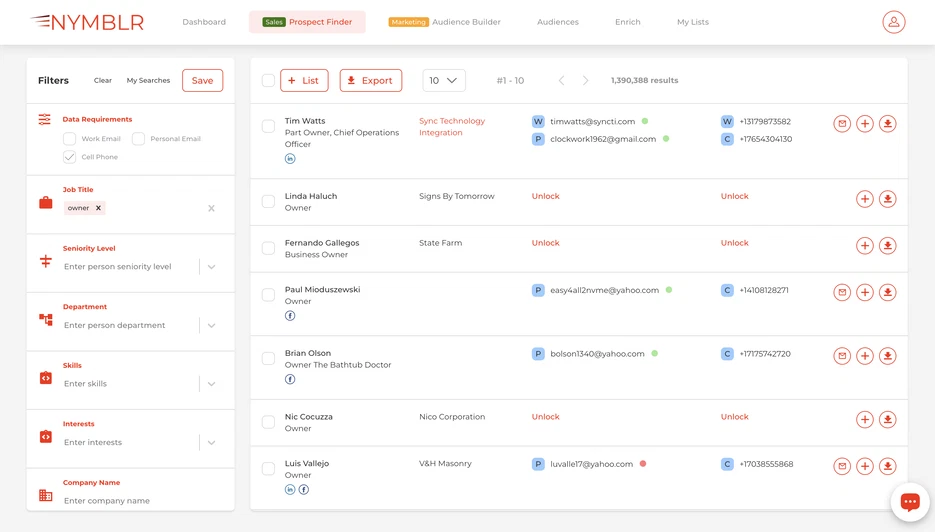
Source: Appsumo
If you need every contact to have a mobile number, Prospect Finder excludes incomplete records upfront. Work emails are validated in real-time during the search with color-coded indicators (green for valid, yellow for catch-all, red for invalid), so users never spend credits on undeliverable addresses.
Data Enrichment takes existing contact identifiers (a mobile number, LinkedIn URL, or email address) and expands each into up to 50 data attributes, covering work email, personal email, mobile number, social profiles, job title, company details, skills, and education.
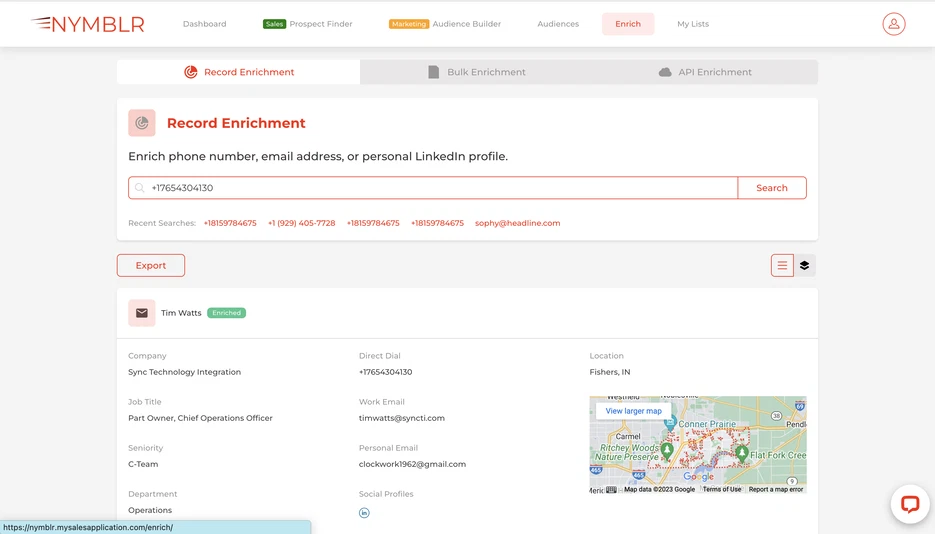
Source: Appsumo
The platform claims a 96% work email validity rate on enriched records. Nimbler charges credits only for validated contacts; accept-all and unknown-status emails are not billed.
Audience Builder connects prospect data to paid advertising by letting users export filtered contact lists as custom audiences for Facebook, Google, and LinkedIn ad platforms. Because contacts pass real-time validation before export, match rates against ad-platform user profiles should be higher than lists exported from unverified databases.
The trade-off is what Nimbler leaves out. There are no native CRM integrations for Salesforce, HubSpot, or Pipedrive. Users must export CSV files and import them manually. There is no email sequencing, no intent data, no conversation intelligence, and no workflow automation. Nimbler handles the first step of prospecting (finding contacts) and leaves everything after that to other tools.
ZoomInfo provides the full go-to-market stack
ZoomInfo starts with a data layer much larger than Nimbler's, then adds intelligence and execution on top.
The data foundation spans 500 million contacts, 100 million companies, 135 million verified phone numbers, 120 million direct-dial phone numbers, and 200 million verified business email addresses. Global coverage includes 34 million company profiles outside North America, 200 million professional profiles outside NA, and 45 million mobile numbers outside NA.
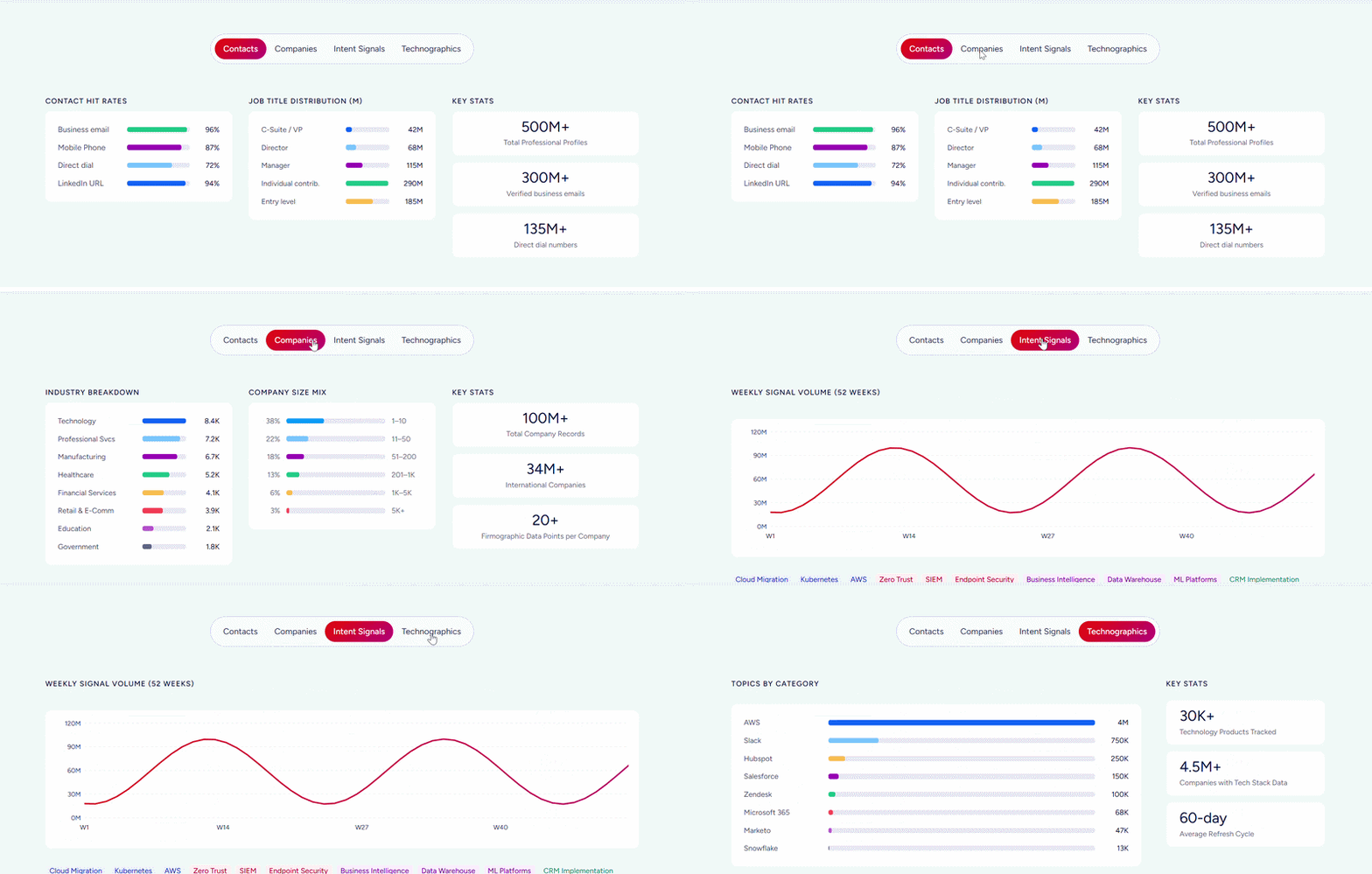
ZoomInfo maintains this data through automated ML scanning of 28 million site domains daily, third-party partner data covering 95 million businesses, a community of 200,000 ZoomInfo Lite users who share data back, and an in-house team of 300 human researchers.
The data is the starting point. ZoomInfo adds capabilities that Nimbler does not offer:
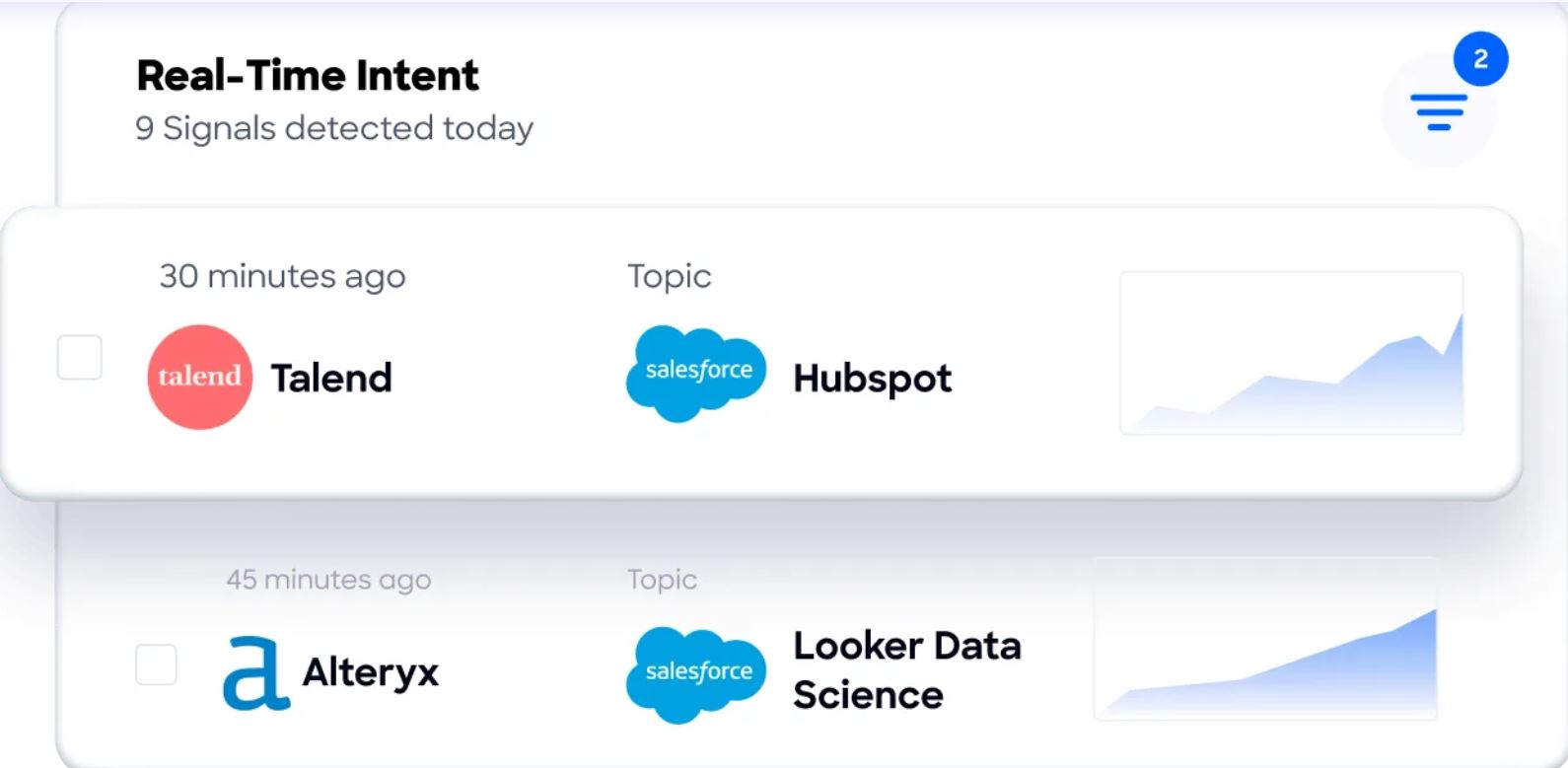
Buyer Intent Data. ZoomInfo Intent tracks signals from 210 million IP-to-Organization pairings and 6 trillion keyword-to-device pairings sourced monthly. Guided Intent, exclusive to ZoomInfo, identifies topics historically correlated with deal success rather than requiring manual topic selection.
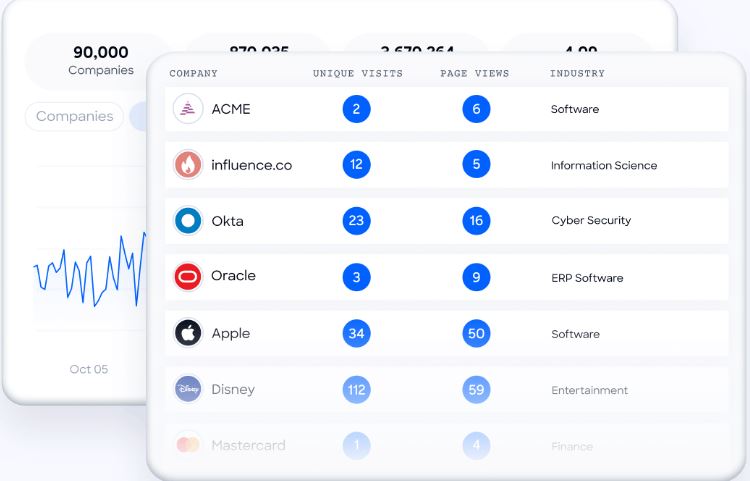
Website Visitor Tracking. WebSights resolves anonymous website traffic to companies and individuals, including buying team identification and direct contact info.
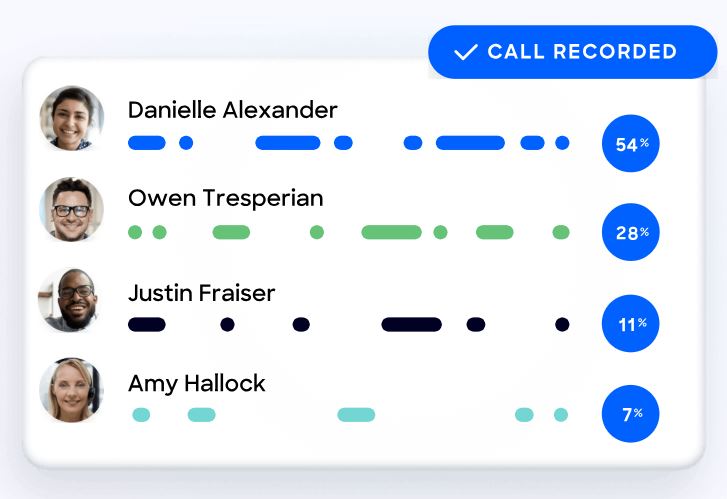
Conversation Intelligence. Chorus captures and analyzes customer calls, meetings, and emails, pulling out the context behind deal movements (why a champion went quiet, what a competitive mention means for deal risk).
Technographics. ZoomInfo profiles the tech stack of 30 million companies, tracking 30,000 technologies across 200 categories.
AI-Powered Execution. GTM Workspace gives sellers AI-drafted outreach, prioritized account feeds, and deal execution in one workspace.
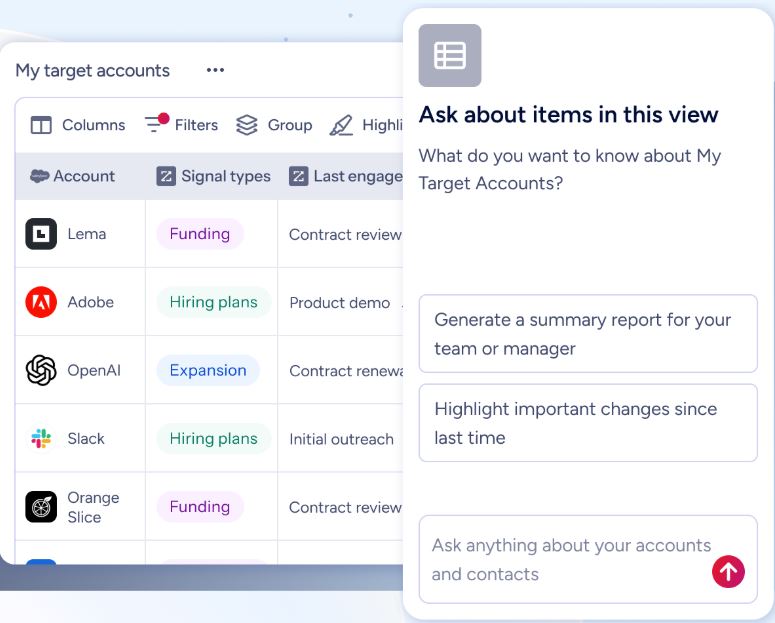
GTM Studio lets marketers and RevOps teams build audiences in natural language, launch multi-channel campaigns, and measure pipeline impact without engineering support.
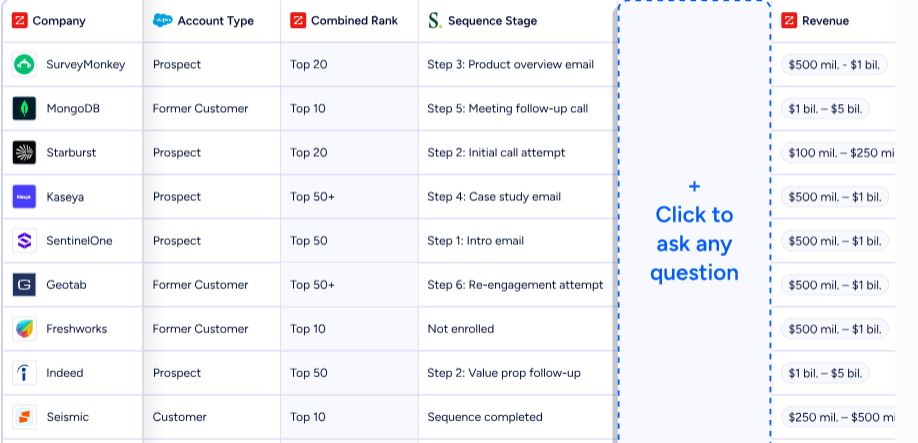
Seismic's sales team attributed 39% of active pipeline to opportunities identified or influenced by ZoomInfo signals, boosted productivity by 54%, and saved 11.5 hours per week. (Seismic)
Data quality and coverage: Scale versus specialization
Data accuracy matters more than database size. A million contacts are worthless if half the emails bounce.
Nimbler leads with real-time email validation as its quality claim. Every Prospect Finder search validates work emails automatically at no additional cost, and the platform claims a 96% work email validity rate on enriched records. The billing model (credits charged only for verified contacts) protects users from paying for bad data.
Source: Appsumo
However, the underlying database refreshes at minimum once per quarter, too slow given how quickly B2B contacts change jobs. Some users have reported accuracy degradation over time. One AppSumo reviewer pulled 2,000 contacts and found only 279 valid leads despite roughly 400 marked as good.
Coverage remains primarily US-based, though post-acquisition claims from Datarade suggest 140 million global contacts across 250 countries. Whether non-US prospecting is fully available through the platform interface remains unclear.
ZoomInfo verifies data at a different scale. The pipeline combines automated ML scanning of 28 million domains daily, human verification from 300 researchers, and community contributions from 200,000 ZoomInfo Lite users. First-party data reaches up to 95% accuracy. Unlike quarterly batch refreshes, ZoomInfo monitors data continuously and updates records in real time when changes appear.
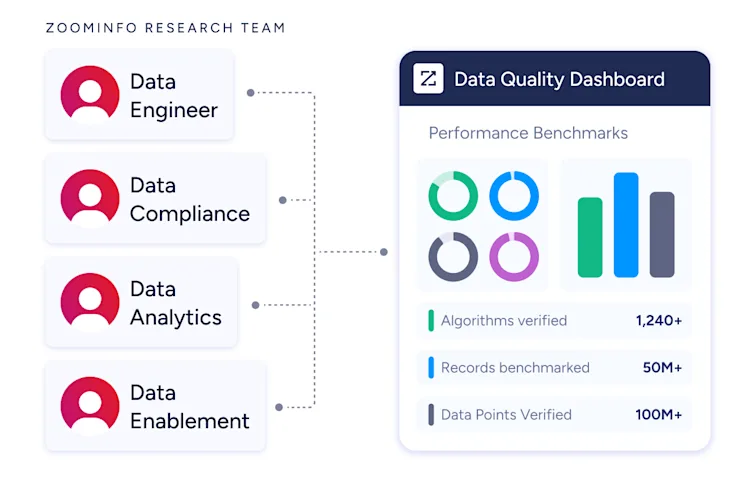
These claims are not self-reported. In a Fortune 500 competitive RFP analyzing 25 million contacts across vendors, an independent consultant concluded that "no other competitor came even close."
ZoomInfo earned 133 No. 1 rankings on G2 in Summer 2025 across Sales Intelligence, Data Quality, and related categories, and was named the only Customers' Choice vendor in the 2025 Gartner Voice of the Customer report with a 4.7 out of 5.0 average rating.
In 2025 alone, ZoomInfo added 10.2 million contacts through enhanced title classification, expanded international mobile coverage by 1.8 million numbers across six European markets, and verified location data for 160 million contacts.
SpringDB saw 2x to 3x increases in campaign conversions, a 300% increase in database usability, and a 30-50% uplift in average deal size using ZoomInfo's enriched data. (SpringDB)
Integrations and workflow: Manual export vs. connected execution
How data moves from your prospecting tool into your sales stack determines how much time your team spends on administration versus selling.
Nimbler requires manual data transfer for nearly every downstream action. There are no native CRM connectors for Salesforce, HubSpot, or Pipedrive. Users export contacts as CSV files and import them into their CRM, outreach tools, or ad platforms by hand.
The REST API is included on all plans, covering contact search, enrichment, and email validation endpoints, giving technical teams a path to automation. But for non-technical users, the workflow is: search, export, import, repeat.
This extends to campaign execution. Nimbler has no email sequencing. A G2 reviewer who switched from Apollo.io flagged email automation as missing, forcing a two-tool workflow. The Audience Builder exports lists for Facebook, Google, and LinkedIn ads, but these are one-directional CSV exports, not bidirectional integrations.
ZoomInfo works the opposite way: data flows automatically to every tool where decisions happen. The App Marketplace lists over 120 integrations spanning CRM, marketing automation, sales engagement, data warehouses, and communications platforms.
Native connectors for Salesforce, HubSpot, Microsoft Dynamics 365, Snowflake, Outreach, and Salesloft mean contacts, intent signals, and enrichment data sync automatically without manual file handling.
For teams building custom workflows, ZoomInfo provides Enterprise APIs with endpoints for search, enrichment, AI intelligence, audience management, and engagement data.
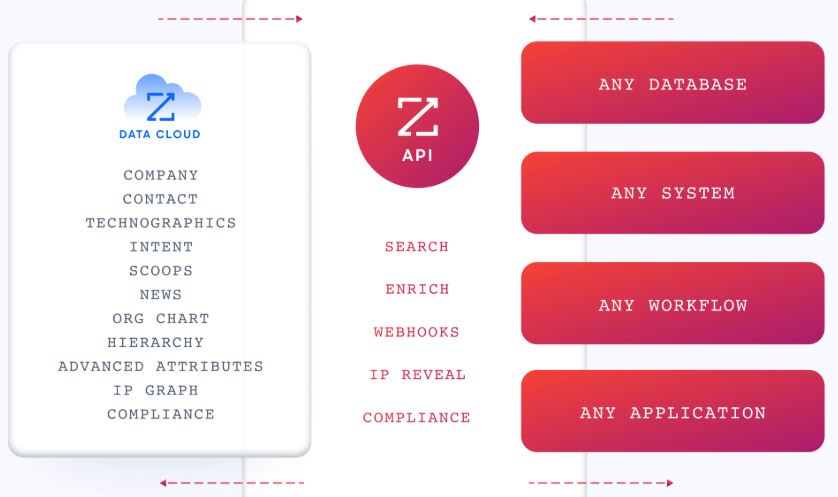
The MCP server connects AI models directly to ZoomInfo data through natural language, supporting Claude and ChatGPT with additional platforms noted as coming soon. API access is included in all relevant plans.
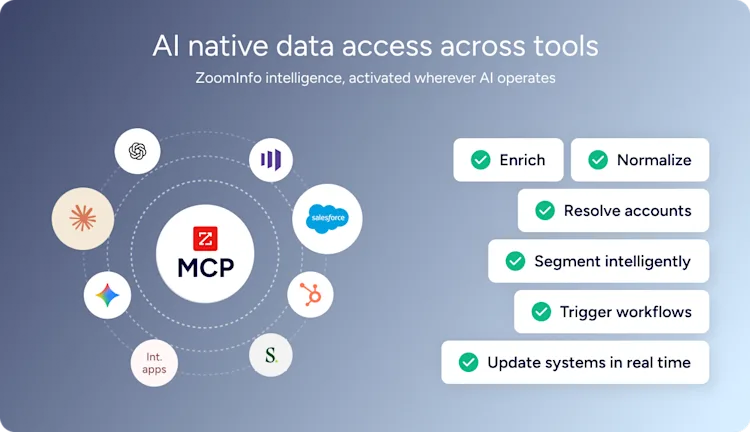
The workflow difference compounds over time. A Nimbler user who prospects 100 contacts per day spends time exporting CSVs, importing into a CRM, and manually triggering outreach. A ZoomInfo user in GTM Workspace sees prioritized accounts with AI-drafted outreach already tailored to each deal, then updates CRM without leaving the page.
BDO Canada's Senior Marketing Intelligence Analyst Jerry Wilson reported that the "plug-and-play aspect of the API means I can integrate it very easily into any process and get information at a moment's notice," achieving an 87% reduction in time spent on internal data dashboard updates. (BDO Canada)
Pricing: Accessible monthly billing vs. enterprise investment
Nimbler structures pricing around monthly credit allotments with unlimited users. Plans include a Starter at roughly $100/month for 1,000 credits and an All-Inclusive at $250/month for 10,000 credits. Enterprise data licensing scales up to $150,000/year for bulk API and data-feed access.
Every plan includes the full feature set: Prospect Finder, Data Enrichment, Audience Builder, white-label capability, and developer APIs. There are no per-seat charges, no mandatory annual contracts, and no onboarding fees. The credit model charges only for validated contacts, so unverifiable email addresses do not consume credits.
A free trial is available, though specific credit limits and duration are not publicly documented.
ZoomInfo uses custom-quoted, seat-and-credit-based pricing with no public price list. Costs depend on user count, monthly credit volume, selected features, and contract length. Annual contracts are standard. The cost is higher than Nimbler's, but it covers capabilities (intent data, conversation intelligence, AI agents, marketing automation, 120+ integrations) that Nimbler does not offer at any price.
ZoomInfo provides two free entry points. ZoomInfo Lite is a permanent free tier (not a trial) that includes access to the B2B database, 10 monthly export credits, individual and company searches, the ReachOut Chrome Extension, WebSights Lite (up to 10 website visitor reveals per day), and HubSpot integration. A separate 7-day free trial provides access to core features without requiring a credit card.
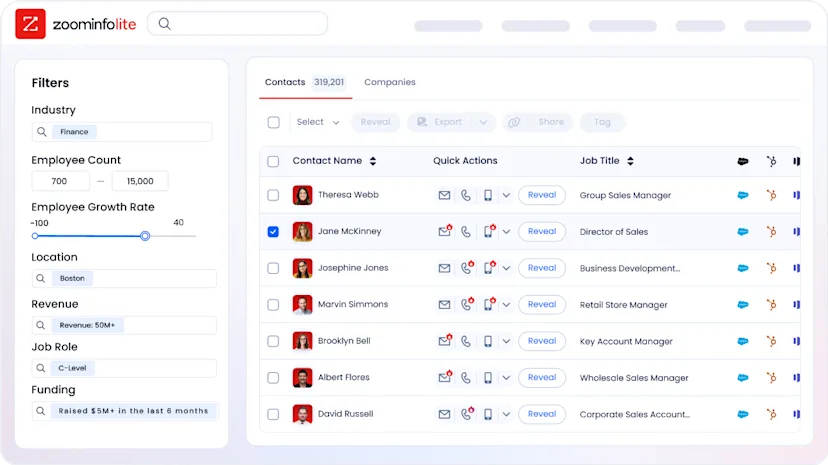
The pricing difference comes down to scope. Nimbler costs less because it does less. A five-person sales team that only needs verified US email addresses and phone numbers can operate on Nimbler for $250/month. A team that needs intent signals, CRM enrichment, automated workflows, conversation intelligence, and global coverage needs ZoomInfo, and the price reflects that.
Security and compliance
Nimbler states GDPR and CCPA compliance in its licensing terms, confirmed by Datarade. Real-time email validation is built into the platform.
However, no third-party security certifications (SOC 2, ISO 27001, or similar) are publicly documented. For small teams running outbound campaigns, this may be enough. For companies in regulated industries or with enterprise procurement requirements, the lack of independent security validation is a gap.
ZoomInfo holds certifications renewed annually: ISO 27001 (information security), SOC 2 Type II (security, confidentiality, and availability), ISO 27701 (privacy information management), and TRUSTe validations for GDPR and CCPA. ZoomInfo is a registered data broker in California and Vermont and maintains a dedicated Trust Center.
For enterprise buyers evaluating data vendors, ZoomInfo's security meets the standard that procurement and legal teams expect. Nimbler's compliance statements cover the basics but lack the independent verification that larger organizations require.
Nimbler vs. ZoomInfo: Which should you choose?
The choice between Nimbler and ZoomInfo depends on what your team needs now and where your go-to-market operation is headed.
Choose Nimbler if:
You are a small sales team, marketing agency, or solo operator on a tight budget
Your prospecting focuses on the US market
You need verified contact data (emails, phone numbers) and nothing more
You are comfortable exporting CSV files and importing into your CRM manually
Unlimited user seats matter more than advanced features
You want month-to-month billing with no annual commitment
White-label capability for agency clients is a priority
Your outreach tools handle sequencing, and you just need contact data to feed them
Choose ZoomInfo if:
You need more than contact data: intent signals, conversation intelligence, and AI-powered execution
Your team prospects globally, not just in the US
Native CRM integration with Salesforce, HubSpot, or Dynamics is a requirement
You want AI-powered account prioritization and outreach, not just a searchable database
Data accuracy and freshness at scale are critical for your pipeline
Your marketing team needs ABM capabilities, ad targeting, and multi-channel orchestration
You need conversation intelligence to understand why deals move or stall
Security certifications (ISO 27001, SOC 2 Type II) are required by your procurement process
You want to power custom AI agents and internal tools through APIs and MCP access
Get a ZoomInfo free trial here!
Levanta CEO Ian Brodie described ZoomInfo as "not just a contact data company anymore. They've built a full system of execution. GTM Intelligence actually works the list, writes the outreach, triggers the play, and helps drive predictable growth." (Levanta)
Nimbler solves a real problem for a specific audience: small teams that need affordable, verified US contact data without enterprise complexity. Its unlimited seats, real-time email validation, and month-to-month pricing make it a practical choice for agencies and startups watching every dollar. The platform does what it promises within its scope.
ZoomInfo operates at a different level. With 35,000 customers including Adobe, Snowflake, and PayPal, $1.25 billion in annual revenue, and recognition as a Leader in the Gartner Magic Quadrant for ABM Platforms and the Forrester Wave for Intent Data Providers, it is the standard for enterprise go-to-market teams.
The investment is larger, but it replaces separate tools for contact data, intent monitoring, conversation intelligence, marketing automation, and workflow orchestration.
The question is not which platform has better data. It is whether your team needs a contact database or a go-to-market engine. If you just need names and numbers, Nimbler can deliver. If you need to understand your market, prioritize the right accounts, and execute with AI, ZoomInfo is built for that.
Nimbler vs. ZoomInfo FAQ
What is the main difference between Nimbler and ZoomInfo?
Nimbler is a B2B contact data platform that provides verified US-based emails and phone numbers at affordable pricing for small teams. ZoomInfo is a go-to-market platform that combines 500 million contacts with intent data, conversation intelligence, AI-powered execution tools, and 120+ native integrations. Nimbler provides contact records; ZoomInfo provides the intelligence and workflow to act on them.
How do Nimbler and ZoomInfo compare on database size?
Nimbler covers over 120 million US-based B2B contacts and 4 million companies. ZoomInfo covers 500 million contacts, 100 million companies, 135 million verified phone numbers, 120 million direct-dial numbers, and 200 million verified business emails, with global coverage including 34 million company profiles and 200 million professional profiles outside North America.
Does Nimbler integrate with Salesforce or HubSpot?
Nimbler does not offer native CRM integrations for Salesforce, HubSpot, or Pipedrive. Users must export contacts as CSV files and import them manually. A REST API is available on all plans for teams that can build custom integrations. ZoomInfo offers native connectors for Salesforce, HubSpot, Microsoft Dynamics 365, and over 120 other platforms through its App Marketplace.
Is Nimbler cheaper than ZoomInfo?
Nimbler's pricing is lower, starting at roughly $100/month for 1,000 credits and $250/month for 10,000 credits, with unlimited user seats and no annual contract required. ZoomInfo uses custom-quoted enterprise pricing that is higher but covers capabilities Nimbler does not offer, including intent data, conversation intelligence, AI agents, marketing automation, and enterprise integrations.
ZoomInfo also offers a permanent free tier (ZoomInfo Lite) with 10 monthly export credits.
Does ZoomInfo offer a free plan?
Yes. ZoomInfo Lite is a permanent free tier that includes access to the B2B database, 10 monthly export credits, individual and company searches, the ReachOut Chrome Extension, WebSights Lite for website visitor identification, and HubSpot integration. No credit card or annual commitment is required. A separate 7-day free trial with broader feature access is also available.
Which platform has better data accuracy?
ZoomInfo's data accuracy has been independently validated. In a Fortune 500 competitive RFP analyzing 25 million contacts across vendors, an independent consultant concluded that no other competitor came close. ZoomInfo claims up to 95% accuracy on first-party data, maintained through continuous monitoring and a team of over 300 human researchers.
Nimbler claims 96% work email validity on enriched records with real-time validation, though some users have reported accuracy degradation with larger pulls and over time due to the platform's quarterly database refresh cycle.
Can Nimbler handle international prospecting?
Nimbler was built for US-based contacts. The founder confirmed at launch that coverage was limited to US contacts only. Post-acquisition listings suggest expanded coverage to 140 million global contacts across 250 countries, but whether non-US prospecting is fully available through the platform interface has not been independently confirmed.
ZoomInfo provides established global coverage with 34 million company profiles and 200 million professional profiles outside North America.
Does ZoomInfo offer intent data and conversation intelligence?
Yes. ZoomInfo Intent tracks buying signals from 210 million IP-to-Organization pairings and over 6 trillion keyword-to-device pairings sourced monthly. Guided Intent, exclusive to ZoomInfo, identifies topics historically correlated with deal success. Chorus, ZoomInfo's conversation intelligence product, captures and analyzes customer calls, meetings, and emails to extract the context behind deal movements.
Nimbler does not currently offer intent data or conversation intelligence.
Weighing Nimbler against ZoomInfo? See how it stacks up elsewhere:
