
Ocean.io occupies a specific niche in the B2B data market: AI-powered lookalike search. The idea is simple. Feed the platform a URL of your best customer, and its AI engine returns a ranked list of companies that resemble it. For teams frustrated by the blunt filters of SIC and NAICS codes, that premise is compelling.
To write this Ocean.io review, we analyzed it thoroughly. We believe it's the right choice if:
You have a defined ideal customer profile and want to find more companies that match it
You sell into European markets and need GDPR-compliant data from a European provider
You target specific niches that generic industry codes can't isolate
You want a simple prospecting tool without a steep learning curve
Your team is small enough that 500 to 2,000 monthly credits cover your needs
However, Ocean.io might not be the best choice if:
You need a go-to-market platform covering sales, marketing, and operations
You require strong US contact data with high hit rates on direct dials and verified emails
You need company hierarchy data showing parent-subsidiary relationships
You want buyer intent signals, conversation intelligence, and deal execution tools in one place
You're scaling beyond niche prospecting into pipeline management and multi-channel orchestration
In this case, you should consider ZoomInfo: a GTM platform that goes well beyond prospecting data. ZoomInfo combines a large B2B dataset (500M contacts, 100M companies, 135M+ verified phone numbers, and 200M+ verified business emails) with an intelligence layer called the GTM Context Graph. The Context Graph merges your CRM records, conversation transcripts, and behavioral signals to reveal not just what's happening in your deals, but why. That intelligence is accessible through GTM Workspace for sellers, GTM Studio for marketers and RevOps, or APIs and MCP in any third-party tool.
We've included a detailed look at ZoomInfo later in this Ocean.io review as the broader alternative for teams that need more than a prospecting database. If you're ready to explore a full GTM platform, you can start with ZoomInfo Lite for free.
What is Ocean.io?
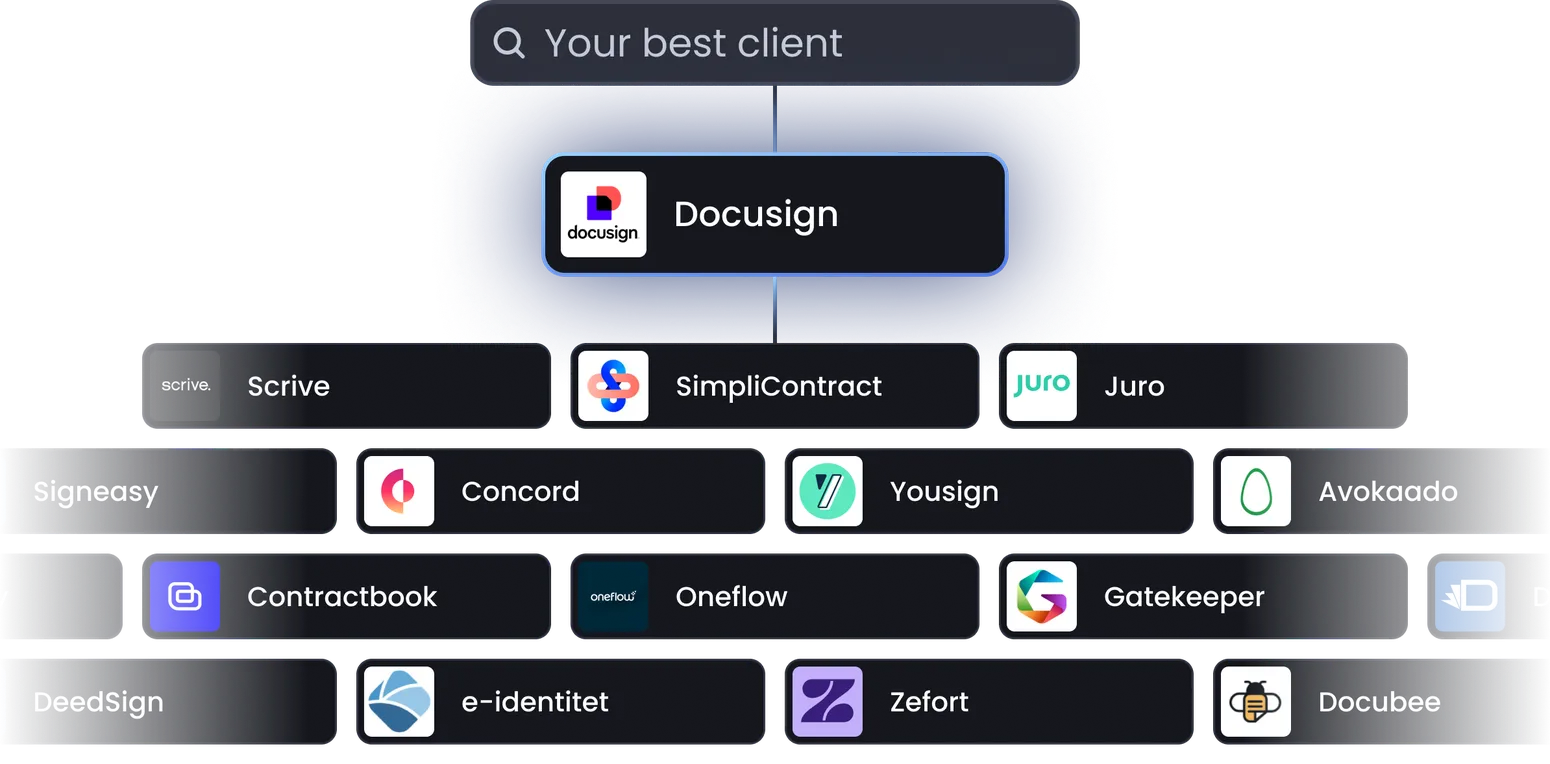
Ocean.io is a B2B data platform founded in 2017 by Michael Heiberg in Copenhagen, Denmark. Heiberg built it out of frustration with how crude keyword-based data matching was for B2B prospecting. Early versions used simple keyword embeddings, but by 2019 the team had rebuilt the engine on a contextual vectoring approach that translates company websites into mathematical vectors.
Source: Ocean.io
This lets the platform understand what companies actually do rather than relying on industry tags.
The company has raised more than $10 million in funding and reached $9.6M in ARR with approximately 64 employees as of 2024. Ocean.io has offices in Copenhagen and Minneapolis, with the US market as a stated expansion priority.
Ocean.io's database covers 35M company profiles and 250M+ LinkedIn profiles, and the platform claims a 98% CRM match rate. Its target buyers are B2B sales teams, ABM practitioners, and sales ops professionals who have a defined ideal customer profile and want to replicate their wins, particularly those selling into European markets.
Ocean.io Pros & Cons
Pros | Cons |
|---|---|
AI lookalike search finds niche companies generic filters miss | Contact data hit rates can be low outside Western Europe |
Intuitive interface with minimal learning curve | No company hierarchy data (parent/subsidiary) |
GDPR-compliant by design with strong European data | Annual contracts only, no monthly billing |
Well-reviewed customer support | Credit costs escalate quickly for phone numbers |
Chrome Extension available on all plans | Limited public review volume for enterprise validation |
Bombora-powered intent data integration | CRM integrations and API restricted to Professional+ |
Unlimited users on all plans | 35M company database is small relative to major competitors |
Ocean.io Review: How it Works & Key Features
AI Lookalike Search: Ocean.io's flagship feature finds companies similar to your best customers using contextual AI.
AI Lookalike Search is the reason most buyers evaluate Ocean.io. Traditional prospecting tools rely on industry codes and keyword filters that return broad, noisy results.
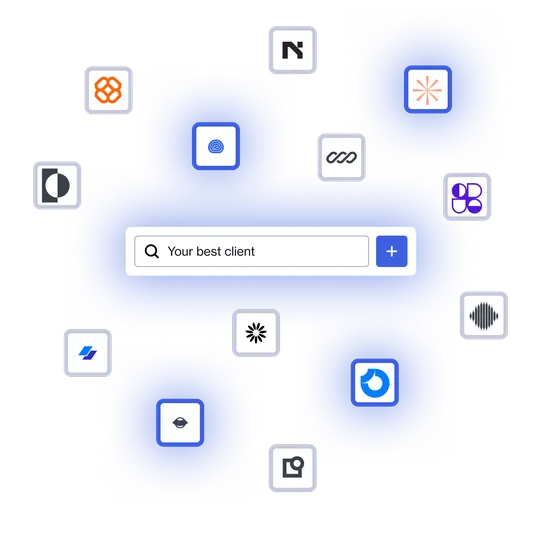
Ocean.io takes a different approach: submit one or more company URLs, and the vectorized NLP model analyzes those companies' websites, converts them into mathematical representations, and returns a ranked list of the most similar companies from its database.
Source: Ocean.io
The advantage is contextual understanding. Rather than matching keywords (where "orange" could mean a fruit or a color), the model reads the full context of company descriptions to determine what a company actually does. This lets the engine find subscription eCommerce companies, hydraulics manufacturers, or drone software makers (verticals that don't map to a single NAICS code).
Users can submit up to 10 seed company domains at once, set a minimum similarity score (default 0.79), and apply filters for geography, company size, revenue range, technographics, and keywords. A preview panel shows distribution stats before credits are consumed, so you can assess result quality without spending. Through the Clay integration, the same lookalike functionality works in automated workflows.
Each lookalike result costs 1 credit, which is reasonable for account-level discovery. Costs add up in the next step: enriching those accounts with contact data.
AI Company and People Search: Standard B2B prospecting with an AI-enhanced filter layer.
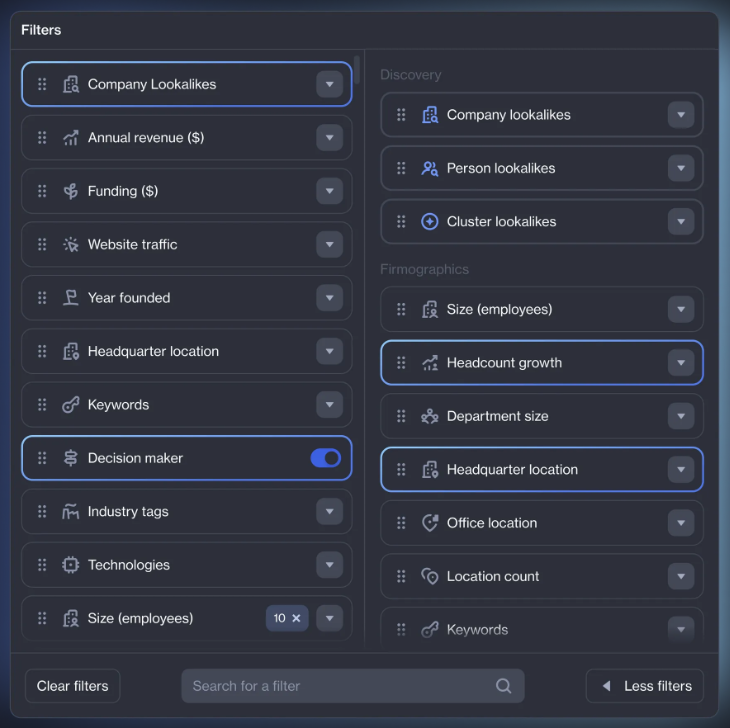
Beyond lookalike search, Ocean.io provides a company search interface with firmographic filters (industry, size, location, revenue, founding year) and technographic targeting. The AI layer applies contextual understanding to keyword searches, so a query for "logistics automation software" surfaces companies that actually do logistics automation, not just companies that happen to use those words.
Source: Ocean.io
The People Search sits on top of the company database, letting users filter contacts by role, seniority, and job title. Ocean.io returns verified business emails (3 credits per contact) and direct mobile phone numbers (10 credits per contact). The platform enriches contacts from 250M+ LinkedIn profiles and uses AI verification algorithms to reduce bounce rates.
Contact data is GDPR-compliant, limited to professional information only: business email and direct work phone. No personal emails or personal phone numbers are included.
One caveat: contact data hit rates vary by geography. Ocean.io's European coverage is strong, but multiple reviewers have reported lower match rates outside Western Europe. One Capterra reviewer reported only a 5% success rate with matched audience lists, a large gap between expectation and reality.
Intent Data and Enrichment: Buying signals powered by Bombora, plus CRM data enrichment.
Ocean.io provides intent data through its partnership with Bombora, one of the established B2B intent data providers. Bombora's Company Surge data tracks content consumption across a cooperative network of B2B media sites, identifying companies researching topics at an elevated rate.
Ocean.io layers these signals on top of its account lists and lookalike searches, letting users prioritize companies showing active buying behavior.
Additional intent signals come from job postings (a company hiring a "Salesforce Administrator" signals Salesforce adoption) and news mentions of relevant pain points or milestones. The combination of lookalike targeting plus intent signals is a useful prioritization mechanism not commonly available at Ocean.io's price point.
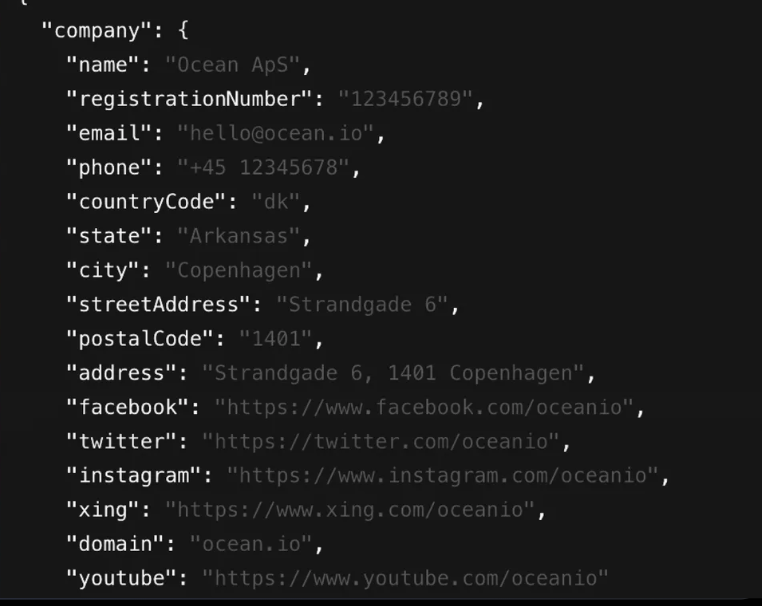
For data enrichment, Ocean.io connects natively to HubSpot, Salesforce, and Pipedrive (Professional plan and above). The platform matches existing CRM records to its database and appends missing firmographic and contact fields.
The API provides enrichCompany and enrichPerson endpoints for programmatic enrichment, and the company claims these automations save teams 20-30 hours per month on manual data cleaning.
Source: Ocean.io
Chrome Extension and API: Browser-based prospecting and programmatic access for automated workflows.
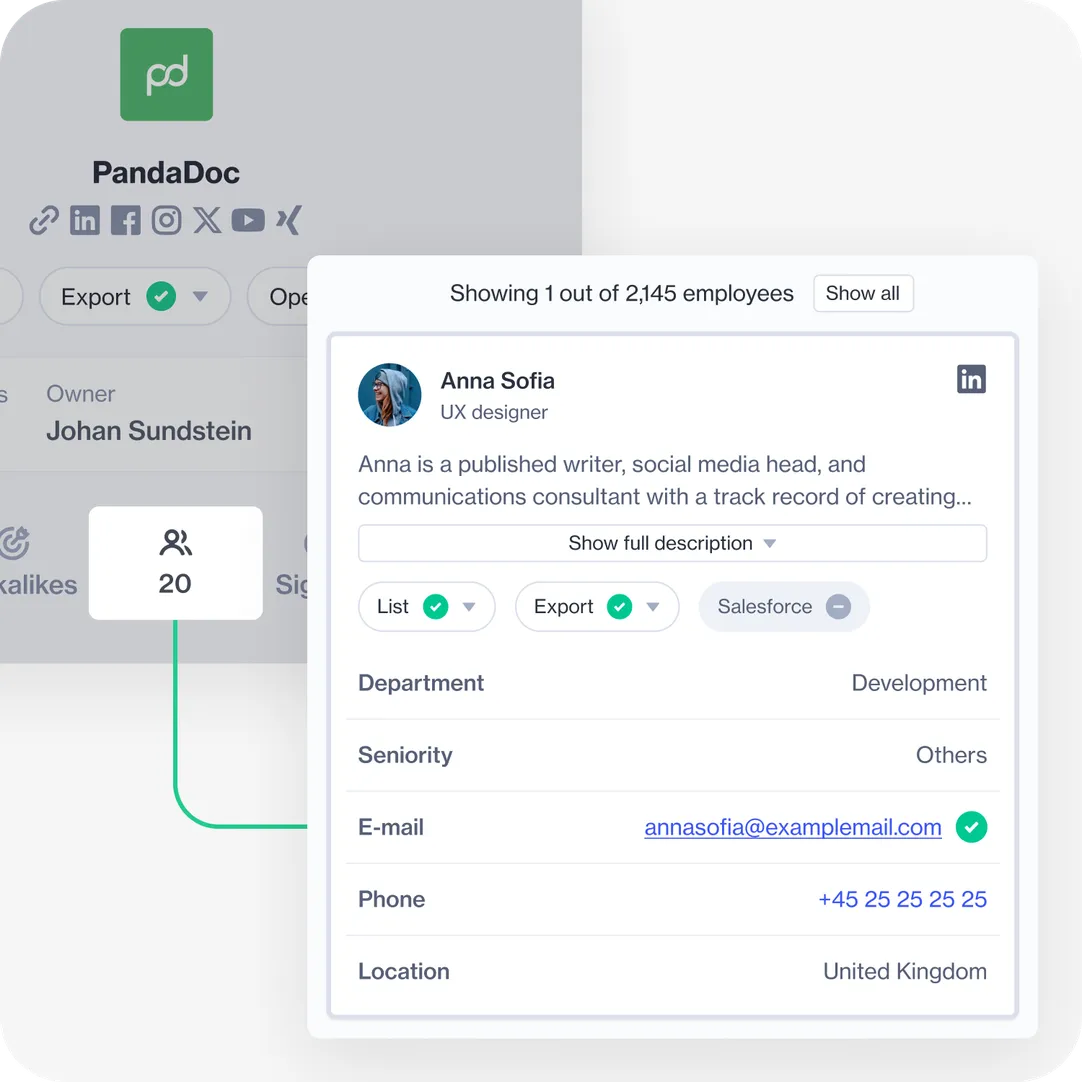
The Chrome Extension brings Ocean.io's data into the browser. When visiting a company website or LinkedIn profile, a sidebar displays firmographics, similar companies, key contacts, and funding data. Inside Gmail, the extension surfaces company data about the sender when reading an email.
Source: Ocean.io
It's available on all plans, including Starter, making it the most accessible entry point for SDRs who want quick lookups without navigating the full platform.
The API is REST-based and available on Professional and Enterprise plans. It provides programmatic access to lookalike search, company enrichment, and contact enrichment, using the same credit pool as the platform. The Clay integration gives no-code workflow builders access to Ocean.io's data without custom engineering, supporting up to 10 seed domains per lookalike query.
Pricing: Credit-based model with annual billing only.
Ocean.io uses a credit-based pricing model where different actions consume different amounts of credits:
Action | Credit Cost |
|---|---|
Export company | 1 credit |
Show verified email | 3 credits |
Show mobile phone | 10 credits |
Email verification | 1 credit |
Starter ($79/month, billed annually):
500 company, 500 contact, and 500 email verification credits per month
Chrome Extension
Unlimited users
No CRM integrations, no API, no lookalike audiences
Professional ($299/month, billed annually):
2,000 credits across company, contact, and email per month
CRM integrations (HubSpot, Salesforce, Pipedrive)
API access, lookalike audiences, data cleansing
Dedicated Customer Success Manager and phone support
Enterprise (custom pricing, typically $800-2,000/month):
All Professional features with custom credit allocations
SLA guarantee and priority support
A 14-day free trial is available, though a credit card is required and users go through a qualification process. No permanent free plan exists. All paid plans require annual contracts with no monthly billing option.
The credit math matters. On the Professional plan, 10 credits per phone number means you can retrieve just 200 verified mobile numbers per month before hitting overages. Overage pricing runs $0.05-$0.15 per credit, and most customers reportedly exceed plan limits within 90 days.
Where Ocean.io Falls Short
Ocean.io's lookalike search is genuinely differentiated, but several limitations surface as teams grow beyond niche prospecting into full go-to-market execution.
Limited Database Scale: Ocean.io's 35M company profiles cover a fraction of the global B2B market. For teams targeting a specific European niche, this may suffice. But for organizations that need broad coverage across North America, Asia-Pacific, or global enterprise accounts, the gaps become a constraint. Larger competitors maintain databases of 100M+ companies with deeper contact coverage.
No Company Hierarchy Data: Reviewers note that Ocean.io does not indicate whether a company is a parent, subsidiary, or independent entity. Enterprise sales teams mapping buying committees across complex organizations must do manual research to determine corporate structure.
Uneven Contact Data Quality: Contact coverage outside Western Europe can be inconsistent. When verified emails and phone numbers are the goal, hit rates vary by geography. For teams with a US-heavy or global target market, this creates a reliability problem that other providers don't share.
Credit Cost Escalation: The tiered credit system (1 for companies, 3 for emails, 10 for phones) means costs compound quickly for teams doing high-volume outreach. A team needing both email and phone for each contact spends 13 credits per person. On the Professional plan, that's roughly 150 fully enriched contacts per month before overages, a tight constraint for active sales teams.
No Multi-Channel Execution: Ocean.io is a data platform, not an execution platform. It has no conversation intelligence, no multi-channel orchestration, no AI-powered outreach drafting, no deal management, and no marketing automation. Teams using Ocean.io still need separate tools for everything after list-building, which means more integrations, more context-switching, and more vendor management.
Annual Lock-in with Limited Social Proof: With no monthly billing and fewer than 25 combined reviews on G2 and Capterra, buyers face the uncomfortable combination of a long commitment and limited external validation. Enterprise procurement teams accustomed to extensive peer review data may find this a difficult hurdle.
These limitations reflect Ocean.io's focus on one thing: AI-driven lookalike search for niche targeting. But for teams that need more than a prospecting database, they point toward platforms with broader capability across the go-to-market lifecycle.
Top Ocean.io Alternative for Full GTM Execution: ZoomInfo
ZoomInfo addresses Ocean.io's scope limitations by providing a GTM platform built on three pillars: broad B2B data, an intelligence layer that understands deal context, and access that delivers that intelligence into any tool.
Comprehensive B2B Data: ZoomInfo maintains a large, verified B2B dataset.
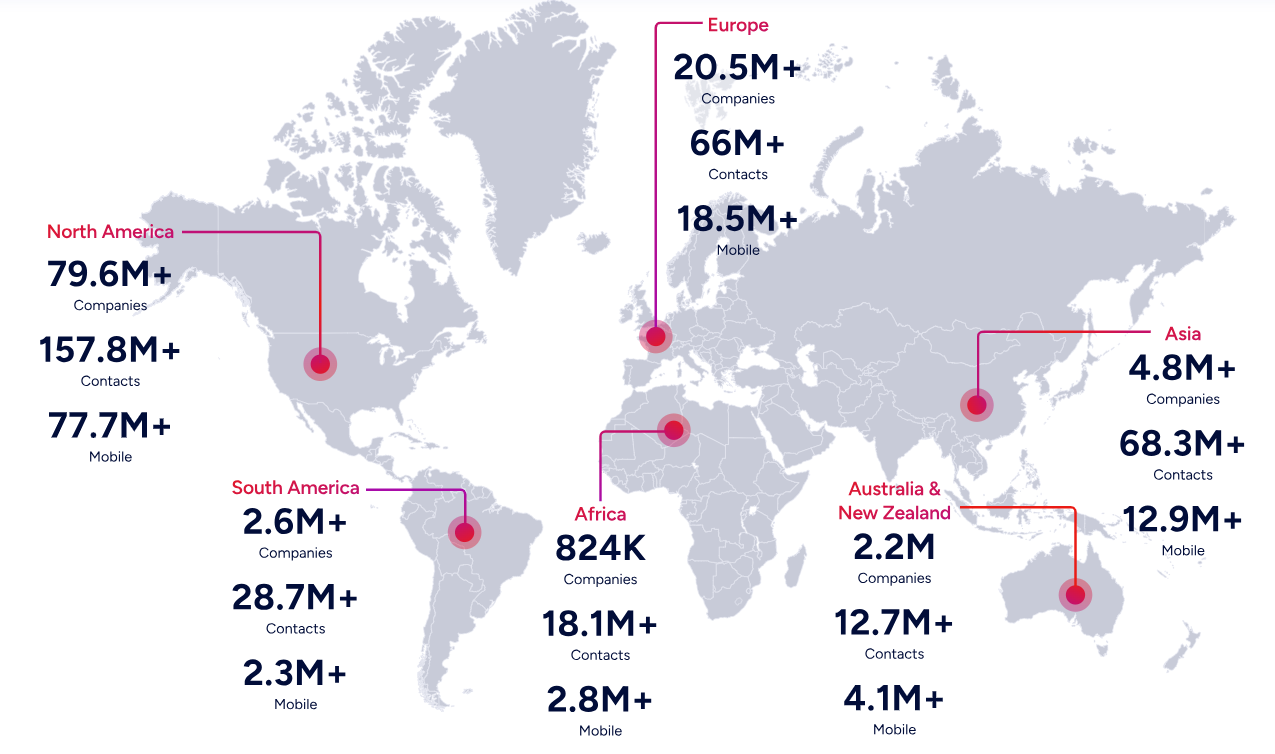
Where Ocean.io covers 35M company profiles, ZoomInfo's database spans 500M contacts, 100M companies, 135M+ verified phone numbers, 120M direct-dial phone numbers, and 200M+ verified business email addresses.
The data is verified through multiple sources: automated ML scanning 28 million site domains daily, third-party partner data covering 95 million businesses, a network of 200,000+ Lite users who share data back, and an in-house Data Training Lab of 300+ human researchers. First-party data reaches up to 95% accuracy.
The data covers three dimensions: identity data (who buyers are and how to reach them), company context (firmographics, parent-child hierarchy relationships, technographics across 30,000+ technologies, and org charts), and live signals (buyer intent, job changes, and funding events).
Global coverage extends to 34M+ company profiles and 200M+ professional profiles outside North America, plus 45M+ mobile numbers outside NA.
This data advantage has external validation. In a Fortune 500 competitive RFP analyzing 25 million contacts across vendors, an independent consultant concluded that "no other competitor came even close." ZoomInfo has been named a Leader in the Gartner Magic Quadrant for ABM Platforms for two consecutive years, a Leader in the Forrester Wave for Intent Data Providers, and holds 133 No. 1 rankings on G2 across Sales Intelligence, Buyer Intent, and Data Quality categories.
"ZoomInfo gives us the information we need to execute. We don't have to spend our time digging. It's already there, so we can be three steps ahead." (Vensure)
GTM Context Graph: ZoomInfo's intelligence layer captures why deals move, not just that they moved.
Ocean.io provides data.
ZoomInfo provides data plus context. The GTM Context Graph processes 1.5B+ data points daily, merging ZoomInfo's third-party B2B data with a customer's own CRM records, conversation transcripts, email interactions, and behavioral signals into a single intelligence layer.
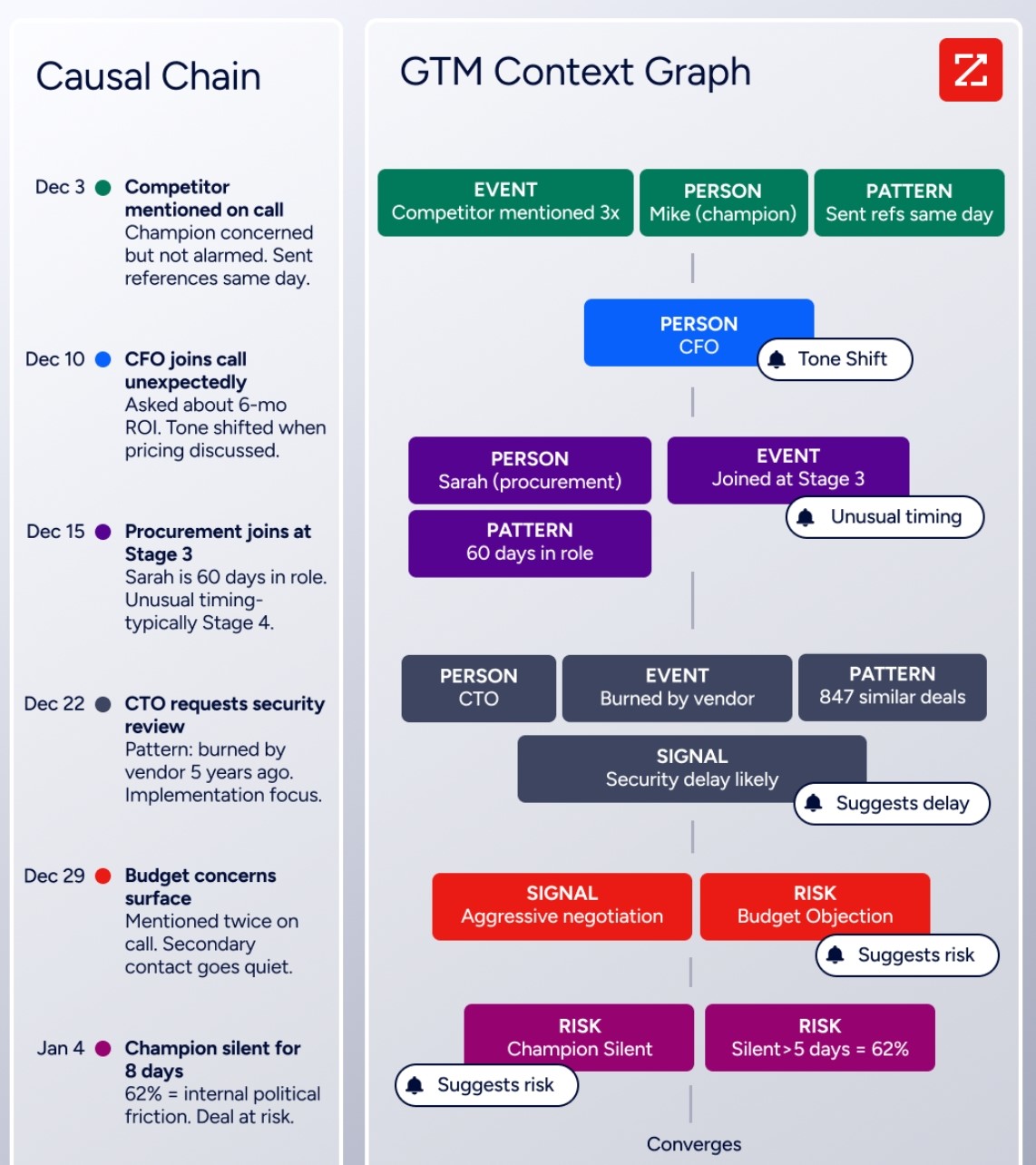
The practical difference: a CRM records that a deal moved from Stage 3 to Stage 4. It doesn't record why. Maybe the CFO joined the last call and asked about six-month ROI. Maybe the VP went quiet for eight days during an internal budget fight.
The GTM Context Graph captures these signals and makes them actionable. It reveals which deal patterns predict closed-won outcomes, which stakeholders are blocking progress, and what the next best action should be.
This capability exists because ZoomInfo spent two decades building data unification infrastructure and integrated Chorus's conversation intelligence engine to capture context from every customer call, meeting, and email. No prospecting-only tool can replicate this because none have both the data connections and the extraction layer required to understand deals in full.
"That combination of our internal CRM data, external signals, and AI that's given all that context has helped us craft very specific account- and persona-based messages. And people have responded to them right away." (Seismic)
Universal Access: Use ZoomInfo's intelligence in any tool, through any workflow.
Ocean.io's data is accessible through its platform, a Chrome Extension, and an API on Professional plans. ZoomInfo delivers its intelligence through three channels.
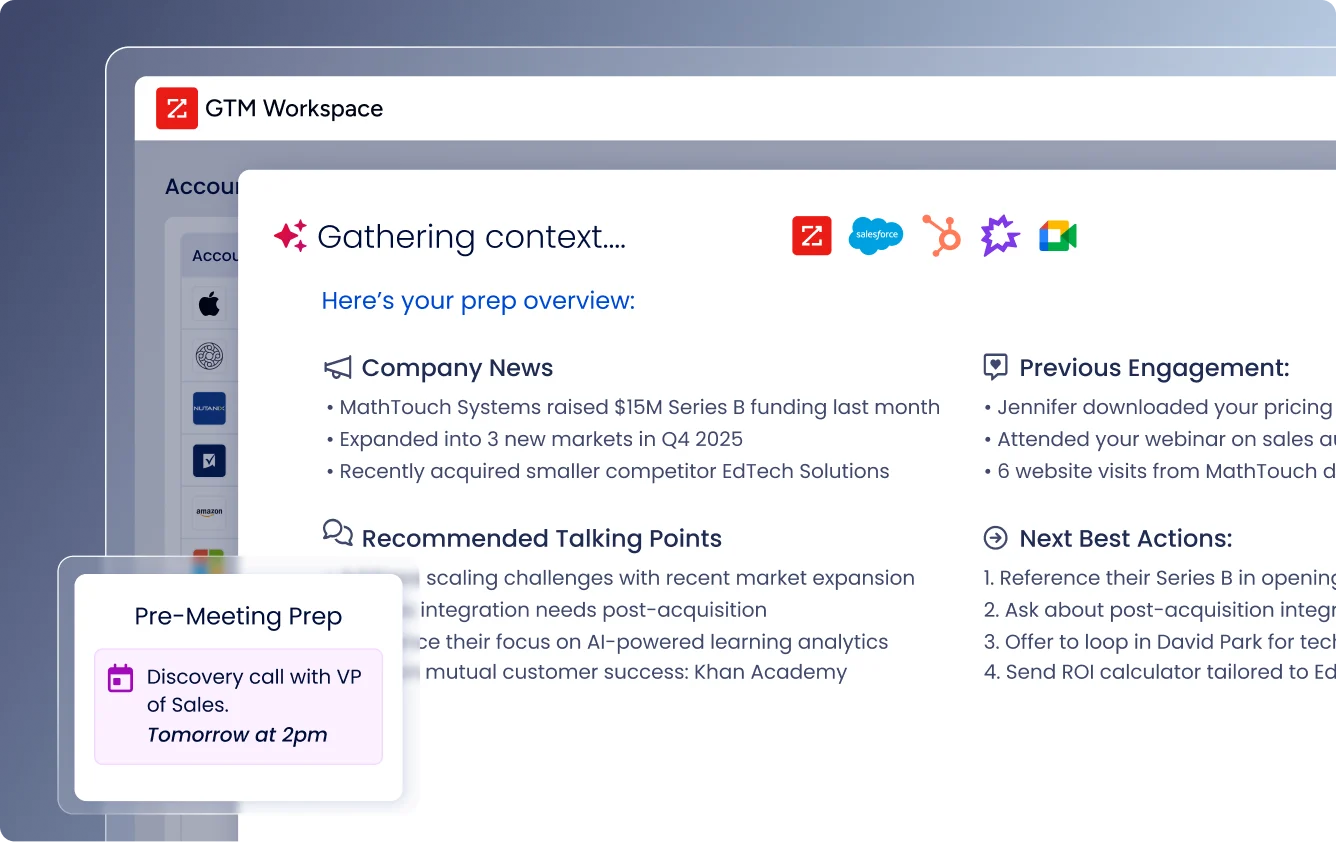
GTM Workspace gives sellers a single view where prioritized accounts, AI-drafted outreach, and deal execution converge. AI agents built on Anthropic's Claude handle account research, outreach drafting, CRM updates, and signal monitoring.
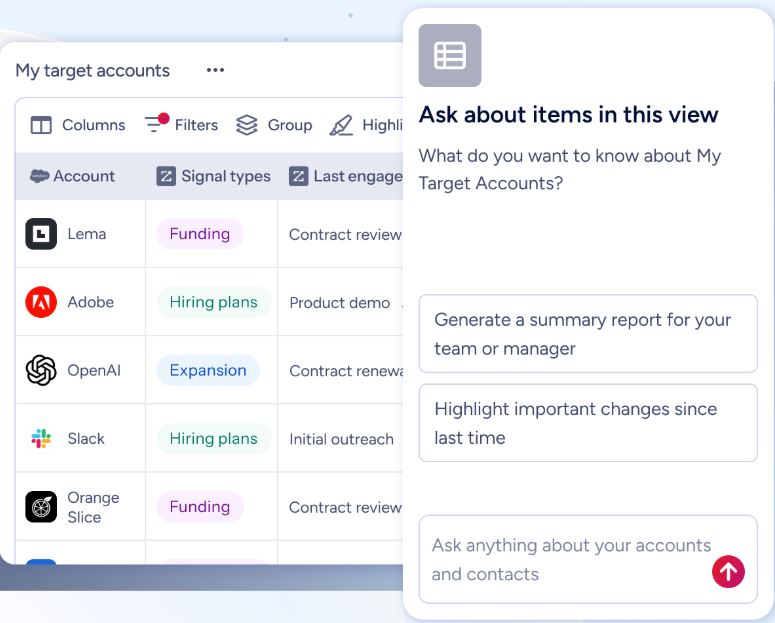
GTM Studio gives marketers, RevOps, and GTM engineers a builder environment where audience definition, campaign orchestration, and pipeline measurement happen in natural language, no engineering tickets required.
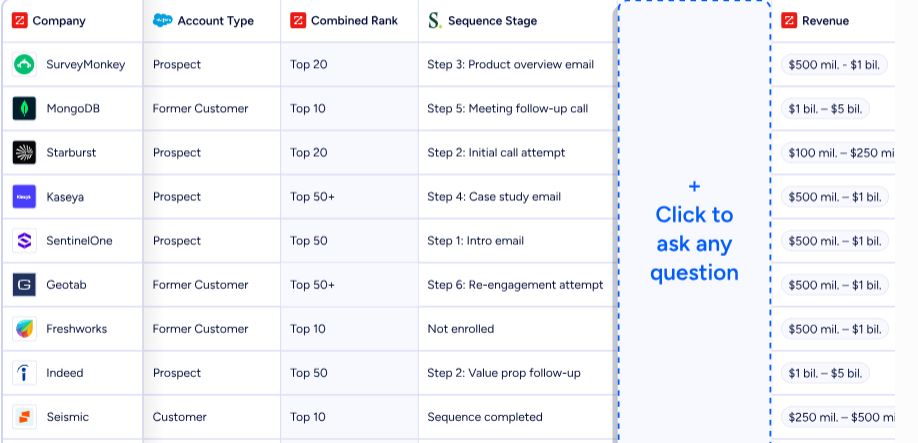
And APIs and MCP expose the same intelligence to any custom agent, internal tool, or partner platform.
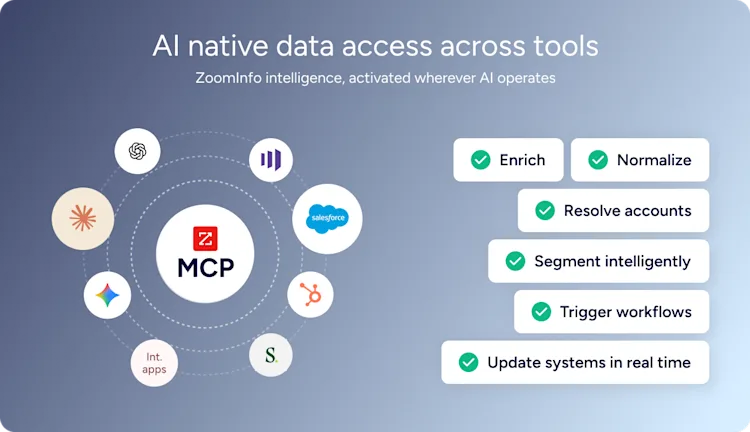
All three channels draw from one GTM Context Graph. A buying signal one team detects is immediately actionable by every other team.
"Without ZoomInfo, it would be extremely difficult, if not impossible, to achieve our business objectives. Without it, we wouldn't be able to understand the market, have the right contact data, and make meaningful connections." (Smartsheet)
Lookalike Search, Plus Everything Else: ZoomInfo includes similar-company discovery within a complete GTM platform.
Ocean.io's core value (finding companies similar to your best customers) is available inside ZoomInfo as well. The Find Similar Companies capability (accessible via the API and MCP) lets users expand from a seed account to lookalike companies, with results enriched by ZoomInfo's full data layer: verified contacts, org charts, intent signals, and technographics.
The difference is what surrounds it. With ZoomInfo, lookalike discovery is one step in a connected workflow.
You find similar companies, identify the buying committee using org charts and contact recommendations, layer on intent signals to prioritize accounts actively researching your category, draft personalized outreach using AI that understands the deal context, and execute across channels, all without leaving the platform or switching vendors.
Pricing That Scales With Your GTM Motion.
ZoomInfo uses a custom-quoted, seat-and-credit-based model. Costs depend on users, credit volume, features, and contract length.
For teams evaluating the platform, there are two free entry points. ZoomInfo Lite is a permanent free tier (not a trial) with access to the B2B database, 10 monthly export credits, individual and company search, the Chrome Extension, WebSights Lite, and HubSpot integration. A separate 7-day free trial provides access to core paid features with no credit card required.
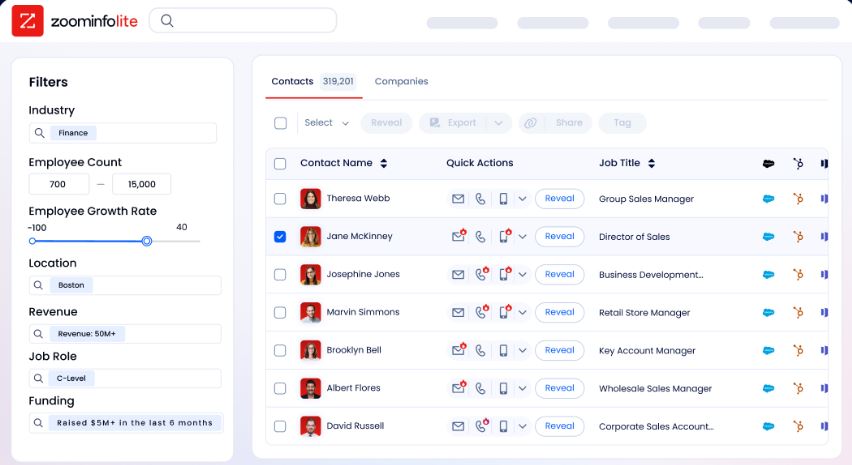
Paid plans are organized across Sales, Marketing, and Operations product lines, each with Professional, Advanced, and Enterprise tiers. These tiers differ in capability, not just credit volume.
Professional provides contact and company data with CRM integrations. Advanced adds buyer intent signals, website visitor tracking, and automated workflows. Enterprise adds real-time intent, AI-generated account summaries, and dedicated support.
ZoomInfo investment suits teams that will use the full GTM platform, not just the data. For organizations comparing the cost of assembling multiple point solutions (prospecting data, intent data, conversation intelligence, marketing automation, CRM enrichment) against a single platform, ZoomInfo's consolidated approach often delivers better value.
Ocean.io or ZoomInfo: Comparison Summary
Ocean.io | ZoomInfo | |
|---|---|---|
Primary focus | AI lookalike search and niche prospecting | AI GTM platform |
Company database | 35M company profiles | 100M companies |
Contact database | 250M+ LinkedIn profiles | 500M contacts, 200M+ verified emails, 135M+ verified phones |
Lookalike search | Core feature, up to 10 seed domains | Find Similar Companies via API/MCP |
Company hierarchy | Not available | Parent-child hierarchy data |
Intent data | Bombora partnership | Proprietary + Bombora, Guided Intent (exclusive) |
Conversation intelligence | Not available | Chorus (14 ML patents) |
AI-powered outreach | Not available | GTM Workspace AI agents |
Marketing automation | Not available | GTM Studio, native DSP, ABM |
CRM integrations | HubSpot, Salesforce, Pipedrive (Professional+) | Salesforce, HubSpot, Dynamics 365, 120+ marketplace integrations |
GDPR compliance | EU-headquartered, GDPR-native | ISO 27701, TRUSTe GDPR, SOC 2 Type II |
Free tier | 14-day trial only | ZoomInfo Lite (permanent, no credit card) |
Annual contract required | Yes, all plans | Annual standard, with free trial and Lite available |
Ease of use | Minimal learning curve | Broader platform with structured onboarding |
Best for | Niche European prospecting | Full go-to-market execution at scale |
Final Verdict
The choice between Ocean.io and ZoomInfo depends on what you need your data platform to do.
Choose Ocean.io if your main challenge is finding niche companies that generic industry filters miss, and your go-to-market motion is simple enough that a prospecting database is all you need. It suits small European-based sales teams with a defined ICP who want an intuitive, GDPR-compliant tool for AI-powered lookalike discovery. The platform does one thing, and it does it well.
Choose ZoomInfo if you need more than a prospecting database. ZoomInfo is built for teams that want to find accounts, understand buying committees, detect intent signals, draft AI-powered outreach, execute multi-channel campaigns, and manage deals from one platform powered by one intelligence layer.
With broad B2B data, the GTM Context Graph that captures why deals move, and access through GTM Workspace, GTM Studio, and APIs/MCP, ZoomInfo turns prospecting from a standalone activity into the first step of a connected go-to-market motion.
Get started with ZoomInfo Lite for free.
The gap between these two platforms reflects a difference in scope. Ocean.io helps you find accounts. ZoomInfo helps you find, reach, engage, and win them.
Ocean.io FAQ
What is Ocean.io best used for?
Ocean.io is best used for AI-powered lookalike search, where you submit a URL of an existing customer and the platform returns companies with similar profiles. It excels at finding niche verticals that generic SIC/NAICS code filters cannot isolate, such as subscription eCommerce companies or drone software makers.
The platform is particularly strong for European-based teams targeting GDPR-compliant prospecting.
How much does Ocean.io cost?
Ocean.io's Starter plan costs $79 per month billed annually, with 500 credits each for companies, contacts, and email verification. The Professional plan costs $299 per month billed annually, with 2,000 credits and access to CRM integrations, API, and lookalike audiences. Enterprise plans are custom-priced.
All plans require annual contracts with no monthly billing option. ZoomInfo offers a permanent free tier called ZoomInfo Lite with 10 monthly export credits and no time limit.
Does Ocean.io have a free plan?
No. Ocean.io provides a 14-day free trial that requires a credit card and a qualification process. ZoomInfo offers ZoomInfo Lite, a permanent free tier with access to its B2B database, 10 monthly export credits, the Chrome Extension, WebSights Lite, and HubSpot integration, with no credit card or time limit.
How does Ocean.io's credit system work?
Ocean.io uses a tiered credit system where different actions consume different amounts. Exporting a company costs 1 credit, revealing a verified email costs 3 credits, and revealing a mobile phone number costs 10 credits. On the Professional plan with 2,000 credits, a team needing both email and phone for each contact can fully enrich roughly 150 contacts per month. Overages cost $0.05 to $0.15 per additional credit.
ZoomInfo's credit system charges 1 credit per export, with searching and viewing data consuming no credits.
Does Ocean.io provide company hierarchy data?
No. Ocean.io does not indicate whether a company is a parent, subsidiary, or independent entity. Multiple reviewers have flagged this as a gap for enterprise sales teams that need to map complex corporate structures. ZoomInfo provides parent-child hierarchy data as a standard capability, letting teams understand organizational relationships without manual research.
How does Ocean.io's data coverage compare to ZoomInfo?
Ocean.io covers 35M company profiles with strong depth in European markets. ZoomInfo covers 100M companies and 500M contacts with 135M+ verified phone numbers and 200M+ verified business email addresses globally.
Ocean.io's contact data hit rates can be uneven outside Western Europe, while ZoomInfo maintains global coverage with 34M+ company profiles and 200M+ professional profiles outside North America.
Does Ocean.io offer intent data?
Yes. Ocean.io provides intent data through a partnership with Bombora, one of the leading B2B intent data providers. It also surfaces intent signals from job postings and news mentions.
ZoomInfo offers proprietary intent data plus Bombora integration, with the exclusive Guided Intent feature that identifies topics historically correlated with deal success rather than requiring manual topic selection. ZoomInfo tracks signals from 210 million IP-to-Organization pairings and 6 trillion+ keyword-to-device pairings monthly.
Can Ocean.io replace a full go-to-market platform?
No. Ocean.io is a prospecting and data platform focused on company discovery, contact enrichment, and lookalike search. It does not include conversation intelligence, multi-channel campaign orchestration, AI-powered outreach drafting, deal management, or marketing automation. Teams using Ocean.io typically need additional tools for execution.
ZoomInfo provides all of these capabilities in a single platform through GTM Workspace for sellers, GTM Studio for marketers and RevOps, and Chorus for conversation intelligence.
