
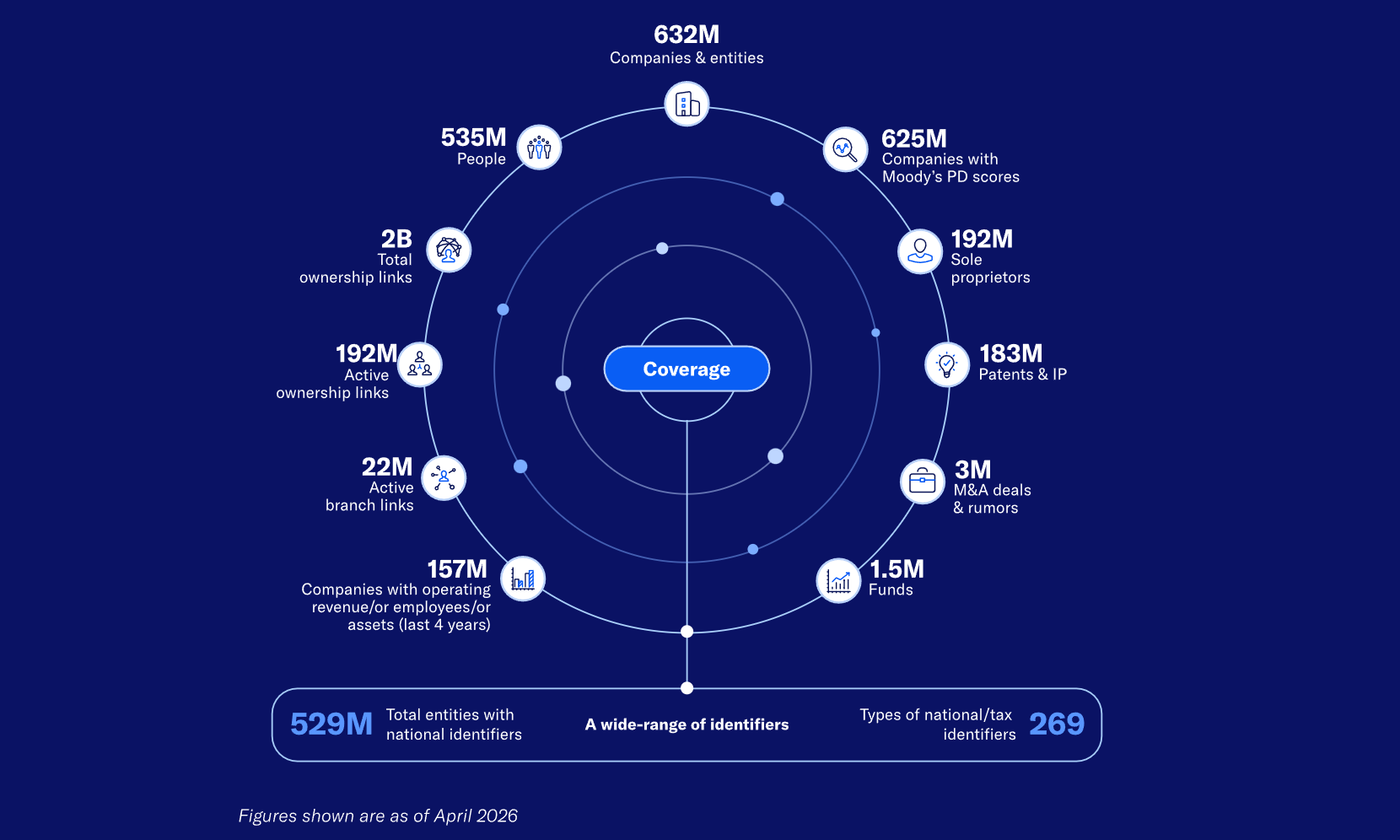
Orbis, now a Moody's product, is one of the largest commercial databases of private company information in the world. With coverage of 625+ million entities sourced from 170+ data providers, it gives institutional buyers a single place to search, compare, and analyze companies across borders using standardized financials, ownership structures, and risk indicators. For compliance teams tracing beneficial ownership, tax professionals benchmarking intercompany transactions, and M&A analysts screening private targets, Orbis solves a real problem: private company data is fragmented, filed under different accounting standards, and scattered across national registries that don't talk to each other.
To write this Orbis review, we've analyzed it extensively. We believe it's the right choice if:
You need standardized financial data on private companies across multiple countries
Your work involves KYC, AML, or beneficial ownership verification at enterprise scale
You require transfer pricing benchmarking accepted by tax authorities and the OECD
Your team runs M&A screening or corporate finance due diligence on private targets
You operate within a large institution (bank, insurer, multinational, government agency) with the budget and data engineering capacity for enterprise software
However, Orbis is not the right choice if:
You need B2B contact data for sales prospecting and outreach
Your primary goal is generating pipeline, booking meetings, or running marketing campaigns
You want intent signals that reveal when companies are actively researching solutions
You need AI-powered tools that tell reps who to contact, when to engage, and what to say
You're a sales, marketing, or RevOps team looking for a go-to-market platform
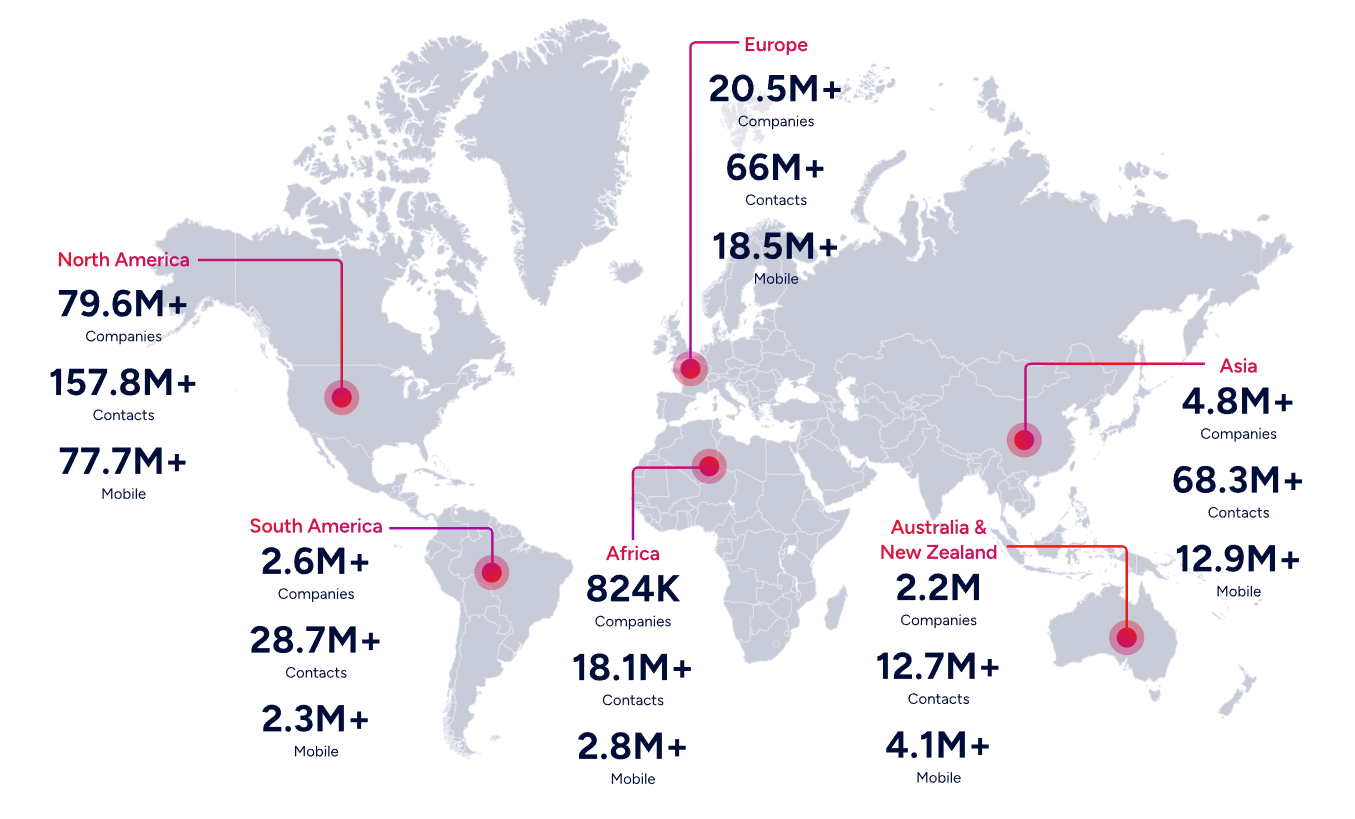
In this case, you should consider ZoomInfo: an AI-powered GTM platform that approaches business intelligence from a different angle. Where Orbis provides company reference data for institutional research and compliance, ZoomInfo provides go-to-market intelligence for revenue teams, with 500M contacts and 100M companies, 135M+ verified phone numbers, 120M direct dials, and 200M+ verified business email addresses, combined with buyer intent signals, conversation intelligence, and AI execution tools.
We've included a detailed look at ZoomInfo later in this Orbis review as a different approach for teams whose primary need is generating revenue rather than conducting institutional research. If you're ready to explore a go-to-market platform, you can start with ZoomInfo's free trial.
What is Orbis?
Orbis traces its origins to Bureau van Dijk, a Belgian company formally incorporated in 1991 as "Bureau van Dijk Electronic Publishing" to build and distribute economic and financial databases. The company spent decades building relationships with registries, information providers, and regulators across 160+ countries, assembling what became the largest commercially available database of private company information.
In 2017, Moody's Analytics acquired Bureau van Dijk for approximately $3.3 billion, one of the largest acquisitions in Moody's history. The legacy Bureau van Dijk website was shut down on January 31, 2024, completing the transition to the Moody's brand. Orbis now operates within Moody's Corporation (NYSE: MCO), which posted full-year 2024 revenue of $7.1 billion and employs approximately 16,000 people across more than 40 countries.
At its core, Orbis is a company reference data platform. It aggregates data from 170+ sources, then standardizes financial statements across accounting regimes, maps industry codes, and harmonizes company names and legal forms so that a German manufacturer, a French holding company, and a UK subsidiary can be compared side by side. The database covers listed companies as well, but its defining strength is private company coverage, where filing standards vary widely and data is otherwise hard to access.
Orbis serves eight primary application areas: sales and marketing, master data management, corporate finance, compliance and financial crime, supplier risk, credit risk, cyber risk, and tax and transfer pricing. The product is accessible via a web interface, APIs, and bulk data feeds, and is delivered through Moody's own platform as well as its global partner network.
Orbis Pros & Cons
Pros | Cons |
|---|---|
Covers 625+ million entities, weighted toward private companies | Enterprise pricing with no published rates; requires sales engagement |
Standardizes financials across accounting regimes for cross-border comparison | Coverage depth varies by country, thinner in emerging markets |
2+ billion ownership links with beneficial ownership tracing | Data freshness depends on underlying registry infrastructure per country |
OECD-selected data source for transfer pricing benchmarking | Complex interface with a steep learning curve |
Integrated risk layers (cyber, supplier, credit, sustainability scores) | Technical onboarding required for API and feed-based delivery |
Country-specific products for deeper national data (FAME, AIDA, DIANE) | No contact-level data for sales prospecting or outreach |
ISO 27001 certified with SOC 2 reports available | No free plan; 30-day evaluation access granted at Moody's discretion |
Orbis Review: How It Works & Key Features
Company Data & Search: Orbis aggregates and standardizes private company data from 170+ sources into a single, comparable dataset.
The core problem Orbis solves is comparability. A researcher evaluating companies across jurisdictions cannot meaningfully compare their financials if each is presented in its native format under local accounting rules and industry codes. Orbis addresses this by collecting information from 170+ external providers as well as hundreds of its own sources, then running it through a multi-step pipeline: linking data sources to create unified entity records, standardizing financials across accounting regimes, cross-referencing industry codes (NACE, SIC, NAICS), and applying consistent classifications for company names and legal forms.
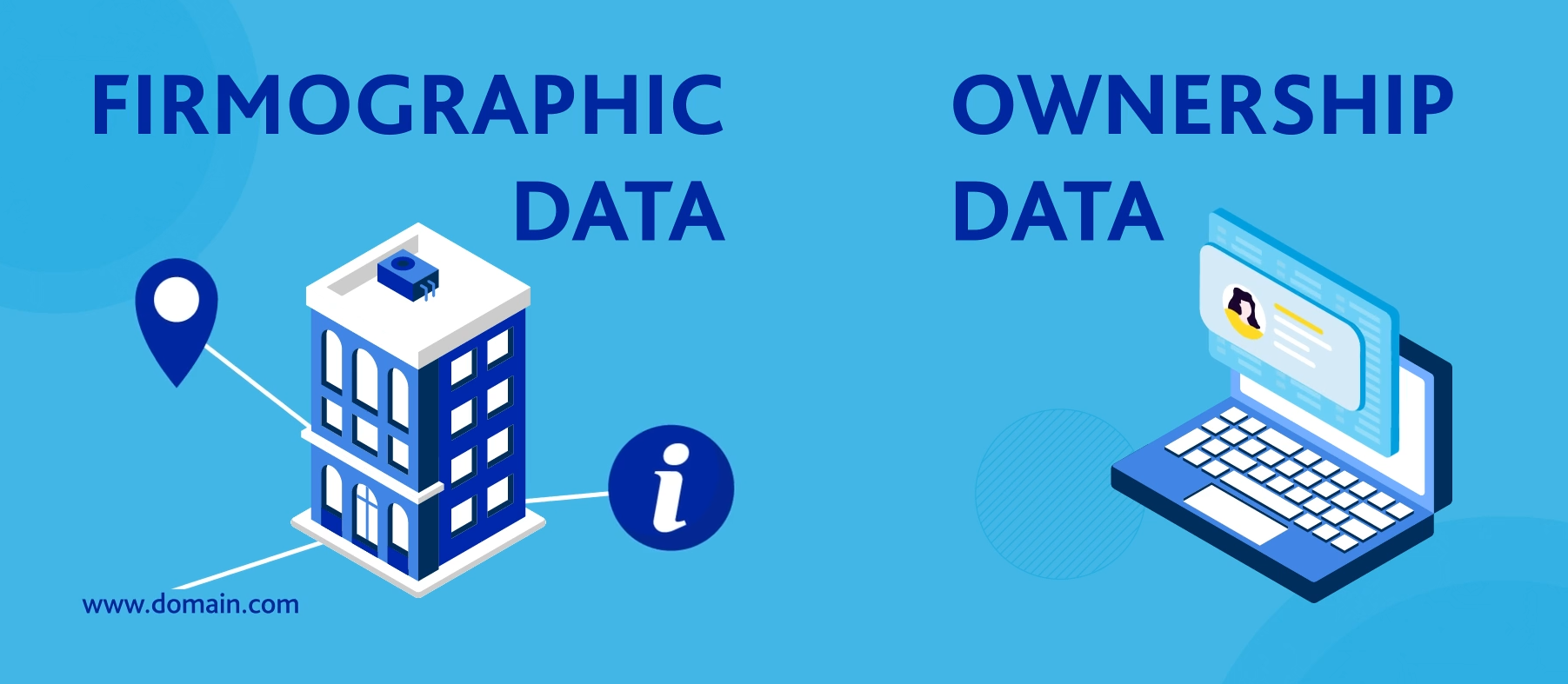
Users can search across regions and countries using the same criteria, including actual financials, growth rates, and financial estimates, using hundreds of search criteria. The database includes financial, ownership, and M&A data (firmographic details, corporate hierarchies, foreign investments, and deal activity) along with financial strength metrics and qualitative scores for companies where full financial statements are unavailable.
Source: Moody’s
For organizations needing deeper national data, Orbis offers country-specific product variants: FAME for the UK (21+ million companies), DIANE for France (24+ million companies), MARKUS for Germany/Austria/Luxembourg (7.4+ million companies), and AIDA for Italy (9.5+ million companies), among others. Regional products include 150+ million European companies via Orbis for Europe and 200+ million companies across 40 APAC countries via Orbis for APAC.
Within the platform, banks gain access to WalletSizing from Vallstein, a module that shows which banking products and services existing and prospective customers use across over 90 million companies globally.
Ownership & Corporate Structure: Orbis maps over 2 billion ownership links to trace beneficial ownership across complex corporate hierarchies.
Corporate ownership is rarely straightforward. Subsidiaries, holding companies, nominee shareholders, and layered intermediary structures can obscure who actually controls a business. Orbis's ownership database contains over 2 billion ownership links, including 1.8 billion historic links and 209 million active links, making it one of the largest commercially available corporate ownership graphs.
The platform assembles corporate trees: visual and data-structured representations of entire corporate groups. These trees reveal ownership structures of business partners and third-party associates worldwide, covering direct equity stakes as well as indirect ownership and control. Orbis can calculate power scores and integrated percentages, numerical measures of how much effective control or economic interest flows through the chain to each beneficial owner.
Source: Moody’s
The compliance-focused variant claims 600 million+ entities with beneficial ownership data and 99%+ private company coverage. Rather than mirroring what government registries publish, Orbis goes beyond registry data by mapping connections around influence and known associates.
Source: Moody’s
The Shell Company Indicator applies seven typology-based indicators (directorship patterns, mass registration activity, jurisdictional risk disparity, circular ownership, dormancy, inconsistent age data, and financial anomalies) to flag behaviors associated with shell company risk.
When primary source documents are required, Orbis connects to a global register network delivering official registry data timestamped and unaltered from the source, covering 348 million+ companies with billions of filings available for retrieval.
Compliance & Financial Crime: Orbis automates KYC, AML, and sanctions screening across 625+ million entities.
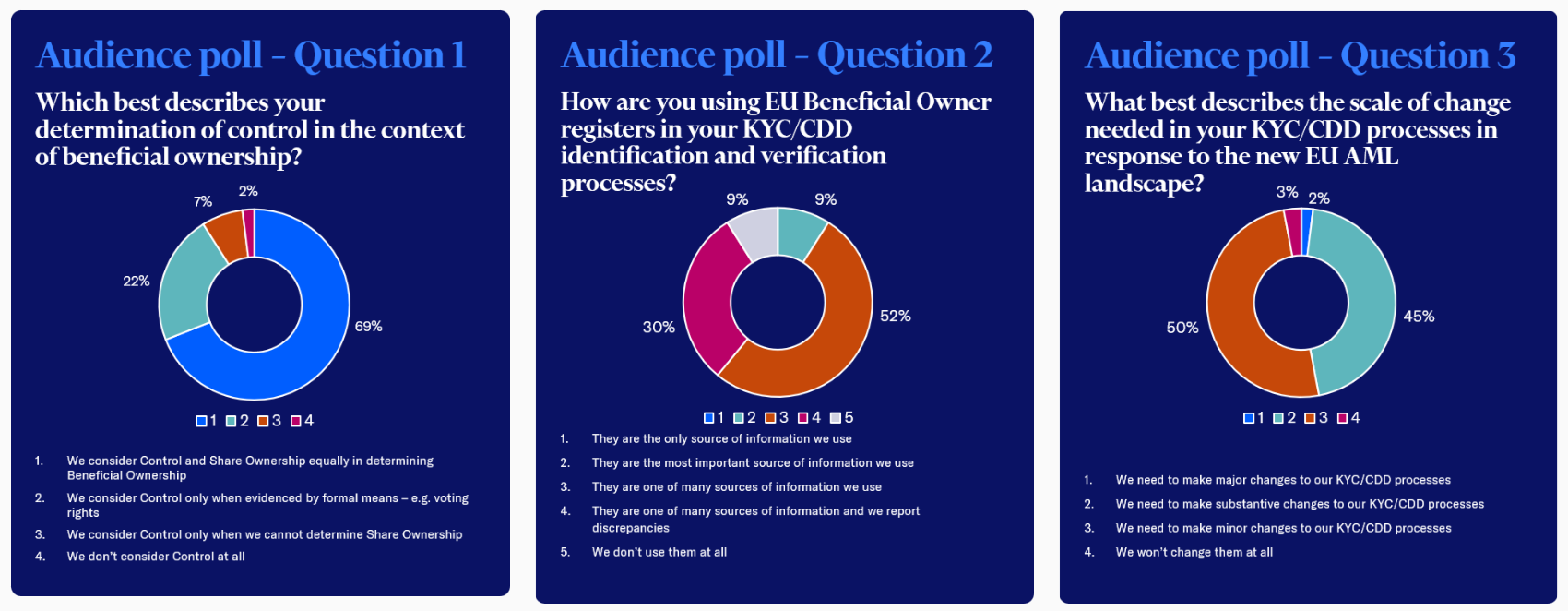
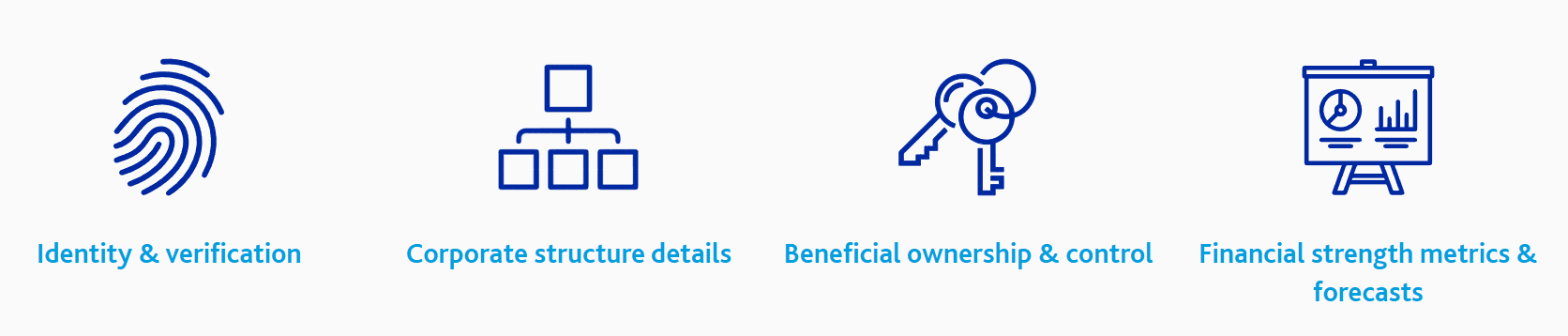
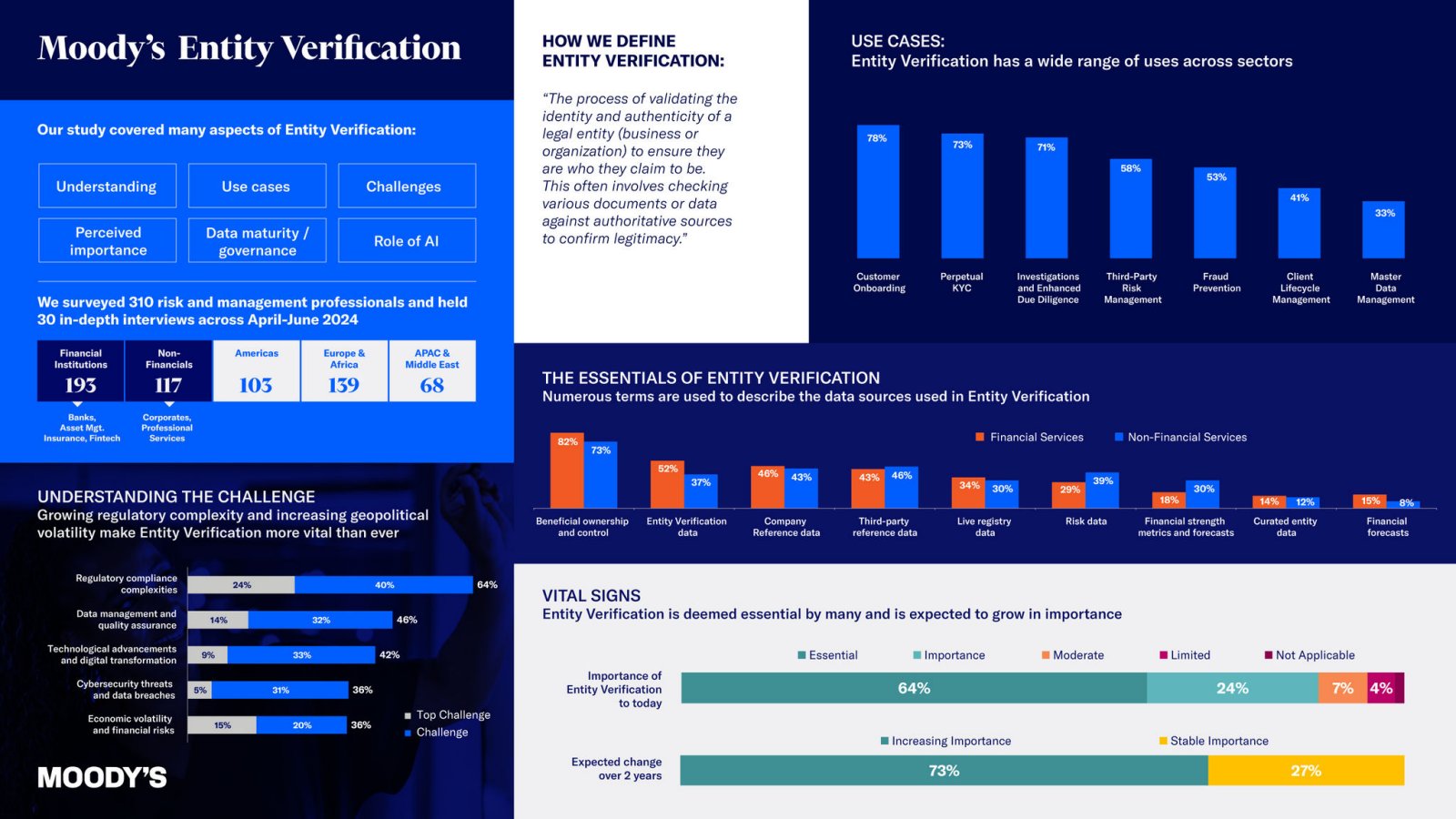
Orbis for Compliance is Moody's dedicated compliance edition, designed for organizations legally required to know who they do business with. It addresses two problems: verifying that a business entity is what it claims to be, and identifying whether the individuals who ultimately own or control it pose financial crime risk through sanctions exposure, money laundering structures, or politically exposed persons (PEP) ties.
Source: Moody’s
The compliance workflow moves through several phases. At onboarding, Moody's Entity Verification API connects with commercial registries, financial authorities, and tax offices in more than 200 jurisdictions. Orbis then calculates power scores and ownership percentages to map ultimate beneficial owners across multiple layers. Data feeds into Moody's Grid product, a risk-relevant AML/CTF database, through continuous monitoring of thousands of data sources.
Source: Moody’s
Rather than relying on periodic reviews, Orbis data underpins perpetual KYC (pKYC), a continuous, automated workflow of data checks that run in near real-time. When material changes occur (ownership shifts, new sanctions designations, or adverse media) the system flags them for investigation.
Moody's screening solutions use AI and machine learning to reduce false positives by as much as 80%, addressing one of the biggest pain points in AML compliance. These compliance data streams can be orchestrated through Moody's Maxsight, a risk management platform that brings entity verification, ownership mapping, screening, case management, and audit trails into a single workflow.
Corporate Finance & M&A: Orbis integrates 3+ million deals and rumors with company fundamentals for target screening and deal research.
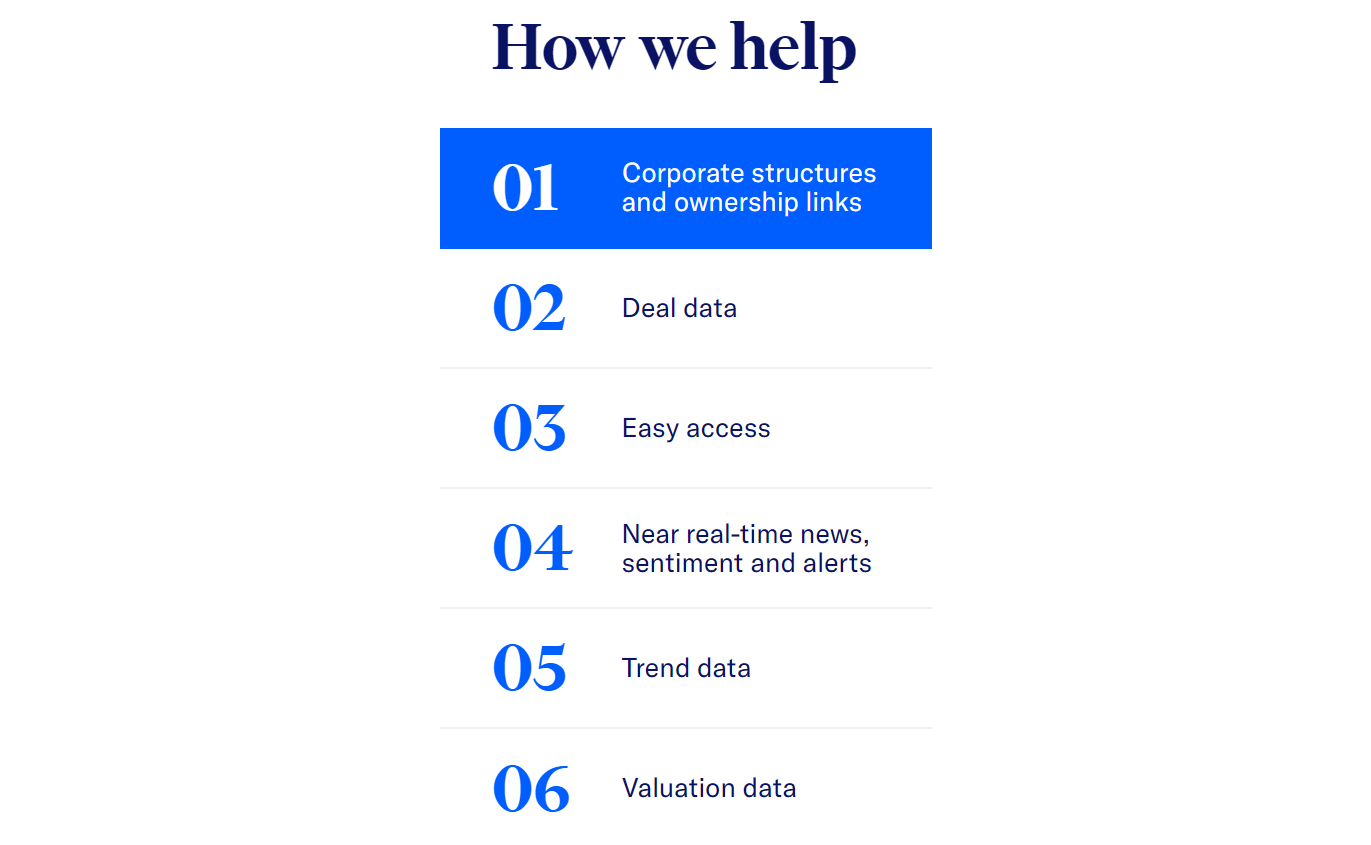
Corporate finance teams face a data problem when pursuing deals: fragmented, unstandardized information across millions of private companies makes it hard to identify acquisition targets, benchmark valuations, and monitor deal pipelines. Orbis M&A is integrated into Orbis, so deal data sits alongside company financials, ownership trees, and firmographics within the same search and analysis environment.
Source: Moody’s
The deal dataset spans 3 million+ deals and rumors covering more than 25 years of history. Users can track deals through completion or monitor as they drop out, compare deals across borders with globally standardized financial and M&A data, and access detailed entity valuations based on actual deal value, equity value, actual and modeled enterprise value, total target value, and the native deal currency.
Because deal data links to Orbis's beneficial ownership and PEP data layers, M&A professionals can immediately screen an acquisition target's ownership chain for sanctions exposure or politically exposed persons. The European Commission's Joint Research Centre has used the platform to identify dual-use company risks through investments and acquisitions, and the ZEW (Leibniz Centre for European Economic Research) relies on it to publish a biannual M&A Report using the Orbis M&A database.
Tax & Transfer Pricing: Orbis is the OECD-selected data source for transfer pricing benchmarking, serving 80+ global tax authorities.
Transfer pricing sits at the intersection of international tax law, compliance documentation, and audit risk. Tax authorities worldwide are increasing scrutiny of intercompany transactions, and the regulatory landscape grows more complex as OECD/BEPS rules add compliance burdens on multinationals and their advisors.
Orbis addresses this by combining company reference data with integrated transfer pricing functionality. Users access detailed financials for 190 million+ companies worldwide, including information on more than 49 million private firms, available in IFRS, local GAAP, and globally standardized formats. The platform's TP Catalyst software uses GenAI to identify comparable transactions and entities, ensuring arm's length compliance in minutes.
Source: Moody’s
The platform also covers IP-intensive transactions with a database of 168 million+ patents and more than 70,000 royalty rate arrangements, and includes OECD-aligned benchmarking tools for credit risk and interest rate analysis of intercompany financing.
The external validation is notable. The OECD's Pillar One (Amount B) project selected the Orbis database as the data source to determine financial returns for baseline marketing and distribution activities globally. Moody's serves 80+ global tax authorities, 750+ global professional services firms, and the OECD itself, meaning the data and methods used to prepare transfer pricing documentation are the same ones the reviewing authorities use.
Where Orbis Falls Short
Orbis is a strong platform for institutional research and compliance, but several limitations surface depending on what you're trying to accomplish. These reflect a platform built for analysts, compliance officers, and tax professionals, not revenue-generating teams.
No Contact-Level Sales Intelligence. Orbis covers companies and their structures, but provides no verified contact data for individual decision-makers: no direct-dial phone numbers, no verified business email addresses, no org charts showing who reports to whom, and no engagement tools to act on the data. A sales team cannot use Orbis to find the VP of Engineering at a target account, get their phone number, and start a conversation. For organizations whose goal is generating pipeline and closing deals, this is a gap that matters.
No Buyer Intent or Behavioral Signals. Orbis shows you what a company looks like (its financials, its structure, its filings) but not what it's doing right now. There are no intent signals showing which companies are researching solutions, no website visitor tracking, and no behavioral data revealing buying patterns. For go-to-market teams trying to prioritize accounts by likelihood to buy, Orbis provides a static picture where they need a dynamic one.
No AI-Powered Execution Tools. Orbis is a research and reference platform, not an execution platform. It does not draft outreach, prioritize accounts for sales reps, orchestrate multi-channel campaigns, or automate CRM updates. Teams that need to move from insight to action must bridge that gap with separate tools and manual workflows.
Pricing Opacity and Cost. Orbis pricing is enterprise-negotiated with no published rates. Every product page directs to "Request a demo." The platform offers no free plan; evaluation access is a 30-day period at Moody's discretion following a sales engagement. Country-specific modules (FAME, AIDA, DIANE, MARKUS) appear to be licensed separately, and delivery method (web interface vs. API vs. bulk feed) reportedly affects contract scope. For smaller organizations or teams that want to evaluate before committing budget, this creates a barrier.
Coverage Variability by Geography. While 625+ million entities is a large number, the depth of financial data varies by country. Coverage for private companies in emerging markets (particularly sub-Saharan Africa, parts of Southeast Asia, and Central Asia) is thinner than for Western Europe or North America. With 170+ source providers, update latency is not uniform either; company filings from some jurisdictions may lag actual events by months.
Complex Interface. Orbis's history as a Bureau van Dijk application comes with a dense, analyst-first interface. Moody's has invested in redesign, but the breadth of the platform (firmographics, financials, ownership trees, M&A data, sanctions screening, and transfer pricing modules) means a steep learning curve exists for users who want to use the full feature set.
These limitations aren't failures. They reflect the natural choices of a platform built for institutional research, compliance, and risk management. But they create a clear gap for teams whose primary need is identifying buyers, engaging them, and driving revenue.
A Different Approach to Business Intelligence: ZoomInfo
Orbis and ZoomInfo both deal in company data, but they approach the problem from opposite directions. Orbis is built for institutional buyers who need to research, verify, and analyze companies for compliance, tax, and corporate finance purposes. ZoomInfo is built for revenue teams who need to find buyers, understand their intent, and engage them at the right moment.
Where Orbis answers "What does this company's financial structure look like?" and "Who ultimately owns this entity?", ZoomInfo answers "Who at this company is ready to buy?" and "What should my rep say to them today?"
ZoomInfo is an AI-powered GTM platform built on a large B2B data foundation: 500M contacts and 100M companies, 135M+ verified phone numbers, 120M direct dials, and 200M+ verified business email addresses. Its GTM Context Graph processes 1.5B+ data points daily, unifying this data with your CRM records, conversation transcripts, and behavioral signals to reveal the full context of your accounts. That context gives AI the fuel to show not just what happened, but why it happened and which actions to take next. Your team can drive sales from the GTM Workspace, run go-to-market plays from GTM Studio, or power their own tools through the API and MCP.
Actionable Contact Data and Buyer Intent: ZoomInfo provides verified contact information and real-time buying signals that tell teams who to contact, when, and why.
While Orbis provides company-level reference data, ZoomInfo provides person-level intelligence designed for action. Every contact record can include direct-dial phone numbers, verified business email addresses, job title, department, seniority level, and reporting structure. Sales reps don't have to research an account and then go find the right person to call; ZoomInfo surfaces the buying committee directly, with 120M direct-dial phone numbers and 200M+ verified business emails.
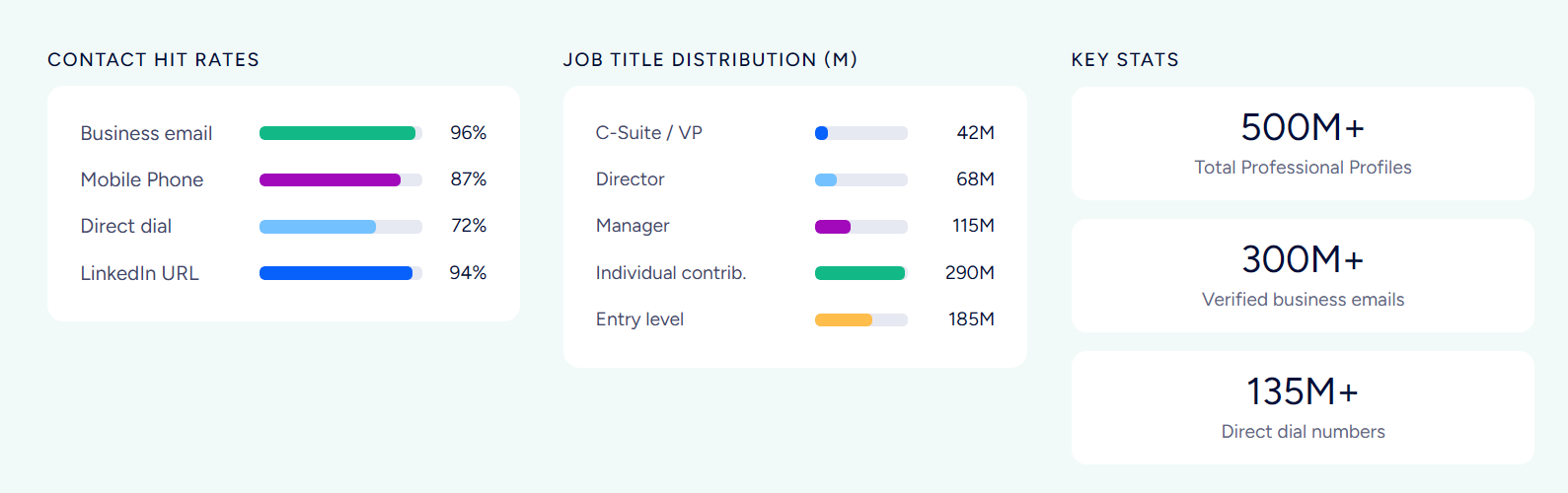
That data runs through a multi-source verification pipeline backed by 300+ human researchers, reaching up to 95% accuracy on first-party data. In a Fortune 500 competitive RFP analyzing 25 million contacts across vendors, the independent consultant concluded that "no other competitor came even close."
The data extends beyond static profiles. ZoomInfo Intent tracks signals from 210M IP-to-Organization pairings and 6 trillion+ new keyword-to-device pairings sourced monthly, identifying when companies are researching relevant topics. Guided Intent, exclusive to ZoomInfo, identifies topics historically correlated with deal success rather than requiring manual topic selection. WebSights resolves anonymous website traffic to companies, including buying team identification and direct contact info.
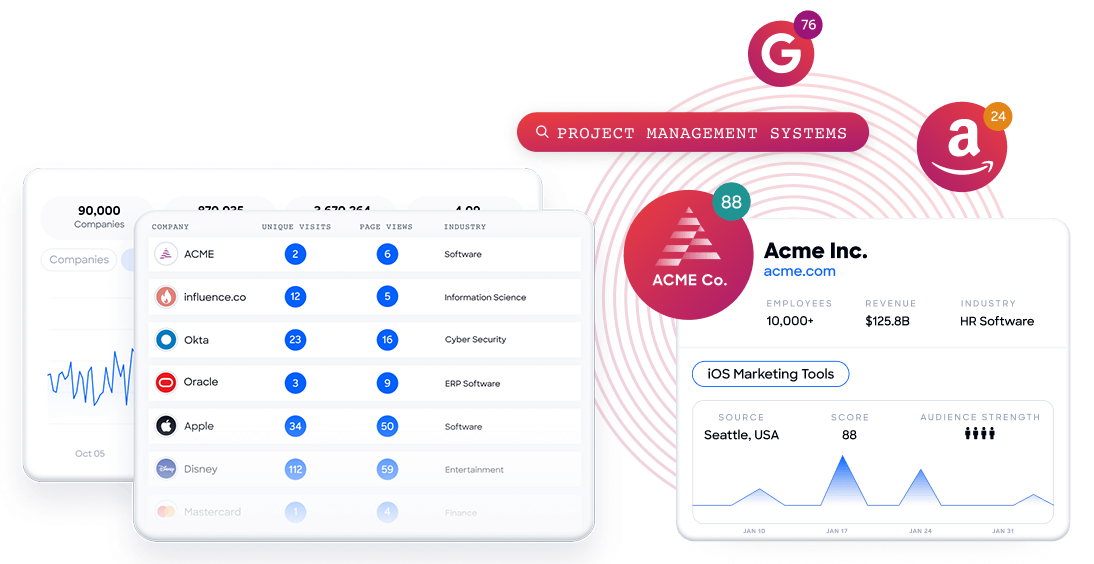
This combination of verified contacts and real-time intent creates a different workflow than what Orbis enables. Instead of researching a company and then building a case for outreach, teams see which accounts are in-market and who specifically to engage.
Vensure scaled prospecting with ZoomInfo's B2B data. As William Kenimer, VP of Revenue Operations, put it: "ZoomInfo gives us the information we need to execute. We don't have to go through and spend our time digging. It's already there, so we can be three steps ahead." (Vensure)
The GTM Context Graph: ZoomInfo fuses its B2B data with your CRM, conversation intelligence, and behavioral signals to reveal why deals move or stall.
ZoomInfo's GTM Context Graph processes 1.5B+ data points daily, unifying ZoomInfo's third-party intelligence with a customer's own CRM records, conversation transcripts, email interactions, and behavioral signals. The result is an intelligence layer that captures not just what happened in a deal, but why it happened.
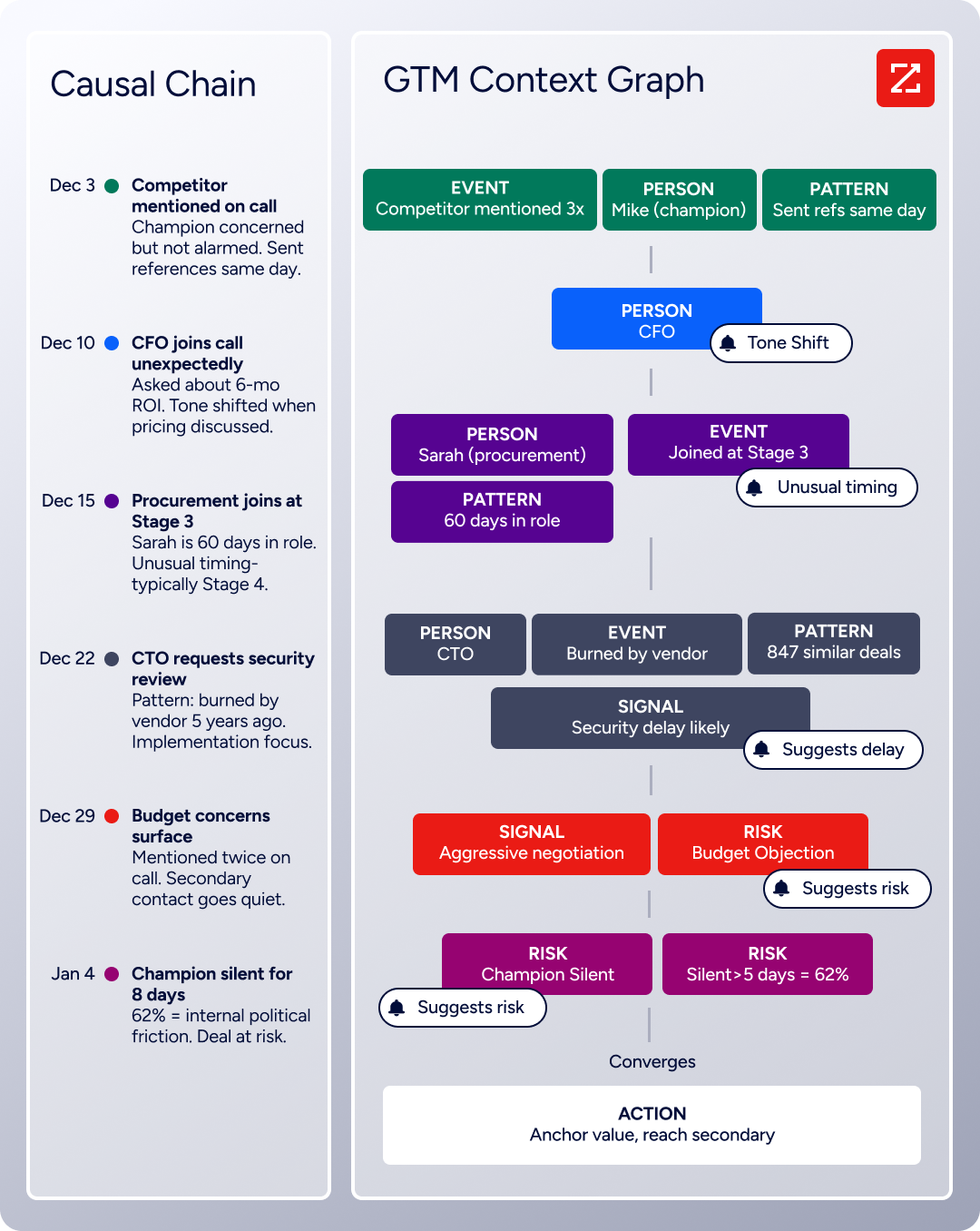
As ZoomInfo's Chief Product Officer Dominik Facher writes: "The CRM recorded the state change. It has no record of why it happened." Perhaps a CFO joined the last call and asked about six-month ROI, which is what actually accelerated the deal. Perhaps a VP went quiet for eight days due to an internal budget battle. CRMs were never designed to capture these signals. The GTM Context Graph makes this decision context machine-readable, capturing people and their relationships, actions and their outcomes, patterns across thousands of deals, and exceptions that reveal real blockers.
This context layer exists because of two decades of infrastructure investment. ZoomInfo spent 20 years building a B2B data unification platform and acquired Chorus and Workbounce for their context capture and reasoning engines. The same infrastructure that resolves, verifies, and connects hundreds of millions of companies and contacts now applies to first-party signals (a customer's calls, emails, CRM, and product usage).
Seismic attributed 39% of active pipeline to ZoomInfo-influenced opportunities and reported 54% productivity gains. As CBO Toby Carrington noted: "That combination of our internal CRM data, external signals, and AI that's given all that context has helped us craft very specific account- and persona-based messages." (Seismic)
Universal Access: ZoomInfo delivers intelligence through GTM Workspace for sellers, GTM Studio for marketers and RevOps, and APIs and MCP for any tool.
ZoomInfo provides three ways to access its data, all drawing from the same GTM Context Graph:
GTM Workspace is the seller's workspace. It consolidates prioritized accounts, AI-drafted outreach, deal context, and CRM updates in one place. AI agents handle researching accounts, generating follow-ups, monitoring signals, and surfacing next best actions. Customer results include Databricks reaching prospects 50% faster and Thomson Reuters increasing closed-won deals by 40%.
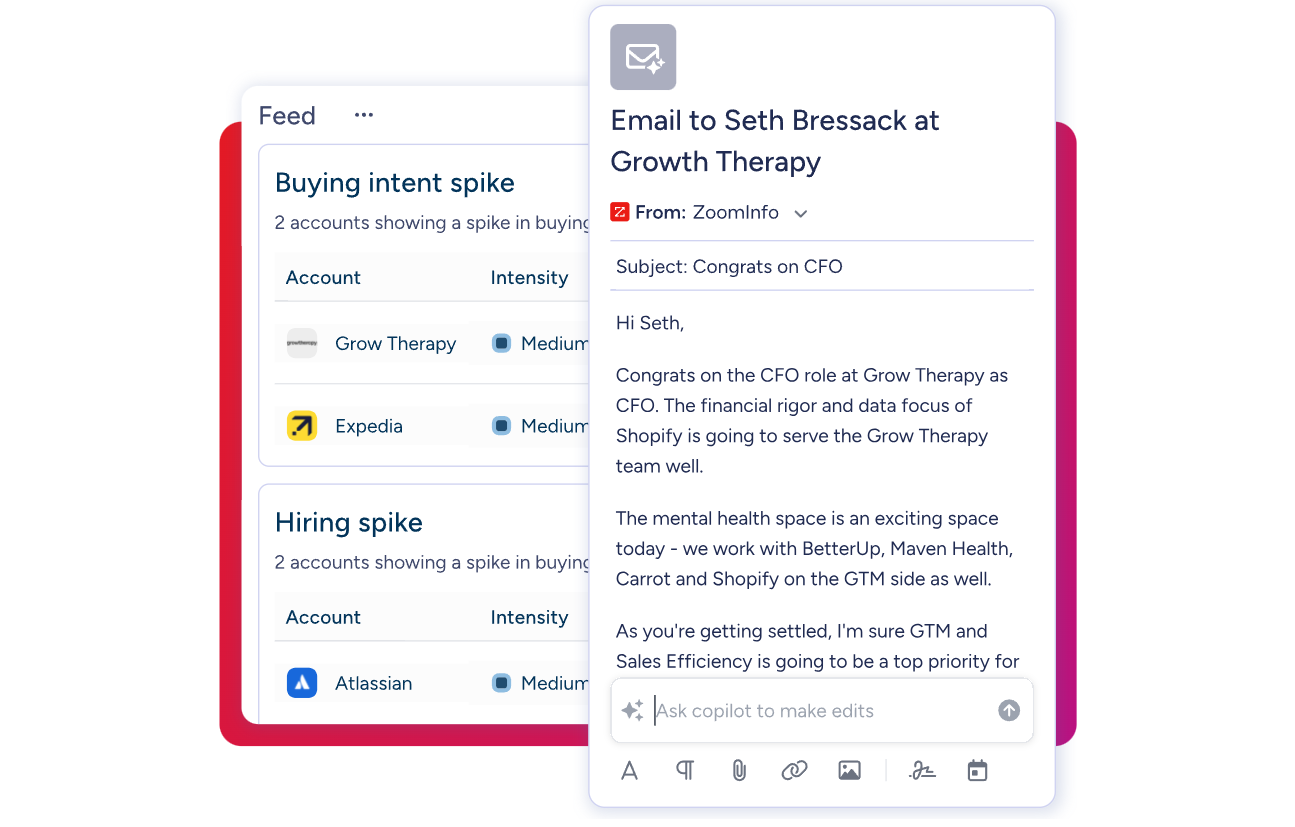
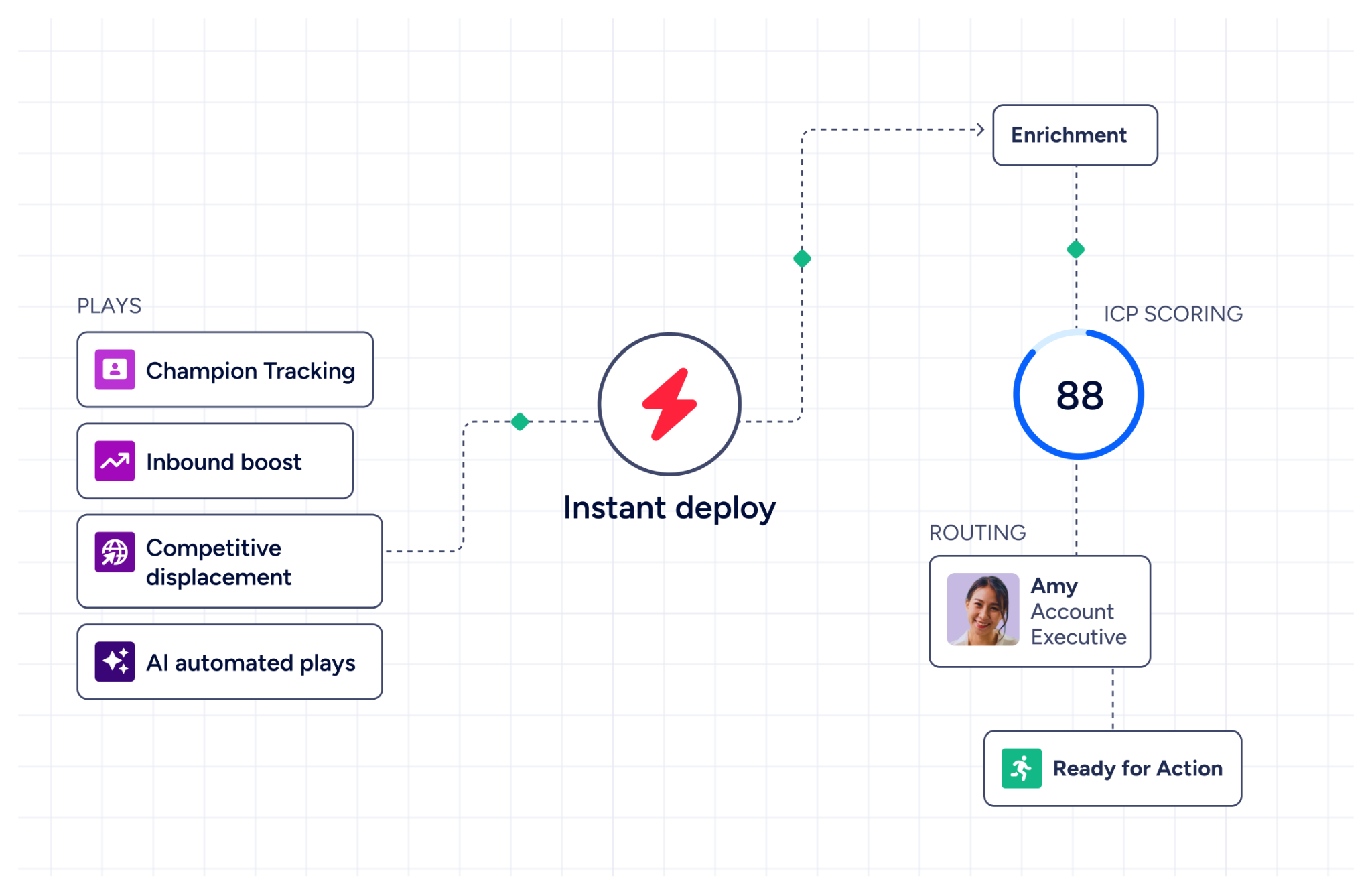
GTM Studio is the canvas for marketers, RevOps, and GTM engineers. Teams build audiences using natural language, enrich with first- and third-party data, define triggers, and activate plays across channels, without engineering support. Expansion plays that used to take 3 weeks now launch in 30 minutes.
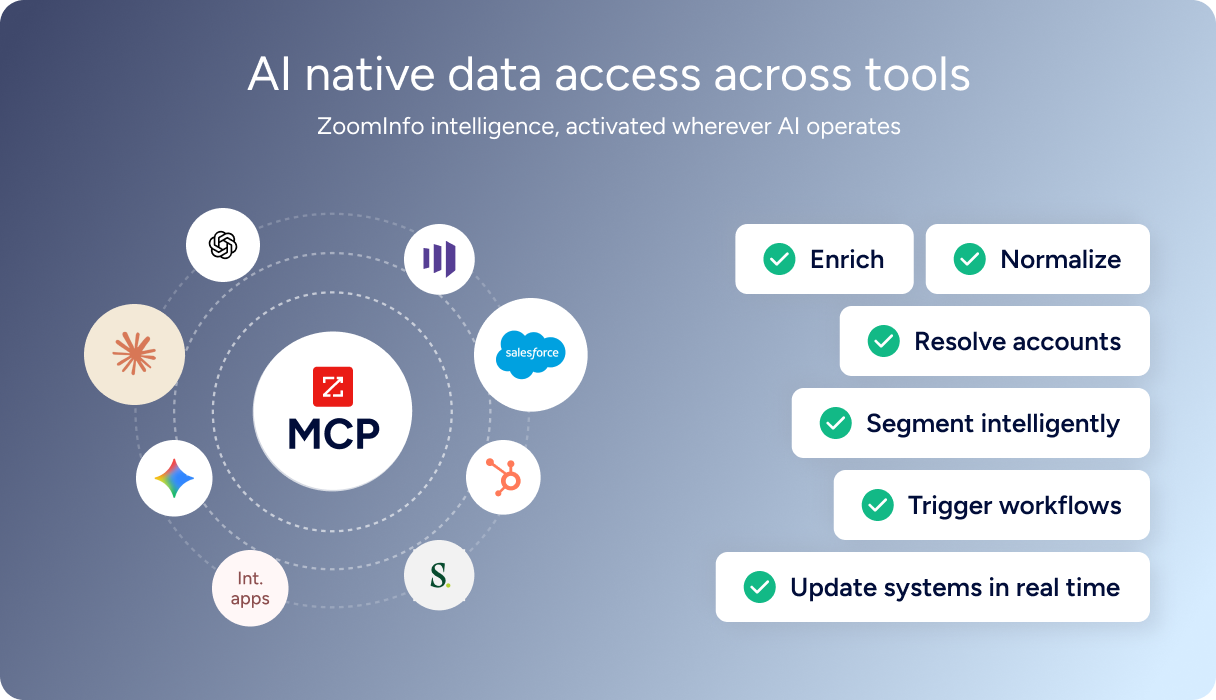
For teams building beyond ZoomInfo's own products, APIs and MCP expose the same intelligence to any custom agent, internal tool, or partner platform. The MCP server connects AI models directly to ZoomInfo's B2B data as a native tool, currently supporting Claude and ChatGPT. API access is included in all relevant plans.
BDO Canada activated data directly within their internal systems. Jerry Wilson, Senior Marketing Intelligence Analyst, said: "The plug-and-play aspect of the API means I can integrate it very easily into any process and get information at a moment's notice," resulting in an 87% reduction in time spent on data dashboard updates. (BDO Canada)
Pricing and Accessibility: ZoomInfo offers a permanent free tier, a 7-day trial, and consumption-based pricing.
ZoomInfo uses a consumption-based pricing model organized into Sales, Marketing, and standalone product tiers. While paid plan pricing is custom-quoted, the platform provides two free entry points:
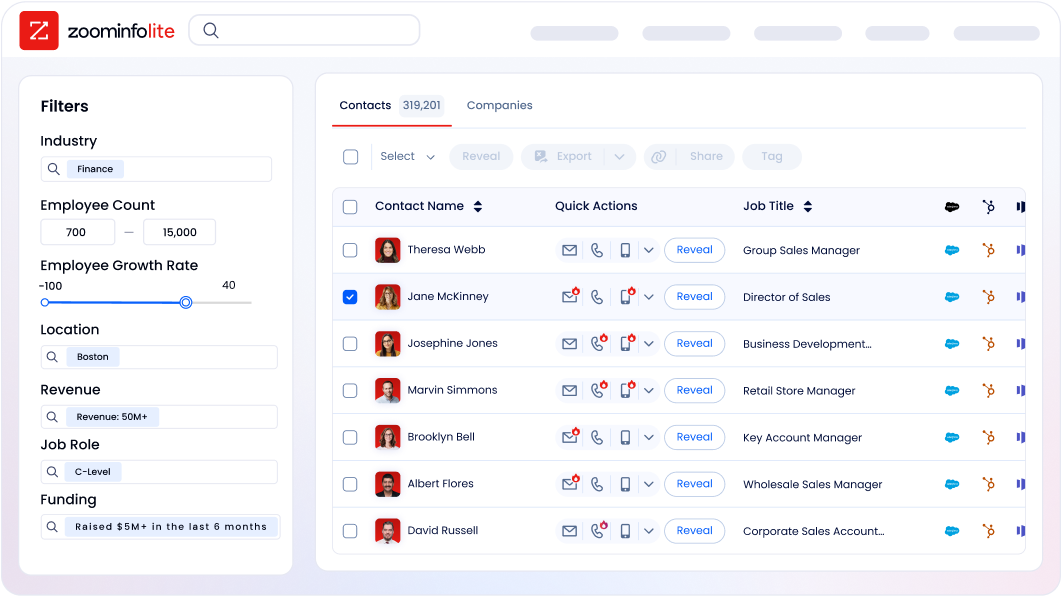
ZoomInfo Lite is a permanent free tier (no credit card, no time limit) that includes access to ZoomInfo's B2B database, 10 monthly export credits, individual and company searches with advanced filters, the ReachOut Chrome Extension, WebSights Lite (up to 10 website visitor reveals per day), built-in email sending, and HubSpot integration.
A separate 7-day free trial provides access to core platform features with no credit card required.
Paid plans are structured around seats (user access) and credits (1 credit = 1 exported profile). The three Sales tiers (Professional, Advanced, Enterprise) unlock progressively more features: Professional includes contact and company data, CRM integrations, and AI-powered email generation; Advanced adds buyer intent signals, website visitor tracking, and automated outreach workflows; Enterprise adds real-time intent signals, advanced workflows, and AI-generated account summaries.
Orbis or ZoomInfo: Comparison Summary
Aspect | Orbis | ZoomInfo |
|---|---|---|
Primary purpose | Company reference data and risk intelligence | Go-to-market intelligence and execution |
Target users | Compliance teams, tax professionals, M&A analysts, academic researchers | Sales, marketing, and RevOps teams |
Company coverage | 625+ million entities (private company focus) | 100 million companies |
Contact data | Not available | 500M contacts, 135M+ verified phone numbers, 200M+ verified emails |
Ownership data | 2+ billion ownership links, UBO tracing | Parent-child hierarchy data |
Standardized financials | Cross-border comparable financials (IFRS, local GAAP) | Company attributes (revenue, headcount, industry) |
Buyer intent signals | Not available | 210M IP-to-Org pairings, 6T+ keyword signals monthly |
AI execution tools | GenAI-assisted benchmarking for transfer pricing | GTM Workspace (sellers), GTM Studio (marketers/RevOps), AI agents |
Compliance and KYC | Full KYC/AML/CDD suite with perpetual KYC | Not a compliance platform |
Transfer pricing | OECD-selected data source, TP Catalyst software | Not applicable |
M&A research | 3M+ deals and rumors over 25+ years | Not a primary use case |
Free access | 30-day evaluation at Moody's discretion | Permanent free tier (ZoomInfo Lite) + 7-day trial |
Pricing transparency | Enterprise-negotiated, no published rates | Custom-quoted, consumption-based |
Integration approach | Web interface, APIs, bulk feeds, DataHub, MCP server | 120+ marketplace integrations, Enterprise API, MCP server |
Security certifications | ISO 27001, SOC 2 | ISO 27001, ISO 27701, SOC 2 Type II, TRUSTe GDPR/CCPA |
Best for | Institutional research, compliance, tax, M&A due diligence | Finding, engaging, and converting B2B buyers |
Final Verdict
Orbis and ZoomInfo serve different needs, and the right choice depends on what problem you're solving.
Choose Orbis if your work requires standardized private company data for institutional purposes. It is the right platform for compliance teams running KYC and beneficial ownership verification at global scale, for tax professionals benchmarking intercompany transactions against OECD standards, for M&A teams screening private acquisition targets across borders, and for academic researchers conducting cross-country empirical analysis. The platform's strength is its breadth of entity coverage, depth of corporate structure data, and regulatory credibility, anchored by 30+ years of data collection and the backing of Moody's Corporation.
Choose ZoomInfo if your goal is finding buyers, building pipeline, and driving revenue. It is the right platform for sales teams that need verified direct dials and emails for decision-makers, for marketing teams running account-based campaigns triggered by real-time buying signals, and for RevOps teams that need to enrich CRM data, automate lead routing, and orchestrate go-to-market plays. ZoomInfo's strength is that it connects intelligence to action: the same platform that identifies an in-market account can draft the outreach, prioritize the rep's day, and update the CRM, all powered by the GTM Context Graph.
Get started with ZoomInfo here.
These platforms address different parts of the business intelligence spectrum. Orbis tells you what a company is. ZoomInfo tells you who at that company is ready to buy and how to reach them.
Orbis FAQ
What is Orbis used for?
Orbis is a company reference data platform used primarily for compliance and financial crime screening (KYC, AML, beneficial ownership verification), transfer pricing benchmarking, corporate finance and M&A research, master data management, supplier risk assessment, and academic research. It covers 625+ million entities worldwide with standardized financials, corporate structures, and ownership data. It is not designed for sales prospecting, marketing campaigns, or go-to-market execution.
How much does Orbis cost?
Orbis does not publish pricing. All commercial terms are negotiated directly with Moody's sales teams and vary by organization size, data scope, number of users, and delivery method. Country-specific modules (FAME, AIDA, DIANE, MARKUS) appear to be licensed separately from the global Orbis product. There is no free plan; a 30-day evaluation period may be granted at Moody's discretion following a sales engagement. ZoomInfo, by contrast, offers a permanent free tier (ZoomInfo Lite) and a 7-day free trial with no credit card required.
Who owns Orbis?
Orbis is owned by Moody's Corporation (NYSE: MCO), which acquired Bureau van Dijk (the original developer of Orbis) in 2017 for approximately $3.3 billion. Orbis operates within Moody's Analytics, the data and analytics division of Moody's Corporation. Moody's posted full-year 2024 revenue of $7.1 billion and employs approximately 16,000 people across more than 40 countries.
Does Orbis provide contact data for sales prospecting?
No. Orbis provides company-level reference data including financials, corporate structures, ownership links, and risk scores, but it does not offer verified contact details (direct-dial phone numbers, business email addresses) for individual decision-makers. Teams that need contact data for sales outreach should consider a go-to-market platform like ZoomInfo, which covers 500 million contacts with 135 million+ verified phone numbers and 200 million+ verified business emails.
How does Orbis handle data freshness?
Orbis aggregates data from 170+ source providers, and update latency varies by jurisdiction. Western European and North American data tends to be more current due to stronger registry infrastructure. Coverage for private companies in emerging markets is thinner, and filings from some jurisdictions may lag actual events by months. Moody's is addressing real-time needs through perpetual KYC workflows within its Maxsight suite, but data freshness variability remains a structural limitation tied to underlying registry infrastructure.
What certifications does Orbis have?
Moody's Analytics (the division that includes Orbis) is ISO/IEC 27001:2022 certified, with SOC 2 reports available to contracted customers. Moody's Corporation holds a Bitsight Security Rating of 790 (rated "Advanced") and has conducted ICT risk management reviews mapped to DORA, APRA CPS234, and CPS230. The company maintains EU Standard Contractual Clauses, a CCPA Addendum, and Data Processing Schedule certified by TermScout as "Customer Favorable."
Is Orbis suitable for small businesses?
Orbis is built for large enterprises and public sector organizations with the data engineering capacity to integrate bulk feeds or APIs and the budget for enterprise software licensing. Small businesses, startups, and teams without dedicated data or compliance functions will likely find the cost, complexity, and onboarding requirements disproportionate to their needs. ZoomInfo offers more accessible entry points, including a permanent free tier and a 7-day trial, for teams of any size that need B2B intelligence for sales and marketing.
Does Orbis offer an API?
Yes. Orbis data is accessible via APIs, bulk data feeds, cloud delivery, and through Moody's DataHub (a cloud-based analytics sandbox). Moody's has also begun offering delivery via MCP server for embedding Orbis data into agentic AI workflows. However, specific API documentation, authentication methods, rate limits, and named CRM integration connectors are not publicly disclosed; these details surface during the sales process.
